John 13:2

Greek (Tischendorf 8th ed.) John 13:2 appears in the Greek New Testament. The text above is from the Tischendorf 8th edition. Each word links to its Strong’s number and a concise gloss. Click any word for its full Thayer’s Greek Lexicon entry.
Download image
Cite this verse

John 13:2 (World English Bible). Public Domain. Lemma interlinear Bible study tool, https://lemma.gebible.app/v/john/13/2.

Show BibTeX & RIS
BibTeX
RIS
English Translation
After supper, the devil having already put into the heart of Judas Iscariot, Simon's son, to betray him,
World English Bible · Public Domain
Download a study sheet

One document with this verse’s original text, its word-by-word gloss line, the meaning frame, cross-references with their text, attributed commentary, and full source and license credits — printable, and it pastes into notes with its structure intact.

This verse Autodidact and up

Study sheet (.html) Plain text (.txt)

A passage Seminary Student

Up to 50 verses in one chapter. A passage sheet keeps up to 6 commentary sources and 12 cross-references per verse, in the order this page ranks them, and says so on the sheet whenever that leaves anything out. Ask for a single verse and you get the Autodidact verse sheet above.

Everything on this page stays free to read, with no account — the sheet is a download of what is already on screen, not access to it.

Want to remove ads? Support Godless Engineer
Compare translations 3

The same verse in 3 English versions, stacked beneath the original-language interlinear above. Click any original word for its lexicon entry.

Each is an independent rendering of the whole verse — the interlinear is not word-aligned to these translations.

Highlighted words mark where these versions differ — a whole-verse word diff, not a word-by-word alignment.

  • World English Bible Public Domain
    After supper, the devil having already put into the heart of Judas Iscariot, Simon's son, to betray him,
  • King James Version Public Domain
    And supper being ended, the devil having now put into the heart of Judas Iscariot, Simon's son, to betray him;
  • unfoldingWord Literal Text CC BY-SA 4.0
    And supper happening, the devil having already put into the heart of Judas, of Simon Iscariot, so that he might betray him,

unfoldingWord Literal Text — © unfoldingWord, licensed CC BY-SA 4.0. Word-aligned USFM3 via Door43 (git.door43.org/unfoldingWord/en_ult).

Versions to compare (up to 4)

3 of 4 selected

Show all 19 translations

Every available English version of this verse, each an independent rendering of the whole verse.

  • World English Bible Public Domain
    After supper, the devil having already put into the heart of Judas Iscariot, Simon's son, to betray him,
  • Berean Standard Bible Public Domain
    The evening meal was underway, and the devil had already put into the heart of Judas, the son of Simon Iscariot, to betray Jesus.
  • Majority Standard Bible Public Domain
    By the time the evening meal had ended, the devil had already put into the heart of Judas, the son of Simon Iscariot, to betray Jesus.
  • King James Version Public Domain
    And supper being ended, the devil having now put into the heart of Judas Iscariot, Simon's son, to betray him;
  • American Standard Version (1901) Public Domain
    And during supper, the devil having already put into the heart of Judas Iscariot, Simon's `son', to betray him,
  • Revised Version (1885) Public Domain
    And during supper, the devil having already put into the heart of Judas Iscariot, Simon’s son, to betray him,
  • Geneva Bible (1599) Public Domain
    And when supper was done (and that the deuill had now put in the heart of Iudas Iscariot, Simons sonne, to betray him)
  • Douay-Rheims (1899) Public Domain
    And when supper was done, (the devil having now put into the heart of Judas Iscariot, the son of Simon, to betray him,)
  • Young's Literal Translation Public Domain
    And supper being come, the devil already having put `it' into the heart of Judas of Simon, Iscariot, that he may deliver him up,
  • Literal Standard Version CC BY-SA 4.0
    And dinner having come, the Devil already having put [it] into the heart of Judas of Simon, Iscariot, that he may deliver Him up,
  • Unlocked Literal Bible CC BY-SA 4.0
    Now the devil had already put it into the heart of Judas Iscariot son of Simon, to betray Jesus.
  • unfoldingWord Literal Text CC BY-SA 4.0
    And supper happening, the devil having already put into the heart of Judas, of Simon Iscariot, so that he might betray him,
  • Darby Bible Public Domain
    And during supper, the devil having already put it into the heart of Judas [son] of Simon, Iscariote, that he should deliver him up,
  • World Messianic Bible Public Domain
    During supper, the devil having already put into the heart of Judah Iscariot, Simon’s son, to betray him,
  • Webster's Bible Public Domain
    And supper being ended (the devil having now put into the heart of Judas Iscariot, Simon's son, to betray him;)
  • Free Bible Version CC BY-SA 4.0
    It was during supper, and the devil had already put the thought of betraying Jesus into the mind of Judas, son of Simon Iscariot.
  • Bible in Basic English Public Domain
    So while a meal was going on, the Evil One having now put it into the heart of Judas Iscariot, Simon's son, to be false to him,
  • Text-Critical English NT CC BY 4.0
    By the time supper ended, the devil had put it into the heart of Judas Iscariot, the son of Simon, to betray Jesus.
  • Tyndale New Testament (1534) Public Domain
    And when supper was ended after that the devyll had put in the hert of Iudas Iscariot Simons sonne to betraye him:

Literal Standard Version (2020), Covenant Press — licensed CC BY-SA 4.0. Text via the HelloAO Bible API (eBible.org). Unlocked Literal Bible (unfoldingWord) — licensed CC BY-SA 4.0. Text via the HelloAO Bible API (eBible.org). unfoldingWord Literal Text — © unfoldingWord, licensed CC BY-SA 4.0. Word-aligned USFM3 via Door43 (git.door43.org/unfoldingWord/en_ult). Free Bible Version, Dr. Jonathan Gallagher — licensed CC BY-SA 4.0. Text via the HelloAO Bible API (eBible.org).

Word by word

More ways to search: Search by grammar → Find every occurrence → Compare this word →

Practice this passage: Drill this verse → Learn its vocabulary →

Ἰσκαριώτης
Iskariṓtēs
G2469
“Judas”
Noun, Nominative, Singular, Masculine
Part of Speech
Noun
Case
Nominative
Number
Singular
Gender
Masculine
Full Thayer's Definition

Origin: of hebrew origin probably G377 and G7149

TDNT: None

Iscariot = "men of Kerioth" 1. the apostle who betrayed Jesus
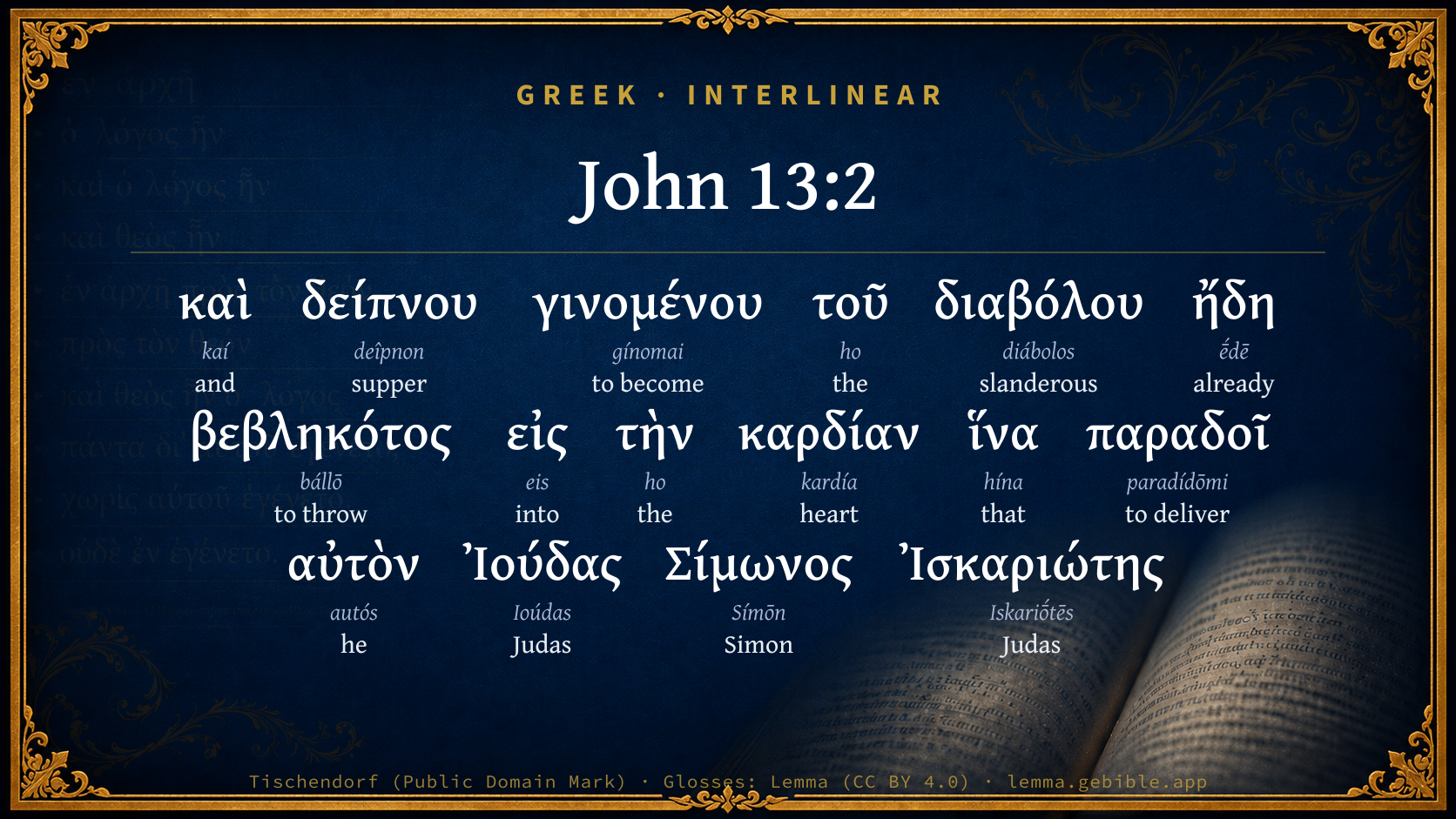
  1. καὶ kaí G2532 “and” Conjunction
  2. δείπνου deîpnon G1173 “supper” Noun, Genitive, Singular, Neuter
  3. γινομένου gínomai G1096 “to become” Verb, Present, Middle or Passive deponent, Participle, Genitive, Singular, Neuter
  4. τοῦ ho G3588 “the” Article, Genitive, Singular, Masculine
  5. διαβόλου diábolos G1228 “slanderous” Adjective, Genitive, Singular, Masculine
  6. ἤδη ḗdē G2235 “already” Adverb
  7. βεβληκότος bállō G906 “to throw” Verb, Perfect, Active, Participle, Genitive, Singular, Masculine
  8. εἰς eis G1519 “into” Preposition
  9. τὴν ho G3588 “the” Article, Accusative, Singular, Feminine
  10. καρδίαν kardía G2588 “heart” Noun, Accusative, Singular, Feminine
  11. ἵνα hína G2443 “that” Conjunction
  12. παραδοῖ paradídōmi G3860 “to deliver” Verb, Aorist, Active, Subjunctive, 3rd person, Singular
  13. αὐτὸν autós G846 “he” Personal pronoun, Accusative, Singular, Masculine
  14. Ἰούδας Ioúdas G2455 “Judas” Noun, Nominative, Singular, Masculine
  15. Σίμωνος Símōn G4613 “Simon” Noun, Genitive, Singular, Masculine

About this verse

These counts appear in no published source. They are computed here, from the morphology-tagged text and Lemma’s own curated glosses. What Lemma adds →

16
words
15
distinct lemmas
Gospels
section

Notable vocabulary

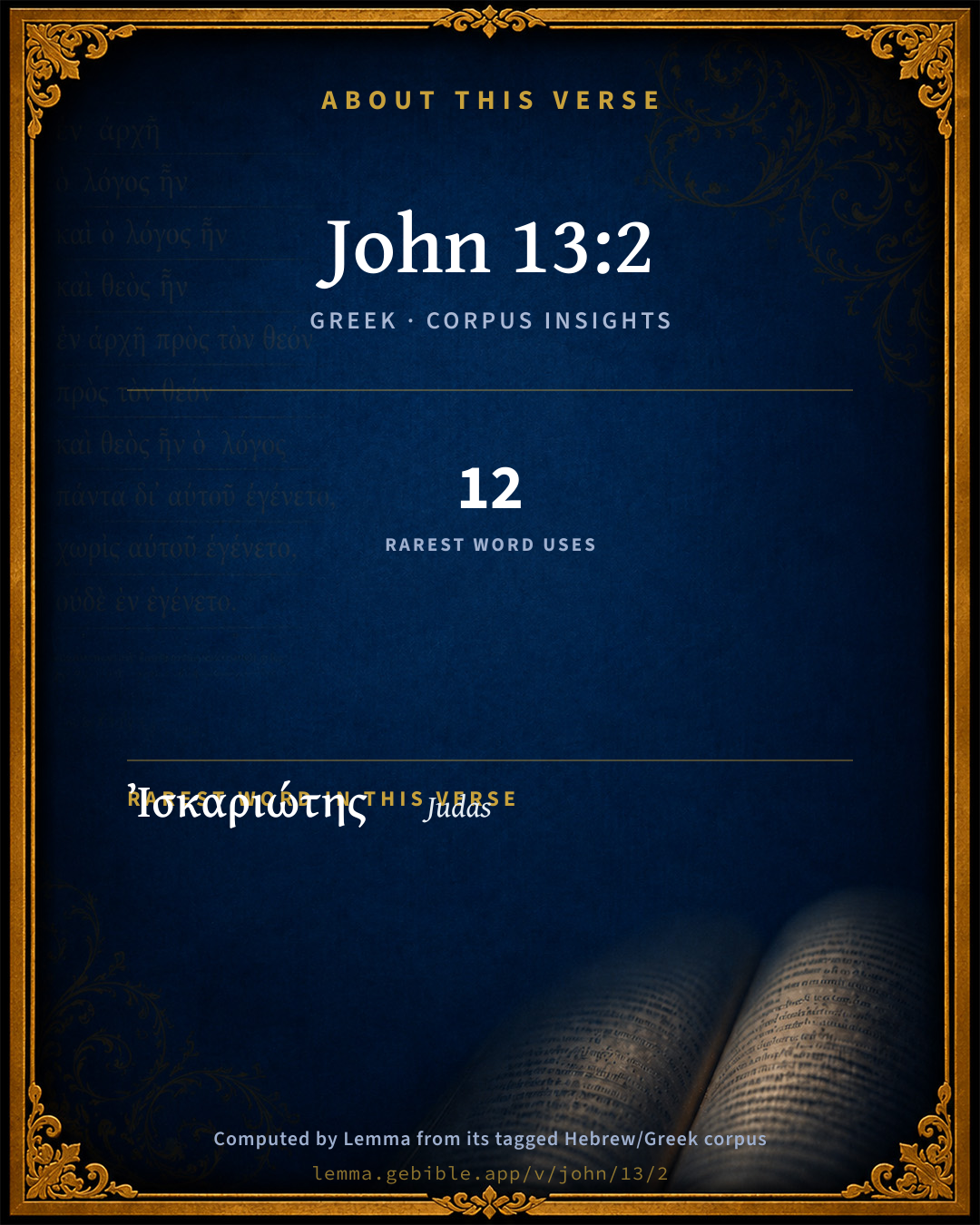
The rarest word here is Ἰσκαριώτης Judas G2469 — appearing just 12 times in the whole Greek New Testament.

Shared distinctive vocabulary

Ἰσκαριώτης Judas G2469 occurs in 12 verses of the Greek New Testament. Also found in:

Repetition

A word recurs within this verse:

Cross-references

11

Topical passages linked to John 13:2 in the Treasury of Scripture Knowledge — connected by theme and wording, ordered by reader-vote popularity; previews shown in the World English Bible.

  • James 1:13–17 Let no man say when he is tempted, "I am tempted by God," for God can't be tempted by evil, and he himself tempts no one.
  • Acts 5:3 But Peter said, "Ananias, why has Satan filled your heart to lie to the Holy Spirit, and to keep back part of the price of the land?
  • Luke 22:3 Satan entered into Judas, who was surnamed Iscariot, who was numbered with the twelve.
  • Luke 22:31 The Lord said, "Simon, Simon, behold, Satan asked to have you, that he might sift you as wheat,
  • John 6:70–71 Jesus answered them, "Didn't I choose you, the twelve, and one of you is a devil?"
  • John 13:26–27 Jesus therefore answered, "It is he to whom I will give this piece of bread when I have dipped it." So when he had dipped the piece of bread, he gave it to Judas, the son of Simon Iscariot.
  • 2 Corinthians 8:16 But thanks be to God, who puts the same earnest care for you into the heart of Titus.
  • Ephesians 2:3 among whom we also all once lived in the lust of our flesh, doing the desires of the flesh and of the mind, and were by nature children of wrath, even as the rest.
  • Revelation 17:17 For God has put in their hearts to do what he has in mind, and to be of one mind, and to give their kingdom to the beast, until the words of God should be accomplished.
  • Ezra 7:27 Blessed be Yahweh, the God of our fathers, who has put such a thing as this in the king's heart, to beautify the house of Yahweh which is in Jerusalem;
  • Nehemiah 2:12 I arose in the night, I and some few men with me; neither told I any man what my God put into my heart to do for Jerusalem; neither was there any animal with me, except the animal that I rode on.

Cross-references courtesy of OpenBible.info (CC BY 4.0).

Commentary

Notes on John 13:2 from classic Christian and Jewish commentators (each source and its license shown beneath its notes). The classic Christian expositions comment on the surrounding passage and are grouped to its opening verse, so a note may address several verses; the Jewish commentaries on the Tanakh (Rashi and others) are per-verse, so they appear only where the commentator wrote on this verse.

Lemma curates 59 commentaries, every one of them public domain or Creative Commons licensed, each selected and text-cleaned for this edition rather than reprinted as found. About our sources →

Joseph Benson's Commentary

Joh 13:2. And supper being ended — Or, as δειπνου γενομενου should rather be translated, supper, or supper-time, being come, or, while they were at supper, as Dr. Campbell renders it. Thus, Joh 21:4, πρωιας γενομενης, when morning was come. Act 12:18; Act 16:35, ημερας γενομενης, when day was come; and Act 21:40, σιγης λενομενης, when silence was made: in all which places, and in many more, which might easily be collected from the Greek writers, it would be absurd to translate the word, ended. “When γενομενης,” says Dr. Campbell, “is joined with πρωιας, οψιας, ημερας, or with any term denoting a precise portion of time, it invariably signifies that the period denoted by the noun is begun, not ended.” Of this he produces several incontrovertible examples. “That this was the passover-supper, may be proved by four arguments: 1st, In John’s history of this supper we are told, when Jesus had washed the disciples’ feet he sat down again at table, and explained the meaning of the action, Joh 13:12; and then declared that one of them should betray him, Joh 13:18-21. This occasioned the beloved disciple first, and after him the other disciples, to inquire which of them should do the horrid deed, Joh 13:23. But, by the consent of all the evangelists, that declaration and inquiry were first made while they were eating the last passover. 2d, At this supper, mentioned by John, Jesus declared that Peter should deny him, Joh 13:38; and the words of his declaration are not, The cock shall not crow the next, the third, or the fourth day, but, The cock shall not crow till thou hast denied me thrice: therefore the declaration must have been made on the night of the denial; and consequently the supper, at which it was made, must have been the paschal-supper, for all the evangelists agree that Peter denied his Master the night in which that supper was celebrated. 3d, The connection in which John’s supper stands with the subsequent facts mentioned by him shows plainly that it was the paschal-supper. For the discourse, (John 14,) being intended to give the disciples consolation, was delivered by Christ immediately after he had foretold Peter’s denial, and the cowardice of the rest. Having ended that discourse, Jesus went out of the house, (Joh 14:31,) and delivered the allegorical sermon, (John 15.,) which, from the subject of it, seems to have been preached in a place where there were many vines growing, probably on the mount of Olives, whither, as the other evangelists inform us, he retired after the paschal-supper. Immediately after the allegorical sermon, he spake that which is contained in the 16th and 17th chapters, and then went with his disciples over the brook Cedron, into the garden of Gethsemane, where he was apprehended. From this series of facts it appears, that the supper was the paschal-supper, because, between it and Jesus’s crucifixion, there is not the least chasm in John’s history, where the passover can be brought in. 4th, We are told, (chap. Joh 13:27-30,) that after Jesus had ordered Judas to do quickly what he was about to do, he went out; upon which Jesus mentioned the near prospect he had of being glorified, to intimate that he knew Judas was gone out to betray him. From this time forth there is nothing said of Judas by John till he appeared with the armed band. Nevertheless, by the accounts of the other evangelists, Judas was present at the institution of the sacrament of the supper, after the passover. Wherefore the passover being celebrated before Judas went out, the supper mentioned by John must have been that solemnity.” — Macknight. The devil having now put it into the heart of Judas to betray him — By this version the English reader would be led to apprehend, that it was at this paschal-supper that the devil first tempted Judas to betray Christ: but the original expression may be properly rendered, the devil having already put it into the heart of Judas, &c., for the participle βεβληκοτος is of the perfect tense, and denotes an action done at some time past, and the particle ηδη, rendered now, often signifies already, or before: so that what Christ says here concerning Judas, may refer to what had passed between him and the chief priests, after the reproof given him in the supper at Bethany. And therefore when John says afterward, (Joh 13:27,) that after the sop was given him, Satan entered into Judas, the meaning must be, that he was then again incited by the devil to execute the treachery which he had before resolved upon, by a like instigation of the same evil spirit.

Joseph Benson's Commentary on the Old and New Testaments (1811–1818) — public domain. Text from a community e-Sword module.

Tyndale Open Study Notes

Tyndale Open Resources

13:2 Judas . . . Iscariot, who had refused to believe, was engulfed by darkness and had become Satan’s pawn (cp. study note on 12:39-40).

Tyndale Open Study Notes — © Tyndale Open Resources, licensed CC BY-SA 4.0. Text via the HelloAO Bible API.

Bengel's Gnomon

Johann Albrecht Bengel

Joh 13:2. Δείπνου, supper) Indefinitely. That was the day before the Passover supper.—γενομένου, when it was being made [but Engl. Vers., “supper being ended”]) Therefore the washing of feet was about the beginning of supper. Comp. the words, He riseth from, Joh 13:4, and lying down again [“after He was set down again”], Joh 13:12. Also the general custom of the Jews is in accordance with this view.—ἤδη, now) Chrysost. Æth. Arab. Lat, in some MSS., Pers. and Sy[331]. versions, omit the particle; but it ought to be retained. The τότε, then, Joh 13:27, answers to it.[332]—βεβληκότος, when he had [having] put into) There is great force in this. The words διαβόλου [Th. βάλλω] and βεβληκότος are conjugates.—καρδίαν, the heart) The purpose of Judas was as yet hidden.—Ἰούδα, of Judas) Precaution was taken by the washing of feet, that the impurity of Judas should not infect the hearts of the rest. Comp. Joh 13:11, “He knew who should betray Him; therefore said He, Ye are not all clean.”—Ἰσκαριώτου, Iscariot) This is the surname, not of Simon, but of Judas; ch. Joh 6:71, Joh 14:22, “Judas—not Iscariot.”

[331] yr the Peschito Syriac Version: second cent.: publ. and corrected by Cureton, from MS. of fifth cent.

[332] Orig. 2,120; 4,212; 409; 425, omits ἤδη; also ac. But ABDbd Vulg. and Orig. elsewhere retain ἤδη.—E. and T.

Bengel's Gnomon of the New Testament — English translation (T&T Clark, Edinburgh, 1860) — public domain. Text from a community e-Sword module.

Meyer's Critical & Exegetical Commentary

Heinrich August Wilhelm Meyer

Joh_13:2-5. And (et quidem) this εἰς τέλος ἠγάπησεν αὐτούς He fulfilled at the supper by the washing of the feet.

δείπνου γινομ.] Note the present standing in relation to the present ἐγείρεται, Joh_13:4 (see critical notes). Whilst it is becoming supper-time, i.e. whilst supper-time is on the point of being kept. They had already reclined for the purpose, Joh_13:4; Joh_13:12. According to the Recepta, γενομ., the meal was not yet over (Luther and several others, including Klee and Hofmann, p. 207, who explains as though μετὰ τὸ δεῖπνον were expressed), but already in progress,supper had begun. This itself was, according to Joh_13:1, not the paschal supper, but (hence also without the article[125]) an ordinary evening meal on the 13th Nisan (in opposition to the synoptical account) in Jerusalem (not in Bethany, see on Joh_14:31), the last repast of Jesus before His death, at which He founded the Lords Supper (Joh_13:21 ff., Joh_13:38, Joh_18:1). The institution of the Supper is not mentioned by John,not as though he were unacquainted with it (Strauss), or had perceived no ecclesiastical rite at all involved in it (Scholten), but because it was universally known (1 Corinthians 11), and the practice itself was in daily use (Act_2:46). Accordingly, not repeating the account of this, because known to all, he rather selected from the abundance of that last night what he found, over and above, to be most in harmony with his peculiar object, the making known the δόξα of the ΛΌΓΟς in the flesh,in the washing of the feet ΧΆΡΙς, in the discourses ΧΆΡΙς and ἈΛΉΘΕΙΑ. According to Schenkel, John desired by his silence to preclude the notions of a magical effect resulting from the Lords Supper, and the later controversies concerning it. As though such a purpose would not have required the very opposite procedure, viz. distinct instruction! Baurs assumption, p. 264, is, that the evangelist has dated back the importance of the Supper to the second Passover, chap. 6, because he did not wish to allow the last meal of Jesus to pass for the same as that in the Synoptics, namely, as a paschal meal. Comp. also Scholten, p. 289 ff. But for this purpose such an inversion of the synoptical material would not have been at all necessary. He could have mentioned the institution of the Supper at the last meal in such a way that this would nevertheless not have been a paschal meal.

τοῦ διαβόλου ἤδη, κ.τ.λ.] cannot serve merely as a prelude to the subsequent and more frequent mention of the relation of Jesus to the traitor (Joh_13:10; Joh_13:18; Joh_13:21; Joh_13:26-27; Joh_13:30), as Godet maintains, which would be only a formal purpose, and one not in correspondence with the tragically solemn emphasis. Again, it is not even intended to make us sensible of the forbearance of Jesus, who Himself washed the feet of Judas[126] (Euth. Zigabenus, comp. Chrysostom, Calvin, and several others), nor generally, as it were, the mere nearness (ἤδη) in point of time of the last destiny, which He yet employed in such a work of love (this, indeed, was already contained in εἰδὼς, κ.τ.λ.), butto what the ἬΔΗ pointsthe undisturbed dear elevation of this His might of love over the outbreak, already so near, of the tragic devilish treachery, which could not even now, immediately before its occurrence, confuse His mind. According to the reading Ἰούδας Σιμ. Ἰσκαριώτης (see the critical notes), we must explain: the devil having already formed the design that Judas should deliver Him up, so that the καρδία is not that of Judas (Luthardt, Baeumlein), as in the Recepta, but that of the devil (comp. Vulgate); as also in the classics βάλλειν or ΒΆΛΛΕΣΘΑΙ ΕἸς ΝΟῦΝ, ΕἸς ΘΥΜΌΝ, ἘΝ ΦΡΕΣΊΝ, very frequently denotes in animum inducere, statuere, deliberare. See Wetstein in loc.; Kypke, II. p. 399; Ellendt, Lex. Soph. I. p. 294. The more current this mode of speech was, the less can we be surprised in an anthropomorphic representation of the devil at the mention of his heart (in answer to Lücke, Godet, and others), in which he has his ἐπιθυμίας (Joh_8:44), ΜΕΘΟΔΕΊΑς (Eph_6:11), ΝΟΉΜΑΤΑ (2Co_2:11), etc. As the heart of God may be spoken of (Act_13:22), so also the heart of the devil.

Ἰούδας Σίμ. Ἰσκαρ.] The full name, and at the close contains a shuddering emphasis.

The participial clause, further, is not to be placed in a parenthesis; it is co-ordinated with ΔΕΊΠΝΟΥ ΓΙΝΟΜ.

ΕἸΔῺς, Κ.Τ.Λ.] Although He knew (ὅμως εἰς ἄκραν συγκατεβη ταπείνωσιν, Euth. Zigabenus). The consciousness of His divine elevation rested, while on this threshold of death, in the fact that now, being on the point of entering, by stepping over this threshold, upon His glorification, the Messianic fulness of power, which had formerly been bestowed upon Him on the occasion of His mission (Mat_11:27), which extended over all things, and was limited by nothing, was given into His hands for complete exercise (comp. on Joh_17:2, Mat_28:18); and that God; as He was the source of His coming (comp. on Joh_8:42), so is the goal of His present departure.

On πάντα δέδωκεν αὐτῶ comp. 1Co_15:25; Eph_2:22; Php_2:9-11, et. al.

Joh_13:4. ἐγείρεται, κ.τ.λ.] Note how the whole representation regards things as present; to the historic present correspond the present and perfect participles γινομ., βεβληκ., εἰδώς, Joh_13:2-3. On ΤΊΘ. ΤᾺ ἹΜΆΤ. comp. Plut. Alc. 8.

The washing of the feet was wont to take place before the beginning of the meal, by the ministry of slaves (see Dougt. Anal. II. p. 50; Stuck, Antt. conviv. p. 217); it was not, however, always observed; see on Luk_7:44. Hence we cannot argue, from the omission of it up to this point at this meal (for the guests had already reclined at table), either against (Wichelhaus) or in favour of (Lange: the host was bound to eat with his family) the supposition that the meal was the Passover meal.

Any peculiar cause for the extraordinary procedure of Jesus is not intimated by John; and to drag in such from the dispute among the disciples about rank, mentioned in Luk_22:24 ff. (so, following the older commentators, Ebrard, Hengstenberg, Godet, with various representations of the scenic associations; also Baur, who, however, regards the narrative only as the exposition, given in a historical form, of Mat_20:26-27, and Luk_22:26-28, after Strauss had maintained it to be a mythical rendering of a synoptical discourse on humility), is arbitrary in itself, since John, fully as he introduces his narrative in Joh_13:1-2, gives not the slightest indication of the above, while it is appropriate neither to the position nor to the validity of the account of Luke (see on Luk_22:24). The symbolical act of departing love must, especially since Jesus had already reclined at table, have been the outcome of the moment, arising from His own urgent consideration of that which was needful for the disciples and for His work. Comp. Ewald, Gesch. Chr. p. 542.

διέζωσεν ἑαυτ.] setting forth the personal performance more than the means (comp. Joh_21:18). He is, in truth, entirely a servant, πάντα μετὰ πάσης προθυμίας αὐτουργήσας (Euth. Zigabenus).

ΒΆΛΛΕΙ ὝΔΩΡ] He pours water. Comp. Planudius in Bachmann, Anal. 2. p. 90, 18.

εἰς Τ. ΝΙΠΤ.] into the wash basin standing by. Nihil ministerii omittit, Grotius.

ἬΡΞΑΤΟ] for the act commenced was interrupted when Peters turn came, and not till after Joh_13:10 was it continued and finished. John employs the ἤρξατο, so common in the other evangelists, here only in this minute description.

ᾯ] with which (Hom. Il. x. 77, Od. xviii. 66; Athen. x. p. 443 B), or instead of ὅ, by attraction (Rev_1:13; Rev_15:6), as in Joh_17:5; Joh_17:11.

[125] Certainly it is often indifferent whether the article stands with δεῖπνον or not, but here it must have stood, had it been intended to indicate that solemn meal of the 14th Nisan, the venerable meal of the feast. In Joh_21:20 the article had to be expressed, because it points backwards. This in answer to Tholuck. Hofmann, Lange, and Paul also get over too readily the want of the article; and even Graf imports the meaning, which is incompatible with the absence of the article: After the principal part of the supper, the eating of the paschal lamb, was over.

[126] Otherwise special prominence must have been given in what follows to the washing of his feet.

Meyer — Critical and Exegetical Commentary on the New Testament — English translation by Peter Christie, edited by Frederick Crombie (T&T Clark, 1880) — public domain. Text from a community e-Sword module.

Jamieson, Fausset & Brown

Robert Jamieson, A. R. Fausset & David Brown

supper being ended--rather, "being prepared," "being served," or, "going on"; for that it was not "ended" is plain from Joh 13:26.

the devil having now--or, "already."

put into the heart of Judas . . . to betray him--referring to the agreement he had already made with the chief priests (Luk 22:3-6).

Jamieson, Fausset & Brown — Commentary Critical and Explanatory on the Whole Bible (1871) — public domain (CC PDM 1.0). Text via the HelloAO Bible API.

Adam Clarke's Commentary

Verse 2. And supper being ended] Rather, δειπνου γενομενου, while supper was preparing. To support this new translation of the words, it may be remarked that, from Joh 13:26; Joh 13:30, it appears that the supper was not then ended: nay, it is probable that it was not then begun; because the washing of feet (Joh 13:5) was usually practised by the Jews before they entered upon their meals, as may be gathered from Lu 7:44, and from the reason of the custom. I think that John wrote, not γενομενου, but γινομενου, as in BL. Cant. and Origen, which latter reading is approved by several eminent critics, and should be translated as above. By the supper I suppose to be meant, not only the eating of it, but the preparing and dressing of it, and doing all things necessary previously to the eating of it. The devil had, before this time of the supper, put it into Judas's heart to betray his Master. See Mt 26:14, c. Mr 14:10-11; and Lu 22:3, &c. See also Bishop Pearce, from whose judicious commentary the preceding notes are principally taken.

Calmet observes that John, designing only to supply what was omitted by the other evangelists, passes over all the transactions of the Tuesday, Wednesday, and Thursday, before the passion, and at once goes from Monday evening to Thursday evening. It is remarkable that St. John says nothing about the institution of the holy sacrament, which Matthew, Mt 26:26, &c., Mark, Mr 14:22, &c., and Luke, Lu 22:19, &c., describe so particularly. No other reason can be assigned for this than that he found it completely done by the others, and that he only designed to supply their defects.

The devil having now put it into the heart] Judas formed his plot six days before this, on occasion of what happened at the house of Simon the leper: see Mt 26:14. Calmet.

Adam Clarke's Commentary on the Bible (1810–1826) — public domain. Text from a community e-Sword/MySword module.

John Calvin's Commentaries

2. After supper. We shall afterwards take into consideration, at the proper place, the whole of Christ’s design in washing the feet of his disciples, and the advantage to be derived from this narrative. Let us now attend to the connection of the words. The Evangelist says that this was done, while Judas already resolved to betray Christ, not only to show the wonderful patience of Christ, who could endure to wash the feet of such a wicked and detestable traitor; but also that he purposely selected the time when he was near death, for performing what may be regarded as the last act of his life.

The devil having already put it into the heart of Judas. When the Evangelist says that Judas had been impelled by the devil to form the design of betraying Christ, this tends to show the enormity of the crime; for it was dreadful and most atrocious wickedness, in which the efficacy of Satan was openly displayed. There is no wickedness, indeed, that is perpetrated by men, to which Satan does not excite them, but the more hideous and execrable any crime is, the more ought we to view in it the rage of the devil, who drives about, in all possible directions, men who have been forsaken by God. But though the lust of men is kindled into a fiercer flame by Satan’s fan, still it does not cease to be a furnace; it contains the flame kindled within itself, it receives with avidity the agitation of the fan, so that no excuse is left for wicked men.

John Calvin's Commentaries (1540-1563) — public domain. Text from the Calvin Translation Society English edition (1840s-50s) via the Christian Classics Ethereal Library (ccel.org). Calvin's coverage is partial (roughly two-thirds of the Bible); uncommented books and verses are honest gaps, never fabricated. The 19th-century editor's footnotes and remarks are omitted so the notes are faithfully Calvin's own voice.

Ellicott's Commentary for English Readers

(2) And supper being ended.—The reading here is uncertain, but neither reading justifies our translation. It should probably be, “And it now becoming supper time.” As a matter of fact, the supper was not ended (Joh_13:12; Joh_13:26); but they had already reclined, and were, as we say, ready for supper.

The devil having now put into the heart of Judas Iscariot.—The better reading is, The devil having now put it into the heart, that Judas Iscariot, Simon’s son, should betray Him. But the sense must be that of our version, “The heart of Judas” (the devil having suggested). The alternative interpretation, “the heart of the devil” (the devil having conceived) is opposed to all scriptural analogy. For the fact, comp. Notes on Mat_26:14, and Luk_22:3.

For “Judas Iscariot,” comp. Notes on Mat_10:4; Mat_26:14. The name is given here in the sad fulness of this mournful record. The fact is recorded hero to explain the references to Judas which follow in our Lord’s words (Joh_13:10; Joh_13:18; Joh_13:21; Joh_13:26-27; Joh_13:30).

A Bible Commentary for English Readers, edited by Charles John Ellicott (1878–1897) — public domain. Text from a community e-Sword module.

The Cambridge Bible for Schools and Colleges

gen. ed. J. J. S. Perowne

2. supper being ended] There are two readings here, but neither of them means ‘being ended,’ moreover the supper is not ended (Joh_13:26). The common reading would mean ‘supper having begun,’ and the better reading, ‘when supper was at hand,’ or, ‘when supper was beginning.’ “It was the custom for slaves to wash the feet of the guests before sitting down to meat; and we are tempted to suppose that the symbolical act, which our Evangelist relates here, took the place of this custom.” S. p. 214.

the devil … to betray him] The true reading gives us, The devil having now put it into the heart, that Judas, Simon’s son, Iscariot, should betray Him. Whose heart? Only two answers are possible grammatically; (1) the heart of Judas, (2) the devil’s own heart. The latter is incredible, if only for the reason that S. John himself has shewn that the devil had long been at work with Judas. The meaning is that of the received reading, but more awkwardly expressed. ‘To betray’ is literally S. John’s favourite form ‘in order that he should betray.’ The traitor’s name is given in full for greater solemnity, and in the true text comes last for emphasis. Note the position of Iscariot, confirming the view (see on Joh_6:71) that the word is a local epithet rather than a proper name.

The Cambridge Bible for Schools and Colleges (gen. ed. J. J. S. Perowne; Cambridge University Press, 1878–1918) — public domain. Text from a community e-Sword module.

John Gill's Exposition

And supper being ended,.... Or rather "supper being", or it "being supper time", for it was not ended; not the paschal supper, nor the Lord's supper, but the supper in Simon's house at Bethany, two days before the passover. There is no mention made in this whole chapter of the passover supper, or of any of its rites: the washing of the disciples' feet was a peculiar action of our Lord's, and had no manner of regard to any usage among the Jews at such a time; nor was it ever usual with them, at the passover, to wash the feet of those that ate of it; there is not the least trace of any such custom in any of their writings: besides, it is said in so many words, in Joh 13:1, that this was "before the feast of the passover"; and by comparing it with Mat 26:2, it appears to be two days before it; and so much time seems necessary to be allowed, for Judas to do what he did after this supper, in which he was first instigated to it: and that the feast of the passover was yet to come, when this supper was ended, and Judas had taken the sop, and was bid to do quickly what he did, is manifest from the sense the disciples put upon those words of Christ, who thought he ordered him to get the necessaries for the feast, Joh 13:29, which can be understood of no other than the feast of the passover, which was at hand, and for which many things were to be got ready; to which may be added, that Satan's entering into Judas, and putting it into his heart to betray his master, and his covenanting with the high priests to do it for such a sum, were before the passover supper, as is clear from Luk 22:1. Nor is it reasonable to suppose that Judas could meet that night, after the supper, with the chief priests, captains, and all the council, the great sanhedrim, who could not be together; since by the law of the passover, every head of a family was to be with his respective family: and if this could be supposed, yet there seems to be some time between this agreement, and the execution of it, in which he sought for a proper opportunity, Mat 26:16. Nor can it be thought there was time enough to do all he did, as to covenant with the chief priests, form his scheme for apprehending Christ, and get such a number of men together for that purpose, between the supper, and the time of night in which Christ was betrayed. Besides, certain it is, that Christ and his disciples arose from the place where he ate his supper, and went from thence elsewhere, Joh 14:31, which cannot be understood very well of any other departure than his going from Bethany to Jerusalem, and not of his going from Jerusalem to the garden, which is afterwards spoken of as a distinct thing, Joh 18:1. And to say no more, there is not in this chapter the least hint of the institution of the Lord's supper, which all the other evangelists make mention of, when they relate the last passover of our Lord. The reader may be more fully satisfied of the truth of this by consulting Dr. Lightfoot on Mat 26:6.

The devil having now put it into the heart of Judas Iscariot, Simon's son, to betray him; the person Satan influenced and acted upon, for his purpose, was Judas iscariot, Simon's son: whether this was Simon the Pharisee, or Simon the leper, in whose house Christ and his disciples were, or who he was, is not certain: was there any reason to think it might be Simon the tanner that was the father of Judas, or that either he or his father were tanners, I would venture to add one conjecture more to what has been made on Mat 10:4, concerning Judas's surname, Iscariot, as that it may come from "Iscortia", which signifies a tanner's coat: for so it is said in the (q) Talmud,

"what is "Iscortia?" says Rabba bar Chanah, it is , "a tanner's coat":''

a sort of a leathern garment, as the gloss says, which tanners put over their clothes. However, this man was an apostle of Christ's whom Satan tempted to betray him; so that we see that the highest office, and greatest gifts, cannot secure men from the temptations of Satan: the manner in which he tempted him was, he "put", or "cast it into his heart"; it was a dart, and a fiery one, he threw into him, into his very heart; which shows the access Satan has into, and the influence he has upon the minds of men: his end in this temptation was to work upon him "to betray" Christ, his Lord and master, who had chosen him to be an apostle of his, and had invested him with this high office, into the hands of his enemies, in order to be put to death. This was an affair determined by God, known by Christ, and which he foretold to his disciples; yet all this did not in the least excuse the malice of Satan, and the wickedness of Judas: it was an action devilish indeed, and which, one would think, could never have entered into his heart, had not the devil put it there; and this was at supper time, whilst they were at table together, that this thought was darted into his mind; which is mentioned to show, that no place and company can preserve persons from the evil suggestions of the devil, and to aggravate the sin of Judas, who when, and while he was eating bread with Christ, first thought of, and determined to lift up his heel against him: moreover, it was when the ointment was poured on the head of Christ, and whilst Judas was fretting at it, that Satan took the opportunity of his choler and wrath, to stir him up to so vile an action. This account is prefaced to Christ's washing the feet of his disciples, to show the great composure of mind Christ was in, though he knew what was doing; and his wonderful condescension in washing the feet of so vile a creature, into whose heart Satan had already put it to betray him; and also his care of, and love to the rest of the disciples, when Satan had got possession of one of them.

(q) T. Bab. Nedarim, fol. 55. 2. Vid. Maimon. & Bartenora in Misn. Celim. c. 16. sect. 4. & Oholot, c. 8. sect. 1.

John Gill's Exposition of the Whole Bible (1746–1763) — public domain (CC PDM 1.0). Text via the HelloAO Bible API.

Trapp's Complete Commentary

John Trapp

2 And supper being ended, the devil having now put into the heart of Judas Iscariot, Simon’s son, to betray him;

Ver. 2. The devil having now put] He is likely at one end of every temptation to sin; as the hand of Joab was in the tale of the woman of Tekoah. He rubs the firebrand of evil concupiscence, and makes it send out sparkles.

John Trapp, A Commentary or Exposition upon All the Books of the Old and New Testament (1647–1656) — public domain. Text from a community e-Sword module.

Albert Barnes' Notes on the Bible

Supper being ended - This translation expresses too much. The original means while they were at supper; and that this is the meaning is clear from the fact that we find them still eating after this. The Arabic and Persic translations give it this meaning. The Latin Vulgate renders it like the English.

The devil - The leader or prince of evil spirits.

Having now put it into the heart - Literally, having cast it into the heart. Compare Eph 6:16; “The fiery darts of the wicked.” See Act 5:3; Luk 22:3. The meaning of this passage is that Satan inclined the mind of Judas to do this, or he tempted him to betray his Master. We know not precisely how this was done, but we know that it was by means of his avarice. Satan could tempt no one unless there was some inclination of the mind, some natural or depraved propensity that he could make use of. He presents objects in alluring forms fitted to that propensity, and under the influence of a strong or a corrupt inclination the soul yields to sin. In the case of Judas it was the love of money; and it was necessary to present to him only the possibility of obtaining money, and it found him ready for any crime.

Albert Barnes' Notes on the Bible (1834–1885) — public domain. Text from a community e-Sword/MySword module.

Haydock's Catholic Bible Commentary

And when supper was done. By this we must not understand, that the supper was over; for we afterwards find the Jesus again sat down, and gave bread to the traitor. But these words only mean, that all had partook of refreshment, and might be therefore said to have supped. (St. Augustine, tract. 55. in Joan.) --- He knew that he went out from God, and would return to God; but at the same time, he did not leave God, when he went out from him, nor us, when he returns to him. (St. Augustine, as above.) --- And though he went out from God, and returns to him, yet here he condescends to perform the office, not of the Lord God of the universe, but of a man and a slave; (St. Augustine) and this, says St. John Chrysostom, (hom. lxix. in Joan.) that he might tread all pride under foot: doing every thing himself on this occasion, to teach us with what eagerness we ought to perform the duties of humility.

George Leo Haydock (1774–1849), Haydock's Catholic Family Bible and Commentary, 1859 edition — public domain. Excludes Psalms (Douay-Rheims chapter numbering differs from Protestant) and Deuterocanonical books (Catholic canon only).

Matthew Poole's English Annotations

And supper being ended; possibly it were better translated, while they were at supper, or in supper time, Greek, δειπνου γενομενου, but the great question is, What supper is here intended? Our most learned Lightfoot is very confident this was not the paschal supper. The most interpreters, ancient and modern, seem to be of another mind. Or it may be rather a common supper, which they ate before the passover: for whereas some think this supper was that in the house of Simon the leper, mentioned Mat 26:6, it seemeth no way probable, no circumstance inclining us to believe any such thing; and the evangelist having told us that it was after that supper that Christ rode into Jerusalem and again went from thence, and hid himself, Joh 12:36, and then reporting this as a thing subsequent to it in this chapter; it seemeth very clear to me, that it could not be the supper in the house of Simon the leper. Concerning the influence of the devil upon Judas, to put it into his heart to betray his Master, see Luk 22:3,4.

Matthew Poole's English Annotations on the Holy Bible (1683–1685) — public domain. Text from a community e-Sword/MySword module.

Whedon's Commentary on the Bible

Daniel D. Whedon

2. Supper being ended—It is plain from 25-28 that the supper was not ended. The present phrase, as the best scholars now agree, should be rendered the supper having arrived, or being in process. It appears from Luke’s account, that as they took their reclining couches at the table, a strife arose for precedency; and by this is explained the ablution of the apostles’ feet by Jesus now performed; namely, as an acted reproof of their emulation, and a lesson of humility and peace.

The devil… unto the heart of Judas—The Evangelist intimates by this parenthesis, that while Jesus is dispensing his lessons of love, Satan is instigating Judas’ plans of treason.

Daniel D. Whedon (gen. ed.), Commentary on the Old and New Testaments (1874–1909) — public domain. Text from a community e-Sword module.

The Pulpit Commentary

A supper having commenced; or, being then in progress without doubt the meal in which our Lord terminated the Old Testament dispensation and introduced the New, and which John discriminates, therefore, from the Passover proper referred to in ver. 1. The evangelist now reverts to the diabolic design which had been injected into the heart of Judas. The devil having already cast into the heart (of Judas) that he Meyer"s suggestion that the devil put this design into his own heart, does not lighten the construction, and encumbers the passage with ideas which are foreign to the Bible (even) Judas, (the son) of Simon, the Iscariot, should betray him. The idea came from the devil, but the purpose of the devil was not irrevocable. The evangelist looked through his tears of love to the traitor"s face as he sat at meat, and felt how the very excess and uttermost and hyperbole of love was reached and scaled by the contact between the treachery of the one and the Divine humiliation of the other. The contrast between these two mental states is one of the most striking antitheses in the Gospel. But how should John know that Judas had already plotted the betrayal of his Master? Hengstenberg makes the wise suggestion that the fourth evangelist was acquainted with the synoptic tradition of the priority of Judas"s bargain with the chief priests. (Mat_26:14-16 Mar_14:10, 11 Luk_22:3-6)

The Pulpit Commentary (1880–1919), ed. H.D.M. Spence-Jones & Joseph S. Exell — public domain. Text from a community e-Sword module.

John Wesley's Explanatory Notes

Having now - Probably now first.

John Wesley, Explanatory Notes Upon the Whole Bible (1754–1765) — public domain. Text via the GEBible commentary corpus.

Scofield Reference Notes

C. I. Scofield

devil diabolos. (See Scofield "Rev 20:10").

The Scofield Reference Bible (1917 edition), notes by C. I. Scofield — public domain. Text from a community e-Sword module.

The People's New Testament

B. W. Johnson

2. Supper being ended. The Revision says, “During the Supper.” It is likely that Christ arose near the beginning of the feast, washed the feet, and then sat down again to the feast. See verse 12. The devil having already put into the heart of Judas Iscariot, etc. The devil planted the seed, but the soil of his heart was ready. The devil has no power except where there is preparation for him. The covetous disposition of Judas had prepared the way.

B. W. Johnson's The People's New Testament with Notes (1889–1891) — public domain. Electronic text from the Christian Classics Ethereal Library (CCEL) ThML edition.

Cambridge Greek Testament for Schools and Colleges

2. γινομένου for γενομένου, with BLX [א has γεινομένου] against AD.

ἵνα παραδοῖ αὐτὸν Ἰούδας Σίμωνος Ἰσκαριώτης for Ἰούδα Σ. Ισκαριώτου, ἵνα αὐτὸν παραδῷ (correction to avoid difficulty of construction) with אBLMX against AD.

2. δείπνου γινομένου. Neither this nor δ. γενομένου (Mar 6:2) can mean ‘supper being ended;’ and the supper is not ended (Joh 13:26). The former means ‘when supper was beginning’ or ‘was at hand;’ the latter, ‘supper having begun.’ If the Lord’s act represents the customary washing of the guests’ feet by servants before the meal, ‘when supper was at hand’ would be the better rendering of δ. γινομένου: but ἐκ τοῦ δείπνου in Joh 13:4 seems to be against this.

τ. διαβόλου κ.τ.λ. The devil having now put it into the heart, that Judas, Simon’s son, Iscariot, should betray Him. Whose heart? Only two answers are possible grammatically; (1) the heart of Judas, (2) the devil’s own heart. The latter is incredible, if only for the reason that S. John himself has shewn that the devil had long been at work with Judas. The meaning is that of the received reading, but more awkwardly expressed. The traitor’s name is given in full for greater solemnity, and comes last for emphasis. Note the position of Iscariot, confirming the view (see on Joh 6:71) that the word is a local epithet rather than a proper name.

Cambridge Greek Testament for Schools and Colleges (Cambridge University Press, 1896; 21 vols, various authors incl. Carr, Maclear, Plummer, Farrar, Lumby, Moule, M. R. James, Simcox) — public domain. Text from a community e-Sword module.

Alford’s Greek Testament

Henry Alford

2. δείπ. γεν.] Not as E. V. ‘supper being ended,’ for (ver. 12) He reclined again, and in ver. 26, the supper is still going on:—but, supper having begun, or having been served—see Ἰησ. γενομένου ἐν Βηθ. Mat 26:6, ‘When Jesus had arrived at B.;’—and πρωΐας γενομένης, ‘when it had become morning,’ ch. 21:4. Cf. also γενομένου σαββάτου, Mar 6:2.

τοῦ δ. ἤδη βεβ.] The construction of the text, according to the true reading, is involved and difficult. But its meaning will be immediately perceived, if we render βεβληκότος εἰς τὴν καρδίαν, suggested,—proposed, viz. to the mind of Judas. The devil having by this time suggested (to Judas) that Judas Iscariot the son of Simon (i.e. that he) should betray Him. The interpretation of βεβλ. εἰς τ. κ., “having conceived in his (the devil’s) mind” (Meyer), is wholly unworthy of a scholar, and simply absurd. Judas had before this covenanted with the Sanhedrim to betray Him, Mat 26:14 and , which must here be meant by the devil having put it into his heart:—the thorough self-abandonment to Satan which led to the actual deed, being designated ver. 27.

Luke (22:3) expresses the steps of his treasonable purpose otherwise,—meaning the same. The fact is here stated, to enhance the love which Jesus shewed in the following action.

Henry Alford, The Greek Testament (1849–1861) — public domain. Text from a community e-Sword module.

International Critical Commentary

2. For γινομένου (א*BLW) the rec. text, with אcADΓΔΘ, has γενομένου, which wrongly suggests that the supper was ended.

δείπνου γινομένου, “while a supper was going on,” “during supper,” there being no def. art. and no suggestion that this was the supper of the Passover feast, as the Synoptists state.

τοῦ διαβόλου ἤδη βεβληκότος κτλ., “the devil having already put it into the heart of Judas, etc.” So the Synoptists (Mar 14:10, Mat 26:14, Luk 22:3) represent the matter, Judas having made his bargain with the chief priests on a previous day of the same week; Lk. alone (as Jn. does here) ascribing his treachery to the instigation of the devil, εἰσῆλθεν Σατανᾶς εἰς Ἰούδαν. This is repeated by Jn. at v. 27, when Judas decided on the final and fatal step. Cf. Act 5:3.

The rec. text, with ADΓΔΘ, has a smoother order of words, εἰς τὴν καρδίαν Ἰούδα Σίμωνος Ἰσκαριώτου, ἵνα αὐτὸν παραδῷ, which does not differ in meaning from the better supported εἰς τὴν καρδίαν ἵνα παραδοῖ αὐτὸν Ἰούδας Σίμωνος Ἰσκαριώτης (so אBL).

For παραδίδωμι, see on 6:64. For Ἰσκαριώτης, see on 6:71. It is applied here to Judas, as there to his father Simon.

2. The disciples dispute about precedence (Luk 22:24f.; not in Mk., Mt., Jn.).

International Critical Commentary — older volumes (1896–1929), various authors — public domain. Text from a community e-Sword module.

Vincent's Word Studies in the New Testament

Marvin R. Vincent

Supper being ended [δειπνου γενομενου] . The most approved reading is ginomenou, the present participle, denoting while a supper was in progress. Hence Rev., rightly, during supper. The A. V. is wrong, even if the reading of the Received Text be retained; for in ver. 12 Jesus reclined again, and in ver. 26, the supper is still in progress. It should be, supper having begun, or having been served. 42 It is important to note the absence of the definite article : a supper, as distinguished from the feast, which also is designated by a different word.

Having now put [ηδη βεβληκοτος] . Rev., better, already. Put, is literally, thrown or cast.

Into the heart of Judas. Meyer, strangely, refers the heart, not to Judas, but to the Devil himself; rendering, the Devil having already formed the design that Judas should deliver Him up. Godet does not speak too strongly when he says that "this meaning is insufferable." 43

Marvin R. Vincent, Word Studies in the New Testament (1887–1900) — public domain. Text from a community e-Sword/MySword module.

Godet's Commentaries

Frédéric Louis Godet

Vv. 2, 3. “And a supper having taken place, when the devil had already put into the heart of Judas Iscariot, the son of Simon, to betray him, 3 Jesus knowing that the Father had given all things into his hands, and that he came from God and went to God.” And first, the temporal determination: a supper having taken place.

The Alexandrian reading γινομένου, taking place, seems to me inadmissible. This expression could scarcely refer to anything but the Paschal supper: “While this supper took place Jesus rises.” But for this it would be necessary that the article τοῦ, the, should be wanting, that is to say, that the substantive should have been sufficiently determined by what precedes, which is not the case since the first words of Joh 13:1 : “before the feast of the Passover” are rather suited to set aside the idea of the Paschal feast than to give rise to it. The present or imperfect, taking place, appears to me to be an adaptation, by the copyists, of this participle to the present ἐγείρεται, he rises, of Joh 13:4. It was not understood that the descriptive present rises might perfectly accord with the past tense of the participle: “(a) supper having taken place, Jesus rises.” It does not appear to me possible that this supper can be the Israelite Paschal supper.

The word δείπνου, designating that solemn supper, must necessarily have been marked by the article. The second determination is expressed in the two Alexandrian and Byzantine texts in two quite different forms; the Byzantine: “the devil having already put into the heart of Judas that he should betray him.” The Alexandrian: “the devil having already put into the heart that Judas Iscariot, son of Simon, should betray him.” Into whose heart? That of the devil, Meyer and Reuss answer. They take the Greek phrase: to put into the heart, in the sense of: to conceive the design of. But this sense is not tolerable. And where in Scripture is the devil’s heart spoken of? Then, one does not put a thought into one’s own heart. And why not say ἑαυτοῦ (of himself)?

Finally, since when does the devil dispose of men in such a way that it is enough for him to decide to make one of them a traitor, in order that this one should indeed become a traitor. It must therefore be explained: put into the heart of Judas (Baumlein, Luthardt, Weiss); but this term: into the heart, could not be thus used absolutely and without any complement fitted to define it. This reading is therefore inadmissible. It is probably due to a correction resting on the false idea that the fact expressed by the received reading would constitute an anticipation of that which is to be related afterwards in Joh 13:27; but wrongly; for at the moment when the supper took place, the treachery was really consummated in the heart of Judas; still more, according to the Synoptics, everything was already agreed upon between him and the Sanhedrim. The Byzantine reading simply says: the devil having already put into the heart of Judas...that he should betray him.

The design of this indication is not to set forth the long-suffering and benevolence of Jesus (Chrysostom, Calvin, Luthardt), or the perfect clearness of mind with which He goes to meet His fate (Meyer); nor again to indicate that time was pressing (Lucke). John wishes to give grounds for the different allusions which Jesus is about to make to the presence of the traitor throughout the whole course of the following scene (comp. Joh 13:10; Joh 13:18; Joh 13:21; Joh 13:26) and especially to explain the conduct and the severe word of Jesus in Joh 13:27. The Alexandrian reading παραδοῖ, instead of παραδῶ (T. R.), is explained in two ways by the grammarians: either as a contraction of the optative παραδοίη (see in Kuhner, Ausfuhrl, Gramm. a multitude of examples taken from Plato and other authors), or as a contraction of the subjunctive δόῃ, from δόω (for δίδωμι); so Baumlein, after Buttmann. As the first determination: a feast having taken place, answers to the first of Joh 13:1 (before the feast), so the reflection (the devil having put ...) answers to that of Joh 13:1 : having loved his own. The blackest hatred forms the counterpart to the most tender love.

The picture of the external and moral situation is completed by a third indication which helps us to penetrate into the inner feeling of Jesus and unveils to us the true meaning of the act of humiliation which is about to follow: “Jesus knowing that ...” This knowing is by no means the resumption of that of Joh 13:1; for it has a quite different content. It is not the sorrowful feeling of the approaching separation: it is the consciousness of His greatness which inspires in Him the act of humiliation which He is going to accomplish. Here, more frequently even than in Joh 13:1, the commentators interpret in the sense of: “Although knowing; although feeling Himself so great, He humbled Himself.” This is, according to our view, to misconceive, even more seriously than in Joh 13:1, the evangelist’s thought, as well as that of Jesus Himself. It is not in spite of His divine greatness, it is because of this very greatness, that Jesus humbles Himself, as He is going to do. Feeling Himself the greatest, He understands that it belongs to Him to give the model of real greatness, by humbling Himself to the lowest part; for greatness in the Messianic kingdom which He comes to inaugurate on the earth, consists in voluntary humiliation. This kind of greatness, still unknown here on earth, His own must at this moment behold in Him, to the end that His Church may never recognize any other. It is therefore inasmuch as He is Lord, and not although He is Lord, that He is going to discharge the office of a slave. Moreover, it is Jesus Himself who expresses this idea (Joh 13:13-14): “You call me Master and Lord...If then,” and it is from these words that it is derived. Hence we understand the accumulation of clauses which recall to mind the features of the supreme greatness of Jesus: 1. His sovereign position: everything is put into His hands;

2. His divine origin: He comes from God; 3. His divine destiny: He returns to God (the repetition of the word God is to be remarked). It is in the consciousness of what He is, that He does what no other has ever done. The example becomes thus for His own decisive, irresistible: the servant cannot remain with proud bearing when the Master humbles Himself before him.

Frédéric Louis Godet — Commentaries on Luke, John, Romans, and 1 Corinthians — English translation (T&T Clark, Edinburgh, 1870s–1890s) — public domain. Text from a community e-Sword module.

Lesson kit

Teaching starters — assembled from the data on this page, not authored interpretation. Every prompt links to the verse data it draws on. Edit before teaching.

John, in the Gospels, opens this verse with 16 words (15 distinct Greek lemmas). Its most distinctive word is Iskariṓtēs (“Judas”). A historical commentator’s framing appears above. Read the whole chapter for the surrounding context.

Discussion questions

  1. The word Iskariṓtēs carries the sense “Judas.” How does it shape the verse?
  2. How does Matthew 10:4, which shares the word «Judas», read alongside this verse?
  3. What does the repetition of “the” (2× in this one verse) do in this verse?
  4. These translations render this verse differently. What is at stake in choosing one wording over another?
  5. Compare how Joseph Benson's Commentary and Tyndale Open Study Notes read this verse. Where do they agree or differ?

Things to notice

Reading settings

Reading text

Shown beneath each verse's original-language words.

Old Testament
Old Testament edition

Read the OT as the Masoretic Hebrew (MT) or the Greek Septuagint (LXX).

English shown for the Greek Septuagint (in the Hebrew ↔ Greek comparison).

Comparing translations? Open the Compare panel on any verse page to stack up to four side by side.