
Ephesians 5:19

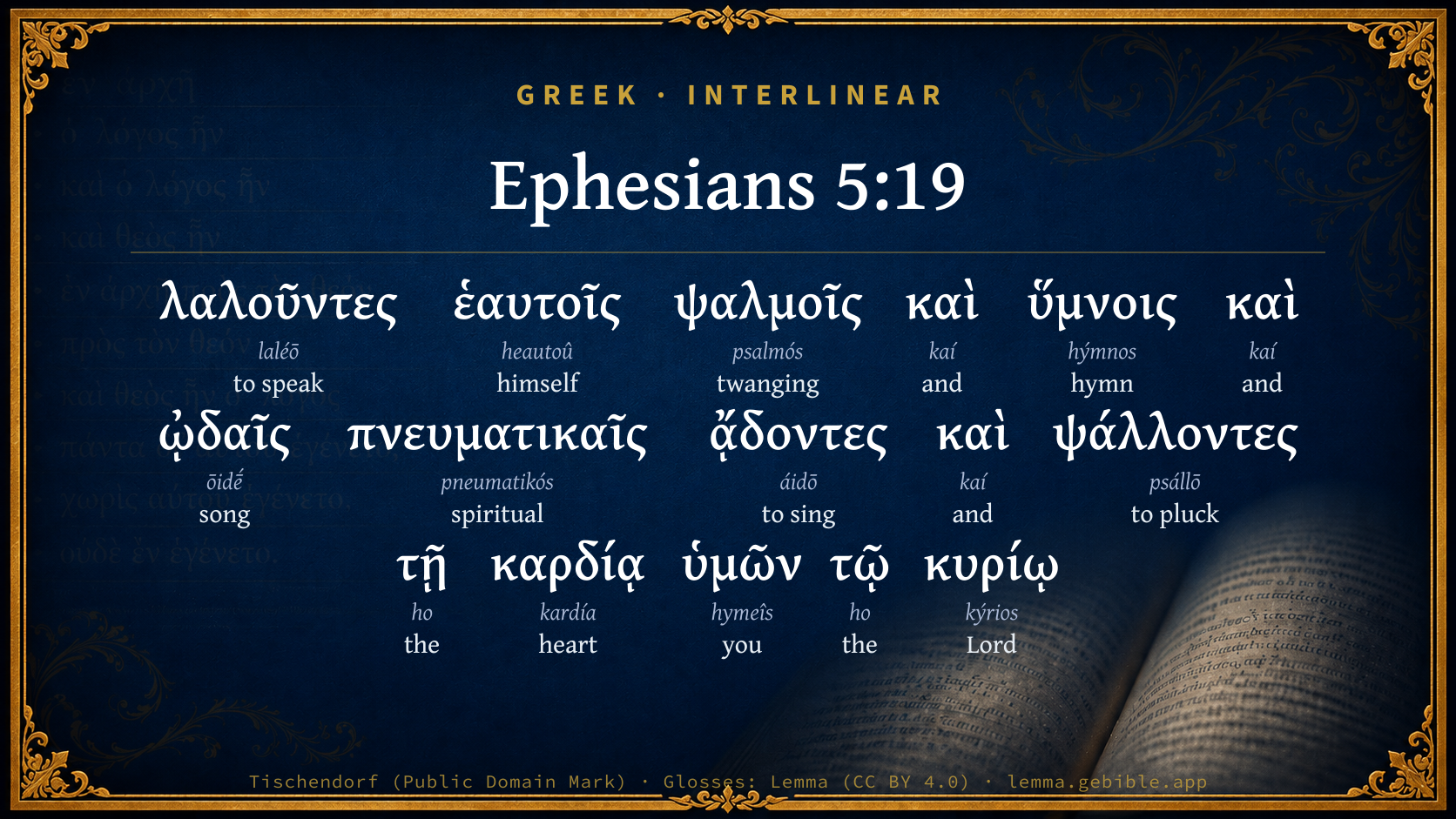
Greek (Tischendorf 8th ed.) Ephesians 5:19 appears in the Greek New Testament. The text above is from the Tischendorf 8th edition. Each word links to its Strong’s number and a concise gloss. Click any word for its full Thayer’s Greek Lexicon entry.
Download image
Cite this verse

Ephesians 5:19 (World English Bible). Public Domain. Lemma interlinear Bible study tool, https://lemma.gebible.app/v/ephesians/5/19.

Show BibTeX & RIS
BibTeX
RIS
English Translation
speaking to one another in psalms, hymns, and spiritual songs; singing, and singing praises in your heart to the Lord;
World English Bible · Public Domain
Highlights
  • 3 first appearances in the Greek New Testament
Full analysis ↓
Download a study sheet

One document with this verse’s original text, its word-by-word gloss line, the meaning frame, cross-references with their text, attributed commentary, and full source and license credits — printable, and it pastes into notes with its structure intact.

This verse Autodidact and up

Study sheet (.html) Plain text (.txt)

A passage Seminary Student

Up to 50 verses in one chapter. A passage sheet keeps up to 6 commentary sources and 12 cross-references per verse, in the order this page ranks them, and says so on the sheet whenever that leaves anything out. Ask for a single verse and you get the Autodidact verse sheet above.

Everything on this page stays free to read, with no account — the sheet is a download of what is already on screen, not access to it.

Want to remove ads? Support Godless Engineer
Compare translations 3

The same verse in 3 English versions, stacked beneath the original-language interlinear above. Click any original word for its lexicon entry.

Each is an independent rendering of the whole verse — the interlinear is not word-aligned to these translations.

Highlighted words mark where these versions differ — a whole-verse word diff, not a word-by-word alignment.

  • World English Bible Public Domain
    speaking to one another in psalms, hymns, and spiritual songs; singing, and singing praises in your heart to the Lord;
  • King James Version Public Domain
    Speaking to yourselves in psalms and hymns and spiritual songs, singing and making melody in your heart to the Lord;
  • unfoldingWord Literal Text CC BY-SA 4.0
    speaking to each other in psalms and hymns and spiritual songs, singing and singing psalms in your heart to the Lord,

unfoldingWord Literal Text — © unfoldingWord, licensed CC BY-SA 4.0. Word-aligned USFM3 via Door43 (git.door43.org/unfoldingWord/en_ult).

Versions to compare (up to 4)

3 of 4 selected

Show all 19 translations

Every available English version of this verse, each an independent rendering of the whole verse.

  • World English Bible Public Domain
    speaking to one another in psalms, hymns, and spiritual songs; singing, and singing praises in your heart to the Lord;
  • Berean Standard Bible Public Domain
    Speak to one another with psalms, hymns, and spiritual songs. Sing and make music in your hearts to the Lord,
  • Majority Standard Bible Public Domain
    Speak to one another with psalms, hymns, and spiritual songs. Sing and make music in your hearts to the Lord,
  • King James Version Public Domain
    Speaking to yourselves in psalms and hymns and spiritual songs, singing and making melody in your heart to the Lord;
  • American Standard Version (1901) Public Domain
    speaking one to another in psalms and hymns and spiritual songs, singing and making melody with your heart to the Lord;
  • Revised Version (1885) Public Domain
    speaking one to another in psalms and hymns and spiritual songs, singing and making melody with your heart to the Lord;
  • Geneva Bible (1599) Public Domain
    Speaking vnto your selues in psalmes, and hymnes, and spirituall songs, singing, and making melodie to the Lord in your hearts,
  • Douay-Rheims (1899) Public Domain
    Speaking to yourselves in psalms, and hymns, and spiritual canticles, singing and making melody in your hearts to the Lord;
  • Young's Literal Translation Public Domain
    speaking to yourselves in psalms and hymns and spiritual songs, singing and making melody in your heart to the Lord,
  • Literal Standard Version CC BY-SA 4.0
    speaking to yourselves in psalms and hymns and spiritual songs, singing and making melody in your heart to the LORD,
  • Unlocked Literal Bible CC BY-SA 4.0
    speaking to each other in psalms and hymns and spiritual songs, singing and making melody to the Lord with all your heart,
  • unfoldingWord Literal Text CC BY-SA 4.0
    speaking to each other in psalms and hymns and spiritual songs, singing and singing psalms in your heart to the Lord,
  • Darby Bible Public Domain
    speaking to yourselves in psalms and hymns and spiritual songs, singing and chanting with your heart to the Lord;
  • World Messianic Bible Public Domain
    speaking to one another in psalms, hymns, and spiritual songs; singing and making melody in your heart to the Lord;
  • Webster's Bible Public Domain
    Speaking to yourselves in psalms, and hymns, and spiritual songs, singing and making melody in your heart to the Lord,
  • Free Bible Version CC BY-SA 4.0
    Share together with one another, using psalms and hymns and sacred songs, singing and making music to the Lord to express what you feel.
  • Bible in Basic English Public Domain
    Joining with one another in holy songs of praise and of the Spirit, using your voice in songs and making melody in your heart to the Lord;
  • Text-Critical English NT CC BY 4.0
    speaking to one another in psalms, hymns, and spiritual songs, singing and making melody with your hearts to the Lord,
  • Tyndale New Testament (1534) Public Domain
    speakynge vnto youre selves in psalmes and ymnes and spretuall songes synginge and makinge melodie to the Lorde in youre hertes

Literal Standard Version (2020), Covenant Press — licensed CC BY-SA 4.0. Text via the HelloAO Bible API (eBible.org). Unlocked Literal Bible (unfoldingWord) — licensed CC BY-SA 4.0. Text via the HelloAO Bible API (eBible.org). unfoldingWord Literal Text — © unfoldingWord, licensed CC BY-SA 4.0. Word-aligned USFM3 via Door43 (git.door43.org/unfoldingWord/en_ult). Free Bible Version, Dr. Jonathan Gallagher — licensed CC BY-SA 4.0. Text via the HelloAO Bible API (eBible.org).

Word by word

More ways to search: Search by grammar → Find every occurrence → Compare this word →

Practice this passage: Drill this verse → Learn its vocabulary →

ὕμνοις
hýmnos
G5215
“hymn”
Noun, Dative, Plural, Masculine
Part of Speech
Noun
Case
Dative
Number
Plural
Gender
Masculine
Full Thayer's Definition

Origin: apparently from a simpler (obsolete) form of hudeo (to celebrate, probably akin to G103 , cf G5667 )

TDNT: 16:09,1

1. a song in tithe praise of gods, heroes, conquerors 2. a sacred song, hymn
  1. λαλοῦντες laléō G2980 “to speak” Verb, Present, Active, Participle, Nominative, Plural, Masculine
  2. ἑαυτοῖς heautoû G1438 “himself” Reflexive pronoun, 2nd person, Dative, Plural, Masculine
  3. ψαλμοῖς psalmós G5568 “twanging” Noun, Dative, Plural, Masculine
  4. καὶ kaí G2532 “and” Conjunction
  5. καὶ kaí G2532 “and” Conjunction
  6. ᾠδαῖς ōidḗ G5603 “song” Noun, Dative, Plural, Feminine
  7. πνευματικαῖς pneumatikós G4152 “spiritual” Adjective, Dative, Plural, Feminine
  8. ᾄδοντες áidō G103 “to sing” Verb, Present, Active, Participle, Nominative, Plural, Masculine
  9. καὶ kaí G2532 “and” Conjunction
  10. ψάλλοντες psállō G5567 “to pluck” Verb, Present, Active, Participle, Nominative, Plural, Masculine
  11. τῇ ho G3588 “the” Article, Dative, Singular, Feminine
  12. καρδίᾳ kardía G2588 “heart” Noun, Dative, Singular, Feminine
  13. ὑμῶν hymeîs G5210 “you” Personal pronoun, 2nd person, Genitive, Plural
  14. τῷ ho G3588 “the” Article, Dative, Singular, Masculine
  15. κυρίῳ kýrios G2962 “Lord” Noun, Dative, Singular, Masculine

About this verse

These counts appear in no published source. They are computed here, from the morphology-tagged text and Lemma’s own curated glosses. What Lemma adds →

16
words
13
distinct lemmas
Pauline Epistles
section

Notable vocabulary

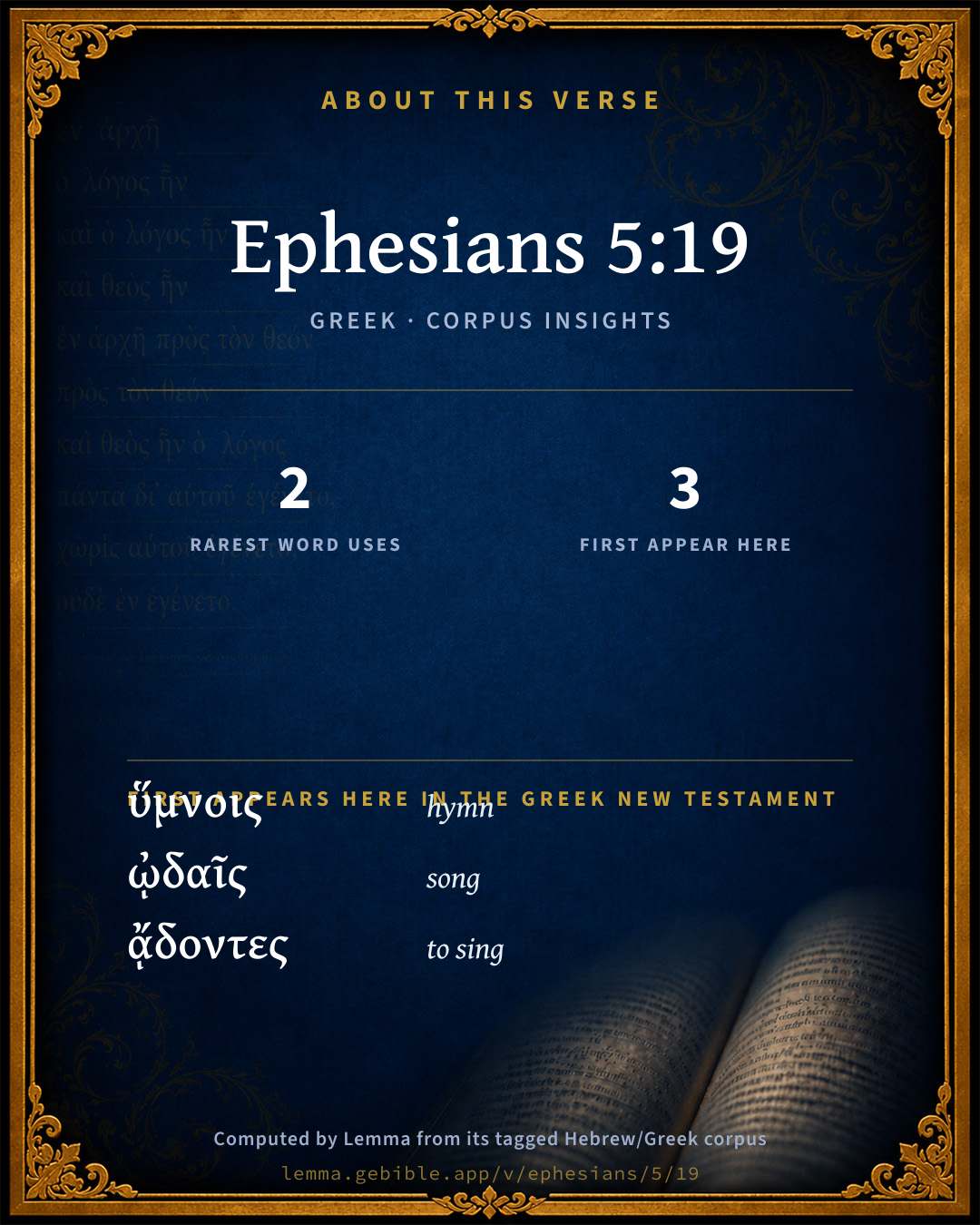
The rarest word here is ὕμνοις hymn G5215 — appearing just 2 times in the whole Greek New Testament.

First appearance in Scripture

These words make their first canonical appearance in the Greek New Testament here:

  • ὕμνοις hymn G5215
  • ᾠδαῖς song G5603
  • ᾄδοντες to sing G103

Shared distinctive vocabulary

ὕμνοις hymn G5215 occurs in 2 verses of the Greek New Testament. Also found in:
Repetition

Words recur within this verse:

Cross-references

14

Topical passages linked to Ephesians 5:19 in the Treasury of Scripture Knowledge — connected by theme and wording, ordered by reader-vote popularity; previews shown in the World English Bible.

  • Colossians 3:16 Let the word of Christ dwell in you richly; in all wisdom teaching and admonishing one another with psalms, hymns, and spiritual songs, singing with grace in your heart to the Lord.
  • Psalms 95:2 Let's come before his presence with thanksgiving. Let's extol him with songs!
  • 1 Corinthians 14:26 What is it then, brothers? When you come together, each one of you has a psalm, has a teaching, has a revelation, has another language, has an interpretation. Let all things be done to build each other up.
  • Acts 16:25 But about midnight Paul and Silas were praying and singing hymns to God, and the prisoners were listening to them.
  • Psalms 147:7 Sing to Yahweh with thanksgiving. Sing praises on the harp to our God,
  • James 5:13 Is any among you suffering? Let him pray. Is any cheerful? Let him sing praises.
  • Psalms 105:2–3 Sing to him, sing praises to him! Tell of all his marvelous works.
  • John 4:23–24 But the hour comes, and now is, when the true worshippers will worship the Father in spirit and truth, for the Father seeks such to be his worshippers.
  • Psalms 62:8 Trust in him at all times, you people. Pour out your heart before him. God is a refuge for us. Selah.
  • Psalms 86:12 I will praise you, Lord my God, with my whole heart. I will glorify your name forevermore.
  • Isaiah 65:14 behold, my servants shall sing for joy of heart, but you shall cry for sorrow of heart, and shall wail for vexation of spirit.
  • Matthew 26:30 When they had sung a hymn, they went out to the Mount of Olives.
  • Psalms 47:7–8 For God is the King of all the earth. Sing praises with understanding.
  • Matthew 15:8 'These people draw near to me with their mouth, And honor me with their lips; But their heart is far from me.

Cross-references courtesy of OpenBible.info (CC BY 4.0).

Commentary

Notes on Ephesians 5:19 from classic Christian and Jewish commentators (each source and its license shown beneath its notes). The classic Christian expositions comment on the surrounding passage and are grouped to its opening verse, so a note may address several verses; the Jewish commentaries on the Tanakh (Rashi and others) are per-verse, so they appear only where the commentator wrote on this verse.

Lemma curates 59 commentaries, every one of them public domain or Creative Commons licensed, each selected and text-cleaned for this edition rather than reprinted as found. About our sources →

Albert Barnes' Notes on the Bible

Speaking to yourselves - Speaking among yourselves, that is, endeavoring to edify one another, and to promote purity of heart, by songs of praise. This has the force of a command, and it is a matter of obligation on Christians. From the beginning, praise was an important part of public worship, and is designed to be to the end of the world; see the notes on 1Co 14:15. Nothing is more clear than that it was practiced by the Saviour himself and the apostles (see Mat 26:30), and by the primitive church, as well as by the great body of Christians in all ages.

In psalms - The Psalms of David were sung by the Jews at the temple, and by the early Christians (notes Mat 26:30), and the singing of those psalms has constituted a delightful part of public worship in all ages. They speak the language of devotion at all times, and a large part of them are as well suited to the services of the sanctuary now as they were when first composed.

And hymns - It is not easy to determine precisely what is the difference in the meaning of the words used here, or to designate the kind of compositions which were used in the early churches. A “hymn” is properly a song or ode in honor of God. Among the pagan it was a song in honor of some deity. With us now it denotes a short poem, composed for religious service, and sung in praise to God. Such brief poems were common among the pagan, and it was natural that Christians should early introduce and adopt them. Whether any of them were composed by the apostles it is impossible now to determine, though the presumption is very strong that if they had been they would have been preserved with as much care as their epistles, or as the Psalms. One thing is proved clearly by this passage, that there were other compositions used in the praise of God than the Psalms of David; and if it was right then to make use of such compositions, it is now. They were not merely “Psalms” that were sung, but there were hymns and odes.

Spiritual songs - Spiritual “odes” - ᾠδᾶις ōdais. Odes or songs relating to spiritual things in contradistinction from these which were sung in places of festivity and revelry. An “ode” is properly a short poem or song adapted to be set to music, or to be sung; a lyric poem. In what way these were sung, it is now vain to conjecture. Whether with or without instrumental accompaniments; whether by a choir or by the assembly; whether by an individual only, or whether they were by responses, it is not possible to decide from anything in the New Testament. It is probable that it would be done in the most simple manner possible. Yet as music constituted so important a part of the worship of the temple, it is evident that the early Christians would be by no means indifferent to the nature of the music which they had in their churches. And as it was so important a part of the worship of the pagan gods, and contributed so much to maintain the influence of paganism, it is not unlikely that the early Christians would feel the importance of making their music attractive, and of making it tributary to the support of religion. If there is attractive music at the banquet, and in the theater, contributing to the maintenance of amusements where God is forgotten, assuredly the music of the sanctuary should not be such as to disgust those of pure and refined taste.

Singing - ᾄδοντες adontes. The prevailing character of music in the worship of God should be vocal. If instruments are employed, they should be so subordinate that the service may be characterized as singing.

And making melody - “Melody” is an agreeable succession of sounds; a succession so regulated and modulated as to please the ear. It differs from “harmony,” inasmuch as melody is an agreeable succession of sounds by a single voice; harmony consists in the accordance of different sounds. It is not certain, however, that the apostle here had reference to what is properly called “melody.” The word which he uses - ψάλλω psallō - means to touch, twitch, pluck - as the hair, the beard; and then to twitch a string - to “twang” it - as the string of a bow, and then the string of an instrument of music. It is most frequently used in the sense of touching or playing a lyre, or a harp; and then it denotes to make music in general, to sing - perhaps usually with the idea of being accompanied with a lyre or harp. It is used, in the New Testament, only in Rom 5:19; 1Co 14:15, where it is translated “sing;” in Jam 5:13, where it is rendered “sing psalms,” and in the place before us. The idea here is, that of singing in the heart, or praising God from the heart. The psalms, and hymns, and songs were to be sung so that the heart should be engaged, and not so as to be mere music, or a mere external performance. On the phrase “in the heart,” see the notes on 1Co 14:15.

To the Lord - In praise of the Lord, or addressed to him. Singing, as here meant, is a direct and solemn act of worship, and should be considered such as really as prayer. In singing we should regard ourselves as speaking directly to God, and the words, therefore, should be spoken with a solemnity and awe becoming such a direct address to the great Yahweh. So Pliny says of the early Christians, “Carmenquc Christo quasi Deo dicere secure invicem” - “and they sang among themselves hymns to Christ as God.” If this be the true nature and design of public psalmody, then it follows:

(1) That all should regard it as an act of solemn worship in which they should engage - in “heart” at least, if they cannot themselves sing.

(2) Public psalmody should not be entrusted wholly to the light and frivolous; to the trifling and careless part of a congregation.

(3) They who conduct this part of public worship ought to be pious. The leader “ought” to be a Christian; and they who join in it “ought” also to give their hearts to the Redeemer. Perhaps it would not be proper to say absolutely that no one who is not a professor of religion should take part in the exercises of a choir in a church; but thoro can be no error in saying that such persons “ought” to give themselves to Christ, and to sing from the heart. Their voices would be none the less sweet; their music no less pure and beautiful; nor could their own pleasure in the service be lessened. A choir of sweet singers in a church - united in the same praises here - “ought” to be prepared to join in the same praises around the throne of God.

Albert Barnes' Notes on the Bible (1834–1885) — public domain. Text from a community e-Sword/MySword module.

The Biblical Illustrator

Joseph S. Exell

Eph_5:19

Speaking to yourselves in psalms and hymns and spiritual songs.

Sacred music

I. The design of music in general. Singing is no less natural to mankind than speaking. They are naturally disposed to speak, because they wish to communicate their thoughts, and they are naturally disposed to sing, because they wish to communicate their feelings. Speaking is the natural language of the understanding, and singing is the natural language of the heart. We always use words to express our thoughts, but we do not always use words to express our feelings. These we can clearly and forcibly express by simple sounds. How often do we see this exemplified in the case of little children! Before they are capable of speaking, or even understanding a single word, they can express their joy and sorrow, their love and hatred, and all the variety of their feelings, by merely varying the tones of their voice. This language of the heart grows up with every person, and would be as commonly used as the language of the understanding, were it not restrained by the force of example, or by the sense of propriety. Accordingly we find that music has always been much more in use among those people, who have been left to follow the mere dictates of nature, than among others who have been governed by the customs and manners of civil society.

II. The design of sacred music in particular. General music becomes particular when it is applied to one particular purpose. The first purpose to which mankind naturally apply music is to cheer and exhilarate their spirits. The design of another kind of music is to inspire men with a spirit of courage, fortitude, and patriotism. This is the music of the army. But the great design of sacred music is to awaken and express every holy affection of the heart towards God.

III. Let us next inquire, what is necessary to render sacred music the most useful in religious worship.

1. That sacred music should be constructed with great simplicity.

2. It is highly proper that sacred music should be connected with poetry, in order to promote private and public devotion. Melodious sounds have only a mechanical operation on the mind; but when they are united with appropriate language, they produce a moral effect. The apostle directs Christians not only to sing, but to sing in psalms, or hymns, or spiritual songs. This is always proper in devotional music, which has immediate reference to God, who is the only proper object of religious worship. How absurd would it be, for instance, to celebrate the birthday of Washington by mere music, without any ode or hymn adapted to the occasion! And how much more absurd would it be to celebrate the character, the works, and the ways of God, by mere music, without using any psalm or spiritual song, to bring those great and glorious objects into view! There can be no religious affection without the perception of some religious object. Some part of the Divine character or the Divine conduct must be seen, in order to exercise any right affection towards God. And since it is the sole design of sacred music to excite or express devout and holy affections towards the Divine Being, it should always be connected with some significant and appropriate language, either in prose or poetry.

3. Sacred music should not only be connected with words, but adapted to their sense, rather than to their sound. When music is adapted to the mere sound of words, it can serve no other purpose than to please the ear; but when it is adapted to the proper meaning of a psalm or hymn, it not only pleases the ear, but affects the heart. It is here that both composers and performers of sacred music are most apt to fail. How often do composers appear to pay more regard to the sound than to the sense of the words which they set to music!

4. Sacred music can never produce its best effect unless it be performed with true sincerity. There ought to be a perfect concord between the music, the words, and the heart. (N. Emmons, D. D.)

How we may make melody in our hearts to God in singing of psalms

1. The singers.

Christians.

2. The song itself. Three divisions.

(1) Psalms.--They are the composures of holy David.

(2) Hymns.--They are the songs of some other excellent men recorded in Scripture, as Moses, Heman, Asaph, etc.

(3) Spiritual songs.--They are odes of some other holy and good men not mentioned in Scripture, as the song of Ambrose, Nepos, and others.

3. Some aver that these several speeches mentioned in the text, answer the Hebrew distinction of psalms. But I may add, Are not all these several species mentioned to prefigure the plenty and the joy which is reserved for the saints within the veil, when they shall join in concert with the glorious angels in singing their perpetual hallelujahs to their glorious Creator?

3. The manner of singing. Our text saith, making melody; with inward joy and tripudiation of soul; if the tongue make the pause, the heart must make the elevation.

4. The master of the choir, the preceptor. That is, the heart.

5. The end of the duty--To the Lord. Our singing must not serve our gain, or our luxury, or our fancy; but our Lord. The several parts of the text being thus opened, they may be set together again in this Divine and excellent truth: In the ordinance of singing, we must not make noise, but music; and the heart must make melody to the Lord. In this service we must study more to act the Christian than the musician. We must sing Davids psalms with Davids spirit.

I. We will show the Divine authority of this ordinance.

II. We will show the sweetness of it.

III. The universal practice of it.

IV. We shall show the honours God hath put upon this ordinance.

V. And then come to the main case.

VI. And make application.

I. For the first: we shall show the divine authority of this ordinance.

1. From Scripture precept. And here we have divers commands laid upon us, both in the Old and New Testament. David, who among his honourable titles obtains this, to be called the sweet singer of Israel (2Sa_23:1)--he frequently calls upon himself: I will sing praise to the name of the Lord most high (Psa_7:17). And sometimes he calls upon others: Sing unto Him, sing psalms unto Him, talk ye of all His wondrous works (1Ch_16:9). Nay, sometimes He summons the whole earth to join in this duty: Sing unto the Lord, all the earth; show forth from day to day His salvation (1Ch_16:23; Psa_68:32). And holy Hezekiah--he propagated this service (2Ch_29:30). Nay, in their times when the royal majesty was lodged in Judah, singers were a peculiar office enjoined constantly to sing the praises of the Lord (1Ki_10:12). And Jehoshaphat appointed singers (2Ch_20:21). Nay, and Asaph, Heman, Jeduthun, and Ethan, men eminent and holy, were employed in this holy service (2Ch_5:12). But why should I light a candle at noon day? Thus this harmonious service was most usual and most acceptable in the times of the law.

2. From Scripture argument. And I shall only take out one shaft out of the whole quiver. I shall use one argument among many, which is this, namely, we always find this duty of singing psalms linked to and joined with other moral duties (Psa_95:1; Psa_95:6; Jam_5:13).

3. From Scripture pattern. Moses both pens a psalm, namely, the ninetieth; and sings a holy song, and Exo_15:1-27. is the record of it. So David tripudiates in the practice of this delightful service (Psa_104:33).

4. From Scripture prophecy. Divers prophecies in the Old Testament concerning this ordinance in the New. So in Psa_108:3; upon which Mollerus observes, that in that text David pours forth ardent prayers and wishes for the kingdom of Christ. And so divines observe that the first and second verses of Psa_100:1-5 are prophetical: Make a joyful noise unto the Lord, all ye lands. Serve the Lord with gladness: come before His presence with singing. To which may be added that pregnant prophecy recorded in Isa_52:8.

II. We may take notice of the sweetness of this duty. Singing is the souls jubilee, our spiritual recreation, the shout of the heart, our tuning of our hallelujahs, the sweetest solace of a sanctified soul.

1. Singing is the music of nature (Isa_44:23; Psa_65:13).

2. Singing is the music of ordinances. Augustine reports of himself, that when he came to Milan and heard the people sing, he wept for joy.

3. Singing is the music of saints.

(1) They have performed this duty in their greatest numbers (Psa_149:2).

(2) In their greatest straits (Isa_26:19).

(3) In their greatest flight (Isa_42:10-11).

(4) In their greatest deliverances (Isa_65:14.

(5) In their greatest plenties.

4. Singing is the music of angels (Job_38:7; Luk_2:13).

5. Singing is the music of heaven (Rev_15:8).

III. The universal practice of this duty. It has been practised--

1. By all varieties of persons.

(1) By Christ and His apostles (Mat_26:30).

(2) By godly princes (2Ch_29:30).

(3) Worthy governors (2Ch_5:12).

(4) Holy prophets (Psa_146:2. Deu_32:1-52).

(5) The body of the people.

As singing is not too low for kings, so not too choice for subjects. The whole multitude sometimes engaged in the harmony: Then Israel sang this song (Num_21:17). The peoples voice may make melody, as the lesser birds contribute to the music of the grove, their chirping notes filling up the harmony.

2. In all ages. This service of singing to God was soon started in the world. Moses, the first penman of Scripture--he both sung a song and penned a psalm, as we hinted before. In the Judges times, Deborah and Barak sang a triumphant song (Jdg_5:1-2, etc.). During the time of the kings of Judah, the Levites sang the praises of God in the sanctuary. A little before the captivity, we find the Church praising God in singing (Isa_35:2). In the time of the captivity, Israel did not forget the songs of Zion, though they were in Babylon (Psa_126:2). After their return from captivity, we soon find them return to this joyous service (Neh_7:1). Their long exile had not banished this duty. Towards the close of their prophets prophesying, the Church is again engaged in this part of Gods worship (Zep_3:15; Zep_3:17).

3. In all places. Moses praiseth God by singing in the wilderness, throughout Exo_15:1-27. David practises this duty in the tabernacle (Psa_47:6); Solomon in the temple (1Ki_10:12); Jehoshaphat in the camp (2Ch_20:21); Christ and His apostles in a particular chamber (Mat_26:30); and Paul and Silas in an uncomfortable prison (Act_16:25). We may say of singing, as the apostle speaks of prayer: I will, saith he, that men pray everywhere, lifting up holy hands (1Ti_2:8).

4. In all conditions.

(1) In a time of cheerfulness and inward joy. The Apostle James commands us then to take the advantage of singing psalms (Jam_5:13). Joy may excite, must not stifle, this duty.

(2) In a time of affliction. Paul and Silas sang in prison, a place of sorrow and confinement (Act_16:25). A chain might bind their feet, but not their tongue; while others sleep, they sing, and turn their dungeon into a chapel.

(3) In a time of fear. When some would press Luther with the dangers the Church was in, and what a black cloud hung over Zion, he would call for Psa_46:1-11 to be sung; and he thought that psalm was a charm against all fears whatsoever. And since, this psalm is called Luthers psalm, his sacred spell against invading fears.

5. By all sexes. Miriam sings a song to God, as well as Moses (Exo_15:21). Rivet well observes, God is the Lord of both sexes. Women, though they are removed by apostolical command from the desk or pulpit, yet they are not debarred the choir, to join in that harmony where Gods praises are elevated.

IV. And now we come to speak of that honour which God hath put upon this heavenly duty. And this will appear in three things; namely--

1. God hath honoured this duty with glorious appearances. This we find upon record in 2Ch_5:13.

2. With eminent victories (2Ch_20:21-22).

3. With evident miracles (Act_16:25-26).

V. And now I come to the main case, how we may make melody in our hearts to God in singing of psalms.

1. We must sing with understanding. We must not be guided by the tune, but the words, of the psalm; we must mind the matter more than the music, and consider what we sing, as well as how we sing.

2. We must sing with affection. Love is the fulfilling of this law. It is a notable saying of St. Augustine: It is not crying, but loving, that sounds in the ears of God. The pretty child sings a mean song; but it delights the mother, because there is love on both sides.

3. We must sing with real grace. This the apostle admonishes us (Col_3:16). It is grace, not nature, sweetens the voice to sing. We must draw out our spices, our graces, in this duty.

4. We must slug with excited grace. Not only with grace habitual, but with excited and actual. The musical instrument delights not but when it is played upon. The clock must be plucked up before it can guide our time; the bird pleaseth not in her nest, but in her notes; the chimes only make music while they are going. Let us therefore beg the Spirit to blow upon our garden, that the spices thereof may flow out, when we set upon this joyous service (Son_4:16). God loves active grace in duty; that the soul should be ready trimmed, when it presents itself to God in any worship.

5. We must sing with spiritual joy. Indeed, singing only makes joy articulate; it is only the turning of bullion into coin; as the prophet speaks to this purpose (Isa_65:14). Singing is only the triumphant gladness of a gracious heart, a softer rapture.

6. We must sing with faith.

7. We must sing in the Spirit.

8. Purify thy heart.

9. Neglect not preparatory prayer.

1. Those who despise this ordinance do not consider the holy ends of this duty; namely--

(1) Psalms are sung for instruction.

(2) Psalms are sung for admonition.

(3) Psalms are sung for praise and thanksgiving.

2. Nor do such consider the rare effects of this duty, namely, of singing to the Lord: and they are--

(1) Singing can sweeten a prison. Thus Paul and Silas indulcorated their bondage by this service (Act_16:25).

(2) Singing can prepare us for sufferings. When Christ was ready to be offered up, He sang an hymn with His disciples: Christ sups and sings, then dies.

(3) Singing lightens and exhilarates the soul.

3. Nor do such consider the sweet allurements which draw us to this duty. And if we inquire what it is that puts us upon rejoicing in God by singing, I shall tell you--

(1) The good Spirit. That heavenly principle both leads us to this duty, and helps us in it.

(2) The joyous heart. Holy singing is both the sign and vent of joy. The little child is pained, and then it cries; the saint is surprised with joy, and then it breaks out into singing.

(3) A sense of obedience. To sing praises to the Lord is a duty which the saints know not how to wave or respite.

I. This checks those who scruple this ordinance. Surely this must proceed from the evil one, turning himself into an angel of light.

II. Let this check those who suspend and neglect this heavenly ordinance.

III. This likewise checks those who formalize in this duty; who act a part, not a duty. They make a noise, and not music; and more provoke the eyes, than please the ears, of God. Bernard makes two conditions of grateful singing.

1. We must sing purely, minding what we sing; nor must we act or think anything besides; there must be no vain or vagrant thoughts; no dissonancy between the mind and the tongue.

2. We must sing strenuously, not idly, not sleepily or perfunctorily.

IV. Let us get an interest in Christ. If we are not in Christ, we are certainly out of tune. The singing of a sinner is natural, like the singing of a bird. But the singing of a saint is musical, like the singing of a child. We are accepted in Christ in this offer of love. Therefore let us get into Christ: He can raise our voice in singing to a pleasing elevation.

V. Let us sometimes raise our hearts in holy contemplation. Let us think of the music of the bride chamber. There shall be no cracked strings, displeasing sounds, harsh voices, nothing to abate or remit our melody; there shall be no willows to hang up our harps upon. (J. Wells, M. A.)

Music in the Bible

This is but one of hundreds of passages in which the inspired writers, both of the Old and the New Testaments, dwell on the sacredness of music. Joy and gladness shall be found therein, says David of the redeemed Zion, thanksgiving, and the voice of melody. Music is in our Lords parable the fit sign of joy for the returning prodigal. Is any merry, says St. James, let him sing psalms. Not only the psalms which we have just been singing, but it is not too much to say that even the whole Bible rings with music. There is an heavenly music in it and an earthly music. For in the very beginning when the earth was made we are told that the morning stars sang together, and all the sons of God shouted for joy. And in the very beginning of the gospel also, when the gospel was revealed, there was with the herald angel a multitude of the heavenly host praising God, and saying, Glory to God in the highest, on earth peace, goodwill towards men. And as music is the earliest, so is it the last glimpse we have of heaven, when, before its azure curtain was closed forever to mortal eyes, we see myriads of angels shouting Hallelujah; and harpers harping with their harps, and the redeemed in their countless multitudes as with the sound of many waters, and as with the voice of great thunder, singing the song of Moses and the Lamb. And so, too, from first to last, there is in the Bible an abundance of earthly music. In the fourth chapter of Genesis, you have the first instruments invented by Jubal--the father of all such as handle the harp and organ. In the thirty-first chapter of Genesis you have the first choir, when Laban says that he would have sent Jacob away with mirth and with songs, with tabret and with harp. And after that the whole Bible thrills with song. There is Miriam with her timbrels shaken over the rolling waves which have drowned the enemies of God. There are the silver trumpets of the new moons and the solemn feast days. There is David with his psalms, now sad as the wail over Saul, and Jonathan lost upon the mountains of Gilboa; now rapturous as the paeans which tell of the triumph of the Lord. There are the Levites in their white robes on the temple steps, the one choir singing aloud, Oh, give thanks unto the Lord, and the other replying as with thunderous antiphone--for His mercy endureth forever. The exiles march home from Babylon with rivers of music; the disciples break forth into hymns after Pentecost; our Lord and His apostles sing a hymn before that last walk under the olive trees to the Garden of Gethsemane; Paul and Silas, their backs bleeding with Roman rods, turn their prison into an edeum, and God gives them songs in the night. Even in the Epistles, as far back as these early days of Christianity, we find more than one fragment of the earliest Christian hymns. And lastly, the Apocalypse, as Milton said, shuts up the stately acts of its awful tragedy, and fitly concludes the whole volume of Scripture with a seven-fold chorus of Hallelujahs and harping symphonies. (Archdeacon Farrar.)

Music in nature

There is, indeed, little of what can be accurately called music in nature, for music is the Divine prerogative of human and angelic beings, and nature furnishes only the rude elements of music, the uncut diamonds, as it were, of sound. We may, indeed, say that the winds of God make music under the blue dome of His temple, not made with hands; music, sweet sometimes and soft as the waving of angel wings, or weird as when it sweeps the wild moors and mingles the multitudinous murmurs of the withered heather bells, or awful as when it roars among the mountain pines. And you may say that the sea makes music; now in the ripples that flash upon the shore, and now in the bursting of its stormy billows. And you may say that the thrush and the nightingale make music, or the lark when it becomes a singing speck in the summer heaven. And so the poets have sung of the music of nature; but, my brethren, the music is not in these outward things; where they sound to us like music it is because we are making melody of them in our hearts; happy for us if that melody be always to the Lord. It is thus that David says, Praise the Lord upon earth: ye dragons, and all deeps; fire and hail, snow and vapours: wind and storm, fulfilling His word, etc. Yet David knew that the music of heaven and earth was in itself deep silence. It was only the music of the cosmos, the music which the beauty and order of the universe awaken in the heart of man, and none had ever heard it, though the Jewish legend said that Moses was solely sustained by that music of the spheres when he spent those forty days upon the mount of God. (Archdeacon Farrar.)

Music in the life

The man who makes melody in his heart to the Lord will make it in his life. Making melody. What is melody? Is it not the arrangement of notes, the sequence of the same or different sounds, so following one another as to give us pleasure? Unless there be melody in your hearts there will be no true music, neither Christmas music, nor Lenten music, nor Easter music, in your worship. Believe me, we may be able to make little music, or none at all, with our hands or our voices; but oh! what music we can make of the sweet, solemn, sacred human life of every one of us! And how beautiful is a musical life; but how many of us spoil it!

How sour sweet music is when time is broke

And no proportion kept.

So is it with the music of mens lives. When do we break the time? When there is no rhythm, no due order, no regulated sequence in our lives; when reckless youth makes rueful age; when we waste, squander, defile, throw away our early years, and are never able to be again what once we might have been; when we have sudden pauses and backslidings, and breaks and stoppings short in the wholesome continuity of righteous purposes and righteous actions; above all, when we sacrifice the vast future to the fleeting present; when we sell our eternity for a little hour--ah! then we ruin the melody; for we break the time. And when is there no proportion kept? Is it not when some evil passion or some base desire utterly subdues and masters us, raises above the rest its dominant and screaming voice, makes of our lives a foolish and fussy egotism, or a harsh and agonizing jar? Ah! what broken music there is in the individual character of many of us. When the unruly wills and affections of sinful men snatch up in their lives each its several instrument, or when they lay their tainted and raging hands upon the sacred strings; pleasure, with its corrupt under song; pride, with its jangling cymbals; hate, with its fierce trumpet; malice, with its ear piercing fife. What horrible discord there is in the lives of the drunkard, the cheat, the gambler, the debauchee! You have all heard of that point on the strings of the violin, which, if touched, produces a harsh and grating dissonance called the wolf note. Alas! how often do we hear in our own lives, and in the lives of others, that hideous jarring wolf note--the wolf note of envy, of virulent hatred, of vile, selfish lust, from the stringed instrument of what should be a mans sacred life! Only, my brethren, if there be melody in your hearts to the Lord can you make life and death and the forever one grand, sweet, song. For the potentiality of music is everywhere. The heart of every one of you is a harp of God. Yield it to the music of furious passions, and it will disgust and horrify; but let it be swept by the Holy Spirit of God, and it will give forth Divine and solemn sounds. Then, lastly, for the music of life harmony is no less necessary than melody. We must learn the united chorus no less than the individual hymn. The sounds of our lives must not only be sweet in themselves, but they must be subordinated to each other. If melody be the due sequence, is not harmony the due inter-relation of sounds? the combination of different sounds uttered at the same time, but so related to each other as to give us pleasure? A self-willed musician, one who only cares to hear his own voice, one who from carelessness or from vanity will introduce his own eccentric or special variation, one whose voice is always ringing false or falling flat, does not he ruin the harmony and so spoil the chorus? Where there is not Gods peace in the life, where selfishness rules in place of self-denial, where pride asserts itself at the expense of considerateness, where violence overleaps the barriers of law, there, for the music of lifes sweet and solemn chorus, you have got the screeching discords of anarchy and an anticipated hell. As the hideous sounds of war break up the unity and spoil the chorus of nations, so the quarrels, hatreds, envies, selfishness of individual men, spoil Gods choir of human society. These it is which keep us out of tune with heaven. When the breath of the Holy Spirit of God breathes through the organ of noble natures, then, indeed, the world hears music as Divine as it is rare; but when a man has nothing to offer to that high influence of the Holy Spirit of God but the scrannel pipes of an individuality which he has degraded by egotism and by mean alms, then all his life becomes a lean and flashy song. There can be no harmony in ourselves, no harmony in societies where there is no melody in our individual lives. Only by self-repression, by obedience, by humility, by purity, by common sympathy, can we get that music which one day shall be when the sound of every several voice, of every several instrument in Gods great orchestra of human communities is dominated over by the Divine keynote--shall I sadly say by the last chord of heavenly love. So, and so only, can any one of us hope to be joined to that choir, visible and invisible--

The noble living and th immortal dead.

Whose music is the gladness of the world.

But we can all strive to be like Christ, and Christ is the music of the world. In Him only do music, chorus, worship find their meaning. Only in unison with Him can you hope for individual melody or for harmony. The time for perfect music, the time when these discords which we hear all around us shall cease to be in all the world--that time is not yet. We may hope that at some day it shall be. We may hope that He who died for the world will, we know not how, in some way or other, at last make lifes broken music whole. It is the nature of evil to perish, it is the nature of good to live forever; it partakes, and it alone partakes, of Gods eternity. (Archdeacon Farrar.)

Let joy overflow in song

Joy in God opens a thousand gates at once. There are gates in the heart, gates in the mind, gates in the nerves and muscles of the body, and gates in the atmosphere, which may be either open to Heavens tide of sweet influence, or shut against it. Unbelief and gloom shut the gates: hope and joy open them. But the gates are very secret, and when heaven is pouring itself in, whether upon souls in their closets, or upon congregations, no one suspects how, or by what channels, the tide has come. The joy in God, of a single soul in private, may let loose a blessing that shall run round the whole earth in its mission of comfort, and carry in its glance the break of day to numberless sad hearts. In the world, the Divine life finds prose enough; but in himself, every child of God is a new Divine poem and temple of psalmody. The understanding is not able always to appreciate the melody which is made unto the Lord, in the inmost chambers of the soul. The understanding misjudges it, and calls it groaning, because it has no ear to hear the purest music of the heart. Blessed are they that mourn. God joys with singing, and rests in His love, over His mourners. In the bitterest cry of His best beloved: My God, My God, why hast Thou forsaken Me? the Father hears the midnight singing in the morning to all broken hearts. (J. Pulsford.)

Thomas Fuller on his voice

Old Thomas Fuller, who was as noted for his quaintness as for the wisdom of his remarks, had a defective voice; but he did not refuse to praise on this account. Lord, he said, my voice by nature is harsh and untunable, and it is vain to lavish any art to better it. Can my singing of psalms be pleasing to Thine ears, which is unpleasant to my own? Yet, though I cannot chant with the nightingale, or chirp with the blackbird, I had rather chatter with the swallow than be altogether silent. Now what my music wants in sweetness, let it have in sense. Yea, Lord, create in me a new heart, therein to make melody, and I will be contented with my old voice, until in due time, being admitted into the choir of heaven, I shall have another voice more harmonious bestowed upon me. So let it be with us. Let us ever sing in the same spirit and in the same joy and hope.

Psalm singing a gospel ordinance

1. A duty prescribed, and that is, singing of psalms.

2. It is amplified, and set forth in its parts or necessary branches, outward and reward.

(1) The outward part; there we have--

(a) The subject matter, psalms and hymns and spiritual songs.

(b) The actions conversant about it--

(i) Speaking;

(ii) singing.

(2) The inward part, Making melody in your hearts to the Lord.

Doctrine: That singing of psalms is an ordinance of Gods worship under the gospel.

I. Before I come to prove it, let me observe something out of the words, to fix and state the duty. Observe that singing of psalms is made to be a fruit of being filled with the Spirit.

II. Having thus stated the duty as it is here recommended to us, I shall here prove--

1. That it is a clear and unquestionable duty.

2. That it is a delectable duty.

3. That it is a very profitable duty. It is a profitable ordinance.

(1) It subdueth the lusts and passions of the flesh by diversion, or directing us to a purer and safer delight. Spiritual joy is the best cure of carnal, for we keep our joy pure, and our delights are safe and healthful.

(2) It inspireth us with fortitude, courage, and constancy in wrestling for the truth; for singing of psalms is our exultation in God.

(3) It is profitable, as the psalm not only holdeth forth what the word read doth, but it stayeth and fixeth the heart upon the sweet and lively meditation of what we sing.

Use 1. To show us what a good God we serve, who hath made our delight a great part of our work. God is much for His peoples pleasure and holy joy.

Use 2. To show how much we overlook our profit when we deal slightly in this ordinance. It is a means, as other duties are, not a task; and a means to make our lives both holy and comfortable; therefore let us not contemn it. The same graces which are necessary for other parts of worship, which we make greater reckoning of, are necessary here also. (T. Manton, D. D.)

Nature and office of sacred music

I. The design of public worship may be learned from the word worship itself. Good etymologists are agreed that it is composed of the noun worth and the suffix ship, forming worth-ship; contracted, worship. The verb to worship, accordingly, signifies to ascribe worth. John describes an act of worship, when he represents the elders falling down before the throne and saying, Thou art worthy, O Lord, to receive glory, and honour, and power. Worship essentially consists of holy emotions inspired in the soul by the contemplation of God. Worship is complete when these emotions are expressed in the most natural and suitable form.

1. There is in the constitution of our nature a necessity for the expression of emotion. We cannot subdue expression any more than we can subdue emotion.

2. Audible worship is enjoined.

3. We have Divine example. Jesus prayed audibly. He sang with His disciples at the Holy Supper.

4. We have example furnished by the apostles in their writings, and in the records of early Church historians, and profane writers.

5. We have the continued example of the early Church for centuries, and the unbroken observance of vocal worship by the universal Church unto this day.

6. There is, however, a reason for audible worship that is alone decisive. Without audible prayer and praise, there can be no social worship.

II. What part does music perform in this worship? We have seen that worship is the expression to God of holy affections. Music is the highest form of emotional utterance, and therefore becomes a necessary instrument of worship. The child sings as naturally as it talks--it often sings before it can speak. Man everywhere has made for himself the art of song, however rude and imperfect. Religious emotion is the highest that fills the soul. Its inspiring source is the grandest, the sublimest, the only perfect, the infinite object of contemplation. Religious feeling, therefore, demands the most expressive form of utterance. The worship which consists of the speaking forth to God of oar highest and holiest affections, must have the service of song.

III. Social worship is the expression to God of common affections by united worshippers, and the utterance of feeling by one to another.

1. Preparation is needful to the proper employment of this part of worship. If you do not meditate upon God as He is revealed, your soul will.

2. The psalms and hymns that we sing should express correct thought and true feeling, and we should use such of these as truthfully express our own sentiments and emotions. To remedy the evil of untruthful singing, the hymn book should be made a study.

3. Sacred music should be simple and familiar.

4. All the worshippers should unite in the singing. (J. T. Duryea.)

The song of the heart

But whilst we believe that there is some expression of joy and praise which God peculiarly desires, and which in His Word is called singing, yet we shall fall into most serious and fatal errors, unless we strictly understand what is principally meant by the term. And here our text will altogether assist us. It must, first, be an expression of joy having the heart as its source of utterance. Making melody in your heart, says Paul. But this singing must not only come from the heart, and a new heart too, but it must also come from a believing heart in a particular states state of joy. The very term indicates the required temperament of the soul. Singing implies gladness. The ransomed of the Lord, says the prophet, shall return, and come to Zion with songs and everlasting icy upon their heads. True, there are such things as dirges; but the Christian must never attempt them. His work is psalms and hymns and spiritual songs. But, yet further, this song of the heart must have for its constant and invariable theme its Lord and Redeemer. Music is often very varied. You will often find page after page of notes all as different and widely distinguished each from each as possible. There are a thousand chords, and runs, and combinations, and movements; and yet all are variations on one short air, included perhaps in two or three lines. Just so with your Redeemer. He must be your theme, running through all the variations of business, or pleasure, or domestic cares. But, lastly, in this song you must remember, that it is only the Spirit who can teach you either the love of spiritual music, or its true expression. Man is born to sorrow as the sparks fly upward. So many tears, so many evils, so many sins around us--oh! what a place for song! Not Babels stream, all lined with willows, was half so unsuitable a place as this wilderness of a world, Not they that led the chained captive of Judah from his dear home were half so unreasonable in their demand for melody, as are men who can expect songs from the sin and trouble-choked sons of Adam. How can we sing the Lords song? We are in a strange land, and a land of darkness and sorrow. Yea, we ourselves are voiceless and tuneless as the dull clay itself. Sin has taken away our faculty of song, and sorrow has put us out of heart for music. What can we sing? We can mock song it is true; we can excite ourselves to an unnatural and bacchanalian imitation of melody. Paul alludes to something of this kind, when he says, Be not drunk with wine, wherein is excess; but be ye filled with the Spirit; speaking to yourselves in psalms and hymns and spiritual songs. As though he had said, Go to the true source of joy; drink in the spirit of song from Him who is the Lord of bliss; be filled with the Spirit; and avoid the false, excited, drunken mirth of the world. It is only music created by the fumes of wine, and doomed to expire in weeping and wailing. What a delusion is such mere noise! What a counterfeit of the hearts music! We had intended to show you that this music must not be confined to the heart, though it must commence there. You must let others hear it, and be cheered by its cadence. Speaking to or among yourselves, says Paul, in psalms. He makes his meaning still clearer in a parallel passage. Teaching and admonishing one another in psalms and hymns and spiritual songs. Your singing must always be designed to influence others. (D. F. Jarman, M. A.)

The Biblical Illustrator, edited by Joseph S. Exell (c. 1880s–1900s) — public domain. Text from a community e-Sword module.

The Preacher's Complete Homiletical Commentary

Joseph S. Exell (gen. ed.)

CRITICAL AND EXPLANATORY NOTES

Eph_5:19. Psalms and hymns and spiritual songs.—When the spirit is elevated so that ordinary prose conversation is inadequate to express the feelings let it find vent in sacred music. St. James’s advice to the “merry” heart is, “Sing psalms.” The “psalm” is properly a song with accompaniment of a stringed instrument; “a ‘hymn” must always be more or less of a Magnificat, a direct address of praise and glory to God.” “Spiritual songs” were “such as were composed by spiritual men and moved in the sphere of spiritual things” (Trench). No spiritual excitement, however highly wrought, can be injurious that flows between the banks of thanksgiving and mutual submission in the fear of God.

Eph_5:20. Giving thanks always for all things.—If one who speaks as a philosopher merely can praise the “sweet uses of adversity” and discern the “soul of goodness in things evil,” how much more should one believing Rom_8:28!

Eph_5:21. Submitting yourselves one to another.—In another Church the endeavour to take precedence of each other had produced what a stranger might have taken for a madhouse (1Co_14:23). St. Paul’s word for “submitting” means “ranging yourselves beneath,” and finds its illustration in our Lord’s words, “Go and sit down in the lowest place” (Luk_14:10).

MAIN HOMILETICS OF THE PARAGRAPH.—Eph_5:19-21

Spiritual Enjoyment.—

I. Expressed in heartfelt praise to God.—“Speaking … in spiritual songs, singing and making melody in your heart to the Lord” (Eph_5:19). Men filled with wine seek their enjoyment in singing bacchanalian odes and songs; but the men of the Spirit find a higher and more satisfying joy in chanting psalms and hymns of praise to God. The holiest excitement seeks expression in music and song. In the praise meetings of the Ephesians we have the beginnings of Christian psalmody. The psalms of the Old Testament were sung, accompanied by musical instruments. “Singing and making melody” means singing and playing, voice and instrument blending in joyous strains of praise. Then would follow hymns expressing the great ideas of the gospel. Regarding the early Christians, Pliny wrote: “They are wont on a fixed day to meet before daylight—to avoid persecution—and to recite a hymn among themselves by turns to Christ, as being God.” There might not be much artistic taste in the music, either of voice or instrument; but the sincerity of the heart was the true harmony. The contrast of the verse is between the heathen and the Christian practice. Let your songs be not the drinking songs of heathen feasts, but psalms and hymns; and their accompaniment, not the music of the lyre, but the melody of the heart. Is any merry, let him sing, not light and frivolous songs, breathing questionable morality, but psalms. The glad heart is eager first to acknowledge God.

II. Largely consists in thanksgiving.—“Giving thanks always for all things unto God” (Eph_5:20). God is the active Source of all blessings in creation, providence, and grace, and should be constantly acknowledged in grateful adoration. The thankful heart is the happiest; and it is the happy who sing. Thanksgiving is the predominating element in praise; and praise is the essence of true worship. Prayer is not the essence of worship, though it is an important help. Prayer becomes worship when it merges into praise. The reading and exposition of God’s word are not worship. Preaching accomplishes one of its loftiest functions when it incites to praise. Music is not worship; but it may become a valuable accessory. Christianity has taken hold of music and consecrated and elevated it to the highest uses of worship. It has produced the greatest musicians and the grandest music. All true music is the outward and melodious expression of our dearest and most sacred thoughts and feelings. The musical artist touches what is deepest and best in us. Nature has no false notes. When we praise God aright, worship becomes an act of the highest intelligence, calling forth and exercising our noblest powers. We are to sing with the Spirit, and we are to sing with the understanding also. Worship is acceptable to God as it is the joyous expression of the soul, brimming over with thankfulness and reverence. We are then brought under the spiritually transforming power of the Being we worship; the worshipper becomes like the object worshipped.

III. Soberly recognises the relation in which we stand to each other and to Christ.—“Submitting yourselves one to another in the fear of God” (Eph_5:21). In the fear of Christ—so read all the old MSS. and authorities. The believer passes from under the bondage of the law to be the servant of Christ, which through the instinct of love to Him is really to be the Lord’s freeman, for he is under the law to Christ. Thus reverential fear of displeasing Him is the motive for discharging our relative duties as Christians. The Church should be a pattern and an example of harmony and peace, and this can only be by the members submitting themselves one to another “in the fear of Christ.” The man with the most distinguished gifts must not be above submitting himself to the judgment and will of his fellow-members. Preacher, organist, choir, and congregation must vie with each other in harmonious rivalry in the service and worship of God.

Lessons.—

1. Spiritual enjoyment is not dependent on fictitious excitement.

2. Expresses itself in holiest Song of Solomon 3. Is unselfish.

GERM NOTES ON THE VERSES

Eph_5:19. Singing in the Worship of God.

I. The singing of psalms is here enjoined as a sacred branch of social worship.—We are to glorify God in our bodies and in our spirits. To Him we are to consecrate the use of all our powers. And there is the same reason why the musical as any other faculty should be employed in His service. Praise is the most excellent part of divine worship.

II. The matter or subject of our singing—In psalms, hymns, and spiritual songs. By psalms is intended that collection of sacred poems which passes under this name and is one of the canonical books of Scripture. By hymns may be designed other poetical compositions of Scripture as the songs of Moses, Hannah, Zechariah, Simeon, and others. By spiritual songs may be meant those pious and devout songs which in that age were composed by prophets and holy men in the Church under the immediate influence of the Spirit. The matter we sing should be accommodated to the occasion of the worship. If in the days of David it was thought necessary that on extraordinary occasions a new song should be sung, surely now we may sing some new songs on the glorious occasion of the gospel.

III. We are to sing, making melody.—The use of music in social worship is to assist and enliven the devotion of the heart. When music is performed with melody of sound, exactness of time, and harmony of voices, it greatly contributes to this end. Singing cannot be performed to edification and comfort without skill. The singers in the Jewish Temple were carefully instructed, and this branch of worship conducted with great order and solemnity.

IV. In singing we must make melody in our hearts to the Lord.—Singing as a part of religious worship must be directed to God. We sing in obedience to His command, with a sense of His presence, with hearts disposed for His service, with affections corresponding to the matter of the psalm. The man who can hear holy anthems sung to the universal Parent, with voices sweetly mingling and harmonising together, and not feel himself softened into benevolence and love and moulded into condescension and peace, must have a soul rugged as the rocks and stubborn as an oak.

Lessons.—

1. If singing is an instituted part of divine worship, all should take a share in it.

2. Every one according to his ability is bound to promote the psalmody of the Church. 3. Psalmody as a branch of divine worship should be regarded, not as a theatrical exhibition, but as a religious solemnity.—Lathrop.

Eph_5:20. The Duty of Thanksgiving.

I. The duty to which we are exhorted.—

1. Implies a right apprehension and considerate attention to benefits conferred.

2. Requires a faithful retention of benefits in memory and frequent reflections on them.

3. A due esteem and valuation of benefits.

4. That benefits be received with a willing mind, a hearty sense, a vehement affection.

5. Always attended with the esteem, veneration, and love of the benefactor.

II. The time allotted to the performance of the duty.—“Always.”

1. Hereby is required a frequent performance thereof.

2. Appointing and punctually observing convenient times for the purpose.

3. A vigilant attendance on the duty such as men bestow on their employments.

4. Implies a ready disposition to give thanks ever permanent in us.

5. That we embrace every opportunity of actually expressing our thankfulness.

III. The matter of this duty.—“For all things.”

1. We are to give thanks not only for great but the least favours of God.

2. Not only for new and present benefits, but for all we have formerly or may hereafter receive.

3. Not only for pleasant occurrences of providence, but also those which are adverse.

4. Not only for temporal but for spiritual and eternal blessings.—Barrow.

Thanksgiving.

I. The duty here enjoined is to give thanks.

II. Consider the character of that Being to whom our thanks must be supremely directed.—“To God, even the Father.”

III. We are required to give thanks always to God.

IV. The matters for which we are to give thanks.—“For all things.”

V. Consider the medium of our access to God in this duty.—“In the name of our Lord Jesus Christ.”—Lathrop.

Eph_5:21. Mutual Submission.

I. A degree of submission is due to superiors.—Superiors in age, in knowledge and wisdom, in authority. Honour a virtuous character wherever you see it.

II. Mutual submission as it respects equals.—All men have the same immutable right to an equitable treatment from all with whom they have intercourse. Mutual subjection ought to be seen in families.

III. There is a submission due to those who on some accounts may be deemed inferiors.—Superiors owe respect to those below them. They should be easy of access, gentle in language, and condescending in deportment.

IV. This mutual submission ought to appear in Christian Churches.—Ibid.

The Preacher's Complete Homiletical Commentary (gen. ed. Joseph S. Exell; Funk & Wagnalls, c. 1892) — public domain (pre-1929). A full-Bible homiletical/sermon-outline anthology covering 65 of 66 books (2 John is absent from the source module). Text from a community e-Sword module.

Tyndale Open Study Notes

Tyndale Open Resources

5:19-20 Lives filled with the Holy Spirit will be expressed in singing . . . and making music (Col 3:16-17). Joyful praise, worship, and giving thanks are fitting responses to God’s saving grace. • among yourselves: Singing together builds up the body of Christ. • The Lord hears the music in our hearts. • in the name of our Lord Jesus Christ: Jesus Christ is our mediator and representative as we approach God (cp. John 14:13-14; 16:23-27; Rev 22:4).

Tyndale Open Study Notes — © Tyndale Open Resources, licensed CC BY-SA 4.0. Text via the HelloAO Bible API.

Bengel's Gnomon

Johann Albrecht Bengel

Eph 5:19. Λαλοῦντες ἑαυτοῖς, speaking among yourselves) The antithesis is, to the Lord; comp. Col 3:16, note. The Spirit makes believers eloquent[86] [disertos].—ψαλμοῖς, in psalms) of the Bible, of David, new and unpremeditated, with the addition of an instrument.—ὕμνοις, in hymns) to be used in the express praise of God.—ᾠδαῖς) songs, which are or may be sung on any sacred subject.—πνευματικαῖς, spiritual) not worldly, as those of the drunkards are.—τῷ Κυρίῳ, to the Lord) Christ, who searches the hearts.

[86] Beng. says this in contrast to Horace’s praise of wine, as making eloquent, “Fæcundi calices quem non fecere disertum?”—ED.

Bengel's Gnomon of the New Testament — English translation (T&T Clark, Edinburgh, 1860) — public domain. Text from a community e-Sword module.

Meyer's Critical & Exegetical Commentary

Heinrich August Wilhelm Meyer

Eph_5:19. Accompanying definition to the just required being filled by the Spirit, as that with which this λαλεῖν ἑαυτοῖς ψαλμοῖς κ.τ.λ. is to be simultaneously combined as its immediate expression: so that ye speak to one another through psalms and hymns and spiritual songs. What a contrast with the preceding ἐν ᾧ ἐστιν ἀσωτία! Comp. Col_3:16.

λαλοῦντες ἑαυτοῖς] not meditantes vobiscum (Morus, Michaelis), but it denotes the reciprocal speaking (ἑαυτοῖς, in the sense of ἀλλήλοις, as Eph_4:32, to each other), the oral interchange of thoughts and feelings, whichjust because the condition is that of being filled by the Spiritdoes not make use of the conversational language of ordinary life, or even of drunken passion, but of psalms, etc., as the means of mutual communication (dativus instrumentalis; Luther incorrectly renders: about psalms[267]). That, however, the apostle is here speaking of actual worship in the narrower sense (Olshausen), is assumed in opposition to the context, since the contrast μὴ μεθύσκ. οἴνῳ, ἀλλὰ πληρ. ἐν πν. does not characterize the λαλεῖν ἑαυτοῖς as taking place in worship, although in itself it is not denied that in worship too the inspired antiphonal singing took place. See 1Co_14:15; 1Co_14:26; Niceph. Call. xiii. 8: τὴν τῶν ἀντιφώνων συνήθειαν ἄνωθεν ἀποστόλων ἡ ἐκκλησία παρέλαβε.[268] The distinction between ΨΑΛΜΌς and ὝΜΝΟς consists in this, that by ΨΑΛΜ. Paul denotes a religious song in general bearing the character of the O. T. psalms, but by ὕμν. specially a song of praise (Plat. Legg. viii. p. 700 B, opposed to θρῆνος), and that, in accordance with the context, addressed to Christ (Eph_5:19) and God (Eph_5:20). Properly ΨΑΛΜΌς (which originally means the making the cithara sound) is a song in general, and that indeed as sung to a stringed instrument (see Spanheim, ad Callim. p. 55); but in the N.T. the character of the psalm is determined by the psalms of the O. T., so called κατʼ ἐξοχήν (1Co_14:15; 1Co_14:26; Jam_5:13). According to Harless, the two words are not different as regards their contents, but ΨΑΛΜΟῖς is the expression of the spiritual song for the Jewish-Christians, ὕμνοις for the Gentile-Christians. An external distinction in itself improbable, and very arbitrary, since the special signification of ὕμνος, song of praise, is thoroughly established, and ψαλμός also was a word very current in Greek, whichas well in itself as more especially with regard to its sense established in Christian usage in accordance with the conception of the O. T. psalmscould not but be equally intelligible for the Gentile-Christians as for the Jewish-Christians. See also Rudelb. in the Zeitschr. f. Luth. Theol. 1855, 4, p. 634 f. According to Olshausen, ψαλμοί are here the psalms of the O. T., which had passed over from the synagogue into the use of the church. But worship is not spoken of here; and that the Christians, filled by the Spirit, improvised psalms, is clear from 1Co_14:15; 1Co_14:26. Such Christian psalms and hymns are meant, as the Spirit gave them to be uttered (Act_2:4; Act_10:46; Act_19:6),phenomena doubtless, which, like the operations of the Spirit generally in the first age of the church, are withdrawn from our special cognizance.

καὶ ᾠδαῖς πνευμ.] Inasmuch as ᾨΔΉ may be any song, even secular, ΠΝΕΥΜΑΤΙΚΑῖς is here added, so that by ᾨΔΑῖς ΠΝΕΥΜ. is denoted the whole genus, of which the ψαλμοί and ὝΜΝΟΙ were species. πνευματικαῖς defines the songs as proceeding from the Holy Spirit, as θεοπνεύστους. Pind. Ol. iii. 18: θεύμοροι νίσσοντʼ ἐπʼ ἀνθρώπους ἀοιδαί. It is to be observed, moreover, that Paul does not require a constant λαλεῖν ἑαυτοῖς ψαλμοῖς κ.τ.λ. on the part of his readers, but, in contradistinction to the heathen ἈΣΩΤΊΑ in drunkenness, as that which is to take place among the Christians instead of drunken revelry with its dissolute doings.

The cumulation ψαλμ. κ. ὕμν. κ. ᾠδ. πν. belongs to the animated and urgent style of discourse. See Bornemann, Schol. in Luc. p. xxviii. f. Comp. also Lobeck, Paralip. I. p. 60 f.

ᾄδοντες καὶ ψάλλοντες ἐν τῇ καρδ. ὑμ. τῷ κυρίῳ] co-ordinate with the preceding λαλοῦντες κ.τ.λ., containing another singing of praise, namely, that which goes on in the silence of the heart. The point of difference lies in ἐν ταῖς καρδ. ὑμ., as contradistinguished from the preceding ἙΑΥΤΟῖς. Usually this second participial clause is regarded as subordinate to the previous one; it is held to affirm that that reciprocal singing of praise must take place not merely with the mouth, but also in the heart (τῇ καρδίᾳ ψάλλει ὁ μὴ μόνον τὴν γλῶτταν κινῶν, ἀλλὰ καὶ τὸν νοῦν εἰς τὴν τῶν λεγομένων κατανόησιν διεγείρων, Theodoret). But how could it have occurred to Paul here to enter such a protest against mere lip-praise, when he, in fact, represents the psalm-singing, etc., as the utterance of the being filled by the Spirit, and makes express mention of ΠΝΕΥΜΑΤΙΚΑῖς ᾨΔΑῖς, in which case, at any rate, the thought of a mere singing with the mouth was of itself excluded. The right view is found substantially in Rückert (who, nevertheless, already here imports an always), Harless, Olshausen, Baumgarten-Crusius, Schenkel.

τῷ κυρίῳ] to Christ, Eph_5:20.

[267] Pliny, Ep. x. 97: Carmen Christo quasi Deo dicunt stecum invicem (ἑαυτοῖς).

[268] A collection of church-hymns is of course not even remotely to be thought of in our passage; and it is to go in quest of a reason for suspecting our Epistle, when, with Schwegler, the mention of ψαλμοὶ κ.τ.λ. is designated as surprising.

Meyer — Critical and Exegetical Commentary on the New Testament — English translation by Peter Christie, edited by Frederick Crombie (T&T Clark, 1880) — public domain. Text from a community e-Sword module.

Expositor's Greek Testament

ed. W. Robertson Nicoll

Eph 5:19 . λαλοῦντες ἑαυτοῖς ψαλμοῖς καὶ ὕμνοις καὶ ᾠδαῖς πνευματικαῖς : speaking one to another in psalms and hymns and spiritual songs . Lachm. inserts ἐν before ψαλμοῖς ; Tr and WH place it in the margin, on the authority of [578] [579] 17, 67 2 , Vulg., Jer. πνευματικαῖς is bracketed by Lach., but is to be retained, as being found in all authorities with the exception of a very few [580] , d, e , etc. The AV and the other old English Versions render ἑαυτοῖς “yourselves,” and the RV gives this a place in the margin. But in all probability ἑαυτοῖς has the reciprocal sense = ἀλλήλοις , as in Eph 4:32 ( cf. Jelf, Greek Gram. , § 654, 2). The idea is not that of meditation , but that of converse . There is nothing, however, to suggest the thought of actual worship . The sentence specifies one of the ways in which the condition of being “filled with the Spirit” would express itself. In their intercourse one with another their language would not be that of ordinary convention, far less that of base intoxication, but that of spiritual devotion and thankfulness. Reference is made by many commentators to Pliny’s well-known report of the practice of the Christians of Bithynia and Pontus carmen Christo quasi Deo dicunt secum invicem (Ep., x., 97); but what is in view there is responsive praise in the Lord’s Day worship. Psalms, hymns , and spiritual songs are mentioned again in Col 3:16 . What the distinctions are, if any, between the three terms has been considerably disputed. ψαλμός is a religious song, especially one sung to a musical accompaniment, and par excellence an OT psalm; ὕμνος is properly speaking a song of praise ; ᾠδή is the most general term, applicable to all kinds of songs, secular or sacred, accompanied or unaccompanied ( cf. Trench, Syn. , p. 279; Light. on Col 3:16 ). The three words are brought together here with a view to rhetorical force, and it is precarious, therefore, to build much upon supposed differences between them. There is nothing to warrant Harless’s idea that the ψαλμός is the spiritual song for Jewish -Christians and the ὕμνος for Gentile -Christians; or Olshausen’s supposition that the term ψαλμοῖς is to be limited to the OT psalms which had passed over into the Christian Church. There were Christian psalms psalms which the Holy Spirit moved the primitive Christians to utter when they came together in worship (1Co 14:15 ; 1Co 14:26 ), as He moved them to speak with tongues (Act 2:4 ; Act 10:46 ; Act 19:6 ). It is probable, therefore, that these are intended here, especially in view of what has been said of being “filled by the Spirit”. If the terms, therefore, are to be distinguished at all, the case will be simply this that the ψαλμοί and the ὕμνοι are specific kinds of ᾠδαί πνευματικαί , and that the former are the Christian psalms which worshippers were inspired to sing, and which no doubt would be like the familiar psalms of Israel, while the latter were songs of praise to Christ or to God. On this view the adj. πνευματικαῖς is attached to the ᾠδαῖς not merely to differentiate these ᾠδαί as religious and not secular, but to describe them as inspired by the Holy Ghost. ᾄδοντες καὶ ψάλλοντες ἐν τῇ καρδίᾳ ὑμῶν τῷ Κυρίῳ : singing and making melody in your heart to the Lord . The ἐν of the TR is supported by [581] [582] , most cursives, Syr.-Harcl., Arm., etc. It is omitted by [583] [584] [585] , Orig., etc., and is deleted by LT[Tr]WHRV. For τῇ καρδίᾳ , Lachm. prefers ταῖς καρδίαις , which is given by [586] 3 [587] [588] [589] [590] , Vulg., Boh., Syr. ψάλλοντες , properly = playing on a stringed instrument, and then = singing , especially to an instrument (Rom 15:9 ; 1Co 14:15 ; Jas 5:13 ). The τῷ Κυρίῳ will have its usual reference, viz. , to Christ. The question, however, is whether this clause is to be taken as coordinate or as subordinate . Does it add something to the previous λαλοῦντες clause, or simply explain and extend it? The latter view has been accepted by many from Theodoret downwards, who understand the point here to be that the speaking one to another in psalms and hymns and spiritual songs was not to be a formal thing or a matter of the lips only, but the utterance of the heart, “with the heart” (RV). But this would be expressed rather by ἐκ τῆς καρδίας or κατὰ τὴν καρδίαν . The rendering “heartily” also would be easier if there were no ὑμῶν . Besides the contrast in the context is not between lip-praise and heart-praise on the part of Christians, but between Christian converse expressing itself in praise, and the vain or profligate talk of the heathen. Hence (with Harl., Mey., Ell., Alf.), it is best to give ἐν its proper sense of in , and to understand the clause as referring to the melody that takes place in the stillness of the heart. It specifies a second kind of praise in addition to that of the λαλοῦντες the unvoiced praise of meditation and inward worship.

[578] Codex Vaticanus (sæc. iv.), published in photographic facsimile in 1889 under the care of the Abbate Cozza-Luzi.

[579] Codex Porphyrianus (sæc. ix.), at St. Petersburg, collated by Tischendorf. Its text is deficient for chap. Eph 2:13-16 .

[580] Codex Vaticanus (sæc. iv.), published in photographic facsimile in 1889 under the care of the Abbate Cozza-Luzi.

[581] Codex Mosquensis (sæc. ix.), edited by Matthæi in 1782.

[582] Codex Angelicus (sæc. ix.), at Rome, collated by Tischendorf and others.

[583] Codex Vaticanus (sæc. iv.), published in photographic facsimile in 1889 under the care of the Abbate Cozza-Luzi.

[584] Autograph of the original scribe of א .

[585] Autograph of the original scribe of א .

[586] Codex Sinaiticus (sæc. iv.), now at St. Petersburg, published in facsimile type by its discoverer, Tischendorf, in 1862.

[587] Codex Alexandrinus (sæc. v.), at the British Museum, published in photographic facsimile by Sir E. M. Thompson (1879).

[588] Codex Claromontanus (sæc. vi.), a Græco-Latin MS. at Paris, edited by Tischendorf in 1852.

[589] Codex Boernerianus (sæc. ix.), a Græco-Latin MS., at Dresden, edited by Matthæi in 1791. Written by an Irish scribe, it once formed part of the same volume as Codex Sangallensis ( δ ) of the Gospels. The Latin text, g, is based on the O.L. translation.

[590] Codex Porphyrianus (sæc. ix.), at St. Petersburg, collated by Tischendorf. Its text is deficient for chap. Eph 2:13-16 .

The Expositor's Greek Testament, edited by W. Robertson Nicoll (1897–1910) — public domain. Text from a community e-Sword module.

Hodge's Commentary on Romans, Ephesians & First Corinthians

Charles Hodge

Eph_5:19

Λαλοῦντες ἑαυτοῖς (i.e. ἀλλήλοις, as in Eph_4:32, and elsewhere), speaking to each other, not to yourselves. Compare Col_3:16 where it is, διδάσκοντες καὶ νουθετοῦντες ἑαυτούς, teaching and admonishing one another. Speaking to each other, signifies the interchange of thought and feelings expressed in the psalms and hymns employed. This is supposed to refer to responsive singing, in the private assemblies and public worship of Christians, to which the well known passage of Pliny: Carmen Christo quasi Deo dicunt secum invicem, seems also to refer. Whether the passage refers to the responsive method of singing or not, which is somewhat doubtful from the parallel passage in Colossians (where Paul speaks of their teaching one another), it at least proves that singing was from the beginning a part of Christian worship, and that not only psalms but hymns also were employed.

The early usage of the words ψαλμός, ὕμνος, ᾠδή, appears to have been as loose as that of the corresponding English terms, psalm, hymn, song, is with us. A psalm was a hymn and a hymn a song. Still there was a distinction between them as there is still.

1. A psalm was, agreeably to the atymology of the word ψαλμός, a song designed to be sung with the accompaniment of instrumental music.

2. It was one of the sacred poems contained in the book of Psalms,.as in Act_13:33, ἐν τῷ ψαλμῳ τῷ δευτέρῳ, in the second Psalm; and Act_1:20, ἐν βίβλῳ ψαλμῶν, in the book of Psalms.

3. Any sacred poem formed on the model of the Old Testament Psalms, as in 1Co_14:26, where ψαλμόν appears to mean such a song given by inspiration, and not one of the psalms of David.

A hymn was a song of praise to God; a divine song. ARRIAN, Exped. Alex. 4, ὕμνοι μὲν ἐς τοὺς Θεοὺς ποιοῦνται, ἔπαινοι δὲ ἐς ἀνθρώπους. AMMON. de differ. vocbl. ὁ μὲν γὰρ ὕμνος ἔστι θεῶν, τὸ δὲ ἐγκώμιον τῶν ἀνθρώπων. PHAVOR. ὕμνος, ἡ πρὸς θεὸν ᾠδή. Such being the general meaning of the word, Josephus uses it of those Psalms which were songs of praise to God: ὁ Δαυΐ́δος ᾠδὰς εἰς τὸν Θεὸν καὶ ὕμνους συνετάξατο, Ant. 7; 12:3. Psalms and hymns then, as now, were religious songs; ᾠδαί were religious or secular, and therefore those here intended are described as spiritual. This may mean either inspired, i.e. derived from the Spirit; or expressing spiritual thoughts and feelings. This latter is the more probable; as not only inspired men are said to be filled with the Spirit, but all those who in their ordinary thoughts and feelings are governed by the Holy Ghost.

Singing and making melody in your heart to the Lord. If this clause be considered as coordinate with the preceding, then it refers to a different kind of singing. The former expressed by λαλοῦντες ἑαυτοῖς is singing audibly, the latter by ᾄδοντες ἐν τῇ καρδίᾳ is the music of the heart, the rhythm of the affections not clothed in words. In favor of this view, which is adopted by several of the best modern commentators, as Harless, Rückert, Olshausen, and Meyer, it is urged that the apostle says, ἐν τῇ καρδίᾳ ὑμῶν and not simply ἐκ τῇ καρδίᾳ, from the heart; and that the pronoun ὑμῶν, your, would be unnecessary, had he meant only that the singing was to be cordial. Besides, the singing here referred to is that of those filled with the Spirit, and therefore the caution that it should not be a mere lip service is out of place. Notwithstanding these reasons, the great majority of commentators make this clause subordinate to the preceding and descriptive of the kind of singing required, You are to commence with each in Psalms and Hymns, singing in your heart. Compare Rom_1:9, where the apostle says: ᾧ λατπεύω (not ἐκ πνεύματος) but ἐν τῷ πνεύματί μου, whom I serve in my spirit, and 1Co_14:15. There is no sufficient reason for departing from the ordinary view of the passage.

ᾄδοντες καὶ ψάλλοντες, singing and making melody, are two forms of expressing the same thing. The latter term is the more comprehensive; as αἴδειν is to make music with the voice; ψάλλειν, to make music in any way; literally, to play on a stringed instrument; then, to sing in concert with such an instrument; then, to sing or chant. See 1Co_14:15; Jam_5:13; Rom_15:9.

To the Lord, i.e. to Christ. In the parallel passage, Col_3:16, it is to God. In either the idea is the same. In worshipping Christ we worship God. God in Christ, however, is the definite, special object of Christian worship, to whom the heart when filled with the Spirit instinctively turns. This special worship of Christ is neither inconsistent with the worship of the Father, nor is it ever dissociated from it. The one runs into the other. And

Charles Hodge — Commentary on Romans (1835), First Corinthians (1857), and Ephesians (1856) — public domain. Text from a community e-Sword module.

Geneva Bible (1599)

Geneva Bible translators

With an earnest affection of the heart, and not with the tongue only.

Geneva Bible (1599) marginal notes — public domain. Text via Bolls.life.

Jamieson, Fausset & Brown

Robert Jamieson, A. R. Fausset & David Brown

(Col 3:16).

to yourselves--"to one another." Hence soon arose the antiphonal or responsive chanting of which PLINY writes to Trajan: "They are wont on a fixed day to meet before daylight [to avoid persecution] and to recite a hymn among themselves by turns, to Christ, as if being God." The Spirit gives true eloquence; wine, a spurious eloquence.

psalms--generally accompanied by an instrument.

hymns--in direct praise to God (compare Act 16:25; Co1 14:26; Jam 5:13).

songs--the general term for lyric pieces; "spiritual" is added to mark their being here restricted to sacred subjects, though not merely to direct praises of God, but also containing exhortations, prophecies, &c. Contrast the drunken "songs," Amo 8:10.

making melody--Greek, "playing and singing with an instrument."

in your heart--not merely with the tongue; but the serious feeling of the heart accompanying the singing of the lips (compare Co1 14:15; Psa 47:7). The contrast is between the heathen and the Christian practice, "Let your songs be not the drinking songs of heathen feasts, but psalms and hymns; and their accompaniment, not the music of the lyre, but the melody of the heart" [CONYBEARE and HOWSON].

to the Lord--See PLINY'S letter quoted above: "To Christ as God."

Jamieson, Fausset & Brown — Commentary Critical and Explanatory on the Whole Bible (1871) — public domain (CC PDM 1.0). Text via the HelloAO Bible API.

Adam Clarke's Commentary

Verse 19. Speaking to yourselves in psalms] We can scarcely say what is the exact difference between these three expressions. Psalms, ψαλμοι, may probably mean those of David.

Hymns] υμνοις. Extemporaneous effusions in praise of God, uttered under the influence of the Divine Spirit, or a sense of his especial goodness. See Ac 16:25.

Songs] ωιδαις. Odes; premeditated and regular poetic compositions; but, in whatever form they were composed, we learn that they were all πνευματικα, spiritual-tending to magnify God and edify men.

Singing and making melody in your heart] The heart always going with the lips. It is a shocking profanation of Divine worship to draw nigh to God with the lips, while the heart is far from him. It is too often the case that, in public worship, men are carried off from the sense of the words by the sounds that are put to them. And how few choirs of singers are there in the universe whose hearts ever accompany them in what they call singing the praises of God!

Adam Clarke's Commentary on the Bible (1810–1826) — public domain. Text from a community e-Sword/MySword module.

John Calvin's Commentaries

19. To psalms, and hymns, and spiritual songs. These are truly pleasant and delightful fruits. The Spirit means “joy in the Holy Ghost,” (Romans 14:17;) and the exhortation, be ye filled, (ver. 18,) alludes to deep drinking, with which it is indirectly contrasted. Speaking to themselves, is speaking among themselves. Nor does he enjoin them to sing inwardly or alone; for he immediately adds, singing in your hearts; as if he had said, “Let your praises be not merely on the tongue, as hypocrites do, but from the heart.” What may be the exact difference between psalms and hymns, or between hymns and songs, it is not easy to determine, though a few remarks on this subject shall be offered on a future occasion. The appellation spiritual, given to these songs, is strikingly appropriate; for the songs most frequently used are almost always on trifling subjects, and very far from being chaste.

John Calvin's Commentaries (1540-1563) — public domain. Text from the Calvin Translation Society English edition (1840s-50s) via the Christian Classics Ethereal Library (ccel.org). Calvin's coverage is partial (roughly two-thirds of the Bible); uncommented books and verses are honest gaps, never fabricated. The 19th-century editor's footnotes and remarks are omitted so the notes are faithfully Calvin's own voice.

Ellicott's Commentary for English Readers

(19) Speaking to yourselves in psalms and hymns and spiritual songs.—The same words are found in Col_3:16, with a notable difference of application. There the idea is of teaching: “teaching and admonishing one another;” here, simply of a natural vent for emotion, especially of thanksgiving, although probably here also “to yourselves” means “to one another,” and refers, perhaps, chiefly to public worship. The well-known passage in Pliny, “Carmen dicere inter se invicem,” describes alternate, possibly antiphonal, singing of such sacred music. Of the various kinds of this music, the “psalms” and “hymns” are easily distinguished. The “psalm,” as the word itself implies, is music with instrumental accompaniment, and can hardly fail to refer to the Old Testament psalms, familiar in Jewish worship, and as we know, used in the first instance we have of apostolic worship (Act_4:24). On their frequent use see 1Co_14:26; Jas_5:12. The “hymn” is purely vocal music, apparently of the whole company (see Mat_26:30; Act_16:25), more especially directed to praise of God, and probably designating the new utterances of the Christian Church itself. But the interpretation of the “spiritual song,” or “ode,” is more difficult. It is often considered as inclusive of the other two (as etymologically it might well be), but the genius of the passage appears to make it co-ordinate, and so distinct from them. From the use of the word “song,” or “ode,” as applied to lyric poetry, it may perhaps be conjectured that it describes more varied and elaborate music, sung by one person only—a spiritual utterance of one for the whole congregation. In a passage of Philo (2 p. 476)—quoted by Dr. Lightfoot on Col_3:16—on Jewish sacred music, we read, “He who stands up sings a hymn composed in praise of God, either having made a new one for himself, or using an ancient one of the poets of days gone by.” The Christian counterpart of this might well be the “spiritual song.” To some such utterance, under the name of “psalm,” St. Paul seems to allude in 1Co_14:26, a passage dealing expressly with special spiritual gifts. “Each one of you has a psalm.” Evidently it might be strictly a “hymn” or “psalm,” though in common usage (as here) it would be distinguished from both.

Singing and making melody in your heart.—The word rendered “making melody” is the verb corresponding to the “psalm” above, as singing to the “song.” This clause is not identical but co-ordinate with the last. That described audible and public melody; this, the secret utterance of music in the soul, whether accompanying the other or distinct from it.

A Bible Commentary for English Readers, edited by Charles John Ellicott (1878–1897) — public domain. Text from a community e-Sword module.

The Cambridge Bible for Schools and Colleges

gen. ed. J. J. S. Perowne

19. to yourselves] R.V., one to another. The Gr. admits either rendering (see above on Eph_4:32); but the parallel, Col_3:16 (“teaching and admonishing, &c.”) is clearly for the R. V. here, as the much most natural reference there is to mutual edification.

It has been thought that we have here a suggestion of responsive chanting. But this is most precarious, to say the least; the words being fully satisfied by the thought of the mutual spiritual help, most real and powerful now as then, given on any occasion of common spiritual praise. The first disciples thus “spoke one to another” in the united outburst of ascription and praise, Act_4:24. Still, it is interesting to remember that responsive hymn-singing was, as a fact, used very early in Christian worship. In the famous Letter of Pliny to Trajan (written between a. d. 108 and a. d. 114), where the worship of the Christians is described, we read; “they are used to meet before dawn on a stated day, and to chant (carmen dicere) to Christ, as to a God, alternately together (secum invicem).” See Alford’s note here.

psalms … hymns … spiritual songs] It is impossible to fix precisely the limits of these terms; nor does the character of the passage, full of the spirit rather than the theory of praise, demand it. But there is probability in the suggestion that the psalm was generally a rhythmic utterance, either actually one of the O. T. psalms, or in their manner; the hymn, a rhythmic utterance of praise distinctively Christian; and the spiritual song, or spiritual ode, a similar utterance, but more of experience or meditation than of praise. The canticles of Luke 1, 2, would thus rank as psalms; the inspired chant of the disciples (Acts 4) as a hymn; and the possibly rhythmic “faithful words” in the Pastoral Epistles (see esp. 2Ti_2:11-13) as spiritual odes.

Another suggested distinction is that a psalm (Gr., psallein, to play,) demanded instrumental accompaniment, a hymn did not. But this cannot be sustained in detail.

“Psalm-singing” (see further 1Co_14:26; Jas_5:13) is thus a primeval element in not only Christian worship but Christian common life; for the Apostle here evidently contemplates social gatherings rather than formulated services; similar occasions to those formerly defaced by “excess of wine.”

The history of psalmody and hymnody in the Church cannot be discussed, however briefly, here. See articles on Hymns, in Smith’s Dictionaries (of the Bible and of Christian Antiquities). We may just note that (1) Pliny (quoted above on this verse) speaks already of Christian hymnody, very early cent. 2; (2) St Justin, rather later cent. 2, in his account of Sunday eucharistic worship makes no distinct allusion to it; but (3) a century later the allusions are frequent. See e.g. Eusebius, Hist. Eccl. v. 28, 7:30. The “earliest known Christian hymn” is a noble Greek hymn, in anapæstic metre, to the Son of God, by St Clement of Alexandria, at the end of his Pædagogus (middle of cent. 3).

“Spiritual songs”:—not necessarily “inspired,” but charged with spiritual truth.

making melody] Lit. “playing instruments” (psallontes, psalm). This seems to assume the use of lute or flute on such occasions.

in your heart] Both voice and instrument were literal and external, but the use of them both was to be spiritual, and so “in the heart.” No other use of either, in and for worship, can be truly according to the will of God (Joh_4:24).

to the Lord] Who is either directly or indirectly addressed in the song, and to Whom every act of the Christian’s life is related.

The Cambridge Bible for Schools and Colleges (gen. ed. J. J. S. Perowne; Cambridge University Press, 1878–1918) — public domain. Text from a community e-Sword module.

John Gill's Exposition

Submitting yourselves one to another,.... Which may be understood either in a political sense, of giving honour, obedience, and tribute, to civil magistrates, since they are set up by God for the good of men, and it is for the credit of religion for the saints to submit to them; or in an economical sense; thus the wife should be subject to the husband, children to their parents, and servants to their masters, which several things are afterwards insisted on, as explanative of this rule; or in an ecclesiastic sense, so the Ethiopic version renders it, "subject yourselves to your brethren": thus members of churches should be subject to their pastors, not in the same sense as they are to Christ, the head, nor are they obliged to believe or do everything they say, right or wrong; yet honour and esteem are due to them, and submission and obedience should be yielded to their doctrines, precepts, and exhortations, when they are agreeably to the word of God; since God has set them in the highest place in the church, called them to the highest service, and most honourable work, and bestowed on them the greatest gifts; the younger members should also submit to the elder, and the minority to the majority; one member should submit to another, to the superior judgment of another, and to the weakness of another, and to the admonitions of others, and so as to perform all offices of love: and the manner in which this duty is to be performed, is

in the fear of God; which may be considered as the moving cause of submission, or, as the rule of it; submission should be on account of the fear of God, and so far as is consistent with it; and indeed, the fear of God is that which should influence and engage to every duty; and which should be before our eyes, and in exercise in our hearts, in all concerns, civil and religious: the Alexandrian copy and some others, the Complutensian edition, and the Vulgate Latin and Ethiopic versions read, "in the fear of Christ"; who is the head of the church, and King of saints, and as such to be feared and reverenced; and for his sake there should be a submission to one another; the Syriac version reads, in the love of Christ, which should constrain the saints to this duty.

John Gill's Exposition of the Whole Bible (1746–1763) — public domain (CC PDM 1.0). Text via the HelloAO Bible API.

Trapp's Complete Commentary

John Trapp

19 Speaking to yourselves in psalms and hymns and spiritual songs, singing and making melody in your heart to the Lord;

Ver. 19. Speaking to yourselves, &c.] As drunkards sing and halloo over their cups in their goodfellow meetings; so in a sober sense, do you express your spiritual jollity in psalms, &c.

Melody in your hearts unto the Lord] This is the best tune to any psalm. Spiritual songs they are called, both because they are indited by the Spirit, and because they spiritualize us in the use of them.

John Trapp, A Commentary or Exposition upon All the Books of the Old and New Testament (1647–1656) — public domain. Text from a community e-Sword module.

Matthew Poole's English Annotations

Speaking, &c.; in opposition to the vain chaff and lewd talkativeness of drunkards over their cups.

To yourselves; Gr. in yourselves, i.e. among yourselves, both in church assemblies and families.

In psalms, and hymns, and spiritual songs; under these names he comprehends all manner of singing to mutual edification and God’s glory. The particular distinction of them is uncertain, but most take psalms to be such as anciently were sung with musical instruments; hymns, such as contained only matter of praise;

spiritual songs, such as were of various matter, doctrinal, prophetical, historical, &c.: see on Col 3:16.

Singing and making melody in your heart; not only with your voice, but with inward affection, contrary to the guise of hypocrites.

To the Lord; to the glory of God, not for the pleasure of the sense, or for gain, &c.

Matthew Poole's English Annotations on the Holy Bible (1683–1685) — public domain. Text from a community e-Sword/MySword module.

Whedon's Commentary on the Bible

Daniel D. Whedon

19. Speaking to yourselves—Voicing to each other. For the Greek word for speaking includes any vocal utterance. There may be allusion here to the antiphonal or responsive music, in which different parts of the choir alternated. Such was the manner of the Hebrew choral worship, and was very early adopted by the Christian Church. So the philosopher Pliny, but a little later than when Paul wrote these words, in his letter quoted in our vol. i, p. 5, says that the early Christians sang “in concert,” that is, secum invicem, in turn among themselves, “a hymn of praise to Christ as God.”

Psalms and hymns and spiritual songs—For the apostle will have a joyful Church, resounding with rich and glorious melodies. However ascetic in words, it shall be ever rejoicing in spirit. Gentilism is drunkenly obstreperous, but Christianity shall be spiritually melodious and triumphant.

Psalms—The psalm was inherited by the Christian Church from her old Hebrew ancestry. By the derivation of the word it signifies a sacred poem to be chanted in accompaniment with an instrument. But during the period of churchly inspiration, when each one had an improvised psalm, (1Co_14:26,) the psalm lost the instrument.

Hymns— The word is inherited from the pagan Church, so to speak, and signified a poem sung in honour of a god, or gods. These are among the earliest of recorded human compositions. The hymns of the Sanscrit Vedas, sung in honour of the gods who were personifications of the elements, are, some of them, probably as old as the time of Moses. Worship naturally runs its emotions into rhythm and tune, and so the apostolic Church early formed a body of hymnology.

Songs—Literally, odes, derived from aeido, to sing, as our word song is derived from sing. Hence it is any metrical composition set to tune. All the jovial strains of the Gentile revellers could be called by this term; and St. Paul therefore specializes it by the adjective spiritual. If, then, a hymn and a spiritual song had any difference, it would be that the former signified a singing directly in honour to God, while the latter sang any phase of Christian feeling or experience. Perhaps the larger share of what are at the present day called hymns, would belong to the latter class of spiritual odes. And in the primitive Church, however the above three terms differed in origin and earlier meaning, they all ran into each other and retained but little distinction of application.

Daniel D. Whedon (gen. ed.), Commentary on the Old and New Testaments (1874–1909) — public domain. Text from a community e-Sword module.

The Pulpit Commentary

Speaking to one another. Literally, this would denote antiphonal singing, but this is rather an artificial idea for so simple times. It seems here to denote one person singing one hymn, then another another, and so on; and the meetings would seem to have been for social Christian enjoyment rather than for the public worship of God. In the Epistle to the Colossians it is, "Teaching and admonishing one another with psalms," and this has more of the idea of public worship; and if it be proper to express joyful feelings in the comparatively private social gatherings of Christians, it is proper to do the same in united public worship. In psalms and hymns and spiritual songs. The precise meaning of these terms is not easily seen; "psalms" we should naturally apply to the Old Testament psalms, but the want of the article makes the meaning more general, equivalent to "songs with the character of the psalms;" hymns, songs celebrating the praises of the Divine Being, Father, Son, and Holy Ghost; "spiritual songs" or odes of a more general cast, meditative, historical, hortatory, or didactic. But these must be "spiritual," such as the Holy Spirit would lead us to use and would use with us for our good. The two clauses correspond: "be filled with the Spirit;" "speaking in spiritual songs." Receive the Spirit pour out the Spirit; let your songs be effusions sent forth from your hearts with the aroma of the Holy Spirit. Singing and making melody with your heart to the Lord; i.e. to the Lord Jesus. Some have argued that while adontev denotes singing, yallontev means striking the musical instrument. But yallw is so frequently used in a more general sense, that it can hardly be restricted to this meaning here. The great thought is that this musical service must not be musical only, but a service of the heart, in rendering which the heart must be in a state of worship.

Christian worship.

We have here, not only an interesting picture of worship as it was conducted in the early Church, but also apostolic directions for Christian worship that may be applied to all times. Consider some of the chief features of this worship.

I IT IS PURE. The context shows that this point was of especial interest under the circumstances that obtained when the Epistle was written. The pure and simple observances of the Christian assembly at Ephesus must have stood in striking contrast to the riotous orgies that characterized the heathen festivities. In those pagan ceremonies intoxication and licentiousness were recognized accompaniments. Instead of indulging in drunkenness, the Christians seek to be filled with the Spirit; abandoning immoral practices, they occupy themselves in social worship by singing and making melody in their hearts. Pagans separated morality from religion. To Christians neither is possible without the other. Christian worship must be offered up in the beauty of holiness. Christian conduct is purified and elevated by the inspiration of worship.

II IT IS SPIRITUAL. We are to make melody with our "heart." The heart stands, not for the feelings only nor chiefly, but generally for the inner life. Worship must begin here, or the richest music and the sweetest song will be an empty mockery. Whatever be our forms of worship, we have constantly to remember that the spiritual God can only be really worshipped in spirit, in inward thoughts and feelings of devotion.

III IT IS EMOTIONAL. Religion is not all feeling. It is based on convictions, and it develops into actions. But religion does not dispense with emotions. It touches our whole nature the emotional part with the rest. It makes great use of feelings as springs of active and sympathetic influences. We ought to cherish feelings of love and adoration. In worship this element of religion finds its natural scope and exercise.

IV IT IS JOYOUS. Instead of gloomy rites and bloody sacrifices Christians have music and song in their worship. They are living under a gospel and should echo back the glad tidings of God"s love. They are coming to a Father and should approach him with happy home-confidence. They are following Christ, who gives his joy to his people. (Joh_15:11)

V IT IS VOCAL. It begins in the heart, but it does not remain hidden there. Deep feeling naturally wells out in strong utterance. Religious emotion is encouraged and assisted by adequate expression. Of all parts of religion thanksgiving should be least reserved.

VI IT IS MUSICAL. Making melody." We cannot make the service of praise too beautiful, because we should offer to God what is best in form as well as in substance, and because the music of song assists the feeling that it expresses. Slovenly singing is a mark of indifference and irreverence.

VII IT IS CONGREGATIONAL. "Speaking one to another." This is probably an allusion to antiphonal congregational singing. But whatever be the method adopted, and though a choir may take its part in the service, it is plainly the intention of St. Paul that all the people should sing, and that thus one should exhort and encourage another. We cannot praise God by proxy.

VIII IT IS ADDRESSED TO GOD IN CHRIST. "To the Lord." Pliny writes how the Christians in his time met in the early morning to sing hymns to one Christ. We are not to sing simply for our own delectation or spiritual culture, or merely to attract and interest others, but mainly as addressing God and Christ in praise and communion. W.F.A.

The Pulpit Commentary (1880–1919), ed. H.D.M. Spence-Jones & Joseph S. Exell — public domain. Text from a community e-Sword module.

John Wesley's Explanatory Notes

Speaking to each other - By the Spirit. In the Psalms - Of David. And hymns - Of praise. And spiritual songs - On any divine subject. By there being no inspired songs, peculiarly adapted to the Christian dispensation, as there were to the Jewish, it is evident that the promise of the Holy Ghost to believers, in the last days, was by his larger effusion to supply the lack of it. Singing with your hearts - As well as your voice. To the Lord - Jesus, who searcheth the heart.

John Wesley, Explanatory Notes Upon the Whole Bible (1754–1765) — public domain. Text via the GEBible commentary corpus.

Burkitt's Expository Notes on the New Testament

William Burkitt

The apostle, in the foregoing verse, cautions the Ephesians against that drunkenness and uncleanness which did commonly attend them at the solemnities of their heathen gods: their Bacchanalia, or feasts dedicated to Bacchus the god of wine, were usually concluded with excessive drunkenness and uncleanness. In these drunken feasts they had their drunken hymns, which they sung to their drunken deity, in praise of him whom they called the god of wine.

Now in opposition to these drunken and unpure songs, the apostle exhorts Christian Ephesians to sing the psalms of David, or the hymns composed by spiritual men, such as Zachariah and Simeon, or by the afflatus of the Holy Spirit, which in those times did immediately inspire persons both to pray and sing in their assemblies, 1Co 14:15, singing these with the mouth, and also making melody in your heart to the Lord.

Note here, The hearts and spirits of good men are full of spiritual mirth and joy: they are as merry in the Lord as sinners in their lusts; that it is lawful and laudable for them to express their mirth, and give vent to their spiritual joy, by singing; that psalms and hymns, and spiritual songs, do best become their mouths when they perform those spiritual exercises; that, in singing these, there must be an inward harmony, and musical melody, in the soul and heart, as well as in the tongue; besides a melodious tuning of the voice, the exercise of the understanding, and the orderly motions of the affections, must accompany them that will make melody in the heart to the Lord in their singing.

Singing of psalms then, both in public assemblies and in private families, and sounding forth the high praises of God for mercies received, is a special duty, to be jointly performed by all persons capable of it; Speaking to yourselves in psalms and hymns.

William Burkitt's Expository Notes on the New Testament (1700–1703) — public domain. Text from a community e-Sword module.

The People's New Testament

B. W. Johnson

19. Speaking to yourselves in psalms. Under the influence of the Spirit when together you will sing psalms, such as those of the psalmist. And hymns. Songs of praise. Spiritual songs. Songs which express spiritual emotions. We find Christian hymns in the church at a very early period. Singing and making melody. While the lips sing, the heart must join in the melody by an uplifting to God. Too much singing in the churches is only of the lips.

B. W. Johnson's The People's New Testament with Notes (1889–1891) — public domain. Electronic text from the Christian Classics Ethereal Library (CCEL) ThML edition.

Cambridge Greek Testament for Schools and Colleges

19. λαλοῦντες ἐαυτοῖς. Cf. Eph 4:32. In the parallel Col 3:16 we find διδάσκοντες καὶ νουθετοῦντες ἐαυτοὺς ψαλμοῖς κ.τ.λ. It seems natural therefore to take λαλοῦντες (as e.g. in 1Pe 4:11) of speaking in the Christian assembly. The thought of the social gatherings of the heathen suggested by μὴ μεθύσκεσθε οἴνῳ would call up at once the thoughts of Christian gatherings esp. for Agapè or Communion and the music and song by which they were accompanied.

ψαλμοῖς κ.τ.λ. Cf. Lightfoot on Col 3:16. The ref. here is prepared for by the quotation in Eph 5:14.

ᾄδοντες καὶ ψάλλοντες τῇ καρδίᾳ ὑμῶν τῷ κυρίῳ. The heart is lifted up to the Lord while the mouth is giving expression to its joy in the congregation. In music in the congregation, ritual expression is in danger of outrunning the inward devotion. In the matter of public confession of faith in the sight of an opposing world, the danger is the other way, and the order of reference to heart and mouth is reversed in Rom 10:10.

Cambridge Greek Testament for Schools and Colleges (Cambridge University Press, 1896; 21 vols, various authors incl. Carr, Maclear, Plummer, Farrar, Lumby, Moule, M. R. James, Simcox) — public domain. Text from a community e-Sword module.

International Critical Commentary

19. λαλοῦντες ἐαυτοῖς On ἑαυτοῖς = ἀλλήλοις, see 4:32. Not “to yourselves,” AV.; “meditantes vobiscum,” Michaelis. Compare Pliny’s description, “carmen Christo quasi Deo dicere secum invicem” (ἑαυτοῖς) (Epp. x. 97). But the reference cannot be specially to religious services, as the context shows; cf. Col 3:16.

ψαλμοῖς καὶ ὕμνοις καὶ ᾠδαῖς πνευματικαῖς = Col 3:16, except that the copulas are there wanting. The distinction between these words is not quite agreed upon. ψαλμός from ψάλλειν, primarily the plucking of the strings, is used by classical authors to mean the sound of the harp, and hence any strain of music. The Schol. on Aristoph. Aves, 218, says: ψαλμὸς κυρίως, ὁ τῆς κιθάρας ἦχος. Cyrilli Lex. and Basil on Psa_29. define it: λόλος μουσικός, ὅταν εὐρύθμως κατὰ τοὺς ἁρμονικοὺς λόγους πρὸς τὸ ὄργανον κρούεται. And to the same effect Greg. Nyss. It occurs frequently in the Sept., not always of sacred music, e.g. 1Sa 16:18 of young David, εἰδότα τὸν ψαλμόν, i.e. playing on the harp.

ὕμνος is properly a song of praise of some god or hero. Arrian says: ὕμνοι μὲν ἐς τοὺς θεοὺς ποιοῦνται, ἔπαινοι δὲ ἐς ἀνθρώπους (Exped. Alex. iv. 11. 3). Augustine’s definition is well known: “Oportet ut, si sit hymnus, habeat haec tria, et laudem, et Dei, et canticum.” Hence ὑμνεῖν, to praise by a hymn.

ᾠδή, from ἀείδω, ᾄδω, seems to have originally meant any kind of song, but was specially used of lyric poetry. It is frequently used in Sept. (Exo 15:1; Deu 31:19-22; Jdg 5:1, Jdg 5:12, etc.).

πνευματικαῖς is omitted by B d e, and bracketed by Lachmann. Not only is it attested by superabundant authority, but it seems essential as a further definition of the preceding word or words. Probably it is to be taken (as by Hofmann and Soden) with all three. ἐν is prefixed to ψαλμοῖς in B P 17 672, Vulg., Jerome, and admitted to the margin by WH. After πνευμ. A adds ἐν χάριτι, clearly from Col 3:16.

ᾄδοντες καὶ ψάλλοντες τῇ καρδίᾳ ὑμῶν τῷ κυρίῳ.

Rec. has ἐν before τῇ Κ., with K L most MSS., Syr-Harcl., Arm., while Lachm. reads ἐν ταῖς καρδίαις, with אc A D G P, It, Vulg., Boh., Syr-Pesh, Harcl. mg. But א* B have the singular without ἐν, and so Origen. In Col 3:16 all MSS. have ἐν, and most MSS. and Vss. the plural, Dc K L reading the singular.

Chrysostom interprets ἐν τῇ καρδίᾳ as meaning “heartily or sincerely”; μετὰ συνέσεως προσέχοντες, i.e. from the heart, not merely with the mouth. But this would be ἐκ τῇς καρδίας without ὑμῶν.

International Critical Commentary — older volumes (1896–1929), various authors — public domain. Text from a community e-Sword module.

Vincent's Word Studies in the New Testament

Marvin R. Vincent

Speaking to yourselves [λαλουντες εαυτοις] . Rev., one to another. The A. V. is literally correct, but is open to the misinterpretation each one communing with himself. The meaning is as in Col 3:13, and Rev. is better.

Psalms. See on 1Co 14:15 Hymns - spiritual songs. See on Col 3:16.

Marvin R. Vincent, Word Studies in the New Testament (1887–1900) — public domain. Text from a community e-Sword/MySword module.

Lesson kit

Teaching starters — assembled from the data on this page, not authored interpretation. Every prompt links to the verse data it draws on. Edit before teaching.

Ephesians, in the Pauline Epistles, opens this verse with 16 words (13 distinct Greek lemmas). Its most distinctive word is hýmnos (“hymn”). A historical commentator’s framing appears above. Read the whole chapter for the surrounding context.

Discussion questions

  1. How does “hymn” (hýmnos) shape what this verse is saying?
  2. 3 words make their first appearance in Scripture here. What does this debut establish?
  3. How does Colossians 3:16, which shares the word «hymn», read alongside this verse?
  4. What does the repetition of “and” (3× in this one verse) do in this verse?
  5. These translations render this verse differently; the difference is in the English rendering, not the original. What questions does that raise?
  6. Compare how Albert Barnes' Notes on the Bible and The Biblical Illustrator read this verse. Where do they agree or differ?

Things to notice

  • 3 words make their first canonical appearance in Scripture here.
  • These translations choose different wording for 8 words in this verse.
  • “and” occurs 3× in this single verse.
  • 13 distinct Greek lemmas span 16 words in this verse.

Reading settings

Reading text

Shown beneath each verse's original-language words.

Old Testament
Old Testament edition

Read the OT as the Masoretic Hebrew (MT) or the Greek Septuagint (LXX).

English shown for the Greek Septuagint (in the Hebrew ↔ Greek comparison).

Comparing translations? Open the Compare panel on any verse page to stack up to four side by side.