1 Peter 3:15

Greek (Tischendorf 8th ed.) 1 Peter 3:15 appears in the Greek New Testament. The text above is from the Tischendorf 8th edition. Each word links to its Strong’s number and a concise gloss. Click any word for its full Thayer’s Greek Lexicon entry.
Download image
Cite this verse

1 Peter 3:15 (World English Bible). Public Domain. Lemma interlinear Bible study tool, https://lemma.gebible.app/v/1-peter/3/15.

Show BibTeX & RIS
BibTeX
RIS
English Translation
But sanctify the Lord God in your hearts; and always be ready to give an answer to everyone who asks you a reason concerning the hope that is in you, with humility and fear:
World English Bible · Public Domain
Download a study sheet

One document with this verse’s original text, its word-by-word gloss line, the meaning frame, cross-references with their text, attributed commentary, and full source and license credits — printable, and it pastes into notes with its structure intact.

This verse Autodidact and up

Study sheet (.html) Plain text (.txt)

A passage Seminary Student

Up to 50 verses in one chapter. A passage sheet keeps up to 6 commentary sources and 12 cross-references per verse, in the order this page ranks them, and says so on the sheet whenever that leaves anything out. Ask for a single verse and you get the Autodidact verse sheet above.

Everything on this page stays free to read, with no account — the sheet is a download of what is already on screen, not access to it.

Want to remove ads? Support Godless Engineer
Compare translations 3

The same verse in 3 English versions, stacked beneath the original-language interlinear above. Click any original word for its lexicon entry.

Each is an independent rendering of the whole verse — the interlinear is not word-aligned to these translations.

Highlighted words mark where these versions differ — a whole-verse word diff, not a word-by-word alignment.

  • World English Bible Public Domain
    But sanctify the Lord God in your hearts; and always be ready to give an answer to everyone who asks you a reason concerning the hope that is in you, with humility and fear:
  • King James Version Public Domain
    But sanctify the Lord God in your hearts: and be ready always to give an answer to every man that asketh you a reason of the hope that is in you with meekness and fear:
  • unfoldingWord Literal Text CC BY-SA 4.0
    but sanctify the Lord Christ in your hearts, always ready for a defense to everyone who asks you for a word concerning the hope in you,

unfoldingWord Literal Text — © unfoldingWord, licensed CC BY-SA 4.0. Word-aligned USFM3 via Door43 (git.door43.org/unfoldingWord/en_ult).

Versions to compare (up to 4)

3 of 4 selected

Show all 19 translations

Every available English version of this verse, each an independent rendering of the whole verse.

  • World English Bible Public Domain
    But sanctify the Lord God in your hearts; and always be ready to give an answer to everyone who asks you a reason concerning the hope that is in you, with humility and fear:
  • Berean Standard Bible Public Domain
    But in your hearts sanctify Christ as Lord. Always be prepared to give a defense to everyone who asks you the reason for the hope that is in you. But respond with gentleness and respect,
  • Majority Standard Bible Public Domain
    But in your hearts sanctify the Lord God. Always be prepared to give a defense to everyone who asks you the reason for the hope that is in you. But respond with gentleness and respect,
  • King James Version Public Domain
    But sanctify the Lord God in your hearts: and be ready always to give an answer to every man that asketh you a reason of the hope that is in you with meekness and fear:
  • American Standard Version (1901) Public Domain
    but sanctify in your hearts Christ as Lord: `being' ready always to give answer to every man that asketh you a reason concerning the hope that is in you, yet with meekness and fear:
  • Revised Version (1885) Public Domain
    but sanctify in your hearts Christ as Lord: being ready always to give answer to every man that asketh you a reason concerning the hope that is in you, yet with meekness and fear:
  • Geneva Bible (1599) Public Domain
    But sanctifie the Lord God in your hearts: and be ready alwayes to giue an answere to euery man that asketh you a reason of the hope that is in you, with meekenesse and reuerence,
  • Douay-Rheims (1899) Public Domain
    But sanctify the Lord Christ in your hearts, being ready always to satisfy every one that asketh you a reason of that hope which is in you.
  • Young's Literal Translation Public Domain
    and the Lord God sanctify in your hearts. And `be' ready always for defence to every one who is asking of you an account concerning the hope that `is' in you, with meekness and fear;
  • Literal Standard Version CC BY-SA 4.0
    but sanctify the LORD God in your hearts. And always [be] ready for defense to everyone who is asking of you an account concerning the hope that [is] in you, with meekness and fear,
  • Unlocked Literal Bible CC BY-SA 4.0
    Instead, set apart the Lord Christ in your hearts as holy. Always be ready to answer everyone who asks you why you have confidence in God. Do this with meekness and respect.
  • unfoldingWord Literal Text CC BY-SA 4.0
    but sanctify the Lord Christ in your hearts, always ready for a defense to everyone who asks you for a word concerning the hope in you,
  • Darby Bible Public Domain
    but sanctify [the] Lord the Christ in your hearts, and [be] always prepared to [give] an answer [to] every one that asks you to give an account of the hope that [is] in you, but with meekness and fear;
  • World Messianic Bible Public Domain
    But sanctify the Lord God in your hearts. Always be ready to give an answer to everyone who asks you a reason concerning the hope that is in you, with humility and fear,
  • Webster's Bible Public Domain
    But sanctify the Lord God in your hearts: and be ready always to give an answer to every man that asketh you a reason of the hope that is in you, with meekness and fear.
  • Free Bible Version CC BY-SA 4.0
    just keep your mind focused on Christ as Lord. Always be ready to explain to anyone who asks you the reason for the hope that you have. Do this in a gentle and respectful way.
  • Bible in Basic English Public Domain
    But give honour to Christ in your hearts as your Lord; and be ready at any time when you are questioned about the hope which is in you, to give an answer in the fear of the Lord and without pride;
  • Text-Critical English NT CC BY 4.0
    but sanctify the Lord God in your hearts. Always be ready to make a defense to anyone who asks you for an explanation of the hope you have within you, with gentleness and respect,
  • Tyndale New Testament (1534) Public Domain
    but sanctifie the Lorde God in youre hertes. Be redy all wayes to geve an answere to every man that axeth you a reason of the hope that is in you and that with meaknes and feare:

Literal Standard Version (2020), Covenant Press — licensed CC BY-SA 4.0. Text via the HelloAO Bible API (eBible.org). Unlocked Literal Bible (unfoldingWord) — licensed CC BY-SA 4.0. Text via the HelloAO Bible API (eBible.org). unfoldingWord Literal Text — © unfoldingWord, licensed CC BY-SA 4.0. Word-aligned USFM3 via Door43 (git.door43.org/unfoldingWord/en_ult). Free Bible Version, Dr. Jonathan Gallagher — licensed CC BY-SA 4.0. Text via the HelloAO Bible API (eBible.org).

Word by word

More ways to search: Search by grammar → Find every occurrence → Compare this word →

Practice this passage: Drill this verse → Learn its vocabulary →

ἀεὶ
aeí
G104
“always”
Adverb
Part of Speech
Adverb
Full Thayer's Definition

Origin: from an obsolete primary noun (apparently meaning continued duration)

TDNT: None

1. perpetually, incessantly 2. invariably, at any and every time: when according to the circumstances something is or ought to be done again
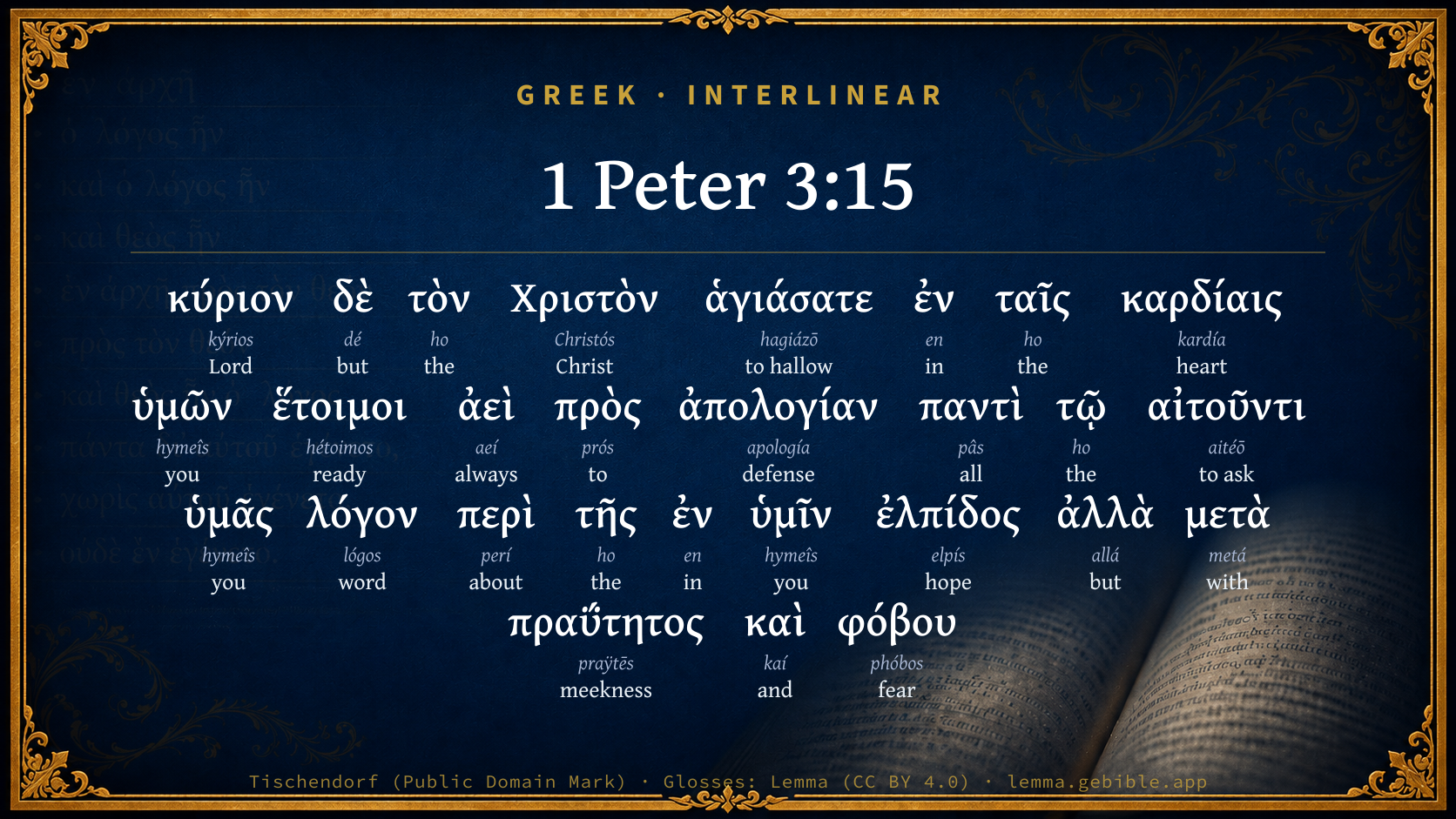
  1. κύριον kýrios G2962 “Lord” Noun, Accusative, Singular, Masculine
  2. δὲ dé G1161 “but” Conjunction
  3. τὸν ho G3588 “the” Article, Accusative, Singular, Masculine
  4. Χριστὸν Christós G5547 “Christ” Noun, Accusative, Singular, Masculine
  5. ἁγιάσατε hagiázō G37 “to hallow” Verb, Aorist, Active, Imperative, 2nd person, Plural
  6. ἐν en G1722 “in” Preposition
  7. ταῖς ho G3588 “the” Article, Dative, Plural, Feminine
  8. καρδίαις kardía G2588 “heart” Noun, Dative, Plural, Feminine
  9. ὑμῶν hymeîs G5210 “you” Personal pronoun, 2nd person, Genitive, Plural
  10. ἕτοιμοι hétoimos G2092 “ready” Adjective, Nominative, Plural, Masculine
  11. πρὸς prós G4314 “to” Preposition
  12. ἀπολογίαν apología G627 “defense” Noun, Accusative, Singular, Feminine
  13. παντὶ pâs G3956 “all” Adjective, Dative, Singular, Masculine
  14. τῷ ho G3588 “the” Article, Dative, Singular, Masculine
  15. αἰτοῦντι aitéō G154 “to ask” Verb, Present, Active, Participle, Dative, Singular, Masculine
  16. ὑμᾶς hymeîs G5210 “you” Personal pronoun, 2nd person, Accusative, Plural
  17. λόγον lógos G3056 “word” Noun, Accusative, Singular, Masculine
  18. περὶ perí G4012 “about” Preposition
  19. τῆς ho G3588 “the” Article, Genitive, Singular, Feminine
  20. ἐν en G1722 “in” Preposition
  21. ὑμῖν hymeîs G5210 “you” Personal pronoun, 2nd person, Dative, Plural
  22. ἐλπίδος elpís G1680 “hope” Noun, Genitive, Singular, Feminine
  23. ἀλλὰ allá G235 “but” Conjunction
  24. μετὰ metá G3326 “with” Preposition
  25. πραΰτητος praÿtēs G4240 “meekness” Noun, Genitive, Singular, Feminine
  26. καὶ kaí G2532 “and” Conjunction
  27. φόβου phóbos G5401 “fear” Noun, Genitive, Singular, Masculine

About this verse

These counts appear in no published source. They are computed here, from the morphology-tagged text and Lemma’s own curated glosses. What Lemma adds →

28
words
22
distinct lemmas
General Epistles
section

Notable vocabulary

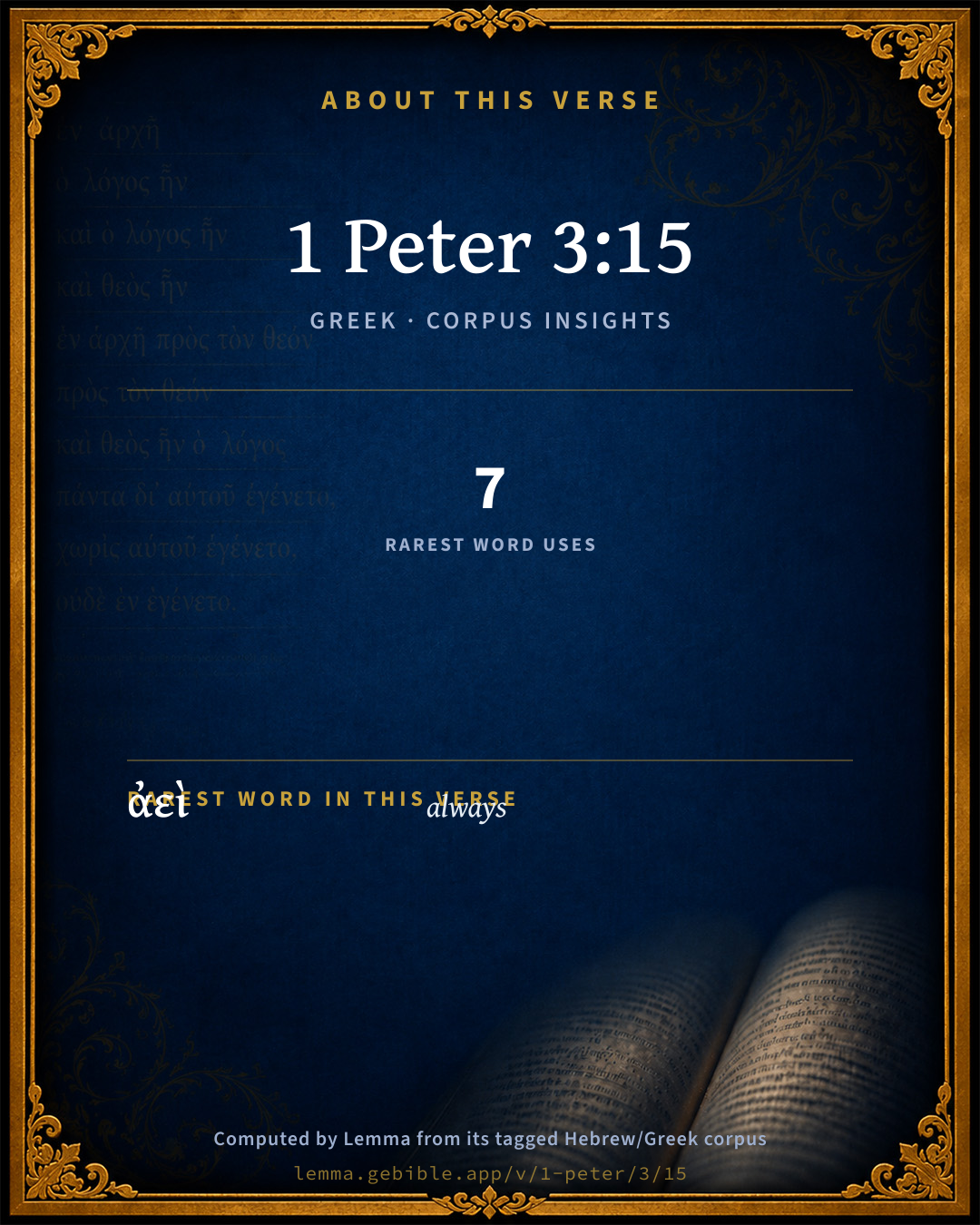
The rarest word here is ἀεὶ always G104 — appearing just 7 times in the whole Greek New Testament.

Shared distinctive vocabulary

ἀεὶ always G104 occurs in 7 verses of the Greek New Testament. Also found in:

Repetition

Words recur within this verse:

Cross-references

30

Topical passages linked to 1 Peter 3:15 in the Treasury of Scripture Knowledge — connected by theme and wording, ordered by reader-vote popularity; previews shown in the World English Bible.

  • Colossians 4:6 Let your speech always be with grace, seasoned with salt, that you may know how you ought to answer each one.
  • 2 Timothy 2:25–26 in gentleness correcting those who oppose him: perhaps God may give them repentance leading to a full knowledge of the truth,
  • Luke 21:14–15 Settle it therefore in your hearts not to meditate beforehand how to answer,
  • 1 Peter 3:2 seeing your pure behavior in fear.
  • Matthew 10:18–20 Yes, and you will be brought before governors and kings for my sake, for a testimony to them and to the Gentiles.
  • Psalms 119:46 I will also speak of your statutes before kings, And will not be disappointed.
  • Hebrews 6:1 Therefore leaving the doctrine of the first principles of Christ, let us press on to perfection--not laying again a foundation of repentance from dead works, of faith toward God,
  • Titus 1:2 in hope of eternal life, which God, who can't lie, promised before eternal times;
  • Colossians 1:27 to whom God was pleased to make known what are the riches of the glory of this mystery among the Gentiles, which is Christ in you, the hope of glory;
  • 1 Samuel 12:7 Now therefore stand still, that I may plead with you before Yahweh concerning all the righteous acts of Yahweh, which he did to you and to your fathers.
  • Colossians 1:5 because of the hope which is laid up for you in the heavens, of which you heard before in the word of the truth of the Gospel,
  • Colossians 1:23 if it is so that you continue in the faith, grounded and steadfast, and not moved away from the hope of the Gospel which you heard, which is being proclaimed in all creation under heaven; of which I, Paul, was made a servant.
  • Hebrews 6:18–19 that by two immutable things, in which it is impossible for God to lie, we may have a strong encouragement, who have fled for refuge to take hold of the hope set before us.
  • Daniel 3:16–18 Shadrach, Meshach, and Abednego answered the king, Nebuchadnezzar, we have no need to answer you in this matter.
  • Acts 5:29–31 But Peter and the apostles answered, "We must obey God rather than men.
  • Hebrews 3:6 but Christ is faithful as a Son over his house; whose house we are, if we hold fast our confidence and the glorying of our hope firm to the end.
  • 1 Peter 1:3–4 Blessed be the God and Father of our Lord Jesus Christ, who according to his great mercy became our father again to a living hope through the resurrection of Jesus Christ from the dead,
  • Isaiah 29:23 But when he sees his children, the work of my hands, in the midst of him, they shall sanctify my name; yes, they shall sanctify the Holy One of Jacob, and shall stand in awe of the God of Israel.
  • Isaiah 1:18 "Come now, and let us reason together," says Yahweh: "Though your sins be as scarlet, they shall be as white as snow. Though they be red like crimson, they shall be as wool.
  • Isaiah 5:16 But Yahweh of Hosts is exalted in justice, And God the Holy One is sanctified in righteousness.
  • Isaiah 41:21 Produce your cause, says Yahweh; bring forth your strong reasons, says the King of Jacob.
  • Amos 7:14–17 Then Amos answered Amaziah, "I was no prophet, neither was I a prophet's son; but I was a herdsman, and a farmer of sycamore trees;
  • Acts 4:8–12 Then Peter, filled with the Holy Spirit, said to them, "You rulers of the people, and elders of Israel,
  • 1 Peter 3:4 but in the hidden person of the heart, in the incorruptible adornment of a gentle and quiet spirit, which is in the sight of God very precious.
  • Acts 24:25 As he reasoned about righteousness, self-control, and the judgment to come, Felix was terrified, and answered, "Go your way for this time, and when it is convenient for me, I will summon you."
  • Jeremiah 26:12–16 Then spoke Jeremiah to all the princes and to all the people, saying, Yahweh sent me to prophesy against this house and against this city all the words that you have heard.
  • Acts 21:39–22:5 But Paul said, "I am a Jew, from Tarsus in Cilicia, a citizen of no insignificant city. I beg you, allow me to speak to the people."
  • 1 Peter 1:17 If you call on him as Father, who without respect of persons judges according to each man's work, pass the time of your living as strangers here in reverent fear:
  • Numbers 20:12 Yahweh said to Moses and Aaron, Because you didn't believe in me, to sanctify me in the eyes of the children of Israel, therefore you shall not bring this assembly into the land which I have given them.
  • Numbers 27:14 because you rebelled against my word in the wilderness of Zin, in the strife of the congregation, to sanctify me at the waters before their eyes. (These are the waters of Meribah of Kadesh in the wilderness of Zin.)

Cross-references courtesy of OpenBible.info (CC BY 4.0).

Where the printed editions differ

1 variant

Places in this verse where the major printed Greek editions disagree on the wording in a way that affects the translation — a comparison of editions, not a manuscript-by-manuscript collation. The editions are the modern critical texts (Nestlé-Aland 28/27, SBL, Westcott-Hort, Tregelles, Tyndale House) and the traditional texts behind the KJV (the Textus Receptus and the Byzantine/Majority text). It is not a claim about which reading is original.

  1. Different wording
    Χριστὸν

    “Christ”

    In NA28NA27TynSBLWHTreg Not in TRByz

    θεὸν (theon) 'God' occurs in traditional manuscripts (TR+Byz) instead of Χριστὸν (Christon) 'Christ' in older manuscripts (NA28+NA27+Tyn+SBL+WH+Treg)

Textual data: Translators Amalgamated Greek New Testament (STEPBible TAGNT) · CC BY 4.0.

Commentary

Notes on 1 Peter 3:15 from classic Christian and Jewish commentators (each source and its license shown beneath its notes). The classic Christian expositions comment on the surrounding passage and are grouped to its opening verse, so a note may address several verses; the Jewish commentaries on the Tanakh (Rashi and others) are per-verse, so they appear only where the commentator wrote on this verse.

Lemma curates 59 commentaries, every one of them public domain or Creative Commons licensed, each selected and text-cleaned for this edition rather than reprinted as found. About our sources →

Albert Barnes' Notes on the Bible

But sanctify the Lord God in your hearts - In Isaiah Isa 8:13 this is, “sanctify the Lord of hosts himself;” that is, in that connection, regard him as your Protector, and be afraid of him, and not of what man can do. The sense in the passage before us is, “In your hearts, or in the affections of the soul, regard the Lord God as holy, and act toward him with that confidence which a proper respect for one so great and so holy demands. In the midst of dangers, be not intimidated; dread not what man can do, but evince proper reliance on a holy God, and flee to him with the confidence which is due to one so glorious.” This contains, however, a more general direction, applicable to Christians at all times. It is, that in our hearts we are to esteem God as a holy being, and in all our deportment to act toward him as such. The object of Peter in quoting the passage from Isaiah, was to lull the fears of those whom he addressed, and preserve them from any alarms in view of the persecutions to which they might be exposed; the trials which would be brought upon them by people. Thus, in entire accordance with the sentiment as employed by Isaiah, he says, “Be not afraid of their terror, neither be troubled; but sanctify the Lord God in your hearts.” That is, “in order to keep the mind calm in trials, sanctify the Lord in your hearts; regard him as your holy God and Saviour; make him your refuge. This will allay all your fears, and secure you from all that you dread.” The sentiment of the passage then is, that the sanctifying of the Lord God in our hearts, or proper confidence in him as a holy and righteous God, will deliver us from fear. As this is a very important sentiment for Christians, it may be proper, in order to a just exposition of the passage, to dwell a moment on it:

I. What is meant by our sanctifying the Lord God? It cannot mean to make him holy, for he is perfectly holy, whatever may be our estimate of him; and our views of him evidently can make no change in his character. The meaning therefore must be, that we should regard him as holy in our estimate of him, or in the feelings which we have toward him. This may include the following things:

(1) To esteem or regard him as a holy being, in contradistinction from all those feelings which rise up in the heart against him - the feelings of complaining and murmuring under his dispensations, as if he were severe and harsh; the feelings of dissatisfaction with his government, as if it were partial and unequal; the feelings of rebellion, as if his claims were unfounded or unjust.

(2) To desire that he may be regarded by others as holy, in accordance with the petition in the Lord’s prayer, Mat 6:9, “hallowed be thy name;” that is, “let thy name be esteemed to be holy everywhere;” a feeling in opposition to that which is regardless of the honor which he may receive in the world. When we esteem a friend, we desire that all due respect should be shown him by others; we wish that all who know him should have the same views that we have; we are sensitive to his honor, just in proportion as we love him.

(3) To act toward him as holy: that is, to obey his laws, and acquiesce in all his requirements, as if they were just and good. This implies:

(a)That we are to speak of him as holy, in opposition to the language of disrespect and irreverence so common among mankind;

(b)That we are to flee to him in trouble, in contradistinction from withholding our hearts from him, and flying to other sources of consolation and support.

II. What is it to do this in the heart? Sanctify the Lord God in your hearts; that is, in contradistinction from a mere external service. This may imply the following things:

(1) In contradistinction from a mere intellectual assent to the proposition that he is holy. Many admit the doctrine that God is holy into their creeds, who never suffer the sentiment to find its way to the heart. All is right on this subject in the articles of their faith; all in their hearts may be murmuring and complaining. In their creeds he is spoken of as just and good; in their hearts they regard him as partial and unjust, as severe and stern, as unamiable and cruel.

(2) In contradistinction From a mere outward form of devotion. In our prayers, and in our hymns, we, of course, “ascribe holiness to our Maker.” But how much of this is the mere language of form! How little does the heart accompany it! And even in the most solemn and sublime ascriptions of praise, how often are the feelings of the heart entirely at variance with what is expressed by the lips! What would more justly offend us, than for a professed friend to approach us with the language of friendship, when every feeling of his heart belied his expressions, and we knew that his honeyed words were false and hollow!

III. Such a sanctifying of the Lord in our hearts will save us from fear. We dread danger, we dread sickness, we dread death, we dread the eternal world. We are alarmed when our affairs are tending to bankruptcy; we are alarmed when a friend is sick and ready to die; we are alarmed if our country is invaded by a foe, and the enemy already approaches our dwelling. The sentiment in the passage before us is, that if we sanctify the Lord God with proper affections, we shall be delivered from these alarms, and the mind will be calm:

(1) The fear of the Lord, as Leighton (in loc.) expresses it, “as greatest, overtops and nullifies all lesser fears: the heart possessed with this fear hath no room for the other.” It is an absorbing emotion; making everything else comparatively of no importance. If we fear God, we have nothing else to fear. The highest emotion which there can be in the soul is the fear of God; and when that exists, the soul will be calm amidst all that might tend otherwise to disturb it. “What time I am afraid,” says David, “I will trust in thee,” Psa 56:3. “We are not, careful,” said Daniel and his friends, “to answer thee, O king. Our God can deliver us; but if not, we will not worship the image,” Dan 3:16.

(2) If we sanctify the Lord God in our hearts, there will be a belief that he will do all things well, and the mind will be calm. However dark his dispensations may be, we shall be assured that everything is ordered aright. In a storm at sea, a child may be calm when he feels that his father is at the helm, and assures him that there is no danger. In a battle, the mind of a soldier may be calm, if he has confidence in his commander, and he assures him that all is safe. So in anything, if we have the assurance that the best thing is done that can be, that the issues will all be right, the mind will be calm. But in this respect the highest confidence that can exist, is that which is reposed in God.

(3) There will be the assurance that all is safe. “Though I walk,” says David, “through the valley of the shadow of death, I will fear no evil, for thou art with me,” Psa 23:4. “The Lord is my light and my salvation; whom shall I fear? The Lord is the strength of my life; of whom shall I be afraid? Psa 27:1. “God is our refuge and strength, a very present help in trouble: therefore will not we fear, though the earth be removed, and though the mountains be carried into the midst of the sea; though the waters thereof roar and be troubled, though the mountains shake with the swelling thereof,” Psa 46:1-3. Let us ever then regard the Lord as holy, just, and good. Let us flee to him in all the trials of the present life, and in the hour of death repose on his arm. Every other source of trust will fail; and whatever else may be our reliance, when the hour of anguish approaches, that reliance will fail, and that which we dreaded will overwhelm us. Nor riches, nor honors, nor earthly friends, can save us from those alarms, or be a security for our souls when “the rains descend, and the floods come, and the winds blow” upon us.

And be ready always - That is:

(a)Be always able to do it; have such reasons for the hope that is in you that they can be stated; or, have good and substantial reasons; and,

(b)Be willing to state those reasons on all proper occasions.

No man ought to entertain opinions for which a good reason cannot be given; and every man ought to be willing to state the grounds of his hope on all proper occasions. A Christian should have such intelligent views of the truth of his religion, and such constant evidence in his own heart and life that he is a child of God, as to be able at any time to satisfy a candid inquirer that the Bible is a revelation from heaven, and that it is proper for him to cherish the hope of salvation.

To give an answer - Greek, “An apology,” (ἀπολογίαν apologian.) This word formerly did not mean, as the word apology does now, an excuse for anything that is done as if it were wrong, but a defense of anything. We apply the word now to denote something written or said in extenuation of what appears to others to be wrong, or what might be construed as wrong - as when we make an apology to others for not fulfilling an engagement, or for some conduct which might be construed as designed neglect. The word originally, however, referred rather to that which was thought not to be true, than that which might be construed as wrong; and the defense or “apology” which Christians were to make of their religion, was not on the supposition that others would regard it as wrong, but in order to show them that it was true. The word used here is rendered “defense,” Act 22:1; Phi 1:7, Phi 1:17; answer, Act 25:16; 1Co 9:3; 2Ti 4:16; 1Pe 3:15; and clearing of yourselves in 2Co 7:11. We are not to hold ourselves ready to make an apology for our religion as if it were a wrong thing to be a Christian; but we are always to be ready to give reasons for regarding it as true.

To every man that asketh you - Anyone has a right respectfully to ask another on what grounds he regards his religion as true; for every man has a common interest in religion, and in knowing what is the truth on the subject. If any man, therefore, asks us candidly and respectfully by what reasons we have been led to embrace the gospel, and on what grounds we, regard it as true, we are under obligation to state those grounds in the best manner that we are able. We should regard it not as an impertinent intrusion into our private affairs, but as an opportunity of doing good to others, and to honor the Master whom we serve. Nay, we should hold ourselves in readiness to state the grounds of our faith and hope, whatever maybe the motive of the inquirer, and in whatever manner the request may be made. Those who were persecuted for their religion, were under obligation to make as good a defense of it as they could, and to state to their persecutors the “reason” of the hope which they entertained. And so now, if a man attacks our religion; if he ridicules us for being Christians; if he tauntingly asks us what reason we have for believing the truth of the Bible, it is better to tell him in a kind manner, and to meet his taunt with a kind and strong argument, than to become angry, or to turn away with contempt. The best way to disarm him is to show him that by embracing religion we are not fools in understanding; and, by a kind temper, to convince him that the influence of religion over us when we are abused and insulted, is a reason why we should love our religion, and why he should too.

A reason of the hope that is in you - Greek, “an account,” (λόγον logon.) That is, you are to state on what ground you cherish that hope. This refers to the whole ground of our hope, and includes evidently two things:

The reason why we regard Christianity as true, or as furnishing a ground of hope for people; and,

(2)The reason which we have ourselves for cherishing a hope of heaven, or the experimental and practical views which we have of religion, which constitute a just ground of hope.

It is not improbable that the former of these was more directly in the eye of the apostle than the latter, though both seem to be implied in the direction to state the reasons which ought to satisfy others that it is proper for us to cherish the hope of heaven. The first part of this duty - that we are to state the reasons why we regard the system of religion which we have embraced as true - implies, that we should be acquainted with the evidences of the truth of Christianity, and be able to state them to others. Christianity is founded on evidence; and though it cannot be supposed that every Christian will be able to understand all that is involved in what are called the evidences of Christianity, or to meet all the objections of the enemies of the gospel; yet every man who becomes a Christian should have such intelligent views of religion, and of the evidences of the truth of the Bible, that he can show to others that the religion which he has embraced has claims to their attention, or that it is not a mere matter of education, of tradition, or of feeling. It should also be an object with every Christian to increase his acquaintance with the evidences of the truth of religion, not only for his own stability and comfort in the faith, but that he may be able to defend religion if attacked, or to guide others if they are desirous of knowing what is truth. The second part of this duty, that we state the reasons which we have for cherishing the hope of heaven as a personal matter, implies:

(a)That there should be, in fact, a well-founded hope of heaven; that is, that we have evidence that we are true Christians, since it is impossible to give a “reason” of the hope that is in us unless there are reasons for it;

(b)That we be able to state in a clear and intelligent manner what constitutes evidence of piety, or what should be reasonably regarded as such; and,

(c)That we be ever ready to state these reasons.

A Christian should always be willing to converse about his religion. He should have such a deep conviction of its truth, of its importance, and of his personal interest in it; he should have a hope so firm, so cheering, so sustaining, that he will be always prepared to converse on the prospect of heaven and to endeavor to lead others to walk in the path to life.

With meekness - With modesty; without any spirit of ostentation; with gentleness of manner. This seems to be added on the supposition that they sometimes might be rudely assailed; that the questions might be proposed in a spirit of evil; that it might be done in a taunting or insulting manner. Even though this should be done, they were not to fall into a passion, to manifest resentment, or to retort in an angry and revengeful manner; but, in a calm and gentle spirit, they were to state the reasons of their faith and hope, and leave the matter there.

And fear - Margin, “reverence.” The sense seems to be, “in the fear of God; with a serious and reverent spirit; as in the presence of Him who sees and hears all things.” It evidently does not mean with the fear or dread of those who propose the question, but with that serious and reverent frame of mind which is produced by a deep impression of the importance of the subject, and a conscious sense of the presence of God. It follows, from the injunction of the apostle here:

(1)That every professing Christian should have clear and intelligent views of his own personal interest in religion, or such evidences of piety that they can be stated to others, and that they can be made satisfactory to other minds;

(2)That every Christian, however humble his rank, or however unlettered he may be, may become a valuable defender of the truth of Christianity;

(3)That we should esteem it a privilege to bear our testimony to the truth and value of religion, and to stand up as the advocates of truth in the world. Though we may be rudely assailed, it is an honor to speak in defense of religion; though we are persecuted and reviled, it is a privilege to be permitted in any way to show our fellow-men that there is such a thing as true religion, and that man may cherish the hope of heaven.

Albert Barnes' Notes on the Bible (1834–1885) — public domain. Text from a community e-Sword/MySword module.

Bengel's Gnomon

Johann Albrecht Bengel

1Pe 3:15. Ἕτοιμοι δὲ, but prepared) The word prepared gives the idea of boldness; δὲ has force. Not only ought the conversation to be good, on which point see ch. 1Pe 2:12, note, but every one also ought to be prepared to make confession.—τῷ αἰτοῦντι, to him that asketh) Among the Gentiles some were openly wicked, 1Pe 3:16; others were in doubt. To these latter believers are ordered to give a kind answer.—ἐλπίδος, of the hope) which they confess, who say that they are strangers in the world, and avoid its lusts, ch. 1Pe 2:11. Comp. Heb 11:13, and following verses. The hope of Christians has often excited others to inquiry.—μετὰ, with) Twells, P. I. p. 125, joins this with every man that asketh; but it depends upon prepared to give an answer. There is need of meekness with regard to ourselves; of fear, with respect to others; of a good conscience towards God.—φόβου, fear) In common language, respect. They who have a good conscience, when accused, are more easily provoked, and less easily preserve meekness and fear, than the guilty. Therefore they are here admonished, to unite with a good conscience, meekness and fear, and thus to gain a complete victory. Meekness avails especially, when we have to do with inferiors; fear, when we have to do with superiors.

Bengel's Gnomon of the New Testament — English translation (T&T Clark, Edinburgh, 1860) — public domain. Text from a community e-Sword module.

Meyer's Critical & Exegetical Commentary

Heinrich August Wilhelm Meyer

1Pe_3:15. κύριον δὲ τὸν Χριστόν] κύριον, in Isaiah equivalent to τὸν Θεόν; a substitution of this kind is frequently found in the N. T., where reference is made to passages in the O. T., and can be easily explained on the principle that a consciousness distinctively Christian was asserting itself; κύριον is placed first, as antithesis to αὐτῶν (Wiesinger). Schott denies that κύριον stands in apposition to τὸν Χριστόν, holding that κύριον is to be taken rather as a predicate of the object, equivalent to, as Lord; for this reason, that κύριος stands here without the article, and that the simple conjunction of κύριος and Χριστός does not occur. But against the first objection the expression κύριος ὁ Θεός may be urged, and against the second the verse Luk_2:11. It is more natural, and at the same time more in harmony with the passage in the O. T., to connect κύριος directly with τὸν Χριστόν: but … the Lord, the Messiah.

ἁγιάσατε] in antithesis to φοβηθῆτε and ταραχθῆτε; hold, i.e. honour, fear as holy (de Wette); the sanctifying comprehends within it the fear of God; cf. Isa_8:18; Isa_29:23; it thus forms the contrast to the fear of man; where the former is, the latter must give way.

ἐν ταῖς καρδίαις ὑμῶν] added by the apostle in order to mark the inward nature of the ἁγιάζειν.

ἕτοιμοι] Whether δέ be the original reading or not, this clause is undoubtedly intimately connected in thought with that which precedes it. Without δέ this being ready is conceived as a proof of the ἁγιάζειν Χρ.; with δέ the thought is this, that the ἁγιάζειν Χρ. κ.τ.λ., which banishes all fear of man, should not exclude the ἀπολογία before men (de Wette, Wiesinger). Hofmann takes the particle here as equal to rather; but against this is the fact that here κύριον … ὑμῶν would have to be taken as a simple parenthesis, inasmuch as δέ would refer only to what precedes, and a second antithesis would then be added to the already antithetical κύριον δὲ κ.τ.λ.

ἀεὶ πρὸς ἀπολογίαν παντὶ τῷ κ.τ.λ.] ἕτοιμος πρός, cf. Titus 3 :.The injunction exempts neither time (ἀεί) nor person (παντί) (Steiger).

To limit its application to a judicial examination is arbitrary, and militates against παντί.

ἀπολογία not equal to satisfactio (Vulg.), but here rather quaevis responsio, qua ratio fidei (more correctly spei) nostrae redditur (Vorstius; Php_1:7; Php_1:16; Act_26:2).

παντὶ τῷ αἰτοῦντι κ.τ.λ.] The dative depending on ἀπολογίαν, cf. 1Co_9:3; for αἰτέω with double accusative, cf. Winer, p. 212 f. [E. T. 281]. λόγον αἰτεῖν: to demand account of, only here, cf. chap. 1Pe_4:5; Rom_14:12.

περὶ τῆς ἐν ὑμῖν ἐλπίδος] περί: as to its nature and ground.

ἐλπίς, not equivalent to πίστις (Calvin: spes hic per synecdochen pro fide capitur), but the hope of the Christian looking, on the ground of faith, into the future salvation.[190]

ἀλλὰ μετὰ πραΰτητος καὶ φόβου] If ἀλλά be the true reading, as there can hardly be any doubt it is, it will serve to make more sharply prominent the way and manner, in which the ἀπολογία should be conducted; de Wette: as it were: but remember.

μετά, to be connected not with ἕτοιμοι, but with ἀπολογίαν; πραΰτητος opposed to passionate zeal. φόβου is to be applied directly neither to God (Aretius: reverentia et timor Dei; thus Weiss also, p. 169), nor to men before whom testimony is to be borne (according to some: the civil authorities); but it denotes the being afraidbased, of course, on the fear of Godof every unseemly kind of ἀπολογία, and stands especially opposed to all arrogant self-confidence (Wiesinger).

[190] That this account had special reference to the removal of the suspicion that the kingdom of Christ was of this world, is nowhere alluded to in the context (de Wette, Schott). And Schott is hardly justified in giving the apostles exhortations special application to the divinely ordained ordinances of natural social life.

Meyer — Critical and Exegetical Commentary on the New Testament — English translation by Peter Christie, edited by Frederick Crombie (T&T Clark, 1880) — public domain. Text from a community e-Sword module.

Geneva Bible (1599)

Geneva Bible translators

Give him all praise and glory, and hang only on him.

He will have us when we are afflicted for righteousness’ sake, to be careful not for redeeming of our life, either with denying, or renouncing the truth, or with like violence, or any such means: but rather to give an account of our faith boldly, and yet with a meek spirit, and full to godly reverence, that the enemies may not have anything justly to object, but may rather be ashamed of themselves.

Geneva Bible (1599) marginal notes — public domain. Text via Bolls.life.

Jamieson, Fausset & Brown

Robert Jamieson, A. R. Fausset & David Brown

sanctify--hallow; honor as holy, enshrining Him in your hearts. So in the Lord's Prayer, Mat 6:9. God's holiness is thus glorified in our hearts as the dwelling-place of His Spirit.

the Lord God--The oldest manuscripts read "Christ." Translate, "Sanctify Christ as Lord."

and--Greek, "but," or "moreover." Besides this inward sanctification of God in the heart, be also ready always to give, &c.

answer--an apologetic answer defending your faith.

to every man that asketh you--The last words limit the universality of the "always"; not to a roller, but to everyone among the heathen who inquires honestly.

a reason--a reasonable account. This refutes Rome's dogma, "I believe it, because the Church believes it." Credulity is believing without evidence; faith is believing on evidence. There is no repose for reason itself but in faith. This verse does not impose an obligation to bring forward a learned proof and logical defense of revelation. But as believers deny themselves, crucify the world, and brave persecution, they must be buoyed up by some strong "hope"; men of the world, having no such hope themselves, are moved by curiosity to ask the secret of this hope; the believer must be ready to give an experimental account "how this hope arose in him, what it contains, and on what it rests" [STEIGER].

with--The oldest manuscripts read, "but with." Be ready, but with "meekness." Not pertly and arrogantly.

meekness-- (Pe1 3:4). The most effective way; not self-sufficient impetuosity.

fear--due respect towards man, and reverence towards God, remembering His cause does not need man's hot temper to uphold it.

Jamieson, Fausset & Brown — Commentary Critical and Explanatory on the Whole Bible (1871) — public domain (CC PDM 1.0). Text via the HelloAO Bible API.

Adam Clarke's Commentary

Verse 15. But sanctify the Lord God in your hearts] To sanctify God may signify to offer him the praises due to his grace, but as to sanctify literally signifies to make holy, it is impossible that God should be thus sanctified. We have often already seen that αγιαζω signifies to separate from earth, that is, from any common use or purpose, that the thing or person thus separated may be devoted to a sacred use. Perhaps we should understand Peter's words thus: Entertain just notions of God; of his nature, power, will, justice, goodness, and truth. Do not conceive of him as being actuated by such passions as men; separate him in your hearts from every thing earthly, human, fickle, rigidly severe, or capriciously merciful. Consider that he can neither be like man, feel like man, nor act like man. Ascribe no human passions to him, for this would desecrate not sanctify him. Do not confine him in your conceptions to place, space, vacuity, heaven, or earth; endeavour to think worthily of the immensity and eternity of his nature, of his omniscience, omnipresence, and omnipotence. Avoid the error of the heathens, who bound even their Dii Majores, their greatest gods, by fate, as many well-meaning Christians do the true God by decrees; conceive of him as infinitely free to act or not act, as he pleases. Consider the goodness of his nature; for goodness, in every possible state of perfection and infinitude, belongs to him. Ascribe no malevolence to him; nor any work, purpose, or decree, that implies it: this is not only a human passion, but a passion of fallen man. Do not suppose that he can do evil, or that he can destroy when he might save; that he ever did, or ever can, hate any of those whom he made in his own image and in his own likeness, so as by a positive decree to doom them, unborn, to everlasting perdition, or, what is of the same import, pass them by without affording them the means of salvation, and consequently rendering it impossible for them to be saved. Thus endeavour to conceive of him; and, by so doing, you separate him from all that is imperfect, human, evil, capricious, changeable, and unkind. Ever remember that he has wisdom without error, power, without limits, truth without falsity, love without hatred, holiness without evil, and justice without rigour or severity on the one hand, or capricious tenderness on the other. In a word, that he neither can be, say, purpose, or do, any thing that is not infinitely just, holy, wise, true, and gracious; that he hates nothing that he has made; and has so loved the world, the whole human race, as to give his only-begotten Son to die for them, that they might not perish, but have everlasting life. Thus sanctify the Lord God in your hearts, and you will ever be ready to give a reason of the hope that is in you to every serious and candid inquirer after truth. Most religious systems and creeds are incapable of rational explanation, because founded on some misconception of the Divine nature.

"They set at odds heaven's jarring attributes,

And with one excellence another wound."

The system of humanizing God, and making him, by our unjust conceptions of him, to act as ourselves would in certain circumstances, has been the bane of both religion and piety; and on this ground infidels have laughed us to scorn. It is high time that we should no longer know God after the flesh; for even if we have known Jesus Christ after the flesh, we are to know him so no more.

What I have written above is not against any particular creed of religious people, it is against any or all to whom it may justly apply, it may even be against some portions of my own; for even in this respect I am obliged daily to labour to sanctify the Lord God in my heart, to abstract him from every thing earthly and human, and apprehend him as far as possible in his own essential nature and attributes through the light of his Spirit and the medium of his own revelation. To act thus requires no common effort of soul: and just apprehensions of this kind are not acquired without much prayer, much self-reflection, much time, and much of the grace and mercy of God.

Instead of τονθεον, GOD, ABC, four others, both the Syriac, Erpen's Arabic, the Coptic, Vulgate, and Armenian, with Clement and Fulgentius, read τονχριστον, CHRIST. Sanctify Christ in your hearts. This reading is at least equal to the other in the authorities by which it is supported; but which was written by St. Peter we know not.

A reason of the hope] An account of your hope of the resurrection of the dead and eternal life in God's glory. This was the great object of their hope, as Christ was the grand object of their faith.

The word απολογια, which we translate answer, signifies a defence; from this we have our word apology, which did not originally signify an excuse for an act, but a defence of that act. The defences of Christianity by the primitive fathers are called apologies. See Clarke on Ac 21:1.

With meekness and fear] Several excellent MSS. add the word αλλα, but, here, and it improves the sense considerably: Be ready always to give an answer to every man that asketh you a reason of the hope that is in you, BUT with meekness and fear. Do not permit your readiness to answer, nor the confidence you have in the goodness of your cause, to lead you to answer pertly or superciliously to any person; defend the truth with all possible gentleness and fear, lest while you are doing it you should forget his presence whose cause you support, or say any thing unbecoming the dignity and holiness of the religion which you have espoused, or inconsistent with that heavenly temper which the Spirit of your indwelling Lord must infallibly produce.

Adam Clarke's Commentary on the Bible (1810–1826) — public domain. Text from a community e-Sword/MySword module.

John Calvin's Commentaries

Though this is a new precept, it yet depends on what is gone before, for he requires such constancy in the faithful, as boldly to give a reason for their faith to their adversaries. And this is a part of that sanctification which he had just mentioned; for we then really honor God, when neither fear nor shame hinders us from making a profession of our faith. But Peter does not expressly bid us to assert and proclaim what has been given us by the Lord everywhere, and always and among all indiscriminately, for the Lord gives his people the spirit of discretion, so that they may know when and how far and to whom it is expedient to speak. He bids them only to be ready to give an answer, lest by their sloth and the cowardly fear of the flesh they should expose the doctrine of Christ, by being silent, to the derision of the ungodly. The meaning then is, that we ought to be prompt in avowing our faith, so as to set it forth whenever necessary, lest the unbelieving through our silence should condemn the religion we follow.

But it ought to be noticed, that Peter here does not command us to be prepared to solve any question that may be mooted; for it is not the duty of all to speak on every subject. But it is the general doctrine that is meant, which belongs to the ignorant and the simple. Then Peter had in view no other thing, than that Christians should make it evident to unbelievers that they truly worshipped God, and had a holy and good religion. And in this there is no difficulty, for it would be strange if we could bring nothing to defend our faith when any one made inquiries respecting it. For we ought always to take care that all may know that we fear God, and that we piously and reverently regard his legitimate worship.

This was also required by the state of the times: the Christian name was much hated and deemed infamous; many thought the sect wicked and guilty of many sacrileges. It would have been, therefore, the highest perfidy against God, if, when asked, they had neglected to give a testimony in favor of their religion. And this, as I think, is the meaning of the word apology, which Peter uses, that is, that the Christians were to make it evident to the world that they were far off from every impiety, and did not corrupt true religion, on which account they were suspected by the ignorant.

Hope here is by a metonymy to be taken for faith. Peter, however, as it has been said, does not require them to know how to discuss distinctly and refinedly every article of the faith, but only to shew that their faith in Christ was consistent with genuine piety. And hence we learn how all those abuse the name of Christians, who understand nothing certain respecting their faith, and have nothing to give as an answer for it. But it behoves us again carefully to consider what he says, when he speaks of that hope that is in you; for he intimates that the confession which flows from the heart is alone that which is approved by God; for except faith dwells within, the tongue prattles in vain. It ought then to have its roots within us, so that it may afterwards bring forth the fruit of confession.

John Calvin's Commentaries (1540-1563) — public domain. Text from the Calvin Translation Society English edition (1840s-50s) via the Christian Classics Ethereal Library (ccel.org). Calvin's coverage is partial (roughly two-thirds of the Bible); uncommented books and verses are honest gaps, never fabricated. The 19th-century editor's footnotes and remarks are omitted so the notes are faithfully Calvin's own voice.

Ellicott's Commentary for English Readers

(15) But sanctify the Lord God in your hearts.—The tense of this and the two preceding imperatives shows that St. Peter meant this for advice to be acted upon at the moment of being called on to suffer. The passage, as it stands in Isaiah, runs literally, “Jehovah Sabaoth, Him shall ye sanctify, and He (shall be) your fear, and He your dread.” It becomes, therefore, very striking when we find that, without a shadow of doubt, the right reading here is, But sanctify the Lord the Christ in your hearts. How is it possible, except on the supposition that the Catholic doctrine is really a statement of fact, that a Jew like St. Peter should ever have come to apply to a Man whom he had known familiarly, a Man who had served him at table and had washed his feet, the words which Isaiah had said about the “Lord of Hosts?” This passage immediately precedes that which was quoted in 1Pe_2:8, and (like that) is not caught up at random, but as coming in the great Immanuel passage. That presence of God which was the palladium of Israel in the days of Hezekiah has found fulfilment in “the Christ” now given. But what is meant by “sanctifying” Him? The phrase is not elsewhere used in the New Testament, except in the Lord’s Prayer; but in the Old Testament see Lev_10:3; Isa_29:23; Eze_38:23. As to “glorify” God means (in word and deed) to recognise His glorious perfections; as to “magnify” Him means to recognise His greatness; as to “justify” Him means to recognise His inherent justice; so to “sanctify” Him means to recognise, in word and deed, His full holiness, and therefore to treat Him with due awe. This not only substitutes the fear of God for the fear of man (since they mutually exclude each other), but enforces purity of life, thus catching up again “that which is good” and “for righteousness’ sake.” This, adds St. Peter, is to be done “in your hearts.” This does not mean simply “with your hearts,” or “from your hearts” (i.e., inwardly, or, with all sincerity and devotion), but it signifies the local habitation where the Christ is to be thus recognised. That is to say: St. Peter, like St. Paul (Eph_3:17), acknowledges an indwelling of Christ in the hearts of the faithful; and this indwelling not merely subjective, consisting of their constant recollection of him, but real and objective: there He is, as in a shrine, and they must pay due reverence to His presence. The Apostle does, in fact, in those words “in your hearts,” purposely call attention to the difference between Isaiah’s use of the name Immanuel and the Christian meaning of it. To Isaiah, God dwelt in the midst of a people in its corporate capacity; St. Peter knew that, through the Incarnation, each individual Christian has God in him, united with him.

And be.—The better reading omits the connecting particle, so that we should put “being” instead of “and be.”

Ready always to give an answer.—This is the consequence of sanctifying Christ within by the worship of a pure life, that no moment, no questioner finds us unprepared to speak with freedom of our hope in Him. The word for “answer” here is apologia, an apology; not, of course, in the modern sense of an excuse, but a defence, the reply of an accused person, like the well-known Apologia Socratis, or the great modern Apologia pro Vita Sua, or the works from which Tertullian, Athenagoras, St. Justin, and others are called “The Apologists.” It does not mean that every person is bound to be able to state intellectually the nature and grounds of the Christian creed, though such a duty may, perhaps, be fairly deduced from the text. It does not say that every Christian ought to know why he is a Christian, but that every Christians own life ought to be so free from taint, so conscious of Christ enshrined within, as to cause him no misgiving in defending the faith from the calumnies (see 1Pe_2:12) brought against it. The constant readiness, or freedom from encumbrance of sin, is the main point, “which intimates,” says Leighton, “it was not always to be done to every one, but we, being ready to do, are to consider when, and to whom, and how far.” Consciousness of impurity of life shuts a man’s mouth from defending Christian morality.

That asketh you a reason.—Rather, that demandeth of you an account. It does not mean inquirers about Christian doctrine, but those who call Christians to account for their profession of the Gospel hopes. Though it must not be exclusively so taken, St. Peter evidently means chiefly the being called into the law court to give account. Probably he is thinking of our Lord’s charge to himself and his co-apostles, in St. Luk_12:11. (Comp. Mat_10:5; Mat_10:16; Mat_10:19.)

Of the hope that is in you.—More literally, with regard to the hope that is in you: i.e., with regard to the Christianity in which you share. It is, of course, quite a modern application to the text to see in this anything of the individual assurance of salvation. However fairly it may be argued that a Christian ought to know why he, personally, expects to be saved, it is not the thought of St. Peter here. Christianity is here called a hope, rather than a faith, as in Act_28:20, Col_1:23, because, especially in times of persecution, so much of our creed has a future tinge.

With meekness and fear.—There ought certainly to be added a warning But before these words. The readiness of the Christian’s defence of himself and the Church from all moral aspersions is not to be marred by any self-exaltation or improper confidence. Archbishop Leighton says, “Not, therefore, blustering and flying out into invectives because he hath the better on it against any man that questions him touching this hope, as some think themselves certainly authorised to use rough speech because they plead for truth. On the contrary, so much the rather study meekness, for the glory and advantage of the truth.” The “fear” will be, in large measure, a dread of overstepping the bounds of truth or modesty in speaking of the Christian morals. The Acts of the Martyrs, with all their splendour, too often show how St. Peter’s cautious But was needed.

A Bible Commentary for English Readers, edited by Charles John Ellicott (1878–1897) — public domain. Text from a community e-Sword module.

The Cambridge Bible for Schools and Colleges

gen. ed. J. J. S. Perowne

15. but sanctify the Lord God in your hearts] The better MSS. give the Lord Christ. The original text was probably altered by transcribers to bring it into conformity with the LXX. text of Isaiah. To “sanctify Christ” or “God” was to count His Name as holy above all other names, His fear, as the only fear which men ought to cherish, and therefore as the safeguard against all undue fear of men. The words “in your hearts” are added by the Apostle to the text of Isaiah as shewing that the “hallowing” of which he speaks should work in the root and centre of their spiritual being.

be ready always to give an answer] The words imply that the disciples of Christ were not to take refuge in the silence to which fear might prompt. They were to be ready with a defence, a vindication, an apologia, for their faith and hope. And this answer was to be given not in a tone of threatening defiance, but “in meekness” as regards the interrogator, whether the questions were put officially or in private, and “in fear,” partly lest the truth should suffer through any infirmities in its defenders, partly because the spirit of reverential awe towards God was the best safeguard against such infirmities.

The Cambridge Bible for Schools and Colleges (gen. ed. J. J. S. Perowne; Cambridge University Press, 1878–1918) — public domain. Text from a community e-Sword module.

John Gill's Exposition

Having a good conscience,.... Meaning not the faculty of the conscience itself, which is naturally evil, and defiled with sin, and is only made good by the sanctification of the Spirit, and the sprinkling of the blood of Jesus, by which the heart is sprinkled from it, and that itself purged from dead works; but a life and conversation according to the dictates of such a conscience, in the uprightness and sincerity of it, and by the grace of God, and according to the Gospel, and whereby the doctrines of it are adorned; for, as besides internal sanctification of God, or a fearing of him, and believing in him with the heart, there must be a profession of him with the mouth, and a reason of faith and hope given verbally, when there is an occasion for it; so to both must be added a conscientious discharge of duty, both to God and men, which is one way of defending and recommending the doctrines of the Gospel:

that whereas they speak evil of you as of evildoers; as vain, proud, haughty, and arrogant persons, as seditious men, enemies to order and civil magistracy; as such that speak evil of dignities, and despise government; when they shall see your modest and humble deportment in the world, and before them, and with what reverence and esteem you treat them:

they may be ashamed that falsely accuse your good conversation in Christ; which was in consequence of their being in Christ, and made new creatures by him, and was as became his Gospel, and by and under the influence of his grace and Spirit.

John Gill's Exposition of the Whole Bible (1746–1763) — public domain (CC PDM 1.0). Text via the HelloAO Bible API.

Trapp's Complete Commentary

John Trapp

15 But sanctify the Lord God in your hearts: and be ready always to give an answer to every man that asketh you a reason of the hope that is in you with meekness and fear:

Ver. 15. Sanctify the Lord God] Consider and conceive of him, as he stands described in the Scriptures, and as related to his people, resting upon his power and love, for safety here, and salvation hereafter.

Ready always to give an answer] Gr. To make apology, a bold and wise profession of the truth, with due observation of just circumstances. To dissemble is ever a fault; but not to profess is then only a fault, when a man is silent, Intempestive et loco minime idoneo, at an unfit time and place. Let me be counted and called proud, or anything, Mode impii silentii non arguar, said Luther, so I be not guilty of a sinful silence.

To every man that asketh] Christians should in this case stay till they are asked. Cyprian reproveth the rashness of those in his time, that would go of their own accord to the heathen magistrates, professing themselves Christians; whereby they were put to death. This made one of the persecutors cry out, O miseri, si libet perire num vobis rupes aut restes desunt? O wretches, can ye find no way else to despatch yourselves, but that I must be thus troubled with you Christ, saith Cyprian, would have us rather confess than profess our religion, Now, he confesseth, that doth it being asked; as he professeth, that doth it of his own free accord.

A reason of the hope] Not every trifling question or malicious cavil. Christ answered the governor not a word to some things, and yet he witnessed a good confession before Pontius Pilate, 1Ti 6:13.

With meekness and fear] Lest you should dishonour a good cause by an ill carriage. Austin professeth this was that which heartened him, and made him to triumph in his former Manichism, that he met with feeble opponents, and such as his nimble wit was easily able to overturn. Carolostadius also had the right on his side, but was not able to make it out and maintain it against Luther.

John Trapp, A Commentary or Exposition upon All the Books of the Old and New Testament (1647–1656) — public domain. Text from a community e-Sword module.

Haydock's Catholic Bible Commentary

Always ready to satisfy,[1] &c. St. Peter would have every Christian, according to his circumstances and capacity, ready to give general reasons of his faith and hope of salvation, both to infidels and heretics that refuse to believe. (Witham)

===============================

[BIBLIOGRAPHY]

Ad satisfactionem, Greek: pros apologian, ad defensionem.

George Leo Haydock (1774–1849), Haydock's Catholic Family Bible and Commentary, 1859 edition — public domain. Excludes Psalms (Douay-Rheims chapter numbering differs from Protestant) and Deuterocanonical books (Catholic canon only).

Matthew Poole's English Annotations

But sanctify the Lord God in your hearts; exalt him in your hearts, and give him the honour of all his glorious perfections, power, wisdom, goodness, faithfulness, &c., by believing them, and depending upon his promises for defence and assistance against all the evils your enemies may threaten you with.

And be ready always; prepared to answer when duly called to it.

To give an answer; or, to make an apology or defence, viz. of the faith ye profess; the word is used, Act 22:1; 1Co 9:3.

To every man that asketh you; either that hath authority to examine you, and take an account of your religion; or, that asks with modesty, and a desire to be satisfied, and learn of you.

A reason of the hope that is in you; i.e. faith, for which hope is frequently used in Scipture, which is built upon faith: the sense is: Whereas unbelievers, your persecutors especially, may scoff at your hope of future glory, as vain and groundless, and at yourselves, as mad or foolish, for venturing the loss of all in this world, and exposing yourselves to so many sufferings, in expectation of ye know not what uncertainties in the other; do ye therefore be always ready to defend and justify your faith against all objectors, and to show how reasonable your hope of salvation is, and on how sure a foundation it is built.

With meekness and fear; either with meekness in relation to men, in opposition to passion and intemperate zeal, (your confession of the faith must be with courage, but yet with a spirit of meekness and modesty), and fear or reverence in relation to God, which, where it prevails, overcomes the fierceness of men’s spirits, and makes them speak modestly of the things of God, and give due respect to men; or, fear may be set in opposition to pride, and presumption of a man’s own wisdom or strength; q.d. Make confession of your faith humbly, with fear and trembling, not in confidence of your own strength, or gifts, or abilities.

Matthew Poole's English Annotations on the Holy Bible (1683–1685) — public domain. Text from a community e-Sword/MySword module.

Whedon's Commentary on the Bible

Daniel D. Whedon

15. The Lord God—The proper object of fear, as opposed to terror. The passage is from Isa_8:12-13. Tregelles, Tischendorf, Alford, and Wordsworth read Christ for God, the last two translating “sanctify Christ as the Lord.” But it is rather Christ who is the Lord, the Lord Christ, whom they are instructed to sanctify. Enthrone him in your hearts for life and for death; and in alarm and danger he shall keep you in quietness and rest. The passage is proof of the Godhead of Christ.

Daniel D. Whedon (gen. ed.), Commentary on the Old and New Testaments (1874–1909) — public domain. Text from a community e-Sword module.

The Pulpit Commentary

But sanctify the Lord God in your hearts. From Isa_8:13. The reading of the best and oldest manuscripts here is Kurion de ton, "Sanctify the Lord Christ," or, "Sanctify the Christ as Lord." The absence of the article with Kurion is in favor of the second translation; but the first seems more natural, more in accordance with the original passage in Isaiah, and the common expression, Kuriov oJ Qeov, is in its favor. Whichever translation is adopted, St. Peter here substitutes the Savior"s Name where the prophet wrote, "the Lord of hosts, Jehovah Sabaoth a change which would be nothing less than impious if the Lord Jesus Christ were not truly God. "Sanctify him," the apostle says (as the Lord himself teaches us to say, in the first words of the Lord"s Prayer); that is, regard him as most holy, awful in sanctity; serve him with reverence and godly fear; so you will not "be afraid of their terror." The holy fear of God will lift you above the fear of man. "Let him be your fear, and let him be your dread". (Isa_8:13; see also Lev_10:3; Isaiah. Eze_38:23) St. Peter adds the words, "in your hearts," to teach us that this reverence, this hallowing of the Name of God, must be inward and spiritual, in our inmost being. And be ready always to give an answer to every man; literally, ready always for an apology to every man. The word ajpologia is often used of a formal answer before a magistrate, or of a written defense of the faith; but here the addition, "to every man," shows that St. Peter is thinking of informal answers on any suitable occasion. That asketh you a reason of the here that is in you; literally, an account concerning the hope. Hope is the grace on which St. Peter lays most stress; it lives in the hearts of Christians. Christians ought to be able to give an account of their hope when asked, both for the defense of the truth and for the good of the asker. That account may be very simple; it may be the mere recital of personal experience often the most convincing of arguments; it may be, in the case of instructed Christians, profound and closely reasoned. Some answer every Christian ought to be able to give. With meekness and fear. The best manuscripts read, "but with meekness and fear." The word "but" (ajlla) is emphatic; argument always involves danger of weakening the spiritual life through pride or bitterness. We must sometimes "contend earnestly for the faith;" but it must be with gentleness and awe. We should fear lest we injure our own souls by arrogant and angry controversy; we should seek the spiritual good of our opponents; and we should entertain a solemn awe of the presence of God, with a trembling anxiety to think and to say only what is acceptable unto him.

The Pulpit Commentary (1880–1919), ed. H.D.M. Spence-Jones & Joseph S. Exell — public domain. Text from a community e-Sword module.

John Wesley's Explanatory Notes

But sanctify the Lord God in your hearts - Have an holy fear, and a full trust in his wise providence. The hope - Of eternal life. With meekness - For anger would hurt your cause as well as your soul. And fear - A filial fear of offending God, and a jealousy over yourselves, lest ye speak amiss.

John Wesley, Explanatory Notes Upon the Whole Bible (1754–1765) — public domain. Text via the GEBible commentary corpus.

Burkitt's Expository Notes on the New Testament

William Burkitt

But sanctify the Lord God in your hearts;-- This phrase in scripture imports, 1. A firm belief of God’s Almighty power, that he can protect from sufferings; and a full affiance in his goodness and providence, that he will do it, if it be good for us.

2. It is from the heart to own and believe the truth of all that God delivers in his word by way of promise to his people, and by way of threatening to their enemies, that his eyes are over the righteous, and his face against them that do evil.

3. To sanctify the Lord God in our hearts, is always to maintain upon our minds such an holy fear, and awful reverence of God, as will effectually prevail upon us to dread more the displeasure of God, than any thing we can suffer at the hand of man.

Learn hence, 1. That when sufferings are approaching we ought to strengthen our hearts against all fears of suffering, by putting our trust in God.

2. That by this trust and confidence in God in a suffering hour, we do eminently sanctify the Lord God in our hearts, Sanctify the Lord of hosts himself, and let him be your fear and your dread. Isa 8:13

--And be ready always to give an answer to every man that asketh you a reason of the hope that is in you, with meekness and fear: As if the apostle had said, "If you be Christians indeed, you are not without hope, an hope of everlasting bliss and happiness, which will infinitely recompense you hereafter for all the hard things which you suffer for the sake of Christianity here; and forasmuch as this your hope is not a vain and groundless expectation, but a rational hope, be always ready to render a reason of that hope that is in you, with meekness and fear.

Learn hence, 1. That the Christian’s hope is a rational hope, he has a reason to hope for what he hopes, his hope is well-grounded upon the promise of God, upon the purchase of Christ, and upon the operations of the Holy Spirit, quickening him by its renovation, leading him by its manuduction, actuating him by its influence, animating him in devotions by its assistances, by being the author of all that grace that is in him.

Learn, 2. That it is a Christian’s duty to be always ready to render a reason of this his hope, when the glory of God, the honour of religion, and the good of others do require it.

Learn, 3. That this must not be done with vanity and ostentation, but with meekness and fear: Be always ready to render a reason of the hope that is in you with meekness and fear.

William Burkitt's Expository Notes on the New Testament (1700–1703) — public domain. Text from a community e-Sword module.

The People's New Testament

B. W. Johnson

15. But sanctify in your hearts Christ as Lord. Revision. Let Christ be honored and reverenced. Fear not man but the Lord. Yet with meekness and fear. To confess Christ as the ground of your hope. The answer to adversaries is to be made, not with arrogance and indignation, but modestly, meekly, reverentially.

B. W. Johnson's The People's New Testament with Notes (1889–1891) — public domain. Electronic text from the Christian Classics Ethereal Library (CCEL) ThML edition.

unfoldingWord translationNotes

Door43 World Missions Community

Instead, set apart

"Instead of being troubled, set apart"

set apart the Lord Christ in your hearts as holy

The phrase "set apart the Lord Christ ... as holy" is a metaphor for acknowledging Christ's holiness. Here "hearts" is a metonym for the "inner person." AT: "acknowledge within yourselves that the Lord Christ is holy" or "honor the Lord Christ as holy within yourselves" (See: Metaphor and Metonymy)

translationWords

set apart

lord

Christ

heart

holy

confidence

God

meek

conscience

shame

evildoer

unfoldingWord translationNotes — © Distant Shores Media and the Door43 World Missions Community, licensed CC BY-SA 4.0. Source: git.door43.org/Door43/en_tn.

Cambridge Greek Testament for Schools and Colleges

15. ἁγιάσατε. The verb is occasionally applied to God in the LXX. e.g. of Moses and Aaron failing to sanctify Him in the eyes of the people. (Deu 32:51.) In Isaiah it was perhaps selected because Jehovah is described as the sanctuary “or place of asylum to be consecrated as an object of fear.” So here Christians are to treat the indwelling presence of Christ, as Lord and Master in their hearts, as a kind of sacred shrine which must never be surrendered or profaned by cowardly fears or inconsistent conduct.

τὸν Χριστὸν. The T.R., with KLP etc., reads Κύριον τὸν Θεόν which would mean “God as Lord” Κύριον being the predicate, not as A.V. “the Lord God.” In Isaiah the words are merely “Sanctify Jehovah.” The constant transference to Christ of language referring to Jehovah in the O.T. is one indication of the full Divinity ascribed to Christ by N.T. writers.

ἕτοιμοι ἀεὶ πρὸς ἀπολογίαν. The question whether this implies formal trial and organized persecution, as Ramsay suggests, is fully discussed Intr. p. xlii. The addition of ἀεὶ and παντὶ make it more probable that St Peter means that Christians are always to be prepared to shew their colours and give a reason for their hope whenever any one challenges them, cf. Col 4:6.

μετὰ πραΰτητος καὶ φόβου. Meekness not arrogance or self-assertion must be their attitude towards these questioners. φόβου might mean respect and deference towards those in authority, but more probably it means fear of God as in 1Pe 1:17, 1Pe 2:18. To deliver God’s message and champion God’s cause is a grave responsibility which should make them ask “who is sufficient for these things?”

Cambridge Greek Testament for Schools and Colleges (Cambridge University Press, 1896; 21 vols, various authors incl. Carr, Maclear, Plummer, Farrar, Lumby, Moule, M. R. James, Simcox) — public domain. Text from a community e-Sword module.

Alford’s Greek Testament

Henry Alford

15.] nay rather (the sharply adversative δέ, see above on ch. 2:23) sanctify (reff.) in your hearts (in the O. T. passage it is added, καὶ αὐτὸς ἔσται σου φόβος. “This addition is not made here, but ἐν ταῖς καρδ. ὑμῶν, to bring out that the ἁγιάσατε must be perfected in the inner parts of a man and so keep him from all false fear. As if he would say, Care only for this, that your heart may be a temple of Christ, in which becoming honour may be given to Him as Lord; then will nothing further disturb you: you have in Him all that you can need.” Wiesinger) Christ as Lord (κύριον is emphatically placed forward as predicate; and the expression τὸν κύριον τῶν δυνάμεων αὐτόν (LXX-F., not A) changed in a Christian sense into κύριον δὲ τὸν χριστόν): [but (so far from being afraid of men, be ever ready to give them a gentle and reverent answer when they enquire of your hope)], (being) (the same adjectival sentences as before) ready always for (ἑτοιμ. πρός, ref. [i. e. to give]) an answer (an apologetic justification, in the primitive Christian sense. This was most commonly given before official persons and on trial, but in the present case is expressly extended to every person and occasion) to every man (παντί, dat. aft. ἀπολογίαν, as in ref. 1 Cor.) that asketh of you a reason (a reasonable account) concerning the hope [that is] in you (ἐλπίς, not as Calvin = πίστις (“spes hic per synecdochen pro fide capitur”), but as Luth.: “in persecutione oportet nos habere spem: si ratio spei exigitur, oportet nos habere verbum.” And Bengel: “spes christianorum sæpe commovit alios ad percontandum”), but (ἀλλά makes a contrast to the ἑτοιμότης—ready, but not over ready: see Luther, below) with meekness (see above on ver. 4) and fear (another antanaclasis, after μὴ φοβηθῆτε φόβον above. This fear is not the fear of God exclusively, nor that of men, but the aspect of the mind as regards both: proper respect for man, and humble reverence of God. The case supposed would generally occur when some one invested with authority asked a reason: and the complexion of the answer to be given is taken from that circumstance. On the injunction, Luther says, speaking from his own experience at Worms and elsewhere, “Then must ye not answer with proud words and bring out the matter with a defiance and with violence as if ye would tear up trees, but with such fear and lowliness as if ye stood before God’s tribunal.… so must thou stand in fear, and not rest on thine own strength, but on the word and promise of Christ,” Mat 10:19 f. (in Wiesinger)):

Henry Alford, The Greek Testament (1849–1861) — public domain. Text from a community e-Sword module.

Vincent's Word Studies in the New Testament

Marvin R. Vincent

Sanctify the Lord God. The A. V. follows the Tex. Rec., reading ton Qeon, God, instead of ton Criston, Christ, which is the reading of the best texts. The article with Christ shows that kurion, Lord, is to be taken predicatively. Render, therefore, as Rev., sanctify Christ (the Christ) as Lord.

Ready to give an answer [ετοιμοι προς απολογιαν] . Lit., ready for an answer. Answer is our word apology, not in the popular sense of excuse, but in the more radical sense of defence. So it is translated Act 22:1; Phi 1:7, 16. Clearing of yourselves, 2Co 7:11. Meekness. See on Mt 5:5.

Marvin R. Vincent, Word Studies in the New Testament (1887–1900) — public domain. Text from a community e-Sword/MySword module.

Lesson kit

Teaching starters — assembled from the data on this page, not authored interpretation. Every prompt links to the verse data it draws on. Edit before teaching.

1 Peter, in the General Epistles, opens this verse with 28 words (22 distinct Greek lemmas). Its most distinctive word is aeí (“always”). A historical commentator’s framing appears above. Read the whole chapter for the surrounding context.

Discussion questions

  1. The word aeí carries the sense “always.” How does it shape the verse?
  2. Acts 7:51 shares the word «always» with this verse. How do the two illuminate each other?
  3. “the” occurs 4× in this one verse. What is the effect of the repetition?
  4. The translations on this page render this verse differently — a whole-verse word diff, not a word-by-word alignment. What might account for the different wordings?
  5. Reading how Albert Barnes' Notes on the Bible and Bengel's Gnomon read this verse, where do the two commentators agree and where do they part?

Things to notice

Reading settings

Reading text

Shown beneath each verse's original-language words.

Old Testament
Old Testament edition

Read the OT as the Masoretic Hebrew (MT) or the Greek Septuagint (LXX).

English shown for the Greek Septuagint (in the Hebrew ↔ Greek comparison).

Comparing translations? Open the Compare panel on any verse page to stack up to four side by side.