
John 12:40

Greek (Tischendorf 8th ed.) John 12:40 appears in the Greek New Testament. The text above is from the Tischendorf 8th edition. Each word links to its Strong’s number and a concise gloss. Click any word for its full Thayer’s Greek Lexicon entry.
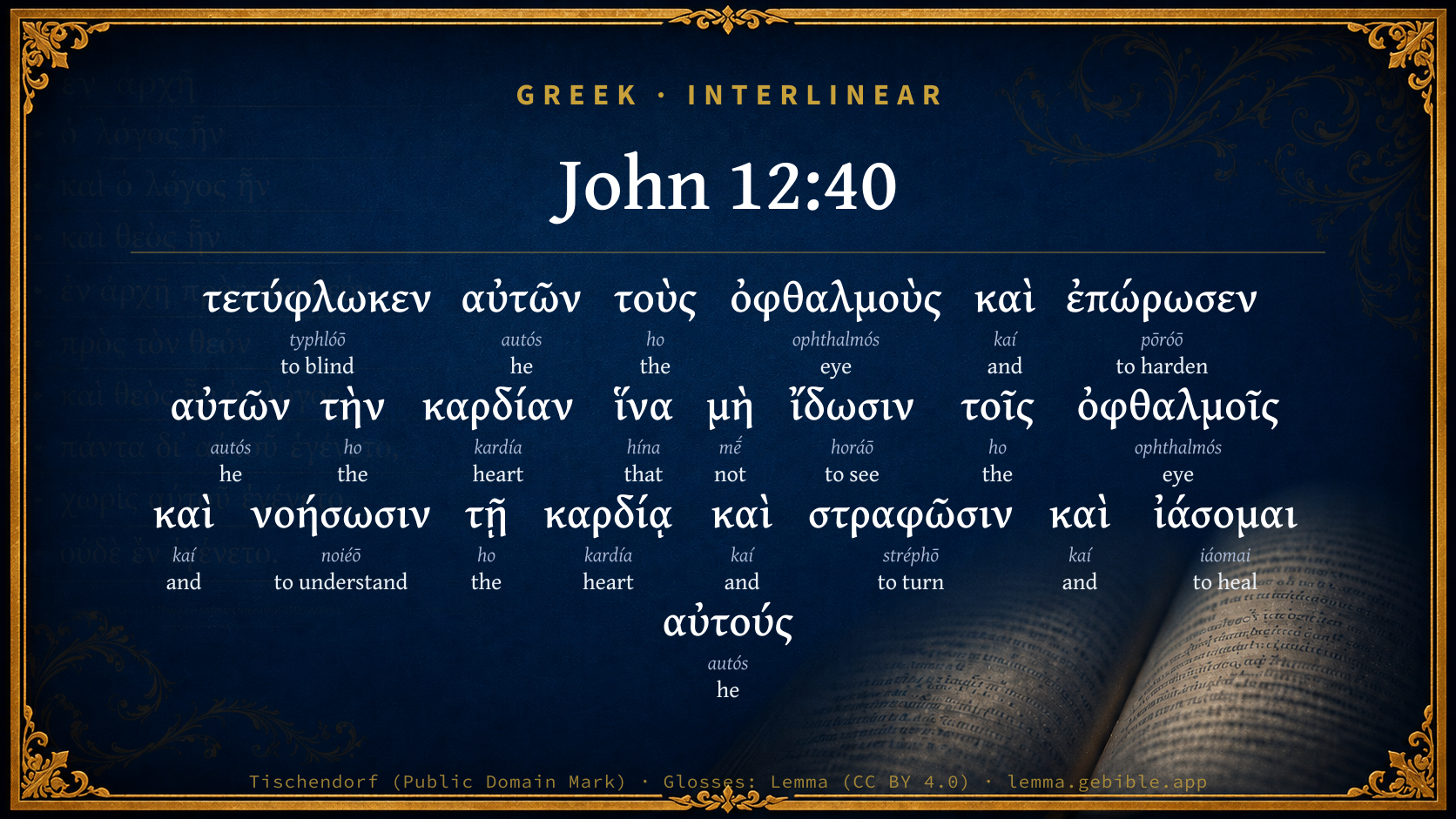
Download image
Cite this verse

John 12:40 (World English Bible). Public Domain. Lemma interlinear Bible study tool, https://lemma.gebible.app/v/john/12/40.

Show BibTeX & RIS
BibTeX
RIS
English Translation
"He has blinded their eyes and he hardened their heart, Lest they should see with their eyes, And perceive with their heart, And would turn, And I would heal them."
World English Bible · Public Domain
Highlights
  • 1 first appearance in the Greek New Testament
Full analysis ↓
Download a study sheet

One document with this verse’s original text, its word-by-word gloss line, the meaning frame, cross-references with their text, attributed commentary, and full source and license credits — printable, and it pastes into notes with its structure intact.

This verse Autodidact and up

Study sheet (.html) Plain text (.txt)

A passage Seminary Student

Up to 50 verses in one chapter. A passage sheet keeps up to 6 commentary sources and 12 cross-references per verse, in the order this page ranks them, and says so on the sheet whenever that leaves anything out. Ask for a single verse and you get the Autodidact verse sheet above.

Everything on this page stays free to read, with no account — the sheet is a download of what is already on screen, not access to it.

Want to remove ads? Support Godless Engineer
Compare translations 3

The same verse in 3 English versions, stacked beneath the original-language interlinear above. Click any original word for its lexicon entry.

Each is an independent rendering of the whole verse — the interlinear is not word-aligned to these translations.

Highlighted words mark where these versions differ — a whole-verse word diff, not a word-by-word alignment.

  • World English Bible Public Domain
    "He has blinded their eyes and he hardened their heart, Lest they should see with their eyes, And perceive with their heart, And would turn, And I would heal them."
  • King James Version Public Domain
    He hath blinded their eyes, and hardened their heart; that they should not see with their eyes, nor understand with their heart, and be converted, and I should heal them.
  • unfoldingWord Literal Text CC BY-SA 4.0
    “He has blinded their eyes, and he has hardened their heart; so that they might not see with their eyes and might understand with their heart, and might turn, and I will heal them.” ts\*

unfoldingWord Literal Text — © unfoldingWord, licensed CC BY-SA 4.0. Word-aligned USFM3 via Door43 (git.door43.org/unfoldingWord/en_ult).

Versions to compare (up to 4)

3 of 4 selected

Show all 19 translations

Every available English version of this verse, each an independent rendering of the whole verse.

  • World English Bible Public Domain
    "He has blinded their eyes and he hardened their heart, Lest they should see with their eyes, And perceive with their heart, And would turn, And I would heal them."
  • Berean Standard Bible Public Domain
    “He has blinded their eyes and hardened their hearts, so that they cannot see with their eyes, and understand with their hearts, and turn, and I would heal them.”
  • Majority Standard Bible Public Domain
    “He has blinded their eyes and hardened their hearts, so that they cannot see with their eyes, and understand with their hearts, and turn, and I would heal them.”
  • King James Version Public Domain
    He hath blinded their eyes, and hardened their heart; that they should not see with their eyes, nor understand with their heart, and be converted, and I should heal them.
  • American Standard Version (1901) Public Domain
    He hath blinded their eyes, and he hardened their heart; Lest they should see with their eyes, and perceive with their heart, And should turn, And I should heal them.
  • Revised Version (1885) Public Domain
    He hath blinded their eyes, and he hardened their heart; Lest they should see with their eyes, and perceive with their heart, And should turn, And I should heal them.
  • Geneva Bible (1599) Public Domain
    He hath blinded their eyes, and hardened their heart, that they shoulde not see with their eyes, nor vnderstand with their heart, and should be conuerted, and I should heale them.
  • Douay-Rheims (1899) Public Domain
    He hath blinded their eyes, and hardened their heart, that they should not see with their eyes, nor understand with their heart, and be converted, and I should heal them.
  • Young's Literal Translation Public Domain
    `He hath blinded their eyes, and hardened their heart, that they might not see with the eyes, and understand with the heart, and turn back, and I might heal them;'
  • Literal Standard Version CC BY-SA 4.0
    “He has blinded their eyes, and hardened their heart, that they might not see with the eyes, and understand with the heart, and turn, and I might heal them”;
  • Unlocked Literal Bible CC BY-SA 4.0
    “He has blinded their eyes, and he has hardened their hearts; otherwise they would see with their eyes and understand with their hearts, and turn, and I would heal them.”
  • unfoldingWord Literal Text CC BY-SA 4.0
    “He has blinded their eyes, and he has hardened their heart; so that they might not see with their eyes and might understand with their heart, and might turn, and I will heal them.” ts\*
  • Darby Bible Public Domain
    He has blinded their eyes and hardened their heart, that they may not see with their eyes, and understand with their heart and be converted, and I should heal them.
  • World Messianic Bible Public Domain
    “He has blinded their eyes and he hardened their heart, lest they should see with their eyes, and perceive with their heart, and would turn, and I would heal them.”
  • Webster's Bible Public Domain
    He hath blinded their eyes, and hardened their heart; that they should not see with their eyes, nor understand with their heart, and be converted, and I should heal them.
  • Free Bible Version CC BY-SA 4.0
    “He blinded their eyes, and made their minds dull, so that their eyes would not see, and their minds would not think, and they would not turn to me—for if they did I would heal them.”
  • Bible in Basic English Public Domain
    He has made their eyes blind, and their hearts hard; for fear that they might see with their eyes and get knowledge with their hearts, and be changed, and I might make them well.
  • Text-Critical English NT CC BY 4.0
    “He has blinded their eyes and hardened their hearts, lest they should see with their eyes and understand with their hearts and turn back, and I would heal them.”
  • Tyndale New Testament (1534) Public Domain
    he hath blinded their eyes and hardened their hertes that they shuld not se with their eyes and vnderstonde with their hertes and shuld be converted and I shuld heale them.

Literal Standard Version (2020), Covenant Press — licensed CC BY-SA 4.0. Text via the HelloAO Bible API (eBible.org). Unlocked Literal Bible (unfoldingWord) — licensed CC BY-SA 4.0. Text via the HelloAO Bible API (eBible.org). unfoldingWord Literal Text — © unfoldingWord, licensed CC BY-SA 4.0. Word-aligned USFM3 via Door43 (git.door43.org/unfoldingWord/en_ult). Free Bible Version, Dr. Jonathan Gallagher — licensed CC BY-SA 4.0. Text via the HelloAO Bible API (eBible.org).

Word by word

More ways to search: Search by grammar → Find every occurrence → Compare this word →

Practice this passage: Drill this verse → Learn its vocabulary →

τετύφλωκεν
typhlóō
G5186
“to blind”
Verb, Perfect, Active, Indicative, 3rd person, Singular
Part of Speech
Verb
Tense
Perfect
Voice
Active
Mood
Indicative
Person
3rd person
Number
Singular
Full Thayer's Definition

Origin: from G5185

TDNT: 12:30,1

1. to blind, make blind 2. in the NT metaph. to blunt the mental discernment, darken the mind
  1. αὐτῶν autós G846 “he” Personal pronoun, Genitive, Plural, Masculine
  2. τοὺς ho G3588 “the” Article, Accusative, Plural, Masculine
  3. ὀφθαλμοὺς ophthalmós G3788 “eye” Noun, Accusative, Plural, Masculine
  4. καὶ kaí G2532 “and” Conjunction
  5. ἐπώρωσεν pōróō G4456 “to harden” Verb, Aorist, Active, Indicative, 3rd person, Singular
  6. αὐτῶν autós G846 “he” Personal pronoun, Genitive, Plural, Masculine
  7. τὴν ho G3588 “the” Article, Accusative, Singular, Feminine
  8. καρδίαν kardía G2588 “heart” Noun, Accusative, Singular, Feminine
  9. ἵνα hína G2443 “that” Conjunction
  10. μὴ mḗ G3361 “not” Particle, Negative
  11. ἴδωσιν horáō G3708 “to see” Verb, Aorist, Active, Subjunctive, 3rd person, Plural
  12. τοῖς ho G3588 “the” Article, Dative, Plural, Masculine
  13. ὀφθαλμοῖς ophthalmós G3788 “eye” Noun, Dative, Plural, Masculine
  14. καὶ kaí G2532 “and” Conjunction
  15. νοήσωσιν noiéō G3539 “to understand” Verb, Aorist, Active, Subjunctive, 3rd person, Plural
  16. τῇ ho G3588 “the” Article, Dative, Singular, Feminine
  17. καρδίᾳ kardía G2588 “heart” Noun, Dative, Singular, Feminine
  18. καὶ kaí G2532 “and” Conjunction
  19. στραφῶσιν stréphō G4762 “to turn” Verb, Aorist, Passive, Subjunctive, 3rd person, Plural
  20. καὶ kaí G2532 “and” Conjunction
  21. ἰάσομαι iáomai G2390 “to heal” Verb, Future, Middle deponent, Indicative, 1st person, Singular
  22. αὐτούς autós G846 “he” Personal pronoun, Accusative, Plural, Masculine

About this verse

These counts appear in no published source. They are computed here, from the morphology-tagged text and Lemma’s own curated glosses. What Lemma adds →

23
words
13
distinct lemmas
Gospels
section

Notable vocabulary

The rarest word here is τετύφλωκεν to blind G5186 — appearing just 3 times in the whole Greek New Testament.

First appearance in Scripture

This word makes its first canonical appearance in the Greek New Testament here:

  • τετύφλωκεν to blind G5186

Shared distinctive vocabulary

τετύφλωκεν to blind G5186 occurs in 3 verses of the Greek New Testament. Also found in:
Repetition

Words recur within this verse:

  • ὀφθαλμοὺς eye G3788 ×2
  • καρδίαν heart G2588 ×2
  • τοὺς the G3588 ×4
  • καὶ and G2532 ×4
  • αὐτῶν he G846 ×3

Cross-references

39

Topical passages linked to John 12:40 in the Treasury of Scripture Knowledge — connected by theme and wording, ordered by reader-vote popularity; previews shown in the World English Bible.

  • Isaiah 6:10 Make the heart of this people fat; Make their ears heavy, and shut their eyes; Lest they see with their eyes, And hear with their ears, And understand with their heart, And turn again, and be healed."
  • Matthew 13:13–15 Therefore I speak to them in parables, because seeing they don't see, and hearing, they don't hear, neither do they understand.
  • Luke 8:10 He said, "To you it is given to know the mysteries of the Kingdom of God, but to the rest in parables; that 'seeing they may not see, and hearing they may not understand.'
  • Mark 4:12 that 'seeing they may see, and not perceive; and hearing they may hear, and not understand; lest perhaps they should turn again, and their sins should be forgiven them.'"
  • Isaiah 57:18–19 I have seen his ways, and will heal him: I will lead him also, and restore comforts to him and to his mourners.
  • Isaiah 29:10 For Yahweh has poured out on you the spirit of deep sleep, and has closed your eyes, the prophets; and your heads, the seers, has he covered.
  • Hosea 6:1 "Come, and let us return to Yahweh; For he has torn us to pieces, And he will heal us; He has injured us, And he will bind up our wounds.
  • Deuteronomy 29:4 but Yahweh has not given you a heart to know, and eyes to see, and ears to hear, to this day.
  • Joshua 11:20 For it was of Yahweh to harden their hearts, to come against Israel in battle, that he might utterly destroy them, that they might have no favor, but that he might destroy them, as Yahweh commanded Moses.
  • Psalms 147:3 He heals the broken in heart, And binds up their wounds.
  • Jeremiah 3:22 Return, you backsliding children, I will heal your backsliding. Behold, we are come to you; for you are Yahweh our God.
  • Ezekiel 12:2 Son of man, you dwell in the midst of the rebellious house, who have eyes to see, and don't see, who have ears to hear, and don't hear; for they are a rebellious house.
  • Hosea 14:4 "I will heal their waywardness. I will love them freely; For my anger is turned away from him.
  • Matthew 15:14 Leave them alone. They are blind guides of the blind. If the blind guide the blind, both will fall into a pit."
  • Mark 8:17–18 Jesus, perceiving it, said to them, "Why do you reason that it's because you have no bread? Don't you perceive yet, neither understand? Is your heart still hardened?
  • Luke 4:18 "The Spirit of the Lord is on me, Because he has anointed me to preach good news to the poor. He has sent me to heal the brokenhearted, To proclaim release to the captives, Recovering of sight to the blind, To deliver those who are crushed,
  • John 9:39 Jesus said, "I came into this world for judgment, that those who don't see may see; and that those who see may become blind."
  • Acts 3:19 "Repent therefore, and turn again, that your sins may be blotted out, so that there may come times of refreshing from the presence of the Lord,
  • Romans 11:7–11 What then? That which Israel seeks for, that he didn't obtain, but the chosen ones obtained it, and the rest were hardened.
  • Psalms 6:2 Have mercy on me, Yahweh, for I am faint. Yahweh, heal me, for my bones are troubled.
  • Psalms 41:4 I said, "Yahweh, have mercy on me! Heal me, for I have sinned against you."
  • Isaiah 42:19–20 Who is blind, but my servant? or deaf, as my messenger whom I send? Who is blind as he who is at peace, and blind as Yahweh's servant?
  • Jeremiah 5:21 Hear now this, foolish people, and without understanding; who have eyes, and don't see; who have ears, and don't hear:
  • Ezekiel 14:9 If the prophet be deceived and speak a word, I, Yahweh, have deceived that prophet, and I will stretch out my hand on him, and will destroy him from the midst of my people Israel.
  • Acts 28:26 saying, 'Go to this people, and say, In hearing, you will hear, But will in no way understand. In seeing, you will see, But will in no way perceive.
  • Romans 9:18 So then, he has mercy on whom he desires, and he hardens whom he desires.
  • Exodus 4:21 Yahweh said to Moses, "When you go back into Egypt, see that you do before Pharaoh all the wonders which I have put in your hand, but I will harden his heart and he will not let the people go.
  • Exodus 7:3 I will harden Pharaoh's heart, and multiply my signs and my wonders in the land of Egypt.
  • Exodus 7:13 Pharaoh's heart was hardened, and he didn't listen to them; as Yahweh had spoken.
  • Exodus 14:4 I will harden Pharaoh's heart, and he will follow after them; and I will get honor over Pharaoh, and over all his host; and the Egyptians shall know that I am Yahweh." They did so.
  • Exodus 14:8 Yahweh hardened the heart of Pharaoh king of Egypt, and he pursued after the children of Israel; for the children of Israel went out with a high hand.
  • Exodus 14:17 I, behold, I will harden the hearts of the Egyptians, and they shall go in after them: and I will get myself honor over Pharaoh, and over all his host, over his chariots, and over his horsemen.
  • Isaiah 26:11 Yahweh, your hand is lifted up, yet they don't see: but they shall see [your] zeal for the people, and be disappointed; yes, fire shall devour your adversaries.
  • Mark 6:52 for they hadn't understood about the loaves, but their hearts were hardened.
  • Acts 15:3 They, being sent on their way by the assembly, passed through both Phoenicia and Samaria, declaring the conversion of the Gentiles. They caused great joy to all the brothers.
  • James 5:19–20 Brothers, if any among you wanders from the truth, and someone turns him back,
  • Isaiah 53:5 But he was pierced for our transgressions, he was crushed for our iniquities; the punishment that brought our peace was on him; and by his wounds we are healed.
  • 1 Kings 22:20 Yahweh said, Who shall entice Ahab, that he may go up and fall at Ramoth-gilead? One said on this manner; and another said on that manner.
  • Psalms 135:10–18 Who struck many nations, And killed mighty kings,

Cross-references courtesy of OpenBible.info (CC BY 4.0).

Commentary

Notes on John 12:40 from classic Christian and Jewish commentators (each source and its license shown beneath its notes). The classic Christian expositions comment on the surrounding passage and are grouped to its opening verse, so a note may address several verses; the Jewish commentaries on the Tanakh (Rashi and others) are per-verse, so they appear only where the commentator wrote on this verse.

Lemma curates 59 commentaries, every one of them public domain or Creative Commons licensed, each selected and text-cleaned for this edition rather than reprinted as found. About our sources →

Bengel's Gnomon

Johann Albrecht Bengel

Joh 12:40. Τετύφλωκεν, hath blinded) God, by a just judgment on them. There follows, with a change of person, I the Messiah should heal them.—πεπώρωκεν) The words in antithesis are, πώρωσις, and νόησις hardness of heart, and understanding. Comp. 2Co 3:14, “Their minds were blinded; for until this day remaineth the same veil untaken away.”—ἵνα μή) even to that degree that not. Comp. ἵνα, ch. Joh 5:20, “He will show Him (the Son) greater works than these, ἵνα (with the effect that, to that degree that) ὑμεῖς θαυμάζητε, ye may marvel.”—καὶ νοήσωσι τῇ καρδίᾳ καὶ ἐπιστραφῶσι, and understand with their heart, and be converted) These two clauses have a nearer connection with one another than with the rest, as is shown by the Hebrew accents in Isaiah.

Bengel's Gnomon of the New Testament — English translation (T&T Clark, Edinburgh, 1860) — public domain. Text from a community e-Sword module.

Vincent's Word Studies in the New Testament

Marvin R. Vincent

He hath blinded, etc. These words of Isaiah are repeated five times in the New Testament as the description of the Jewish people in its latest stage of decay. Mt 13:13; Mr 4:12; Luk 8:10; Joh 12:40; Act 28:26.

Hardened [πεπωρωκεν] . See on the kindred noun pwrwsiv, hardness, Mr 3:5.

Understand [νοησωσιν] . Rev., better, perceive. Mark has suniwsin, understand. See on understanding, Luk 2:47.

Be converted (ejpistrafwsin). See on Mt 13:15; Luk 22:32. Rev., more accurately, turn, with the idea of turning to or toward something [επι] .

Marvin R. Vincent, Word Studies in the New Testament (1887–1900) — public domain. Text from a community e-Sword/MySword module.

Adam Clarke's Commentary

Verse 40. And I should heal them.] This verse is taken from Isa 6:9, and, perhaps, refers more to the judgments that should fall upon them as a nation, which God was determined should not be averted, than it does to their eternal state. To suppose that the text meant that God was unwilling that they should turn unto him, lest he should be obliged to save them, is an insupportable blasphemy.

Adam Clarke's Commentary on the Bible (1810–1826) — public domain. Text from a community e-Sword/MySword module.

John Calvin's Commentaries

40. He hath blinded their eyes, and hardened their heart. The passage is taken from Isaiah 6:9, where the Lord forewarns the prophet, that the labor which he spends in instructing will lead to no other result than to make the people worse. First then he says, Go, and tell this people, Hearing, hear and do not hear; as if he had said, “I send thee to speak to the deaf.” He afterwards adds, Harden the heart of this people, &c. By these words he means, that he intends to make his word a punishment to the reprobate, that it may render them more thoroughly blind, and that their blindness may be plunged in deeper darkness. It is indeed a dreadful judgment of God, when He overwhelms men by the light of doctrine, in such a manner as to deprive them of all understanding; and when, even by means of that which is their only light, he brings darkness upon them.

But it ought to be observed, that it is accidental to the word of God, that it blinds men; for nothing can be more inconsistent than that there should be no difference between truth and falsehood, that the bread of life should become a deadly poison, and that medicine should aggravate a disease. But this must be ascribed to the wickedness of men, which turns life into death. It ought also to be observed, that sometimes the Lord, by himself, blinds the minds of men, by depriving them of judgment and understanding; sometimes by Satan and false prophets, when he maddens them by their impostures; sometimes. too by his ministers, when the doctrine of salvation is injurious and deadly to them. But provided that prophets labor faithfully in the work of instruction, and commit to the Lord the result of their labor, though they may not succeed to their wish, they ought not to give way or despond. Let them rather be satisfied with knowing that God approves of their labor, though it be useless to men’ and that even the savor of doctrine, which wicked men render deadly to themselves elves, is good and pleasant to God, as Paul testifies, (2 Corinthians 2:15.)

The heart is sometimes in Scripture put for the seat of the affections; but here, as in many other passages, it denotes what is called the intellectual part of the soul. To the same purpose Moses speaks:

God hath not given you a heart to understand, (Deuteronomy 29:4.)

Lest they should see with their eyes. Let us remember that the prophet speaks of unbelievers who had already rejected the grace of God. It is certain that all would continue to be such by nature, if The Lord did not form to obedience to him those whom he has elected. At first, therefore, the condition of men is equal and alike, but when reprobate men have, of their own accord, and by their own wickedness, rebelled against God, they subject themselves to this vengeance, by which, being given up to a reprobate mind, they continually rush forward more and more to their own destruction. It is their own fault, therefore, if God does not choose to convert them, because they were the cause of their own despair. We are briefly instructed also, by these words of the prophet, what is the beginning of our conversion to God. It is when he enlightens the hearts, which must have been turned away from him, so long as they were held by the darkness of Satan; but, on the contrary, such is the power of Divine light, that it attracts us to itself, and forms us to the image of God.

And I should heal them. He next adds the fruit of conversion, that is, healing. By this word the prophet means the blessing of God and a prosperous condition, and likewise deliverance from all the miseries which spring from the wrath of God. Now, if this happens to the reprobate, contrary to the nature of the word, we ought to attend to the contrast implied in the, opposite use of it; namely, that the purpose for which the word of God is preached is, to enlighten us in the true knowledge of God, to turn us to God, and reconcile us to him, that we may be happy and blessed.

John Calvin's Commentaries (1540-1563) — public domain. Text from the Calvin Translation Society English edition (1840s-50s) via the Christian Classics Ethereal Library (ccel.org). Calvin's coverage is partial (roughly two-thirds of the Bible); uncommented books and verses are honest gaps, never fabricated. The 19th-century editor's footnotes and remarks are omitted so the notes are faithfully Calvin's own voice.

Ellicott's Commentary for English Readers

(40) He hath blinded their eyes, and hardened their heart. . . .—These words are quoted three times in the New Testament. Our Lord, as we have seen, quotes them as explaining His own teaching (Mat_13:14); St. John quotes them here to explain the rejection of that teaching; St. Paul quotes them in Act_28:26, to explain the rejection of the Gospel by the Jews at Rome. Yet we are to remember that the prophet and those who quote him are all witnesses that within Israel there were eyes which were not blinded and hearts which were not hardened. Isaiah, and John, and Paul, were all Jews; and our Lord Himself was, in His human nature, of the seed of Abraham. Isaiah’s prophecy is accompanied by the promise of a holy seed (Joh_12:13); St. John quotes these words, and adds that “even of the rulers many believed” (Joh_12:42); St. Paul quotes them when “some believed the things which were spoken and some believed not” (Joh_12:24); our Lord quotes them, and immediately says, “But blessed are your eyes, for they see, and your ears, for they hear.” There is, indeed, a judicial blinding and a judicial hardening—let no man therefore presume; but these come only to eyes that will not to see, and to hearts that will not to hear—let no man therefore despair. The quotation in this place does not follow exactly either the Hebrew or the Greek of the passage in Isaiah. In the Hebrew text, as in the Authorised version, the prophet is commanded to “make the heart of this people fat.” . . . The Greek text says simply, “The heart of this people was hardened.” . . . St. John represents the action which God commanded to be done as done by Himself, and speaks of it in the past tense.

And I should heal them.—The pronoun here refers to Christ. St. John in his interpretation of the prophecy has made God (“He”) the author of the judicial blindness and hardness, and represents Christ as the physician. This clause is, however, not to be taken separately, but is governed by “that not” which precedes, The effect of their not turning was that Christ could not heal them.

On the whole verse comp. Note on Mat_13:14, and Act_28:26.

A Bible Commentary for English Readers, edited by Charles John Ellicott (1878–1897) — public domain. Text from a community e-Sword module.

The Cambridge Bible for Schools and Colleges

gen. ed. J. J. S. Perowne

40. He hath blinded] Not Christ, nor the devil, but God. The quotation is free, following neither the Hebrew nor the LXX. very closely.

I should heal] ‘I’ = Christ. God has hardened their hearts so that they could not be converted, and therefore Christ could not heal them. Comp. Mat_13:14-15, where Christ quotes this text to explain why He teaches in parables; and Act_28:26, where S. Paul quotes it to explain the rejection of his preaching by the Jews in Rome.

The Cambridge Bible for Schools and Colleges (gen. ed. J. J. S. Perowne; Cambridge University Press, 1878–1918) — public domain. Text from a community e-Sword module.

John Gill's Exposition

These things said Esaias,.... Concerning the blinding and hardening of the Jews:

when he saw his glory, and spake of him; when he saw, in a visionary way, the glory of the Messiah in the temple, and the angels covering their faces with their wings at the sight of him; and when he spake of him as the King, the Lord of hosts, whom he had seen, Isa 6:1, from whence it is clear that he had respect to the Jews in the times of the Messiah. The prophet says in Isa 6:1 that he "saw the Lord": the Targumist renders it, "I saw", , "the glory of Jehovah"; and in Isa 6:5 he says, "mine eyes have seen the King", Jehovah, Zebaot, the Lord of hosts; which the Chaldee paraphrase renders, "mine eyes have seen", , "the glory" of the Shekinah, the King of the world, the Lord of hosts. Agreeably to which our Lord says here, that he saw his glory, the glory of his majesty, the glory of his divine nature, the train of his divine perfections, filling the temple of the human nature; and he spoke of him as the true Jehovah, the Lord of hosts; and which therefore is a very clear and strong proof of the proper divinity of Christ. And it may be observed from hence, that such persons who have a true, spiritual, and saving sight of Christ, of the glory of his person, and the fulness of his grace, cannot but be speaking of him to others, either in private, or in public, as Isaiah here did, and as the church in Sol 5:10; and as the apostles of Christ, Joh 1:1; and indeed, should they hold their peace, the stones would cry out; such must, and will speak of his glory in his temple, Psa 29:9.

John Gill's Exposition of the Whole Bible (1746–1763) — public domain (CC PDM 1.0). Text via the HelloAO Bible API.

Trapp's Complete Commentary

John Trapp

40 He hath blinded their eyes, and hardened their heart; that they should not see with their eyes, nor understand with their heart, and be converted, and I should heal them.

Ver. 40. He hath hardened their hearts] With a judiciary hardness. This is in some respect worse than hell: since (besides that God inflicts it as a punishment of former obstinance) it is one of the greatest sins, and so far greater an evil than any of the greatest punishments. Hence it was the saying of a reverend man, "If I must be put to my choice, I had rather be in hell with a sensible heart, than live on earth with a reprobate mind."

John Trapp, A Commentary or Exposition upon All the Books of the Old and New Testament (1647–1656) — public domain. Text from a community e-Sword module.

Albert Barnes' Notes on the Bible

He hath blinded their eyes - The expression in Isaiah is, “Go, make the heart of this people fat, and shut their eyes.” That is, go and proclaim truth to them truth that will result in blinding their eyes. Go and proclaim the law and the will of God, and the effect will be, owing to the hardness of their heart, that their eyes will be blinded and their hearts hardened. As God knew that this would be the result - as it was to be the effect of the message, his commanding Isaiah to go and proclaim it was the same in effect, or in the result, as if he had commanded him to blind their eyes and harden their hearts. It is this effect or result to which the evangelist refers in this place. He states that God did it, that is, he did it in the manner mentioned in Isaiah, for we are limited to that in our interpretation of the passage. In that case it is clear that the mode specified is not a direct agency on the part of God in blinding the mind - which we cannot reconcile with any just notions of the divine character - but “in suffering the truth to produce a regular effect on sinful minds, without putting forth any positive supernatural influence to prevent it.” The effect of truth on such minds is to irritate, to enrage, and to harden, unless counteracted by the grace of God. See Rom 7:8-9, Rom 7:11; 2Co 2:15-16. And as God knew this, and, knowing it, still sent the message, and suffered it to produce the regular effect, the Evangelist says “he hath blinded their minds,” thus retaining the substance of the passage in Isaiah without quoting the precise language; but in proclaiming the truth there was nothing wrong on the part of God or of Isaiah, nor is there any indication that God was unwilling that they should believe and be saved.

That they should not see ... - This does not mean that it was the design of God that they should not be converted, but that it was the effect of their rejecting the message. See the notes at Mat 13:14-15.

Albert Barnes' Notes on the Bible (1834–1885) — public domain. Text from a community e-Sword/MySword module.

Haydock's Catholic Bible Commentary

He hath blinded their eyes, &c. See Matthew xiii. 14. (Witham) --- God blinded the Jews, not by filling them with malice, but by refusing them his graces, of which they had made themselves unworthy, and which they before abused and despised. It was their perverse will, their pride, presumption, and obstinacy, that brought on them this judgment. (St. Augustine)

George Leo Haydock (1774–1849), Haydock's Catholic Family Bible and Commentary, 1859 edition — public domain. Excludes Psalms (Douay-Rheims chapter numbering differs from Protestant) and Deuterocanonical books (Catholic canon only).

Matthew Poole's English Annotations

We have this text (than which there is not one more terrible in the whole book of God) no less than six times quoted in the New Testament, and in all places quoted and given as a reason for the Jews unbelief in the Lord Jesus Christ, Mat 13:14,15; Mr 4:12; Luk 8:10; Act 28:26,27; Ro 11:8. It is not quoted alike in all places, but for substance the same. The original from whence these quotations are, is Isa 6:9,10. By comparing the texts we shall find several authors, instruments, or causes of these dreadful effects. In the original, the prophet Isaiah is made the instrumental cause: Go, (saith God), and make the heart of this people fat, & c. Matthew, and Luke in Act 28:27, mention themselves as the cause. Matthew saith, For this people’s heart is waxed gross, and their ears are dull of hearing, and their eyes they have closed. And the Acts it is, For the heart of this people is waxed gross, and their ears are dull of hearing, and their eyes have they closed. All the other texts speak of it as God’s act. The thing is easily thus reconciled: God sent to the Jews his prophets, and gave them the means of salvation; it is true, without the inward efficacy of his Spirit they could not savingly believe, but they did not do what was in their power to have done, nay, they did do what was in their power to have avoided, they slighted and contemned the Lord’s prophets, and killed them, and stoned such as were sent unto them. Thus they first shut their own eyes, and hardened their own hearts; and as their forefathers had done in their generation, so the Jews in our Saviour Christ’s time did also in their generation, shutting their eyes against the revelation of the gospel by Christ himself. They thus behaving themselves, God judicially gave them up to their own lusts, permitting their hearts to harden, and suffering them to close their own eyes, so as they could not repent, believe, or return, and be saved; not that God infused any malice into their hearts, but withdrew his grace from them after such provocations on their parts: so that as the prophets in their age laboured with them in vain, and all the event of their ministry was but the generality of that people’s growing worse and more obdurate; so all the event of Christ’s ministry and miracles, which he personally wrought amongst them in his age, did accidentally but increase their sin and their judgment, and ripen them for their ruin, through their wilful abuse of those sacred means of life and salvation. The judgment itself was but one, viz. a judicial hardening of them; but it is set out by a great variety of expressions, both by the prophets, and the writers of the New Testament: in Isaiah, by making their hearts fat, their ears heavy, shutting their eyes: in Matthew, making their hearts gross, their ears dull of hearing, shutting their eyes: in this text, by blinding their eyes, and hardening their hearts: in the Acts, by the same phrases as in Matthew: in Rom 11:8 is added, God hath given them the spirit of slumber. All the phrases are expressive of the same dreadful judgment of God; yet it may be expressed in this variety of phrase, to signify the distinct, particular plagues (comprehended in this one plague) which fall upon the several powers and faculties of those souls upon whom this dreadful judgment falls; blindness in the mind, stubbornness in the will, &c., vileness in the affections, reprobacy in the mind, &c.

Matthew Poole's English Annotations on the Holy Bible (1683–1685) — public domain. Text from a community e-Sword/MySword module.

Whedon's Commentary on the Bible

Daniel D. Whedon

40. He hath blinded their eyes—They had shut themselves in, and the harder He pushed the tighter the door was pressed. They had made their choice; and the more he would persuade, the more firmly they braced themselves against him. They fitted their eyes to the darkness; and, like owls, the clearer the light the more total their blindness. So that although God, according to the prophet, was the unwilling cause of their blindness, yet it was their wicked will that gave to the cause its effect.

And be converted—Which was the desired result on the part of God. But their perverse will transformed his mercy into judgment; his means of softening into results of hardening. Thus does the same sun that melts the wax harden the clay. But the clay is inanimate and blameless; these living agents, hardened by the divine softenings, were free and responsible. The Evangelist has no idea of the modern argument, that because the Jews did not believe the miracles were not real. On the contrary, their unbelief, being a fulfilment of prophecy, was an actual proof of their supernatural reality. That unbelief was by God foreseen, and by him provided for and predicted. Knowing what the Jews would freely do, God had accordingly adjusted his plans, plans contingent indeed upon their doing, yet certain because that doing was freely certain and foreseen Jewish rejection, according to prophecy, is good proof of the reality of Jesus’s Messiahship.

Daniel D. Whedon (gen. ed.), Commentary on the Old and New Testaments (1874–1909) — public domain. Text from a community e-Sword module.

The Pulpit Commentary

There are several illustrations in this verse that the diction of the evangelist differs from that which he uses when recording the words of Christ. Thus omwv mentoi is peculiar to John himself, and thus is an apax legomenon ; but mentoi occurs five times in the style of John himself, (see Joh_4:27 Joh_7:13 Joh 12:42 Joh_20:5 Joh_21:4) not once by our Lord. Omologein again is used four times by the evangelist, and seven times in the Epistles and Apocalypse, but never put by him into the lips of Jesus. Nevertheless many of the rulers believed on him. These words are used, not to mitigate the charge, but to show that, though individuals did believe, even among the rulers, they had not courage to avow their faith. The instances of Nicodemus and Joseph and others lie upon the surface. Godet thinks rather of Gamaliel and the like, "the Eras-muses of those days." Theirs was, indeed, a hypocrisy of unbelief, and it is not "altogether banished from the modem world, and notwithstanding Christ"s rejection by the nation as a nation, individuals saw his glory and believed. It is still true of municipalities, nations, even Churches, that they reject Christ, while individuals among them are molded by and obedient to the faith. But by reason of the Pharisees our Lord"s most deadly enemies, from Joh 1 to Joh 12they were making no confession or, acknowledgment of his claims, lest they should be put out of the synagogue; become the excommunicate, fall under the terrible ban. (see Joh_9:22) The fear of class exclusion, the dread of running counter to the current opinion of the Church or the world, has led to much of the misery of both.

The Pulpit Commentary (1880–1919), ed. H.D.M. Spence-Jones & Joseph S. Exell — public domain. Text from a community e-Sword module.

John Wesley's Explanatory Notes

Isaiah vi, 10; Matt. xiii, 14; Acts xxviii, 26.

John Wesley, Explanatory Notes Upon the Whole Bible (1754–1765) — public domain. Text via the GEBible commentary corpus.

Cambridge Greek Testament for Schools and Colleges

40. ἐπώρωσεν for πεπώρωκεν, and ἰάσομαι for ἰάσωμαι (both corrections for uniformity): στραφῶσιν for ἐπιστραφῶσι (ἐπιστρέψωσιν in LXX.).

40. τετύφλωκεν. The nominative is ὁ Θεός. Here the quotation follows neither the Hebrew nor the LXX. of Isa 6:10 very closely. The nominative to ἰάσομαι is Christ. God has hardened their hearts so that Christ cannot heal them. Comp. Mat 13:14-15, where Jesus quotes this text to explain why He teaches in parables; and Act 28:26, where S. Paul quotes it to explain the rejection of his preaching by the Jews in Rome. For ἵνα see Winer, p. 575.

Cambridge Greek Testament for Schools and Colleges (Cambridge University Press, 1896; 21 vols, various authors incl. Carr, Maclear, Plummer, Farrar, Lumby, Moule, M. R. James, Simcox) — public domain. Text from a community e-Sword module.

Alford’s Greek Testament

Henry Alford

40.] The prophecy is freely cited, after neither the Heb. nor the LXX, which is followed in Mat 13:14f. What God bids the Prophet do, is here described as done, and by Himself: which is obviously implied in the Heb. text. The reading αὑτῶν (Morus) supplying ὁ λαὸς οὗτος as the subject of τετύφ. and πεπώρ., is out of the question,—as ungrammatical, and inconsistent with the context, which will only allow of ὁ κύριος (i.e. Jehovah) as the subject.

Henry Alford, The Greek Testament (1849–1861) — public domain. Text from a community e-Sword module.

International Critical Commentary

40. This second quotation, from Isa 6:10, differs markedly from the LXX. (1) The LXX has altered the Hebrew, which ascribes the hardening of Israel’s heart to God’s agency, and throws the sentence into a passive form: ἐπαχύνθη γὰρ ἡ καρδία τοῦ λαοῦ τούτου κτλ. Jn., however, reproduces the sense (although not the exact phrases) of the Hebrew “He hath hardened their heart.” (2) The LXX has μήποτε ἴδωσιν τοῖς ὀφθαλμοῖς. Now Jn. (and it is one of the notable features of his style) never uses μήποτε. Instead, he has ἵνα μὴ here and elsewhere (see on 3:20), which may represent the Aramaic דְּלָא. Indeed דְּלָא is actually reproduced in the Pesh. rendering of Isa 6:10. Burney infers2 that Jn. is here translating direct from the Aramaic.

The passage Isa 6:10 is quoted also by Mt. (13:15), who takes it verbally from the LXX. He places it in the mouth of Jesus Himself; it is not in Mt., as in Jn., an illustrative passage quoted by the evangelist. It is quoted also in Act 28:26 from the LXX, where Paul is represented as applying its words to the Jews at Rome. Probably Isa 6:10 was regarded by Christians from the beginning as predictive of the Rejection of Jesus by the Jews (cf. Mar 4:12, Luk 8:10).

The prophets often speak of people who “have eyes and see not, and ears and hear not” (Jer 5:21, Eze 12:2; cf. Isa 42:20), and the same thing may be observed in every age and country. The child’s story of “Eyes and no Eyes” has a universal application. But Isa 6:10 speaks of a penal blindness, an insensibility which was, as it were, a Divine punishment for sin. So at Isa 44:18 we have, “He hath shut their eyes, that they cannot see; and their hearts, that they cannot understand.” And in Deu 29:4 the comment of Moses when the Israelites did not recognise the meaning of the “signs” in Egypt is, “The Lord hath not given you an heart to know and eyes to see and ears to hear unto this day.” Paul makes this doctrine his own: “God gave them eyes that they should not see, and ears that they should not hear” (Rom 11:8). That sin causes a blindness of the soul, a moral insensibility to spiritual truths, is a law of the natural, that is of the Divine, order.

Jesus rebukes the multitude (Mar 8:18) who did not rightly interpret the miracle of the loaves, by saying, “Having eyes, see ye not? and having ears, hear ye not?” In explaining the Parable of the Sower to His disciples, while He did not explain it to the multitudes, He gave the reason, “Unto them that are without all things are done in parables, that seeing they may see and not perceive, and hearing they may hear and not understand, lest haply they should turn again and it should be forgiven them” (Mar 4:11, Mar 4:12, Luk 8:10). Mat 13:13 gives the same saying, and represents Jesus as quoting Isa 6:9, Isa 6:10 in full from the LXX, which does not ascribe the moral blindness of the people to the agency of God.

Jn., however, never shrinks from a direct statement of events as predestined; if things happened, it was because God intended them to happen. He does not attempt here to soften down the tremendous judgment of Isa 6:9, Isa 6:10.

The verb ἐπώρωσεν has been generally translated “hardened.” But this is a misleading rendering.1 πώρωσις is numbness, rather than hardness; and the prophet’s ἐπώρωσεν αὐτῶν τῆν καρδίαν is strictly parallel to the first half of the verse, τετύφλωκεν αὐτῶν τοὺς ὀφθαλμούς. We should translate:

“He hath blinded their eyes,

and darkened their hearts,”

for πώρωσις τῆς καρδίας is precisely “blindness of heart.” See 9:39 above; and cf. 8:43.

ἐπώρωσεν. So AB*LWΘ; the rec. has πεπώρωκεν (ΓΔ).

στραφῶσιν is read by אBD*, and is therefore to be preferred to the rec. ἐπιστραφῶσιν. LWΘ have ἐπιστρέψωσιν. Field points out that στραφῶσιν is to be taken in a middle sense, “turn themselves”; cf. a similar usage at 20:14, 16.

International Critical Commentary — older volumes (1896–1929), various authors — public domain. Text from a community e-Sword module.

Lesson kit

Teaching starters — assembled from the data on this page, not authored interpretation. Every prompt links to the verse data it draws on. Edit before teaching.

John, in the Gospels, opens this verse with 23 words (13 distinct Greek lemmas). Its most distinctive word is typhlóō (“to blind”). A historical commentator’s framing appears above. Read the whole chapter for the surrounding context.

Discussion questions

  1. The word typhlóō carries the sense “to blind.” How does it shape the verse?
  2. The word “to blind” first appears here in Scripture. What is being introduced at this debut?
  3. 2 Corinthians 4:4 shares the word «to blind» with this verse. How do the two illuminate each other?
  4. “eye” occurs 2× in this one verse. What is the effect of the repetition?
  5. These translations render this verse differently. What is at stake in choosing one wording over another?
  6. Reading how Bengel's Gnomon and Vincent's Word Studies in the New Testament read this verse, where do the two commentators agree and where do they part?

Things to notice

  • 1 word makes its first canonical appearance in Scripture here.
  • These translations choose different wording for 11 words in this verse.
  • “eye” occurs 2× in this single verse.
  • 13 distinct Greek lemmas span 23 words in this verse.

Reading settings

Reading text

Shown beneath each verse's original-language words.

Old Testament
Old Testament edition

Read the OT as the Masoretic Hebrew (MT) or the Greek Septuagint (LXX).

English shown for the Greek Septuagint (in the Hebrew ↔ Greek comparison).

Comparing translations? Open the Compare panel on any verse page to stack up to four side by side.