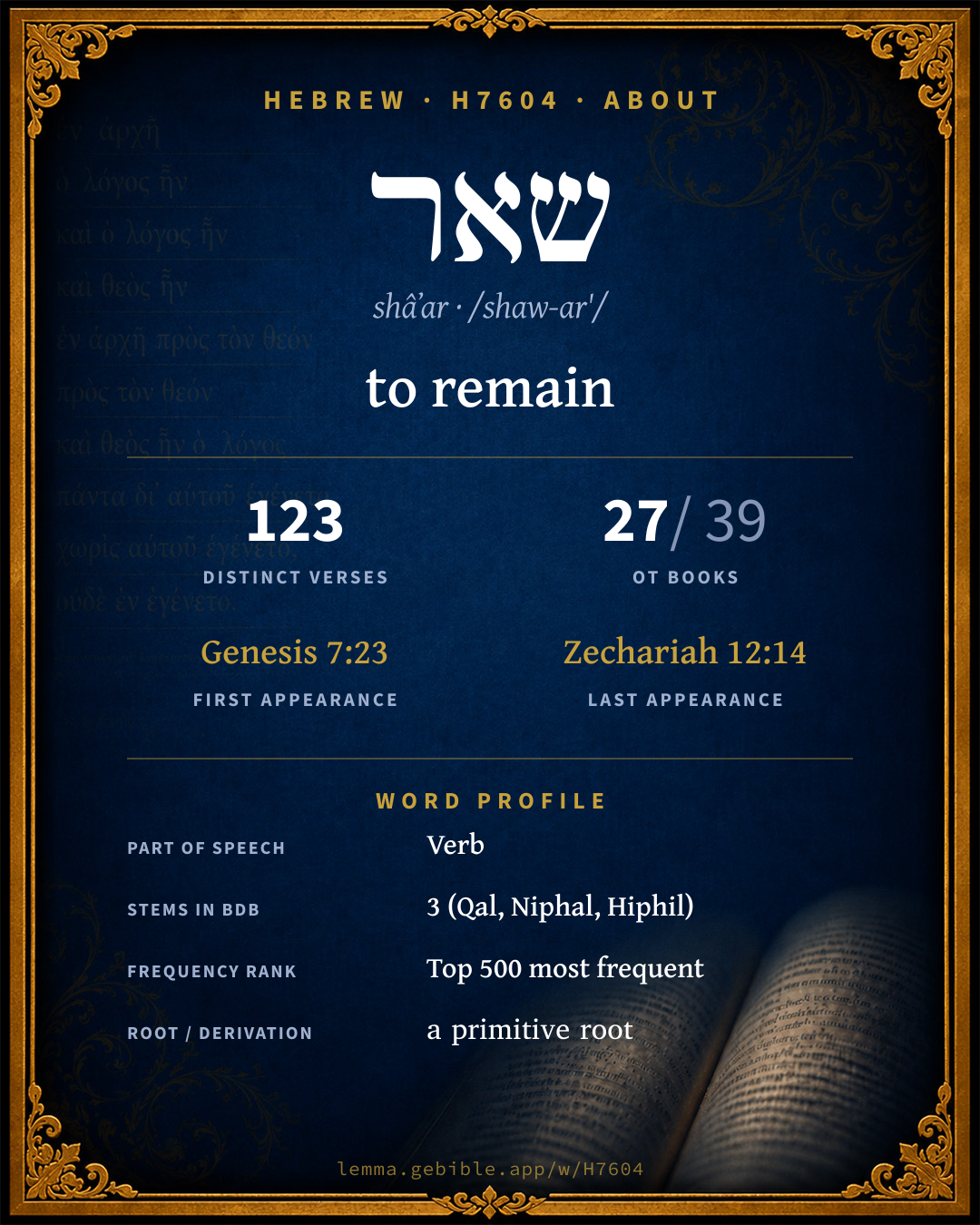
שָׁאַר
to remain
also: be left over, be left behind fuller range ↓
Full lexicon entry — Brown-Driver-Briggs (BDB)
From Brown-Driver-Briggs (BDB)
Where this word appears
See every Niphal verb in the Hebrew Bible →
Grammar key — what these labels mean
Part of speech
- Verb
- An action or state-of-being word.
Stem
- Hiphil
- The causative active stem (“he caused / brought about”). Here: ‘leave over’
- Niphal
- Usually the simple passive or reflexive of the Qal (“he was written”). Here: ‘be left over’
- Qal
- The basic, simple active stem — the plain form of the verb (“he wrote”).
Form
- Perfect
- A completed action or state — Hebrew marks aspect (completeness) more than strict tense (“he wrote”).
- Participle Active
- A verbal adjective expressing ongoing or characteristic action (“writing / one who writes”).
- Imperfect
- An incomplete, ongoing, or future action (“he will / would write”).
- Sequential Perfect
- A perfect with prefixed waw continuing a preceding imperfect or command (waw-consecutive perfect).
- Sequential Imperfect
- An imperfect with prefixed waw — the standard past-narrative form (waw-consecutive imperfect).
- Participle Passive
- A verbal adjective expressing action received (“written”).
- Infinitive Construct
- A bound verbal noun, frequently with prepositions (“to write / in writing”).
- Cohortative
- A first-person volitional form expressing wish or resolve (“let me / let us write”).
State
- Absolute
- The independent form of a noun, not bound to a following word.
Person
- 3rd Person
- The one spoken about (“he / she / it / they”).
- 2nd Person
- The one addressed (“you”).
- 1st Person
- The speaker (“I / we”).
Gender
- Masculine
- Grammatically masculine.
- Common
- Either gender — not distinguished for this form.
- Feminine
- Grammatically feminine.
Number
- Singular
- One.
- Plural
- More than one (in Hebrew, generally three or more).
Grammatical forms 32 distinct
- Verb, Niphal, Participle Active, Masculine, Plural, Absolute 26 times (20%)
- Verb, Hiphil, Perfect, 3rd Person, Masculine, Singular 22 times (17%)
- Verb, Niphal, Perfect, 3rd Person, Masculine, Singular 19 times (14%)
- Verb, Niphal, Perfect, 3rd Person, Common, Plural 10 times (8%)
- Verb, Niphal, Participle Active, Masculine, Singular, Absolute 10 times (8%)
- Verb, Niphal, Participle Active, Feminine, Singular, Absolute 5 times (4%)
- Verb, Hiphil, Imperfect, 3rd Person, Masculine, Plural 4 times (3%)
- Verb, Niphal, Perfect, 3rd Person, Feminine, Singular 3 times (2%)
+24 more forms (34 occurrences)
Parsed forms decoded from the imported morphology (morphhb / Westminster Leningrad Codex — WLC text public domain, morphhb tagging CC BY 4.0), counted across 133 parsed occurrences — not distinct verses.
Every verse where H7604 appears — 123 distinct verses across 27 books. Click any verse to open its interlinear word-by-word view. Verse text shown in the World English Bible for context — . Each verse’s Hebrew form is shown with its reference; the English is not keyword-highlighted, since the data carries no word-level English alignment. Use “Compare translations” on any verse to read it across multiple English versions. This concordance covers the Hebrew Bible; Septuagint (Greek Old Testament) occurrences are not indexed here.
Genesis 5 verses
- Genesis 7:23 וַ/יִשָּׁ֧אֶר conj + Niphal wimpf 3ms Every living thing was destroyed that was on the surface of the ground, including man, cattle, creeping things, and birds of the sky. They were destroyed from the earth. Only Noah was left, and those who were with him in the ark.
- Genesis 14:10 וְ/הַ/נִּשְׁאָרִ֖ים conj + ptcl def.art + Niphal ptcp.act mp Now the valley of Siddim was full of tar pits; and the kings of Sodom and Gomorrah fled, and they fell there, and those who remained fled to the mountain.
- Genesis 32:8 הַ/נִּשְׁאָ֖ר ptcl def.art + Niphal ptcp.act ms and he said, "If Esau comes to the one company, and strikes it, then the company which is left will escape."
- Genesis 42:38 נִשְׁאָ֗ר Niphal ptcp.act ms He said, "My son shall not go down with you; for his brother is dead, and he only is left. If harm happens to him by the way in which you go, then you will bring down my gray hairs with sorrow to Sheol."
- Genesis 47:18 נִשְׁאַר֙ Niphal pf 3ms When that year was ended, they came to him the second year, and said to him, "We will not hide from my lord how our money is all spent, and the herds of cattle are my lord's. There is nothing left in the sight of my lord, but our bodies, and our lands.
Exodus 8 verses
- Exodus 8:9 תִּשָּׁאַֽרְנָה Niphal impf 3fp Moses said to Pharaoh, "I give you the honor of setting the time that I should pray for you, and for your servants, and for your people, that the frogs be destroyed from you and your houses, and remain in the river only."
- Exodus 8:11 תִּשָּׁאַֽרְנָה Niphal impf 3fp The frogs shall depart from you, and from your houses, and from your servants, and from your people. They shall remain in the river only."
- Exodus 8:31 נִשְׁאַ֖ר Niphal pf 3ms Yahweh did according to the word of Moses, and he removed the swarms of flies from Pharaoh, from his servants, and from his people. There remained not one.
- Exodus 10:5 הַ/נִּשְׁאֶ֤רֶת ptcl def.art + Niphal ptcp.act fs and they shall cover the surface of the earth, so that one won't be able to see the earth. They shall eat the residue of that which has escaped, which remains to you from the hail, and shall eat every tree which grows for you out of the field.
- Exodus 10:12 הִשְׁאִ֖יר Hiphil pf 3ms Yahweh said to Moses, "Stretch out your hand over the land of Egypt for the locusts, that they may come up on the land of Egypt, and eat every herb of the land, even all that the hail has left."
- Exodus 10:19 נִשְׁאַר֙ Niphal pf 3ms Yahweh turned an exceeding strong west wind, which took up the locusts, and drove them into the Red Sea. There remained not one locust in all the borders of Egypt.
- Exodus 10:26 תִשָּׁאֵר֙ Niphal impf 3fs Our cattle also shall go with us. There shall not a hoof be left behind, for of it we must take to serve Yahweh our God; and we don't know with what we must serve Yahweh, until we come there."
- Exodus 14:28 נִשְׁאַ֥ר Niphal pf 3ms The waters returned, and covered the chariots and the horsemen, even all Pharaoh's army that went in after them into the sea. There remained not so much as one of them.
Leviticus 4 verses
- Leviticus 5:9 וְ/הַ/נִּשְׁאָ֣ר conj + ptcl def.art + Niphal ptcp.act ms He shall sprinkle some of the blood of the sin offering on the side of the altar; and the rest of the blood shall be drained out at the base of the altar. It is a sin offering.
- Leviticus 25:52 נִשְׁאַ֧ר Niphal pf 3ms If there remain but a few years to the year of jubilee, then he shall reckon with him; according to his years of service he shall give back the price of his redemption.
- Leviticus 26:36 וְ/הַ/נִּשְׁאָרִ֣ים conj + ptcl def.art + Niphal ptcp.act mp "'As for those of you who are left, I will send a faintness into their hearts in the lands of their enemies: and the sound of a driven leaf will put them to flight; and they shall flee, as one flees from the sword; and they will fall when no one pursues.
- Leviticus 26:39 וְ/הַ/נִּשְׁאָרִ֣ים conj + ptcl def.art + Niphal ptcp.act mp Those of you who are left will pine away in their iniquity in your enemies' lands; and also in the iniquities of their fathers shall they pine away with them.
Numbers 3 verses
- Numbers 9:12 יַשְׁאִ֤ירוּ Hiphil impf 3mp They shall leave none of it until the morning, nor break a bone of it. According to all the statute of the Passover they shall keep it.
- Numbers 11:26 וַ/יִּשָּׁאֲר֣וּ conj + Niphal wimpf 3mp But there remained two men in the camp, the name of the one was Eldad, and the name of the other Medad: and the Spirit rested on them; and they were of those who were written, but had not gone out to the Tent; and they prophesied in the camp.
- Numbers 21:35 הִשְׁאִֽיר Hiphil pf 3ms So they struck him, and his sons and all his people, until there was none left him remaining: and they possessed his land.
Deuteronomy 9 verses
- Deuteronomy 2:34 הִשְׁאַ֖רְנוּ Hiphil pf 1cp We took all his cities at that time, and utterly destroyed every inhabited city, with the women and the little ones; we left none remaining:
- Deuteronomy 3:3 הִשְׁאִֽיר Hiphil pf 3ms So Yahweh our God delivered into our hand Og also, the king of Bashan, and all his people: and we struck him until none was left to him remaining.
- Deuteronomy 3:11 נִשְׁאַר֮ Niphal pf 3ms (For only Og king of Bashan remained of the remnant of the Rephaim; behold, his bedstead was a bedstead of iron; isn't it in Rabbah of the children of Ammon? nine cubits was the length of it, and four cubits the breadth of it, after the cubit of a man.)
- Deuteronomy 4:27 וְ/נִשְׁאַרְתֶּם֙ conj + Niphal wpf 2mp Yahweh will scatter you among the peoples, and you shall be left few in number among the nations, where Yahweh shall lead you away.
- Deuteronomy 7:20 הַ/נִּשְׁאָרִ֛ים ptcl def.art + Niphal ptcp.act mp Moreover Yahweh your God will send the hornet among them, until those who are left, and hide themselves, perish from before you.
- Deuteronomy 19:20 וְ/הַ/נִּשְׁאָרִ֖ים conj + ptcl def.art + Niphal ptcp.act mp Those who remain shall hear, and fear, and shall henceforth commit no more any such evil in the midst of you.
- Deuteronomy 28:51 יַשְׁאִ֜יר Hiphil impf 3ms and shall eat the fruit of your cattle, and the fruit of your ground, until you are destroyed; that also shall not leave you grain, new wine, or oil, the increase of your cattle, or the young of your flock, until they have caused you to perish.
- Deuteronomy 28:55 הִשְׁאִֽיר Hiphil pf 3ms so that he will not give to any of them of the flesh of his children whom he shall eat, because he has nothing left him, in the siege and in the distress with which your enemy shall distress you in all your gates.
- Deuteronomy 28:62 וְ/נִשְׁאַרְתֶּם֙ conj + Niphal wpf 2mp You shall be left few in number, whereas you were as the stars of the sky for multitude; because you didn't listen to the voice of Yahweh your God.
Joshua 17 verses
- Joshua 8:17 נִשְׁאַ֣ר Niphal pf 3ms There was not a man left in Ai or Beth El, who didn't go out after Israel: and they left the city open, and pursued after Israel.
- Joshua 8:22 הִשְׁאִֽיר Hiphil pf 3ms The others came forth out of the city against them; so they were in the midst of Israel, some on this side, and some on that side: and they struck them, so that they let none of them remain or escape.
- Joshua 10:28 הִשְׁאִ֖יר Hiphil pf 3ms Joshua took Makkedah on that day, and struck it with the edge of the sword, and the king of it: he utterly destroyed them and all the souls who were therein; he left none remaining; and he did to the king of Makkedah as he had done to the king of Jericho.
- Joshua 10:30 הִשְׁאִ֥יר Hiphil pf 3ms and Yahweh delivered it also, and the king of it, into the hand of Israel; and he struck it with the edge of the sword, and all the souls who were therein; he left none remaining in it; and he did to the king of it as he had done to the king of Jericho.
- Joshua 10:33 הִשְׁאִֽיר Hiphil pf 3ms Then Horam king of Gezer came up to help Lachish; and Joshua struck him and his people, until he had left him none remaining.
- Joshua 10:37 הִשְׁאִ֣יר Hiphil pf 3ms and they took it, and struck it with the edge of the sword, and the king of it, and all the cities of it, and all the souls who were therein; he left none remaining, according to all that he had done to Eglon; but he utterly destroyed it, and all the souls who were therein.
- Joshua 10:39 הִשְׁאִ֖יר Hiphil pf 3ms and he took it, and the king of it, and all the cities of it; and they struck them with the edge of the sword, and utterly destroyed all the souls who were therein; he left none remaining: as he had done to Hebron, so he did to Debir, and to the king of it; as he had done also to Libnah, and to the king of it.
- Joshua 10:40 הִשְׁאִ֖יר Hiphil pf 3ms So Joshua struck all the land, the hill-country, and the South, and the lowland, and the slopes, and all their kings: he left none remaining, but he utterly destroyed all that breathed, as Yahweh, the God of Israel, commanded.
- Joshua 11:8 הִשְׁאִֽיר Hiphil pf 3ms Yahweh delivered them into the hand of Israel, and they struck them, and chased them to great Sidon, and to Misrephoth Maim, and to the valley of Mizpeh eastward; and they struck them, until they left them none remaining.
- Joshua 11:14 הִשְׁאִ֖ירוּ Hiphil pf 3cp All the spoil of these cities, and the cattle, the children of Israel took for a prey to themselves; but every man they struck with the edge of the sword, until they had destroyed them, neither left they any who breathed.
- Joshua 11:22 נִשְׁאָֽרוּ Niphal pf 3cp There was none of the Anakim left in the land of the children of Israel: only in Gaza, in Gath, and in Ashdod, did some remain.
- Joshua 13:1 נִשְׁאֲרָ֥ה Niphal pf 3fs Now Joshua was old and well stricken in years; and Yahweh said to him, You are old and well stricken in years, and there remains yet very much land to be possessed.
- Joshua 13:2 הַ/נִּשְׁאָ֑רֶת ptcl def.art + Niphal ptcp.act fs This is the land that yet remains: all the regions of the Philistines, and all the Geshurites;
- Joshua 13:12 נִשְׁאַר֙ Niphal pf 3ms all the kingdom of Og in Bashan, who reigned in Ashtaroth and in Edrei (the same was left of the remnant of the Rephaim); for these did Moses strike, and drove them out.
- Joshua 23:4 הַ/נִּשְׁאָרִ֥ים ptcl def.art + Niphal ptcp.act mp Behold, I have allotted to you these nations that remain, to be an inheritance for your tribes, from the Jordan, with all the nations that I have cut off, even to the great sea toward the going down of the sun.
- Joshua 23:7 הַ/נִּשְׁאָרִ֥ים ptcl def.art + Niphal ptcp.act mp that you not come among these nations, these that remain among you; neither make mention of the name of their gods, nor cause to swear [by them], neither serve them, nor bow down yourselves to them;
- Joshua 23:12 הַ/נִּשְׁאָרִ֥ים ptcl def.art + Niphal ptcp.act mp Else if you do at all go back, and cleave to the remnant of these nations, even these who remain among you, and make marriages with them, and go in to them, and they to you;
Judges 3 verses
- Judges 4:16 נִשְׁאַ֖ר Niphal pf 3ms But Barak pursued after the chariots, and after the host, to Harosheth of the Gentiles: and all the host of Sisera fell by the edge of the sword; there was not a man left.
- Judges 6:4 יַשְׁאִ֤ירוּ Hiphil impf 3mp and they encamped against them, and destroyed the increase of the earth, until you come to Gaza, and left no sustenance in Israel, neither sheep, nor ox, nor donkey.
- Judges 7:3 נִשְׁאָֽרוּ Niphal pf 3cp Now therefore proclaim in the ears of the people, saying, Whoever is fearful and trembling, let him return and depart from Mount Gilead. There returned of the people twenty-two thousand; and there remained ten thousand.
Ruth 2 verses
1 Samuel 6 verses
- 1 Samuel 5:4 נִשְׁאַ֥ר Niphal pf 3ms When they arose early on the next day morning, behold, Dagon was fallen on his face to the ground before the ark of Yahweh; and the head of Dagon and both the palms of his hands [lay] cut off on the threshold; only [the stump of] Dagon was left to him.
- 1 Samuel 9:24 הַ/נִּשְׁאָר֙ ptcl def.art + Niphal ptcp.act ms The cook took up the thigh, and that which was on it, and set it before Saul. [Samuel] said, Behold, that which has been reserved! set it before you and eat; because to the appointed time has it been kept for you, for I said, I have invited the people. So Saul ate with Samuel that day.
- 1 Samuel 11:11 הַ/נִּשְׁאָרִים֙ נִשְׁאֲרוּ ptcl def.art + Niphal ptcp.act mp Niphal pf 3cp It was so on the next day, that Saul put the people in three companies; and they came into the midst of the camp in the morning watch, and struck the Ammonites until the heat of the day: and it happened, that those who remained were scattered, so that no two of them were left together.
- 1 Samuel 14:36 נַשְׁאֵ֤ר Hiphil coh 1cp Saul said, Let us go down after the Philistines by night, and take spoil among them until the morning light, and let us not leave a man of them. They said, Do whatever seems good to you. Then said the priest, Let us draw near here to God.
- 1 Samuel 16:11 שָׁאַ֣ר Qal pf 3ms Samuel said to Jesse, Are here all your children? He said, There remains yet the youngest, and, behold, he is keeping the sheep. Samuel said to Jesse, Send and get him; for we will not sit down until he come here.
- 1 Samuel 25:22 אַשְׁאִ֧יר Hiphil impf 1cs God do so to the enemies of David, and more also, if I leave of all that belongs to him by the morning light so much as one man-child.
2 Samuel 1 verse
1 Kings 4 verses
- 1 Kings 15:29 הִשְׁאִ֧יר Hiphil pf 3ms It happened that, as soon as he was king, he struck all the house of Jeroboam: he didn't leave to Jeroboam any who breathed, until he had destroyed him; according to the saying of Yahweh, which he spoke by his servant Ahijah the Shilonite;
- 1 Kings 16:11 הִשְׁאִ֥יר Hiphil pf 3ms It happened, when he began to reign, as soon as he sat on his throne, that he struck all the house of Baasha: he didn't leave him a single man-child, neither of his relatives, nor of his friends.
- 1 Kings 19:18 וְ/הִשְׁאַרְתִּ֥י conj + Hiphil pf 1cs Yet will I leave [me] seven thousand in Israel, all the knees which have not bowed to Baal, and every mouth which has not kissed him.
- 1 Kings 22:46 נִשְׁאַ֔ר Niphal pf 3ms The remnant of the sodomites, that remained in the days of his father Asa, he put away out of the land.
2 Kings 13 verses
- 2 Kings 3:25 הִשְׁאִ֧יר Hiphil pf 3ms They beat down the cities; and on every good piece of land they cast every man his stone, and filled it; and they stopped all the springs of water, and felled all the good trees, until in Kir Hareseth [only] they left the stones of it; however the men armed with slings went about it, and struck it.
- 2 Kings 7:13 הַֽ/נִּשְׁאָרִים֮ נִשְׁאֲרוּ נִשְׁאֲרוּ ptcl def.art + Niphal ptcp.act mp Niphal pf 3cp Niphal pf 3cp One of his servants answered, Please let some take five of the horses that remain, which are left in the city (behold, they are as all the multitude of Israel who are left in it; behold, they are as all the multitude of Israel who are consumed); and let us send and see.
- 2 Kings 10:11 הַ/נִּשְׁאָרִ֤ים הִשְׁאִֽיר ptcl def.art + Niphal ptcp.act mp Hiphil pf 3ms So Jehu struck all that remained of the house of Ahab in Jezreel, and all his great men, and his familiar friends, and his priests, until he left him none remaining.
- 2 Kings 10:14 הִשְׁאִ֥יר Hiphil pf 3ms He said, Take them alive. They took them alive, and killed them at the pit of the shearing-house, even two and forty men; neither left he any of them.
- 2 Kings 10:17 הַ/נִּשְׁאָרִ֧ים ptcl def.art + Niphal ptcp.act mp When he came to Samaria, he struck all who remained to Ahab in Samaria, until he had destroyed him, according to the word of Yahweh, which he spoke to Elijah.
- 2 Kings 10:21 נִשְׁאַ֥ר Niphal pf 3ms Jehu sent through all Israel: and all the worshippers of Baal came, so that there was not a man left that didn't come. They came into the house of Baal; and the house of Baal was filled from one end to another.
- 2 Kings 13:7 הִשְׁאִ֨יר Hiphil pf 3ms For he didn't leave to Jehoahaz of the people save fifty horsemen, and ten chariots, and ten thousand footmen; for the king of Syria destroyed them, and made them like the dust in threshing.
- 2 Kings 17:18 נִשְׁאַ֔ר Niphal pf 3ms Therefore Yahweh was very angry with Israel, and removed them out of his sight: there was none left but the tribe of Judah only.
- 2 Kings 19:30 הַ/נִּשְׁאָרָ֖ה ptcl def.art + Niphal ptcp.act fs The remnant that has escaped of the house of Judah shall again take root downward, and bear fruit upward.
- 2 Kings 24:14 נִשְׁאַ֔ר Niphal pf 3ms He carried away all Jerusalem, and all the princes, and all the mighty men of valor, even ten thousand captives, and all the craftsmen and the smiths; none remained, save the poorest sort of the people of the land.
- 2 Kings 25:11 הַ/נִּשְׁאָרִ֣ים ptcl def.art + Niphal ptcp.act mp The residue of the people who were left in the city, and those who fell away, who fell to the king of Babylon, and the residue of the multitude, did Nebuzaradan the captain of the guard carry away captive.
- 2 Kings 25:12 הִשְׁאִ֖יר Hiphil pf 3ms But the captain of the guard left of the poorest of the land to work the vineyards and fields.
- 2 Kings 25:22 הַ/נִּשְׁאָר֙ הִשְׁאִ֔יר ptcl def.art + Niphal ptcp.act ms Hiphil pf 3ms As for the people who were left in the land of Judah, whom Nebuchadnezzar king of Babylon had left, even over them he made Gedaliah the son of Ahikam, the son of Shaphan, governor.
1 Chronicles 1 verse
2 Chronicles 3 verses
- 2 Chronicles 21:17 נִשְׁאַר Niphal pf 3ms and they came up against Judah, and broke into it, and carried away all the substance that was found in the king's house, and his sons also, and his wives; so that there was never a son left him, save Jehoahaz, the youngest of his sons.
- 2 Chronicles 30:6 הַ/נִּשְׁאֶ֣רֶת ptcl def.art + Niphal ptcp.act fs So the posts went with the letters from the king and his princes throughout all Israel and Judah, and according to the commandment of the king, saying, You children of Israel, turn again to Yahweh, the God of Abraham, Isaac, and Israel, that he may return to the remnant that have escaped of you out of the hand of the kings of Assyria.
- 2 Chronicles 34:21 הַ/נִּשְׁאָר֙ ptcl def.art + Niphal ptcp.act ms Go you, inquire of Yahweh for me, and for those who are left in Israel and in Judah, concerning the words of the book that is found; for great is the wrath of Yahweh that is poured out on us, because our fathers have not kept the word of Yahweh, to do according to all that is written in this book.
Ezra 3 verses
- Ezra 1:4 הַ/נִּשְׁאָ֗ר ptcl def.art + Niphal ptcp.act ms Whoever is left, in any place where he sojourns, let the men of his place help him with silver, and with gold, and with goods, and with animals, besides the freewill-offering for the house of God which is in Jerusalem.
- Ezra 9:8 לְ/הַשְׁאִ֥יר prep + Hiphil inf.cs Now for a little moment grace has been shown from Yahweh our God, to leave us a remnant to escape, and to give us a nail in his holy place, that our God may lighten our eyes, and give us a little reviving in our bondage.
- Ezra 9:15 נִשְׁאַ֥רְנוּ Niphal pf 1cp Yahweh, the God of Israel, you are righteous; for we are left a remnant that is escaped, as it is this day: behold, we are before you in our guiltiness; for none can stand before you because of this.
Nehemiah 2 verses
- Nehemiah 1:2 נִשְׁאֲר֥וּ Niphal pf 3cp that Hanani, one of my brothers, came, he and certain men out of Judah; and I asked them concerning the Jews who had escaped, who were left of the captivity, and concerning Jerusalem.
- Nehemiah 1:3 הַֽ/נִּשְׁאָרִ֞ים נִשְׁאֲר֤וּ ptcl def.art + Niphal ptcp.act mp Niphal pf 3cp They said to me, The remnant who are left of the captivity there in the province are in great affliction and reproach: the wall of Jerusalem also is broken down, and the gates of it are burned with fire.
Job 1 verse
Isaiah 8 verses
- Isaiah 4:3 הַ/נִּשְׁאָ֣ר ptcl def.art + Niphal ptcp.act ms It will happen, that he who is left in Zion, and he who remains in Jerusalem, shall be called holy, even everyone who is written among the living in Jerusalem;
- Isaiah 11:11 יִשָּׁאֵר֩ Niphal impf 3ms It shall happen in that day, that the Lord will set his hand again the second time to recover the remnant of his people, who shall remain, from Assyria, and from Egypt, and from Pathros, and from Cush, and from Elam, and from Shinar, and from Hamath, and from the islands of the sea.
- Isaiah 11:16 יִשָּׁאֵ֖ר Niphal impf 3ms There shall be a highway for the remnant of his people, who shall remain, from Assyria; like as there was for Israel in the day that he came up out of the land of Egypt.
- Isaiah 17:6 וְ/נִשְׁאַר conj + Niphal wpf 3ms Yet there shall be left therein gleanings, as the shaking of an olive tree, two or three berries in the top of the uppermost bough, four or five in the outmost branches of a fruitful tree, says Yahweh, the God of Israel.
- Isaiah 24:6 וְ/נִשְׁאַ֥ר conj + Niphal pf 3ms Therefore has the curse devoured the earth, and those who dwell therein are found guilty: therefore the inhabitants of the earth are burned, and few men left.
- Isaiah 24:12 נִשְׁאַ֥ר Niphal pf 3ms In the city is left desolation, and the gate is struck with destruction.
- Isaiah 37:31 הַ/נִּשְׁאָרָ֖ה ptcl def.art + Niphal ptcp.act fs The remnant that is escaped of the house of Judah shall again take root downward, and bear fruit upward.
- Isaiah 49:21 נִשְׁאַ֣רְתִּי Niphal pf 1cs Then shall you say in your heart, Who has conceived these for me, seeing I have been bereaved of my children, and am solitary, an exile, and wandering back and forth? and who has brought up these? Behold, I was left alone; these, where were they?
Jeremiah 16 verses
- Jeremiah 8:3 הַ/נִּשְׁאָרִ֔ים הַ/נִּשְׁאָרִים֙ ptcl def.art + Niphal ptcp.act mp ptcl def.art + Niphal ptcp.act mp Death shall be chosen rather than life by all the residue that remain of this evil family, that remain in all the places where I have driven them, says Yahweh of Hosts.
- Jeremiah 21:7 הַ/נִּשְׁאָרִים֩ ptcl def.art + Niphal ptcp.act mp Afterward, says Yahweh, I will deliver Zedekiah king of Judah, and his servants, and the people, even such as are left in this city from the pestilence, from the sword, and from the famine, into the hand of Nebuchadrezzar king of Babylon, and into the hand of their enemies, and into the hand of those who seek their life: and he shall strike them with the edge of the sword; he shall not spare them, neither have pity, nor have mercy.
- Jeremiah 24:8 הַ/נִּשְׁאָרִים֙ ptcl def.art + Niphal ptcp.act mp As the bad figs, which can't be eaten, they are so bad, surely thus says Yahweh, So will I give up Zedekiah the king of Judah, and his princes, and the residue of Jerusalem, who remain in this land, and those who dwell in the land of Egypt,
- Jeremiah 34:7 נִשְׁאֲר֛וּ Niphal pf 3cp when the king of Babylon's army was fighting against Jerusalem, and against all the cities of Judah that were left, against Lachish and against Azekah; for these [alone] remained of the cities of Judah [as] fortified cities.
- Jeremiah 37:10 וְ/נִ֨שְׁאֲרוּ conj + Niphal pf 3cp For though you had struck the whole army of the Chaldeans who fight against you, and there remained but wounded men among them, yes would they rise up every man in his tent, and burn this city with fire.
- Jeremiah 38:4 הַֽ/נִּשְׁאָרִ֣ים ptcl def.art + Niphal ptcp.act mp Then the princes said to the king, Let this man, we pray you, be put to death; because he weakens the hands of the men of war who remain in this city, and the hands of all the people, in speaking such words to them: for this man doesn't seek the welfare of this people, but the hurt.
- Jeremiah 38:22 נִשְׁאֲרוּ֙ Niphal pf 3cp behold, all the women who are left in the king of Judah's house shall be brought forth to the king of Babylon's princes, and those women shall say, Your familiar friends have set you on, and have prevailed over you: [now that] your feet are sunk in the mire, they are turned away back.
- Jeremiah 39:9 הַ/נִּשְׁאָרִ֣ים הַ/נִּשְׁאָרִ֑ים ptcl def.art + Niphal ptcp.act mp ptcl def.art + Niphal ptcp.act mp Then Nebuzaradan the captain of the guard carried away captive into Babylon the residue of the people who remained in the city, the deserters also who fell away to him, and the residue of the people who remained.
- Jeremiah 39:10 הִשְׁאִ֛יר Hiphil pf 3ms But Nebuzaradan the captain of the guard left of the poor of the people, who had nothing, in the land of Judah, and gave them vineyards and fields at the same time.
- Jeremiah 40:6 הַ/נִּשְׁאָרִ֖ים ptcl def.art + Niphal ptcp.act mp Then went Jeremiah to Gedaliah the son of Ahikam to Mizpah, and lived with him among the people who were left in the land.
- Jeremiah 41:10 הַ/נִּשְׁאָרִ֣ים ptcl def.art + Niphal ptcp.act mp Then Ishmael carried away captive all the residue of the people who were in Mizpah, even the king's daughters, and all the people who remained in Mizpah, whom Nebuzaradan the captain of the guard had committed to Gedaliah the son of Ahikam; Ishmael the son of Nethaniah carried them away captive, and departed to go over to the children of Ammon.
- Jeremiah 42:2 נִשְׁאַ֤רְנוּ Niphal pf 1cp and said to Jeremiah the prophet, Let, we pray you, our supplication be presented before you, and pray for us to Yahweh your God, even for all this remnant; for we are left but a few of many, as your eyes do see us:
- Jeremiah 49:9 יַשְׁאִ֖רוּ Hiphil impf 3mp If grape-gatherers came to you, would they not leave some gleaning grapes? if thieves by night, wouldn't they destroy until they had enough?
- Jeremiah 50:20 אַשְׁאִֽיר Hiphil impf 1cs In those days, and in that time, says Yahweh, the iniquity of Israel shall be sought for, and there shall be none; and the sins of Judah, and they shall not be found: for I will pardon them whom I leave as a remnant.
- Jeremiah 52:15 הַ/נִּשְׁאָרִ֣ים ptcl def.art + Niphal ptcp.act mp Then Nebuzaradan the captain of the guard carried away captive of the poorest of the people, and the residue of the people who were left in the city, and those who fell away, who fell to the king of Babylon, and the residue of the multitude.
- Jeremiah 52:16 הִשְׁאִ֕יר Hiphil pf 3ms But Nebuzaradan the captain of the guard left of the poorest of the land to be vineyard keepers and farmers.
Ezekiel 4 verses
- Ezekiel 6:12 וְ/הַ/נִּשְׁאָר֙ conj + ptcl def.art + Niphal ptcp.act ms He who is far off shall die of the pestilence; and he who is near shall fall by the sword; and he who remains and is besieged shall die by the famine: thus will I accomplish my wrath on them.
- Ezekiel 9:8 וְ/נֵֽאשֲׁאַ֖ר conj + Niphal ptcp.pass ms It happened, while they were smiting, and I was left, that I fell on my face, and cried, and said, Ah Lord Yahweh! will you destroy all the residue of Israel in your pouring out of your wrath on Jerusalem?
- Ezekiel 17:21 וְ/הַ/נִּשְׁאָרִ֖ים conj + ptcl def.art + Niphal ptcp.act mp All his fugitives in all his bands shall fall by the sword, and those who remain shall be scattered toward every wind: and you shall know that I, Yahweh, have spoken it.
- Ezekiel 36:36 יִֽשָּׁאֲרוּ֮ Niphal impf 3mp Then the nations that are left round about you shall know that I, Yahweh, have built the ruined places, and planted that which was desolate: I, Yahweh, have spoken it, and I will do it.
Daniel 2 verses
- Daniel 10:8 נִשְׁאַ֣רְתִּי נִשְׁאַר Niphal pf 1cs Niphal pf 3ms So I was left alone, and saw this great vision, and there remained no strength in me; for my comeliness was turned in me into corruption, and I retained no strength.
- Daniel 10:17 נִשְׁאֲרָה Niphal pf 3fs For how can the servant of this my lord talk with this my lord? for as for me, immediately there remained no strength in me, neither was there breath left in me.
Joel 1 verse
Amos 1 verse
Obadiah 1 verse
Zephaniah 1 verse
Haggai 1 verse
Zechariah 3 verses
- Zechariah 9:7 וְ/נִשְׁאַ֥ר conj + Niphal wpf 3ms I will take away his blood out of his mouth, And his abominations from between his teeth; And he also will be a remnant for our God; And he will be as a chieftain in Judah, And Ekron as a Jebusite.
- Zechariah 11:9 וְ/הַ֨/נִּשְׁאָר֔וֹת conj + ptcl def.art + Niphal ptcp.pass fp Then I said, "I will not feed you. That which dies, let it die; and that which is to be cut off, let it be cut off; and let those who are left eat each other's flesh."
- Zechariah 12:14 הַ/נִּשְׁאָר֔וֹת ptcl def.art + Niphal ptcp.pass fp all the families who remain, every family apart, and their wives apart.
About this entry
At a glance — auto-summarized from this page’s data, not written by a person. Every figure links to its source below. This summary describes the numbers; it doesn’t interpret them.
שאר (shâʼar) is a Hebrew verb most often rendered “to remain.” Its English rendering has broadened — “remained” classically, “leave” (unfoldingWord Literal Text) in modern versions; see the renderings breakdown. Spanning 123 verses in 27 books, it ranks among the common words of the Hebrew Bible. It first appears in Genesis 7:23. As a verb its force shifts by stem, across 3 stems (Qal, Niphal, and more). The sections below give every sense, occurrence, and version rendering.
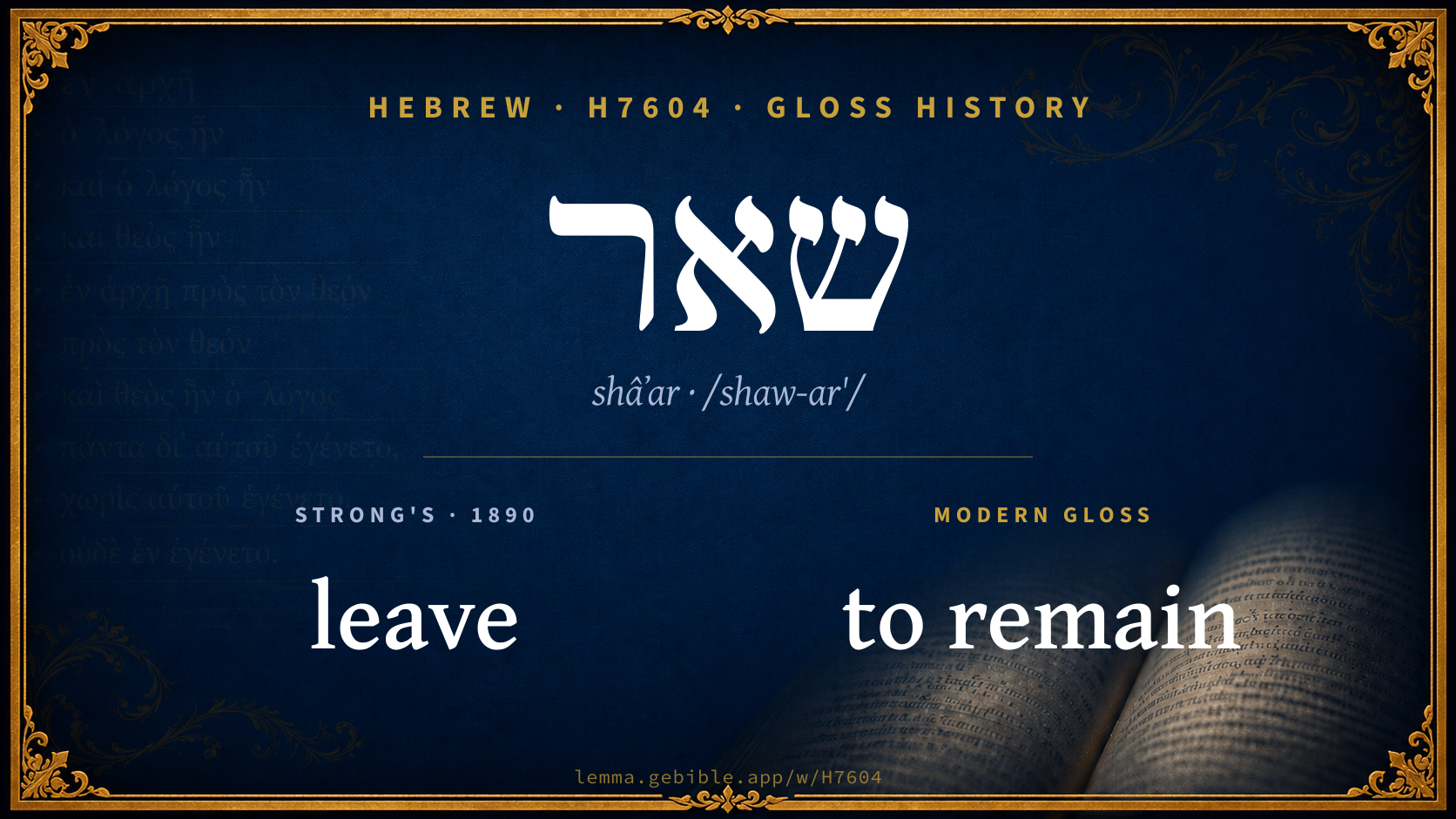
Gloss history
Strong's 1890 vs modern scholarship
About this word
Strong's H7604 catalogs a Hebrew word from the Hebrew Old Testament.
These counts are not copied from any lexicon or concordance. They are computed here, from the morphology-tagged Hebrew Old Testament. What Lemma adds →
- 123
- distinct verses
- The word appears in 123 distinct verses.
- 27 / 39
- OT books
- The word appears in 27 of 39 Old Testament books.
- #339
- by frequency
- Top 500 most frequent Hebrew words (rank 339 of 8,640 Hebrew words by occurrence).
View all 123 occurrences in the concordance →
By section of the Old Testament
By traditional corpus
Conventional, traditional groupings — biblical authorship is debated, so this is a traditional corpus grouping, not an authorship claim. Each share is this word’s portion of its verses in that division of the Hebrew canon. Each figure is a share of the word’s 123 distinct verses.
- Prophets (Nevi'im) 80 verses · 65%
- Torah (Pentateuch) 29 verses · 24%
- Writings (Ketuvim) 14 verses · 11%
How translations render this word
Counts come from each version’s own published word-to-Strong’s tagging or interlinear alignment — an approximate guide to how each version renders this word, not a word-level alignment the data otherwise carries. Because each total is that version’s own tagged count, the per-version totals vary from one another and need not match the appearance or distinct-verse counts above. These counts may also differ from a printed concordance because Lemma counts each distinctly tagged rendering and does not collapse phrase taggings into a single head-word total. This is a fixed set of word-tagged versions (KJV, ASV, BSB, ULT) and does not change with the reading translation you choose elsewhere. Each version’s license is shown beside its name below (and on Sources).
BDB lists this Strong’s number as 2 distinct words (homographs). Each count above pools all of them and is not split by sense — see the Senses section below. A low-frequency rendering may belong to a different one of those words, not the primary meaning.
- King James Version†: Remained 17×, Left 14×, Remain 11×
- American Standard Version†: Left 13×, Remain 12×, Remained 11×
- Berean Standard Bible†: Remained 15×, Remain 10×, Leaving 8×
- unfoldingWord Literal Text†: Leave 17×, Remaining 12×, He did 11×
King James Version Public Domain
Renders H7604 across 133† tagged occurrences — most commonly:
Plus other, less common renderings. Plus 42 renderings that appear only once — usually multi-word phrases or single function words the recovered tagging swept in, not distinct renderings.
American Standard Version Public Domain
Renders H7604 across 132† tagged occurrences — most commonly:
Plus other, less common renderings. Plus 52 renderings that appear only once — usually multi-word phrases or single function words the recovered tagging swept in, not distinct renderings.
Berean Standard Bible Public Domain
Renders H7604 across 124† tagged occurrences — most commonly:
Plus other, less common renderings. Plus 34 renderings that appear only once — usually multi-word phrases or single function words the recovered tagging swept in, not distinct renderings. Not rendered by a distinct English word in 9 further occurrences.
unfoldingWord Literal Text CC BY-SA 4.0
Renders H7604 across 154† tagged occurrences — most commonly:
Plus other, less common renderings. Plus 40 renderings that appear only once — usually multi-word phrases or single function words the recovered tagging swept in, not distinct renderings.
9 senses and sub-senses in the full BDB
Hebrew verbs can shift meaning by stem (binyan): Qal is the basic action, Niphal is often passive or reflexive, Piel often intensifies or makes it factitive, and Hiphil is typically causative. The senses below are grouped under the stem BDB assigns to each.
What do BDB’s symbols mean?
BDB uses these scholarly abbreviations:
| Symbol | Meaning |
|---|---|
| 𝔊 | the Septuagint (the ancient Greek translation, LXX) |
| 𝔙 | the Vulgate (the Latin translation) |
| 𝔖 | the Syriac version (the Peshitta) |
| 𝔗 | the Targum (the Aramaic translation) |
| ψ | the Psalms |
| √ | root (the underlying root or stem) |
| ‖ | parallel passage (a synonymous or contrasted parallel) |
| † | the dagger: every passage where the word occurs is cited |
The 9 senses and sub-senses the full Brown-Driver-Briggs lexicon distinguishes for this word, in lexicon order (not ranked by frequency), with BDB’s own verbatim wording and sub-sense lettering. Shown in Hebrew script with BDB’s own scholarly abbreviations. The condensed entry is in the Lexicon Entry tab. See also the Forms in the corpus table below.
שאר I remain, be left over (syn. יָתַר) (NH id.
Qal
- Pf. 3 ms. שׁ׳ 1 S 16:11 the youngest still remains. e.g. 1 Samuel 16:11
Niphal
- Pf. 3 ms. נִשְׁאַר Gn 47:18 +; 3 fs. נִשְׁאֲרָה Jos 13:1; Dn 10:8, etc.; Impf. 3 ms. יִשָּׁאֵר Is 11:11, 16, וַיִּשָּׁ֫אֶר Gn 7:23, etc.; Pt. נִשְׁאָר Gn 32:9 +, וְנֵאשֲׁאַר Ez 9:8 (read וְנִשְׁאָר Hi Toy Krae, וָאֶשָּׁ֫אֶר Sm; del. 𝔊 Hi Co Siegf Berthol); f. נִשְׁאָרָה 2 K 19:30 = Is 37:31, נִשְׁאֶ֫רֶת Ex 10:5; 2 Ch 30:6, נִשְׁאָ֑רֶת Jos 13:2, etc.;— e.g. Genesis 47:18
- 1. be left over (sometimes ‖ נוֹתַר) Ex 8:27; 10:19; 14:28 (all J), Jos 11:22 (D), Ju 7:3 2 S 14:7 +; in restrictive cl. לֹא נ׳ זוּלַת 2 K 24:14 there were left only, etc., לֹא נ׳ לִפְנֵי אֲדֹנִי בִּלְתִּי אִם וגו׳ Gn 47:18 (J); sq. acc. adv. (Ges§ 118 q), or appos., Dt 4:27; Ezr 9:15; cf. נ׳ בִּמְתֵי מְעָ֑ט Dt 28:62 (Ges§ 119 i); sometimes c. ב loc. Ex 8:5, 7 (J), Je 38:22 +; c. אֵת (prep. loc.) †Jos 23:7, 12 (D); c. מִן = be left from (of) †Ex 10:5 (J), Dt 3:11; Jos 13:12 (D), Is 11:11, 16; Je 8:3a (pt.; v b del. הַנּי 𝔊 𝔖 Hi Gf Gie Co), Ne 1:2, 3, נ׳ מְעַט מֵהַרְבֵּה Je 42:2; c. לְ to or for, †2 K 10:11, 17 (pt.), Zc 9:7; 2 Ch 21:17, הַנּ׳ לָכֶם מִן־הַבָּרָד Ex 10:5, cf. 2 Ch 30:6 and (ב loc. for ל) Je 21:7; c. בְּ, in, among, of, †1 S 11:11; Is 17:6; Je 34:7; 37:10; Lv 26:36, 39 (H; pt.), 25:52 (P; of years), even הַנּ׳ בַּדָּם 5:9 (P) the rest of the blood; c. עַל †1 S 5:4; c. inf. נ׳ לְרִשְׁתָּהּ †Jos 13:1 (D); = be left alive, survive, †Gn 7:23 (J), Ez 9:8 (but on text v. supr.); הַנּ׳ = the survivors, †Gn 14:10; 1 S 11:11; Ez 17:21; pt. as term. techn. = the (purified) remainder, remnant (cf. שְׁאָר, שְׁאֵרִית) Is 4:3 (ב loc.; ‖ הַנּוֹתָר), 2 Ch 34:21 (ב loc.).—הַנּ׳ 1 S 9:24 is dub.; what is left over, in polite depreciation, Bu; read הַשְּׁאֵר HPS. e.g. Exodus 8:27
- 2. be left behind, Ex 10:26 (E), Nu 11:26 (JE); c. לְבַדּוֹ Gn 42:38 (J), cf. Is 49:21 Dn 10:8; of widow Ru 1:3, †מִן of the dead v 5. e.g. Exodus 10:26
Hiphil
- Pf. 3 ms. הִשְׁאִיר Ex 10:12 +, etc.; Impf. 3 ms. יַשְׁאִיר Dt 28:51, 1 pl. נַשְׁאֵר 1 S 14:36 (Ges§ 48 g; 109 d Köp. 466 f.), etc.; Inf. cstr. הַשְׁאִיר Ezr 9:8, v. also infr.;— e.g. Exodus 10:12
- 1. leave over, spare, c. acc. Ex 10:12 (E), 2 K 25:22; Je 49:9 = Ob 5, Jos 11:14 (D), Ju 6:4; אֶסְלַח לַאֲשֶׁר אַשׁ׳ Je 50:20; especially לֹא הִשׁ׳ שָׂרִיד leave no survivor, Jos 10:28, cf. v 30, 37, 39, 40 (all D), so עַד־בִּלְתִּי הִשׁ׳ שׂ׳ (sometimes c. ל pers.) Nu 21:35 (E) = Dt 3:3, cf. Dt 2:34; Jos 8:22; 11:8 (both JE), 10:33 (D), 2 K 10:11, and מִבְּלִי הִשׁ׳ לוֹ כֹּ֑ל Dt 28:55 (in all these read Inf. cstr. הַשׁ׳ v. Dr Dt 3:3; 7:24); c. ב, among, of, 1 S 14:36, ב loc. 1 K 19:18; Zp 3:12 (in both of preserving a pious remnant, cf. שְׁאָר, שְׁאֵרִית), also 2 K 3:25 (Bur reads בָּנֶיהָ for אֲבָנֶיהָ, Kit אֲנָשִׁים, cf. Klo Benz); c. לְ pers. Dt 28:51; 1 K 15:29; 16:11; 2 K 13:7; Ezr 9:8; c. מִן, from, of, 2 K 10:14, מִן part. 1 S 25:22; 2 K 25:12 = Je 52:16; Je 39:10. e.g. Exodus 10:12
- 2. leave or keep over (מִן part.) till morning Nu 9:12 (P). e.g. Numbers 9:12
- 3. תַּשׁ׳ מֵאָה Am 5:3 the city shall have 100 left, cf. v 3. e.g. Amos 5:3
- 4. leave as a gift, וְהִשׁ׳ אַחֲרָיו בְּרָכָה Jo 2:14.—We Now read וַיַּשְׁאֵר Mal 2:15, v. שְׁאָר. e.g. Joel 2:14
שאר II (√ of foll.
Senses from the full Brown-Driver-Briggs lexicon (Brown, Driver, Briggs; Oxford 1906 — public domain), digitized via Sefaria, supplemented by the OpenScriptures HebrewLexicon (CC BY 4.0). Full attribution on Sources.
Word origin
I. vb. remain, be left over (syn. יָתַר) (NH id.; 𝔗 שְׁאַר; Sab. סאר remaining HomChr 124; Arabic سَأَرَ, سَىِٔرَ be left over, Lane, cf. LagGGN 1889, 297; Old Aramaic שאר remainder, Nab. שארית, v. Lzb371 SAC110);—
I. (√ of foll.; cf. Assyrian šêru, Pun. שאד, flesh, Arabic ثَأْرٌ blood revenge, so Sab. תֿאר, Sab.Denkm.No. 5, l.7; perhaps orig. blood (cf. Je 51:35), NöZMG xi (1886), 723 and Id.M 101, who cp. Mand. תירתא = ܬܻܐܪܳܬܐ conscience, mind, etc., perhaps proposes midriff, cf. Hoffminfr.).
— Brown-Driver-Briggs (Oxford 1906, public domain), digitized via Sefaria, supplemented by the OpenScriptures HebrewLexicon (CC BY 4.0). See Sources.
Origin: a primitive root
Jastrow Dictionary
A second Hebrew/Aramaic lexicon for comparison, covering Aramaic and post-biblical (Talmudic, Targumic, Midrashic) usage that the biblical-Hebrew BDB does not. Matched by lemma rather than by Strong’s number, so a lemma may carry more than one Jastrow headword (shown separately below), and the entries cover usage well beyond the Bible.
שָׁאַר
- (b. h.) to swell, rise; to run over; (cmp. יָתַר, עָדַף) to remain over. Denom. מִשְׁאֶרֶת, שְׁאָר, שְׁאֵר &c.
- to be left over, reserved, preserved, spared. Gen. R. s. 76 (ref. to Gen. XXXII, 9) אלו אחינו … אע"פ שנִשְׁאֲרוּ לפליטה וכ׳ this refers to our brethren in the diaspora …; although they have been spared for escape (from Roman persecution), yet they fasted for us (Palestinians) &c. Cant. R. to II, 13 הנִשְׁאָרִים the survivors of the Messianic days; a. e. e.g. Genesis 32:9
- ,) שִׁיֵּיר to leave over, reserve. B. Bath. IX, 6 שכיב … וש׳ וכ׳ if an ill person donated all his property to others and reserved some land for himself, his donation is valid (even if he recovers). Ib. 148ᵃ דקל לאחד וש׳ פירותיו לפניו ש׳ מקום פירי if he donated a palm-tree (for the wood of it) to a person, and reserved its fruit for himself, he meant to reserve for himself the place whereon the fruit grows (the branches). Ib. כל … בעין יפה מְשַׁיֵּיר whatever one reserves for one’s self, one reserves liberally; a. v. fr.—Part. pass. מְשׁוֹאָר, (מְשׁוּיָּיר). Y. Pes. VII, 35ᵃ top לא עשה בה המש׳ כיוצא the law does not treat that which is left over (of the sacrifice) like that which has been carried outside of its limits. Peah III, 3 נותּן מן המש׳ על מה ששייר he must give to the poor out of the remainder in proportion to that which he left over; נותן מן המש׳ על הכל he must give out of the remainder a quantity corresponding to the whole (including that which he has taken out before); a. fr.
- same. Midr. Till. to Ps. IX שלא להַשְׁאִיר זכר וכ׳ that he will not leave a remainder of the memory of Amalek; Yalk. ib. 642 להשאר (corr. acc.); a. e.
- to be left over. Ḥull. III, 1 ניטל … ולא נ׳ וכ׳ if the liver of a slaughtered animal is found consumed without any part of it left. Yoma 77ᵃ לא נִשְׁתַּיְירוּ משונאיהן וכ׳ no remnant or survivor would have been left of the enemies of Israel (euphem. for ‘of Israel’); a. fr.
שְׁאַר I
- to leave over. Targ. O. Ex. X, 12 (Y. שייר). Ib. 26 נַשְׁאַר ed. Berl. (ed. Vien. תִּשְׁתָּאַר Ithpa.); a. fr.
- , שַׁיֵּר same. Targ. Y. Ex. XII, 10 (O. Af.). Ib. X, 12, v. supra; a. fr.—B. Kam. 15ᵃ תנא וש׳ מאי ש׳ דהאי ש׳ ש׳ וכ׳ the Mishnah states some cases, but leaves over (does not state all cases coming under the same category). But what else did it omit, so as to be justified in omitting this? It omitted a case when half the assessed fine is to be paid; Succ. 54ᵃ; a. fr.
- to leave over, spare. Targ. Ps. LXXIX, 11 Var. ed. Lag. (ed. Lag. a. oth. שרי; h. text הוֹתֵר).
- to be left over, remain. Targ. Gen. VII, 23. Targ. Ex. VIII, 5; a. fr.—B. Mets. 25ᵃ א׳ בה מידי some of it was left behind; a. e.
שְׁאַר II
- Pa. שָׁאֵר (denom. of מֵשָׁאר, v. מֵישָׁרָא) to plant in beds. B. Kam. 81ᵃ שַׁאֲרֵיה מֵשָׁארֵי לאדם וכ׳ (Ms. M. שדיא משראי לשראי, read: משארי משארי; v. Rabb. D. S. a. l. note) if he planted in beds, it shows that he planted it for human food; if not, it is intended for cattle.
שְׁאֵר
- v. שָׁאַר) [preservation, existence,]
- 1. sustenance, alimentation;
- 2. (sub. בשר) body, flesh;
- 3. bodily contact, intimacy. Mekh. Mishp. s. 3 (ref. to שארה, Ex. XXI, 10) שְׁאֵרָהּ אלו מזונותיה וכ׳ sh’erah means her alimentation &c. (ref. to Mic. III, 3, a. Ps. LXXVIII, 27); ib. (anoth. opin.) שארה כסותה כסות … לשְׁאֵרָהּ וכ׳ sh’erah k’suthah means, garments suited to her body (according to age and season) &c.; ib. (anoth. opin.) שארה זו דרך ארץ sh’erah means (intimacy) marital duty (ref. to Lev. XVIII, 6; 12; 13, cmp. Targ.); Keth. 47ᵇ לפום שארה תן כסותה וכ׳ according to her body (age) give her garments …, according to the season give her &c.; Y. ib. V, 30ᵇ top. Sabb. 137ᵇ חוק בשְׁאֵרוֹ, v. חוֹק; Y. Ber. IX, 14ᵃ bot. בשְׁאֵירוֹ.—Trnsf. [flesh and blood,] relationship, relatives; race. Ib. שְׁאֵירֵנוּ; Sabb. l. c. שְׁאֵרֵינוּ, v. יְדִידוּת. Lev. R. v. 34 (expl. עכר שארו, Prov. XI, 17) זה שמגעת … את קרוביו וכ׳ that is he to whom joy (a festive occasion) happens, and who lets not his nearest relatives join him because they are poor; Yalk. Prov. 947. Yeb. 90ᵇ (ref. to Lev. XXI, 2) שארו זו אשתו his flesh (sh’er), this means his wife (cmp. Gen. II, 24); Sifra Emor beg.; a. e. e.g. Exodus 21:10
שְׁאָר
- remainder, rest. Sot. VII, 7 ועל ש׳ התפלה (Y. ed. וש׳ תפילה) and a special benediction for the remaining (general) prayer; Bab. ed. 40ᵇ והש׳ תפלה and the remainder is a general prayer; ib. 41ᵃ; Y. ib. VII, end, 22ᵃ; Yoma 70ᵃ וש׳ התפלה רינה וכ׳ and the remaining prayer is song, supplication &c. B. Mets. III, 4 והש׳ יהא מונח וכ׳ and what is left must be deposited &c., v. אֵלִיָּהוּ. Peah IV, 3; a. fr.—V. שְׁיָ֫יר.
שְׁאָר ²
- Targ. O. Gen. XLV, 7 (Y. שיורא; h. text שארית). Targ. Is. X, 19, sq. Targ. II Sam. III, 8 (h. text אשר?); a. fr.—Targ. II Chr. XXXVI, 20 (fem.).—Ruth R. to III, 3 והיא עבדא ש׳ (some ed. שְׁאָרָהּ); Yalk. ib. 604 שְׁיָרָהּ, v. נְפֵי.—[שאריא, Yalk. Jer. 321, v. שְׁמָרָא.]
A Dictionary of the Targumim, the Talmud Babli and Yerushalmi, and the Midrashic Literature (Marcus Jastrow; London, Luzac, 1903) — Public Domain. Digitized via Sefaria. Digitized via Sefaria. Full attribution on Sources.
Forms in the corpus
The 89 distinct written forms H7604 takes in the Hebrew Bible, most frequent first — each parse links to that stem’s occurrences in the concordance. Hebrew forms include their vowel points and cantillation, so a single lemma takes many written forms.
The 60 most common forms are shown; 29 rarer forms follow in the full concordance.
Same root — word family
Other BDB entries built from the same root as H7604, grouped by Strong’s listed origin. These share a root / origin per the lexicon — not necessarily a shared meaning. Each links to that word’s own entry.
Derived from this word
- משארת mishʼereth H4863 kneading trough
- שאר sᵉʼôr H7603 leaven
- שאר shᵉʼâr H7605 remnant
- שאר shᵉʼêr H7607 flesh
- שארית shᵉʼêrîyth H7611 remnant
Compare all same-root words → Showing 4 of 6 — not the complete family. They share a root, not necessarily a meaning.
Septuagint verse parallels
This word appears in 116 verses that also exist in the Greek Old Testament (Septuagint), out of the 123 Hebrew verses it occurs in. You can read those verses in Greek by switching the Old Testament edition to the Septuagint.
Read these verses in the Septuagint
- Genesis 7:23
- Exodus 8:9
- Leviticus 5:9
- Numbers 9:12
- Deuteronomy 2:34
- Joshua 8:17
- Judges 4:16
- Ruth 1:3
- 1 Samuel 5:4
- 2 Samuel 14:7
- 1 Kings 15:29
- 2 Kings 3:25
This is a verse-level parallel only — the same verses exist in both the Hebrew and Greek Old Testaments. No word-level Hebrew↔Greek correspondence is claimed: the data carries no such alignment, so no Greek word is shown as this Hebrew word’s translation. Coverage is not total — the Septuagint omits the deuterocanon and renumbers the Psalms, so some Hebrew verses have no direct Greek parallel.