Isaiah 24:6

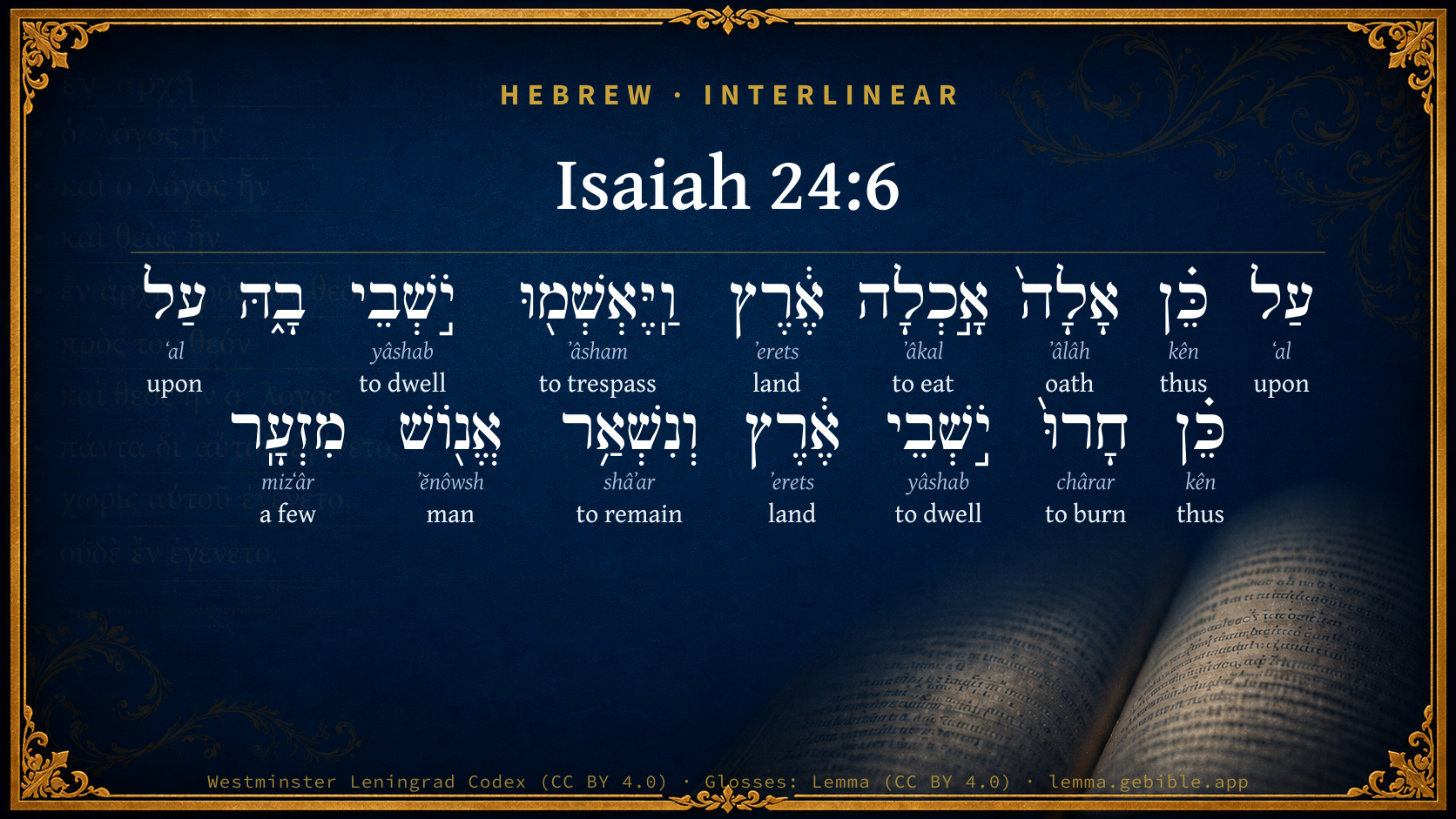
Hebrew (Westminster Leningrad Codex) Isaiah 24:6 appears in the Hebrew Old Testament. The text above is from the Westminster Leningrad Codex. Each word links to its Strong’s number, a concise gloss, and parsing drawn from the Open Scriptures Hebrew Bible morphology. Click any word for its full Brown-Driver-Briggs (BDB) entry.
Download image
Cite this verse

Isaiah 24:6 (World English Bible). Public Domain. Lemma interlinear Bible study tool, https://lemma.gebible.app/v/isaiah/24/6.

Show BibTeX & RIS
BibTeX
RIS
English Translation
Therefore has the curse devoured the earth, and those who dwell therein are found guilty: therefore the inhabitants of the earth are burned, and few men left.
World English Bible · Public Domain
Download a study sheet

One document with this verse’s original text, its word-by-word gloss line, the meaning frame, cross-references with their text, attributed commentary, and full source and license credits — printable, and it pastes into notes with its structure intact.

This verse Autodidact and up

Study sheet (.html) Plain text (.txt)

A passage Seminary Student

Up to 50 verses in one chapter. A passage sheet keeps up to 6 commentary sources and 12 cross-references per verse, in the order this page ranks them, and says so on the sheet whenever that leaves anything out. Ask for a single verse and you get the Autodidact verse sheet above.

Everything on this page stays free to read, with no account — the sheet is a download of what is already on screen, not access to it.

Want to remove ads? Support Godless Engineer
Compare translations 3

The same verse in 3 English versions, stacked beneath the original-language interlinear above. Click any original word for its lexicon entry.

Each is an independent rendering of the whole verse — the interlinear is not word-aligned to these translations.

Highlighted words mark where these versions differ — a whole-verse word diff, not a word-by-word alignment.

  • World English Bible Public Domain
    Therefore has the curse devoured the earth, and those who dwell therein are found guilty: therefore the inhabitants of the earth are burned, and few men left.
  • King James Version Public Domain
    Therefore hath the curse devoured the earth, and they that dwell therein are desolate: therefore the inhabitants of the earth are burned, and few men left.
  • unfoldingWord Literal Text CC BY-SA 4.0
    Therefore, a curse has devoured the earth, and the dwellers in it are guilty. Therefore, the dwellers of the earth burn up, and a man of few is left.

unfoldingWord Literal Text — © unfoldingWord, licensed CC BY-SA 4.0. Word-aligned USFM3 via Door43 (git.door43.org/unfoldingWord/en_ult).

Versions to compare (up to 4)

3 of 4 selected

Show all 18 translations

Every available English version of this verse, each an independent rendering of the whole verse.

  • World English Bible Public Domain
    Therefore has the curse devoured the earth, and those who dwell therein are found guilty: therefore the inhabitants of the earth are burned, and few men left.
  • Berean Standard Bible Public Domain
    Therefore a curse has consumed the earth, and its inhabitants must bear the guilt; the earth’s dwellers have been burned, and only a few survive.
  • Majority Standard Bible Public Domain
    Therefore a curse has consumed the earth, and its inhabitants must bear the guilt; the earth’s dwellers have been burned, and only a few survive.
  • King James Version Public Domain
    Therefore hath the curse devoured the earth, and they that dwell therein are desolate: therefore the inhabitants of the earth are burned, and few men left.
  • American Standard Version (1901) Public Domain
    Therefore hath the curse devoured the earth, and they that dwell therein are found guilty: therefore the inhabitants of the earth are burned, and few men left.
  • Revised Version (1885) Public Domain
    Therefore hath the curse devoured the earth, and they that dwell therein are found guilty: therefore the inhabitants of the earth are burned, and few men left.
  • Geneva Bible (1599) Public Domain
    Therefore hath the curse deuoured the earth, and the inhabitantes thereof are desolate. Wherefore the inhabitants of the land are burned vp, and fewe men are left.
  • Douay-Rheims (1899) Public Domain
    Therefore shall a curse devour the earth, and the inhabitants thereof shall sin: and therefore they that dwell therein shall be mad, and few men shall be left.
  • Young's Literal Translation Public Domain
    Therefore a curse hath consumed the land, And the inhabitants in it are become desolate, Therefore consumed have been inhabitants of the land, And few men have been left.
  • Literal Standard Version CC BY-SA 4.0
    Therefore a curse has consumed the earth, || And the inhabitants in it become desolate, || Therefore inhabitants of the earth have been consumed, || And few men have been left.
  • Unlocked Literal Bible CC BY-SA 4.0
    Therefore a curse devours the earth, and its inhabitants are found guilty. The inhabitants of the earth burn up, and few people are left.
  • unfoldingWord Literal Text CC BY-SA 4.0
    Therefore, a curse has devoured the earth, and the dwellers in it are guilty. Therefore, the dwellers of the earth burn up, and a man of few is left.
  • Darby Bible Public Domain
    Therefore doth the curse devour the earth, and they that dwell therein are held guilty; therefore the inhabitants of the earth are consumed, and few men are left.
  • World Messianic Bible Public Domain
    Therefore the curse has devoured the earth, and those who dwell therein are found guilty. Therefore the inhabitants of the earth are burned, and few men are left.
  • Webster's Bible Public Domain
    Therefore hath the curse devoured the earth, and they that dwell in it are desolate: therefore the inhabitants of the earth are burned, and few men left.
  • Free Bible Version CC BY-SA 4.0
    That is why a curse is destroying the earth. The people suffer because of their guilt. The inhabitants of the earth are burned up and only a few survive.
  • Bible in Basic English Public Domain
    For this cause the earth is given up to the curse, and those in it are judged as sinners: for this cause those living on the earth are burned up, and the rest are small in number.
  • JPS Tanakh (1917) Public Domain
    Therefore hath a curse devoured the earth, and they that dwell therein are found guilty; therefore the inhabitants of the earth waste away, and men are left few.

Literal Standard Version (2020), Covenant Press — licensed CC BY-SA 4.0. Text via the HelloAO Bible API (eBible.org). Unlocked Literal Bible (unfoldingWord) — licensed CC BY-SA 4.0. Text via the HelloAO Bible API (eBible.org). unfoldingWord Literal Text — © unfoldingWord, licensed CC BY-SA 4.0. Word-aligned USFM3 via Door43 (git.door43.org/unfoldingWord/en_ult). Free Bible Version, Dr. Jonathan Gallagher — licensed CC BY-SA 4.0. Text via the HelloAO Bible API (eBible.org).

Word by word

More ways to search: Search by grammar → Find every occurrence → Compare this word →

Practice this passage: Drill this verse → Learn its vocabulary →

מִזְעָֽר
mizʻâr
H4213
“a few”
Noun, Common, Masculine, Singular, Absolute
Part of Speech
Noun
Type
Common
Gender
Masculine
Number
Singular
State
Absolute
Full BDB Definition

Origin: from the same as H2191

TWOT: 571b

a little, a trifle, a few - a trifle, a little (of time) - a remnant, a very few (of number)
  1. עַל ʻal H5921 “upon” Preposition
  2. כֵּ֗ן kên H3651 “thus” Particle, Demonstrative
  3. אָלָה֙ ʼâlâh H423 “oath” Noun, Common, Feminine, Singular, Absolute
  4. אָ֣כְלָה ʼâkal H398 “to eat” Verb, Qal, Perfect, 3rd Person, Feminine, Singular
  5. אֶ֔רֶץ ʼerets H776 “land” Noun, Common, Both, Singular, Absolute
  6. וַֽיֶּאְשְׁמ֖וּ ʼâsham H816 “and · to trespass” Conjunction + Verb, Qal, Sequential Imperfect, 3rd Person, Masculine, Plural
  7. יֹ֣שְׁבֵי yâshab H3427 “dwelling” Verb, Qal, Participle Active, Masculine, Plural, Construct
  8. עַל ʻal H5921 “upon” Preposition
  9. כֵּ֗ן kên H3651 “thus” Particle, Demonstrative
  10. חָרוּ֙ chârar H2787 “to burn” Verb, Qal, Perfect, 3rd Person, Common, Plural
  11. יֹ֣שְׁבֵי yâshab H3427 “dwelling” Verb, Qal, Participle Active, Masculine, Plural, Construct
  12. אֶ֔רֶץ ʼerets H776 “land” Noun, Common, Both, Singular, Absolute
  13. וְנִשְׁאַ֥ר shâʼar H7604 “and · to remain” Conjunction + Verb, Niphal, Perfect, 3rd Person, Masculine, Singular
  14. אֱנ֖וֹשׁ ʼĕnôwsh H582 “man of” Noun, Common, Masculine, Singular, Construct

About this verse

These counts appear in no published source. They are computed here, from the morphology-tagged text and Lemma’s own curated glosses. What Lemma adds →

16
words
11
distinct lemmas
Prophets
section

Notable vocabulary

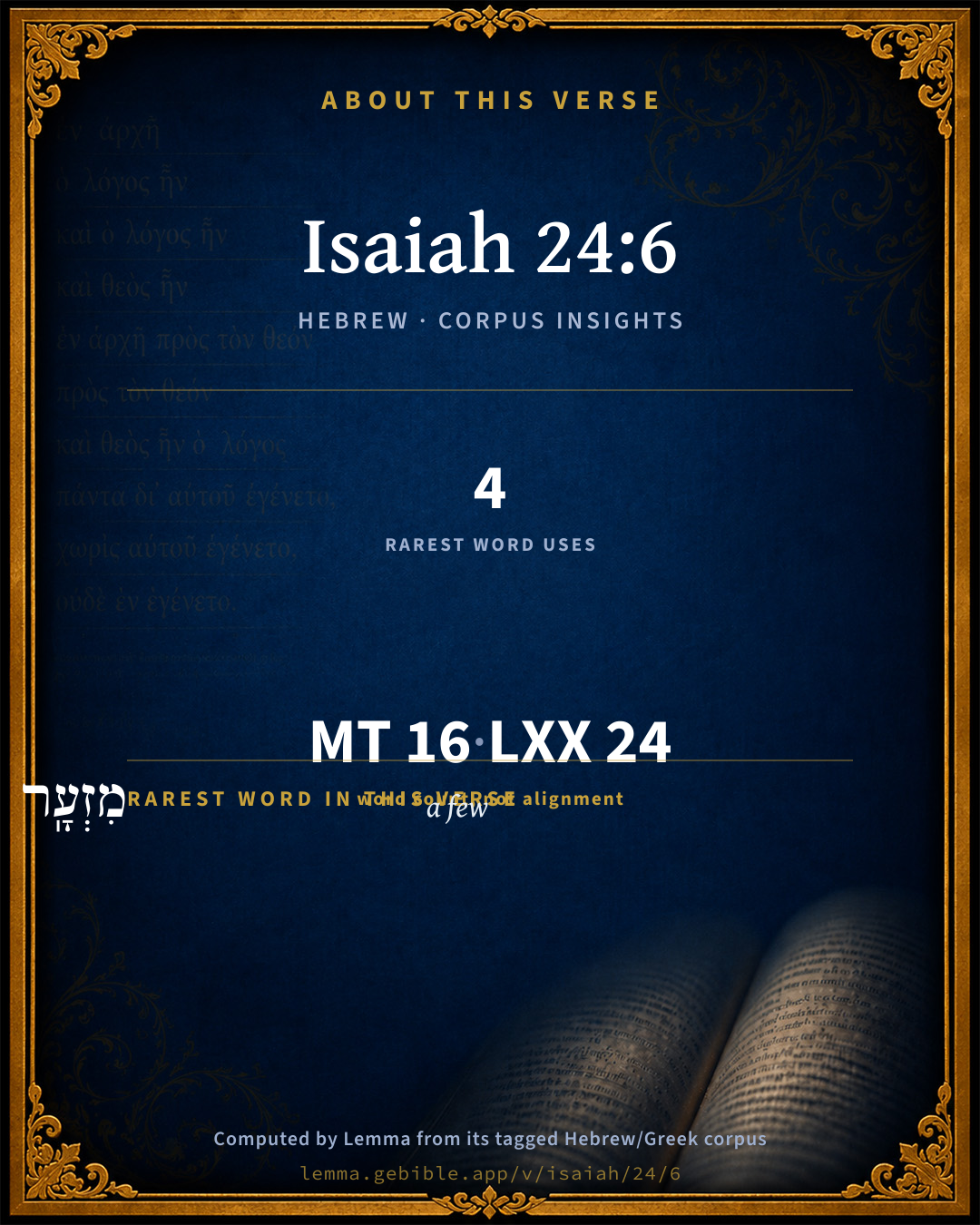
The rarest word here is מִזְעָֽר a few H4213 — appearing just 4 times in the whole Hebrew Bible.

Shared distinctive vocabulary

מִזְעָֽר a few H4213 occurs in 4 verses of the Hebrew Bible. Also found in:

Grammatical profile

  • 6 verbs
  • 5 nouns
  • 3 prepositions
  • 2 particles

Verb forms

  • אָ֣כְלָה Qal · Perfect
  • וַֽיֶּאְשְׁמ֖וּ Qal · Sequential Imperfect
  • יֹ֣שְׁבֵי Qal · Participle Active
  • חָרוּ֙ Qal · Perfect
  • יֹ֣שְׁבֵי Qal · Participle Active
  • וְנִשְׁאַ֥ר Niphal · Perfect

Repetition

Words recur within this verse — often emphatic in Hebrew:

  • עַל upon H5921 ×2
  • כֵּ֗ן thus H3651 ×2
  • אֶ֔רֶץ land H776 ×2
  • יֹ֣שְׁבֵי to dwell H3427 ×2

Hebrew & Septuagint length

In English translation the verse runs 27 words from the Hebrew and 28 from the Septuagint (LXX English) — closely comparable.

A rough comparison of the two English renderings, which tokenize alike — not a word-level alignment.

Word counts can differ between the Hebrew and the Greek without any difference in meaning — e.g. the Hebrew direct-object marker אֵת has no separate Greek word, and Greek often adds the article ὁ.

In the original languages it is 16 Hebrew tokens and 24 Greek tokens — but the two are counted differently (Hebrew bundles its prefixes and suffixes into one token; the Greek is in lemma form), so that isn’t a like-for-like length.

Cross-references

19

Topical passages linked to Isaiah 24:6 in the Treasury of Scripture Knowledge — connected by theme and wording, ordered by reader-vote popularity; previews shown in the World English Bible.

  • Malachi 4:1 "For, behold, the day comes, it burns as a furnace; and all the proud, and all who work wickedness, will be stubble; and the day that comes will burn them up," says Yahweh of Hosts, "that it shall leave them neither root nor branch.
  • Zechariah 5:3–4 Then he said to me, "This is the curse that goes out over the surface of the whole land; for everyone who steals shall be cut off according to it on the one side; and everyone who swears falsely shall be cut off according to it on the other side.
  • Matthew 7:14 How narrow is the gate, and restricted is the way that leads to life! Few are those who find it.
  • Leviticus 26:22 I will send the wild animals among you, which will rob you of your children, destroy your cattle, and make you few in number; and your roads will become desolate.
  • Ezekiel 5:3 You shall take of it a few in number, and bind them in your skirts.
  • Malachi 4:6 He will turn the hearts of the fathers to the children, and the hearts of the children to their fathers, lest I come and strike the earth with a curse."
  • Romans 9:27 Isaiah cries concerning Israel, "If the number of the children of Israel are as the sand of the sea, It is the remnant who will be saved;
  • Deuteronomy 4:27 Yahweh will scatter you among the peoples, and you shall be left few in number among the nations, where Yahweh shall lead you away.
  • Deuteronomy 28:15–20 But it shall come to pass, if you will not listen to the voice of Yahweh your God, to observe to do all his commandments and his statutes which I command you this day, that all these curses shall come on you, and overtake you.
  • Deuteronomy 28:62 You shall be left few in number, whereas you were as the stars of the sky for multitude; because you didn't listen to the voice of Yahweh your God.
  • Deuteronomy 29:22–28 The generation to come, your children who shall rise up after you, and the foreigner who shall come from a far land, shall say, when they see the plagues of that land, and the sicknesses with which Yahweh has made it sick;
  • Deuteronomy 30:18–19 I denounce to you this day, that you shall surely perish; you shall not prolong your days in the land, where you pass over the Jordan to go in to possess it.
  • Joshua 23:15–16 It shall happen, that as all the good things are come on you of which Yahweh your God spoke to you, so will Yahweh bring on you all the evil things, until he have destroyed you from off this good land which Yahweh your God has given you.
  • Isaiah 1:31 The strong will be like tinder, And his work like a spark. They will both burn together, And no one will quench them."
  • Isaiah 42:24–25 Who gave Jacob for a spoil, and Israel to the robbers? Didn't Yahweh? he against whom we have sinned, and in whose ways they would not walk, neither were they obedient to his law.
  • Malachi 2:2 If you will not listen, and if you will not lay it to heart, to give glory to my name," says Yahweh of Hosts, "then will I send the curse on you, and I will curse your blessings. Indeed, I have cursed them already, because you do not lay it to heart.
  • Malachi 3:9 You are cursed with the curse; for you rob me, even this whole nation.
  • 2 Peter 3:10 But the day of the Lord will come as a thief in the night; in which the heavens will pass away with a great noise, and the elements will be dissolved with fervent heat, and the earth and the works that are in it will be burned up.
  • Matthew 27:25 All the people answered, "May his blood be on us, and on our children!"

Cross-references courtesy of OpenBible.info (CC BY 4.0).

Hebrew and Greek witnesses Masoretic Hebrew ↔ Greek Septuagint

The same verse in the two great witnesses to the Old Testament, shown verse-for-verse.

These are two independent witnesses, not word-aligned to each other, and the Septuagint is shown in lemma (dictionary) form.

Hebrew Isaiah 24:6 Masoretic · Westminster Leningrad Codex

עַל כֵּ֗ן אָלָה֙ אָ֣כְלָה אֶ֔רֶץ וַֽיֶּאְשְׁמ֖וּ יֹ֣שְׁבֵי בָ֑הּ עַל כֵּ֗ן חָרוּ֙ יֹ֣שְׁבֵי אֶ֔רֶץ וְנִשְׁאַ֥ר אֱנ֖וֹשׁ מִזְעָֽר

Therefore has the curse devoured the earth, and those who dwell therein are found guilty: therefore the inhabitants of the earth are burned, and few men left.

World English Bible · Public Domain

Greek LXX Isaiah 24:6 Septuagint · lemma form

διά οὗτος ἀρά ἐσθίω ὁ γῆ ὅτι ἁμαρτάνω ὁ καταοἰκέω αὐτός διά οὗτος πτωχός εἰμί ὁ ἐνοἰκέω ἐν ὁ γῆ καί καταλείπω ἄνθρωπος ὀλίγος

Therefore a curse shall consume the earth, because the inhabitants thereof have sinned: therefore the dwellers in the earth shall be poor, and few men shall be left.

LXX2012 (modern English Septuagint) · Public Domain

On this verse, Adam Clarke's Commentary discusses the Septuagint’s reading. Read the note in Commentary ↓

Hebrew: Westminster Leningrad Codex (CC BY 4.0). Greek: Septuagint (public domain); English from LXX2012 (modern English Septuagint) (Public Domain). How the Septuagint differs from the Hebrew →

Targum (Aramaic paraphrase)

1

The Targum is the ancient Jewish Aramaic paraphrase of the Hebrew Scriptures — an interpretive translation, not the Hebrew text itself. Onkelos (literal) and Pseudo-Jonathan (expansive) render the Torah, and Jonathan the Prophets. Coverage is partial: where no permissively-licensed English translation exists for a verse, only the Aramaic is shown. This is verse-level text, not a word-by-word alignment to the Hebrew.

  1. Targum Jonathan Prophets (Joshua–Malachi)
    עַל כֵּן מִן קֳדָם מוֹמֵי דִשְׁקַר חֲרוֹבַת אַרְעָא וּצְדִיאוּ דְיָתְבִין בָּהּ עַל כֵּן סָפוּ יָתְבֵי אַרְעָא וְאִשְׁתְּאַר אֱנָשָׁא כִּזְעֵיר:

    Because of perjury the land hath become a desert, and all the inhabitants in it are laid desolate: therefore are the inhabitants of the land destroyed, and the men that are left are but few.

    Targum Jonathan — Aramaic: “Mikraot Gedolot” (public domain). English: “Sefaria Community Translation” (CC0 1.0 (public-domain dedication)); “London "Chaldee Paraphrase," 1871” (public domain). Text via Sefaria.

Commentary

Notes on Isaiah 24:6 from classic Christian and Jewish commentators (each source and its license shown beneath its notes). The classic Christian expositions comment on the surrounding passage and are grouped to its opening verse, so a note may address several verses; the Jewish commentaries on the Tanakh (Rashi and others) are per-verse, so they appear only where the commentator wrote on this verse.

Lemma curates 59 commentaries, every one of them public domain or Creative Commons licensed, each selected and text-cleaned for this edition rather than reprinted as found. About our sources →

Trapp's Complete Commentary

John Trapp

Isa 24:6 Therefore hath the curse devoured the earth, and they that dwell therein are desolate: therefore the inhabitants of the earth are burned, and few men left.

Ver. 6. Therefore hath the curse devoured the earth.] The Chaldee and Vatablus render it the perjury - viz., in transgressing the laws, &c., which they had covenanted and sworn to observe; see Psa 119:106. That dreadful curse of the Jews {Mat 27:25} is come upon them to the utmost, devouring their land and desolating the inhabitants thereof. Though the curse causeless come not, yet God sometimes saith Amen to other men’s curses, as he did to Jotham’s upon the Shechemites. {Jdg 9:57} How much more to men’s cursing themselves?

John Trapp, A Commentary or Exposition upon All the Books of the Old and New Testament (1647–1656) — public domain. Text from a community e-Sword module.

Tyndale Open Study Notes

Tyndale Open Resources

24:6 The effect of sin is so great that no earthly thing or action can adequately atone for it. Hope ultimately lies in God himself. God has reconciled the world to himself in Christ (Col 1:19-20).

Tyndale Open Study Notes — © Tyndale Open Resources, licensed CC BY-SA 4.0. Text via the HelloAO Bible API.

Geneva Bible (1599)

Geneva Bible translators

Written in the Law, as Lev. 26:14; Deut. 28:16, thus the Prophets used to apply particularly the menaces and promises, which are general in the Law.

With heat and drought, or else that they were consumed with the fire of God’s wrath.

Geneva Bible (1599) marginal notes — public domain. Text via Bolls.life.

Jamieson, Fausset & Brown

Robert Jamieson, A. R. Fausset & David Brown

earth--the land.

burned--namely, with the consuming wrath of heaven: either internally, as in Job 30:30 [ROSENMULLER]; or externally, the prophet has before his eyes the people being consumed with the withering dryness of their doomed land (so Joe 1:10, Joe 1:12), [MAURER].

Jamieson, Fausset & Brown — Commentary Critical and Explanatory on the Whole Bible (1871) — public domain (CC PDM 1.0). Text via the HelloAO Bible API.

Adam Clarke's Commentary

Verse 6. Are burned - "Are destroyed"] For חרו charu, read חרבו charebu. See the Septuagint, Syriac, Chaldee, and Symmachus.

Adam Clarke's Commentary on the Bible (1810–1826) — public domain. Text from a community e-Sword/MySword module.

Ellicott's Commentary for English Readers

(6) Therefore hath the curse . . .—The definite article may be either generic, the curse which always follows on evil-doing, or, more specifically, the curse of the Book of the Covenant, as in Leviticus 26; Deuteronomy 28. The curse is personified as a beast of prey or a consuming fire, ready to devour. (Comp. Gen_4:7; Gen_4:11.)

They that dwell therein are desolate.—Better, bear their punishment, or are dealt with as guilty.

Are burned.—The word determines, perhaps, the sense of the word “devour” in the previous clause. The curse, the symbol of the wrath of Jehovah, is the consuming fire that burns.

A Bible Commentary for English Readers, edited by Charles John Ellicott (1878–1897) — public domain. Text from a community e-Sword module.

The Cambridge Bible for Schools and Colleges

gen. ed. J. J. S. Perowne

6. hath the (or a) curse devoured the earth] Cf. Zec_5:3.

are desolate] Render with R.V., are found guilty.

the inhabitants of the earth are burned] or burn under the curse, which is the expression of the Divine wrath. The verb (ḥârar) means “to glow” (Eze_24:11) or “be parched” (Job_30:30), not “be burned up.”

few men left] Desolating and protracted wars have reduced the population of all countries; but the process of extermination is not yet at an end (see Isa_24:13).

The Cambridge Bible for Schools and Colleges (gen. ed. J. J. S. Perowne; Cambridge University Press, 1878–1918) — public domain. Text from a community e-Sword module.

John Gill's Exposition

Therefore hath the curse devoured the earth,.... The inhabitants of it, and the fruits upon it, alluding to the earth being cursed for the sin of man, when it brought forth briers and thorns; this may denote the seven vials of God's wrath poured upon the earth, or the antichristian states. Some, by the curse, understand perjury or false swearing; so the Targum,

"therefore, because of perjury (or a false oath) the earth is become a desert;''

of which popes, and Popish princes, cardinals, priests, Jesuits, &c. have been notoriously guilty:

and they that dwell therein are desolate: for want of houses, cities and towns being destroyed by war; or through famine, for want of provisions, the earth being cursed for their sins: or the words may be rendered, "for they that dwell therein are guilty" (s); of idolatry, bloodshed, perjury, thefts, sorcery, and all other abominations, Rev 9:20,

therefore the inhabitants of the earth are burned; their cities burnt with fire, and particularly the city of Rome; or their persons, their bodies burnt with burning fevers, and pestilential diseases; and their minds with envy, fury, and madness: this may be the same with the fourth vial poured upon the sun, when men will be scorched with fire and great heat, and blaspheme, Rev 16:8. The Vulgate Latin version here renders it, "shall be mad"; through the wrath of God poured out upon them:

and few men left; but what shall be consumed by fire or sword, by famine or pestilence, or by one or other of the vials; and those that remain shall be frightened, and give glory to the God of heavens Rev 11:13.

(s) Sept. "peccabunt", V. L. "quia deliquerunt", Tigurine version; "rei aguntur, sive luunt", Cocceius.

John Gill's Exposition of the Whole Bible (1746–1763) — public domain (CC PDM 1.0). Text via the HelloAO Bible API.

Albert Barnes' Notes on the Bible

Therefore hath the curse devoured - Eaten it up; a figurative expression that is common in the Scriptures, denoting that the desolation is widespread and ruinous.

Are burned - (חרוּ chârû). Instead of this reading, Lowth proposes to read: חרבוּ chârebû ‘Are destroyed.’ The Septuagint reads it, ‘Therefore the inhabitants of the land shall be poor.’ The Syriac, ‘The inhabitants of the land shall be slain.’ But there is no authority from the manuscripts to change the text as proposed by Lowth, Nor is it necessary. The prophet does not mean that the inhabitants of the land were consumed by fire. The expression is evidently figurative. He is speaking of the effect of wrath or the curse, and that effect is often described in the Scriptures as burning, or consuming, as a fire does. The sense is, that the inhabitants of the land are brought under the withering, burning, consuming effect of that wrath; and the same effects are produced by it as are seen when a fire runs over a field or a forest. Hence, the word here used (חרה chârâh, “to burn, to be kindled”) is often used in connection with wrath, to denote burning or raging anger. Exo 22:23 : ‘His anger burns.’ Gen 30:2 : ‘And the anger of Jacob was kindled against Rachel; Gen 44:18; Job 27:2-3; Job 42:7; Gen 31:6 : ‘His anger was kindled.’ Psa 37:1, Psa 37:7-8; Pro 24:19 Compare Job 30:30 :

My skin is black upon me,

And my bones are burnt with heat.

The sense is, that the inhabitants of the land were wasted away under the wrath of God, so that few were left; as the trees of the forest are destroyed before a raging fire.

And few men are left - This was literally true after the invasion of the land by the Chaldeans 2Ki 24:14-16.

Albert Barnes' Notes on the Bible (1834–1885) — public domain. Text from a community e-Sword/MySword module.

Haydock's Catholic Bible Commentary

Sin. Towards the end of the world iniquity will abound, and men shall rage against each other, Matthew xxiv. (Worthington) --- They will also feel the effects of sin. --- Mad: abandoned to their passions, (Deuteronomy xxviii. 28.) excepting only the elect. (Menochius) --- Few. The Chaldeans permitted only a few of the poorest sort to remain, 2 Paralipomenon xxix. 10.

George Leo Haydock (1774–1849), Haydock's Catholic Family Bible and Commentary, 1859 edition — public domain. Excludes Psalms (Douay-Rheims chapter numbering differs from Protestant) and Deuterocanonical books (Catholic canon only).

Matthew Poole's English Annotations

The curse; the curse of God threatened to transgressors, Deu 28:15; 29:20, and imprecated by and upon themselves, if they should not persist in their obedience to God, Deu 27:26, and elsewhere.

Are burned; are consumed by the wrath of God, which is commonly compared to fire.

Matthew Poole's English Annotations on the Holy Bible (1683–1685) — public domain. Text from a community e-Sword/MySword module.

Whedon's Commentary on the Bible

Daniel D. Whedon

6. Therefore hath the curse — The prophecy moves on from sin to punishment. The curses denounced (see Deuteronomy xxvii and xxviii) fall upon transgressors. If the term earth covers the land of Israel and more, the law covers commands revealed and commands of conscience; it is alike the law written and unwritten.

Daniel D. Whedon (gen. ed.), Commentary on the Old and New Testaments (1874–1909) — public domain. Text from a community e-Sword module.

The Pulpit Commentary

The curse; rather, a curse. God has pronounced a curse upon the earth on account of man"s perversity; and hence the calamities which the earth is about to suffer. Are desolate; rather, are held as guilty. (see Zec_11:5; and compare the marginal rendering of Psa_5:10 Psa_34:21) Are burned; or, scorched shriveled up by the "burning anger" (Isa_30:27) and "fiery indignation" (Heb_10:27) of Jehovah.

The Pulpit Commentary (1880–1919), ed. H.D.M. Spence-Jones & Joseph S. Exell — public domain. Text from a community e-Sword module.

John Wesley's Explanatory Notes

The curse - The curse of God threatened to transgressors. Burned - Are consumed by the wrath of God, which is commonly compared to fire.

John Wesley, Explanatory Notes Upon the Whole Bible (1754–1765) — public domain. Text via the GEBible commentary corpus.

J. A. Alexander on Isaiah

Joseph Addison Alexander

“Therefore a curse devoured the earth, and those dwelling in it were reckoned guilty (and so treated). Therefore the inhabitants of the earth burned, and there are few men left.”

Joseph Addison Alexander, The Prophecies of Isaiah (1846–1847; New York: Scribner, 1870–1878) — public domain. Text from a community e-Sword module.

unfoldingWord translationNotes

Door43 World Missions Community

General Information:

Isaiah continues to describe a time in the future when God will judge the earth. Prophets sometimes describe a future event as something in the past or in the present. This emphasizes the event certainly will happen. (See: Predictive Past)

a curse devours the earth

Yahweh cursing the earth and destroying it is spoken of as if a curse were either a wild animal that completely eats the earth or a fire that completely burns up the earth. (See: Metaphor)

its inhabitants are found guilty

This can be stated in active form. AT: "Yahweh will declare that the people are guilty" (See: Active or Passive)

translationWords

curse

devour

guilt

wine

vine

unfoldingWord translationNotes — © Distant Shores Media and the Door43 World Missions Community, licensed CC BY-SA 4.0. Source: git.door43.org/Door43/en_tn.

Rashi

Rabbi Shlomo Yitzchaki (Rashi)

Therefore, an oath For the sin of vain oaths. ([Manuscripts read:] Because of the sin of false oaths.)

were dried up (חָרוּ) an expression of dryness and thirst through the heat of dryness. Comp. (Jer. 6: 29) “The bellows are dried (נִחַר).”

Rashi on the Tanakh — English translations: “The Judaica Press complete Tanach with Rashi, translated by A. J. Rosenberg” (CC BY 4.0); “Pentateuch with Rashi's commentary by M. Rosenbaum and A.M. Silbermann, 1929-1934” (public domain); “The Metsudah Tanach series, Lakewood, N.J” (CC BY 4.0); and “The Book of Joshua, Metsudah Publications, 1997” (CC BY 4.0). Text via Sefaria.

Ibn Ezra

Rabbi Abraham ibn Ezra

באלה ═ אלה By a curse; comp. בששת ═ ששת, in sin (Ex. 20:11); according to others, the preposition תחת, for, is to be supplied; comp. פ׳ שפ׳ ונ׳ תחת ═ ונשלמה פרים שפתינו. And let us bring our lips (that is, the words of our lips, our prayer) instead of bulls (Hos. 14:2).

חרו They are burned. Comp. וחרה, and may be burnt (Ez. xxiv. II).

Ibn Ezra on the Tanakh — English translations: “Sefaria Community Translation” (CC0 1.0 (public-domain dedication)); “Yalkut, Sifsei Chachomim Chumash, Metsudah Publications, 2009” (CC BY 4.0); and “Commentary of Ibn Ezra on Isaiah - trans. by M. Friedlander, 1873” (public domain). Text via Sefaria.

Lesson kit

Teaching starters — assembled from the data on this page, not authored interpretation. Every prompt links to the verse data it draws on. Edit before teaching.

Isaiah, in the Prophets, opens this verse with 16 words (11 distinct Hebrew lemmas). Its most distinctive word is mizʻâr (“a few”). A historical commentator’s framing appears above. Read the whole chapter for the surrounding context.

Discussion questions

  1. How does “a few” (mizʻâr) shape what this verse is saying?
  2. How does Isaiah 10:25, which shares the word «a few», read alongside this verse?
  3. What does the repetition of “upon” (2× in this one verse) do in this verse?
  4. The translations on this page render this verse differently — a whole-verse word diff, not a word-by-word alignment. What might account for the different wordings?
  5. «אָ֣כְלָה» is a Qal Perfect verb. How does that grammatical form shape the action described?
  6. Compare how Trapp's Complete Commentary and Tyndale Open Study Notes read this verse. Where do they agree or differ?

Things to notice

Reading settings

Reading text

Shown beneath each verse's original-language words.

Old Testament
Old Testament edition

Read the OT as the Masoretic Hebrew (MT) or the Greek Septuagint (LXX).

English shown for the Greek Septuagint (in the Hebrew ↔ Greek comparison).

Comparing translations? Open the Compare panel on any verse page to stack up to four side by side.