
2 Kings 10:11

Hebrew (Westminster Leningrad Codex) 2 Kings 10:11 appears in the Hebrew Old Testament. The text above is from the Westminster Leningrad Codex. Each word links to its Strong’s number, a concise gloss, and parsing drawn from the Open Scriptures Hebrew Bible morphology. Click any word for its full Brown-Driver-Briggs (BDB) entry.
Download image
Cite this verse

2 Kings 10:11 (World English Bible). Public Domain. Lemma interlinear Bible study tool, https://lemma.gebible.app/v/2-kings/10/11.

Show BibTeX & RIS
BibTeX
RIS
English Translation
So Jehu struck all that remained of the house of Ahab in Jezreel, and all his great men, and his familiar friends, and his priests, until he left him none remaining.
World English Bible · Public Domain
Download a study sheet

One document with this verse’s original text, its word-by-word gloss line, the meaning frame, cross-references with their text, attributed commentary, and full source and license credits — printable, and it pastes into notes with its structure intact.

This verse Autodidact and up

Study sheet (.html) Plain text (.txt)

A passage Seminary Student

Up to 50 verses in one chapter. A passage sheet keeps up to 6 commentary sources and 12 cross-references per verse, in the order this page ranks them, and says so on the sheet whenever that leaves anything out. Ask for a single verse and you get the Autodidact verse sheet above.

Everything on this page stays free to read, with no account — the sheet is a download of what is already on screen, not access to it.

Want to remove ads? Support Godless Engineer
Compare translations 3

The same verse in 3 English versions, stacked beneath the original-language interlinear above. Click any original word for its lexicon entry.

Each is an independent rendering of the whole verse — the interlinear is not word-aligned to these translations.

Highlighted words mark where these versions differ — a whole-verse word diff, not a word-by-word alignment.

  • World English Bible Public Domain
    So Jehu struck all that remained of the house of Ahab in Jezreel, and all his great men, and his familiar friends, and his priests, until he left him none remaining.
  • King James Version Public Domain
    So Jehu slew all that remained of the house of Ahab in Jezreel, and all his great men, and his kinsfolk, and his priests, until he left him none remaining.
  • unfoldingWord Literal Text CC BY-SA 4.0
    And Jehu struck everyone remaining to the house of Ahab in Jezreel and all of his great and his acquaintances and his priests, until he left to him no survivor.

unfoldingWord Literal Text — © unfoldingWord, licensed CC BY-SA 4.0. Word-aligned USFM3 via Door43 (git.door43.org/unfoldingWord/en_ult).

Versions to compare (up to 4)

3 of 4 selected

Show all 18 translations

Every available English version of this verse, each an independent rendering of the whole verse.

  • World English Bible Public Domain
    So Jehu struck all that remained of the house of Ahab in Jezreel, and all his great men, and his familiar friends, and his priests, until he left him none remaining.
  • Berean Standard Bible Public Domain
    So Jehu killed everyone in Jezreel who remained of the house of Ahab, as well as all his great men and close friends and priests, leaving him without a single survivor.
  • Majority Standard Bible Public Domain
    So Jehu killed everyone in Jezreel who remained of the house of Ahab, as well as all his great men and close friends and priests, leaving him without a single survivor.
  • King James Version Public Domain
    So Jehu slew all that remained of the house of Ahab in Jezreel, and all his great men, and his kinsfolk, and his priests, until he left him none remaining.
  • American Standard Version (1901) Public Domain
    So Jehu smote all that remained of the house of Ahab in Jezreel, and all his great men, and his familiar friends, and his priests, until he left him none remaining.
  • Revised Version (1885) Public Domain
    So Jehu smote all that remained of the house of Ahab in Jezreel, and all his great men, and his familiar friends, and his priests, until he left him none remaining.
  • Geneva Bible (1599) Public Domain
    So Iehu slew al that remained of the house of Ahab in Izreel, and all that were great with him, and his familiars and his priestes, so that he let none of his remaine.
  • Douay-Rheims (1899) Public Domain
    So Jehu slew all that were left of the house of Achab in Jezrahel, and all his chief men, and his friends, and his priests, till there were no remains left of him.
  • Young's Literal Translation Public Domain
    And Jehu smiteth all those left to the house of Ahab in Jezreel, and all his great men, and his acquaintances, and his priests, till he hath not left to him a remnant.
  • Literal Standard Version CC BY-SA 4.0
    And Jehu strikes all those left to the house of Ahab in Jezreel, and all his great men, and his acquaintances, and his priests, until he has not left a remnant to him.
  • Unlocked Literal Bible CC BY-SA 4.0
    So Jehu killed all who remained in the family of Ahab in Jezreel, and all his important men, his close friends, and his priests, until none of them remained.
  • unfoldingWord Literal Text CC BY-SA 4.0
    And Jehu struck everyone remaining to the house of Ahab in Jezreel and all of his great and his acquaintances and his priests, until he left to him no survivor.
  • Darby Bible Public Domain
    And Jehu slew all that remained of the house of Ahab in Jizreel, and all his great men, and his acquaintances, and his priests, until he left him none remaining.
  • World Messianic Bible Public Domain
    So Jehu struck all that remained of Ahab’s house in Jezreel, with all his great men, his familiar friends, and his priests, until he left him no one remaining.
  • Webster's Bible Public Domain
    So Jehu slew all that remained of the house of Ahab in Jezreel, and all his great men, and his kinsmen, and his priests, until he left him none remaining.
  • Free Bible Version CC BY-SA 4.0
    So Jehu killed everyone in Jezreel who was left of the house of Ahab, as well as all his high officials, close friends, and priests. This left Ahab without a single survivor.
  • Bible in Basic English Public Domain
    So Jehu put to death all the rest of the seed of Ahab in Jezreel, and all his relations and his near friends and his priests, till there were no more of them.
  • JPS Tanakh (1917) Public Domain
    So Jehu smote all that remained of the house of Ahab in Jezreel, and all his great men, and his familiar friends, and his priests, until there was left him none remaining.

Literal Standard Version (2020), Covenant Press — licensed CC BY-SA 4.0. Text via the HelloAO Bible API (eBible.org). Unlocked Literal Bible (unfoldingWord) — licensed CC BY-SA 4.0. Text via the HelloAO Bible API (eBible.org). unfoldingWord Literal Text — © unfoldingWord, licensed CC BY-SA 4.0. Word-aligned USFM3 via Door43 (git.door43.org/unfoldingWord/en_ult). Free Bible Version, Dr. Jonathan Gallagher — licensed CC BY-SA 4.0. Text via the HelloAO Bible API (eBible.org).

Word by word

More ways to search: Search by grammar → Find every occurrence → Compare this word →

Practice this passage: Drill this verse → Learn its vocabulary →

שָׂרִֽיד
sârîyd
H8300
“survivor”
Noun, Common, Masculine, Singular, Absolute
Part of Speech
Noun
Type
Common
Gender
Masculine
Number
Singular
State
Absolute
Full BDB Definition

Origin: from H8277

TWOT: 2285a

survivor, remnant, that which is left - survivor
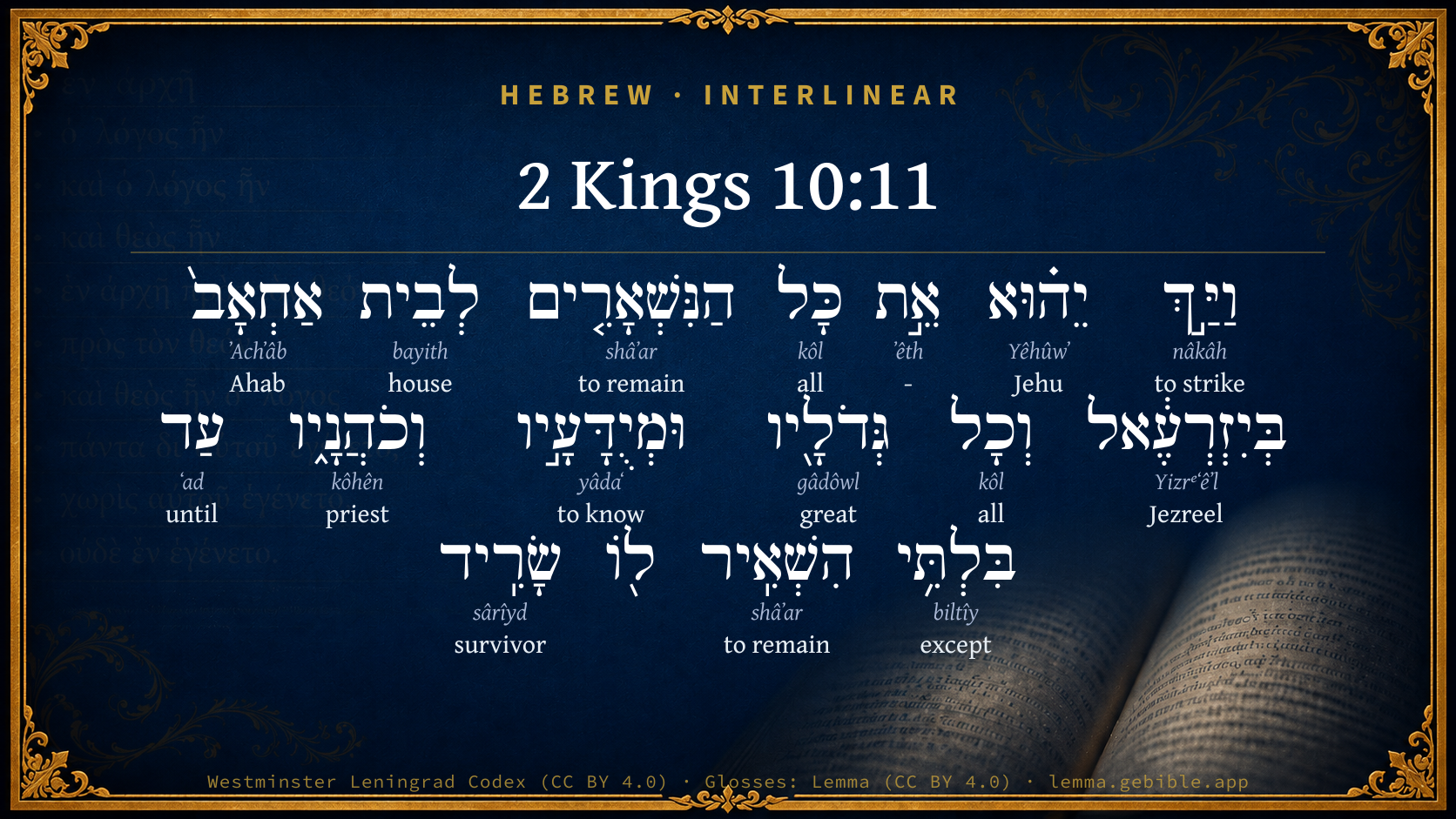
  1. וַיַּ֣ךְ nâkâh H5221 “and · to strike” Conjunction + Verb, Hiphil, Sequential Imperfect, 3rd Person, Masculine, Singular
  2. יֵה֗וּא Yêhûwʼ H3058 “Jehu” Noun, Proper
  3. אֵ֣ת ʼêth H853 “-” Particle, Direct Object
  4. כָּל kôl H3605 “all of” Noun, Common, Masculine, Singular, Construct
  5. הַנִּשְׁאָרִ֤ים shâʼar H7604 “the · remaining” Particle, Definite Article + Verb, Niphal, Participle Active, Masculine, Plural, Absolute
  6. לְבֵית bayith H1004 “to/for · house of” Preposition + Noun, Common, Masculine, Singular, Construct
  7. אַחְאָב֙ ʼAchʼâb H256 “Ahab” Noun, Proper
  8. בְּיִזְרְעֶ֔אל Yizrᵉʻêʼl H3157 “in/at · Jezreel” Preposition + Noun, Proper
  9. וְכָל kôl H3605 “and · all of” Conjunction + Noun, Common, Masculine, Singular, Construct
  10. גְּדֹלָ֖יו gâdôwl H1419 “great · his” Adjective, Adjective, Masculine, Plural, Construct + Suffix, Personal, 3rd Person, Masculine, Singular
  11. וּמְיֻדָּעָ֣יו yâdaʻ H3045 “and · known · him” Conjunction + Verb, Pual, Participle Passive, Masculine, Plural, Construct + Suffix, Personal, 3rd Person, Masculine, Singular
  12. וְכֹהֲנָ֑יו kôhên H3548 “and · priests · his” Conjunction + Noun, Common, Masculine, Plural, Construct + Suffix, Personal, 3rd Person, Masculine, Singular
  13. עַד ʻad H5704 “until” Preposition
  14. בִּלְתִּ֥י biltîy H1115 “except” Conjunction
  15. הִשְׁאִֽיר shâʼar H7604 “to remain” Verb, Hiphil, Perfect, 3rd Person, Masculine, Singular

About this verse

These counts appear in no published source. They are computed here, from the morphology-tagged text and Lemma’s own curated glosses. What Lemma adds →

17
words
14
distinct lemmas
Historical
section

Shared distinctive vocabulary

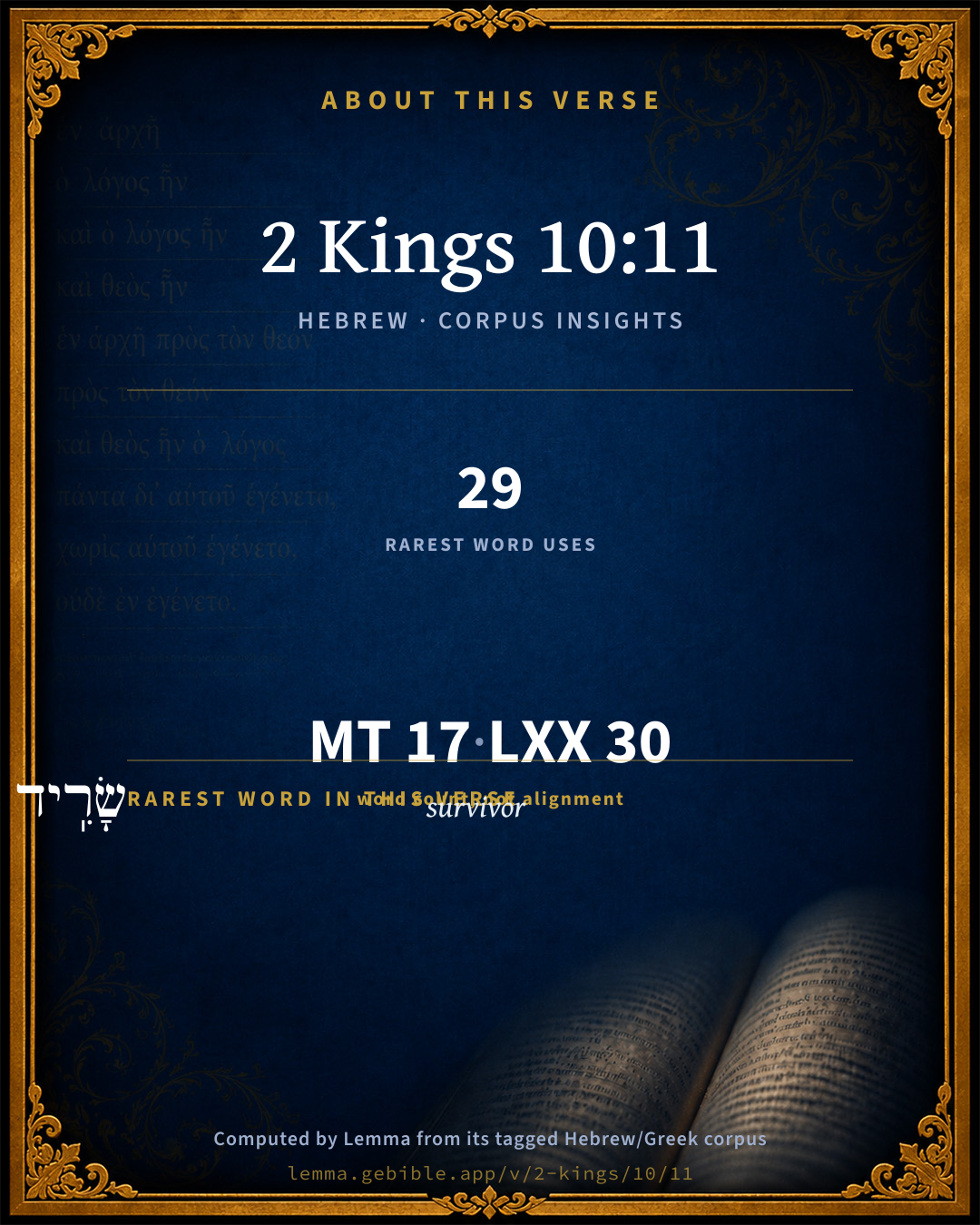
שָׂרִֽיד survivor H8300 occurs in 28 verses of the Hebrew Bible. Also found in:

Grammatical profile

  • 4 verbs
  • 8 nouns
  • 1 adjective
  • 2 prepositions
  • 1 conjunction
  • 1 particle

Verb forms

  • וַיַּ֣ךְ Hiphil · Sequential Imperfect
  • הַנִּשְׁאָרִ֤ים Niphal · Participle Active
  • וּמְיֻדָּעָ֣יו Pual · Participle Passive
  • הִשְׁאִֽיר Hiphil · Perfect

Repetition

Words recur within this verse — often emphatic in Hebrew:

  • כָּל all H3605 ×2
  • הַנִּשְׁאָרִ֤ים to remain H7604 ×2

Hebrew & Septuagint length

In English translation the verse runs 31 words from the Hebrew and 33 from the Septuagint (LXX English) — closely comparable.

A rough comparison of the two English renderings, which tokenize alike — not a word-level alignment.

Word counts can differ between the Hebrew and the Greek without any difference in meaning — e.g. the Hebrew direct-object marker אֵת has no separate Greek word, and Greek often adds the article ὁ.

In the original languages it is 17 Hebrew tokens and 30 Greek tokens — but the two are counted differently (Hebrew bundles its prefixes and suffixes into one token; the Greek is in lemma form), so that isn’t a like-for-like length.

Cross-references

18

Topical passages linked to 2 Kings 10:11 in the Treasury of Scripture Knowledge — connected by theme and wording, ordered by reader-vote popularity; previews shown in the World English Bible.

  • Job 18:19 He shall have neither son nor grandson among his people, Nor any remaining where he sojourned.
  • Joshua 10:30 and Yahweh delivered it also, and the king of it, into the hand of Israel; and he struck it with the edge of the sword, and all the souls who were therein; he left none remaining in it; and he did to the king of it as he had done to the king of Jericho.
  • Joshua 11:8 Yahweh delivered them into the hand of Israel, and they struck them, and chased them to great Sidon, and to Misrephoth Maim, and to the valley of Mizpeh eastward; and they struck them, until they left them none remaining.
  • 1 Kings 14:10 therefore, behold, I will bring evil on the house of Jeroboam, and will cut off from Jeroboam every man-child, him who is shut up and him who is left at large in Israel, and will utterly sweep away the house of Jeroboam, as a man sweeps away dung, until it be all gone.
  • 1 Kings 15:29 It happened that, as soon as he was king, he struck all the house of Jeroboam: he didn't leave to Jeroboam any who breathed, until he had destroyed him; according to the saying of Yahweh, which he spoke by his servant Ahijah the Shilonite;
  • 1 Kings 16:11 It happened, when he began to reign, as soon as he sat on his throne, that he struck all the house of Baasha: he didn't leave him a single man-child, neither of his relatives, nor of his friends.
  • 1 Kings 18:19 Now therefore send, and gather to me all Israel to Mount Carmel, and the prophets of Baal four hundred fifty, and the prophets of the Asherah four hundred, who eat at Jezebel's table.
  • 1 Kings 18:40 and Elijah said to them, Take the prophets of Baal; don't let one of them escape. They took them; and Elijah brought them down to the brook Kishon, and killed them there.
  • 1 Kings 21:22 and I will make your house like the house of Jeroboam the son of Nebat, and like the house of Baasha the son of Ahijah for the provocation with which you have provoked me to anger, and have made Israel to sin.
  • 1 Kings 22:6 Then the king of Israel gathered the prophets together, about four hundred men, and said to them, Shall I go against Ramoth-gilead to battle, or shall I forbear? They said, Go up; for the Lord will deliver it into the hand of the king.
  • 2 Kings 23:20 He killed all the priests of the high places that were there, on the altars, and burned men's bones on them; and he returned to Jerusalem.
  • Psalms 109:13 Let his posterity be cut off. In the generation following let their name be blotted out.
  • Psalms 125:5 But as for those who turn aside to their crooked ways, Yahweh will lead them away with the workers of iniquity. Peace be on Israel.
  • Proverbs 13:20 One who walks with wise men grows wise, But a companion of fools suffers harm.
  • Isaiah 14:21–22 Prepare slaughter for his children for the iniquity of their fathers, that they not rise up, and possess the earth, and fill the surface of the world with cities.
  • Hosea 1:4 Yahweh said to him, "Call his name Jezreel; for yet a little while, and I will avenge the blood of Jezreel on the house of Jehu, and will cause the kingdom of the house of Israel to cease.
  • Revelation 19:20 The beast was taken, and with him the false prophet who worked the signs in his sight, with which he deceived those who had received the mark of the beast and those who worshiped his image. These two were thrown alive into the lake of fire that burns with sulfur.
  • Revelation 20:10 The devil who deceived them was thrown into the lake of fire and sulfur, where the beast and the false prophet are also. They will be tormented day and night forever and ever.

Cross-references courtesy of OpenBible.info (CC BY 4.0).

Hebrew and Greek witnesses Masoretic Hebrew ↔ Greek Septuagint

The same verse in the two great witnesses to the Old Testament, shown verse-for-verse.

These are two independent witnesses, not word-aligned to each other, and the Septuagint is shown in lemma (dictionary) form.

Hebrew 2 Kings 10:11 Masoretic · Westminster Leningrad Codex

וַיַּ֣ךְ יֵה֗וּא אֵ֣ת כָּל הַנִּשְׁאָרִ֤ים לְבֵית אַחְאָב֙ בְּיִזְרְעֶ֔אל וְכָל גְּדֹלָ֖יו וּמְיֻדָּעָ֣יו וְכֹהֲנָ֑יו עַד בִּלְתִּ֥י הִשְׁאִֽיר ל֖וֹ שָׂרִֽיד

So Jehu struck all that remained of the house of Ahab in Jezreel, and all his great men, and his familiar friends, and his priests, until he left him none remaining.

World English Bible · Public Domain

Greek LXX 2 Kings 10:11 Septuagint · lemma form

καί πατάσσω ιου πᾶς ὁ καταλείπω ἐν ὁ οἶκος αχααβ ἐν ιεζραελ καί πᾶς ὁ ἁδρός αὐτός καί ὁ γνωστός αὐτός καί ὁ ἱερεύς αὐτός ὥστε μή καταλείπω αὐτός κατάλειμμα

And Ju struck all that were left of the house of Achaab in Jezrael, and all his great men, and his acquaintance, and his priests, so as not to leave him any remnant.

LXX2012 (modern English Septuagint) · Public Domain

On this verse, The Cambridge Bible for Schools and Colleges discusses the Septuagint’s reading. Read the note in Commentary ↓

Hebrew: Westminster Leningrad Codex (CC BY 4.0). Greek: Septuagint (public domain); English from LXX2012 (modern English Septuagint) (Public Domain). How the Septuagint differs from the Hebrew →

Targum (Aramaic paraphrase)

1

The Targum is the ancient Jewish Aramaic paraphrase of the Hebrew Scriptures — an interpretive translation, not the Hebrew text itself. Onkelos (literal) and Pseudo-Jonathan (expansive) render the Torah, and Jonathan the Prophets. Coverage is partial: where no permissively-licensed English translation exists for a verse, only the Aramaic is shown. This is verse-level text, not a word-by-word alignment to the Hebrew.

  1. Targum Jonathan Prophets (Joshua–Malachi)
    וּמְחָא יֵהוּא יַת כָּל דְאִשְׁתַּאֲרוּ לְבֵית אַחְאָב בְּיִזְרְעֶאל וְכָל רַבְרְבוֹהִי וְקָרִיבוֹהִי וְחַבְרוֹהִי עַד דְלָא אִשְׁתָּאַר לֵיהּ מְשֵׁיזִיב:

    (no public-domain English translation for this verse)

    Targum Jonathan — Aramaic: “Mikraot Gedolot” (public domain). English: “Sefaria Community Translation” (CC0 1.0 (public-domain dedication)); “London "Chaldee Paraphrase," 1871” (public domain). Text via Sefaria.

Commentary

Notes on 2 Kings 10:11 from classic Christian and Jewish commentators (each source and its license shown beneath its notes). The classic Christian expositions comment on the surrounding passage and are grouped to its opening verse, so a note may address several verses; the Jewish commentaries on the Tanakh (Rashi and others) are per-verse, so they appear only where the commentator wrote on this verse.

Lemma curates 59 commentaries, every one of them public domain or Creative Commons licensed, each selected and text-cleaned for this edition rather than reprinted as found. About our sources →

Trapp's Complete Commentary

John Trapp

2Ki 10:11 So Jehu slew all that remained of the house of Ahab in Jezreel, and all his great men, and his kinsfolks, and his priests, until he left him none remaining.

Ver. 11. So Jehu slew all.] Neither was this cruelty, but zeal and justice; because according to God’s will, which is the rule of righteousness. There cannot be a better or more noble act, than to do justice upon obstinate malefactors. {a} It was therefore without good reason that the Roman laws forbade the common executioner, as accursed, to dwell within the city, or to draw breath therein. Doth not God truss up notoriously wicked men sometimes with his own bare hand? and are not his angels executioners of his judgments, as on the Sodomites, Sennacherib, &c.?

And his priests.] His household chaplains: and had not Baal’s priests now some cause to be afraid of Jehu?

Until he left none remaining.] This had been well done, but that he had ill aims; and so there was malum opus in bona materia. Works materially good, may never prove so formally and eventually.

{a} Cic., pro Rabir.

John Trapp, A Commentary or Exposition upon All the Books of the Old and New Testament (1647–1656) — public domain. Text from a community e-Sword module.

Joseph Benson's Commentary

2Ki 10:11. So Jehu slew all his great men — Whom Ahab had advanced and made great in wealth, or honour and quality; who had been partners with him in his sins, and were likely to avenge Joram’s death. And his priests — Who had served him in his idolatrous worship, and confirmed him in it. Or, his chief officers of state, as the word rendered priests sometimes signifies, and is translated: see 2Sa 8:18; 1Ch 18:17. Until he left him none remaining — To wit, in that place: but there were still some remaining in Samaria, (2Ki 10:17,) whom he afterward destroyed, and some of the royal seed of Judah, descended from Ahab’s daughter.

Joseph Benson's Commentary on the Old and New Testaments (1811–1818) — public domain. Text from a community e-Sword module.

Tyndale Open Study Notes

Tyndale Open Resources

10:11 Jehu also killed all of Ahab’s surviving relatives and associates without a single survivor, exceeding his divine commission and pursuing a selfish quest for power at any cost. The Lord condemned his excesses through the prophet Hosea (Hos 1:4).

Tyndale Open Study Notes — © Tyndale Open Resources, licensed CC BY-SA 4.0. Text via the HelloAO Bible API.

Geneva Bible (1599)

Geneva Bible translators

Meaning, which were the idolatrous priests.

Geneva Bible (1599) marginal notes — public domain. Text via Bolls.life.

Adam Clarke's Commentary

Verse 11. Jehu slew all] So it appears that the great men who had so obsequiously taken off the heads of Ahab's seventy sons, fell also a sacrifice to the ambition of this incomparably bad man.

Adam Clarke's Commentary on the Bible (1810–1826) — public domain. Text from a community e-Sword/MySword module.

Ellicott's Commentary for English Readers

(11) So.—Rather, And. The verse relates further massacres.

In Jezreel.—The seat of the court.

His great men—i.e., high officials of his court; persons who owed their exaltation to him.

Kinsfolks.—Rather, his friends (literally, his known ones; “familiares ejus”).

Priests.—See Notes on 2Sa_8:18; 1Ki_4:5; 1Ch_18:17.

None remaining.—No survivor.

A Bible Commentary for English Readers, edited by Charles John Ellicott (1878–1897) — public domain. Text from a community e-Sword module.

The Cambridge Bible for Schools and Colleges

gen. ed. J. J. S. Perowne

11. and his kinsfolks] R.V. familiar friends. The word indicates those who were well known to him, [LXX. γνωστοὺς] and contains no notion of kinship. It is rendered, by A.V. ‘familiar friends’ in Job_19:14, and ‘acquaintance’ in Psa_31:11 and in several other places. The final s in kinsfolks makes the form unusual in English.

and his priests] On this word, which is most frequently rendered ‘priests’, see note on 1Ki_4:2, where it is pointed out that ‘chief ruler’ or ‘principal officer’ appears sometimes to be its meaning. That sense appears more appropriate here, where the family and the acquaintances of Ahab’s family are spoken of. The priests of Ahab, who would be the Baal-priests, would be included in the wholesale destruction of the Baal-worship described later on in this chapter.

The Cambridge Bible for Schools and Colleges (gen. ed. J. J. S. Perowne; Cambridge University Press, 1878–1918) — public domain. Text from a community e-Sword module.

John Gill's Exposition

So Jehu slew all that remained of the house of Ahab in Jezreel,.... Which to do, and to justify himself in so doing, was the design of what he said in the preceding verses:

and his great men; his ministers of state and counsellors, that advised him to, and abetted him in his idolatrous practices, and so justly suffered for the same; and perhaps some of them at least were those very men that cut off the heads of his sons in complaisance to Jehu:

and his kinsfolks: more distantly related to him or his acquaintance and familiars, his associates in sin and wickedness:

and his priests: who officiated for him and offered his sacrifices to Baal; the priests he kept in his palace, and ate at his table:

until he left him none remaining; either of his kindred or his priests, that is, that were at Jezreel; for there were others at Samaria, Kg2 10:17.

John Gill's Exposition of the Whole Bible (1746–1763) — public domain (CC PDM 1.0). Text via the HelloAO Bible API.

Albert Barnes' Notes on the Bible

So Jehu slew - Rather, “And Jehu slew.” The reference is to fresh executions (compare 2Ki 10:17). He proceeded on his bloody course, not merely destroying the remainder of the kindred of Ahab, but further putting to death all the most powerful of Ahab’s partisans.

His priests - Not the Baal priests generally, whose persecution came afterward 2Ki 10:19, but only such of them as were attached to the court.

Albert Barnes' Notes on the Bible (1834–1885) — public domain. Text from a community e-Sword/MySword module.

Haydock's Catholic Bible Commentary

Chief men, probably including those perfidious wretches, who had so basely betrayed their trust, and slain the 70 sons of Achab, "the nobles of the kingdom, his kinsmen, and friends." (Chaldean; Arabic) --- Friends. Some copies of the Septuagint have connoisseurs, of magicians, Leviticus xix. 31. --- Priests, princes of the court (2 Kings viii. 18.) and those who offered sacrifice to idols, (Calmet) being of Achab’s descendants. (Menochius) --- He afterwards inveigled all the priests of Baal, to their entire ruin, ver. 19. (Haydock)

George Leo Haydock (1774–1849), Haydock's Catholic Family Bible and Commentary, 1859 edition — public domain. Excludes Psalms (Douay-Rheims chapter numbering differs from Protestant) and Deuterocanonical books (Catholic canon only).

Matthew Poole's English Annotations

All his great men; whom he had advanced and made great in wealth, for honour, and quality; who had been partners with him in his sins, and who were likely to be avenged of his death.

His priests; his domestic priests, which had waited upon Ahab and Jezebel in their idolatrous services, and were fed at the king’s table. Compare 1Ki 18:19. Or, his chief officers of state, as that word is sometimes used; of which see 2Sa 8:18, compared with 1Ch 18:17.

Object. These were included in

his great men mentioned before.

Answ. Yet may they well be mentioned apart, as a distinct and the most eminent sort of them.

He left him none remaining, to wit, in that place and kingdom; for he did leave some of the royal seed of Judah, 2Ki 1:1,2.

Matthew Poole's English Annotations on the Holy Bible (1683–1685) — public domain. Text from a community e-Sword/MySword module.

Whedon's Commentary on the Bible

Daniel D. Whedon

11. Slew all that remained — There was yet remaining in Jezreel not a few of the court favourites and friends of the royal family, and these Jehu proceeded at once to slay, and probably in presence of all the people. None dared oppose or resist him, for the people felt, as he had shown, that this was a fulfilling of prophecy.

Great men — State officers who were then in Jezreel.

Kinsfolks — Distant relatives, or intimate acquaintances, who had been accustomed to receive court favours.

Priests — His private court priests, who were devoted to the calf-worship which Jeroboam had established, and Ahab had continued to encourage.

Daniel D. Whedon (gen. ed.), Commentary on the Old and New Testaments (1874–1909) — public domain. Text from a community e-Sword module.

The Pulpit Commentary

So Jehu slew all that remained of the house of Ahab in Jezreel, and all his great men, and his kinsfolks; rather, and Jehu slew. Encouraged by his past success, having killed Jehoram, Ahaziah, and Jezebel, having secured the adhesion of the chief men in Samaria, and effected the destruction of all those who might naturally have claimed the succession and involved him in civil war, Jehu proceeded to greater lengths. He "slew all that remained of the house of Ahab in Jezreel the princesses probably, as well as the princes and further put to death all the leading partisans of the dethroned dynasty, the "great men," perhaps even those who had worked his bloody will at Samaria, and the intimate friends and supporters of the house the yum, as they are here called not relatives, but "intimate acquaintances." And his priests. This expression causes a difficulty, since the destruction of the Baal-priests is related subsequently (vers. 19-25). It has been suggested to understand by not" priests," but "high state officers" (Bahr) a meaning which the word is thought to have in 2Sa_8:18 and 1Ki_4:5. But this signification of heKo is scarcely an ascertained one. Perhaps the same persons are intended as in ver. 19, the present notice of their death being a mere summary, and the narrative of vers. 19-25 a full statement of the circumstances. Until he left him none remaining; i.e. until the entire Ahabite faction was blotted out.

The Pulpit Commentary (1880–1919), ed. H.D.M. Spence-Jones & Joseph S. Exell — public domain. Text from a community e-Sword module.

John Wesley's Explanatory Notes

Left none - In that place and kingdom; for he did leave some of the royal seed of Judah.

John Wesley, Explanatory Notes Upon the Whole Bible (1754–1765) — public domain. Text via the GEBible commentary corpus.

Keil & Delitzsch

C. F. Keil & F. Delitzsch

The effect of these words was, that the people looked quietly on when he proceeded to slay all the rest of the house of Ahab, i.e., all the more distant relatives in Jezreel, and "all his great men," i.e., the superior officers of the fallen dynasty, and "all his acquaintances," i.e., friends and adherents, and "all his priests," probably court priest, such as the heathen kings had; not secular counsellors or nearest servants (Thenius), a meaning which כּהנים never has, not even in Sa2 8:18 and Kg1 4:5.

Keil & Delitzsch — Biblical Commentary on the Old Testament (1861–1891) — public domain (CC PDM 1.0). Text via the HelloAO Bible API. (Old Testament only.)

Lesson kit

Teaching starters — assembled from the data on this page, not authored interpretation. Every prompt links to the verse data it draws on. Edit before teaching.

2 Kings, in the Historical, opens this verse with 17 words (14 distinct Hebrew lemmas). Its most distinctive word is sârîyd (“survivor”). A historical commentator’s framing appears above. Read the whole chapter for the surrounding context.

Discussion questions

  1. The word sârîyd carries the sense “survivor.” How does it shape the verse?
  2. How does Numbers 21:35, which shares the word «survivor», read alongside this verse?
  3. What does the repetition of “all” (2× in this one verse) do in this verse?
  4. These translations render this verse differently; the difference is in the English rendering, not the original. What questions does that raise?
  5. «וַיַּ֣ךְ» is a Hiphil Sequential Imperfect verb. How does that grammatical form shape the action described?
  6. Compare how Trapp's Complete Commentary and Joseph Benson's Commentary read this verse. Where do they agree or differ?

Things to notice

Reading settings

Reading text

Shown beneath each verse's original-language words.

Old Testament
Old Testament edition

Read the OT as the Masoretic Hebrew (MT) or the Greek Septuagint (LXX).

English shown for the Greek Septuagint (in the Hebrew ↔ Greek comparison).

Comparing translations? Open the Compare panel on any verse page to stack up to four side by side.