Ruth 1:5

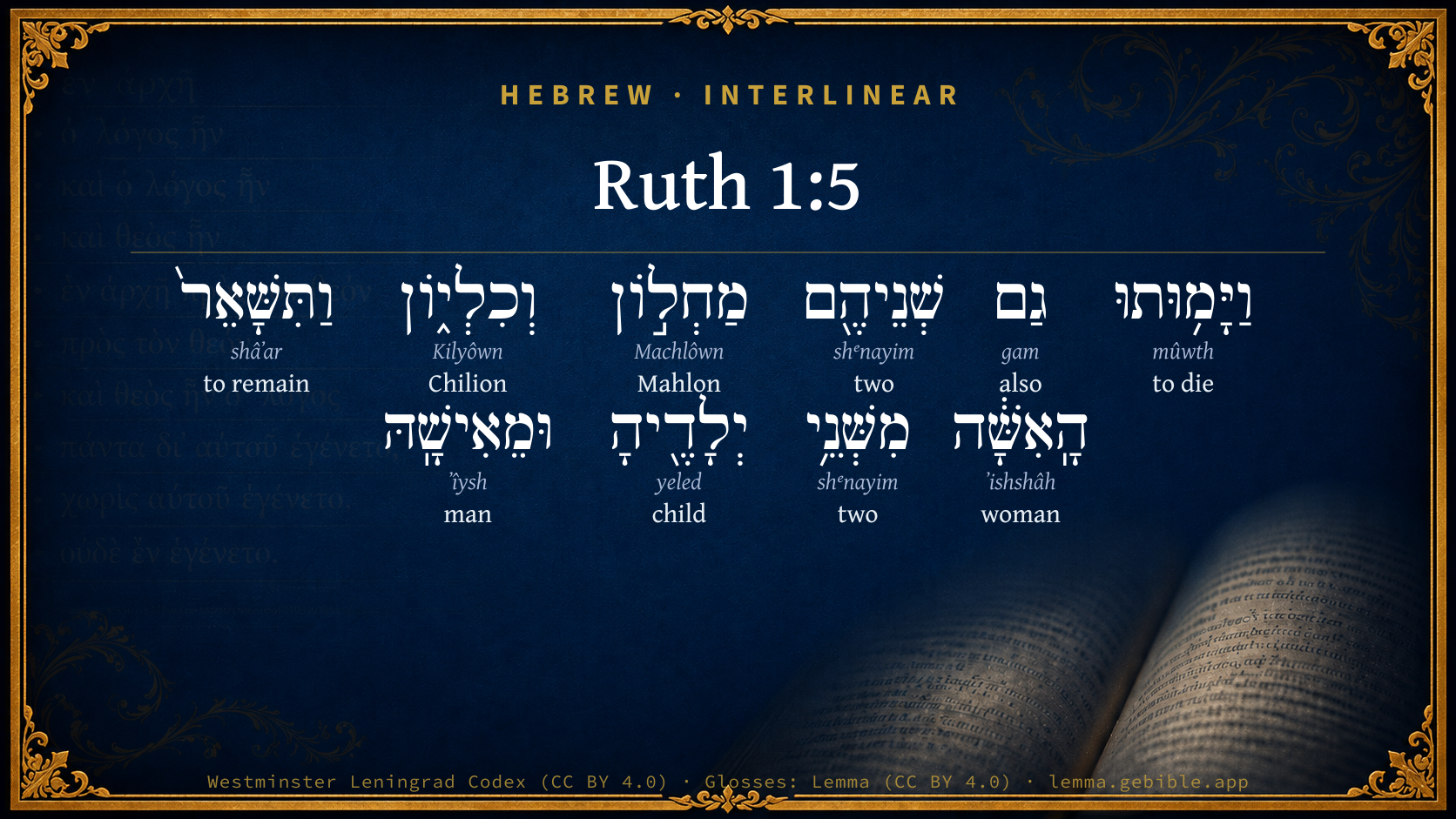
Hebrew (Westminster Leningrad Codex) Ruth 1:5 appears in the Hebrew Old Testament. The text above is from the Westminster Leningrad Codex. Each word links to its Strong’s number, a concise gloss, and parsing drawn from the Open Scriptures Hebrew Bible morphology. Click any word for its full Brown-Driver-Briggs (BDB) entry.
Download image
Cite this verse

Ruth 1:5 (World English Bible). Public Domain. Lemma interlinear Bible study tool, https://lemma.gebible.app/v/ruth/1/5.

Show BibTeX & RIS
BibTeX
RIS
English Translation
Mahlon and Chilion died both of them; and the woman was left of her two children and of her husband.
World English Bible · Public Domain
Download a study sheet

One document with this verse’s original text, its word-by-word gloss line, the meaning frame, cross-references with their text, attributed commentary, and full source and license credits — printable, and it pastes into notes with its structure intact.

This verse Autodidact and up

Study sheet (.html) Plain text (.txt)

A passage Seminary Student

Up to 50 verses in one chapter. A passage sheet keeps up to 6 commentary sources and 12 cross-references per verse, in the order this page ranks them, and says so on the sheet whenever that leaves anything out. Ask for a single verse and you get the Autodidact verse sheet above.

Everything on this page stays free to read, with no account — the sheet is a download of what is already on screen, not access to it.

Want to remove ads? Support Godless Engineer
Compare translations 3

The same verse in 3 English versions, stacked beneath the original-language interlinear above. Click any original word for its lexicon entry.

Each is an independent rendering of the whole verse — the interlinear is not word-aligned to these translations.

Highlighted words mark where these versions differ — a whole-verse word diff, not a word-by-word alignment.

  • World English Bible Public Domain
    Mahlon and Chilion died both of them; and the woman was left of her two children and of her husband.
  • King James Version Public Domain
    And Mahlon and Chilion died also both of them; and the woman was left of her two sons and her husband.
  • unfoldingWord Literal Text CC BY-SA 4.0
    And the two of them, Mahlon and Kilion, also died, and the woman was left without her two children or her husband.

unfoldingWord Literal Text — © unfoldingWord, licensed CC BY-SA 4.0. Word-aligned USFM3 via Door43 (git.door43.org/unfoldingWord/en_ult).

Versions to compare (up to 4)

3 of 4 selected

Show all 18 translations

Every available English version of this verse, each an independent rendering of the whole verse.

  • World English Bible Public Domain
    Mahlon and Chilion died both of them; and the woman was left of her two children and of her husband.
  • Berean Standard Bible Public Domain
    both Mahlon and Chilion also died, and Naomi was left without her two sons and without her husband.
  • Majority Standard Bible Public Domain
    both Mahlon and Chilion also died, and Naomi was left without her two sons and without her husband.
  • King James Version Public Domain
    And Mahlon and Chilion died also both of them; and the woman was left of her two sons and her husband.
  • American Standard Version (1901) Public Domain
    And Mahlon and Chilion died both of them; and the woman was left of her two children and of her husband.
  • Revised Version (1885) Public Domain
    And Mahlon and Chilion died both of them; and the woman was left of her two children and of her husband.
  • Geneva Bible (1599) Public Domain
    And Mahlon and Chilion dyed also both twaine: so the woman was left destitute of her two sonnes, and of her husband.
  • Douay-Rheims (1899) Public Domain
    And they both died, to wit, Mahalon and Chelion: and the woman was left alone, having lost both her sons and her husband.
  • Young's Literal Translation Public Domain
    And they die also, both of them -- Mahlon and Chilion -- and the woman is left of her two children and of her husband.
  • Literal Standard Version CC BY-SA 4.0
    And they die also, both of them—Mahlon and Chilion—and the woman is left of her two children and of her husband.
  • Unlocked Literal Bible CC BY-SA 4.0
    Then both Mahlon and Kilion died, leaving Naomi without her husband and without her two children.
  • unfoldingWord Literal Text CC BY-SA 4.0
    And the two of them, Mahlon and Kilion, also died, and the woman was left without her two children or her husband.
  • Darby Bible Public Domain
    And Mahlon and Chilion died also, both of them; and the woman was left of her two children and of her husband.
  • World Messianic Bible Public Domain
    Mahlon and Chilion both died, and the woman was bereaved of her two children and of her husband.
  • Webster's Bible Public Domain
    And Mahlon and Chilion died also both of them; and the woman was left by her two sons and her husband.
  • Free Bible Version CC BY-SA 4.0
    both Mahlon and Chilion died. Naomi was left alone, without her two sons or her husband.
  • Bible in Basic English Public Domain
    And Mahlon and Chilion came to their end; and the woman was without her two sons and her husband.
  • JPS Tanakh (1917) Public Domain
    And Mahlon and Chilion died both of them; and the woman was left of her two children and of her husband.

Literal Standard Version (2020), Covenant Press — licensed CC BY-SA 4.0. Text via the HelloAO Bible API (eBible.org). Unlocked Literal Bible (unfoldingWord) — licensed CC BY-SA 4.0. Text via the HelloAO Bible API (eBible.org). unfoldingWord Literal Text — © unfoldingWord, licensed CC BY-SA 4.0. Word-aligned USFM3 via Door43 (git.door43.org/unfoldingWord/en_ult). Free Bible Version, Dr. Jonathan Gallagher — licensed CC BY-SA 4.0. Text via the HelloAO Bible API (eBible.org).

Word by word

More ways to search: Search by grammar → Find every occurrence → Compare this word →

Practice this passage: Drill this verse → Learn its vocabulary →

וְכִלְי֑וֹן
Kilyôwn
H3630
“and · Chilion”
Conjunction + Noun, Proper
Part of Speech
Conjunction + Noun
Type
Proper
Full BDB Definition

Origin: a form of H3631

TWOT: None

Chilion = "pining" - an Ephraimite and son of Elimelech by Naomi and the deceased husband of Ruth (or maybe deceased husband of Orpah)
  1. וַיָּמ֥וּתוּ mûwth H4191 “and · to die” Conjunction + Verb, Qal, Sequential Imperfect, 3rd Person, Masculine, Plural
  2. גַם gam H1571 “also” Adverb
  3. שְׁנֵיהֶ֖ם shᵉnayim H8147 “two · their” Adjective, Cardinal number, Masculine, Dual, Construct + Suffix, Personal, 3rd Person, Masculine, Plural
  4. מַחְל֣וֹן Machlôwn H4248 “Mahlon” Noun, Proper
  5. וַתִּשָּׁאֵר֙ shâʼar H7604 “and · to remain” Conjunction + Verb, Niphal, Sequential Imperfect, 3rd Person, Feminine, Singular
  6. הָֽאִשָּׁ֔ה ʼishshâh H802 “the · woman” Particle, Definite Article + Noun, Common, Feminine, Singular, Absolute
  7. מִשְּׁנֵ֥י shᵉnayim H8147 “from · two” Preposition + Adjective, Cardinal number, Masculine, Dual, Construct
  8. יְלָדֶ֖יהָ yeled H3206 “children · her” Noun, Common, Masculine, Plural, Construct + Suffix, Personal, 3rd Person, Feminine, Singular
  9. וּמֵאִישָֽׁהּ ʼîysh H376 “and · from · man · her” Conjunction + Preposition + Noun, Common, Masculine, Singular, Construct + Suffix, Personal, 3rd Person, Feminine, Singular

About this verse

These counts appear in no published source. They are computed here, from the morphology-tagged text and Lemma’s own curated glosses. What Lemma adds →

10
words
9
distinct lemmas
Historical
section

Notable vocabulary

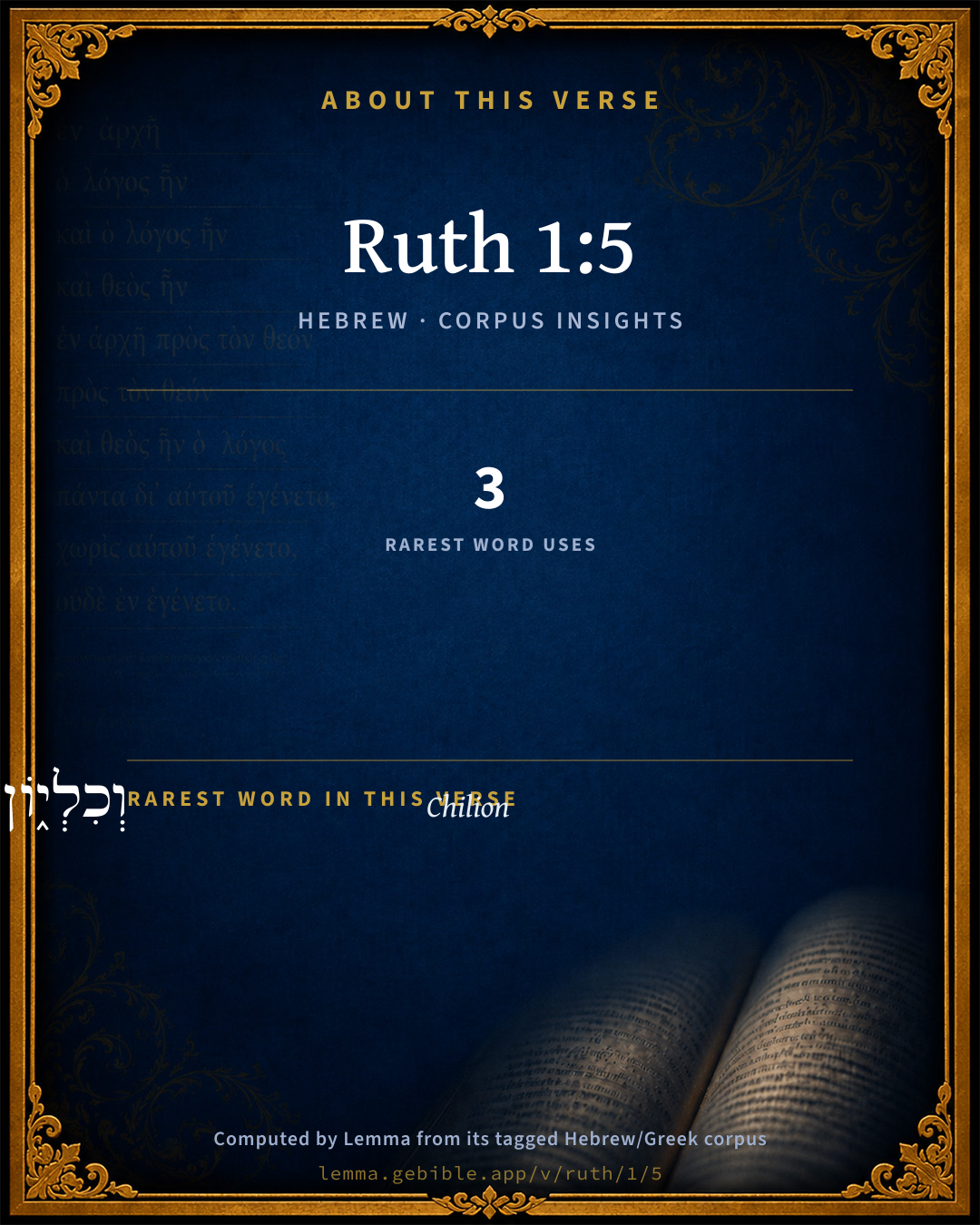
The rarest word here is וְכִלְי֑וֹן Chilion H3630 — appearing just 3 times in the whole Hebrew Bible.

Shared distinctive vocabulary

וְכִלְי֑וֹן Chilion H3630 occurs in 3 verses of the Hebrew Bible. Also found in:

Grammatical profile

  • 2 verbs
  • 5 nouns
  • 2 adjectives
  • 1 adverb

Verb forms

  • וַיָּמ֥וּתוּ Qal · Sequential Imperfect
  • וַתִּשָּׁאֵר֙ Niphal · Sequential Imperfect

Repetition

A word recurs within this verse — often emphatic in Hebrew:

  • שְׁנֵיהֶ֖ם two H8147 ×2

Hebrew & Septuagint length

In English translation the verse runs 20 words from the Hebrew and 19 from the Septuagint (LXX English) — closely comparable.

A rough comparison of the two English renderings, which tokenize alike — not a word-level alignment.

Word counts can differ between the Hebrew and the Greek without any difference in meaning — e.g. the Hebrew direct-object marker אֵת has no separate Greek word, and Greek often adds the article ὁ.

Cross-references

6

Topical passages linked to Ruth 1:5 in the Treasury of Scripture Knowledge — connected by theme and wording, ordered by reader-vote popularity; previews shown in the World English Bible.

  • Deuteronomy 32:39 See now that I, even I, am he, There is no god with me: I kill, and I make alive; I wound, and I heal; There is none who can deliver out of my hand.
  • Psalms 89:30–32 If his children forsake my law, And don't walk in my ordinances;
  • Isaiah 49:21 Then shall you say in your heart, Who has conceived these for me, seeing I have been bereaved of my children, and am solitary, an exile, and wandering back and forth? and who has brought up these? Behold, I was left alone; these, where were they?
  • Jeremiah 2:19 Your own wickedness shall correct you, and your backsliding shall reprove you: know therefore and see that it is an evil thing and a bitter, that you have forsaken Yahweh your God, and that my fear is not in you, says the Lord, Yahweh of Hosts.
  • Matthew 22:25–27 Now there were with us seven brothers. The first married and died, and having no seed left his wife to his brother.
  • Luke 7:12 Now when he drew near to the gate of the city, behold, one who was dead was carried out, the only son of his mother, and she was a widow. Many people of the city were with her.

Cross-references courtesy of OpenBible.info (CC BY 4.0).

Hebrew and Greek witnesses Masoretic Hebrew ↔ Greek Septuagint

The same verse in the two great witnesses to the Old Testament, shown verse-for-verse.

These are two independent witnesses, not word-aligned to each other, and the Septuagint is shown in lemma (dictionary) form.

Hebrew Ruth 1:5 Masoretic · Westminster Leningrad Codex

וַיָּמ֥וּתוּ גַם שְׁנֵיהֶ֖ם מַחְל֣וֹן וְכִלְי֑וֹן וַתִּשָּׁאֵר֙ הָֽאִשָּׁ֔ה מִשְּׁנֵ֥י יְלָדֶ֖יהָ וּמֵאִישָֽׁהּ

Mahlon and Chilion died both of them; and the woman was left of her two children and of her husband.

World English Bible · Public Domain

Greek LXX Ruth 1:5 Septuagint · lemma form

καί ἀποθνήσκω καί γέ ἀμφότεροι μααλων καί χελαιων καί καταλείπω ὁ γυνή ἀπό ὁ ἀνήρ αὐτός καί ἀπό ὁ δύο υἱός αὐτός

And both Maalon and Chelaion died also; and the woman was left of her husband and her two sons.

LXX2012 (modern English Septuagint) · Public Domain

Hebrew: Westminster Leningrad Codex (CC BY 4.0). Greek: Septuagint (public domain); English from LXX2012 (modern English Septuagint) (Public Domain). How the Septuagint differs from the Hebrew →

Commentary

Notes on Ruth 1:5 from classic Christian and Jewish commentators (each source and its license shown beneath its notes). The classic Christian expositions comment on the surrounding passage and are grouped to its opening verse, so a note may address several verses; the Jewish commentaries on the Tanakh (Rashi and others) are per-verse, so they appear only where the commentator wrote on this verse.

Lemma curates 59 commentaries, every one of them public domain or Creative Commons licensed, each selected and text-cleaned for this edition rather than reprinted as found. About our sources →

Trapp's Complete Commentary

John Trapp

Rth 1:5 And Mahlon and Chilion died also both of them; and the woman was left of her two sons and her husband.

Ver. 5. And Mahlon and Chilion died also both of them.] For a further trial and exercise of Naomi’s faith and patience.

And the woman was left of her two sons and her husband.] Catenata piorum crux. Crosses seldom come single. This excellent woman was left desolate and disconsolate, only she "comforted herself in the Lord her God," as David in like distress did. {1Sa 30:6}

John Trapp, A Commentary or Exposition upon All the Books of the Old and New Testament (1647–1656) — public domain. Text from a community e-Sword module.

The Biblical Illustrator

Joseph S. Exell

Rth_1:5

Mahlon and Chilion died also both of them.

Bereavement a blessing

What a melancholy collapse it all had been! For those so dear to her, death; for herself, solitude--the woman was left of her two sons and her husband. And yet what a marvellous blessing bereavement not only may be but often is. Surrounded by those who make up to us our world, we are slow to raise our eyes above or beyond them, or to realise that we have any need which they are incapable of supplying; but when they are taken from us, these beloved ones upon whom alone we have leaned and to whom alone we have been in the habit of looking for strength and consolation and advice, then it sometimes is that the soul looks up as she hears the Master calling her by name, and through her tears recognises for the first time the patient Lord who has ever been her truest friend. God would not have us love our dear ones one whit the less, but He would have us learn to put Him first and to trust Him implicitly about them no less than about ourselves. (H. A. Hall, B. D.)

Enormous trials

Observe--

1. That many afflictions do attend the most gracious souls (Psa_34:19).

2. Crosses seldom come single upon Gods servants.

3. God did wonderfully support her in all these her great trials, and left her upon Scripture record as a pattern of patience unto all succeeding generations. (C. Ness.)

The Biblical Illustrator, edited by Joseph S. Exell (c. 1880s–1900s) — public domain. Text from a community e-Sword module.

Joseph Benson's Commentary

Rth 1:5-6. The woman was left of her two sons and her husband — Loss of children and widowhood are both come upon her. By whom shall she be comforted? It is God alone who is able to comfort those who are thus cast down. The Lord had visited his people in giving them bread — That is, food: so she stayed no longer than necessity forced her.

Joseph Benson's Commentary on the Old and New Testaments (1811–1818) — public domain. Text from a community e-Sword module.

Tyndale Open Study Notes

Tyndale Open Resources

1:5 This left Naomi alone (literally the woman was bereft): Naomi suffered devastating emotional losses. She was also without economic support, and with the loss of heirs, she had no hope for the future of her family.

Tyndale Open Study Notes — © Tyndale Open Resources, licensed CC BY-SA 4.0. Text via the HelloAO Bible API.

Adam Clarke's Commentary

Verse 5. And Mahlon and Chilion died] The Targum adds, And because they transgressed the decree of the word of the Lord, and joined affinity with strange people, therefore their days were cut off. It is very likely that there is more here than conjecture.

Adam Clarke's Commentary on the Bible (1810–1826) — public domain. Text from a community e-Sword/MySword module.

Ellicott's Commentary for English Readers

(5) And they died.—Clearly as quite young men. It is not for us to say how far those are right who see in the death of Elimelech and his sons God’s punishment for the disregard of His law. Thus Naomi is left alone, as one on whom comes suddenly the loss of children and widowhood.

A Bible Commentary for English Readers, edited by Charles John Ellicott (1878–1897) — public domain. Text from a community e-Sword module.

John Gill's Exposition

And Mahlon and Chilion died also both of them,.... As well as their father, in the land of Moab, after they had lived with their wives in it about ten years; the Targum is,"because they transgressed the decree of the Word of the Lord, and joined in affinity with strange people, their days were cut off;''or shortened:

and the woman was left of her two sons and her husband; deprived both of her husband and her sons, which was a great affliction, aggravated by her being in a strange country; many are the afflictions of the righteous.

John Gill's Exposition of the Whole Bible (1746–1763) — public domain (CC PDM 1.0). Text via the HelloAO Bible API.

Whedon's Commentary on the Bible

Daniel D. Whedon

5. The woman was left of her two sons and her husband — That is, she alone remained of the family that came from Beth-lehem. They emigrated from the land of their people to escape the miseries of famine, but in the plenteous land of Moab death overtook them. The Targum and the Jewish writers generally regard these deaths as a judgment on the family of Elimelech for seeking comfort among idolaters, and intermarrying with them. Generally, those who are easily induced by losses or difficulties to change their places or pursuits in life seldom reap advantage from their changes. The bitter losses and changes of Naomi, however, were overruled by a wise and gracious Providence to the honour of her name and the blessing of the world.

Daniel D. Whedon (gen. ed.), Commentary on the Old and New Testaments (1874–1909) — public domain. Text from a community e-Sword module.

The Pulpit Commentary

And, to make a long story short, Machlon and Chillon died also both of them. "Like green apples," says Fuller, "cudgelled off the tree." But why "cudgelled?" There is no evidence in the text of Divine displeasure, and the Christian expositor, when going beyond the text in quest of principles, should not forget the tower of Siloam, and the victims of Pilate s bloodthirstiness. (see Luk_13:1-5) And the woman was left of her two children and of her husband. That is, "of her two children as well as of her husband." She became as it were their relict too. She remained behind after they had gone on before. If all sentiment were to be taken out of the expression, it might then be simply said, in very commonplace prose, she survived them. Poor woman! "Of the two sexes," says Fuller, "the woman is the weaker; of women, old women are most feeble; of old women, widows most woeful; of widows, those that are poor, their plight most pitiful; of poor widows, those who want children, their case most doleful; of widows that want children, those that once had them, and after lost them, their estate most desolate; of widows that have had children, those that are strangers in a foreign country, their condition most comfortless. Yet all these met together in Naomi, as in the center of sorrow, to make the measure of her misery pressed down, shaken together, running over. I conclude, therefore, many men have had affliction none like Job; many women have had tribulation none like Naomi.

Double desolation.

In the happiness of her children Naomi would revive the happy years of her own early married life. But the bright sky was soon clouded over by the shadow of death. Perhaps inheriting their father"s constitution, her sons died in early manhood. She became a childless widow. Three widows were in one house, each bearing in her silent heart her own burden of grief.

I SOME ARE CALLED UPON TO ENDURE REPEATED BEREAVEMENTS. Households there are which have been visited again and again by the angel of death. Youthful lives are snapped asunder; youthful hearts are left desolate. Some are called upon to endure prolonged age, whilst children and friends, the joy of their hearts, are taken from them. Here and there is one who can exclaim, "All thy waves and thy billows are gone over me.

II FOR SUCH GOD HAS PROMISES OF GRACE AND PURPOSES OF MERCY.

1. The assurances of the Divine remembrance and kindness. "The mountains shall depart," etc.

2. The sympathy of the Divine High Priest. The miracle of the raising of the widow"s son at Nain is an illustration.

3. Grace of submission shall be imparted. "The Lord gave, and the Lord hath taken away; blessed be the name of the Lord.

4. Intentions of Divine wisdom shall be accomplished. Thus shall the heart be weaned from earth; thus shall Christian character be matured; thus shall saints be prepared for glory. How can the vicissitudes of life be borne by those who are strangers to Christian principles, to Christian consolations, to Christian hopes? May ours be the happy lot of the Christian, from whom (as from all the children of men) the future is hidden; but who knows himself to be the object of a Father"s love and a Savior"s care, and to whose heart comes day by day a voice from heaven, saying, "I will never leave thee! I will never forsake thee! T.

The Pulpit Commentary (1880–1919), ed. H.D.M. Spence-Jones & Joseph S. Exell — public domain. Text from a community e-Sword module.

John Wesley's Explanatory Notes

Was left of her two sons, and her husband - Loss of children and widowhood are both come upon her. By whom shall she be comforted? It is God alone that is able to comfort those who are thus cast down.

John Wesley, Explanatory Notes Upon the Whole Bible (1754–1765) — public domain. Text via the GEBible commentary corpus.

Rashi

Rabbi Shlomo Yitzchaki (Rashi)

both...also What is the meaning of “also”? First their possessions were smitten, and their camels and their cattle died, and afterwards they too died.

Rashi on the Tanakh — English translations: “The Judaica Press complete Tanach with Rashi, translated by A. J. Rosenberg” (CC BY 4.0); “Pentateuch with Rashi's commentary by M. Rosenbaum and A.M. Silbermann, 1929-1934” (public domain); “The Metsudah Tanach series, Lakewood, N.J” (CC BY 4.0); and “The Book of Joshua, Metsudah Publications, 1997” (CC BY 4.0). Text via Sefaria.

Lesson kit

Teaching starters — assembled from the data on this page, not authored interpretation. Every prompt links to the verse data it draws on. Edit before teaching.

Ruth, in the Historical, opens this verse with 10 words (9 distinct Hebrew lemmas). Its most distinctive word is Kilyôwn (“Chilion”). A historical commentator’s framing appears above. Read the whole chapter for the surrounding context.

Discussion questions

  1. The word Kilyôwn carries the sense “Chilion.” How does it shape the verse?
  2. How does Ruth 1:2, which shares the word «Chilion», read alongside this verse?
  3. What does the repetition of “two” (2× in this one verse) do in this verse?
  4. These translations render this verse differently; the difference is in the English rendering, not the original. What questions does that raise?
  5. «וַיָּמ֥וּתוּ» is a Qal Sequential Imperfect verb. How does that grammatical form shape the action described?
  6. Compare how Trapp's Complete Commentary and The Biblical Illustrator read this verse. Where do they agree or differ?

Things to notice

Reading settings

Reading text

Shown beneath each verse's original-language words.

Old Testament
Old Testament edition

Read the OT as the Masoretic Hebrew (MT) or the Greek Septuagint (LXX).

English shown for the Greek Septuagint (in the Hebrew ↔ Greek comparison).

Comparing translations? Open the Compare panel on any verse page to stack up to four side by side.