
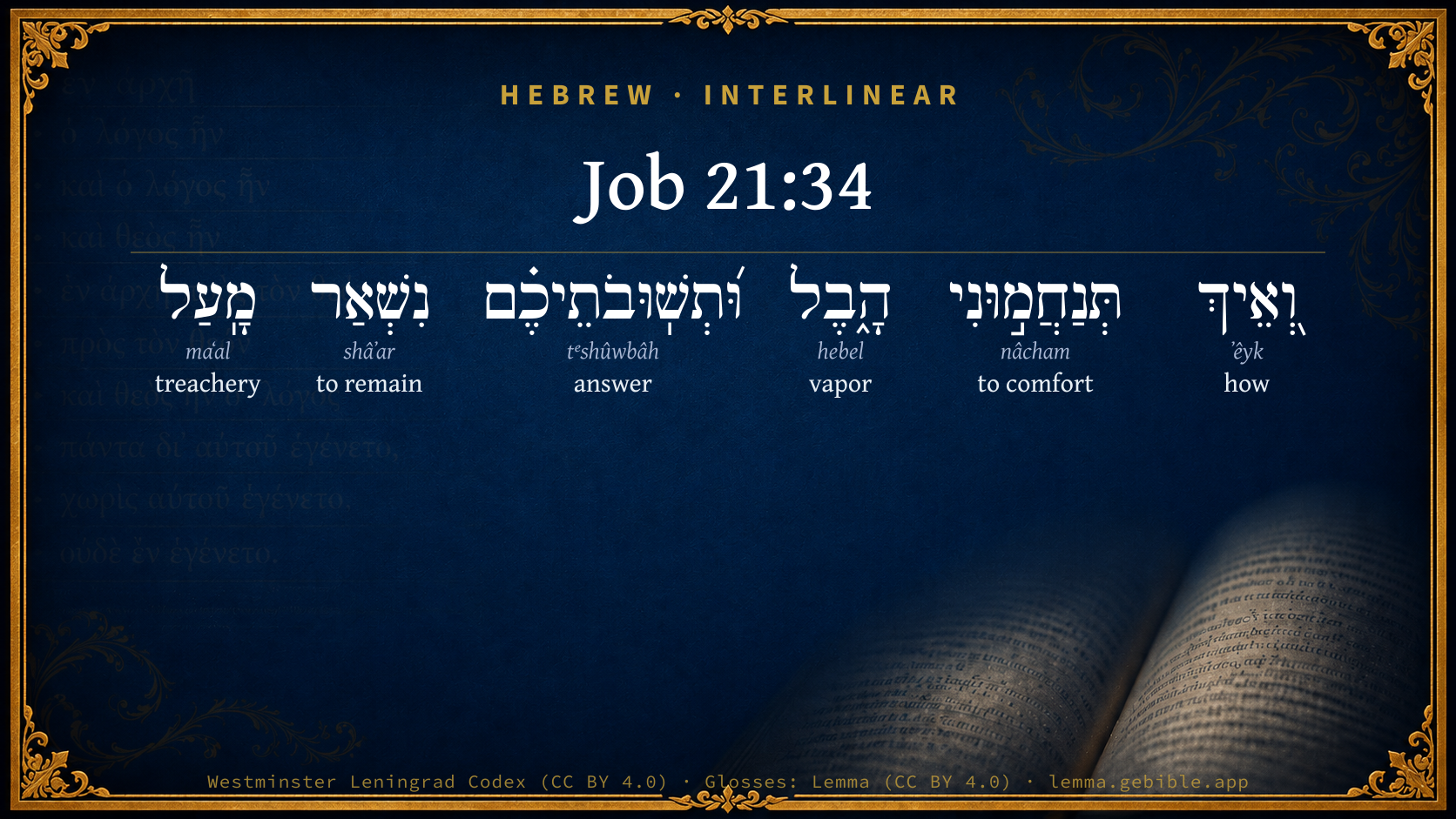
Job 21:34

Hebrew (Westminster Leningrad Codex) Job 21:34 appears in the Hebrew Old Testament. The text above is from the Westminster Leningrad Codex. Each word links to its Strong’s number, a concise gloss, and parsing drawn from the Open Scriptures Hebrew Bible morphology. Click any word for its full Brown-Driver-Briggs (BDB) entry.
Download image
Cite this verse

Job 21:34 (World English Bible). Public Domain. Lemma interlinear Bible study tool, https://lemma.gebible.app/v/job/21/34.

Show BibTeX & RIS
BibTeX
RIS
English Translation
So how can you comfort me with nonsense, Seeing that in your answers there remains only falsehood?"
World English Bible · Public Domain
Download a study sheet

One document with this verse’s original text, its word-by-word gloss line, the meaning frame, cross-references with their text, attributed commentary, and full source and license credits — printable, and it pastes into notes with its structure intact.

This verse Autodidact and up

Study sheet (.html) Plain text (.txt)

A passage Seminary Student

Up to 50 verses in one chapter. A passage sheet keeps up to 6 commentary sources and 12 cross-references per verse, in the order this page ranks them, and says so on the sheet whenever that leaves anything out. Ask for a single verse and you get the Autodidact verse sheet above.

Everything on this page stays free to read, with no account — the sheet is a download of what is already on screen, not access to it.

Want to remove ads? Support Godless Engineer
Compare translations 3

The same verse in 3 English versions, stacked beneath the original-language interlinear above. Click any original word for its lexicon entry.

Each is an independent rendering of the whole verse — the interlinear is not word-aligned to these translations.

Highlighted words mark where these versions differ — a whole-verse word diff, not a word-by-word alignment.

  • World English Bible Public Domain
    So how can you comfort me with nonsense, Seeing that in your answers there remains only falsehood?"
  • King James Version Public Domain
    How then comfort ye me in vain, seeing in your answers there remaineth falsehood?
  • unfoldingWord Literal Text CC BY-SA 4.0
    So how do you comfort me in vain? And falsehood is left in your answers!”

unfoldingWord Literal Text — © unfoldingWord, licensed CC BY-SA 4.0. Word-aligned USFM3 via Door43 (git.door43.org/unfoldingWord/en_ult).

Versions to compare (up to 4)

3 of 4 selected

Show all 18 translations

Every available English version of this verse, each an independent rendering of the whole verse.

  • World English Bible Public Domain
    So how can you comfort me with nonsense, Seeing that in your answers there remains only falsehood?"
  • Berean Standard Bible Public Domain
    So how can you comfort me with empty words? For your answers remain full of falsehood.”
  • Majority Standard Bible Public Domain
    So how can you comfort me with empty words? For your answers remain full of falsehood.”
  • King James Version Public Domain
    How then comfort ye me in vain, seeing in your answers there remaineth falsehood?
  • American Standard Version (1901) Public Domain
    How then comfort ye me in vain, Seeing in your answers there remaineth `only' falsehood?
  • Revised Version (1885) Public Domain
    How then comfort ye me in vain, seeing in your answers there remaineth only falsehood?
  • Geneva Bible (1599) Public Domain
    How then comfort ye me in vaine, seeing in your answeres there remaine but lyes?
  • Douay-Rheims (1899) Public Domain
    How then do ye comfort me in vain, whereas your answer is shewn to be repugnant to truth?
  • Young's Literal Translation Public Domain
    And how do ye comfort me `with' vanity, And in your answers hath been left trespass?
  • Literal Standard Version CC BY-SA 4.0
    And how do you comfort me [with] vanity, || And trespass has been left in your answers?”
  • Unlocked Literal Bible CC BY-SA 4.0
    How then do you comfort me with nonsense, since in your answers there is nothing but falsehood?”
  • unfoldingWord Literal Text CC BY-SA 4.0
    So how do you comfort me in vain? And falsehood is left in your answers!”
  • Darby Bible Public Domain
    How then comfort ye me in vain? Your answers remain perfidious.
  • World Messianic Bible Public Domain
    So how can you comfort me with nonsense, because in your answers there remains only falsehood?”
  • Webster's Bible Public Domain
    How then comfort ye me in vain, seeing in your answers there remaineth falsehood?
  • Free Bible Version CC BY-SA 4.0
    Why do you try to comfort me with worthless nonsense? Your answers are just a pack of lies!”
  • Bible in Basic English Public Domain
    Why then do you give me comfort with words in which there is no profit, when you see that there is nothing in your answers but deceit?
  • JPS Tanakh (1917) Public Domain
    How then comfort ye me in vain? And as for your answers, there remaineth only faithlessness?

Literal Standard Version (2020), Covenant Press — licensed CC BY-SA 4.0. Text via the HelloAO Bible API (eBible.org). Unlocked Literal Bible (unfoldingWord) — licensed CC BY-SA 4.0. Text via the HelloAO Bible API (eBible.org). unfoldingWord Literal Text — © unfoldingWord, licensed CC BY-SA 4.0. Word-aligned USFM3 via Door43 (git.door43.org/unfoldingWord/en_ult). Free Bible Version, Dr. Jonathan Gallagher — licensed CC BY-SA 4.0. Text via the HelloAO Bible API (eBible.org).

Word by word

More ways to search: Search by grammar → Find every occurrence → Compare this word →

Practice this passage: Drill this verse → Learn its vocabulary →

About this verse

These counts appear in no published source. They are computed here, from the morphology-tagged text and Lemma’s own curated glosses. What Lemma adds →

6
words
6
distinct lemmas
Wisdom
section

Notable vocabulary

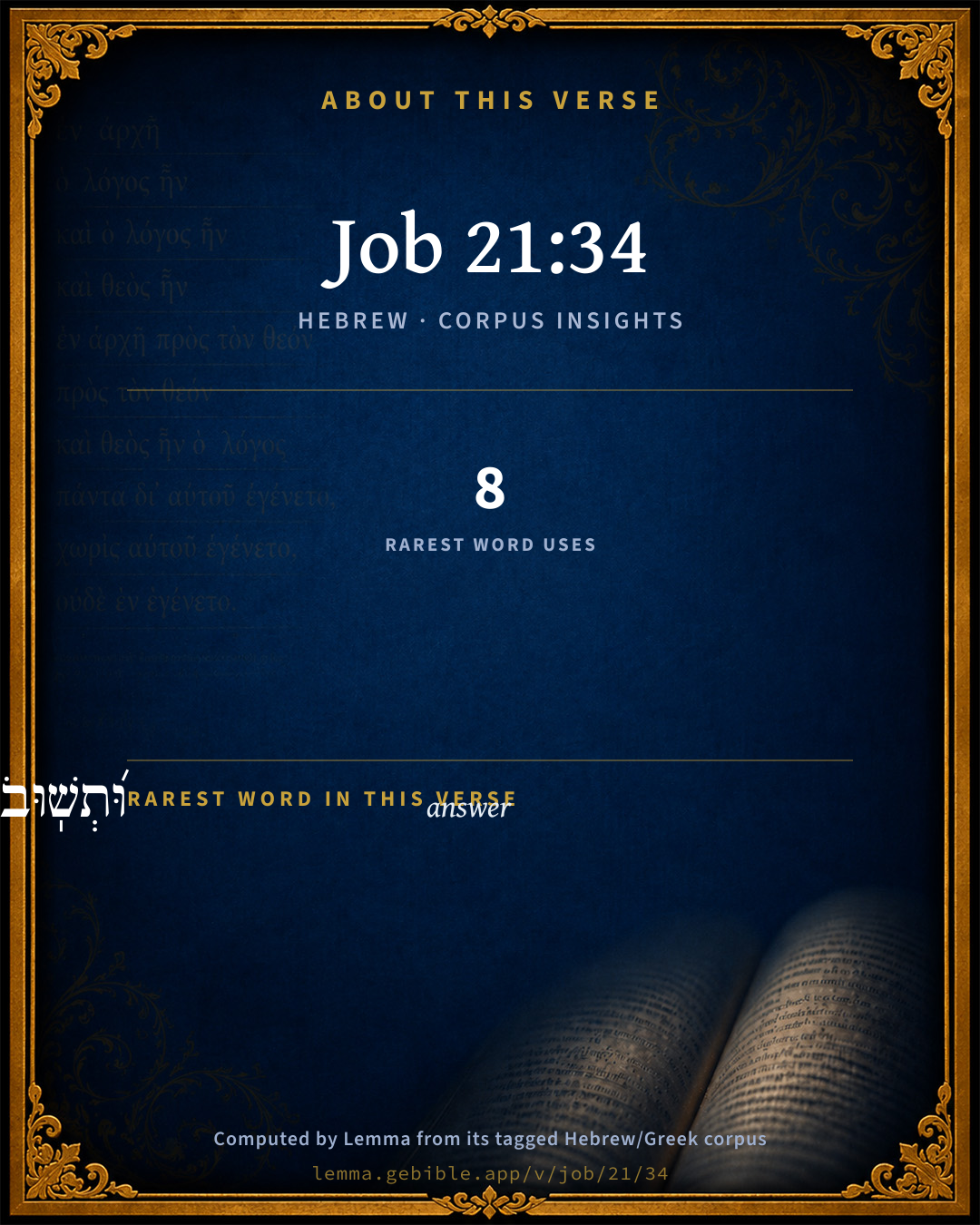
The rarest word here is וּ֝תְשֽׁוּבֹתֵיכֶ֗ם answer H8666 — appearing just 8 times in the whole Hebrew Bible.

Shared distinctive vocabulary

וּ֝תְשֽׁוּבֹתֵיכֶ֗ם answer H8666 occurs in 8 verses of the Hebrew Bible. Also found in:

Grammatical profile

  • 2 verbs
  • 3 nouns
  • 1 particle

Verb forms

  • תְּנַחֲמ֣וּנִי Piel · Imperfect
  • נִשְׁאַר Niphal · Perfect

Hebrew & Septuagint length

In English translation the verse runs 17 words from the Hebrew and 16 from the Septuagint (LXX English) — closely comparable.

A rough comparison of the two English renderings, which tokenize alike — not a word-level alignment.

Word counts can differ between the Hebrew and the Greek without any difference in meaning — e.g. the Hebrew direct-object marker אֵת has no separate Greek word, and Greek often adds the article ὁ.

Cross-references

4

Topical passages linked to Job 21:34 in the Treasury of Scripture Knowledge — connected by theme and wording, ordered by reader-vote popularity; previews shown in the World English Bible.

  • Job 16:2 "I have heard many such things. Miserable comforters are you all!
  • Job 13:4 But you are forgers of lies. You are all physicians of no value.
  • Job 32:3 Also his wrath was kindled against his three friends, because they had found no answer, and yet had condemned Job.
  • Job 42:7 It was so, that after Yahweh had spoken these words to Job, Yahweh said to Eliphaz the Temanite, "My wrath is kindled against you, and against your two friends; for you have not spoken of me the thing that is right, as my servant Job has.

Cross-references courtesy of OpenBible.info (CC BY 4.0).

Hebrew and Greek witnesses Masoretic Hebrew ↔ Greek Septuagint

The same verse in the two great witnesses to the Old Testament, shown verse-for-verse.

These are two independent witnesses, not word-aligned to each other, and the Septuagint is shown in lemma (dictionary) form.

Hebrew Job 21:34 Masoretic · Westminster Leningrad Codex

וְ֭אֵיךְ תְּנַחֲמ֣וּנִי הָ֑בֶל וּ֝תְשֽׁוּבֹתֵיכֶ֗ם נִשְׁאַר מָֽעַל

So how can you comfort me with nonsense, Seeing that in your answers there remains only falsehood?"

World English Bible · Public Domain

Greek LXX Job 21:34 Septuagint · lemma form

πῶς δέ παρακαλέω ἐγώ κενός ὁ δέ ἐγώ καταπαύω ἀπό σύ οὐδείς

How then do you⌃ comfort me in vain? whereas I have no rest from your molestation.

LXX2012 (modern English Septuagint) · Public Domain

On this verse, Adam Clarke's Commentary discusses the Septuagint’s reading. Read the note in Commentary ↓

Hebrew: Westminster Leningrad Codex (CC BY 4.0). Greek: Septuagint (public domain); English from LXX2012 (modern English Septuagint) (Public Domain). How the Septuagint differs from the Hebrew →

Commentary

Notes on Job 21:34 from classic Christian and Jewish commentators (each source and its license shown beneath its notes). The classic Christian expositions comment on the surrounding passage and are grouped to its opening verse, so a note may address several verses; the Jewish commentaries on the Tanakh (Rashi and others) are per-verse, so they appear only where the commentator wrote on this verse.

Lemma curates 59 commentaries, every one of them public domain or Creative Commons licensed, each selected and text-cleaned for this edition rather than reprinted as found. About our sources →

Trapp's Complete Commentary

John Trapp

Job 21:34 How then comfort ye me in vain, seeing in your answers there remaineth falsehood?

Ver. 34. How then comfort ye me in vain] Since ye apply nothing rightly to me, nor affirm nothing rightly of me, but, instead of comforting me, which you came for, ye trouble me. And such are all those consolatiunculae, creaturulae (as Luther finely phraseth it), petty creature comforts, waterish and empty businesses; an unsubstantial substance, as one saith of the bulrush.

Seeing in your answers remaineth falsehood?] Or prevarication, or double dealing; foul mistakes, and little less than malice.

John Trapp, A Commentary or Exposition upon All the Books of the Old and New Testament (1647–1656) — public domain. Text from a community e-Sword module.

The Biblical Illustrator

Joseph S. Exell

Job_21:34

How then comfort ye me in vain?

False comfort

Some years ago, I met a woman in Philadelphia, who was anxious about her soul, and had been a long time in that state. I conversed with her, and endeavoured to learn her state. She told me a good many things, and finally said she knew she ought to be willing to wait on God as long as He had waited upon her. She said God had waited on her a great many years before she would give any attention to His calls, and now she believed it was her duty to wait Gods time to show mercy and convert her soul. And she said this was the instruction she had received. She must be patient, and wait Gods time, and, by and by, He would give her relief. Oh! amazing folly! Here is the sinner in rebellion. God comes with pardon in one hand, and a sword in the other, and tells the sinner to repent and receive pardon, or refuse and perish. And now here comes a minister of the Gospel, and tells the sinner to wait Gods time. Virtually, he says that God is not ready to have him repent now, and is not ready to pardon him now, and thus, in fact, throws off the blame of his impenitence upon God. Instead of pointing out the sinners guilt, in not submitting at once to God, he points out Gods insincerity in making the offer, when, in fact, He was not ready to grant the blessing. (C. G. Finney.)

.

The Biblical Illustrator, edited by Joseph S. Exell (c. 1880s–1900s) — public domain. Text from a community e-Sword module.

Joseph Benson's Commentary

Job 21:34. How then comfort ye me in vain? — See then how ill you discharge the office of comforters, whose arguments have so little truth in them. Or, Why do you seek to comfort me with vain hopes of recovering my prosperity if I repent, seeing your grounds are manifestly false, and common experience shows, what also every body can tell you, that good men are very often in great tribulation, while the vilest of men thrive and prosper in the world.

Joseph Benson's Commentary on the Old and New Testaments (1811–1818) — public domain. Text from a community e-Sword module.

Tyndale Open Study Notes

Tyndale Open Resources

21:34 They told lies about Job (13:4) and about God (42:7).

Tyndale Open Study Notes — © Tyndale Open Resources, licensed CC BY-SA 4.0. Text via the HelloAO Bible API.

Geneva Bible (1599)

Geneva Bible translators

Saying, that the just in this world have prosperity, and the wicked adversity.

Geneva Bible (1599) marginal notes — public domain. Text via Bolls.life.

Jamieson, Fausset & Brown

Robert Jamieson, A. R. Fausset & David Brown

falsehood--literally, "transgression." Your boasted "consolations" (Job 15:11) are contradicted by facts ("vain"); they therefore only betray your evil intent ("wickedness") against me.

Next: Job Chapter 22

Jamieson, Fausset & Brown — Commentary Critical and Explanatory on the Whole Bible (1871) — public domain (CC PDM 1.0). Text via the HelloAO Bible API.

Adam Clarke's Commentary

Verse 34. How then comfort ye me in vain] Mr. Good translates: "How vainly then would ye make me retract!" See the note on Job 21:2. I cannot retract any thing I have said, as I have proved by fact and testimony that your positions are false and unfounded. Your pretensions to comfort me are as hollow as the arguments you bring in support of your exceptionable doctrines.

THIS chapter may be called Job's triumph over the insinuated calumnies, and specious but false doctrines, of his opponents. The irritability of his temper no longer appears: from the time he got that glorious discovery of his Redeemer, and the JOYOUS hope of an eternal inheritance, Job 19:25, c., we find no more murmurings, nor unsanctified complainings. He is now full master of himself and reasons conclusively, because he reasons coolly. Impassioned transports no longer carry him away: his mind is serene; his heart, fixed; his hope, steady; and his faith, strong. Zophar the Naamathite is now, in his presence, as an infant in the gripe of a mighty giant. Another of these pretended friends but real enemies comes forward to renew the attack with virulent invective, malevolent insinuation, and unsupported assertion. Him, Job meets, and vanquishes by pious resignation and fervent prayer. Though, at different times after this, Job had his buffetings from his grand adversary, and some seasons of comparative darkness, yet his faith is unshaken, and he stands as a beaten anvil to the stroke. He effectually exculpates himself, and vindicates the dispensations of his Maker.

There appears to be something in the 29th verse which requires to be farther examined: Have ye not asked them that go by the way? And do ye not know their tokens? It is probable that this verse may allude to the custom of burying the dead by the way-side, and raising up specious and descriptive monuments over them. Job argues that the lot of outward prosperity fell alike to the just and to the unjust, and that the sepulchral monuments by the wayside were proofs of his assertion; for his friends, as well as himself and others, had noted them, and asked the history of such and such persons, from the nearest inhabitants of the place; and the answers, in a great variety of cases, had been: "That monument points out the place where a wicked man lies, who was all his lifetime in prosperity and affluence, yet oppressed the poor, and shut up the bowels of his compassion against the destitute; and this belongs to a man who lived only to serve his God, and to do good to man according to his power, yet had not a day of health, nor an hour of prosperity; God having given to the former his portion in this life, and reserved the recompense of the latter to a future state."

The Septuagint render the verse thus: - Ερωτησατε παραπορευμενους ὁδον, και τα σημεια αυτων ουκ απαλλοτριωσατε, "Inquire of those who pass by the way, and their signs [monuments] ye will not alienate." That is, When ye hear the history of these persons, ye will not then assert that the man who lived in prosperity was a genuine worshipper of the true God, and therefore was blessed with temporal good, and that he who lived in adversity was an enemy to God and was consequently cursed with the want of secular blessings. Of the former ye will hear a different account from those who dare now speak the truth, because the prosperous oppressor is no more; And of the latter ye shall learn that, though afflicted, destitute, and distressed, he was one of those who acknowledged God in all his ways, and never performed an act of religious service to him in hope of secular gain; sought his approbation only, and met death cheerfully, in the hope of being eternally with the Lord.

Neither good nor evil can be known by the occurrences of this life. Every thing argues the certainty of a future state, and the necessity of a day of judgment. They who are in the habit of marking casualties, especially if those whom they love not are the subjects of them, as tokens of Divine displeasure, only show an ignorance of God's dispensations, and a malevolence of mind that would fain arm itself with the celestial thunders, in order to transfix those whom they deem their enemies.

Adam Clarke's Commentary on the Bible (1810–1826) — public domain. Text from a community e-Sword/MySword module.

Ellicott's Commentary for English Readers

(34) There remaineth falsehood.—Or, all that is left of them is transgression, that is to say, it is not only worthless, but yet more, it is even harmful and wrong.

A Bible Commentary for English Readers, edited by Charles John Ellicott (1878–1897) — public domain. Text from a community e-Sword module.

The Cambridge Bible for Schools and Colleges

gen. ed. J. J. S. Perowne

34. Job feels he has refuted the theories of his friends in regard to the pretended calamities and misery of the wicked man, whether in life or death. Hence their attempts to comfort him by this line of thinking are vain.

there remaineth falsehood] i. e. there is left (only) falsehood. When Job’s proofs to the contrary are subtracted from the answers of his friends, there is left in them only the wrongful, false disposition they shew towards him.

The Cambridge Bible for Schools and Colleges (gen. ed. J. J. S. Perowne; Cambridge University Press, 1878–1918) — public domain. Text from a community e-Sword module.

Albert Barnes' Notes on the Bible

How then comfort ye me in vain ... - That is, how can you be qualified to give me consolation in my trials, who have such erroneous views of the government and dealings of God? True consolation could be founded only on correct views of the divine government; but such views, Job says, they had not. With their conceptions of the divine administration, they could not administer to him any real consolation. We may learn hence,

(1) That all real consolation in trial must be based on correct apprehensions of the divine character and plans. Falsehood, delusion, error, can give no permanent comfort.

(2) They whose office it is to administer consolation to the afflicted, should seek after the “truth” about God and his government.

They should endeavor to learn why he afflicts people, what purpose he proposes to accomplish, and what are the proper ends of trial. They should have an unwavering conviction that he is right, and should see as far as possible “why” he is right, before they attempt to comfort others. Their own souls should be imbued with the fullest conviction that all the ways of God are holy, and then they should go and endeavor to pour their convictions into other hearts, and make them feel so too. A minister of the gospel, who has unsettled, erroneous, or false views of the character and government of God, is poorly qualified for his station, and will be a “miserable comforter” to those who are in trial. Truth alone sustains the soul in affliction. Truth only can inspire confidence in God. Truth only can break the force of sorrow, and enable the sufferer to look up to God and to heaven with confidence and joy.

(The end of Part One of the Commentary on Job)

Albert Barnes' Notes on the Bible (1834–1885) — public domain. Text from a community e-Sword/MySword module.

Haydock's Catholic Bible Commentary

Vain. These arguments shew that your assertions are destitute of proof, and afford me no comfort. (Calmet)

George Leo Haydock (1774–1849), Haydock's Catholic Family Bible and Commentary, 1859 edition — public domain. Excludes Psalms (Douay-Rheims chapter numbering differs from Protestant) and Deuterocanonical books (Catholic canon only).

Matthew Poole's English Annotations

Why then do you seek to comfort me with vain hopes of recovering my prosperity if I repent, seeing your grounds are manifestly false, and common experience showeth that good men are very oft in great tribulation, while the vilest of men thrive and prosper in the world?

Matthew Poole's English Annotations on the Holy Bible (1683–1685) — public domain. Text from a community e-Sword/MySword module.

Whedon's Commentary on the Bible

Daniel D. Whedon

34. Falsehood — Malice or treachery. Having subjected their consolatory speeches to the test of reason, and having eliminated that which seemed to be truth, Job declares the residuum to be solely the perfidious or malicious disposition by which they have been actuated. Comp. Job_21:27.

Daniel D. Whedon (gen. ed.), Commentary on the Old and New Testaments (1874–1909) — public domain. Text from a community e-Sword module.

The Pulpit Commentary

How then comfort ye me in vain, seeing in your answers there remaineth falsehood? Your position, that the godly always prosper, while the wicked are afflicted and brought low, being an absolutely false one, your attempts to console and comfort me are wholly vain and futile. Why continue them?

Most commentators consider the second colloquy here to end, and a pause to occur, before Eliphaz resumes the argument.

Vain comfort.

The three bungling comforters are wasting their efforts, because they are not speaking the truth. Their misapprehension and misrepresentation vitiate all their good intentions.

I WE MUST UNDERSTAND THOSE WHOM WE WOULD HELP.

1. By mixing with them. Job"s friends took the first step. They travelled from their remote homes across the desert and came to see him. We can only help the miserable if we first go among them and see them with our own eyes. Much philanthropy fails by reason of distance and separation. We cannot know people till we are with them. Christ came down from heaven and lived among men.

2. By freedom from prejudice. Job"s friends came with fixed notions. They only looked at Job through their coloured spectacles. We can never understand people till we throw aside all our preconceived notions about them and look at them as they are.

3. By sympathy. This must be insisted on over and over again. The lack of it was the chief cause of the failure of Job"s friends. The presence of it is the first essential for understanding people.

II TRUTH IS A PRIMARY CONDITION OF CONSOLATION.

1. In regard to the sufferer. It is useless to ignore his sufferings, or to try to reason him into the belief that they do not exist. The attempt to help will be spoilt if we argue that what he knows to be undeserved is really his due. Any view that does not regard him as he is spoils all efforts to console.

2. I n regard to the remedy. It is worse than useless to offer wrong remedies. The trite commonplaces of consolation are only irritants. Some of them are known to be false in fact. Others have not the ring of sincerity about them when repeated by the comforting friend. However true they have been once, they have ceased to bear any meaning that people believe in.

III SPIRITUAL CONSOLATION IS CONDITIONED BY SPIRITUAL TRUTH.

1. In thought. We cannot console others with dogmas that we do not believe in ourselves. If we have no faith in Christ we cannot use the Name of Christ to heal the wounds of others. Unless we look forward to a future life it is vain for us to talk about the "many mansions" when we are trying to console others. There is a foolish notion that we should talk up to the maximum of orthodoxy, even though we do not live and think up to it. But this notion is only an excuse for cant, and nothing is more vexing to the sufferer than to be treated with cant. Let us say only what we believe.

2. In fact. Delusions cannot afford permanent consolations, They may soothe pain and alarm for the moment; but they cannot endure, and when the mistake of them is discovered the result will be a deeper despair than ever. If, however, we could succeed in lulling all distress on earth by means of a false hope, the consolation itself would be a most terrible calamity. The soul needs truth more than comfort. It is better to hear the painful truth now than at the great judgment. But there is another truth, one which gives real consolation the truth of the gospel of Christ. W.F.A.

The Pulpit Commentary (1880–1919), ed. H.D.M. Spence-Jones & Joseph S. Exell — public domain. Text from a community e-Sword module.

John Wesley's Explanatory Notes

How - Why then do you seek to comfort me with vain hopes of recovering my prosperity, seeing your grounds are false, and experience shews, that good men are often in great tribulation, while the vilest of men prosper.

John Wesley, Explanatory Notes Upon the Whole Bible (1754–1765) — public domain. Text via the GEBible commentary corpus.

unfoldingWord translationNotes

Door43 World Missions Community

Connecting Statement:

This concludes Job's speech to his friends.

How then do you comfort me with nonsense, since in your answers there is nothing but falsehood?

Job uses a question to scold his friends. AT: "You cannot comfort me with nonsense. All of your answers are false." (See: Rhetorical Question)

translationWords

comfort

unfoldingWord translationNotes — © Distant Shores Media and the Door43 World Missions Community, licensed CC BY-SA 4.0. Source: git.door43.org/Door43/en_tn.

Rashi

Rabbi Shlomo Yitzchaki (Rashi)

Now how do you comfort me with futility Since only betrayal remains of your replies, the replies of wisdom are forgotten and lost from you, and of your replies, [those] left in your hands are only replies of betrayal. betrayal This word (מעל) is a noun, which is why it is voweled with a kamatz, and the accent is on the first syllable.

Rashi on the Tanakh — English translations: “The Judaica Press complete Tanach with Rashi, translated by A. J. Rosenberg” (CC BY 4.0); “Pentateuch with Rashi's commentary by M. Rosenbaum and A.M. Silbermann, 1929-1934” (public domain); “The Metsudah Tanach series, Lakewood, N.J” (CC BY 4.0); and “The Book of Joshua, Metsudah Publications, 1997” (CC BY 4.0). Text via Sefaria.

Lesson kit

Teaching starters — assembled from the data on this page, not authored interpretation. Every prompt links to the verse data it draws on. Edit before teaching.

Job, in the Wisdom, opens this verse with 6 words (6 distinct Hebrew lemmas). Its most distinctive word is tᵉshûwbâh (“answer”). A historical commentator’s framing appears above. Read the whole chapter for the surrounding context.

Discussion questions

  1. What does “answer” (tᵉshûwbâh) contribute to the verse as a whole?
  2. How does 1 Samuel 7:17, which shares the word «answer», read alongside this verse?
  3. The translations on this page render this verse differently — a whole-verse word diff, not a word-by-word alignment. What might account for the different wordings?
  4. «תְּנַחֲמ֣וּנִי» is a Piel Imperfect verb. How does that grammatical form shape the action described?
  5. Compare how Trapp's Complete Commentary and The Biblical Illustrator read this verse. Where do they agree or differ?

Things to notice

Reading settings

Reading text

Shown beneath each verse's original-language words.

Old Testament
Old Testament edition

Read the OT as the Masoretic Hebrew (MT) or the Greek Septuagint (LXX).

English shown for the Greek Septuagint (in the Hebrew ↔ Greek comparison).

Comparing translations? Open the Compare panel on any verse page to stack up to four side by side.