
Obadiah 1:5

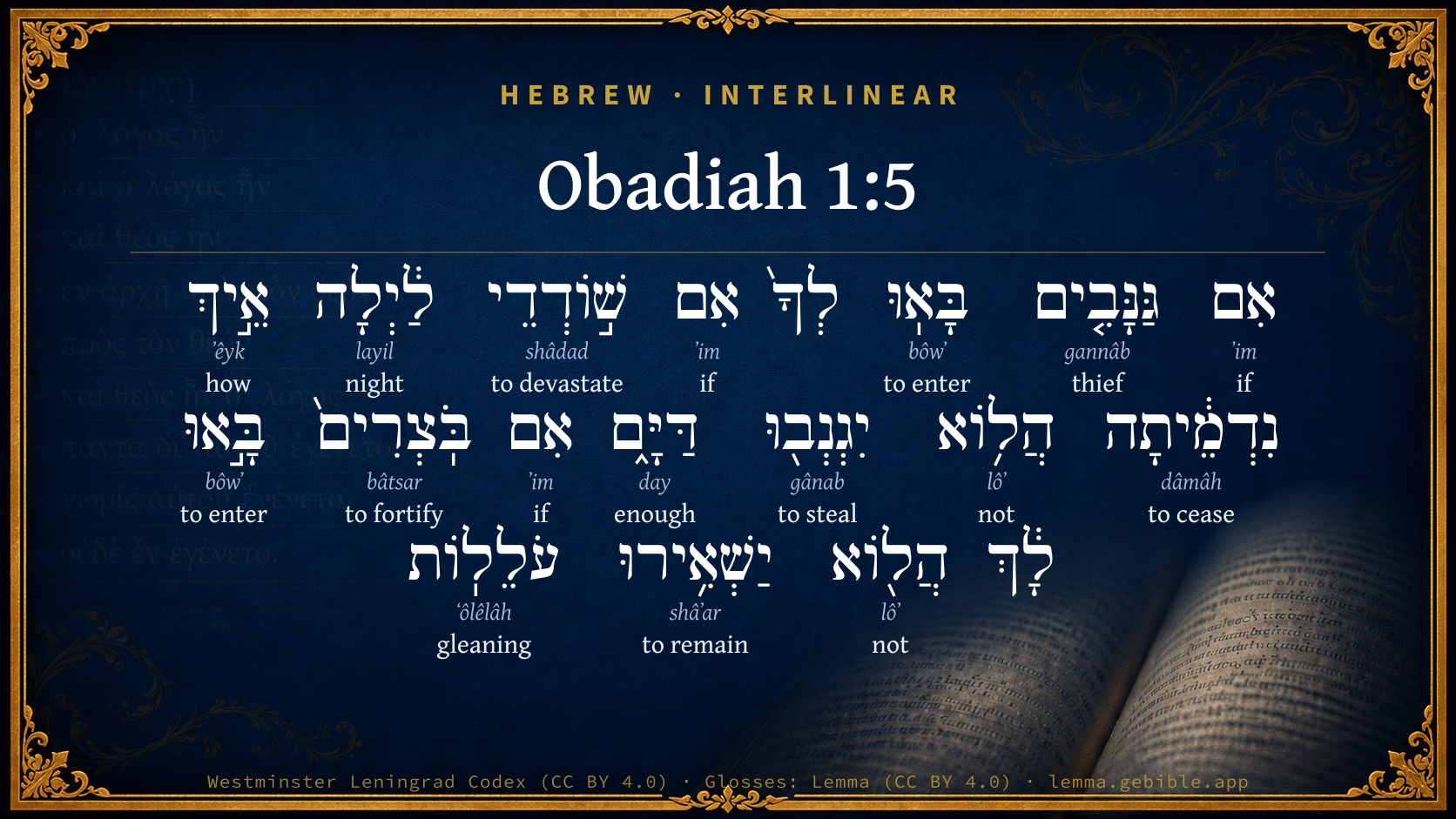
Hebrew (Westminster Leningrad Codex) Obadiah 1:5 appears in the Hebrew Old Testament. The text above is from the Westminster Leningrad Codex. Each word links to its Strong’s number, a concise gloss, and parsing drawn from the Open Scriptures Hebrew Bible morphology. Click any word for its full Brown-Driver-Briggs (BDB) entry.
Download image
Cite this verse

Obadiah 1:5 (World English Bible). Public Domain. Lemma interlinear Bible study tool, https://lemma.gebible.app/v/obadiah/1/5.

Show BibTeX & RIS
BibTeX
RIS
English Translation
If thieves came to you, if robbers by night-- oh, what disaster awaits you--wouldn't they only steal until they had enough? If grape pickers came to you, wouldn't they leave some gleaning grapes?
World English Bible · Public Domain
Download a study sheet

One document with this verse’s original text, its word-by-word gloss line, the meaning frame, cross-references with their text, attributed commentary, and full source and license credits — printable, and it pastes into notes with its structure intact.

This verse Autodidact and up

Study sheet (.html) Plain text (.txt)

A passage Seminary Student

Up to 50 verses in one chapter. A passage sheet keeps up to 6 commentary sources and 12 cross-references per verse, in the order this page ranks them, and says so on the sheet whenever that leaves anything out. Ask for a single verse and you get the Autodidact verse sheet above.

Everything on this page stays free to read, with no account — the sheet is a download of what is already on screen, not access to it.

Want to remove ads? Support Godless Engineer
Compare translations 3

The same verse in 3 English versions, stacked beneath the original-language interlinear above. Click any original word for its lexicon entry.

Each is an independent rendering of the whole verse — the interlinear is not word-aligned to these translations.

Highlighted words mark where these versions differ — a whole-verse word diff, not a word-by-word alignment.

  • World English Bible Public Domain
    If thieves came to you, if robbers by night-- oh, what disaster awaits you--wouldn't they only steal until they had enough? If grape pickers came to you, wouldn't they leave some gleaning grapes?
  • King James Version Public Domain
    If thieves came to thee, if robbers by night, (how art thou cut off!) would they not have stolen till they had enough? if the grapegatherers came to thee, would they not leave some grapes?
  • unfoldingWord Literal Text CC BY-SA 4.0
    If thieves came to you, and plunderers by night (how you are being destroyed!), would they not steal enough for them? If grape-cutters came to you, would they not leave behind gleanings?

unfoldingWord Literal Text — © unfoldingWord, licensed CC BY-SA 4.0. Word-aligned USFM3 via Door43 (git.door43.org/unfoldingWord/en_ult).

Versions to compare (up to 4)

3 of 4 selected

Show all 18 translations

Every available English version of this verse, each an independent rendering of the whole verse.

  • World English Bible Public Domain
    If thieves came to you, if robbers by night-- oh, what disaster awaits you--wouldn't they only steal until they had enough? If grape pickers came to you, wouldn't they leave some gleaning grapes?
  • Berean Standard Bible Public Domain
    “If thieves came to you, if robbers by night—oh, how you will be ruined—would they not steal only what they wanted? If grape gatherers came to you, would they not leave some gleanings?
  • Majority Standard Bible Public Domain
    “If thieves came to you, if robbers by night—oh, how you will be ruined—would they not steal only what they wanted? If grape gatherers came to you, would they not leave some gleanings?
  • King James Version Public Domain
    If thieves came to thee, if robbers by night, (how art thou cut off!) would they not have stolen till they had enough? if the grapegatherers came to thee, would they not leave some grapes?
  • American Standard Version (1901) Public Domain
    If thieves came to thee, if robbers by night (how art thou cut off!), would they not steal `only' till they had enough? if grape-gatherers came to thee, would they not leave some gleaning grapes?
  • Revised Version (1885) Public Domain
    If thieves came to thee, if robbers by night, (how art thou cut off!) would they not steal till they had enough? if grapegatherers came to thee, would they not leave some gleaning grapes?
  • Geneva Bible (1599) Public Domain
    Came theeues to thee or robbers by night? howe wast thou brought to silence? woulde they not haue stolen, til they had ynough? if the grape gatherers came to thee, woulde they not leaue some grapes?
  • Douay-Rheims (1899) Public Domain
    If thieves had gone in to thee, if robbers by night, how wouldst thou have held thy peace? would they not have stolen till they had enough? if the grapegatherers had come in to thee, would they not have left thee at the least a cluster?
  • Young's Literal Translation Public Domain
    If thieves have come in to thee, If spoilers of the night, How hast thou been cut off! Do they not steal their sufficiency? If gatherers have come in to thee, Do they not leave gleanings?
  • Literal Standard Version CC BY-SA 4.0
    “If thieves have come in to you, || If spoilers of the night, || How have you been cut off! Do they not steal their sufficiency? If gatherers have come in to you, || Do they not leave gleanings?
  • Unlocked Literal Bible CC BY-SA 4.0
    If thieves came to you, if robbers came by night—how you will be ruined!—would they not steal only as much as they needed? If grape gatherers came to you, would they not leave the gleanings?
  • unfoldingWord Literal Text CC BY-SA 4.0
    If thieves came to you, and plunderers by night (how you are being destroyed!), would they not steal enough for them? If grape-cutters came to you, would they not leave behind gleanings?
  • Darby Bible Public Domain
    If thieves had come to thee, if robbers by night, (how art thou cut off!) would they not have stolen [till] they had had enough? If grape-gatherers had come to thee, would they not have left some gleanings?
  • World Messianic Bible Public Domain
    “If thieves came to you, if robbers by night—oh, what disaster awaits you—wouldn’t they only steal until they had enough? If grape pickers came to you, wouldn’t they leave some gleaning grapes?
  • Webster's Bible Public Domain
    If thieves came to thee, if robbers by night, (how art thou cut off!) would they not have stolen till they had enough? if the grape-gatherers came to thee, would they not leave some grapes?
  • Free Bible Version CC BY-SA 4.0
    You will be completely destroyed! If thieves came to you, if robbers came at night, wouldn't they steal only what they wanted? If those who harvest grapes came to you, wouldn't they leave some behind?
  • Bible in Basic English Public Domain
    If thieves came, attacking you by night, (how are you cut off!) would they not go on taking till they had enough? if men came cutting your grapes would they take them all?
  • JPS Tanakh (1917) Public Domain
    If thieves came to thee, if robbers by night — how art thou cut off! — would they not steal till they had enough? If grape-gatherers came to thee, would they not leave some gleaning grapes?

Literal Standard Version (2020), Covenant Press — licensed CC BY-SA 4.0. Text via the HelloAO Bible API (eBible.org). Unlocked Literal Bible (unfoldingWord) — licensed CC BY-SA 4.0. Text via the HelloAO Bible API (eBible.org). unfoldingWord Literal Text — © unfoldingWord, licensed CC BY-SA 4.0. Word-aligned USFM3 via Door43 (git.door43.org/unfoldingWord/en_ult). Free Bible Version, Dr. Jonathan Gallagher — licensed CC BY-SA 4.0. Text via the HelloAO Bible API (eBible.org).

Word by word

More ways to search: Search by grammar → Find every occurrence → Compare this word →

Practice this passage: Drill this verse → Learn its vocabulary →

עֹלֵלֽוֹת
ʻôlêlâh
H5955
“gleanings”
Noun, Common, Feminine, Plural, Absolute
Part of Speech
Noun
Type
Common
Gender
Feminine
Number
Plural
State
Absolute
Full BDB Definition

Origin: act part of H5953

TWOT: 1627a

gleaning
  1. אִם ʼim H518 “if” Conjunction
  2. גַּנָּבִ֤ים gannâb H1590 “thieves” Noun, Common, Masculine, Plural, Absolute
  3. בָּאֽוּ bôwʼ H935 “to enter” Verb, Qal, Perfect, 3rd Person, Common, Plural
  4. אִם ʼim H518 “if” Conjunction
  5. שׁ֣וֹדְדֵי shâdad H7703 “devastating” Verb, Qal, Participle Active, Masculine, Plural, Construct
  6. לַ֔יְלָה layil H3915 “night” Noun, Common, Masculine, Singular, Absolute
  7. אֵ֣יךְ ʼêyk H349 “how” Particle, Interrogative
  8. נִדְמֵ֔יתָה dâmâh H1820 “to cease” Verb, Niphal, Perfect, 2nd Person, Masculine, Singular
  9. הֲל֥וֹא lôʼ H3808 “not” Particle, Interrogative + Particle, Negative
  10. יִגְנְב֖וּ gânab H1589 “to steal” Verb, Qal, Imperfect, 3rd Person, Masculine, Plural
  11. דַּיָּ֑ם day H1767 “enough · their” Noun, Common, Masculine, Singular, Construct + Suffix, Personal, 3rd Person, Masculine, Plural
  12. אִם ʼim H518 “if” Conjunction
  13. בֹּֽצְרִים֙ bâtsar H1219 “fortifying” Verb, Qal, Participle Active, Masculine, Plural, Absolute
  14. בָּ֣אוּ bôwʼ H935 “to enter” Verb, Qal, Perfect, 3rd Person, Common, Plural
  15. הֲל֖וֹא lôʼ H3808 “not” Particle, Interrogative + Particle, Negative
  16. יַשְׁאִ֥ירוּ shâʼar H7604 “to remain” Verb, Hiphil, Imperfect, 3rd Person, Masculine, Plural

About this verse

These counts appear in no published source. They are computed here, from the morphology-tagged text and Lemma’s own curated glosses. What Lemma adds →

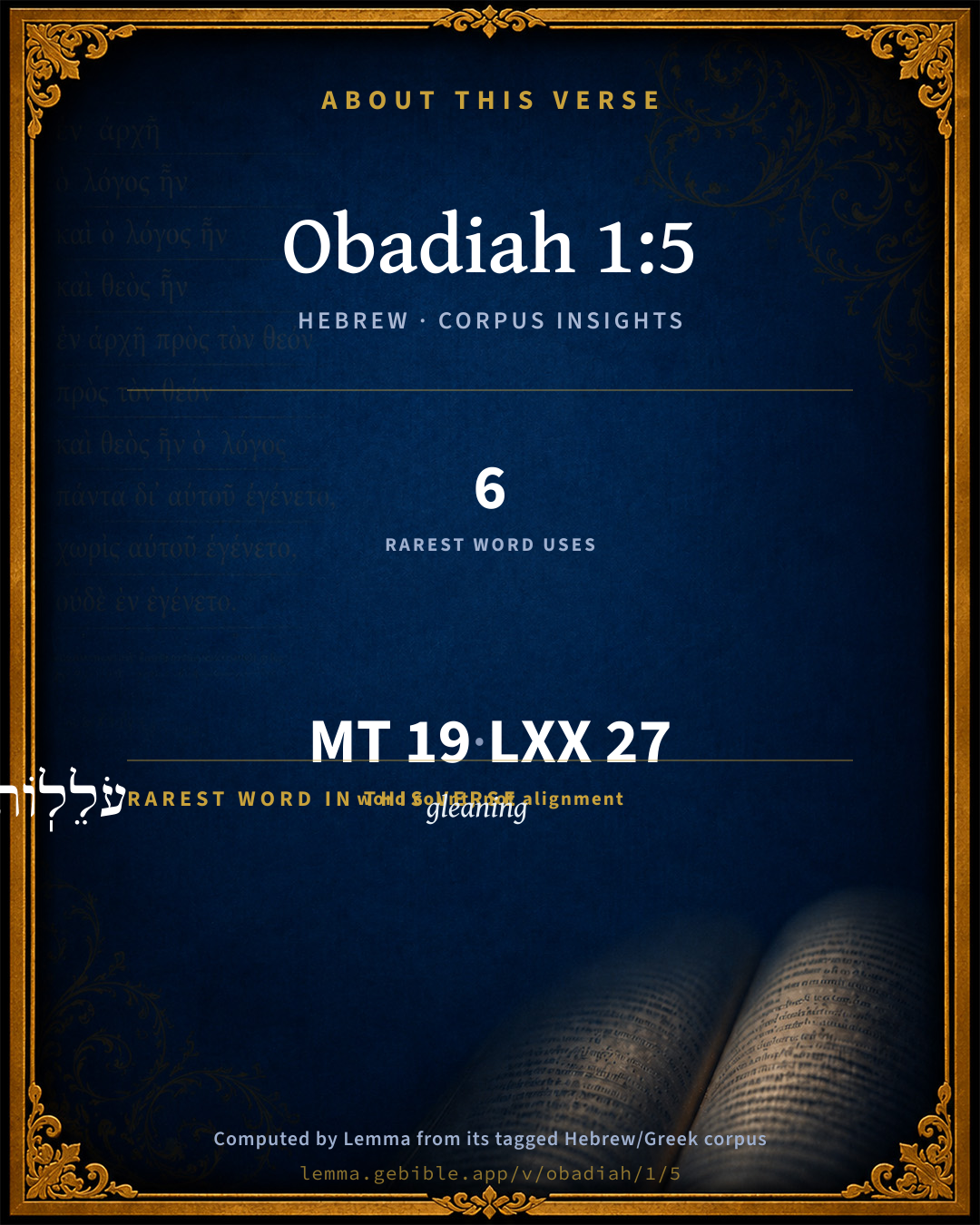
19
words
13
distinct lemmas
Prophets
section

Notable vocabulary

The rarest word here is עֹלֵלֽוֹת gleaning H5955 — appearing just 6 times in the whole Hebrew Bible.

Shared distinctive vocabulary

עֹלֵלֽוֹת gleaning H5955 occurs in 6 verses of the Hebrew Bible. Also found in:

Grammatical profile

  • 7 verbs
  • 4 nouns
  • 2 prepositions
  • 3 conjunctions
  • 3 particles

Verb forms

  • בָּאֽוּ Qal · Perfect
  • שׁ֣וֹדְדֵי Qal · Participle Active
  • נִדְמֵ֔יתָה Niphal · Perfect
  • יִגְנְב֖וּ Qal · Imperfect
  • בֹּֽצְרִים֙ Qal · Participle Active
  • בָּ֣אוּ Qal · Perfect
  • יַשְׁאִ֥ירוּ Hiphil · Imperfect

Repetition

Words recur within this verse — often emphatic in Hebrew:

  • בָּאֽוּ to enter H935 ×2
  • אִם if H518 ×3
  • הֲל֥וֹא not H3808 ×2

Hebrew & Septuagint length

In English translation the verse runs 33 words from the Hebrew and 40 from the Septuagint (LXX English) — closely comparable.

A rough comparison of the two English renderings, which tokenize alike — not a word-level alignment.

Word counts can differ between the Hebrew and the Greek without any difference in meaning — e.g. the Hebrew direct-object marker אֵת has no separate Greek word, and Greek often adds the article ὁ.

In the original languages it is 19 Hebrew tokens and 27 Greek tokens — but the two are counted differently (Hebrew bundles its prefixes and suffixes into one token; the Greek is in lemma form), so that isn’t a like-for-like length.

Cross-references

11

Topical passages linked to Obadiah 1:5 in the Treasury of Scripture Knowledge — connected by theme and wording, ordered by reader-vote popularity; previews shown in the World English Bible.

  • Deuteronomy 24:21 When you gather [the grapes of] your vineyard, you shall not glean it after you: it shall be for the foreigner, for the fatherless, and for the widow.
  • Jeremiah 49:9 If grape-gatherers came to you, would they not leave some gleaning grapes? if thieves by night, wouldn't they destroy until they had enough?
  • Isaiah 17:6 Yet there shall be left therein gleanings, as the shaking of an olive tree, two or three berries in the top of the uppermost bough, four or five in the outmost branches of a fruitful tree, says Yahweh, the God of Israel.
  • 2 Samuel 1:19 Your glory, Israel, is slain on your high places! How are the mighty fallen!
  • Isaiah 14:12 How you are fallen from heaven, day-star, son of the morning! How you are cut down to the ground, who laid the nations low!
  • Isaiah 24:13 For thus shall it be in the midst of the earth among the peoples, as the shaking of an olive tree, as the gleanings when the vintage is done.
  • Jeremiah 50:23 How is the hammer of the whole earth cut apart and broken! how is Babylon become a desolation among the nations!
  • Lamentations 1:1 How does the city sit solitary, that was full of people! She has become as a widow, who was great among the nations! She who was a princess among the provinces is become tributary!
  • Micah 7:1 Misery is mine! Indeed, I am like one who gathers the summer fruits, as gleanings of the vinyard: There is no cluster of grapes to eat. My soul desires to eat the early fig.
  • Zephaniah 2:15 This is the joyous city that lived carelessly, that said in her heart, "I am, and there is none besides me." How she has become a desolation, a place for animals to lie down in! Everyone who passes by her will hiss, and shake their fists.
  • Revelation 18:10 standing far away for the fear of her torment, saying, 'Woe, woe, the great city, Babylon, the strong city! For your judgment has come in one hour.'

Cross-references courtesy of OpenBible.info (CC BY 4.0).

Hebrew and Greek witnesses Masoretic Hebrew ↔ Greek Septuagint

The same verse in the two great witnesses to the Old Testament, shown verse-for-verse.

These are two independent witnesses, not word-aligned to each other, and the Septuagint is shown in lemma (dictionary) form.

Hebrew Obadiah 1:5 Masoretic · Westminster Leningrad Codex

אִם גַּנָּבִ֤ים בָּאֽוּ לְךָ֙ אִם שׁ֣וֹדְדֵי לַ֔יְלָה אֵ֣יךְ נִדְמֵ֔יתָה הֲל֥וֹא יִגְנְב֖וּ דַּיָּ֑ם אִם בֹּֽצְרִים֙ בָּ֣אוּ לָ֔ךְ הֲל֖וֹא יַשְׁאִ֥ירוּ עֹלֵלֽוֹת

If thieves came to you, if robbers by night-- oh, what disaster awaits you--wouldn't they only steal until they had enough? If grape pickers came to you, wouldn't they leave some gleaning grapes?

World English Bible · Public Domain

Greek LXX Obadiah 1:5 Septuagint · lemma form

εἰ κλέπτης εἰςἔρχομαι πρός σύ ἤ λῃστής νύξ ποῦ ἄν ἀποῥίπτω οὐ ἄν κλέπτω ὁ ἱκανός ἑαυτοῦ καί εἰ τρυγητής εἰςἔρχομαι πρός σύ οὐ ἄν ὑπολείπω ἐπιφυλλίς

If thieves came in to you, or robbers by night, where would you have been cast away? would they not have stolen just enough for themselves? and if grape gatherers went in to you, would they not leave a gleaning?

LXX2012 (modern English Septuagint) · Public Domain

On this verse, Ellicott's Commentary for English Readers discusses the Septuagint’s reading. Read the note in Commentary ↓

Hebrew: Westminster Leningrad Codex (CC BY 4.0). Greek: Septuagint (public domain); English from LXX2012 (modern English Septuagint) (Public Domain). How the Septuagint differs from the Hebrew →

Targum (Aramaic paraphrase)

1

The Targum is the ancient Jewish Aramaic paraphrase of the Hebrew Scriptures — an interpretive translation, not the Hebrew text itself. Onkelos (literal) and Pseudo-Jonathan (expansive) render the Torah, and Jonathan the Prophets. Coverage is partial: where no permissively-licensed English translation exists for a verse, only the Aramaic is shown. This is verse-level text, not a word-by-word alignment to the Hebrew.

  1. Targum Jonathan Prophets (Joshua–Malachi)
    אִם גַנָבִים אֲתוֹ עֲלָךְ אִם בְּזוֹזֵי לֵילְיָא אֵיכְדֵין הֲוֵיתָא דָמִיךְ עַד דִגְנָבוּ מִסִתְהוֹן וְאִם חָטוֹפִין כְּקִטוּפִין אָתוּ עֲלָךְ הֲלָא מַשְׁאֲרִין עוֹלְלָן:

    (no public-domain English translation for this verse)

    Targum Jonathan — Aramaic: “Mikraot Gedolot” (public domain). English: “Sefaria Community Translation” (CC0 1.0 (public-domain dedication)); “London "Chaldee Paraphrase," 1871” (public domain). Text via Sefaria.

Commentary

Notes on Obadiah 1:5 from classic Christian and Jewish commentators (each source and its license shown beneath its notes). The classic Christian expositions comment on the surrounding passage and are grouped to its opening verse, so a note may address several verses; the Jewish commentaries on the Tanakh (Rashi and others) are per-verse, so they appear only where the commentator wrote on this verse.

Lemma curates 59 commentaries, every one of them public domain or Creative Commons licensed, each selected and text-cleaned for this edition rather than reprinted as found. About our sources →

Ellicott's Commentary for English Readers

(5-9) The completeness of the overthrow awaiting Edom. It is no mere inroad of a marauding tribe. Something would escape the robber, though he might go away quite satisfied with his plunder; and even a raid in vintage time, for the purpose of doing all the mischief possible to the country, would leave here and there a scattered bunch, gleanings for the inhabitants when the spoilers had retired, but now everything is doomed to destruction. Edom is completely robbed and ransacked. Notice how the sad, almost pathetic, conviction of this breaks out—as if rather from a friend (see Introduction) than an enemy—in the parenthetical “how art thou cut off!” in the very middle of the sentence. Every one must perceive, the prophet seems to say, a higher hand at work here.

(5) Some grapes.—Gleanings, as in margin. (Comp. Isa_17:6; Isa_24:13.)

(6) How are the things of Esau searched out!—Literally, How are they searched out Esau! Where Esau is either taken collectively = Edom as a nation, or we must supply, as in the Authorised Version, “the things of,” or, as Ewald, “they of.” For search, comp. Zep_1:12.

His hidden things.—Heb., matspunîm, from tsapan = to hide, but whether hidden treasures or hiding places cannot be determined, as the word only occurs here.

(7-9) Overtaken by this terrible calamity, and deserted by her allies, Edom will turn in vain for counsel to her senators and wise men, and for support to her heroes and mighty men, for these will not only share in the general ruin, but are marked out for an overthrow as signal as their renown.

(7) All the men of thy confederacy. . . .—This desertion by allies is doubtless put prominently forward as the due retribution on Edom for his treachery and cruelty to his natural ally, his brother Jacob. The members of the confederacy are not specified. In Jer_27:3 we find Edom associated with Moab, Ainmon, Tyre, and Sidon, in the warning to submit to Nebuchadnezzar. The two former would be the natural allies of Edom, and in Eze_25:8 Seir is joined with Moab as reproaching Israel. From Psa_60:8, we may add to these Philistia (comp. also Oba_1:19). The expression “have brought thee to the border” is variously understood. The most natural explanation is that the fugitives from the ruin of Edom, flying into the territory of neighbouring and allied tribes for help, are basely driven back to their own frontier, and left to their fate.

The men that were at peace with thee.—As in margin, the men of thy peace, an expressive Hebrew idiom occurring in Jer_20:10; Jer_38:22, and in Psa_41:9, where it is translated “mine own familiar friend.”

Great difference of opinion exists as to the connection of this and the following clause, and as it stands the text presents considerable difficulty. By dropping the italicised words in our version, and omitting the semicolon, we get, “The men of thy peace have deceived thee, prevailed against thee and thy bread, have laid a wound under thee.” There are two verbal difficulties—(1) “wound,” Heb., mazôr, which occurs in Hos_5:13 in the sense of a festering wound or abscess, but which the older translators here render ambush, or snare; ἔνεδρα (LXX.); insidiœ (Vulg.). Ewald and Hitzig, among moderns, prefer net, and defend it etymologically. This certainly gives good sense, and if zûr, of which it is a derivative, can have the sense of binding, may be correct. Our translators in Jer_30:13, and Aquila and Symmachus in this passage, evidently give it that force (see also Lee’s Heb. Lex., sub voce). To squeeze or crush, however, seems the true meaning of zûr: as in Jdg_6:38, of Gideon’s fleece; Job_39:15, of the eggs of the ostrich. The preposition tachath = under, also offers a difficulty; “Laid a wound under thee” suggests no intelligible meaning. But on the authority (though possibly somewhat doubtful) of 2Sa_3:12, where the word is translated “on behalf of,” but where the context requires “without his knowledge,” and on the analogy of all other languages, we may (with Vatablus, Drusius, Luther, and L. de Dieu; see Keil) translate the word deceitfully, or without thy knowledge, a rendering in accordance with the parallelism. But the syntax of the passage still remains unexplained. What is the construction of lachmeka=of thy bread? From Psa_41:9, “The man of my peace which did eat of my bread,” we are led to the conjecture that it forms part of a familiar, perhaps proverbial, expression for one bound by the closest ties of fellowship and hospitality, and we must, therefore, either supply a participle, these eating, as in the Psalm, or understand a second anshêy=men of. It is true there is no other instance of the phrase “men of thy bread,” but it is a conceivable Hebrew idiom. Keeping the parallelism we now get an intelligible rendering of the passage.

“Unto the border they sent thee, all the men of thy confederacy.

Deceived thee, ruined thee,

Men of thy peace, men of thy bread;

(They) gave thee a wound in secret.

No understanding (is) in him.”

For the arrangement of the second clause, which is put for deceived thee the men of thy peace, ruined thee the men of thy bread, see Son_1:5, and Note there. In the last clause the margin reads of it: i.e., of the injury just mentioned, instead of in him. But it is better to take it as an abrupt declaration in the prophet’s manner (comp. “how art thou cut off!” in Oba_1:5) of the utter bewilderment that had come or was coming on Edom, unable either by counsel or force to withstand his foes.

(8) Shall I not . . .—Literally, Surely in that day—it is Jehovah’s saying—I will make sages disappear from Edom, and understanding from Esau’s mountain.

The tradition of a peculiar sagacity in Edom, and especially in Teman (see Jer_49:7), lingered long. Job’s sage friend Eliphaz was a Temanite. In Bar_3:22-23 we read: “It (wisdom) hath not been heard of in Chanaan, neither hath it been seen in Theman. The Agarenes that seek wisdom upon earth, the merchants of Meran and of Theman, the authors (margin, expounders) of fables and searchers out of understanding, none of these have known the way of wisdom, or remember her paths.” Jeremiah’s words show even more strikingly how high the reputation had been: “Is wisdom no more in Teman? is counsel perished from the prudent? is their wisdom vanished?” “The men of the world think that they hold their wisdom and all God’s natural gifts independently of the giver. God, by the events of His natural providence, as here by His word, shows, through some withdrawal of their wisdom, that it is His, not theirs. Men wonder at the sudden failure, the flaw in the well-arranged plan, the one over-confident act which ruins the whole scheme, the over-shrewdness which betrays itself, or the unaccountable oversight.” So the utter want of perception and foresight in Edom seems unaccountable, till we think of the Divine purpose and end in it all. The wise were destroyed, and the mighty men dismayed, “to the end that every one of the mount of Esau may be cut off by slaughter.” It is the prophetic statement of the truth of the old heathen proverb: “Whom God wishes to destroy He first dements.”

(9) For Teman, see Job_2:11.

A Bible Commentary for English Readers, edited by Charles John Ellicott (1878–1897) — public domain. Text from a community e-Sword module.

Trapp's Complete Commentary

John Trapp

Oba 1:5 If thieves came to thee, if robbers by night, (how art thou cut off!) would they not have stolen till they had enough? if the grapegatherers came to thee, would they not leave [some] grapes?

Ver. 5. If thieves came to thee, if robbers by night] Or, what? have thieves come to thee? have robbers been here? O, sure it is worse than so with thee; they would never have made such clean work as they say, but have left somewhat behind them; they would never have played the harpies {a} in this sort, and taken all before them. Thus the neighbour nations stand wondering at this woeful desolation, and sarcastically insulting. Now to be mocked in misery is no small grief to the party. Thus the prophet pricks them by a rhetorical addubitation, the better to affect their minds with an effectual fear of no ordinary or easy calamity, but such as will be wonderful and incredible; so that they that hear of it will say,

How art thou cut off!] Or, how silent art thou! what, did thine enemies set upon thee per amica silentia lunae? did they take thee napping that they shred thee thus? Have they dealt by thee as Sir Francis Drake in his travels did by the Spaniard, whom he found sleeping on the bank of a river with many wedges of gold lying by him; he never waked the man, but eased him of his charge: or rather as Epaminondas did by the watchman, whom he found fast asleep; he thrust him through with his sword; and being chid for so severe a fact, replied, Talem eum reliqui, qualem inveni, I left him but as I found him.

If the grape gatherers came to thee, would they not leave some grates?] Surely they would, Deu 24:21; there would likely be a gleaning of grapes after the vintage is done, Isa 24:13, two or three berries in the top of the uppermost bough; four or five in the outmost fruitful branches, Isa 17:6. It is hard but some may escape out of the battle to bring the ill news. Edom’s ruin therefore and desolation was most deplorable and irreparable, since none was left alone; but all, both men and means, raked and racemated. {b}

{a} A rapacious, plundering, or grasping person; one that preys upon other ŒD

{b} A salt of racemic acid. ŒD

John Trapp, A Commentary or Exposition upon All the Books of the Old and New Testament (1647–1656) — public domain. Text from a community e-Sword module.

Joseph Benson's Commentary

Oba 1:5-9. If thieves come unto thee — See note on Jer 49:9. How are his hidden things sought up! — Those treasures and riches which he took all possible care to conceal, that they might not be discovered by the enemy. All the men of thy confederacy have brought thee even to the border — Thy confederates marched out with thee, until thou wast come to the borders of thy country, and then they perfidiously joined with the enemy’s forces, and thereby deceived thee. And prevailed against thee — Namely, treacherously. They that eat thy bread have laid a wound under thee — Those that were maintained at thy cost, as thine allies, have given thee a secret blow. There is none understanding — Thou wast not aware of it. Shall I not, in that day, even destroy the wise men, &c. — At that time, when these evils shall come upon them, their prudence and skill shall altogether forsake them, and the wisest among them shall not know what to do, or shall give unsatisfactory, or foolish, counsel. When God designs a people for destruction, he causes such circumstances to arise, such a multiplicity of dangers, and so unexpectedly, to surround them, that their greatest wisdom is confounded, and the most skilful among them are quite at a loss how to act. See note on Jer 49:7. And thy mighty men, O Teman, shall be dismayed, &c. — Teman was one of the grandsons of Esau, after whom some city and district in Idumea was named. Here it seems to be used to signify the whole country of Idumea. Certain it is that the Idumeans were looked upon as a strong and valiant people. Josephus says, they went as unconcernedly and as cheerfully into battle as to a banquet; but here it is threatened that a panic fear should seize upon this courageous nation, so that they should be entirely discouraged, and not able to stand against their enemies, or defend themselves; the consequence of which would be, a great slaughter of them.

Joseph Benson's Commentary on the Old and New Testaments (1811–1818) — public domain. Text from a community e-Sword module.

Whedon's Commentary on the Bible

Daniel D. Whedon

In Oba_1:5-6 the prophet pictures the completeness of the destruction by a comparison of the calamity to come with familiar experiences.

Thieves… robbers… grape-gatherers — R.V. brings out the thought more satisfactorily by reading the first question of Oba_1:5, “would they not steal only till they had enough?” The second reads, “would they not leave some gleaning grapes?” Thieves and robbers, it is true, take and carry off whatever they can lay their hands on; but when they have satisfied their desire they go away leaving some things behind. In a similar manner grape-gatherers do not pick every single berry or grape; with (Lev_9:10; Deu_24:21) or without intention they leave some gleanings. Not so Edom’s conqueror; he will leave behind nothing but waste and desolation.

How art thou cut off! — A parenthetical exclamation by the prophet, forced from him by the awful character of the judgment, which, in his prophetic vision, he sees already accomplished.

How are the things of Esau searched out! — Literally, How are they searched out, Esau! An expression of amazement at the completeness of the ruin. Every corner of Edom will be searched thoroughly and the plunder will be carried off.

Hidden things — R.V., “hidden treasures.”

The treasures stored in the treasure houses hewn in the rock in inaccessible places. These hiding places will be discovered and the treasures will be taken away as booty. Edom will be completely despoiled (Jer_49:9).

Daniel D. Whedon (gen. ed.), Commentary on the Old and New Testaments (1874–1909) — public domain. Text from a community e-Sword module.

The Preacher's Complete Homiletical Commentary

Joseph S. Exell (gen. ed.)

CRITICAL NOTES.]

Oba_1:5.] Spoliation shall be complete; not such as thieves or grape-gatherers make, who leave the rest when they have had enough.

Oba_1:6. Hidden] places explored; all treasures searched out, lit. diligent and earnest tracking out (Zep_1:12).

HOMILETICS

THE IRREPARABLE LOSS.—Oba_1:5-6

The prophet now depicts the utter overthrow of Edom. The material wealth on which they relied shall be taken away, and nothing shall remain or be recovered.

I. Their treasures are searched out. “How are the things of Esau searched out!” The most secret places, the most hidden things, are diligently tracked out. Everything safely stored up in holes of the rock was sought after and discovered. No place can hide from God. No wealth can protect from retribution. Nothing can be concealed and kept on earth. Our best treasures are searched out, stolen by thieves or corroded by time. In the judgment day the hidden things of all men will be brought to light, every hiding-place of sin exposed, and sinners stripped of their pride and self-confidence.

II. Their treasures are taken away. The grape-gatherer leaves some gleanings, thieves and robbers retreat with what they can carry with them: but the enemy would act much worse than ordinary plunderers. Nothing shall escape them. The devastation should be complete. A gleaning was left in Israel (Isa_17:6; Isa_24:13), but Edom was utterly spoiled. Treasures ensure not from the invader, aggrandize not the possessors, but become the spoil of the conqueror. Nations may trust to their defences and individuals to their wealth, but God can take them all away. “I have made Esau bare. I have uncovered his secret places, and he shall not be able to hide himself.”

III. The regret at the loss is great. “How art thou cut off!” This parenthetic sentence indicates the amazement of the prophet at the great destruction of the ungodly. Sad to see men lose reputation and happiness, the health of the body and the fortunes of the family, without the least hope of recovery. What a sight to behold men exposed to judgment, robbed of all defence, and stupefied in their sin.

1. God pities such. Judgment is strange work to him. He desires not the death of any sinner. O Jerusalem, how often would I have gathered thee!

2. God’s servants pity such. Amos mourns over the destruction which he announces in the name of God. David and Jeremiah wept because men kept not the law. All true prophets are in sympathy with the people for whom they labour. A lost soul should cause tears to flow like rivers of water.” Oh that they were wise, that they understood this!”

ILLUSTRATIONS TO THE CHAPTER

Oba_1:5-6. Thieves. Paulinus, when he was told that the Goths had sacked Nola and plundered him of all he had, lifted up his eyes to heaven, and said, “Lord, thou knowest where I have laid up my treasure” [Bib. Museum].

The Preacher's Complete Homiletical Commentary (gen. ed. Joseph S. Exell; Funk & Wagnalls, c. 1892) — public domain (pre-1929). A full-Bible homiletical/sermon-outline anthology covering 65 of 66 books (2 John is absent from the source module). Text from a community e-Sword module.

Keil & Delitzsch

C. F. Keil & F. Delitzsch

The prophet sees this overthrow of Edom from its lofty height as something that has already happened, and he now depicts the utter devastation of Edom through the medium of the enemies whom Jehovah has summoned against it. Oba 1:5. "If thieves had come to thee, if robbers by night, alas, how art thou destroyed! would they not steal their sufficiency? If vine-dressers had come to thee, would they not leave gleanings? Oba 1:6. How have the things of Esau been explored, his hidden treasures desired! Oba 1:7. Even to the border have all the men of thy covenant sent thee: the men of thy peace have deceived thee, overpowered thee. They make thy bread a wound under thee. There is no understanding in him." In order to exhibit the more vividly the complete clearing out of Edom, Obadiah supposes two cases of plundering in which there is still something left (Oba 1:5), and then shows that the enemies in Edom will act much worse than this. אם with the perfect supposes a case to have already occurred, when, although it does not as yet exist in reality, it does so in imagination. גּנּבים are common thieves, and שׁדדי לילה robbers by night, who carry off another's property by force. With this second expression, the verb בּאוּ לך must be repeated. "To thee," i.e., to do thee harm; it is actually equivalent to "upon thee." The following words איך נדמיתה cannot form the apodosis to the two previous clauses, because nidmēthâh is too strong a term for the injury inflicted by thieves or robbers, but chiefly because the following expression הלוא יגנבוּ וגו is irreconcilable with such an explanation, the thought that thieves steal דּיּם being quite opposed to nidmâh, or being destroyed. The clause "how art thou destroyed" must rather be taken as pointing far beyond the contents of Oba 1:5 and Oba 1:6. It is more fully explained in Oba 1:9, and is thereby proved to be a thought thrown in parenthetically, with which the prophet anticipates the principal fact in his lively description, in the form of an exclamation of amazement. The apodosis to 'im gannâghı̄m (if robbers, etc.) follows in the words "do they not steal" (= they surely steal) dayyâm, i.e., their sufficiency (see Delitzsch on Isa 40:16); that is to say, as much as they need, or can use, or find lying open before them. The picture of the grape-gatherers says the same thing. They also do not take away all, even to the very last, but leave some gleanings behind, not only if they fear God, according to Lev 19:10; Deu 24:21, as Hitzig supposes, but even if they do not trouble themselves about God's commandments at all, because many a bunch escapes their notice which is only discovered on careful gleaning. Edom, on the contrary, is completely cleared out. In Deu 24:6 the address to Edom passes over into words concerning him. עשׂו is construed as a collective with the plural. איך is a question of amazement. Châphas, to search through, to explore (cf. Zep 1:12-13). Bâ‛âh (nibh‛ū), to beg, to ask; here in the niphal to be desired. Matspōn, ἁπ. λεγ. from tsâphan, does not mean a secret place, but a hidden thing or treasure (τὰ κεκρυμμένα αὐτοῦ, lxx). Obadiah mentions the plundering first, because Petra, the capital of Edom, was a great emporium of the Syrio-Arabian trade, where many valuables were stored (vid., Diod. Sic. xix. 95), and because with the loss of these riches the prosperity and power of Edom were destroyed.

(Note: Jeremiah (Jer 49:9) has greatly altered the words of Obadiah, dropping the comparison of the enemy to thieves and grape-gatherers, and representing the enemy as being themselves grape-gatherers who leave no gleaning, and thieves who waste till they have enough; and thereby considerably weakening the poetical picture.)

Keil & Delitzsch — Biblical Commentary on the Old Testament (1861–1891) — public domain (CC PDM 1.0). Text via the HelloAO Bible API. (Old Testament only.)

Tyndale Open Study Notes

Tyndale Open Resources

1:5-7 The Babylonians completely destroyed Jerusalem. By sharing in the plunder, Edom deserved equal retribution (see 1:15-18).

1:5 Edom’s destroyers would take everything, unlike thieves and harvesters. Thieves would leave anything that would hinder an immediate, successful escape; harvesters would always leave gleanings for the poor (Deut 24:19; cp. Ruth 2; Matt 12:1).

Tyndale Open Study Notes — © Tyndale Open Resources, licensed CC BY-SA 4.0. Text via the HelloAO Bible API.

Geneva Bible (1599)

Geneva Bible translators

God will so destroy them that he will leave none, though thieves when they come, take but till they have enough, and they that gather grapes, ever leave some behind them, Jer. 49:9.

Geneva Bible (1599) marginal notes — public domain. Text via Bolls.life.

Jamieson, Fausset & Brown

Robert Jamieson, A. R. Fausset & David Brown

The spoliation which thou shalt suffer shall not be such as that which thieves cause, bad as that is, for these when they have seized enough, or all they can get in a hurry, leave the rest--nor such as grape-gatherers cause in a vineyard, for they, when they have gathered most of the grapes, leave gleanings behind--but it shall be utter, so as to leave thee nothing. The exclamation, "How art thou cut off!" bursting in amidst the words of the image, marks strongly excited feeling. The contrast between Edom where no gleanings shall be left, and Israel where at the worst a gleaning is left (; ), is striking.

Jamieson, Fausset & Brown — Commentary Critical and Explanatory on the Whole Bible (1871) — public domain (CC PDM 1.0). Text via the HelloAO Bible API.

Adam Clarke's Commentary

Verse 5. If thieves came to thee] That is, if thieves entered thy dwellings, they would not have taken every thing; they would have laid hold on thy wealth; and carried off as much as they could escape with conveniently; if grape-gatherers entered thy vineyards, they would not have taken every bunch; some gleanings would have been left. But the Chaldeans have stripped thee bare; they have searched out all thy hidden things, Ob 1:6, they have left thee nothing. Hour art thou cut off! Thou art totally and irretrievably ruined! The prophet speaks of this desolation as if it had already taken place.

Adam Clarke's Commentary on the Bible (1810–1826) — public domain. Text from a community e-Sword/MySword module.

John Calvin's Commentaries

The Prophet shows in this verse that the calamity with which God was resolved to afflict the Idumeans would not be slight, for nothing would be left among them; and he amplifies what he says by a comparison. When one is plundered of his property by thieves, he grieves, that what he had acquired by much labor through life, has been in one moment taken from him: and when any one has spent labor and expense in cultivating his vineyard, and another takes away its fruit, he complains of his great misfortune, that he had lost his property and big labor in the cultivation of his vineyard, while another devours its fruit. But the Prophet intimates that God would not be content with such kind of punishment as to the Idumeans.

Hence he says, Have night thieves or robbers come to thee? They must doubtless have stolen, and have taken away what they thought sufficient for them; but now nothing shall be left to thee. In short, the Prophet intimates that the Assyrians would not be like thieves or night robbers, who stealthily and privately take away what comes to their hands; but he means, that the Idumeans would be so plundered, that their houses would be left wholly empty, and he declares that the Assyrians would thus spoil them like night thieves or robbers, who are wont to proceed with unbridled liberty; for none dares to resist them, or even to say a word against them. This plundering then will not be, says the Prophet, of an ordinary kind; but the enemies will make thee entirely empty.

The same is the object in view when he says, Have vintagers come to thee? To be sure, they commonly leave some clusters; but the Assyrians will leave, no, not one: they shall depart so laden with plunders, that thou shalt be left empty.

But all this, as we have reminded you, was said in order to alleviate or to mitigate the grief of the faithful, who then deemed themselves very miserable, as they were alone plundered by enemies; for they saw that their neighbors were dwelling in safety, and even becoming partakers of the spoil. Their condition therefore was very miserable and degraded. Hence the Prophet, that he might moderate this bitter grief, says, that the Idumeans would in no common way be plundered, for not a hair could be left them. This is the import of the passage.

But some regard the verb נדמיתה nudamite as signifying, “Thou art reduced to silence;” for the verb דום dum or דמה dame means to be silent: and they give this exposition, “How dost thou not endeavor at least to meet thine enemies?” for they take “to be silent” in the sense of being still, as דמה dame is often so taken in Scripture, “How then have they been silent?” but he speaks of the future in the past tense, as though God had already inflicted punishment on the Idumeans, that faith in the prediction might be made more certain: thou hast been reduced to silence, that is, how couldest thou remain quiet on seeing thine enemies plundering with so much violence — how then hast thou been reduced to silence? Others say, How hast thou been consumed? for דמה dame often means to destroy. But to this point belongs no great importance; for the Prophet means, that it could not be ascribed to chance, that enemies would destroy the whole land of Edom, for the cruel assault would by no means be of an ordinary kind: and then as the Idumeans thought that an entrance to their enemies was on every side closed up, as they inhabited the summits of mountains, according to what I have already said, and that they were most safe in their recesses and lofty rocks, the Prophet here sets it forth as a wonderful thing that God’s judgment would yet reach them. Let us proceed —

John Calvin's Commentaries (1540-1563) — public domain. Text from the Calvin Translation Society English edition (1840s-50s) via the Christian Classics Ethereal Library (ccel.org). Calvin's coverage is partial (roughly two-thirds of the Bible); uncommented books and verses are honest gaps, never fabricated. The 19th-century editor's footnotes and remarks are omitted so the notes are faithfully Calvin's own voice.

The Cambridge Bible for Schools and Colleges

gen. ed. J. J. S. Perowne

5, 6. The completeness of the destruction and desolation of Edom is depicted by a double contrast. Two cases are supposed in which something would be left behind. The thief or the robber would take his fill and depart: the grape-gatherer would not strip every cluster from the vine. But the enemies of Edom would do worse than either of these. They would spare nothing, nor stay their hand till they had left her utterly desolate and bare.

how art thou cut off] These words are an exclamation of the prophet, forced from him by the utter devastation which in prophetic vision he sees before his eyes. This is no work of the common robber, of the ordinary spoiler!

The Cambridge Bible for Schools and Colleges (gen. ed. J. J. S. Perowne; Cambridge University Press, 1878–1918) — public domain. Text from a community e-Sword module.

John Gill's Exposition

If thieves came to thee, if robbers by night,.... Whether the one came by day, and the other by night, or both by night, the same being meant by different words, whose intent is to plunder and steal, and carry off what they can; thy condition would not be worse, nor so bad as now it is: for

how art thou cut off! from being a nation, wholly destroyed; thy people killed, or carried captive; thy fortresses demolished, towns and cities levelled with the ground, and all thy wealth and substance carried off, and nothing left: these are either the words of God, or of the prophet, setting forth their utter ruin, as if it was already; or of the nations round about, wondering at their sudden destruction. Some render it, "how silent art thou!" (q) that is, under all these calamities: or, "how art thou asleep!" or "stupefied!" as the Targum and Jarchi; not to be upon thy guard against the incursions of the enemy, but careless, secure, and stupid, and now stripped of everything: had common thieves and robbers broke in upon thee,

would they not have stolen till they had enough? as much as they came for, or could carry off; they seldom strip a house into which they enter of everything in it; they come for some particular things, and, meeting with them, they go off, and leave the rest:

if the grape gatherers come to thee, would they not leave some grapes? that is, if men should come into thy vineyards, and gather the grapes, and carry them off by force or stealth, would they take them all a way? doubtless they would leave some behind; some would be hid under the boughs, and be left unobserved by them: or the allusion is to gatherers of grapes, who gather them for the owners, and at their direction, who were wont to leave some clusters for the poor to glean after them; but in the case of Edom it is suggested that nothing should be left, all should be clean carried off; the destruction would he complete and entire. The Targum is,

"if spoilers as grape gatherers should come unto thee, &c.''

see Jer 49:9.

(q) "quomodo redactus es in silentium?" Calvin; "quomodo siles?" some in Tarnovius; so Syr.

John Gill's Exposition of the Whole Bible (1746–1763) — public domain (CC PDM 1.0). Text via the HelloAO Bible API.

Albert Barnes' Notes on the Bible

If thieves came to thee - The prophet describes their future punishment, by contrast with that which, as a marauding people, they well knew. Thieves and robbers spoil only for their petty end. They take what comes to hand; what they can, they carry off shortness of time, difficulty of transport, necessity of providing for a retreat, limit their plunder. When they have gorged themselves, they depart. “Their” plunder is limited. The “grape-gatherer” leaves gleanings. God promises to His own people, under the same image, that they should have a remnant left Isa 17:6; Isa 24:13. “Gleaning grapes shall be left in it.” It shall be, “as gleaning grapes, when the vintage is done.” The prophet anticipates the contrast by a burst of sympathy. In the name of God, he mourns over the destruction which he fore-announces. He laments over the destruction, even of the deadly enemy of his people. “How art thou destroyed!” So the men of God are accustomed to express their amazement at the greatness of the destruction of the ungodly Psa 73:19. “How are they brought into desolation as in a moment!” Isa 14:4, Isa 14:12. “How hath the oppressor ceased! How art thou fallen from heaven, O Lucifer, son of the morning!” Jer 50:23. “How is the hammer of the whole earth cut asunder and broken! how is Babylon become a desolation among the nations!” Jer 51:41. “How is Sheshach taken! How is the praise of the whole earth surprised.”

Albert Barnes' Notes on the Bible (1834–1885) — public domain. Text from a community e-Sword/MySword module.

Haydock's Catholic Bible Commentary

Cluster. (Jeremias xlix. 9.) The Chaldeans take all, and remove the people, ver. 7.

George Leo Haydock (1774–1849), Haydock's Catholic Family Bible and Commentary, 1859 edition — public domain. Excludes Psalms (Douay-Rheims chapter numbering differs from Protestant) and Deuterocanonical books (Catholic canon only).

Matthew Poole's English Annotations

In this verse the prophet doth in an abrupt manner of speech, mixed of wonder and doubt, express the strange havoc and desolation made in Edom, as if lie had said, Who have been here? or in what posture wast thou found, O Edom! that such strange desolution is found in thee?

If thieves by day had spoiled thee, they would not have thus stripped thee. If robbers, which practise their violences in the night, had been with thee, they would have left somewhat behind them.

How art thou cut off? here is either a trajection, this placed here which must be read first in the verse, or an exclamation of one as in haste to know whence such unexpected events; or an insulting derision of that pride which boasted so much and performed so little in self defence.

Would they not have stolen till they had enough? thieves and robbers take till they have what is sufficient for them at present and leave the rest, but here is nothing left.

If the grape-gatherers came to thee, would they not leave some grapes? if Edom be a vine, and gathered, some gleanings would be left by grape-gatherers; but, alas, here have been those that have cut up the vine! and is all thy confidence and boasting come to this?

Matthew Poole's English Annotations on the Holy Bible (1683–1685) — public domain. Text from a community e-Sword/MySword module.

The Pulpit Commentary

Ver. 5, 6. To prove the completeness of the destruction that shall befall Eden, the prophet supposes two eases of despoiling in which something would be left behind. It will be far worse than any mere raid of thieves; nothing will be spared.

Thieves... robbers. The former are ordinary thieves who pilfer secretly; the latter are robbers who act with violence, or members of a marauding expedition. How art thou cut off! An interposed ejaculation of the prophet, sympathizing with the Edomites for the utter desolation which he sees in vision. Septuagint, Pou an aperrifhv ; "Where wouldst thou have been east away?" taking a different reading; Vulgate, Quomodo conticuisses? "How wouldst thou have been silent?" i.e. for fear. Till they had enough. Would they not have taken such plunder as they wanted, and then decamped? The grape gatherers would leave some bunches untouched, which escaped their notice. There is no reference to the charitable law in Lev_19:10 Deu_24:21, which would not affect, or be known unto, these grape plunderers.

The Pulpit Commentary (1880–1919), ed. H.D.M. Spence-Jones & Joseph S. Exell — public domain. Text from a community e-Sword module.

John Wesley's Explanatory Notes

If thieves - If thieves by day had spoiled thee, they would not have thus stripped thee. Robbers - If robbers in the night had been with thee, they would have left somewhat behind them. 'Till they had enough - But here is nothing left. Some grapes - But here have been those that have cut up the vine.

John Wesley, Explanatory Notes Upon the Whole Bible (1754–1765) — public domain. Text via the GEBible commentary corpus.

unfoldingWord translationNotes

Door43 World Missions Community

General Information:

Yahweh continues giving Obadiah his message to Edom.

If thieves came to you ... would they not steal only as much as they needed?

This question is used to imply that Yahweh's punishment of Edom would be worse than what thieves would do when they steal. This can be stated explicitly. AT: "If thieves came to you ... they would only steal as much as they needed, but I will take everything from you!" (See: Rhetorical Question and Assumed Knowledge and Implicit Information)

If thieves came to you, if robbers came by night

These two phrases mean the same thing and are used to emphasize people who steal. They can be combined. AT: "When thieves break into someone's house during the night" (See: Hendiadys)

if robbers came by night

"or if robbers came during the night"

robbers

people who steal things from other people

how you will be ruined!

Yahweh adds this phrase in the middle of another sentence to express that the punishment of Edom is shocking. AT: "you are completely destroyed!"

If grape gatherers came to you, would they not leave the gleanings?

This question is used to imply that Yahweh's punishment of Edom would be more thorough than what grape gatherers would do when they harvest grapes. This can be stated explicitly. AT: "If grape gatherers came to you, they would leave some grapes, but I will take everything from you!" (See: Rhetorical Question and Assumed Knowledge and Implicit Information)

How Esau has been ransacked, his hidden treasures will be searched out

This can be stated in active form. AT: "Ah, enemies have stolen everything from Esau; they have found his hidden treasure" (See: Active or Passive)

Esau

The people of Edom were the descendants of Esau. Therefore, in this book "Edom" and "Esau" refer to the same group of people.

has been ransacked

This means the enemies have search through Esau's things, taken everything valuable, and left everything else in a mess or damaged.

translationWords

thief

grape

glean

Esau

unfoldingWord translationNotes — © Distant Shores Media and the Door43 World Missions Community, licensed CC BY-SA 4.0. Source: git.door43.org/Door43/en_tn.

Rashi

Rabbi Shlomo Yitzchaki (Rashi)

come upon you Heb. בָּאוּ לְךָ, lit., came to you.

How were you silent?—Why were you sleeping soundly and still until they stole all they desired?

would (the vintagers) not leave over some gleaning grapes?—But these will not leave you anything, for they will search and reveal and seek out your hidden things.

Rashi on the Tanakh — English translations: “The Judaica Press complete Tanach with Rashi, translated by A. J. Rosenberg” (CC BY 4.0); “Pentateuch with Rashi's commentary by M. Rosenbaum and A.M. Silbermann, 1929-1934” (public domain); “The Metsudah Tanach series, Lakewood, N.J” (CC BY 4.0); and “The Book of Joshua, Metsudah Publications, 1997” (CC BY 4.0). Text via Sefaria.

Lesson kit

Teaching starters — assembled from the data on this page, not authored interpretation. Every prompt links to the verse data it draws on. Edit before teaching.

Obadiah, in the Prophets, opens this verse with 19 words (13 distinct Hebrew lemmas). Its most distinctive word is ʻôlêlâh (“gleaning”). A historical commentator’s framing appears above. Read the whole chapter for the surrounding context.

Discussion questions

  1. The word ʻôlêlâh carries the sense “gleaning.” How does it shape the verse?
  2. Judges 8:2 shares the word «gleaning» with this verse. How do the two illuminate each other?
  3. “to enter” occurs 2× in this one verse. What is the effect of the repetition?
  4. The translations on this page render this verse differently — a whole-verse word diff, not a word-by-word alignment. What might account for the different wordings?
  5. The verb «בָּאֽוּ» is Qal Perfect. How does its form color the action?
  6. Reading how Ellicott's Commentary for English Readers and Trapp's Complete Commentary read this verse, where do the two commentators agree and where do they part?

Things to notice

Reading settings

Reading text

Shown beneath each verse's original-language words.

Old Testament
Old Testament edition

Read the OT as the Masoretic Hebrew (MT) or the Greek Septuagint (LXX).

English shown for the Greek Septuagint (in the Hebrew ↔ Greek comparison).

Comparing translations? Open the Compare panel on any verse page to stack up to four side by side.