

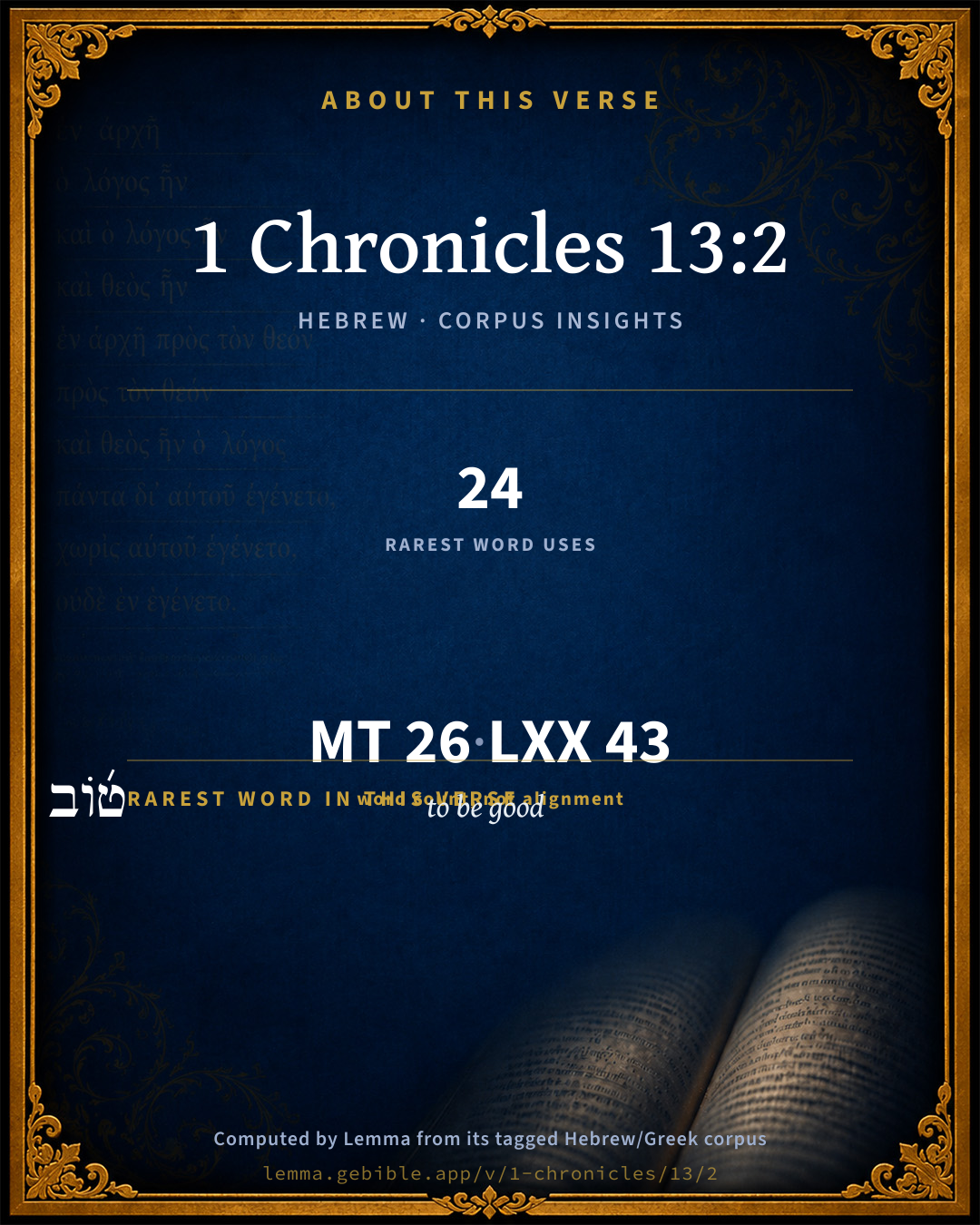
1 Chronicles 13:2

Hebrew (Westminster Leningrad Codex) 1 Chronicles 13:2 appears in the Hebrew Old Testament. The text above is from the Westminster Leningrad Codex. Each word links to its Strong’s number, a concise gloss, and parsing drawn from the Open Scriptures Hebrew Bible morphology. Click any word for its full Brown-Driver-Briggs (BDB) entry.
Download image
Cite this verse

1 Chronicles 13:2 (World English Bible). Public Domain. Lemma interlinear Bible study tool, https://lemma.gebible.app/v/1-chronicles/13/2.

Show BibTeX & RIS
BibTeX
RIS
English Translation
David said to all the assembly of Israel, If it seem good to you, and if it be of Yahweh our God, let us send abroad everywhere to our brothers who are left in all the land of Israel, with whom the priests and Levites are in their cities that have suburbs, that they may gather themselves to us;
World English Bible · Public Domain
Download a study sheet

One document with this verse’s original text, its word-by-word gloss line, the meaning frame, cross-references with their text, attributed commentary, and full source and license credits — printable, and it pastes into notes with its structure intact.

This verse Autodidact and up

Study sheet (.html) Plain text (.txt)

A passage Seminary Student

Up to 50 verses in one chapter. A passage sheet keeps up to 6 commentary sources and 12 cross-references per verse, in the order this page ranks them, and says so on the sheet whenever that leaves anything out. Ask for a single verse and you get the Autodidact verse sheet above.

Everything on this page stays free to read, with no account — the sheet is a download of what is already on screen, not access to it.

Want to remove ads? Support Godless Engineer
Compare translations 3

The same verse in 3 English versions, stacked beneath the original-language interlinear above. Click any original word for its lexicon entry.

Each is an independent rendering of the whole verse — the interlinear is not word-aligned to these translations.

Highlighted words mark where these versions differ — a whole-verse word diff, not a word-by-word alignment.

  • World English Bible Public Domain
    David said to all the assembly of Israel, If it seem good to you, and if it be of Yahweh our God, let us send abroad everywhere to our brothers who are left in all the land of Israel, with whom the priests and Levites are in their cities that have suburbs, that they may gather themselves to us;
  • King James Version Public Domain
    And David said unto all the congregation of Israel, If it seem good unto you, and that it be of the LORD our God, let us send abroad unto our brethren every where, that are left in all the land of Israel, and with them also to the priests and Levites which are in their cities and suburbs, that they may gather themselves unto us:
  • unfoldingWord Literal Text CC BY-SA 4.0
    And David said to all of the assembly of Israel, “If good to you and from Yahweh our God, let us spread, let us send to our remaining brothers in all of the lands of Israel, and with them the priests and the Levites in the cities of their pasturelands, and let them be gathered to us.

unfoldingWord Literal Text — © unfoldingWord, licensed CC BY-SA 4.0. Word-aligned USFM3 via Door43 (git.door43.org/unfoldingWord/en_ult).

Versions to compare (up to 4)

3 of 4 selected

Show all 18 translations

Every available English version of this verse, each an independent rendering of the whole verse.

  • World English Bible Public Domain
    David said to all the assembly of Israel, If it seem good to you, and if it be of Yahweh our God, let us send abroad everywhere to our brothers who are left in all the land of Israel, with whom the priests and Levites are in their cities that have suburbs, that they may gather themselves to us;
  • Berean Standard Bible Public Domain
    And he said to the whole assembly of Israel, “If it seems good to you, and if this is of the LORD our God, let us send word far and wide to the rest of our brothers in all the land of Israel, and also to the priests and Levites in their cities and pasturelands, so that they may join us.
  • Majority Standard Bible Public Domain
    And he said to the whole assembly of Israel, “If it seems good to you, and if this is of the LORD our God, let us send word far and wide to the rest of our brothers in all the land of Israel, and also to the priests and Levites in their cities and pasturelands, so that they may join us.
  • King James Version Public Domain
    And David said unto all the congregation of Israel, If it seem good unto you, and that it be of the LORD our God, let us send abroad unto our brethren every where, that are left in all the land of Israel, and with them also to the priests and Levites which are in their cities and suburbs, that they may gather themselves unto us:
  • American Standard Version (1901) Public Domain
    And David said unto all the assembly of Israel, If it seem good unto you, and if it be of Jehovah our God, let us send abroad every where unto our brethren that are left in all the land of Israel, with whom the priests and Levites are in their cities that have suburbs, that they may gather themselves unto us;
  • Revised Version (1885) Public Domain
    And David said unto, all the assembly of Israel, If it seem good unto you, and if it be of the LORD our God, let us send abroad every where unto our brethren that are left in all the land of Israel, with whom the priests and Levites are in their cities that have suburbs, that they may gather themselves unto us:
  • Geneva Bible (1599) Public Domain
    And Dauid said to all the Congregation of Israel, If it seeme good to you, and that it proceedeth of the Lord our God, we will sende to and from vnto our brethren, that are left in all the lande of Israel (for with them are the Priests and the Leuites in the cities and their suburbes) that they may assemble them selues vnto vs.
  • Douay-Rheims (1899) Public Domain
    And he said to all the assembly of Israel: If it please you; and if the words which I speak come from the Lord our God, let us send to the rest of our brethren into all the countries of Israel, and to the priests, and the Levites, that dwell in the suburbs of the cities, to gather themselves to us,
  • Young's Literal Translation Public Domain
    and David saith to all the assembly of Israel, `If unto you it be good, and from Jehovah our God it hath broken forth -- we send unto our brethren, those left in all the lands of Israel, and with them the priests and the Levites, in the cities of their suburbs, and they are gathered unto us,
  • Literal Standard Version CC BY-SA 4.0
    and David says to all the assembly of Israel, “If it is good to you, and it has broken forth from our God YHWH—we send to our brothers, those left in all the lands of Israel, and the priests and the Levites with them in the cities of their outskirts, and they are gathered to us,
  • Unlocked Literal Bible CC BY-SA 4.0
    David said to all the assembly of Israel, “If it seems good to you, and if this comes from Yahweh our God, let us send messengers everywhere to our brothers who remain in all the regions of Israel, and to the priests and Levites who are in their cities. Let them be told to join us.
  • unfoldingWord Literal Text CC BY-SA 4.0
    And David said to all of the assembly of Israel, “If good to you and from Yahweh our God, let us spread, let us send to our remaining brothers in all of the lands of Israel, and with them the priests and the Levites in the cities of their pasturelands, and let them be gathered to us.
  • Darby Bible Public Domain
    And David said to all the congregation of Israel, If it seem good to you, and it be of Jehovah our God, let us send abroad to our brethren everywhere, that are left in all the lands of Israel, and with them to the priests and Levites in their cities and suburbs, that they may gather themselves to us;
  • World Messianic Bible Public Domain
    David said to all the assembly of Israel, “If it seems good to you, and if it is of the LORD our God, let’s send word everywhere to our brothers who are left in all Eretz-Israel, with whom the priests and Levites are in their cities that have pasture lands, that they may gather themselves to us.
  • Webster's Bible Public Domain
    And David said to all the congregation of Israel, If it seemeth good to you, and that it is of the LORD our God, let us send abroad to our brethren every where, that are left in all the land of Israel, and with them also to the priests and Levites who are in their cities and suburbs, that they may assemble to us:
  • Free Bible Version CC BY-SA 4.0
    Then he addressed the whole assembly of Israel, saying, “If you agree, and if God approves, let us send an invitation to every Israelite in the land, including the priests and Levites in their towns and pastures, to come and join us.
  • Bible in Basic English Public Domain
    And David said to all the men of Israel who had come together there, If it seems good to you and if it is the purpose of the Lord our God, let us send to all the rest of our brothers, everywhere in the land of Israel, and to the priests and the Levites in their towns and the country round them, and get them to come together here to us;
  • JPS Tanakh (1917) Public Domain
    And David said unto all the assembly of Israel: 'If it seem good unto you, and if it be of the LORD our God, let us send abroad everywhere unto our brethren that are left in all the land of Israel, and with them to the priests and Levites that are in their cities that have open land about them, that they may gather themselves unto us;

Literal Standard Version (2020), Covenant Press — licensed CC BY-SA 4.0. Text via the HelloAO Bible API (eBible.org). Unlocked Literal Bible (unfoldingWord) — licensed CC BY-SA 4.0. Text via the HelloAO Bible API (eBible.org). unfoldingWord Literal Text — © unfoldingWord, licensed CC BY-SA 4.0. Word-aligned USFM3 via Door43 (git.door43.org/unfoldingWord/en_ult). Free Bible Version, Dr. Jonathan Gallagher — licensed CC BY-SA 4.0. Text via the HelloAO Bible API (eBible.org).

Word by word

More ways to search: Search by grammar → Find every occurrence → Compare this word →

Practice this passage: Drill this verse → Learn its vocabulary →

ט֜וֹב
ṭôwb
H2895
“good”
Adjective, Adjective, Masculine, Singular, Absolute
Part of Speech
Adjective
Type
Adjective
Gender
Masculine
Number
Singular
State
Absolute
Full BDB Definition

Origin: a primitive root

TWOT: 793

to be good, be pleasing, be joyful, be beneficial, be pleasant, be favourable, be happy, be right - (Qal) - to be pleasant, be delightful - to be glad, be joyful - to be better - to be well with, be good for - to be pleasing - (Hiphil) to do well, do good, act right, act rightly
  1. וַיֹּ֨אמֶר ʼâmar H559 “and · to say” Conjunction + Verb, Qal, Sequential Imperfect, 3rd Person, Masculine, Singular
  2. דָּוִ֜יד Dâvid H1732 “David” Noun, Proper
  3. לְכֹ֣ל kôl H3605 “to/for · all of” Preposition + Noun, Common, Masculine, Singular, Construct
  4. קְהַ֣ל qâhâl H6951 “assembly of” Noun, Common, Masculine, Singular, Construct
  5. יִשְׂרָאֵ֗ל Yisrâʼêl H3478 “Israel” Noun, Proper
  6. אִם ʼim H518 “if” Conjunction
  7. עֲלֵיכֶ֨ם ʻal H5921 “upon · you” Preposition + Suffix, Personal, 2nd Person, Masculine, Plural
  8. וּמִן min H4480 “and · from” Conjunction + Preposition
  9. יְהוָ֣ה Yᵉhôvâh H3068 “LORD” Noun, Proper
  10. אֱלֹהֵ֗ינוּ ʼĕlôhîym H430 “God(s) · our” Noun, Common, Masculine, Plural, Construct + Suffix, Personal, 1st Person, Common, Plural
  11. נִפְרְצָה֙ pârats H6555 “to break through” Verb, Qal, Cohortative, 1st Person, Common, Plural
  12. נִשְׁלְחָ֞ה shâlach H7971 “to send” Verb, Qal, Cohortative, 1st Person, Common, Plural
  13. עַל ʻal H5921 “upon” Preposition
  14. אַחֵ֣ינוּ ʼâch H251 “brothers · our” Noun, Common, Masculine, Plural, Construct + Suffix, Personal, 1st Person, Common, Plural
  15. הַנִּשְׁאָרִ֗ים shâʼar H7604 “the · remaining” Particle, Definite Article + Verb, Niphal, Participle Active, Masculine, Plural, Absolute
  16. בְּכֹל֙ kôl H3605 “in/at · all of” Preposition + Noun, Common, Masculine, Singular, Construct
  17. אַרְצ֣וֹת ʼerets H776 “lands of” Noun, Common, Both, Plural, Construct
  18. יִשְׂרָאֵ֔ל Yisrâʼêl H3478 “Israel” Noun, Proper
  19. וְעִמָּהֶ֛ם ʻim H5973 “and · with · them” Conjunction + Preposition + Suffix, Personal, 3rd Person, Masculine, Plural
  20. הַכֹּהֲנִ֥ים kôhên H3548 “the · priests” Particle, Definite Article + Noun, Common, Masculine, Plural, Absolute
  21. וְהַלְוִיִּ֖ם Lêvîyîy H3881 “and · the · Levites” Conjunction + Particle, Definite Article + Noun, Gentilic, Masculine, Plural, Absolute
  22. בְּעָרֵ֣י ʻîyr H5892 “in/at · cities of” Preposition + Noun, Common, Feminine, Plural, Construct
  23. מִגְרְשֵׁיהֶ֑ם migrâsh H4054 “common lands · their” Noun, Common, Masculine, Plural, Construct + Suffix, Personal, 3rd Person, Masculine, Plural
  24. וְיִקָּבְצ֖וּ qâbats H6908 “and · to gather” Conjunction + Verb, Niphal, Imperfect, 3rd Person, Masculine, Plural
  25. אֵלֵֽינוּ ʼêl H413 “to · us” Preposition + Suffix, Personal, 1st Person, Common, Plural

About this verse

These counts appear in no published source. They are computed here, from the morphology-tagged text and Lemma’s own curated glosses. What Lemma adds →

26
words
23
distinct lemmas
Historical
section

Notable vocabulary

The rarest word here is ט֜וֹב to be good H2895 — appearing just 24 times in the whole Hebrew Bible.

Shared distinctive vocabulary

ט֜וֹב to be good H2895 occurs in 24 verses of the Hebrew Bible. Also found in:

Grammatical profile

  • 5 verbs
  • 14 nouns
  • 1 adjective
  • 5 prepositions
  • 1 conjunction

Verb forms

  • וַיֹּ֨אמֶר Qal · Sequential Imperfect
  • נִפְרְצָה֙ Qal · Cohortative
  • נִשְׁלְחָ֞ה Qal · Cohortative
  • הַנִּשְׁאָרִ֗ים Niphal · Participle Active
  • וְיִקָּבְצ֖וּ Niphal · Imperfect

Repetition

Words recur within this verse — often emphatic in Hebrew:

  • לְכֹ֣ל all H3605 ×2
  • יִשְׂרָאֵ֗ל Israel H3478 ×2
  • עֲלֵיכֶ֨ם upon H5921 ×2

Hebrew & Septuagint length

In English translation the verse runs 59 words from the Hebrew and 64 from the Septuagint (LXX English) — closely comparable.

A rough comparison of the two English renderings, which tokenize alike — not a word-level alignment.

Word counts can differ between the Hebrew and the Greek without any difference in meaning — e.g. the Hebrew direct-object marker אֵת has no separate Greek word, and Greek often adds the article ὁ.

In the original languages it is 26 Hebrew tokens and 43 Greek tokens — but the two are counted differently (Hebrew bundles its prefixes and suffixes into one token; the Greek is in lemma form), so that isn’t a like-for-like length.

Cross-references

14

Topical passages linked to 1 Chronicles 13:2 in the Treasury of Scripture Knowledge — connected by theme and wording, ordered by reader-vote popularity; previews shown in the World English Bible.

  • Numbers 4:4–20 This is the service of the sons of Kohath in the Tent of Meeting, the most holy things.
  • 1 Samuel 31:1 Now the Philistines fought against Israel: and the men of Israel fled from before the Philistines, and fell down slain on Mount Gilboa.
  • Exodus 18:23 If you will do this thing, and God commands you so, then you will be able to endure, and all of these people also will go to their place in peace."
  • Numbers 35:2–9 Command the children of Israel that they give to the Levites of the inheritance of their possession cities to dwell in; and suburbs for the cities round about them shall you give to the Levites.
  • 2 Samuel 7:2–5 that the king said to Nathan the prophet, See now, I dwell in a house of cedar, but the ark of God dwells within curtains.
  • 1 Kings 12:7 They spoke to him, saying, If you will be a servant to this people this day, and will serve them, and answer them, and speak good words to them, then they will be your servants forever.
  • 2 Kings 9:15 but king Joram was returned to be healed in Jezreel of the wounds which the Syrians had given him, when he fought with Hazael king of Syria.) Jehu said, If this be your mind, then let none escape and go forth out of the city, to go to tell it in Jezreel.
  • 1 Chronicles 6:54–81 Now these are their dwelling-places according to their encampments in their borders: to the sons of Aaron, of the families of the Kohathites (for theirs was the [first] lot),
  • 1 Chronicles 10:7 When all the men of Israel who were in the valley saw that they fled, and that Saul and his sons were dead, they forsook their cities, and fled; and the Philistines came and lived in them.
  • 1 Chronicles 15:2–14 Then David said, None ought to carry the ark of God but the Levites: for them has Yahweh chosen to carry the ark of God, and to minister to him forever.
  • 2 Chronicles 31:4–21 Moreover he commanded the people who lived in Jerusalem to give the portion of the priests and the Levites, that they might give themselves to the law of Yahweh.
  • Proverbs 15:22 Where there is no counsel, plans fail; But in a multitude of counselors they are established.
  • Isaiah 37:4 It may be Yahweh your God will hear the words of Rabshakeh, whom the king of Assyria his master has sent to defy the living God, and will rebuke the words which Yahweh your God has heard. Therefore lift up your prayer for the remnant that is left.
  • Philemon 1:8–9 Therefore, though I have all boldness in Christ to command you that which is appropriate,

Cross-references courtesy of OpenBible.info (CC BY 4.0).

Hebrew and Greek witnesses Masoretic Hebrew ↔ Greek Septuagint

The same verse in the two great witnesses to the Old Testament, shown verse-for-verse.

These are two independent witnesses, not word-aligned to each other, and the Septuagint is shown in lemma (dictionary) form.

Hebrew 1 Chronicles 13:2 Masoretic · Westminster Leningrad Codex

וַיֹּ֨אמֶר דָּוִ֜יד לְכֹ֣ל קְהַ֣ל יִשְׂרָאֵ֗ל אִם עֲלֵיכֶ֨ם ט֜וֹב וּמִן יְהוָ֣ה אֱלֹהֵ֗ינוּ נִפְרְצָה֙ נִשְׁלְחָ֞ה עַל אַחֵ֣ינוּ הַנִּשְׁאָרִ֗ים בְּכֹל֙ אַרְצ֣וֹת יִשְׂרָאֵ֔ל וְעִמָּהֶ֛ם הַכֹּהֲנִ֥ים וְהַלְוִיִּ֖ם בְּעָרֵ֣י מִגְרְשֵׁיהֶ֑ם וְיִקָּבְצ֖וּ אֵלֵֽינוּ

David said to all the assembly of Israel, If it seem good to you, and if it be of Yahweh our God, let us send abroad everywhere to our brothers who are left in all the land of Israel, with whom the priests and Levites are in their cities that have suburbs, that they may gather themselves to us;

World English Bible · Public Domain

Greek LXX 1 Chronicles 13:2 Septuagint · lemma form

καί εἶπον δαυίδ ὁ πᾶς ἐκκλησία ἰσραήλ εἰ ἐπί σύ ἀγαθός καί παρά κύριος θεός ἐγώ εὐοδόω ἀποστέλλω πρός ὁ ἀδελφός ἐγώ ὁ ὑπολείπω ἐν πᾶς γῆ ἰσραήλ καί μετά αὐτός ὁ ἱερεύς ὁ λευίτης ἐν πόλις κατάσχεσις αὐτός καί συνἄγω πρός ἐγώ

And David said to the whole congregation of Israel, If it seem good to you, and it should be prospered by the Lord our God, let us send to our brethren that are left in all the land of Israel, and let the priests the Levites who are with them in the cities of their possession come, and let them be gathered to us.

LXX2012 (modern English Septuagint) · Public Domain

Hebrew: Westminster Leningrad Codex (CC BY 4.0). Greek: Septuagint (public domain); English from LXX2012 (modern English Septuagint) (Public Domain). How the Septuagint differs from the Hebrew →

Commentary

Notes on 1 Chronicles 13:2 from classic Christian and Jewish commentators (each source and its license shown beneath its notes). The classic Christian expositions comment on the surrounding passage and are grouped to its opening verse, so a note may address several verses; the Jewish commentaries on the Tanakh (Rashi and others) are per-verse, so they appear only where the commentator wrote on this verse.

Lemma curates 59 commentaries, every one of them public domain or Creative Commons licensed, each selected and text-cleaned for this edition rather than reprinted as found. About our sources →

Trapp's Complete Commentary

John Trapp

1Ch 13:2 And David said unto all the congregation of Israel, If [it seem] good unto you, and [that it be] of the LORD our God, let us send abroad unto our brethren every where, [that are] left in all the land of Israel, and with them [also] to the priests and Levites [which are] in their cities [and] suburbs, that they may gather themselves unto us:

Ver. 2. If it seem good unto you.] Thus he both getteth their good wills and underfeeleth how they stood affected to God’s sincere service.

And that it be of the Lord.] If he hinder it not by any oracle, or cross accident; but assist and succeed our enterprise.

Let us send abroad.] Erumpamus, dimittamus. Let us break forth and send; that is, let us send speedily and effectually. See his zeal for the Lord of hosts.

Unto our brethren.] So he calleth all his subjects. The great Turk counteth and calleth them all his slaves.

John Trapp, A Commentary or Exposition upon All the Books of the Old and New Testament (1647–1656) — public domain. Text from a community e-Sword module.

Joseph Benson's Commentary

1Ch 13:2. David said unto all the congregation — Unto all the people then assembled with him at Hebron. In the second book of Samuel (chap. 5. and 6.) this story of removing the ark is mentioned after the taking of Jerusalem, and the two first fights with the Philistines, whereas here it is placed before the latter, and there is no mention of the former. The case seems to have been as follows: There being now a great and general concourse of all Israel, and David being now established in his throne with universal consent and applause, he begins with God, and his first thoughts and cares are concerning religion, and what was then the great instrument and ornament of it, the ark. And, having this assembly with him, he takes the opportunity of desiring their advice and concurrence with him about bringing the ark, either to Hebron, which was then the royal city, or to Jerusalem, which, as probably he told them, he was resolved to besiege, and hoped, by God’s help, to take. After this was proposed by the king, and accepted by the people, this great assembly was dismissed, only some of them David reserved to go with him against Jerusalem, which accordingly he did, and succeeded in his enterprise. But before his resolution to fetch the ark could be executed, the Philistines came and fought twice with him, as is related 2Sa 5:17, &c., and here 1Ch 14:8, &c. And after they were repulsed with great loss and shame, David sets upon the execution of what he had resolved, and, in order to it, calls another general assembly of the people. And it be of the Lord our God — If this translation of the ark be pleasing to God; let us send abroad — Hebrew, נפרצה, niphretsa, Let us break out and send. We are now in some sort pent up in one place, but let us break up the assembly, and disperse ourselves, and send messengers speedily and universally to the several tribes about this work. It is a metaphor taken from the sea, or rivers, which, when the banks are broken, suddenly overflow the adjacent country. That are left in all the land of Israel — By which expression he reminds them of the great desolations and destructions brought upon them for their sins; and therefore advises that remnant, whom God had so graciously saved in and from those dreadful ruins, more seriously to set themselves to seek God than they had formerly done.

Joseph Benson's Commentary on the Old and New Testaments (1811–1818) — public domain. Text from a community e-Sword module.

Jamieson, Fausset & Brown

Robert Jamieson, A. R. Fausset & David Brown

If it seem good unto you, and . . . it be of the Lord--that is, I shall conclude that this favorite measure of mine is agreeable to the mind of God, if it receive your hearty concurrence.

let us send abroad to our brethren everywhere--He wished to make it known throughout the country, in order that there might be a general assembly of the nation, and that preparations might be made on a scale and of a kind suitable to the inauguration of the august ceremonial.

with them also to the priests and Levites . . . in their cities and suburbs--(See on Num 35:2). The original terms, "Let us send," imply immediate execution; and, doubtless, the publication of the royal edict would have been followed by the appointment of an early day for the contemplated solemnity, had it not been retarded by a sudden invasion of the Philistines, who were twice repulsed with great loss (Sa2 5:17), by the capture of Jerusalem, and the transference of the seat of government to that city. Finding, however, soon after, peace restored and his throne established, he resumed his preparations for removing the ark to the metropolis.

Jamieson, Fausset & Brown — Commentary Critical and Explanatory on the Whole Bible (1871) — public domain (CC PDM 1.0). Text via the HelloAO Bible API.

Ellicott's Commentary for English Readers

(2) All the congregation of Israel.—As represented by the Council of Chiefs, who, according to the passage in Samuel, were 30,000 iύύ number.

And that it be.—Rather, and if it be. The clause is not dependent. David says: “If before you (the thing be) good, and if (the motion come) from Jehovah.” The former phrase recurs in Neh_2:5; Neh_2:7, and is late Hebrew; the latter is illustrated by Gen_24:50.

Let us send abroad.—Literally, break we forth, send we, i.e., let us send with all despatch.

Everywhere.—Not in the Hebrew.

Land.—Hebrew, lands or territories, i.e., of the various tribes. Comp. Gen_26:3-4, where the same plural implies the partition of Canaan into many smaller national domains.

In their cities and Suburbs.—In the cities of their pastures. The Levites appear to have occupied themselves with pastoral pursuits when not engaged in the services of religion (comp. 1Ch_6:57 seq.).

That they may gather themselves unto us.—The result would be a great addition to an already large gathering. However, it does not follow that every one to whom the summons came would be willing or able to obey it. The invitation was, in fact, a kind of formal proclamation to the entire people of a solemn act of national importance.

A Bible Commentary for English Readers, edited by Charles John Ellicott (1878–1897) — public domain. Text from a community e-Sword module.

The Cambridge Bible for Schools and Colleges

gen. ed. J. J. S. Perowne

2. let us send abroad] The Heb. phrase is peculiar; let us send abroad widely, let the invitation be no limited one!

all the land of Israel] R.V. mg. lands; cp. 2Ch_11:23; 2Ch_15:5; 2Ch_34:33.

the priests and Levites] In Samuel no mention of the Levites is made in the account of the removal of the ark.

in their cities and suburbs] R.V. mg. in their cities that have pasture-lands. It is laid down in the Hexateuch that cities are to be assigned to the Levites with “suburbs for their cattle and for their substance, and for all their beasts.” (Num_35:2-7; cp. Jos_14:4; Jos_21:2).

The Cambridge Bible for Schools and Colleges (gen. ed. J. J. S. Perowne; Cambridge University Press, 1878–1918) — public domain. Text from a community e-Sword module.

John Gill's Exposition

And David said unto all the congregation of Israel,.... To the above persons, as representatives of it:

if it seem good unto you, and that it be of the Lord our God; if it could be thought by them a good and useful thing, and agreeable to the will of God, and would make for his glory:

let us send abroad unto our brethren everywhere that are left in all the land of Israel; that were not then present with them, even all the common people; whom David, though king, owns as his brethren; nor is his antitype ashamed to own this relation between him and his people, Heb 2:11.

and with them also to the priests and Levites which are in their cities and suburbs: given to them in the several tribes to dwell in, see Ch1 6:54,

that they may gather themselves unto us; at a certain time and place appointed.

John Gill's Exposition of the Whole Bible (1746–1763) — public domain (CC PDM 1.0). Text via the HelloAO Bible API.

Haydock's Catholic Bible Commentary

To us. In the first assembly, David’s motion was adopted, and a more general meeting, particularly of the priests, was convoked. (Haydock)

George Leo Haydock (1774–1849), Haydock's Catholic Family Bible and Commentary, 1859 edition — public domain. Excludes Psalms (Douay-Rheims chapter numbering differs from Protestant) and Deuterocanonical books (Catholic canon only).

Matthew Poole's English Annotations

Unto all the congregation of Israel, i.e. unto all the people then assembled with him at Hebron. This story is mentioned in another place, in 2Sa 5; 2Sa 6, even after the taking of Jerusalem and the two first fights with the Philistines, whereas here it is placed before the latter, and there is no mention here of the former. The matter may be thus conceived. There being now a great and general concourse of all Israel, and David being now established in his throne with universal consent and applause, he begins with God, and his first thoughts and cares are about religion and the ark, then the great instrument and ornament of it, and takes the opportunity of this assembly to desire their advice and concurrence with him in it, that the ark might be brought either to Hebron, which then was the royal city; or to Jerusalem, which, as probably he told them, he was resolved to besiege, and doubted not, by God’s help, to take. After this was proposed by the king, and accepted by the people, this great assembly was dismissed, only some of them David reserved to go with him against Jerusalem, which accordingly he did, and succeeded in his enterprise, as is related, 1Sa 5. But before this resolution could be executed, the Philistines came and fought twice with David, as is related, 2Sa 5:17, &c., and here, 1Ch 14:8, &c. And after they were repulsed with great loss and shame, David sets upon the execution of that which before he had resolved, and, in order to it, calls another general assembly of the people. And that it be of the Lord our God, i.e. if this translation of the ark be pleasing to God, which I purpose to inquire by the Urim, after the manner, and to act accordingly.

Let us send abroad, Heb. let us break out and send, i.e. let us send messengers speedily and universally to the several tribes. We are now in some sort pent up in a corner of the land in Hebron, but let us break up the assembly, and disperse ourselves, and send far and near about this work. It is a metaphor from the sea or rivers, which, when the banks are broken, do suddenly overflow the whole adjoining country.

That are left; by which word he minds them of the great desolations and destructions which God for their sins had hitherto made among them; and therefore adviseth that remnant whom God had so graciously saved in and from those dreadful ruins, that they would more seriously set themselves to seek God than they had formerly done.

Matthew Poole's English Annotations on the Holy Bible (1683–1685) — public domain. Text from a community e-Sword/MySword module.

The Pulpit Commentary

Left in all the land. Some think that this phrase points to the destruction that had been widespread by the Philistines.

The Pulpit Commentary (1880–1919), ed. H.D.M. Spence-Jones & Joseph S. Exell — public domain. Text from a community e-Sword module.

John Wesley's Explanatory Notes

David said - After this was proposed by the king and accepted by the people, this great assembly was dismissed, only some of them David reserved to go with him against Jerusalem, which accordingly he did, and succeeded in his enterprize. But before this resolution could be executed, the Philistines came and fought twice with David, as is related 2 Sam. v, 17, 22, &c. and here chap. chap. xiv, 8, &c. And after they were repulsed with great loss and shame, David sets upon the execution of what he had resolved, and in order to it calls another general assembly of the people. Of the Lord - If this translation of the ark be pleasing to God. Are left - After the great desolations and destructions which God for their sins had made among them.

John Wesley, Explanatory Notes Upon the Whole Bible (1754–1765) — public domain. Text via the GEBible commentary corpus.

Keil & Delitzsch

C. F. Keil & F. Delitzsch

And David said unto all the congregation of Israel,.... To the above persons, as representatives of it:

if it seem good unto you, and that it be of the Lord our God; if it could be thought by them a good and useful thing, and agreeable to the will of God, and would make for his glory:

let us send abroad unto our brethren everywhere that are left in all the land of Israel; that were not then present with them, even all the common people; whom David, though king, owns as his brethren; nor is his antitype ashamed to own this relation between him and his people, Heb 2:11.

and with them also to the priests and Levites which are in their cities and suburbs: given to them in the several tribes to dwell in, see Ch1 6:54,

that they may gather themselves unto us; at a certain time and place appointed.

Keil & Delitzsch — Biblical Commentary on the Old Testament (1861–1891) — public domain (CC PDM 1.0). Text via the HelloAO Bible API. (Old Testament only.)

Rashi

Rabbi Shlomo Yitzchaki (Rashi)

it has been opened The fence that was closed until now has been opened, for no one has yet inquired of God. let us send to our brethren remaining because of the honor of the Ark.

Rashi on the Tanakh — English translations: “The Judaica Press complete Tanach with Rashi, translated by A. J. Rosenberg” (CC BY 4.0); “Pentateuch with Rashi's commentary by M. Rosenbaum and A.M. Silbermann, 1929-1934” (public domain); “The Metsudah Tanach series, Lakewood, N.J” (CC BY 4.0); and “The Book of Joshua, Metsudah Publications, 1997” (CC BY 4.0). Text via Sefaria.

Lesson kit

Teaching starters — assembled from the data on this page, not authored interpretation. Every prompt links to the verse data it draws on. Edit before teaching.

1 Chronicles, in the Historical, opens this verse with 26 words (23 distinct Hebrew lemmas). Its most distinctive word is ṭôwb (“to be good”). A historical commentator’s framing appears above. Read the whole chapter for the surrounding context.

Discussion questions

  1. How does “to be good” (ṭôwb) shape what this verse is saying?
  2. How does Numbers 11:18, which shares the word «to be good», read alongside this verse?
  3. What does the repetition of “all” (2× in this one verse) do in this verse?
  4. The translations on this page render this verse differently — a whole-verse word diff, not a word-by-word alignment. What might account for the different wordings?
  5. «וַיֹּ֨אמֶר» is a Qal Sequential Imperfect verb. How does that grammatical form shape the action described?
  6. Compare how Trapp's Complete Commentary and Joseph Benson's Commentary read this verse. Where do they agree or differ?

Things to notice

Reading settings

Reading text

Shown beneath each verse's original-language words.

Old Testament
Old Testament edition

Read the OT as the Masoretic Hebrew (MT) or the Greek Septuagint (LXX).

English shown for the Greek Septuagint (in the Hebrew ↔ Greek comparison).

Comparing translations? Open the Compare panel on any verse page to stack up to four side by side.