
2 Kings 10:17

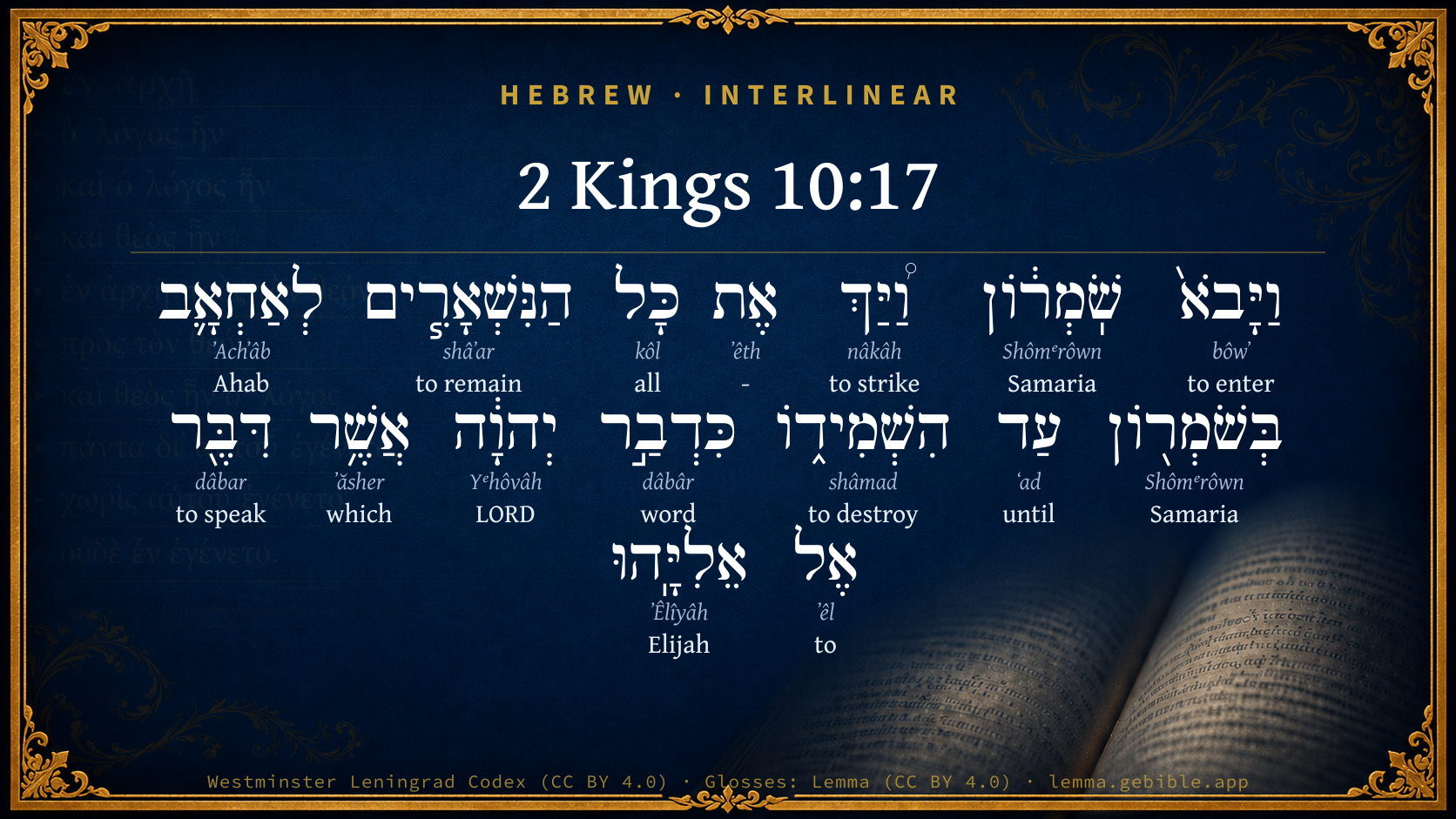
Hebrew (Westminster Leningrad Codex) 2 Kings 10:17 appears in the Hebrew Old Testament. The text above is from the Westminster Leningrad Codex. Each word links to its Strong’s number, a concise gloss, and parsing drawn from the Open Scriptures Hebrew Bible morphology. Click any word for its full Brown-Driver-Briggs (BDB) entry.
Download image
Cite this verse

2 Kings 10:17 (World English Bible). Public Domain. Lemma interlinear Bible study tool, https://lemma.gebible.app/v/2-kings/10/17.

Show BibTeX & RIS
BibTeX
RIS
English Translation
When he came to Samaria, he struck all who remained to Ahab in Samaria, until he had destroyed him, according to the word of Yahweh, which he spoke to Elijah.
World English Bible · Public Domain
Download a study sheet

One document with this verse’s original text, its word-by-word gloss line, the meaning frame, cross-references with their text, attributed commentary, and full source and license credits — printable, and it pastes into notes with its structure intact.

This verse Autodidact and up

Study sheet (.html) Plain text (.txt)

A passage Seminary Student

Up to 50 verses in one chapter. A passage sheet keeps up to 6 commentary sources and 12 cross-references per verse, in the order this page ranks them, and says so on the sheet whenever that leaves anything out. Ask for a single verse and you get the Autodidact verse sheet above.

Everything on this page stays free to read, with no account — the sheet is a download of what is already on screen, not access to it.

Want to remove ads? Support Godless Engineer
Compare translations 3

The same verse in 3 English versions, stacked beneath the original-language interlinear above. Click any original word for its lexicon entry.

Each is an independent rendering of the whole verse — the interlinear is not word-aligned to these translations.

Highlighted words mark where these versions differ — a whole-verse word diff, not a word-by-word alignment.

  • World English Bible Public Domain
    When he came to Samaria, he struck all who remained to Ahab in Samaria, until he had destroyed him, according to the word of Yahweh, which he spoke to Elijah.
  • King James Version Public Domain
    And when he came to Samaria, he slew all that remained unto Ahab in Samaria, till he had destroyed him, according to the saying of the LORD, which he spake to Elijah.
  • unfoldingWord Literal Text CC BY-SA 4.0
    And he entered Samaria, and he struck everyone remaining to Ahab in Samaria until he destroyed him, according to the word of Yahweh that he spoke to Elijah.

unfoldingWord Literal Text — © unfoldingWord, licensed CC BY-SA 4.0. Word-aligned USFM3 via Door43 (git.door43.org/unfoldingWord/en_ult).

Versions to compare (up to 4)

3 of 4 selected

Show all 18 translations

Every available English version of this verse, each an independent rendering of the whole verse.

  • World English Bible Public Domain
    When he came to Samaria, he struck all who remained to Ahab in Samaria, until he had destroyed him, according to the word of Yahweh, which he spoke to Elijah.
  • Berean Standard Bible Public Domain
    When Jehu came to Samaria, he struck down everyone belonging to Ahab who remained there, until he had destroyed them, according to the word that the LORD had spoken to Elijah.
  • Majority Standard Bible Public Domain
    When Jehu came to Samaria, he struck down everyone belonging to Ahab who remained there, until he had destroyed them, according to the word that the LORD had spoken to Elijah.
  • King James Version Public Domain
    And when he came to Samaria, he slew all that remained unto Ahab in Samaria, till he had destroyed him, according to the saying of the LORD, which he spake to Elijah.
  • American Standard Version (1901) Public Domain
    And when he came to Samaria, he smote all that remained unto Ahab in Samaria, till he had destroyed him, according to the word of Jehovah, which he spake to Elijah.
  • Revised Version (1885) Public Domain
    And when he came to Samaria, he smote all that remained unto Ahab in Samaria, till he had destroyed him, according to the word of the LORD, which he spake to Elijah.
  • Geneva Bible (1599) Public Domain
    And when he came to Samaria, he slew all that remained vnto Ahab in Samaria, till he had destroyed him, according to the worde of the Lord, which he spake to Eliiah.
  • Douay-Rheims (1899) Public Domain
    And brought him into Samaria. And he slew all that were left of Achab in Samaria, to a man, according to the word of the Lord, which he spoke by Elias.
  • Young's Literal Translation Public Domain
    And he cometh in to Samaria, and smiteth all those left to Ahab in Samaria, till his destroying him, according to the word of Jehovah that He spake unto Elisha.
  • Literal Standard Version CC BY-SA 4.0
    And he comes to Samaria, and strikes all those left to Ahab in Samaria, until his destroying him, according to the word of YHWH that He spoke to Elisha.
  • Unlocked Literal Bible CC BY-SA 4.0
    When he came to Samaria, Jehu killed all who remained from Ahab's descendants in Samaria, until he had destroyed Ahab's royal line, just as was told them before by the word of Yahweh, which he had spoken to Elijah.
  • unfoldingWord Literal Text CC BY-SA 4.0
    And he entered Samaria, and he struck everyone remaining to Ahab in Samaria until he destroyed him, according to the word of Yahweh that he spoke to Elijah.
  • Darby Bible Public Domain
    And he came to Samaria, and smote all that remained to Ahab in Samaria, until he had destroyed him, according to the word of Jehovah which he spoke to Elijah.
  • World Messianic Bible Public Domain
    When he came to Samaria, he struck all who remained to Ahab in Samaria, until he had destroyed them, according to the LORD’s word which he spoke to Elijah.
  • Webster's Bible Public Domain
    And when he came to Samaria, he slew all that remained to Ahab in Samaria, till he had destroyed him, according to the saying of the LORD, which he spoke to Elijah.
  • Free Bible Version CC BY-SA 4.0
    When Jehu arrived in Samaria, he went around killing everyone who was left of Ahab's family until he had killed all of them, just as the Lord had said through Elijah.
  • Bible in Basic English Public Domain
    And when he came to Samaria, he put to death all those of Ahab's family who were still in Samaria, till there were no more of them, as the Lord had said to Elijah.
  • JPS Tanakh (1917) Public Domain
    And when he came to Samaria, he smote all that remained unto Ahab in Samaria, till he had destroyed him, according to the word of the LORD, which He spoke to Elijah.

Literal Standard Version (2020), Covenant Press — licensed CC BY-SA 4.0. Text via the HelloAO Bible API (eBible.org). Unlocked Literal Bible (unfoldingWord) — licensed CC BY-SA 4.0. Text via the HelloAO Bible API (eBible.org). unfoldingWord Literal Text — © unfoldingWord, licensed CC BY-SA 4.0. Word-aligned USFM3 via Door43 (git.door43.org/unfoldingWord/en_ult). Free Bible Version, Dr. Jonathan Gallagher — licensed CC BY-SA 4.0. Text via the HelloAO Bible API (eBible.org).

Word by word

More ways to search: Search by grammar → Find every occurrence → Compare this word →

Practice this passage: Drill this verse → Learn its vocabulary →

אֵלִיָּֽהוּ
ʼÊlîyâh
H452
“Elijah”
Noun, Proper
Part of Speech
Noun
Type
Proper
Full BDB Definition

Origin: from H410 and H3050

TWOT: None

Elijah or Eliah = "my God is Jehovah" or " Yah(u) is God" - the great prophet of the reign of Ahab - Benjamite son of Jeroham - a son of Elam with foreign wife during exile - a son of Harim, and priest, with foreign wife during exile
  1. וַיָּבֹא֙ bôwʼ H935 “and · to enter” Conjunction + Verb, Qal, Sequential Imperfect, 3rd Person, Masculine, Singular
  2. שֹֽׁמְר֔וֹן Shômᵉrôwn H8111 “Samaria” Noun, Proper
  3. וַ֠יַּךְ nâkâh H5221 “and · to strike” Conjunction + Verb, Hiphil, Sequential Imperfect, 3rd Person, Masculine, Singular
  4. אֶת ʼêth H853 “-” Particle, Direct Object
  5. כָּל kôl H3605 “all of” Noun, Common, Masculine, Singular, Construct
  6. הַנִּשְׁאָרִ֧ים shâʼar H7604 “the · remaining” Particle, Definite Article + Verb, Niphal, Participle Active, Masculine, Plural, Absolute
  7. לְאַחְאָ֛ב ʼAchʼâb H256 “to/for · Ahab” Preposition + Noun, Proper
  8. בְּשֹׁמְר֖וֹן Shômᵉrôwn H8111 “in/at · Samaria” Preposition + Noun, Proper
  9. עַד ʻad H5704 “until” Preposition
  10. הִשְׁמִיד֑וֹ shâmad H8045 “to destroy · him” Verb, Hiphil, Perfect, 3rd Person, Masculine, Singular + Suffix, Personal, 3rd Person, Masculine, Singular
  11. כִּדְבַ֣ר dâbâr H1697 “like/as · word of” Preposition + Noun, Common, Masculine, Singular, Construct
  12. יְהוָ֔ה Yᵉhôvâh H3068 “LORD” Noun, Proper
  13. אֲשֶׁ֥ר ʼăsher H834 “which” Particle, Relative
  14. דִּבֶּ֖ר dâbar H1696 “to speak” Verb, Piel, Perfect, 3rd Person, Masculine, Singular
  15. אֶל ʼêl H413 “to” Preposition

About this verse

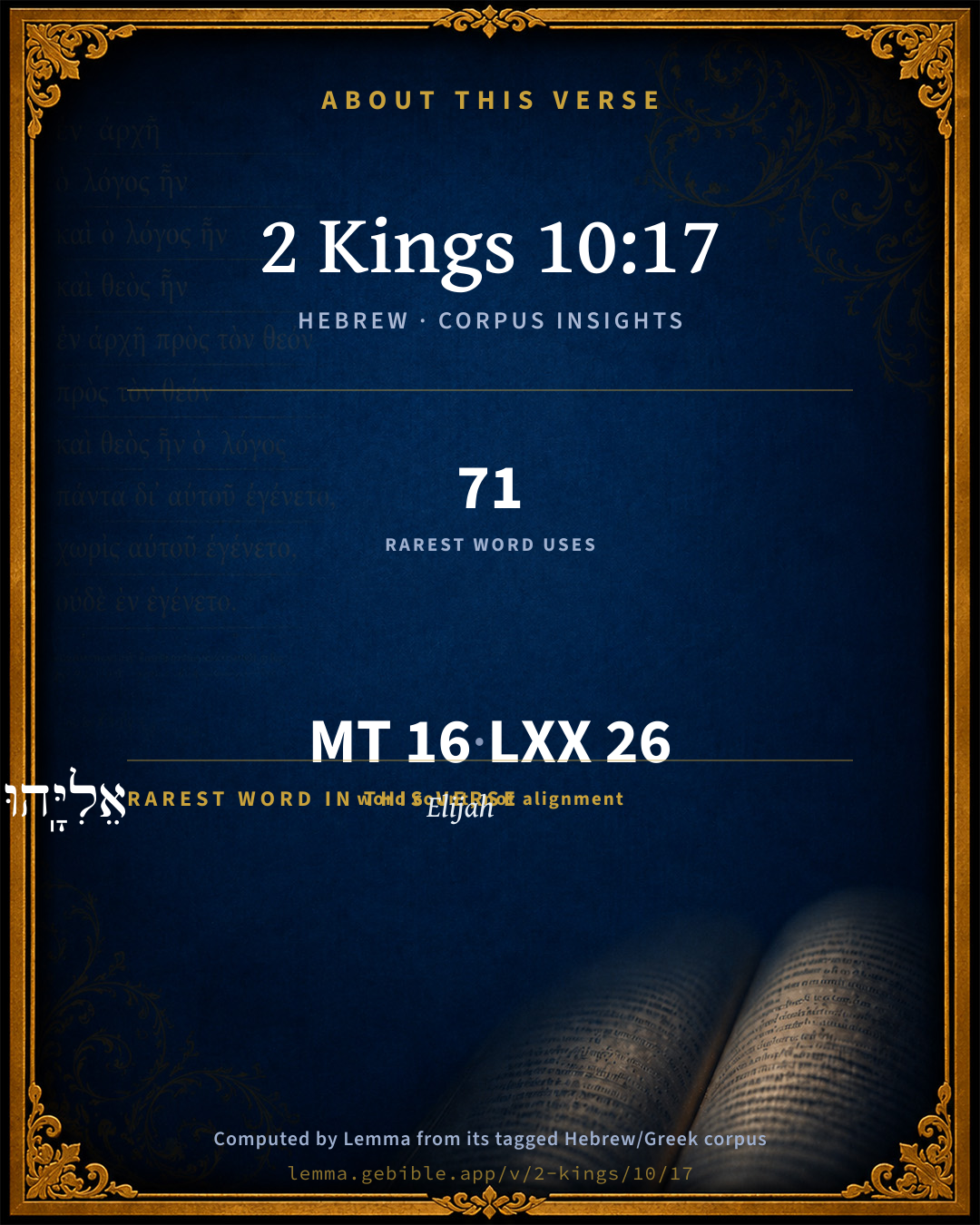
These counts appear in no published source. They are computed here, from the morphology-tagged text and Lemma’s own curated glosses. What Lemma adds →

16
words
15
distinct lemmas
Historical
section

Grammatical profile

  • 5 verbs
  • 7 nouns
  • 2 prepositions
  • 2 particles

Verb forms

  • וַיָּבֹא֙ Qal · Sequential Imperfect
  • וַ֠יַּךְ Hiphil · Sequential Imperfect
  • הַנִּשְׁאָרִ֧ים Niphal · Participle Active
  • הִשְׁמִיד֑וֹ Hiphil · Perfect
  • דִּבֶּ֖ר Piel · Perfect

Repetition

A word recurs within this verse — often emphatic in Hebrew:

  • שֹֽׁמְר֔וֹן Samaria H8111 ×2

Hebrew & Septuagint length

In English translation the verse runs 30 words from the Hebrew and 33 from the Septuagint (LXX English) — closely comparable.

A rough comparison of the two English renderings, which tokenize alike — not a word-level alignment.

Word counts can differ between the Hebrew and the Greek without any difference in meaning — e.g. the Hebrew direct-object marker אֵת has no separate Greek word, and Greek often adds the article ὁ.

In the original languages it is 16 Hebrew tokens and 26 Greek tokens — but the two are counted differently (Hebrew bundles its prefixes and suffixes into one token; the Greek is in lemma form), so that isn’t a like-for-like length.

Cross-references

7

Topical passages linked to 2 Kings 10:17 in the Treasury of Scripture Knowledge — connected by theme and wording, ordered by reader-vote popularity; previews shown in the World English Bible.

  • 2 Kings 9:8 For the whole house of Ahab shall perish; and I will cut off from Ahab every man-child, and him who is shut up and him who is left at large in Israel.
  • 2 Chronicles 22:8 It happened, when Jehu was executing judgment on the house of Ahab, that he found the princes of Judah, and the sons of the brothers of Ahaziah, ministering to Ahaziah, and killed them.
  • 1 Kings 21:21 Behold, I will bring evil on you, and will utterly sweep you away and will cut off from Ahab every man-child, and him who is shut up and him who is left at large in Israel:
  • 2 Kings 9:25–26 Then said [Jehu] to Bidkar his captain, Take up, and cast him in the portion of the field of Naboth the Jezreelite; for remember how that, when I and you rode together after Ahab his father, Yahweh laid this burden on him:
  • 2 Kings 10:10–11 Know now that there shall fall to the earth nothing of the word of Yahweh, which Yahweh spoke concerning the house of Ahab: for Yahweh has done that which he spoke by his servant Elijah.
  • Psalms 109:8–9 Let his days be few. Let another take his office.
  • Malachi 4:1 "For, behold, the day comes, it burns as a furnace; and all the proud, and all who work wickedness, will be stubble; and the day that comes will burn them up," says Yahweh of Hosts, "that it shall leave them neither root nor branch.

Cross-references courtesy of OpenBible.info (CC BY 4.0).

Hebrew and Greek witnesses Masoretic Hebrew ↔ Greek Septuagint

The same verse in the two great witnesses to the Old Testament, shown verse-for-verse.

These are two independent witnesses, not word-aligned to each other, and the Septuagint is shown in lemma (dictionary) form.

Hebrew 2 Kings 10:17 Masoretic · Westminster Leningrad Codex

וַיָּבֹא֙ שֹֽׁמְר֔וֹן וַ֠יַּךְ אֶת כָּל הַנִּשְׁאָרִ֧ים לְאַחְאָ֛ב בְּשֹׁמְר֖וֹן עַד הִשְׁמִיד֑וֹ כִּדְבַ֣ר יְהוָ֔ה אֲשֶׁ֥ר דִּבֶּ֖ר אֶל אֵלִיָּֽהוּ

When he came to Samaria, he struck all who remained to Ahab in Samaria, until he had destroyed him, according to the word of Yahweh, which he spoke to Elijah.

World English Bible · Public Domain

Greek LXX 2 Kings 10:17 Septuagint · lemma form

καί εἰςἔρχομαι εἰς σαμαρεία καί πατάσσω πᾶς ὁ καταλείπω ὁ αχααβ ἐν σαμαρεία ἕως ὁ ἀπο ἀναἵζω αὐτός κατά ὁ ῥῆμα κύριος ὅς λαλέω πρός ηλιας

And he entered into Samaria, and struck all that were left of Achaab in Samaria, until he had utterly destroyed him, according to the word of the Lord, which he spoke to Eliu.

LXX2012 (modern English Septuagint) · Public Domain

Hebrew: Westminster Leningrad Codex (CC BY 4.0). Greek: Septuagint (public domain); English from LXX2012 (modern English Septuagint) (Public Domain). How the Septuagint differs from the Hebrew →

Targum (Aramaic paraphrase)

1

The Targum is the ancient Jewish Aramaic paraphrase of the Hebrew Scriptures — an interpretive translation, not the Hebrew text itself. Onkelos (literal) and Pseudo-Jonathan (expansive) render the Torah, and Jonathan the Prophets. Coverage is partial: where no permissively-licensed English translation exists for a verse, only the Aramaic is shown. This is verse-level text, not a word-by-word alignment to the Hebrew.

  1. Targum Jonathan Prophets (Joshua–Malachi)
    וַאֲתָא לְשֹׁמְרוֹן וּמְחָא יַת כָּל דְאִשְׁתָּאֲרוּ לְאַחְאָב בְּשֹׁמְרוֹן עַד דִי שֵׁיצֵיהּ כְּפִתְגָמָא דַייָ דְמַלֵיל עִם אֵלִיָהוּ:

    (no public-domain English translation for this verse)

    Targum Jonathan — Aramaic: “Mikraot Gedolot” (public domain). English: “Sefaria Community Translation” (CC0 1.0 (public-domain dedication)); “London "Chaldee Paraphrase," 1871” (public domain). Text via Sefaria.

Commentary

Notes on 2 Kings 10:17 from classic Christian and Jewish commentators (each source and its license shown beneath its notes). The classic Christian expositions comment on the surrounding passage and are grouped to its opening verse, so a note may address several verses; the Jewish commentaries on the Tanakh (Rashi and others) are per-verse, so they appear only where the commentator wrote on this verse.

Lemma curates 59 commentaries, every one of them public domain or Creative Commons licensed, each selected and text-cleaned for this edition rather than reprinted as found. About our sources →

Trapp's Complete Commentary

John Trapp

2Ki 10:17 And when he came to Samaria, he slew all that remained unto Ahab in Samaria, till he had destroyed him, according to the saying of the LORD, which he spake to Elijah.

Ver. 17. He slew all that remained.] See on 2Ki 10:11.

John Trapp, A Commentary or Exposition upon All the Books of the Old and New Testament (1647–1656) — public domain. Text from a community e-Sword module.

Joseph Benson's Commentary

2Ki 10:17. He slew all that remained unto Ahab in Samaria — Either all his household, or, rather, all his kindred and relations, though more remote from him. This he did, no doubt, under pretence of zeal for God, and to fulfil the prophecy of Elijah; but there is too much reason to apprehend, from several of his actions, and, indeed, his general conduct, that in this, as well as in several of the other slaughters which he made, his chief motive was to secure the kingdom to himself and his posterity.

Joseph Benson's Commentary on the Old and New Testaments (1811–1818) — public domain. Text from a community e-Sword module.

Ellicott's Commentary for English Readers

(17) And when he came . . . he slew.—Literally. And he entered Samaria, and smote.

Ahab.—Again put for the house or family so called. Some MSS. and the Syriac express it so, reading “the house of Ahab.” (Comp. 1Ki_15:29.)

A Bible Commentary for English Readers, edited by Charles John Ellicott (1878–1897) — public domain. Text from a community e-Sword module.

The Cambridge Bible for Schools and Colleges

gen. ed. J. J. S. Perowne

17. all that remained unto Ahab in Samaria] i.e. Others more remotely connected with the royal family than the direct descendants. The great men in Samaria having slain the sons of Ahab, must be content to side with their new ruler in clearing off all that remained of his connexions, for otherwise vengeance might have awaked against themselves.

according to the saying [R.V. word] of the Lord] This is the more usual expression, but R.V. has left ‘saying of the Lord’ in 1Ki_15:29.

The Cambridge Bible for Schools and Colleges (gen. ed. J. J. S. Perowne; Cambridge University Press, 1878–1918) — public domain. Text from a community e-Sword module.

John Gill's Exposition

And when he came to Samaria, he slew all that remained unto Ahab in Samaria,.... All that were in any connection with him, as related to his family, or as ministers of his in civil or religious things:

till he had destroyed him; his whole house, as he was ordered:

according to the word of the Lord, which he spake to Elijah; which is observed, to show the exact fulfilment of prophecy, see Kg1 21:21.

John Gill's Exposition of the Whole Bible (1746–1763) — public domain (CC PDM 1.0). Text via the HelloAO Bible API.

Albert Barnes' Notes on the Bible

Compare 2Ki 10:11. Thus was finally completed the political revolution which transferred the throne from the house of Omri to that of Nimshi, the fifth of the royal families of Israel.

According to the saying of the Lord - This emphatic reiteration (compare 2Ki 10:10) marks, first, how in the mind of the writer all this history is viewed as deriving its special interest from its being so full and complete an accomplishment of Elijah’s prophecies; and, secondly, how at the time Jehu carefully put forward the plea that what he did had this object. It does not indicate that a single-minded wish to execute God’s will was Jehu’s predominate motive. Probably, even where he most strictly fulfilled the letter of prophecies, he was working for himself, not for God; and hence, vengeance was denounced upon his house even for the very “blood of Jezreel” Hos 1:4.

Albert Barnes' Notes on the Bible (1834–1885) — public domain. Text from a community e-Sword/MySword module.

Matthew Poole's English Annotations

All that remained unto Ahab; either all his household; or rather, all his kindred and relations, though more remote from him.

Matthew Poole's English Annotations on the Holy Bible (1683–1685) — public domain. Text from a community e-Sword/MySword module.

Whedon's Commentary on the Bible

Daniel D. Whedon

17. All that remained unto Ahab in Samaria — That is, all relatives or adherents and partisans of Ahab’s family that were not included in the seventy persons (2Ki_10:7) whom the nobles had slain.

Daniel D. Whedon (gen. ed.), Commentary on the Old and New Testaments (1874–1909) — public domain. Text from a community e-Sword module.

The Pulpit Commentary

And when he came to Samaria, he slew all that remained unto Ahab in Samria, till he had destroyed him. Seventy male descendants of Ahab had been already destroyed in Samaria (vers. 1-7). It seems unlikely that the city can have contained any other members of his house excepting females. Did Jehu now destroy the daughters of Ahab resident in Samaria, with their families? The masculine form used cNh does not disprove this. According to the saying of the Lord, which he spake to Elijah. (comp. ver. 10, and see also the comment 2Ki_9:7)

The Pulpit Commentary (1880–1919), ed. H.D.M. Spence-Jones & Joseph S. Exell — public domain. Text from a community e-Sword module.

Lesson kit

Teaching starters — assembled from the data on this page, not authored interpretation. Every prompt links to the verse data it draws on. Edit before teaching.

2 Kings, in the Historical, opens this verse with 16 words (15 distinct Hebrew lemmas). Its most distinctive word is ʼÊlîyâh (“Elijah”). A historical commentator’s framing appears above. Read the whole chapter for the surrounding context.

Discussion questions

  1. The word ʼÊlîyâh carries the sense “Elijah.” How does it shape the verse?
  2. How does 2 Kings 9:8, which shares this passage’s theme, read alongside this verse?
  3. What does the repetition of “Samaria” (2× in this one verse) do in this verse?
  4. The translations on this page render this verse differently — a whole-verse word diff, not a word-by-word alignment. What might account for the different wordings?
  5. «וַיָּבֹא֙» is a Qal Sequential Imperfect verb. How does that grammatical form shape the action described?
  6. Compare how Trapp's Complete Commentary and Joseph Benson's Commentary read this verse. Where do they agree or differ?

Things to notice

Reading settings

Reading text

Shown beneath each verse's original-language words.

Old Testament
Old Testament edition

Read the OT as the Masoretic Hebrew (MT) or the Greek Septuagint (LXX).

English shown for the Greek Septuagint (in the Hebrew ↔ Greek comparison).

Comparing translations? Open the Compare panel on any verse page to stack up to four side by side.