Joshua 11:22

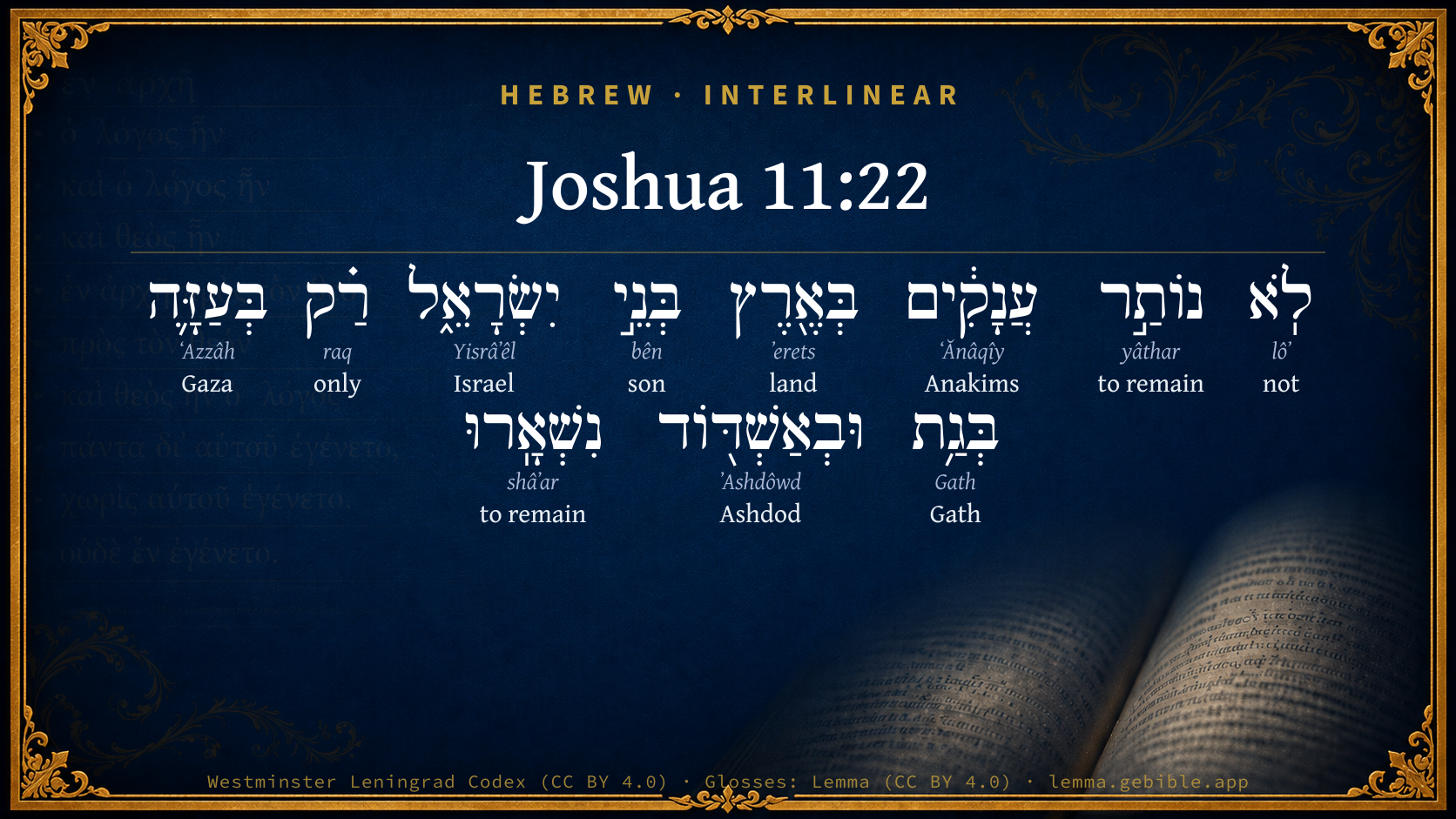
Hebrew (Westminster Leningrad Codex) Joshua 11:22 appears in the Hebrew Old Testament. The text above is from the Westminster Leningrad Codex. Each word links to its Strong’s number, a concise gloss, and parsing drawn from the Open Scriptures Hebrew Bible morphology. Click any word for its full Brown-Driver-Briggs (BDB) entry.
Download image
Cite this verse

Joshua 11:22 (World English Bible). Public Domain. Lemma interlinear Bible study tool, https://lemma.gebible.app/v/joshua/11/22.

Show BibTeX & RIS
BibTeX
RIS
English Translation
There was none of the Anakim left in the land of the children of Israel: only in Gaza, in Gath, and in Ashdod, did some remain.
World English Bible · Public Domain
Highlights
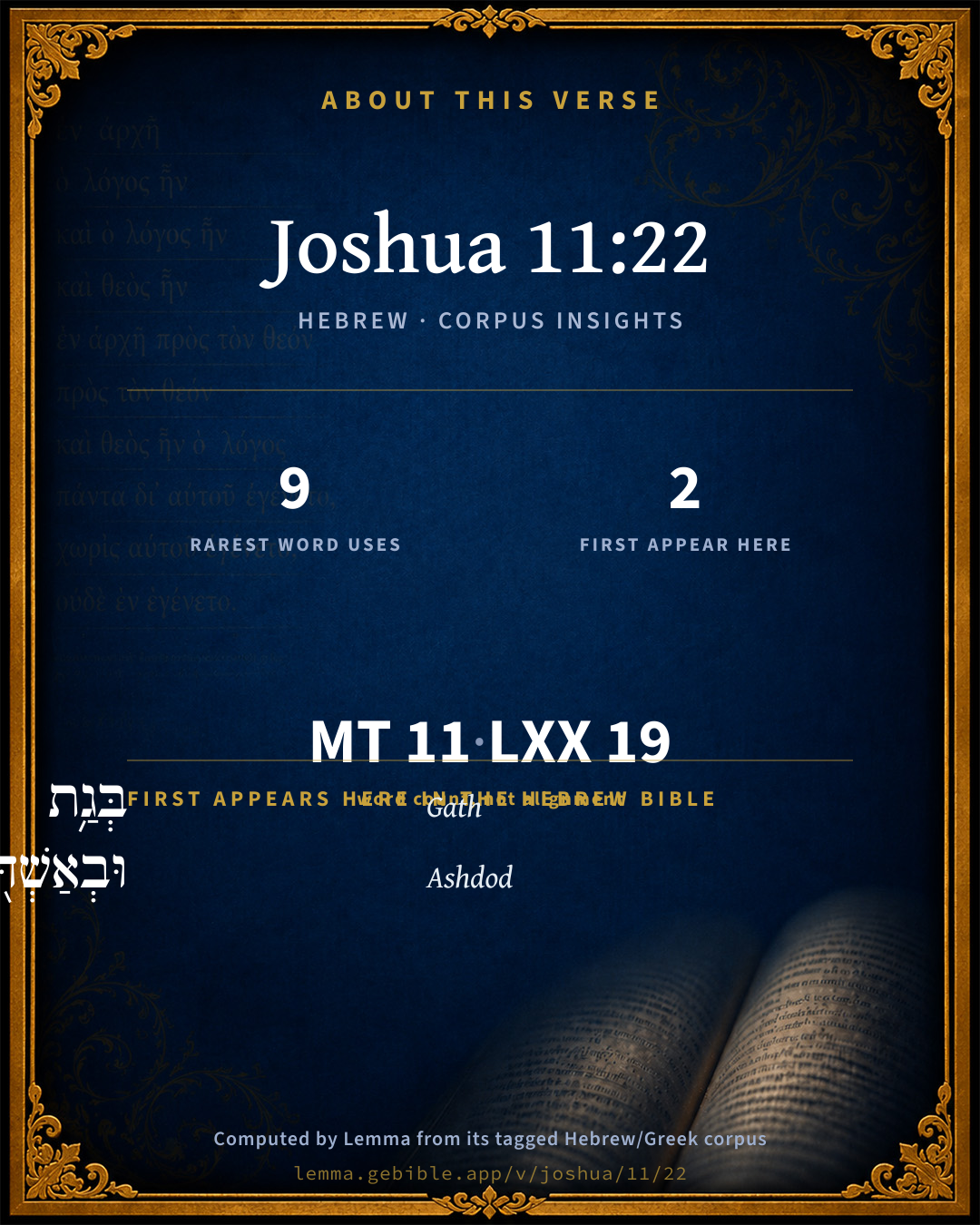
  • 2 first appearances in the Hebrew Bible
Full analysis ↓
Download a study sheet

One document with this verse’s original text, its word-by-word gloss line, the meaning frame, cross-references with their text, attributed commentary, and full source and license credits — printable, and it pastes into notes with its structure intact.

This verse Autodidact and up

Study sheet (.html) Plain text (.txt)

A passage Seminary Student

Up to 50 verses in one chapter. A passage sheet keeps up to 6 commentary sources and 12 cross-references per verse, in the order this page ranks them, and says so on the sheet whenever that leaves anything out. Ask for a single verse and you get the Autodidact verse sheet above.

Everything on this page stays free to read, with no account — the sheet is a download of what is already on screen, not access to it.

Want to remove ads? Support Godless Engineer
Compare translations 3

The same verse in 3 English versions, stacked beneath the original-language interlinear above. Click any original word for its lexicon entry.

Each is an independent rendering of the whole verse — the interlinear is not word-aligned to these translations.

Highlighted words mark where these versions differ — a whole-verse word diff, not a word-by-word alignment.

  • World English Bible Public Domain
    There was none of the Anakim left in the land of the children of Israel: only in Gaza, in Gath, and in Ashdod, did some remain.
  • King James Version Public Domain
    There was none of the Anakims left in the land of the children of Israel: only in Gaza, in Gath, and in Ashdod, there remained.
  • unfoldingWord Literal Text CC BY-SA 4.0
    No Anakites remained in the land of the sons of Israel. They remained only in Gaza, in Gath, and in Ashdod.

unfoldingWord Literal Text — © unfoldingWord, licensed CC BY-SA 4.0. Word-aligned USFM3 via Door43 (git.door43.org/unfoldingWord/en_ult).

Versions to compare (up to 4)

3 of 4 selected

Show all 18 translations

Every available English version of this verse, each an independent rendering of the whole verse.

  • World English Bible Public Domain
    There was none of the Anakim left in the land of the children of Israel: only in Gaza, in Gath, and in Ashdod, did some remain.
  • Berean Standard Bible Public Domain
    No Anakim were left in the land of the Israelites; only in Gaza, Gath, and Ashdod did any survive.
  • Majority Standard Bible Public Domain
    No Anakim were left in the land of the Israelites; only in Gaza, Gath, and Ashdod did any survive.
  • King James Version Public Domain
    There was none of the Anakims left in the land of the children of Israel: only in Gaza, in Gath, and in Ashdod, there remained.
  • American Standard Version (1901) Public Domain
    There was none of the Anakim left in the land of the children of Israel: only in Gaza, in Gath, and in Ashdod, did some remain.
  • Revised Version (1885) Public Domain
    There was none of the Anakim left in the land of the children of Israel: only in Gaza, in Gath, and in Ashdod, did some remain.
  • Geneva Bible (1599) Public Domain
    There was no Anakim left in the lande of the children of Israel: onely in Azzah, in Gath, and in Ashdod were they left.
  • Douay-Rheims (1899) Public Domain
    He left not any of the stock of the Enacims, in the land of the children of Israel: except the cities of Gaza, and Geth, and Azotus, in which alone they were left.
  • Young's Literal Translation Public Domain
    There hath not been left Anakim in the land of the sons of Israel; only in Gaza, in Gath, and in Ashdod, were they left.
  • Literal Standard Version CC BY-SA 4.0
    There has not been Anakim left in the land of the sons of Israel; only in Gaza, in Gath, and in Ashdod, were they left.
  • Unlocked Literal Bible CC BY-SA 4.0
    None of the Anakim were left in the land of Israel except at Gaza, Gath, and Ashdod.
  • unfoldingWord Literal Text CC BY-SA 4.0
    No Anakites remained in the land of the sons of Israel. They remained only in Gaza, in Gath, and in Ashdod.
  • Darby Bible Public Domain
    There were none of the Anakim left in the land of the children of Israel; only at Gazah, at Gath, and at Ashdod there remained.
  • World Messianic Bible Public Domain
    There were none of the Anakim left in the land of the children of Israel. Only in Gaza, in Gath, and in Ashdod, did some remain.
  • Webster's Bible Public Domain
    There was none of the Anakims left in the land of the children of Israel: only in Gaza, in Gath, and in Ashdod, there remained.
  • Free Bible Version CC BY-SA 4.0
    and there were no descendants of Anak left in the land of Israel, only some in Gaza, Gath, and Ashdod.
  • Bible in Basic English Public Domain
    Not one of the Anakim was to be seen in the land of the children of Israel: only in Gaza, in Gath, and in Ashdod, some were still living.
  • JPS Tanakh (1917) Public Domain
    There was none of the Anakim left in the land of the children of Israel; only in Gaza, in Gath, and in Ashdod, did some remain.

Literal Standard Version (2020), Covenant Press — licensed CC BY-SA 4.0. Text via the HelloAO Bible API (eBible.org). Unlocked Literal Bible (unfoldingWord) — licensed CC BY-SA 4.0. Text via the HelloAO Bible API (eBible.org). unfoldingWord Literal Text — © unfoldingWord, licensed CC BY-SA 4.0. Word-aligned USFM3 via Door43 (git.door43.org/unfoldingWord/en_ult). Free Bible Version, Dr. Jonathan Gallagher — licensed CC BY-SA 4.0. Text via the HelloAO Bible API (eBible.org).

Word by word

More ways to search: Search by grammar → Find every occurrence → Compare this word →

Practice this passage: Drill this verse → Learn its vocabulary →

About this verse

These counts appear in no published source. They are computed here, from the morphology-tagged text and Lemma’s own curated glosses. What Lemma adds →

11
words
11
distinct lemmas
Historical
section

Notable vocabulary

The rarest word here is עֲנָקִ֔ים Anakims H6062 — appearing just 9 times in the whole Hebrew Bible.

First appearance in Scripture

These words make their first canonical appearance in the Hebrew Bible here:

  • בְּגַ֥ת Gath H1661
  • וּבְאַשְׁדּ֖וֹד Ashdod H795

Shared distinctive vocabulary

עֲנָקִ֔ים Anakims H6062 occurs in 9 verses of the Hebrew Bible. Also found in:

Grammatical profile

  • 2 verbs
  • 7 nouns
  • 2 particles

Verb forms

  • נוֹתַ֣ר Niphal · Perfect
  • נִשְׁאָֽרוּ Niphal · Perfect

Hebrew & Septuagint length

In English translation the verse runs 26 words from the Hebrew and 28 from the Septuagint (LXX English) — closely comparable.

A rough comparison of the two English renderings, which tokenize alike — not a word-level alignment.

Word counts can differ between the Hebrew and the Greek without any difference in meaning — e.g. the Hebrew direct-object marker אֵת has no separate Greek word, and Greek often adds the article ὁ.

In the original languages it is 11 Hebrew tokens and 19 Greek tokens — but the two are counted differently (Hebrew bundles its prefixes and suffixes into one token; the Greek is in lemma form), so that isn’t a like-for-like length.

Cross-references

12

Topical passages linked to Joshua 11:22 in the Treasury of Scripture Knowledge — connected by theme and wording, ordered by reader-vote popularity; previews shown in the World English Bible.

  • 1 Samuel 17:4 There went out a champion out of the camp of the Philistines, named Goliath, of Gath, whose height was six cubits and a span.
  • Joshua 15:46 from Ekron even to the sea, all that were by the side of Ashdod, with their villages.
  • 1 Chronicles 18:1 After this it happened, that David struck the Philistines, and subdued them, and took Gath and its towns out of the hand of the Philistines.
  • Judges 3:3 [namely], the five lords of the Philistines, and all the Canaanites, and the Sidonians, and the Hivites who lived on Mount Lebanon, from Mount Baal Hermon to the entrance of Hamath.
  • 1 Samuel 5:1 Now the Philistines had taken the ark of God, and they brought it from Ebenezer to Ashdod.
  • 2 Samuel 21:16–22 and Ishbibenob, who was of the sons of the giant, the weight of whose spear was three hundred [shekels] of brass in weight, he being girded with a new [sword], thought to have slain David.
  • 1 Kings 2:39 It happened at the end of three years, that two of the servants of Shimei ran away to Achish, son of Maacah, king of Gath. They told Shimei, saying, Behold, your servants are in Gath.
  • 1 Chronicles 8:13 and Beriah, and Shema, who were heads of fathers' [houses] of the inhabitants of Aijalon, who put to flight the inhabitants of Gath;
  • 1 Chronicles 29:4–8 even three thousand talents of gold, of the gold of Ophir, and seven thousand talents of refined silver, with which to overlay the walls of the houses;
  • 2 Chronicles 26:6 He went forth and warred against the Philistines, and broke down the wall of Gath, and the wall of Jabneh, and the wall of Ashdod; and he built cities in [the country of] Ashdod, and among the Philistines.
  • Nehemiah 13:23–24 In those days also saw I the Jews who had married women of Ashdod, of Ammon, [and] of Moab:
  • Isaiah 20:1 In the year that Tartan came to Ashdod, when Sargon the king of Assyria sent him, and he fought against Ashdod and took it;

Cross-references courtesy of OpenBible.info (CC BY 4.0).

Hebrew and Greek witnesses Masoretic Hebrew ↔ Greek Septuagint

The same verse in the two great witnesses to the Old Testament, shown verse-for-verse.

These are two independent witnesses, not word-aligned to each other, and the Septuagint is shown in lemma (dictionary) form.

Hebrew Joshua 11:22 Masoretic · Westminster Leningrad Codex

לֹֽא נוֹתַ֣ר עֲנָקִ֔ים בְּאֶ֖רֶץ בְּנֵ֣י יִשְׂרָאֵ֑ל רַ֗ק בְּעַזָּ֛ה בְּגַ֥ת וּבְאַשְׁדּ֖וֹד נִשְׁאָֽרוּ

There was none of the Anakim left in the land of the children of Israel: only in Gaza, in Gath, and in Ashdod, did some remain.

World English Bible · Public Domain

Greek LXX Joshua 11:22 Septuagint · lemma form

οὐ καταλείπω ὁ ενακιμ ἀπό ὁ υἱός ἰσραήλ ἀλλά πλήν ἐν γάζα καί ἐν γεθ καί ἐν ασεδωθ καταλείπω

There was not any one left of the Enakim by the children of Israel, only there was left of them in Gaza, and in Gath, and in Aseldo.

LXX2012 (modern English Septuagint) · Public Domain

Hebrew: Westminster Leningrad Codex (CC BY 4.0). Greek: Septuagint (public domain); English from LXX2012 (modern English Septuagint) (Public Domain). How the Septuagint differs from the Hebrew →

Targum (Aramaic paraphrase)

1

The Targum is the ancient Jewish Aramaic paraphrase of the Hebrew Scriptures — an interpretive translation, not the Hebrew text itself. Onkelos (literal) and Pseudo-Jonathan (expansive) render the Torah, and Jonathan the Prophets. Coverage is partial: where no permissively-licensed English translation exists for a verse, only the Aramaic is shown. This is verse-level text, not a word-by-word alignment to the Hebrew.

  1. Targum Jonathan Prophets (Joshua–Malachi)
    לָא אִשְׁתָּאַר גִבָּרַיָא בַּאֲרַע בְּנֵי יִשְׂרָאֵל לְחוֹד בְּעַזָה בְּגַת וּבְאַשְׁדוֹד אִשְׁתָּאֲרוּ:

    (no public-domain English translation for this verse)

    Targum Jonathan — Aramaic: “Mikraot Gedolot” (public domain). English: “Sefaria Community Translation” (CC0 1.0 (public-domain dedication)); “London "Chaldee Paraphrase," 1871” (public domain). Text via Sefaria.

Commentary

Notes on Joshua 11:22 from classic Christian and Jewish commentators (each source and its license shown beneath its notes). The classic Christian expositions comment on the surrounding passage and are grouped to its opening verse, so a note may address several verses; the Jewish commentaries on the Tanakh (Rashi and others) are per-verse, so they appear only where the commentator wrote on this verse.

Lemma curates 59 commentaries, every one of them public domain or Creative Commons licensed, each selected and text-cleaned for this edition rather than reprinted as found. About our sources →

Trapp's Complete Commentary

John Trapp

Jos 11:22 There was none of the Anakims left in the land of the children of Israel: only in Gaza, in Gath, and in Ashdod, there remained.

Ver. 22. Only in Gaza, &c.] Three Philistine cities. See 2Sa 21:15-22.

John Trapp, A Commentary or Exposition upon All the Books of the Old and New Testament (1647–1656) — public domain. Text from a community e-Sword module.

Joseph Benson's Commentary

Jos 11:22. Only in Gaza, in Gath, and in Ashdod — These were three cities of the Philistines, into which either some of the Anakims escaped, and there took shelter, or they had been there from ancient time, and the Israelites could not yet expel them. For they did not possess themselves of the country of the Philistines till the time of David, when we find some of these giants still there.

Joseph Benson's Commentary on the Old and New Testaments (1811–1818) — public domain. Text from a community e-Sword module.

Geneva Bible (1599)

Geneva Bible translators

Out of the which came Goliath, 1 Sam. 17:4.

Geneva Bible (1599) marginal notes — public domain. Text via Bolls.life.

Adam Clarke's Commentary

Verse 22. In Gaza, in Gath, and in Ashdod] The whole race of the Anakims was extirpated in this war, except those who had taken refuge in the above cities, which belonged to the Philistines; and in which some of the descendants of Anak were found even in the days of David.

Adam Clarke's Commentary on the Bible (1810–1826) — public domain. Text from a community e-Sword/MySword module.

Ellicott's Commentary for English Readers

(22) Only in . . . Gath.-Goliath of Gath and his gigantic relatives (1 Samuel 17 and 2 Samuel 21) seem to have been a part of this remnant.

A Bible Commentary for English Readers, edited by Charles John Ellicott (1878–1897) — public domain. Text from a community e-Sword module.

The Cambridge Bible for Schools and Colleges

gen. ed. J. J. S. Perowne

22. only in Gaza] See above, Jos_10:41.

in Gath] One of the five royal cities of the Philistines (Jos_13:3; 1Sa_6:17), and the native place of the giant Goliath, who, though doubtless of the old stock of the Anakims (1Sa_17:4; 2Sa_21:18-20), is called a Philistine, shewing that in David’s time the two races had coalesced and become one. Gath occupied a strong position (2Ch_11:8), on the border of Judah and Philistia (1Sa_21:10; 1Ch_18:1) near Shoco and Adullam (2Ch_11:8), and from its strength and resources formed the key of both countries.

and in Ashdod] Ashdod or Azotus (Act_8:40) was situated about 30 miles from the southern frontier of Palestine, three from the Mediterranean Sea, and nearly midway between Gaza and Joppa. It was assigned to the tribe of Judah (Jos_15:47), but was never subdued by the Israelites, and even down to Nehemiah’s age it preserved its distinctiveness of race and language (Neh_13:23-24). It was the city of Dagon (1Sa_5:1-7), and against it, as against Gaza, the prophets often direct their denunciations (Jer_25:20; Amo_1:8; Zep_2:4; Zec_9:6).

The Cambridge Bible for Schools and Colleges (gen. ed. J. J. S. Perowne; Cambridge University Press, 1878–1918) — public domain. Text from a community e-Sword module.

John Gill's Exposition

There was none of the Anakims left in the land of the children of Israel,.... For those that escaped the sword fled elsewhere, particularly to the following places:

only in Gaza, in Gath, and in Ashdod there remained; that is, some of the Anakims or giants; these were three of the five principalities of the Philistines, and were never conquered and possessed by Israel, see Jos 13:3; of the city of Gaza; see Gill on Amo 1:7; See Gill on Amo 1:8; and See Gill on Zep 2:4; and of Gath; see Gill on Amo 6:2; Ashdod is the same with Azotus; see Gill on Act 8:40, Mela says (h), the port of Azotus was a mart for the merchandises of Arabia, and was built on such an eminence, that from the top of it, at the fourth watch, might be seen the rising of the sun at the mountain Azotus; see"Who discomfited the right wing, and pursued them unto the mount Azotus.'' (1 Maccabees 9:15)this city held out a siege of twenty nine years against Psammitticus, king of Egypt; see Gill on Isa 20:1.

(h) De Situ Orbis, l. 1. c. 10.

John Gill's Exposition of the Whole Bible (1746–1763) — public domain (CC PDM 1.0). Text via the HelloAO Bible API.

Albert Barnes' Notes on the Bible

Gaza, Gath, Ashdod - See the Jos 13:3 note.

Albert Barnes' Notes on the Bible (1834–1885) — public domain. Text from a community e-Sword/MySword module.

Haydock's Catholic Bible Commentary

Gaza, the most southern city of the Philistines, was afterwards taken by the tribe of Juda, but lost again in a short time. It was particularly addicted to the worship of Jupiter, Marnas, or "the Lord." --- Geth was probably taken by David, who found a refuge with its king, 1 Kings xxi. After the reign of Solomon, it returned to its former masters. --- Azotus, or as the Hebrew writes, Asdod, on the Mediterranean, was noted for the temple of Dagon, (1 Kings v. 1,) which Jonathas destroyed. (Josephus, [Antiquities?] xxii. 8.) (Calmet) --- Wars, of a general nature. The different tribes had only to take some cities, chap. xv. 1. (Worthington)

George Leo Haydock (1774–1849), Haydock's Catholic Family Bible and Commentary, 1859 edition — public domain. Excludes Psalms (Douay-Rheims chapter numbering differs from Protestant) and Deuterocanonical books (Catholic canon only).

Matthew Poole's English Annotations

Three cities of the Philistines, to which they retired, and where we find some of them afterwards, 1Sa 17:4; 2Sa 21:16; which may be one reason why the Israelites durst not make an attempt upon these places, though they were a part of their possession.

Matthew Poole's English Annotations on the Holy Bible (1683–1685) — public domain. Text from a community e-Sword/MySword module.

Whedon's Commentary on the Bible

Daniel D. Whedon

22. Gath — The city of the giant Goliath had been searched for in vain, till J.L. Porter in 1857 fixed upon the conspicuous hill now called Tell-es-safieh, at the side of the plain of Philistia, at the foot of the mountains of Judah, ten miles east of Ashdod and south by east of Ekron.

Hither the ark was carried during its captivity, (1Sa_5:8,) and hither David twice fled for refuge while persecuted by Saul. 1Sa_21:10; 1Sa_27:2.

Ashdod is the modern Esdud, on a small round hill thickly covered with trees, between Jamnia and Gaza, ten miles south of the former. This, like the two other cities here named, belonged to the Philistines, and was the chief seat of the worship of Dagon. See 1Sa_5:1-7, and note on Act_8:40.

Daniel D. Whedon (gen. ed.), Commentary on the Old and New Testaments (1874–1909) — public domain. Text from a community e-Sword module.

The Pulpit Commentary

Only in Gaza. This statement is confirmed by what we afterwards read. In Gath especially (1Sa_17:4 2Sa_21:18-22 1Ch_20:4-8, the last passage preserving the true text, which has become hopelessly corrupt in the second Book of Samuel) we find the race of giants remaining till David"s time. But it had almost died out. Goliath and his brethren seem to have been regarded by the Philistines, as much as by the Hebrews, in the light of prodigies. It may be that the race deteriorated in size and strength, when driven from the mountain district. Gaza (Hebrew Azzah, as in Deu_2:23 1Ki_4:24 Jer_25:20) was a stronghold of the Philistines. We first find it mentioned as the border of Canaan in Gen_10:19. It was the scene of the exploits of Samson, related in Jud_1:16. It, with Gath, Ekron, Ashdod, and Ashkelon, formed the five Philistine lordships mentioned in Jos_13:5. Gaza does not appear in the list of cities captured by David, although Gath does. Perhaps the strength of its position (Azzah signifies strength) may have enabled it to resist David and Solomon, whose dominions are said to have extended to, but not to have included, Azzah. We read little more of it in the Old Testament. Jeremiah says that Pharaoh smote it; (Jer_47:1) Amos and Zephaniah threatened it with punishment. It is mentioned in Act_8:26 as a place of some importance. And it still exists, at about an hour"s journey from the sea, and is now called Ghazzeh. (see also note on ver. 41). Gath. Also one of the five Philistine lordships. In David"s time it had a king, with whom David took refuge. (1Sa_21:10 1Sa_27:2) It was afterwards conquered by David. (2Sa_21:20 1Ch_18:1 1Ch_20:6) We find it in Solomon"s jurisdiction, though under the government of one of its own royal family. (1Ki_2:39) Rehoboam fortified it. (2Ch_11:8) Hazael, the powerful king of Syria, wrested it from Jehoash, and was only bought air from assailing Jerusalem. Uzziah retook it once more. (2Ch_26:6) Hezekiah seems to have retained it. (2Ki_18:8) After this we hear no more of it. Modern travellers and commentators have identified it with Beit-Jibrin (the house of the mighty perhaps a reminiscence of Goliath and his kindred), now Eleutheropolis (so Knobel). Others suppose it to be the Blanche Garde of the Crusaders, or Tell-es-Safieh, an opinion supported, among others, by Mr. J. L. Porter and Lieut. Conder. See, however, the note on Libnah, Jos_10:29. Ashdod. Later Azotus, now Esdud. Here the ark was carried after the disastrous defeat related in 1Sa 4. It was conquered by Uzziah (no doubt it had formerly been reduced by David), who built forts to overawe it, (2Ch_26:6) but it fell into the hands of Sargon, king of Assyria, a little later. (Isa_20:1) It is frequently mentioned by the prophets, and we find that Jonathan, the brother of Judas Maceabaeus, burnt the temple of Dagon there. (RAPC 1Ma 10:83, 84) It is mentioned as Azotus in Act_8:40.

The Pulpit Commentary (1880–1919), ed. H.D.M. Spence-Jones & Joseph S. Exell — public domain. Text from a community e-Sword module.

Lesson kit

Teaching starters — assembled from the data on this page, not authored interpretation. Every prompt links to the verse data it draws on. Edit before teaching.

Joshua, in the Historical, opens this verse with 11 words (11 distinct Hebrew lemmas). Its most distinctive word is ʻĂnâqîy (“Anakims”). A historical commentator’s framing appears above. Read the whole chapter for the surrounding context.

Discussion questions

  1. The word ʻĂnâqîy carries the sense “Anakims.” How does it shape the verse?
  2. 2 words here appear for the first time in Scripture. What is being introduced at this debut?
  3. Deuteronomy 1:28 shares the word «Anakims» with this verse. How do the two illuminate each other?
  4. These translations render this verse differently; the difference is in the English rendering, not the original. What questions does that raise?
  5. The verb «נוֹתַ֣ר» is Niphal Perfect. How does its form color the action?
  6. Reading how Trapp's Complete Commentary and Joseph Benson's Commentary read this verse, where do the two commentators agree and where do they part?

Things to notice

Reading settings

Reading text

Shown beneath each verse's original-language words.

Old Testament
Old Testament edition

Read the OT as the Masoretic Hebrew (MT) or the Greek Septuagint (LXX).

English shown for the Greek Septuagint (in the Hebrew ↔ Greek comparison).

Comparing translations? Open the Compare panel on any verse page to stack up to four side by side.