
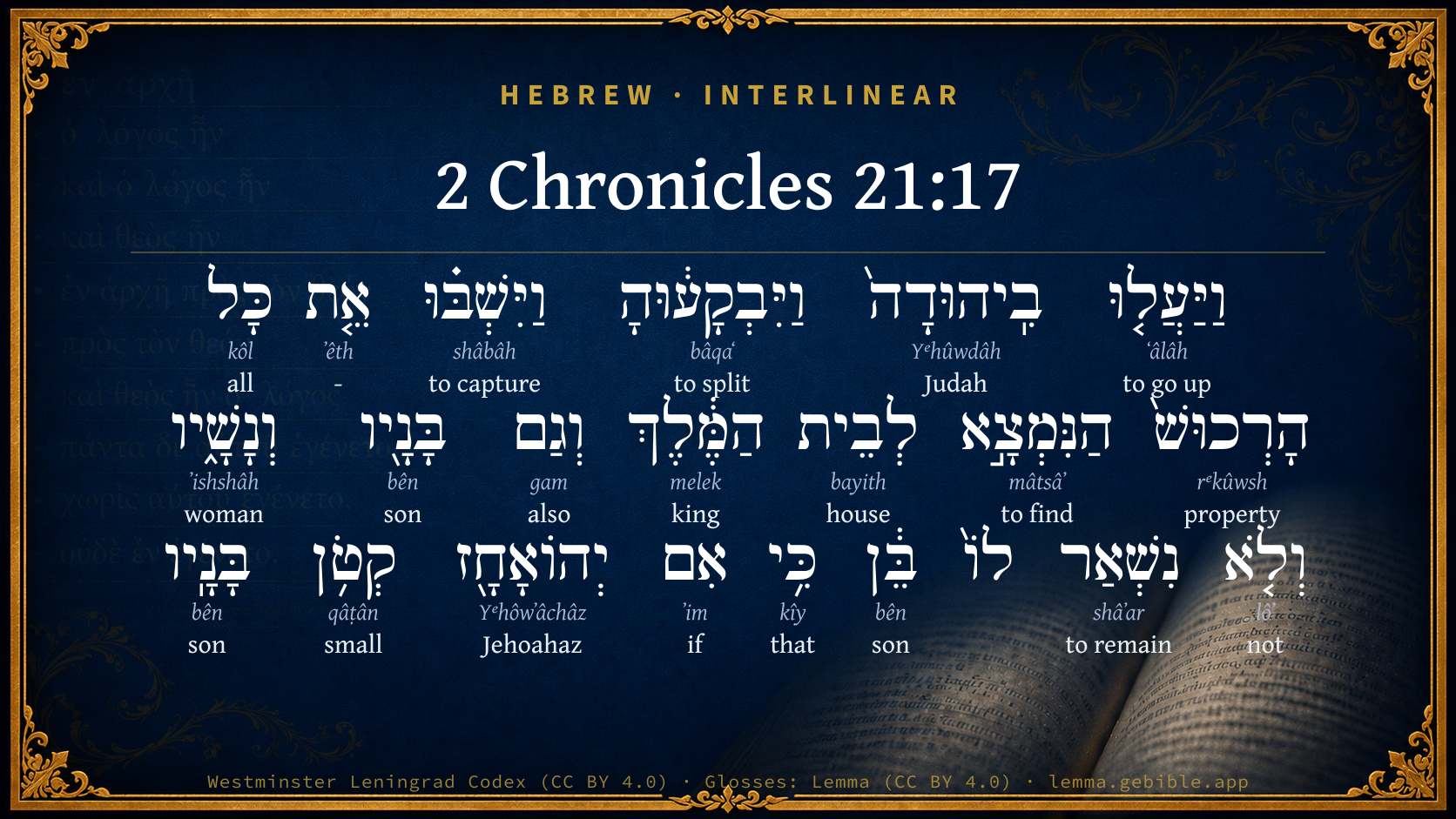
2 Chronicles 21:17

Hebrew (Westminster Leningrad Codex) 2 Chronicles 21:17 appears in the Hebrew Old Testament. The text above is from the Westminster Leningrad Codex. Each word links to its Strong’s number, a concise gloss, and parsing drawn from the Open Scriptures Hebrew Bible morphology. Click any word for its full Brown-Driver-Briggs (BDB) entry.
Download image
Cite this verse

2 Chronicles 21:17 (World English Bible). Public Domain. Lemma interlinear Bible study tool, https://lemma.gebible.app/v/2-chronicles/21/17.

Show BibTeX & RIS
BibTeX
RIS
English Translation
and they came up against Judah, and broke into it, and carried away all the substance that was found in the king's house, and his sons also, and his wives; so that there was never a son left him, save Jehoahaz, the youngest of his sons.
World English Bible · Public Domain
Download a study sheet

One document with this verse’s original text, its word-by-word gloss line, the meaning frame, cross-references with their text, attributed commentary, and full source and license credits — printable, and it pastes into notes with its structure intact.

This verse Autodidact and up

Study sheet (.html) Plain text (.txt)

A passage Seminary Student

Up to 50 verses in one chapter. A passage sheet keeps up to 6 commentary sources and 12 cross-references per verse, in the order this page ranks them, and says so on the sheet whenever that leaves anything out. Ask for a single verse and you get the Autodidact verse sheet above.

Everything on this page stays free to read, with no account — the sheet is a download of what is already on screen, not access to it.

Want to remove ads? Support Godless Engineer
Compare translations 3

The same verse in 3 English versions, stacked beneath the original-language interlinear above. Click any original word for its lexicon entry.

Each is an independent rendering of the whole verse — the interlinear is not word-aligned to these translations.

Highlighted words mark where these versions differ — a whole-verse word diff, not a word-by-word alignment.

  • World English Bible Public Domain
    and they came up against Judah, and broke into it, and carried away all the substance that was found in the king's house, and his sons also, and his wives; so that there was never a son left him, save Jehoahaz, the youngest of his sons.
  • King James Version Public Domain
    And they came up into Judah, and brake into it, and carried away all the substance that was found in the king's house, and his sons also, and his wives; so that there was never a son left him, save Jehoahaz, the youngest of his sons.
  • unfoldingWord Literal Text CC BY-SA 4.0
    And they came up against Judah, and they broke it up. And they captured all the goods that were found in the house of the king, and also his sons and his wives, and there was not left to him a son except Jehoahaz, the youngest of his sons.

unfoldingWord Literal Text — © unfoldingWord, licensed CC BY-SA 4.0. Word-aligned USFM3 via Door43 (git.door43.org/unfoldingWord/en_ult).

Versions to compare (up to 4)

3 of 4 selected

Show all 18 translations

Every available English version of this verse, each an independent rendering of the whole verse.

  • World English Bible Public Domain
    and they came up against Judah, and broke into it, and carried away all the substance that was found in the king's house, and his sons also, and his wives; so that there was never a son left him, save Jehoahaz, the youngest of his sons.
  • Berean Standard Bible Public Domain
    So they went to war against Judah, invaded it, and carried off all the possessions found in the king’s palace, along with his sons and wives; not a son was left to him except Jehoahaz, his youngest.
  • Majority Standard Bible Public Domain
    So they went to war against Judah, invaded it, and carried off all the possessions found in the king’s palace, along with his sons and wives; not a son was left to him except Jehoahaz, his youngest.
  • King James Version Public Domain
    And they came up into Judah, and brake into it, and carried away all the substance that was found in the king's house, and his sons also, and his wives; so that there was never a son left him, save Jehoahaz, the youngest of his sons.
  • American Standard Version (1901) Public Domain
    and they came up against Judah, and brake into it, and carried away all the substance that was found in the king's house, and his sons also, and his wives; so that there was never a son left him, save Jehoahaz, the youngest of his sons.
  • Revised Version (1885) Public Domain
    and they came up against Judah, and brake into it, and carried away all the substance that was found in the king’s house, and his sons also, and his wives; so that there was never a son left him, save Jehoahaz, the youngest of his sons.
  • Geneva Bible (1599) Public Domain
    And they came vp into Iudah, and brake into it, and caryed away all the substance that was found in the Kings house, and his sonnes also, and his wiues, so that there was not a sonne left him, saue Iehoahaz, the yongest of his sonnes.
  • Douay-Rheims (1899) Public Domain
    And they came up into the land of Juda, and wasted it, and they carried away all the substance that was found in the king's house, his sons also, and his wives: so that there was no son left him but Joachaz, who was the youngest.
  • Young's Literal Translation Public Domain
    and they come up into Judah, and rend it, and take captive all the substance that is found at the house of the king, and also his sons, and his wives, and there hath not been left to him a son except Jehoahaz the youngest of his sons.
  • Literal Standard Version CC BY-SA 4.0
    and they come up into Judah, and break into it, and take captive all the substance that is found at the house of the king, and also his sons, and his wives, and there has not been left to him a son except Jehoahaz the youngest of his sons.
  • Unlocked Literal Bible CC BY-SA 4.0
    They attacked Judah, invaded it, and carried away all the wealth that was found in the king's house. They also carried away his sons and his wives. No son was left to him except Jehoahaz, his youngest son.
  • unfoldingWord Literal Text CC BY-SA 4.0
    And they came up against Judah, and they broke it up. And they captured all the goods that were found in the house of the king, and also his sons and his wives, and there was not left to him a son except Jehoahaz, the youngest of his sons.
  • Darby Bible Public Domain
    and they came up into Judah, and broke into it, and carried away all the substance that was found in the king's house, and his sons also, and his wives; so that there was no son left him, except Jehoahaz the youngest of his sons.
  • World Messianic Bible Public Domain
    and they came up against Judah, broke into it, and carried away all the possessions that were found in the king’s house, including his sons and his wives, so that there was no son left to him except Jehoahaz, the youngest of his sons.
  • Webster's Bible Public Domain
    And they came up into Judah, and broke into it, and carried away all the substance that was found in the king's house, and his sons also, and his wives; so that there was not a son left to him, save Jehoahaz the youngest of his sons.
  • Free Bible Version CC BY-SA 4.0
    They came and invaded Judah, and took away everything they found in the king's palace, along with his sons and his wives, so that only the youngest son Jehoahaz was left.
  • Bible in Basic English Public Domain
    And they came up against Judah, forcing a way into it, and took away all the goods in the king's house, as well as his sons and his wives; so that he had no son but only Jehoahaz, the youngest.
  • JPS Tanakh (1917) Public Domain
    and they came up against Judah, and broke into it, and carried away all the substance that was found in the king's house, and his sons also, and his wives; so that there was never a son left him, save Jehoahaz, the youngest of his sons.

Literal Standard Version (2020), Covenant Press — licensed CC BY-SA 4.0. Text via the HelloAO Bible API (eBible.org). Unlocked Literal Bible (unfoldingWord) — licensed CC BY-SA 4.0. Text via the HelloAO Bible API (eBible.org). unfoldingWord Literal Text — © unfoldingWord, licensed CC BY-SA 4.0. Word-aligned USFM3 via Door43 (git.door43.org/unfoldingWord/en_ult). Free Bible Version, Dr. Jonathan Gallagher — licensed CC BY-SA 4.0. Text via the HelloAO Bible API (eBible.org).

Word by word

More ways to search: Search by grammar → Find every occurrence → Compare this word →

Practice this passage: Drill this verse → Learn its vocabulary →

יְהוֹאָחָ֖ז
Yᵉhôwʼâchâz
H3059
“Jehoahaz”
Noun, Proper
Part of Speech
Noun
Type
Proper
Full BDB Definition

Origin: from H3068 and H270

TWOT: None

Jehoahaz = "Jehovah has seized" - a king of Judah and son of Josiah - a king of the northern kingdom of Israel and son of Jehu - a king of Judah and son of Jehoram (Ahaziah)
  1. וַיַּעֲל֤וּ ʻâlâh H5927 “and · to go up” Conjunction + Verb, Qal, Sequential Imperfect, 3rd Person, Masculine, Plural
  2. בִֽיהוּדָה֙ Yᵉhûwdâh H3063 “in/at · Judah” Preposition + Noun, Proper
  3. וַיִּבְקָע֔וּהָ bâqaʻ H1234 “and · to split · her” Conjunction + Verb, Qal, Sequential Imperfect, 3rd Person, Masculine, Plural + Suffix, Personal, 3rd Person, Feminine, Singular
  4. וַיִּשְׁבּ֗וּ shâbâh H7617 “and · to capture” Conjunction + Verb, Qal, Sequential Imperfect, 3rd Person, Masculine, Plural
  5. אֵ֤ת ʼêth H853 “-” Particle, Direct Object
  6. כָּל kôl H3605 “all of” Noun, Common, Masculine, Singular, Construct
  7. הָרְכוּשׁ֙ rᵉkûwsh H7399 “the · property” Particle, Definite Article + Noun, Common, Masculine, Singular, Absolute
  8. הַנִּמְצָ֣א mâtsâʼ H4672 “the · finding” Particle, Definite Article + Verb, Niphal, Participle Active, Masculine, Singular, Absolute
  9. לְבֵית bayith H1004 “to/for · house of” Preposition + Noun, Common, Masculine, Singular, Construct
  10. הַמֶּ֔לֶךְ melek H4428 “the · king” Particle, Definite Article + Noun, Common, Masculine, Singular, Absolute
  11. וְגַם gam H1571 “and · also” Conjunction + Particle, Accusative
  12. בָּנָ֖יו bên H1121 “sons · his” Noun, Common, Masculine, Plural, Construct + Suffix, Personal, 3rd Person, Masculine, Singular
  13. וְנָשָׁ֑יו ʼishshâh H802 “and · women · his” Conjunction + Noun, Common, Feminine, Plural, Construct + Suffix, Personal, 3rd Person, Masculine, Singular
  14. וְלֹ֤א lôʼ H3808 “and · not” Conjunction + Particle, Negative
  15. נִשְׁאַר shâʼar H7604 “to remain” Verb, Niphal, Perfect, 3rd Person, Masculine, Singular
  16. בֵּ֔ן bên H1121 “son” Noun, Common, Masculine, Singular, Absolute
  17. כִּ֥י kîy H3588 “that” Conjunction
  18. אִם ʼim H518 “if” Conjunction
  19. קְטֹ֥ן qâṭân H6996 “small of” Adjective, Adjective, Masculine, Singular, Construct
  20. בָּנָֽיו bên H1121 “sons · his” Noun, Common, Masculine, Plural, Construct + Suffix, Personal, 3rd Person, Masculine, Singular

About this verse

These counts appear in no published source. They are computed here, from the morphology-tagged text and Lemma’s own curated glosses. What Lemma adds →

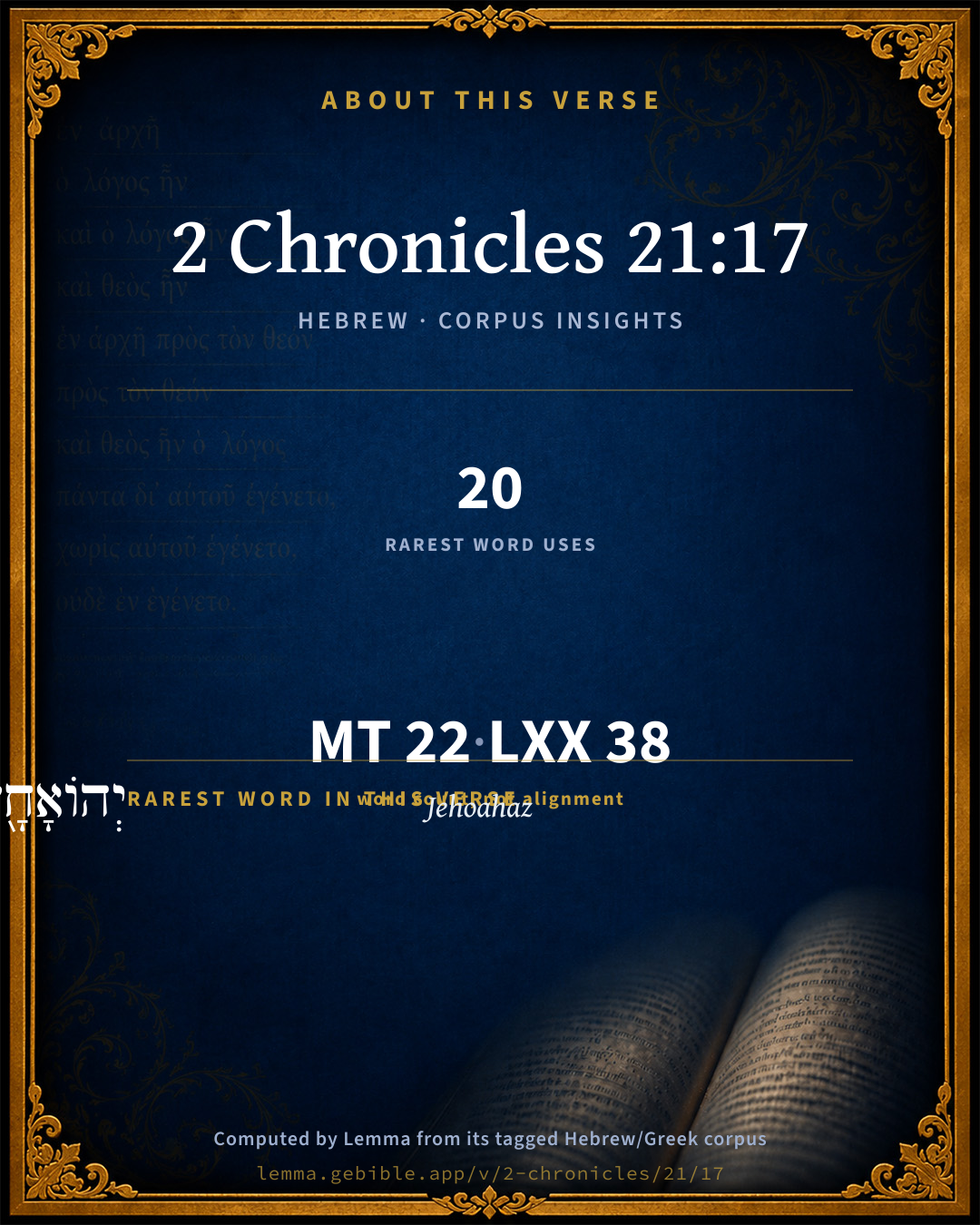
22
words
19
distinct lemmas
Historical
section

Notable vocabulary

The rarest word here is יְהוֹאָחָ֖ז Jehoahaz H3059 — appearing just 20 times in the whole Hebrew Bible.

Shared distinctive vocabulary

יְהוֹאָחָ֖ז Jehoahaz H3059 occurs in 19 verses of the Hebrew Bible. Also found in:

Grammatical profile

  • 5 verbs
  • 10 nouns
  • 1 adjective
  • 1 preposition
  • 2 conjunctions
  • 3 particles

Verb forms

  • וַיַּעֲל֤וּ Qal · Sequential Imperfect
  • וַיִּבְקָע֔וּהָ Qal · Sequential Imperfect
  • וַיִּשְׁבּ֗וּ Qal · Sequential Imperfect
  • הַנִּמְצָ֣א Niphal · Participle Active
  • נִשְׁאַר Niphal · Perfect

Repetition

A word recurs within this verse — often emphatic in Hebrew:

  • בָּנָ֖יו son H1121 ×3

Hebrew & Septuagint length

In English translation the verse runs 46 words from the Hebrew and 46 from the Septuagint (LXX English) — the same length.

A rough comparison of the two English renderings, which tokenize alike — not a word-level alignment.

Word counts can differ between the Hebrew and the Greek without any difference in meaning — e.g. the Hebrew direct-object marker אֵת has no separate Greek word, and Greek often adds the article ὁ.

In the original languages it is 22 Hebrew tokens and 38 Greek tokens — but the two are counted differently (Hebrew bundles its prefixes and suffixes into one token; the Greek is in lemma form), so that isn’t a like-for-like length.

Cross-references

5

Topical passages linked to 2 Chronicles 21:17 in the Treasury of Scripture Knowledge — connected by theme and wording, ordered by reader-vote popularity; previews shown in the World English Bible.

  • 2 Chronicles 22:1 The inhabitants of Jerusalem made Ahaziah his youngest son king in his place; for the band of men who came with the Arabians to the camp had slain all the eldest. So Ahaziah the son of Jehoram king of Judah reigned.
  • 2 Chronicles 22:6 He returned to be healed in Jezreel of the wounds which they had given him at Ramah, when he fought against Hazael king of Syria. Azariah the son of Jehoram king of Judah went down to see Jehoram the son of Ahab in Jezreel, because he was sick.
  • 2 Chronicles 25:23 Joash king of Israel took Amaziah king of Judah, the son of Joash the son of Jehoahaz, at Beth-shemesh, and brought him to Jerusalem, and broke down the wall of Jerusalem from the gate of Ephraim to the corner gate, four hundred cubits.
  • 2 Chronicles 24:7 For the sons of Athaliah, that wicked woman, had broken up the house of God; and also all the dedicated things of the house of Yahweh did they bestow on the Baals.
  • Job 5:3–4 I have seen the foolish taking root, But suddenly I cursed his habitation.

Cross-references courtesy of OpenBible.info (CC BY 4.0).

Hebrew and Greek witnesses Masoretic Hebrew ↔ Greek Septuagint

The same verse in the two great witnesses to the Old Testament, shown verse-for-verse.

These are two independent witnesses, not word-aligned to each other, and the Septuagint is shown in lemma (dictionary) form.

Hebrew 2 Chronicles 21:17 Masoretic · Westminster Leningrad Codex

וַיַּעֲל֤וּ בִֽיהוּדָה֙ וַיִּבְקָע֔וּהָ וַיִּשְׁבּ֗וּ אֵ֤ת כָּל הָרְכוּשׁ֙ הַנִּמְצָ֣א לְבֵית הַמֶּ֔לֶךְ וְגַם בָּנָ֖יו וְנָשָׁ֑יו וְלֹ֤א נִשְׁאַר לוֹ֙ בֵּ֔ן כִּ֥י אִם יְהוֹאָחָ֖ז קְטֹ֥ן בָּנָֽיו

and they came up against Judah, and broke into it, and carried away all the substance that was found in the king's house, and his sons also, and his wives; so that there was never a son left him, save Jehoahaz, the youngest of his sons.

World English Bible · Public Domain

Greek LXX 2 Chronicles 21:17 Septuagint · lemma form

καί ἀναβαίνω ἐπί ἰούδας καί καταδυναστεύω καί ἀποστρέφω πᾶς ὁ ἀποσκευή ὅς εὑρίσκω ἐν οἶκος ὁ βασιλεύς καί ὁ υἱός αὐτός καί ὁ θυγάτηρ αὐτός καί οὐ καταλείπω αὐτός υἱός ἀλλά ἤ οχοζιας ὁ μικρός ὁ υἱός αὐτός

and they went up against Juda, and prevailed against them, and took away all the store which they found in the house of the king, and his sons, and his daughters; and there was no son left to him but Ochozias the youngest of his sons.

LXX2012 (modern English Septuagint) · Public Domain

On this verse, Ellicott's Commentary for English Readers discusses the Septuagint’s reading. Read the note in Commentary ↓

Hebrew: Westminster Leningrad Codex (CC BY 4.0). Greek: Septuagint (public domain); English from LXX2012 (modern English Septuagint) (Public Domain). How the Septuagint differs from the Hebrew →

Commentary

Notes on 2 Chronicles 21:17 from classic Christian and Jewish commentators (each source and its license shown beneath its notes). The classic Christian expositions comment on the surrounding passage and are grouped to its opening verse, so a note may address several verses; the Jewish commentaries on the Tanakh (Rashi and others) are per-verse, so they appear only where the commentator wrote on this verse.

Lemma curates 59 commentaries, every one of them public domain or Creative Commons licensed, each selected and text-cleaned for this edition rather than reprinted as found. About our sources →

Ellicott's Commentary for English Readers

(17) And brake into it.—Literally, clave it asun-der (Exo_14:16). Here as in 1Ch_11:18; 2Sa_23:16.

And carried away all the substance . . . his wives.—This statement implies that the enemy entered Jerusalem, although the chronicler has not expressly said it. In the same way (2Ch_12:9) he omitted to state that Shishak captured the city before plundering the Temple and palace. The desire to be concise accounts for both omissions. (See on 2Ch_22:1.)

All the substance that was found in the king’s house.—Literally, that belonged to the king’s house. (Comp. 2Ch_34:32 for in; comp. also Deu_21:17.) It is not said that the Temple was plundered; but nothing can be inferred from the writer’s silence on this point.

So that there was never a son left him.—They were not only taken, but slain (2Ch_22:1).

Save Jehoahaz.—Called Ahaziah in 2Ch_22:1, which is the same name with the elements of it reversed. It means “Iah holdeth.” The “Azariah” of 2Ch_22:6 seems to be a mistake. LXX., Syriac, Arabic, and Targum, “Ahaziah.”

A Bible Commentary for English Readers, edited by Charles John Ellicott (1878–1897) — public domain. Text from a community e-Sword module.

Trapp's Complete Commentary

John Trapp

2Ch 21:17 And they came up into Judah, and brake into it, and carried away all the substance that was found in the king’s house, and his sons also, and his wives; so that there was never a son left him, save Jehoahaz, the youngest of his sons.

Ver. 17. And carried away all the substance.] Plundered the chief city also, and the king’s palace. Jerusalem, after it became idolatrous, was ten times taken: Rome, since it became Papal, was never besieged but it was also taken and plundered. This word plunder, which we first heard of in the Swedish wars, is said to come from planum dare, to level or plane all to nothing; or from the Dutch, as if it were to plume or pluck the feathers of a bird to the bare skin.

And his sons also.] Whom they slew. {2Ch 22:1}

And his wives.] Athaliah escaped, for a public mischief.

John Trapp, A Commentary or Exposition upon All the Books of the Old and New Testament (1647–1656) — public domain. Text from a community e-Sword module.

Joseph Benson's Commentary

2Ch 21:17. And his sons also, and his wives — Whom they slew, all except Ahaziah and Athaliah, who possibly were hid in some secret place. So that there was never a son left him, save Jehoahaz — Who is also called Ahaziah, a name of the same signification with Jehoahaz, and, by a small alteration of the letters, Azariah, (2Ch 22:6,) the meaning of which word is akin to the other, all signifying the possession, strength, or help of the Lord. Thus blood was required for blood. Jehoram had slain all his brethren; they slay all his sons but one. And he had not escaped, had he not been of the house of David, which must not be extirpated, like that of Ahab, because a blessing was in it, no less a blessing than that of the Messiah.

Joseph Benson's Commentary on the Old and New Testaments (1811–1818) — public domain. Text from a community e-Sword module.

Geneva Bible (1599)

Geneva Bible translators

Called also Ahaziah, as 2 Chron. 22:1, or Azariah, verse 6 following.

Geneva Bible (1599) marginal notes — public domain. Text via Bolls.life.

Adam Clarke's Commentary

Verse 17. Save Jehoahaz the youngest] This person had at least three names, Jehoahaz, Ahaziah, (2Ch 22:1,) and Azariah, (2Ch 22:6.)

Adam Clarke's Commentary on the Bible (1810–1826) — public domain. Text from a community e-Sword/MySword module.

The Cambridge Bible for Schools and Colleges

gen. ed. J. J. S. Perowne

17. and brake into it] The proper meaning of the Heb. verb is “to make a breach in a city-wall [and so take the city]”; cp. 2Ch_32:1. The word is metaphorically applied (here and Isa_7:6) to a whole country.

in the king’s house] R.V. mg., belonging to the king’s house. The rendering of A.V. suggests that the allies entered Jerusalem, but this was almost certainly not the case.

Jehoahaz] In 2Ch_22:1 he is called Ahaziah, which is only another form of the name, the prefix Jeho- of the one, and the ending -iah of the other being each the representative of the divine name Jehovah. The name in either form means “Jehovah hath taken” (or “chosen”). Two similar cases are Jehoshaphat and Shephatiah (2Ch_21:1) and Jehonathan and Nethaniah in 2Ch_17:8.

The Cambridge Bible for Schools and Colleges (gen. ed. J. J. S. Perowne; Cambridge University Press, 1878–1918) — public domain. Text from a community e-Sword module.

John Gill's Exposition

Thirty and two years old was he when he began to reign, and he reigned in Jerusalem eight years,.... See Kg2 8:17,

and departed without being desired; to live, either by himself, being weary of life through the pain he endured; or by his people, he being so wicked a prince, and so ill beloved by them, that nobody wished to have him live, but were glad to hear of his death; the meaning is, he died unlamented; his death is expressed by a departing out of this world into another, a phrase more than once used for death in the New Testament, see Joh 13:1,

howbeit, they buried him in the city of David, but not in the sepulchres of the kings; they showed him some respect for the sake of his father, by burying him in the city of David, but denied him the honour of lying in the royal sepulchres, see Kg2 8:24.

Next: 2 Chronicles Chapter 22

John Gill's Exposition of the Whole Bible (1746–1763) — public domain (CC PDM 1.0). Text via the HelloAO Bible API.

Albert Barnes' Notes on the Bible

Jehoahaz - The writer of Chronicles calls him indifferently Jeboahaz and Abaziah, which are equivalent names (2Ki 8:24 note).

Albert Barnes' Notes on the Bible (1834–1885) — public domain. Text from a community e-Sword/MySword module.

Haydock's Catholic Bible Commentary

Joachaz, alias Ochozias, (Ch.) or Azarias, in Hebrew, C. xxii. 1., and 6. C. --- The variation of names seems to originate in the mistakes of transcribers, very frequently. If we found in some profane author, that Philip had only one son, Ander-alex, left, and that this son, Alex-ander, succeeded him, we should readily allow that the first syllables had been erroneously placed last, (Kennicott) as on this occasion aez-ieu stands for ieu-aez. Sept. has here Greek: Ochozias; as the other versions have also Ochozias, (chap. xxii. 6.) instead of Azrieu, (H.) a name given to Ozias, king of Juda, when it belonged to the priests, as it here belongs to one of the captains, C. xxiii. 1. Sometimes we find Aezie, 4 K. ix. 16. Strange inconsistency! Kennicott) See 4 K. xiv. 21.

George Leo Haydock (1774–1849), Haydock's Catholic Family Bible and Commentary, 1859 edition — public domain. Excludes Psalms (Douay-Rheims chapter numbering differs from Protestant) and Deuterocanonical books (Catholic canon only).

Matthew Poole's English Annotations

His sons also and his wives; whom also they slew, 2Ch 22:1, except Ahaziah and Athaliah, who possibly were hidden in some secret and safe place.

Jehoahaz; called also Ahaziah, which signifies the very same thing with Jehoahaz; and Azariah, 2Ch 22:6, whose signification is near akin to the other, all signifying God’s taking or helping of him.

Matthew Poole's English Annotations on the Holy Bible (1683–1685) — public domain. Text from a community e-Sword/MySword module.

Whedon's Commentary on the Bible

Daniel D. Whedon

17. Brake into it — Made a forcible irruption into the kingdom, and captured many of the chief cities, if not Jerusalem itself.

Carried away all the substance that was found in the king’s house, and his sons also, and his wives — This most naturally implies the capture of Jerusalem and the plunder of the royal palace. And yet, it must be confessed, that such a plunder of the capital city is usually described in a more direct and unmistakable way. Compare 2Ch_12:9; 2Ch_25:24 : 2Ki_14:13. Keil therefore argues that the capital was not captured, and that “the substance that was found in the king’s house” was the treasures belonging to the king’s family, which were stored in various cities, villages, and castles of the kingdom. 1Ch_27:25. He supposes also that the king’s sons and wives were captured, not in Jerusalem, but in the camp of the men of Judah, (2Ch_22:1,) where they were surprised and taken by the enemy. Owing to the brevity of the narrative, the exact sense is somewhat obscure; but we cannot resist the conviction that the king of Judah’s wives would scarcely have been found in the camp, and the whole passage is most easily and naturally explained by supposing that, on this occasion as on a number of others, Jerusalem was broken into, and largely plundered by the invading forces.

Daniel D. Whedon (gen. ed.), Commentary on the Old and New Testaments (1874–1909) — public domain. Text from a community e-Sword module.

The Pulpit Commentary

Brake into it; Hebrew, kal future of qB; (compare the other four significant and expressive occurrences of this exact form, (Jud_1:15:19 2Sa_23:16; 1Ch_11:18; Isa_48:21) The elementary idea of the root is to divide; and it occurs in one conjugation or another fifty-one times, there being no more typical occurrence than that ofYiw; Gen_7:11. Carried away. The Hebrew uses the word "carried captive" (WBv) possibly the order of ver. 14 is inadvertently neglected, which puts the living beings before all the substance, or, goods (vWkrhAlK). His sons also. From 2Ch_24:7 we note that the sons were not punished for their father"s sins alone, but for their own. Jehoahaz. This person is called Ahaziah in 2Ch_22:1 (the syllables of the name being reversed) and Azariah in 2Ch_22:6, which cannot be explained, but must be supposed an error. The Jehoiachin 2Ch_36:9 is written Jeconiah, or Jechoniah, in 1Ch_3:16, 1Ch_3:17; Coniah in Jer_22:24, etc.; and Jechoniah in 2Ch_24:1, etc. The two parts of the word combined in either order make the same meaning. On account of the express mention of the camp in 2Ch_22:1, some think that the slaughter and the plunder were all such as might have been wrought in the royal quarters there; others that we are to infer the taking by assault of Jerusalem itself and what was therein.

The Pulpit Commentary (1880–1919), ed. H.D.M. Spence-Jones & Joseph S. Exell — public domain. Text from a community e-Sword module.

John Wesley's Explanatory Notes

His wives - Whom also they slew, chap. xxii, 1, except Ahaziah and Athaliah; who possibly were hidden in some secret place. Left him - Blood for blood. He had slain all his brethren; they slay all his sons, but one. And he had not escaped, had be not been of the house of David; which must not be extirpated, like that of Ahab: because a blessing was in it; no less a blessing than that of the Messiah.

John Wesley, Explanatory Notes Upon the Whole Bible (1754–1765) — public domain. Text via the GEBible commentary corpus.

Scofield Reference Notes

C. I. Scofield

Jehoahaz

Called Ahaziah, 2Ch 22:1; 2Ch 22:6 and Azariah:

The Scofield Reference Bible (1917 edition), notes by C. I. Scofield — public domain. Text from a community e-Sword module.

Rashi

Rabbi Shlomo Yitzchaki (Rashi)

and split it - Heb. וַיִִּבְקָעוּהָ, like (Isa. 7:6): “Let us go up to Judah and provoke it and breach its walls וְנַבְקִעֶנָה and so, (II Kings 3:26): “to break a way (לְהַבְקִיעַ)o the king of Edom.”

Rashi on the Tanakh — English translations: “The Judaica Press complete Tanach with Rashi, translated by A. J. Rosenberg” (CC BY 4.0); “Pentateuch with Rashi's commentary by M. Rosenbaum and A.M. Silbermann, 1929-1934” (public domain); “The Metsudah Tanach series, Lakewood, N.J” (CC BY 4.0); and “The Book of Joshua, Metsudah Publications, 1997” (CC BY 4.0). Text via Sefaria.

Lesson kit

Teaching starters — assembled from the data on this page, not authored interpretation. Every prompt links to the verse data it draws on. Edit before teaching.

2 Chronicles, in the Historical, opens this verse with 22 words (19 distinct Hebrew lemmas). Its most distinctive word is Yᵉhôwʼâchâz (“Jehoahaz”). A historical commentator’s framing appears above. Read the whole chapter for the surrounding context.

Discussion questions

  1. How does “Jehoahaz” (Yᵉhôwʼâchâz) shape what this verse is saying?
  2. How does 2 Kings 10:35, which shares the word «Jehoahaz», read alongside this verse?
  3. What does the repetition of “son” (3× in this one verse) do in this verse?
  4. These translations render this verse differently; the difference is in the English rendering, not the original. What questions does that raise?
  5. «וַיַּעֲל֤וּ» is a Qal Sequential Imperfect verb. How does that grammatical form shape the action described?
  6. Compare how Ellicott's Commentary for English Readers and Trapp's Complete Commentary read this verse. Where do they agree or differ?

Things to notice

Reading settings

Reading text

Shown beneath each verse's original-language words.

Old Testament
Old Testament edition

Read the OT as the Masoretic Hebrew (MT) or the Greek Septuagint (LXX).

English shown for the Greek Septuagint (in the Hebrew ↔ Greek comparison).

Comparing translations? Open the Compare panel on any verse page to stack up to four side by side.