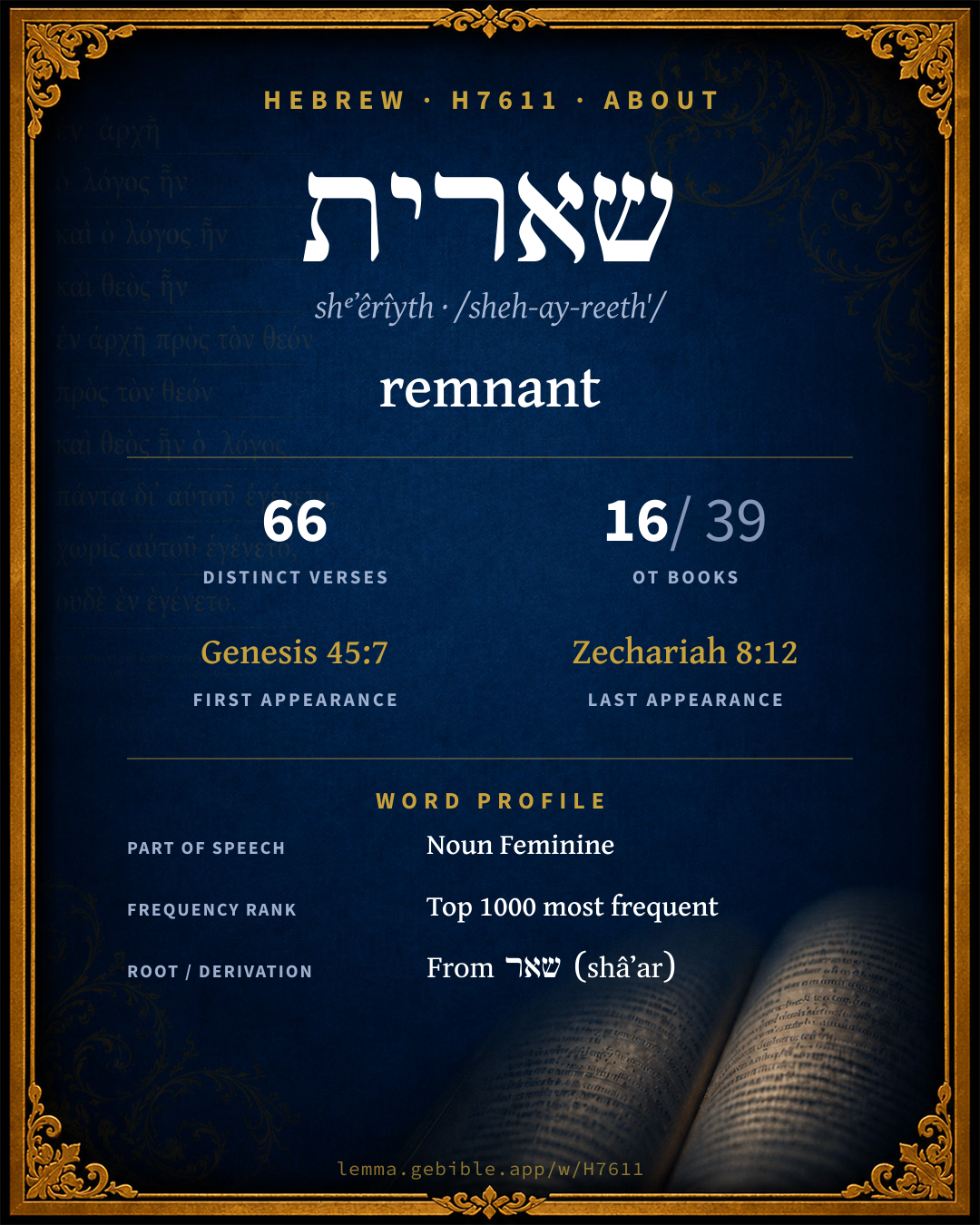
שְׁאֵרִית
remnant
also: rest, residue, remainder fuller range ↓
Full lexicon entry — Brown-Driver-Briggs (BDB)
From Brown-Driver-Briggs (BDB)
Where this word appears
See every Construct-state word in the Hebrew Bible →
Grammar key — what these labels mean
Part of speech
- Noun
- A naming word — a person, place, thing, or idea.
Noun type
- Common
- A common noun — a general class of person, place, or thing (“king,” “city,” “water”), not a specific name.
State
- Construct
- A noun bound to a following noun in a possessive / “of” relationship (the construct chain).
- Absolute
- The independent form of a noun, not bound to a following word.
Gender
- Feminine
- Grammatically feminine.
Number
- Singular
- One.
Grammatical forms
- Noun, Common, Feminine, Singular, Construct 51 times (77%)
- Noun, Common, Feminine, Singular, Absolute 15 times (23%)
Parsed forms decoded from the imported morphology (morphhb / Westminster Leningrad Codex — WLC text public domain, morphhb tagging CC BY 4.0), counted across 66 parsed occurrences — not distinct verses.
Every verse where H7611 appears — 66 distinct verses across 16 books. Click any verse to open its interlinear word-by-word view. Verse text shown in the World English Bible for context — . Each verse’s Hebrew form is shown with its reference; the English is not keyword-highlighted, since the data carries no word-level English alignment. Use “Compare translations” on any verse to read it across multiple English versions. This concordance covers the Hebrew Bible; Septuagint (Greek Old Testament) occurrences are not indexed here.
Genesis 1 verse
2 Samuel 1 verse
2 Kings 3 verses
- 2 Kings 19:4 הַ/שְּׁאֵרִ֖ית ptcl def.art + n c fs It may be Yahweh your God will hear all the words of Rabshakeh, whom the king of Assyria his master has sent to defy the living God, and will rebuke the words which Yahweh your God has heard. Therefore lift up your prayer for the remnant that is left.
- 2 Kings 19:31 שְׁאֵרִ֔ית n c fs For out of Jerusalem shall go forth a remnant, and out of Mount Zion those who shall escape: the zeal of Yahweh shall perform this.
- 2 Kings 21:14 שְׁאֵרִ֣ית n c fs cs I will cast off the remnant of my inheritance, and deliver them into the hand of their enemies; and they shall become a prey and a spoil to all their enemies;
1 Chronicles 2 verses
- 1 Chronicles 4:43 שְׁאֵרִ֥ית n c fs cs They struck the remnant of the Amalekites who escaped, and have lived there to this day.
- 1 Chronicles 12:38 שֵׁרִ֧ית n c fs cs All these being men of war, who could order the battle array, came with a perfect heart to Hebron, to make David king over all Israel: and all the rest also of Israel were of one heart to make David king.
2 Chronicles 2 verses
- 2 Chronicles 34:9 שְׁאֵרִ֣ית n c fs cs They came to Hilkiah the high priest, and delivered the money that was brought into the house of God, which the Levites, the keepers of the threshold, had gathered of the hand of Manasseh and Ephraim, and of all the remnant of Israel, and of all Judah and Benjamin, and of the inhabitants of Jerusalem.
- 2 Chronicles 36:20 הַ/שְּׁאֵרִ֥ית ptcl def.art + n c fs Those who had escaped from the sword carried he away to Babylon; and they were servants to him and his sons until the reign of the kingdom of Persia:
Ezra 1 verse
Nehemiah 1 verse
Psalms 1 verse
Isaiah 6 verses
- Isaiah 14:30 וּ/שְׁאֵרִיתֵ֖/ךְ conj + n c fs cs + sfx pers 2fs The firstborn of the poor shall feed, and the needy shall lie down in safety; and I will kill your root with famine, and your remnant shall be killed.
- Isaiah 15:9 וְ/לִ/שְׁאֵרִ֖ית conj + prep + n c fs cs For the waters of Dimon are full of blood; for I will bring yet more on Dimon, a lion on them of Moab that escape, and on the remnant of the land.
- Isaiah 37:4 הַ/שְּׁאֵרִ֖ית ptcl def.art + n c fs It may be Yahweh your God will hear the words of Rabshakeh, whom the king of Assyria his master has sent to defy the living God, and will rebuke the words which Yahweh your God has heard. Therefore lift up your prayer for the remnant that is left.
- Isaiah 37:32 שְׁאֵרִ֔ית n c fs For out of Jerusalem shall go forth a remnant, and out of Mount Zion those who shall escape. The zeal of Yahweh of Hosts will perform this.
- Isaiah 44:17 וּ/שְׁאֵ֣רִית֔/וֹ conj + n c fs cs + sfx pers 3ms The residue of it he makes a god, even his engraved image; he falls down to it and worships, and prays to it, and says, Deliver me; for you are my god.
- Isaiah 46:3 שְׁאֵרִ֖ית n c fs cs Listen to me, house of Jacob, and all the remnant of the house of Israel, that have been borne [by me] from their birth, that have been carried from the womb;
Jeremiah 24 verses
- Jeremiah 6:9 שְׁאֵרִ֣ית n c fs cs Thus says Yahweh of Hosts, They shall thoroughly glean the remnant of Israel as a vine: turn again your hand as a grape-gatherer into the baskets.
- Jeremiah 8:3 הַ/שְּׁאֵרִית֙ ptcl def.art + n c fs Death shall be chosen rather than life by all the residue that remain of this evil family, that remain in all the places where I have driven them, says Yahweh of Hosts.
- Jeremiah 11:23 וּ/שְׁאֵרִ֕ית conj + n c fs and there shall be no remnant to them: for I will bring evil on the men of Anathoth, even the year of their visitation.
- Jeremiah 15:9 וּ/שְׁאֵֽרִיתָ֗/ם conj + n c fs cs + sfx pers 3mp She who has borne seven languishes; she has given up the spirit; her sun is gone down while it was yet day; she has been disappointed and confounded: and the residue of them will I deliver to the sword before their enemies, says Yahweh.
- Jeremiah 23:3 שְׁאֵרִ֣ית n c fs cs I will gather the remnant of my flock out of all the countries where I have driven them, and will bring them again to their folds; and they shall be fruitful and multiply.
- Jeremiah 24:8 שְׁאֵרִ֣ית n c fs cs As the bad figs, which can't be eaten, they are so bad, surely thus says Yahweh, So will I give up Zedekiah the king of Judah, and his princes, and the residue of Jerusalem, who remain in this land, and those who dwell in the land of Egypt,
- Jeremiah 25:20 שְׁאֵרִ֥ית n c fs cs and all the mixed people, and all the kings of the land of the Uz, and all the kings of the Philistines, and Ashkelon, and Gaza, and Ekron, and the remnant of Ashdod;
- Jeremiah 31:7 שְׁאֵרִ֥ית n c fs cs For thus says Yahweh, Sing with gladness for Jacob, and shout for the chief of the nations: publish you, praise you, and say, Yahweh, save your people, the remnant of Israel.
- Jeremiah 39:3 שְׁאֵרִ֔ית n c fs cs that all the princes of the king of Babylon came in, and sat in the middle gate, [to wit], Nergal Sharezer, Samgar-nebo, Sarsechim, Rabsaris, Nergal Sharezer, Rabmag, with all the rest of the princes of the king of Babylon.
- Jeremiah 40:11 שְׁאֵרִ֖ית n c fs Likewise when all the Jews who were in Moab, and among the children of Ammon, and in Edom, and who were in all the countries, heard that the king of Babylon had left a remnant of Judah, and that he had set over them Gedaliah the son of Ahikam, the son of Shaphan;
- Jeremiah 40:15 שְׁאֵרִ֥ית n c fs cs Then Johanan the son of Kareah spoke to Gedaliah in Mizpah secretly, saying, Please let me go, and I will kill Ishmael the son of Nethaniah, and no man shall know it: why should he take your life, that all the Jews who are gathered to you should be scattered, and the remnant of Judah perish?
- Jeremiah 41:10 שְׁאֵרִ֨ית n c fs cs Then Ishmael carried away captive all the residue of the people who were in Mizpah, even the king's daughters, and all the people who remained in Mizpah, whom Nebuzaradan the captain of the guard had committed to Gedaliah the son of Ahikam; Ishmael the son of Nethaniah carried them away captive, and departed to go over to the children of Ammon.
- Jeremiah 41:16 שְׁאֵרִ֤ית n c fs cs Then took Johanan the son of Kareah, and all the captains of the forces who were with him, all the remnant of the people whom he had recovered from Ishmael the son of Nethaniah, from Mizpah, after that he had killed Gedaliah the son of Ahikam, [to wit], the men of war, and the women, and the children, and the eunuchs, whom he had brought back from Gibeon:
- Jeremiah 42:2 הַ/שְּׁאֵרִ֣ית ptcl def.art + n c fs and said to Jeremiah the prophet, Let, we pray you, our supplication be presented before you, and pray for us to Yahweh your God, even for all this remnant; for we are left but a few of many, as your eyes do see us:
- Jeremiah 42:15 שְׁאֵרִ֣ית n c fs cs now therefore hear you the word of Yahweh, O remnant of Judah: Thus says Yahweh of Hosts, the God of Israel, If you indeed set your faces to enter into Egypt, and go to sojourn there;
- Jeremiah 42:19 שְׁאֵרִ֣ית n c fs cs Yahweh has spoken concerning you, remnant of Judah, Don't you go into Egypt: know certainly that I have testified to you this day.
- Jeremiah 43:5 שְׁאֵרִ֣ית n c fs cs But Johanan the son of Kareah, and all the captains of the forces, took all the remnant of Judah, who were returned from all the nations where they had been driven, to sojourn in the land of Judah;
- Jeremiah 44:7 שְׁאֵרִֽית n c fs Therefore now thus says Yahweh, the God of hosts, the God of Israel: Why commit you [this] great evil against your own souls, to cut off from you man and woman, infant and suckling, out of the midst of Judah, to leave you none remaining;
- Jeremiah 44:12 שְׁאֵרִ֣ית n c fs cs I will take the remnant of Judah, that have set their faces to go into the land of Egypt to sojourn there, and they shall all be consumed; in the land of Egypt shall they fall; they shall be consumed by the sword and by the famine; they shall die, from the least even to the greatest, by the sword and by the famine; and they shall be an object of horror, [and] an astonishment, and a curse, and a reproach.
- Jeremiah 44:14 לִ/שְׁאֵרִ֣ית prep + n c fs cs so that none of the remnant of Judah, who have gone into the land of Egypt to sojourn there, shall escape or be left, to return into the land of Judah, to which they have a desire to return to dwell there: for none shall return save such as shall escape.
- Jeremiah 44:28 שְׁאֵרִ֣ית n c fs cs Those who escape the sword shall return out of the land of Egypt into the land of Judah, few in number; and all the remnant of Judah, who have gone into the land of Egypt to sojourn there, shall know whose word shall stand, mine, or theirs.
- Jeremiah 47:4 שְׁאֵרִ֖ית n c fs cs because of the day that comes to destroy all the Philistines, to cut off from Tyre and Sidon every helper who remains: for Yahweh will destroy the Philistines, the remnant of the isle of Caphtor.
- Jeremiah 47:5 שְׁאֵרִ֣ית n c fs cs Baldness is come on Gaza; Ashkelon is brought to nothing, the remnant of their valley: how long will you cut yourself?
- Jeremiah 50:26 שְׁאֵרִֽית n c fs Come against her from the utmost border; open her store-houses; cast her up as heaps, and destroy her utterly; let nothing of her be left.
Ezekiel 7 verses
- Ezekiel 5:10 שְׁאֵרִיתֵ֖/ךְ n c fs cs + sfx pers 2fs Therefore the fathers shall eat the sons in the midst of you, and the sons shall eat their fathers; and I will execute judgments on you; and the whole remnant of you will I scatter to all the winds.
- Ezekiel 9:8 שְׁאֵרִ֣ית n c fs cs It happened, while they were smiting, and I was left, that I fell on my face, and cried, and said, Ah Lord Yahweh! will you destroy all the residue of Israel in your pouring out of your wrath on Jerusalem?
- Ezekiel 11:13 שְׁאֵרִ֥ית n c fs cs It happened, when I prophesied, that Pelatiah the son of Benaiah died. Then fell I down on my face, and cried with a loud voice, and said, Ah Lord Yahweh! will you make a full end of the remnant of Israel?
- Ezekiel 25:16 שְׁאֵרִ֖ית n c fs cs therefore thus says the Lord Yahweh, Behold, I will stretch out my hand on the Philistines, and I will cut off the Cherethites, and destroy the remnant of the sea coast.
- Ezekiel 36:3 לִ/שְׁאֵרִ֣ית prep + n c fs cs therefore prophesy, and say, Thus says the Lord Yahweh: Because, even because they have made you desolate, and swallowed you up on every side, that you might be a possession to the residue of the nations, and you are taken up in the lips of talkers, and the evil report of the people;
- Ezekiel 36:4 לִ/שְׁאֵרִ֥ית prep + n c fs cs therefore, you mountains of Israel, hear the word of the Lord Yahweh: Thus says the Lord Yahweh to the mountains and to the hills, to the watercourses and to the valleys, to the desolate wastes and to the cities that are forsaken, which are become a prey and derision to the residue of the nations that are round about;
- Ezekiel 36:5 שְׁאֵרִ֥ית n c fs cs therefore thus says the Lord Yahweh: Surely in the fire of my jealousy have I spoken against the residue of the nations, and against all Edom, that have appointed my land to themselves for a possession with the joy of all their heart, with despite of soul, to cast it out for a prey.
Amos 3 verses
- Amos 1:8 שְׁאֵרִ֣ית n c fs cs I will cut off the inhabitant from Ashdod, And him who holds the scepter from Ashkelon; And I will turn my hand against Ekron; And the remnant of the Philistines will perish," says the Lord Yahweh.
- Amos 5:15 שְׁאֵרִ֥ית n c fs cs Hate evil, love good, And establish justice in the courts. It may be that Yahweh, the God of hosts, will be gracious to the remnant of Joseph."
- Amos 9:12 שְׁאֵרִ֤ית n c fs cs that they may possess the remnant of Edom, and all the nations who are called by my name," says Yahweh who does this.
Micah 5 verses
- Micah 2:12 שְׁאֵרִ֣ית n c fs cs I will surely assemble, Jacob, all of you; I will surely gather the remnant of Israel; I will put them together as the sheep of Bozrah, As a flock in the midst of their pasture; They will swarm with people.
- Micah 4:7 לִ/שְׁאֵרִ֔ית prep + n c fs And I will make that which was lame a remnant, And that which was cast far off a strong nation: And Yahweh will reign over them on Mount Zion from then on, even forever.
- Micah 5:7 שְׁאֵרִ֣ית n c fs cs The remnant of Jacob will be in the midst of many peoples, Like dew from Yahweh, Like showers on the grass, That don't wait for man, Nor wait for the sons of men.
- Micah 5:8 שְׁאֵרִ֨ית n c fs cs The remnant of Jacob will be among the nations, In the midst of many peoples, Like a lion among the animals of the forest, Like a young lion among the flocks of sheep; Who, if he goes through, treads down and tears in pieces, And there is no one to deliver.
- Micah 7:18 לִ/שְׁאֵרִ֖ית prep + n c fs cs Who is a God like you, who pardons iniquity, And passes over the disobedience of the remnant of his heritage? He doesn't retain his anger forever, Because he delights in loving kindness.
Zephaniah 3 verses
- Zephaniah 2:7 לִ/שְׁאֵרִ֛ית prep + n c fs cs The coast will be for the remnant of the house of Judah. They will find pasture. In the houses of Ashkelon, they will lie down in the evening, for Yahweh, their God, will visit them, and restore them.
- Zephaniah 2:9 שְׁאֵרִ֤ית n c fs cs Therefore as I live, says Yahweh of Hosts, the God of Israel, surely Moab will be as Sodom, and the children of Ammon as Gomorrah, a possession of nettles, and salt pits, and a perpetual desolation. The remnant of my people will plunder them, and the survivors of my nation will inherit them.
- Zephaniah 3:13 שְׁאֵרִ֨ית n c fs cs The remnant of Israel will not do iniquity, nor speak lies, neither will a deceitful tongue be found in their mouth, for they will feed and lie down, and no one will make them afraid."
Haggai 3 verses
- Haggai 1:12 שְׁאֵרִ֣ית n c fs cs Then Zerubbabel, the son of Shealtiel, and Joshua, the son of Jehozadak, the high priest, with all the remnant of the people, obeyed the voice of Yahweh, their God, and the words of Haggai, the prophet, as Yahweh, their God, had sent him; and the people feared Yahweh.
- Haggai 1:14 שְׁאֵרִ֣ית n c fs cs Yahweh stirred up the spirit of Zerubbabel, the son of Shealtiel, governor of Judah, and the spirit of Joshua, the son of Jehozadak, the high priest, and the spirit of all the remnant of the people; and they came and worked on the house of Yahweh of Hosts, their God,
- Haggai 2:2 שְׁאֵרִ֥ית n c fs cs "Speak now to Zerubbabel, the son of Shealtiel, governor of Judah, and to Joshua, the son of Jehozadak, the high priest, and to the remnant of the people, saying,
Zechariah 3 verses
- Zechariah 8:6 שְׁאֵרִית֙ n c fs cs Thus says Yahweh of Hosts: "If it is marvelous in the eyes of the remnant of this people in those days, should it also be marvelous in my eyes?" says Yahweh of Hosts.
- Zechariah 8:11 לִ/שְׁאֵרִ֖ית prep + n c fs cs But now I will not be to the remnant of this people as in the former days," says Yahweh of Hosts.
- Zechariah 8:12 שְׁאֵרִ֛ית n c fs cs "For the seed of peace and the vine will yield its fruit, and the ground will give its increase, and the heavens will give their dew; and I will cause the remnant of this people to inherit all these things.
About this entry
At a glance — auto-summarized from this page’s data, not written by a person. Every figure links to its source below. This summary describes the numbers; it doesn’t interpret them.
At its core, שארית (shᵉʼêrîyth) means “remnant.” Older and newer Bibles part ways — “remnant” in the King James Version, “remnant of” (unfoldingWord Literal Text) in modern versions. See the renderings breakdown. It appears 66 verses across 16 books of the Hebrew Bible, among its moderately common vocabulary. The word gravitates to Jeremiah (36%), then Ezekiel and Isaiah. Beyond its headline sense, its full sense range takes in “rest”, “residue”, and “remainder”. Dig into 66-verse concordance and the renderings breakdown below.
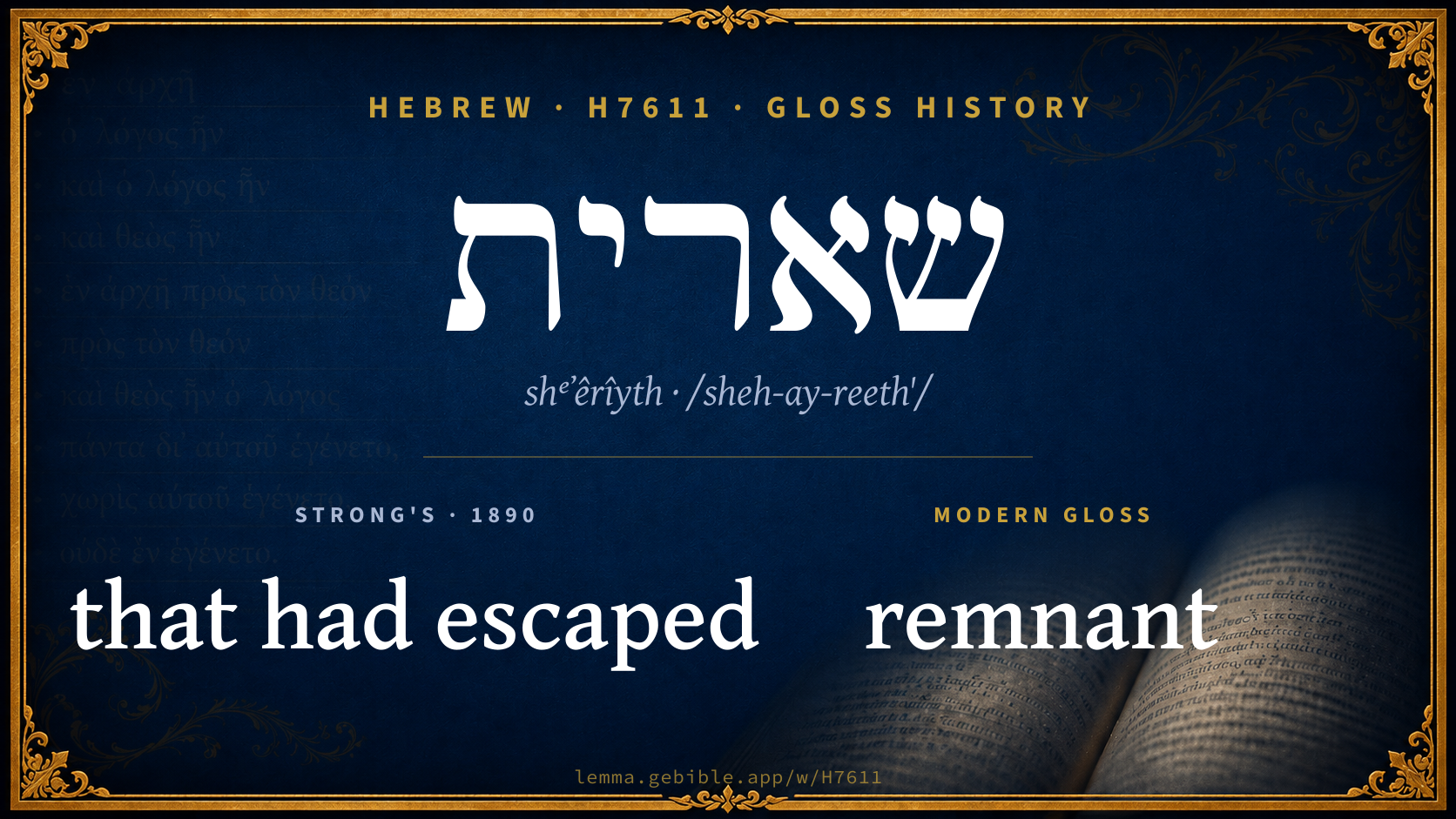
Gloss history
Strong's 1890 vs modern scholarship
About this word
Strong's H7611 catalogs a Hebrew word from the Hebrew Old Testament.
These counts are not copied from any lexicon or concordance. They are computed here, from the morphology-tagged Hebrew Old Testament. What Lemma adds →
- 66
- distinct verses
- The word appears in 66 distinct verses.
- 16 / 39
- OT books
- The word appears in 16 of 39 Old Testament books.
- #594
- by frequency
- Top 1000 most frequent Hebrew words (rank 594 of 8,640 Hebrew words by occurrence).
View all 66 occurrences in the concordance →
By section of the Old Testament
By traditional corpus
Conventional, traditional groupings — biblical authorship is debated, so this is a traditional corpus grouping, not an authorship claim. Each share is this word’s portion of its verses in that division of the Hebrew canon. Each figure is a share of the word’s 66 distinct verses.
- Prophets (Nevi'im) 58 verses · 88%
- Writings (Ketuvim) 7 verses · 11%
- Torah (Pentateuch) 1 verse · 2%
How translations render this word
Counts come from each version’s own published word-to-Strong’s tagging or interlinear alignment — an approximate guide to how each version renders this word, not a word-level alignment the data otherwise carries. Because each total is that version’s own tagged count, the per-version totals vary from one another and need not match the appearance or distinct-verse counts above. These counts may also differ from a printed concordance because Lemma counts each distinctly tagged rendering and does not collapse phrase taggings into a single head-word total. This is a fixed set of word-tagged versions (KJV, ASV, BSB, ULT) and does not change with the reading translation you choose elsewhere. Each version’s license is shown beside its name below (and on Sources).
- King James Version: Remnant 28×, Residue 7×, All the remnant 6×
- American Standard Version: Remnant 31×, All the remnant 6×, Residue 6×
- Berean Standard Bible: Remnant 53×, Rest 8×, Survivors 2×
- unfoldingWord Literal Text: Remnant of 19×, Remnant 18×, Other 3×
King James Version Public Domain
Renders H7611 across 66 tagged occurrences — most commonly:
Plus 19 renderings that appear only once — usually multi-word phrases or single function words the recovered tagging swept in, not distinct renderings.
American Standard Version Public Domain
Renders H7611 across 65 tagged occurrences — most commonly:
Plus 17 renderings that appear only once — usually multi-word phrases or single function words the recovered tagging swept in, not distinct renderings.
Berean Standard Bible Public Domain
Renders H7611 across 66 tagged occurrences — most commonly:
Plus 3 renderings that appear only once — usually multi-word phrases or single function words the recovered tagging swept in, not distinct renderings.
unfoldingWord Literal Text CC BY-SA 4.0
Renders H7611 across 50 tagged occurrences — most commonly:
Plus 6 renderings that appear only once — usually multi-word phrases or single function words the recovered tagging swept in, not distinct renderings.
Senses in the full BDB
What do BDB’s symbols mean?
BDB uses these scholarly abbreviations:
| Symbol | Meaning |
|---|---|
| 𝔊 | the Septuagint (the ancient Greek translation, LXX) |
| 𝔙 | the Vulgate (the Latin translation) |
| 𝔖 | the Syriac version (the Peshitta) |
| 𝔗 | the Targum (the Aramaic translation) |
| ψ | the Psalms |
| √ | root (the underlying root or stem) |
| ‖ | parallel passage (a synonymous or contrasted parallel) |
| † | the dagger: every passage where the word occurs is cited |
The 2 senses and sub-senses the full Brown-Driver-Briggs lexicon distinguishes for this word, in lexicon order (not ranked by frequency), with BDB’s own verbatim wording and sub-sense lettering. Shown in Hebrew script with BDB’s own scholarly abbreviations. The condensed entry is in the Lexicon Entry tab. See also the Forms in the corpus table below.
- 1. rest, what is left, of wood Is 44:17, land 15:9 (‖ פְּלֵיטָה), Je 47:4, 5; Ez 25:16; שׁ׳ חֵמֹת ψ 76:11 is difficult (Gr [cf. Che] proposes חֲמָת Hamath, Du אֻמֹּת tribes); rest of princes Je 39:3, of nations (= the other nations, Toy) Ez 36:3, 4, 5; of Israel 1 Ch 12:39 (van d. H. v 38), 2 Ch 34:9; Ne 7:71 (van d. H. v 72); = last remnant of people, Philistines Am 1:8 (cf. We), Is 14:30, Edom Am 9:12, Anathoth Je 11:23, Ashdod 25:20, Babylon 50:26, Amalek 1 Ch 4:43 (+ הַפְּלֵיטָה), Isr. 2 K 21:14; Je 6:9; 15:9; remnant left after catastrophe Am 5:15; Je 8:3; 24:8; 40:11, 15; 41:10, 16; 42:2, 15, 19; 43:5; 44:12, 14, 28; Ez 5:10; 9:8; 11:13; Hag 1:12, 14; 2:2; even וְשַׂמְתִּי אֶת־הַצֹּלֵעָה לִשׁ׳ Mi 4:7 (as promise, ‖ גּוֹי עָצוּם, cf. GieBeiträge, 42 f.); = survivors Je 44:7, הַשּׁ׳ מִן־הַחֶרֶב 2 Ch 36:20; = faithful remnant of Israel or Judah (term. techn. of proph., cf. שְׁאָר ad fin.), 2 K 19:4 = Is 37:4; 2 K 19:31 (‖ פְּלֵיטָה) = Is 37:32 (‖ id.), Mi 2:12; 5:6, 7; 7:18; Ezr 9:14 (‖ id.), Is 46:3; Je 23:3; 31:7; Zp 2:7, 9 (‖ יֶתֶר), 3:13; Zc 8:6, 11, 12. e.g. Isaiah 44:17
- 2. remainder = descendants (= שְׁאָר Is 14:22): Gn 45:7, שֵׁם וּשׁ׳ 2 S 14:7. e.g. Isaiah 14:22
Senses from the full Brown-Driver-Briggs lexicon (Brown, Driver, Briggs; Oxford 1906 — public domain), digitized via Sefaria, supplemented by the OpenScriptures HebrewLexicon (CC BY 4.0). Full attribution on Sources.
Word origin
n.f. rest, residue, remnant, remainder (= שָׁאָר);—שׁ׳ abs. 2 S 14:7 +, cstr. Ez 36:3 +, שֵׁרִית (Ges§ 23 f) 1 Ch 12:39 (van d. H. v 38); sf. שְׁאֵרִיתֵךְ Is 14:30; Ez 5:10, -תוֹ Is 44:17, -תָם Je 15:9;—
— Brown-Driver-Briggs (Oxford 1906, public domain), digitized via Sefaria, supplemented by the OpenScriptures HebrewLexicon (CC BY 4.0). See Sources.
Derived from שאר (shâʼar) (H7604) — to remain.
Jastrow Dictionary
A second Hebrew/Aramaic lexicon for comparison, covering Aramaic and post-biblical (Talmudic, Targumic, Midrashic) usage that the biblical-Hebrew BDB does not. Matched by lemma rather than by Strong’s number, so a lemma may carry more than one Jastrow headword (shown separately below), and the entries cover usage well beyond the Bible.
שְׁאֵרִית
- preced. wds.) remnant. Tanḥ. ed. Bub., Tol’doth 19 (ref. to Mic. V, 6) אלו ש׳ שאמר וכ׳ this refers to the remnant (of the faithful) concerning whom the Lord said to Elijah &c. (I Kings XIX, 18); Yalk. Jud. 62; Yalk. Mic. 553. e.g. Micah 5:6
A Dictionary of the Targumim, the Talmud Babli and Yerushalmi, and the Midrashic Literature (Marcus Jastrow; London, Luzac, 1903) — Public Domain. Digitized via Sefaria. Digitized via Sefaria. Full attribution on Sources.
Forms in the corpus
The 26 distinct written forms H7611 takes in the Hebrew Bible, most frequent first — each parse links to that state’s occurrences in the concordance. Hebrew forms include their vowel points and cantillation, so a single lemma takes many written forms.
Same root — word family
Other BDB entries built from the same root as H7611, grouped by Strong’s listed origin. These share a root / origin per the lexicon — not necessarily a shared meaning. Each links to that word’s own entry.
Derives from
Shares the same root
- משארת mishʼereth H4863 kneading trough
- שאר sᵉʼôr H7603 leaven
- שאר shᵉʼâr H7605 remnant
- שאר shᵉʼêr H7607 flesh
Compare all same-root words → Showing 4 of 6 — not the complete family. They share a root, not necessarily a meaning.
Septuagint verse parallels
This word appears in 62 verses that also exist in the Greek Old Testament (Septuagint), out of the 66 Hebrew verses it occurs in. You can read those verses in Greek by switching the Old Testament edition to the Septuagint.
Read these verses in the Septuagint
- Genesis 45:7
- 2 Samuel 14:7
- 2 Kings 19:4
- 1 Chronicles 4:43
- 2 Chronicles 34:9
- Ezra 9:14
- Psalms 76:10
- Isaiah 14:30
- Jeremiah 6:9
- Ezekiel 5:10
- Amos 1:8
- Micah 2:12
This is a verse-level parallel only — the same verses exist in both the Hebrew and Greek Old Testaments. No word-level Hebrew↔Greek correspondence is claimed: the data carries no such alignment, so no Greek word is shown as this Hebrew word’s translation. Coverage is not total — the Septuagint omits the deuterocanon and renumbers the Psalms, so some Hebrew verses have no direct Greek parallel.