Jeremiah 40:6

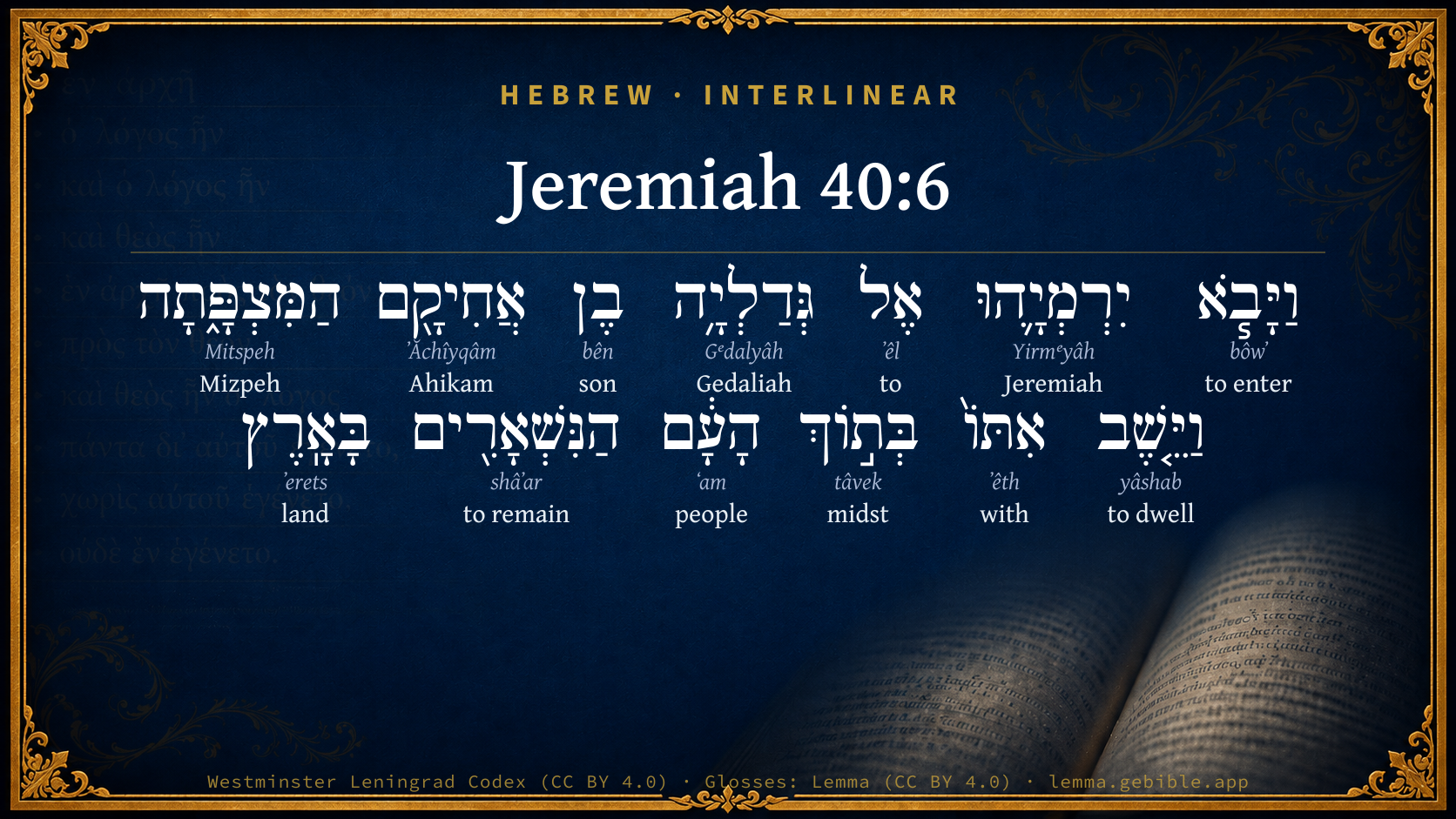
Hebrew (Westminster Leningrad Codex) Jeremiah 40:6 appears in the Hebrew Old Testament. The text above is from the Westminster Leningrad Codex. Each word links to its Strong’s number, a concise gloss, and parsing drawn from the Open Scriptures Hebrew Bible morphology. Click any word for its full Brown-Driver-Briggs (BDB) entry.
Download image
Cite this verse

Jeremiah 40:6 (World English Bible). Public Domain. Lemma interlinear Bible study tool, https://lemma.gebible.app/v/jeremiah/40/6.

Show BibTeX & RIS
BibTeX
RIS
English Translation
Then went Jeremiah to Gedaliah the son of Ahikam to Mizpah, and lived with him among the people who were left in the land.
World English Bible · Public Domain
Download a study sheet

One document with this verse’s original text, its word-by-word gloss line, the meaning frame, cross-references with their text, attributed commentary, and full source and license credits — printable, and it pastes into notes with its structure intact.

This verse Autodidact and up

Study sheet (.html) Plain text (.txt)

A passage Seminary Student

Up to 50 verses in one chapter. A passage sheet keeps up to 6 commentary sources and 12 cross-references per verse, in the order this page ranks them, and says so on the sheet whenever that leaves anything out. Ask for a single verse and you get the Autodidact verse sheet above.

Everything on this page stays free to read, with no account — the sheet is a download of what is already on screen, not access to it.

Want to remove ads? Support Godless Engineer
Compare translations 3

The same verse in 3 English versions, stacked beneath the original-language interlinear above. Click any original word for its lexicon entry.

Each is an independent rendering of the whole verse — the interlinear is not word-aligned to these translations.

Highlighted words mark where these versions differ — a whole-verse word diff, not a word-by-word alignment.

  • World English Bible Public Domain
    Then went Jeremiah to Gedaliah the son of Ahikam to Mizpah, and lived with him among the people who were left in the land.
  • King James Version Public Domain
    Then went Jeremiah unto Gedaliah the son of Ahikam to Mizpah; and dwelt with him among the people that were left in the land.
  • unfoldingWord Literal Text CC BY-SA 4.0
    So Jeremiah went to Gedaliah son of Ahikam, at Mizpah. He stayed with him among the people who were left behind in the land.

unfoldingWord Literal Text — © unfoldingWord, licensed CC BY-SA 4.0. Word-aligned USFM3 via Door43 (git.door43.org/unfoldingWord/en_ult).

Versions to compare (up to 4)

3 of 4 selected

Show all 18 translations

Every available English version of this verse, each an independent rendering of the whole verse.

  • World English Bible Public Domain
    Then went Jeremiah to Gedaliah the son of Ahikam to Mizpah, and lived with him among the people who were left in the land.
  • Berean Standard Bible Public Domain
    So Jeremiah went to Gedaliah son of Ahikam at Mizpah and stayed with him among the people who were left in the land.
  • Majority Standard Bible Public Domain
    So Jeremiah went to Gedaliah son of Ahikam at Mizpah and stayed with him among the people who were left in the land.
  • King James Version Public Domain
    Then went Jeremiah unto Gedaliah the son of Ahikam to Mizpah; and dwelt with him among the people that were left in the land.
  • American Standard Version (1901) Public Domain
    Then went Jeremiah unto Gedaliah the son of Ahikam to Mizpah, and dwelt with him among the people that were left in the land.
  • Revised Version (1885) Public Domain
    Then went Jeremiah unto Gedaliah the son of Ahikam to Mizpah, and dwelt with him among the people that were left in the land.
  • Geneva Bible (1599) Public Domain
    Then went Ieremiah vnto Gedaliah the sonne of Ahikam, to Mizpah, and dwelt there with him among the people that were left in the lande.
  • Douay-Rheims (1899) Public Domain
    And Jeremias went to Godolias the son of Ahicam to Masphath: and dwelt with him in the midst of the people that were left in the land.
  • Young's Literal Translation Public Domain
    and Jeremiah cometh in unto Gedaliah son of Ahikam, to Mizpah, and dwelleth with him, in the midst of the people who are left in the land.
  • Literal Standard Version CC BY-SA 4.0
    and Jeremiah comes to Gedaliah son of Ahikam, to Mizpah, and dwells with him in the midst of the people who are left in the land.
  • Unlocked Literal Bible CC BY-SA 4.0
    So Jeremiah went to Gedaliah son of Ahikam, at Mizpah. He stayed with him among the people who were left behind in the land.
  • unfoldingWord Literal Text CC BY-SA 4.0
    So Jeremiah went to Gedaliah son of Ahikam, at Mizpah. He stayed with him among the people who were left behind in the land.
  • Darby Bible Public Domain
    And Jeremiah came unto Gedaliah the son of Ahikam to Mizpah, and abode with him among the people that remained in the land.
  • World Messianic Bible Public Domain
    Then Jeremiah went to Gedaliah the son of Ahikam to Mizpah, and lived with him among the people who were left in the land.
  • Webster's Bible Public Domain
    Then Jeremiah went to Gedaliah the son of Ahikam to Mizpah; and dwelt with him among the people that were left in the land.
  • Free Bible Version CC BY-SA 4.0
    So Jeremiah went to Gedaliah son of Ahikam at Mizpah and stayed with him with the people who were still left in the country.
  • Bible in Basic English Public Domain
    So Jeremiah went to Gedaliah, the son of Ahikam, in Mizpah, and was living with him among the people who were still in the land.
  • JPS Tanakh (1917) Public Domain
    Then went Jeremiah unto Gedaliah the son of Ahikam to Mizpah, and dwelt with him among the people that were left in the land.

Literal Standard Version (2020), Covenant Press — licensed CC BY-SA 4.0. Text via the HelloAO Bible API (eBible.org). Unlocked Literal Bible (unfoldingWord) — licensed CC BY-SA 4.0. Text via the HelloAO Bible API (eBible.org). unfoldingWord Literal Text — © unfoldingWord, licensed CC BY-SA 4.0. Word-aligned USFM3 via Door43 (git.door43.org/unfoldingWord/en_ult). Free Bible Version, Dr. Jonathan Gallagher — licensed CC BY-SA 4.0. Text via the HelloAO Bible API (eBible.org).

Word by word

More ways to search: Search by grammar → Find every occurrence → Compare this word →

Practice this passage: Drill this verse → Learn its vocabulary →

הַמִּצְפָּ֑תָה
Mitspeh
H4708
“the · Mizpeh · toward”
Particle, Definite Article + Noun, Proper + Suffix, Demonstrative
Part of Speech
Particle + Noun
Type
Proper
Full BDB Definition

Origin: the same as H4707

TWOT: None

Mizpeh = "watchtower" - a city in the district of the Shephelah or lowlands of Judah - a place in Moab on the east of the Jordan - a place in Gilead - a place near Mount Hermon - a place in Benjamin; also 'Mizpah'
  1. וַיָּבֹ֧א bôwʼ H935 “and · to enter” Conjunction + Verb, Qal, Sequential Imperfect, 3rd Person, Masculine, Singular
  2. יִרְמְיָ֛הוּ Yirmᵉyâh H3414 “Jeremiah” Noun, Proper
  3. אֶל ʼêl H413 “to” Preposition
  4. גְּדַלְיָ֥ה Gᵉdalyâh H1436 “Gedaliah” Noun, Proper
  5. בֶן bên H1121 “son of” Noun, Common, Masculine, Singular, Construct
  6. אֲחִיקָ֖ם ʼĂchîyqâm H296 “Ahikam” Noun, Proper
  7. וַיֵּ֤שֶׁב yâshab H3427 “and · to dwell” Conjunction + Verb, Qal, Sequential Imperfect, 3rd Person, Masculine, Singular
  8. אִתּוֹ֙ ʼêth H854 “with · him” Preposition + Suffix, Personal, 3rd Person, Masculine, Singular
  9. בְּת֣וֹךְ tâvek H8432 “in/at · midst of” Preposition + Noun, Common, Masculine, Singular, Construct
  10. הָעָ֔ם ʻam H5971 “the · people” Particle, Definite Article + Noun, Common, Masculine, Singular, Absolute
  11. הַנִּשְׁאָרִ֖ים shâʼar H7604 “the · remaining” Particle, Definite Article + Verb, Niphal, Participle Active, Masculine, Plural, Absolute
  12. בָּאָֽרֶץ ʼerets H776 “in/at the · land” Preposition, Determined + Noun, Common, Both, Singular, Absolute

About this verse

These counts appear in no published source. They are computed here, from the morphology-tagged text and Lemma’s own curated glosses. What Lemma adds →

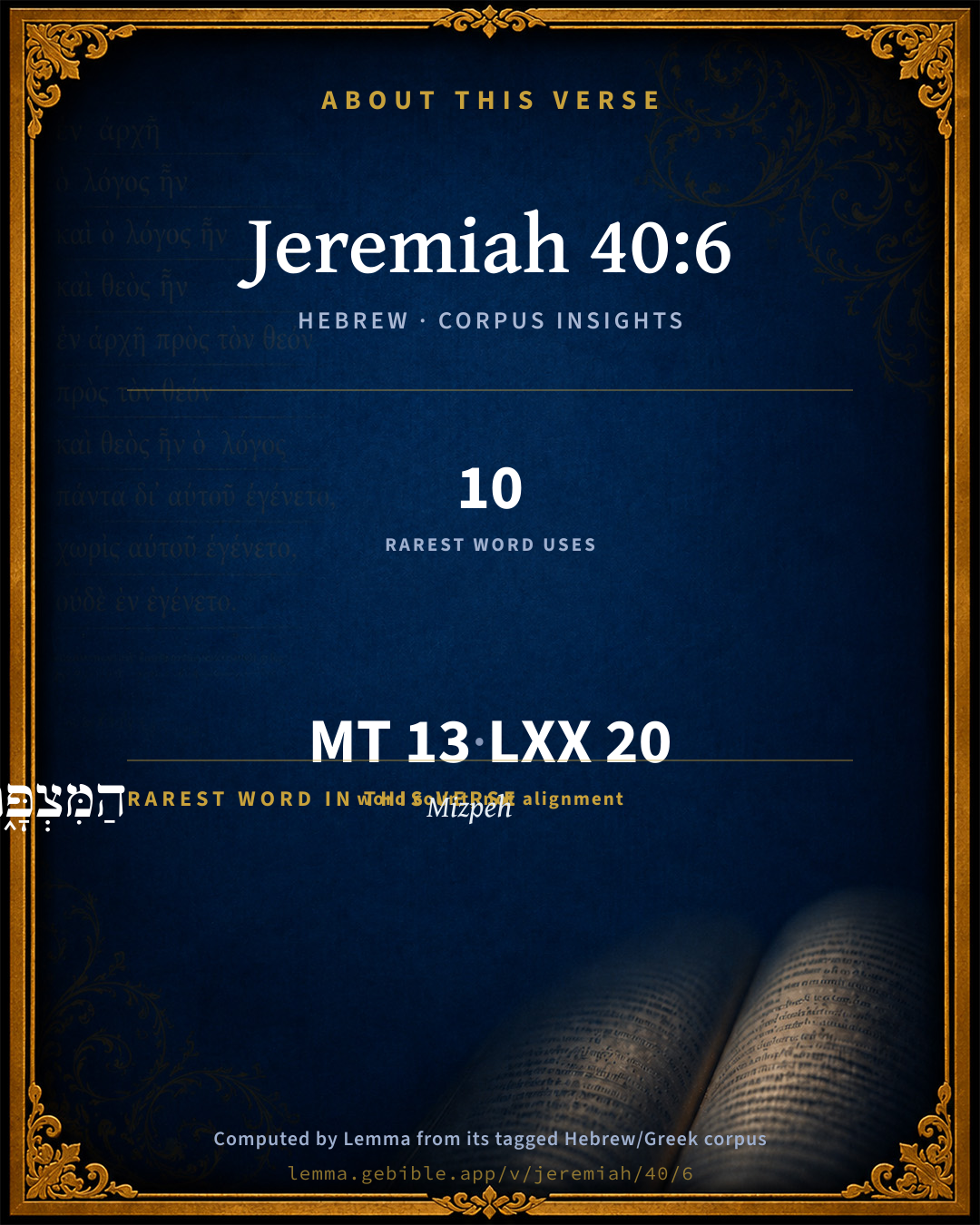
13
words
13
distinct lemmas
Prophets
section

Notable vocabulary

The rarest word here is הַמִּצְפָּ֑תָה Mizpeh H4708 — appearing just 10 times in the whole Hebrew Bible.

Shared distinctive vocabulary

הַמִּצְפָּ֑תָה Mizpeh H4708 occurs in 9 verses of the Hebrew Bible. Also found in:

Grammatical profile

  • 3 verbs
  • 8 nouns
  • 2 prepositions

Verb forms

  • וַיָּבֹ֧א Qal · Sequential Imperfect
  • וַיֵּ֤שֶׁב Qal · Sequential Imperfect
  • הַנִּשְׁאָרִ֖ים Niphal · Participle Active

Hebrew & Septuagint length

In the original languages it is 13 Hebrew tokens and 20 Greek tokens — but the two are counted differently (Hebrew bundles its prefixes and suffixes into one token; the Greek is in lemma form), so that isn’t a like-for-like length.

Cross-references

5

Topical passages linked to Jeremiah 40:6 in the Treasury of Scripture Knowledge — connected by theme and wording, ordered by reader-vote popularity; previews shown in the World English Bible.

  • Judges 20:1 Then all the children of Israel went out, and the congregation was assembled as one man, from Dan even to Beersheba, with the land of Gilead, to Yahweh at Mizpah.
  • Jeremiah 39:14 they sent, and took Jeremiah out of the court of the guard, and committed him to Gedaliah the son of Ahikam, the son of Shaphan, that he should carry him home: so he lived among the people.
  • Judges 21:1 Now the men of Israel had sworn in Mizpah, saying, There shall not any of us give his daughter to Benjamin as wife.
  • 1 Samuel 7:5–6 Samuel said, Gather all Israel to Mizpah, and I will pray for you to Yahweh.
  • Joshua 15:38 and Dilean, and Mizpeh, and Joktheel,

Cross-references courtesy of OpenBible.info (CC BY 4.0).

Hebrew and Greek witnesses Masoretic Hebrew ↔ Greek Septuagint

The same verse in the two great witnesses to the Old Testament, shown verse-for-verse.

These are two independent witnesses, not word-aligned to each other, and the Septuagint is shown in lemma (dictionary) form.

Hebrew Jeremiah 40:6 Masoretic · Westminster Leningrad Codex

וַיָּבֹ֧א יִרְמְיָ֛הוּ אֶל גְּדַלְיָ֥ה בֶן אֲחִיקָ֖ם הַמִּצְפָּ֑תָה וַיֵּ֤שֶׁב אִתּוֹ֙ בְּת֣וֹךְ הָעָ֔ם הַנִּשְׁאָרִ֖ים בָּאָֽרֶץ

Then went Jeremiah to Gedaliah the son of Ahikam to Mizpah, and lived with him among the people who were left in the land.

World English Bible · Public Domain

Greek LXX Structure differs

In the Septuagint, Jeremiah is about an eighth shorter than the Hebrew and arranges its material differently — the Oracles Against the Nations (Hebrew chapters 46–51) appear in the middle of the Greek book, after 25:13. Because the chapter and verse boundaries do not line up, a verse-for-verse comparison with the Hebrew is not shown.

A verse-for-verse comparison isn’t shown here because the chapters and verses don’t line up. Switch to the LXX edition with the MT / LXX toggle above to read the Greek directly.

On this verse, Ellicott's Commentary for English Readers discusses the Septuagint’s reading. Read the note in Commentary ↓

Hebrew: Westminster Leningrad Codex (CC BY 4.0). Greek: Septuagint (public domain); English from a public-domain English Septuagint. How the Septuagint differs from the Hebrew →

Targum (Aramaic paraphrase)

1

The Targum is the ancient Jewish Aramaic paraphrase of the Hebrew Scriptures — an interpretive translation, not the Hebrew text itself. Onkelos (literal) and Pseudo-Jonathan (expansive) render the Torah, and Jonathan the Prophets. Coverage is partial: where no permissively-licensed English translation exists for a verse, only the Aramaic is shown. This is verse-level text, not a word-by-word alignment to the Hebrew.

  1. Targum Jonathan Prophets (Joshua–Malachi)
    וַאֲתָא יִרְמְיָה לְוַת גְדַלְיָה בַּר אֲחִיקָם לְמִצְפְּיָא וִיתֵיב עִמֵיהּ בְּגוֹ עַמָא דְאִשְׁתְּאָרוּ בְּאַרְעָא:

    (no public-domain English translation for this verse)

    Targum Jonathan — Aramaic: “Mikraot Gedolot” (public domain). English: “Sefaria Community Translation” (CC0 1.0 (public-domain dedication)); “London "Chaldee Paraphrase," 1871” (public domain). Text via Sefaria.

Commentary

Notes on Jeremiah 40:6 from classic Christian and Jewish commentators (each source and its license shown beneath its notes). The classic Christian expositions comment on the surrounding passage and are grouped to its opening verse, so a note may address several verses; the Jewish commentaries on the Tanakh (Rashi and others) are per-verse, so they appear only where the commentator wrote on this verse.

Lemma curates 59 commentaries, every one of them public domain or Creative Commons licensed, each selected and text-cleaned for this edition rather than reprinted as found. About our sources →

Trapp's Complete Commentary

John Trapp

Jer 40:6 Then went Jeremiah unto Gedaliah the son of Ahikam to Mizpah; and dwelt with him among the people that were left in the land.

Ver. 6. Then went Jeremiah unto Gedaliah.] Blessing himself from the Chaldeans’ proffered kindness (as Luther also did alate from the great Turk, who invited him to him, and promised him to be his good lord), he maketh Moses’s choice, {Heb 11:25} and David’s, {Psa 84:10} rather to abide with God’s poor people in the promised land, than to be great in the court of Babylon. How few at this day would have been of his mind!

John Trapp, A Commentary or Exposition upon All the Books of the Old and New Testament (1647–1656) — public domain. Text from a community e-Sword module.

Whedon's Commentary on the Bible

Daniel D. Whedon

THE GATHERING OF THE PEOPLE TO GEDALIAH, Jer_40:6-12.

6. Mizpah — In the tribe of Benjamin. Here Samuel judged the people, and here Saul was chosen king. (1Sa_10:17-24.) It is doubtless to be identified with the modern Neby Samuel, which is five miles northward from Jerusalem, and near Ramah. This is to be distinguished from various other places of the same name.

Daniel D. Whedon (gen. ed.), Commentary on the Old and New Testaments (1874–1909) — public domain. Text from a community e-Sword module.

Tyndale Open Study Notes

Tyndale Open Resources

40:6 Gedaliah’s new headquarters were in Mizpah, eight miles north of the ruined Jerusalem.

Tyndale Open Study Notes — © Tyndale Open Resources, licensed CC BY-SA 4.0. Text via the HelloAO Bible API.

Geneva Bible (1599)

Geneva Bible translators

Which was a city of Judah.

Geneva Bible (1599) marginal notes — public domain. Text via Bolls.life.

Jamieson, Fausset & Brown

Robert Jamieson, A. R. Fausset & David Brown

Mizpah--in Benjamin, northwest of Jerusalem (Jer 41:5-6, Jer 41:9). Not the Mizpah in Gilead, beyond Jordan (Jdg 10:17). Jeremiah showed his patriotism and piety in remaining in his country amidst afflictions and notwithstanding the ingratitude of the Jews, rather than go to enjoy honors and pleasures in a heathen court (Heb 11:24-26). This vindicates his purity of motive in his withdrawal (Jer 37:12-14).

Jamieson, Fausset & Brown — Commentary Critical and Explanatory on the Whole Bible (1871) — public domain (CC PDM 1.0). Text via the HelloAO Bible API.

John Calvin's Commentaries

Here is shown to us the firmness of the Prophet, that he hesitated not to reject, what Nebuzaradan kindly offered to him, and yet he might have committed a great offense in making light, as it were, of Chaldea. It was, as we know, a very pleasant country, and very fertile; and tyrants cannot bear their bounty to be despised; for when they are pleased to honor any one, however little may be what they offer, if he refuses, they regard it as a dishonor done to them. The Prophet, then, might have been overcome by modesty and fear, so as to remove to Chaldea. That he dared simply to refuse the offer, and to ask that he might dwell in his own country, was a proof and evidence that he had more concern for religion, and more care for God’s Church, than for all the favors of men, and all that he might have hoped from the wealth of Babylon and Chaldea.

We hence see that the Prophet in receiving presents, accepted of nothing but what he knew would be for the benefit of God’s Church. At the same time he made light of the offense he might have given, when he chose to remain in his own country; for as we have said, it was as though he erected a standard to invite the Jews to return, and thus to prove the truth of his prophecy respecting their exile being temporary, the end of which was to be hoped for after seventy years. For this reason he says, that he went to Gedaliah, and dwelt in the midst of the people, even Of those who remained in the land. It follows, —

John Calvin's Commentaries (1540-1563) — public domain. Text from the Calvin Translation Society English edition (1840s-50s) via the Christian Classics Ethereal Library (ccel.org). Calvin's coverage is partial (roughly two-thirds of the Bible); uncommented books and verses are honest gaps, never fabricated. The 19th-century editor's footnotes and remarks are omitted so the notes are faithfully Calvin's own voice.

Ellicott's Commentary for English Readers

(6) To Mizpah.—The name, which signifies “watch- tower” (Gen_31:49), was naturally not uncommon. Of the six or seven cities that were so called, that which comes before us here was Mizpah of Benjamin (Jos_18:25-26), prominent in the history of Samuel and Saul (1Sa_7:5-13; 1Sa_10:17-25), not far from Gibeah of Saul (Isa_10:29; Jdg_19:13). It has been identified by Dr. Robinson (Bibl. Res. i. 460) with Neby-Samwil, about six miles north of Jerusalem. Dean Stanley, Mr. Grove, and Dr. Bonar, however, find it in the ridge which forms a continuation of the Mount of Olives on the north, and which Josephus (Wars, v. 2), apparently giving the Greek equivalent of the old Hebrew name, calls Skopos, or “the watch-tower.” Mizpah, it may be noted, is twice translated Skopia in the LXX. version (Hos_5:1; 1Sa_22:3). It will be seen that the latter identification fits in better with the narrative than the former.

A Bible Commentary for English Readers, edited by Charles John Ellicott (1878–1897) — public domain. Text from a community e-Sword module.

John Gill's Exposition

Then went Jeremiah to Gedaliah the son of Ahikam to Mizpah,.... A city in the tribe of Benjamin, not far from Ramathon; which, as Josephus says, was about five miles from Jerusalem. Jeremiah took the captain's advice, though it might have been better with him had he gone along with him to Babylon; but he chose rather to dwell in his own land, and suffer affliction with the people of God, than to dwell at ease in a foreign and idolatrous land:

and dwelt with him among the people that were left in the land; among the poor people that Nebuzaradan left, who dwelt either at Mizpah or at Anathoth, and lived as they did.

John Gill's Exposition of the Whole Bible (1746–1763) — public domain (CC PDM 1.0). Text via the HelloAO Bible API.

Haydock's Catholic Bible Commentary

Masphath; because it was near Jerusalem, and an ancient place of devotion. (Calmet)

George Leo Haydock (1774–1849), Haydock's Catholic Family Bible and Commentary, 1859 edition — public domain. Excludes Psalms (Douay-Rheims chapter numbering differs from Protestant) and Deuterocanonical books (Catholic canon only).

Matthew Poole's English Annotations

Mizpah was built by Asa, 1Ki 15:22, or rather enlarged or further built, for we read of it as a city belonging to the tribe of Benjamin, Jos 18:26.

Matthew Poole's English Annotations on the Holy Bible (1683–1685) — public domain. Text from a community e-Sword/MySword module.

The Pulpit Commentary

To Mizpah. A place in the tribe of Benjamin, where Samuel judged, and where Saul was elected king. (1Sa_7:15, 16 10:17)

The choice of a residence.

The captain of the guard gave to Jeremiah the choice between an honourable asylum in Babylon and a return to his own land. The prophet selected the latter course. Why did he do so? Although the circumstances of the case were peculiar, the answer to this question may throw light on some of the considerations which should guide men generally in the selection of their places of abode. Several characteristics may be noted in Jeremiah"s decision, viz.:

I PATRIOTISM. Jeremiah had been accused of a treasonable friendship for Babylon. His conduct in deciding to remain in his native land, wrecked and deserted as it was after the war, in preference to enjoying the position of a privileged guest at Babylon, is an ample refutation of all such charges. Patriotism is more than a sense of duty, it is an affection. It does not speak much for the depth of a man"s nature that he can leave his native country without a sigh of regret. If we find it necessary to emigrate, genuine patriotism will certainly incline us to settle in one of the colonies of the British Empire rather than in a foreign country. This point should be insisted on as a duty, not merely treated as a question of sentiment.

II CONSIDERATION FOR RELIGIOUS ASSOCIATIONS. Babylon was a heathen city. Jeremiah preferred to remain in the Holy Land. Surely the religious advantages of a neighbourhood should he taken into account as of first importance. Yet many people seem to be strangely blind to all such considerations. The soil, the scenery, the society, the convenience of the house, are duly considered; but the Church accommodation is scarcely thought of. A gravel soil is most essential; healthy religious influences are regarded as of very secondary interest. A beautiful view must be got, though the enjoyment of it means banishment from all healthy Church life. How strange that heads of families professing to be Christian should act like pagans in this matter, and care so little for the spiritual atmosphere in which their children are to be brought up!

III THE SACRIFICE OF PERSONAL CONVENIENCE TO THE GOOD OF OTHERS. Ezekiel could minister to the captives in Babylon. Jeremiah had his work in comforting the remnant in the land of Israel. If he had consulted his own convenience, he might have accepted the offer of a safe and probably honourable position in the land of exile. But he had his work to do at home, and he stayed to do it. Such conduct is a fine example to those of us who, in choosing a place of residence, think of our own pleasure and profit rather than of the good we may do. More especially does this apply to Christian ministers. If the choice lay between easy work in a beautiful place in Devonshire, and the toil of service amid all the squalor and ugliness and wretchedness of a densely populated district in the east end of London, should we be willing to choose the harder but more useful life?

IV CONTENTMENT AND SIMPLICITY. These are minor characteristics of the choice of Jeremiah, but they are not without their significance. Jeremiah was satisfied to stay in the old land with the poor, after the wealthy and great had been banished. To the luxuries of court life at Babylon he preferred the homely ways of the peasants of Israel. In abandoning simplicity for display and excitement, the fashion of our age drives men and women to a life that is neither healthy nor happy. Even if the outward surroundings of a quieter life are not so attractive, its true experience will give a restfulness and a satisfaction that cannot be found in the race of worldly pleasures be when the work is that of reconstruction! Gedaliah has to begin, as it were, at the beginning. One of his first difficulties is to know exactly what he has to deal with. There are turbulent as well as peaceful dements, bands of free-lances, who, now that the Chaldean has gone, make their appearance before the governor to see what the prospect may be. Another difficulty is that of inspiring confidence. Those who have just been plundered may be excused for apprehensions lest they should soon be plundered again. On the other hand, Gedaliah was better off than the king who had just been dethroned. The latter vainly held on to a tottering building, whose very foundations were going, while the former was free from the pernicious elements which so long had made all government in the land an abomination. With all his difficulties, Gedaliah had some encouragements. There appears to have been a general gathering to him as a centre. Most men generally tend to the point where there are the greatest prospects of social order, security, and stability. Y.

The Pulpit Commentary (1880–1919), ed. H.D.M. Spence-Jones & Joseph S. Exell — public domain. Text from a community e-Sword module.

Lesson kit

Teaching starters — assembled from the data on this page, not authored interpretation. Every prompt links to the verse data it draws on. Edit before teaching.

Jeremiah, in the Prophets, opens this verse with 13 words (13 distinct Hebrew lemmas). Its most distinctive word is Mitspeh (“Mizpeh”). A historical commentator’s framing appears above. Read the whole chapter for the surrounding context.

Discussion questions

  1. What does “Mizpeh” (Mitspeh) contribute to the verse as a whole?
  2. How does Joshua 11:8, which shares the word «Mizpeh», read alongside this verse?
  3. These translations render this verse differently; the difference is in the English rendering, not the original. What questions does that raise?
  4. «וַיָּבֹ֧א» is a Qal Sequential Imperfect verb. How does that grammatical form shape the action described?
  5. Compare how Trapp's Complete Commentary and Whedon's Commentary on the Bible read this verse. Where do they agree or differ?

Things to notice

Reading settings

Reading text

Shown beneath each verse's original-language words.

Old Testament
Old Testament edition

Read the OT as the Masoretic Hebrew (MT) or the Greek Septuagint (LXX).

English shown for the Greek Septuagint (in the Hebrew ↔ Greek comparison).

Comparing translations? Open the Compare panel on any verse page to stack up to four side by side.