
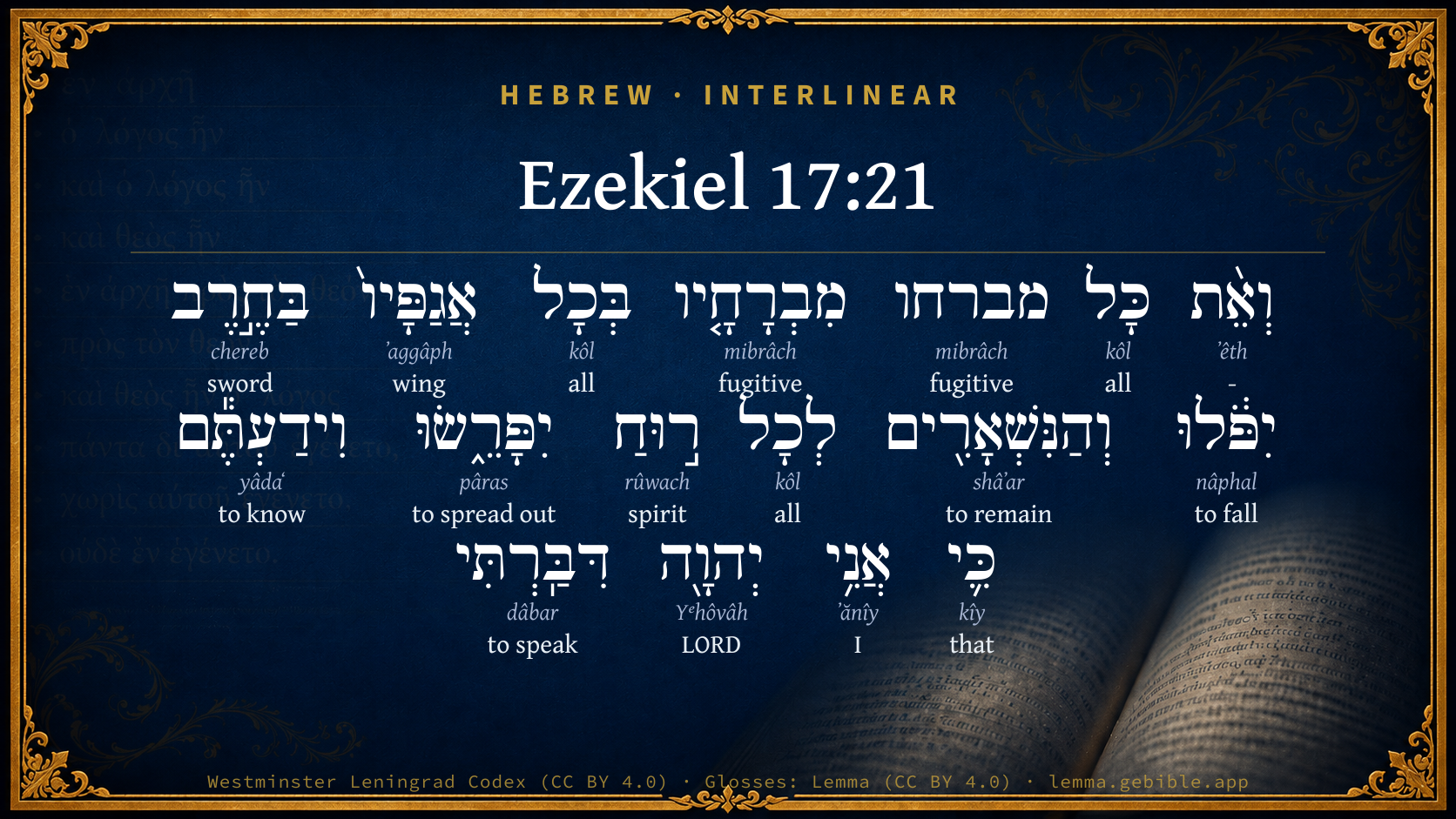
Ezekiel 17:21

Hebrew (Westminster Leningrad Codex) Ezekiel 17:21 appears in the Hebrew Old Testament. The text above is from the Westminster Leningrad Codex. Each word links to its Strong’s number, a concise gloss, and parsing drawn from the Open Scriptures Hebrew Bible morphology. Click any word for its full Brown-Driver-Briggs (BDB) entry.
Download image
Cite this verse

Ezekiel 17:21 (World English Bible). Public Domain. Lemma interlinear Bible study tool, https://lemma.gebible.app/v/ezekiel/17/21.

Show BibTeX & RIS
BibTeX
RIS
English Translation
All his fugitives in all his bands shall fall by the sword, and those who remain shall be scattered toward every wind: and you shall know that I, Yahweh, have spoken it.
World English Bible · Public Domain
Highlights
  • 1 first appearance in the Hebrew Bible
Full analysis ↓
Download a study sheet

One document with this verse’s original text, its word-by-word gloss line, the meaning frame, cross-references with their text, attributed commentary, and full source and license credits — printable, and it pastes into notes with its structure intact.

This verse Autodidact and up

Study sheet (.html) Plain text (.txt)

A passage Seminary Student

Up to 50 verses in one chapter. A passage sheet keeps up to 6 commentary sources and 12 cross-references per verse, in the order this page ranks them, and says so on the sheet whenever that leaves anything out. Ask for a single verse and you get the Autodidact verse sheet above.

Everything on this page stays free to read, with no account — the sheet is a download of what is already on screen, not access to it.

Want to remove ads? Support Godless Engineer
Compare translations 3

The same verse in 3 English versions, stacked beneath the original-language interlinear above. Click any original word for its lexicon entry.

Each is an independent rendering of the whole verse — the interlinear is not word-aligned to these translations.

Highlighted words mark where these versions differ — a whole-verse word diff, not a word-by-word alignment.

  • World English Bible Public Domain
    All his fugitives in all his bands shall fall by the sword, and those who remain shall be scattered toward every wind: and you shall know that I, Yahweh, have spoken it.
  • King James Version Public Domain
    And all his fugitives with all his bands shall fall by the sword, and they that remain shall be scattered toward all winds: and ye shall know that I the LORD have spoken it.
  • unfoldingWord Literal Text CC BY-SA 4.0
    All of his refugees in his armies will fall by the sword, and the ones who remain will be scattered in every direction. Then you will know that I am Yahweh; I have declared this would happen.”

unfoldingWord Literal Text — © unfoldingWord, licensed CC BY-SA 4.0. Word-aligned USFM3 via Door43 (git.door43.org/unfoldingWord/en_ult).

Versions to compare (up to 4)

3 of 4 selected

Show all 18 translations

Every available English version of this verse, each an independent rendering of the whole verse.

  • World English Bible Public Domain
    All his fugitives in all his bands shall fall by the sword, and those who remain shall be scattered toward every wind: and you shall know that I, Yahweh, have spoken it.
  • Berean Standard Bible Public Domain
    All his choice troops will fall by the sword, and those who survive will be scattered to every wind. Then you will know that I, the LORD, have spoken.’
  • Majority Standard Bible Public Domain
    All his choice troops will fall by the sword, and those who survive will be scattered to every wind. Then you will know that I, the LORD, have spoken.’
  • King James Version Public Domain
    And all his fugitives with all his bands shall fall by the sword, and they that remain shall be scattered toward all winds: and ye shall know that I the LORD have spoken it.
  • American Standard Version (1901) Public Domain
    And all his fugitives in all his bands shall fall by the sword, and they that remain shall be scattered toward every wind: and ye shall know that I, Jehovah, have spoken it.
  • Revised Version (1885) Public Domain
    And all his fugitives in all his bands shall fall by the sword, and they that remain shall be scattered toward every wind: and ye shall know that I the LORD have spoken it.
  • Geneva Bible (1599) Public Domain
    And all that flee from him with all his hoste, shall fall by the sword, and they that remaine, shalbe scattered towarde all the windes: and ye shall know that I the Lord haue spoken it.
  • Douay-Rheims (1899) Public Domain
    And all his fugitives with all his bands shall fall by the sword: and the residue shall be scattered into every wind: and you shall know that I the Lord have spoken.
  • Young's Literal Translation Public Domain
    And all his fugitives, with all his bands, By sword do fall, and those remaining, To every wind they are spread out, And ye have known that I, Jehovah, have spoken.
  • Literal Standard Version CC BY-SA 4.0
    And all his fugitives, with all his bands, || Fall by sword, and those remaining, || They are spread out to every wind, || And you have known that I, YHWH, have spoken.
  • Unlocked Literal Bible CC BY-SA 4.0
    All of his refugees in his armies will fall by the sword, and the ones who remain will be scattered in every direction. Then you will know that I am Yahweh; I have declared this would happen.”
  • unfoldingWord Literal Text CC BY-SA 4.0
    All of his refugees in his armies will fall by the sword, and the ones who remain will be scattered in every direction. Then you will know that I am Yahweh; I have declared this would happen.”
  • Darby Bible Public Domain
    And all his fugitives with all his bands shall fall by the sword, and they that remain shall be scattered toward every wind; and ye shall know that I Jehovah have spoken.
  • World Messianic Bible Public Domain
    All his fugitives in all his bands will fall by the sword, and those who remain will be scattered toward every wind. Then you will know that I, the LORD, have spoken it.’
  • Webster's Bible Public Domain
    And all his fugitives with all his bands shall fall by the sword, and they that remain shall be scattered towards all winds: and ye shall know that I the LORD have spoken it.
  • Free Bible Version CC BY-SA 4.0
    All his best soldiers will be killed in battle, and those who do survive will be scattered in all directions. Then you will know that I, the Lord, have spoken.
  • Bible in Basic English Public Domain
    All his best fighting-men will be put to the sword, and the rest will be sent away to every wind: and you will be certain that I the Lord have said it.
  • JPS Tanakh (1917) Public Domain
    And all his mighty men in all his bands shall fall by the sword, and they that remain shall be scattered toward every wind; and ye shall know that I the LORD have spoken it.

Literal Standard Version (2020), Covenant Press — licensed CC BY-SA 4.0. Text via the HelloAO Bible API (eBible.org). Unlocked Literal Bible (unfoldingWord) — licensed CC BY-SA 4.0. Text via the HelloAO Bible API (eBible.org). unfoldingWord Literal Text — © unfoldingWord, licensed CC BY-SA 4.0. Word-aligned USFM3 via Door43 (git.door43.org/unfoldingWord/en_ult). Free Bible Version, Dr. Jonathan Gallagher — licensed CC BY-SA 4.0. Text via the HelloAO Bible API (eBible.org).

Word by word

More ways to search: Search by grammar → Find every occurrence → Compare this word →

Practice this passage: Drill this verse → Learn its vocabulary →

מברחו
mibrâch
H4015
“fugitive · his”
Noun, Common, Masculine, Singular, Construct + Suffix, Personal, 3rd Person, Masculine, Singular
Part of Speech
Noun
Type
Common
Gender
Masculine
Number
Singular
State
Construct
Full BDB Definition

Origin: from H1272

TWOT: 284c

fugitive, flight
  1. וְאֵ֨ת ʼêth H853 “and · -” Conjunction + Particle, Direct Object
  2. כָּל kôl H3605 “all of” Noun, Common, Masculine, Singular, Construct
  3. מִבְרָחָ֤יו mibrâch H4015 “fugitives · his” Noun, Common, Masculine, Plural, Construct + Suffix, Personal, 3rd Person, Masculine, Singular
  4. בְּכָל kôl H3605 “in/at · all of” Preposition + Noun, Common, Masculine, Singular, Construct
  5. אֲגַפָּיו֙ ʼaggâph H102 “wings · his” Noun, Common, Masculine, Plural, Construct + Suffix, Personal, 3rd Person, Masculine, Singular
  6. בַּחֶ֣רֶב chereb H2719 “in/at the · sword” Preposition, Determined + Noun, Common, Feminine, Singular, Absolute
  7. יִפֹּ֔לוּ nâphal H5307 “to fall” Verb, Qal, Imperfect, 3rd Person, Masculine, Plural
  8. וְהַנִּשְׁאָרִ֖ים shâʼar H7604 “and · the · remaining” Conjunction + Particle, Definite Article + Verb, Niphal, Participle Active, Masculine, Plural, Absolute
  9. לְכָל kôl H3605 “to/for · all of” Preposition + Noun, Common, Masculine, Singular, Construct
  10. ר֣וּחַ rûwach H7307 “spirit” Noun, Common, Both, Singular, Absolute
  11. יִפָּרֵ֑שׂוּ pâras H6566 “to spread out” Verb, Niphal, Imperfect, 3rd Person, Masculine, Plural
  12. וִידַעְתֶּ֕ם yâdaʻ H3045 “and · to know” Conjunction + Verb, Qal, Perfect, 2nd Person, Masculine, Plural
  13. כִּ֛י kîy H3588 “that” Conjunction
  14. אֲנִ֥י ʼănîy H589 “I” Pronoun, Personal, 1st Person, Common, Singular
  15. יְהוָ֖ה Yᵉhôvâh H3068 “LORD” Noun, Proper
  16. דִּבַּֽרְתִּי dâbar H1696 “to speak” Verb, Piel, Perfect, 1st Person, Common, Singular

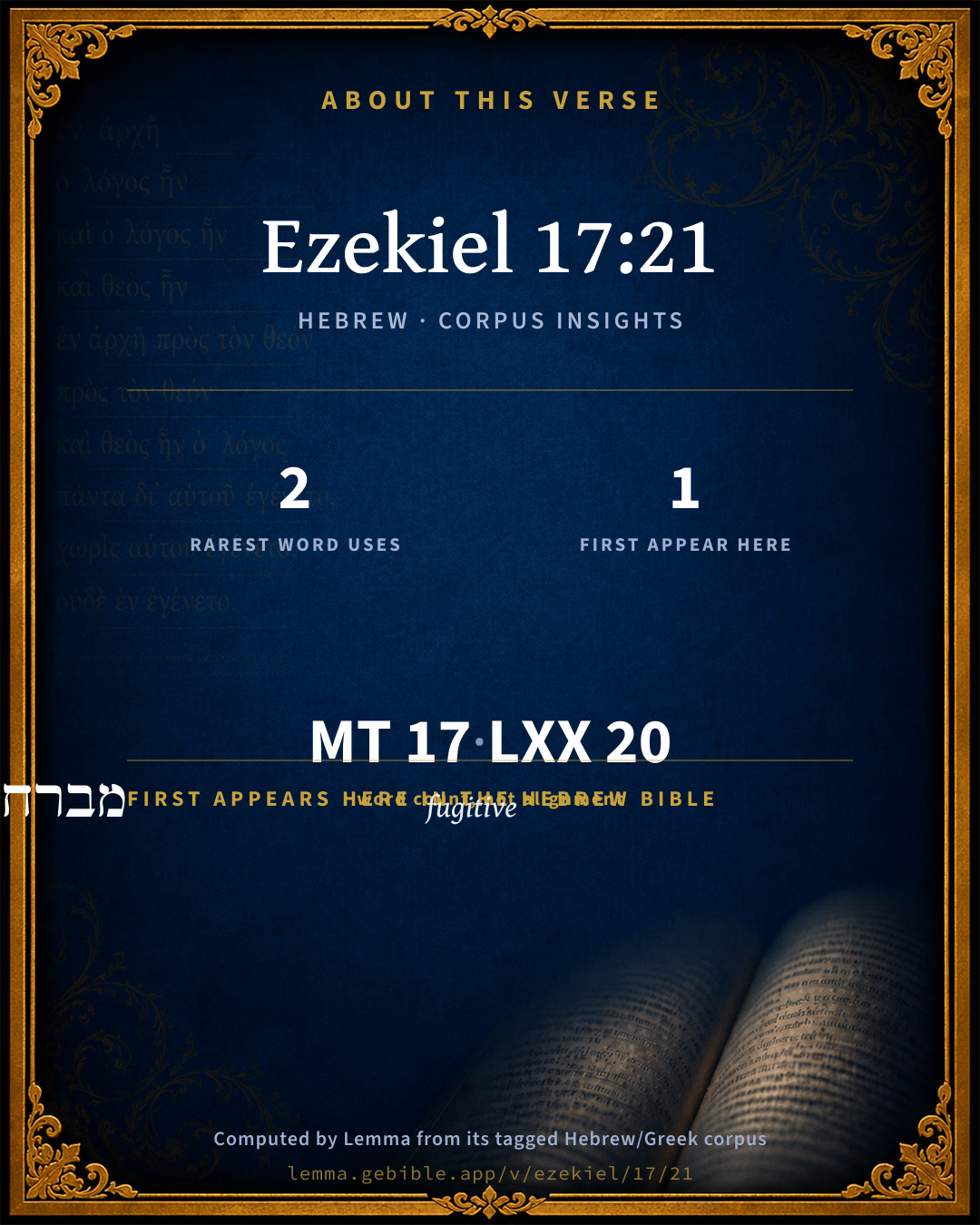
About this verse

These counts appear in no published source. They are computed here, from the morphology-tagged text and Lemma’s own curated glosses. What Lemma adds →

17
words
14
distinct lemmas
Prophets
section

Notable vocabulary

The rarest word here is מברחו fugitive H4015 — appearing just 2 times in the whole Hebrew Bible.

First appearance in Scripture

This word makes its first canonical appearance in the Hebrew Bible here:

  • מברחו fugitive H4015

Grammatical profile

  • 5 verbs
  • 9 nouns
  • 1 pronoun
  • 1 conjunction
  • 1 particle

Verb forms

  • יִפֹּ֔לוּ Qal · Imperfect
  • וְהַנִּשְׁאָרִ֖ים Niphal · Participle Active
  • יִפָּרֵ֑שׂוּ Niphal · Imperfect
  • וִידַעְתֶּ֕ם Qal · Perfect
  • דִּבַּֽרְתִּי Piel · Perfect

Repetition

Words recur within this verse — often emphatic in Hebrew:

  • כָּל all H3605 ×3
  • מברחו fugitive H4015 ×2

Hebrew & Septuagint length

In English translation the verse runs 32 words from the Hebrew and 31 from the Septuagint (LXX English) — closely comparable.

A rough comparison of the two English renderings, which tokenize alike — not a word-level alignment.

Word counts can differ between the Hebrew and the Greek without any difference in meaning — e.g. the Hebrew direct-object marker אֵת has no separate Greek word, and Greek often adds the article ὁ.

In the original languages it is 17 Hebrew tokens and 20 Greek tokens — but the two are counted differently (Hebrew bundles its prefixes and suffixes into one token; the Greek is in lemma form), so that isn’t a like-for-like length.

Cross-references

15

Topical passages linked to Ezekiel 17:21 in the Treasury of Scripture Knowledge — connected by theme and wording, ordered by reader-vote popularity; previews shown in the World English Bible.

  • 2 Kings 25:5 But the army of the Chaldeans pursued after the king, and overtook him in the plains of Jericho; and all his army was scattered from him.
  • 2 Kings 25:11 The residue of the people who were left in the city, and those who fell away, who fell to the king of Babylon, and the residue of the multitude, did Nebuzaradan the captain of the guard carry away captive.
  • Ezekiel 5:12 A third part of you shall die with the pestilence, and with famine shall they be consumed in the midst of you; and a third part shall fall by the sword round about you; and a third part I will scatter to all the winds, and will draw out a sword after them.
  • Ezekiel 12:14 I will scatter toward every wind all who are round about him to help him, and all his bands; and I will draw out the sword after them.
  • Isaiah 26:11 Yahweh, your hand is lifted up, yet they don't see: but they shall see [your] zeal for the people, and be disappointed; yes, fire shall devour your adversaries.
  • Jeremiah 48:44 He who flees from the fear shall fall into the pit; and he who gets up out of the pit shall be taken in the snare: for I will bring on him, even on Moab, the year of their visitation, says Yahweh.
  • Jeremiah 52:8 But the army of the Chaldeans pursued after the king, and overtook Zedekiah in the plains of Jericho; and all his army was scattered from him.
  • Ezekiel 5:10 Therefore the fathers shall eat the sons in the midst of you, and the sons shall eat their fathers; and I will execute judgments on you; and the whole remnant of you will I scatter to all the winds.
  • Ezekiel 6:7 The slain shall fall in the midst of you, and you shall know that I am Yahweh.
  • Ezekiel 6:10 They shall know that I am Yahweh: I have not said in vain that I would do this evil to them.
  • Ezekiel 13:14 So will I break down the wall that you have daubed with whitewash, and bring it down to the ground, so that the foundation of it shall be uncovered; and it shall fall, and you shall be consumed in the midst of it: and you shall know that I am Yahweh.
  • Ezekiel 13:23 Therefore you shall no more see false visions, nor practice divination. I will deliver my people out of your hand; and you shall know that I am Yahweh.
  • Ezekiel 15:7 I will set my face against them; they shall go forth from the fire, but the fire shall devour them; and you shall know that I am Yahweh, when I set my face against them.
  • Amos 9:1 I saw the Lord standing beside the altar, and he said, "Strike the tops of the pillars, that the thresholds may shake; and break them in pieces on the head of all of them; and I will kill the last of them with the sword: there shall not one of them flee away, and there shall not one of them escape.
  • Amos 9:9–10 "For, behold, I will command, and I will sift the house of Israel among all the nations, as grain is sifted in a sieve, yet not the least kernel will fall on the earth.

Cross-references courtesy of OpenBible.info (CC BY 4.0).

Hebrew and Greek witnesses Masoretic Hebrew ↔ Greek Septuagint

The same verse in the two great witnesses to the Old Testament, shown verse-for-verse.

These are two independent witnesses, not word-aligned to each other, and the Septuagint is shown in lemma (dictionary) form.

Hebrew Ezekiel 17:21 Masoretic · Westminster Leningrad Codex

וְאֵ֨ת כָּל מברחו מִבְרָחָ֤יו בְּכָל אֲגַפָּיו֙ בַּחֶ֣רֶב יִפֹּ֔לוּ וְהַנִּשְׁאָרִ֖ים לְכָל ר֣וּחַ יִפָּרֵ֑שׂוּ וִידַעְתֶּ֕ם כִּ֛י אֲנִ֥י יְהוָ֖ה דִּבַּֽרְתִּי

All his fugitives in all his bands shall fall by the sword, and those who remain shall be scattered toward every wind: and you shall know that I, Yahweh, have spoken it.

World English Bible · Public Domain

Greek LXX Ezekiel 17:21 Septuagint · lemma form

ἐν πᾶς παράταξις αὐτός ἐν ῥομφαία πίπτω καί ὁ κατάλοιπος εἰς πᾶς ἄνεμος διασπείρω καί ἐπιγιγνώσκω διότι ἐγώ κύριος λαλέω

In every battle of his they shall fall by the sword, and I will scatter his remnant to every wind: and you⌃ shall know that I the Lord have spoken it.

LXX2012 (modern English Septuagint) · Public Domain

Hebrew: Westminster Leningrad Codex (CC BY 4.0). Greek: Septuagint (public domain); English from LXX2012 (modern English Septuagint) (Public Domain). How the Septuagint differs from the Hebrew →

Targum (Aramaic paraphrase)

1

The Targum is the ancient Jewish Aramaic paraphrase of the Hebrew Scriptures — an interpretive translation, not the Hebrew text itself. Onkelos (literal) and Pseudo-Jonathan (expansive) render the Torah, and Jonathan the Prophets. Coverage is partial: where no permissively-licensed English translation exists for a verse, only the Aramaic is shown. This is verse-level text, not a word-by-word alignment to the Hebrew.

  1. Targum Jonathan Prophets (Joshua–Malachi)
    וְיַת כָּל גַבְּרוֹהִי בְּכָל מַשִׁרְיָתֵיהּ בְּחַרְבָּא יִתְקַטְלוּן וּדְיִשְׁתָּאֲרוּן לְכָל רוּחַ יִתְבַּדְרוּן וְתֵידְעוּן אֲרֵי אֲנָא יְיָ גְזָרֵית בְּמֵימְרִי:

    (no public-domain English translation for this verse)

    Targum Jonathan — Aramaic: “Mikraot Gedolot” (public domain). English: “Sefaria Community Translation” (CC0 1.0 (public-domain dedication)); “London "Chaldee Paraphrase," 1871” (public domain). Text via Sefaria.

Commentary

Notes on Ezekiel 17:21 from classic Christian and Jewish commentators (each source and its license shown beneath its notes). The classic Christian expositions comment on the surrounding passage and are grouped to its opening verse, so a note may address several verses; the Jewish commentaries on the Tanakh (Rashi and others) are per-verse, so they appear only where the commentator wrote on this verse.

Lemma curates 59 commentaries, every one of them public domain or Creative Commons licensed, each selected and text-cleaned for this edition rather than reprinted as found. About our sources →

Trapp's Complete Commentary

John Trapp

Eze 17:21 And all his fugitives with all his bands shall fall by the sword, and they that remain shall be scattered toward all winds: and ye shall know that I the LORD have spoken [it].

Ver. 21. And all his fugitives.] See on Eze 14:13-14.

They shall know.] Sero sapient: vexatio tandem dabit intellectum. All too late they shall aknowledge it.

John Trapp, A Commentary or Exposition upon All the Books of the Old and New Testament (1647–1656) — public domain. Text from a community e-Sword module.

Jamieson, Fausset & Brown

Robert Jamieson, A. R. Fausset & David Brown

all his fugitives--the soldiers that accompany him in his flight.

Jamieson, Fausset & Brown — Commentary Critical and Explanatory on the Whole Bible (1871) — public domain (CC PDM 1.0). Text via the HelloAO Bible API.

Adam Clarke's Commentary

Verse 21. All his fugitives] All who attempted to escape with him, and all that ran to Egypt, &c., shall fall by the sword.

Adam Clarke's Commentary on the Bible (1810–1826) — public domain. Text from a community e-Sword/MySword module.

John Calvin's Commentaries

The Prophet now descends to the whole people, especially to the soldiers, whom Zedekiah himself thought would be fit guardians of the city. He says, then, thus shall all his forces be dissipated, so that they shall be dispersed hither and thither and all by the sword. By these words he means the slaughter of the army, since as long as soldiers stand in their own ranks they sustain and repel a hostile attack; but when they are dispersed, every one is subject to the enemy, and hence a promiscuous slaughter arises. He says, therefore, that Zedekiah’s soldiers would be fugitives amidst all their bands: that is, although he had a large army, yet all his forces should be dispersed, and while each should consult his own advantage, he should fall into the enemy’s hands: thus, all shall fall by the sword; then those who remain shall be dispersed towards every wind. We saw the same thing before, for when the Prophet had declared that all the people should suffer by the sword, he added, at the same time, that all the survivors should be fugitives, just as if any one should throw out refuse or hair which the wind would blow hither and thither. Hence he repeats the same now, namely, that the whole people would be like a torn body, since if they escaped the sword, yet they would find no place of rest. Hence while a few would flee to Egypt, some to the Moabites, and others to the neighboring nations, the whole body of the people, would be dissipated. He adds, and you shall know that I Jehovah have spoken. We have explained the meaning of this, and why the Prophet repeats it so often, namely, because the Jews were untractable and derided all God’s threats: the Prophet teaches that they should really feel that he had spoken, and this is the wisdom of fools, as the common proverb expresses it. For because they do not obey any counsels, nor admit any admonitions, and receive no teaching, they are instructed only by the event itself. It follows —

John Calvin's Commentaries (1540-1563) — public domain. Text from the Calvin Translation Society English edition (1840s-50s) via the Christian Classics Ethereal Library (ccel.org). Calvin's coverage is partial (roughly two-thirds of the Bible); uncommented books and verses are honest gaps, never fabricated. The 19th-century editor's footnotes and remarks are omitted so the notes are faithfully Calvin's own voice.

The Cambridge Bible for Schools and Colleges

gen. ed. J. J. S. Perowne

21. all his fugitives] The form of word does not otherwise occur, but has been so understood by some ancient versions. Others as Targ., Syr., assume a transposition of two letters and render: his choice men; and so many moderns (cf. ch. Eze_23:7; Dan_11:15). This last reading is found in a number of MSS. Cf. ch. Eze_5:2; Eze_5:12, Eze_6:10; Eze_6:13, Eze_12:12 seq.

The Cambridge Bible for Schools and Colleges (gen. ed. J. J. S. Perowne; Cambridge University Press, 1878–1918) — public domain. Text from a community e-Sword module.

John Gill's Exposition

In the mountain of the height of Israel will I plant it,.... In the highest part of the land of Israel, as Jerusalem is said to be by the Jewish writers; the land of Israel, they say, particularly Kimchi upon the place, was higher than all other lands, and Jerusalem was the highest part of that land; here the Messiah preached and wrought his miracles, even in the mountain of the Lord's house, the temple; and here the first Christian church was planted and established:

and it shall bring forth boughs, and bear fruit, and be a goodly cedar; that is, the tender twig or branch cropped off, set and planted as before described: by the "boughs" or "branches" it brings forth may be meant believers, who are as branches in Christ; are of the same nature with him, united to him; have a communication of life and grace from him; are supported and strengthened by him; and so, abiding in him, persevere to the end; see Joh 15:4; and the same may be said of particular churches; and by "fruit" it is said to bear may be designed the persons of the chosen, redeemed, and called; who are the fruit of Christ's death, and of the ministration of his Gospel, Joh 12:24; or the blessings of grace which are in him, come from him, and are communicated by him; even fill spiritual blessings, as justification, pardon, adoption, sanctification, and eternal life; in short, both grace and glory; and thus he becomes and appears to be a "goodly cedar", in his person, office, and grace, to his people, to whom he is altogether lovely; being full of grace and truth, Sol 5:16; and in his kingdom and interest, especially in the latter day, when the kingdoms of this world shall become his:

and under it shall dwell all fowl of every wing; in the shadow of the branches thereof shall they dwell; by whom are designed converted sinners of all sorts, and of all nations, Jews and Gentiles; compared to birds, because weak, defenceless, and timorous; exposed to danger; and wonderfully delivered; are subject to wander and go astray; and for their chirping and warbling notes: now these may be said to "dwell" under the "shadow" of the "branches" of this "goodly cedar", Christ and his church; that is, under the ministration of the word and ordinances, which is a very delightful and refreshing shadow, a very safe and fruitful one, Sol 2:3; and here saints choose to dwell, and determine to abide and continue, as it is their interest and happiness so to do; and what a flocking and tabernacling of these birds here will there be in the latter day, where they will chirp and sing in the height of Zion? Isa 66:4; compare with this Mat 13:32; where our Lord is thought by some to allude to this passage.

John Gill's Exposition of the Whole Bible (1746–1763) — public domain (CC PDM 1.0). Text via the HelloAO Bible API.

Matthew Poole's English Annotations

All his fugitives; not strictly, but in large sense: all, i.e. the greatest part, as. Jer 13:19; 44:22; Mat 2:3; 3:5, of those who, at the taking of Jerusalem, attempt to flee with their king.

His bands; his guards, probably of stoutest men, reserved to convey him in safety from the pursuing enemy.

Shall fall by the sword; the enemy shall overtake, and cut in pieces. The few that do escape shall be scattered abroad among strangers, who will show them very little kindness. The miseries these people shall fall under shall be of such weight and continuance, that all shall know it is the execution of an extraordinary wrath from Heaven against them.

Matthew Poole's English Annotations on the Holy Bible (1683–1685) — public domain. Text from a community e-Sword/MySword module.

Whedon's Commentary on the Bible

Daniel D. Whedon

21. Fugitives — Perhaps, chosen ones, or choice men (Targum, Peshito).

Daniel D. Whedon (gen. ed.), Commentary on the Old and New Testaments (1874–1909) — public domain. Text from a community e-Sword module.

John Wesley's Explanatory Notes

All - Not strictly, but the greatest part.

John Wesley, Explanatory Notes Upon the Whole Bible (1754–1765) — public domain. Text via the GEBible commentary corpus.

Rashi

Rabbi Shlomo Yitzchaki (Rashi)

And all his fugitives Heb. מִבְרָחָיו. According to Targum, and all his mighty men. But Menachem (p. 48) associated it with (Song 8:10): “Flee (בְּרַח) my beloved,” and this is its interpretation: and all those who fled.

with all his wings Heb. אַגַפָּיו with all their wings, i.e., with all their strength they will fall by the sword.

will disperse Seront repandus, will be scattered.

Rashi on the Tanakh — English translations: “The Judaica Press complete Tanach with Rashi, translated by A. J. Rosenberg” (CC BY 4.0); “Pentateuch with Rashi's commentary by M. Rosenbaum and A.M. Silbermann, 1929-1934” (public domain); “The Metsudah Tanach series, Lakewood, N.J” (CC BY 4.0); and “The Book of Joshua, Metsudah Publications, 1997” (CC BY 4.0). Text via Sefaria.

Lesson kit

Teaching starters — assembled from the data on this page, not authored interpretation. Every prompt links to the verse data it draws on. Edit before teaching.

Ezekiel, in the Prophets, opens this verse with 17 words (14 distinct Hebrew lemmas). Its most distinctive word is mibrâch (“fugitive”). A historical commentator’s framing appears above. Read the whole chapter for the surrounding context.

Discussion questions

  1. The word mibrâch carries the sense “fugitive.” How does it shape the verse?
  2. The word “fugitive” first appears here in Scripture. What is being introduced at this debut?
  3. 2 Kings 25:5 shares this passage’s theme. How do the two illuminate each other?
  4. “all” occurs 3× in this one verse. What is the effect of the repetition?
  5. These translations render this verse differently. What is at stake in choosing one wording over another?
  6. The verb «יִפֹּ֔לוּ» is Qal Imperfect. How does its form color the action?
  7. Reading how Trapp's Complete Commentary and Jamieson, Fausset & Brown read this verse, where do the two commentators agree and where do they part?

Things to notice

Reading settings

Reading text

Shown beneath each verse's original-language words.

Old Testament
Old Testament edition

Read the OT as the Masoretic Hebrew (MT) or the Greek Septuagint (LXX).

English shown for the Greek Septuagint (in the Hebrew ↔ Greek comparison).

Comparing translations? Open the Compare panel on any verse page to stack up to four side by side.