
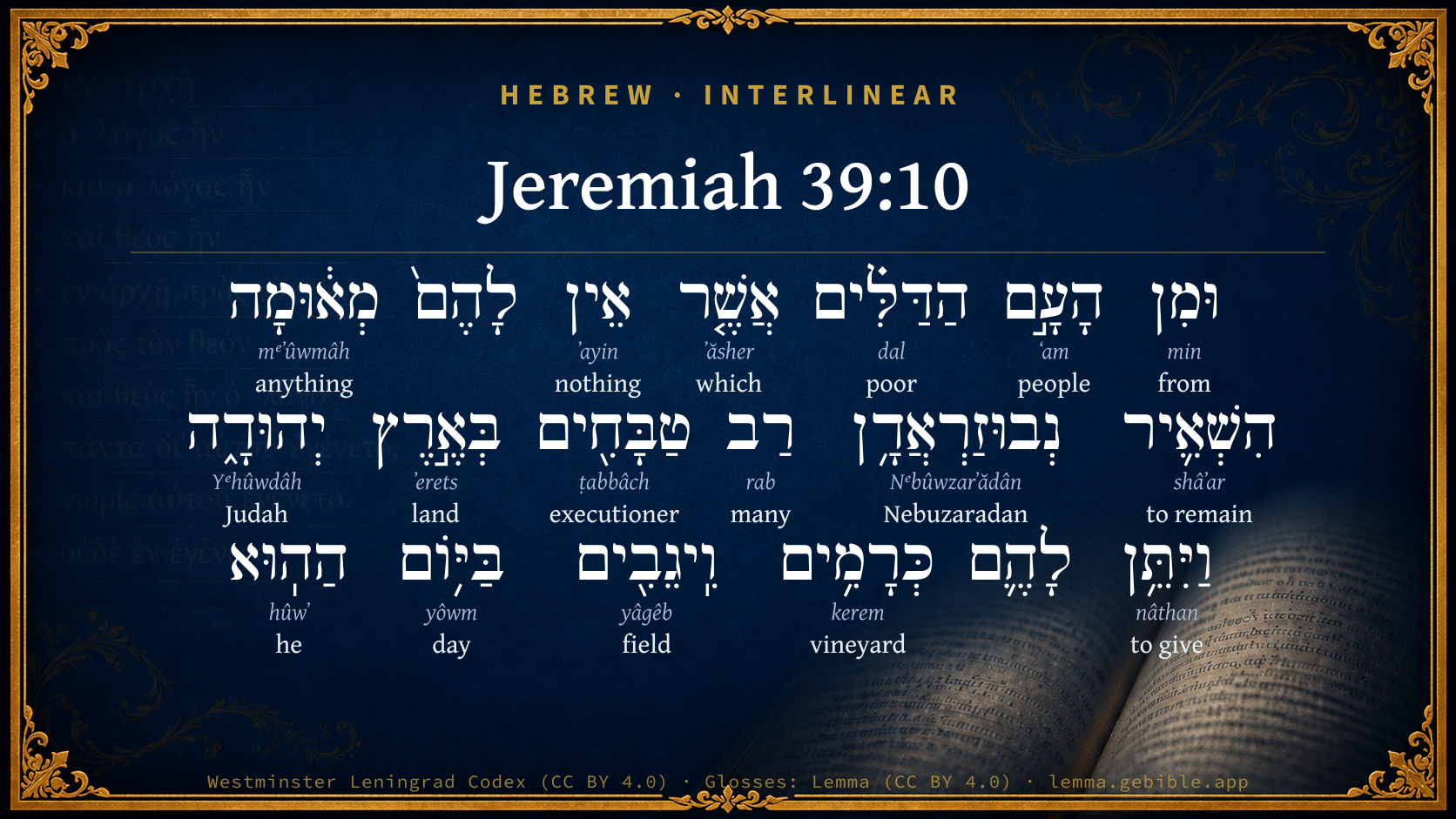
Jeremiah 39:10

Hebrew (Westminster Leningrad Codex) Jeremiah 39:10 appears in the Hebrew Old Testament. The text above is from the Westminster Leningrad Codex. Each word links to its Strong’s number, a concise gloss, and parsing drawn from the Open Scriptures Hebrew Bible morphology. Click any word for its full Brown-Driver-Briggs (BDB) entry.
Download image
Cite this verse

Jeremiah 39:10 (World English Bible). Public Domain. Lemma interlinear Bible study tool, https://lemma.gebible.app/v/jeremiah/39/10.

Show BibTeX & RIS
BibTeX
RIS
English Translation
But Nebuzaradan the captain of the guard left of the poor of the people, who had nothing, in the land of Judah, and gave them vineyards and fields at the same time.
World English Bible · Public Domain
Highlights
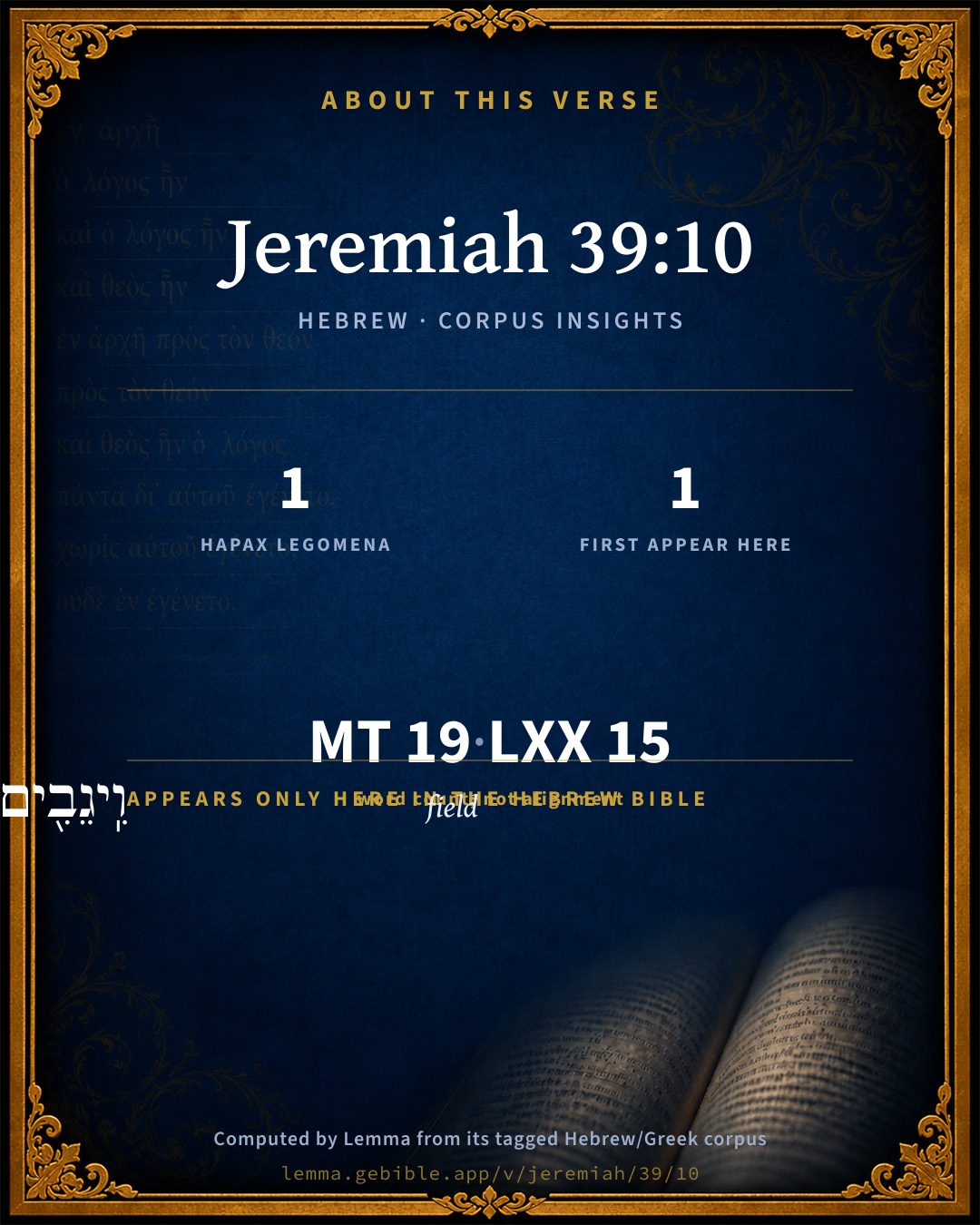
  • 1 hapax legomenon — only here in the Hebrew Bible
  • 1 first appearance in the Hebrew Bible
Full analysis ↓
Download a study sheet

One document with this verse’s original text, its word-by-word gloss line, the meaning frame, cross-references with their text, attributed commentary, and full source and license credits — printable, and it pastes into notes with its structure intact.

This verse Autodidact and up

Study sheet (.html) Plain text (.txt)

A passage Seminary Student

Up to 50 verses in one chapter. A passage sheet keeps up to 6 commentary sources and 12 cross-references per verse, in the order this page ranks them, and says so on the sheet whenever that leaves anything out. Ask for a single verse and you get the Autodidact verse sheet above.

Everything on this page stays free to read, with no account — the sheet is a download of what is already on screen, not access to it.

Want to remove ads? Support Godless Engineer
Compare translations 3

The same verse in 3 English versions, stacked beneath the original-language interlinear above. Click any original word for its lexicon entry.

Each is an independent rendering of the whole verse — the interlinear is not word-aligned to these translations.

Highlighted words mark where these versions differ — a whole-verse word diff, not a word-by-word alignment.

  • World English Bible Public Domain
    But Nebuzaradan the captain of the guard left of the poor of the people, who had nothing, in the land of Judah, and gave them vineyards and fields at the same time.
  • King James Version Public Domain
    But Nebuzaradan the captain of the guard left of the poor of the people, which had nothing, in the land of Judah, and gave them vineyards and fields at the same time.
  • unfoldingWord Literal Text CC BY-SA 4.0
    But Nebuzaradan the commander of the king’s bodyguards allowed the poorest people who had nothing for themselves to remain in the land of Judah. He gave them vineyards and fields on that same day.

unfoldingWord Literal Text — © unfoldingWord, licensed CC BY-SA 4.0. Word-aligned USFM3 via Door43 (git.door43.org/unfoldingWord/en_ult).

Versions to compare (up to 4)

3 of 4 selected

Show all 18 translations

Every available English version of this verse, each an independent rendering of the whole verse.

  • World English Bible Public Domain
    But Nebuzaradan the captain of the guard left of the poor of the people, who had nothing, in the land of Judah, and gave them vineyards and fields at the same time.
  • Berean Standard Bible Public Domain
    But Nebuzaradan left behind in the land of Judah some of the poor people who had no property, and at that time he gave them vineyards and fields.
  • Majority Standard Bible Public Domain
    But Nebuzaradan left behind in the land of Judah some of the poor people who had no property, and at that time he gave them vineyards and fields.
  • King James Version Public Domain
    But Nebuzaradan the captain of the guard left of the poor of the people, which had nothing, in the land of Judah, and gave them vineyards and fields at the same time.
  • American Standard Version (1901) Public Domain
    But Nebuzaradan the captain of the guard left of the poor of the people, that had nothing, in the land of Judah, and gave them vineyards and fields at the same time.
  • Revised Version (1885) Public Domain
    But Nebuzaradan the captain of the guard left of the poor of the people, which had nothing, in the land of Judah, and gave them vineyards and fields at the same time.
  • Geneva Bible (1599) Public Domain
    But Nebuzar-adan the chiefe steward left the poore that had nothing in the land of Iudah, and gaue them vineyards and fieldes at the same time.
  • Douay-Rheims (1899) Public Domain
    But Nabuzardan the general left some of the poor people that had nothing at all, in the land of Juda, and he gave them vineyards, and cisterns at that time.
  • Young's Literal Translation Public Domain
    And of the poor people, who have nothing, hath Nebuzar-Adan, chief of the executioners, left in the land of Judah, and he giveth to them vineyards and fields on the same day.
  • Literal Standard Version CC BY-SA 4.0
    And Nebuzar-Adan, chief of the executioners, has left in the land of Judah the poor people who have nothing, and he gives vineyards and fields to them in that day.
  • Unlocked Literal Bible CC BY-SA 4.0
    But Nebuzaradan the commander of the king's bodyguards allowed the poorest people who had nothing for themselves to remain in the land of Judah. He gave them vineyards and fields on that same day.
  • unfoldingWord Literal Text CC BY-SA 4.0
    But Nebuzaradan the commander of the king’s bodyguards allowed the poorest people who had nothing for themselves to remain in the land of Judah. He gave them vineyards and fields on that same day.
  • Darby Bible Public Domain
    But Nebuzar-adan the captain of the body-guard left [certain] of the people, the poor who had nothing, in the land of Judah, and gave them vineyards and fields at the same time.
  • World Messianic Bible Public Domain
    But Nebuzaradan the captain of the guard left of the poor of the people, who had nothing, in the land of Judah, and gave them vineyards and fields at the same time.
  • Webster's Bible Public Domain
    But Nebuzar-adan the captain of the guard left of the poor of the people, who had nothing, in the land of Judah, and gave them vineyards and fields at the same time.
  • Free Bible Version CC BY-SA 4.0
    But he left behind in the land of Judah some of the poorest people who didn't have any property. He gave them vineyards and fields at that time.
  • Bible in Basic English Public Domain
    But Nebuzaradan, the captain of the armed men, let the poorest of the people, who had nothing whatever, go on living in the land of Judah, and gave them vine-gardens and fields at the same time.
  • JPS Tanakh (1917) Public Domain
    But Nebuzaradan the captain of the guard left of the poor of the people, that had nothing, in the land of Judah, and gave them vineyards and fields in that day.

Literal Standard Version (2020), Covenant Press — licensed CC BY-SA 4.0. Text via the HelloAO Bible API (eBible.org). Unlocked Literal Bible (unfoldingWord) — licensed CC BY-SA 4.0. Text via the HelloAO Bible API (eBible.org). unfoldingWord Literal Text — © unfoldingWord, licensed CC BY-SA 4.0. Word-aligned USFM3 via Door43 (git.door43.org/unfoldingWord/en_ult). Free Bible Version, Dr. Jonathan Gallagher — licensed CC BY-SA 4.0. Text via the HelloAO Bible API (eBible.org).

Word by word

More ways to search: Search by grammar → Find every occurrence → Compare this word →

Practice this passage: Drill this verse → Learn its vocabulary →

וִֽיגֵבִ֖ים
yâgêb
H3010
“and · fields”
Conjunction + Noun, Common, Masculine, Plural, Absolute
Part of Speech
Conjunction + Noun
Type
Common
Gender
Masculine
Number
Plural
State
Absolute
Full BDB Definition

Origin: from H3009

TWOT: 838a

field, ploughed field
  1. וּמִן min H4480 “and · from” Conjunction + Preposition
  2. הָעָ֣ם ʻam H5971 “the · people” Particle, Definite Article + Noun, Common, Masculine, Singular, Absolute
  3. הַדַּלִּ֗ים dal H1800 “the · poor” Particle, Definite Article + Adjective, Adjective, Masculine, Plural, Absolute
  4. אֲשֶׁ֤ר ʼăsher H834 “which” Particle, Relative
  5. אֵין ʼayin H369 “nothing” Particle, Negative
  6. מְא֔וּמָה mᵉʼûwmâh H3972 “anything” Noun, Common, Feminine, Singular, Absolute
  7. הִשְׁאִ֛יר shâʼar H7604 “to remain” Verb, Hiphil, Perfect, 3rd Person, Masculine, Singular
  8. נְבוּזַרְאֲדָ֥ן Nᵉbûwzarʼădân H5018 “Nebuzaradan” Noun, Proper
  9. רַב rab H7227 “many of” Noun, Common, Masculine, Singular, Construct
  10. טַבָּחִ֖ים ṭabbâch H2876 “executioners” Noun, Common, Masculine, Plural, Absolute
  11. בְּאֶ֣רֶץ ʼerets H776 “in/at · land of” Preposition + Noun, Common, Both, Singular, Construct
  12. יְהוּדָ֑ה Yᵉhûwdâh H3063 “Judah” Noun, Proper
  13. וַיִּתֵּ֥ן nâthan H5414 “and · to give” Conjunction + Verb, Qal, Sequential Imperfect, 3rd Person, Masculine, Singular
  14. כְּרָמִ֥ים kerem H3754 “vineyards” Noun, Common, Both, Plural, Absolute
  15. בַּיּ֥וֹם yôwm H3117 “in/at the · day” Preposition, Determined + Noun, Common, Masculine, Singular, Absolute
  16. הַהֽוּא hûwʼ H1931 “the · he” Particle, Definite Article + Pronoun, Personal, 3rd Person, Masculine, Singular

About this verse

These counts appear in no published source. They are computed here, from the morphology-tagged text and Lemma’s own curated glosses. What Lemma adds →

19
words
17
distinct lemmas
Prophets
section

Notable vocabulary

1 hapax legomenon — a word that appears only here in the entire Hebrew Bible:

  • וִֽיגֵבִ֖ים field H3010

First appearance in Scripture

This word makes its first canonical appearance in the Hebrew Bible here:

  • וִֽיגֵבִ֖ים field H3010

Shared distinctive vocabulary

נְבוּזַרְאֲדָ֥ן Nebuzaradan H5018 occurs in 15 verses of the Hebrew Bible. Also found in:

Grammatical profile

  • 2 verbs
  • 10 nouns
  • 1 adjective
  • 1 pronoun
  • 3 prepositions
  • 2 particles

Verb forms

  • הִשְׁאִ֛יר Hiphil · Perfect
  • וַיִּתֵּ֥ן Qal · Sequential Imperfect

Hebrew & Septuagint length

In the original languages it is 19 Hebrew tokens and 15 Greek tokens — but the two are counted differently (Hebrew bundles its prefixes and suffixes into one token; the Greek is in lemma form), so that isn’t a like-for-like length.

Cross-references

4

Topical passages linked to Jeremiah 39:10 in the Treasury of Scripture Knowledge — connected by theme and wording, ordered by reader-vote popularity; previews shown in the World English Bible.

  • 2 Kings 25:12 But the captain of the guard left of the poorest of the land to work the vineyards and fields.
  • Jeremiah 40:7 Now when all the captains of the forces who were in the fields, even they and their men, heard that the king of Babylon had made Gedaliah the son of Ahikam governor in the land, and had committed to him men, and women, and children, and of the poorest of the land, of those who were not carried away captive to Babylon;
  • Jeremiah 52:16 But Nebuzaradan the captain of the guard left of the poorest of the land to be vineyard keepers and farmers.
  • Ezekiel 33:24 Son of man, they who inhabit those waste places in the land of Israel speak, saying, Abraham was one, and he inherited the land: but we are many; the land is given us for inheritance.

Cross-references courtesy of OpenBible.info (CC BY 4.0).

Hebrew and Greek witnesses Masoretic Hebrew ↔ Greek Septuagint

The same verse in the two great witnesses to the Old Testament, shown verse-for-verse.

These are two independent witnesses, not word-aligned to each other, and the Septuagint is shown in lemma (dictionary) form.

Hebrew Jeremiah 39:10 Masoretic · Westminster Leningrad Codex

וּמִן הָעָ֣ם הַדַּלִּ֗ים אֲשֶׁ֤ר אֵין לָהֶם֙ מְא֔וּמָה הִשְׁאִ֛יר נְבוּזַרְאֲדָ֥ן רַב טַבָּחִ֖ים בְּאֶ֣רֶץ יְהוּדָ֑ה וַיִּתֵּ֥ן לָהֶ֛ם כְּרָמִ֥ים וִֽיגֵבִ֖ים בַּיּ֥וֹם הַהֽוּא

But Nebuzaradan the captain of the guard left of the poor of the people, who had nothing, in the land of Judah, and gave them vineyards and fields at the same time.

World English Bible · Public Domain

Greek LXX Structure differs

In the Septuagint, Jeremiah is about an eighth shorter than the Hebrew and arranges its material differently — the Oracles Against the Nations (Hebrew chapters 46–51) appear in the middle of the Greek book, after 25:13. Because the chapter and verse boundaries do not line up, a verse-for-verse comparison with the Hebrew is not shown.

A verse-for-verse comparison isn’t shown here because the chapters and verses don’t line up. Switch to the LXX edition with the MT / LXX toggle above to read the Greek directly.

Hebrew: Westminster Leningrad Codex (CC BY 4.0). Greek: Septuagint (public domain); English from a public-domain English Septuagint. How the Septuagint differs from the Hebrew →

Targum (Aramaic paraphrase)

1

The Targum is the ancient Jewish Aramaic paraphrase of the Hebrew Scriptures — an interpretive translation, not the Hebrew text itself. Onkelos (literal) and Pseudo-Jonathan (expansive) render the Torah, and Jonathan the Prophets. Coverage is partial: where no permissively-licensed English translation exists for a verse, only the Aramaic is shown. This is verse-level text, not a word-by-word alignment to the Hebrew.

  1. Targum Jonathan Prophets (Joshua–Malachi)
    וּמִן עַמָא חֲשִׁיכַיָא דְלֵית לְהוֹן מִדָעַם אַשְׁאַר נְבוּזַרְאֲדָן רַב קָטוֹלַיָא בְּאַרְעָא דְבֵית יְהוּדָה וּמַנִינוּן לְמֶהֱוֵי מְפַלְחִין בְּחַקְלִין וּבְכַרְמִין בְּיוֹמָא הַהוּא:

    (no public-domain English translation for this verse)

    Targum Jonathan — Aramaic: “Mikraot Gedolot” (public domain). English: “Sefaria Community Translation” (CC0 1.0 (public-domain dedication)); “London "Chaldee Paraphrase," 1871” (public domain). Text via Sefaria.

Commentary

Notes on Jeremiah 39:10 from classic Christian and Jewish commentators (each source and its license shown beneath its notes). The classic Christian expositions comment on the surrounding passage and are grouped to its opening verse, so a note may address several verses; the Jewish commentaries on the Tanakh (Rashi and others) are per-verse, so they appear only where the commentator wrote on this verse.

Lemma curates 59 commentaries, every one of them public domain or Creative Commons licensed, each selected and text-cleaned for this edition rather than reprinted as found. About our sources →

Trapp's Complete Commentary

John Trapp

Jer 39:10 But Nebuzaradan the captain of the guard left of the poor of the people, which had nothing, in the land of Judah, and gave them vineyards and fields at the same time.

Ver. 10. See on 2Ki 25:11-12. Sic vides miras rerum vices. See what a wonderful turn of things was here on the sudden, and how that of Seneca was here made good, Una dies interest inter magnam civitatem et nullam, There is but a day’s difference sometimes between a great city and no city. Josephus and some others say that the Rechabites, as men peaceable, and given much to contemplation, were also left in the land. This destruction of Jerusalem was, saith Oecolampadius, a kind of type of the general judgment. For like as in Jerusalem the wicked perished, but the poor and peaceable were not only spared, but enriched, so shall it be at that day.

John Trapp, A Commentary or Exposition upon All the Books of the Old and New Testament (1647–1656) — public domain. Text from a community e-Sword module.

Geneva Bible (1599)

Geneva Bible translators

For the rich and the mighty which put their trust in their shifts and means, were by God’s just judgments most rigorously handled.

Geneva Bible (1599) marginal notes — public domain. Text via Bolls.life.

Jamieson, Fausset & Brown

Robert Jamieson, A. R. Fausset & David Brown

left . . . the poor . . . which had nothing--The poor have least to lose; one of the providential compensations of their lot. They who before had been stripped of their possessions by the wealthier Jews obtain, not only their own, but those of others.

Jamieson, Fausset & Brown — Commentary Critical and Explanatory on the Whole Bible (1871) — public domain (CC PDM 1.0). Text via the HelloAO Bible API.

Adam Clarke's Commentary

Verse 10. Left of the poor of the people] The very refuse of the inhabitants, who were not worthy of being carried away; and among them he divided the fields and vineyards of those whom he took away.

Adam Clarke's Commentary on the Bible (1810–1826) — public domain. Text from a community e-Sword/MySword module.

John Calvin's Commentaries

He now adds, that some were left to inhabit the land, even the poor and those who had nothing He says that these were made, as it were, the lords of the land when the Chal-deans returned into their own country. We here see that poverty is often an advantage, for the nobles, as we have seen, were killed, and many also of the middle class were killed in the siege of the city, and some of them were treated a little more humanely. Still the exiles were miserable, and driven to a distant land without any hope of return. The land was now left to the poor alone; and those who possessed not’ a foot of ground before, lived now very comfortably; for they were not so large a number, but that each of them had some extent of land, as we shall hereafter see. While then these miserable men, who before lived very scantily, and perhaps begged their bread, while these remained secure in the land of Judah, the possessors of the land were torn away and driven into exile; and as Nebuzaradan had assigned to each of them vineyards and fields, it hence appears how much better it was for them to have suffered hunger for a time, to have been in an ignoble condition, and to have been trodden as it were under foot by others, than to have lived in pomp and splendor. Thus often God shews his care for us, when he suffers us not to rise high, but keeps us in an obscure and humble condition; and the issue at length proves that he thus had a regard for our salvation.

At the same time there is here set before our eyes a woeful change. The king is led bound in chains, and is also blind; and all the rest having left their own, are driven into exile; and, on the other hand, the poor alone, and needy men who had nothing, dwell at large, as it were, in their own possessions. As, then, they had their quiet habitations and large fields, and enjoyed a land so fertile and rich, there is no doubt but that Nebuzaradan meant thus to rouse the envy of the exiles; for they saw that needy and worthless men dwelt in that land from which they had been banished. Hence their indignation was increased when they saw that they were more severely and cruelly treated than those lowest of men. It follows, —

John Calvin's Commentaries (1540-1563) — public domain. Text from the Calvin Translation Society English edition (1840s-50s) via the Christian Classics Ethereal Library (ccel.org). Calvin's coverage is partial (roughly two-thirds of the Bible); uncommented books and verses are honest gaps, never fabricated. The 19th-century editor's footnotes and remarks are omitted so the notes are faithfully Calvin's own voice.

The Cambridge Bible for Schools and Colleges

gen. ed. J. J. S. Perowne

10. of the people] Probably we should read, as in Jer_52:15 mg., of the artificers.

gave them … fields] but See on Jer_52:16.

The Cambridge Bible for Schools and Colleges (gen. ed. J. J. S. Perowne; Cambridge University Press, 1878–1918) — public domain. Text from a community e-Sword module.

John Gill's Exposition

But Nebuzaradan the captain of the guard left of the poor of the people, which had nothing, in the land of Judah,.... Because they would have been of no service to the Chaldeans, but a burden to them; and because they had nothing to fear from them; they had no arms to rebel against them, nor money to purchase any; and because it would be to their interest to have the land manured, and not lie waste, that they might have some tribute from it:

and gave them vineyards and fields at the same time; as their own property to dress and cultivate, and receive the advantage of them; though very probably a tax was laid upon them; or they were to pay tribute to the king of Babylon; or, however, contribute out of them to the support of the government that was placed over them; and this was a happy incident in their favour; here was a strange change of circumstances with them; though the nation in general was in distress, they, who before had nothing, are now proprietors of vineyards and fields, when the former owners were carried captive: there might be much of the justice of God conspicuous in this affair; such who had been oppressed and ill used by the rich are now retaliated with their possessions. The Targum is,

"and he appointed them to work in the fields and in the vineyards in that day.''

John Gill's Exposition of the Whole Bible (1746–1763) — public domain (CC PDM 1.0). Text via the HelloAO Bible API.

Haydock's Catholic Bible Commentary

Cisterns, and fields, 4 Kings xxv. 12. They were thus attached to the Chaldeans.

George Leo Haydock (1774–1849), Haydock's Catholic Family Bible and Commentary, 1859 edition — public domain. Excludes Psalms (Douay-Rheims chapter numbering differs from Protestant) and Deuterocanonical books (Catholic canon only).

Matthew Poole's English Annotations

This is usual with conquerors, for whose profit it is not that the countries conquered by them should lie waste, like wildernesses, but be peopled, and manured, that they may render some tribute to them: withal the justice of God is often seen in this, thus restoring to them ofttimes with advantage, by the hands of enemies that prove conquerors, those estates which in corrupt times their proper magistrates by violence and oppression took from them, or at least more than compensating their losses by acts of violence and injustice.

Matthew Poole's English Annotations on the Holy Bible (1683–1685) — public domain. Text from a community e-Sword/MySword module.

The Pulpit Commentary

"Blessed are ye poor.

The Chaldean invasion, which wrought such ruin on princes, nobles, and all the great in Judah and Jerusalem, had far other and happier effect on the poor. The storm which tore down the lofty tree left the lowly flowers that nestled amid the herbage untouched. This verse recalls

I OUR LORD"S WORDS, "BLESSED ARE YE POOR." The poor do not excite the wrath of the great. They are least affected by outward change. They are dealt kindly by when the rich and great are cast down. "He hath put down the mighty from their seat, and hath exalted," etc. But, chief of all, because they are "rich in faith." So said our Lord; and it can only be that the poor have an undying conviction of the love of God, an unquenchable faith therein, that they so patiently endure the ills of their present lot. Let that faith die out, as it has in some places and generations, and. murderous revolution and anarchy burst forth. Our Lord distinctly encouraged this belief in the love of God towards the poor. He said his mission was "to preach the gospel to the poor." In the parable of the rich man, Lazarus, for no other reason than that he was poor, receiving here, as is the lot of the poor so often, only "evil things," was "carried by the angels into Abraham"s bosom." And we may well believe that they who here have been unable by reason of the misery of their condition to see that God is love as Israel in Egypt could not believe in it by reason of the bitterness of spirit which their bondage caused them shall in some blessed Abraham"s bosom hereafter see it clearly, and then shall their hearts go out towards God in that faith and love which are the conditions of the kingdom of heaven, but which have been scarce possible to them here. Therefore are the poor blessed. But this verse teaches also the sure truth

II "HE THAT IS DOWN NEED FEAR NO FALL." Here it was lowliness of position which saved the poor of the land. But the proverb is yet more true where the lowliness is of the heart and mind that yoke of Christ which, if we take, then rest, the undisturbed peace of the soul, is our reward.

III THE COMMON PROVERB, "IT IS AN ILL WIND THAT BLOWS NO ONE ANY GOOD." The prince"s ruin was the poor man"s riches; the noble"s downfall his uprising. Therefore in our own troubles let us remember that we are never as a target at which the arrows of God"s judgments are aimed, and in the hitting of which their purpose is fulfilled; but rather are we the channels of blessing, which by and through us shall flow on to do good to others, perhaps many others. Of. Paul"s allegory, the casting out of the natural branch, the Jew, and the ingrafting of the wild branch, the Gentile. And illustrations are innumerable.

IV GOD"S LAW OF COMPENSATIONS. If he takes away on the one side, he gives on the other. These poor people were favoured.

V THE FIRST BEATITUDE, "BLESSED ARE THE POOR IN SPIRIT: FOR," etc. These poor had lands in Judea; the poor Christ speaks of shall receive "the kingdom of heaven." It is not always true that the literal poor are dealt with in the way told of here, but the recompense of the poor in spirit never fails. They have an earnest of it in the rest and peace of soul it is theirs to enjoy now amid all the cares and distractions of this life. But no man makes himself poor; he must be made so. God"s providence sends the literal poverty, God"s Spirit that spiritual condition to which is promised the kingdom of heaven. But if we place ourselves in the hands of Christ, surrendering ourselves to be dealt with as he sees fit, he will, by his Spirit, bring us to that blessed mind without which none enter the kingdom, but with which we assuredly shall. C.

"The poor of the people.

I HOW THEY HAD COME INTO THIS POSITION. Poverty is, of course, a mischief, having many causes, and no fallacy is greater than that of singling out one cause for some particular reason, and then treating it as if it were the only cause. Still, there is need that in this place the injustice of the rich towards the poor should be remembered. The fact that there are proverbs bearing on this point shows that such oppression was not at all unfrequent. "He that oppresseth the poor to increase his riches, and he that giveth to the rich, shall surely come to want". (Pro_22:16 Pro_28:15) And now these oppressors had attracted to themselves the desiring eye of Babylon. Why were the rich men carried away and the poor left? The chief reason was that they heightened the triumph, for when despoiled they were just as poor as the poorest, and the contrast between their former and present state spoke for itself. Then, too, there is something in considering the rich men as themselves part of their riches. Thus the rich and poor are brought together in one great judicial act, and the rich are made to feel that in the end the poor are really better off than they are.

II THE ADVANTAGES OF POVERTY. Poverty usually presents such disadvantages on the surface, and so demands sympathy and help, that it almost seems like irony ever to talk of its advantages. And yet, if there be such advantages, it is very necessary to consider them, in order to do something for the prevention of envy, repining, and perplexity. As with the advantages of external wealth, so with the disadvantages of external poverty; neither goes very deep. In the time of spoliation the poor man can look on with a light heart, so far as personal loss is concerned. Probably the poor people of Israel were now better off than they had been for years. Amid all the burning and pillage here is one good effect already perceptible in the benefit that is being worked for the poor. Without contradiction, it may be affirmed that the Jehovah of the Old Testament and the Father of Jesus Christ in the New are alike on the side of the poor. All oppression of the poor, all unfair treatment of them, all selfish employment of them, will show in the end that the poor need lose nothing of what is best.

III THE EMPLOYMENT OF THE POOR. They were employed in that which was of greatest moment to them. Vineyards and fields were given to them things they could all make use of; things which would repay their toil, and give them the chance of building up a really honourable wealth. If Nebuzar-Adan had given them something of the plunder, it would not have been near so useful as what he actually did give. Man is nearest to the pure, untainted fulness of nature when he is cultivating the soil. Y. for his own sake, as for the effect his preservation would have on the minds of others. His safety was specially provided for at the time when unrestrained destruction was going on. Thus his very preservation was itself a prophecy. And it is all the more noticeable Because Jeremiah himself had, in due course, to make predictions against Babylon. Why some of God"s servants live long lives and some short ones is not a fortuitous matter; there is always a reason, could we but see it, and sometimes, as in this instance, there is a glimmer of light upon the reason.

III THE PROPHET"S DESTINATION. Nebuchadnezzar"s order was that he should be treated as he desired. We read that in the end "he dwelt among the people." Hence we may conclude that this was his desire. And where could a prophet better be? Especially if he went among the poor of the people, toiling away in their vineyards and fields, and tried to inspire them with the promises of better times. "Dwelling among the people" is a very suggestive expression when applied to a man like Jeremiah, his office, his character, his experience, being such as they were. The people knew that he lived among them by his own free choice, preferring to share their hardship and poverty. As far as we can see, he might have enjoyed the luxuries of Babylon; but what were these to a man like him? Y.

The Pulpit Commentary (1880–1919), ed. H.D.M. Spence-Jones & Joseph S. Exell — public domain. Text from a community e-Sword module.

Rashi

Rabbi Shlomo Yitzchaki (Rashi)

vineyards and fields Heb. ויגבים, fields to till. Every יגיבה is an expression of digging (a fosser in French), to dig.

Rashi on the Tanakh — English translations: “The Judaica Press complete Tanach with Rashi, translated by A. J. Rosenberg” (CC BY 4.0); “Pentateuch with Rashi's commentary by M. Rosenbaum and A.M. Silbermann, 1929-1934” (public domain); “The Metsudah Tanach series, Lakewood, N.J” (CC BY 4.0); and “The Book of Joshua, Metsudah Publications, 1997” (CC BY 4.0). Text via Sefaria.

Lesson kit

Teaching starters — assembled from the data on this page, not authored interpretation. Every prompt links to the verse data it draws on. Edit before teaching.

Jeremiah, in the Prophets, opens this verse with 19 words (17 distinct Hebrew lemmas). Its most distinctive word is yâgêb (“field”). A historical commentator’s framing appears above. Read the whole chapter for the surrounding context.

Discussion questions

  1. What does “field” (yâgêb) contribute to the verse as a whole?
  2. This verse holds 1 word here found nowhere else in the Hebrew Bible. What might the rare word draw attention to?
  3. The word “field” first appears here in Scripture. What is being introduced at this debut?
  4. 2 Kings 25:8 shares the word «Nebuzaradan» with this verse. How do the two illuminate each other?
  5. The translations on this page render this verse differently — a whole-verse word diff, not a word-by-word alignment. What might account for the different wordings?
  6. The verb «הִשְׁאִ֛יר» is Hiphil Perfect. How does its form color the action?
  7. Reading how Trapp's Complete Commentary and Geneva Bible (1599) read this verse, where do the two commentators agree and where do they part?

Things to notice

Reading settings

Reading text

Shown beneath each verse's original-language words.

Old Testament
Old Testament edition

Read the OT as the Masoretic Hebrew (MT) or the Greek Septuagint (LXX).

English shown for the Greek Septuagint (in the Hebrew ↔ Greek comparison).

Comparing translations? Open the Compare panel on any verse page to stack up to four side by side.