
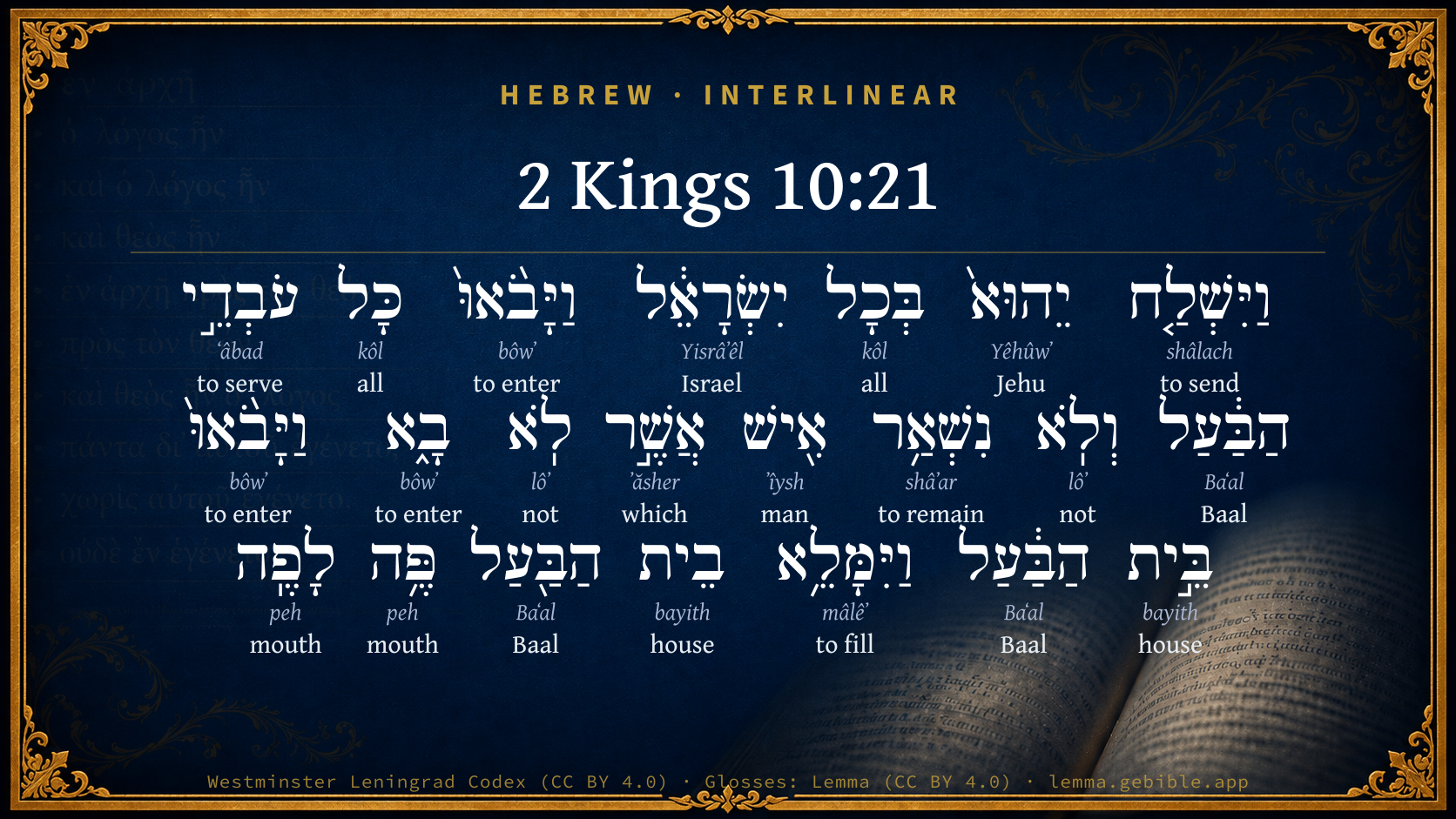
2 Kings 10:21

Hebrew (Westminster Leningrad Codex) 2 Kings 10:21 appears in the Hebrew Old Testament. The text above is from the Westminster Leningrad Codex. Each word links to its Strong’s number, a concise gloss, and parsing drawn from the Open Scriptures Hebrew Bible morphology. Click any word for its full Brown-Driver-Briggs (BDB) entry.
Download image
Cite this verse

2 Kings 10:21 (World English Bible). Public Domain. Lemma interlinear Bible study tool, https://lemma.gebible.app/v/2-kings/10/21.

Show BibTeX & RIS
BibTeX
RIS
English Translation
Jehu sent through all Israel: and all the worshippers of Baal came, so that there was not a man left that didn't come. They came into the house of Baal; and the house of Baal was filled from one end to another.
World English Bible · Public Domain
Download a study sheet

One document with this verse’s original text, its word-by-word gloss line, the meaning frame, cross-references with their text, attributed commentary, and full source and license credits — printable, and it pastes into notes with its structure intact.

This verse Autodidact and up

Study sheet (.html) Plain text (.txt)

A passage Seminary Student

Up to 50 verses in one chapter. A passage sheet keeps up to 6 commentary sources and 12 cross-references per verse, in the order this page ranks them, and says so on the sheet whenever that leaves anything out. Ask for a single verse and you get the Autodidact verse sheet above.

Everything on this page stays free to read, with no account — the sheet is a download of what is already on screen, not access to it.

Want to remove ads? Support Godless Engineer
Compare translations 3

The same verse in 3 English versions, stacked beneath the original-language interlinear above. Click any original word for its lexicon entry.

Each is an independent rendering of the whole verse — the interlinear is not word-aligned to these translations.

Highlighted words mark where these versions differ — a whole-verse word diff, not a word-by-word alignment.

  • World English Bible Public Domain
    Jehu sent through all Israel: and all the worshippers of Baal came, so that there was not a man left that didn't come. They came into the house of Baal; and the house of Baal was filled from one end to another.
  • King James Version Public Domain
    And Jehu sent through all Israel: and all the worshippers of Baal came, so that there was not a man left that came not. And they came into the house of Baal; and the house of Baal was full from one end to another.
  • unfoldingWord Literal Text CC BY-SA 4.0
    And Jehu sent into all of Israel, and all of the servants of Baal came, and a man was not left who had not come. And they entered the house of Baal, and the house of Baal was filled mouth to mouth.

unfoldingWord Literal Text — © unfoldingWord, licensed CC BY-SA 4.0. Word-aligned USFM3 via Door43 (git.door43.org/unfoldingWord/en_ult).

Versions to compare (up to 4)

3 of 4 selected

Show all 18 translations

Every available English version of this verse, each an independent rendering of the whole verse.

  • World English Bible Public Domain
    Jehu sent through all Israel: and all the worshippers of Baal came, so that there was not a man left that didn't come. They came into the house of Baal; and the house of Baal was filled from one end to another.
  • Berean Standard Bible Public Domain
    Then Jehu sent word throughout Israel, and all the servants of Baal came; there was not a man who failed to show. They entered the temple of Baal, and it was filled from end to end.
  • Majority Standard Bible Public Domain
    Then Jehu sent word throughout Israel, and all the servants of Baal came; there was not a man who failed to show. They entered the temple of Baal, and it was filled from end to end.
  • King James Version Public Domain
    And Jehu sent through all Israel: and all the worshippers of Baal came, so that there was not a man left that came not. And they came into the house of Baal; and the house of Baal was full from one end to another.
  • American Standard Version (1901) Public Domain
    And Jehu sent through all Israel: and all the worshippers of Baal came, so that there was not a man left that came not. And they came into the house of Baal; and the house of Baal was filled from one end to another.
  • Revised Version (1885) Public Domain
    And Jehu sent through all Israel: and all the worshippers of Baal came, so that there was not a man left that came not. And they came into the house of Baal; and the house of Baal was filled from one end to another.
  • Geneva Bible (1599) Public Domain
    So Iehu sent vnto all Israel, and all the seruants of Baal came, and there was not a man left that came not. And they came into the house of Baal, and the house of Baal was full from ende to ende.
  • Douay-Rheims (1899) Public Domain
    And he sent into all the borders of Israel, and all the servants of Baal came: there was not one left that did not come. And they went into the temple of Baal: and the house of Baal was filled, from one end to the other.
  • Young's Literal Translation Public Domain
    And Jehu sendeth into all Israel, and all the servants of Baal come in, and there hath not been left a man who hath not come in; and they come in to the house of Baal, and the house of Baal is full -- mouth to mouth.
  • Literal Standard Version CC BY-SA 4.0
    And Jehu sends into all Israel, and all the servants of Ba‘al come in, and there has not been left a man who has not come in; and they come into the house of Ba‘al, and the house of Ba‘al is full—mouth to mouth.
  • Unlocked Literal Bible CC BY-SA 4.0
    Then Jehu sent throughout all Israel and all the worshipers of Baal came, so that there was not a man left who did not come. They came into the temple of Baal, and it was filled from one end to another.
  • unfoldingWord Literal Text CC BY-SA 4.0
    And Jehu sent into all of Israel, and all of the servants of Baal came, and a man was not left who had not come. And they entered the house of Baal, and the house of Baal was filled mouth to mouth.
  • Darby Bible Public Domain
    And Jehu sent into all Israel; and all the servants of Baal came, so that there was not a man left that came not: and they entered into the house of Baal; and the house of Baal was full from one end to the other.
  • World Messianic Bible Public Domain
    Jehu sent through all Israel; and all the worshipers of Baal came, so that there was not a man left that didn’t come. They came into the house of Baal; and the house of Baal was filled from one end to another.
  • Webster's Bible Public Domain
    And Jehu sent through all Israel: and all the worshipers of Baal came, so that there was not a man left that came not. And they came into the house of Baal; and the house of Baal was full from one end to another.
  • Free Bible Version CC BY-SA 4.0
    Jehu sent the announcement through the whole of Israel. All the followers of Baal came—not a single man was missing. They went into the temple of Baal, filling it from end to end.
  • Bible in Basic English Public Domain
    And Jehu sent out through all Israel; and all the servants of Baal came, not one kept away. And they came into the house of Baal, so that it was full from end to end.
  • JPS Tanakh (1917) Public Domain
    And Jehu sent through all Israel; and all the worshippers of Baal came, so that there was not a man left that came not. And they came into the house of Baal; and the house of Baal was filled from one end to another.

Literal Standard Version (2020), Covenant Press — licensed CC BY-SA 4.0. Text via the HelloAO Bible API (eBible.org). Unlocked Literal Bible (unfoldingWord) — licensed CC BY-SA 4.0. Text via the HelloAO Bible API (eBible.org). unfoldingWord Literal Text — © unfoldingWord, licensed CC BY-SA 4.0. Word-aligned USFM3 via Door43 (git.door43.org/unfoldingWord/en_ult). Free Bible Version, Dr. Jonathan Gallagher — licensed CC BY-SA 4.0. Text via the HelloAO Bible API (eBible.org).

Word by word

More ways to search: Search by grammar → Find every occurrence → Compare this word →

Practice this passage: Drill this verse → Learn its vocabulary →

יֵהוּא֙
Yêhûwʼ
H3058
“Jehu”
Noun, Proper
Part of Speech
Noun
Type
Proper
Full BDB Definition

Origin: from H3068 and H1931

TWOT: None

Jehu = "Jehovah is He" - the king of the northern kingdom Israel who overthrew the dynasty of Omri - son of Hanani and an Israelite prophet in the time of Baasha and Jehoshaphat - the Antothite, a Benjamite, one of David's mighty warriors - a descendant of Judah of the house of Hezron - son of Josibiah and a chief of the tribe of Simeon
  1. וַיִּשְׁלַ֤ח shâlach H7971 “and · to send” Conjunction + Verb, Qal, Sequential Imperfect, 3rd Person, Masculine, Singular
  2. בְּכָל kôl H3605 “in/at · all of” Preposition + Noun, Common, Masculine, Singular, Construct
  3. יִשְׂרָאֵ֔ל Yisrâʼêl H3478 “Israel” Noun, Proper
  4. וַיָּבֹ֨אוּ֙ bôwʼ H935 “and · to enter” Conjunction + Verb, Qal, Sequential Imperfect, 3rd Person, Masculine, Plural
  5. כָּל kôl H3605 “all of” Noun, Common, Masculine, Singular, Construct
  6. עֹבְדֵ֣י ʻâbad H5647 “serving” Verb, Qal, Participle Active, Masculine, Plural, Construct
  7. הַבַּ֔עַל Baʻal H1168 “the · Baal” Particle, Definite Article + Noun, Proper
  8. וְלֹֽא lôʼ H3808 “and · not” Conjunction + Particle, Negative
  9. נִשְׁאַ֥ר shâʼar H7604 “to remain” Verb, Niphal, Perfect, 3rd Person, Masculine, Singular
  10. אִ֖ישׁ ʼîysh H376 “man” Noun, Common, Masculine, Singular, Absolute
  11. אֲשֶׁ֣ר ʼăsher H834 “which” Particle, Relative
  12. לֹֽא lôʼ H3808 “not” Particle, Negative
  13. בָ֑א bôwʼ H935 “to enter” Verb, Qal, Perfect, 3rd Person, Masculine, Singular
  14. וַיָּבֹ֨אוּ֙ bôwʼ H935 “and · to enter” Conjunction + Verb, Qal, Sequential Imperfect, 3rd Person, Masculine, Plural
  15. בֵּ֣ית bayith H1004 “house of” Noun, Common, Masculine, Singular, Construct
  16. הַבַּ֔עַל Baʻal H1168 “the · Baal” Particle, Definite Article + Noun, Proper
  17. וַיִּמָּלֵ֥א mâlêʼ H4390 “and · to fill” Conjunction + Verb, Niphal, Sequential Imperfect, 3rd Person, Masculine, Singular
  18. בֵית bayith H1004 “house of” Noun, Common, Masculine, Singular, Construct
  19. הַבַּ֖עַל Baʻal H1168 “the · Baal” Particle, Definite Article + Noun, Proper
  20. פֶּ֥ה peh H6310 “mouth” Noun, Common, Masculine, Singular, Absolute
  21. לָפֶֽה peh H6310 “to/for · mouth” Preposition + Noun, Common, Masculine, Singular, Absolute

About this verse

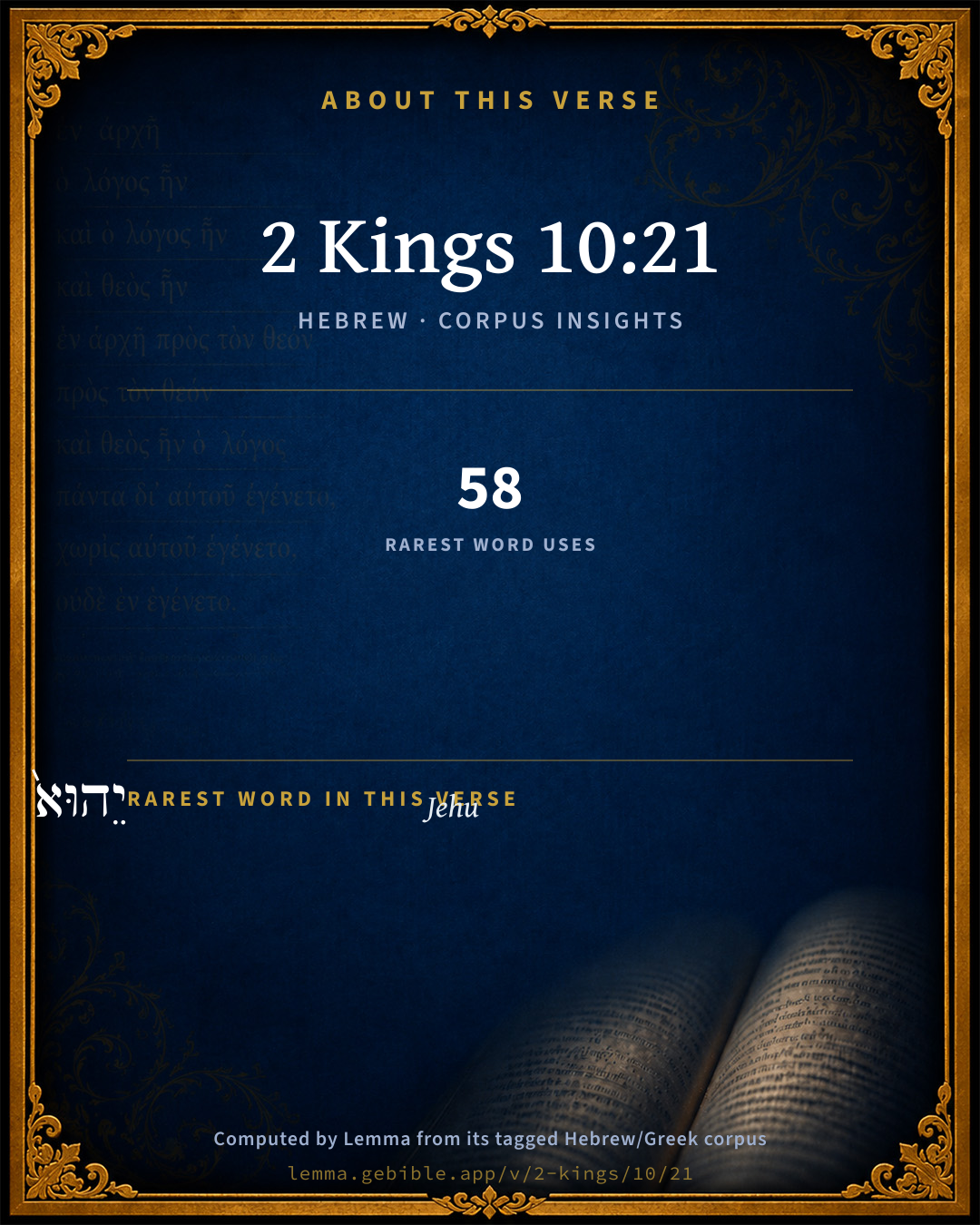
These counts appear in no published source. They are computed here, from the morphology-tagged text and Lemma’s own curated glosses. What Lemma adds →

22
words
14
distinct lemmas
Historical
section

Shared distinctive vocabulary

יֵהוּא֙ Jehu H3058 occurs in 54 verses of the Hebrew Bible. Also found in:

Grammatical profile

  • 7 verbs
  • 12 nouns
  • 3 particles

Verb forms

  • וַיִּשְׁלַ֤ח Qal · Sequential Imperfect
  • וַיָּבֹ֨אוּ֙ Qal · Sequential Imperfect
  • עֹבְדֵ֣י Qal · Participle Active
  • נִשְׁאַ֥ר Niphal · Perfect
  • בָ֑א Qal · Perfect
  • וַיָּבֹ֨אוּ֙ Qal · Sequential Imperfect
  • וַיִּמָּלֵ֥א Niphal · Sequential Imperfect

Repetition

Words recur within this verse — often emphatic in Hebrew:

  • וַיָּבֹ֨אוּ֙ to enter H935 ×3
  • הַבַּ֔עַל Baal H1168 ×3
  • בְּכָל all H3605 ×2
  • בֵּ֣ית house H1004 ×2
  • פֶּ֥ה mouth H6310 ×2
  • וְלֹֽא not H3808 ×2

Hebrew & Septuagint length

In English translation the verse runs 42 words from the Hebrew and 86 from the Septuagint (LXX English) — the Septuagint runs noticeably longer here. See the side-by-side →

A rough comparison of the two English renderings, which tokenize alike — not a word-level alignment.

Word counts can differ between the Hebrew and the Greek without any difference in meaning — e.g. the Hebrew direct-object marker אֵת has no separate Greek word, and Greek often adds the article ὁ.

Cross-references

6

Topical passages linked to 2 Kings 10:21 in the Treasury of Scripture Knowledge — connected by theme and wording, ordered by reader-vote popularity; previews shown in the World English Bible.

  • 1 Kings 16:32 He reared up an altar for Baal in the house of Baal, which he had built in Samaria.
  • Judges 16:27 Now the house was full of men and women; and all the lords of the Philistines were there; and there were on the roof about three thousand men and women, who saw while Samson made sport.
  • 2 Kings 11:18 All the people of the land went to the house of Baal, and broke it down; his altars and his images broke they in pieces thoroughly, and killed Mattan the priest of Baal before the altars. The priest appointed officers over the house of Yahweh.
  • Joel 3:2 I will gather all nations, And will bring them down into the valley of Jehoshaphat; And I will execute judgment on them there for my people, And for my heritage, Israel, whom they have scattered among the nations. They have divided my land,
  • Joel 3:11–14 Hurry and come, all you surrounding nations, And gather yourselves together." Cause your mighty ones to come down there, Yahweh.
  • Revelation 16:16 He gathered them together into the place which is called in Hebrew, Megiddo.

Cross-references courtesy of OpenBible.info (CC BY 4.0).

Hebrew and Greek witnesses Masoretic Hebrew ↔ Greek Septuagint

The same verse in the two great witnesses to the Old Testament, shown verse-for-verse.

Here the Septuagint runs noticeably longer than the Hebrew — LXX2012 (modern English Septuagint) 86 words vs World English Bible 42. A rough length comparison of the two English translations, not a word-level alignment — read both below.

These are two independent witnesses, not word-aligned to each other, and the Septuagint is shown in lemma (dictionary) form.

Hebrew 2 Kings 10:21 Masoretic · Westminster Leningrad Codex

וַיִּשְׁלַ֤ח יֵהוּא֙ בְּכָל יִשְׂרָאֵ֔ל וַיָּבֹ֨אוּ֙ כָּל עֹבְדֵ֣י הַבַּ֔עַל וְלֹֽא נִשְׁאַ֥ר אִ֖ישׁ אֲשֶׁ֣ר לֹֽא בָ֑א וַיָּבֹ֨אוּ֙ בֵּ֣ית הַבַּ֔עַל וַיִּמָּלֵ֥א בֵית הַבַּ֖עַל פֶּ֥ה לָפֶֽה

Jehu sent through all Israel: and all the worshippers of Baal came, so that there was not a man left that didn't come. They came into the house of Baal; and the house of Baal was filled from one end to another.

World English Bible · Public Domain

Greek LXX 2 Kings 10:21 Septuagint · lemma form

καί ἀποστέλλω ιου ἐν πᾶς ἰσραήλ λέγω καί νῦν πᾶς ὁ δοῦλος ὁ βααλ καί πᾶς ὁ ἱερεύς αὐτός καί πᾶς ὁ προφήτης αὐτός μηδείς ἀπολείπω ὅτι θυσία μέγας ποιέω ὅς ἄν ἀπολείπω οὐ ζάω καί ἔρχομαι πᾶς ὁ δοῦλος ὁ βααλ καί πᾶς ὁ ἱερεύς αὐτός καί πᾶς ὁ προφήτης αὐτός οὐ καταλείπω ἀνήρ ὅς οὐ παραγίγνομαι καί εἰςἔρχομαι εἰς ὁ οἶκος ὁ βααλ καί πίμπλημι ὁ οἶκος ὁ βααλ στόμα εἰς στόμα

And Ju sent throughout all Israel, saying, Now then let all Baal's servants, and all his priests, and all his prophets come, let none be lacking: for I am going to offer a great sacrifice; whoever shall be missing, shall not live. So all the servants of Baal came, and all his priests, and all his prophets: there was not one left who came not. And they entered into the house of Baal; and the house of Baal was filled from one end to the other.

LXX2012 (modern English Septuagint) · Public Domain

On this verse, Ellicott's Commentary for English Readers discusses the Septuagint’s reading. Read the note in Commentary ↓

Hebrew: Westminster Leningrad Codex (CC BY 4.0). Greek: Septuagint (public domain); English from LXX2012 (modern English Septuagint) (Public Domain). How the Septuagint differs from the Hebrew →

Targum (Aramaic paraphrase)

1

The Targum is the ancient Jewish Aramaic paraphrase of the Hebrew Scriptures — an interpretive translation, not the Hebrew text itself. Onkelos (literal) and Pseudo-Jonathan (expansive) render the Torah, and Jonathan the Prophets. Coverage is partial: where no permissively-licensed English translation exists for a verse, only the Aramaic is shown. This is verse-level text, not a word-by-word alignment to the Hebrew.

  1. Targum Jonathan Prophets (Joshua–Malachi)
    וּשְׁלַח יֵהוּא בְּכָל יִשְׂרָאֵל וַאֲתוֹ כָּל פַּלְחֵי בְעָלָא וְלָא אִשְׁתָּאַר אֱנַשׁ דְלָא אֲתָא וַעֲלוּ לְבֵית בְּעָלָא וְאִתְמְלֵי בֵית בְּעָלָא סִפָּא בְּסִפָּא:

    (no public-domain English translation for this verse)

    Targum Jonathan — Aramaic: “Mikraot Gedolot” (public domain). English: “Sefaria Community Translation” (CC0 1.0 (public-domain dedication)); “London "Chaldee Paraphrase," 1871” (public domain). Text via Sefaria.

Commentary

Notes on 2 Kings 10:21 from classic Christian and Jewish commentators (each source and its license shown beneath its notes). The classic Christian expositions comment on the surrounding passage and are grouped to its opening verse, so a note may address several verses; the Jewish commentaries on the Tanakh (Rashi and others) are per-verse, so they appear only where the commentator wrote on this verse.

Lemma curates 59 commentaries, every one of them public domain or Creative Commons licensed, each selected and text-cleaned for this edition rather than reprinted as found. About our sources →

Trapp's Complete Commentary

John Trapp

2Ki 10:21 And Jehu sent through all Israel: and all the worshippers of Baal came, so that there was not a man left that came not. And they came into the house of Baal; and the house of Baal was full from one end to another.

Ver. 21. And all the worshippers of Baal came.] It was wonder they should; since they could not but have heard of the slaughter of Ahab’s priests in Jezreel; but they were infatuated, and so fitted for destruction. With like boldness the Egyptians rushed into the Red Sea. {Exo 14:23}

And the house of Baal was full from one end to another.] Or, So full that they stood mouth to mouth; their mouths did even almost touch. {a} It was wont to be so in our holy meetings, till the devil divided us, and made so many separatists among us, who run into by-corners. {Heb 10:25}

{a} Ab ore ad os, vel ab ora ad oram. - Vat.

John Trapp, A Commentary or Exposition upon All the Books of the Old and New Testament (1647–1656) — public domain. Text from a community e-Sword module.

Ellicott's Commentary for English Readers

(21) Sent through all Israel.—The Vatican LXX. adds, “saying: And now all his servants, and all his priests, and all his prophets, let none be wanting; because I make a great sacrifice. Whoever shall be wanting he shall not live.” This is another instance (comp. 2Ki_9:16) of the insertion in the text of a marginal note belonging to another place. The note preserves the reading of the first half of 2Ki_10:19 according to another MS. (See Thenius ad loc.)

Was full from one end to another.—Right as to the sense. The figure is taken from a full vessel; as if we were to say, “The house was brimful.” The rim of a vessel was its mouth. The rim of the contents reached the rim of the vessel. Schulz explains “head to head” (comp. the margin); Gesenius, “from corner to corner” (comp. 2Ki_21:16); LXX. literally, στόμα εἰς στόμα “mouth to mouth.”

A Bible Commentary for English Readers, edited by Charles John Ellicott (1878–1897) — public domain. Text from a community e-Sword module.

The Cambridge Bible for Schools and Colleges

gen. ed. J. J. S. Perowne

21. And Jehu sent through all Israel] Here the LXX. adds the words of the notice; ‘saying, And now all ye worshippers, and all his priests and all his prophets, let no one be absent, for I am about to make a great sacrifice: whosoever shall be absent, he shall not live’. Similarly after ‘And all the worshippers of Baal came’ there is inserted ‘and all his priests and all his prophets’. These amplifications are no evidence that the Hebrew text ever had more than now stands in it. The LXX. often exhibits a desire to round off a narrative in a way very unlike Hebrew.

not a man left that came not] They had been largely encouraged in previous reigns, but now they were to be elevated above all others. Hence all that desired to be popular with the new king and could establish their claim to be counted Baalites, would reckon it a good chance, and come without fail.

the house of Baal] ‘House’ is the constant word for ‘temple’ in the Old Testament, and no doubt this building was as magnificent as the architectural skill of Tyrian workmen, and the zeal of the house of Ahab, with whom architecture seems to have been a passion, could make it. Hence it would be large enough to contain in its spacious courts an immense number of worshippers. For ‘house’ used of Solomon’s temple, see 1Ki_8:13; 1Ki_8:16-19, and constantly in the history of David and Solomon.

from one end to another] The Hebrew phrase is ‘mouth to mouth’ but there is no need to understand, with margin of A.V. ‘so full that they stood mouth to mouth’ which they only could have done in pairs. As in other languages, ‘mouth’ is used in Hebrew for any opening, as of a sack (Gen_42:27), of a cave (Jos_10:18; Jos_10:22; Jos_10:27), and so any doorway or entrance. Hence here ‘from one entrance to the other’. Almost the same phrase is used Ezr_9:11 (as will be seen from margin of A.V.), of a land filled ‘from one end to the other’.

The Cambridge Bible for Schools and Colleges (gen. ed. J. J. S. Perowne; Cambridge University Press, 1878–1918) — public domain. Text from a community e-Sword module.

John Gill's Exposition

And Jehu sent through all Israel,.... Persons to proclaim this solemn assembly:

and all the worshippers of Baal came, so that there was not a man left that came not; some no doubt came cheerfully, having no suspicion of him, and the rather, as he might have been a worshipper of Baal in the times of Ahab; and as for what he had done to Baal's priests, they might consider that only as they were in connection with Ahab's family, whom to destroy was his political interest; and they were glad at heart their new king was so affected to Baal, and fond to see such a grand solemnity as they expected this to be; and others that might be suspicious of him, yet as they must die if they did not appear, and there was a possibility they might live, chose therefore to come:

and they came into the house of Baal; the temple which Ahab had built for him in Samaria, Kg1 16:32.

and the house of Baal was full from one end to the other; not only the body of the temple, but all the outward court, every mouth, or corner, as in the original text: and this single house might be sufficient for all in the land; since the number of them might be greatly lessened by the ministry of Elijah and Elisha, as well as by the destruction the former made of the prophets of Baal; and by the schools of the prophets set up in various places, from whence prophets were sent out to instruct the people; and by Joram's putting away the image of Baal, which no doubt lessened the number of his worshippers.

John Gill's Exposition of the Whole Bible (1746–1763) — public domain (CC PDM 1.0). Text via the HelloAO Bible API.

Albert Barnes' Notes on the Bible

In order to understand how such numbers could find room, we must remember that the ancient temples had vast courts around them, which could contain many thousands.

Albert Barnes' Notes on the Bible (1834–1885) — public domain. Text from a community e-Sword/MySword module.

Haydock's Catholic Bible Commentary

Other. Literally, "from top to top." Hebrew, "from mouth to mouth," (Haydock) like a vessel brimfull. (Calmet) --- Every corner was filled. All the priests and prophets made their appearance, through zeal to re-establish the honour of their idol, and for fear of death. (Menochius)

George Leo Haydock (1774–1849), Haydock's Catholic Family Bible and Commentary, 1859 edition — public domain. Excludes Psalms (Douay-Rheims chapter numbering differs from Protestant) and Deuterocanonical books (Catholic canon only).

Matthew Poole's English Annotations

There was not a man left that came not; either,

1. Because they thought Jehu was serious and sincere in his professions; it being natural and usual for men too easily to believe what they wish to be true. And for the priests which Jehu destroyed before, 2Ki 10:11, they might think that was done only because of their nearness and relation to Ahab and his family. Or,

2. For fear of their lives; for certain death was threatened to all that did not come, 2Ki 10:19, which considering Jehu’s fierce and bloody temper, they knew would be executed; whereas, if they did come, there was more than a possibility of the sparing of their lives; for Jehu was known to be indifferent and unconcerned in matters of religion, one that had served Baal when his prince Ahab lived and did so and forsook it when the next prince Joram did; and therefore it was doubtful whether Jehu had not in good earnest returned to his first love, to that religion which he had formerly embraced, and only deserted in complacency to others. Or,

3. By God’s just providence, deceiving their minds and inclining their hearts to come to their own destruction.

Into the house, i.e. the temple.

Matthew Poole's English Annotations on the Holy Bible (1683–1685) — public domain. Text from a community e-Sword/MySword module.

Whedon's Commentary on the Bible

Daniel D. Whedon

21. House of Baal — The great temple which Ahab built in Samaria for the honour of this Phenician idol. 1Ki_16:32.

From one end to another — Literally, from mouth to mouth. An idiomatic phrase meaning from aperture or opening to opening, or from entrance to exit.

Daniel D. Whedon (gen. ed.), Commentary on the Old and New Testaments (1874–1909) — public domain. Text from a community e-Sword module.

The Pulpit Commentary

And Jehu sent through all Israel; i.e. through the whole of his own kingdom, from Dan on the north to Bethel on the south. And all the worshippers of Baal came, so that there was not a man left that came not. Duty and inclination for once coincided. The king"s command made it incumbent on them, they would argue, to attend; and attendance would, they supposed, result in a time of excitement and enjoyment, which they were not disposed to miss. The death-penalty threatened for nonattendance (ver. 19) was scarcely needed to induce them all to come. And they came into the house of Baal. Ahab had erected a temple to Baal in Samaria shortly after his marriage with Jezebel. (1Ki_16:22) Like the other temples of the time, in Judaea, in Egypt, and in Phoenicia, it was not a mere "house," but contained vast courts and corridors fitted for the reception of immense numbers. And the house of Baal was full from one end to another; literally, from brim to brim; i.e. brimful sumpta a vasibus humore aliquo plenis."

The Pulpit Commentary (1880–1919), ed. H.D.M. Spence-Jones & Joseph S. Exell — public domain. Text from a community e-Sword module.

Keil & Delitzsch

C. F. Keil & F. Delitzsch

The temple of Baal was filled לפה פּה, "from one edge (end) to the other." פּה in this sense is not to be derived from פּאה, a corner (Cler., Ges.), but signifies mouth, or the upper rim of a vessel. Metaphora sumta a vasibus humore aliquo plenis: Vatabl.

Keil & Delitzsch — Biblical Commentary on the Old Testament (1861–1891) — public domain (CC PDM 1.0). Text via the HelloAO Bible API. (Old Testament only.)

unfoldingWord translationNotes

Door43 World Missions Community

Then Jehu sent

This means that he sent messengers to take this message throughout the land. AT: "Then Jehu sent messengers" or "Then Jehu sent the message" (See: Assumed Knowledge and Implicit Information)

so that there was not a man left who did not come

This can be stated in positive form. AT: "so that every worshiper of Baal was there" or "so that every man came" (See: Double Negatives)

it was filled

This can be stated in active form. AT: "they filled it" (See: Active or Passive)

who kept the priest's wardrobe

Here "to keep" something means to care for it and oversee it. AT: "who was in charge of the priest's wardrobe" or "who cared for the priest's wardrobe" (See: Idiom)

translationWords

Israel

temple

robe

unfoldingWord translationNotes — © Distant Shores Media and the Door43 World Missions Community, licensed CC BY-SA 4.0. Source: git.door43.org/Door43/en_tn.

Lesson kit

Teaching starters — assembled from the data on this page, not authored interpretation. Every prompt links to the verse data it draws on. Edit before teaching.

2 Kings, in the Historical, opens this verse with 22 words (14 distinct Hebrew lemmas). Its most distinctive word is Yêhûwʼ (“Jehu”). The Greek Septuagint runs longer here. A historical commentator’s framing appears above. Read the whole chapter for the surrounding context.

Discussion questions

  1. The word Yêhûwʼ carries the sense “Jehu.” How does it shape the verse?
  2. 1 Kings 16:1 shares the word «Jehu» with this verse. How do the two illuminate each other?
  3. “to enter” occurs 3× in this one verse. What is the effect of the repetition?
  4. Compared with the Hebrew, the Septuagint runs longer here. What questions does that raise?
  5. The translations on this page render this verse differently — a whole-verse word diff, not a word-by-word alignment. What might account for the different wordings?
  6. The verb «וַיִּשְׁלַ֤ח» is Qal Sequential Imperfect. How does its form color the action?
  7. Reading how Trapp's Complete Commentary and Ellicott's Commentary for English Readers read this verse, where do the two commentators agree and where do they part?

Things to notice

Reading settings

Reading text

Shown beneath each verse's original-language words.

Old Testament
Old Testament edition

Read the OT as the Masoretic Hebrew (MT) or the Greek Septuagint (LXX).

English shown for the Greek Septuagint (in the Hebrew ↔ Greek comparison).

Comparing translations? Open the Compare panel on any verse page to stack up to four side by side.