
Joshua 13:12

Hebrew (Westminster Leningrad Codex) Joshua 13:12 appears in the Hebrew Old Testament. The text above is from the Westminster Leningrad Codex. Each word links to its Strong’s number, a concise gloss, and parsing drawn from the Open Scriptures Hebrew Bible morphology. Click any word for its full Brown-Driver-Briggs (BDB) entry.
Download image
Cite this verse

Joshua 13:12 (World English Bible). Public Domain. Lemma interlinear Bible study tool, https://lemma.gebible.app/v/joshua/13/12.

Show BibTeX & RIS
BibTeX
RIS
English Translation
all the kingdom of Og in Bashan, who reigned in Ashtaroth and in Edrei (the same was left of the remnant of the Rephaim); for these did Moses strike, and drove them out.
World English Bible · Public Domain
Highlights
  • 1 first appearance in the Hebrew Bible
Full analysis ↓
Download a study sheet

One document with this verse’s original text, its word-by-word gloss line, the meaning frame, cross-references with their text, attributed commentary, and full source and license credits — printable, and it pastes into notes with its structure intact.

This verse Autodidact and up

Study sheet (.html) Plain text (.txt)

A passage Seminary Student

Up to 50 verses in one chapter. A passage sheet keeps up to 6 commentary sources and 12 cross-references per verse, in the order this page ranks them, and says so on the sheet whenever that leaves anything out. Ask for a single verse and you get the Autodidact verse sheet above.

Everything on this page stays free to read, with no account — the sheet is a download of what is already on screen, not access to it.

Want to remove ads? Support Godless Engineer
Compare translations 3

The same verse in 3 English versions, stacked beneath the original-language interlinear above. Click any original word for its lexicon entry.

Each is an independent rendering of the whole verse — the interlinear is not word-aligned to these translations.

Highlighted words mark where these versions differ — a whole-verse word diff, not a word-by-word alignment.

  • World English Bible Public Domain
    all the kingdom of Og in Bashan, who reigned in Ashtaroth and in Edrei (the same was left of the remnant of the Rephaim); for these did Moses strike, and drove them out.
  • King James Version Public Domain
    All the kingdom of Og in Bashan, which reigned in Ashtaroth and in Edrei, who remained of the remnant of the giants: for these did Moses smite, and cast them out.
  • unfoldingWord Literal Text CC BY-SA 4.0
    all of the kingdom of Og in Bashan, who reigned in Ashtaroth and in Edrei. (He remained from the remnant of the Raphaites.) And Moses struck them and dispossessed them.

unfoldingWord Literal Text — © unfoldingWord, licensed CC BY-SA 4.0. Word-aligned USFM3 via Door43 (git.door43.org/unfoldingWord/en_ult).

Versions to compare (up to 4)

3 of 4 selected

Show all 18 translations

Every available English version of this verse, each an independent rendering of the whole verse.

  • World English Bible Public Domain
    all the kingdom of Og in Bashan, who reigned in Ashtaroth and in Edrei (the same was left of the remnant of the Rephaim); for these did Moses strike, and drove them out.
  • Berean Standard Bible Public Domain
    the whole kingdom of Og in Bashan, who had reigned in Ashtaroth and Edrei and had remained as a remnant of the Rephaim. Moses had struck them down and dispossessed them,
  • Majority Standard Bible Public Domain
    the whole kingdom of Og in Bashan, who had reigned in Ashtaroth and Edrei and had remained as a remnant of the Rephaim. Moses had struck them down and dispossessed them,
  • King James Version Public Domain
    All the kingdom of Og in Bashan, which reigned in Ashtaroth and in Edrei, who remained of the remnant of the giants: for these did Moses smite, and cast them out.
  • American Standard Version (1901) Public Domain
    all the kingdom of Og in Bashan, who reigned in Ashtaroth and in Edrei (the same was left of the remnant of the Rephaim); for these did Moses smite, and drove them out.
  • Revised Version (1885) Public Domain
    all the kingdom of Og in Bashan, which reigned in Ashtaroth and in Edrei (the same was left of the remnant of the Rephaim); for these did Moses smite, and drave them out.
  • Geneva Bible (1599) Public Domain
    All the kingdome of Og in Bashan, which reigned in Ashtaroth and in Edrei: (who remained of the rest of the gyants) for these did Moses smite, and cast them out.
  • Douay-Rheims (1899) Public Domain
    All the kingdom of Og in Basan, who reigned in Astaroth and Edrai, he was of the remains of the Raphaims: and Moses overthrew and destroyed them.
  • Young's Literal Translation Public Domain
    all the kingdom of Og in Bashan, who reigned in Ashtaroth and in Edrei; he was left of the remnant of the Rephaim, and Moses doth smite them, and dispossess them;
  • Literal Standard Version CC BY-SA 4.0
    all the kingdom of Og in Bashan, who reigned in Ashtaroth and in Edrei; he was left of the remnant of the Rephaim, and Moses strikes them, and dispossesses them;
  • Unlocked Literal Bible CC BY-SA 4.0
    all the kingdom of Og in Bashan, who reigned in Ashtaroth and Edrei—these are what was left of the remnant of the Rephaim—Moses struck them and drove them out.
  • unfoldingWord Literal Text CC BY-SA 4.0
    all of the kingdom of Og in Bashan, who reigned in Ashtaroth and in Edrei. (He remained from the remnant of the Raphaites.) And Moses struck them and dispossessed them.
  • Darby Bible Public Domain
    all the kingdom of Og in Bashan, who reigned at Ashtaroth and at Edrei, who remained of the residue of the giants; and Moses smote them and dispossessed them.
  • World Messianic Bible Public Domain
    all the kingdom of Og in Bashan, who reigned in Ashtaroth and in Edrei (who was left of the remnant of the Rephaim); for Moses attacked these, and drove them out.
  • Webster's Bible Public Domain
    All the kingdom of Og in Bashan, who reigned in Ashtaroth and in Edrei, who remained of the remnant of the giants. For these did Moses smite, and cast them out.
  • Free Bible Version CC BY-SA 4.0
    as well as all the land of the kingdom of Og of Bashan, who had ruled in Ashtaroth and Edrei. He was one of the last of the Rephaites. Moses had defeated them and driven them out.
  • Bible in Basic English Public Domain
    All the kingdom of Og in Bashan, who was ruling in Ashtaroth and in Edrei (he was one of the last of the Rephaim); these did Moses overcome, driving them out of their country.
  • JPS Tanakh (1917) Public Domain
    all the kingdom of Og in Bashan, who reigned in Ashtaroth and in Edrei — the same was left of the remnant of the Rephaim — for these did Moses smite, and drove them out.

Literal Standard Version (2020), Covenant Press — licensed CC BY-SA 4.0. Text via the HelloAO Bible API (eBible.org). Unlocked Literal Bible (unfoldingWord) — licensed CC BY-SA 4.0. Text via the HelloAO Bible API (eBible.org). unfoldingWord Literal Text — © unfoldingWord, licensed CC BY-SA 4.0. Word-aligned USFM3 via Door43 (git.door43.org/unfoldingWord/en_ult). Free Bible Version, Dr. Jonathan Gallagher — licensed CC BY-SA 4.0. Text via the HelloAO Bible API (eBible.org).

Word by word

More ways to search: Search by grammar → Find every occurrence → Compare this word →

Practice this passage: Drill this verse → Learn its vocabulary →

וּבְאֶדְרֶ֑עִי
ʼedreʻîy
H154
“and · in/at · Edrei”
Conjunction + Preposition + Noun, Proper
Part of Speech
Conjunction + Preposition + Noun
Type
Proper
Full BDB Definition

Origin: from the equivalent of H153

TWOT: None

Edrei = "goodly pasture" - a chief city of Bashan, north of Jabbok river
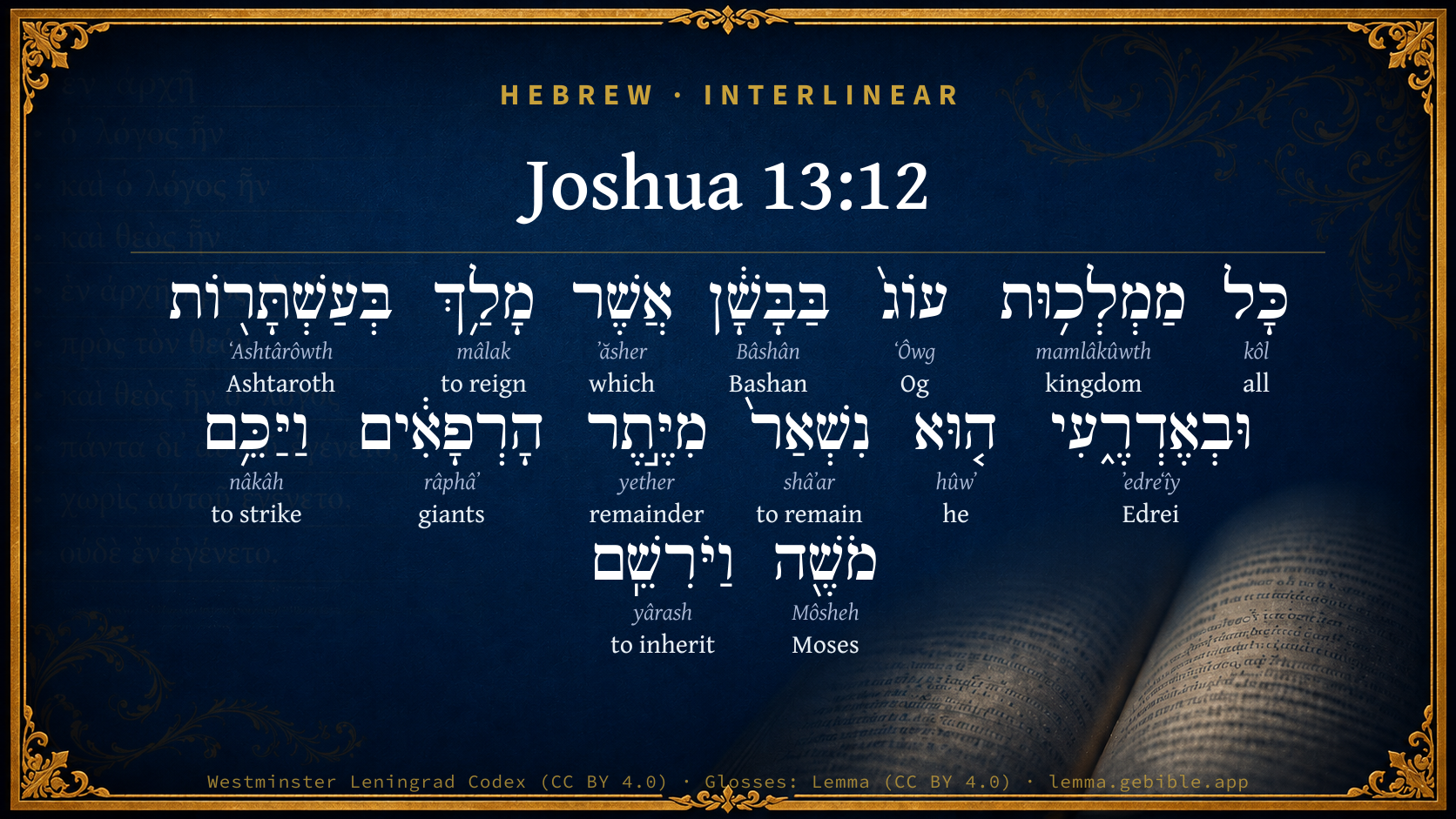
  1. כָּל kôl H3605 “all of” Noun, Common, Masculine, Singular, Construct
  2. מַמְלְכ֥וּת mamlâkûwth H4468 “kingdom of” Noun, Common, Feminine, Singular, Construct
  3. עוֹג֙ ʻÔwg H5747 “Og” Noun, Proper
  4. בַּבָּשָׁ֔ן Bâshân H1316 “in/at the · Bashan” Preposition, Determined + Noun, Proper
  5. אֲשֶׁר ʼăsher H834 “which” Particle, Relative
  6. מָלַ֥ךְ mâlak H4427 “to reign” Verb, Qal, Perfect, 3rd Person, Masculine, Singular
  7. בְּעַשְׁתָּר֖וֹת ʻAshtârôwth H6252 “in/at · Ashtaroth” Preposition + Noun, Proper
  8. ה֤וּא hûwʼ H1931 “he” Pronoun, Personal, 3rd Person, Masculine, Singular
  9. נִשְׁאַר֙ shâʼar H7604 “to remain” Verb, Niphal, Perfect, 3rd Person, Masculine, Singular
  10. מִיֶּ֣תֶר yether H3499 “from · remainder of” Preposition + Noun, Common, Masculine, Singular, Construct
  11. הָרְפָאִ֔ים râphâʼ H7497 “the · giants” Particle, Definite Article + Noun, Proper
  12. וַיַּכֵּ֥ם nâkâh H5221 “and · to strike · them” Conjunction + Verb, Hiphil, Sequential Imperfect, 3rd Person, Masculine, Singular + Suffix, Personal, 3rd Person, Masculine, Plural
  13. מֹשֶׁ֖ה Môsheh H4872 “Moses” Noun, Proper
  14. וַיֹּרִשֵֽׁם yârash H3423 “and · to inherit · them” Conjunction + Verb, Hiphil, Sequential Imperfect, 3rd Person, Masculine, Singular + Suffix, Personal, 3rd Person, Masculine, Plural

About this verse

These counts appear in no published source. They are computed here, from the morphology-tagged text and Lemma’s own curated glosses. What Lemma adds →

15
words
15
distinct lemmas
Historical
section

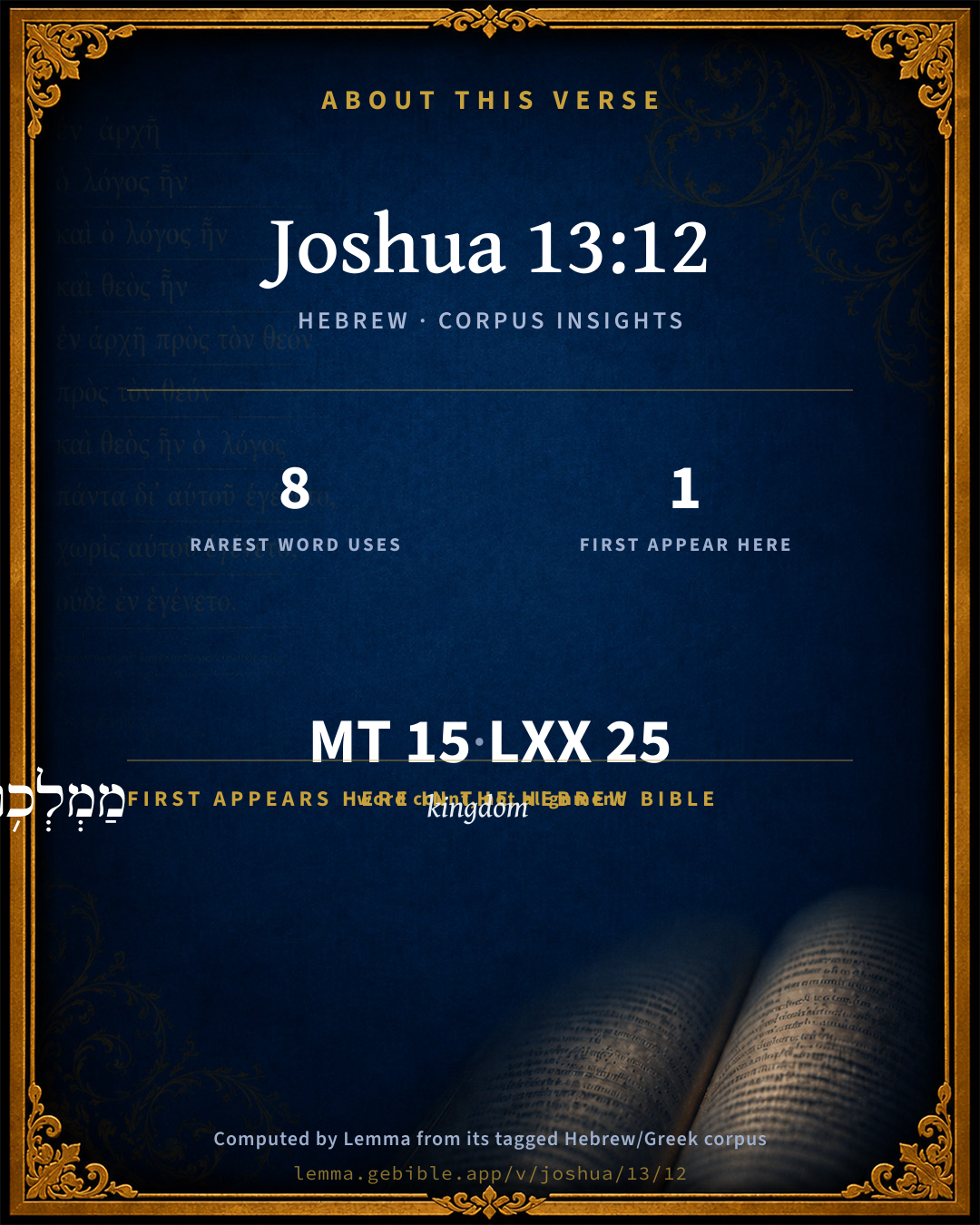
Notable vocabulary

The rarest word here is וּבְאֶדְרֶ֑עִי Edrei H154 — appearing just 8 times in the whole Hebrew Bible.

First appearance in Scripture

This word makes its first canonical appearance in the Hebrew Bible here:

  • מַמְלְכ֥וּת kingdom H4468

Shared distinctive vocabulary

וּבְאֶדְרֶ֑עִי Edrei H154 occurs in 8 verses of the Hebrew Bible. Also found in:

Grammatical profile

  • 4 verbs
  • 9 nouns
  • 1 pronoun
  • 1 particle

Verb forms

  • מָלַ֥ךְ Qal · Perfect
  • נִשְׁאַר֙ Niphal · Perfect
  • וַיַּכֵּ֥ם Hiphil · Sequential Imperfect
  • וַיֹּרִשֵֽׁם Hiphil · Sequential Imperfect

Hebrew & Septuagint length

In English translation the verse runs 33 words from the Hebrew and 30 from the Septuagint (LXX English) — closely comparable.

A rough comparison of the two English renderings, which tokenize alike — not a word-level alignment.

Word counts can differ between the Hebrew and the Greek without any difference in meaning — e.g. the Hebrew direct-object marker אֵת has no separate Greek word, and Greek often adds the article ὁ.

In the original languages it is 15 Hebrew tokens and 25 Greek tokens — but the two are counted differently (Hebrew bundles its prefixes and suffixes into one token; the Greek is in lemma form), so that isn’t a like-for-like length.

Cross-references

4

Topical passages linked to Joshua 13:12 in the Treasury of Scripture Knowledge — connected by theme and wording, ordered by reader-vote popularity; previews shown in the World English Bible.

  • Joshua 12:4 and the border of Og king of Bashan, of the remnant of the Rephaim, who lived at Ashtaroth and at Edrei,
  • Numbers 21:23–35 Sihon would not allow Israel to pass through his border: but Sihon gathered all his people together, and went out against Israel into the wilderness, and came to Jahaz; and he fought against Israel.
  • Deuteronomy 3:10–11 all the cities of the plain, and all Gilead, and all Bashan, to Salecah and Edrei, cities of the kingdom of Og in Bashan.
  • Joshua 14:3–4 For Moses had given the inheritance of the two tribes and the half-tribe beyond the Jordan: but to the Levites he gave no inheritance among them.

Cross-references courtesy of OpenBible.info (CC BY 4.0).

Hebrew and Greek witnesses Masoretic Hebrew ↔ Greek Septuagint

The same verse in the two great witnesses to the Old Testament, shown verse-for-verse.

These are two independent witnesses, not word-aligned to each other, and the Septuagint is shown in lemma (dictionary) form.

Hebrew Joshua 13:12 Masoretic · Westminster Leningrad Codex

כָּל מַמְלְכ֥וּת עוֹג֙ בַּבָּשָׁ֔ן אֲשֶׁר מָלַ֥ךְ בְּעַשְׁתָּר֖וֹת וּבְאֶדְרֶ֑עִי ה֤וּא נִשְׁאַר֙ מִיֶּ֣תֶר הָרְפָאִ֔ים וַיַּכֵּ֥ם מֹשֶׁ֖ה וַיֹּרִשֵֽׁם

all the kingdom of Og in Bashan, who reigned in Ashtaroth and in Edrei (the same was left of the remnant of the Rephaim); for these did Moses strike, and drove them out.

World English Bible · Public Domain

Greek LXX Joshua 13:12 Septuagint · lemma form

πᾶς ὁ βασιλεία ωγ ἐν ὁ βασανῖτις ὅς βασιλεύω ἐν ασταρωθ καί ἐν εδραϊν οὗτος καταλείπω ἀπό ὁ γίγας καί πατάσσω αὐτός μωυσῆς καί ἐκὀλεθρεύω

All the kingdom of Og in the region of Basan, who reigned in Astaroth and in Edrain: he was left of the giants; and Moses struck him, and destroyed him.

LXX2012 (modern English Septuagint) · Public Domain

Hebrew: Westminster Leningrad Codex (CC BY 4.0). Greek: Septuagint (public domain); English from LXX2012 (modern English Septuagint) (Public Domain). How the Septuagint differs from the Hebrew →

Targum (Aramaic paraphrase)

1

The Targum is the ancient Jewish Aramaic paraphrase of the Hebrew Scriptures — an interpretive translation, not the Hebrew text itself. Onkelos (literal) and Pseudo-Jonathan (expansive) render the Torah, and Jonathan the Prophets. Coverage is partial: where no permissively-licensed English translation exists for a verse, only the Aramaic is shown. This is verse-level text, not a word-by-word alignment to the Hebrew.

  1. Targum Jonathan Prophets (Joshua–Malachi)
    כָּל מַלְכוּת עוֹג בְּמַתְנָן דִי מְלַךְ בְּעַשְׁתָּרוֹת וּבְאֶדְרֶעִי וְהוּא אִשְׁתָּאַר מִשְׁאַר גִבָּרַיָא וּמְחָנוּן מֹשֶׁה וְתַרְכִינוּן:

    (no public-domain English translation for this verse)

    Targum Jonathan — Aramaic: “Mikraot Gedolot” (public domain). English: “Sefaria Community Translation” (CC0 1.0 (public-domain dedication)); “London "Chaldee Paraphrase," 1871” (public domain). Text via Sefaria.

Commentary

Notes on Joshua 13:12 from classic Christian and Jewish commentators (each source and its license shown beneath its notes). The classic Christian expositions comment on the surrounding passage and are grouped to its opening verse, so a note may address several verses; the Jewish commentaries on the Tanakh (Rashi and others) are per-verse, so they appear only where the commentator wrote on this verse.

Lemma curates 59 commentaries, every one of them public domain or Creative Commons licensed, each selected and text-cleaned for this edition rather than reprinted as found. About our sources →

Trapp's Complete Commentary

John Trapp

Jos 13:12 All the kingdom of Og in Bashan, which reigned in Ashtaroth and in Edrei, who remained of the remnant of the giants: for these did Moses smite, and cast them out.

Ver. 12. Which reigned in Ashtaroth and in Edrei.] Which some take for two mansion houses of his, or royal palaces.

John Trapp, A Commentary or Exposition upon All the Books of the Old and New Testament (1647–1656) — public domain. Text from a community e-Sword module.

The Cambridge Bible for Schools and Colleges

gen. ed. J. J. S. Perowne

12. all the kingdom of Og in Bashan] “With respect to the two tribes and a half beyond the Jordan, nothing is more striking at the first glance than their wide extent, compared with the narrow space into which the western tribes were compressed … it is certainly a domain which, taken in its entire superficies, would not yield in extent to the whole region on the west of the Jordan.” Ewald’s History of Israel, 11. 294, 295.

The Cambridge Bible for Schools and Colleges (gen. ed. J. J. S. Perowne; Cambridge University Press, 1878–1918) — public domain. Text from a community e-Sword module.

John Gill's Exposition

All the kingdom of Og in Bashan, who reigned in Ashtaroth and in Edrei,.... See Gill on Jos 12:4,

who remained of the remnant of the giants; was descended from those that remained in Ashtaroth, after the rest were cut off by Chedorlaomer, Gen 14:5; called there the Rephaim, as here:

for these did Moses smite, and cast them out: that is, not only the giants, but the inhabitants of the above kingdom, the greatest part of them; for the Geshurites and the Maachathites are excepted in Jos 13:13.

John Gill's Exposition of the Whole Bible (1746–1763) — public domain (CC PDM 1.0). Text via the HelloAO Bible API.

Matthew Poole's English Annotations

These did Moses smite; not all now mentioned, as appears from Jos 13:13, but Sihon and Og, and their people, and the generality of them, which he had now named, some of them being excepted.

Matthew Poole's English Annotations on the Holy Bible (1683–1685) — public domain. Text from a community e-Sword/MySword module.

The Pulpit Commentary

Giants. See note on Jos_12:4.

The Pulpit Commentary (1880–1919), ed. H.D.M. Spence-Jones & Joseph S. Exell — public domain. Text from a community e-Sword module.

John Wesley's Explanatory Notes

These did Moses smite - Not all now mentioned, but Sihon and Og, and their people, and the generality of them.

John Wesley, Explanatory Notes Upon the Whole Bible (1754–1765) — public domain. Text via the GEBible commentary corpus.

Rashi

Rabbi Shlomo Yitzchaki (Rashi)

From the remnant of the giants— who were slain by Kedorlaomeir and the kings who were aligned with him, as it is said, “And they struck the Rephaim in Ashteros Karnayim.”

Rashi on the Tanakh — English translations: “The Judaica Press complete Tanach with Rashi, translated by A. J. Rosenberg” (CC BY 4.0); “Pentateuch with Rashi's commentary by M. Rosenbaum and A.M. Silbermann, 1929-1934” (public domain); “The Metsudah Tanach series, Lakewood, N.J” (CC BY 4.0); and “The Book of Joshua, Metsudah Publications, 1997” (CC BY 4.0). Text via Sefaria.

Lesson kit

Teaching starters — assembled from the data on this page, not authored interpretation. Every prompt links to the verse data it draws on. Edit before teaching.

Joshua, in the Historical, opens this verse with 15 words (15 distinct Hebrew lemmas). Its most distinctive word is ʼedreʻîy (“Edrei”). A historical commentator’s framing appears above. Read the whole chapter for the surrounding context.

Discussion questions

  1. What does “Edrei” (ʼedreʻîy) contribute to the verse as a whole?
  2. This is the first place “kingdom” appears in Scripture (first appears here). What does its debut here establish?
  3. How does Numbers 21:33, which shares the word «Edrei», read alongside this verse?
  4. These translations render this verse differently; the difference is in the English rendering, not the original. What questions does that raise?
  5. «מָלַ֥ךְ» is a Qal Perfect verb. How does that grammatical form shape the action described?
  6. Compare how Trapp's Complete Commentary and The Cambridge Bible for Schools and Colleges read this verse. Where do they agree or differ?

Things to notice

Reading settings

Reading text

Shown beneath each verse's original-language words.

Old Testament
Old Testament edition

Read the OT as the Masoretic Hebrew (MT) or the Greek Septuagint (LXX).

English shown for the Greek Septuagint (in the Hebrew ↔ Greek comparison).

Comparing translations? Open the Compare panel on any verse page to stack up to four side by side.