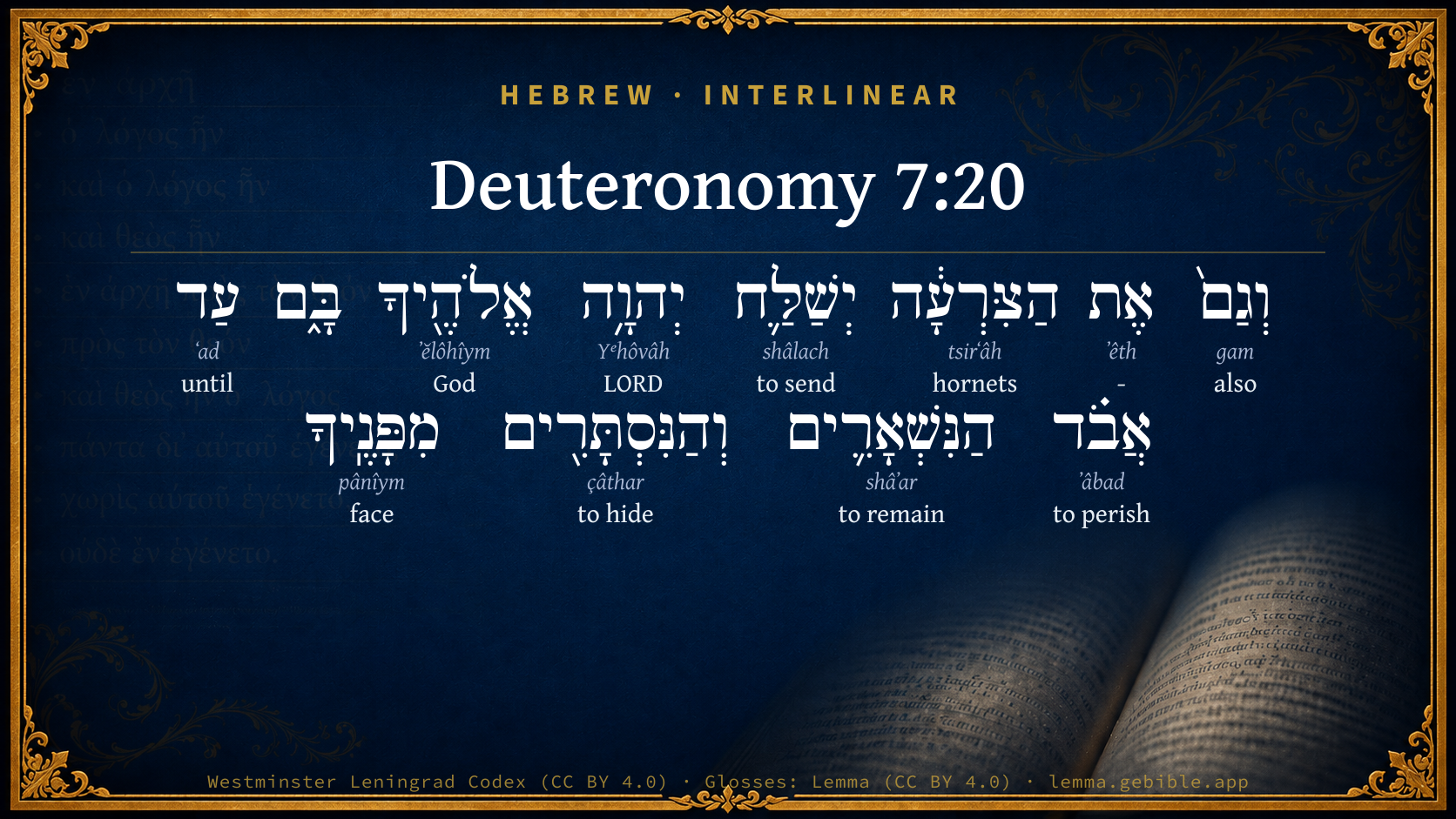
Deuteronomy 7:20

Hebrew (Westminster Leningrad Codex) Deuteronomy 7:20 appears in the Hebrew Old Testament. The text above is from the Westminster Leningrad Codex. Each word links to its Strong’s number, a concise gloss, and parsing drawn from the Open Scriptures Hebrew Bible morphology. Click any word for its full Brown-Driver-Briggs (BDB) entry.
Download image
Cite this verse

Deuteronomy 7:20 (World English Bible). Public Domain. Lemma interlinear Bible study tool, https://lemma.gebible.app/v/deuteronomy/7/20.

Show BibTeX & RIS
BibTeX
RIS
English Translation
Moreover Yahweh your God will send the hornet among them, until those who are left, and hide themselves, perish from before you.
World English Bible · Public Domain
Download a study sheet

One document with this verse’s original text, its word-by-word gloss line, the meaning frame, cross-references with their text, attributed commentary, and full source and license credits — printable, and it pastes into notes with its structure intact.

This verse Autodidact and up

Study sheet (.html) Plain text (.txt)

A passage Seminary Student

Up to 50 verses in one chapter. A passage sheet keeps up to 6 commentary sources and 12 cross-references per verse, in the order this page ranks them, and says so on the sheet whenever that leaves anything out. Ask for a single verse and you get the Autodidact verse sheet above.

Everything on this page stays free to read, with no account — the sheet is a download of what is already on screen, not access to it.

Want to remove ads? Support Godless Engineer
Compare translations 3

The same verse in 3 English versions, stacked beneath the original-language interlinear above. Click any original word for its lexicon entry.

Each is an independent rendering of the whole verse — the interlinear is not word-aligned to these translations.

Highlighted words mark where these versions differ — a whole-verse word diff, not a word-by-word alignment.

  • World English Bible Public Domain
    Moreover Yahweh your God will send the hornet among them, until those who are left, and hide themselves, perish from before you.
  • King James Version Public Domain
    Moreover the LORD thy God will send the hornet among them, until they that are left, and hide themselves from thee, be destroyed.
  • unfoldingWord Literal Text CC BY-SA 4.0
    And also, Yahweh your God will send the hornet against them until those who are left and who hide themselves perish from your face.

unfoldingWord Literal Text — © unfoldingWord, licensed CC BY-SA 4.0. Word-aligned USFM3 via Door43 (git.door43.org/unfoldingWord/en_ult).

Versions to compare (up to 4)

3 of 4 selected

Show all 18 translations

Every available English version of this verse, each an independent rendering of the whole verse.

  • World English Bible Public Domain
    Moreover Yahweh your God will send the hornet among them, until those who are left, and hide themselves, perish from before you.
  • Berean Standard Bible Public Domain
    Moreover, the LORD your God will send the hornet against them until even the survivors hiding from you have perished.
  • Majority Standard Bible Public Domain
    Moreover, the LORD your God will send the hornet against them until even the survivors hiding from you have perished.
  • King James Version Public Domain
    Moreover the LORD thy God will send the hornet among them, until they that are left, and hide themselves from thee, be destroyed.
  • American Standard Version (1901) Public Domain
    Moreover Jehovah thy God will send the hornet among them, until they that are left, and hide themselves, perish from before thee.
  • Revised Version (1885) Public Domain
    Moreover the LORD thy God will send the hornet among them, until they that are left, and hide themselves, perish from before thee.
  • Geneva Bible (1599) Public Domain
    Moreouer, the Lord thy God will send hornets among them vntil they that are left, and hide themselues from thee, be destroyed.
  • Douay-Rheims (1899) Public Domain
    Moreover the Lord thy God will send also hornets among them, until he destroy and consume all that have escaped thee, and could hide themselves.
  • Young's Literal Translation Public Domain
    `And also the locust doth Jehovah thy God send among them, till the destruction of those who are left, and of those who are hidden from thy presence;
  • Literal Standard Version CC BY-SA 4.0
    And your God YHWH also sends the locust among them, until the destruction of those who are left, even those who are hidden from your presence;
  • Unlocked Literal Bible CC BY-SA 4.0
    Moreover, Yahweh your God will send the hornet among them, until those who are left and who hide themselves from you perish from your presence.
  • unfoldingWord Literal Text CC BY-SA 4.0
    And also, Yahweh your God will send the hornet against them until those who are left and who hide themselves perish from your face.
  • Darby Bible Public Domain
    Moreover, Jehovah thy God will send the hornet among them, until they that are left, and they that hide themselves from thee, are destroyed.
  • World Messianic Bible Public Domain
    Moreover the LORD your God will send the hornet among them, until those who are left, and hide themselves, perish from before you.
  • Webster's Bible Public Domain
    Moreover, the LORD thy God will send the hornet among them, until they that are left, and hide themselves from thee, shall be destroyed.
  • Free Bible Version CC BY-SA 4.0
    On top of this, the Lord your God will send the hornet against them until anyone who has survived and anyone hiding from you have been killed.
  • Bible in Basic English Public Domain
    And the Lord will send a hornet among them, till all the rest who have kept themselves safe from you in secret places have been cut off.
  • JPS Tanakh (1917) Public Domain
    Moreover the LORD thy God will send the hornet among them, until they that are left, and they that hide themselves, perish from before thee.

Literal Standard Version (2020), Covenant Press — licensed CC BY-SA 4.0. Text via the HelloAO Bible API (eBible.org). Unlocked Literal Bible (unfoldingWord) — licensed CC BY-SA 4.0. Text via the HelloAO Bible API (eBible.org). unfoldingWord Literal Text — © unfoldingWord, licensed CC BY-SA 4.0. Word-aligned USFM3 via Door43 (git.door43.org/unfoldingWord/en_ult). Free Bible Version, Dr. Jonathan Gallagher — licensed CC BY-SA 4.0. Text via the HelloAO Bible API (eBible.org).

Word by word

More ways to search: Search by grammar → Find every occurrence → Compare this word →

Practice this passage: Drill this verse → Learn its vocabulary →

הַצִּרְעָ֔ה
tsirʻâh
H6880
“the · hornets”
Particle, Definite Article + Noun, Common, Feminine, Singular, Absolute
Part of Speech
Particle + Noun
Type
Common
Gender
Feminine
Number
Singular
State
Absolute
Full BDB Definition

Origin: from H6879

TWOT: 1971b

hornets
  1. וְגַם֙ gam H1571 “and · also” Conjunction + Particle, Accusative
  2. אֶת ʼêth H853 “-” Particle, Direct Object
  3. יְשַׁלַּ֛ח shâlach H7971 “to send” Verb, Piel, Imperfect, 3rd Person, Masculine, Singular
  4. יְהוָ֥ה Yᵉhôvâh H3068 “LORD” Noun, Proper
  5. אֱלֹהֶ֖יךָ ʼĕlôhîym H430 “God(s) · your” Noun, Common, Masculine, Plural, Construct + Suffix, Personal, 2nd Person, Masculine, Singular
  6. עַד ʻad H5704 “until” Preposition
  7. אֲבֹ֗ד ʼâbad H6 “to perish” Verb, Qal, Infinitive Construct
  8. הַנִּשְׁאָרִ֛ים shâʼar H7604 “the · remaining” Particle, Definite Article + Verb, Niphal, Participle Active, Masculine, Plural, Absolute
  9. וְהַנִּסְתָּרִ֖ים çâthar H5641 “and · the · hiding” Conjunction + Particle, Definite Article + Verb, Niphal, Participle Active, Masculine, Plural, Absolute
  10. מִפָּנֶֽיךָ pânîym H6440 “from · face(s) · your” Preposition + Noun, Common, Both, Plural, Construct + Suffix, Personal, 2nd Person, Masculine, Singular

About this verse

These counts appear in no published source. They are computed here, from the morphology-tagged text and Lemma’s own curated glosses. What Lemma adds →

12
words
11
distinct lemmas
Pentateuch
section

Notable vocabulary

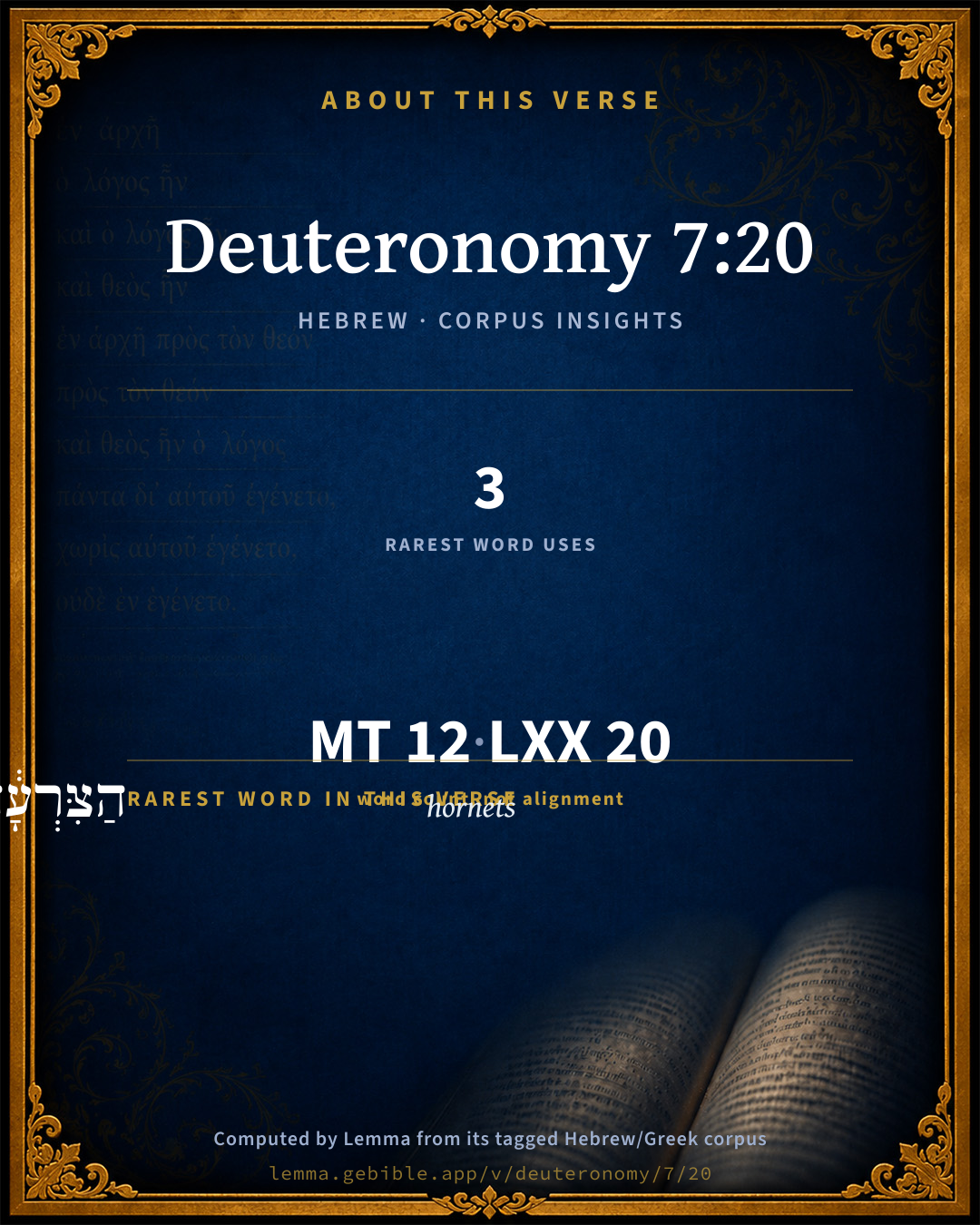
The rarest word here is הַצִּרְעָ֔ה hornets H6880 — appearing just 3 times in the whole Hebrew Bible.

Shared distinctive vocabulary

הַצִּרְעָ֔ה hornets H6880 occurs in 3 verses of the Hebrew Bible. Also found in:

Grammatical profile

  • 4 verbs
  • 4 nouns
  • 2 prepositions
  • 2 particles

Verb forms

  • יְשַׁלַּ֛ח Piel · Imperfect
  • אֲבֹ֗ד Qal · Infinitive Construct
  • הַנִּשְׁאָרִ֛ים Niphal · Participle Active
  • וְהַנִּסְתָּרִ֖ים Niphal · Participle Active

Hebrew & Septuagint length

In English translation the verse runs 22 words from the Hebrew and 26 from the Septuagint (LXX English) — closely comparable.

A rough comparison of the two English renderings, which tokenize alike — not a word-level alignment.

Word counts can differ between the Hebrew and the Greek without any difference in meaning — e.g. the Hebrew direct-object marker אֵת has no separate Greek word, and Greek often adds the article ὁ.

In the original languages it is 12 Hebrew tokens and 20 Greek tokens — but the two are counted differently (Hebrew bundles its prefixes and suffixes into one token; the Greek is in lemma form), so that isn’t a like-for-like length.

Cross-references

2

Topical passages linked to Deuteronomy 7:20 in the Treasury of Scripture Knowledge — connected by theme and wording, ordered by reader-vote popularity; previews shown in the World English Bible.

  • Joshua 24:12 I sent the hornet before you, which drove them out from before you, even the two kings of the Amorites; not with your sword, nor with your bow.
  • Exodus 23:28–30 I will send the hornet before you, which will drive out the Hivite, the Canaanite, and the Hittite, from before you.

Cross-references courtesy of OpenBible.info (CC BY 4.0).

Hebrew and Greek witnesses Masoretic Hebrew ↔ Greek Septuagint

The same verse in the two great witnesses to the Old Testament, shown verse-for-verse.

These are two independent witnesses, not word-aligned to each other, and the Septuagint is shown in lemma (dictionary) form.

Hebrew Deuteronomy 7:20 Masoretic · Westminster Leningrad Codex

וְגַם֙ אֶת הַצִּרְעָ֔ה יְשַׁלַּ֛ח יְהוָ֥ה אֱלֹהֶ֖יךָ בָּ֑ם עַד אֲבֹ֗ד הַנִּשְׁאָרִ֛ים וְהַנִּסְתָּרִ֖ים מִפָּנֶֽיךָ

Moreover Yahweh your God will send the hornet among them, until those who are left, and hide themselves, perish from before you.

World English Bible · Public Domain

Greek LXX Deuteronomy 7:20 Septuagint · lemma form

καί ὁ σφηκία ἀποστέλλω κύριος ὁ θεός σύ εἰς αὐτός ἕως ἄν ἐκτρίβω ὁ καταλείπω καί ὁ κρύπτω ἀπό σύ

And the Lord your God shall send against them the hornets, until they that are left and they that are hidden from you be utterly destroyed.

LXX2012 (modern English Septuagint) · Public Domain

Hebrew: Westminster Leningrad Codex (CC BY 4.0). Greek: Septuagint (public domain); English from LXX2012 (modern English Septuagint) (Public Domain). How the Septuagint differs from the Hebrew →

Targum (Aramaic paraphrase)

2

The Targum is the ancient Jewish Aramaic paraphrase of the Hebrew Scriptures — an interpretive translation, not the Hebrew text itself. Onkelos (literal) and Pseudo-Jonathan (expansive) render the Torah, and Jonathan the Prophets. Coverage is partial: where no permissively-licensed English translation exists for a verse, only the Aramaic is shown. This is verse-level text, not a word-by-word alignment to the Hebrew.

  1. Targum Onkelos Torah (Genesis–Deuteronomy)
    וְאַף יָת עֲרָעִיתָא יְגָרֵי יְיָ אֱלָהָךְ בְּהוֹן עַד דְיֵבַדוּן דְאִשְׁתָּאָרוּ וּדְאִטַמָרוּ מֵקֳדָמָךְ

    (no public-domain English translation for this verse)

    Targum Onkelos — Aramaic: “Onkelos Genesis” (public domain); “Onkelos Exodus” (public domain); “Onkelos Leviticus” (public domain); “Onkelos Numbers” (public domain); “Onkelos Deuteronomy” (public domain). English: “Sefaria Community Translation” (CC0 1.0 (public-domain dedication)); “J.W. Etheridge. The Targums of Onkelos and Jonathan Ben Uzziel on the Pentateuch. London: Longmans, Green, 1862” (public domain). Text via Sefaria.

  2. Targum Pseudo-Jonathan Torah (Genesis–Deuteronomy)
    וּלְחוֹד יַת מְחַת אוֹרְעַיִיתָא טְרִיקַיָיא יְגָרֵי יְיָ אֱלָהָכוֹן בְּהוֹן עַד דִּיהוֹבְדוּן מַה דְּמִשְׁתּוֹתְרִין וּמַה דְּמִיטַמְרִין מִן קֳדָמֵיכוֹן

    Moreover, the Lord your God will send the plague of biting hornets among you, until they who have remained shall perish and disappear before you.

    Targum Pseudo-Jonathan — Aramaic: “Targum Jonathan on Genesis” (public domain); “Targum Jonathan on Exodus” (public domain); “Targum Jonathan on Leviticus” (public domain); “Targum Jonathan on Numbers” (public domain); “Targum Jonathan on Deuteronomy” (public domain). English: “The Targum of Jonathan ben Uzziel, trans. J. W. Etheridge, London, 1862” (public domain). Text via Sefaria.

Commentary

Notes on Deuteronomy 7:20 from classic Christian and Jewish commentators (each source and its license shown beneath its notes). The classic Christian expositions comment on the surrounding passage and are grouped to its opening verse, so a note may address several verses; the Jewish commentaries on the Tanakh (Rashi and others) are per-verse, so they appear only where the commentator wrote on this verse.

Lemma curates 59 commentaries, every one of them public domain or Creative Commons licensed, each selected and text-cleaned for this edition rather than reprinted as found. About our sources →

Trapp's Complete Commentary

John Trapp

Deu 7:20 Moreover the LORD thy God will send the hornet among them, until they that are left, and hide themselves from thee, be destroyed.

Ver. 20. Send the hornet.] {See Trapp on "Exo 23:28"}

John Trapp, A Commentary or Exposition upon All the Books of the Old and New Testament (1647–1656) — public domain. Text from a community e-Sword module.

The Biblical Illustrator

Joseph S. Exell

Deu_7:20

The Lord thy God will send the hornet.

Secret sins driven out by stinging hornets

I. Sins which are left and hidden. John Bunyan very wisely describes the town of Mansoul after it had been taken by Prince Immanuel. The Prince rode to the Castle called the Heart and took possession of it, and the whole city became his; but there were certain Diabolonians, followers of Diabolus, who never quitted the town. They could not be seen in the streets, could not be heard in the markets, never dared to occupy a house, but lurked about in certain old dens and eaves. Some of them got impudent enough even to hire themselves out for servants to the men of Mansoul under other names. There was Mr. Covetousness, who was called Mr. Prudent Thrifty, and there was Mr. Lasciviousness, who was called Mr. Harmless Mirth. They took other names, and still lived here, much to the annoyance of the town of Mansoul, skulking about in holes and corners, and only coming out on dark days, when they could do mischief and serve the Black Prince. Now, in all of us, however watchful we may be, though we may set Mr. Pry Well to listen at the door, and he may watch, and my Lord Mayor, Mr. Understanding, be very careful to search all these out, yet there will remain much hidden sin. I think we ought always to pray to God to forgive us sins that we do not know anything about. Thine unknown agonies, says the old Greek liturgy; and there are unknown sins for which those agonies make atonement. Perhaps the sins which you and I confess are not the tithe of what we really do commit. There are, no doubt, in all of us Canaanites still dwelling in the land, that will be thorns in our side.

II. A singular means for their destruction--thy God will send the hornet among them. These fellows resorted to caves and dens. God employed the very best means for their destruction. I suppose these hornets were large wasps; two or three times, perhaps, as large as a wasp, with very terrible stings. It is not an unusual historical fact to find districts depopulated by means of stinging insects. In connection with the journey of Dr. Livingstone we can never forget that strange kind of guest which is such a pest to the cattle in any district, that the moment it appeared they had either to fly before it or to die. The hornet must have been a very terrible creature; but it is not at all extraordinary that there should have been hornets capable of driving out a nation. The hornet was a very simple means; it was no sound of trumpet, nor even the glitter of miracles, it was a simple, natural means of fetching these people out of their holes. It is well known that insects in some countries will sting one race of people and not another. Sometimes the inhabitants of a country are not at all careful about mosquitoes or such creatures, when strangers are greatly pestered with them. God could therefore bring hornets which would sting the Hivites and the Jebusites but not molest the Israelites, and in this way the Canaanites were driven out of their holes; some died by the stings of hornets, and others were put in the way of the sharp swords of the men of Israel, and thus they died. The spiritual analogy to this is, the daily trouble which God sends to every one of us. I suppose you have all got your hornets. Some have hornets in the family; your child may be a hornet to you--your wife, your husband, your brother, the dearest friend you haves may be a daffy cross to you; and, though a dead cross is very heavy, a living cross is heavier far. To bury a child is a great grief, but to have that child live and sin against you is ten times worse. You may have hornets that shall follow you to your bed chamber--some of you may know what that means--so that even where you ought to find your rest and your sweetest solace, it is there that you receive your bitterest sting of trouble. The hornet will sometimes come in the shape of business. You are perplexed--you cannot prosper--one thing comes after another. You seem to be born to trouble more than other people. You have ventured on the right hand, but it was a failure; you pushed out on the left, but that was a breakdown. Almost everybody you trust fails immediately, and those you do not trust are the people you might have safely relied upon. Others have hornets in their bodies. Some have constant headaches; aches and pains pass and shoot along the nerves of others. If you could but be quit of it, you think, how happy you would be; but you have got your hornet, and that hornet is always with you. But if I tried to get through the whole list of hornets I should want all the morning, for there is a particular grief to every man. Each man has his own form of obnoxious sting which he has to feel. There is one point I want you to notice in the text, and that is, we are expressly told the hornets came from God. He sent them. The Lord thy God will send the hornet. This will help you, perhaps, to bear their stings another time. God weighs your troubles in scales, and measures out your afflictions, every drachm and scruple of them; and since they come, therefore, directly from a loving Fathers hand, accept them with grateful cheerfulness, and pray that the result which Divine Wisdom has ordained to flow from them may be abundantly realised in your sanctification, in being made like unto Christ.

III. A very suggestive lesson to ourselves. It is this. What is my particular besetting sin? Have I been careful in self-examination? If not, I must expect to have the hornet. God never punishes His children for sin penally, but He chastens them for it paternally. You may often discover what your sin is by the punishment, for you can see the face of the sin in the punishment--the one is so like the other. (C. H. Spurgeon.)

Small troubles

It seems as if the insectile world were determined to extirpate the human race. It is bombarding the grain fields, and the orchards, and the vineyards. The Colorado beetle, the Nebraska grasshopper, the New Jersey locust, the universal potato bug seem to carry on the work which was begun ages ago, when the insects buzzed and droned out of Noahs Ark as the door was opened. In my text the hornet flies out on its mission. It is a species of wasp, swift in its motion and violent in its sting. Its touch is torture to man or beast. The hornet goes in swarms. It has captains over hundreds, and twenty of them alighting on one man will produce certain death. The Persians attempted to conquer a Christian city, but the elephants and the beasts on which the Persians rode were assaulted by the hornet, so that the whole army was broken up, and the besieged city was rescued. This burning and noxious insect stung out the Hittites and the Canaanites from their country. What gleaming sword and chariot of war could not accomplish was done by the puncture of an insect. The Lord sent the hornet. When we are assaulted by great Behemoths of trouble, we become chivalric, and we assault them; we get on the high-mettled steed of our courage, and we make a cavalry charge at them; and, if God be with us, we come out stronger and better than when we went in. But, alas! for these insectile annoyances of life--these foes, too small to shoot--these things without any avoirdupois weight--the gnats and the midges, and the flies, and the wasps, and the hornets. In other words, it is the small stinging annoyances of our life which drive us out and use us up. In the best conditioned life, for some grand and glorious purpose, God has sent the hornet.

1. I remark, in the first place, that these small stinging annoyances may come in the shape of a sensitive nervous organisation. People who are prostrated under typhoid fevers or with broken bones get plenty of sympathy; but who pities anybody that is nervous?

2. Again, these small insect annoyances may come to us in the shape of friends and acquaintances who are always saying disagreeable things. There are some people you cannot be with for half an hour but you feel cheered and comforted. Then there are other people you cannot be with for five minutes before you feel miserable. They do not mean to disturb you, but they sting you to the bone. They gather up all the yarn which the gossips spin, and peddle it. They gather up all the adverse criticisms about your person, about your business, about your home, about your church, and they make your ear the funnel into which they pour it. These people of whom I speak, reap and bind in the great harvest field of discouragement. Some days you greet them with a hilarious good morning, and they come buzzing at you with some depressing information. The Lord sent the hornet.

3. Perhaps these small insect annoyances will come in the shape of a domestic irritation. The parlour and the kitchen do not always harmonise. To get good service and to keep it is one of the great questions of the country.

4. These small insect disturbances may also come in the shape of business irritations. It is not the panics that kill the merchants. Panics come only once in ten or twenty years. It is the constant din of these every day annoyances which is sending so many of our best merchants into nervous dyspepsia and paralysis and the grave.

5. I have noticed in the history of some of my congregation that their annoyances are multiplying, and that they have a hundred where they used to have ten. The naturalist tells us that a wasp sometimes has a family of twenty thousand wasps, and it does seem as if every annoyance of your life brooded a million. By the help of God today I want to set in a counter current. The hornet is of no use? Oh yes! The naturalists tell us they are very important in the worlds economy; they kill spiders and they clear the atmosphere; and I really believe God sends the annoyances of our lives upon us to kill the spiders of the soul and to clear the atmosphere into the skies. These annoyances are sent on us, I think, to wake us up from our lethargy. If we had a bed of everything that was attractive and easy, what would we want of heaven? We think that the hollow tree sends the hornet. You think the devil sends the hornet. I want to correct your theology. The Lord sent the hornet. Then I think these annoyances come on us to culture our patience. When you stand chin-deep in annoyances is the time for you to swim out towards the great headlands of Christian attainment, and when your life is loaded to the muzzle with repulsive annoyances--that is the time to draw the bead. Nothing but the furnace will ever burn out of us the clinker and the slag. Now, would you not rather have these small drafts of annoyance on your bank of faith than some all-staggering demand upon your endurance? I want to make my people strong in the faith that they will not surrender to small annoyances. In the village of Hamelin, tradition says, there was an invasion of rats, and these small creatures almost devoured the town and threatened the lives of the population, and the story is that a piper came out one day and played a very sweet tune, and all the vermin followed him--followed him to the banks of the Weser, and then he blew a blast and they dropped in and disappeared forever. Of course this is a fable, but I wish I could, on the sweet flute of the Gospel, draw forth all the nibbling and burrowing annoyances of your life, and play them down into the depths forever. How many touches did Mr. Church give to his picture of Cotopaxi or his Heart of the Andes? I suppose about fifty thousand touches. I hear the canvas saying, Why do you keep me trembling with that pencil so long? Why dont you put it on in one dash? No, said Mr. Church, I know how to make a painting. It will take fifty thousand of these touches. And I want you to understand that it is these ten thousand annoyances which, under God, are making up the picture of your life, to be hung at last in the galleries of heaven, fit for angels to look at. God knows how to make a picture. God meant this world to be only the vestibule of heaven, and that is the great gallery of the universe towards which we are aspiring. We must not have it too good in this world, or we would want no heaven. You are surprised that aged people are so willing to go out of this world. I will tell you the reason. It is not only because of the bright prospects in heaven, but it is because they feel that seventy years of nettlesomeness is enough. They would lie down in the soft meadows of this world forever, but God sent the hornet. (T. De Witt Talmage.)

The Biblical Illustrator, edited by Joseph S. Exell (c. 1880s–1900s) — public domain. Text from a community e-Sword module.

Tyndale Open Study Notes

Tyndale Open Resources

7:20 terror: Often rendered the hornet. Whether God sent stinging insects or some other source of terror, he would expel surviving Canaanites from the land (Exod 23:28; Josh 24:12).

Tyndale Open Study Notes — © Tyndale Open Resources, licensed CC BY-SA 4.0. Text via the HelloAO Bible API.

Geneva Bible (1599)

Geneva Bible translators

There is not so small a creature, which I will not arm to fight on thy side against them.

Geneva Bible (1599) marginal notes — public domain. Text via Bolls.life.

Jamieson, Fausset & Brown

Robert Jamieson, A. R. Fausset & David Brown

Moreover the Lord thy God will send the hornet among them--(See on Jos 24:12 [and Exo 23:28]).

Jamieson, Fausset & Brown — Commentary Critical and Explanatory on the Whole Bible (1871) — public domain (CC PDM 1.0). Text via the HelloAO Bible API.

Ellicott's Commentary for English Readers

(20) The hornet.—To be understood literally. (See on Deu_1:44, and Jos_24:12.) The “land flowing with (milk and) honey” may well have swarmed with bees and hornets.

A Bible Commentary for English Readers, edited by Charles John Ellicott (1878–1897) — public domain. Text from a community e-Sword module.

The Cambridge Bible for Schools and Colleges

gen. ed. J. J. S. Perowne

20. And also the hornets will Jehovah … send, etc.] E twice, Exo_23:28, Jos_24:12. ‘By also D indicates that he will have the hornets understood not as the only weapon of God, but as an example of His weapons; by the rest of the verse he makes it sufficiently clear that he takes hornets in the proper sense of the word, in so far as they penetrate into holes and corners’ (Dillmann).

The Cambridge Bible for Schools and Colleges (gen. ed. J. J. S. Perowne; Cambridge University Press, 1878–1918) — public domain. Text from a community e-Sword module.

John Gill's Exposition

Moreover, the Lord thy God will send the hornet among them,.... Not a single one, but several of them, and which may be understood of creatures so called, which resemble wasps, only twice as large, an insect very bold and venomous; see Exo 23:28. Aben Ezra interprets it of the leprosy:

until they that are left, and hide themselves from thee, be destroyed; such of the Canaanites who escaped the sword of the Israelites, and hid themselves in holes and caverns of the earth; these the hornets would find out and sting them to death, until they were all destroyed. Thus God can make use of small creatures, even insects, to destroy nations the most populous and mighty.

John Gill's Exposition of the Whole Bible (1746–1763) — public domain (CC PDM 1.0). Text via the HelloAO Bible API.

Haydock's Catholic Bible Commentary

Hornets. Abenezra understands the leprosy, which the Hebrew may also signify. But hornets and such like insects are very destructive in hot countries; and Pausanias informs us that the Minsiens were driven out of their country by them. (Calmet) --- God destroyed the army of Sapor II, the Persian king, by sending an army of gnats, at the prayer of St. James of Nisibis, A.D. 350. "Lord, said the saint, thou art able by the weakest means to humble the pride of thy enemies, defeat these multitudes by an army of gnats." (Butler, Lives of the Saints, July 11.) --- We may, therefore, explain this text in a literal sense. (Calmet) (Wisdom xii. 8., and xvi. 9., and Josue xxiv. 12.)

George Leo Haydock (1774–1849), Haydock's Catholic Family Bible and Commentary, 1859 edition — public domain. Excludes Psalms (Douay-Rheims chapter numbering differs from Protestant) and Deuterocanonical books (Catholic canon only).

Matthew Poole's English Annotations

The hornet; of which see on Exo 23:28.

Matthew Poole's English Annotations on the Holy Bible (1683–1685) — public domain. Text from a community e-Sword/MySword module.

Whedon's Commentary on the Bible

Daniel D. Whedon

20. Thy God will send the hornet — The different views taken of the meaning of the Hebrew word which our version renders hornet are mainly the following: (1.) That the word is used literally. (2.) That the Amorites are meant. (3.) That it is used in the sense of dread. “A figurative expression for uncontrolled terror.” Comp. Exo_23:28, and Jos_24:12, where the same Hebrew word is employed. This last view seems correct. The dread of them would so affect the nations that the conquest of them would not be difficult.

Daniel D. Whedon (gen. ed.), Commentary on the Old and New Testaments (1874–1909) — public domain. Text from a community e-Sword module.

The Pulpit Commentary

Hornet. (cf. Exo_23:28) Instances are on record of armies being obliged to give way before swarms of insects by which they were attacked (as in the case of Julian, who was compelled by a host of flies and gnats to change his route in retreating from Parthia; Atom. Marcell., 24, 8); but it may be doubted if the statement here is to be understood literally, and not rather figuratively, as expressive of many and varied evils with which the fugitive Canaanites were to be visited until they were extirpated. (Jos_24:12, compared with Jos_10:22-27)

The Pulpit Commentary (1880–1919), ed. H.D.M. Spence-Jones & Joseph S. Exell — public domain. Text from a community e-Sword module.

unfoldingWord translationNotes

Door43 World Missions Community

General Information:

Moses continues to tell the people of Israel Yahweh's words as if the Israelites are one person. (See: Forms of You)

Moreover, Yahweh

"And also, Yahweh"

send the hornet

Possible meanings are 1) God will send actual flying insects that sting people and cause pain, or 2) God will cause the people to become terrified and want to run away.

perish from your presence

This is an idiom. AT: "die so you do not see them anymore" (See: Idiom)

You will not

"Never"

a great and fearsome God

"a great and awesome God" or "a great God who causes the people to fear"

little by little

"slowly"

translationWords

Yahweh

God

send

perish

cast out

nation

unfoldingWord translationNotes — © Distant Shores Media and the Door43 World Missions Community, licensed CC BY-SA 4.0. Source: git.door43.org/Door43/en_tn.

Rashi

Rabbi Shlomo Yitzchaki (Rashi)

הצרעה — a species of flying insect which injected poison into them, and castrated them and blinded their eyes wherever they hid themselves (Sotah 36a).

Rashi on the Tanakh — English translations: “The Judaica Press complete Tanach with Rashi, translated by A. J. Rosenberg” (CC BY 4.0); “Pentateuch with Rashi's commentary by M. Rosenbaum and A.M. Silbermann, 1929-1934” (public domain); “The Metsudah Tanach series, Lakewood, N.J” (CC BY 4.0); and “The Book of Joshua, Metsudah Publications, 1997” (CC BY 4.0). Text via Sefaria.

Lesson kit

Teaching starters — assembled from the data on this page, not authored interpretation. Every prompt links to the verse data it draws on. Edit before teaching.

Deuteronomy, in the Pentateuch, opens this verse with 12 words (11 distinct Hebrew lemmas). Its most distinctive word is tsirʻâh (“hornets”). A historical commentator’s framing appears above. Read the whole chapter for the surrounding context.

Discussion questions

  1. How does “hornets” (tsirʻâh) shape what this verse is saying?
  2. Exodus 23:28 shares the word «hornets» with this verse. How do the two illuminate each other?
  3. These translations render this verse differently; the difference is in the English rendering, not the original. What questions does that raise?
  4. The verb «יְשַׁלַּ֛ח» is Piel Imperfect. How does its form color the action?
  5. Reading how Trapp's Complete Commentary and The Biblical Illustrator read this verse, where do the two commentators agree and where do they part?

Things to notice

Reading settings

Reading text

Shown beneath each verse's original-language words.

Old Testament
Old Testament edition

Read the OT as the Masoretic Hebrew (MT) or the Greek Septuagint (LXX).

English shown for the Greek Septuagint (in the Hebrew ↔ Greek comparison).

Comparing translations? Open the Compare panel on any verse page to stack up to four side by side.