Joshua 10:33

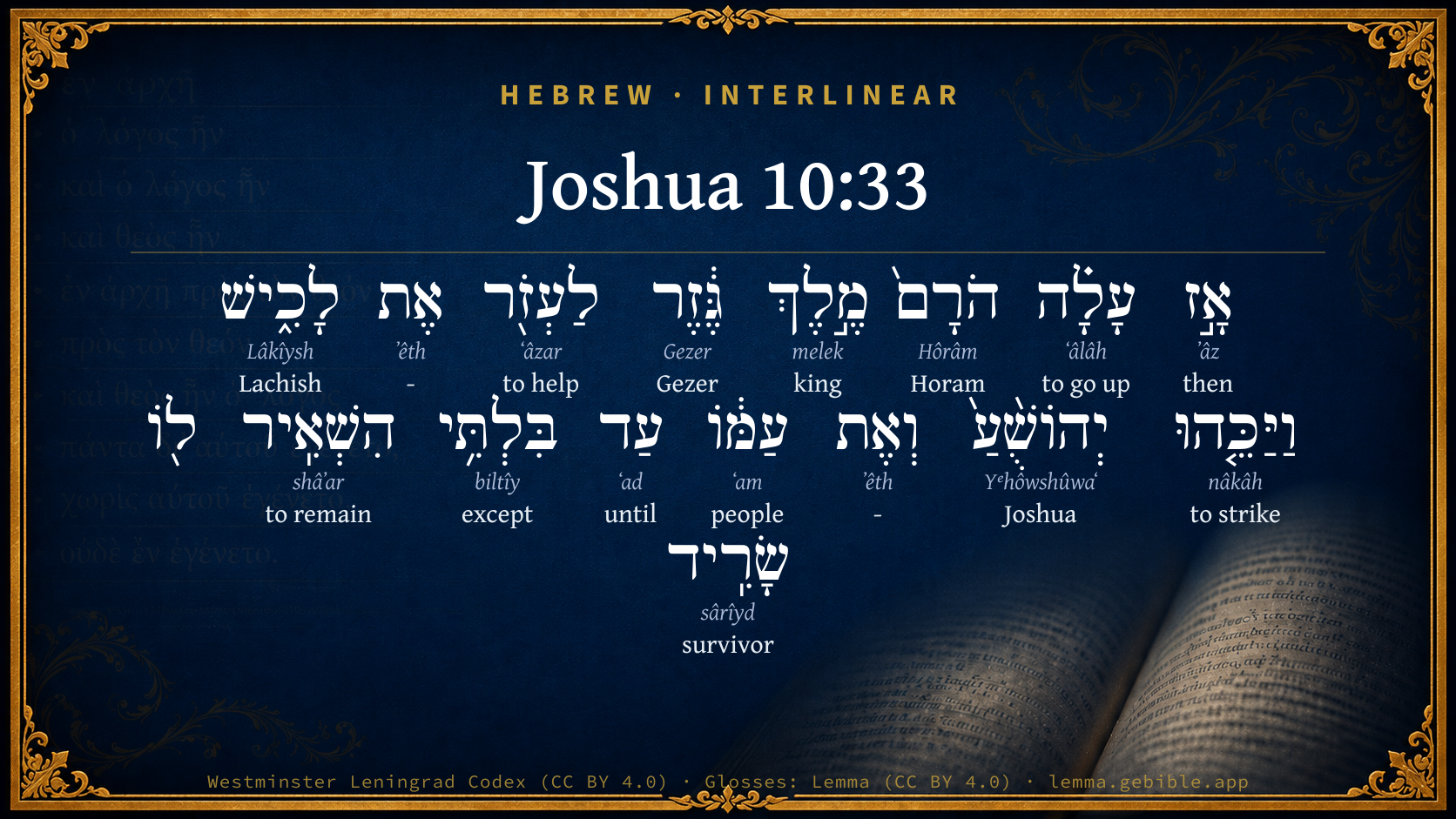
Hebrew (Westminster Leningrad Codex) Joshua 10:33 appears in the Hebrew Old Testament. The text above is from the Westminster Leningrad Codex. Each word links to its Strong’s number, a concise gloss, and parsing drawn from the Open Scriptures Hebrew Bible morphology. Click any word for its full Brown-Driver-Briggs (BDB) entry.
Download image
Cite this verse

Joshua 10:33 (World English Bible). Public Domain. Lemma interlinear Bible study tool, https://lemma.gebible.app/v/joshua/10/33.

Show BibTeX & RIS
BibTeX
RIS
English Translation
Then Horam king of Gezer came up to help Lachish; and Joshua struck him and his people, until he had left him none remaining.
World English Bible · Public Domain
Highlights Full analysis ↓
Download a study sheet

One document with this verse’s original text, its word-by-word gloss line, the meaning frame, cross-references with their text, attributed commentary, and full source and license credits — printable, and it pastes into notes with its structure intact.

This verse Autodidact and up

Study sheet (.html) Plain text (.txt)

A passage Seminary Student

Up to 50 verses in one chapter. A passage sheet keeps up to 6 commentary sources and 12 cross-references per verse, in the order this page ranks them, and says so on the sheet whenever that leaves anything out. Ask for a single verse and you get the Autodidact verse sheet above.

Everything on this page stays free to read, with no account — the sheet is a download of what is already on screen, not access to it.

Want to remove ads? Support Godless Engineer
Compare translations 3

The same verse in 3 English versions, stacked beneath the original-language interlinear above. Click any original word for its lexicon entry.

Each is an independent rendering of the whole verse — the interlinear is not word-aligned to these translations.

Highlighted words mark where these versions differ — a whole-verse word diff, not a word-by-word alignment.

  • World English Bible Public Domain
    Then Horam king of Gezer came up to help Lachish; and Joshua struck him and his people, until he had left him none remaining.
  • King James Version Public Domain
    Then Horam king of Gezer came up to help Lachish; and Joshua smote him and his people, until he had left him none remaining.
  • unfoldingWord Literal Text CC BY-SA 4.0
    Then Horam, the king of Gezer, went up to help Lachish, and Joshua struck him and his people until he did not leave to him a survivor.

unfoldingWord Literal Text — © unfoldingWord, licensed CC BY-SA 4.0. Word-aligned USFM3 via Door43 (git.door43.org/unfoldingWord/en_ult).

Versions to compare (up to 4)

3 of 4 selected

Show all 18 translations

Every available English version of this verse, each an independent rendering of the whole verse.

  • World English Bible Public Domain
    Then Horam king of Gezer came up to help Lachish; and Joshua struck him and his people, until he had left him none remaining.
  • Berean Standard Bible Public Domain
    At that time Horam king of Gezer went to help Lachish, but Joshua struck him down along with his people, leaving no survivors.
  • Majority Standard Bible Public Domain
    At that time Horam king of Gezer went to help Lachish, but Joshua struck him down along with his people, leaving no survivors.
  • King James Version Public Domain
    Then Horam king of Gezer came up to help Lachish; and Joshua smote him and his people, until he had left him none remaining.
  • American Standard Version (1901) Public Domain
    Then Horam king of Gezer came up to help Lachish; and Joshua smote him and his people, until he had left him none remaining.
  • Revised Version (1885) Public Domain
    Then Horam king of Gezer came up to help Lachish; and Joshua smote him and his people, until he had left him none remaining.
  • Geneva Bible (1599) Public Domain
    Then Horam King of Gezer came vp to helpe Lachish: but Ioshua smote him and his people, vntill none of his remained.
  • Douay-Rheims (1899) Public Domain
    At that time Horam king of Gazer, came up to succour Lachis: and Josue slew him with all his people, so as to leave none alive.
  • Young's Literal Translation Public Domain
    Than hath Horam king of Gezer come up to help Lachish, and Joshua smiteth him and his people, till he hath not left to him a remnant.
  • Literal Standard Version CC BY-SA 4.0
    Then Horam king of Gezer has come up to help Lachish, and Joshua strikes him and his people, until he has not left a remnant to him.
  • Unlocked Literal Bible CC BY-SA 4.0
    Then Horam, king of Gezer, came up to help Lachish. Joshua attacked him and his army until there was not even one survivor left.
  • unfoldingWord Literal Text CC BY-SA 4.0
    Then Horam, the king of Gezer, went up to help Lachish, and Joshua struck him and his people until he did not leave to him a survivor.
  • Darby Bible Public Domain
    Then Horam king of Gezer came up to help Lachish; and Joshua smote him and his people, until he had left him none remaining.
  • World Messianic Bible Public Domain
    Then Horam king of Gezer came up to help Lachish; and Joshua struck him and his people, until he had left him no one remaining.
  • Webster's Bible Public Domain
    Then Horam king of Gezer came up to help Lachish; and Joshua smote him and his people, until he had left him none remaining.
  • Free Bible Version CC BY-SA 4.0
    Then Horam, king of Gezer, came with his army to help Lachish, but Joshua and his men killed them, leaving no survivors.
  • Bible in Basic English Public Domain
    Then Horam, king of Gezer, came up to the help of Lachish; and Joshua overcame him and his people, putting all of them to death.
  • JPS Tanakh (1917) Public Domain
    Then Horam king of Gezer came up to help Lachish; and Joshua smote him and his people, until he had left him none remaining.

Literal Standard Version (2020), Covenant Press — licensed CC BY-SA 4.0. Text via the HelloAO Bible API (eBible.org). Unlocked Literal Bible (unfoldingWord) — licensed CC BY-SA 4.0. Text via the HelloAO Bible API (eBible.org). unfoldingWord Literal Text — © unfoldingWord, licensed CC BY-SA 4.0. Word-aligned USFM3 via Door43 (git.door43.org/unfoldingWord/en_ult). Free Bible Version, Dr. Jonathan Gallagher — licensed CC BY-SA 4.0. Text via the HelloAO Bible API (eBible.org).

Word by word

More ways to search: Search by grammar → Find every occurrence → Compare this word →

Practice this passage: Drill this verse → Learn its vocabulary →

הֹרָם֙
Hôrâm
H2036
“Horam”
Noun, Proper
Part of Speech
Noun
Type
Proper
Full BDB Definition

Origin: from an unused root (meaning to tower up)

TWOT: None

Horam = "exalted" - the Canaanite king of Gezer at the time of the conquest
  1. אָ֣ז ʼâz H227 “then” Adverb
  2. עָלָ֗ה ʻâlâh H5927 “to go up” Verb, Qal, Perfect, 3rd Person, Masculine, Singular
  3. מֶ֣לֶךְ melek H4428 “king of” Noun, Common, Masculine, Singular, Construct
  4. גֶּ֔זֶר Gezer H1507 “Gezer” Noun, Proper
  5. לַעְזֹ֖ר ʻâzar H5826 “to help” Preposition + Verb, Qal, Infinitive Construct
  6. אֶת ʼêth H853 “-” Particle, Direct Object
  7. לָכִ֑ישׁ Lâkîysh H3923 “Lachish” Noun, Proper
  8. וַיַּכֵּ֤הוּ nâkâh H5221 “and · to strike · him” Conjunction + Verb, Hiphil, Sequential Imperfect, 3rd Person, Masculine, Singular + Suffix, Personal, 3rd Person, Masculine, Singular
  9. יְהוֹשֻׁ֨עַ֙ Yᵉhôwshûwaʻ H3091 “Joshua” Noun, Proper
  10. וְאֶת ʼêth H853 “and · -” Conjunction + Particle, Direct Object
  11. עַמּ֔וֹ ʻam H5971 “people · his” Noun, Common, Masculine, Singular, Construct + Suffix, Personal, 3rd Person, Masculine, Singular
  12. עַד ʻad H5704 “until” Preposition
  13. בִּלְתִּ֥י biltîy H1115 “except” Conjunction
  14. הִשְׁאִֽיר shâʼar H7604 “to remain” Verb, Hiphil, Perfect, 3rd Person, Masculine, Singular
  15. שָׂרִֽיד sârîyd H8300 “survivor” Noun, Common, Masculine, Singular, Absolute

About this verse

These counts appear in no published source. They are computed here, from the morphology-tagged text and Lemma’s own curated glosses. What Lemma adds →

17
words
15
distinct lemmas
Historical
section

Notable vocabulary

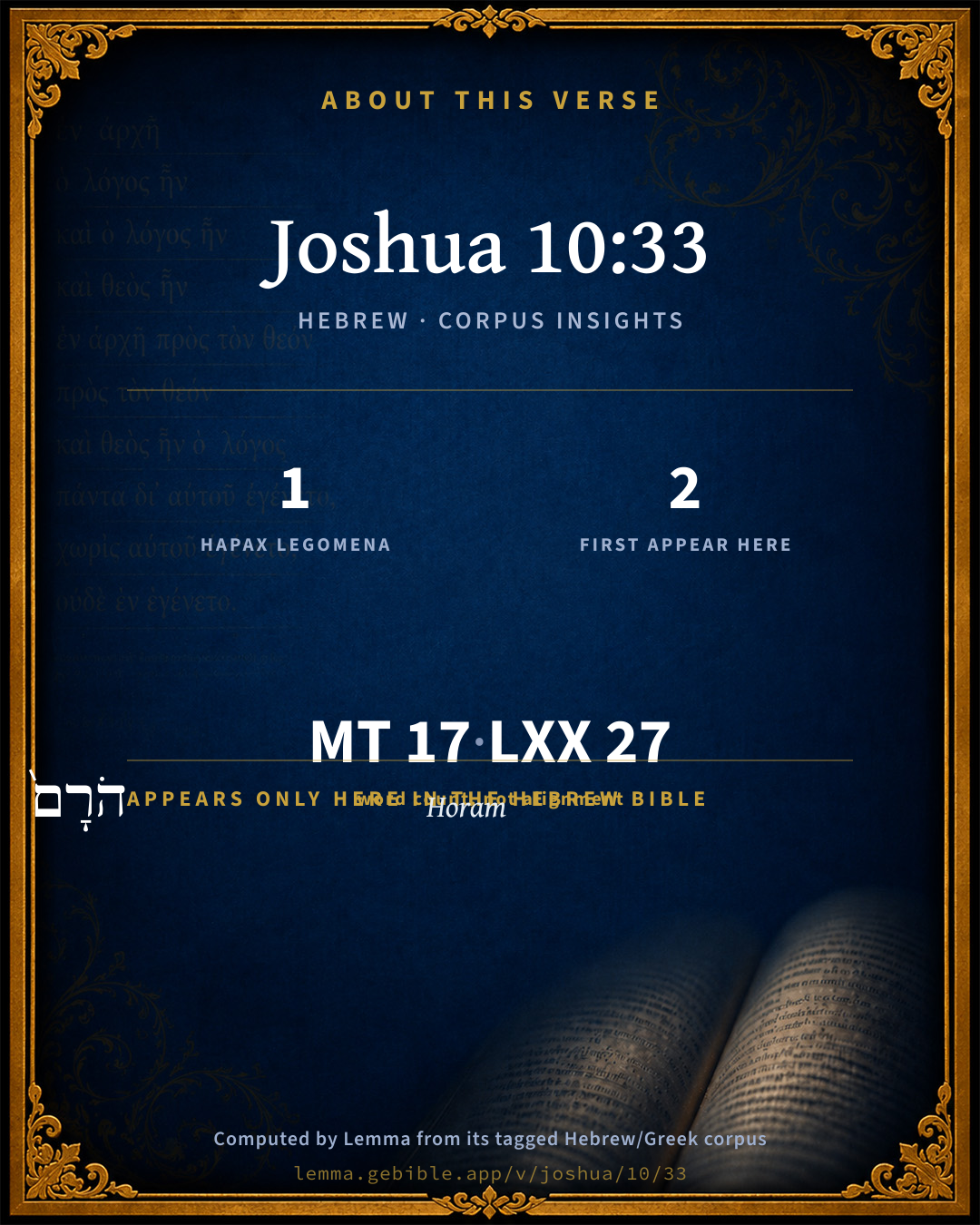
1 hapax legomenon — a word that appears only here in the entire Hebrew Bible:

  • הֹרָם֙ Horam H2036

First appearance in Scripture

These words make their first canonical appearance in the Hebrew Bible here:

  • הֹרָם֙ Horam H2036
  • גֶּ֔זֶר Gezer H1507

Shared distinctive vocabulary

גֶּ֔זֶר Gezer H1507 occurs in 14 verses of the Hebrew Bible. Also found in:

Grammatical profile

  • 4 verbs
  • 7 nouns
  • 2 prepositions
  • 1 conjunction
  • 1 adverb
  • 2 particles

Verb forms

  • עָלָ֗ה Qal · Perfect
  • לַעְזֹ֖ר Qal · Infinitive Construct
  • וַיַּכֵּ֤הוּ Hiphil · Sequential Imperfect
  • הִשְׁאִֽיר Hiphil · Perfect

Hebrew & Septuagint length

In English translation the verse runs 24 words from the Hebrew and 37 from the Septuagint (LXX English) — the Septuagint runs noticeably longer here. See the side-by-side →

A rough comparison of the two English renderings, which tokenize alike — not a word-level alignment.

Word counts can differ between the Hebrew and the Greek without any difference in meaning — e.g. the Hebrew direct-object marker אֵת has no separate Greek word, and Greek often adds the article ὁ.

In the original languages it is 17 Hebrew tokens and 27 Greek tokens — but the two are counted differently (Hebrew bundles its prefixes and suffixes into one token; the Greek is in lemma form), so that isn’t a like-for-like length.

Cross-references

8

Topical passages linked to Joshua 10:33 in the Treasury of Scripture Knowledge — connected by theme and wording, ordered by reader-vote popularity; previews shown in the World English Bible.

  • Joshua 16:10 They didn't drive out the Canaanites who lived in Gezer: but the Canaanites dwell in the midst of Ephraim to this day, and are become servants to do forced labor.
  • Judges 1:29 Ephraim didn't drive out the Canaanites who lived in Gezer; but the Canaanites lived in Gezer among them.
  • Joshua 16:3 and it went down westward to the border of the Japhletites, to the border of Beth Horon the lower, even to Gezer; and the goings out of it were at the sea.
  • Joshua 12:12 the king of Eglon, one; the king of Gezer, one;
  • Joshua 21:21 They gave them Shechem with its suburbs in the hill-country of Ephraim, the city of refuge for the manslayer, and Gezer with its suburbs,
  • 1 Kings 9:15–17 This is the reason of the levy which king Solomon raised, to build the house of Yahweh, and his own house, and Millo, and the wall of Jerusalem, and Hazor, and Megiddo, and Gezer.
  • 1 Chronicles 6:67 They gave to them the cities of refuge, Shechem in the hill-country of Ephraim with its suburbs; Gezer also with its suburbs,
  • 1 Chronicles 20:4 It happened after this, that there arose war at Gezer with the Philistines: then Sibbecai the Hushathite killed Sippai, of the sons of the giant; and they were subdued.

Cross-references courtesy of OpenBible.info (CC BY 4.0).

Hebrew and Greek witnesses Masoretic Hebrew ↔ Greek Septuagint

The same verse in the two great witnesses to the Old Testament, shown verse-for-verse.

Here the Septuagint runs noticeably longer than the Hebrew — LXX2012 (modern English Septuagint) 37 words vs World English Bible 24. A rough length comparison of the two English translations, not a word-level alignment — read both below.

These are two independent witnesses, not word-aligned to each other, and the Septuagint is shown in lemma (dictionary) form.

Hebrew Joshua 10:33 Masoretic · Westminster Leningrad Codex

אָ֣ז עָלָ֗ה הֹרָם֙ מֶ֣לֶךְ גֶּ֔זֶר לַעְזֹ֖ר אֶת לָכִ֑ישׁ וַיַּכֵּ֤הוּ יְהוֹשֻׁ֨עַ֙ וְאֶת עַמּ֔וֹ עַד בִּלְתִּ֥י הִשְׁאִֽיר ל֖וֹ שָׂרִֽיד

Then Horam king of Gezer came up to help Lachish; and Joshua struck him and his people, until he had left him none remaining.

World English Bible · Public Domain

Greek LXX Joshua 10:33 Septuagint · lemma form

τότε ἀναβαίνω αιλαμ βασιλεύς γαζερ βοηθέω ὁ λαχις καί πατάσσω αὐτός ἰησοῦς ἐν στόμα ξίφος καί ὁ λαός αὐτός ἕως ὁ μή καταλείπω αὐτός σώζω καί διαφεύγω

Then Elam the king of Gazer went up to help Lachis; and Joshua struck him and his people with the edge of the sword, until there was not left to him one that was preserved and escaped.

LXX2012 (modern English Septuagint) · Public Domain

Hebrew: Westminster Leningrad Codex (CC BY 4.0). Greek: Septuagint (public domain); English from LXX2012 (modern English Septuagint) (Public Domain). How the Septuagint differs from the Hebrew →

Targum (Aramaic paraphrase)

1

The Targum is the ancient Jewish Aramaic paraphrase of the Hebrew Scriptures — an interpretive translation, not the Hebrew text itself. Onkelos (literal) and Pseudo-Jonathan (expansive) render the Torah, and Jonathan the Prophets. Coverage is partial: where no permissively-licensed English translation exists for a verse, only the Aramaic is shown. This is verse-level text, not a word-by-word alignment to the Hebrew.

  1. Targum Jonathan Prophets (Joshua–Malachi)
    בְּכֵן סְלִיק הוֹרָם מַלְכָּא דְגֶזֶר לְמִסְעַד יַת לָכִישׁ וּמְחָהִי יְהוֹשֻׁעַ וְיַת עַמֵיהּ עַד דְלָא אִשְׁתָּאַר לֵיהּ מְשֵׁזִיב:

    (no public-domain English translation for this verse)

    Targum Jonathan — Aramaic: “Mikraot Gedolot” (public domain). English: “Sefaria Community Translation” (CC0 1.0 (public-domain dedication)); “London "Chaldee Paraphrase," 1871” (public domain). Text via Sefaria.

Commentary

Notes on Joshua 10:33 from classic Christian and Jewish commentators (each source and its license shown beneath its notes). The classic Christian expositions comment on the surrounding passage and are grouped to its opening verse, so a note may address several verses; the Jewish commentaries on the Tanakh (Rashi and others) are per-verse, so they appear only where the commentator wrote on this verse.

Lemma curates 59 commentaries, every one of them public domain or Creative Commons licensed, each selected and text-cleaned for this edition rather than reprinted as found. About our sources →

Trapp's Complete Commentary

John Trapp

Jos 10:33 Then Horam king of Gezer came up to help Lachish; and Joshua smote him and his people, until he had left him none remaining.

Ver. 33. Then Horam king of Gezer.] Whereof read 1Ch 14:16. It lay near to Lachish, and sped the worse for its neighbourhood: as did Hamath for Damascus. {Zec 9:2}

John Trapp, A Commentary or Exposition upon All the Books of the Old and New Testament (1647–1656) — public domain. Text from a community e-Sword module.

Adam Clarke's Commentary

Verse 33. Horam king of Gezer] It is likely that Horam was in a state of alliance with the king of Lachish, and therefore came to his assistance as soon as it appeared that he was likely to be attacked. Joshua probably sent a detachment against him, before he was able to form a junction with the forces of Lachish; and utterly destroyed him and his army.

Gezer is supposed to have been situated near Azotus. See 1Mac 16:34. It fell to the tribe of Ephraim, Jos 16:3, but was probably taken afterwards by some of the remnant of the Canaanitish nations; for we find it was given by Pharaoh to his son-in-law Solomon, 1Kg 9:16, which proves that it had got out of the possession of the Israelites previously to the days of Solomon.

Adam Clarke's Commentary on the Bible (1810–1826) — public domain. Text from a community e-Sword/MySword module.

Ellicott's Commentary for English Readers

(33) Gezer is identified as Tell-Jezer or Tel-el-Jezar, about four miles from Amwâs or Emmaus.

A Bible Commentary for English Readers, edited by Charles John Ellicott (1878–1897) — public domain. Text from a community e-Sword module.

The Cambridge Bible for Schools and Colleges

gen. ed. J. J. S. Perowne

33. Then Horam] His city lay at no great distance from Lachish.

Gezer] or, as it is called later, Gazara (2Ma_10:32), Gadara (Jos. Ant. 5:1:22), was an ancient city of Canaan. It was afterwards allotted with its suburbs to the Kohathite Levites (Jos_21:21; 1Ch_6:67); but the original inhabitants were not dispossessed (Jdg_1:29), and even down to the reign of Solomon the Canaanites were still dwelling there, and paying tribute to Israel (1Ki_9:16). Its site has lately been identified with Tel el Jezar, about four miles from Amwâs, on the road to Ramlah and Lydd. “The position of the Levitical city of Gezer (Jos_12:12; 1Ch_6:67; Jdg_1:29), which Pharaoh gave to his daughter—Solomon’s queen—as a dowry, has been a subject of prolonged controversy. M. Clermont Ganneau discovered the ancient site, with the very name itself still lingering on the spot. Not only that, but he found the Levitical boundaries. In no other case have these been found. They were cut in the rock itself—not on movable stones—in two separate places, in Greek and square Hebrew characters, signifying the ‘boundary of Gezer.’ The date seems to be Maccabean.” (Quarterly Statement of the “Palestine Exploration Fund,” 1874.)

and Joshua smote him] Joshua seems to have been content with repulsing his attack, slaying the king, and inflicting a severe defeat upon his people. Gezer itself lay too far northward of his present line of operations to justify its capture.

The Cambridge Bible for Schools and Colleges (gen. ed. J. J. S. Perowne; Cambridge University Press, 1878–1918) — public domain. Text from a community e-Sword module.

John Gill's Exposition

And from Lachish Joshua passed unto Eglon,.... Which, according to Bunting (f), was eight miles from Lachish, and twelve from Jerusalem southward, of which see Jos 10:5,

and all Israel with him, and they encamped against it, and fought against it; it not surrendering at once, but attempted to hold out a siege.

(f) Ut supra. (Travels of the Patriarchs, &c. p. 96.)

John Gill's Exposition of the Whole Bible (1746–1763) — public domain (CC PDM 1.0). Text via the HelloAO Bible API.

Albert Barnes' Notes on the Bible

Gezer lies on the southern border of the tribe of Ephraim Jos 16:3. It was considerably to the northward of Joshua’s present line of operations, and does not appear to have been captured at this time. He contented himself for the present with repulsing the attack made upon him, killed Horam (compare Jos 12:12), inflicting a severe defeat upon his people, and then continued to pursue his conquests over the confederated kings and their allies in south Canaan.

Albert Barnes' Notes on the Bible (1834–1885) — public domain. Text from a community e-Sword/MySword module.

Haydock's Catholic Bible Commentary

Gazer, near Azotus, in the country of the Philistines. It is not said that Josue took this city. It was given long after to Solomon by the king of Egypt, 3 Kings ix. 15., and Josue xvi. 10. (Calmet)

George Leo Haydock (1774–1849), Haydock's Catholic Family Bible and Commentary, 1859 edition — public domain. Excludes Psalms (Douay-Rheims chapter numbering differs from Protestant) and Deuterocanonical books (Catholic canon only).

Matthew Poole's English Annotations

Gezer; either that in Ephraim, of which Jos 16:3; Jdg 1:29; but that seems too remote from the other places; or rather, that in Judah, which was near Lachish, 1Ch 14:16, whose king therefore was more capable, and more obliged to help them for his own sake.

Matthew Poole's English Annotations on the Holy Bible (1683–1685) — public domain. Text from a community e-Sword/MySword module.

Whedon's Commentary on the Bible

Daniel D. Whedon

33. Horam, like the other ill-fated kings mentioned in this chapter, has left no other record. Gezer must have been between the Lower Beth-horon and the sea. It does not seem to have been destroyed by Joshua. Some identify it with the village Jazur, four or five miles east of Joppa, but this is uncertain. [It was an important city of the Caaaanites, and fell within the borders of Ephraim, (Jos_16:3,) but that tribe failed to drive out the original inhabitants. Jdg_1:19. Subsequently Pharaoh, king of Egypt, captured it, slew its Canaanitish inhabitants, and presented it to his daughter, Solomon’s wife. Pharaoh burned the city, but Solomon rebuilt and fortified Joshua 2 :1Ki_9:16-17.]

Daniel D. Whedon (gen. ed.), Commentary on the Old and New Testaments (1874–1909) — public domain. Text from a community e-Sword module.

The Pulpit Commentary

Then Horam king of Gezer. It is remarkable that, as Gezer lay somewhat out of the line of march, Joshua did not capture it. Accordingly, in spite of the alleged carelessness of our compiler, who is credited with having put together shreds of the various narratives in the most perfunctory manner, he takes care to add (Jos_16:10) that the inhabitants of Gezer were not driven out. In like manner, with the single exception of Hebron, the people of which must have at once chosen another king, he carefully omits the mention of the king in the cities which had lost their kings in the battle before Gibeon. See also note on ver. 32. Thus a careful examination of the narrative puts the care and accuracy of the history very carefully before us. With regard to the situation of Gezer, it has been accurately determined by the Palestine Exploration Society. The Levitical boundaries, with Greek and Hebrew inscriptions, signifying the boundary of Gezer, have been discovered by M. Ganneau (see "Quarterly Paper" for October, 1874). Tell el Jezer was first identified by M. Ganneau with Gezer. Continuing his researches, he found on a slab of rock nearly horizontal and very nearly two inches in length a bilingual inscription, in Greek and Hebrew, signifying the limit of Gezer (rzg Since the inscription is Greek and Talmudical in its character (the word has not the signification of "limit" in the Hebrew Scriptures) it must, in spite of the early form of the letters, belong to a period long subsequent to the Babylonish captivity. M. Ganneau suggests the Maccabean period. (See below) But it is, no doubt, the result of a remeasurement in accordance with the rules laid down in Num_35:5. Some have supposed the above to have been designed to fix the limit of the sabbath day"s journey. But it is more probable that it served as a boundary between the Levitical and the tribal territory, the more especially as the words are so placed as to be read by one entering the town. It was a Levitical city, (Jos_21:21 1Ch_6:67) or at least assigned to the Levites; but Jud 1:29 shows that the Canaanitish population lived on with the Levites. It may have been the nondescript character of the population that caused it to fall an easy prey to Pharaoh; (1Ki_9:16, where note that the Canaanites had never been driven out) but when Solomon espoused his daughter he restored Gezer to Israel. Under the same name Gazara it plays a conspicuous part in the wars of the Maccabees. (RAPC 1Ma 9:52 2Ma 10:32) From the latter passage we learn that it was "a very strong hold." It retains its old name, being now known as Tell el Jezer.

The Pulpit Commentary (1880–1919), ed. H.D.M. Spence-Jones & Joseph S. Exell — public domain. Text from a community e-Sword module.

unfoldingWord translationNotes

Door43 World Missions Community

Horam

This is the name of a man who is an important king. (See: How to Translate Names)

Gezer ... Lachish

These are the names of cities. (See: How to Translate Names)

translationWords

king

Joshua

unfoldingWord translationNotes — © Distant Shores Media and the Door43 World Missions Community, licensed CC BY-SA 4.0. Source: git.door43.org/Door43/en_tn.

Lesson kit

Teaching starters — assembled from the data on this page, not authored interpretation. Every prompt links to the verse data it draws on. Edit before teaching.

Joshua, in the Historical, opens this verse with 17 words (15 distinct Hebrew lemmas). Its most distinctive word is Hôrâm (“Horam”). The Greek Septuagint runs longer here. A historical commentator’s framing appears above. Read the whole chapter for the surrounding context.

Discussion questions

  1. How does “Horam” (Hôrâm) shape what this verse is saying?
  2. 1 word here appears nowhere else in the Hebrew Bible. Why might the author reach for such rare wording?
  3. 2 words make their first appearance in Scripture here. What does this debut establish?
  4. How does Joshua 12:12, which shares the word «Gezer», read alongside this verse?
  5. The Septuagint runs longer here than the Hebrew. What might account for the difference?
  6. The translations on this page render this verse differently — a whole-verse word diff, not a word-by-word alignment. What might account for the different wordings?
  7. «עָלָ֗ה» is a Qal Perfect verb. How does that grammatical form shape the action described?
  8. Compare how Trapp's Complete Commentary and Adam Clarke's Commentary read this verse. Where do they agree or differ?

Things to notice

Reading settings

Reading text

Shown beneath each verse's original-language words.

Old Testament
Old Testament edition

Read the OT as the Masoretic Hebrew (MT) or the Greek Septuagint (LXX).

English shown for the Greek Septuagint (in the Hebrew ↔ Greek comparison).

Comparing translations? Open the Compare panel on any verse page to stack up to four side by side.