Numbers 21:35

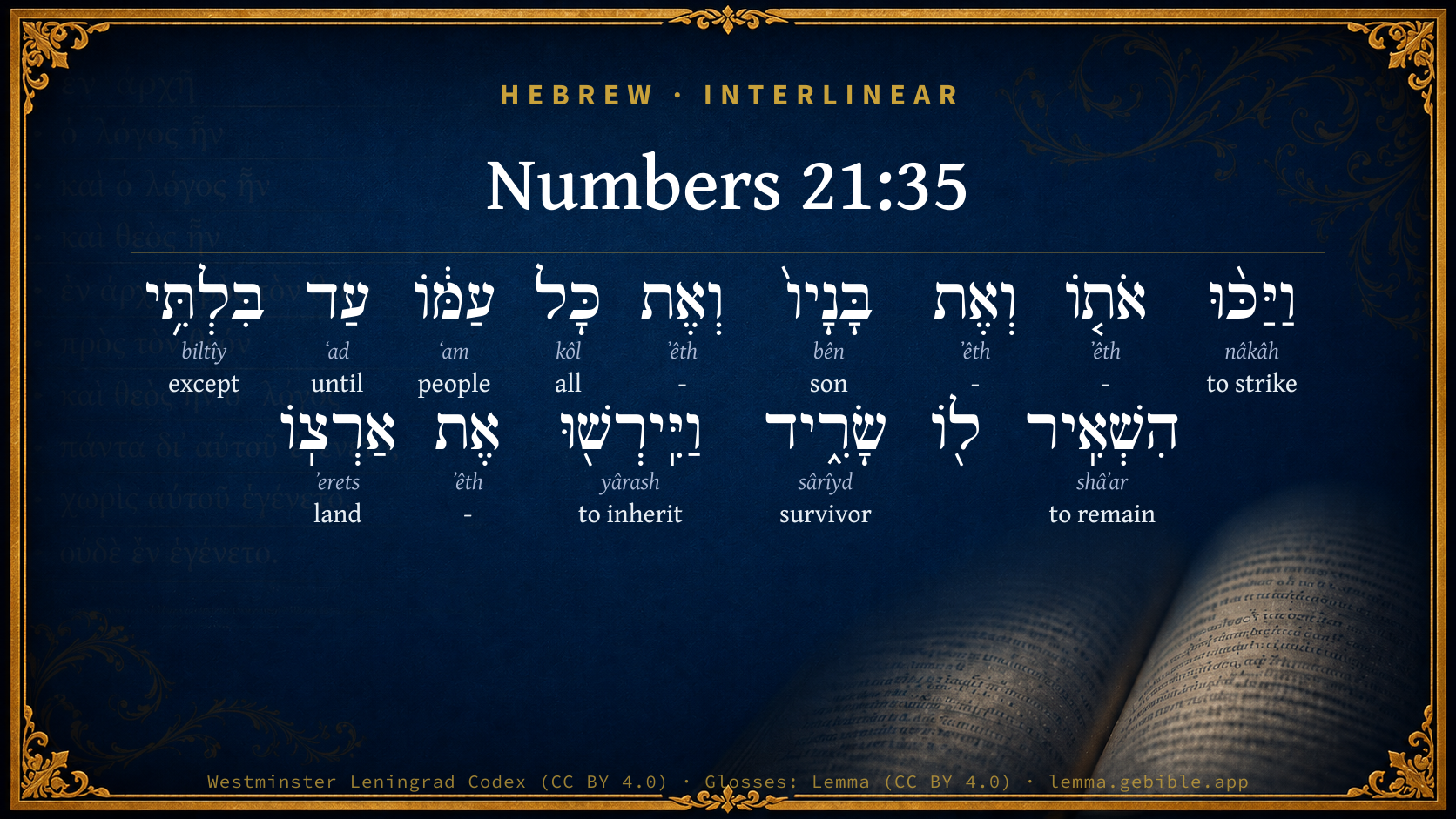
Hebrew (Westminster Leningrad Codex) Numbers 21:35 appears in the Hebrew Old Testament. The text above is from the Westminster Leningrad Codex. Each word links to its Strong’s number, a concise gloss, and parsing drawn from the Open Scriptures Hebrew Bible morphology. Click any word for its full Brown-Driver-Briggs (BDB) entry.
Download image
Cite this verse

Numbers 21:35 (World English Bible). Public Domain. Lemma interlinear Bible study tool, https://lemma.gebible.app/v/numbers/21/35.

Show BibTeX & RIS
BibTeX
RIS
English Translation
So they struck him, and his sons and all his people, until there was none left him remaining: and they possessed his land.
World English Bible · Public Domain
Highlights
  • 1 first appearance in the Hebrew Bible
Full analysis ↓
Download a study sheet

One document with this verse’s original text, its word-by-word gloss line, the meaning frame, cross-references with their text, attributed commentary, and full source and license credits — printable, and it pastes into notes with its structure intact.

This verse Autodidact and up

Study sheet (.html) Plain text (.txt)

A passage Seminary Student

Up to 50 verses in one chapter. A passage sheet keeps up to 6 commentary sources and 12 cross-references per verse, in the order this page ranks them, and says so on the sheet whenever that leaves anything out. Ask for a single verse and you get the Autodidact verse sheet above.

Everything on this page stays free to read, with no account — the sheet is a download of what is already on screen, not access to it.

Want to remove ads? Support Godless Engineer
Compare translations 3

The same verse in 3 English versions, stacked beneath the original-language interlinear above. Click any original word for its lexicon entry.

Each is an independent rendering of the whole verse — the interlinear is not word-aligned to these translations.

Highlighted words mark where these versions differ — a whole-verse word diff, not a word-by-word alignment.

  • World English Bible Public Domain
    So they struck him, and his sons and all his people, until there was none left him remaining: and they possessed his land.
  • King James Version Public Domain
    So they smote him, and his sons, and all his people, until there was none left him alive: and they possessed his land.
  • unfoldingWord Literal Text CC BY-SA 4.0
    And they struck him and his sons and all his people until there was no survivor remaining for him, and they possessed his land.

unfoldingWord Literal Text — © unfoldingWord, licensed CC BY-SA 4.0. Word-aligned USFM3 via Door43 (git.door43.org/unfoldingWord/en_ult).

Versions to compare (up to 4)

3 of 4 selected

Show all 18 translations

Every available English version of this verse, each an independent rendering of the whole verse.

  • World English Bible Public Domain
    So they struck him, and his sons and all his people, until there was none left him remaining: and they possessed his land.
  • Berean Standard Bible Public Domain
    So they struck down Og, along with his sons and his whole army, until no remnant was left. And they took possession of his land.
  • Majority Standard Bible Public Domain
    So they struck down Og, along with his sons and his whole army, until no remnant was left. And they took possession of his land.
  • King James Version Public Domain
    So they smote him, and his sons, and all his people, until there was none left him alive: and they possessed his land.
  • American Standard Version (1901) Public Domain
    So they smote him, and his sons and all his people, until there was none left him remaining: and they possessed his land.
  • Revised Version (1885) Public Domain
    So they smote him, and his sons, and all his people, until there was none left him remaining: and they possessed his land.
  • Geneva Bible (1599) Public Domain
    They smote him therefore, and his sonnes, and all his people, vntill there was none left him: so they conquered his land.
  • Douay-Rheims (1899) Public Domain
    So they slew him also with his sons, and all his people, not letting any one escape, and they possessed his land.
  • Young's Literal Translation Public Domain
    And they smite him, and his sons, and all his people, until he hath not left to him a remnant, and they possess his land.
  • Literal Standard Version CC BY-SA 4.0
    And they strike him, and his sons, and all his people, until he has no remnant left to him, and they possess his land.
  • Unlocked Literal Bible CC BY-SA 4.0
    So they killed him, his sons, and all his army, until none of his people were left alive. Then they took over his land.
  • unfoldingWord Literal Text CC BY-SA 4.0
    And they struck him and his sons and all his people until there was no survivor remaining for him, and they possessed his land.
  • Darby Bible Public Domain
    And they smote him, and his sons, and all his people, so that they left him none remaining, and took possession of his land.
  • World Messianic Bible Public Domain
    So they struck him, with his sons and all his people, until there were no survivors; and they possessed his land.
  • Webster's Bible Public Domain
    So they smote him, and his sons, and all his people, until there was none left to him alive: and they possessed his land.
  • Free Bible Version CC BY-SA 4.0
    So they killed Og, his sons, and all his army. Nobody survived, and the Israelites took over his country.
  • Bible in Basic English Public Domain
    So they overcame him and his sons and his people, driving them all out: and they took his land for their heritage.
  • JPS Tanakh (1917) Public Domain
    So they smote him, and his sons, and all his people, until there was none left him remaining; and they possessed his land.

Literal Standard Version (2020), Covenant Press — licensed CC BY-SA 4.0. Text via the HelloAO Bible API (eBible.org). Unlocked Literal Bible (unfoldingWord) — licensed CC BY-SA 4.0. Text via the HelloAO Bible API (eBible.org). unfoldingWord Literal Text — © unfoldingWord, licensed CC BY-SA 4.0. Word-aligned USFM3 via Door43 (git.door43.org/unfoldingWord/en_ult). Free Bible Version, Dr. Jonathan Gallagher — licensed CC BY-SA 4.0. Text via the HelloAO Bible API (eBible.org).

Word by word

More ways to search: Search by grammar → Find every occurrence → Compare this word →

Practice this passage: Drill this verse → Learn its vocabulary →

שָׂרִ֑יד
sârîyd
H8300
“survivor”
Noun, Common, Masculine, Singular, Absolute
Part of Speech
Noun
Type
Common
Gender
Masculine
Number
Singular
State
Absolute
Full BDB Definition

Origin: from H8277

TWOT: 2285a

survivor, remnant, that which is left - survivor
  1. וַיַּכּ֨וּ nâkâh H5221 “and · to strike” Conjunction + Verb, Hiphil, Sequential Imperfect, 3rd Person, Masculine, Plural
  2. אֹת֤וֹ ʼêth H853 “- · him” Particle, Direct Object + Suffix, Personal, 3rd Person, Masculine, Singular
  3. וְאֶת ʼêth H853 “and · -” Conjunction + Particle, Direct Object
  4. בָּנָיו֙ bên H1121 “sons · his” Noun, Common, Masculine, Plural, Construct + Suffix, Personal, 3rd Person, Masculine, Singular
  5. וְאֶת ʼêth H853 “and · -” Conjunction + Particle, Direct Object
  6. כָּל kôl H3605 “all of” Noun, Common, Masculine, Singular, Construct
  7. עַמּ֔וֹ ʻam H5971 “people · his” Noun, Common, Masculine, Singular, Construct + Suffix, Personal, 3rd Person, Masculine, Singular
  8. עַד ʻad H5704 “until” Preposition
  9. בִּלְתִּ֥י biltîy H1115 “except” Conjunction
  10. הִשְׁאִֽיר shâʼar H7604 “to remain” Verb, Hiphil, Perfect, 3rd Person, Masculine, Singular
  11. וַיִּֽירְשׁ֖וּ yârash H3423 “and · to inherit” Conjunction + Verb, Qal, Sequential Imperfect, 3rd Person, Masculine, Plural
  12. אֶת ʼêth H853 “-” Particle, Direct Object
  13. אַרְצֽוֹ ʼerets H776 “land · his” Noun, Common, Both, Singular, Construct + Suffix, Personal, 3rd Person, Masculine, Singular

About this verse

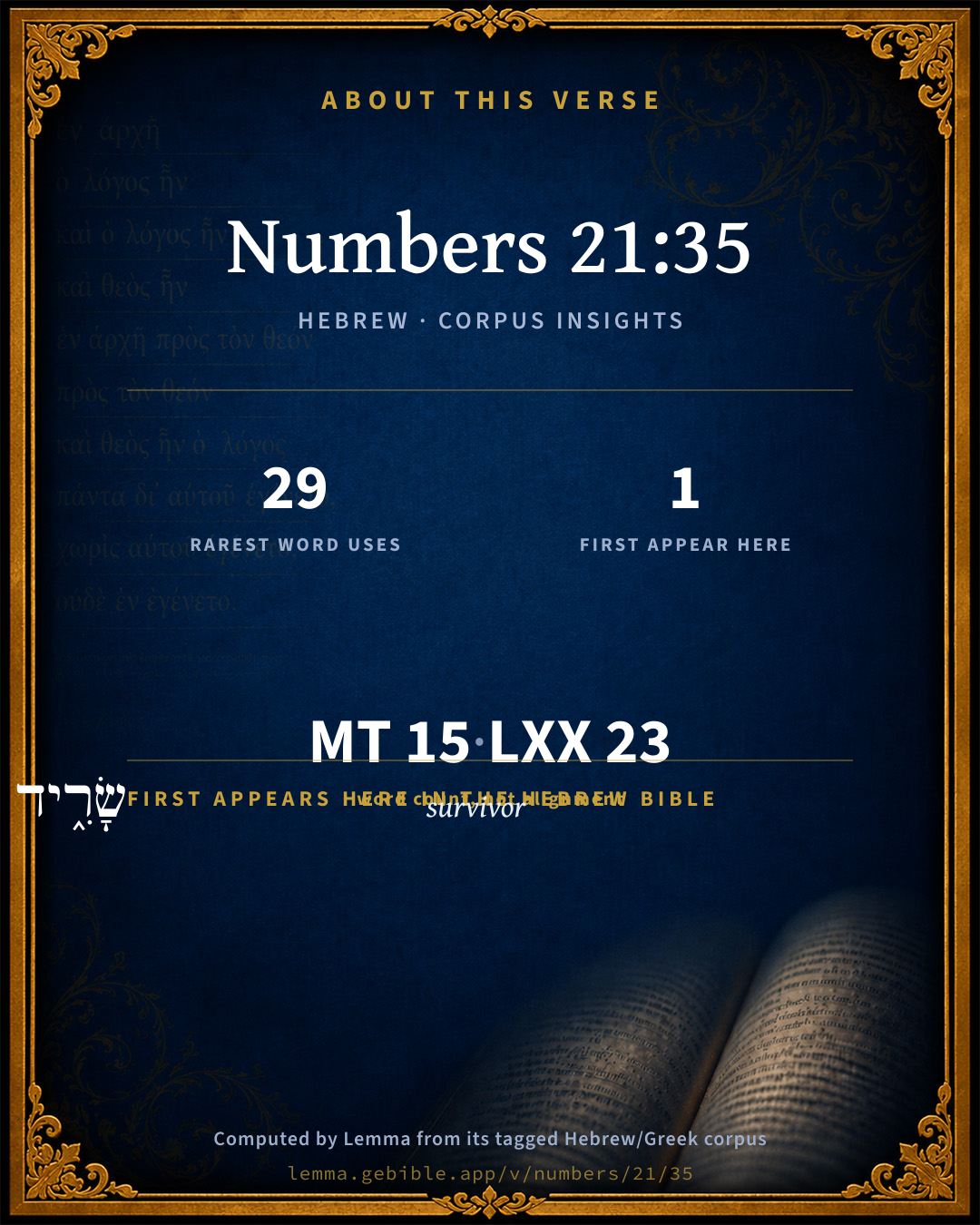
These counts appear in no published source. They are computed here, from the morphology-tagged text and Lemma’s own curated glosses. What Lemma adds →

15
words
11
distinct lemmas
Pentateuch
section

First appearance in Scripture

This word makes its first canonical appearance in the Hebrew Bible here:

  • שָׂרִ֑יד survivor H8300

Shared distinctive vocabulary

שָׂרִ֑יד survivor H8300 occurs in 28 verses of the Hebrew Bible. Also found in:

Grammatical profile

  • 3 verbs
  • 5 nouns
  • 2 prepositions
  • 1 conjunction
  • 4 particles

Verb forms

  • וַיַּכּ֨וּ Hiphil · Sequential Imperfect
  • הִשְׁאִֽיר Hiphil · Perfect
  • וַיִּֽירְשׁ֖וּ Qal · Sequential Imperfect

Hebrew & Septuagint length

In English translation the verse runs 23 words from the Hebrew and 26 from the Septuagint (LXX English) — closely comparable.

A rough comparison of the two English renderings, which tokenize alike — not a word-level alignment.

Word counts can differ between the Hebrew and the Greek without any difference in meaning — e.g. the Hebrew direct-object marker אֵת has no separate Greek word, and Greek often adds the article ὁ.

In the original languages it is 15 Hebrew tokens and 23 Greek tokens — but the two are counted differently (Hebrew bundles its prefixes and suffixes into one token; the Greek is in lemma form), so that isn’t a like-for-like length.

Cross-references

7

Topical passages linked to Numbers 21:35 in the Treasury of Scripture Knowledge — connected by theme and wording, ordered by reader-vote popularity; previews shown in the World English Bible.

  • Deuteronomy 3:3–17 So Yahweh our God delivered into our hand Og also, the king of Bashan, and all his people: and we struck him until none was left to him remaining.
  • Deuteronomy 29:7–8 When you came to this place, Sihon the king of Heshbon, and Og the king of Bashan, came out against us to battle, and we struck them:
  • Joshua 12:4–6 and the border of Og king of Bashan, of the remnant of the Rephaim, who lived at Ashtaroth and at Edrei,
  • Joshua 13:12 all the kingdom of Og in Bashan, who reigned in Ashtaroth and in Edrei (the same was left of the remnant of the Rephaim); for these did Moses strike, and drove them out.
  • Psalms 135:10–12 Who struck many nations, And killed mighty kings,
  • Psalms 136:17–21 To him who struck great kings; For his loving kindness endures forever;
  • Romans 8:37 No, in all these things, we are more than conquerors through him who loved us.

Cross-references courtesy of OpenBible.info (CC BY 4.0).

Hebrew and Greek witnesses Masoretic Hebrew ↔ Greek Septuagint

The same verse in the two great witnesses to the Old Testament, shown verse-for-verse.

These are two independent witnesses, not word-aligned to each other, and the Septuagint is shown in lemma (dictionary) form.

Hebrew Numbers 21:35 Masoretic · Westminster Leningrad Codex

וַיַּכּ֨וּ אֹת֤וֹ וְאֶת בָּנָיו֙ וְאֶת כָּל עַמּ֔וֹ עַד בִּלְתִּ֥י הִשְׁאִֽיר ל֖וֹ שָׂרִ֑יד וַיִּֽירְשׁ֖וּ אֶת אַרְצֽוֹ

So they struck him, and his sons and all his people, until there was none left him remaining: and they possessed his land.

World English Bible · Public Domain

Greek LXX Numbers 21:35 Septuagint · lemma form

καί πατάσσω αὐτός καί ὁ υἱός αὐτός καί πᾶς ὁ λαός αὐτός ἕως ὁ μή καταλείπω αὐτός ζωγρεία καί κληρονομέω ὁ γῆ αὐτός

And he struck him and his sons, and all his people, until he left none of his to be taken alive; and they inherited his land.

LXX2012 (modern English Septuagint) · Public Domain

Hebrew: Westminster Leningrad Codex (CC BY 4.0). Greek: Septuagint (public domain); English from LXX2012 (modern English Septuagint) (Public Domain). How the Septuagint differs from the Hebrew →

Targum (Aramaic paraphrase)

2

The Targum is the ancient Jewish Aramaic paraphrase of the Hebrew Scriptures — an interpretive translation, not the Hebrew text itself. Onkelos (literal) and Pseudo-Jonathan (expansive) render the Torah, and Jonathan the Prophets. Coverage is partial: where no permissively-licensed English translation exists for a verse, only the Aramaic is shown. This is verse-level text, not a word-by-word alignment to the Hebrew.

  1. Targum Onkelos Torah (Genesis–Deuteronomy)
    וּמְחוֹ יָתֵיהּ וְיָת בְּנוֹהִי וְיָת כָל עַמֵּיהּ עַד דְלָא אִשְׁתָּאַר לֵיהּ מְשֵׁיזִיב וִירִיתוּ יָת אַרְעֵיהּ

    (no public-domain English translation for this verse)

    Targum Onkelos — Aramaic: “Onkelos Genesis” (public domain); “Onkelos Exodus” (public domain); “Onkelos Leviticus” (public domain); “Onkelos Numbers” (public domain); “Onkelos Deuteronomy” (public domain). English: “Sefaria Community Translation” (CC0 1.0 (public-domain dedication)); “J.W. Etheridge. The Targums of Onkelos and Jonathan Ben Uzziel on the Pentateuch. London: Longmans, Green, 1862” (public domain). Text via Sefaria.

  2. Targum Pseudo-Jonathan Torah (Genesis–Deuteronomy)
    וַהֲוָה כֵּיוַן דְחָמָא עוֹג רַשִׁיעָא יַת מַשִׁירְיָיתָא דְיִשְרָאֵל דַהֲוָה שִׁיתָּא פַּרְסֵי אָמַר לֵית אֲנָא מְסַדֵר סִדְרֵי קְרָבָא כֻּלוֹ קֳבֵיל עַמָא הָדֵין דִלְמָא יַעַבְדוּן לִי הֵיכְמָא דְעָבָדוּ לְסִיחוֹן וַאֲזַל וְעָקַר טַוְורָא בַּר שִׁיתָּא פַּרְסֵי וְאַחֲתֵיהּ עַל רֵישֵׁיהּ לְמִטְלַק עֲלֵיהוֹן מִן יַד זַמִין מֵימְרָא דַיְיָ זוֹחֲלָא וּפָכַר טַוְורָא וְנַקְרֵיהּ וְטָמַע רֵישֵׁיהּ בְּגַוֵיהּ בָּעָא לְמִשְׁלְפֵיהּ מִן רֵישֵׁיהּ וְלָא יָכִיל מִן בִּגְלַל דְמַשְׁכֵי כַּכֵיהּ וְשִׁינֵיהּ פּוּמֵיהּ הַלְכָא וְהַלְכָא אָזַל משֶׁה וְנָסַב נַרְגָא בְּרַת עִישַרְתֵּי אַמִין וְטָפַז עִישַרְתֵּי אַמִין וּמַחְיֵיהּ בְּקַרְסוּלֵיהּ וְנָפַל וּמִית מִן לְהָאֵל לְמַשְׁרִיתָא דְיִשְרָאֵל דְהָכִין כְּתִיב וּמְחוֹ יָתֵיהּ וְיַת בְּנוֹי וְיַת כָּל עַמֵיהּ עַד דִי לָא שְׁיָירוּ לֵיהּ מְשֵׁיזִיב וִירִיתוּ יַת אַרְעֵיהּ

    Now it was, after Og the Wicked had seen the camp of Israel spreading over six miles he said with himself, I will make war against this people, that they may not do to me as they have done to Sihon: so went he and tare up a mountain six miles in size, and brought it upon his head to hurl it upon them. But the Word of the Lord forthwith prepared a reptile which ate into the mountain and perforated it, and his head was swallowed up within it; and he sought to withdraw it, but could not, because his back teeth and his front ones were drawn hither and thither. And Mosheh went and took an axe of ten cubits, and sprang ten cubits, and struck him on the ankle of his foot, and he fell, and died beyond the camp of Israel. Thus it is written. And they smote him and his sons and daughters, and all his people, till none of them remained to escape; and they took possession of his land.

    Targum Pseudo-Jonathan — Aramaic: “Targum Jonathan on Genesis” (public domain); “Targum Jonathan on Exodus” (public domain); “Targum Jonathan on Leviticus” (public domain); “Targum Jonathan on Numbers” (public domain); “Targum Jonathan on Deuteronomy” (public domain). English: “The Targum of Jonathan ben Uzziel, trans. J. W. Etheridge, London, 1862” (public domain). Text via Sefaria.

Commentary

Notes on Numbers 21:35 from classic Christian and Jewish commentators (each source and its license shown beneath its notes). The classic Christian expositions comment on the surrounding passage and are grouped to its opening verse, so a note may address several verses; the Jewish commentaries on the Tanakh (Rashi and others) are per-verse, so they appear only where the commentator wrote on this verse.

Lemma curates 59 commentaries, every one of them public domain or Creative Commons licensed, each selected and text-cleaned for this edition rather than reprinted as found. About our sources →

Tyndale Open Study Notes

Tyndale Open Resources

21:35 Then Israel occupied their land: See ch 32.

Tyndale Open Study Notes — © Tyndale Open Resources, licensed CC BY-SA 4.0. Text via the HelloAO Bible API.

Adam Clarke's Commentary

Verse 35. So they smote him, and his sons] There is a curious note of Dr. Lightfoot here, of which I should think it wrong to deprive the reader.

"Sihon and Og conquered, A. M. 2553. Of the life of Moses, 120. From the Exodus, 40. It is now six and twenty generations from the creation, or from Adam to Moses; and accordingly doth Psa. cxxxvi, rehearse the durableness of God's mercy six and twenty times over, beginning the story with the creation, and ending it in the conquest of Sihon and Og. The numerals of the name יהוה Jehovah amount to the sum of six and twenty."

ON some difficulties in this chapter Dr. Kennicott makes the following observations: -

"This one chapter has several very considerable difficulties; and some verses, as now translated, are remarkably unintelligible, A true state of this chapter is not, however, to be despaired of; and it has in it some circumstances which merit more than common attention. It contains the history of the last part of the travels of the Israelites in their way to the promised land; beginning with them at Mount Hor, the thirty-fourth encampment, and concluding with them, as in their forty-second and last encampment, near Jordan, in the country which they had acquired by conquest over Sihon, king of the Amorites.

"It begins with saying - that King Arad, the Canaanite, who dwelt in the south, (in the land of Canaan, Nu 33:40), attacked Israel and was defeated, and that Israel destroyed their cities; and that, after destroying these Canaanite cities, and consequently after being in a part of Canaan, a part of the very country they were going to, on the west of the Dead Sea, they returned towards the Red Sea, and near the eastern tongue or gulf of the Red Sea, on the south of Edom, marched round Edom to the east of the Dead Sea, in order to enter Canaan from the east side of Jordan!

"This surprising representation of so vast and dangerous a march, quite unnecessarily performed, is owing to two circumstances. The first is, (Nu 21:1), the Canaanites heard that Israel was coming by the way of the spies, meaning, by the way the spies went from Kadesh-Barnea into Canaan. But this being impossible, because Israel had now marched from Meribah-Kadesh to Mount Hor, beyond Ezion-gaber, and were turning round Edom, to the south-east; it is happy that the word rendered spies, in our version, is in the Greek a proper name, (Atharim,) which removes that difficulty: and the other difficulty (Nu 21:2-3) is removed by the Greek version likewise, according to which, the vow made, with the facts subsequent, does not signify destroying the Canaanite cities, but devoting them to destruction at some future time. See Wall's Crit. Notes.

"It proceeds with saying, that after defeating the Canaanites at Mount Hor, they journeyed from Mount Hor by the way of the Red Sea, (in the road from Ammon, Midian, c., to the eastern gulf of the Red Sea,) to compass the land of Edom that on their murmuring for want both of bread and of water they were punished by fiery serpents, after which they marched to Oboth, and thence to Ije-abarim in the wilderness, east of Moab. The encampments of the Israelites, amounting to forty-two, are recorded all together, in historical succession, in Nu 33:1-49, where Ije-abarim is the 38th; Dibon-gad, 39; Almon-Diblathaim, 40; mountains of Abarim, 41; and the plains of Moab, by Jordan, 42. This regular detail in Nu 33:1-49 has occasioned great perplexity as to Nu 21:10-20, where, after the stations at Oboth and Ije-abarim, in Nu 21:10-11, we have, in Nu 21:19-20, the words Mattanah, Nahaliel, and Bamoth; which are usually considered as the proper names of three places, but widely different from the three proper names after Ije-abarim in the catalogue at Nu 33:44-48.

"But there is, in reality, no inconsistency here. In the plain and historical catalogue (Nu 33:44-48) the words are strictly the proper names of the three places; but here the words Mattanah, Nahaliel, and Bamoth follow some lines of poetry, and seem to form a continuation of the song. They evidently express figurative and poetical ideas. The verbs journeyed from and pitched in are not found here, though necessary to prose narration: see verses 10 and 11 here, and Nu 33:44-48. Lastly, verse 20th, (in this 21st chapter), usually supposed to express the last encampment, does not. Pisgah signifies a hill; and the Israelites could not encamp on the top of any single hill, such as this is described. Balak took Balaam to the top of Peor, which looketh toward Jeshimon, (Nu 23:28), which Peor undoubtedly was in Moab. He took him to another hill in Moab, when he took him (Nu 23:14) to the top of Pisgah, in the field of Zophim. And if the Pisgah or hill in Nu 21:20, was in the country of Balak, it could not point out the last encampment, which was not in Balak's country, but north of Arnon.

"The word Mattanah probably alludes to a place distinguished by some gift or blessing from God. Fagius says: Nomen loci, ab eventu aquarum quas Dominus ibi dedit, sic appellati; מתנה nam significat donum -

'The name of the place was so called, from the circumstance of the waters which the Lord gave there; for Mattanah signifies a gift.' נהליאל Nahaliel is torrentes Dei; i. e., great streams, particularly seasonable or salutary. And במות Bamoth (Nu 21:28) may point out any high places of signal benefit in the country of Moab, or it may answer to the last station but one, which was the mountains of Abarim.

If, therefore, these words were meant to express poetically some eminent blessing, what blessing was so likely to be then celebrated as copious streams of water? And after they had wandered nearly forty years through many a barren desert, and after (compare De 8:15) having passed through that great and terrible wilderness, wherein were fiery serpents and drought, where there was no water, it is no wonder they should shout for joy at finding water in plenty, and finding it almost on the banks of Arnon, the last river they were to pass, in their way to their last station, east of Jordan. No wonder they should sing in poetic rapture, that after the wilderness was (Mattanah) the GIFT of GOD; meaning the great well in Moab, dug by public authority; and no wonder that, after such a gift, there were (Nahaliel) blessed streams, by which they passed, till they came to (Bamoth) the high places from which, perhaps, these streams descended. And the thanksgiving ends, where the blessing was no longer wanted, on their coming down into the valley, along the banks of Arnon, which was then the north boundary of Moab.

"The Israelites had spent no less than thirty-eight years in coming from Kadesh-Barnea to their encampment north of Zared. Here, at this fortieth station, they were commanded to pass through Moab by ער Ar, the chief city; but were not to stop till they came to the valley on the south of Arnon. At this last station but one they probably continued no longer than was necessary for sending messengers to Sihon, king of the Amorites, at Heshbon, and receiving his answer. They then crossed the Arnon; and having vanquished Sihon and Og, took possession of the forty-second and last encampment.

"This one chapter has three pieces of poetry, either fragments or complete; and poetry, seldom found in a historical narrative, may be here accounted for from the exuberance of joy which must have affected these wearied travellers, when arriving thus happily near their journey's end. What occurs first is in Nu 21:14; and has often been called the fragment of an old Amorite song. But it may have been Amorite or Moabite, or either or neither, for the subject matter of it, as it is generally understood, if indeed it can be said to be understood at all. The words את והב בסופה ואת הנתליס ארנו , usually supposed to contain this fragment, do not signify, as in our English version, What he did in the Red Sea, and in the brooks of Arnon. Without enumerating the many interpretations given by others, I shall offer a new one, which seems to make good sense, and a sense very pertinent.

"Observe first, that there must have been a place called Suph, near the conflux of the Arnon and Jordan; because Moses, whilst in that last station, begins Deuteronomy with saying, he was on this side (i. e., east) of Jordan, over against Suph. By this word is not here meant the Red Sea; partly, because that has every where else the word for sea before it, and partly, because of the great distance of the Red Sea now from Moses. The single word, therefore, signifies here some place in itself obscure, because no where mentioned but in these two passages. And yet we cannot wonder that Moses should mention it twice, as the word Suph, introduced in speaking of the two last encampments, recalled to mind the Sea of Suph, so glorious to Israel, near the beginning of their march towards Canaan.

"Moses had now led Israel from the Red Sea to the river Arnon, through many dreadful dangers, partly from hostile nations, partly from themselves; such dangers as no other people ever experienced, and such as no people could have surmounted, without the signal favour of the Almighty. And here, just before the battles with Sihon and Og, he reminds them of Pharaoh, c. and he asserts, that in the history of the wars it shall be recorded that JEHOVAH, who had triumphantly brought Israel through the Sea of Suph, near Egypt, at first, had now conducted him to Suph, near Arnon; that

JEHOVAH went with him to SUPH,

And he came to the streams of Arnon.

"This version removes the difficulties urged by Hobbes, page 266, fol. 1750; by Spinoza, page 108, 4to., 1670; and retailed in a deistical pamphlet called The Doubts of the Infidels, page 4, 8vo., 1781.

"The general meaning of the next piece of poetry seems to be this: that at some distance from the city of Ar, by which the Israelites were to pass, (De 2:18), they came to A WELL of uncommon size and magnificence, which seems to have been sought out, built up, and adorned for the public, by the rulers of Moab. And it is no wonder that, on their arrival at such a well, they should look upon it as a blessing from Heaven, and speak of it as a new miracle in their favour.

17. Then Israel sang this song: -

Spring up, O WELL! Sing ye hitherto!

18. THE WELL! princes searched it out;

The nobles of the people have digged it;

By their decree, by their act of government,

So, after the wilderness, was Mattanah!

19. And after Mattanah were Nahaliel!

And after Nahaliel were Bamoth!

20. And after Bamoth was the valley;

Where, in the country of Moab,

Appeareth the top of Pisgah,

Which is over against Jeshimon.

See Dr. KENNICOTT'S Remarks upon Select Passages in the Old Testament.

Adam Clarke's Commentary on the Bible (1810–1826) — public domain. Text from a community e-Sword/MySword module.

The Cambridge Bible for Schools and Colleges

gen. ed. J. J. S. Perowne

35. and his sons] These words are absent from Deu_3:3; but cf. Num_2:33.

The Cambridge Bible for Schools and Colleges (gen. ed. J. J. S. Perowne; Cambridge University Press, 1878–1918) — public domain. Text from a community e-Sword module.

Whedon's Commentary on the Bible

Daniel D. Whedon

35. There was none left him alive — As in the case of Sihon and his kingdom — “We utterly destroyed the men and the women and the little ones of every city; we left none to remain.” Deu_2:34. Such was the command, Num_33:52; Deu_7:2, and the promise, Exo_34:11; Lev_26:6-8. No fewer than sixty cities, “fenced with high walls, gates, and bars,” (Deu_3:4-5,) had to be taken, but they all fell before the vigorous assaults of the invaders, who trusted in Jehovah, their great ally. A notable trophy of this campaign, (Deu_3:11,) the gigantic iron bedstead, or, as some think, sarcophagus, of King Og, was laid up in Rabbath.

That the whole of the country was not conquered before the invasion of Western Palestine is evident from notices of a later date, but it was so thoroughly subdued that preparations could now be safely made to move on the enemy’s fortified cities west of the Jordan. Hence the camp was pitched, apparently for a long time, in the fertile trench of that river immediately above its entrance into the Dead Sea.

Daniel D. Whedon (gen. ed.), Commentary on the Old and New Testaments (1874–1909) — public domain. Text from a community e-Sword module.

The Pulpit Commentary

So they smote him. Acting under the direct commands of God, they exterminated the Amorites of the northern as they had of the southern kingdom.

The Pulpit Commentary (1880–1919), ed. H.D.M. Spence-Jones & Joseph S. Exell — public domain. Text from a community e-Sword module.

Rashi

Rabbi Shlomo Yitzchaki (Rashi)

ויכו אתו AND THEY SMOTE HIM — Moses slew him, as it is related in Treatise Berakhot, in the chapter beginning הרואה‎ (Berakhot 54b): He tore up a rock covering an area of three Parsang and he hurled it at him.

Rashi on the Tanakh — English translations: “The Judaica Press complete Tanach with Rashi, translated by A. J. Rosenberg” (CC BY 4.0); “Pentateuch with Rashi's commentary by M. Rosenbaum and A.M. Silbermann, 1929-1934” (public domain); “The Metsudah Tanach series, Lakewood, N.J” (CC BY 4.0); and “The Book of Joshua, Metsudah Publications, 1997” (CC BY 4.0). Text via Sefaria.

Lesson kit

Teaching starters — assembled from the data on this page, not authored interpretation. Every prompt links to the verse data it draws on. Edit before teaching.

Numbers, in the Pentateuch, opens this verse with 15 words (11 distinct Hebrew lemmas). Its most distinctive word is sârîyd (“survivor”). A historical commentator’s framing appears above. Read the whole chapter for the surrounding context.

Discussion questions

  1. The word sârîyd carries the sense “survivor.” How does it shape the verse?
  2. This is the first place “survivor” appears in Scripture (first appears here). What does its debut here establish?
  3. How does Numbers 24:19, which shares the word «survivor», read alongside this verse?
  4. The translations on this page render this verse differently — a whole-verse word diff, not a word-by-word alignment. What might account for the different wordings?
  5. «וַיַּכּ֨וּ» is a Hiphil Sequential Imperfect verb. How does that grammatical form shape the action described?
  6. Compare how Tyndale Open Study Notes and Adam Clarke's Commentary read this verse. Where do they agree or differ?

Things to notice

Reading settings

Reading text

Shown beneath each verse's original-language words.

Old Testament
Old Testament edition

Read the OT as the Masoretic Hebrew (MT) or the Greek Septuagint (LXX).

English shown for the Greek Septuagint (in the Hebrew ↔ Greek comparison).

Comparing translations? Open the Compare panel on any verse page to stack up to four side by side.