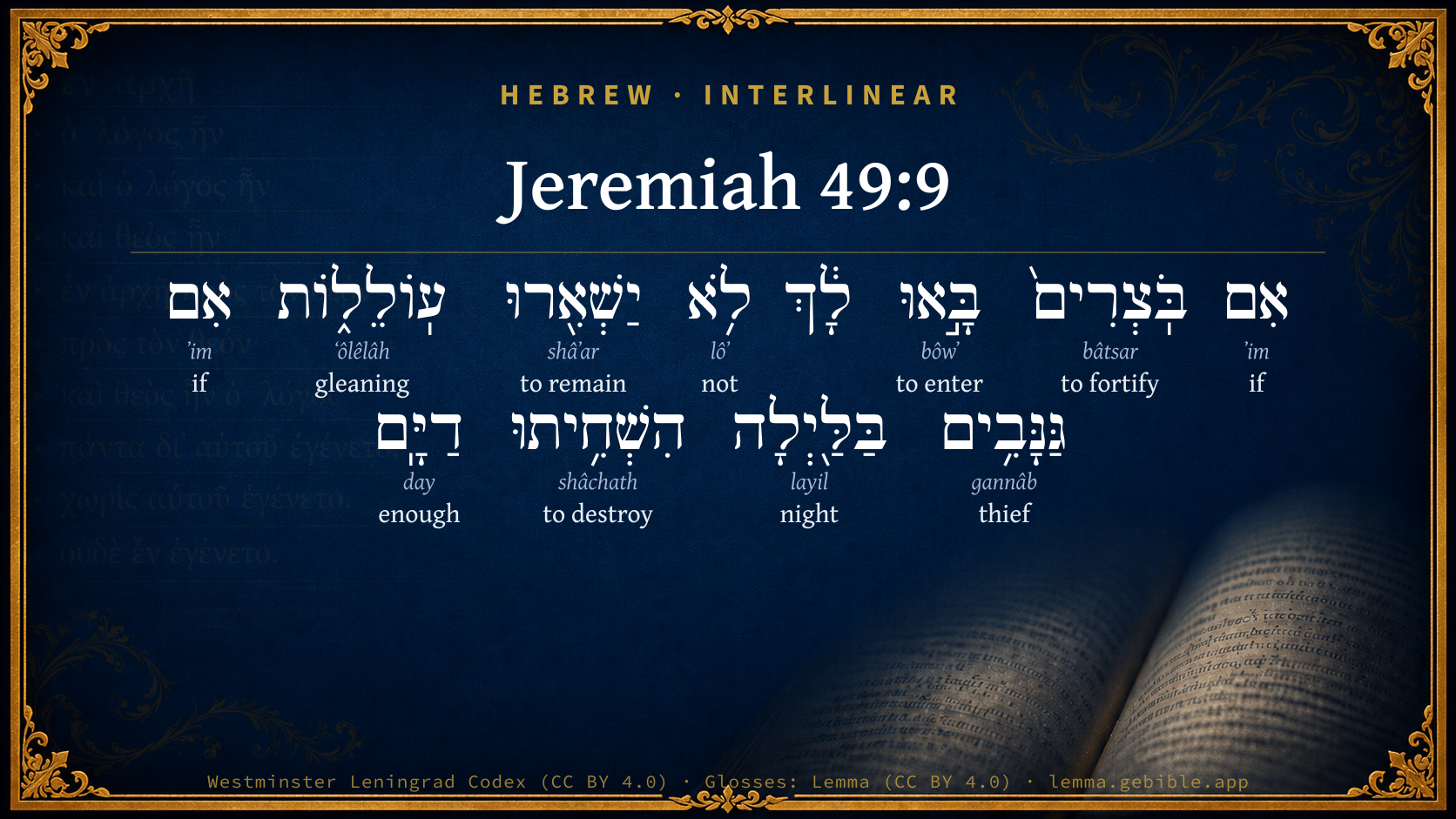
Jeremiah 49:9

Hebrew (Westminster Leningrad Codex) Jeremiah 49:9 appears in the Hebrew Old Testament. The text above is from the Westminster Leningrad Codex. Each word links to its Strong’s number, a concise gloss, and parsing drawn from the Open Scriptures Hebrew Bible morphology. Click any word for its full Brown-Driver-Briggs (BDB) entry.
Download image
Cite this verse

Jeremiah 49:9 (World English Bible). Public Domain. Lemma interlinear Bible study tool, https://lemma.gebible.app/v/jeremiah/49/9.

Show BibTeX & RIS
BibTeX
RIS
English Translation
If grape-gatherers came to you, would they not leave some gleaning grapes? if thieves by night, wouldn't they destroy until they had enough?
World English Bible · Public Domain
Download a study sheet

One document with this verse’s original text, its word-by-word gloss line, the meaning frame, cross-references with their text, attributed commentary, and full source and license credits — printable, and it pastes into notes with its structure intact.

This verse Autodidact and up

Study sheet (.html) Plain text (.txt)

A passage Seminary Student

Up to 50 verses in one chapter. A passage sheet keeps up to 6 commentary sources and 12 cross-references per verse, in the order this page ranks them, and says so on the sheet whenever that leaves anything out. Ask for a single verse and you get the Autodidact verse sheet above.

Everything on this page stays free to read, with no account — the sheet is a download of what is already on screen, not access to it.

Want to remove ads? Support Godless Engineer
Compare translations 3

The same verse in 3 English versions, stacked beneath the original-language interlinear above. Click any original word for its lexicon entry.

Each is an independent rendering of the whole verse — the interlinear is not word-aligned to these translations.

Highlighted words mark where these versions differ — a whole-verse word diff, not a word-by-word alignment.

  • World English Bible Public Domain
    If grape-gatherers came to you, would they not leave some gleaning grapes? if thieves by night, wouldn't they destroy until they had enough?
  • King James Version Public Domain
    If grapegatherers come to thee, would they not leave some gleaning grapes? if thieves by night, they will destroy till they have enough.
  • unfoldingWord Literal Text CC BY-SA 4.0
    If grape harvesters came to you, would they not leave a little bit behind? If thieves came in the night, would they not steal only as much as they wanted?

unfoldingWord Literal Text — © unfoldingWord, licensed CC BY-SA 4.0. Word-aligned USFM3 via Door43 (git.door43.org/unfoldingWord/en_ult).

Versions to compare (up to 4)

3 of 4 selected

Show all 18 translations

Every available English version of this verse, each an independent rendering of the whole verse.

  • World English Bible Public Domain
    If grape-gatherers came to you, would they not leave some gleaning grapes? if thieves by night, wouldn't they destroy until they had enough?
  • Berean Standard Bible Public Domain
    If grape gatherers came to you, would they not leave some gleanings? Were thieves to come in the night, would they not steal only what they wanted?
  • Majority Standard Bible Public Domain
    If grape gatherers came to you, would they not leave some gleanings? Were thieves to come in the night, would they not steal only what they wanted?
  • King James Version Public Domain
    If grapegatherers come to thee, would they not leave some gleaning grapes? if thieves by night, they will destroy till they have enough.
  • American Standard Version (1901) Public Domain
    If grape-gatherers came to thee, would they not leave some gleaning grapes? if thieves by night, would they not destroy till they had enough?
  • Revised Version (1885) Public Domain
    If grapegatherers came to thee, would they not leave some gleaning grapes? if thieves by night, would they not destroy till they had enough?
  • Geneva Bible (1599) Public Domain
    If the grape gatherers come to thee, would they not leaue some grapes? if theeues come by night, they will destroy till they haue ynough.
  • Douay-Rheims (1899) Public Domain
    If grapegatherers had come to thee, would they not have left a bunch? if thieves in the night, they would have taken what was enough for them.
  • Young's Literal Translation Public Domain
    If gatherers have come in to thee, They do not leave gleanings, If thieves in the night, They have destroyed their sufficiency!
  • Literal Standard Version CC BY-SA 4.0
    If gatherers have come to you, || They do not leave gleanings, || If thieves in the night, || They have destroyed their sufficiency!
  • Unlocked Literal Bible CC BY-SA 4.0
    If grape harvesters came to you, would they not leave a little bit behind? If thieves came in the night, would they not steal only as much as they wanted?
  • unfoldingWord Literal Text CC BY-SA 4.0
    If grape harvesters came to you, would they not leave a little bit behind? If thieves came in the night, would they not steal only as much as they wanted?
  • Darby Bible Public Domain
    If grape-gatherers had come to thee, would they not have left a gleaning? If thieves by night, they would destroy only till they had enough.
  • World Messianic Bible Public Domain
    If grape gatherers came to you, would they not leave some gleaning grapes? If thieves came by night, wouldn’t they steal until they had enough?
  • Webster's Bible Public Domain
    If grape-gatherers come to thee, would they not leave some gleaning grapes? if thieves by night, they will destroy till they have enough.
  • Free Bible Version CC BY-SA 4.0
    If people harvesting grapes came to you, they'd leave some behind, wouldn't they? If thieves came during the night, they'd only steal what they wanted, wouldn't they?
  • Bible in Basic English Public Domain
    If men came to get your grapes, would they not let some be uncut on the vines? if thieves came by night, would they not make waste till they had enough?
  • JPS Tanakh (1917) Public Domain
    If grape-gatherers came to thee, would they not leave some gleaning grapes? if thieves by night, would they not destroy till they had enough?

Literal Standard Version (2020), Covenant Press — licensed CC BY-SA 4.0. Text via the HelloAO Bible API (eBible.org). Unlocked Literal Bible (unfoldingWord) — licensed CC BY-SA 4.0. Text via the HelloAO Bible API (eBible.org). unfoldingWord Literal Text — © unfoldingWord, licensed CC BY-SA 4.0. Word-aligned USFM3 via Door43 (git.door43.org/unfoldingWord/en_ult). Free Bible Version, Dr. Jonathan Gallagher — licensed CC BY-SA 4.0. Text via the HelloAO Bible API (eBible.org).

Word by word

More ways to search: Search by grammar → Find every occurrence → Compare this word →

Practice this passage: Drill this verse → Learn its vocabulary →

עֽוֹלֵל֑וֹת
ʻôlêlâh
H5955
“gleanings”
Noun, Common, Feminine, Plural, Absolute
Part of Speech
Noun
Type
Common
Gender
Feminine
Number
Plural
State
Absolute
Full BDB Definition

Origin: act part of H5953

TWOT: 1627a

gleaning
  1. אִם ʼim H518 “if” Conjunction
  2. בֹּֽצְרִים֙ bâtsar H1219 “fortifying” Verb, Qal, Participle Active, Masculine, Plural, Absolute
  3. בָּ֣אוּ bôwʼ H935 “to enter” Verb, Qal, Perfect, 3rd Person, Common, Plural
  4. לֹ֥א lôʼ H3808 “not” Particle, Negative
  5. יַשְׁאִ֖רוּ shâʼar H7604 “to remain” Verb, Hiphil, Imperfect, 3rd Person, Masculine, Plural
  6. אִם ʼim H518 “if” Conjunction
  7. גַּנָּבִ֥ים gannâb H1590 “thieves” Noun, Common, Masculine, Plural, Absolute
  8. בַּלַּ֖יְלָה layil H3915 “in/at the · night” Preposition, Determined + Noun, Common, Masculine, Singular, Absolute
  9. הִשְׁחִ֥יתוּ shâchath H7843 “to destroy” Verb, Hiphil, Perfect, 3rd Person, Common, Plural
  10. דַיָּֽם day H1767 “enough · their” Noun, Common, Masculine, Singular, Construct + Suffix, Personal, 3rd Person, Masculine, Plural

About this verse

These counts appear in no published source. They are computed here, from the morphology-tagged text and Lemma’s own curated glosses. What Lemma adds →

12
words
10
distinct lemmas
Prophets
section

Notable vocabulary

The rarest word here is עֽוֹלֵל֑וֹת gleaning H5955 — appearing just 6 times in the whole Hebrew Bible.

Shared distinctive vocabulary

עֽוֹלֵל֑וֹת gleaning H5955 occurs in 6 verses of the Hebrew Bible. Also found in:

Grammatical profile

  • 4 verbs
  • 4 nouns
  • 1 preposition
  • 2 conjunctions
  • 1 particle

Verb forms

  • בֹּֽצְרִים֙ Qal · Participle Active
  • בָּ֣אוּ Qal · Perfect
  • יַשְׁאִ֖רוּ Hiphil · Imperfect
  • הִשְׁחִ֥יתוּ Hiphil · Perfect

Repetition

A word recurs within this verse — often emphatic in Hebrew:

  • אִם if H518 ×2

Cross-references

2

Topical passages linked to Jeremiah 49:9 in the Treasury of Scripture Knowledge — connected by theme and wording, ordered by reader-vote popularity; previews shown in the World English Bible.

  • Obadiah 1:5–6 If thieves came to you, if robbers by night-- oh, what disaster awaits you--wouldn't they only steal until they had enough? If grape pickers came to you, wouldn't they leave some gleaning grapes?
  • Isaiah 17:6 Yet there shall be left therein gleanings, as the shaking of an olive tree, two or three berries in the top of the uppermost bough, four or five in the outmost branches of a fruitful tree, says Yahweh, the God of Israel.

Cross-references courtesy of OpenBible.info (CC BY 4.0).

Hebrew and Greek witnesses Masoretic Hebrew ↔ Greek Septuagint

The same verse in the two great witnesses to the Old Testament, shown verse-for-verse.

These are two independent witnesses, not word-aligned to each other, and the Septuagint is shown in lemma (dictionary) form.

Hebrew Jeremiah 49:9 Masoretic · Westminster Leningrad Codex

אִם בֹּֽצְרִים֙ בָּ֣אוּ לָ֔ךְ לֹ֥א יַשְׁאִ֖רוּ עֽוֹלֵל֑וֹת אִם גַּנָּבִ֥ים בַּלַּ֖יְלָה הִשְׁחִ֥יתוּ דַיָּֽם

If grape-gatherers came to you, would they not leave some gleaning grapes? if thieves by night, wouldn't they destroy until they had enough?

World English Bible · Public Domain

Greek LXX Structure differs

In the Septuagint, Jeremiah is about an eighth shorter than the Hebrew and arranges its material differently — the Oracles Against the Nations (Hebrew chapters 46–51) appear in the middle of the Greek book, after 25:13. Because the chapter and verse boundaries do not line up, a verse-for-verse comparison with the Hebrew is not shown.

A verse-for-verse comparison isn’t shown here because the chapters and verses don’t line up. Switch to the LXX edition with the MT / LXX toggle above to read the Greek directly.

Hebrew: Westminster Leningrad Codex (CC BY 4.0). Greek: Septuagint (public domain); English from a public-domain English Septuagint. How the Septuagint differs from the Hebrew →

Targum (Aramaic paraphrase)

1

The Targum is the ancient Jewish Aramaic paraphrase of the Hebrew Scriptures — an interpretive translation, not the Hebrew text itself. Onkelos (literal) and Pseudo-Jonathan (expansive) render the Torah, and Jonathan the Prophets. Coverage is partial: where no permissively-licensed English translation exists for a verse, only the Aramaic is shown. This is verse-level text, not a word-by-word alignment to the Hebrew.

  1. Targum Jonathan Prophets (Joshua–Malachi)
    אִם חֲטוֹפִין כִּקְטוֹפִין אֱתוֹ עֲלָךְ לָא אַשְׁאָרוּ עוֹלְלָן אִם גַנָבַיָא בְּלֵילְיָא חַבִּילוּ מִיסַתְהוֹן:

    (no public-domain English translation for this verse)

    Targum Jonathan — Aramaic: “Mikraot Gedolot” (public domain). English: “Sefaria Community Translation” (CC0 1.0 (public-domain dedication)); “London "Chaldee Paraphrase," 1871” (public domain). Text via Sefaria.

Commentary

Notes on Jeremiah 49:9 from classic Christian and Jewish commentators (each source and its license shown beneath its notes). The classic Christian expositions comment on the surrounding passage and are grouped to its opening verse, so a note may address several verses; the Jewish commentaries on the Tanakh (Rashi and others) are per-verse, so they appear only where the commentator wrote on this verse.

Lemma curates 59 commentaries, every one of them public domain or Creative Commons licensed, each selected and text-cleaned for this edition rather than reprinted as found. About our sources →

Trapp's Complete Commentary

John Trapp

Jer 49:9 If grapegatherers come to thee, would they not leave [some] gleaning grapes? if thieves by night, they will destroy till they have enough.

Ver. 9. If grape gatherers, &c.] See on Oba 1:5.

John Trapp, A Commentary or Exposition upon All the Books of the Old and New Testament (1647–1656) — public domain. Text from a community e-Sword module.

Joseph Benson's Commentary

Jer 49:9-10. If grape-gatherers come to thee, &c. — The vintage is not usually gathered so clean but there will be a gleaning left, Isa 17:6; and house-breakers, or thieves, commonly leave something behind. But I have made Esau bare — But the destruction coming upon thee will be so entire that scarcely a remnant shall be preserved. I have uncovered his secret places — I have taken from him every thing that might be a refuge or defence to him, and laid open all the recesses wherein he might conceal himself, or his riches. His seed is spoiled, &c. — The calamity shall also extend to his family, and to all that he has any connection with. And he is not — He is utterly ruined and undone.

Joseph Benson's Commentary on the Old and New Testaments (1811–1818) — public domain. Text from a community e-Sword module.

Tyndale Open Study Notes

Tyndale Open Resources

49:9-11 Harvesters customarily left some of the crop for the poor (Lev 19:9-10); thieves would take only those grapes they could get quickly and easily. The invaders would take their time and mercilessly strip Edom bare, leaving only ruin behind them. However, the Lord promised to be merciful to the defeated nation’s orphans and widows.

Tyndale Open Study Notes — © Tyndale Open Resources, licensed CC BY-SA 4.0. Text via the HelloAO Bible API.

Geneva Bible (1599)

Geneva Bible translators

Meaning, that God would utterly destroy them, and not spare one, though the grape gatherers leave some grapes, and thieves seek but till they have enough, Obad. 1:5.

Geneva Bible (1599) marginal notes — public domain. Text via Bolls.life.

Jamieson, Fausset & Brown

Robert Jamieson, A. R. Fausset & David Brown

(Oba 1:5). Grape gatherers, yea even thieves, leave something behind them; but the Chaldeans will sweep Idumea clean of everything.

Jamieson, Fausset & Brown — Commentary Critical and Explanatory on the Whole Bible (1871) — public domain (CC PDM 1.0). Text via the HelloAO Bible API.

Adam Clarke's Commentary

Verse 9. If grape-gatherers] Both in vintage and harvest every grape and every stalk are not gathered; hence the gleaners get something for their pains: but your enemies shall not leave one of you behind; all shall be carried into captivity.

Adam Clarke's Commentary on the Bible (1810–1826) — public domain. Text from a community e-Sword/MySword module.

John Calvin's Commentaries

Interpreters have not only obscured, but also perverted this verse, and only said what is to no purpose, and have gone far from the meaning of the Prophet. How so? because it did not occur to them to compare this with a passage in Obadiah. Obadiah is the true interpreter; nay, our Prophet has borrowed what we read here from him. For there a question is asked, “If thieves were to come to thee, if robbers (שדדי, shaddi, is added there, but is omitted by Jeremiah) — if robbers by night, how wouldest thou have been reduced to nothing?” But in the first place the rendering ought to be, “Had thieves come to thee, how wouldest thou have been reduced to nothing?” then he adds, “Would they not have stolen what would suffice them?” He afterwards adds the second clause, “If the grape-gatherers had come to thee, would they not have left grapes.” There is now then no ambiguity in the Prophet’s words, if we read them interrogatively. But there is an implied contrast between the calamity threatened to the people and the other devastations. Were a thief of the night to plunder another’s house, he would depart, loaded with his prey, and leave something behind; for in all plunder some things remain: so also as to grape-gatherers, some grapes remain, which escape the gatherers.

Then the Prophet here shews, that so great would be the destruction of that nation, that it would exceed all kinds of plundering; for when one strips his vines, he leaves some grapes; and when a thief enters a house, he does not carry all things away with him, being satisfied with his booty. But nothing, he says, shall be left remaining with the Idumeans. We hence see why the Prophet brings forward the two comparisons, that of the grape-gatherers and of the thieves.

We must at the same time observe, that when God denounces his vengeance on the Israelites, he often adduces these comparisons, in order to show that nothing would be left them, “When the olives are shaken, yet some fruit remains on the top of the trees; but thou shalt be wholly emptied.” As God had said these things, the Israelites might have raised an objection and said, “What is our condition, and how miserable! for we are extremely afflicted; though God afflicts the Idumeans, yet he deals mildly with them, for God’s wrath is less inflamed against them than against us.” Lest then the faithful should be thus thrown into despair, our Prophet declares that the Idumeans would be wholly destroyed, so that not a grape would be left them, nor any of their furniture, for their enemies would lay desolate the whole land. Now follows a confirmation of this verse —

John Calvin's Commentaries (1540-1563) — public domain. Text from the Calvin Translation Society English edition (1840s-50s) via the Christian Classics Ethereal Library (ccel.org). Calvin's coverage is partial (roughly two-thirds of the Bible); uncommented books and verses are honest gaps, never fabricated. The 19th-century editor's footnotes and remarks are omitted so the notes are faithfully Calvin's own voice.

Ellicott's Commentary for English Readers

(9) If grapegatherers come to thee . . .—The words are reproduced in Oba_1:5. Vine-gatherers leave some bunches for the gleaner; robbers are at last satiated with plunder; but the destroyers of Edom would be insatiable (comp. Isa_17:6). Esau (the name stands for Edom) should be laid bare, and perish utterly. It is significant that there is no promise to Edom that her captivity should be brought back.

A Bible Commentary for English Readers, edited by Charles John Ellicott (1878–1897) — public domain. Text from a community e-Sword module.

The Cambridge Bible for Schools and Colleges

gen. ed. J. J. S. Perowne

9. would they not leave some gleaning grapes?] The v. is based on Oba_1:5, but while the general sense is the same, Obadiah contrasts the extremities to which the foe proceeds with the comparative moderation shewn by grape-gatherers or thieves. Here, on the contrary, the enemy’s conduct is directly illustrated by the figures employed, and accordingly we should render as mg.

The Cambridge Bible for Schools and Colleges (gen. ed. J. J. S. Perowne; Cambridge University Press, 1878–1918) — public domain. Text from a community e-Sword module.

John Gill's Exposition

If grape gatherers come to thee, would they not leave some gleaning grapes?.... If gatherers of grapes, at the time of the vintage, should come into thy fields to gather the grapes, being ripe, would not they leave some for the poor to glean? certainly they would, and not take every cluster. The Targum renders it,

"if thy spoilers, as grape gatherers, should come to thee,'' &c.

if thieves by night, they will destroy till they have enough; who break into houses by night, these will eat and drink as much as is sufficient, and carry off what serves their turn; but they seldom take away everything they find in a house; they leave some things behind them; but it is suggested that the Chaldeans should take away all from the Edomites, and leave them nothing; see Oba 1:5.

John Gill's Exposition of the Whole Bible (1746–1763) — public domain (CC PDM 1.0). Text via the HelloAO Bible API.

Matthew Poole's English Annotations

We have much the same Ob 5. The scope of the prophet in this place is only to show that Edom should be totally destroyed; their destruction should not be like the gleaning of grapes, where the gatherers content themselves with taking the principal clusters, but for single grapes, or small clusters, they leave them; nor yet like the robbings of thieves, who take for their hunger, and when they have got enough leave the rest.

Matthew Poole's English Annotations on the Holy Bible (1683–1685) — public domain. Text from a community e-Sword/MySword module.

Whedon's Commentary on the Bible

Daniel D. Whedon

9, 10. If grapegatherers come… leave some gleaning — “Grape gatherers” and even thieves leave something behind them, but the Chaldeans will strip them utterly bare.

His seed — His family.

His brethren — The related peoples who were intermingled with them — the Simeonites, Horites, etc., etc.

Daniel D. Whedon (gen. ed.), Commentary on the Old and New Testaments (1874–1909) — public domain. Text from a community e-Sword module.

The Pulpit Commentary

If grape gatherers, etc. Jeremiah modifies his original in Oba_1:5; the interrogative clauses here become affirmative. Render, If vintagers come to thee, they will not leave any gleanings: if thieves by night, they destroy what is sufficient for them.

The Pulpit Commentary (1880–1919), ed. H.D.M. Spence-Jones & Joseph S. Exell — public domain. Text from a community e-Sword module.

John Wesley's Explanatory Notes

If - Edom shall be totally destroyed; their destruction should not be like the gleaning of grapes, where the gatherers content themselves with taking the principal clusters: nor yet like the robbings of thieves, who take for their hunger, and when they have got enough leave the rest.

John Wesley, Explanatory Notes Upon the Whole Bible (1754–1765) — public domain. Text via the GEBible commentary corpus.

unfoldingWord translationNotes

Door43 World Missions Community

General Information:

Yahweh continues speaking about what will happen to Edom.

If grape harvesters ... would they not leave a little bit behind?

Yahweh uses a question to cause the people to think about how grape harvesters leave some grapes behind. This can be translated as a statement. AT: "If grape harvesters ... they would certainly leave some grapes behind." (See: Rhetorical Question)

If thieves ... would they not steal only as much as they wanted?

Yahweh uses a question to cause the people to think about how thieves only take what they want. This question can be translated as a statement. AT: "If thieves ... they would only take as much as they wanted." (See: Rhetorical Question)

But I have stripped Esau bare

Yahweh causing an enemy army to come and take everything is spoken of as if Yahweh stripped all the clothes off of Esau. AT: "But I have sent an army to take everything away from Esau" (See: Metaphor)

Esau ... his hiding ... he will not ... hide himself ... His children ... he is gone

Here "Esau" represents the people of Edom. AT: "the people of Edom ... their hiding ... they will not ... hide themselves ... Their children ... they are gone" (See: Metonymy)

I have revealed his hiding places

"I have made known to the enemy soldiers where the people of Edom hide"

translationWords

grape

harvest

thief

Esau

reveal

neighbor

life

trust

unfoldingWord translationNotes — © Distant Shores Media and the Door43 World Missions Community, licensed CC BY-SA 4.0. Source: git.door43.org/Door43/en_tn.

Rashi

Rabbi Shlomo Yitzchaki (Rashi)

If vintagers have come upon you, etc. I have exposed Esau, etc. I have heard tidings, etc. On this order, Obadiah prophesied concerning Edom, but since one watchword is passed to many prophets, but no two prophets prophesy under the same watchword, they differ in several words.

will they not leave over gleaning grapes? This is the interrogative. Yet the spoilers who came upon you left over nothing for you.

Rashi on the Tanakh — English translations: “The Judaica Press complete Tanach with Rashi, translated by A. J. Rosenberg” (CC BY 4.0); “Pentateuch with Rashi's commentary by M. Rosenbaum and A.M. Silbermann, 1929-1934” (public domain); “The Metsudah Tanach series, Lakewood, N.J” (CC BY 4.0); and “The Book of Joshua, Metsudah Publications, 1997” (CC BY 4.0). Text via Sefaria.

Lesson kit

Teaching starters — assembled from the data on this page, not authored interpretation. Every prompt links to the verse data it draws on. Edit before teaching.

Jeremiah, in the Prophets, opens this verse with 12 words (10 distinct Hebrew lemmas). Its most distinctive word is ʻôlêlâh (“gleaning”). A historical commentator’s framing appears above. Read the whole chapter for the surrounding context.

Discussion questions

  1. How does “gleaning” (ʻôlêlâh) shape what this verse is saying?
  2. How does Judges 8:2, which shares the word «gleaning», read alongside this verse?
  3. What does the repetition of “if” (2× in this one verse) do in this verse?
  4. These translations render this verse differently. What is at stake in choosing one wording over another?
  5. «בֹּֽצְרִים֙» is a Qal Participle Active verb. How does that grammatical form shape the action described?
  6. Compare how Trapp's Complete Commentary and Joseph Benson's Commentary read this verse. Where do they agree or differ?

Things to notice

Reading settings

Reading text

Shown beneath each verse's original-language words.

Old Testament
Old Testament edition

Read the OT as the Masoretic Hebrew (MT) or the Greek Septuagint (LXX).

English shown for the Greek Septuagint (in the Hebrew ↔ Greek comparison).

Comparing translations? Open the Compare panel on any verse page to stack up to four side by side.