
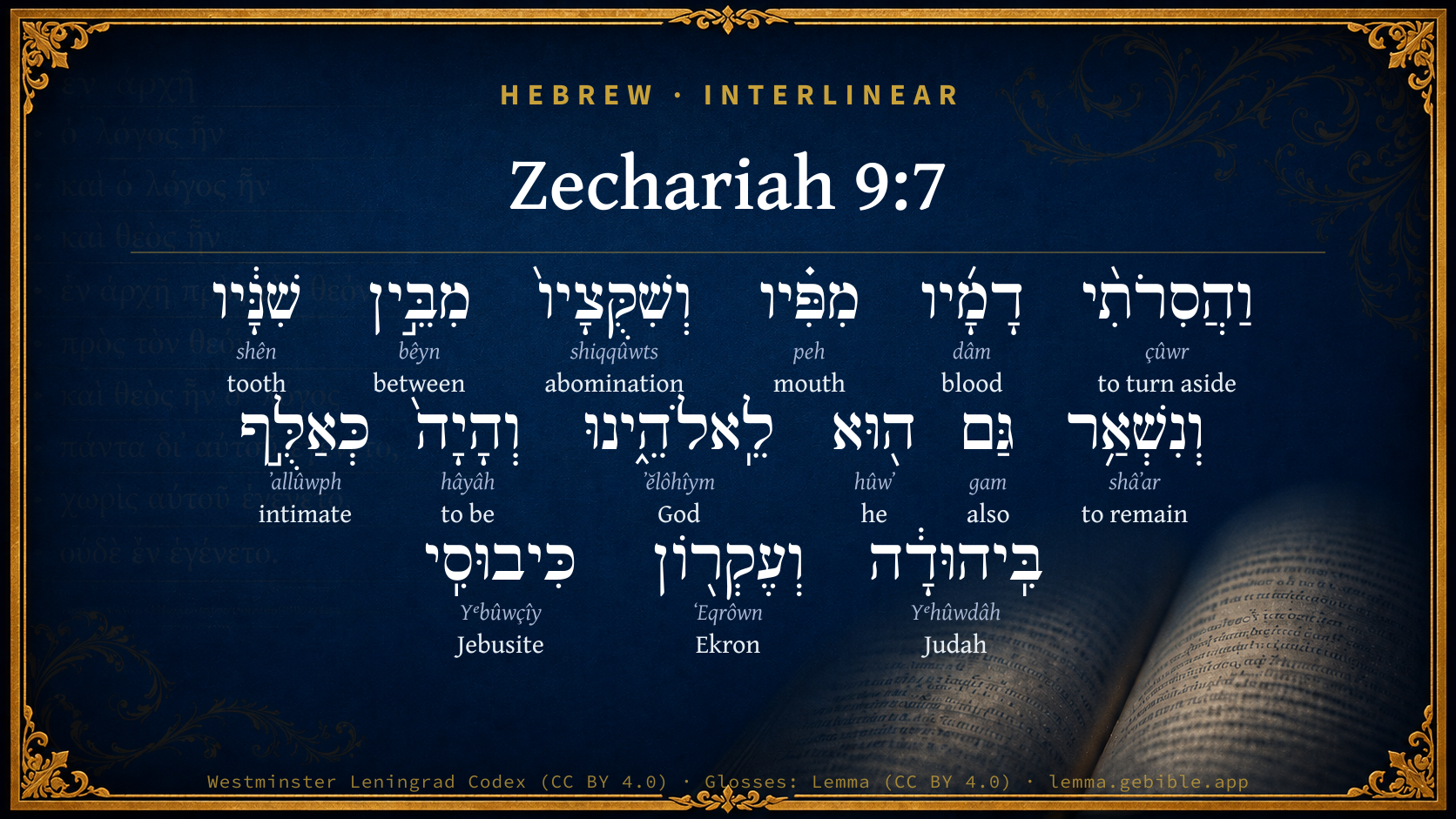
Zechariah 9:7

Hebrew (Westminster Leningrad Codex) Zechariah 9:7 appears in the Hebrew Old Testament. The text above is from the Westminster Leningrad Codex. Each word links to its Strong’s number, a concise gloss, and parsing drawn from the Open Scriptures Hebrew Bible morphology. Click any word for its full Brown-Driver-Briggs (BDB) entry.
Download image
Cite this verse

Zechariah 9:7 (World English Bible). Public Domain. Lemma interlinear Bible study tool, https://lemma.gebible.app/v/zechariah/9/7.

Show BibTeX & RIS
BibTeX
RIS
English Translation
I will take away his blood out of his mouth, And his abominations from between his teeth; And he also will be a remnant for our God; And he will be as a chieftain in Judah, And Ekron as a Jebusite.
World English Bible · Public Domain
Download a study sheet

One document with this verse’s original text, its word-by-word gloss line, the meaning frame, cross-references with their text, attributed commentary, and full source and license credits — printable, and it pastes into notes with its structure intact.

This verse Autodidact and up

Study sheet (.html) Plain text (.txt)

A passage Seminary Student

Up to 50 verses in one chapter. A passage sheet keeps up to 6 commentary sources and 12 cross-references per verse, in the order this page ranks them, and says so on the sheet whenever that leaves anything out. Ask for a single verse and you get the Autodidact verse sheet above.

Everything on this page stays free to read, with no account — the sheet is a download of what is already on screen, not access to it.

Want to remove ads? Support Godless Engineer
Compare translations 3

The same verse in 3 English versions, stacked beneath the original-language interlinear above. Click any original word for its lexicon entry.

Each is an independent rendering of the whole verse — the interlinear is not word-aligned to these translations.

Highlighted words mark where these versions differ — a whole-verse word diff, not a word-by-word alignment.

  • World English Bible Public Domain
    I will take away his blood out of his mouth, And his abominations from between his teeth; And he also will be a remnant for our God; And he will be as a chieftain in Judah, And Ekron as a Jebusite.
  • King James Version Public Domain
    And I will take away his blood out of his mouth, and his abominations from between his teeth: but he that remaineth, even he, shall be for our God, and he shall be as a governor in Judah, and Ekron as a Jebusite.
  • unfoldingWord Literal Text CC BY-SA 4.0
    For I will remove their blood from their mouths and their abominations from between their teeth. Then they will become a remnant for our God like a clan in Judah, and Ekron will become like the Jebusites.

unfoldingWord Literal Text — © unfoldingWord, licensed CC BY-SA 4.0. Word-aligned USFM3 via Door43 (git.door43.org/unfoldingWord/en_ult).

Versions to compare (up to 4)

3 of 4 selected

Show all 18 translations

Every available English version of this verse, each an independent rendering of the whole verse.

  • World English Bible Public Domain
    I will take away his blood out of his mouth, And his abominations from between his teeth; And he also will be a remnant for our God; And he will be as a chieftain in Judah, And Ekron as a Jebusite.
  • Berean Standard Bible Public Domain
    I will remove the blood from their mouths and the abominations from between their teeth. Then they too will become a remnant for our God; they will become like a clan in Judah, and Ekron will be like the Jebusites.
  • Majority Standard Bible Public Domain
    I will remove the blood from their mouths and the abominations from between their teeth. Then they too will become a remnant for our God; they will become like a clan in Judah, and Ekron will be like the Jebusites.
  • King James Version Public Domain
    And I will take away his blood out of his mouth, and his abominations from between his teeth: but he that remaineth, even he, shall be for our God, and he shall be as a governor in Judah, and Ekron as a Jebusite.
  • American Standard Version (1901) Public Domain
    And I will take away his blood out of his mouth, and his abominations from between his teeth; and he also shall be a remnant for our God; and he shall be as a chieftain in Judah, and Ekron as a Jebusite.
  • Revised Version (1885) Public Domain
    And I will take away his blood out of his mouth, and his abominations from between his teeth; and he also shall be a remnant for our God: and he shall be as a chieftain in Judah, and Ekron as a Jebusite.
  • Geneva Bible (1599) Public Domain
    And I wil take away his blood out of his mouth, and his abominations from betweene his teeth: but he that remaineth, euen he shalbe for our God, and he shalbe as a prince in Iudah, but Ekron shalbe as a Iebusite.
  • Douay-Rheims (1899) Public Domain
    And I will take away his blood out of his mouth, and his abominations from between his teeth: and even he shall be left to our God, and he shall be as a governor in Juda, and Accaron as a Jebusite.
  • Young's Literal Translation Public Domain
    And turned aside his blood from his mouth, His abominations from between his teeth, And he hath remained, even he, to our God, And he hath been as a leader in Judah, And Ekron as a Jebusite.
  • Literal Standard Version CC BY-SA 4.0
    And turned aside his blood from his mouth, || His abominations from between his teeth, || And he has remained, even he, to our God, || And he has been as a leader in Judah, || And Ekron as a Jebusite.
  • Unlocked Literal Bible CC BY-SA 4.0
    For I will remove their blood from their mouths and their abominations from between their teeth. Then they will become a remnant for our God like a clan in Judah, and Ekron will become like the Jebusites.
  • unfoldingWord Literal Text CC BY-SA 4.0
    For I will remove their blood from their mouths and their abominations from between their teeth. Then they will become a remnant for our God like a clan in Judah, and Ekron will become like the Jebusites.
  • Darby Bible Public Domain
    and I will take away his blood out of his mouth, and his abominations from between his teeth; but he that remaineth, he also shall belong to our God, and shall be as a leader in Judah, and Ekron as a Jebusite.
  • World Messianic Bible Public Domain
    I will take away his blood out of his mouth, and his abominations from between his teeth; and he also will be a remnant for our God; and he will be as a chieftain in Judah, and Ekron as a Jebusite.
  • Webster's Bible Public Domain
    And I will take away his blood out of his mouth, and his abominations from between his teeth: but he that remaineth, even he, shall be for our God, and he shall be as a governor in Judah, and Ekron as a Jebusite.
  • Free Bible Version CC BY-SA 4.0
    I will remove the blood-filled meat from their mouths; the unclean food from their jaws. Those who remain will belong to our God—they shall become like a family of Judah—and those from Ekron will become part of my people, just as the Jebusites did.
  • Bible in Basic English Public Domain
    And I will take away his blood from his mouth, and his disgusting things from between his teeth; and some of his people will be kept for our God: and he will be as a family in Judah, and Ekron as one living in Jerusalem.
  • JPS Tanakh (1917) Public Domain
    And I will take away his blood out of his mouth, and his detestable things from between his teeth, and he also shall be a remnant for our God; and he shall be as a chief in Judah, and Ekron as a Jebusite.

Literal Standard Version (2020), Covenant Press — licensed CC BY-SA 4.0. Text via the HelloAO Bible API (eBible.org). Unlocked Literal Bible (unfoldingWord) — licensed CC BY-SA 4.0. Text via the HelloAO Bible API (eBible.org). unfoldingWord Literal Text — © unfoldingWord, licensed CC BY-SA 4.0. Word-aligned USFM3 via Door43 (git.door43.org/unfoldingWord/en_ult). Free Bible Version, Dr. Jonathan Gallagher — licensed CC BY-SA 4.0. Text via the HelloAO Bible API (eBible.org).

Word by word

More ways to search: Search by grammar → Find every occurrence → Compare this word →

Practice this passage: Drill this verse → Learn its vocabulary →

וְעֶקְר֖וֹן
ʻEqrôwn
H6138
“and · Ekron”
Conjunction + Noun, Proper
Part of Speech
Conjunction + Noun
Type
Proper
Full BDB Definition

Origin: from H6131

TWOT: None

Ekron = "emigration" or " torn up by the roots" - the most northerly of the 5 principal cities of the Philistines; located in the lowlands of Judah and later given to Dan
  1. וַהֲסִרֹתִ֨י çûwr H5493 “and · to turn aside” Conjunction + Verb, Hiphil, Perfect, 1st Person, Common, Singular
  2. דָמָ֜יו dâm H1818 “blood · his” Noun, Common, Masculine, Plural, Construct + Suffix, Personal, 3rd Person, Masculine, Singular
  3. מִפִּ֗יו peh H6310 “from · mouth · his” Preposition + Noun, Common, Masculine, Singular, Construct + Suffix, Personal, 3rd Person, Masculine, Singular
  4. וְשִׁקֻּצָיו֙ shiqqûwts H8251 “and · abominations · his” Conjunction + Noun, Common, Masculine, Plural, Construct + Suffix, Personal, 3rd Person, Masculine, Singular
  5. מִבֵּ֣ין bêyn H996 “from · between” Preposition + Preposition
  6. שִׁנָּ֔יו shên H8127 “teeth · his” Noun, Common, Both, Dual, Construct + Suffix, Personal, 3rd Person, Masculine, Singular
  7. וְנִשְׁאַ֥ר shâʼar H7604 “and · to remain” Conjunction + Verb, Niphal, Sequential Perfect, 3rd Person, Masculine, Singular
  8. גַּם gam H1571 “also” Particle, Accusative
  9. ה֖וּא hûwʼ H1931 “he” Pronoun, Personal, 3rd Person, Masculine, Singular
  10. לֵֽאלֹהֵ֑ינוּ ʼĕlôhîym H430 “to/for · God(s) · our” Preposition + Noun, Common, Masculine, Plural, Construct + Suffix, Personal, 1st Person, Common, Plural
  11. וְהָיָה֙ hâyâh H1961 “and · to be” Conjunction + Verb, Qal, Perfect, 3rd Person, Masculine, Singular
  12. כְּאַלֻּ֣ף ʼallûwph H441 “like/as · intimate” Preposition + Noun, Common, Masculine, Singular, Absolute
  13. בִּֽיהוּדָ֔ה Yᵉhûwdâh H3063 “in/at · Judah” Preposition + Noun, Proper
  14. כִּיבוּסִֽי Yᵉbûwçîy H2983 “like/as · Jebusite” Preposition + Noun, Proper

About this verse

These counts appear in no published source. They are computed here, from the morphology-tagged text and Lemma’s own curated glosses. What Lemma adds →

15
words
15
distinct lemmas
Prophets
section

Notable vocabulary

The rarest word here is וְעֶקְר֖וֹן Ekron H6138 — appearing just 22 times in the whole Hebrew Bible.

Shared distinctive vocabulary

וְעֶקְר֖וֹן Ekron H6138 occurs in 20 verses of the Hebrew Bible. Also found in:

Grammatical profile

  • 3 verbs
  • 9 nouns
  • 1 pronoun
  • 1 preposition
  • 1 particle

Verb forms

  • וַהֲסִרֹתִ֨י Hiphil · Perfect
  • וְנִשְׁאַ֥ר Niphal · Sequential Perfect
  • וְהָיָה֙ Qal · Perfect

Hebrew & Septuagint length

In English translation the verse runs 41 words from the Hebrew and 43 from the Septuagint (LXX English) — closely comparable.

A rough comparison of the two English renderings, which tokenize alike — not a word-level alignment.

Word counts can differ between the Hebrew and the Greek without any difference in meaning — e.g. the Hebrew direct-object marker אֵת has no separate Greek word, and Greek often adds the article ὁ.

Cross-references

17

Topical passages linked to Zechariah 9:7 in the Treasury of Scripture Knowledge — connected by theme and wording, ordered by reader-vote popularity; previews shown in the World English Bible.

  • Galatians 3:28 There is neither Jew nor Greek, there is neither slave nor free man, there is neither male nor female; for you are all one in Christ Jesus.
  • 1 Samuel 17:34–36 David said to Saul, Your servant was keeping his father's sheep; and when there came a lion, or a bear, and took a lamb out of the flock,
  • 2 Samuel 24:16–23 When the angel stretched out his hand toward Jerusalem to destroy it, Yahweh repented him of the evil, and said to the angel who destroyed the people, It is enough; now stay your hand. The angel of Yahweh was by the threshing floor of Araunah the Jebusite.
  • 1 Chronicles 11:4–6 David and all Israel went to Jerusalem (the same is Jebus); and the Jebusites, the inhabitants of the land, were there.
  • 1 Chronicles 21:15–22:1 God sent an angel to Jerusalem to destroy it: and as he was about to destroy, Yahweh saw, and he repented him of the evil, and said to the destroying angel, It is enough; now stay your hand. The angel of Yahweh was standing by the threshing floor of Ornan the Jebusite.
  • Psalms 3:7 Arise, Yahweh! Save me, my God! For you have struck all of my enemies on the cheek bone. You have broken the teeth of the wicked.
  • Psalms 58:6 Break their teeth, God, in their mouth. Break out the great teeth of the young lions, Yahweh.
  • Isaiah 11:12–14 He will set up an ensign for the nations, and will assemble the outcasts of Israel, and gather together the dispersed of Judah from the four corners of the earth.
  • Isaiah 19:23–25 In that day shall there be a highway out of Egypt to Assyria, and the Assyrian shall come into Egypt, and the Egyptian into Assyria; and the Egyptians shall worship with the Assyrians.
  • Isaiah 49:22–23 Thus says the Lord Yahweh, Behold, I will lift up my hand to the nations, and set up my ensign to the peoples; and they shall bring your sons in their bosom, and your daughters shall be carried on their shoulders.
  • Isaiah 60:14–16 The sons of those who afflicted you shall come bending to you; and all those who despised you shall bow themselves down at the soles of your feet; and they shall call you The city of Yahweh, The Zion of the Holy One of Israel.
  • Jeremiah 48:47 Yet will I bring back the captivity of Moab in the latter days, says Yahweh. Thus far is the judgment of Moab.
  • Jeremiah 49:6 But afterward I will bring back the captivity of the children of Ammon, says Yahweh.
  • Jeremiah 49:39 But it shall happen in the latter days, that I will bring back the captivity of Elam, says Yahweh.
  • Ezekiel 16:57–61 before your wickedness was uncovered, as at the time of the reproach of the daughters of Syria, and of all who are round about her, the daughters of the Philistines, who do despite to you round about.
  • Amos 3:12 Thus says Yahweh: "As the shepherd rescues out of the mouth of the lion two legs, Or a piece of an ear, So shall the children of Israel be rescued who sit in Samaria on the corner of a couch, And on the silken cushions of a bed."
  • Zechariah 8:23 Thus says Yahweh of Hosts: "In those days, ten men will take hold, out of all the languages of the nations, they will take hold of the skirt of him who is a Jew, saying, 'We will go with you, for we have heard that God is with you.'"

Cross-references courtesy of OpenBible.info (CC BY 4.0).

Hebrew and Greek witnesses Masoretic Hebrew ↔ Greek Septuagint

The same verse in the two great witnesses to the Old Testament, shown verse-for-verse.

These are two independent witnesses, not word-aligned to each other, and the Septuagint is shown in lemma (dictionary) form.

Hebrew Zechariah 9:7 Masoretic · Westminster Leningrad Codex

וַהֲסִרֹתִ֨י דָמָ֜יו מִפִּ֗יו וְשִׁקֻּצָיו֙ מִבֵּ֣ין שִׁנָּ֔יו וְנִשְׁאַ֥ר גַּם ה֖וּא לֵֽאלֹהֵ֑ינוּ וְהָיָה֙ כְּאַלֻּ֣ף בִּֽיהוּדָ֔ה וְעֶקְר֖וֹן כִּיבוּסִֽי

I will take away his blood out of his mouth, And his abominations from between his teeth; And he also will be a remnant for our God; And he will be as a chieftain in Judah, And Ekron as a Jebusite.

World English Bible · Public Domain

Greek LXX Zechariah 9:7 Septuagint · lemma form

καί ἐκαἴρω ὁ αἷμα αὐτός ἐκ στόμα αὐτός καί ὁ βδέλυγμα αὐτός ἐκ μέσος ὀδούς αὐτός καί ὑπολείπω καί οὗτος ὁ θεός ἐγώ καί εἰμί ὡς χιλίαρχος ἐν ιουδα καί ακκαρων ὡς ὁ ιεβουσαῖος

And I will take their blood out of their mouth, and their abominations from between their teeth; and these also shall be left to our God, and they shall be as a captain of a thousand in Juda, and Accaron as a Jebusite.

LXX2012 (modern English Septuagint) · Public Domain

On this verse, Whedon's Commentary on the Bible discusses the Septuagint’s reading. Read the note in Commentary ↓

Hebrew: Westminster Leningrad Codex (CC BY 4.0). Greek: Septuagint (public domain); English from LXX2012 (modern English Septuagint) (Public Domain). How the Septuagint differs from the Hebrew →

Targum (Aramaic paraphrase)

1

The Targum is the ancient Jewish Aramaic paraphrase of the Hebrew Scriptures — an interpretive translation, not the Hebrew text itself. Onkelos (literal) and Pseudo-Jonathan (expansive) render the Torah, and Jonathan the Prophets. Coverage is partial: where no permissively-licensed English translation exists for a verse, only the Aramaic is shown. This is verse-level text, not a word-by-word alignment to the Hebrew.

  1. Targum Jonathan Prophets (Joshua–Malachi)
    וֶאֱשַׁצֵי אָכְלֵי דְמָה וְשִׁקְצָא מִבֵּינֵיהוֹן וִיסוֹף חֵילֵיהוֹן וְגִיוּרִין דִי יִשְׁתָּאֲרוּן בְּהוֹן יִתּוֹסְפוּן אַף אִינוּן עַל עַמָא דֶאֱלָהָנָא וִיהוֹן כְּרַבְרְבִין דְבֵית יְהוּדָה וְעֶקְרוֹן תִּתְמְלֵי בֵּית יִשְׂרָאֵל כִּירוּשְׁלֵם:

    (no public-domain English translation for this verse)

    Targum Jonathan — Aramaic: “Mikraot Gedolot” (public domain). English: “Sefaria Community Translation” (CC0 1.0 (public-domain dedication)); “London "Chaldee Paraphrase," 1871” (public domain). Text via Sefaria.

Commentary

Notes on Zechariah 9:7 from classic Christian and Jewish commentators (each source and its license shown beneath its notes). The classic Christian expositions comment on the surrounding passage and are grouped to its opening verse, so a note may address several verses; the Jewish commentaries on the Tanakh (Rashi and others) are per-verse, so they appear only where the commentator wrote on this verse.

Lemma curates 59 commentaries, every one of them public domain or Creative Commons licensed, each selected and text-cleaned for this edition rather than reprinted as found. About our sources →

Trapp's Complete Commentary

John Trapp

Zec 9:7 And I will take away his blood out of his mouth, and his abominations from between his teeth: but he that remaineth, even he, [shall be] for our God, and he shall be as a governor in Judah, and Ekron as a Jebusite.

Ver. 7. And I will take away his blood out of his mouth] That is, his bloody prey (for, saith Aben Ezra, these Philistines did, according to the savage custom of those times, eat of the flesh and drink of the blood of the slain enemies), and I will keep them from devouring my people any more.

And his abomination] Hoc est, praedas abominabiles, saith Calvin, his abominable spoils, his bloody robberies and pillages.

And he that remaineth] The small remnant of Jews not yet altogether devoured by these cruel cannibals, the Babylonians, Philistines, and other enemies.

Even he shall be for our God] Though they be but a he, a small poor company of them; yet God will both own them and honour them.

And he shall be as a governor in Judah] They shall all be Magnificos , little princes, of high rank and dignity; even as governors in Judah; God will honour them in the hearts of all men. See Zec 12:8.

And Ekron as a Jebusite] i.e. Either slain or a slave and tributary. I know this text is otherwise expounded by Junius and others; but I now like this interpretation, as most proper.

John Trapp, A Commentary or Exposition upon All the Books of the Old and New Testament (1647–1656) — public domain. Text from a community e-Sword module.

Whedon's Commentary on the Bible

Daniel D. Whedon

7. The new population will not continue the attitude of hostility maintained for so many centuries by the Philistines; on the contrary, in time it will be incorporated into the Jewish nation.

His… he — These pronouns in Zec_9:7 refer to the new population.

Blood — According to the law the blood belonged to the deity; it was not lawful for the worshiper to eat it (Lev_17:12; Lev_19:26; compare Eze_33:25). The eating of blood indicates ignorance or willful transgression of the law of Jehovah. Though temporarily the new inhabitants may live contrary to the divine law, in the end Jehovah will draw them unto himself, when they will cease to eat the blood.

Abominations — This word is used of idols themselves, here apparently of the flesh of sacrificial animals offered to idols (Num_25:2). The eating of this flesh will be discontinued. The two expressions look forward to a time when idolatry will be completely abolished.

R.V. presents a more satisfactory translation of Zec_9:7 b: “and he also shall be a remnant for our God; and he shall be as a chieftain in Judah, and Ekron as a Jebusite.”

A remnant for our God (R.V.) — The remnant consists of the true worshipers of Jehovah (see on Amo_5:15); the new inhabitants of Philistia will become such a company. The complete incorporation into the Jewish nation is predicted in the rest of the verse.

As a governor in Judah — R.V., “chieftain.” The word translated “chieftain” or “governor” is used of the head of a thousand (compare Zec_12:5). Here it denotes not the leader, but the division over which he rules (Mic_5:2), and the thought is that Philistia will become just like one of the divisions of Judah, that is, an integral part of the nation. A slight alteration, ‘eleph for ‘alluph, would bring out the thought more clearly, since the former denotes the division itself (Jdg_6:15; 1Sa_10:19).

Ekron — Represents, like Ashdod in Zec_9:6, all Philistia.

As a Jebusite — Not the Jewish inhabitants of Jerusalem, but the Canaanitish inhabitants of Jebus, who after the conquest of their stronghold by David were in time incorporated into the Jewish nation, so that they became an integral part of the same.

Some consider Zec_9:8 the beginning of the new section. It seems preferable, however, to connect it with Zec_9:1-7. While the judgment falls upon the nations, Jerusalem will enjoy the protecting care of Jehovah.

About mine house — Literally, for my house; that is, for the protection of my house. House denotes here not the temple, but the whole land (see on Hos_8:1).

Because of the army — R.V., “against the army.” With either translation the thought is that Jehovah will be around his land to protect it against foreign invasions. Another possible translation is “without an army”; Jehovah will not employ an army of soldiers (compare Zec_2:5). The word translated “army” is written peculiarly in Hebrew; this, taken in connection with the fact that LXX. does not agree with the Hebrew, has led many to substitute the LXX. reading, “as a garrison” (so margin R.V.).

Because of him that passeth by — Better, R.V., “that none pass through or return.” Jehovah will guard the borders so carefully that no invader can cross them.

Oppressor — In Exo_3:7, and other places the same word is translated “taskmaster.” From such taskmasters the Jews suffered again and again, but their staves will be broken. Why, is indicated in the last clause.

For now have I seen with mine eyes — The afflictions suffered by the Jews and the cruelties perpetrated by the oppressors. Of these Jehovah will now make an end.

Daniel D. Whedon (gen. ed.), Commentary on the Old and New Testaments (1874–1909) — public domain. Text from a community e-Sword module.

Tyndale Open Study Notes

Tyndale Open Resources

9:7 bloody meat: The Philistines ate meat that had not been drained of blood and was therefore unclean (Gen 9:4; Lev 3:17; Acts 15:20). • Detestable sacrifices suggests eating unclean foods (see Lev 11:2-23). • the surviving Philistines will worship our God: This anticipates Philip’s ministry in the cities of the Philistine coastal plain (Acts 8:40). • The Jebusites were a Canaanite group (see Gen 10:16; 1 Chr 1:14) living in and around Jerusalem. The city of Jebus (Jerusalem) was sacked and burned during the days of the judges (Judg 1:8); it was later recaptured by David, who made it the capital of his kingdom (2 Sam 5:6-10). The Jebusites were absorbed by the Israelites through intermarriage during David’s reign (see 2 Sam 5:13).

Tyndale Open Study Notes — © Tyndale Open Resources, licensed CC BY-SA 4.0. Text via the HelloAO Bible API.

Geneva Bible (1599)

Geneva Bible translators

He promiseth to deliver the Jews when he shall take vengeance on their enemies for their cruelty and wrongs done to them.

As the Jebusites had been destroyed, so should Ekron and all the Philistines.

Geneva Bible (1599) marginal notes — public domain. Text via Bolls.life.

Jamieson, Fausset & Brown

Robert Jamieson, A. R. Fausset & David Brown

take . . . his blood out of . . . mouth--Blood was forbidden as food (Gen 9:4; Lev 7:26).

abominations--things sacrificed to idols and then partaken of by the worshippers (Num 25:2; Act 15:29). The sense is, "I will cause the Philistines to cease from the worship of idols."

even he shall be for our God--"even he," like Hamath, Damascus, Tyre, &c., which, these words imply, shall also be converted to God (Isa 56:3, "son of the stranger joined himself to the Lord") [ROSENMULLER]. The "even," however, may mean, Besides the Hebrews, "even" the Philistine shall worship Jehovah (so Isa 56:8) [MAURER].

he shall be as a governor in Judah--On the conversion of the Philistine prince, he shall have the same dignity "in Judah as a governor"; there shall be no distinction [HENDERSON]. The Philistine princes with their respective states shall equally belong to the Jews' communion, as if they were among the "governors" of states "in Judah" [MAURER].

Ekron as a Jebusite--The Jebusites, the original inhabitants of Jerusalem, who, when subjugated by David, were incorporated with the Jews (Sa2 24:16, &c.), and enjoyed their privileges: but in a subordinate position civilly (Kg1 9:20-21). The Jebusites' condition under Solomon being that of bond-servants and tributaries, CALVIN explains the verse differently: "I will rescue the Jew from the teeth of the Philistine foe (image from wild beasts rending their prey with their teeth), who would have devoured him, as he would devour blood or flesh of his abominable sacrifices to idols: and even he, the seemingly ignoble remnant of the Jews, shall be sacred to our God (consecrated by His favor); and though so long bereft of dignity, I will make them to be as governors ruling others, and Ekron shall be a tributary bond-servant as the Jebusite? Thus the antithesis is between the Jew that remaineth (the elect remnant) and the Ekronite.

Jamieson, Fausset & Brown — Commentary Critical and Explanatory on the Whole Bible (1871) — public domain (CC PDM 1.0). Text via the HelloAO Bible API.

Adam Clarke's Commentary

Verse 7. I will take away his blood out of his mouth] The Philistines, when incorporated with the Israelites, shall abstain from blood, and every thing that is abominable.

And Ekron as a Jebusite.] As an inhabitant of Jerusalem. Many of the Philistines became proselytes to Judiasm; and particularly the cities of Gaza, and Ashdod. See Joseph. Antiq. lib. xlii., c. 15, s. 4.

Adam Clarke's Commentary on the Bible (1810–1826) — public domain. Text from a community e-Sword/MySword module.

John Calvin's Commentaries

Interpreters do also pervert the whole of this verse; and as to the following verse, that is, the next, they do nothing else but lead the readers far astray from its real meaning. God says now, that he will take away blood from the mouth of enemies; as though he had said, “I will check their savage disposition, that they may not thus swallow down the blood of my people.” For here is not described any change, as though they were to become a different people, as though the Syrians, the Sidonians, the Philistine, and other nations, who had been given to plunders, and raged cruelly against the miserable Jews, were to assume the gentleness of lambs: this the Prophet does not mean; but he introduces God here as armed with power to repress the barbarity of their enemies, and to prevent them from cruelly assaulting the Church.

I will take away blood, he says, from their mouth; and he says, from their mouth, because they had been inured in cruelty. I will cause, then, that they may not as hitherto satiate their own lust for blood. He adds, and abominations, that is, I will take from the midst of their teeth their abominable plunders; for he calls all those things abominations which had been taken by robbery and violence. And he compares them to wild beasts, who not only devour the flesh, but drink also the blood and tear asunder the raw carcass. In short, he shows here, under the similitude of wolves and leopards and wild boars, how great had been the inhumanity of enemies to the Church; for they devoured the miserable Jews, as wild and savage beasts are wont to devour their prey.

It afterwards follows, and he who shall be a remnant. Some translate, “and he shall be left,” and explain it of the Philistine and other nations of whom mention is made. But the Prophet doubtless means the Jews; for though few only had returned to their country as remnants from their exile, he yet says that this small number would be sacred to God, and that all who remained would be, as it were, leaders in Judah, however despised they might have been. For there was no superiority even in the chief men among them; only they spontaneously paid reverence to Zerubbabel, who was of the royal seed, and to Joshua on account of the priesthood; while yet all of them were in a low and mean condition. But the Prophet says, that the most despised of them would be leaders and chiefs in Judah. We now perceive the Prophet’s meaning; for after having predicted the ruin that was nigh all the enemies of the Church, he now sets forth the end and use of his prophecy; for God would provide for the good of the miserable Jews, who had been long exiles, and who, though now restored to their country, were yet exposed to the ill treatment of all, and also despised and made even the objects of scorn to their enemies. He then who shall be a remnant, even he shall be for our God, as though he had said, “Though the Lord had for a time repudiated you as well as your fathers, when he drove you here and there and scattered you, yet now God has gathered you, and for this end — that you may be his people: ye shall then be the peculiar people of God, though ye are small in number and contemptible in your condition.”

Then he adds, these remnants shall be as leaders in Judah, that is, God will raise them to the highest honor; though they are now without any dignity, they shall yet be made by God almost all of them princes. It then follows, And Ekron shall be as a Jebusite. Some explain thus — that the citizens of Ekron would dwell in Jerusalem, which the Jebusites had formerly possessed; and others give another view, but nothing to the purpose. The Prophet speaks not here of God’s favor to the citizens of Ekron, but on the contrary shows the difference between God’s chosen people and heathen nations, who gloried in their own good fortune: hence he says, that they should be like the Jebusites, for they at length would have to endure a similar destruction. We indeed know, that the Jebusites had been driven out of that town, when Jerusalem was afterwards built; but it was done late, even under David. As then they had long held that place and were at length dislodged, this is the reason why the Prophet says, that though the citizens of Ekron seemed now to be in the very middle of the holy land, they would be made like the Jebusites, for the Lord would drive away and destroy them all. He afterwards adds —

John Calvin's Commentaries (1540-1563) — public domain. Text from the Calvin Translation Society English edition (1840s-50s) via the Christian Classics Ethereal Library (ccel.org). Calvin's coverage is partial (roughly two-thirds of the Bible); uncommented books and verses are honest gaps, never fabricated. The 19th-century editor's footnotes and remarks are omitted so the notes are faithfully Calvin's own voice.

Ellicott's Commentary for English Readers

(7) Blood . . . abominations.—viz., their idolatrous sacrifices.

Jebusite.—Some take this word to mean Jerusalem (comp. Jos_15:8, and especially Jos_18:28). Others suppose it to be a designation of the remnant of the Canaanitish tribes, who were, like the Gibeonites, retained for servile duties about the Temple. But since the “Jebusite” seems to be parallel with the word alluph, “governor” or “prince,” rather than contrasted with it, it seems more probable that it refers to the Jebusite people, who “dwelt with the children of Judah in Jerusalem,” as equals, and not as a conquered race (Jos_15:63). But for the fact that the place Eleph is distinctly mentioned (ibid.) as being in Benjamin, not Judah, one would be inclined to read the word alluph (which occurs in the singular in this passage only without the u distinctly written) as Eleph, and to understand Jebusi as meaning Jerusalem. Perhaps Eleph was on the borders of Benjamin and Judah, and so may have sometimes been spoken of as belonging to Judah. Nothing is known of any great conversion of Philistines to Judaism at this time; nay, indeed, in later times we still hear of them as hostile to the Jews (1Ma_3:41; 1Ma_10:83); but after this last reference they disappear from history as a separate nation, probably because they were no longer distinguishable from the Jews or the Greek settlers of those regions.

A Bible Commentary for English Readers, edited by Charles John Ellicott (1878–1897) — public domain. Text from a community e-Sword module.

The Cambridge Bible for Schools and Colleges

gen. ed. J. J. S. Perowne

7. his blood out of his mouth, &c.] Lit., bloods, i.e. blood as shed (comp. Gen_4:10). According to Calvin the Philistine, the nation personified, is here compared to a wild beast from whose jaws the prey which he is devouring is torn. “Abominationes enim intelligit quicquid injusta violentia ad se traxerant. Et comparat eos feris bestiis, quæ non modum carnem devorant, sed etiam hauriunt sanguinem ipsum, et lacerant crudas carnes.” The objection to this interpretation is that the word rendered “abominations” can hardly refer to the victims or the spoils of the cruelty or rapacity of the Philistine. It is a word of frequent occurrence in the O. T. and is used almost always (Nah_3:6, “abominable filth,” is an exception) of “idols in that they were abominations.” (Comp. 1Ki_11:5; 1Ki_11:7; 2Ki_23:13; and Dan_11:31 with Mat_24:15, τὸ βδέλυγμα τῆς ἐρημώσεως). It is probably best therefore, with the majority of modern commentators, to understand the reference to be to idolatrous sacrifices eaten by the worshippers with the blood. From these pollutions the survivors of the Philistines should be cleansed and so prepared for that incorporation into the commonwealth of Israel, which the remainder of the verse predicts.

but he that remaineth] Rather, and he too shall remain (or, be a remnant, R. V.) for our God. “Of the Philistines too, as of Israel” (but may it not be, as of the other nations mentioned in these verses?), “a remnant shall be saved. After this visitation their idolatry should cease; God speaks of the Philistine nation as one man; He would wring his idol-sacrifices and idol-enjoyments from him; he should exist as a nation, but as God’s.” Pusey.

as a governor] Lit., the head over a thousand, a chiliarch. A chieftain, R. V. The tribes of Israel both during the Exodus (Num_1:16; Num_10:4), and after their settlement in Canaan (Jos_22:21; Jos_22:30; 1Sa_10:19; Mic_5:1) were divided into thousands. The word here used for the chief of such a division is used again for a Jewish chief in this Book (Zec_12:5-6). Elsewhere it is commonly used of the chiefs of Edom (Gen_36:15 seq.; 1Ch_1:51-54). The meaning is that the Philistine, the nation personified as before, shall take his place, ruler and people, as one of the divisions of the Jewish nation.

Ekron as a Jebusite] The Jebusites had held their own in the midst of the chosen people, possessors of the stronghold of Sion up to the time of David (Jos_15:63); but at last had been merged and lost in Israel. So should it be with the Philistines, who are here intended by Ekron. They too shall be absorbed into the Jewish church and nation, when the ultimate goal of the prophecy is reached.

The Cambridge Bible for Schools and Colleges (gen. ed. J. J. S. Perowne; Cambridge University Press, 1878–1918) — public domain. Text from a community e-Sword module.

John Gill's Exposition

And I will take away his blood out of his mouth,.... The Septuagint, Syriac, and Arabic versions, read "their blood"; not the blood of the bastard, but of the Philistines. The Targum is, "I will destroy them that eat blood"; the meaning may be, that they shall no more thirst after blood, nor drink it; nor breathe out threatenings and slaughter against the saints, or persecute the people of God: or that they should no more offer the blood of their sacrifices upon the altars to their deities, or eat things sacrificed to them:

and his abominations from between his teeth; their idols and idolatries they were tenacious of, as a man is of his food, or of any thing that is grateful to him; it may design things sacrificed to idols, eaten by them:

but he that remaineth, even he shall be for our God: the Targum paraphrases it,

"and the proselytes that remain among them, they also shall be added to the people of our God:''

Jarchi interprets it of the synagogues and schools in the captivity of Edom or Rome; but Aben Ezra's note is much better, that there shall be none remaining of the Philistines, but only such who serve the blessed God openly: but the true sense is, that here should be a remnant, according to the election of grace, who should evidently appear to be the Lord's people, by their conversion and effectual calling:

and he shall be as a governor in Judah; the Targum is,

"they shall be as the princes of the house of Judah;''

that is, as the heads of the families in that tribe; see Mic 5:2 compared with Mat 2:6 all true Christians are as princes, yea, they are kings and priests unto God; and some of them are as a guide, teacher; and instructor of others; who go before them, and instruct them in the doctrines of the Gospel, as pastors and ministers of the word:

and Ekron as a Jebusite; that is, the inhabitant of Ekron, that shall be converted to Christ, shall be as an inhabitant of Jerusalem, which was called Jebus, Ch1 11:4 shall have a dwelling in the church, the city of God, and enjoy all the privileges and immunities of it. Kimchi says this refers to the times of the Messiah, when, he supposes, the Ekronites will be tributary to the Israelites, as the Jebusites were in the days of David. The Targum is,

"and Ekron shall be filled with the house of Israel, as Jerusalem.''

The Syriac version is, "and Ekron shall be as Hebron".

John Gill's Exposition of the Whole Bible (1746–1763) — public domain (CC PDM 1.0). Text via the HelloAO Bible API.

Albert Barnes' Notes on the Bible

And I will take away his blood out of his mouth - The “abominations” being idol-sacrifices , the “bloods” will also be, the blood mingled with the wine of sacrifices, of which David says, “Their drink-offerings of blood will I not offer” Psa 16:4; and Ezekiel unites the offences, “Ye eat With the blood, and lift up your eyes toward your idols, and shed blood” Eze 33:25.

But he that remaineth - Better, “And he too” shall remain over to our God.” Of the Philistines too, as of Israel, “a remnant shall be saved.” After this visitation their idolatry should cease; God speaks of the Philistine nation as one man; He would wring his idol-sacrifices and idol-enjoyments from him; he should exist as a nation, but as God’s.

And he shall be as a governor in Judah - Literally, “a captain of a thousand,” merged in Judah as in a larger whole, as each tribe was divided into its “thousands,” yet intimately blended, in no inferior position, with the people of God, as each converted nation became an integral yet unseparated whole in the people of God.

And Ekron as a Jebusite - Ekron was apparently the least important of the few remaining Philistine cities (see at Joe 1:8, vol. 1); yet he shall he, as those of the Canaanite nations who were not destroyed, nor fled, but in the very capital and center of Israel’s worship, “dwelt with the children of Benjamin and Judah” Jos 15:63; Jdg 1:21, and were, as a type of the future conversion and absorption of the pagan, incorporatcd into Judah.

Albert Barnes' Notes on the Bible (1834–1885) — public domain. Text from a community e-Sword/MySword module.

Haydock's Catholic Bible Commentary

His blood. It is spoken of the Philistines, and particularly of Azotus, (where the temple of Dagon was) and contains a prophecy of the conversion of that people from their bloody sacrifices and abominations to the worship of the true God. (Challoner) --- Many pagans devoured the victims raw, and drank the blood of their enemies. These marks of cruelty and superstition shall cease when they adopt the law of Moses, Genesis ix. 4., and Leviticus vii. 26,. and xvii. 11. --- Governor, or city of a thousand: (Calmet) Hebrew alup, Micheas v. 2. (Haydock) --- Jebusite. They probably embraced the faith with Areuna, 2 Kings xxiv. 16. The city was formerly styled Jebus. The towns of the Philistines shall not be distinguished from the rest, under the dominion of Juda. See 1 Machabees v. 66., and x. 78. (Calmet)

George Leo Haydock (1774–1849), Haydock's Catholic Family Bible and Commentary, 1859 edition — public domain. Excludes Psalms (Douay-Rheims chapter numbering differs from Protestant) and Deuterocanonical books (Catholic canon only).

Matthew Poole's English Annotations

I will take away his blood out of his mouth; though proud and warlike nations have delighted to shed blood, nay, (if some judge aright,) to eat the blood of their slain enemies; yet now God will restrain, nay, overthrow their power, and take the prey out of their mouth, they shall neither breathe out slaughter, nor act it with their hands.

And his abominations from between his teeth: this may possibly be explanatory of the former, but I think it rather is meant of their abominable sacrifices which they offered and feasted on: so the word in Deu 7:26, with Deu 5:25 1Ki 11:5,7; 2Ki 23:13; and by Hoses, Hos 9:10. God will punish for these sins, idolatries, and by his destroying the people and cities of those abominations will remove them for ever.

He that remaineth, even he; the remnant, even that (so it might be read): if so read, it points out that small select number who escape the sword, and are reserved to be for God, to worship, obey, honour, and love him; such a remnant as Isa 4:3, or as Isa 17:6, or Isa 24:6.

Shall be for our God; those few Jews whom God preserved from the rage and cruelty of these bloody idolaters shall be the Lord’s peculiar ones. As a governor, for respect and honour which shall be given to them; it is not said they shall be governors, but they shall be as like governors.

And Ekron as a Jebusite; the city for the people, and this one city and people for all the other: all the Philistines shall be as Jebusites, servants to the people of God, or slain.

Matthew Poole's English Annotations on the Holy Bible (1683–1685) — public domain. Text from a community e-Sword/MySword module.

The Pulpit Commentary

Personifying Philistia, the prophet declares that she shall cease to practise idolatry, and shall be incorporated in Israel. I will take away his blood out of his mouth. This refers to the practice of drinking the blood of sacrifices as an act of worship, or of eating the victims with the blood a practice strictly forbidden to the Israelites. (see Lev_3:17 Lev_7:26 Lev_17:10, Lev_17:12; and comp. Gen_9:4) Abominations. Sacrifices offered to idols, and afterwards eaten. The two clauses intimate the entire abolition of idolatry. Many see in this prediction a reference to the doings of the Maccabees; how, e.g., Judas destroyed the altars and idols in Azotus; (RAPC 1Ma 5:68) Jonathan again took that city, and burned it and the neighbouring towns, and, besieging Ashkelon, was received with great honour by the inhabitants, and confirmed in the possession of this place and Ekron; (RAPC 1Ma 10:84, etc.) and Simon stormed Gaza (?Gazara, a place near Ashdod), cleansed the houses of idols, "put all uncleanness out of it, and placed such men there as would keep the Law". (RAPC 1Ma 13:47, 48) But though such events partially fulfil the prophecy, the seer looks forward to a greater issue, and in these comparatively petty details beholds the working of the great principle that all nations shall be subdued to the faith. He that remaineth, even he, shall be for our God; better, he too shall be left (or, a remnant) for our God. The Philistine shall become a choice and elect remnant unto the God of the Israelites, and no longer regarded as alien and impure. As a governor; Septuagint, ciliarcov , "head over a thousand." which the word alluph means. (Zec_12:5, Zec_12:6) It is used of the chiefs of Edom in Gen_36:15, Gen_36:16, etc., where the Authorized Version gives "dukes." The tribes of Israel were divided into thousands, consisting of families, each of which was held together by closer affinities than the mere tribal bond. (see note on Mic_5:2) The meaning is that the Philistine shall be admitted into the commonwealth of Israel as one of her chiefs. Ekron as a Jebusite. "Ekron" is equivalent to "the Ekronite," who again stands in the place of all the Philistines. The Jebusites were the ancient possessors of Zion, who held their position till the days of David, and, when at last conquered by him, (2Sa_5:6, etc.) were incorporated into his nation, and, as we may infer from Araunah"s conduct, adopted his religion. (2Sa_24:22 1Ch_21:23) God promises here that the Philistines, like the Jebusites, shall be absorbed into the Jewish Church. Mr. Drake ("Speaker"s Commentary," in loc. ) curiously renders, "He shall be as Eleph (Jos_18:28) in Judah, and Ekron as Jebusi," explaining that the cities of Philistia were to be incorporated into Judaea. The conquests of Alexander conduced to the conversion of the heathen and their reception into the Church of God; and the general principle enunciated by all the prophets was tiros abundantly confirmed. But it is rot easy to discover the exact historical fulfilment of the latter part of this prophecy, concerning the merging of the Philistines in the Jewish nation. Josephus ("Ant.," 13:15. 4) tells us that, about B.C. 100, the Jews held most of their cities, destroying some whose inhabitants refused to become proselytes. In the time of our Lord, by reason of intermarriage and social intercourse, the Philistines had ceased to be regarded as a separate nation; and a little later Philistia, far from being considered as alien and hostile, under the form Palestine, gave its name to the whole country. Christianity, too, made rapid progress in this district, so that the psalmist"s words received herein a fulfilment, "Behold Philistia, and Tyre, with Gush; this one was born there". (Psa_87:4)

Vers. 7, 8. A visitation of mercy.

"And I will take away his blood out of his mouth, and his abominations from between his teeth," etc. The key to this passage seems to be in its very last words. (comp. Exo_3:7 and end of ver. 6) In the preceding verses we saw how God "visited" the nations bordering on Israel with a "visitation of judgment." Here we seem to read how he visits his own people with a "visitation of mercy," He does so, apparently, in two principal ways, viz.

(1) indirectly, by converting their enemies; and

(2) directly, by defending themselves.

I IN CONVERTING THEIR ENEMIES. (Comp. Pro_16:7) Of this conversion, as described in ver. 7, three things should be noted.

1. Its completeness. This evidenced, partly, by the doing away of that especial outward token of religious distinction connected with "eating the blood"; (see Lev_17:10, 11 Psa_16:4 Eze_33:25) and partly, also, by the fact of this greatly prized heathen indulgence being given up when "between the teeth," and so when most enticing and pleasant. (comp. Jon_3:8, "the violence that is in their hands

2. Its extent. It would apply to all the Philistines that "remained;" and to all of them, also, in such a manner that every one of them individually ("he that remaineth, even he") should be on the God of Israel"s side.

3. Its importance. Every individual so gained would he as great a source of strength as a "governor," or captain of a thousand; and every band of them (so the concluding phrase of ver. 7 may signify) as great an advantage as when their originally indomitable enemy, the "Jebusite," became, in the person of Ornan or Araunah, the king-like giver of the very site on which their temple was built. (see Jos_15:60 Jud_1:21 1Ch_21:15 2Sa_24:18 1Ch_22:1) In supposed fulfilment of all this, some have noticed what Josephus relates as to the way in which the Philistines, many years afterwards, identified themselves with the Jews. But we are, perhaps, on safer ground if we notice, with a similar view, how completely, in New Testament times, the Philistines have disappeared from sight as enemies of the Jews; and how much, also, we read of the early triumphs of the gospel in their part of the land. (see the mission of St. Peter as related in Act_9:32-43 Act 10:11:1-18) Was not Cornelius as important to the Gentile Church as Araunah to the Jewish temple?

II IN DEFENDING THEMSELVES. Here also three features to be specially marked. Notice:

1. The completeness of this defence. In many ways there would be danger: in the mere existence of an "army" or hostile body; in its close proximity to them when in movement, and that, both when "passing by" and also when "returning;" perhaps, also, in the terrible character and exceptional might of that army"s commander, as signified by what is twice said here so emphatically about "him" in connection with its movements. From all these dangers defence is here promised.

2. Its secret. By God"s own hand: "I will encamp". (comp. Psa_20:7 Psa_34:7 2Ki_6:17) For the sake of God"s own house, some expressly render the words, "about mine house". (comp. Psa_122:9 1Ki_8:29)

3. Its results; viz. comparative freedom from oppression to God"s people till their then work should be accomplished. They might be visited; they might be attacked; but they would not, as before, be left to the oppressor"s mercy and will. In apparent fulfilment of this part of the prophecy, we may notice, in the pages of history, how Alexander, when engaged in besieging Tyre, demanded the assistance of the Jews; how the high priest, Jaddua, refused on account of his previous oath to Darius; how Alexander threatened Jerusalem in consequence; how, after destroying Gaza, he passed by them to subdue Egypt; how he returned thence, vowing vengeance; how Jaddua and the priests met him, and showed him the prophecies of Daniel; how Alexander is said to have recognized in Jaddua the same man as had long previously appeared to him in a dream; how, on all these accounts, he not only spared the Jews, but promoted them, and laid the foundation of a policy in regard to them which helped to preserve them till New Testament times (see Josephus and other authorities, as quoted by Wardlaw, and by Pusey in "Minor Prophets," and "Daniel the Prophet").

Thus regarded, we seem taught for ourselves:

1. How God preserves those that are his how variously; how wonderfully; how abundantly. Though unarmed themselves, they not only escape, they more than disarm, the vengeance of the conqueror of the world.

2. Why God preserves them, viz. because of their connection with his "temple in other words, with his Son. (comp. Joh 2:19-21Co Joh_2:9 1Ti_2:5 Act_4:12 Act_10:43 Act_13:39, etc.)

The Pulpit Commentary (1880–1919), ed. H.D.M. Spence-Jones & Joseph S. Exell — public domain. Text from a community e-Sword module.

John Wesley's Explanatory Notes

Take away his blood - Though proud and warlike nations have delighted to shed blood, and, as it were, to eat the blood of their enemies, yet God will overthrow their power, and take the prey out of their mouth. Abominations - Their abominable sacrifices which they offered and feasted on. God will punish their idolatries, and by destroying the cities of those abominations, will remove them forever. The remnant - That small select number who escape the sword, shall be the Lord's peculiar ones. As a governor - For the honour which shall be given them. As a Jebusite - The city is put for the people, and this one city and people for all the other: all the remaining Philistines shall be as Jebusites, servants to the people of God.

John Wesley, Explanatory Notes Upon the Whole Bible (1754–1765) — public domain. Text via the GEBible commentary corpus.

Rashi

Rabbi Shlomo Yitzchaki (Rashi)

And I will remove his blood from his mouth From the mouth of Esau. This is their house of Bamia [one of Edom’s principal deities (Rashi to Megillah 6a)], where they would sprinkle the blood of their sacrifices. Others interpret this to mean the bloodshed, that the [Edomites] would shed the blood of Israel.

and it, too, shall remain to our God These are the synagogues and the studyhalls in our exile.

and it shall be like a study hall in Judah These are their theaters and circuses, where the princes of Judah are destined to teach Torah in public.

and it shall be like a study hall an expression of study and learning.

and Ekron shall be to Israel.

like Jebusi Jerusalem.

Rashi on the Tanakh — English translations: “The Judaica Press complete Tanach with Rashi, translated by A. J. Rosenberg” (CC BY 4.0); “Pentateuch with Rashi's commentary by M. Rosenbaum and A.M. Silbermann, 1929-1934” (public domain); “The Metsudah Tanach series, Lakewood, N.J” (CC BY 4.0); and “The Book of Joshua, Metsudah Publications, 1997” (CC BY 4.0). Text via Sefaria.

Lesson kit

Teaching starters — assembled from the data on this page, not authored interpretation. Every prompt links to the verse data it draws on. Edit before teaching.

Zechariah, in the Prophets, opens this verse with 15 words (15 distinct Hebrew lemmas). Its most distinctive word is ʻEqrôwn (“Ekron”). A historical commentator’s framing appears above. Read the whole chapter for the surrounding context.

Discussion questions

  1. How does “Ekron” (ʻEqrôwn) shape what this verse is saying?
  2. How does Joshua 13:3, which shares the word «Ekron», read alongside this verse?
  3. The translations on this page render this verse differently — a whole-verse word diff, not a word-by-word alignment. What might account for the different wordings?
  4. «וַהֲסִרֹתִ֨י» is a Hiphil Perfect verb. How does that grammatical form shape the action described?
  5. Compare how Trapp's Complete Commentary and Whedon's Commentary on the Bible read this verse. Where do they agree or differ?

Things to notice

Reading settings

Reading text

Shown beneath each verse's original-language words.

Old Testament
Old Testament edition

Read the OT as the Masoretic Hebrew (MT) or the Greek Septuagint (LXX).

English shown for the Greek Septuagint (in the Hebrew ↔ Greek comparison).

Comparing translations? Open the Compare panel on any verse page to stack up to four side by side.