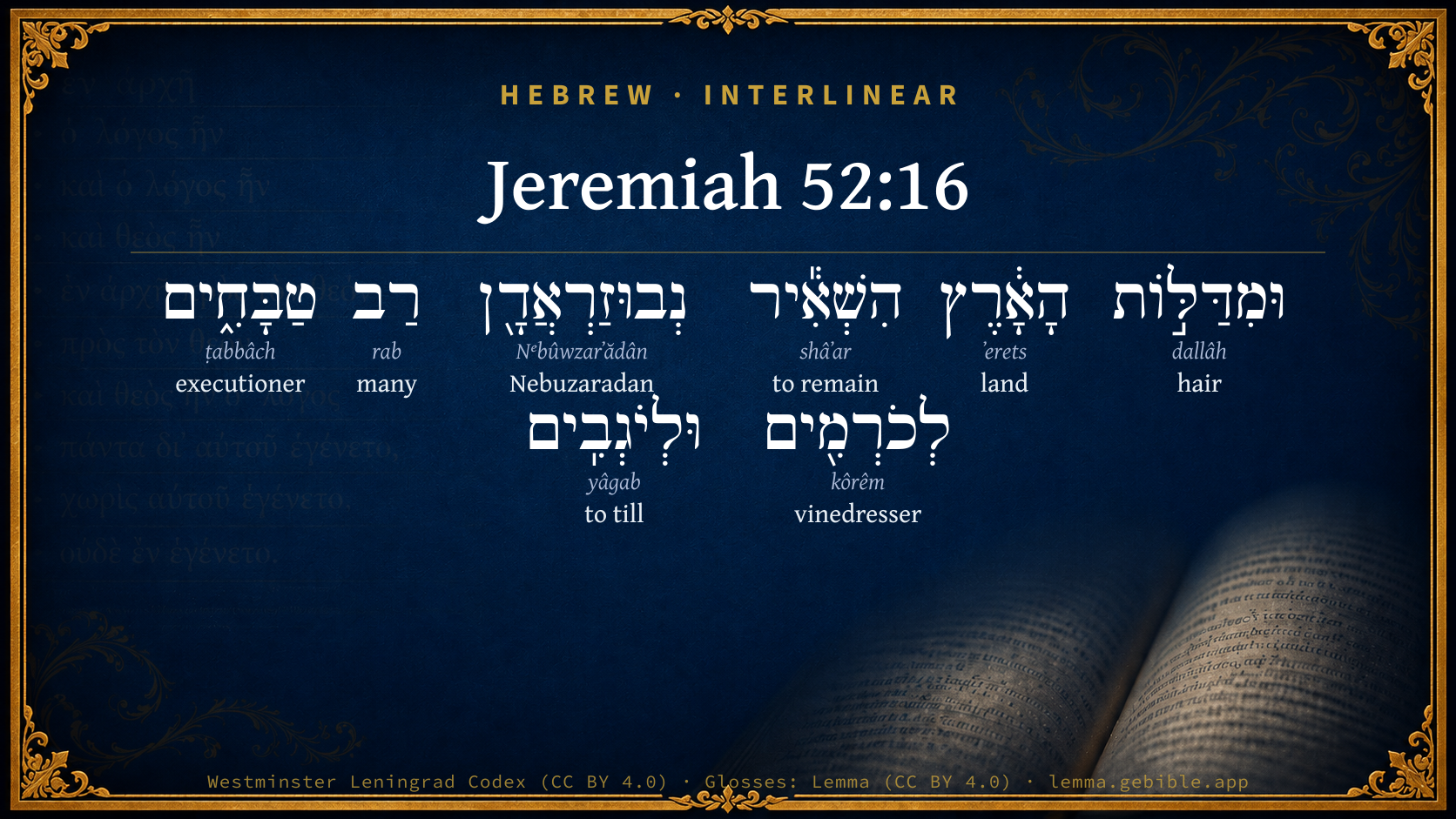
Jeremiah 52:16

Hebrew (Westminster Leningrad Codex) Jeremiah 52:16 appears in the Hebrew Old Testament. The text above is from the Westminster Leningrad Codex. Each word links to its Strong’s number, a concise gloss, and parsing drawn from the Open Scriptures Hebrew Bible morphology. Click any word for its full Brown-Driver-Briggs (BDB) entry.
Download image
Cite this verse

Jeremiah 52:16 (World English Bible). Public Domain. Lemma interlinear Bible study tool, https://lemma.gebible.app/v/jeremiah/52/16.

Show BibTeX & RIS
BibTeX
RIS
English Translation
But Nebuzaradan the captain of the guard left of the poorest of the land to be vineyard keepers and farmers.
World English Bible · Public Domain
Highlights
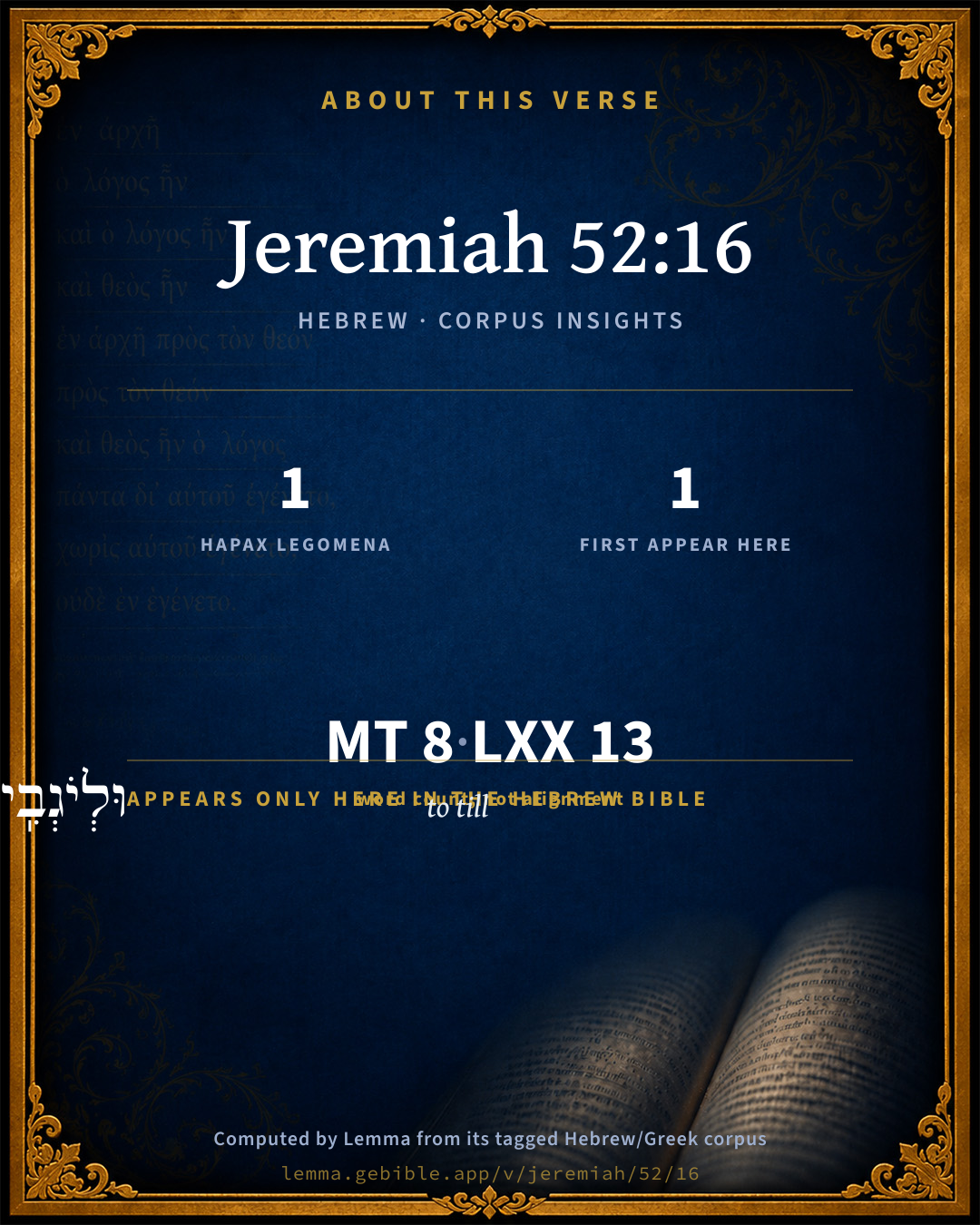
  • 1 hapax legomenon — only here in the Hebrew Bible
  • 1 first appearance in the Hebrew Bible
Full analysis ↓
Download a study sheet

One document with this verse’s original text, its word-by-word gloss line, the meaning frame, cross-references with their text, attributed commentary, and full source and license credits — printable, and it pastes into notes with its structure intact.

This verse Autodidact and up

Study sheet (.html) Plain text (.txt)

A passage Seminary Student

Up to 50 verses in one chapter. A passage sheet keeps up to 6 commentary sources and 12 cross-references per verse, in the order this page ranks them, and says so on the sheet whenever that leaves anything out. Ask for a single verse and you get the Autodidact verse sheet above.

Everything on this page stays free to read, with no account — the sheet is a download of what is already on screen, not access to it.

Want to remove ads? Support Godless Engineer
Compare translations 3

The same verse in 3 English versions, stacked beneath the original-language interlinear above. Click any original word for its lexicon entry.

Each is an independent rendering of the whole verse — the interlinear is not word-aligned to these translations.

Highlighted words mark where these versions differ — a whole-verse word diff, not a word-by-word alignment.

  • World English Bible Public Domain
    But Nebuzaradan the captain of the guard left of the poorest of the land to be vineyard keepers and farmers.
  • King James Version Public Domain
    But Nebuzaradan the captain of the guard left certain of the poor of the land for vinedressers and for husbandmen.
  • unfoldingWord Literal Text CC BY-SA 4.0
    But Nebuzaradan, the commander of the bodyguards, left some of the poorest of the land to work the vineyards and fields.

unfoldingWord Literal Text — © unfoldingWord, licensed CC BY-SA 4.0. Word-aligned USFM3 via Door43 (git.door43.org/unfoldingWord/en_ult).

Versions to compare (up to 4)

3 of 4 selected

Show all 18 translations

Every available English version of this verse, each an independent rendering of the whole verse.

  • World English Bible Public Domain
    But Nebuzaradan the captain of the guard left of the poorest of the land to be vineyard keepers and farmers.
  • Berean Standard Bible Public Domain
    But Nebuzaradan captain of the guard left behind some of the poorest of the land to tend the vineyards and fields.
  • Majority Standard Bible Public Domain
    But Nebuzaradan captain of the guard left behind some of the poorest of the land to tend the vineyards and fields.
  • King James Version Public Domain
    But Nebuzaradan the captain of the guard left certain of the poor of the land for vinedressers and for husbandmen.
  • American Standard Version (1901) Public Domain
    But Nebuzaradan the captain of the guard left of the poorest of the land to be vinedressers and husbandmen.
  • Revised Version (1885) Public Domain
    But Nebuzaradan the captain of the guard left of the poorest of the land to be vinedressers and husbandmen.
  • Geneva Bible (1599) Public Domain
    But Nebuzar-adan the chiefe steward left certaine of the poore of the lande, to dresse the vines, and to till the land.
  • Douay-Rheims (1899) Public Domain
    But of the poor of the land, Nabuzardan the general left some for vinedressers, and for husbandmen.
  • Young's Literal Translation Public Domain
    and of the poor of the land hath Nebuzar-Adan, chief of the executioners, left for vine-dressers and for husbandmen.
  • Literal Standard Version CC BY-SA 4.0
    and of the poor of the land, Nebuzar-Adan, chief of the executioners, has left for vinedressers and for farmers.
  • Unlocked Literal Bible CC BY-SA 4.0
    But Nebuzaradan, the commander of the bodyguards, left some of the poorest of the land to work the vineyards and fields.
  • unfoldingWord Literal Text CC BY-SA 4.0
    But Nebuzaradan, the commander of the bodyguards, left some of the poorest of the land to work the vineyards and fields.
  • Darby Bible Public Domain
    But Nebuzar-adan the captain of the body-guard left of the poor of the land for vinedressers and for husbandmen.
  • World Messianic Bible Public Domain
    But Nebuzaradan the captain of the guard left of the poorest of the land to be vineyard keepers and farmers.
  • Webster's Bible Public Domain
    But Nebuzar-adan the captain of the guard left certain of the poor of the land for vine-dressers and for husbandmen.
  • Free Bible Version CC BY-SA 4.0
    But Nebuzaradan allowed others of the poor people who were left in the country to stay and take care of the vineyards and the fields.
  • Bible in Basic English Public Domain
    But Nebuzaradan, the captain of the armed men, let the poorest of the land go on living there, to take care of the vines and the fields.
  • JPS Tanakh (1917) Public Domain
    But Nebuzaradan the captain of the guard left of the poorest of the land to be vinedressers and husbandmen.

Literal Standard Version (2020), Covenant Press — licensed CC BY-SA 4.0. Text via the HelloAO Bible API (eBible.org). Unlocked Literal Bible (unfoldingWord) — licensed CC BY-SA 4.0. Text via the HelloAO Bible API (eBible.org). unfoldingWord Literal Text — © unfoldingWord, licensed CC BY-SA 4.0. Word-aligned USFM3 via Door43 (git.door43.org/unfoldingWord/en_ult). Free Bible Version, Dr. Jonathan Gallagher — licensed CC BY-SA 4.0. Text via the HelloAO Bible API (eBible.org).

Word by word

More ways to search: Search by grammar → Find every occurrence → Compare this word →

Practice this passage: Drill this verse → Learn its vocabulary →

וּלְיֹגְבִֽים
yâgab
H3009
“and · to/for · tilling”
Conjunction + Preposition + Verb, Qal, Participle Active, Masculine, Plural, Absolute
Part of Speech
Conjunction + Preposition + Verb
Stem
Qal
Form
Participle Active
Gender
Masculine
Number
Plural
State
Absolute
Full BDB Definition

Origin: a primitive root

TWOT: 838

(Qal) to till, be a husbandman
  1. וּמִדַּלּ֣וֹת dallâh H1803 “and · from · poor of” Conjunction + Preposition + Noun, Common, Feminine, Plural, Construct
  2. הָאָ֔רֶץ ʼerets H776 “the · land” Particle, Definite Article + Noun, Common, Both, Singular, Absolute
  3. הִשְׁאִ֕יר shâʼar H7604 “to remain” Verb, Hiphil, Perfect, 3rd Person, Masculine, Singular
  4. נְבוּזַרְאֲדָ֖ן Nᵉbûwzarʼădân H5018 “Nebuzaradan” Noun, Proper
  5. רַב rab H7227 “many of” Noun, Common, Masculine, Singular, Construct
  6. טַבָּחִ֑ים ṭabbâch H2876 “executioners” Noun, Common, Masculine, Plural, Absolute
  7. לְכֹרְמִ֖ים kôrêm H3755 “to/for · vinedressers” Preposition + Noun, Common, Masculine, Plural, Absolute

About this verse

These counts appear in no published source. They are computed here, from the morphology-tagged text and Lemma’s own curated glosses. What Lemma adds →

8
words
8
distinct lemmas
Prophets
section

Notable vocabulary

1 hapax legomenon — a word that appears only here in the entire Hebrew Bible:

  • וּלְיֹגְבִֽים to till H3009

First appearance in Scripture

This word makes its first canonical appearance in the Hebrew Bible here:

  • וּלְיֹגְבִֽים to till H3009

Shared distinctive vocabulary

לְכֹרְמִ֖ים vinedresser H3755 occurs in 5 verses of the Hebrew Bible. Also found in:

Grammatical profile

  • 2 verbs
  • 6 nouns

Verb forms

  • הִשְׁאִ֕יר Hiphil · Perfect
  • וּלְיֹגְבִֽים Qal · Participle Active

Hebrew & Septuagint length

In the original languages it is 8 Hebrew tokens and 13 Greek tokens — but the two are counted differently (Hebrew bundles its prefixes and suffixes into one token; the Greek is in lemma form), so that isn’t a like-for-like length.

Cross-references

4

Topical passages linked to Jeremiah 52:16 in the Treasury of Scripture Knowledge — connected by theme and wording, ordered by reader-vote popularity; previews shown in the World English Bible.

  • 2 Kings 25:12 But the captain of the guard left of the poorest of the land to work the vineyards and fields.
  • Jeremiah 39:9–10 Then Nebuzaradan the captain of the guard carried away captive into Babylon the residue of the people who remained in the city, the deserters also who fell away to him, and the residue of the people who remained.
  • Jeremiah 40:5–7 Now while he was not yet gone back, Go back then, [said he], to Gedaliah the son of Ahikam, the son of Shaphan, whom the king of Babylon has made governor over the cities of Judah, and dwell with him among the people; or go wherever it seems right to you to go. So the captain of the guard gave him food and a present, and let him go.
  • Ezekiel 33:24 Son of man, they who inhabit those waste places in the land of Israel speak, saying, Abraham was one, and he inherited the land: but we are many; the land is given us for inheritance.

Cross-references courtesy of OpenBible.info (CC BY 4.0).

Hebrew and Greek witnesses Masoretic Hebrew ↔ Greek Septuagint

The same verse in the two great witnesses to the Old Testament, shown verse-for-verse.

These are two independent witnesses, not word-aligned to each other, and the Septuagint is shown in lemma (dictionary) form.

Hebrew Jeremiah 52:16 Masoretic · Westminster Leningrad Codex

וּמִדַּלּ֣וֹת הָאָ֔רֶץ הִשְׁאִ֕יר נְבוּזַרְאֲדָ֖ן רַב טַבָּחִ֑ים לְכֹרְמִ֖ים וּלְיֹגְבִֽים

But Nebuzaradan the captain of the guard left of the poorest of the land to be vineyard keepers and farmers.

World English Bible · Public Domain

Greek LXX Structure differs

In the Septuagint, Jeremiah is about an eighth shorter than the Hebrew and arranges its material differently — the Oracles Against the Nations (Hebrew chapters 46–51) appear in the middle of the Greek book, after 25:13. Because the chapter and verse boundaries do not line up, a verse-for-verse comparison with the Hebrew is not shown.

A verse-for-verse comparison isn’t shown here because the chapters and verses don’t line up. Switch to the LXX edition with the MT / LXX toggle above to read the Greek directly.

Hebrew: Westminster Leningrad Codex (CC BY 4.0). Greek: Septuagint (public domain); English from a public-domain English Septuagint. How the Septuagint differs from the Hebrew →

Targum (Aramaic paraphrase)

1

The Targum is the ancient Jewish Aramaic paraphrase of the Hebrew Scriptures — an interpretive translation, not the Hebrew text itself. Onkelos (literal) and Pseudo-Jonathan (expansive) render the Torah, and Jonathan the Prophets. Coverage is partial: where no permissively-licensed English translation exists for a verse, only the Aramaic is shown. This is verse-level text, not a word-by-word alignment to the Hebrew.

  1. Targum Jonathan Prophets (Joshua–Malachi)
    וּמֵחֲשִׁיכֵי עַמָא דְאַרְעָא אַשְׁאַר נְבוּזַרְאֲדָן רַב קָטוֹלַיָא לְמֶהֱוֵי מַפְלְחִין בְּחַקְלִין וּבְכַרְמִין:

    (no public-domain English translation for this verse)

    Targum Jonathan — Aramaic: “Mikraot Gedolot” (public domain). English: “Sefaria Community Translation” (CC0 1.0 (public-domain dedication)); “London "Chaldee Paraphrase," 1871” (public domain). Text via Sefaria.

Commentary

Notes on Jeremiah 52:16 from classic Christian and Jewish commentators (each source and its license shown beneath its notes). The classic Christian expositions comment on the surrounding passage and are grouped to its opening verse, so a note may address several verses; the Jewish commentaries on the Tanakh (Rashi and others) are per-verse, so they appear only where the commentator wrote on this verse.

Lemma curates 59 commentaries, every one of them public domain or Creative Commons licensed, each selected and text-cleaned for this edition rather than reprinted as found. About our sources →

Adam Clarke's Commentary

Verse 16. The poor of the land] See Clarke on Jer 39:10.

Adam Clarke's Commentary on the Bible (1810–1826) — public domain. Text from a community e-Sword/MySword module.

John Gill's Exposition

Also the pillars of brass that were in the house of the Lord,.... The two pillars in the temple, called Jachin and Boaz, which were made of cast brass, Kg1 7:15;

and the bases; which were in number ten, and which were also made of cast brass, and were all of one measure and size; and on which the ten lavers of brass were set, five on the right side and five on the left side of the house, Kg1 7:37;

and the brasen sea that was in the house of the Lord; called the molten sea; a sea, because of the large quantity of water it held; and brasen and molten, because made of molten brass, Kg1 7:23;

the Chaldeans broke, and carried all the brass of them to Babylon: they broke them to pieces, that they might carry them the more easily. This account is given, and which is continued in some following verses, partly to show the accomplishment of the prophecy of Jeremiah, Jer 27:19; and partly to show that what was left in the temple, at the former captivities of Jehoiakim and Jeconiah, were now carried clear off.

John Gill's Exposition of the Whole Bible (1746–1763) — public domain (CC PDM 1.0). Text via the HelloAO Bible API.

Albert Barnes' Notes on the Bible

Husbandmen - Men who tilled little plots of ground with the mattock.

Albert Barnes' Notes on the Bible (1834–1885) — public domain. Text from a community e-Sword/MySword module.

Matthew Poole's English Annotations

See Poole "2Ki 25:8", See Poole "2Ki 25:9", See Poole "2Ki 25:10", See Poole "2Ki 25:11", See Poole "2Ki 25:12" where all this is related, only with a small difference as to the day of the month when Nebuzar-adan came to Jerusalem and burned the temple. In the Kings it is said he came the seventh day, here it is said he came the tenth day. See the solution of it in the annotations on 2Ki 25. Probably he might come into Jerusalem the seventh day, and not burn the temple till the tenth. Much of it also is related by Jer 39. The provost-marshal, about a month after the taking of the city, returned with a part of the army, burned the temple, the great men’s houses in the city, and many other houses, and carried away divers prisoners, but left some of the poorer sort of the people to dress the vineyards and till the grounds, which is a thing very usual with conquerors, for their own advantage, that their conquests may yield them some revenue.

Matthew Poole's English Annotations on the Holy Bible (1683–1685) — public domain. Text from a community e-Sword/MySword module.

The Pulpit Commentary

Sparing the poor.

I THE FACT. Whilst the king, the nobles, the wealthy, and many others were carried into exile, certain of the poor were still left in the land. We are accustomed to speak of the hardships of poverty, but there are compensating advantages not a few. Many evils of the worst character only visit the rich. In times of public trouble the houses of the rich are attacked and the persons of the great are threatened, while the poor are left in happy neglect. Great men are beset with anxieties such as are unknown to the simpler lives of the poor. Who would be a king now that kings are all marks for the assassin? In those countries where the sovereign is compelled to take elaborate precautions for his safety, the poor citizen can move about the streets without fear. The one is a prisoner in his own palace, the other a free man with liberty to roam over the whole kingdom. Ambition aims at distinction, but that is a poor crown to win. Distinguished men have peculiar vexations and dangers of their own. There is more happiness in obscurity. The wise man will say, "Give me neither poverty nor riches;" and the Christian will add, "Not my will, but thine, be done," knowing well that for him that lot is best which his heavenly Father assigns to him.

II THE EXPLANATION. What was there in the condition of the poor to induce the Chaldeans to spare them?

1. Their innocence. The peasants had not been plotting against Nebuchadnezzar, and the vengeance that the Babylonian monarch vented on the king and the seat of his government was naturally averted from the quiet country folk. These men were also more innocent in the sight of God. The leading people had shown their faithlessness in turning from Jehovah to Egypt; they, too, had probably descended the lowest in the vices of the age, which brought upon the nation the wrath of God. Poor men may be bad men. But there are sins to which they are less liable than great men.

2. Their weakness. While the great men were removed to Babylon, there would appear to be little danger of an insurrection among the poor people scattered over the farms, who had enough to do to earn their daily bread. There is a protection in weakness. A little strength often courts danger. They who are weak in themselves may be strong in the protection of God"s providence.

3. Their usefulness. These poor people were left to work as "vine dressers and husbandmen." Nebuchadnezzar had no wish to see his newly acquired territory converted into a desert. It was for his advantage that some of the people should be spared. There is no protection like usefulness. Be serviceable and you will be safe. lie who lives for the real. good of his fellow men and the glory of his great Master may be sure that no harm can touch him so long as he is faithful to his task.

The Pulpit Commentary (1880–1919), ed. H.D.M. Spence-Jones & Joseph S. Exell — public domain. Text from a community e-Sword module.

Kretzmann's Popular Commentary

Paul E. Kretzmann

Disposition of the Spoil and of the Captives

v. 16. But Nebuzar-adan, the captain of the guard, left certain of the poor of the land, of those who had no possessions in money or goods, for vine-dressers and for husbandmen, so that the country would not revert to a wilderness on account of total neglect.

v. 17. Also the pillars of brass that were in the house of the Lord, on either aide of the main entrance of the Sanctuary, 1Ki 7:15, and the bases, and the brazen sea that was in the house of the Lord, the Chaldeans brake, in order to make all these pieces fit for transportation, and carried all the brass of them to Babylon.

v. 18. The caldrons also, large pots used for sacrificial worship, and the shovels, and the snuffers, and the bowls, and the spoons, vessels for incense, and all the vessels of brass wherewith they ministered, took they away, all those used for the altar of burnt offerings in the Court of the Priests.

v. 19. And the basins, and the fire-pans, and the bowls, and the caldrons, and the candlesticks, and the spoons, and the cups, all these used chiefly in the ministrations of the Holy Place; that which was of gold in gold, and that which was of silver in silver, in either case of solid metal, not of some cheap alloy or merely plated, took the captain of the guard away.

v. 20. The two pillars, one sea, and twelve brazen bulls that were under the bases, 1Ki 7:23-26, which King Solomon had made in the house of the Lord. The brass of all these vessels was without weight, its mass beyond calculation.

v. 21. And concerning the pillars, the height of one pillar was eighteen cubits, and a fillet of twelve cubits did compass it, that, in round numbers, being the circumference of either of the pillars; and the thickness thereof was four fingers; it was hollow. The thirty-five cubits of 2Ch 3:15 either refer to a different cubit, or they give the sum total of both pillars less the bases.

v. 22. And a ter, or capital, of brass was upon it, and the height of one ter, that is, of its upper part, where it curved away from the shaft, was five cubits, with network and pomegranates upon the ters round about, all of brass, in the nature of ornaments in chains or festoons. The second pillar also and the pomegranates were like unto these.

v. 23. And there were ninety and six pomegranates on a side, set towards the four winds or sides; and all the pomegranates upon the network were an hundred round about, including those on the corners of the capitals.

v. 24. And the captain of the guard took Seraiah, the chief priest, not identical with the man named Jer 51:59, and Zephaniah, the second priest, a very important member of the hierarchy, and the three keepers of the door, officers of the Temple-guard.

v. 25. He took also out of the city an eunuch, which had the charge of the men of war, the commander of the city forces, and seven men of them that were near the king’s person, of the king’s intimate counselors, which were found in the city; and the principal scribe of the host, an officer in the direct service of the commander-in-chief, who mustered the people of the land, enrolling them for military service; and threescore men of the people of the land that were found in the midst of the city, either leaders in the rebellion or such as had distinguished themselves in the defense of the city.

v. 26. So Nebuzar-adan, the captain of the guard, took them and brought them to the king of Babylon to Riblah.

v. 27. And the king of Babylon smote them, for the part they had taken in the rebellion of Judah, and put them to death in Riblah, in the land of Hamath, the Syrian province in the extreme northern part of Palestine. Thus Judah was carried away captive out of his own land. There follows a summary or enumeration of the prominent captives.

v. 28. This is the people whom Nebuchadnezzar carried away captive: in the seventh year, at the first captivity under Jehoiachin, three thousand Jews and three and twenty, these being of the tribe of Judah only, those from other tribes being more than twice as many;

v. 29. in the eighteenth year of Nebuchadnezzar, after his actual accession to the throne, but nineteen years after he had gotten into power, 2Ki 25:8, he carried away captive from Jerusalem eight hundred thirty and two persons;

v. 30. in the three and twentieth year of Nebuchadnezzar, Nebuzar-adan, the captain of the guard, carried away captive of the Jews seven hundred forty and five persons; all the persons evidently of the tribe of Judah alone, not including any of the other tribes who had sought and found refuge in Jerusalem since the fall of the northern kingdom, were four thousand and six hundred, not including the general multitude, and the women and children.

v. 31. And it came to pass in the seven-and-thirtieth year of the captivity of Jehoiachin, king of Judah, in the twelfth month, in the five and twentieth day of the month, the decree being issued on that day, although it was not carried out till two days later, 2Ki 25:27, that Evil-merodach, king of Babylon, son and successor of Nebuchadnezzar, in the first year of his reign, lifted up the head of Jehoiachin, king of Judah, and brought him forth out of prison, delivering him from the special bondage in which he had been held all these years,

v. 32. and spake kindly unto him and set his throne above the throne of the king’s that were with him in Babylon, captive monarchs of other conquered nations,

v. 33. and changed his prison-garments, witnesses of his deep humiliation; and he did continually eat bread before him all the days of his life.

v. 34. And for his diet there was a continual diet given him of the king of Babylon, every day a portion, until the day of his death, all the days of his life. Cf 2Ki 25:27-30. The same Lord who humbles the proud transgressors is able also to exalt those who turn to Him in true repentance.

Paul E. Kretzmann, Popular Commentary of the Bible (1921–1924) — public domain. Text from a community e-Sword module.

Lesson kit

Teaching starters — assembled from the data on this page, not authored interpretation. Every prompt links to the verse data it draws on. Edit before teaching.

Jeremiah, in the Prophets, opens this verse with 8 words (8 distinct Hebrew lemmas). Its most distinctive word is yâgab (“to till”). A historical commentator’s framing appears above. Read the whole chapter for the surrounding context.

Discussion questions

  1. What does “to till” (yâgab) contribute to the verse as a whole?
  2. 1 word here appears nowhere else in the Hebrew Bible. Why might the author reach for such rare wording?
  3. This is the first place “to till” appears in Scripture (first appears here). What does its debut here establish?
  4. How does 2 Kings 25:12, which shares the word «vinedresser», read alongside this verse?
  5. These translations render this verse differently; the difference is in the English rendering, not the original. What questions does that raise?
  6. «הִשְׁאִ֕יר» is a Hiphil Perfect verb. How does that grammatical form shape the action described?
  7. Compare how Adam Clarke's Commentary and John Gill's Exposition read this verse. Where do they agree or differ?

Things to notice

Reading settings

Reading text

Shown beneath each verse's original-language words.

Old Testament
Old Testament edition

Read the OT as the Masoretic Hebrew (MT) or the Greek Septuagint (LXX).

English shown for the Greek Septuagint (in the Hebrew ↔ Greek comparison).

Comparing translations? Open the Compare panel on any verse page to stack up to four side by side.