
Jeremiah 8:3

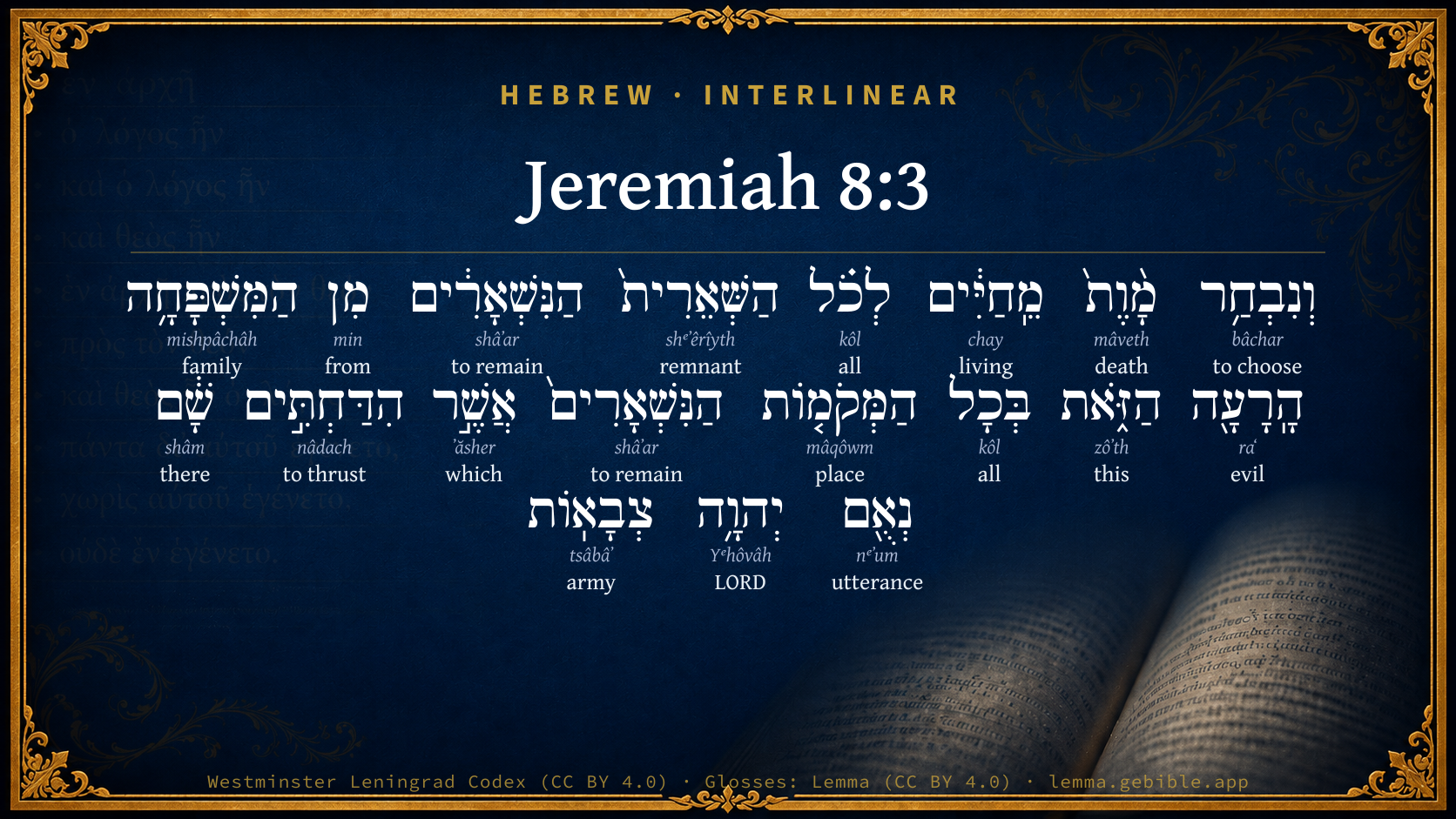
Hebrew (Westminster Leningrad Codex) Jeremiah 8:3 appears in the Hebrew Old Testament. The text above is from the Westminster Leningrad Codex. Each word links to its Strong’s number, a concise gloss, and parsing drawn from the Open Scriptures Hebrew Bible morphology. Click any word for its full Brown-Driver-Briggs (BDB) entry.
Download image
Cite this verse

Jeremiah 8:3 (World English Bible). Public Domain. Lemma interlinear Bible study tool, https://lemma.gebible.app/v/jeremiah/8/3.

Show BibTeX & RIS
BibTeX
RIS
English Translation
Death shall be chosen rather than life by all the residue that remain of this evil family, that remain in all the places where I have driven them, says Yahweh of Hosts.
World English Bible · Public Domain
Download a study sheet

One document with this verse’s original text, its word-by-word gloss line, the meaning frame, cross-references with their text, attributed commentary, and full source and license credits — printable, and it pastes into notes with its structure intact.

This verse Autodidact and up

Study sheet (.html) Plain text (.txt)

A passage Seminary Student

Up to 50 verses in one chapter. A passage sheet keeps up to 6 commentary sources and 12 cross-references per verse, in the order this page ranks them, and says so on the sheet whenever that leaves anything out. Ask for a single verse and you get the Autodidact verse sheet above.

Everything on this page stays free to read, with no account — the sheet is a download of what is already on screen, not access to it.

Want to remove ads? Support Godless Engineer
Compare translations 3

The same verse in 3 English versions, stacked beneath the original-language interlinear above. Click any original word for its lexicon entry.

Each is an independent rendering of the whole verse — the interlinear is not word-aligned to these translations.

Highlighted words mark where these versions differ — a whole-verse word diff, not a word-by-word alignment.

  • World English Bible Public Domain
    Death shall be chosen rather than life by all the residue that remain of this evil family, that remain in all the places where I have driven them, says Yahweh of Hosts.
  • King James Version Public Domain
    And death shall be chosen rather than life by all the residue of them that remain of this evil family, which remain in all the places whither I have driven them, saith the LORD of hosts.
  • unfoldingWord Literal Text CC BY-SA 4.0
    And they will choose death from life for all of the remnant who are remaining from this evil family, in all of the places of those who remaining, where I drove them—the declaration of Yahweh of hosts.

unfoldingWord Literal Text — © unfoldingWord, licensed CC BY-SA 4.0. Word-aligned USFM3 via Door43 (git.door43.org/unfoldingWord/en_ult).

Versions to compare (up to 4)

3 of 4 selected

Show all 18 translations

Every available English version of this verse, each an independent rendering of the whole verse.

  • World English Bible Public Domain
    Death shall be chosen rather than life by all the residue that remain of this evil family, that remain in all the places where I have driven them, says Yahweh of Hosts.
  • Berean Standard Bible Public Domain
    And wherever I have banished them, the remnant of this evil family will choose death over life,” declares the LORD of Hosts.
  • Majority Standard Bible Public Domain
    And wherever I have banished them, the remnant of this evil family will choose death over life,” declares the LORD of Hosts.
  • King James Version Public Domain
    And death shall be chosen rather than life by all the residue of them that remain of this evil family, which remain in all the places whither I have driven them, saith the LORD of hosts.
  • American Standard Version (1901) Public Domain
    And death shall be chosen rather than life by all the residue that remain of this evil family, that remain in all the places whither I have driven them, saith Jehovah of hosts.
  • Revised Version (1885) Public Domain
    And death shall be chosen rather than life by all the residue that remain of this evil family, which remain in all the places whither I have driven them, saith the LORD of hosts.
  • Geneva Bible (1599) Public Domain
    And death shall bee desired rather then life of all the residue that remaineth of this wicked familie, which remaine in all the places where I haue scattered them, sayeth the Lord of hostes.
  • Douay-Rheims (1899) Public Domain
    And death shall be chosen rather than life by all that shall remain of this wicked kindred in all places, which are left, to which I have cast them out, saith the Lord of hosts.
  • Young's Literal Translation Public Domain
    And chosen is death rather than life By all the remnant who are left of this evil family, In all the remaining places, whither I have driven them, An affirmation of Jehovah of Hosts.
  • Literal Standard Version CC BY-SA 4.0
    And death is chosen rather than life || By all the remnant who are left of this evil family, || In all the remaining places, to where I have driven them,” || A declaration of YHWH of Hosts.
  • Unlocked Literal Bible CC BY-SA 4.0
    In every remaining place where I have driven them, they will choose death instead of life for themselves, all who are still left over from this evil nation—this is the declaration of Yahweh of hosts.
  • unfoldingWord Literal Text CC BY-SA 4.0
    And they will choose death from life for all of the remnant who are remaining from this evil family, in all of the places of those who remaining, where I drove them—the declaration of Yahweh of hosts.
  • Darby Bible Public Domain
    And death shall be chosen rather than life by all the residue that remain of this evil family, in all the places whither I have driven those that remain, saith Jehovah of hosts.
  • World Messianic Bible Public Domain
    Death will be chosen rather than life by all the residue that remain of this evil family, that remain in all the places where I have driven them,” says the LORD of Hosts.
  • Webster's Bible Public Domain
    And death shall be chosen rather than life by all the residue of them that remain of this evil family, who remain in all the places whither I have driven them, saith the LORD of hosts.
  • Free Bible Version CC BY-SA 4.0
    Those who are left of this evil family will prefer to die rather than live in every place I've scattered them, declares the Lord Almighty.
  • Bible in Basic English Public Domain
    And death will be desired more than life by the rest of this evil family who are still living in all the places where I have sent them away, says the Lord of armies.
  • JPS Tanakh (1917) Public Domain
    And death shall be chosen rather than life by all the residue that remain of this evil family, that remain in all the places whither I have driven them, saith the LORD of hosts.

Literal Standard Version (2020), Covenant Press — licensed CC BY-SA 4.0. Text via the HelloAO Bible API (eBible.org). Unlocked Literal Bible (unfoldingWord) — licensed CC BY-SA 4.0. Text via the HelloAO Bible API (eBible.org). unfoldingWord Literal Text — © unfoldingWord, licensed CC BY-SA 4.0. Word-aligned USFM3 via Door43 (git.door43.org/unfoldingWord/en_ult). Free Bible Version, Dr. Jonathan Gallagher — licensed CC BY-SA 4.0. Text via the HelloAO Bible API (eBible.org).

Word by word

More ways to search: Search by grammar → Find every occurrence → Compare this word →

Practice this passage: Drill this verse → Learn its vocabulary →

הִדַּחְתִּ֣ים
nâdach
H5080
“to thrust · them”
Verb, Hiphil, Perfect, 1st Person, Common, Singular + Suffix, Personal, 3rd Person, Masculine, Plural
Part of Speech
Verb
Stem
Hiphil
Form
Perfect
Person
1st Person
Gender
Common
Number
Singular
Full BDB Definition

Origin: a primitive root

TWOT: 1304

to impel, thrust, drive away, banish - (Qal) - to impel - to thrust away, banish - (Niphal) - to be impelled - to be thrust out, be banished - banished, outcast (participle) - to be driven away - to be thrust away, thrust aside - (Pual) to be thrust into - thrust (participle) - (Hiphil) - to thrust, move, impel - to thrust out, banish - to thrust away, thrust aside - (Hophal) to be chased, be hunted - chased, hunted (participle)
  1. וְנִבְחַ֥ר bâchar H977 “and · to choose” Conjunction + Verb, Niphal, Sequential Perfect, 3rd Person, Masculine, Singular
  2. מָ֨וֶת֙ mâveth H4194 “death” Noun, Common, Masculine, Singular, Absolute
  3. מֵֽחַיִּ֔ים chay H2416 “from · living things” Preposition + Noun, Common, Masculine, Plural, Absolute
  4. לְכֹ֗ל kôl H3605 “to/for · all of” Preposition + Noun, Common, Masculine, Singular, Construct
  5. הַשְּׁאֵרִית֙ shᵉʼêrîyth H7611 “the · remnant” Particle, Definite Article + Noun, Common, Feminine, Singular, Absolute
  6. הַנִּשְׁאָרִ֔ים shâʼar H7604 “the · remaining” Particle, Definite Article + Verb, Niphal, Participle Active, Masculine, Plural, Absolute
  7. מִן min H4480 “from” Preposition
  8. הַמִּשְׁפָּחָ֥ה mishpâchâh H4940 “the · family” Particle, Definite Article + Noun, Common, Feminine, Singular, Absolute
  9. הָֽרָעָ֖ה raʻ H7451 “the · evil” Particle, Definite Article + Adjective, Adjective, Feminine, Singular, Absolute
  10. הַזֹּ֑את zôʼth H2063 “the · this” Particle, Definite Article + Pronoun, Demonstrative, Feminine, Singular
  11. בְּכָל kôl H3605 “in/at · all of” Preposition + Noun, Common, Masculine, Singular, Construct
  12. הַמְּקֹמ֤וֹת mâqôwm H4725 “the · places” Particle, Definite Article + Noun, Common, Masculine, Plural, Absolute
  13. הַנִּשְׁאָרִים֙ shâʼar H7604 “the · remaining” Particle, Definite Article + Verb, Niphal, Participle Active, Masculine, Plural, Absolute
  14. אֲשֶׁ֣ר ʼăsher H834 “which” Particle, Relative
  15. שָׁ֔ם shâm H8033 “there” Adverb
  16. נְאֻ֖ם nᵉʼum H5002 “utterance of” Noun, Common, Masculine, Singular, Construct
  17. יְהוָ֥ה Yᵉhôvâh H3068 “LORD” Noun, Proper
  18. צְבָאֽוֹת tsâbâʼ H6635 “armies” Noun, Common, Both, Plural, Absolute

About this verse

These counts appear in no published source. They are computed here, from the morphology-tagged text and Lemma’s own curated glosses. What Lemma adds →

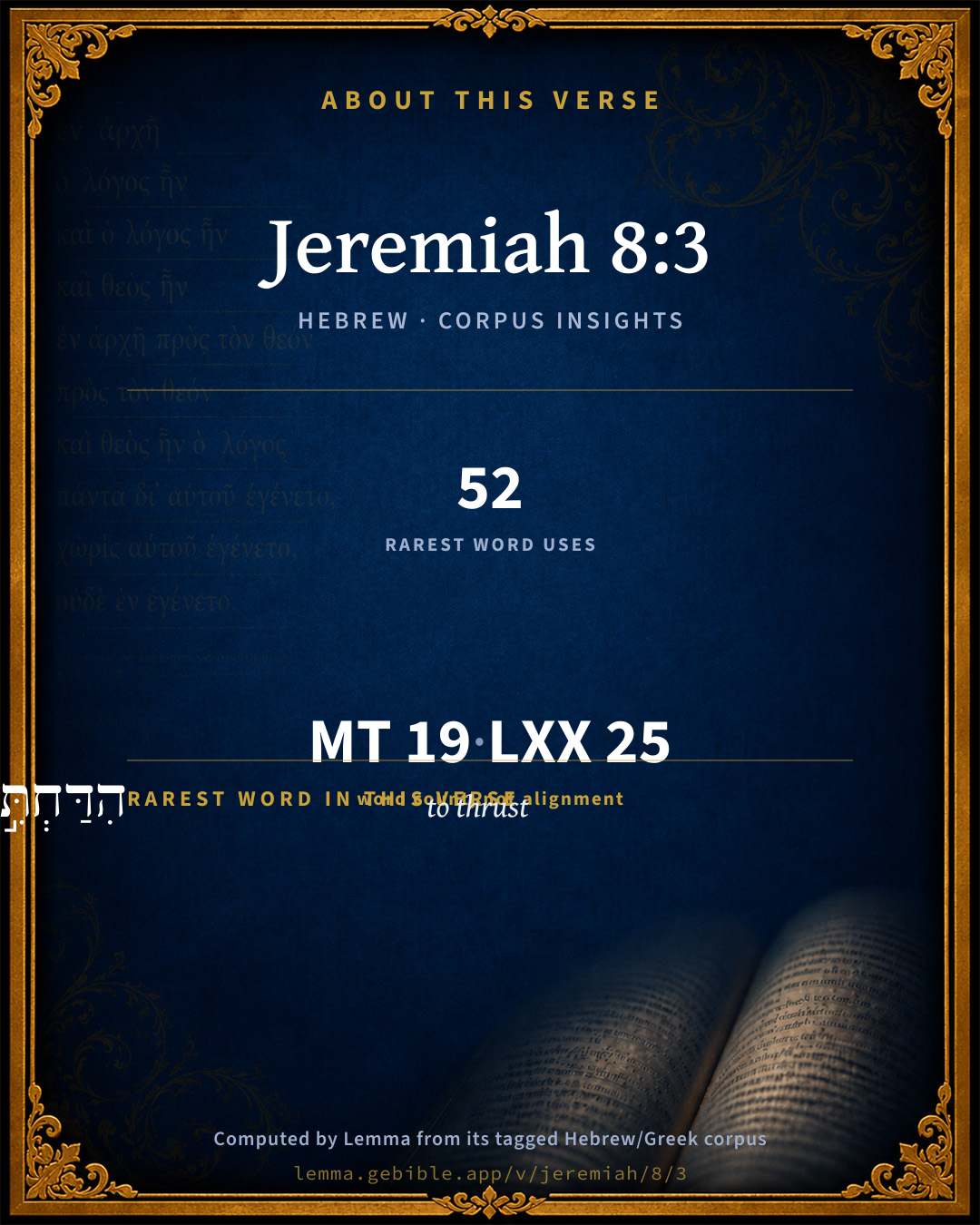
19
words
17
distinct lemmas
Prophets
section

Shared distinctive vocabulary

הִדַּחְתִּ֣ים to thrust H5080 occurs in 51 verses of the Hebrew Bible. Also found in:

Grammatical profile

  • 4 verbs
  • 10 nouns
  • 1 adjective
  • 1 pronoun
  • 1 preposition
  • 1 adverb
  • 1 particle

Verb forms

  • וְנִבְחַ֥ר Niphal · Sequential Perfect
  • הַנִּשְׁאָרִ֔ים Niphal · Participle Active
  • הַנִּשְׁאָרִים֙ Niphal · Participle Active
  • הִדַּחְתִּ֣ים Hiphil · Perfect

Repetition

Words recur within this verse — often emphatic in Hebrew:

  • לְכֹ֗ל all H3605 ×2
  • הַנִּשְׁאָרִ֔ים to remain H7604 ×2

Hebrew & Septuagint length

In the original languages it is 19 Hebrew tokens and 25 Greek tokens — but the two are counted differently (Hebrew bundles its prefixes and suffixes into one token; the Greek is in lemma form), so that isn’t a like-for-like length.

Cross-references

16

Topical passages linked to Jeremiah 8:3 in the Treasury of Scripture Knowledge — connected by theme and wording, ordered by reader-vote popularity; previews shown in the World English Bible.

  • Revelation 9:6 In those days people will seek death, and will in no way find it. They will desire to die, and death will flee from them.
  • Jeremiah 29:14 I will be found by you, says Yahweh, and I will turn again your captivity, and I will gather you from all the nations, and from all the places where I have driven you, says Yahweh; and I will bring you again to the place from where I caused you to be carried away captive.
  • Jeremiah 23:3 I will gather the remnant of my flock out of all the countries where I have driven them, and will bring them again to their folds; and they shall be fruitful and multiply.
  • Jeremiah 23:8 but, As Yahweh lives, who brought up and who led the seed of the house of Israel out of the north country, and from all the countries where I had driven them. They shall dwell in their own land.
  • Deuteronomy 30:4 If [any of] your outcasts are in the uttermost parts of the heavens, from there will Yahweh your God gather you, and from there will he bring you back:
  • Job 7:15–16 So that my soul chooses strangling, Death rather than my bones.
  • Deuteronomy 30:1 It shall happen, when all these things are come on you, the blessing and the curse, which I have set before you, and you shall call them to mind among all the nations, where Yahweh your God has driven you,
  • Daniel 9:7 Lord, righteousness belongs to you, but to us confusion of face, as at this day; to the men of Judah, and to the inhabitants of Jerusalem, and to all Israel, who are near, and who are far off, through all the countries where you have driven them, because of their trespass that they have trespassed against you.
  • Jonah 4:3 Therefore now, Yahweh, take, I beg you, my life from me; for it is better for me to die than to live."
  • 1 Kings 19:4 But he himself went a day's journey into the wilderness, and came and sat down under a juniper tree: and he requested for himself that he might die, and said, It is enough; now, O Yahweh, take away my life; for I am not better than my fathers.
  • Job 3:20–22 "Why is light given to him who is in misery, Life to the bitter in soul,
  • Jeremiah 20:14–18 Cursed be the day in which I was born: don't let the day in which my mother bore me be blessed.
  • Jeremiah 29:28 because he has sent to us in Babylon, saying, [The captivity] is long: build you houses, and dwell in them; and plant gardens, and eat the fruit of them?
  • Jeremiah 32:36–37 Now therefore thus says Yahweh, the God of Israel, concerning this city, about which you say, It is given into the hand of the king of Babylon by the sword, and by the famine, and by the pestilence:
  • Jeremiah 40:12 then all the Jews returned out of all places where they were driven, and came to the land of Judah, to Gedaliah, to Mizpah, and gathered wine and summer fruits very much.
  • Revelation 6:16 They told the mountains and the rocks, "Fall on us, and hide us from the face of him who sits on the throne, and from the wrath of the Lamb,

Cross-references courtesy of OpenBible.info (CC BY 4.0).

Hebrew and Greek witnesses Masoretic Hebrew ↔ Greek Septuagint

The same verse in the two great witnesses to the Old Testament, shown verse-for-verse.

These are two independent witnesses, not word-aligned to each other, and the Septuagint is shown in lemma (dictionary) form.

Hebrew Jeremiah 8:3 Masoretic · Westminster Leningrad Codex

וְנִבְחַ֥ר מָ֨וֶת֙ מֵֽחַיִּ֔ים לְכֹ֗ל הַשְּׁאֵרִית֙ הַנִּשְׁאָרִ֔ים מִן הַמִּשְׁפָּחָ֥ה הָֽרָעָ֖ה הַזֹּ֑את בְּכָל הַמְּקֹמ֤וֹת הַנִּשְׁאָרִים֙ אֲשֶׁ֣ר הִדַּחְתִּ֣ים שָׁ֔ם נְאֻ֖ם יְהוָ֥ה צְבָאֽוֹת

Death shall be chosen rather than life by all the residue that remain of this evil family, that remain in all the places where I have driven them, says Yahweh of Hosts.

World English Bible · Public Domain

Greek LXX Structure differs

In the Septuagint, Jeremiah is about an eighth shorter than the Hebrew and arranges its material differently — the Oracles Against the Nations (Hebrew chapters 46–51) appear in the middle of the Greek book, after 25:13. Because the chapter and verse boundaries do not line up, a verse-for-verse comparison with the Hebrew is not shown.

A verse-for-verse comparison isn’t shown here because the chapters and verses don’t line up. Switch to the LXX edition with the MT / LXX toggle above to read the Greek directly.

On this verse, John Gill's Exposition discusses the Septuagint’s reading. Read the note in Commentary ↓

Hebrew: Westminster Leningrad Codex (CC BY 4.0). Greek: Septuagint (public domain); English from a public-domain English Septuagint. How the Septuagint differs from the Hebrew →

Targum (Aramaic paraphrase)

1

The Targum is the ancient Jewish Aramaic paraphrase of the Hebrew Scriptures — an interpretive translation, not the Hebrew text itself. Onkelos (literal) and Pseudo-Jonathan (expansive) render the Torah, and Jonathan the Prophets. Coverage is partial: where no permissively-licensed English translation exists for a verse, only the Aramaic is shown. This is verse-level text, not a word-by-word alignment to the Hebrew.

  1. Targum Jonathan Prophets (Joshua–Malachi)
    וְיִתְרְעוּן בְּמוֹתָא מִדִבְחַיָא לְכָל שְׁאָרָא דְיִשְׁתָּאֲרוּן מִן זַרְעִיתָא בִישְׁתָּא הָדָא בְּכָל אַתְרַיָא דְיִשְׁתָּאֲרוּן דְאַגְלֵיתִינוּן לְתַמָן אֲמַר יְיָ צְבָאוֹת:

    (no public-domain English translation for this verse)

    Targum Jonathan — Aramaic: “Mikraot Gedolot” (public domain). English: “Sefaria Community Translation” (CC0 1.0 (public-domain dedication)); “London "Chaldee Paraphrase," 1871” (public domain). Text via Sefaria.

Commentary

Notes on Jeremiah 8:3 from classic Christian and Jewish commentators (each source and its license shown beneath its notes). The classic Christian expositions comment on the surrounding passage and are grouped to its opening verse, so a note may address several verses; the Jewish commentaries on the Tanakh (Rashi and others) are per-verse, so they appear only where the commentator wrote on this verse.

Lemma curates 59 commentaries, every one of them public domain or Creative Commons licensed, each selected and text-cleaned for this edition rather than reprinted as found. About our sources →

Trapp's Complete Commentary

John Trapp

Jer 8:3 And death shall be chosen rather than life by all the residue of them that remain of this evil family, which remain in all the places whither I have driven them, saith the LORD of hosts.

Ver. 3. And death shall be chosen rather than life.] Vae victis. Alas O survivers, they being captives, and sorely oppressed, shall sing that doleful ditty,

“ O terque quaterque beati

Queis ante ora patrum, Solymae sub moenibus altis

Contigit oppetere. ”

Oh how happy were they that perished during the siege, or in the surprisal of the city! Life indeed is sweet, as we say; and man is a life loving creature, said that heathen; but it may happen that life shall be a burden and a bitterness. How oft doth Job unwish it, and how fain would Elijah have been rid of it! So little cause is there that any good man should be either fond of life, or afraid of death.

John Trapp, A Commentary or Exposition upon All the Books of the Old and New Testament (1647–1656) — public domain. Text from a community e-Sword module.

Joseph Benson's Commentary

Jer 8:3. And death shall be chosen rather than life — Not through a lively and well-grounded hope of happiness in another life, but through an utter despair of any ease in this life. It denotes the extremity of misery, when men have no comfort left wherewith to alleviate their calamities, or render their lives tolerable. This appears by the next words to be spoken chiefly of the miseries which those should suffer who should survive the siege, and either flee or be carried captive into divers countries.

Joseph Benson's Commentary on the Old and New Testaments (1811–1818) — public domain. Text from a community e-Sword module.

Geneva Bible (1599)

Geneva Bible translators

Because of the afflictions that they shall feel through God’s judgments.

Geneva Bible (1599) marginal notes — public domain. Text via Bolls.life.

Jamieson, Fausset & Brown

Robert Jamieson, A. R. Fausset & David Brown

The survivors shall be still worse off than the dead (Job 3:21-22; Rev 9:6).

which remain in all the places--"in all places of them that remain, whither I . . . that is, in all places whither I have driven them that remain [MAURER].

Jamieson, Fausset & Brown — Commentary Critical and Explanatory on the Whole Bible (1871) — public domain (CC PDM 1.0). Text via the HelloAO Bible API.

John Calvin's Commentaries

He intimates in this verse, that all survivors would be doubly miserable, as it would be better for them to die at once than to pine away in unceasing evils: for they who give another meaning to the words, seem not to understand the design of the Prophet. The import then of the passage is, — that however dreadful God’s judgment would be, when slaughters everywhere prevailed, and dead bodies were drawn out which had been previously buried, yet all this would be a slight punishment in comparison with what God would inflict on the rest, such as remained alive: and he also intimates that their life would be more miserable than death itself, yea, than ten deaths.

That those then who would escape death might not think that they gained any advantage, the Prophet says, Chosen shall be death before life by all the residue We hence learn how grievous was to be God’s vengeance; for nothing would be better or more desirable than to undergo death at once, as life would be nothing else but a continued languor and torment. Expected then will be death in all places in which there shall be survivors, where I shall drive them He mentions a reason for this twofold misery, — they would not be allowed to live in their own country, but would become aliens, — and they would find in their exile God’s hand against them, and as it were following them everywhere.

John Calvin's Commentaries (1540-1563) — public domain. Text from the Calvin Translation Society English edition (1840s-50s) via the Christian Classics Ethereal Library (ccel.org). Calvin's coverage is partial (roughly two-thirds of the Bible); uncommented books and verses are honest gaps, never fabricated. The 19th-century editor's footnotes and remarks are omitted so the notes are faithfully Calvin's own voice.

Ellicott's Commentary for English Readers

(3) The residue of them that remain.—Once more the emphasis of re-iteration, “the remnant of a remnant.” The “evil family” is the whole house of Israel, but the words contemplate specially the exile of Judah and Benjamin, rather than that of the ten tribes.

A Bible Commentary for English Readers, edited by Charles John Ellicott (1878–1897) — public domain. Text from a community e-Sword module.

The Cambridge Bible for Schools and Colleges

gen. ed. J. J. S. Perowne

3. The thoughts correspond closely with Lev_26:36 ff.; Deu_28:65 ff.

family] See on Jer_3:14.

which remain] repeated in MT. by the error of a copyist.

The Cambridge Bible for Schools and Colleges (gen. ed. J. J. S. Perowne; Cambridge University Press, 1878–1918) — public domain. Text from a community e-Sword module.

John Gill's Exposition

And death shall be chosen rather than life,.... By them that should be alive in those times, who would be carried captive into other lands, and be used very hardly, and suffer greatly, by the nations among whom they should dwell; see Rev 9:6. The Septuagint version, and those that follow it, make this to be a reason of the former, reading the words thus, "because they have chosen death rather than life"; see Deu 30:19, but the other sense is best, which is confirmed by what follows:

by all the residue of them that remain of this evil family; the nation of the Jews, become very corrupt and degenerate; so the people of Israel are called the whole family of Israel, Amo 3:1, now it is foretold, that those which remained of that people, who died not by famine, or were not slain by the sword, yet should be in such a miserable condition, as that death would be more eligible to them than life:

even which remain in all the places whither I have driven them, saith the Lord of hosts: for, though they were carried captive by men, yet the thing was of the Lord, and a just punishment upon them for their sins.

John Gill's Exposition of the Whole Bible (1746–1763) — public domain (CC PDM 1.0). Text via the HelloAO Bible API.

Albert Barnes' Notes on the Bible

This evil family - The whole Jewish race.

Which remain - The words are omitted by the Septuagint and Syriac versions.

Albert Barnes' Notes on the Bible (1834–1885) — public domain. Text from a community e-Sword/MySword module.

Matthew Poole's English Annotations

And death shall be chosen rather than life; a description of the unexpressibleness of their misery, that notwithstanding all the barbarism of the Babylonians exercised both upon the bring and the dead, yet a small matter in comparison of what the living would feel, of the greatness of which misery there was a double cause; not only their being led into captivity, but God’s displeasure following them, even in their banishment, being sorely oppressed; one of those threatenings Lev 26:36,39; see Job 3:20,21; Rev 9:6. Which remain in all the places whither I have driven them; some dispersed among the mountains and hiding-places of Judea, others in the desert of Moab and Idumea, whither they fled for fear of the Chaldeans, and all other places where God would scatter them; an hypallage.

The Lord of hosts, he that hath all the creatures as an army at his command, can do this against those with whom he is displeased.

Matthew Poole's English Annotations on the Holy Bible (1683–1685) — public domain. Text from a community e-Sword/MySword module.

Whedon's Commentary on the Bible

Daniel D. Whedon

3. Death shall be chosen — The fate of the survivors is most pitiable of all, for they prefer death but do not find it.

Daniel D. Whedon (gen. ed.), Commentary on the Old and New Testaments (1874–1909) — public domain. Text from a community e-Sword module.

The Pulpit Commentary

Which remain. The words are certainly to be omitted in the second place where they occur. In the Hebrew they stand after in all the places, and the word for "places" is feminine, whereas the participle, "the remaining," is masculine. The Septuagint and Peshito have nothing corresponding. There is a clerical error in the Hebrew.

A pitiable condition: death preferable to life.

I REMEMBER MAN"S NATURAL DREAD OF DEATH. The very force of the prophet"s expression here lies in this, that it contradicts the habitual feelings of the human breast. The natural preference is to choose life rather than death; nay, it can hardly be called preference at all. There is an instinctive prompting to ward off everything that may be fatal. Whatever the drawbacks and pains of life may be, life is chosen rather than death. In most instances the suicide is held not responsible for the state of his mind at the time. We must all die indeed; yet death is so alien to every predominating feeling of the mind when in health and prosperous circumstances, that even when death comes near others, it is viewed as if it had little or nothing to do with us. And so when Jeremiah"s word came to these people in Jerusalem, they, at least the young and the strong among them, would receive it very incredulously. That things should ever become so bad as to make death desirable would seem to them to show that the threatener of such a doom was overdoing his warnings.

II LIFE MAY BECOME SO FULL OF PAIN AND MISERY THAT THIS NATURAL DREAD MAY BE REVERSED. When the blow was struck and Jerusalem fell into the hands of the hosts from Babylon, thousands would be thankful that, amid so much destruction, their lives were spared. To lose possessions and go into exile would seem a light price to pay for the preservation of life. But with the increased experience of exile itself its dreadfulness became manifest. How could it be otherwise? The captivity and exile were not of an ordinary nation, but of one whose God was Jehovah. These people had been in the enjoyment of peculiar privileges and satisfactions, which they had come to accept as a matter of course; and when they lost them, they would then discern, if never before, something of their true value. It was out of a land of promise, a laud reserved for the people of God, that they had been cast, and no lapse of time could content them to be as other nations. It is just because man has within him such capabilities for enjoying life that he can be driven to the other extreme of desiring death. Life could not be so blessed as Christ holds out the hope of its being, unless there were also the possibility of its being correspondingly wretched.

III It is thus suggested that we should aim at reaching a state of mind such that EITHER LIFE OR DEATH SHOULD BE EQUALLY ACCEPTABLE. To prefer life to death is a natural feeling, but certainly not the feeling which a believer in God and Jesus should have. And to prefer death to life is the feeling which comes after a time of struggling, weariness, pain, and disappointment; but what darkness of the mind does this not prove] what inability to profit by the light which shines in Christ! The Christian medium lies between the two extremes. Not to wish to live, nor to wish to die, but to be in Christ"s hands, so that as long as we are living there may be an availing of every opportunity of service, and when we die a fresh proof that faith in the Savior who also died, but rose again, is no deluding vanity. It is one of the glorious aspects of Christ"s salvation that he can save men from crying out for death rather than life, just because he can lift them into an experience of joy and peace which overbear the sense of temporal pain and loss. Y.

The Pulpit Commentary (1880–1919), ed. H.D.M. Spence-Jones & Joseph S. Exell — public domain. Text from a community e-Sword module.

Keil & Delitzsch

C. F. Keil & F. Delitzsch

Not less dreadful will be the fate of those who remain in life; so appalling that they will prefer death to life, since every kind of hardship in exile and imprisonment amongst the heathen is awaiting them: cf. Lev 26:36-39; Deu 28:65-67. המּקמות strikes us as peculiar, seeing that the latter word cannot be adjective to the former; for "in all the remaining places of Judah" (Umbr.) gives no suitable sense, and "in all remaining places outside of Judah" is contrary to usage. But הנּשׁארים may be taken as genitive, in spite of the article prefixed to the stat. constr. מקמות; and we may then translate, with Maur.: in all the places of those who remain whither I have driven them. The lxx have omitted the second word; and it is possible it may have found its way hither from the preceding line by an error of transcription. And so Hitz., Ew., and Graf have deleted it as a gloss; but the arguments adduced have little weight. The lxx have also omitted "and say to them," Jer 8:4, have changed כּה into כּי, and generally have treated Jeremiah in a quite uncritical fashion: so that they may have omitted the word from the present verse because it seemed awkward to them, and was not found in the parallel passages, Jer 29:14; Jer 23:3, which are not, however, precisely similar to the present verse.

Keil & Delitzsch — Biblical Commentary on the Old Testament (1861–1891) — public domain (CC PDM 1.0). Text via the HelloAO Bible API. (Old Testament only.)

Rashi

Rabbi Shlomo Yitzchaki (Rashi)

And death shall be preferable to life Although they see the dead being subjected to disgrace, the distress of the living is worse than that, and they will choose death.

Rashi on the Tanakh — English translations: “The Judaica Press complete Tanach with Rashi, translated by A. J. Rosenberg” (CC BY 4.0); “Pentateuch with Rashi's commentary by M. Rosenbaum and A.M. Silbermann, 1929-1934” (public domain); “The Metsudah Tanach series, Lakewood, N.J” (CC BY 4.0); and “The Book of Joshua, Metsudah Publications, 1997” (CC BY 4.0). Text via Sefaria.

Lesson kit

Teaching starters — assembled from the data on this page, not authored interpretation. Every prompt links to the verse data it draws on. Edit before teaching.

Jeremiah, in the Prophets, opens this verse with 19 words (17 distinct Hebrew lemmas). Its most distinctive word is nâdach (“to thrust”). A historical commentator’s framing appears above. Read the whole chapter for the surrounding context.

Discussion questions

  1. The word nâdach carries the sense “to thrust.” How does it shape the verse?
  2. Deuteronomy 4:19 shares the word «to thrust» with this verse. How do the two illuminate each other?
  3. “all” occurs 2× in this one verse. What is the effect of the repetition?
  4. The translations on this page render this verse differently — a whole-verse word diff, not a word-by-word alignment. What might account for the different wordings?
  5. The verb «וְנִבְחַ֥ר» is Niphal Sequential Perfect. How does its form color the action?
  6. Reading how Trapp's Complete Commentary and Joseph Benson's Commentary read this verse, where do the two commentators agree and where do they part?

Things to notice

Reading settings

Reading text

Shown beneath each verse's original-language words.

Old Testament
Old Testament edition

Read the OT as the Masoretic Hebrew (MT) or the Greek Septuagint (LXX).

English shown for the Greek Septuagint (in the Hebrew ↔ Greek comparison).

Comparing translations? Open the Compare panel on any verse page to stack up to four side by side.