
2 Kings 10:14

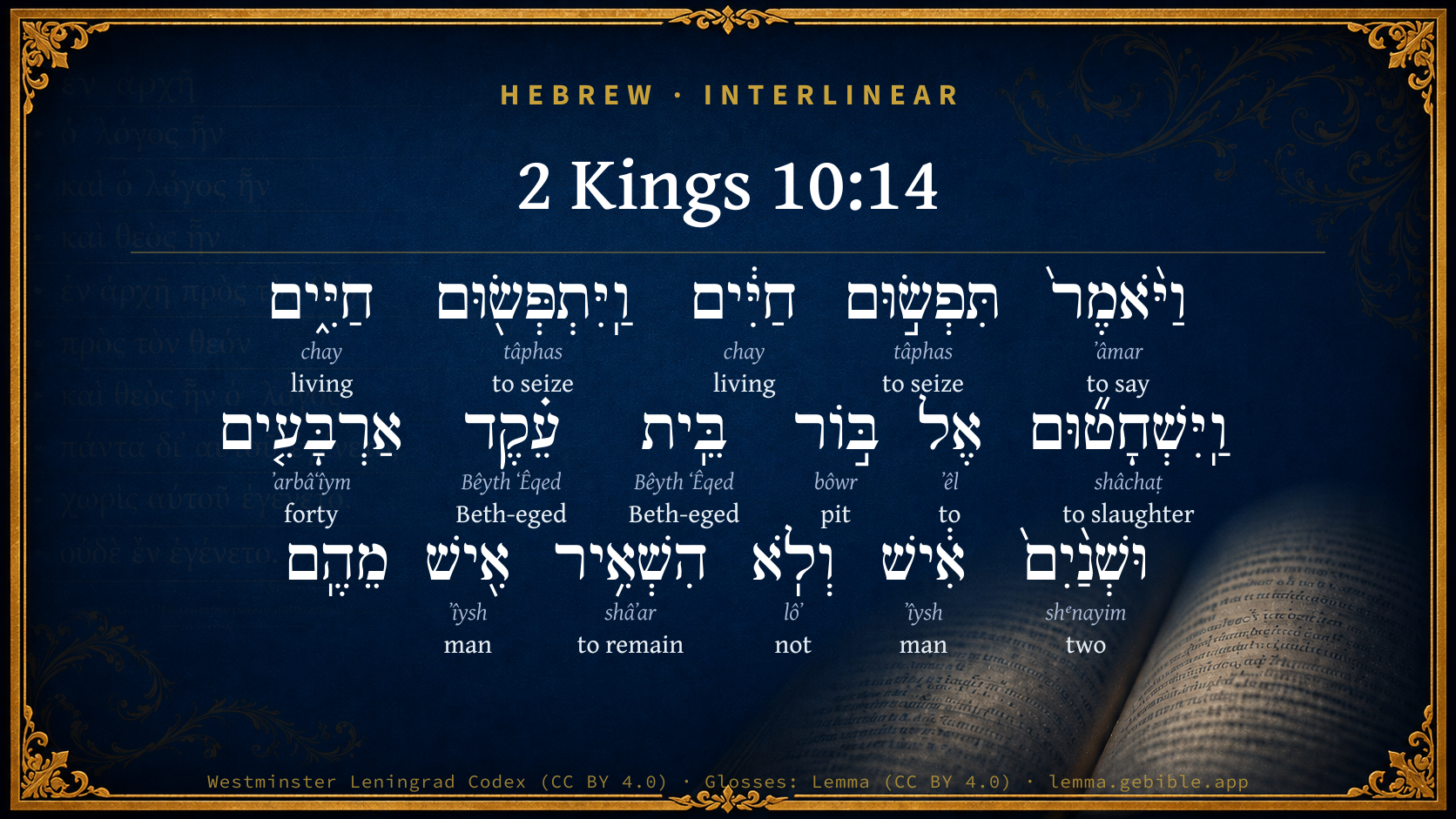
Hebrew (Westminster Leningrad Codex) 2 Kings 10:14 appears in the Hebrew Old Testament. The text above is from the Westminster Leningrad Codex. Each word links to its Strong’s number, a concise gloss, and parsing drawn from the Open Scriptures Hebrew Bible morphology. Click any word for its full Brown-Driver-Briggs (BDB) entry.
Download image
Cite this verse

2 Kings 10:14 (World English Bible). Public Domain. Lemma interlinear Bible study tool, https://lemma.gebible.app/v/2-kings/10/14.

Show BibTeX & RIS
BibTeX
RIS
English Translation
He said, Take them alive. They took them alive, and killed them at the pit of the shearing-house, even two and forty men; neither left he any of them.
World English Bible · Public Domain
Download a study sheet

One document with this verse’s original text, its word-by-word gloss line, the meaning frame, cross-references with their text, attributed commentary, and full source and license credits — printable, and it pastes into notes with its structure intact.

This verse Autodidact and up

Study sheet (.html) Plain text (.txt)

A passage Seminary Student

Up to 50 verses in one chapter. A passage sheet keeps up to 6 commentary sources and 12 cross-references per verse, in the order this page ranks them, and says so on the sheet whenever that leaves anything out. Ask for a single verse and you get the Autodidact verse sheet above.

Everything on this page stays free to read, with no account — the sheet is a download of what is already on screen, not access to it.

Want to remove ads? Support Godless Engineer
Compare translations 3

The same verse in 3 English versions, stacked beneath the original-language interlinear above. Click any original word for its lexicon entry.

Each is an independent rendering of the whole verse — the interlinear is not word-aligned to these translations.

Highlighted words mark where these versions differ — a whole-verse word diff, not a word-by-word alignment.

  • World English Bible Public Domain
    He said, Take them alive. They took them alive, and killed them at the pit of the shearing-house, even two and forty men; neither left he any of them.
  • King James Version Public Domain
    And he said, Take them alive. And they took them alive, and slew them at the pit of the shearing house, even two and forty men; neither left he any of them.
  • unfoldingWord Literal Text CC BY-SA 4.0
    And he said, “Seize them alive!” And they seized them alive, and they slaughtered them at the pit of Beth Eked, 42 men, and he did not leave a man from them.

unfoldingWord Literal Text — © unfoldingWord, licensed CC BY-SA 4.0. Word-aligned USFM3 via Door43 (git.door43.org/unfoldingWord/en_ult).

Versions to compare (up to 4)

3 of 4 selected

Show all 18 translations

Every available English version of this verse, each an independent rendering of the whole verse.

  • World English Bible Public Domain
    He said, Take them alive. They took them alive, and killed them at the pit of the shearing-house, even two and forty men; neither left he any of them.
  • Berean Standard Bible Public Domain
    Then Jehu ordered, “Take them alive.” So his men took them alive, then slaughtered them at the well of Beth-eked—forty-two men. He spared none of them.
  • Majority Standard Bible Public Domain
    Then Jehu ordered, “Take them alive.” So his men took them alive, then slaughtered them at the well of Beth-eked—forty-two men. He spared none of them.
  • King James Version Public Domain
    And he said, Take them alive. And they took them alive, and slew them at the pit of the shearing house, even two and forty men; neither left he any of them.
  • American Standard Version (1901) Public Domain
    And he said, Take them alive. And they took them alive, and slew them at the pit of the shearing-house, even two and forty men; neither left he any of them.
  • Revised Version (1885) Public Domain
    And he said, Take them alive. And they took them alive, and slew them at the pit of the shearing house, even two and forty men; neither left he any of them.
  • Geneva Bible (1599) Public Domain
    And he sayde, Take them aliue. And they tooke them aliue, and slew them at the well beside the house where the sheepe are shorne, euen two and fourtie men, and he left not one of them.
  • Douay-Rheims (1899) Public Domain
    And he said: Take them alive. And they took them alive, and killed them at the pit by the cabin, two and forty men, and he left not any of them.
  • Young's Literal Translation Public Domain
    And he saith, `Catch them alive;' and they catch them alive, and slaughter them at the pit of the shearing-house, forty and two men, and he hath not left a man of them.
  • Literal Standard Version CC BY-SA 4.0
    And he says, “Catch them alive”; and they catch them alive, and slaughter them at the pit of the shearing-house, forty-two men, and he has not left [even one] man of them.
  • Unlocked Literal Bible CC BY-SA 4.0
    Jehu said to his own men, “Take them alive.” So they took them alive and killed them at the well of Beth Eked, all forty-two men. He did not leave any of them alive.
  • unfoldingWord Literal Text CC BY-SA 4.0
    And he said, “Seize them alive!” And they seized them alive, and they slaughtered them at the pit of Beth Eked, 42 men, and he did not leave a man from them.
  • Darby Bible Public Domain
    And he said, Take them alive! And they took them alive, and slew them at the well of the meeting-place, forty-two men; and he left not one of them remaining.
  • World Messianic Bible Public Domain
    He said, “Take them alive!” They took them alive, and killed them at the pit of the shearing house, even forty-two men. He didn’t leave any of them.
  • Webster's Bible Public Domain
    And he said, Take them alive. And they took them alive, and slew them at the pit of the shearing-house, even two and forty men; neither left he any of them.
  • Free Bible Version CC BY-SA 4.0
    “Take them alive!” Jehu ordered. So they took them alive, then killed them at the well of Beth-eked. There were forty-two men. He didn't allow any of them to live.
  • Bible in Basic English Public Domain
    And he said, Take them living. So they took them living, and put them to death in the water-hole of Beth-eked; of the forty-two men he put every one to death;
  • JPS Tanakh (1917) Public Domain
    And he said: 'Take them alive.' And they took them alive, and slew them at the pit of the shearing-house, even two and forty men; neither left he any of them.

Literal Standard Version (2020), Covenant Press — licensed CC BY-SA 4.0. Text via the HelloAO Bible API (eBible.org). Unlocked Literal Bible (unfoldingWord) — licensed CC BY-SA 4.0. Text via the HelloAO Bible API (eBible.org). unfoldingWord Literal Text — © unfoldingWord, licensed CC BY-SA 4.0. Word-aligned USFM3 via Door43 (git.door43.org/unfoldingWord/en_ult). Free Bible Version, Dr. Jonathan Gallagher — licensed CC BY-SA 4.0. Text via the HelloAO Bible API (eBible.org).

Word by word

More ways to search: Search by grammar → Find every occurrence → Compare this word →

Practice this passage: Drill this verse → Learn its vocabulary →

בֵּֽית
Bêyth ʻÊqed
H1044
“Beth-eged”
Noun, Proper
Part of Speech
Noun
Type
Proper
Full BDB Definition

Origin: from H1004 and a derivative of H6123

TWOT: None

Beth-eged = "house of binding" i.e. " shearing house" - a place in the northern kingdom
  1. וַיֹּ֨אמֶר֙ ʼâmar H559 “and · to say” Conjunction + Verb, Qal, Sequential Imperfect, 3rd Person, Masculine, Singular
  2. תִּפְשׂ֣וּם tâphas H8610 “seize · them” Verb, Qal, Imperative, 2nd Person, Masculine, Plural + Suffix, Personal, 3rd Person, Masculine, Plural
  3. חַיִּ֔ים chay H2416 “living” Adjective, Adjective, Masculine, Plural, Absolute
  4. וַֽיִּתְפְּשׂ֖וּם tâphas H8610 “and · to seize · them” Conjunction + Verb, Qal, Sequential Imperfect, 3rd Person, Masculine, Plural + Suffix, Personal, 3rd Person, Masculine, Plural
  5. חַיִּ֑ים chay H2416 “living” Adjective, Adjective, Masculine, Plural, Absolute
  6. וַֽיִּשְׁחָט֞וּם shâchaṭ H7819 “and · to slaughter · them” Conjunction + Verb, Qal, Sequential Imperfect, 3rd Person, Masculine, Plural + Suffix, Personal, 3rd Person, Masculine, Plural
  7. אֶל ʼêl H413 “to” Preposition
  8. בּ֣וֹר bôwr H953 “pit of” Noun, Common, Masculine, Singular, Construct
  9. עֵ֗קֶד Bêyth ʻÊqed H1044 “Beth-eged” Noun, Proper
  10. אַרְבָּעִ֤ים ʼarbâʻîym H705 “forty” Adjective, Cardinal number, Both, Plural, Absolute
  11. וּשְׁנַ֨יִם֙ shᵉnayim H8147 “and · two” Conjunction + Adjective, Cardinal number, Masculine, Dual, Absolute
  12. אִ֔ישׁ ʼîysh H376 “man” Noun, Common, Masculine, Singular, Absolute
  13. וְלֹֽא lôʼ H3808 “and · not” Conjunction + Particle, Negative
  14. הִשְׁאִ֥יר shâʼar H7604 “to remain” Verb, Hiphil, Perfect, 3rd Person, Masculine, Singular
  15. אִ֖ישׁ ʼîysh H376 “man” Noun, Common, Masculine, Singular, Absolute

About this verse

These counts appear in no published source. They are computed here, from the morphology-tagged text and Lemma’s own curated glosses. What Lemma adds →

17
words
12
distinct lemmas
Historical
section

Notable vocabulary

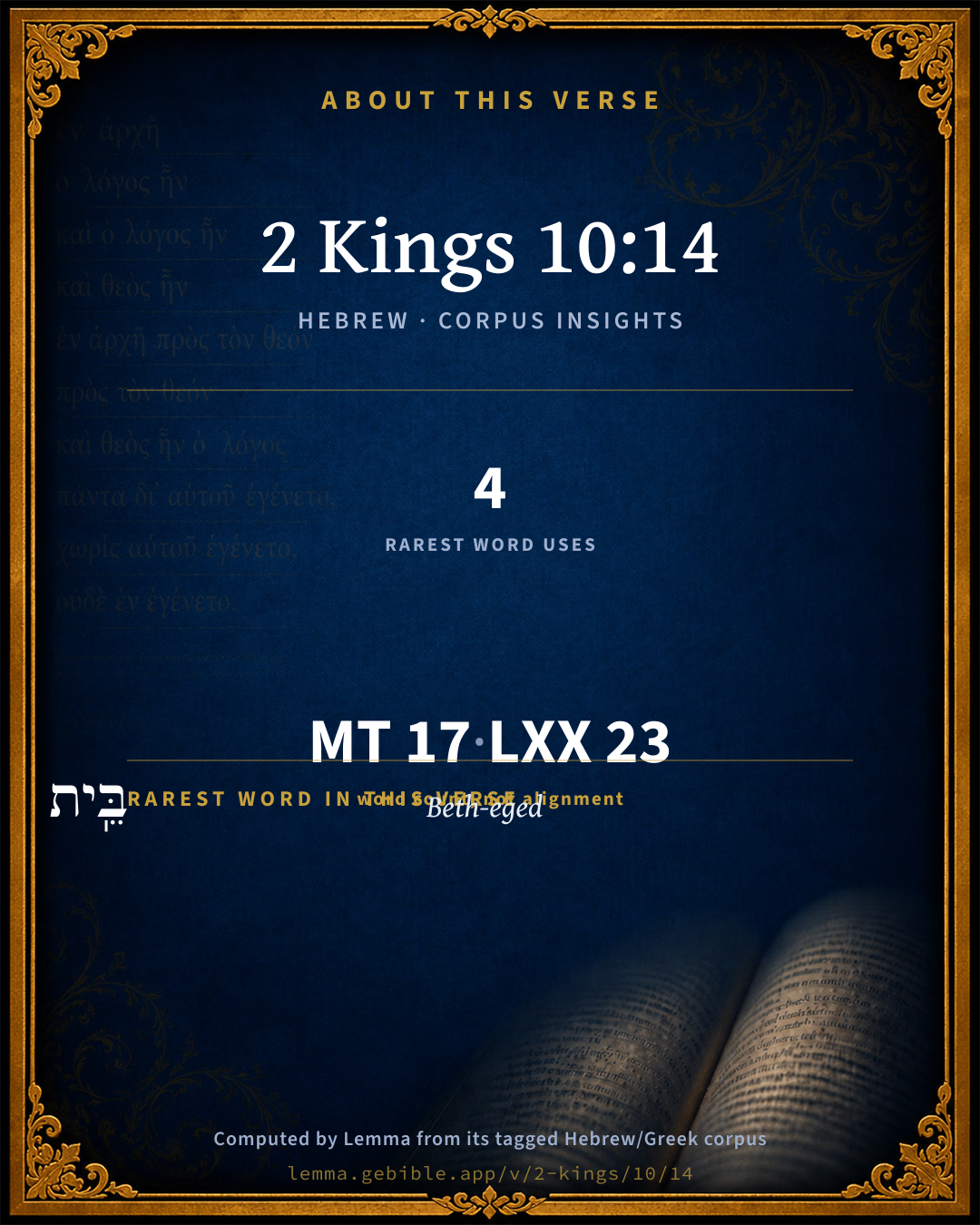
The rarest word here is בֵּֽית Beth-eged H1044 — appearing just 4 times in the whole Hebrew Bible.

Shared distinctive vocabulary

בֵּֽית Beth-eged H1044 occurs in 2 verses of the Hebrew Bible. Also found in:

Grammatical profile

  • 5 verbs
  • 5 nouns
  • 4 adjectives
  • 2 prepositions
  • 1 particle

Verb forms

  • וַיֹּ֨אמֶר֙ Qal · Sequential Imperfect
  • תִּפְשׂ֣וּם Qal · Imperative
  • וַֽיִּתְפְּשׂ֖וּם Qal · Sequential Imperfect
  • וַֽיִּשְׁחָט֞וּם Qal · Sequential Imperfect
  • הִשְׁאִ֥יר Hiphil · Perfect

Repetition

Words recur within this verse — often emphatic in Hebrew:

  • תִּפְשׂ֣וּם to seize H8610 ×2
  • חַיִּ֔ים living H2416 ×2
  • בֵּֽית Beth-eged H1044 ×2
  • אִ֔ישׁ man H376 ×2

Hebrew & Septuagint length

In English translation the verse runs 29 words from the Hebrew and 24 from the Septuagint (LXX English) — closely comparable.

A rough comparison of the two English renderings, which tokenize alike — not a word-level alignment.

Word counts can differ between the Hebrew and the Greek without any difference in meaning — e.g. the Hebrew direct-object marker אֵת has no separate Greek word, and Greek often adds the article ὁ.

In the original languages it is 17 Hebrew tokens and 23 Greek tokens — but the two are counted differently (Hebrew bundles its prefixes and suffixes into one token; the Greek is in lemma form), so that isn’t a like-for-like length.

Cross-references

7

Topical passages linked to 2 Kings 10:14 in the Treasury of Scripture Knowledge — connected by theme and wording, ordered by reader-vote popularity; previews shown in the World English Bible.

  • 1 Kings 20:18 He said, Whether they are come out for peace, take them alive, or whether they are come out for war, taken them alive.
  • 2 Kings 8:18 He walked in the way of the kings of Israel, as did the house of Ahab: for he had the daughter of Ahab as wife; and he did that which was evil in the sight of Yahweh.
  • 2 Kings 10:6 Then he wrote a letter the second time to them, saying, If you be on my side, and if you will listen to my voice, take the heads of the men your master's sons, and come to me to Jezreel by tomorrow this time. Now the king's sons, being seventy persons, were with the great men of the city, who brought them up.
  • 2 Kings 10:10–11 Know now that there shall fall to the earth nothing of the word of Yahweh, which Yahweh spoke concerning the house of Ahab: for Yahweh has done that which he spoke by his servant Elijah.
  • 2 Kings 11:1 Now when Athaliah the mother of Ahaziah saw that her son was dead, she arose and destroyed all the seed royal.
  • 2 Chronicles 22:8 It happened, when Jehu was executing judgment on the house of Ahab, that he found the princes of Judah, and the sons of the brothers of Ahaziah, ministering to Ahaziah, and killed them.
  • 2 Chronicles 22:10 Now when Athaliah the mother of Ahaziah saw that her son was dead, she arose and destroyed all the seed royal of the house of Judah.

Cross-references courtesy of OpenBible.info (CC BY 4.0).

Hebrew and Greek witnesses Masoretic Hebrew ↔ Greek Septuagint

The same verse in the two great witnesses to the Old Testament, shown verse-for-verse.

These are two independent witnesses, not word-aligned to each other, and the Septuagint is shown in lemma (dictionary) form.

Hebrew 2 Kings 10:14 Masoretic · Westminster Leningrad Codex

וַיֹּ֨אמֶר֙ תִּפְשׂ֣וּם חַיִּ֔ים וַֽיִּתְפְּשׂ֖וּם חַיִּ֑ים וַֽיִּשְׁחָט֞וּם אֶל בּ֣וֹר בֵּֽית עֵ֗קֶד אַרְבָּעִ֤ים וּשְׁנַ֨יִם֙ אִ֔ישׁ וְלֹֽא הִשְׁאִ֥יר אִ֖ישׁ מֵהֶֽם

He said, Take them alive. They took them alive, and killed them at the pit of the shearing-house, even two and forty men; neither left he any of them.

World English Bible · Public Domain

Greek LXX 2 Kings 10:14 Septuagint · lemma form

καί εἶπον συνλαμβάνω αὐτός ζάω καί συνλαμβάνω αὐτός ζάω καί σφάζω αὐτός εἰς βαιθακαδ τεσσαράκοντα καί δύο ἀνήρ οὐ καταλείπω ἀνήρ ἐκ αὐτός

And he said, Take them alive. And they killed them at the shearing-house, forty and two men: he left not a man of them.

LXX2012 (modern English Septuagint) · Public Domain

On this verse, The Cambridge Bible for Schools and Colleges discusses the Septuagint’s reading. Read the note in Commentary ↓

Hebrew: Westminster Leningrad Codex (CC BY 4.0). Greek: Septuagint (public domain); English from LXX2012 (modern English Septuagint) (Public Domain). How the Septuagint differs from the Hebrew →

Targum (Aramaic paraphrase)

1

The Targum is the ancient Jewish Aramaic paraphrase of the Hebrew Scriptures — an interpretive translation, not the Hebrew text itself. Onkelos (literal) and Pseudo-Jonathan (expansive) render the Torah, and Jonathan the Prophets. Coverage is partial: where no permissively-licensed English translation exists for a verse, only the Aramaic is shown. This is verse-level text, not a word-by-word alignment to the Hebrew.

  1. Targum Jonathan Prophets (Joshua–Malachi)
    וַאֲמַר אֲחוּדִינוּן כַּד חַיִין וְאַחְדוּנוּן כַּד חַיִין וּנְכוּסוּנוּן לְגוֹ בֵית כְּנִשְׁתָּא אַרְבְּעִין וּתְרֵין גַבְרָא וְלָא אִשְׁתָּאַר אֱנַשׁ מִנְהוֹן:

    (no public-domain English translation for this verse)

    Targum Jonathan — Aramaic: “Mikraot Gedolot” (public domain). English: “Sefaria Community Translation” (CC0 1.0 (public-domain dedication)); “London "Chaldee Paraphrase," 1871” (public domain). Text via Sefaria.

Commentary

Notes on 2 Kings 10:14 from classic Christian and Jewish commentators (each source and its license shown beneath its notes). The classic Christian expositions comment on the surrounding passage and are grouped to its opening verse, so a note may address several verses; the Jewish commentaries on the Tanakh (Rashi and others) are per-verse, so they appear only where the commentator wrote on this verse.

Lemma curates 59 commentaries, every one of them public domain or Creative Commons licensed, each selected and text-cleaned for this edition rather than reprinted as found. About our sources →

Trapp's Complete Commentary

John Trapp

2Ki 10:14 And he said, Take them alive. And they took them alive, and slew them at the pit of the shearing house, [even] two and forty men; neither left he any of them.

Ver. 14. And slew them at the pit.] Because they also were of the house of Ahab, {2Ch 22:8} and lest they should revenge the death of Ahaziah. See on 2Ki 10:6.

Neither left he any of them.] See on 2Ki 10:11.

John Trapp, A Commentary or Exposition upon All the Books of the Old and New Testament (1647–1656) — public domain. Text from a community e-Sword module.

Geneva Bible (1599)

Geneva Bible translators

Thus God’s vengeance is upon them that have any part or familiarity with the wicked.

Geneva Bible (1599) marginal notes — public domain. Text via Bolls.life.

Adam Clarke's Commentary

Verse 14. The pit of the shearing house] Probably the place where they washed the sheep previously to shearing, or the fleeces after they were shorn off.

Adam Clarke's Commentary on the Bible (1810–1826) — public domain. Text from a community e-Sword/MySword module.

Ellicott's Commentary for English Readers

(14) Take them alive.—Perhaps they made some show of resistance. Jehu slew them because of their connection with the doomed house of Ahab. Keil thinks he dreaded their conspiring with the partisans of the fallen dynasty in Samaria.

Slew them at the pit of the shearing house.—Literally, slaughtered them into the cistern of Betheked. Either they cut their throats over the cistern, or threw the corpses into it.

Two and forty.—Curiously parallel with 2Ki_2:24; and perhaps a definite for an indefinite number.

A Bible Commentary for English Readers, edited by Charles John Ellicott (1878–1897) — public domain. Text from a community e-Sword module.

The Cambridge Bible for Schools and Colleges

gen. ed. J. J. S. Perowne

14. Take them alive] i.e. Make them prisoners. Perhaps for a moment he was uncertain what he should do with them, however being of Ahab’s lineage they must share the fate of the rest of that house.

And they took them alive] The LXX. has nothing to represent these words. The ‘pit’ (R.V. margin, cistern) was the great pond or pool in which the sheep were washed before shearing.

The Cambridge Bible for Schools and Colleges (gen. ed. J. J. S. Perowne; Cambridge University Press, 1878–1918) — public domain. Text from a community e-Sword module.

John Gill's Exposition

And he said, take them alive,.... Gave orders to his guards to seize them, and make them captives:

and they took them alive, and slew them at the pit of the shearing house; where they washed the sheep when they sheered them:

even forty and two men, neither left he any of them; they being, by their grandmother's side, of the house of Ahab, and so within the commission of Jehu to slay them, at least as he thought; though his chief view might be, lest they should make any pretensions to the crown, being descended from that house, or should hereafter attempt to avenge the death of their relations; but by the judgment of God they were cut off as idolaters.

John Gill's Exposition of the Whole Bible (1746–1763) — public domain (CC PDM 1.0). Text via the HelloAO Bible API.

Haydock's Catholic Bible Commentary

Alive. That they might not attempt to defend themselves, (Menochius) as they might hope that Jehu would, at least, spare their lives. (Haydock) --- Of them, as they were in some degree related to Achab, (Menochius) or might endeavour to obstruct his dominion. (Tirinus)

George Leo Haydock (1774–1849), Haydock's Catholic Family Bible and Commentary, 1859 edition — public domain. Excludes Psalms (Douay-Rheims chapter numbering differs from Protestant) and Deuterocanonical books (Catholic canon only).

Matthew Poole's English Annotations

They took them alive, and slew them; partly in compliance with God’s command, 2Ki 9:8, for these were of the house of Ahab by the mother’s side, 2Ki 8:18; and partly that they might neither claim the kingdom of Israel in right of their grandmother; as they might well have done, if God had not given it to Jehu; nor revenge the deaths of their near relations.

At the pit of the shearing-house, where he intended to bury them.

Matthew Poole's English Annotations on the Holy Bible (1683–1685) — public domain. Text from a community e-Sword/MySword module.

Whedon's Commentary on the Bible

Daniel D. Whedon

14. Take them alive — So that none may escape, as might have been the case had they proceeded to slay them as they took them one by one.

At the pit of the shearing house — Rather, at the pit of Beth-eked. See note on 2Ki_10:12. This pit was some well-known cistern or well belonging to the town.

Daniel D. Whedon (gen. ed.), Commentary on the Old and New Testaments (1874–1909) — public domain. Text from a community e-Sword module.

The Pulpit Commentary

And he said, Take them alive. And they took them alive, and slew them. The Brevity of the narrative leaves many points of it obscure. It is impossible to say why the order was given, "Take them alive," when, immediately afterwards, they were massacred. Perhaps Jehu at first intended to spare their lives, but afterwards thought that it would be safer to have them put out of his way. It must be borne in mind that they were descendants of Ahab. At the pit of the shearing-house ; rather, at the well of Beth-Eked. Probably the bodies were thrown into the well. (Jer_41:7) Even two and forty men. It is this number which makes the idea of a visit of compliment incredible. Neither left he any of them. The Greeks said, Nhpiov o patera kteitav paidav kataleipei; and the general Hebrew practice was to give effect to the teaching conveyed by the maxim (see Jos_7:24, Jos_7:25; 2Ki_9:26 2Ki_14:6)

The Pulpit Commentary (1880–1919), ed. H.D.M. Spence-Jones & Joseph S. Exell — public domain. Text from a community e-Sword module.

Lesson kit

Teaching starters — assembled from the data on this page, not authored interpretation. Every prompt links to the verse data it draws on. Edit before teaching.

2 Kings, in the Historical, opens this verse with 17 words (12 distinct Hebrew lemmas). Its most distinctive word is Bêyth ʻÊqed (“Beth-eged”). A historical commentator’s framing appears above. Read the whole chapter for the surrounding context.

Discussion questions

  1. How does “Beth-eged” (Bêyth ʻÊqed) shape what this verse is saying?
  2. 2 Kings 10:12 shares the word «Beth-eged» with this verse. How do the two illuminate each other?
  3. “to seize” occurs 2× in this one verse. What is the effect of the repetition?
  4. The translations on this page render this verse differently — a whole-verse word diff, not a word-by-word alignment. What might account for the different wordings?
  5. The verb «וַיֹּ֨אמֶר֙» is Qal Sequential Imperfect. How does its form color the action?
  6. Reading how Trapp's Complete Commentary and Geneva Bible (1599) read this verse, where do the two commentators agree and where do they part?

Things to notice

Reading settings

Reading text

Shown beneath each verse's original-language words.

Old Testament
Old Testament edition

Read the OT as the Masoretic Hebrew (MT) or the Greek Septuagint (LXX).

English shown for the Greek Septuagint (in the Hebrew ↔ Greek comparison).

Comparing translations? Open the Compare panel on any verse page to stack up to four side by side.