

Isaiah 17:6

Hebrew (Westminster Leningrad Codex) Isaiah 17:6 appears in the Hebrew Old Testament. The text above is from the Westminster Leningrad Codex. Each word links to its Strong’s number, a concise gloss, and parsing drawn from the Open Scriptures Hebrew Bible morphology. Click any word for its full Brown-Driver-Briggs (BDB) entry.
Download image
Cite this verse

Isaiah 17:6 (World English Bible). Public Domain. Lemma interlinear Bible study tool, https://lemma.gebible.app/v/isaiah/17/6.

Show BibTeX & RIS
BibTeX
RIS
English Translation
Yet there shall be left therein gleanings, as the shaking of an olive tree, two or three berries in the top of the uppermost bough, four or five in the outmost branches of a fruitful tree, says Yahweh, the God of Israel.
World English Bible · Public Domain
Highlights
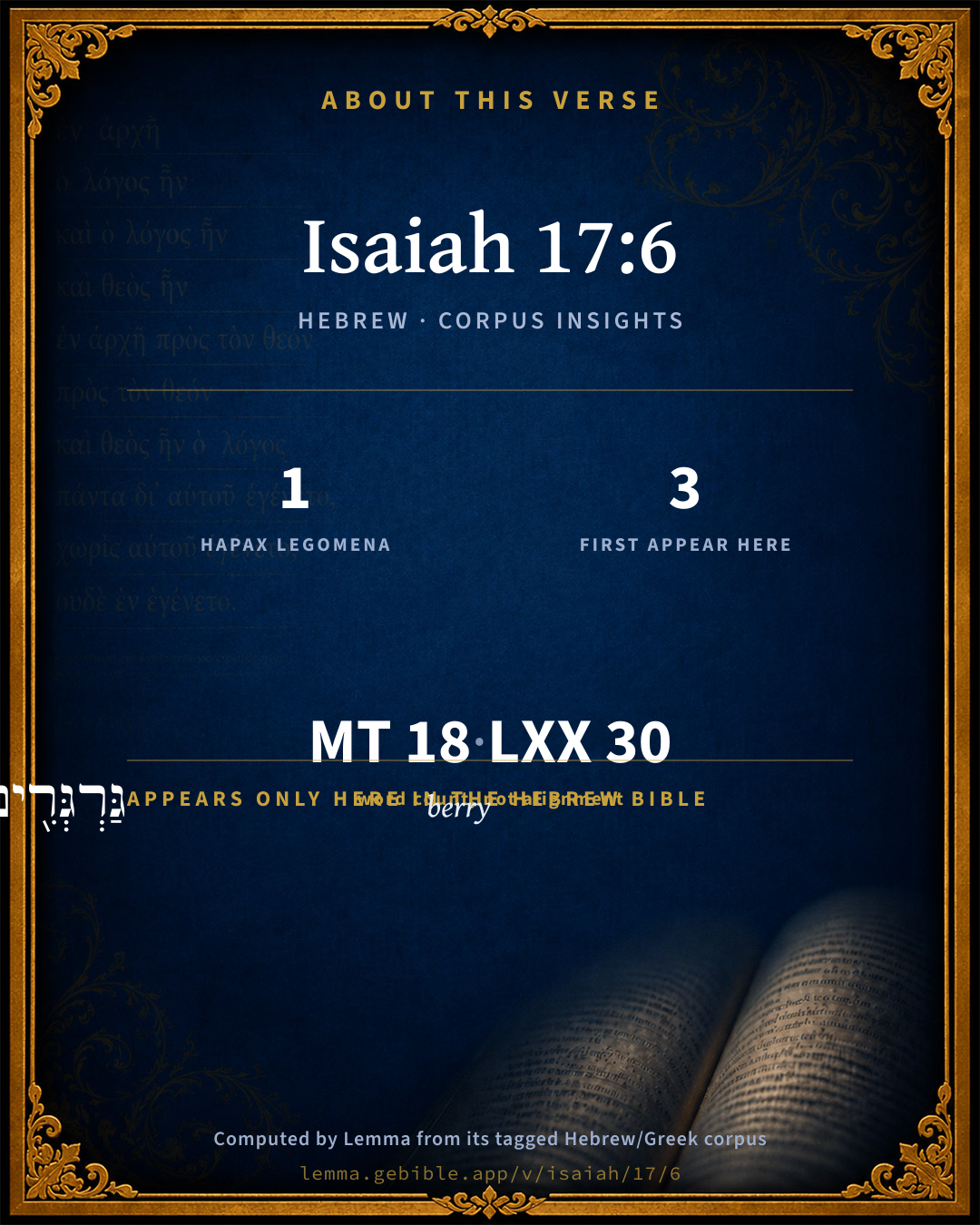
  • 1 hapax legomenon — only here in the Hebrew Bible
  • 3 first appearances in the Hebrew Bible
Full analysis ↓
Download a study sheet

One document with this verse’s original text, its word-by-word gloss line, the meaning frame, cross-references with their text, attributed commentary, and full source and license credits — printable, and it pastes into notes with its structure intact.

This verse Autodidact and up

Study sheet (.html) Plain text (.txt)

A passage Seminary Student

Up to 50 verses in one chapter. A passage sheet keeps up to 6 commentary sources and 12 cross-references per verse, in the order this page ranks them, and says so on the sheet whenever that leaves anything out. Ask for a single verse and you get the Autodidact verse sheet above.

Everything on this page stays free to read, with no account — the sheet is a download of what is already on screen, not access to it.

Want to remove ads? Support Godless Engineer
Compare translations 3

The same verse in 3 English versions, stacked beneath the original-language interlinear above. Click any original word for its lexicon entry.

Each is an independent rendering of the whole verse — the interlinear is not word-aligned to these translations.

Highlighted words mark where these versions differ — a whole-verse word diff, not a word-by-word alignment.

  • World English Bible Public Domain
    Yet there shall be left therein gleanings, as the shaking of an olive tree, two or three berries in the top of the uppermost bough, four or five in the outmost branches of a fruitful tree, says Yahweh, the God of Israel.
  • King James Version Public Domain
    Yet gleaning grapes shall be left in it, as the shaking of an olive tree, two or three berries in the top of the uppermost bough, four or five in the outmost fruitful branches thereof, saith the LORD God of Israel.
  • unfoldingWord Literal Text CC BY-SA 4.0
    And gleanings will be left in it, like the shaking of an olive tree: two, three berries on the head of the bough, four, five on its branches bearing fruit” —the declaration of Yahweh, the God of Israel.

unfoldingWord Literal Text — © unfoldingWord, licensed CC BY-SA 4.0. Word-aligned USFM3 via Door43 (git.door43.org/unfoldingWord/en_ult).

Versions to compare (up to 4)

3 of 4 selected

Show all 18 translations

Every available English version of this verse, each an independent rendering of the whole verse.

  • World English Bible Public Domain
    Yet there shall be left therein gleanings, as the shaking of an olive tree, two or three berries in the top of the uppermost bough, four or five in the outmost branches of a fruitful tree, says Yahweh, the God of Israel.
  • Berean Standard Bible Public Domain
    Yet gleanings will remain, like an olive tree that has been beaten—two or three berries atop the tree, four or five on its fruitful branches,” declares the LORD, the God of Israel.
  • Majority Standard Bible Public Domain
    Yet gleanings will remain, like an olive tree that has been beaten—two or three berries atop the tree, four or five on its fruitful branches,” declares the LORD, the God of Israel.
  • King James Version Public Domain
    Yet gleaning grapes shall be left in it, as the shaking of an olive tree, two or three berries in the top of the uppermost bough, four or five in the outmost fruitful branches thereof, saith the LORD God of Israel.
  • American Standard Version (1901) Public Domain
    Yet there shall be left therein gleanings, as the shaking of an olive-tree, two or three berries in the top of the uppermost bough, four or five in the outmost branches of a fruitful tree, saith Jehovah, the God of Israel.
  • Revised Version (1885) Public Domain
    Yet there shall be left therein gleanings, as the shaking of an olive tree, two or three berries in the top of the uppermost bough, four or five in the outmost branches of a fruitful tree, saith the LORD, the God of Israel.
  • Geneva Bible (1599) Public Domain
    Yet a gathering of grapes shall be left in it, as the shaking of an oliue tree, two or three beries are in the top of the vpmost boughes, and foure or fiue in the hie branches of the fruite thereof, sayeth the Lord God of Israel.
  • Douay-Rheims (1899) Public Domain
    And the fruit thereof that shall be left upon it, shall be as one cluster of grapes, and as the shaking of the olive tree, two or three berries in the top of a bough, or four or five upon the top of the tree, saith the Lord the God of Israel.
  • Young's Literal Translation Public Domain
    And left in him have been gleanings, As the compassing of an olive, Two -- three berries on the top of a branch, Four -- five on the fruitful boughs, The affirmation of Jehovah, God of Israel!
  • Literal Standard Version CC BY-SA 4.0
    And gleanings have been left in him, || As the surrounding of an olive, || Two—three berries on the top of a branch, || Four—five on the fruitful boughs, || A declaration of YHWH, God of Israel!
  • Unlocked Literal Bible CC BY-SA 4.0
    Gleanings will be left, however, as when the olive tree is shaken: two or three olives in the top of the uppermost bough, four or five in the highest branches of a fruitful tree—this is the declaration of Yahweh, the God of Israel.
  • unfoldingWord Literal Text CC BY-SA 4.0
    And gleanings will be left in it, like the shaking of an olive tree: two, three berries on the head of the bough, four, five on its branches bearing fruit” —the declaration of Yahweh, the God of Israel.
  • Darby Bible Public Domain
    And a gleaning shall be left in it, as at the shaking of an olive-tree: two, three berries above, in the tree-top; four, five in its fruitful boughs, saith Jehovah, the God of Israel.
  • World Messianic Bible Public Domain
    Yet gleanings will be left there, like the shaking of an olive tree, two or three olives in the top of the uppermost bough, four or five in the outermost branches of a fruitful tree,” says the LORD, the God of Israel.
  • Webster's Bible Public Domain
    Yet gleaning grapes shall be left in it, as the shaking of an olive-tree, two or three berries in the top of the uppermost bough, four or five in the outmost fruitful branches of it, saith the LORD God of Israel.
  • Free Bible Version CC BY-SA 4.0
    Yet there will be some left behind, like an olive tree that has been shaken—two or three ripe olives are left at the top of the tree, four or five on its lower branches, declares the Lord, the God of Israel.
  • Bible in Basic English Public Domain
    But it will be like a man shaking an olive-tree, something will still be there, two or three berries on the top of the highest branch, four or five on the outside branches of a fertile tree, says the Lord, the God of Israel.
  • JPS Tanakh (1917) Public Domain
    Yet there shall be left therein gleanings, as at the beating of an olive-tree, two or three berries in the top of the uppermost bough, four or five in the branches of the fruitful tree, saith the LORD, the God of Israel.

Literal Standard Version (2020), Covenant Press — licensed CC BY-SA 4.0. Text via the HelloAO Bible API (eBible.org). Unlocked Literal Bible (unfoldingWord) — licensed CC BY-SA 4.0. Text via the HelloAO Bible API (eBible.org). unfoldingWord Literal Text — © unfoldingWord, licensed CC BY-SA 4.0. Word-aligned USFM3 via Door43 (git.door43.org/unfoldingWord/en_ult). Free Bible Version, Dr. Jonathan Gallagher — licensed CC BY-SA 4.0. Text via the HelloAO Bible API (eBible.org).

Word by word

More ways to search: Search by grammar → Find every occurrence → Compare this word →

Practice this passage: Drill this verse → Learn its vocabulary →

גַּרְגְּרִ֖ים
gargar
H1620
“berries”
Noun, Common, Masculine, Plural, Absolute
Part of Speech
Noun
Type
Common
Gender
Masculine
Number
Plural
State
Absolute
Full BDB Definition

Origin: by reduplication from H1641

TWOT: 386c

berry, olive berry
  1. וְנִשְׁאַר shâʼar H7604 “and · to remain” Conjunction + Verb, Niphal, Sequential Perfect, 3rd Person, Masculine, Singular
  2. עֽוֹלֵלֹת֙ ʻôlêlâh H5955 “gleanings” Noun, Common, Feminine, Plural, Absolute
  3. כְּנֹ֣קֶף nôqeph H5363 “like/as · striking off of” Preposition + Noun, Common, Masculine, Singular, Construct
  4. זַ֔יִת zayith H2132 “olive” Noun, Common, Masculine, Singular, Absolute
  5. שְׁנַ֧יִם shᵉnayim H8147 “two” Adjective, Cardinal number, Masculine, Dual, Absolute
  6. שְׁלֹשָׁ֛ה shâlôwsh H7969 “three” Adjective, Cardinal number, Masculine, Singular, Absolute
  7. בְּרֹ֣אשׁ rôʼsh H7218 “in/at · head of” Preposition + Noun, Common, Masculine, Singular, Construct
  8. אָמִ֑יר ʼâmîyr H534 “summit” Noun, Common, Masculine, Singular, Absolute
  9. אַרְבָּעָ֣ה ʼarbaʻ H702 “four” Adjective, Cardinal number, Masculine, Singular, Absolute
  10. חֲמִשָּׁ֗ה châmêsh H2568 “five” Adjective, Cardinal number, Masculine, Singular, Absolute
  11. בִּסְעִפֶ֨יהָ֙ çâʻîyph H5585 “in/at · clefts · her” Preposition + Noun, Common, Masculine, Plural, Construct + Suffix, Personal, 3rd Person, Feminine, Singular
  12. פֹּֽרִיָּ֔ה pârâh H6509 “bearing fruit” Verb, Qal, Participle Active, Feminine, Singular, Absolute
  13. נְאֻם nᵉʼum H5002 “utterance of” Noun, Common, Masculine, Singular, Construct
  14. יְהוָ֖ה Yᵉhôvâh H3068 “LORD” Noun, Proper
  15. אֱלֹהֵ֥י ʼĕlôhîym H430 “God(s) of” Noun, Common, Masculine, Plural, Construct
  16. יִשְׂרָאֵֽל Yisrâʼêl H3478 “Israel” Noun, Proper

About this verse

These counts appear in no published source. They are computed here, from the morphology-tagged text and Lemma’s own curated glosses. What Lemma adds →

18
words
17
distinct lemmas
Prophets
section

Notable vocabulary

1 hapax legomenon — a word that appears only here in the entire Hebrew Bible:

  • גַּרְגְּרִ֖ים berry H1620

First appearance in Scripture

These words make their first canonical appearance in the Hebrew Bible here:

  • כְּנֹ֣קֶף striking off H5363
  • גַּרְגְּרִ֖ים berry H1620
  • אָמִ֑יר summit H534

Shared distinctive vocabulary

כְּנֹ֣קֶף striking off H5363 occurs in 2 verses of the Hebrew Bible. Also found in:

Grammatical profile

  • 2 verbs
  • 11 nouns
  • 4 adjectives
  • 1 preposition

Verb forms

  • וְנִשְׁאַר Niphal · Sequential Perfect
  • פֹּֽרִיָּ֔ה Qal · Participle Active

Hebrew & Septuagint length

In English translation the verse runs 42 words from the Hebrew and 46 from the Septuagint (LXX English) — closely comparable.

A rough comparison of the two English renderings, which tokenize alike — not a word-level alignment.

Word counts can differ between the Hebrew and the Greek without any difference in meaning — e.g. the Hebrew direct-object marker אֵת has no separate Greek word, and Greek often adds the article ὁ.

In the original languages it is 18 Hebrew tokens and 30 Greek tokens — but the two are counted differently (Hebrew bundles its prefixes and suffixes into one token; the Greek is in lemma form), so that isn’t a like-for-like length.

Cross-references

15

Topical passages linked to Isaiah 17:6 in the Treasury of Scripture Knowledge — connected by theme and wording, ordered by reader-vote popularity; previews shown in the World English Bible.

  • Isaiah 24:13 For thus shall it be in the midst of the earth among the peoples, as the shaking of an olive tree, as the gleanings when the vintage is done.
  • Deuteronomy 4:27 Yahweh will scatter you among the peoples, and you shall be left few in number among the nations, where Yahweh shall lead you away.
  • Judges 8:2 He said to them, What have I now done in comparison with you? Isn't the gleaning of the grapes of Ephraim better than the vintage of Abiezer?
  • Obadiah 1:5 If thieves came to you, if robbers by night-- oh, what disaster awaits you--wouldn't they only steal until they had enough? If grape pickers came to you, wouldn't they leave some gleaning grapes?
  • Romans 9:27 Isaiah cries concerning Israel, "If the number of the children of Israel are as the sand of the sea, It is the remnant who will be saved;
  • Romans 11:4–6 But how does God answer him? "I have reserved for myself seven thousand men, who have not bowed the knee to Baal."
  • 1 Kings 19:18 Yet will I leave [me] seven thousand in Israel, all the knees which have not bowed to Baal, and every mouth which has not kissed him.
  • Isaiah 1:9 Unless Yahweh of hosts had left to us a very small remnant, We would have been as Sodom; We would have been like Gomorrah.
  • Isaiah 10:22 For though your people, Israel, be as the sand of the sea, [only] a remnant of them shall return: a destruction [is] determined, overflowing with righteousness.
  • Isaiah 27:12 It shall happen in that day, that Yahweh will beat off [his fruit] from the flood of the River to the brook of Egypt; and you shall be gathered one by one, you children of Israel.
  • Ezekiel 36:8–15 But you, mountains of Israel, you shall shoot forth your branches, and yield your fruit to my people Israel; for they are at hand to come.
  • Ezekiel 37:19–25 tell them, Thus says the Lord Yahweh: Behold, I will take the stick of Joseph, which is in the hand of Ephraim, and the tribes of Israel his companions; and I will put them with it, [even] with the stick of Judah, and make them one stick, and they shall be one in my hand.
  • Ezekiel 39:29 neither will I hide my face any more from them; for I have poured out my Spirit on the house of Israel, says the Lord Yahweh.
  • Micah 7:1 Misery is mine! Indeed, I am like one who gathers the summer fruits, as gleanings of the vinyard: There is no cluster of grapes to eat. My soul desires to eat the early fig.
  • Romans 11:26 and so all Israel will be saved. Even as it is written, "There will come out of Zion the Deliverer, And he will turn away ungodliness from Jacob.

Cross-references courtesy of OpenBible.info (CC BY 4.0).

Hebrew and Greek witnesses Masoretic Hebrew ↔ Greek Septuagint

The same verse in the two great witnesses to the Old Testament, shown verse-for-verse.

These are two independent witnesses, not word-aligned to each other, and the Septuagint is shown in lemma (dictionary) form.

Hebrew Isaiah 17:6 Masoretic · Westminster Leningrad Codex

וְנִשְׁאַר בּ֤וֹ עֽוֹלֵלֹת֙ כְּנֹ֣קֶף זַ֔יִת שְׁנַ֧יִם שְׁלֹשָׁ֛ה גַּרְגְּרִ֖ים בְּרֹ֣אשׁ אָמִ֑יר אַרְבָּעָ֣ה חֲמִשָּׁ֗ה בִּסְעִפֶ֨יהָ֙ פֹּֽרִיָּ֔ה נְאֻם יְהוָ֖ה אֱלֹהֵ֥י יִשְׂרָאֵֽל

Yet there shall be left therein gleanings, as the shaking of an olive tree, two or three berries in the top of the uppermost bough, four or five in the outmost branches of a fruitful tree, says Yahweh, the God of Israel.

World English Bible · Public Domain

Greek LXX Isaiah 17:6 Septuagint · lemma form

καί καταλείπω ἐν αὐτός καλάμη ἤ ὡς ῥώξ ἐλαία δύο ἤ τρεῖς ἐπί ἄκρος μετέωρος ἤ τέσσαρες ἤ πέντε ἐπί ὁ κλάδος αὐτός καταλείπω ὅδε λέγω κύριος ὁ θεός ἰσραήλ

and as if there should be left stubble therein, or as it were the berries of an olive tree, two or three on the topmost bough, or as if four or five should be left on their branches; thus says the Lord, the God of Israel.

LXX2012 (modern English Septuagint) · Public Domain

Hebrew: Westminster Leningrad Codex (CC BY 4.0). Greek: Septuagint (public domain); English from LXX2012 (modern English Septuagint) (Public Domain). How the Septuagint differs from the Hebrew →

Targum (Aramaic paraphrase)

1

The Targum is the ancient Jewish Aramaic paraphrase of the Hebrew Scriptures — an interpretive translation, not the Hebrew text itself. Onkelos (literal) and Pseudo-Jonathan (expansive) render the Torah, and Jonathan the Prophets. Coverage is partial: where no permissively-licensed English translation exists for a verse, only the Aramaic is shown. This is verse-level text, not a word-by-word alignment to the Hebrew.

  1. Targum Jonathan Prophets (Joshua–Malachi)
    וְיִשְׁתַּאֲרוּן בֵּיהּ עוֹלְלִין כְּבִיעוּר זֵיתָא תְּרֵין תְּלָתָא גַרְגְרִין בְּרֵישׁ עַנְפָא אַרְבְּעָא חַמְשָׁא בְסוֹכָא מֵרְדָא כֵּן יִשְׁתַּאֲרוּן יְחִידָאִין צַדִיקַיָא בְּגוֹ עַלְמָא בְּנֵי מַלְכְּוָתָא אֲמַר יְיָ אֱלָהָא דְיִשְׂרָאֵל:

    Yet a gleaning shall be left in it, as in the shaking of the olive tree, two or three berries on the top of the uppermost branch; so shall the righteous be left lonely in the midst of the world, among the kingdoms, saith the Lord, the God of Israel.

    Targum Jonathan — Aramaic: “Mikraot Gedolot” (public domain). English: “Sefaria Community Translation” (CC0 1.0 (public-domain dedication)); “London "Chaldee Paraphrase," 1871” (public domain). Text via Sefaria.

Commentary

Notes on Isaiah 17:6 from classic Christian and Jewish commentators (each source and its license shown beneath its notes). The classic Christian expositions comment on the surrounding passage and are grouped to its opening verse, so a note may address several verses; the Jewish commentaries on the Tanakh (Rashi and others) are per-verse, so they appear only where the commentator wrote on this verse.

Lemma curates 59 commentaries, every one of them public domain or Creative Commons licensed, each selected and text-cleaned for this edition rather than reprinted as found. About our sources →

Matthew Henry's Commentary

Mercy is here reserved, in a parenthesis, in the midst of judgment, for a remnant that should escape the common ruin of the kingdom of the ten tribes. Though the Assyrians took all the care they could that none should slip out of their net, yet the meek of the earth were hidden in the day of the Lord's anger, and had their lives given them for a prey and made comfortable to them by their retirement to the land of Judah, where they had the liberty of God's courts. 1. They shall be but a small remnant, a very few, who shall be marked for preservation (Isa 17:6): Gleaning grapes shall be left in it. The body of the people were carried into captivity, but here and there one was left behind, perhaps one of two in a bed when the other was taken, Luk 17:34. The most desolating judgments in this world are short of the last judgment, which shall be universal and which none shall escape. In times of the greatest calamity some are kept safe, as in times of the greatest degeneracy some are kept pure. But the fewness of those that escape supposes the captivity of the far greatest part; those that are left are but like the poor remains of an olive tree when it has been carefully shaken by the owner; if there be two or three berries in the top of the uppermost bough (out of the reach of those that shook it), that is all. Such is the remnant according to the election of grace, very few in comparison with the multitudes that walk on in the broad way. 2. They shall be a sanctified remnant, Isa 17:7, Isa 17:8. These few that are preserved are such as, in the prospect of the judgment approaching, had repented of their sins and reformed their lives, and therefore were snatched thus as brands out of the burning, or such as having escaped, and becoming refugees in strange countries, were awakened, partly by a sense of the distinguishing mercy of their deliverance, and partly by the distresses they were still in, to return to God. (1.) They shall look up to their Creator, shall enquire, Where is God my Maker, who giveth songs in the night, in such a night of affliction as this? Job 35:10, Job 35:11. They shall acknowledge his hand in all the events concerning them, merciful and afflictive, and shall submit to his hand. They shall give him the glory due to his name, and be suitably affected with his providences. They shall expect relief and succour from him and depend upon him to help them. Their eyes shall have respect to him, as the eyes of a servant to the hand of his master, Psa 123:2. Observe, It is our duty at all times to have respect to God, to have our eyes ever towards him, both as our Maker (the author of our being and the God of nature) and as the Holy One of Israel, a God in covenant with us and the God of grace; particularly, when we are in affliction, our eyes must be towards the Lord, to pluck our feet out of the net (Psa 25:15); to bring us to this is the design of his providence as he is our Maker and the work of his grace as he is the Holy One of Israel. (2.) They shall look off from their idols, the creatures of their own fancy, shall no longer worship them, and seek to them, and expect relief from them. For God will be alone regarded, or he does not look upon himself as at all regarded. He that looks to his Maker must not look to the altars, the work of his hands, but disown them and cast them off, must not retain the least respect for that which his fingers have made, but break it to pieces, though it be his own workmanship - the groves and the images; the word signifies images made in honour of the sun and by which he was worshipped, the most ancient and most plausible idolatry, Deu 4:19; Job 31:26. We have reason to account those happy afflictions which part between us and our sins, and by sensible convictions of the vanity of the world, that great idol, cool our affections to it and lower our expectations from it.

Matthew Henry's Commentary on the Whole Bible (1708–1710) — public domain (CC PDM 1.0). Text via the HelloAO Bible API.

Trapp's Complete Commentary

John Trapp

Isa 17:6 Yet gleaning grapes shall be left in it, as the shaking of an olive tree, two [or] three berries in the top of the uppermost bough, four [or] five in the outmost fruitful branches thereof, saith the LORD God of Israel.

Ver. 6. Yet gleaning grapes, &c.] See on Isa 17:5.

John Trapp, A Commentary or Exposition upon All the Books of the Old and New Testament (1647–1656) — public domain. Text from a community e-Sword module.

The Biblical Illustrator

Joseph S. Exell

Isa_17:6

Yet gleaning grapes shall be left in it

Autumn: the diminutions of life

The prophet is here predicting a season of national calamity.

He represents the condition of the people under the figure of an autumnal scene. Armed hosts from the north have invaded the country like a sharp wind. The substance of its inhabitants has been carried away before their rapacity, as when the harvest man gathereth the corn, and reapeth the ears with his arm. With this difference, however, that it has been destroyed by the violence of strangers, instead of being garnered for the use of those who had tilled the soil; and the sickle is the sword. The population is thinned, like the trees in the waning part of the year. Only that the wrath of man, unlike the severity of nature, has no benevolent purpose in it. The comforts and blessings of life are shaken down as faded leaves. Only it is without any sign from experience, that they shall be replaced by a new spring. A desolated prospect rises before his sight. Two or three berries in the top of the uppermost bough; four or five in the outmost fruitful branches thereof. The Word of the Lord was a burden in those days, and he felt its weight upon his own heart as he held it over the heads of his people. He comforted himself at least with the thought that the visitation itself, if not his warning, would bring them to a more faithful mind (Isa_17:7-8). There lies in the text, apart from its historical reference, this general truth,--that circumstances of decline and destitution are suited to wean the heart from its vanities. In the day of adversity men consider. And when time and fortune have made the enjoyments of the world fewer, and thrown a longer shadow and a paler tint upon those that remain, the soul naturally remembers its truer and more enduring portions.

1. With some the change relates to their worldly goods and the general prosperity of their affairs.

2. A second class of diminutions concerns the bodily ease and health.

3. The third instance of diminutions to which our attention is called, is found in the encroachments of age.

4. One more instance of destitution is when companions and friends drop off like the foliage of summer, and we are more and more frequently bereft. (N. L.Frothingham.)

The Biblical Illustrator, edited by Joseph S. Exell (c. 1880s–1900s) — public domain. Text from a community e-Sword module.

Tyndale Open Study Notes

Tyndale Open Resources

17:6 Although the God of Israel judged the wickedness of Israel, he was still its God.

Tyndale Open Study Notes — © Tyndale Open Resources, licensed CC BY-SA 4.0. Text via the HelloAO Bible API.

Geneva Bible (1599)

Geneva Bible translators

Because God would have his covenant stable, he promiseth to reserve some of this people, and to bring them to repentance.

Geneva Bible (1599) marginal notes — public domain. Text via Bolls.life.

Jamieson, Fausset & Brown

Robert Jamieson, A. R. Fausset & David Brown

in it--that is, in the land of Israel.

two or three . . . in the top--A few poor inhabitants shall be left in Israel, like the two or three olive berries left on the topmost boughs, which it is not worth while taking the trouble to try to reach.

Jamieson, Fausset & Brown — Commentary Critical and Explanatory on the Whole Bible (1871) — public domain (CC PDM 1.0). Text via the HelloAO Bible API.

Ellicott's Commentary for English Readers

(6) Yet gleaning grapes shall be left in it.—The idea of the “remnant” is still in the prophet’s thoughts, even in the case of the northern kingdom. First the vineyard, then the olive-yard, supplies a similitude. The “shaking” followed on the “beating” of Deu_24:20 (comp. Isa_24:13), but even after that a few berries might be seen on the topmost bough.

A Bible Commentary for English Readers, edited by Charles John Ellicott (1878–1897) — public domain. Text from a community e-Sword module.

The Cambridge Bible for Schools and Colleges

gen. ed. J. J. S. Perowne

6. Yet gleaning grapes … olive tree] Render (cf. R.V.) And gleanings shall be left in it as at the beating of an olive tree. The olives were struck down from the higher branches with a stick (ch. Isa_24:13; Deu_24:20); the few that were overlooked were left for the poor.

the uppermost bough] The Hebr. word does not occur again except in Isa_17:9, where (if correct) it must bear a different sense.

the outmost fruitful branches] Render, the branches of the fruitful tree,—the last word containing perhaps a play on the name Ephraim.

The Cambridge Bible for Schools and Colleges (gen. ed. J. J. S. Perowne; Cambridge University Press, 1878–1918) — public domain. Text from a community e-Sword module.

John Gill's Exposition

Yet gleaning grapes shall be left in it,.... In Ephraim or Jacob; that is, in the ten tribes, a few of them should escape, a remnant should be saved; comparable, for the smallness of their number, to grapes that are gleaned after the vintage is got in: though Kimchi interprets it of the inhabitants of Jerusalem, who were but few, in comparison of the ten tribes, who were many; and Jarchi explains it of Hezekiah and his company, in the midst of Jerusalem, who were but few; and observes, that some of their Rabbins understood it of the few men that were left of the multitude of Sennacherib's army, when it was destroyed; but the first sense is best: and the same thing is signified by another simile,

as the shaking of an olive tree; with the hand, when the fruit is ripe; or, "as the striking" (q) of it with a staff; to beat off the berries, when there are left

two or three berries at the top of the uppermost bough: the word "amir" is only used here, and in Isa 17:9 and signifies, as Kimchi says, the upper bough or branch; and so Aben Ezra interprets it, the highest part of the olive; and observes, that it so signifies in the language of Kedar, or the Arabic language; in which it is used for a king, a prince, an emperor, one that has the command and government of others (r); and hence the word "amiral" or "admiral" comes: now two or three olive berries, being in the uppermost bough, are left, because they cannot be reached by the hand of the gatherer, nor by the staff of the striker. Kimchi applies this to Jerusalem, which was the highest part of the land of Israel; and what was in it the hand of the king of Assyria could not reach:

four or five in the outmost fruitful branches thereof; which escape the gatherer, shaker, or striker, for the same reason. These similes are very aptly made use of, since the people of Israel are frequently compared to grapes, and vines, and olives, Isa 5:1, Jer 11:16,

saith the Lord God of Israel; this is added to confirm what is said, and to express the certainty of it; and shows that the Israelites are meant, to whom the Lord was a covenant God. The Targum applies the metaphors thus,

"so shall the righteous be left alone in the world among the kingdoms, saith the Lord God of Israel.''

(q) "ut strictura oleae", Cocceius. (r) "imperator; princeps, dux qui allis quomodo cumque praest imperatque", Golius, col. 158. Castel. col. 150. though the verb in the Hebrew language is used in the sense of elevation or lifting up, and seems to be derived from hence. So Schindler, col. 96. "ramus, summitas rami----inde verbum", "eminere aut prominere fecit, rami aut frondis instar exaltavit, extulit, evexit", Deut. xxvi. 17, 18. Psal. xciv. 4.

John Gill's Exposition of the Whole Bible (1746–1763) — public domain (CC PDM 1.0). Text via the HelloAO Bible API.

Albert Barnes' Notes on the Bible

Yet gleaning-grapes ... - They shall not all be removed, or destroyed. A “few” shall be left, as a man who is gathering grapes or olives will leave a few that are inaccessible on the topmost boughs, or the furthest branches. Those would be usually the poorest, and so it may be implied that those left in Israel would be among the poorer inhabitants of the land.

Two or three - A very few - such as would be left in gathering grapes, or in endeavoring to shake olives from a tree.

Four or five - A very few that would remain on the furthest branches, and that could not be shaken off or reached.

Albert Barnes' Notes on the Bible (1834–1885) — public domain. Text from a community e-Sword/MySword module.

Matthew Poole's English Annotations

Some few Israelites were left after their captivity, who joined themselves to the kingdom of Judah, and were carried captive to Babylon with them, from whence also they returned with them, as we find in the history of their return in Ezra and Nehemiah.

Matthew Poole's English Annotations on the Holy Bible (1683–1685) — public domain. Text from a community e-Sword/MySword module.

Whedon's Commentary on the Bible

Daniel D. Whedon

6. Gleaning grapes shall be left — Similar to what remains of lingering olives — two or three in the top and four or five in the lateral branches, after the hard beating with sticks in the late harvest of the olive trees. The deportation of people will be so thorough that only here and there will an occasional poor family be left. See THOMSON’S The Land and the Book, (vol. i, page 74,) where present practices in that land exhibit the aptness and beauty of the figure in the text.

Daniel D. Whedon (gen. ed.), Commentary on the Old and New Testaments (1874–1909) — public domain. Text from a community e-Sword module.

The Pulpit Commentary

Yet gleaning grapes shall be left in it; rather, yet gleanings shall be left in it. There is no mention of grapes, and it is clear that the "gleaning" intended is that of an olive-ground. As the shaking of an olive tree; rather, as at the beating of an olive tree. The olive crop was obtained, not by shaking, but by beating the trees. (Deu_24:20) The owner was forbidden to "go over the boughs again," in order that a portion of the crop might be left for the stranger, the widow, and the fatherless to glean. In the top of the uppermost bough. Where the sticks of the beaters had not reached. Four or five in the outmost fruitful branches; rather, four or fire apiece on its fruitful branches, This is the average that would be left, after beating, on a good-sized branch.

Vers. 6-11. National repentance may come too late to avert national ruin.

The crisis of a nation"s fate is brought on by slow degrees, and results from a multitude of acts, each one of which, when once done, is past recall. Up to a certain point there is a possibility of retrieval. "Tout peut se retablir," as a great monarch of our own time said. The modes of action that have brought the state into difficulties may be renounced, or even reversed; and recovery may set in as a natural consequence of such reversal. Or the change of conduct may have appeased God"s anger, and his favor may raise up the nation which he has depressed, to mark his displeasure. Such was the case with united Israel during the period of the judges. Seven times was the nation for its sins "sold into the hand" of a foreign power, its independence suspended, its ruin all but accomplished; and seven times upon its repentance did God raise up a deliverer who restored it to vigorous life and re-established its prosperity. But this process cannot go on forever. A time comes when the sources of national vigor are sapped, when exhaustion has set in, when foreign neighbors have become enormously powerful, and when it would require, not one miracle only, but a series of miracles, to save the state from the consequences of its long-continued misconduct. Then, although the remnant left may perceive its danger, and regret the past, and repent, and put away the evil of its doings, and even reverse its modes of action, turning to God (ver. 7) instead of turning away from him (ver. 10), and looking to the Holy One instead of looking to idols and vanities, it may be too late to reverse the fiat that has long since gone forth, or to arrest the destruction decreed and determined on. The remnant may save their own souls, but they cannot save their country. The "day of grief and of desperate sorrow" comes on, whatever they may do; and the nation perishes in consequence of its past misdeeds, despite its tardy amendment.

The Lord"s remnant.

Figuratively here is called to mind the fact that God"s dealings are never wholly destructive; they never utterly desolate; there is always a mitigation, always a spared remnant. The figure used, of the few olive berries left for the gleaner, is a very striking one, if the customs of the olive-growing countries is understood. In Thomson"s "Land and the Book" there is a full description. "Early in autumn the berries begin to drop off of themselves, or are shaken off by the wind. They are allowed to remain under the trees for some time, guarded by the watchman of the town"s very familiar Bible character. Presently public proclamations are made that the owners may gather the fruit. And in November comes the general and final summons. No olives are now safe unless the owner looks after them, for the watchmen are removed, and the orchards are alive with men, women, and children. It is a merry time, and the laugh and the song echo far and wide. Everywhere the people are in the trees," shaking" them with all their might, to bring down the fruit. The effort is to make a clear sweep of all the crop; but in spite of shaking and beating, there is always a gleaning left or three berries in the top of the uttermost boughs, four or five in the outermost fruitful branches." These are afterwards gleaned up by the very poor, who have no trees of their own." Matthew. Henry well expresses the thought to which this figure directs us: "Mercy is here reserved, in a parenthesis, in the midst of judgment, for a remnant that should escape the common ruin of the kingdom of the ten tribes. Though the Assyrians took all the care they could that none should slip out of their net, yet the meek of the earth were hidden in the day of the Lord"s anger, and had their lives given them for a prey, and made comfortable to them by their retirement to the land of Judah, where they had the liberty of God"s courts." God"s remnants are illustrated in the Flood; fate of Sodom; Captivity; Elijah"s time; and siege by the Romans of Jerusalem. Always there has been "a remnant according to the election of grace." This remnant has shown in every age that God"s judgments are never

I VINDICTIVE. They are always, and for every one

II DISCIPLINARY. And they are so mitigated as

III NEVER TO CRUSH OUT HOPE FOR THE FUTURE. R.T.

The Pulpit Commentary (1880–1919), ed. H.D.M. Spence-Jones & Joseph S. Exell — public domain. Text from a community e-Sword module.

John Wesley's Explanatory Notes

Yet - Some few Israelites were left after their captivity, who joined themselves to Judah, and were carried captive to Babylon with them, from whence also they returned with them.

John Wesley, Explanatory Notes Upon the Whole Bible (1754–1765) — public domain. Text via the GEBible commentary corpus.

J. A. Alexander on Isaiah

Joseph Addison Alexander

“And gleanings shall be left therein like the beating (or shaking) of an olive tree, two (or) three berries in the top of a high bough, four (or) five in the branches of the fruit-tree, saith Jehovah God of Israel.” There is here an allusion to the custom of beating the unripe olives from the tree for the purpose of making oil. Those described as left may either be the few left to ripen for eating, or the few overlooked by the gatherer or beyond his reach. The common version (gleaning grapes) is too restricted, and presents the incongruity of grapes upon an olive-tree. The transition from the figure of a harvest to that of an olive-gathering may be intended simply to vary and multiply the images, or, as some suppose, to complete the illustration which would otherwise have been defective, because the reaper is followed by the gleaner who completes the ingathering at once, whereas the olive-gatherer leaves some as a matter of course. Two, three, four, and five, are used, as in other languages, for an indefinite small number or a few. This verse is regarded by most interpreters as describing the extent to which the threatened judgment would be carried. The gleanings, then, are not the pious remnant, but the ignoble refuse who survived the deportation of the ten tribes by the Assyrians.

Joseph Addison Alexander, The Prophecies of Isaiah (1846–1847; New York: Scribner, 1870–1878) — public domain. Text from a community e-Sword module.

unfoldingWord translationNotes

Door43 World Missions Community

General Information:

This continues to compare the nation of Israel with a field after it is harvested. (See: Isaiah 17:4-5)

Gleanings will be left

The word "Gleanings" here represents the people who will still live in Israel. AT: "But there will be a few people left in Israel" (See: Metaphor)

as when the olive tree is shaken

People harvested olive trees by shaking them so that the olives would fall out. AT: "like the few olives that remain on the olive trees after people harvest them" (See: Simile)

four or five

The word "olives" is understood from the phrase before this. AT: "four or five olives" (See: Ellipsis)

this is the declaration of Yahweh, the God of Israel

Yahweh speaks of himself by name to express the certainty of what he is declaring. AT: "this is what Yahweh, the God of Israel, has declared" or "this is what I, Yahweh, the God of Israel, have declared" (See: First, Second, or Third Person)

men will look toward their Maker ... will look to the Holy One of Israel

Looking toward God here represents hoping that he will help them. AT: "men will hope that their Maker, the Holy One of Israel, will help them" (See: Idiom)

men will look

The word "men" represents people in general. AT: "people will look" (See: Synecdoche)

their eyes will look

Here "eyes" represents the people who look. AT: "they will look" or "the people will look" (See: Synecdoche)

Holy One of Israel

See how you translated this in Isaiah 1:4.

translationWords

glean

olive

declare

Yahweh

God

Israel

Holy One

unfoldingWord translationNotes — © Distant Shores Media and the Door43 World Missions Community, licensed CC BY-SA 4.0. Source: git.door43.org/Door43/en_tn.

Rashi

Rabbi Shlomo Yitzchaki (Rashi)

And...shall be left in it Hezekiah and his company, who are inside Jerusalem. They are few people like the gleanings of a vineyard and like the cutter of an olive tree, who leaves over two or three berries.

like the cutter of an olive tree Heb. כְּנֹקֶף, like the one who cuts olives to pick them from the tree. Comp. (infra 10:34) “And the thickets of the forest shall be cut off (וְנִקַּף).” Our Rabbis expounded: “And...shall be left in it,” as referring to Sennacherib’s army; i.e., there shall be left in the multitude of Sennacherib a few people like the cutter of an olive tree, as it is stated in the Aggadah of ‘Chelek’ (95b).

at the end of the uppermost bough at the end of the bough.

on its branches Heb. בִּסְעִפֶיהָ. Comp. infra (27:10) “And he shall finish its branches (סְעִיפֶיהָ).” Also (supra 10:33), “Lops off the branches (מְסָעֵף).”

Rashi on the Tanakh — English translations: “The Judaica Press complete Tanach with Rashi, translated by A. J. Rosenberg” (CC BY 4.0); “Pentateuch with Rashi's commentary by M. Rosenbaum and A.M. Silbermann, 1929-1934” (public domain); “The Metsudah Tanach series, Lakewood, N.J” (CC BY 4.0); and “The Book of Joshua, Metsudah Publications, 1997” (CC BY 4.0). Text via Sefaria.

Ibn Ezra

Rabbi Abraham ibn Ezra

כנוקף As the shaking of. Comp. ונקף and he will cut down (10:34); ינקופו let them kill (29:1).

אמיר The top of the olive-tree. Comp. האמירך He hath exalted thee (Deut. 26:18); the word אמיר has the same meaning in Arabic.

Four or five. Supply berries.

בסעיפיה פוריה In the branches of the fruitful olive-tree.

Ibn Ezra on the Tanakh — English translations: “Sefaria Community Translation” (CC0 1.0 (public-domain dedication)); “Yalkut, Sifsei Chachomim Chumash, Metsudah Publications, 2009” (CC BY 4.0); and “Commentary of Ibn Ezra on Isaiah - trans. by M. Friedlander, 1873” (public domain). Text via Sefaria.

Lesson kit

Teaching starters — assembled from the data on this page, not authored interpretation. Every prompt links to the verse data it draws on. Edit before teaching.

Isaiah, in the Prophets, opens this verse with 18 words (17 distinct Hebrew lemmas). Its most distinctive word is gargar (“berry”). A historical commentator’s framing appears above. Read the whole chapter for the surrounding context.

Discussion questions

  1. What does “berry” (gargar) contribute to the verse as a whole?
  2. 1 word here appears nowhere else in the Hebrew Bible. Why might the author reach for such rare wording?
  3. 3 words make their first appearance in Scripture here. What does this debut establish?
  4. How does Isaiah 24:13, which shares the word «striking off», read alongside this verse?
  5. The translations on this page render this verse differently — a whole-verse word diff, not a word-by-word alignment. What might account for the different wordings?
  6. «וְנִשְׁאַר» is a Niphal Sequential Perfect verb. How does that grammatical form shape the action described?
  7. Compare how Matthew Henry's Commentary and Trapp's Complete Commentary read this verse. Where do they agree or differ?

Things to notice

Reading settings

Reading text

Shown beneath each verse's original-language words.

Old Testament
Old Testament edition

Read the OT as the Masoretic Hebrew (MT) or the Greek Septuagint (LXX).

English shown for the Greek Septuagint (in the Hebrew ↔ Greek comparison).

Comparing translations? Open the Compare panel on any verse page to stack up to four side by side.