
Isaiah 11:16

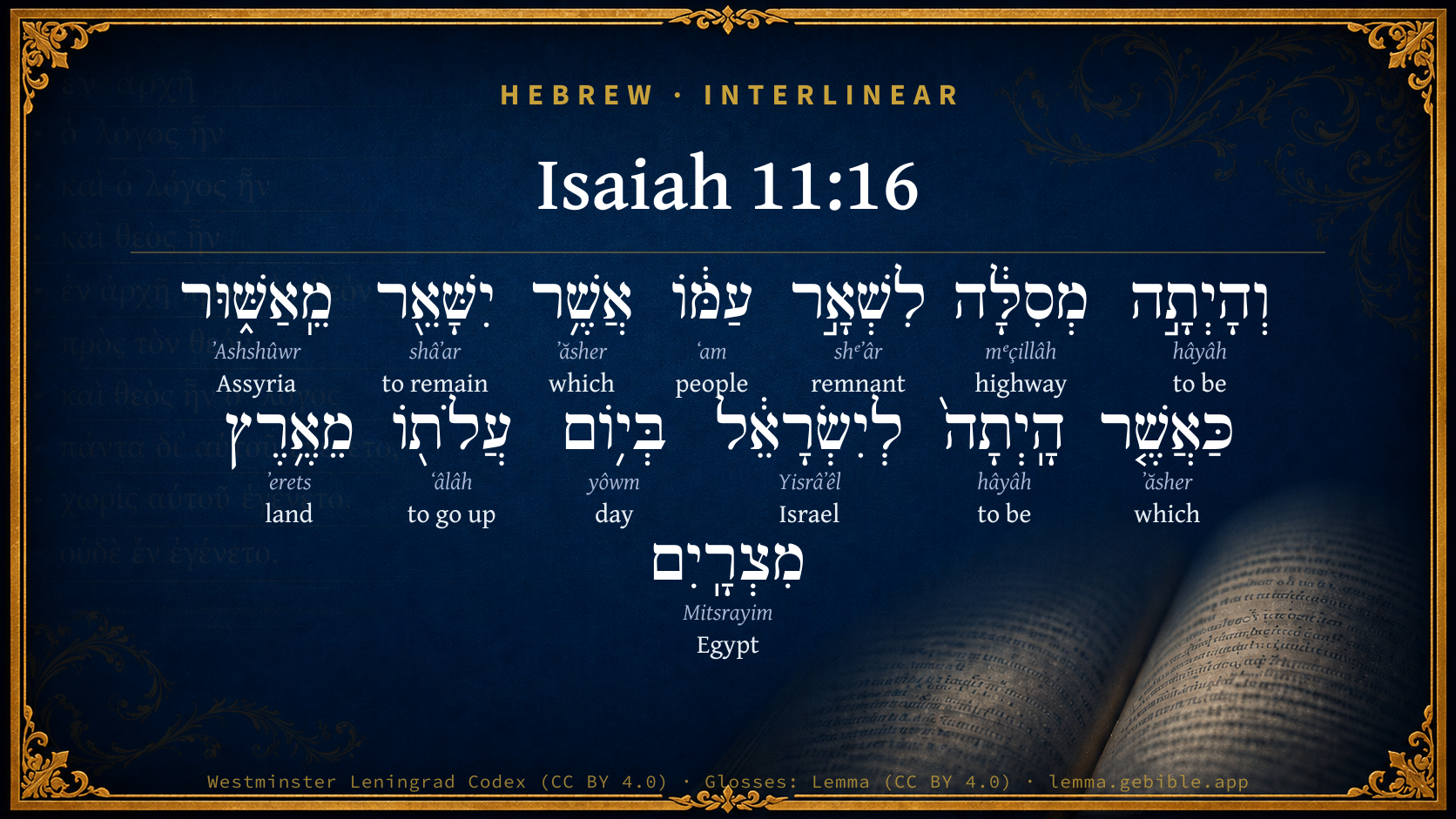
Hebrew (Westminster Leningrad Codex) Isaiah 11:16 appears in the Hebrew Old Testament. The text above is from the Westminster Leningrad Codex. Each word links to its Strong’s number, a concise gloss, and parsing drawn from the Open Scriptures Hebrew Bible morphology. Click any word for its full Brown-Driver-Briggs (BDB) entry.
Download image
Cite this verse

Isaiah 11:16 (World English Bible). Public Domain. Lemma interlinear Bible study tool, https://lemma.gebible.app/v/isaiah/11/16.

Show BibTeX & RIS
BibTeX
RIS
English Translation
There shall be a highway for the remnant of his people, who shall remain, from Assyria; like as there was for Israel in the day that he came up out of the land of Egypt.
World English Bible · Public Domain
Download a study sheet

One document with this verse’s original text, its word-by-word gloss line, the meaning frame, cross-references with their text, attributed commentary, and full source and license credits — printable, and it pastes into notes with its structure intact.

This verse Autodidact and up

Study sheet (.html) Plain text (.txt)

A passage Seminary Student

Up to 50 verses in one chapter. A passage sheet keeps up to 6 commentary sources and 12 cross-references per verse, in the order this page ranks them, and says so on the sheet whenever that leaves anything out. Ask for a single verse and you get the Autodidact verse sheet above.

Everything on this page stays free to read, with no account — the sheet is a download of what is already on screen, not access to it.

Want to remove ads? Support Godless Engineer
Compare translations 3

The same verse in 3 English versions, stacked beneath the original-language interlinear above. Click any original word for its lexicon entry.

Each is an independent rendering of the whole verse — the interlinear is not word-aligned to these translations.

Highlighted words mark where these versions differ — a whole-verse word diff, not a word-by-word alignment.

  • World English Bible Public Domain
    There shall be a highway for the remnant of his people, who shall remain, from Assyria; like as there was for Israel in the day that he came up out of the land of Egypt.
  • King James Version Public Domain
    And there shall be an highway for the remnant of his people, which shall be left, from Assyria; like as it was to Israel in the day that he came up out of the land of Egypt.
  • unfoldingWord Literal Text CC BY-SA 4.0
    And will be a highway from Assyria for the remnant of his people who will be left, as was for Israel in the day of his coming up from the land of Egypt.

unfoldingWord Literal Text — © unfoldingWord, licensed CC BY-SA 4.0. Word-aligned USFM3 via Door43 (git.door43.org/unfoldingWord/en_ult).

Versions to compare (up to 4)

3 of 4 selected

Show all 18 translations

Every available English version of this verse, each an independent rendering of the whole verse.

  • World English Bible Public Domain
    There shall be a highway for the remnant of his people, who shall remain, from Assyria; like as there was for Israel in the day that he came up out of the land of Egypt.
  • Berean Standard Bible Public Domain
    There will be a highway for the remnant of His people who remain from Assyria, as there was for Israel when they came up from the land of Egypt.
  • Majority Standard Bible Public Domain
    There will be a highway for the remnant of His people who remain from Assyria, as there was for Israel when they came up from the land of Egypt.
  • King James Version Public Domain
    And there shall be an highway for the remnant of his people, which shall be left, from Assyria; like as it was to Israel in the day that he came up out of the land of Egypt.
  • American Standard Version (1901) Public Domain
    And there shall be a highway for the remnant of his people, that shall remain, from Assyria; like as there was for Israel in the day that he came up out of the land of Egypt.
  • Revised Version (1885) Public Domain
    And there shall be an highway for the remnant of his people, which shall remain, from Assyria; like as there was for Israel in the day that he came up out of the land of Egypt.
  • Geneva Bible (1599) Public Domain
    And there shalbe a path to the remnant of his people, which are left of Asshur, like as it was vnto Israel in the day that he came vp out of the land of Egypt.
  • Douay-Rheims (1899) Public Domain
    And there shall be a highway for the remnant of my people, which shall be left from the Assyrians: as there was for Israel in the day that he came up out of the land of Egypt.
  • Young's Literal Translation Public Domain
    And there hath been a highway, For the remnant of His people that is left, from Asshur, As there was for Israel in the day of his coming up out of the land of Egypt!
  • Literal Standard Version CC BY-SA 4.0
    And there has been a highway, || For the remnant of His people that is left, from Asshur, || As there was for Israel in the day of his coming up out of the land of Egypt!
  • Unlocked Literal Bible CC BY-SA 4.0
    There will be a highway for the remnant of his people that return from Assyria, as there was for Israel in their coming up from the land of Egypt.
  • unfoldingWord Literal Text CC BY-SA 4.0
    And will be a highway from Assyria for the remnant of his people who will be left, as was for Israel in the day of his coming up from the land of Egypt.
  • Darby Bible Public Domain
    And there shall be a highway for the remnant of his people which will be left, from Assyria; like as it was to Israel in the day when he went up out of the land of Egypt.
  • World Messianic Bible Public Domain
    There will be a highway for the remnant that is left of his people from Assyria, like there was for Israel in the day that he came up out of the land of Egypt.
  • Webster's Bible Public Domain
    And there shall be a highway for the remnant of his people, which shall be left, from Assyria; as it was to Israel in the day that he came up from the land of Egypt.
  • Free Bible Version CC BY-SA 4.0
    There will be a highway from Assyria for the remnant of his people that are left, just as there was for Israel when they left the land of Egypt.
  • Bible in Basic English Public Domain
    And there will be a highway for the rest of his people from Assyria; as there was for Israel in the day when he came up out of the land of Egypt.
  • JPS Tanakh (1917) Public Domain
    And there shall be a highway for the remnant of His people, that shall remain from Assyria, like as there was for Israel in the day that he came up out of the land of Egypt.

Literal Standard Version (2020), Covenant Press — licensed CC BY-SA 4.0. Text via the HelloAO Bible API (eBible.org). Unlocked Literal Bible (unfoldingWord) — licensed CC BY-SA 4.0. Text via the HelloAO Bible API (eBible.org). unfoldingWord Literal Text — © unfoldingWord, licensed CC BY-SA 4.0. Word-aligned USFM3 via Door43 (git.door43.org/unfoldingWord/en_ult). Free Bible Version, Dr. Jonathan Gallagher — licensed CC BY-SA 4.0. Text via the HelloAO Bible API (eBible.org).

Word by word

More ways to search: Search by grammar → Find every occurrence → Compare this word →

Practice this passage: Drill this verse → Learn its vocabulary →

לִשְׁאָ֣ר
shᵉʼâr
H7605
“to/for · remnant of”
Preposition + Noun, Common, Masculine, Singular, Construct
Part of Speech
Preposition + Noun
Type
Common
Gender
Masculine
Number
Singular
State
Construct
Full BDB Definition

Origin: from H7604

TWOT: 2307a

rest, residue, remnant, remainder
  1. וְהָיְתָ֣ה hâyâh H1961 “and · to be” Conjunction + Verb, Qal, Sequential Perfect, 3rd Person, Feminine, Singular
  2. מְסִלָּ֔ה mᵉçillâh H4546 “highway” Noun, Common, Feminine, Singular, Absolute
  3. עַמּ֔וֹ ʻam H5971 “people · his” Noun, Common, Masculine, Singular, Construct + Suffix, Personal, 3rd Person, Masculine, Singular
  4. אֲשֶׁ֥ר ʼăsher H834 “which” Particle, Relative
  5. יִשָּׁאֵ֖ר shâʼar H7604 “to remain” Verb, Niphal, Imperfect, 3rd Person, Masculine, Singular
  6. מֵֽאַשּׁ֑וּר ʼAshshûwr H804 “from · Assyria” Preposition + Noun, Proper
  7. כַּאֲשֶׁ֤ר ʼăsher H834 “like/as · which” Preposition + Particle, Relative
  8. הָֽיְתָה֙ hâyâh H1961 “to be” Verb, Qal, Perfect, 3rd Person, Feminine, Singular
  9. לְיִשְׂרָאֵ֔ל Yisrâʼêl H3478 “to/for · Israel” Preposition + Noun, Proper
  10. בְּי֥וֹם yôwm H3117 “in/at · day of” Preposition + Noun, Common, Masculine, Singular, Construct
  11. עֲלֹת֖וֹ ʻâlâh H5927 “to go up · him” Verb, Qal, Infinitive Construct + Suffix, Personal, 3rd Person, Masculine, Singular
  12. מֵאֶ֥רֶץ ʼerets H776 “from · land of” Preposition + Noun, Common, Both, Singular, Construct
  13. מִצְרָֽיִם Mitsrayim H4714 “Egypt” Noun, Proper

About this verse

These counts appear in no published source. They are computed here, from the morphology-tagged text and Lemma’s own curated glosses. What Lemma adds →

14
words
12
distinct lemmas
Prophets
section

Shared distinctive vocabulary

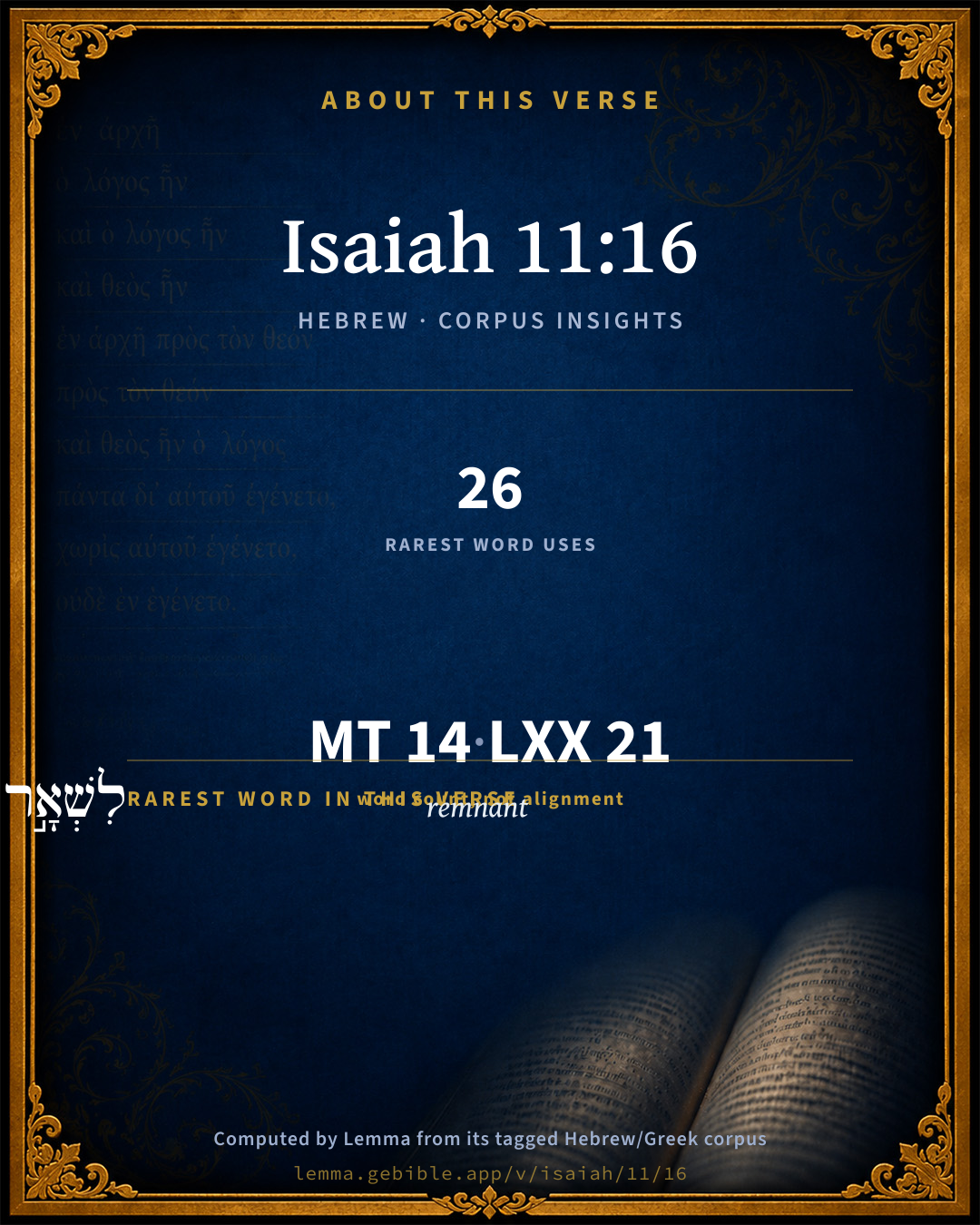
לִשְׁאָ֣ר remnant H7605 occurs in 25 verses of the Hebrew Bible. Also found in:

Grammatical profile

  • 4 verbs
  • 8 nouns
  • 2 particles

Verb forms

  • וְהָיְתָ֣ה Qal · Sequential Perfect
  • יִשָּׁאֵ֖ר Niphal · Imperfect
  • הָֽיְתָה֙ Qal · Perfect
  • עֲלֹת֖וֹ Qal · Infinitive Construct

Repetition

Words recur within this verse — often emphatic in Hebrew:

  • וְהָיְתָ֣ה to be H1961 ×2
  • אֲשֶׁ֥ר which H834 ×2

Hebrew & Septuagint length

In English translation the verse runs 35 words from the Hebrew and 33 from the Septuagint (LXX English) — closely comparable.

A rough comparison of the two English renderings, which tokenize alike — not a word-level alignment.

Word counts can differ between the Hebrew and the Greek without any difference in meaning — e.g. the Hebrew direct-object marker אֵת has no separate Greek word, and Greek often adds the article ὁ.

In the original languages it is 14 Hebrew tokens and 21 Greek tokens — but the two are counted differently (Hebrew bundles its prefixes and suffixes into one token; the Greek is in lemma form), so that isn’t a like-for-like length.

Cross-references

13

Topical passages linked to Isaiah 11:16 in the Treasury of Scripture Knowledge — connected by theme and wording, ordered by reader-vote popularity; previews shown in the World English Bible.

  • Isaiah 19:23 In that day shall there be a highway out of Egypt to Assyria, and the Assyrian shall come into Egypt, and the Egyptian into Assyria; and the Egyptians shall worship with the Assyrians.
  • Isaiah 35:8–10 A highway shall be there, and a way, and it shall be called The way of holiness. The unclean shall not pass over it, but is shall be for for him who walks in the Way. Wicked fools will not go there.
  • Isaiah 11:11 It shall happen in that day, that the Lord will set his hand again the second time to recover the remnant of his people, who shall remain, from Assyria, and from Egypt, and from Pathros, and from Cush, and from Elam, and from Shinar, and from Hamath, and from the islands of the sea.
  • Exodus 14:26–29 Yahweh said to Moses, "Stretch out your hand over the sea, that the waters may come again on the Egyptians, on their chariots, and on their horsemen."
  • Isaiah 62:10 Go through, go through the gates; prepare you the way of the people; cast up, cast up the highway; gather out the stones; lift up an ensign for the peoples.
  • Isaiah 40:3–4 The voice of one who cries, Prepare you in the wilderness the way of Yahweh; make level in the desert a highway for our God.
  • Isaiah 51:10 Isn't it you who dried up the sea, the waters of the great deep; who made the depths of the sea a way for the redeemed to pass over?
  • Isaiah 57:14 He will say, Cast up, cast up, prepare the way, take up the stumbling-block out of the way of my people.
  • Isaiah 27:13 It shall happen in that day, that a great trumpet shall be blown; and they shall come who were ready to perish in the land of Assyria, and those who were outcasts in the land of Egypt; and they shall worship Yahweh in the holy mountain at Jerusalem.
  • Isaiah 42:15–16 I will lay waste mountains and hills, and dry up all their herbs; and I will make the rivers islands, and will dry up the pools.
  • Isaiah 48:20–21 Go you forth from Babylon, flee you from the Chaldeans; with a voice of singing declare you, tell this, utter it even to the end of the earth: say you, Yahweh has redeemed his servant Jacob.
  • Isaiah 49:12 Behold, these shall come from far; and, behold, these from the north and from the west; and these from the land of Sinim.
  • Isaiah 63:12–13 who caused his glorious arm to go at the right hand of Moses? who divided the waters before them, to make himself an everlasting name?

Cross-references courtesy of OpenBible.info (CC BY 4.0).

Hebrew and Greek witnesses Masoretic Hebrew ↔ Greek Septuagint

The same verse in the two great witnesses to the Old Testament, shown verse-for-verse.

These are two independent witnesses, not word-aligned to each other, and the Septuagint is shown in lemma (dictionary) form.

Hebrew Isaiah 11:16 Masoretic · Westminster Leningrad Codex

וְהָיְתָ֣ה מְסִלָּ֔ה לִשְׁאָ֣ר עַמּ֔וֹ אֲשֶׁ֥ר יִשָּׁאֵ֖ר מֵֽאַשּׁ֑וּר כַּאֲשֶׁ֤ר הָֽיְתָה֙ לְיִשְׂרָאֵ֔ל בְּי֥וֹם עֲלֹת֖וֹ מֵאֶ֥רֶץ מִצְרָֽיִם

There shall be a highway for the remnant of his people, who shall remain, from Assyria; like as there was for Israel in the day that he came up out of the land of Egypt.

World English Bible · Public Domain

Greek LXX Isaiah 11:16 Septuagint · lemma form

καί εἰμί δίοδος ὁ καταλείπω ἐγώ λαός ἐν αἴγυπτος καί εἰμί ὁ ἰσραήλ ὡς ὁ ἡμέρα ὅτε ἐκἔρχομαι ἐκ γῆ αἴγυπτος

And there shall be a passage for my people that is left in Egypt: and it shall be to Israel as the day when he came forth out of the land of Egypt.

LXX2012 (modern English Septuagint) · Public Domain

On this verse, John Gill's Exposition discusses the Septuagint’s reading. Read the note in Commentary ↓

Hebrew: Westminster Leningrad Codex (CC BY 4.0). Greek: Septuagint (public domain); English from LXX2012 (modern English Septuagint) (Public Domain). How the Septuagint differs from the Hebrew →

Targum (Aramaic paraphrase)

1

The Targum is the ancient Jewish Aramaic paraphrase of the Hebrew Scriptures — an interpretive translation, not the Hebrew text itself. Onkelos (literal) and Pseudo-Jonathan (expansive) render the Torah, and Jonathan the Prophets. Coverage is partial: where no permissively-licensed English translation exists for a verse, only the Aramaic is shown. This is verse-level text, not a word-by-word alignment to the Hebrew.

  1. Targum Jonathan Prophets (Joshua–Malachi)
    וּתְהֵי אוֹרַח כְּבִישָׁא לִשְׁאָרָא דְעַמֵיהּ דְיִשְׁתָּאַר מֵאַתּוּרָאָה כְּמָא דַהֲוַת לְיִשְׂרָאֵל בְּיוֹם מַסְקֵיהוֹן מֵאַרְעָא דְמִצְרָיִם:

    And there shall be a paved way for the remnant of His people, which shall be left, from Assyria, like as it was to Israel in the day of their coming up from the land of Egypt.

    Targum Jonathan — Aramaic: “Mikraot Gedolot” (public domain). English: “Sefaria Community Translation” (CC0 1.0 (public-domain dedication)); “London "Chaldee Paraphrase," 1871” (public domain). Text via Sefaria.

Commentary

Notes on Isaiah 11:16 from classic Christian and Jewish commentators (each source and its license shown beneath its notes). The classic Christian expositions comment on the surrounding passage and are grouped to its opening verse, so a note may address several verses; the Jewish commentaries on the Tanakh (Rashi and others) are per-verse, so they appear only where the commentator wrote on this verse.

Lemma curates 59 commentaries, every one of them public domain or Creative Commons licensed, each selected and text-cleaned for this edition rather than reprinted as found. About our sources →

Jamieson, Fausset & Brown

Robert Jamieson, A. R. Fausset & David Brown

highway--a highway clear of obstructions (Isa 19:23; Isa 35:8).

like as . . . Israel . . . Egypt-- (Isa 51:10-11; Isa 63:12-13).

Just as Miriam, after the deliverance of the Red Sea (Isa 11:16), celebrated it with an ode of praise (Exo. 15:1-19).

Next: Isaiah Chapter 12

Jamieson, Fausset & Brown — Commentary Critical and Explanatory on the Whole Bible (1871) — public domain (CC PDM 1.0). Text via the HelloAO Bible API.

Trapp's Complete Commentary

John Trapp

Isa 11:16 And there shall be an highway for the remnant of his people, which shall be left, from Assyria; like as it was to Israel in the day that he came up out of the land of Egypt.

Ver. 16. And there shall be an highway.] Agger, via strata, a causeway. {Isa 7:3}

In the day that he came up out of the land of Egypt.] This signal deliverance was a clear type of our redemption by Christ. And this prophecy was fulfilled when thousands of the Egyptians were converted by Mark the evangelist and other preachers, as also when other nations forsook spiritual Egypt {Rev 11:8} and embraced the truth.

John Trapp, A Commentary or Exposition upon All the Books of the Old and New Testament (1647–1656) — public domain. Text from a community e-Sword module.

Ellicott's Commentary for English Readers

(16) And there shall be an highway for the remnant . . .—The “highway” is, as in Isa_19:23; Isa_49:11, and elsewhere, the raised embanked road, made by Eastern kings for the march of their armies. Such a road the prophet sees in his vision (here as in Isa_40:3), stretching across the great plains of Mesopotamia for the return of Israel. It was to be for that “second time” of restoration what the passage of the Red Sea had been for the “first time” of the Exodus, for the exiles in Assyria what another passage of the Egyptian sea was to be for those in Egypt.

A Bible Commentary for English Readers, edited by Charles John Ellicott (1878–1897) — public domain. Text from a community e-Sword module.

The Cambridge Bible for Schools and Colleges

gen. ed. J. J. S. Perowne

16. a highway] through river and desert. This miraculous “highway” is a frequent feature in prophetic descriptions of the return from exile. Cf. ch. Isa_35:8, Isa_40:3-4, Isa_42:16, Isa_49:11, &c.

The Cambridge Bible for Schools and Colleges (gen. ed. J. J. S. Perowne; Cambridge University Press, 1878–1918) — public domain. Text from a community e-Sword module.

John Gill's Exposition

And there shall be a highway for the remnant of his people,.... That is, through the river; that being dried up, and all hindrances and obstacles being removed, the way will be clear for multitudes to walk in without interruption, like a large common, highway, or causeway; so the Mahometan, Pagan, and Papal kingdoms being destroyed, and with them each of their religions, the way of truth, righteousness, and holiness, will be manifest to the remnant of the Lord's people; who will be at this time in those parts, in which they will be directed to walk, and will walk, and not err, see Isa 35:8,

which shall be left from Assyria; the Septuagint and Arabic versions read, "which is left in Egypt"; and designs the remnant, according to the election of grace, that shall be in any of the antichristian countries, either Mahometan or Papal; rather the former seems intended, who shall at this time be brought to the knowledge of Christ, and to walk in his ways:

like as it was to Israel in that day that he came up out of the land of Egypt; that is, as there was a highway made through the Red Sea, in which Israel passed, as on dry land, when they came out of Egypt, and went through the wilderness to Canaan's land.

Next: Isaiah Chapter 12

John Gill's Exposition of the Whole Bible (1746–1763) — public domain (CC PDM 1.0). Text via the HelloAO Bible API.

Albert Barnes' Notes on the Bible

And there shall be an highway - All obstructions shall be removed, and they shall be permitted to return without hinderance (compare the note at Isa 35:8).

For the remnant of his people from Assyria - See note at Isa 11:11.

Like as it was to Israel... - That is, God will remove all obstructions as he did at the Red Sea; he will subdue all their enemies; he will provide for their needs; and he will interpose by the manifest marks of his presence and protection, as their God and their friend. The general view of the chapter is, therefore, that it, refers to the triumph of the Messiah’s kingdom; that it is not yet fully accomplished; and that the time is coming when the scattered Jews shall be regathered to God - not returned to their own land, but brought again under his dominion under the administration of the Messiah; and that this event shall be attended with a sudden removal of the obstructions to the gospel, and to its rapid spread everywhere among the nations. Comparing this with the present state of the Jews, we may remark, in regard to this prospect:

(1) That they are now, and will continue to be, scattered in all nations. They have been driven to all parts of the earth - wanderers without a home - yet continuing their customs, rites, and special opinions; and continuing to live, notwithstanding all the efforts of the nations to crush and destroy them.

(2) They speak nearly all the languages of the world. They are acquainted with all the customs, prejudices, and opinions of the nations of the earth. They would, therefore, be under no necessity of engaging in the laborious work of learning language - which now occupies so much of the time, and consumes so much of the strength of the modern missionary.

(3) The law of God is thus in all nations. It is in every synagogue; and it has been well said, that the law there is like extinguished candles, and that all that is needful to illuminate the world, is to light those candles. Let the Jew everywhere be brought to see the true meaning of his law; let the light of evangelical truth shine into his synagogue, and the world would be at once illuminated. The truth would go with the rapidity of the sunbeams from place to place, until the whole earth would be enlightened with the knowledge of the Redeemer.

(4) The Jews, when converted, make the best missionaries. There is a freshness in their views of the Messiah when they are converted, which Gentile converts seldom feel. The apostles were all Jews; and the zeal of Paul shows what converted Jews will do when they become engaged in making known the true Messiah. If it has been a characteristic of their nation that they would ‘compass sea and land to make one proselyte,’ what will their more than three million accomplish when they become converted to the true faith of the Redeemer? We have every reason, therefore, to expect that God intends to make great use yet of the Jews, whom he has preserved scattered everywhere - though they be but a ‘remnant’ - in converting the world to his Son. And we should most fervently pray, that they may be imbued with love to their long-rejected Messiah, and that they may everywhere become the missionaries of the cross.

Albert Barnes' Notes on the Bible (1834–1885) — public domain. Text from a community e-Sword/MySword module.

Haydock's Catholic Bible Commentary

Assyrians. They shall march without impediment. (Calmet)

George Leo Haydock (1774–1849), Haydock's Catholic Family Bible and Commentary, 1859 edition — public domain. Excludes Psalms (Douay-Rheims chapter numbering differs from Protestant) and Deuterocanonical books (Catholic canon only).

Matthew Poole's English Annotations

From Assyria; as there was another highway from Egypt in the former verse. So the sense is, that all impediments shall be removed, and a way made for the return of God’s Israel from all parts of the world. He mentions Assyria, because thither the ten tribes were carried, 2Ki 17:23; whose case seemed to be most desperate.

Matthew Poole's English Annotations on the Holy Bible (1683–1685) — public domain. Text from a community e-Sword/MySword module.

The Pulpit Commentary

There shall be a highway. This is the object in view the free and unhindered passage of his people from the various regions where they are scattered (ver. 11) to their resting-place in Palestine.

The Pulpit Commentary (1880–1919), ed. H.D.M. Spence-Jones & Joseph S. Exell — public domain. Text from a community e-Sword module.

John Wesley's Explanatory Notes

As it was - As there was another high-way from Egypt. All impediments shall be removed, and a way made for the return of God's Israel from all parts of the world. He mentions Assyria, because thither the ten tribes were carried, whose case seemed to be most desperate.

John Wesley, Explanatory Notes Upon the Whole Bible (1754–1765) — public domain. Text via the GEBible commentary corpus.

J. A. Alexander on Isaiah

Joseph Addison Alexander

“And there shall be a highway for the remnant of my people, which shall be left, from Assyria, as there was for Israel, in the day of his coming up from the land of Egypt.” This verse admits of two interpretations. According to one, it is a comparison of the former deliverance from Egypt with the future one from Assyria and the neighboring countries, where most Jewish exiles were to be found. According to the other, it is a repetition of the preceding promise, that previous deliverances, particularly those from Egypt and Assyria, should be repeated in the future history of the church. The fulfillment has been sought by different interpreters, in the return from Babylon, in the general progress of the gospel, and in the future restoration of the Jews. The first of these can at most be regarded only as a partial or inchoate fulfillment, and against the last lies the obvious objection, that the context contains promises and threatenings which are obviously figurative, although so expressed as to contain allusion to remarkable events in the experience of Israel. Such is the dividing or drying up of the tongue of the Red Sea, which must either be figuratively understood, or supposed to refer to a future miracle, which last hypothesis is certainly not necessary, and therefore can be fully justified by nothing but the actual event.

Joseph Addison Alexander, The Prophecies of Isaiah (1846–1847; New York: Scribner, 1870–1878) — public domain. Text from a community e-Sword module.

unfoldingWord translationNotes

Door43 World Missions Community

There will be a highway

A highway is a large road that many people can travel on. "Yahweh will make a road"

in their coming up from the land of Egypt

"when they came up from the land of Egypt"

translationWords

remnant

people of God

Assyria

Israel

Egypt

unfoldingWord translationNotes — © Distant Shores Media and the Door43 World Missions Community, licensed CC BY-SA 4.0. Source: git.door43.org/Door43/en_tn.

Rashi

Rabbi Shlomo Yitzchaki (Rashi)

And there shall be a highway in the midst of the water for the remnant of His people.

Rashi on the Tanakh — English translations: “The Judaica Press complete Tanach with Rashi, translated by A. J. Rosenberg” (CC BY 4.0); “Pentateuch with Rashi's commentary by M. Rosenbaum and A.M. Silbermann, 1929-1934” (public domain); “The Metsudah Tanach series, Lakewood, N.J” (CC BY 4.0); and “The Book of Joshua, Metsudah Publications, 1997” (CC BY 4.0). Text via Sefaria.

Ibn Ezra

Rabbi Abraham ibn Ezra

And there shall be an highway, etc. This verse explains the purpose of the utter destruction and smiting (ver. 15).

As it was to Israel, etc. This refers to the dividing of the Red Sea at the Exodus from Egypt.

Ibn Ezra on the Tanakh — English translations: “Sefaria Community Translation” (CC0 1.0 (public-domain dedication)); “Yalkut, Sifsei Chachomim Chumash, Metsudah Publications, 2009” (CC BY 4.0); and “Commentary of Ibn Ezra on Isaiah - trans. by M. Friedlander, 1873” (public domain). Text via Sefaria.

Lesson kit

Teaching starters — assembled from the data on this page, not authored interpretation. Every prompt links to the verse data it draws on. Edit before teaching.

Isaiah, in the Prophets, opens this verse with 14 words (12 distinct Hebrew lemmas). Its most distinctive word is shᵉʼâr (“remnant”). A historical commentator’s framing appears above. Read the whole chapter for the surrounding context.

Discussion questions

  1. How does “remnant” (shᵉʼâr) shape what this verse is saying?
  2. 1 Chronicles 11:8 shares the word «remnant» with this verse. How do the two illuminate each other?
  3. “to be” occurs 2× in this one verse. What is the effect of the repetition?
  4. These translations render this verse differently. What is at stake in choosing one wording over another?
  5. The verb «וְהָיְתָ֣ה» is Qal Sequential Perfect. How does its form color the action?
  6. Reading how Jamieson, Fausset & Brown and Trapp's Complete Commentary read this verse, where do the two commentators agree and where do they part?

Things to notice

Reading settings

Reading text

Shown beneath each verse's original-language words.

Old Testament
Old Testament edition

Read the OT as the Masoretic Hebrew (MT) or the Greek Septuagint (LXX).

English shown for the Greek Septuagint (in the Hebrew ↔ Greek comparison).

Comparing translations? Open the Compare panel on any verse page to stack up to four side by side.