
1 Kings 15:29

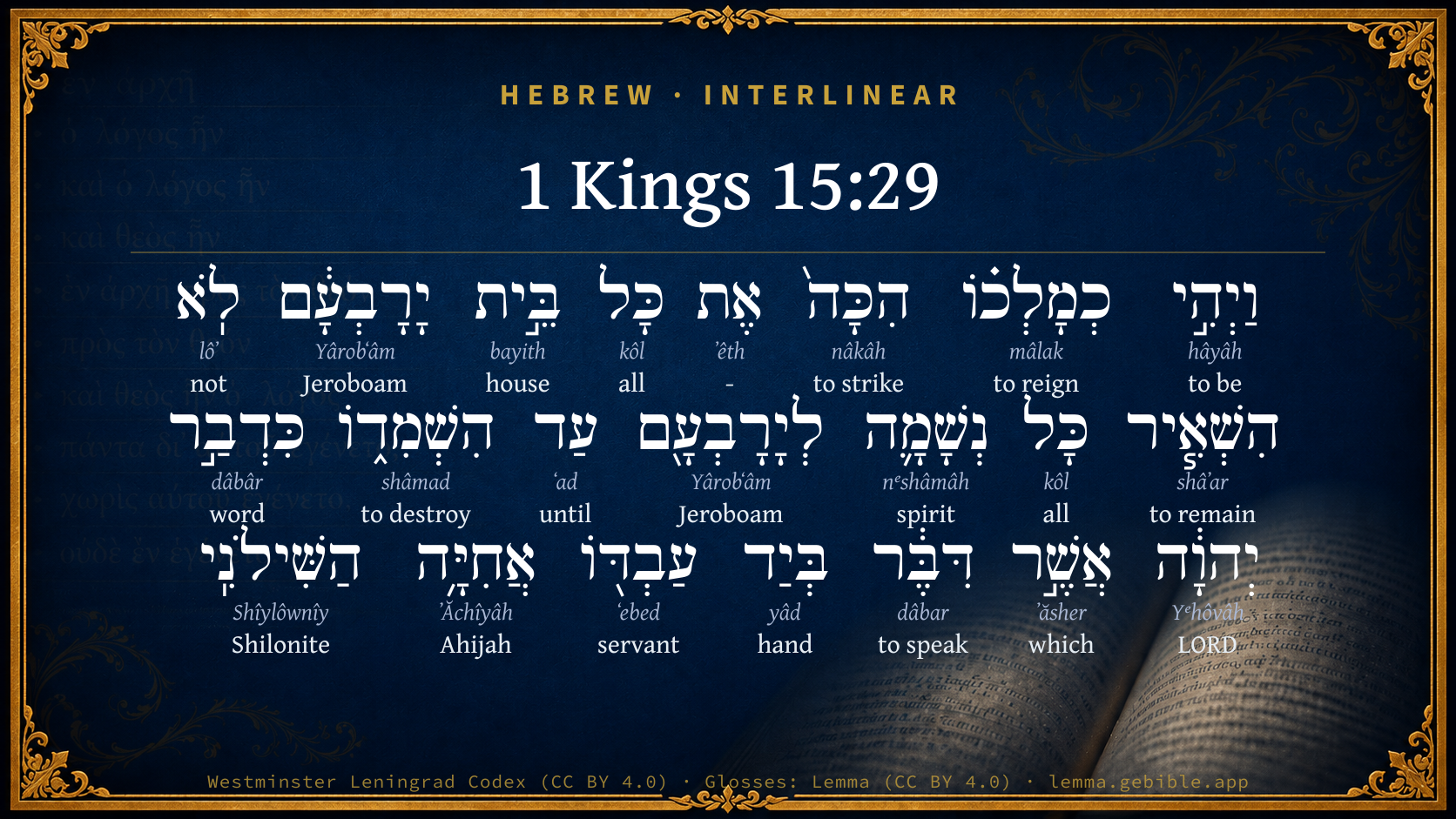
Hebrew (Westminster Leningrad Codex) 1 Kings 15:29 appears in the Hebrew Old Testament. The text above is from the Westminster Leningrad Codex. Each word links to its Strong’s number, a concise gloss, and parsing drawn from the Open Scriptures Hebrew Bible morphology. Click any word for its full Brown-Driver-Briggs (BDB) entry.
Download image
Cite this verse

1 Kings 15:29 (World English Bible). Public Domain. Lemma interlinear Bible study tool, https://lemma.gebible.app/v/1-kings/15/29.

Show BibTeX & RIS
BibTeX
RIS
English Translation
It happened that, as soon as he was king, he struck all the house of Jeroboam: he didn't leave to Jeroboam any who breathed, until he had destroyed him; according to the saying of Yahweh, which he spoke by his servant Ahijah the Shilonite;
World English Bible · Public Domain
Download a study sheet

One document with this verse’s original text, its word-by-word gloss line, the meaning frame, cross-references with their text, attributed commentary, and full source and license credits — printable, and it pastes into notes with its structure intact.

This verse Autodidact and up

Study sheet (.html) Plain text (.txt)

A passage Seminary Student

Up to 50 verses in one chapter. A passage sheet keeps up to 6 commentary sources and 12 cross-references per verse, in the order this page ranks them, and says so on the sheet whenever that leaves anything out. Ask for a single verse and you get the Autodidact verse sheet above.

Everything on this page stays free to read, with no account — the sheet is a download of what is already on screen, not access to it.

Want to remove ads? Support Godless Engineer
Compare translations 3

The same verse in 3 English versions, stacked beneath the original-language interlinear above. Click any original word for its lexicon entry.

Each is an independent rendering of the whole verse — the interlinear is not word-aligned to these translations.

Highlighted words mark where these versions differ — a whole-verse word diff, not a word-by-word alignment.

  • World English Bible Public Domain
    It happened that, as soon as he was king, he struck all the house of Jeroboam: he didn't leave to Jeroboam any who breathed, until he had destroyed him; according to the saying of Yahweh, which he spoke by his servant Ahijah the Shilonite;
  • King James Version Public Domain
    And it came to pass, when he reigned, that he smote all the house of Jeroboam; he left not to Jeroboam any that breathed, until he had destroyed him, according unto the saying of the LORD, which he spake by his servant Ahijah the Shilonite:
  • unfoldingWord Literal Text CC BY-SA 4.0
    And it happened when he reigned he struck all of the house of Jeroboam. He did not leave any breathing one to Jeroboam, until he had destroyed him, according to the word of Yahweh that he had spoken by the hand of his servant Ahijah the Shilonite

unfoldingWord Literal Text — © unfoldingWord, licensed CC BY-SA 4.0. Word-aligned USFM3 via Door43 (git.door43.org/unfoldingWord/en_ult).

Versions to compare (up to 4)

3 of 4 selected

Show all 18 translations

Every available English version of this verse, each an independent rendering of the whole verse.

  • World English Bible Public Domain
    It happened that, as soon as he was king, he struck all the house of Jeroboam: he didn't leave to Jeroboam any who breathed, until he had destroyed him; according to the saying of Yahweh, which he spoke by his servant Ahijah the Shilonite;
  • Berean Standard Bible Public Domain
    As soon as Baasha became king, he struck down the entire household of Jeroboam. He did not leave to Jeroboam anyone that breathed, but destroyed them all according to the word that the LORD had spoken through His servant Ahijah the Shilonite,
  • Majority Standard Bible Public Domain
    As soon as Baasha became king, he struck down the entire household of Jeroboam. He did not leave to Jeroboam anyone who breathed, but destroyed them all according to the word that the LORD had spoken through His servant Ahijah the Shilonite,
  • King James Version Public Domain
    And it came to pass, when he reigned, that he smote all the house of Jeroboam; he left not to Jeroboam any that breathed, until he had destroyed him, according unto the saying of the LORD, which he spake by his servant Ahijah the Shilonite:
  • American Standard Version (1901) Public Domain
    And it came to pass that, as soon as he was king, he smote all the house of Jeroboam: he left not to Jeroboam any that breathed, until he had destroyed him; according unto the saying of Jehovah, which he spake by his servant Ahijah the Shilonite;
  • Revised Version (1885) Public Domain
    And it came to pass that, as soon as he was king, he smote all the house of Jeroboam; he left not to Jeroboam any that breathed, until he had destroyed him; according unto the saying of the LORD, which he spake by the hand of his servant Ahijah the Shilonite:
  • Geneva Bible (1599) Public Domain
    And when he was King, he smote all the house of Ieroboam, he left none aliue to Ieroboam, vntill hee had destroyed him, according to the word of the Lord which he spake by his seruant Ahijah the Shilonite,
  • Douay-Rheims (1899) Public Domain
    And when he was king he cut off all the house of Jeroboam: he left not so much as one soul of his seed, till he had utterly destroyed him, according to the word of the Lord, which he had spoken in the hand of Ahias the Silonite:
  • Young's Literal Translation Public Domain
    And it cometh to pass, at his reigning, he hath smitten the whole house of Jeroboam, he hath not left any breathing to Jeroboam till his destroying him, according to the word of Jehovah, that He spake by the hand of His servant Ahijah the Shilonite,
  • Literal Standard Version CC BY-SA 4.0
    And it comes to pass, at his reigning, he has struck the whole house of Jeroboam, he has not left any breathing to Jeroboam until his destroying him, according to the word of YHWH, that He spoke by the hand of His servant Ahijah the Shilonite,
  • Unlocked Literal Bible CC BY-SA 4.0
    As soon as he was king, Baasha killed all the family of Jeroboam. He left none of Jeroboam's descendants breathing; in this way he destroyed his royal line, just as Yahweh had spoken by his servant Ahijah the Shilonite,
  • unfoldingWord Literal Text CC BY-SA 4.0
    And it happened when he reigned he struck all of the house of Jeroboam. He did not leave any breathing one to Jeroboam, until he had destroyed him, according to the word of Yahweh that he had spoken by the hand of his servant Ahijah the Shilonite
  • Darby Bible Public Domain
    And it came to pass when he was king, he smote all the house of Jeroboam; he left to Jeroboam none that breathed; until he had destroyed him, according to the word of Jehovah which he spoke by his servant Ahijah the Shilonite,
  • World Messianic Bible Public Domain
    As soon as he was king, he struck all the house of Jeroboam. He didn’t leave to Jeroboam any who breathed, until he had destroyed him, according to the saying of the LORD, which he spoke by his servant Ahijah the Shilonite;
  • Webster's Bible Public Domain
    And it came to pass, when he reigned, that he smote all the house of Jeroboam; he left not to Jeroboam any that breathed, until he had destroyed him, according to the saying of the LORD, which he spoke by his servant Ahijah the Shilonite:
  • Free Bible Version CC BY-SA 4.0
    As soon as he became king he killed all the rest of Jeroboam's family. He did not leave any of Jeroboam's descendants alive—he destroyed them all, as the Lord had said through his servant Ahijah the Shilonite.
  • Bible in Basic English Public Domain
    And straight away when he became king, he sent destruction on all the offspring of Jeroboam; there was not one living person of all the family of Jeroboam whom he did not put to death, so the word of the Lord, which he said by his servant Ahijah the Shilonite, came about;
  • JPS Tanakh (1917) Public Domain
    And it came to pass that, as soon as he was king, he smote all the house of Jeroboam; he left not to Jeroboam any that breathed, until he had destroyed him; according unto the saying of the LORD, which He spoke by the hand of His servant Ahijah the Shilonite;

Literal Standard Version (2020), Covenant Press — licensed CC BY-SA 4.0. Text via the HelloAO Bible API (eBible.org). Unlocked Literal Bible (unfoldingWord) — licensed CC BY-SA 4.0. Text via the HelloAO Bible API (eBible.org). unfoldingWord Literal Text — © unfoldingWord, licensed CC BY-SA 4.0. Word-aligned USFM3 via Door43 (git.door43.org/unfoldingWord/en_ult). Free Bible Version, Dr. Jonathan Gallagher — licensed CC BY-SA 4.0. Text via the HelloAO Bible API (eBible.org).

Word by word

More ways to search: Search by grammar → Find every occurrence → Compare this word →

Practice this passage: Drill this verse → Learn its vocabulary →

הַשִּׁילֹנִֽי
Shîylôwnîy
H7888
“the · Shilonite”
Particle, Definite Article + Noun, Gentilic, Masculine, Singular, Absolute
Part of Speech
Particle + Noun
Type
Gentilic
Gender
Masculine
Number
Singular
State
Absolute
Full BDB Definition

Origin: from H7887

TWOT: None

Shilonite = see Shiloh " place of rest" - an inhabitant of Shiloh
  1. וַיְהִ֣י hâyâh H1961 “and · to be” Conjunction + Verb, Qal, Sequential Imperfect, 3rd Person, Masculine, Singular
  2. כְמָלְכ֗וֹ mâlak H4427 “like/as · to reign · him” Preposition + Verb, Qal, Infinitive Construct + Suffix, Personal, 3rd Person, Masculine, Singular
  3. הִכָּה֙ nâkâh H5221 “to strike” Verb, Hiphil, Perfect, 3rd Person, Masculine, Singular
  4. אֶת ʼêth H853 “-” Particle, Direct Object
  5. כָּל kôl H3605 “all of” Noun, Common, Masculine, Singular, Construct
  6. בֵּ֣ית bayith H1004 “house of” Noun, Common, Masculine, Singular, Construct
  7. יָרָבְעָ֔ם Yârobʻâm H3379 “Jeroboam” Noun, Proper
  8. לֹֽא lôʼ H3808 “not” Particle, Negative
  9. הִשְׁאִ֧יר shâʼar H7604 “to remain” Verb, Hiphil, Perfect, 3rd Person, Masculine, Singular
  10. כָּל kôl H3605 “all of” Noun, Common, Masculine, Singular, Construct
  11. נְשָׁמָ֛ה nᵉshâmâh H5397 “spirit” Noun, Common, Feminine, Singular, Absolute
  12. לְיָרָבְעָ֖ם Yârobʻâm H3379 “to/for · Jeroboam” Preposition + Noun, Proper
  13. עַד ʻad H5704 “until” Preposition
  14. הִשְׁמִד֑וֹ shâmad H8045 “to destroy · him” Verb, Hiphil, Perfect, 3rd Person, Masculine, Singular + Suffix, Personal, 3rd Person, Masculine, Singular
  15. כִּדְבַ֣ר dâbâr H1697 “like/as · word of” Preposition + Noun, Common, Masculine, Singular, Construct
  16. יְהוָ֔ה Yᵉhôvâh H3068 “LORD” Noun, Proper
  17. אֲשֶׁ֣ר ʼăsher H834 “which” Particle, Relative
  18. דִּבֶּ֔ר dâbar H1696 “to speak” Verb, Piel, Perfect, 3rd Person, Masculine, Singular
  19. בְּיַד yâd H3027 “in/at · hand of” Preposition + Noun, Common, Both, Singular, Construct
  20. עַבְדּ֖וֹ ʻebed H5650 “servant · his” Noun, Common, Masculine, Singular, Construct + Suffix, Personal, 3rd Person, Masculine, Singular
  21. אֲחִיָּ֥ה ʼĂchîyâh H281 “Ahijah” Noun, Proper

About this verse

These counts appear in no published source. They are computed here, from the morphology-tagged text and Lemma’s own curated glosses. What Lemma adds →

22
words
20
distinct lemmas
Historical
section

Notable vocabulary

The rarest word here is הַשִּׁילֹנִֽי Shilonite H7888 — appearing just 6 times in the whole Hebrew Bible.

Shared distinctive vocabulary

הַשִּׁילֹנִֽי Shilonite H7888 occurs in 6 verses of the Hebrew Bible. Also found in:

Grammatical profile

  • 6 verbs
  • 12 nouns
  • 1 preposition
  • 3 particles

Verb forms

  • וַיְהִ֣י Qal · Sequential Imperfect
  • כְמָלְכ֗וֹ Qal · Infinitive Construct
  • הִכָּה֙ Hiphil · Perfect
  • הִשְׁאִ֧יר Hiphil · Perfect
  • הִשְׁמִד֑וֹ Hiphil · Perfect
  • דִּבֶּ֔ר Piel · Perfect

Repetition

Words recur within this verse — often emphatic in Hebrew:

  • כָּל all H3605 ×2
  • יָרָבְעָ֔ם Jeroboam H3379 ×2

Hebrew & Septuagint length

In English translation the verse runs 44 words from the Hebrew and 45 from the Septuagint (LXX English) — closely comparable.

A rough comparison of the two English renderings, which tokenize alike — not a word-level alignment.

Word counts can differ between the Hebrew and the Greek without any difference in meaning — e.g. the Hebrew direct-object marker אֵת has no separate Greek word, and Greek often adds the article ὁ.

In the original languages it is 22 Hebrew tokens and 33 Greek tokens — but the two are counted differently (Hebrew bundles its prefixes and suffixes into one token; the Greek is in lemma form), so that isn’t a like-for-like length.

Cross-references

6

Topical passages linked to 1 Kings 15:29 in the Treasury of Scripture Knowledge — connected by theme and wording, ordered by reader-vote popularity; previews shown in the World English Bible.

  • 1 Kings 14:9–16 but have done evil above all who were before you, and have gone and made you other gods, and molten images, to provoke me to anger, and have cast me behind your back:
  • 2 Kings 9:7–10 You shall strike the house of Ahab your master, that I may avenge the blood of my servants the prophets, and the blood of all the servants of Yahweh, at the hand of Jezebel.
  • 2 Kings 9:36–37 Therefore they came back, and told him. He said, This is the word of Yahweh, which he spoke by his servant Elijah the Tishbite, saying, In the portion of Jezreel shall the dogs eat the flesh of Jezebel;
  • 2 Kings 10:10–11 Know now that there shall fall to the earth nothing of the word of Yahweh, which Yahweh spoke concerning the house of Ahab: for Yahweh has done that which he spoke by his servant Elijah.
  • 2 Kings 10:31 But Jehu took no heed to walk in the law of Yahweh, the God of Israel, with all his heart: he didn't depart from the sins of Jeroboam, with which he made Israel to sin.
  • 2 Kings 19:25 Haven't you heard how I have done it long ago, and formed it of ancient times? now have I brought it to pass, that it should be yours to lay waste fortified cities into ruinous heaps.

Cross-references courtesy of OpenBible.info (CC BY 4.0).

Hebrew and Greek witnesses Masoretic Hebrew ↔ Greek Septuagint

The same verse in the two great witnesses to the Old Testament, shown verse-for-verse.

These are two independent witnesses, not word-aligned to each other, and the Septuagint is shown in lemma (dictionary) form.

Hebrew 1 Kings 15:29 Masoretic · Westminster Leningrad Codex

וַיְהִ֣י כְמָלְכ֗וֹ הִכָּה֙ אֶת כָּל בֵּ֣ית יָרָבְעָ֔ם לֹֽא הִשְׁאִ֧יר כָּל נְשָׁמָ֛ה לְיָרָבְעָ֖ם עַד הִשְׁמִד֑וֹ כִּדְבַ֣ר יְהוָ֔ה אֲשֶׁ֣ר דִּבֶּ֔ר בְּיַד עַבְדּ֖וֹ אֲחִיָּ֥ה הַשִּׁילֹנִֽי

It happened that, as soon as he was king, he struck all the house of Jeroboam: he didn't leave to Jeroboam any who breathed, until he had destroyed him; according to the saying of Yahweh, which he spoke by his servant Ahijah the Shilonite;

World English Bible · Public Domain

Greek LXX 1 Kings 15:29 Septuagint · lemma form

καί γίγνομαι ὡς βασιλεύω καί πατάσσω ὁ οἶκος ιεροβοαμ καί οὐ ὑπολείπω πᾶς πνοή ὁ ιεροβοαμ ἕως ὁ ἐκὀλεθρεύω αὐτός κατά ὁ ῥῆμα κύριος ὅς λαλέω ἐν χείρ δοῦλος αὐτός αχια ὁ σηλωνίτης

And it came to pass when he reigned, that he struck the whole house of Jeroboam, and left none that breathed of Jeroboam, until he has destroyed him utterly, according to the word of the Lord which he spoke by his servant Achia the Selonite,

LXX2012 (modern English Septuagint) · Public Domain

Hebrew: Westminster Leningrad Codex (CC BY 4.0). Greek: Septuagint (public domain); English from LXX2012 (modern English Septuagint) (Public Domain). How the Septuagint differs from the Hebrew →

Targum (Aramaic paraphrase)

1

The Targum is the ancient Jewish Aramaic paraphrase of the Hebrew Scriptures — an interpretive translation, not the Hebrew text itself. Onkelos (literal) and Pseudo-Jonathan (expansive) render the Torah, and Jonathan the Prophets. Coverage is partial: where no permissively-licensed English translation exists for a verse, only the Aramaic is shown. This is verse-level text, not a word-by-word alignment to the Hebrew.

  1. Targum Jonathan Prophets (Joshua–Malachi)
    וַהֲוָה כְמִמְלְכֵיהּ קְטַל יַת בֵּית יָרָבְעָם לָא אַשְׁאַר כָּל נִשְׁמָא לִיְרָבְעָם עַד דִי שֵׁיצֵיהּ כְּפִתְגָמָא דַייָ דְמַלֵיל בְּיַד עַבְדֵיהּ אֲחִיָה שִׁילוֹנָאָה:

    (no public-domain English translation for this verse)

    Targum Jonathan — Aramaic: “Mikraot Gedolot” (public domain). English: “Sefaria Community Translation” (CC0 1.0 (public-domain dedication)); “London "Chaldee Paraphrase," 1871” (public domain). Text via Sefaria.

Commentary

Notes on 1 Kings 15:29 from classic Christian and Jewish commentators (each source and its license shown beneath its notes). The classic Christian expositions comment on the surrounding passage and are grouped to its opening verse, so a note may address several verses; the Jewish commentaries on the Tanakh (Rashi and others) are per-verse, so they appear only where the commentator wrote on this verse.

Lemma curates 59 commentaries, every one of them public domain or Creative Commons licensed, each selected and text-cleaned for this edition rather than reprinted as found. About our sources →

Trapp's Complete Commentary

John Trapp

1Ki 15:29 And it came to pass, when he reigned, [that] he smote all the house of Jeroboam; he left not to Jeroboam any that breathed, until he had destroyed him, according unto the saying of the LORD, which he spake by his servant Ahijah the Shilonite:

Ver. 29. According to the saying of the Lord.] The fulfilling whereof Baasha aimed not at; but the wise God effected it. The devil and his imps do God’s will, though oft against their own will.

John Trapp, A Commentary or Exposition upon All the Books of the Old and New Testament (1647–1656) — public domain. Text from a community e-Sword module.

Joseph Benson's Commentary

1Ki 15:29. He smote all the house of Jeroboam — The first thing he did when he came to the crown was, to cut off all that had any title to it, that he might secure himself in his usurped government. He did not think it enough to imprison or banish them, but he destroyed them; and carried his vengeance so far, that he left not only no males, as was foretold 1Ki 14:10, but not any that breathed. Herein he was barbarous; but God was righteous; and Jeroboam’s sin was punished: for they that provoke God do it to their own confusion, Jer 7:19. According to the word of the Lord, which he spake by Ahijah — Baasha had no thought about fulfilling Ahijah’s prophecy, but God overruled his ambition and cruelty to that end, and thereby executed, on the house of Jeroboam, the judgments he had threatened, and that as speedily as Ahijah had foretold, (1Ki 14:14,) for no word of God shall fall to the ground.

Joseph Benson's Commentary on the Old and New Testaments (1811–1818) — public domain. Text from a community e-Sword module.

Geneva Bible (1599)

Geneva Bible translators

So God stirred up one tyrant to punish the wickedness of another.

Geneva Bible (1599) marginal notes — public domain. Text via Bolls.life.

Jamieson, Fausset & Brown

Robert Jamieson, A. R. Fausset & David Brown

when he reigned, he smote all the house of Jeroboam--It was according to a barbarous practice too common in the East, for a usurper to extirpate all rival candidates for the throne; but it was an accomplishment of Ahijah's prophecy concerning Jeroboam (Kg1 14:10-11).

Next: 1 Kings Chapter 16

Jamieson, Fausset & Brown — Commentary Critical and Explanatory on the Whole Bible (1871) — public domain (CC PDM 1.0). Text via the HelloAO Bible API.

Adam Clarke's Commentary

Verse 29. He smote all the house of Jeroboam] This was according to Ahijah's prophetic declaration; see 1Kg 14:10; 1Kg 14:14. Thus God made use of one wicked man to destroy another.

Adam Clarke's Commentary on the Bible (1810–1826) — public domain. Text from a community e-Sword/MySword module.

Ellicott's Commentary for English Readers

(29) According unto the saying of the Lord.—See 1Ki_14:10-14. There seems no reason to suppose that Baasha had any formal mission of vengeance, or that his conspiracy and assassination were due to any motive but his own ambition. The contrary, indeed, may be inferred from the declaration of 1Ki_16:7, that the judgment on Baasha was in part “because he killed” Nadab and his house. Sin which works out God’s purpose is not the less truly sin. Of Baasha we know nothing, except his attempt on the independence of Judah, and its failure (1Ki_15:16-22).

A Bible Commentary for English Readers, edited by Charles John Ellicott (1878–1897) — public domain. Text from a community e-Sword module.

The Cambridge Bible for Schools and Colleges

gen. ed. J. J. S. Perowne

29. when he reigned, that he smote] R.V. that as soon as he was king he smote. Being an usurper he would desire to make his power secure by removing at once everyone who might become a rival. This is expressed in the original, and the R.V. seems to bring it out fully. Thus God used the policy of Baasha to fulfil the prophecy against Jeroboam.

by his servant] The Hebrew says by the hand of his servant, and as this mode of expression is not uncommon in the Old Testament, the R.V. has given the full form. For the threat against Jeroboam and the reason, see 1Ki_14:9-11.

The Cambridge Bible for Schools and Colleges (gen. ed. J. J. S. Perowne; Cambridge University Press, 1878–1918) — public domain. Text from a community e-Sword module.

Haydock's Catholic Bible Commentary

Jeroboam. The author of schism is punished in his posterity. (Worthington) --- The body of Nadab was left unburied, chap. xiv. 11. (Menochius)

George Leo Haydock (1774–1849), Haydock's Catholic Family Bible and Commentary, 1859 edition — public domain. Excludes Psalms (Douay-Rheims chapter numbering differs from Protestant) and Deuterocanonical books (Catholic canon only).

Matthew Poole's English Annotations

Any that breathed, i.e. any of the males of that family. See Deu 20:16; Jos 10:40. According unto the saying of the Lord: so God overruled Baasha’s ambition and cruelty, to fulfil his own counsel and prediction.

Matthew Poole's English Annotations on the Holy Bible (1683–1685) — public domain. Text from a community e-Sword/MySword module.

Whedon's Commentary on the Bible

Daniel D. Whedon

29. He smote all the house of Jeroboam — Thus signally fulfilling the prophecy of Ahijah. 1Ki_14:10-14. But this slaughter was not, on the part of Baasha, a design or desire to fulfil the word of the Lord; it was his policy, and the bloody policy of most ancient sovereigns and of all usurpers, to rid themselves of every heir or claimant of the usurped possession.

Daniel D. Whedon (gen. ed.), Commentary on the Old and New Testaments (1874–1909) — public domain. Text from a community e-Sword module.

The Pulpit Commentary

And it cams to pass, when he reigned, that he smote all the house of Jeroboam; he left not to Jeroboam any that breathed Same expression in Jos_11:14; cf. Deu_20:16. Males and females alike were destroyed; (see 1Ki_14:11) until he had destroyed him according unto the saying of the Lord, which he spake by his servant AhiJah the Shilonite 1Ki_14:10. It is not implied that it was because of this prophecy that Baasha exterminated the house of Jeroboam. It is probable that, so far from setting himself to fulfil it, he knew nothing about it, and, as he thought, merely took effectual measures for his own security. His seat could never be safe, so long as one of Jeroboam"s house survived. Grotius aptly cites, with reference to these wholesale murders, the saying, orav pate kteinav uiJoulipe:

The Pulpit Commentary (1880–1919), ed. H.D.M. Spence-Jones & Joseph S. Exell — public domain. Text from a community e-Sword module.

John Wesley's Explanatory Notes

Any - Any of the males of that family. According, &c. - So God overruled Baasha's ambition and cruelty, to fulfil his own prediction.

John Wesley, Explanatory Notes Upon the Whole Bible (1754–1765) — public domain. Text via the GEBible commentary corpus.

unfoldingWord translationNotes

Door43 World Missions Community

Baasha killed all the family of Jeroboam. He left none of Jeroboam's descendants breathing.

These two sentences mean the same thing and are combined to emphasize his descendents were all killed. (See: Parallelism)

all the family of Jeroboam

Jeroboam was King Nadab's father.

He left none of Jeroboam's descendants breathing

Breathing represents being alive. AT: "He left none of Jeroboam's descendants living" (See: Metonymy)

his royal line

"Jeroboam's royal line"

just as Yahweh had spoken by his servant Ahijah the Shilonite

In 1 Kings 14:10-11 Yahweh spoke through his prophet Ahijah and told Jeroboam that he would destroy his family.

Ahijah the Shilonite

"Ahijah, who was from Shiloh"

for the sins of Jeroboam which he committed and by which he led Israel to sin

The abstract noun "sins" can be expressed with the verb "sin." AT: "because Jeroboam sinned and led Israel to sin in the same ways" (See: Abstract Nouns)

by which he led Israel to sin

Leading people to do something represents influencing them to do something. AT: "by which he influenced Israel to sin" (See: Metaphor)

translationWords

descend

royal

servant

Ahijah

God

Israel

anger

unfoldingWord translationNotes — © Distant Shores Media and the Door43 World Missions Community, licensed CC BY-SA 4.0. Source: git.door43.org/Door43/en_tn.

Lesson kit

Teaching starters — assembled from the data on this page, not authored interpretation. Every prompt links to the verse data it draws on. Edit before teaching.

1 Kings, in the Historical, opens this verse with 22 words (20 distinct Hebrew lemmas). Its most distinctive word is Shîylôwnîy (“Shilonite”). A historical commentator’s framing appears above. Read the whole chapter for the surrounding context.

Discussion questions

  1. The word Shîylôwnîy carries the sense “Shilonite.” How does it shape the verse?
  2. 1 Kings 11:29 shares the word «Shilonite» with this verse. How do the two illuminate each other?
  3. “all” occurs 2× in this one verse. What is the effect of the repetition?
  4. These translations render this verse differently; the difference is in the English rendering, not the original. What questions does that raise?
  5. The verb «וַיְהִ֣י» is Qal Sequential Imperfect. How does its form color the action?
  6. Reading how Trapp's Complete Commentary and Joseph Benson's Commentary read this verse, where do the two commentators agree and where do they part?

Things to notice

Reading settings

Reading text

Shown beneath each verse's original-language words.

Old Testament
Old Testament edition

Read the OT as the Masoretic Hebrew (MT) or the Greek Septuagint (LXX).

English shown for the Greek Septuagint (in the Hebrew ↔ Greek comparison).

Comparing translations? Open the Compare panel on any verse page to stack up to four side by side.