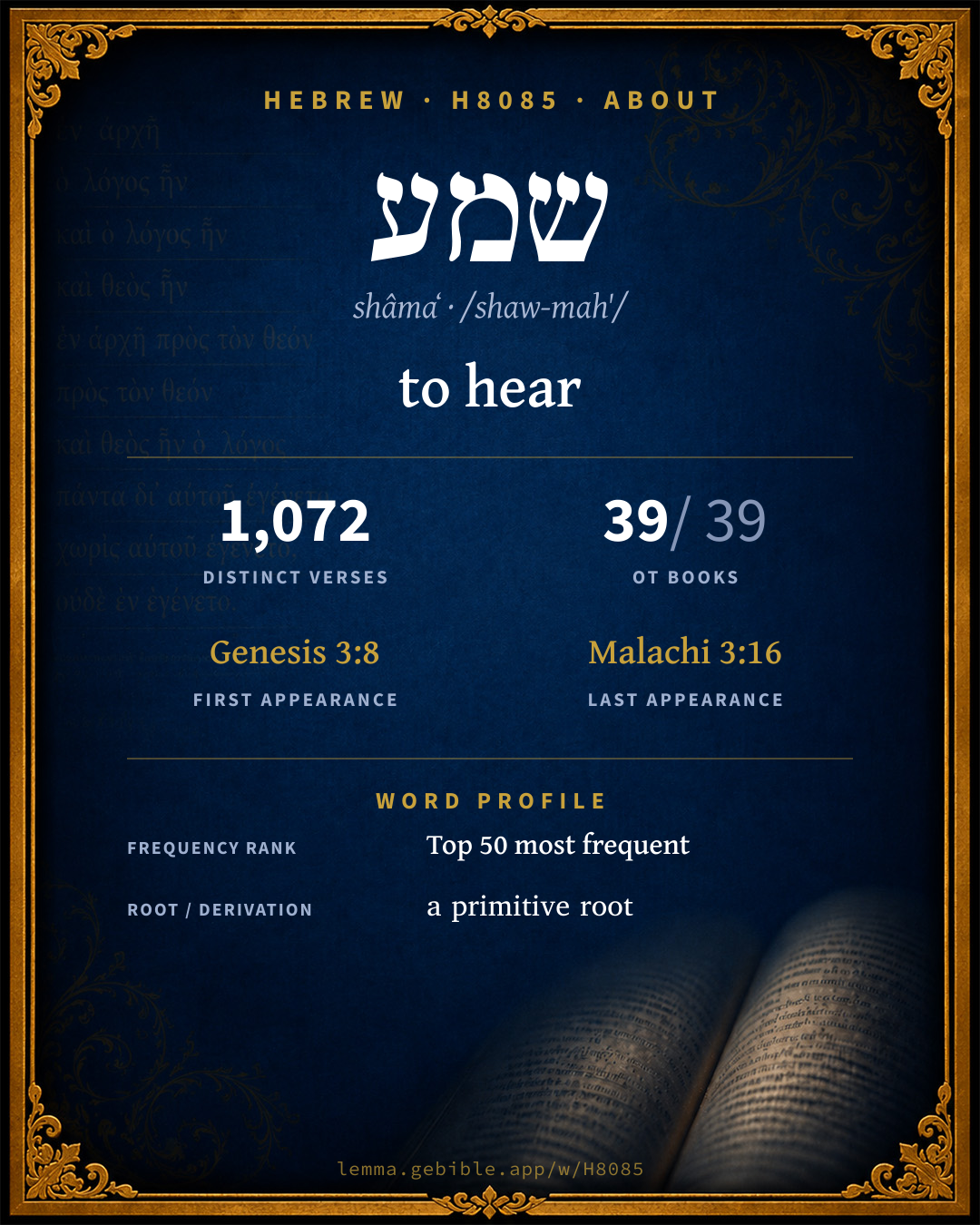
שָׁמַע
to hear
also: listen to, obey fuller range ↓
Full lexicon entry — Brown-Driver-Briggs (BDB)
From Brown-Driver-Briggs (BDB)
Where this word appears
See every Qal verb in the Hebrew Bible →
Grammar key — what these labels mean
Part of speech
- Verb
- An action or state-of-being word.
Stem
- Qal
- The basic, simple active stem — the plain form of the verb (“he wrote”). Here: ‘subj. pers. hum.’
- Niphal
- Usually the simple passive or reflexive of the Qal (“he was written”). Here: ‘be heard’
- Hiphil
- The causative active stem (“he caused / brought about”). Here: ‘of man’
- Piel
- An intensive or resultative active stem.
Form
- Imperative
- A direct command (“write!”).
- Sequential Imperfect
- An imperfect with prefixed waw — the standard past-narrative form (waw-consecutive imperfect).
- Infinitive Construct
- A bound verbal noun, frequently with prepositions (“to write / in writing”).
- Perfect
- A completed action or state — Hebrew marks aspect (completeness) more than strict tense (“he wrote”).
- Imperfect
- An incomplete, ongoing, or future action (“he will / would write”).
- Participle Active
- A verbal adjective expressing ongoing or characteristic action (“writing / one who writes”).
- Sequential Perfect
- A perfect with prefixed waw continuing a preceding imperfect or command (waw-consecutive perfect).
- Infinitive Absolute
- An unbound verbal noun, often intensifying or standing in for a finite verb.
- Jussive
- A third- or second-person volitional form expressing wish or command (“let him write”).
- Cohortative
- A first-person volitional form expressing wish or resolve (“let me / let us write”).
- Participle Passive
- A verbal adjective expressing action received (“written”).
State
- Absolute
- The independent form of a noun, not bound to a following word.
- Construct
- A noun bound to a following noun in a possessive / “of” relationship (the construct chain).
Person
- 2nd Person
- The one addressed (“you”).
- 3rd Person
- The one spoken about (“he / she / it / they”).
- 1st Person
- The speaker (“I / we”).
Gender
- Masculine
- Grammatically masculine.
- Common
- Either gender — not distinguished for this form.
- Feminine
- Grammatically feminine.
Number
- Plural
- More than one (in Hebrew, generally three or more).
- Singular
- One.
54 verses where H8085 appears in the Qal stem in the Book of 1 Kings. Filtered view — show all forms. Click any verse to open its interlinear word-by-word view. Verse text shown in the World English Bible for context — . Each verse’s Hebrew form is shown with its reference; the English is not keyword-highlighted, since the data carries no word-level English alignment. Use “Compare translations” on any verse to read it across multiple English versions. This concordance covers the Hebrew Bible; Septuagint (Greek Old Testament) occurrences are not indexed here.
1 Kings
- 1 Kings 1:11 שָׁמַ֔עַתְּ Qal pf 2fs Then Nathan spoke to Bathsheba the mother of Solomon, saying, Haven't you heard that Adonijah the son of Haggith reigns, and David our lord doesn't know it?
- 1 Kings 1:41 וַ/יִּשְׁמַ֣ע וַ/יִּשְׁמַ֤ע conj + Qal wimpf 3ms conj + Qal wimpf 3ms Adonijah and all the guests who were with him heard it as they had made an end of eating. When Joab heard the sound of the trumpet, he said, Why is this noise of the city being in an uproar?
- 1 Kings 1:45 שְׁמַעְתֶּֽם Qal pf 2mp and Zadok the priest and Nathan the prophet have anointed him king in Gihon; and they are come up from there rejoicing, so that the city rang again. This is the noise that you have heard.
- 1 Kings 2:42 שָׁמָֽעְתִּי Qal pf 1cs The king sent and called for Shimei, and said to him, Didn't I adjure you by Yahweh, and protest to you, saying, Know for certain, that on the day you go out, and walk abroad any where, you shall surely die? and you said to me, The saying that I have heard is good.
- 1 Kings 3:9 שֹׁמֵ֨עַ֙ Qal ptcp.act ms Give your servant therefore an understanding heart to judge your people, that I may discern between good and evil; for who is able to judge this your great people?
- 1 Kings 3:11 לִ/שְׁמֹ֥עַ prep + Qal inf.cs God said to him, Because you have asked this thing, and have not asked for yourself long life, neither have asked riches for yourself, nor have asked the life of your enemies, but have asked for yourself understanding to discern justice;
- 1 Kings 3:28 וַ/יִּשְׁמְע֣וּ conj + Qal wimpf 3mp All Israel heard of the judgment which the king had judged; and they feared the king: for they saw that the wisdom of God was in him, to do justice.
- 1 Kings 4:34 לִ/שְׁמֹ֕עַ שָׁמְע֖וּ prep + Qal inf.cs Qal pf 3cp There came of all peoples to hear the wisdom of Solomon, from all kings of the earth, who had heard of his wisdom.
- 1 Kings 5:1 שָׁמַ֔ע Qal pf 3ms Hiram king of Tyre sent his servants to Solomon; for he had heard that they had anointed him king in the room of his father: for Hiram was ever a lover of David.
- 1 Kings 5:7 כִּ/שְׁמֹ֧עַ prep + Qal inf.cs It happened, when Hiram heard the words of Solomon, that he rejoiced greatly, and said, Blessed be Yahweh this day, who has given to David a wise son over this great people.
- 1 Kings 5:8 שָׁמַ֕עְתִּי Qal pf 1cs Hiram sent to Solomon, saying, I have heard [the message] which you have sent to me: I will do all your desire concerning timber of cedar, and concerning timber of fir.
- 1 Kings 8:28 לִ/שְׁמֹ֤עַ prep + Qal inf.cs Yet have respect for the prayer of your servant, and for his supplication, Yahweh my God, to listen to the cry and to the prayer which your servant prays before you this day;
- 1 Kings 8:29 לִ/שְׁמֹ֨עַ֙ prep + Qal inf.cs that your eyes may be open toward this house night and day, even toward the place of which you have said, My name shall be there; to listen to the prayer which your servant shall pray toward this place.
- 1 Kings 8:30 וְ/שָׁ֨מַעְתָּ֜ תִּשְׁמַ֞ע וְ/שָׁמַעְתָּ֖ conj + Qal wpf 2ms Qal impf 2ms conj + Qal wpf 2ms Listen you to the supplication of your servant, and of your people Israel, when they shall pray toward this place: yes, hear in heaven, your dwelling-place; and when you hear, forgive.
- 1 Kings 8:32 תִּשְׁמַ֣ע Qal impf 2ms then hear you in heaven, and do, and judge your servants, condemning the wicked, to bring his way on his own head, and justifying the righteous, to give him according to his righteousness.
- 1 Kings 8:34 תִּשְׁמַ֣ע Qal impf 2ms then hear you in heaven, and forgive the sin of your people Israel, and bring them again to the land which you gave to their fathers.
- 1 Kings 8:36 תִּשְׁמַ֣ע Qal impf 2ms then hear in heaven, and forgive the sin of your servants, and of your people Israel, when you teach them the good way in which they should walk; and send rain on your land, which you have given to your people for an inheritance.
- 1 Kings 8:39 תִּשְׁמַ֨ע Qal impf 2ms then hear in heaven, your dwelling-place, and forgive, and do, and render to every man according to all his ways, whose heart you know; (for you, even you only, know the hearts of all the children of men;)
- 1 Kings 8:42 יִשְׁמְעוּ/ן֙ Qal impf 3mp + sfx n (for they shall hear of your great name, and of your mighty hand, and of your outstretched arm); when he shall come and pray toward this house;
- 1 Kings 8:43 תִּשְׁמַ֤ע Qal impf 2ms hear in heaven, your dwelling-place, and do according to all that the foreigner calls to you for; that all the peoples of the earth may know your name, to fear you, as does your people Israel, and that they may know that this house which I have built is called by my name.
- 1 Kings 8:45 וְ/שָׁמַעְתָּ֙ conj + Qal wpf 2ms then hear in heaven their prayer and their supplication, and maintain their cause.
- 1 Kings 8:49 וְ/שָׁמַעְתָּ֤ conj + Qal wpf 2ms then hear you their prayer and their supplication in heaven, your dwelling-place, and maintain their cause;
- 1 Kings 8:52 לִ/שְׁמֹ֣עַ prep + Qal inf.cs that your eyes may be open to the supplication of your servant, and to the supplication of your people Israel, to listen to them whenever they cry to you.
- 1 Kings 9:3 שָׁ֠מַעְתִּי Qal pf 1cs Yahweh said to him, I have heard your prayer and your supplication, that you have made before me: I have made this house holy, which you have built, to put my name there forever; and my eyes and my heart shall be there perpetually.
- 1 Kings 10:1 שֹׁמַ֛עַת Qal ptcp.act fs When the queen of Sheba heard of the fame of Solomon concerning the name of Yahweh, she came to prove him with hard questions.
- 1 Kings 10:6 שָׁמַ֖עְתִּי Qal pf 1cs She said to the king, It was a true report that I heard in my own land of your acts, and of your wisdom.
- 1 Kings 10:7 שָׁמָֽעְתִּי Qal pf 1cs However I didn't believe the words, until I came, and my eyes had seen it: and, behold, the half was not told me; your wisdom and prosperity exceed the fame which I heard.
- 1 Kings 10:8 הַ/שֹּׁמְעִ֖ים ptcl def.art + Qal ptcp.act mp Happy are your men, happy are these your servants, who stand continually before you, [and] who hear your wisdom.
- 1 Kings 10:24 לִ/שְׁמֹ֨עַ֙ prep + Qal inf.cs All the earth sought the presence of Solomon, to hear his wisdom, which God had put in his heart.
- 1 Kings 11:21 שָׁמַ֣ע Qal pf 3ms When Hadad heard in Egypt that David slept with his fathers, and that Joab the captain of the host was dead, Hadad said to Pharaoh, Let me depart, that I may go to my own country.
- 1 Kings 11:38 תִּשְׁמַע֮ Qal impf 2ms It shall be, if you will listen to all that I command you, and will walk in my ways, and do that which is right in my eyes, to keep my statutes and my commandments, as David my servant did; that I will be with you, and will build you a sure house, as I built for David, and will give Israel to you.
- 1 Kings 12:2 כִּ/שְׁמֹ֣עַ prep + Qal inf.cs It happened, when Jeroboam the son of Nebat heard of it (for he was yet in Egypt, where he had fled from the presence of king Solomon, and Jeroboam lived in Egypt,
- 1 Kings 12:15 שָׁמַ֥ע Qal pf 3ms So the king didn't listen to the people; for it was a thing brought about of Yahweh, that he might establish his word, which Yahweh spoke by Ahijah the Shilonite to Jeroboam the son of Nebat.
- 1 Kings 12:16 שָׁמַ֣ע Qal pf 3ms When all Israel saw that the king didn't listen to them, the people answered the king, saying, What portion have we in David? neither have we inheritance in the son of Jesse: to your tents, Israel: now see to your own house, David. So Israel departed to their tents.
- 1 Kings 12:20 כִּ/שְׁמֹ֤עַ prep + Qal inf.cs It happened, when all Israel heard that Jeroboam was returned, that they sent and called him to the congregation, and made him king over all Israel: there was none who followed the house of David, but the tribe of Judah only.
- 1 Kings 12:24 וַ/יִּשְׁמְעוּ֙ conj + Qal wimpf 3mp Thus says Yahweh, You shall not go up, nor fight against your brothers the children of Israel: return every man to his house; for this thing is of me. So they listened to the word of Yahweh, and returned and went their way, according to the word of Yahweh.
- 1 Kings 13:4 כִ/שְׁמֹ֨עַ prep + Qal inf.cs It happened, when the king heard the saying of the man of God, which he cried against the altar in Bethel, that Jeroboam put forth his hand from the altar, saying, Lay hold on him. His hand, which he put forth against him, dried up, so that he could not draw it back again to him.
- 1 Kings 13:26 וַ/יִּשְׁמַ֣ע conj + Qal wimpf 3ms When the prophet who brought him back from the way heard of it, he said, It is the man of God, who was disobedient to the mouth of Yahweh: therefore Yahweh has delivered him to the lion, which has torn him, and slain him, according to the word of Yahweh, which he spoke to him.
- 1 Kings 14:6 כִ/שְׁמֹ֨עַ prep + Qal inf.cs It was so, when Ahijah heard the sound of her feet, as she came in at the door, that he said, Come in, you wife of Jeroboam; why feign you yourself to be another? for I am sent to you with heavy news.
- 1 Kings 15:20 וַ/יִּשְׁמַ֨ע conj + Qal wimpf 3ms Ben Hadad listened to king Asa, and sent the captains of his armies against the cities of Israel, and struck Ijon, and Dan, and Abel Beth Maacah, and all Chinneroth, with all the land of Naphtali.
- 1 Kings 15:21 כִּ/שְׁמֹ֣עַ prep + Qal inf.cs It happened, when Baasha heard of it, that he left off building Ramah, and lived in Tirzah.
- 1 Kings 16:16 וַ/יִּשְׁמַ֤ע conj + Qal wimpf 3ms The people who were encamped heard say, Zimri has conspired, and has also struck the king: therefore all Israel made Omri, the captain of the host, king over Israel that day in the camp.
- 1 Kings 17:22 וַ/יִּשְׁמַ֥ע conj + Qal wimpf 3ms Yahweh listened to the voice of Elijah; and the soul of the child came into him again, and he revived.
- 1 Kings 19:13 כִּ/שְׁמֹ֣עַ prep + Qal inf.cs It was so, when Elijah heard it, that he wrapped his face in his mantle, and went out, and stood in the entrance of the cave. Behold, there came a voice to him, and said, What are you doing here, Elijah?
- 1 Kings 20:8 תִּשְׁמַ֖ע Qal juss 2ms All the elders and all the people said to him, Don't you listen, neither consent.
- 1 Kings 20:12 כִּ/שְׁמֹ֨עַ֙ prep + Qal inf.cs It happened, when [Ben Hadad] heard this message, as he was drinking, he and the kings, in the pavilions, that he said to his servants, Set [yourselves in array]. They set [themselves in array] against the city.
- 1 Kings 20:25 וַ/יִּשְׁמַ֥ע conj + Qal wimpf 3ms and number you an army, like the army that you have lost, horse for horse, and chariot for chariot; and we will fight against them in the plain, and surely we shall be stronger than they. He listened to their voice, and did so.
- 1 Kings 20:31 שָׁמַ֔עְנוּ Qal pf 1cp His servants said to him, See now, we have heard that the kings of the house of Israel are merciful kings: let us, we pray you, put sackcloth on our loins, and ropes on our heads, and go out to the king of Israel: peradventure he will save your life.
- 1 Kings 20:36 שָׁמַ֨עְתָּ֙ Qal pf 2ms Then said he to him, Because you have not obeyed the voice of Yahweh, behold, as soon as you are departed from me, a lion shall kill you. As soon as he was departed from him, a lion found him, and killed him.
- 1 Kings 21:15 כִּ/שְׁמֹ֣עַ prep + Qal inf.cs It happened, when Jezebel heard that Naboth was stoned, and was dead, that Jezebel said to Ahab, Arise, take possession of the vineyard of Naboth the Jezreelite, which he refused to give you for money; for Naboth is not alive, but dead.
- 1 Kings 21:16 כִּ/שְׁמֹ֥עַ prep + Qal inf.cs It happened, when Ahab heard that Naboth was dead, that Ahab rose up to go down to the vineyard of Naboth the Jezreelite, to take possession of it.
- 1 Kings 21:27 כִ/שְׁמֹ֨עַ prep + Qal inf.cs It happened, when Ahab heard those words, that he tore his clothes, and put sackcloth on his flesh, and fasted, and lay in sackcloth, and went softly.
- 1 Kings 22:19 שְׁמַ֣ע Qal impv 2ms [Micaiah] said, Therefore hear you the word of Yahweh: I saw Yahweh sitting on his throne, and all the host of heaven standing by him on his right hand and on his left.
- 1 Kings 22:28 שִׁמְע֖וּ Qal impv 2mp Micaiah said, If you return at all in peace, Yahweh has not spoken by me. He said, Hear, you peoples, all of you.
About this entry
At a glance — auto-summarized from this page’s data, not written by a person. Every figure links to its source below. This summary describes the numbers; it doesn’t interpret them.
שמע (shâmaʻ) is a Hebrew word most often rendered “to hear.” Translators differ — “hear” in the King James Version, then “listen” (unfoldingWord Literal Text), as the renderings breakdown shows. It turns up in 1,072 verses across 39 books, one of the most common footprint. It first appears in Genesis 3:8. It also covers “listen to” and “obey”, alongside “to hear” — see its full sense range. The sections below give every sense, occurrence, and version rendering.
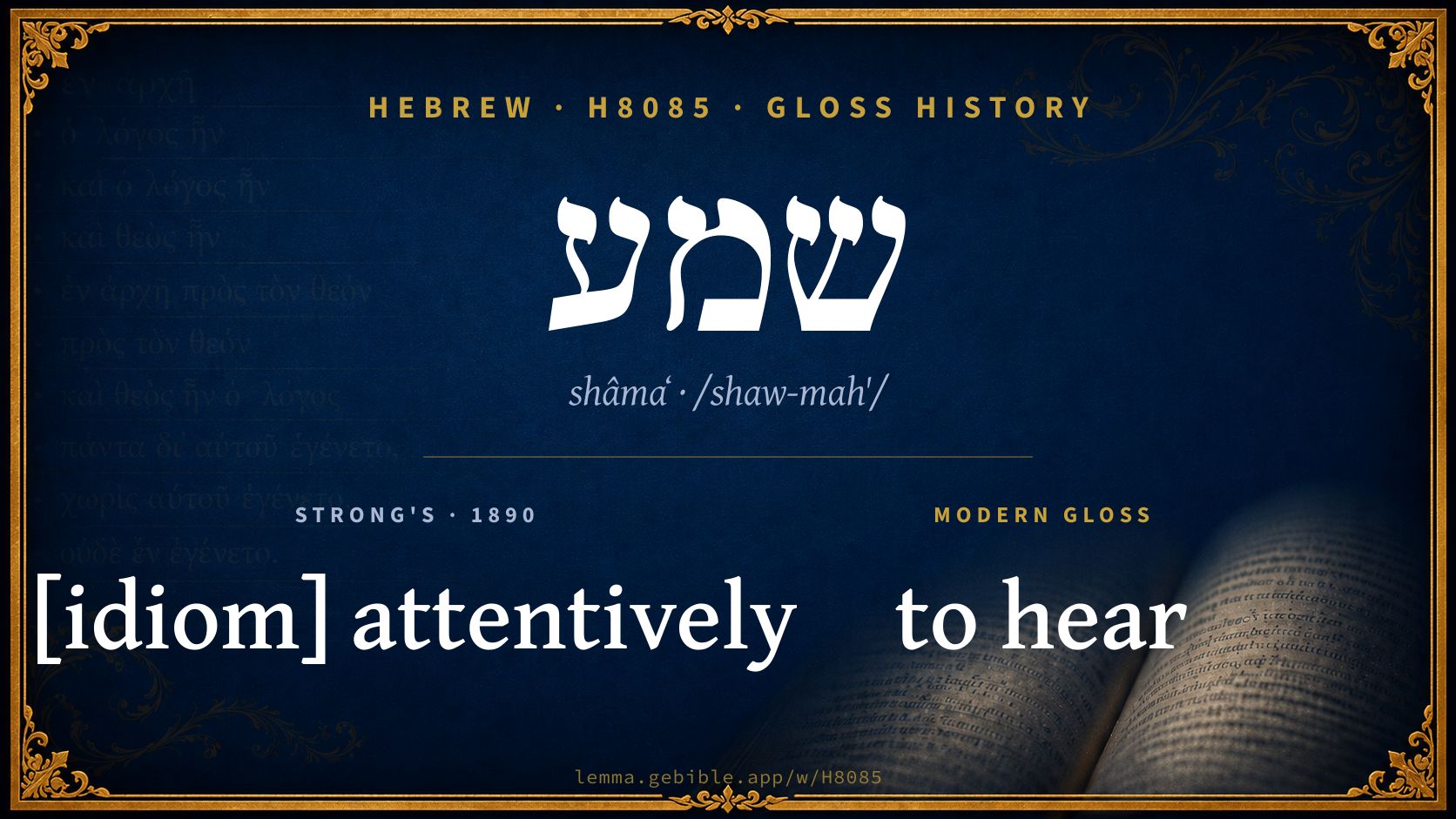
Gloss history
Strong's 1890 vs modern scholarship
About this word
Strong's H8085 catalogs a Hebrew word from the Hebrew Old Testament.
These counts are not copied from any lexicon or concordance. They are computed here, from the morphology-tagged Hebrew Old Testament. What Lemma adds →
- 1,072
- distinct verses
- The word appears in 1,072 distinct verses.
- 39 / 39
- OT books
- The word appears in 39 of 39 Old Testament books.
- #32
- by frequency
- Top 50 most frequent Hebrew words (rank 32 of 8,640 Hebrew words by occurrence).
View all 1,072 occurrences in the concordance →
Most concentrated in
- Jeremiah 168 verses 16%
- Isaiah 95 verses 9%
- Deuteronomy 82 verses 8%
By section of the Old Testament
By traditional corpus
Conventional, traditional groupings — biblical authorship is debated, so this is a traditional corpus grouping, not an authorship claim. Each share is this word’s portion of its verses in that division of the Hebrew canon. Each figure is a share of the word’s 1,072 distinct verses.
- Prophets (Nevi'im) 583 verses · 54%
- Writings (Ketuvim) 267 verses · 25%
- Torah (Pentateuch) 222 verses · 21%
How translations render this word
Counts come from each version’s own published word-to-Strong’s tagging or interlinear alignment — an approximate guide to how each version renders this word, not a word-level alignment the data otherwise carries. Because each total is that version’s own tagged count, the per-version totals vary from one another and need not match the appearance or distinct-verse counts above. These counts may also differ from a printed concordance because Lemma counts each distinctly tagged rendering and does not collapse phrase taggings into a single head-word total. This is a fixed set of word-tagged versions (KJV, ASV, BSB, ULT) and does not change with the reading translation you choose elsewhere. Each version’s license is shown beside its name below (and on Sources).
BDB lists this Strong’s number as 3 distinct words (homographs). Each count above pools all of them and is not split by sense — see the Senses section below. A low-frequency rendering may belong to a different one of those words, not the primary meaning.
- King James Version†: Hear 202×, Heard 142×, Hearken 58×
- American Standard Version†: Hear 173×, Heard 114×, Hearken 48×
- Berean Standard Bible†: Hear 169×, Listen 167×, Heard 114×
- unfoldingWord Literal Text†: Listen 189×, Hear 182×, Heard 163×
King James Version Public Domain
Renders H8085 across 1,160† tagged occurrences — most commonly:
Plus other, less common renderings. Plus 264 renderings that appear only once — usually multi-word phrases or single function words the recovered tagging swept in, not distinct renderings. Not rendered by a distinct English word in 1 further occurrence.
American Standard Version Public Domain
Renders H8085 across 1,157† tagged occurrences — most commonly:
Plus other, less common renderings. Plus 300 renderings that appear only once — usually multi-word phrases or single function words the recovered tagging swept in, not distinct renderings.
Berean Standard Bible Public Domain
Renders H8085 across 1,133† tagged occurrences — most commonly:
Plus other, less common renderings. Plus 202 renderings that appear only once — usually multi-word phrases or single function words the recovered tagging swept in, not distinct renderings. Not rendered by a distinct English word in 26 further occurrences.
unfoldingWord Literal Text CC BY-SA 4.0
Renders H8085 across 1,441† tagged occurrences — most commonly:
Plus other, less common renderings. Plus 145 renderings that appear only once — usually multi-word phrases or single function words the recovered tagging swept in, not distinct renderings.
41 senses and sub-senses in the full BDB
Hebrew verbs can shift meaning by stem (binyan): Qal is the basic action, Niphal is often passive or reflexive, Piel often intensifies or makes it factitive, and Hiphil is typically causative. The senses below are grouped under the stem BDB assigns to each.
What do BDB’s symbols mean?
BDB uses these scholarly abbreviations:
| Symbol | Meaning |
|---|---|
| 𝔊 | the Septuagint (the ancient Greek translation, LXX) |
| 𝔙 | the Vulgate (the Latin translation) |
| 𝔖 | the Syriac version (the Peshitta) |
| 𝔗 | the Targum (the Aramaic translation) |
| ψ | the Psalms |
| √ | root (the underlying root or stem) |
| ‖ | parallel passage (a synonymous or contrasted parallel) |
| † | the dagger: every passage where the word occurs is cited |
The 41 senses and sub-senses the full Brown-Driver-Briggs lexicon distinguishes for this word, in lexicon order (not ranked by frequency), with BDB’s own verbatim wording and sub-sense lettering. Shown in Hebrew script with BDB’s own scholarly abbreviations. The condensed entry is in the Lexicon Entry tab. See also the Forms in the corpus table below.
שמע I hear (NH id.
Qal
- Pf. 3 ms. שׁ׳ Gn 24:52 +, שָׁמֵ֑עַ Je 36:13 + 3 times; 2 fs. שָׁמַעַתְּ 1 K 1:11 + 2 times; 3 pl. שָׁמֵ֑עוּ Ju 2:17 + 12 times; Impf. 3 ms. יִשְׁמַע Ex 6:30 +, 1 s. cohort. אֶשִׁמְעָה Nu 9:8, וָאֶשְׁמֳעָה (on—ֳ cf. Ges§ 10 h; Ol § 65 c. qu. reading) Dn 8:13; 2 mpl. תִּשְׁמְע֔וּן Dt 8:20 +, תִּשְׁמָע֔וּן Dt 1:17, etc.; Imv. ms. שְׁמַע Am 7:16 +, שִׁמְעָה Jb 32:10 + (especially ψψ), שְׁמָ֮עָה֮ Dn 9:19; fpl. שְׁמַ֫עְנָה Is 32:9; Je 9:19, שְׁמַ֫עַן Gn 4:23 (Ges§ 46 f), etc.; Inf. abs. שָׁמוֹעַ Is 6:9 +; cstr. שְׁמֹעַ 1 S 15:22 +; sf. שָׁמְעוֹ Dt 29:18 +, שָׁמְעָתוֹ Is 30:19 (Ges§ 45 d), etc.; Pt. שֹׁמֵעַ Gn 42:23 +; f. שֹׁמַ֫עַת Gn 18:10 +, etc.;— e.g. Genesis 24:52
- 1. subj. pers. hum. (vel rei personif.):
- a. hear (perceive by ear), acc. rei, especially קוֹל Gn 3:10 (J) + 46 times, דבר(ים) Am 8:11 + 50 times, etc.; acc. חָכְמָה i.e. wise sayings 1 K 5:14 + 4 times; any utterance or sound (c. 150 times) + (obj. om.) Dt 4:33 + 32 times + (cl. temp.) 1 S 14:27 + 6 times; c. ב 1 S 14:6, שׁ׳ בְּסוֹד י׳ Jb 15:8; 26:14; 37:2; c. obj. cl., כִּי Ex 4:31 + 52 times + Is 39:1b (read כִּי שׁ׳ 𝔊 𝔖 ‖ 2 K 20:12), אֶת־אֲשֶׁר Jos 2:10; 5:1 (both RD),—ֹֹמַה־ Ju 7:11 + 3 times; without connect. שׁ׳ אֹתָהּ עָשִׂיתִי †2 K 19:25 = Is 37:26; sq. orat. rect. †Is 40:28; Zc 8:23. e.g. Genesis 3:10
- b. acc. pers. + מְדַבֵּר hear one speaking Gn 27:6 (J), Je 26:7; Dn 8:13, so בֹּכֶה Nu 11:10 (J), נִבָּא Je 20:1, מְקַלְלֶ֑ךָ Ec 7:21; occas. pers. om., דֹּבְרִים Gn 37:17 (JE), אֶת־מִדַּבֵּר Ez 2:2; 43:6 (v. דבר Hithp.); acc. pers. only Dn 12:7. e.g. Genesis 27:6
- c. c. לֵאמֹר only, hear say = hear it said, 1 S 13:4; 2 S 19:3; Dt 13:13; Jos 22:11 (P), 1 K 16:16; + עַל pers. concerning Gn 41:15 (E), Is 37:9; אֶל pers. id. 2 K 19:9. e.g. 1 Samuel 13:4
- d. hear of, concerning: (1) acc. rei, אֵת (כָּל־)אֲשֶׁר Ex 18:1; 2 K 19:11 + 5 times, דבר(ים) 1 S 3:11 + 4 times, רָעָה Je 19:3 + 5 times, etc.; כַּאֲשֶׁר 1 S 23:11 ψ 48:9, כָּזֹאת Is 66:8 hear of anything like this, כָּאֵלֶּה Je 18:13; acc., etc., om. Ju 9:46 + 43 times; (2) less often acc. pers. Jb 42:5, אֶל pers. Ez 19:4, pers. om. Dt 9:2; c. ב pers. hear exultantly of their fate †ψ 92:12 (prob. imitated from ‖ הִבִּיט בְּ v a; v. especially ראה 8 a (6)). e.g. Exodus 18:1
- e. hear, abs., = have power to hear, 2 S 19:36 (c. בְּקוֹל), Is 21:3; 32:3; Pr 20:12; Zc 7:11; in sim. ψ 38:15; c. neg. of idols Dt 4:28 ψ 115:6; fig. (spiritual power) Je 5:21; Dt 29:3; Ez 12:2; Is 42:20.—Pr 21:28 is probably corrupt, v. Toy. e.g. 2 Samuel 19:36
- f. hear with attention, interest, listen to (sometimes ‖ הֶאֱזִין, הִקְשִׁיב), acc. דבר(ים) (54 times) Am 4:1 +, especially דבר(י) י׳ Nu 12:6 (JE) + 45 times; אִמְרָה Is 28:23, קוֹל v 23, זֹאת Mi 3:9, etc.; often abs. Ju 5:3 + 57 times, + (neg.) ψ 38:14 pay no attention; abs. לֵב שֹׁמֵעַ 1 K 3:9, אִישׁ שֹׁמֵעַ Pr 21:28. e.g. Amos 4:1
- g. understand (language), שָׂפָה Gn 11:7 (J), Is 33:19, לָשׁוֹן Dt 28:49, דְּבָרִים Ez 3:6, מַה־יְּדַבֵּר Je 5:15, no acc. Gn 42:23 (E), 2 K 18:26 = Is 36:11. e.g. Genesis 11:7
- h. specif. of hearing a (judicial) case, דָּבָר Dt 1:17, cf. v 17; acc. om. בֵּין pers. v 16, of י׳ Ju 11:10; c. מִשְׁפָּט 1 K 3:11; לִשׁ׳ הַטּוֹב וְהָרֵע 2 S 14:17, וְשֹׁמֵע אֵין לְךָ 15:3, cf. Jb 31:35. e.g. Deuteronomy 1:17
- i. c. acc. pers. in polite address, hear us (me)! Gn 23:6, 8, 11, 13, 15 (all P), 1 Ch 28:2; 2 Ch 13:4; 15:2; 20:20. e.g. Genesis 23:6
- j. listen, give heed (sometimes ‖ הִקְשִׁיב), abs., Gn 42:21 (E) + 18 times, + (usually ‖ הִטָּה אֹזֶן), Je 7:13 + 14 times Je, + (opp. חָדַל) Ez 2:5 + 3 times Ez; + שִׂים עַל־לֵב Mal 2:2; hear + do Dt 5:24; 2 K 18:12, etc.; = consent, agree, Gn 37:27 (J), grant request Ju 11:17; c. ל pers. (mostly late) Ju 19:25; 1 S 30:24; Jb 15:17 + 16 times, לי׳ Ho 9:17; Lv 26:14, 18, 21, 27; לְדִבְרֵי י׳ 1 S 15:1, לְעֵצָה Pr 12:15. k. c. אֶל pers. + listen to, yield to Gn 49:2; Ju 2:17 + 69 times (אֶל־י׳ 15 times, especially Je 7:26 + 10 times Je), עַל pers. 2 K 20:13; אֶל־דִּבְרֵי etc., Dt 18:19; Je 29:19 + 14 times, עַל־דִּבְרֵי etc., 2 K 22:13 + 3 times; very rarely acc. rei 1 S 24:10 (Gi v 9). l. שׁ׳ לְקוֹל = id., obey, Gn 3:17 (J) + 11 times + (לְקוֹל י׳) Ju 2:20; Ex 15:26 (JE). m. very often, שׁ׳ בְּקוֹל = obey 1 S 8:7 + 25 times, + שׁ׳ בְּקוֹל י׳ (י׳’s word, etc.) Dt 4:30; Je 3:13 + 65 times (Dt 18 times, Je 18 times). n. obey, c. acc. דבר(ים) Jos 1:18 + 2 times + (ד׳ י׳) Je 11:3 + 5 times Je, 1 K 12:24 = 2 Ch 11:4, etc.; acc. pers. Ex 6:12 (P), 2 Ch 28:11. o. abs. be obedient (especially to י׳) Is 1:19; Mi 5:14; Je 12:17 + 4 times Je + 7 times. e.g. Genesis 42:21
- 2. י׳ (God) subj.:
- a. acc. קוֹל, דברים, etc., Gn 21:17 (E), 2 K 19:4(×2), 16, usually with favour implied Nu 20:16; Dt 33:7 +, so especially acc. תְּפִלָּה, תְּחִנָּה, etc., 1 K 8:45 ψ 6:10 +. e.g. Genesis 21:17
- b. obj. cl. כִּי Gn 29:33 (J). e.g. Genesis 29:33
- c. no obj. (32 times) Is 59:2; Je 22:21, usually hear and forgive, help, etc., 1 K 8:30, 32; Is 30:19 +; hear and be angry ψ 78:59, cf. 55:20. e.g. Isaiah 59:2
- d. = be able to hear Is 59:1 ψ 94:9. e.g. Isaiah 59:1
- e. שׁ׳ בְּקוֹל = hear (and grant) Gn 30:6 (J) + 6 times. e.g. Genesis 30:6
- f. hear and answer, c. אֶל of cry, etc., Gn 21:17; 16:11 1 K 8:28 + 8 times; c. אֶל pers. Dt 3:26 + 12 times. e.g. Genesis 21:17
- g. c. לְ of utterance Je 18:19 ψ 61:6; ל pers. Jos 24:10 (E). e.g. Jeremiah 18:19
- h. hear, acc. pers. + מִתְנוֹדֵד Je 31:18; favourably, c. acc. pers. Mi 7:7 + 3 times, so, + ל concerning, Gn 17:20 (P); obj. om. 2 K 22:19 ψ 22:25 + 3 times + ψ 34:7, 18 (hear and deliver); c. cl. temp. Je 11:14. e.g. Jeremiah 31:18
Niphal
- Pf. 3 ms. נִשְׁמַע Gn 45:16 +, etc.; Impf. 3 ms. יִשָּׁמַע Ex 23:13 +, יִשָּׁמֵ֑עַ 1 S 1:13, etc.; Inf. cstr. הִשָּׁמַע Est 2:8; Pt. f. נִשְׁמַ֫עַת Je 51:46, etc.;— e.g. Genesis 45:16
- 1. be heard, of voice, sound, etc., 1 S 1:13; 1 K 6:7; Jb 26:14 (or 1 pl. Qal Impf.?); of a report, נִשׁ׳ … לֵאמֹר Gn 45:16 (E); subj. cl., כִּי, Ne 6:1 (ל pers.), cf. cl. וְהַיְהוּדִים חשְׁבִים Ne 6:6; v 7 be reported, (לַמֶּלֶךְ) כַּדְּבָרִים הָאֵלֶּה; be heard, לִפְנֵי אֱלֹהֶיךָ Dn 10:12. e.g. 1 Samuel 1:13
- 2. be heard of, כָּמֹהוּ Dt 4:32. e.g. Deuteronomy 4:32
- 3. be regarded, obeyed, Ec 9:17; in 2 S 22:45 = ψ 18:45 it is be obedient (לִי), si vera l. (read perhaps Qal, cf. Now). e.g. Ecclesiastes 9:17
- 4. וַיִּשּׁ׳ בְּקוֹלָם 2 Ch 30:27 = (favourable) hearing was granted to their voice. e.g. 2 Chronicles 30:27
Piel
- Impf. 3 ms. וַיְשַׁמַּע 1 S 15:4 he caused the people (acc.) to hear (and respond, i.e. he assembled them), so 23:8 (v. Hiph. 1 d). e.g. 1 Samuel 15:4
Hiphil
- Pf. 3 ms. הִשְׁמִיעַ 1 K 15:22 +, etc.; Impf. 3 ms. sf. יַשְׁמִעֵנִי Dt 30:12, 13; 2 ms. juss. תַּשְׁמַע Ju 18:25, etc.; Imv. ms. sf. הַשְׁמִיעֵנִי ψ 143:8; fs. sf. הַשְׁמִיעִנִי Ct 2:14; 8:13, etc.; Inf. cstr. לַשְׁמִעַ ψ 26:7 (Ges§ 53q); Pt. מַשְׁמִיעַ Je 4:15 +, etc.;— e.g. 1 Kings 15:22
- 1. of man:
- a. cause to hear, acc. pers. + rei Dt 30:12, 13; Ct 2:14; 8:13 + 4 times; obj. rei om. (= make proclamation to) 1 K 15:22; obj. pers. om. Je 5:20 +; acc. שָׁלוֹם †Is 52:7; Na 2:1 i.e. proclaim peace; אָוֶן †Je 4:15 (מִן loc.); הַשׁ׳ קוֹל utter a sound Jos 6:10 (J; ‖ הֵרִיעַ), cf. Ju 18:25 (קוֹלְךָ, + עִמָּנוּ), Is 42:2; 58:4; הִשׁ׳ קוֹל תְּהִלָּתוֹ †ψ 66:8, בְּקוֹל תּוֹדָה †26:7. e.g. Deuteronomy 30:12
- b. abs. as musical term, sound aloud, בִּמְצִלְתַּיִם לְהַשְׁמִיעַ 1 Ch 15:19 (perhaps to mark the time, Gr ψ 67 De: cf. 16:5; also ψ 150:5 בְּצִלְצְלֵי שָׁ֑מַע), מַשְׁמִיעִים 15:16, 28; 16:42, לְהַשׁ׳ קוֹל אֶחָד 2 Ch 5:13 i.e. prob. in unison (PrinceEB iii. 3241), Ne 12:42. e.g. 1 Chronicles 15:19
- c. abs. make proclamation (often ‖ הִגִּיד), Am 3:9; 4:5; Is 41:26; Je 4:5 + 6 times Je. e.g. Amos 3:9
- d. הַשְׁמִיעוּ, acc. pers. + אֶל loc. = summon Je 50:29, עַל loc. 51:27 (cf. Pi.). e.g. Jeremiah 50:29
- 2. י׳ subj.:
- a. cause to hear, acc. pers. et rei Dt 4:10, 36 (מִן loc.), 2 K 7:6 + 4 times; acc. pers. om. Is 30:30 + 3 times; acc. rei om. 44:8; 48:5. e.g. Deuteronomy 4:10
- b. = tell, acc. pers. + כָּזֹאת Ju 13:23; acc. pers. only, Is 42:9; acc. rei only, 48:3; Ez 36:15 (אֵלַיִךְ). e.g. Judges 13:23
- c. abs., make proclamation Is 43:12; 62:11 (אֶל loc.). e.g. Isaiah 43:12
שמע II [m.] sound
שמע III m. usually Σαμα(α), Σεμαα (cf. Sab. n.pr. סמע Hal509)
- 1. in Judah 1 Ch 2:44, שָׁ֑מַע v 43. e.g. 1 Chronicles 2:44
- 2. in Reuben 5:8. e.g. 1 Chronicles 5:8
- 3. in Benj. 8:13 (= שִׁמְעִי v 21). e.g. 1 Chronicles 8:13
- 4. post-ex. Ne 8:4, Σαμαιας. e.g. Nehemiah 8:4
Senses from the full Brown-Driver-Briggs lexicon (Brown, Driver, Briggs; Oxford 1906 — public domain), digitized via Sefaria, supplemented by the OpenScriptures HebrewLexicon (CC BY 4.0). Full attribution on Sources.
Word origin
I. vb. hear (NH id.; Ph. שמע Lzb378; Assyrian šemǔ; Arabic سَمِعَ; Sab. סמע, mostly in deriv., especially epith. div. סמע he who hears HomChr 124 FellZMG iiv (1900), 250, 252 DHMHofmus. No. 10, l. 1; Ethiopic ሰምዐ Aramaic שְׁמַע, ܫܡܰܥ, Old Aramaic שמע Lzb 378; cf. also משמעת MI 28 obedience);—
II. n.pr.m. usually Σαμα(α), Σεμαα (cf. Sab. n.pr. סמע Hal509);—
— Brown-Driver-Briggs (Oxford 1906, public domain), digitized via Sefaria, supplemented by the OpenScriptures HebrewLexicon (CC BY 4.0). See Sources.
Origin: a primitive root
Jastrow Dictionary
A second Hebrew/Aramaic lexicon for comparison, covering Aramaic and post-biblical (Talmudic, Targumic, Midrashic) usage that the biblical-Hebrew BDB does not. Matched by lemma rather than by Strong’s number, so a lemma may carry more than one Jastrow headword (shown separately below), and the entries cover usage well beyond the Bible.
שָׁמַע
- (b. h.) [to be still,] to hear, listen, obey; to understand. R. Hash. IV, 2 כל עיר … ושׁוֹמַעַת וכ׳ every township near Jerusalem from where you can see (the city) and hear (the Shofar) &c. Ib. 21ᵇ עד שיִשְׁמְעוּ … מקודש until they heard from the mouth of the court m’ḳuddash (v. קָרַשׁ). Snh. 90ᵃ שְׁמַע לו listen to him (obey the prophet’s command); אל תִּשְׁמַע לו listen not to him. Keth. 5ᵇ אם יִשְׁמַע וכ׳ if a man hears an improper word &c., v. שָׁפָה II. Ber. 13ᵃ the text (Deut. VI, 4) says ‘hear’ (or ‘understand’), בכל לשון שאתה שׁוֹמֵעַ recite the Sh’mʿa in whatever language you understand. R. Hash. III, 7 אם קול שופר ש׳ if he heard the sound of a Shofar; ואם קול הברה ש׳, v. הֲבָרָה. Y. Hor. I, 46ᵃ top נותנין לו שהות עד שׁיִשְׁמַע we allow him time enough that he may have heard (the decision of the other court), opp. to עד שישמע (not שישפע) (he is not guilty) until he has really heard it; a. v. fr. e.g. Deuteronomy 6:4
- 1. to cause to hear; to announce. Ber. l. c. הַשְׁמַע לאזניך וכ׳ let thy ears hear what thou utterest &c. Ib. לא ה׳ לאזנו if he read the Sh’inʿa inaudibly to himself. R. Hash. 28ᵇ עד שיתכוין שומע ומַשְׁמִיעַ until he that hears (the Shofar) and he that causes to hear (that blows) have the intention to perform a religious act. Shek. I, 1 מַשְׁמִיעִין על השקלים וכ׳ (Y. ed. מְשַׁמְּעִין, Pi.) public announcement is made concerning the contribution of the half-Shekels &c.; a. fr.
- 2. (sub. עצמו) to show one’s self obedient, be persuaded, surrender, v. Nif.
- 1. to announce, v. supra. Y. Shek. I, beg. 45ᶜ; Y. Meg. I, 71ᵃ.
- 2. to assemble for mourning services, invite. Snh. 47ᵃ הלינו לכבודו לשַׁמֵּעַ עליו וכ׳ if burial is postponed for the honor of the dead, to assemble the surrounding townships for his funeral, to bring on lamenting women &c.
- 1. to be heard; to be listened to, be obeyed. Ber. 6ᵃ אין תפלה … נִשְׁמַעַת וכ׳ man’s prayer is heard only in the house of prayer. Y. ib. V, end, 9ᵇ שׁנִשְׁמְעָה תפלתו that his prayer will be heard (his petition be granted). Erub. 18ᵇ כל בית שׁנִשְׁמָעִין וכ׳ a house in which the words of the Law are heard by night will never be destroyed. Yeb. 65ᵇ כשם … דבר הנִשְׁמָע וכ׳ as well as it is proper to say a thing that has been heard (to mention one’s authority), so it is proper not to say a thing that has not been heard (for which you cannot cite your authority); a. fr.
- 2. to show one’s self willing; to submit to authority; (of woman) to surrender. R. Hash. 25ᵇ אשרי הדור שהגדולים נִשְׁמָעִים וכ׳ blessed the generation in which the superiors (in wisdom) submit to the authority of their inferiors, and how much more when inferiors acknowledge the authority of their superiors!—Snh. 82ᵃ הִשָּׁמְעִי לי (ed. הַשְׁמִיעִי לי) surrender thyself to me; לא תִשָּׁמְעִי אלא וכ׳ surrender thyself only to a prominent man among them; Sifré Num. 131; ib. רצונך שׁאֶשָּׁמַע לך הנזר וכ׳ if thou desirest me to surrender myself to thee, renounce the law of Moses; Yalk. ib. 771. Y. Succ. V, 55ᵇ top נִשְׁמָעוֹת … לליגיונותי וכ׳ if you will surrender to my legions, I will not put you to death. Snh. 93ᵃ הַשְׁמִיעִי אל וכ׳ surrender thyself to Zedekiah; a. fr.
שְׁמַע I
- Targ. Gen. XXVII, 5. Targ. Ex. XVIII, 1. Targ. Job IV, 16; a. v. fr.—Part. pass. שְׁמִיעַ; f. שְׁמִיעָא. Targ. Ps. XXIX, 3, sq. Targ. II Chr. VII, 12; a. fr.—Y. Ter. X, 47ᵇ bot. אנא מה דשַׁמְעִית ואינון מה דשַׁמְעוּן I report what I have heard, and they, what they have heard. Sabb. 46ᵇ הא שַׁמְעִינָן ליה לר"ש וכ׳ have we not heard what R. S. says &c.? Y. Sot. VII, beg. 21ᵇ, v. אֲלִנִיסְטִי; a. v. fr.—שמיע ל־ he has heard, he knows of. Erub. 9ᵇ ור"י מי לא ש׳ ליה הא but has R. J. not heard that (does he not know that Boraitha of R. Ḥiya)? ש׳ ליה ולא סבר (v. Rabb. D. S. a. l.) he knows of it, but does not accept it. Ib. 10ᵃ, a. fr. לא ש׳ לי הא שמעתתא this tradition is not known to me. Pes. 34ᵃ מידי ש׳ לך בהא do you know anything about this (hălakhah)?; a. v. fr.—Esp. שמע מ־ to understand from, to infer, prove. Ab. Zar. 72ᵇ, a. fr. ש׳ מינה וכ׳ (abbrev. ש"מ) deduce from this that &c. Ib. שַׁמְעַת מינה וכ׳ wilt thou conclude from this that &c.? Ib., a. fr. אלא מהא ליכא למִשְׁמַע מינה but (the conclusion is,) you can derive nothing from this.—Ib., a. fr. תא שמע (abbrev. ת"ש; v. אֲתָא) come and learn, i.e. derive it from the following. Sabb. 13ᵇ ת"ש … ש"מ ואלו תנן ש"מ I will prove it (from this Tosefta): ‘you must not …, and those are some of the halakhoth &c.’, which proves that the right version is ‘and those’: it stands proved. Y. M. Kat. III, 83ᵃ top נִישְׁמְעִינָהּ מן הדא let us prove it from this; a. v. fr.
- 1. to make music; to sing, v. Af.
- שַׁמְּעָא) to minister to, be an attendant of. Ber. 41ᵇ מאן … ונְשַׁמְּעִינָךְ would that we had iron feet, that we could always wait on thee! Meg. 28ᵇ ניחא לי דאֲשַׁמְּעֵיה למר (Ms. M. דאשתמש ליה למר, v. Rabb. D. S. a. l.) it gives me pleasure to be your servant; a. e.
- 1. to cause to hear, cause to be heard, announce, proclaim. Targ. Deut. IV, 36. Targ. Is. LII, 7. Targ. Ps. XXVI, 7; a. fr.—Esp. (interch. with Pa.) to make music, play; to be a musician. Targ. I Sam. XXIX, 5 (Ms. Pa.). Targ. I Chr. XV, 16. Ib. XVI, 42 מַשְׁמְעַיָּא ed. Lag. (ed. Rahmer משמעייאה, Var. מַשְׁמְעַיָּה; h. text מַשְׁמִיעִים) musicians. Targ. Ps. CL, 5 דמְשַׁמְּעִין לבדוחא Ms. (ed. Lag. דמשמעין בלחודיהון; ed. Wil. a. oth. דשמעין בלחודיהון, corr. acc.). Ib. דמַשְׁ׳ ביבבא (Ms. Pa.).
- 2. to give to understand; to teach, prove. Ber. 2ᵃ מילתא … קא מַשְׁמַע לן וכ׳ (the Tannai in using such an expression) wants to teach us something by the way: when do the priests eat &c.; והא קמשמע לן וכ׳ (abbrev. קמ"ל) and it is this he teaches us, that the sacrifice of atonement is not indispensable &c. Ib. 4ᵇ לאפוקי … קמ"ל דחובה in opposition to the opinion that the evening prayer is optional, he gives us to understand that it is obligatory. Sabb. 19ᵃ מהו דתימא … קמ"ל you may have thought (that the cases are different, because) this devolves upon him, and the other does not, therefore he teaches us (that they are the same). Ib. 108ᵃ מאי קמ"ל what does he teach us (is it not a matter of course)? Ber. 21ᵃ sq. דאי אַשְׁמְעִינָן וכ׳, v. צְרִיךְ; a. v. fr.—Part. pass. מַשְׁמֵע a) understood. Yeb. 102ᵇ מ׳ הכי ומ׳ הכי it may be understood thus (it may mean, ‘to take off’), and may be understood thus (it may mean, ‘to strengthen’); a. fr.—2) inferred, proved; evidence. Sabb. 84ᵇ מאי מ׳ how is this proved (from the verse quoted)? Erub. 65ᵃ מאי מ׳ וכ׳ what evidence is there &c.?, v. פּוּק. Ib. מַשְׁמְעֵי, v. infra; a. fr.—V. מַשְׁמָע.
- 1. to be heard, let one’s self be heard. Targ. Gen. XLV, 16. Targ. Job XXXVII, 4 Ms. (ed. ישמע). Targ. Ps. LXXVII, 19; a. fr.—Snh. 95ᵇ (prov.) אגב אורחך … א׳ on thy road let thy enemy hear from thee, i.e. take revenge when occasion offers. R. Hash. 27ᵃ תרתי … לא מִשְׁתַּמְּעֵי … משתמעי two different sounds produced simultaneously by the same person are not distinctly perceived, but if produced by two persons, they are. Erub. l. c. מכדי קראי מִשְׁתַּמְּעֵי בין למר וכ׳ Ms. M. (ed. משמעי, v. Rabb. D. S. a. l. note) since verses may be quoted in favor of the one as well as of the other, what is the practical difference between them?; a. fr.
- 2. to make one’s self subservient, obey; to surrender to the enemy, desert. Targ. II Kings XXV, 11 (h. text נפלו). Ib. VII, 4. Targ. Ps. XVIII, 45; II Sam. XXII, 45; a. fr. e.g. 2 Samuel 22:45
שְׁמַע II
- (v. Deut. VI, 4) Sh’mʿa, the confession of faith in the morning and evening prayers (recitation of Deut. VI, 4-9; XI, 13-21; Num. XVI, 37-41). Targ. Y. I Num. XXV, 6. Targ. II Esth. III, 8.—Ber. I, 1 מאימתי קורין את ש׳ וכ׳ from what time of the day may we read the Sh’mʿa of the evening prayer? Ib. II, 2 (13ᵃ) למה קדמה (פרשת) ש׳ וכ׳ why does the reading of the section of Sh’mʿa (Deut. VI, 4–9) precede that of v’hayah (ib. XI, 13-21) Ib. בין שניה לש׳ ובין ש׳ וכ׳ between the second benediction and Sh’mʿa (the first section), and between Sh’mʿa and v’hayah &c.; a. fr.—קריאת ש׳ (abbr. ק"ש), v. קְרִיאָה. Ib. 2ᵃ ק"ש דשכיבה the recitation of Sh’mʿa at bed-time. Num. R. s. 2020 עומדין … וחוטפין ק"ש וכ׳ they rise from their sleep like lions, and hasten to read the Sh’mʿa, and proclaim the kingship of the Lord &c. Ib. והוא … בק"ש משומרי וכ׳ and with the recital of the Sh’mʿa he is handed over from the guards of the day to those of the night. Ber. 4ᵇ אע"פ שקרא אדם ק"ש וכ׳ although one has read the Sh. in synagogue, it is proper to recite it again on going to bed. Ib. 5ᵃ אם … ואם לאו יקרא ק"ש if he conquers it (the evil thought), it is well, and if not, let him read the Sh.; a. v. fr. e.g. Deuteronomy 6:4
שֵׁמַע
- 1. report, fame. Deut. R. s. 1, end היו … שומעים שִׁמְעֲכֶם וכ׳ the nations heard of your fame and were afraid; a. e.
- 2. = מִשְׁמָע understanding, meaning. Sifré Num. 142 (ref. to Num. XXVIII, 3) כשִׁמְעוֹ וכ׳ (trad. pronunc. כִּשְׁמָעוֹ) according to its literal meaning, two each day. e.g. Numbers 28:3
שֵׁמַע ²
- , report, fame. Targ. Gen. XXIX, 13. Targ. Ps. XVIII, 45; II Sam. XXII, 45 ed. Lag. (oth. שְׁמוֹעַ, שְׁמוּעַ). Targ. Josh. VI, 27 שִׁמְעֵיה (some ed. שָׁמְ׳); a. e. e.g. 2 Samuel 22:45
A Dictionary of the Targumim, the Talmud Babli and Yerushalmi, and the Midrashic Literature (Marcus Jastrow; London, Luzac, 1903) — Public Domain. Digitized via Sefaria. Digitized via Sefaria. Full attribution on Sources.
Forms in the corpus
The 535 distinct written forms H8085 takes in the Hebrew Bible, most frequent first — each parse links to that stem’s occurrences in the concordance. Hebrew forms include their vowel points and cantillation, so a single lemma takes many written forms.
The 60 most common forms are shown; 475 rarer forms follow in the full concordance.
Same root — word family
Other BDB entries built from the same root as H8085, grouped by Strong’s listed origin. These share a root / origin per the lexicon — not necessarily a shared meaning. Each links to that word’s own entry.
Derived from this word
- השמעות hashmâʻûwth H2045 report
- משמע mishmâʻ H4926 rumor
- שמע shᵉmaʻ H8086 to hear
- שמע shêmaʻ H8088 hearing
- שמע shômaʻ H8089 report
Proper names from this root
People and places named from this root — a name, not an additional meaning of the word.
- אשתמע ʼEshtᵉmôaʻ H851 Eshtemoh
- ישמעאל Yishmâʻêʼl H3458 Ishmael
- ישמעיה Yishmaʻyâh H3460 Ishmaiah
- שמואל Shᵉmûwʼêl H8050 Samuel
- שמע Shâmâʻ H8091 Shama
- שמעון Shimʻôwn H8095 Simeon
- שמעיה Shᵉmaʻyâh H8098 Shemaiah
Compare all same-root words → Showing 4 of 13 — not the complete family. 7 of the same-root words are proper names (people or places). They share a root, not necessarily a meaning.
Septuagint verse parallels
This word appears in 990 verses that also exist in the Greek Old Testament (Septuagint), out of the 1,072 Hebrew verses it occurs in. You can read those verses in Greek by switching the Old Testament edition to the Septuagint.
Read these verses in the Septuagint
- Genesis 3:8
- Exodus 2:15
- Leviticus 5:1
- Numbers 7:89
- Deuteronomy 1:16
- Joshua 1:17
- Judges 2:2
- Ruth 1:6
- 1 Samuel 1:13
- 2 Samuel 3:28
- 1 Kings 1:11
- 2 Kings 3:21
This is a verse-level parallel only — the same verses exist in both the Hebrew and Greek Old Testaments. No word-level Hebrew↔Greek correspondence is claimed: the data carries no such alignment, so no Greek word is shown as this Hebrew word’s translation. Coverage is not total — the Septuagint omits the deuterocanon and renumbers the Psalms, so some Hebrew verses have no direct Greek parallel.