
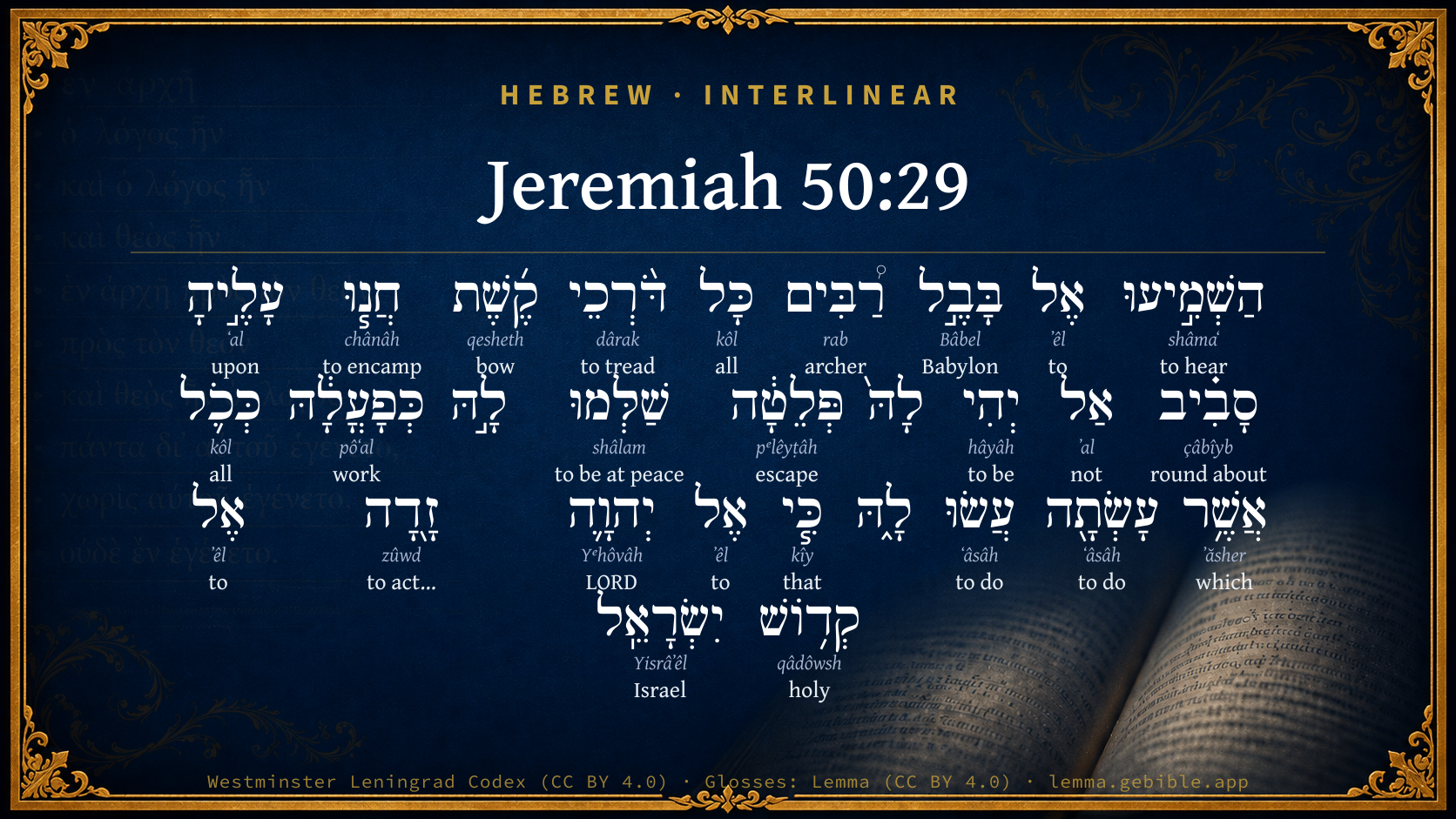
Jeremiah 50:29

Hebrew (Westminster Leningrad Codex) Jeremiah 50:29 appears in the Hebrew Old Testament. The text above is from the Westminster Leningrad Codex. Each word links to its Strong’s number, a concise gloss, and parsing drawn from the Open Scriptures Hebrew Bible morphology. Click any word for its full Brown-Driver-Briggs (BDB) entry.
Download image
Cite this verse

Jeremiah 50:29 (World English Bible). Public Domain. Lemma interlinear Bible study tool, https://lemma.gebible.app/v/jeremiah/50/29.

Show BibTeX & RIS
BibTeX
RIS
English Translation
Call together the archers against Babylon, all those who bend the bow; encamp against her round about; let none of it escape: recompense her according to her work; according to all that she has done, do to her; for she has been proud against Yahweh, against the Holy One of Israel.
World English Bible · Public Domain
Download a study sheet

One document with this verse’s original text, its word-by-word gloss line, the meaning frame, cross-references with their text, attributed commentary, and full source and license credits — printable, and it pastes into notes with its structure intact.

This verse Autodidact and up

Study sheet (.html) Plain text (.txt)

A passage Seminary Student

Up to 50 verses in one chapter. A passage sheet keeps up to 6 commentary sources and 12 cross-references per verse, in the order this page ranks them, and says so on the sheet whenever that leaves anything out. Ask for a single verse and you get the Autodidact verse sheet above.

Everything on this page stays free to read, with no account — the sheet is a download of what is already on screen, not access to it.

Want to remove ads? Support Godless Engineer
Compare translations 3

The same verse in 3 English versions, stacked beneath the original-language interlinear above. Click any original word for its lexicon entry.

Each is an independent rendering of the whole verse — the interlinear is not word-aligned to these translations.

Highlighted words mark where these versions differ — a whole-verse word diff, not a word-by-word alignment.

  • World English Bible Public Domain
    Call together the archers against Babylon, all those who bend the bow; encamp against her round about; let none of it escape: recompense her according to her work; according to all that she has done, do to her; for she has been proud against Yahweh, against the Holy One of Israel.
  • King James Version Public Domain
    Call together the archers against Babylon: all ye that bend the bow, camp against it round about; let none thereof escape: recompense her according to her work; according to all that she hath done, do unto her: for she hath been proud against the LORD, against the Holy One of Israel.
  • unfoldingWord Literal Text CC BY-SA 4.0
    “Summon the archers against Babylon—all those who bend their bows. Camp against her, and let no one escape. Repay her for what she has done. Do to her by the measure she has used. For she had defied Yahweh, the Holy One of Israel.

unfoldingWord Literal Text — © unfoldingWord, licensed CC BY-SA 4.0. Word-aligned USFM3 via Door43 (git.door43.org/unfoldingWord/en_ult).

Versions to compare (up to 4)

3 of 4 selected

Show all 18 translations

Every available English version of this verse, each an independent rendering of the whole verse.

  • World English Bible Public Domain
    Call together the archers against Babylon, all those who bend the bow; encamp against her round about; let none of it escape: recompense her according to her work; according to all that she has done, do to her; for she has been proud against Yahweh, against the Holy One of Israel.
  • Berean Standard Bible Public Domain
    Summon the archers against Babylon, all who string the bow. Encamp all around her; let no one escape. Repay her according to her deeds; do to her as she has done. For she has defied the LORD, the Holy One of Israel.
  • Majority Standard Bible Public Domain
    Summon the archers against Babylon, all who string the bow. Encamp all around her; let no one escape. Repay her according to her deeds; do to her as she has done. For she has defied the LORD, the Holy One of Israel.
  • King James Version Public Domain
    Call together the archers against Babylon: all ye that bend the bow, camp against it round about; let none thereof escape: recompense her according to her work; according to all that she hath done, do unto her: for she hath been proud against the LORD, against the Holy One of Israel.
  • American Standard Version (1901) Public Domain
    Call together the archers against Babylon, all them that bend the bow; encamp against her round about; let none thereof escape: recompense her according to her work; according to all that she hath done, do unto her; for she hath been proud against Jehovah, against the Holy One of Israel.
  • Revised Version (1885) Public Domain
    Call together the archers against Babylon, all them that bend the bow; camp against her round about; let none thereof escape: recompense her according to her work; according to all that she hath done, do unto her: for she hath been proud against the LORD, against the Holy One of Israel.
  • Geneva Bible (1599) Public Domain
    Call vp the archers against Babel: al ye that bend the bow, besiege it rounde about: let none thereof escape: recompence her according to her worke, and according to all that she hath done, doe vnto her: for she hath bene proud against the Lord, euen against the holy one of Israel.
  • Douay-Rheims (1899) Public Domain
    Declare to many against Babylon, to all that bend the bow: stand together against her round about, and let nose escape; pay her according to her work: according to all that she hath done, do ye to her: for she hath lifted up herself against the Lord, against the Holy One of Israel.
  • Young's Literal Translation Public Domain
    Summon unto Babylon archers, all treading the bow, Encamp against her round about, Let `her' have no escape; Recompense to her according to her work, According to all that she did -- do to her, For unto Jehovah she hath been proud, Unto the Holy One of Israel.
  • Literal Standard Version CC BY-SA 4.0
    Summon archers to Babylon, all treading the bow, || Encamp against her all around, || Let [her] have no escape; Repay to her according to her work, || According to all that she did—do to her, || For she has been proud against YHWH, || Against the Holy One of Israel.
  • Unlocked Literal Bible CC BY-SA 4.0
    “Summon the archers against Babylon—all those who bend their bows. Camp against her, and let no one escape. Repay her for what she has done. Do to her by the measure she has used. For she had defied Yahweh, the Holy One of Israel.
  • unfoldingWord Literal Text CC BY-SA 4.0
    “Summon the archers against Babylon—all those who bend their bows. Camp against her, and let no one escape. Repay her for what she has done. Do to her by the measure she has used. For she had defied Yahweh, the Holy One of Israel.
  • Darby Bible Public Domain
    Call together the archers against Babylon, all those that bend the bow: encamp against her round about; let there be no escaping: recompense her according to her work; according to all that she hath done, do unto her: for she hath acted proudly against Jehovah, against the Holy One of Israel.
  • World Messianic Bible Public Domain
    “Call together the archers against Babylon, all those who bend the bow. Encamp against her all around. Let none of it escape. Pay her back according to her work. According to all that she has done, do to her; for she has been proud against the LORD, against the Holy One of Israel.
  • Webster's Bible Public Domain
    Call together the archers against Babylon: all ye that bend the bow, encamp against it on every side; let none thereof escape: recompense her according to her work; according to all that she hath done, do to her: for she hath been proud against the LORD, against the Holy One of Israel.
  • Free Bible Version CC BY-SA 4.0
    Call up the archers to attack Babylon, yes, all of them! Completely surround her—don't let anyone escape. Pay her back for what she's done, because in her pride she defied the Lord, Israel's Holy One.
  • Bible in Basic English Public Domain
    Send for the archers to come together against Babylon, all the bowmen; put up your tents against her on every side; let no one get away: give her the reward of her work; as she has done, so do to her: for she has been uplifted in pride against the Lord, against the Holy One of Israel.
  • JPS Tanakh (1917) Public Domain
    Call together the archers against Babylon, all them that bend the bow; encamp against her round about, let none thereof escape; recompense her according to her work, according to all that she hath done, do unto her: for she hath been arrogant against the LORD, against the Holy One of Israel.

Literal Standard Version (2020), Covenant Press — licensed CC BY-SA 4.0. Text via the HelloAO Bible API (eBible.org). Unlocked Literal Bible (unfoldingWord) — licensed CC BY-SA 4.0. Text via the HelloAO Bible API (eBible.org). unfoldingWord Literal Text — © unfoldingWord, licensed CC BY-SA 4.0. Word-aligned USFM3 via Door43 (git.door43.org/unfoldingWord/en_ult). Free Bible Version, Dr. Jonathan Gallagher — licensed CC BY-SA 4.0. Text via the HelloAO Bible API (eBible.org).

Word by word

More ways to search: Search by grammar → Find every occurrence → Compare this word →

Practice this passage: Drill this verse → Learn its vocabulary →

רַ֠בִּים
rab
H7228
“archers”
Noun, Common, Masculine, Plural, Absolute
Part of Speech
Noun
Type
Common
Gender
Masculine
Number
Plural
State
Absolute
Full BDB Definition

Origin: by contraction from H7232

TWOT: 2100a

archer
  1. הַשְׁמִ֣יעוּ shâmaʻ H8085 “hear” Verb, Hiphil, Imperative, 2nd Person, Masculine, Plural
  2. אֶל ʼêl H413 “to” Preposition
  3. בָּבֶ֣ל Bâbel H894 “Babylon” Noun, Proper
  4. כָּל kôl H3605 “all of” Noun, Common, Masculine, Singular, Construct
  5. דֹּ֨רְכֵי dârak H1869 “treading” Verb, Qal, Participle Active, Masculine, Plural, Construct
  6. קֶ֜שֶׁת qesheth H7198 “bow” Noun, Common, Feminine, Singular, Absolute
  7. חֲנ֧וּ chânâh H2583 “encamp” Verb, Qal, Imperative, 2nd Person, Masculine, Plural
  8. עָלֶ֣יהָ ʻal H5921 “upon · her” Preposition + Suffix, Personal, 3rd Person, Feminine, Singular
  9. סָבִ֗יב çâbîyb H5439 “round about” Noun, Common, Both, Singular, Absolute
  10. אַל ʼal H408 “not” Particle, Negative
  11. יְהִי hâyâh H1961 “to be” Verb, Qal, Jussive, 3rd Person, Masculine, Singular
  12. פְּלֵטָ֔ה pᵉlêyṭâh H6413 “escape” Noun, Common, Feminine, Singular, Absolute
  13. שַׁלְּמוּ shâlam H7999 “be at peace” Verb, Piel, Imperative, 2nd Person, Masculine, Plural
  14. כְּפָעֳלָ֔הּ pôʻal H6467 “like/as · work · her” Preposition + Noun, Common, Masculine, Singular, Construct + Suffix, Personal, 3rd Person, Feminine, Singular
  15. כְּכֹ֛ל kôl H3605 “like/as · all” Preposition + Noun, Common, Masculine, Singular, Absolute
  16. אֲשֶׁ֥ר ʼăsher H834 “which” Particle, Relative
  17. עָשְׂתָ֖ה ʻâsâh H6213 “to do” Verb, Qal, Perfect, 3rd Person, Feminine, Singular
  18. עֲשׂוּ ʻâsâh H6213 “do” Verb, Qal, Imperative, 2nd Person, Masculine, Plural
  19. כִּ֧י kîy H3588 “that” Conjunction
  20. אֶל ʼêl H413 “to” Preposition
  21. יְהוָ֛ה Yᵉhôvâh H3068 “LORD” Noun, Proper
  22. זָ֖דָה zûwd H2102 “to act presumptuously” Verb, Qal, Perfect, 3rd Person, Feminine, Singular
  23. אֶל ʼêl H413 “to” Preposition
  24. קְד֥וֹשׁ qâdôwsh H6918 “holy of” Adjective, Adjective, Masculine, Singular, Construct
  25. יִשְׂרָאֵֽל Yisrâʼêl H3478 “Israel” Noun, Proper

About this verse

These counts appear in no published source. They are computed here, from the morphology-tagged text and Lemma’s own curated glosses. What Lemma adds →

29
words
22
distinct lemmas
Prophets
section

Notable vocabulary

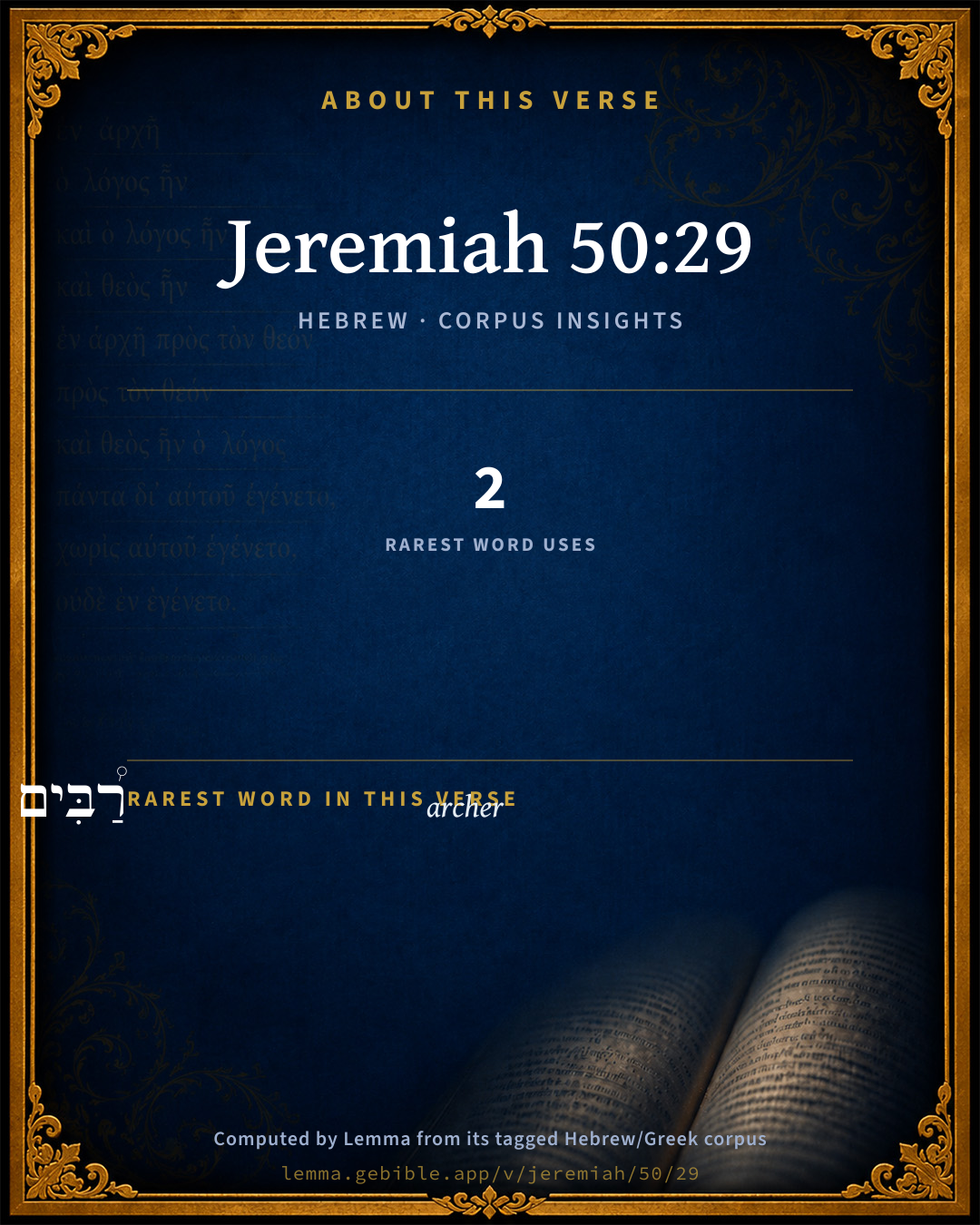
The rarest word here is רַ֠בִּים archer H7228 — appearing just 2 times in the whole Hebrew Bible.

Shared distinctive vocabulary

רַ֠בִּים archer H7228 occurs in 2 verses of the Hebrew Bible. Also found in:

Grammatical profile

  • 8 verbs
  • 10 nouns
  • 1 adjective
  • 7 prepositions
  • 1 conjunction
  • 2 particles

Verb forms

  • הַשְׁמִ֣יעוּ Hiphil · Imperative
  • דֹּ֨רְכֵי Qal · Participle Active
  • חֲנ֧וּ Qal · Imperative
  • יְהִי Qal · Jussive
  • שַׁלְּמוּ Piel · Imperative
  • עָשְׂתָ֖ה Qal · Perfect
  • עֲשׂוּ Qal · Imperative
  • זָ֖דָה Qal · Perfect

Repetition

Words recur within this verse — often emphatic in Hebrew:

  • כָּל all H3605 ×2
  • עָשְׂתָ֖ה to do H6213 ×2
  • אֶל to H413 ×3

Cross-references

18

Topical passages linked to Jeremiah 50:29 in the Treasury of Scripture Knowledge — connected by theme and wording, ordered by reader-vote popularity; previews shown in the World English Bible.

  • Isaiah 47:10 For you have trusted in your wickedness; you have said, None sees me; your wisdom and your knowledge, it has perverted you, and you have said in your heart, I am, and there is none else besides me.
  • Jeremiah 51:56 for the destroyer is come on her, even on Babylon, and her mighty men are taken, their bows are broken in pieces; for Yahweh is a God of recompenses, he will surely requite.
  • Exodus 10:3 Moses and Aaron went in to Pharaoh, and said to him, "This is what Yahweh, the God of the Hebrews, says: 'How long will you refuse to humble yourself before me? Let my people go, that they may serve me.
  • Jeremiah 50:14–15 Set yourselves in array against Babylon round about, all you who bend the bow; shoot at her, spare no arrows: for she has sinned against Yahweh.
  • Daniel 4:37 Now I, Nebuchadnezzar, praise and extol and honor the King of heaven; for all his works are truth, and his ways justice; and those who walk in pride he is able to abase.
  • Revelation 18:6 Return to her just as she returned, and repay her double as she did, and according to her works. In the cup which she mixed, mix to her double.
  • Psalms 137:8–9 Daughter of Babylon, doomed to destruction, He will be happy who rewards you, As you have served us.
  • Isaiah 14:13–14 You said in your heart, I will ascend into heaven, I will exalt my throne above the stars of God; and I will sit on the mountain of congregation, in the uttermost parts of the north;
  • Isaiah 37:23 Whom have you defied and blasphemed? and against whom have you exalted your voice and lifted up your eyes on high? [even] against the Holy One of Israel.
  • Jeremiah 50:9 For, behold, I will stir up and cause to come up against Babylon a company of great nations from the north country; and they shall set themselves in array against her; from there she shall be taken: their arrows shall be as of an expert mighty man; none shall return in vain.
  • Jeremiah 50:24 I have laid a snare for you, and you are also taken, Babylon, and you weren't aware: you are found, and also caught, because you have striven against Yahweh.
  • Jeremiah 50:26 Come against her from the utmost border; open her store-houses; cast her up as heaps, and destroy her utterly; let nothing of her be left.
  • Jeremiah 50:32 The proud one shall stumble and fall, and none shall raise him up; and I will kindle a fire in his cities, and it shall devour all who are round about him.
  • Daniel 5:23 but have lifted up yourself against the Lord of heaven; and they have brought the vessels of his house before you, and you and your lords, your wives and your concubines, have drunk wine from them; and you have praised the gods of silver and gold, of brass, iron, wood, and stone, which don't see, nor hear, nor know; and the God in whose hand your breath is, and whose are all your ways, you have not glorified.
  • Daniel 11:36 The king shall do according to his will; and he shall exalt himself, and magnify himself above every god, and shall speak marvelous things against the God of gods; and he shall prosper until the indignation be accomplished; for that which is determined shall be done.
  • 2 Thessalonians 2:4 he who opposes and exalts himself against all that is called God or that is worshiped; so that he sits as God in the temple of God, setting himself up as God.
  • Revelation 13:5–6 A mouth speaking great things and blasphemy was given to him. Authority to make war for forty-two months was given to him.
  • Revelation 16:6 For they poured out the blood of the saints and the prophets, and you have given them blood to drink. They deserve this."

Cross-references courtesy of OpenBible.info (CC BY 4.0).

Hebrew and Greek witnesses Masoretic Hebrew ↔ Greek Septuagint

The same verse in the two great witnesses to the Old Testament, shown verse-for-verse.

These are two independent witnesses, not word-aligned to each other, and the Septuagint is shown in lemma (dictionary) form.

Hebrew Jeremiah 50:29 Masoretic · Westminster Leningrad Codex

הַשְׁמִ֣יעוּ אֶל בָּבֶ֣ל רַ֠בִּים כָּל דֹּ֨רְכֵי קֶ֜שֶׁת חֲנ֧וּ עָלֶ֣יהָ סָבִ֗יב אַל יְהִי לָהּ֙ פְּלֵטָ֔ה שַׁלְּמוּ לָ֣הּ כְּפָעֳלָ֔הּ כְּכֹ֛ל אֲשֶׁ֥ר עָשְׂתָ֖ה עֲשׂוּ לָ֑הּ כִּ֧י אֶל יְהוָ֛ה זָ֖דָה אֶל קְד֥וֹשׁ יִשְׂרָאֵֽל

Call together the archers against Babylon, all those who bend the bow; encamp against her round about; let none of it escape: recompense her according to her work; according to all that she has done, do to her; for she has been proud against Yahweh, against the Holy One of Israel.

World English Bible · Public Domain

Greek LXX Structure differs

In the Septuagint, Jeremiah is about an eighth shorter than the Hebrew and arranges its material differently — the Oracles Against the Nations (Hebrew chapters 46–51) appear in the middle of the Greek book, after 25:13. Because the chapter and verse boundaries do not line up, a verse-for-verse comparison with the Hebrew is not shown.

A verse-for-verse comparison isn’t shown here because the chapters and verses don’t line up. Switch to the LXX edition with the MT / LXX toggle above to read the Greek directly.

On this verse, Keil & Delitzsch discusses the Septuagint’s reading. Read the note in Commentary ↓

Hebrew: Westminster Leningrad Codex (CC BY 4.0). Greek: Septuagint (public domain); English from a public-domain English Septuagint. How the Septuagint differs from the Hebrew →

Targum (Aramaic paraphrase)

1

The Targum is the ancient Jewish Aramaic paraphrase of the Hebrew Scriptures — an interpretive translation, not the Hebrew text itself. Onkelos (literal) and Pseudo-Jonathan (expansive) render the Torah, and Jonathan the Prophets. Coverage is partial: where no permissively-licensed English translation exists for a verse, only the Aramaic is shown. This is verse-level text, not a word-by-word alignment to the Hebrew.

  1. Targum Jonathan Prophets (Joshua–Malachi)
    בִּסְרוּ עַל בָּבֶל סַגִיאִין כָּל מָחֲתֵי קַשְׁתָּא שְׁרוֹ עֲלָהּ סְחוֹר סְחוֹר לָא יְהֵי לָהּ שֵׁיזְבָא שְׁלִימוּ לָהּ כְּאַגְרָהּ כְּכֹל דַעֲבְדַת עֱבִידוּ לָהּ אֲרֵי עַל עַמָא דַייָ בַּסְרַת אֲמָרַת מִלִין דְלָא כַשְׁרִין קֳדָם קַדִישָׁא דְיִשְׂרָאֵל:

    (no public-domain English translation for this verse)

    Targum Jonathan — Aramaic: “Mikraot Gedolot” (public domain). English: “Sefaria Community Translation” (CC0 1.0 (public-domain dedication)); “London "Chaldee Paraphrase," 1871” (public domain). Text via Sefaria.

Commentary

Notes on Jeremiah 50:29 from classic Christian and Jewish commentators (each source and its license shown beneath its notes). The classic Christian expositions comment on the surrounding passage and are grouped to its opening verse, so a note may address several verses; the Jewish commentaries on the Tanakh (Rashi and others) are per-verse, so they appear only where the commentator wrote on this verse.

Lemma curates 59 commentaries, every one of them public domain or Creative Commons licensed, each selected and text-cleaned for this edition rather than reprinted as found. About our sources →

Trapp's Complete Commentary

John Trapp

Jer 50:29 Call together the archers against Babylon: all ye that bend the bow, camp against it round about; let none thereof escape: recompense her according to her work; according to all that she hath done, do unto her: for she hath been proud against the LORD, against the Holy One of Israel.

Ver. 29. According to all that she hath done.] See Jer 50:15.

For she hath been proud against the Lord.] Who setteth himself in battle array against the proud. {1Pe 5:5}

John Trapp, A Commentary or Exposition upon All the Books of the Old and New Testament (1647–1656) — public domain. Text from a community e-Sword module.

Whedon's Commentary on the Bible

Daniel D. Whedon

PRIDE AND HUMILIATION, Jer_50:29-40.

29. Call together the archers — The meaning of this verse is slightly disguised by an inaccuracy in the translation. The reading should be, Summon the archers to Babylon, all those who bend the bow, etc.

Daniel D. Whedon (gen. ed.), Commentary on the Old and New Testaments (1874–1909) — public domain. Text from a community e-Sword module.

Keil & Delitzsch

C. F. Keil & F. Delitzsch

The pride of Babylon is humbled through the utter destruction of the people and the land. - Jer 50:29. "Summon archers against Jerusalem, all those who bend the bow; encamp against her round about. Let there be no escape for her; recompense to her according to her work; according to that which she hath done, do ye to her: for she hath presumed against Jahveh, against the Holy One of Israel. Jer 50:30. Therefore shall her young men fall in her streets, and all her men of war shall fail in that day, saith Jahveh. Jer 50:31. Behold, I am against thee, O Pride! said the Lord, Jahveh of hosts; for thy day hath come, the time [when] I visit thee. Jer 50:32. And Pride shall stumble and fall, and he shall have none to lift him up; and I will kindle fire in his cities, and it shall devour all that is round about him. Jer 50:33. Thus saith Jahveh of hosts, the Children of Israel and the children of Judah are oppressed together, and all who led them captive kept hold of them; they refused to let them go. Jer 50:34. Their Redeemer is strong; Jahveh of hosts is His name: He shall surely plead their cause, that He may give rest to the earth, and make the inhabitants of Babylon tremble. Jer 50:35. A sword [is] against the Chaldeans, saith Jahveh, and against the inhabitants of Babylon, and against her princes, and against her wise men. Jer 50:36. A sword [is] against the liars, and they shall become fools; a sword is against her heroes, and they shall be confounded. Jer 50:37. A sword [is] against his horses, and against his chariots, and against all the auxiliaries which [are] in the midst of her, and they shall become women; a sword is against her treasures, and they shall be plundered. Jer 50:38. A drought is against her waters, and they shall become dry; for it is a land of graven images, and they are mad upon idols. Jer 50:39. Therefore shall wild beasts dwell [there] with jackals, and ostriches shall dwell in it; and it shall no more be inhabited for ever, neither shall it be dwelt in from generation to generation. Jer 50:40. As God overthrew Sodom and Gomorrah and their inhabitants, saith Jahveh, no man shall dwell there, nor shall a son of man sojourn in it."

Further description of the execution of God's wrath. Archers shall come and besiege Babylon round about, so that no one shall escape. The summons, "Call archers hither," is a dramatic turn in the thought that the siege is quickly to ensue. השׁמיע is used here as in Jer 51:27, to summon, call by making proclamation, as in Kg1 15:22. רבּים does not signify "many," as the ancient versions give it; this agrees neither with the apposition which follows, "all that bend the bow," nor with Jer 50:26, where all, to the last, are summoned against Babylon. Raschi, followed by all the moderns, more correctly renders it "archers," and derives it from רבה = רבב, Gen 49:23, cf. with Jer 21:10, like רב, Job 16:13. The apposition, "all those who bend the bow," gives additional force. חנה with accus. means to besiege; cf. Psa 53:6. "Let there be no escape" is equivalent to saying, "that none may escape from Babylon." The Qeri להּ after יהי is unnecessary, and merely taken from Jer 50:26. On the expression "render to her," etc., cf. Jer 25:14; and on "according to all," etc., f. Jer 50:15. "For she hath acted presumptuously against Jahveh," by burning His temple, and keeping His people captive: in this way has Babylon offended "against the Holy One of Israel." This epithet of God is taken from Isaiah, cf. Isa 51:5. This presumption must be punished.

Jer 50:30-32

Jer 50:30 is a repetition of Jer 49:26. - Jer 50:31. The Lord will now visit the presumption of Babylon. The day of punishment has arrived. On "behold, I am against thee," cf. Jer 21:13. "O arrogance, pride!" is directly addressed to Babylon: in Jer 50:32 also there is a like designation of Babylon as the personification of pride. On the words "for thy day is come," cf. Jer 50:27. "And I will kindle a fire," etc., stands as in Jer 21:14, where, however, "in its forest" is found instead of "in his cities." The former, indeed, is the reading rendered by the lxx in this passage; but they have acted quite arbitrarily in this, since Jeremiah, for the most part, varies individual words when he repeats a thought. "In his cities" does not suit very well, inasmuch as the other cities of the country belonged to Babylon, the μητρόπολις as hers, and in Jer 51:43 they are spoken of as hers; cf. Jer 19:15; Jer 34:1; Jer 49:13, etc.

Jer 50:33-38

Further description of the guilt and punishment of Babylon. The presumptuous pride manifests itself in the fact that Israel and Judah still languish in exile. All those who have been seized and carried away they have kept hold of. שׁביהם is used as in Isa 14:2. They refuse to let them go, as Pharaoh once did, Exo 7:14, 27; Exo 9:2; cf. Isa 14:17. Jahveh, the deliverer of Israel, cannot endure this. As the strong One, the God of hosts, He will lead them in the fight; as their advocate, He will obtain their dues for them; cf. Jer 25:31; Isa 49:25. Dahler, Ewald, and Umbreit follow the Vulgate and the Chaldee in taking 'למען הרגּיע as synonymous with הרגּיז, in the sense of shaking, rousing, a meaning which רגע has in the Kal, but which cannot be made out for the Hiphil. In the Hiphil it means to give rest, to come to rest, Deu 28:65; Isa 34:14; Isa 61:4; Jer 31:2; and in the Niphal, to rest, keep quiet, Jer 47:6. This is the meaning given by the Syriac, Raschi, Kimchi, Rosenmller, Maurer, Hitzig, etc., and supported by a comparison with Isa 14:7, Isa 14:3,Isa 14:16. Babylon has hitherto kept the earth in unrest and anxiety (Isa 14:16); now it is to get rest (Isa 14:3, Isa 14:7), and trembling or quaking for fear is to come on Babylon. The two verbs, which have similar sounds, express a contrast. On the form of the infinitive הרגּיע, cf. Ewald, 238, d. In order to conduct the case of Israel as against Babylon, the Lord (Jer 50:35-38) calls for the sword against the Chaldeans, the inhabitants of Babylon, on their princes, wise men, heroes, and the whole army, the treasures and the waters. There is no verb following חרב, but only the object with על, the words being put in the form of an exclamation, on account of the passion pervading them. The sword is to come and show its power on the Chaldeans, i.e., the population of the rural districts, on the inhabitants of the capital, and further, on the princes and wise men (magicians). A special class of the last named are the בּדּים, properly "babblers," those who talk at random, here "soothsayers" and lying prophets, the astrologers of Babylon; see Delitzsch on Isa 44:25 [Clark's translation, For. Theol. Lib.]. ונאלוּ, "And they shall be as fools;" see on Jer 5:4. Further, on the warriors, the horses, and war-chariots, the main strength of the Asiatic conquerors, cf. Jer 46:9, Isa 43:17; Psa 20:8. כּל־הערב, "all the mixed multitude" in the midst of Babylon: these are here the mercenaries ad allies (as to this word, see on Jer 25:20). These shall become women, i.e., weak and incapable of resistance; see Nah 3:13. The last objects of vengeance are the treasures and the waters of Babylon. In Jer 50:38 the Masoretes have pointed חרב, because חרב, "sword," seemed to be inapplicable to the waters. But indeed neither does the sword, in the proper sense of the word, well apply to treasures; it rather stands, by synecdoche, for war. In this improper meaning it might also be used with reference to the waters, in so far as the canals and watercourses, on which the fertility of Babylonia depended, were destroyed by war. Hence many expositors would read חרב here also, and attribute the employment of this word to the rhetorical power connected with enumeration. Others are of opinion that חרב may also mean aridity, drought, in Deu 28:22; but the assumption is erroneous, and cannot be confirmed by that passage. Neither can it be denied, that to confine the reference of the expression "her waters" to the canals and artificial watercourses of Babylonia seems unnatural. All these received their water from the rivers Euphrates and Tigris, the volume of water in which remained uninfluenced by war. We therefore follow Hitzig in holding that חרב is the correct punctuation; in the transition from חרב into חרב, with its similar sound, we neither perceive any injury done to rhetorical force, derived from an enumeration of objects, nor any need for referring the following clause, which assigns the reason merely to such rhetorical considerations as Graf does. In the drying up of the water there is no allusion to the diversion of the Euphrates, by which Cyrus opened up for himself an entrance into the city (Herodotus, i. 190); the drying up is merely appointed by God, as a consequence of continued drought, for the purpose of destroying the land. Hitzig's opinion neither suits the context, nor can be justified otherwise; he holds that water is the emblem of the sea on nations, the surging multitude of people in the streets of the city, and he refers for proof to Jer 51:36 and Isa 21:1 (!). The clauses in Jer 50:38, which assign the reason, refer to the whole threatening, Jer 50:35-38. Babylon is to be destroyed, with its inhabitants and all its means of help, because it is a land of idols (cf. Jer 51:52 and Isa 21:9), and its inhabitants suffer themselves to be befooled by false gods. התהולל means to act or behave like a madman, rave, Jer 25:16; here, to let oneself be deprived of reason, not (as Graf thinks) to fall into a sacred frenzy. אימים, terrors, Psa 88:16; here, objects of fear and horror, i.e., idols.

Jer 50:39

Therefore shall Babylon become an eternal waste, where none but beasts of the desert find shelter, where no human being dwells. This threat is formed out of reminiscences from Isa 13:20-22 and Isa 34:14. For ציּים and איּים, see on Isa 34:14; for בּנות יענה, see on Isa 13:21. The second half of the verse agrees word for word with Isa 13:20.

Jer 50:40

Jer 50:40 is a repetition of Jer 49:18, and in its first half is founded on Isa 13:19.

Keil & Delitzsch — Biblical Commentary on the Old Testament (1861–1891) — public domain (CC PDM 1.0). Text via the HelloAO Bible API. (Old Testament only.)

Lange's Commentary on the Holy Scriptures

8. THE PUNISHMENT OF PRIDE

Jer_50:29-32

29          Call against Babylon archers;27

All ye that bend the bow camp against it round about!28

No escape! Recompense her according to her work,

Just as she hath done, do ye also unto her,

For against Jehovah was she proud,

Against the Holy One of Israel.

30     Therefore shall her young men fall in her streets,

And all her warriors shall be cut off in that day, saith Jehovah.

31     Behold I come to thee, O Pride, saith the Lord, Jehovah Zebaoth.

For come is thy day, the time of thy visitation.

32     Then Pride totters and falls,

And none helps him up;

And I kindle a fire in his cities,

Which shall devour all round about.

EXEGETICAL AND CRITICAL

Warriors are summoned to recompense Babylon for the pride which it has manifested towards Jehovah (Jer_50:20). Its men shall perish (Jer_50:31). Thus will toe Lord on the day of recompense bring their pride to totter and fall; no one will raise it up, fire will consume all its power (Jer_50:31-32).

Jer_50:29. Call … of Israel.Convocatio militum initium belli. Comp. Jer_50:14. השׁמיצו is taken by most commentators and translators in the sense of vocare, convocare, as in Jer_51:27; 1Ki_15:22 coll. 1Sa_15:4.—All ye, etc. Comp. Jer_50:14.—Recompense, etc. Comp. Jer_50:15; Jer_25:14.—Proud. Deserved humiliation of the pride of Babylon is predicted by earlier prophets: Isa_13:11; Isa_14:13 sqq.; Isa_47:7-8; Hab_2:5; Hab_2:8.—Holy One of Israel. Comp. Jer_51:5. This expression is peculiar to Isaiah. “All Isaiah’s prophecies bear this name of God as their peculiar stamp. It occurs twelve times in chh. Jer_50:39., seventeen times in chh. 40–66.” Delitzsch on Isa_6:3.

Jer_50:30-32. Therefore … round about. Jer_50:30 is repeated almost verbatim from Jer_49:26. The only difference is that here we have herwarriors for the warriors. The verse is not necessary, but rather disturbing, for Jer_50:31, is closely connected by Pride with Jer_50:29 (proud). It may have been a gloss.—Behold I come,etc. Comp. Jer_21:13; Jer_23:30 sqq.; Jer_51:25.—Pride. “In nominis proprii formam transiit.” J. D. Michaelis.—Thy day. Comp. Jer_50:27; Jer_49:8.—Totters, etc. Comp. Isa_31:3; Jer_46:6.—I kindle, etc. Comp. Jer_21:14; Jer_17:27; Jer_49:27.—Him in Jer_50:32 refers to Pride.—Babylon is regarded as the metropolis. Comp. Jer_50:12; Jer_51:43; Jer_9:10, etc.

DOCTRINAL AND ETHICAL

1. “Daniel’s Babylonian empire resumes, as it were, the thread which was broken off with the tower-erection and kingdom of Nimrod. In the Babylonian tower-building the whole of the then existing humanity was united against God; with the Babylonian kingdom began the period of the universal monarchies, which again aspired after an atheistical union of entire humanity. Babylon has since and even to the Revelation (Jeremiah 18) remained the standing type of this world.” Auberlen, Der proph. Daniel, S. 230.

2. For what reason does Babylon appear as a type of the world? Why not Nineveh, or Persepolis, or Tyre, or Memphis, or Rome? Certainly not because Babylon was greater, more glorious, more powerful or prouder and more ungodly than those cities and kingdoms. Nineveh especially was still greater than Babylon (comp. Duncker, Gesch. d. Alterth. I. S. 474, 5), and Assyria was not less hostile to the theocracy, having carried away into captivity the northern and larger half of the people of Israel. Babylon is qualified for this representation in two ways: 1. because it is the home of worldly princedom and titanic arrogance (Gen_10:8; Gen_11:1-4); 2. because Babylon destroyed the centre of the theocracy, Jerusalem, the temple and the theocratic kingdom, and first assumed to be the single supreme power of the globe.

3. “When God has used a superstitious, wicked and tyrannical nation long enough as His rod, He breaks it in pieces and finally throws it into the fire. For even those whom He formerly used as His chosen anointed instruments He then regards as but the dust in the streets or as chaff before the wind.” Cramer.

4. “No monarch is too rich, too wicked, too strong for God the Lord. And He can soon enlist and engage soldiers whom He can use against His declared enemies.” Cramer.

5. “Israel was founded on everlasting foundations, even God’s word and promise. The sins of the people brought about that it was laid low in the dust, but not without hope of a better resurrection. Babylon, on the other hand, must perish forever, for in it is the empire of evil come to its highest bloom. Jeremiah owns the nothingness of all worldly kingdoms, since they are all under this national order to serve only for a time. We are to be subject to them and seek their welfare for the sake of the souls of men, whom God is educating therein; a Christian however cannot be enthusiastic for them after the manner of the ancient heathen nor of ancient Israel, for here we have no abiding city, our citizenship is in heaven. The kingdoms of this world are no sanctuaries for us and we supplicate their continuance only with the daily bread of the fourth petition. Jeremiah applies many words and figures to Babylon which he has already used in the judgments on other nations, thus to intimate that in Babylon all the heathenism of the world culminates, and that here also must be the greatest anguish. What, however, is here declared of Babylon must be fulfilled again on all earthly powers in so far as, treading in its footprints, they take flesh for their arm and regard the material of this world as power, whether they be called states or churches.” Diedrich.

6. On Jer_50:2. In putting into the mouth of Israel, returning from Babylon, the call to an everlasting covenant with Jehovah, the prophet causes them 1. to confess that they have forgotten the first covenant; 2. he shows us that the time of the new covenant begins with the redemption from the Babylonish captivity. He was far, however, from supposing that this redemption would be only a weak beginning, that the appearance of the Saviour would be deferred for centuries, that Israel would sink still deeper as an external πολιτεία, and that finally the Israel of the new covenant would itself appear as a μυστήριον, εἰς ὃ ἐπιθυμοῦσιν ἄγγελοι παρακύψαι (1Pe_1:9-12).

7. From what Jeremiah has already said in Jer_31:31-34 of the new covenant we see that its nature and its difference from the old is not unknown to him. Yet he knows the new covenant only in general. He knows that it will be deeply spiritual and eternal, but how and why it will be so is still to him part of the μυστήριον.

8. On Jer_50:6. Jeremiah here points back to Jeremiah 23. Priests, kings and prophets, who should discharge the office of shepherds, prove to be wolves. Yea, they are the worst of wolves, who go about in official clothing. There is therefore no more dangerous doctrine than that of an infallible office. Jer_14:14; Mat_7:15; Mat_23:2-12.

9. On Jer_50:7. It is the worst condition into which a church of God can come, when the enemies who desolate it can maintain that they are in the right in doing so. It is, however, a just nemesis when those who will not hear the regular messengers of God must be told by the extraordinary messengers of God what they should have done. Comp. Jer_40:2-3.

10. On Jer_50:8. “Babylon is opened, and it must be abandoned not clung to, for the captivity is a temporary chastisement, not the divine arrangement for the children of God. God’s people must in the general redemption go like rams before the herd of the nations, that these may also attach themselves to Israel, as this was fulfilled at the time of Christ in the first churches and the apostles, who now draw the whole heathen world after them to eternal life. Here the prophet recognizes the new humanity, which proceeds from the ruins of the old, in which also ancient Israel leads the way; thus all, who follow it, become Israel.” Diedrich.—“The heathen felt somewhat of the divine punishment when they overcame so easily the usually so strongly protected nation. But Jeremiah shows them still how they deceived themselves in thinking that God had wholly rejected His people, for of the eternal covenant of grace they certainly understood nothing.” Heim and Hoffmann on the Major Prophets.

11. On Jer_50:18. “The great powers of the world form indeed the history of the world, but they have no future. Israel, however, always returns home to the dear and glorious land. The Jews might as a token of this return under Cyrus; the case is however this, that the true Holy One in Israel, Christ, guides us back to Paradise, when we flee to His hand from the Babylon of this world and let it be crucified for us.” Diedrich.

12. On Jer_50:23. “Although the Chaldeans were called of God for the purpose of making war on the Jewish nation on account of their multitudinous sins, yet they are punished because they did it not as God with a pure intention, namely, to punish the wrong in them and keep them for reformation; for they were themselves greater sinners than the Jews and continued with impenitence in their sins. Therefore they could not go scot-free and remain unpunished. Moreover, they acted too roughly and dealt with the Jews more harshly than God had commanded, for which He therefore fairly punished them. As God the Lord Himself says (Isa_47:6): When I was angry with My people I gave them into thine hands; but thou shewedst them no mercy. Therefore it is not enough that God’s will be accomplished, but there must be the good intention in it, which God had, otherwise such a work may be a sin and call down the divine punishment upon it.” Würtemb. Summ.

13. On Jer_50:31-34. “God calls Babylon Thou Pride, for pride was their inward force and impulse in all their actions. But worldly pride makes a Babylon and brings on a Babylon’s fate .… Pride must fall, for it is in itself a lie against God, and all its might must perish in the fire; thus will the humble and meek remain in possession of the earth: this has a wide application through all times, even to eternity.” Diedrich.

14. On Jer_51:33. “Israel is indeed weak and must suffer in a time of tyranny; it cannot help itself, nor needs it to do so, for its Redeemer is strong, His name The Lord Zebaoth—and He is, now, having assumed our flesh, among us and conducts our cause so that the world trembles.” Diedrich.

15. On Jer_50:45. “An emblem of the destruction of anti-christian Babylon, which was also the true hammer of the whole world. This has God also broken and must and will do it still more. And this will the shepherd-boys do, as is said here in Jer_51:45 (according to Luther’s translation), that is, all true teachers and preachers.” Cramer.

16. On Jeremiah 51. “The doctrines accord in all points with the previous chapter. And the prophet Jeremiah both in this and the previous chapter does nothing else but make out for the Babylonians their final discharge and passport, because they behaved so valiantly and well against the people of Judah, that they might know they would not go unrecompensed. For payment is according to service. And had they done better it would have gone better with them. It is well that when tyrants succeed in their evil undertakings they should not suppose they are God’s dearest children and lean on His bosom, since they will yet receive the recompense on their crown, whatever they have earned.” Cramer.

17. [“Though in the hand of Babylon is a golden cup; she chooses such a cup, in order that men’s eyes may be dazzled with the glitter of the gold, and may not inquire what it contains. But mark well, in the golden cup of Babylon is the poison of idolatry, the poison of false doctrines, which destroy the souls of men. I have often seen such a golden cup, in fair speeches of seductive eloquence: and when I have examined the venomous ingredients of the golden chalice, I have recognized the cup of Babylon.” Origen in Wordsworth.—S. R. A.]

“The seat and throne of Anti-christ is expressly named Babylon, namely, the city of Rome, built on the seven hills (Rev_17:9). Just as Babylon brought so many lands and kingdoms under its sway and ruled them with great pomp and pride (the golden cup, which made all the world drunk, was Babylon in the hand of the Lord (Jer_51:7), and all the heathen drank of the wine and became mad)—so has the spiritual Babylon a cup in its hand, full of the abomination and uncleanness of its whoredom, of which the kings of the earth and all who dwell on the earth have been made drunk. As it is said of Babylon that she dwells by great waters and has great treasures, so writes John of the Romish Babylon, that it is clothed in silk and purple and scarlet and adorned with gold, precious stones and pearls (Rev_18:12). Of Babylon it is said that the slain in Israel were smitten by her; so also the spiritual Babylon is become drunk with the blood of the saints (Rev_17:6). Just, however, as the Chaldean Babylon is a type of the spiritual in its pride and despotism, so also is it a type of the destruction which will come upon it. Many wished to heal Babylon but she would not be healed; so many endeavor to support the ruinous anti-christian Babylon, but all in vain. For as Babylon was at last so destroyed as to be a heap of stones and abode of dragons, so will it be with anti-christian Babylon. Of this it is written in Rev_14:8 : She is fallen, fallen, that great city, for she has made all nations drink of the wine of her fornication. And again, Babylon the great is fallen, and is become the habitation of devils and a hold of all foul and hateful birds (Rev_18:2). As the inhabitants of Babylon were admonished to flee from her, that every man might deliver his soul (Jer_51:6)—and again, My people, go ye out from the midst of her and deliver every man his soul, etc. (Jer_51:45)—so the Holy Spirit admonishes Christians almost in the same words to go out from the spiritual Babylon, that they be not polluted by her sins and at the same time share in her punishment. For thus it is written in Rev_18:4, I heard, says John, a voice from heaven saying, Go ye out of her, My people, that ye be not partakers of her sins and that ye receive not of her plagues, for her sins reach unto heaven and God remembers her iniquities.” Wurtemb. Summarien.

18. On Jer_51:5. “A monarch can sooner make an end of half a continent than draw a nail from a hut which the Lord protects.—And if it is true that Kaiser Rudolph, when he revoked the toleration of the Picards and the same day lost one of his principal forts, said, ‘I thought it would be so, for I grasped at God’s sceptre’ (Weismanni, Hist. Eccl. Tom. II. p. 320)—this was a sage remark, a supplement to the words of the wise.” Zinzendorf.

19. On Jer_51:9. We heal Babylon, but she will not be healed. Babylon is an outwardly beautiful but inwardly worm-eaten apple. Hence sooner or later the foulness must become noticeable. So is it with all whose heart and centre is not God. All is inwardly hollow and vain. When this internal vacuity begins to render itself externally palpable, when here and there a rent or foul spot becomes visible, then certainly come the friends and admirers of the unholy form and would improve, cover up, sew up, heal. But it does not avail. When once there is death in the body no physician can effect a cure.

20. On Jer_51:17; Jer_51:19-20. “The children of God have three causes why they may venture on Him. 1. All men are fools, their treasure is it not; 2. The Lord is their hammer; He breaks through everything, and 3, they are an instrument in His hand, a heritage; in this there is happiness.” Zinzendorf.

21. On Jer_51:41-44. “How was Sheshach thus won, the city renowned in all the world thus taken? No one would have thought it possible, but God does it. He rules with wonders and with wonders He makes His church free. Babylon is a wonder no longer for its power, but for its weakness. We are to know the world’s weakness even where it still appears strong. A sea of hostile nations has covered Babylon. Her land is now a desolation. God takes Bel, the principal idol of Babylon, symbolizing its whole civil powers in hand, and snatches his prey from his teeth. Our God is stronger than all worldly forces, and never leaves us to them.” Diedrich.

22. On Jer_51:58. “Yea, so it is with all walls and towers, in which God’s word is not the vital force, even though they be entitled churches and cathedrals … God’s church alone possesses permanence through His pure word.” Diedrich.

23. On Jer_51:60-64. When we wish to preserve an archive safely, we deposit it in a record-office where it is kept in a dry place that no moisture may get to it. Seraiah throws his book-roll into the waters of the Euphrates, which must wash it away, dissolve and destroy it. But this was of no account. The main point was that he, Seraiah, as representative of the holy nation had taken solemn stock of the word of God against Babylon, and as it were taken God at His word, and reminded Him of it. In this manner the matter was laid up in the most enduring and safest archive that could be imagined; it was made a case of honor with the omniscient and omnipotent God. Such matters can, however, neither be forgotten, nor remain in dead silence, nor be neglected. They must be brought to such an end as the honor of God requires.

HOMILETICAL AND PRACTICAL

1. On Jer_50:2. This text may be used on the feast of the Reformation, or any other occasion with reference to a rem bene gestam. The Triumph of the Good Cause, 1. over what enemies it is gained; 2. to what it should impel us; (a) to the avoidance of that over which we new triumph; (b) to the grateful proclamation of what the Lord has done for us, by word and by deed.

2. On Jer_50:4-8. The deliverance of Israel from the Babylonian captivity a type of the deliverance of the Church. 1. The Church must humbly acknowledge the captivity suffered as a judgment of God. 2. She must turn like Israel inwardly with an upright heart unto the Lord; 3. She must become like Israel to all men a pattern and leader to freedom.

3. On Jer_50:5. A confirmation sermon. “What is the hour of confirmation? 1. An hour which calls to separation; 2. an hour which leads to new connections; 3. an hour which fixes forever the old covenant with the soul’s friend.” Florey, 1853.

4. On Jer_50:18-20. Assyria and Babylon the types of all the spiritual enemies of the church as of individual Christians. Every one has his Assyria and his Babylon. Sin is the destruction of men. Forgiveness of sins is the condition of life, for only where forgiveness of sins is, is there life and blessedness. In Christ we find the forgiveness of sins. He destroys the handwriting. He washes us clean. He is also the good shepherd who leads our souls into green pastures, to the spiritual Carmel.

5. On Jer_50:31-32. Warning against pride. Babylon was very strong and powerful, rich and splendid. It seemed invincible by nature and by art. Had it not then a certain justification in being proud, at least towards men? No; for no one has to contend only with men. Every one who contends has the Lord either for his friend or his enemy. It is the Lord from whom cometh victory (Pro_21:31). He it is who teacheth our hands to fight (Psa_18:35; Psa_144:1). His strength is made perfect in weakness (2Co_12:9). He can make the lame (Isa_33:23; Mic_4:7) and mortally wounded (Jer_37:10) so strong that they overmaster the sound (comp. Jer_51:45). He can make one man put to flight a thousand (Deu_32:30; Isa_30:17). With him can one dash in pieces a troop and leap over a wall (Psa_18:29). No one accordingly should be proud. The word of the Lord, “I am against thee, thou proud one!” is a terrible word which no one should conjure up against himself.

6. On Jer_50:33-34. The consolation of the Church in persecution. 1. It suffers violence and injustice. 2. Its redeemer is strong.

7. On Jer_51:5. God the Lord manifests such favor to Israel as to declare Himself her husband (Jer_2:2; Jer_3:1). But now that Israel and Judah are in exile, it seems as if they were rejected or widowed women. This, however, is only appearance. Israel’s husband does not die. He may well bring a period of chastisement, of purification and trial on His people, but when this period is over, the Lord turns the handle, and smites those through whom He chastised Israel, when they had forgotten that they were not to satisfy their own desire, but only to accomplish the Lord’s will on Israel.

8. On Jer_51:6. A time may come when it is well to separate one’s self. For although it is said in Pro_18:1; he who separateth himself, seeketh that which pleaseth him and opposeth all that is good—and therefore separation, as the antipodes of churchliness, i.e., of churchly communion and humble subjection to the law of the co-operation of members (1Co_12:25 sqq.) is to be repudiated, yet there may come moments in the life of the church, when it will be a duty to leave the community and separate one’s self. Such a moment is come when the community has become a Babylon. It should, however, be noted that one should not be too ready with such a decision. For even the life of the church is subject to many vacillations. There are periods of decay, obscurations, as it were, comparable to eclipses of the stars, but to these, so long as the foundations only subsist, must always follow a restoration and return to the original brightness. No one is to consider the church a Babylon on account of such a passing state of disease. It is this only when it has withheld the objective divine foundations, the means of grace, the word and sacrament, altogether and permanently in their saving efficacy. Then, when the soul can no longer find in the church the pure and divine bread of life; it is well “to deliver the soul that it perish not in the iniquity of the church.” From this separation from the church is, however, to be carefully distinguished the separation within the church, from all that which is opposed to the healthy life of the church, and is therefore to be regarded as a diseased part of the ecclesiastical body. Such separation is the daily duty of the Christian. He has to perform it with respect to his private life in all the manifold relations, indicated to us in Mat_18:17; Rom_16:17; 1Co_5:9 sqq.; 2Th_3:6; Tit_3:10; 2Jn_1:10-11.—Comp. the article on Sects, by Palmer in Herzog, R.-Enc., XXI., S. 21, 22.

9. On Jer_51:10. The righteousness which avails before God. 1. Its origin (not our work or merit, but God’s grace in Christ); 2. Its fruit, praise of that which the Lord has wrought in us (a) by words, (b) by works.

10. On Jer_51:50. This text may be used at the sending out of missionaries or the departure of emigrants. Occasion may be taken to speak 1, of the gracious help and deliverance, which the Lord has hitherto shown to the departing; 2, they may be admonished to remain united in their distant land with their brethren at home by (a) remembering the Lord, i.e., ever remaining sincerely devoted to the Lord as the common shield of salvation; (b) faithfuly serving Jerusalem, i.e., the common mother of us all (Gal_4:26), the church, with all our powers in the proper place and measure, and ever keeping her in our hearts.

Footnotes:

[27]Jer_50:29.—רבימ. As there is no substantive here as in Jer_50:41; Jer_16:16, the meaning appears to be different. Derived from רָבַב (Gen_49:23; Psa_18:15 coll. רָבָב Gen_21:20) רַב is found with the meaning of “archer,” also in Job_16:13; Pro_26:10.

[28]Jer_50:29.—אל־יהי ו׳.The Keri unnecessarily adds לָהּ from Jer_50:26.

Lange's Commentary on the Holy Scriptures (Critical, Doctrinal, and Homiletical), ed. John Peter Lange, English translation edited by Philip Schaff (1864–1880) — public domain. Text from a community e-Sword module.

Tyndale Open Study Notes

Tyndale Open Resources

50:29-30 Skilled archers would kill the Babylonian soldiers even as those soldiers had killed their victims in battle. This was the Lord’s way of judging the ruthless empire builders who had defied the one true God by worshiping other deities (50:38).

Tyndale Open Study Notes — © Tyndale Open Resources, licensed CC BY-SA 4.0. Text via the HelloAO Bible API.

Jamieson, Fausset & Brown

Robert Jamieson, A. R. Fausset & David Brown

archers--literally, "very many and powerful"; hence the Hebrew word is used of archers (Job 16:13) from the multitude and force of their arrows.

according to all that she hath done--(See on Jer 50:15).

proud against the Lord--not merely cruel towards men (Isa 47:10).

Jamieson, Fausset & Brown — Commentary Critical and Explanatory on the Whole Bible (1871) — public domain (CC PDM 1.0). Text via the HelloAO Bible API.

Adam Clarke's Commentary

Verse 29. Call together the archers] The preceding verses are the prediction: here, God calls the Medes and Persians to fulfil it.

Adam Clarke's Commentary on the Bible (1810–1826) — public domain. Text from a community e-Sword/MySword module.

John Calvin's Commentaries

The Prophet adopts various modes of speaking, and not without reason, because he had to thunder rather than to speak; and then as he spoke of a thing incredible, there was need of no common confirmation; the faithful also, almost pining away in their miseries, could hardly entertain any hope. This is the reason why the Prophet dwells so long and so diffusely on a subject in itself not obscure, for there was not only need of amplifying, but also of great vehemence.

Then, as though he had many heralds ready to obey, he says, Call together the mighty against Babylon Some read “many,” but the word רבים, rebim, means both; and I think that “the mighty” or strong are meant here. Why some render it “arrows” I know not. It is, indeed, immediately added, all who bend the bow, כל-דרכי קשת, caldereki koshet. But the word, without anything added to it, never means an arrow. They refer to a place in Genesis 21:20, where Ishmael is said to be “an archer,” רבה, rebe; but the word “bow” follows it. We cannot then take רבים, rebim here but as signifying many or the mighty; and the latter is the most suitable word. Then the Prophet bids the strong and the warlike to come together, and then he mentions them specifically, — all who bend the bow, even all skillful archers. For the Persians excelled in this art, they were archers of the first order. It was indeed a practice common among eastern nations, but the Persians surpassed all others. The Prophet then points them out when he bids archers to assemble.

He adds, encompass or besiege her around, that there may be no escape This also was a thing difficult to be believed, for Babylon was more like a country than a city. Then one could have hardly thought that it could have been besieged around and at length taken, as it happened. Therefore the Prophet here testifies that what exceeded the opinion of all would take place. But he had said before that this would be the work of God, that the faithful might not form a judgment according to their own measure, for nothing is more absurd, as it has been said, than to measure the power of God by our own understanding. As then the Prophet had before declared that the siege of Babylon would be the work of God, he bids them now, with more confidence, to besiege it around, that there might not be an escape

It is then added, Render to her according to her work; according to what she has done, do to her By these words the Prophet shows that the vengeance which God would execute on the Chaldeans would be just, for nothing is more equitable than to render to one what he had done to others.

“With what measure ye mete to others,” says Christ, “it shall be rendered to you.” (Luke 6:38)

As, then, nature itself teaches us that the punishment is most just which is inflicted on the cruel themselves, hence the Prophet reminds us here that God would be a just avenger in his extreme violence against the Babylonians. But he looks farther, for he assumes this principle, that God is the judge of the world. Since he is so, it follows that they who unjustly oppress others must at length receive their own reward; as also Paul says, that the judgment of God, otherwise obscure, will be made evident, when he shall give relief and rest to the miserable who are now unjustly afflicted, and when he shall render their reward to oppressors. (2 Thessalonians 1:6, 7.) The Prophet then takes occasion of confidence from this truth to animate the faithful and to encourage them to entertain hope. How so? Since God is the judge of the world, the Jews ought to have considered what sort of people the Babylonians had been; nay, they had already sufficiently experienced how cruel and barbarous they were. As, then, the avarice and cruelly of the Chaldeans were sufficiently apparent, the Prophet here reminds them, that as God is in heaven, it could not be otherwise but that he would shortly call them to judgment, for otherwise he would not be God. Surely he would not be the judge of the world, were he not to regard the miserable unjustly oppressed, and bring them help, and stretch forth his hand to relieve them; and were he not also, on the other hand, to punish the avaricious and the proud and the cruel. We now understand the meaning of the Prophet.

He adds, in the last place, because she has acted proudly against Jehovah, against the Holy One of Israel By saying that the Babylonians had acted proudly, he means that they had not only been injurious to men, but had been also insolent towards God himself; for the verb here used denotes a sin different from that which happens through levity or want of thought. When any one sins inconsiderately, he is said to have erred; but when one sins knowingly, it is a deliberate wickedness, and he is said to be proud; and this we learn from Psalm 19:12; for David there sets pride in opposition to errors:

“errors,” he says, “who can understand?”

and then he asks God to cleanse him from all pride. David indeed had not designedly raised his horns against God, but he yet feared lest the wantonness of the flesh should lead him to pride. When, therefore, the Prophet now says that the Chaldeans had acted proudly towards God, it is the same as though he accused them of sacrilegious pride, even that they designed to be insolent towards God himself, and not only cruel to his people.

But an explanation follows, against the Holy One of Israel The Babylonians might have raised an objection, and said, that it was not their purpose to act proudly towards God. But the Prophet here brings forward the word Israel, as though he had said, “If there be a God in heaven, our religion is true; then God’s name dwells with us. Since, then, the Babylonians have basely oppressed the people whom God has chosen, it follows that they have been sacrilegious towards him.” And he meant the same thing when he said before, the vengeance of Jehovah our God Why did he add, our God? that the Jews might know that whatever wrongs they had suffered, they reached God himself, as though he were hurt in his own person. So also in this place the Prophet takes away from the Babylonians all means of evasion when he says, that they had acted proudly towards the Holy One of Israel When, therefore, the ungodly seek evasions and say that they do not contend with God, their pretenses are disproved, when they carry on war with his Church, and fight, against his faithful people, whose safety he has undertaken to defend. For God cannot be otherwise the protector of his Church than by setting himself up as a shield in its defense whenever he sees his people unjustly attacked by the reprobate. It follows, —

John Calvin's Commentaries (1540-1563) — public domain. Text from the Calvin Translation Society English edition (1840s-50s) via the Christian Classics Ethereal Library (ccel.org). Calvin's coverage is partial (roughly two-thirds of the Bible); uncommented books and verses are honest gaps, never fabricated. The 19th-century editor's footnotes and remarks are omitted so the notes are faithfully Calvin's own voice.

Ellicott's Commentary for English Readers

(29) Recompense her according to her work . . .—As before, in Jer_50:15, the prophet sees in the fall of Babylon the working of the Divine law of retribution. In “the Holy One of Israel” we note the occurrence, for the first time in Jeremiah, of the characteristic name which is so prominent in Isaiah, and is seldom found elsewhere. It occurs again in Jer_51:5.

A Bible Commentary for English Readers, edited by Charles John Ellicott (1878–1897) — public domain. Text from a community e-Sword module.

The Cambridge Bible for Schools and Colleges

gen. ed. J. J. S. Perowne

29. the archers] This is no doubt right, as against mg. many. Cp. Jer_50:14.

proud] presumptuous.

The Cambridge Bible for Schools and Colleges (gen. ed. J. J. S. Perowne; Cambridge University Press, 1878–1918) — public domain. Text from a community e-Sword module.

John Gill's Exposition

Call together the archers against Babylon,.... The Medes and Persians, who were well skilled in archery, especially the Elamites; see Isa 22:6; hence Horace (d) makes mention of "Medi pharetra"; and Cyrus in Xenophon (e) says, that he had under his command sixty thousand men that wore targets and were archers; See Gill on Jer 50:9. Some render it "many", as the Targum; and the sense is, either gather many together against Babylon, a large army; or cause many to hear the vengeance against Babylon; publish this good news; so the word used by the Targum signifies; and this will be done by Gospel preachers, with respect to mystical Babylon, Rev 14:6;

all ye that bend the bow, camp against it round about; let none thereof escape; surround it on every side; besiege it so closely that none may be able to escape:

recompence her according to her work: according to all that she hath done, do unto her; which is the law of retaliation; See Gill on Jer 50:15; and with it compare Rev 18:6;

for she hath been proud against the Lord, against the Holy One of Israel; behaved haughtily and contemptuously towards the Lord and his people; burning the city and temple of Jerusalem; profaning the vessels of it, and ill treating the captive Jews; so the Targum,

"because she hath spoken ill against the people of the Lord, saying words which were not right before the Holy One of Israel;''

which may fitly be applied to antichrist the man of sin, sitting in the temple of God, showing himself as God; opening his mouth in blasphemy against him and his saints, Th2 2:4.

(d) Carmin. l. 2. Ode 16. (e) Cyropaedia, l. 2. c. 1.

John Gill's Exposition of the Whole Bible (1746–1763) — public domain (CC PDM 1.0). Text via the HelloAO Bible API.

Albert Barnes' Notes on the Bible

Or, “Summon the archers to Babylon, even all who bend the bow: encamp against her etc.” In this portion of the prophecy the capture of Babylon is regarded as the punishment due to her for burning the temple Jer 50:28.

Albert Barnes' Notes on the Bible (1834–1885) — public domain. Text from a community e-Sword/MySword module.

Matthew Poole's English Annotations

The word translated archers signifieth also many, and is by divers so translated, but the following words more justify our translation. The cause of God’s calling for Babylon’s enemies against her is assigned to be her

pride against the Lord.

Matthew Poole's English Annotations on the Holy Bible (1683–1685) — public domain. Text from a community e-Sword/MySword module.

The Pulpit Commentary

Vers. 29-40. The completeness of Babylon"s destruction.

Call together the archers, etc. A dramatic way of indicating that the siege is about to begin.

The Pulpit Commentary (1880–1919), ed. H.D.M. Spence-Jones & Joseph S. Exell — public domain. Text from a community e-Sword module.

unfoldingWord translationNotes

Door43 World Missions Community

General Information:

Yahweh continues telling how to destroy the people of Babylon and Chaldea.

Summon the archers against Babylon

Yahweh is speaking to the enemies of Babylon. This can be made clear. AT: "You enemies of Babylon, summon the archers against her" (See: Assumed Knowledge and Implicit Information)

the archers ... those who bend their bows

These phrases refer to the same people and are repeated for poetic effect. (See: Doublet)

her ... her ... she

The words "her" and "she" refer to Babylon.

let no one escape

This can be stated in positive form. AT: "capture or kill every person"

Do to her by the measure she has used

The evil things the Babylonians did to Israel are spoken of as if Babylon measured them. AT: "Measure out punishment for her with the same amount she used to punish Israel" (See: Metaphor)

her young men will fall

"they will kill her young men"

all her fighting men will be destroyed

This can be stated in active form. AT: "I will destroy all her fighting men" (See: Active or Passive)

this is Yahweh's declaration

Yahweh speaks of himself by name to express the certainty of what he is declaring. See how you translated this in Jeremiah 1:8. AT: "this is what Yahweh declares" or "this is what I, Yahweh, declare" (See: First, Second, or Third Person)

translationWords

bow and arrow

Babylon

Holy One

Israel

declare

unfoldingWord translationNotes — © Distant Shores Media and the Door43 World Missions Community, licensed CC BY-SA 4.0. Source: git.door43.org/Door43/en_tn.

Rashi

Rabbi Shlomo Yitzchaki (Rashi)

Gather archers against Babylon Heb. השמיעו, an expression similar to: “And Saul called the people together (וַיְשַׁמַע)” (I Sam. 15:4). Call out that archers assemble against Babylon. Cf. “His archers (רַבָּיו) surround me” (Job 16:13).

Rashi on the Tanakh — English translations: “The Judaica Press complete Tanach with Rashi, translated by A. J. Rosenberg” (CC BY 4.0); “Pentateuch with Rashi's commentary by M. Rosenbaum and A.M. Silbermann, 1929-1934” (public domain); “The Metsudah Tanach series, Lakewood, N.J” (CC BY 4.0); and “The Book of Joshua, Metsudah Publications, 1997” (CC BY 4.0). Text via Sefaria.

Lesson kit

Teaching starters — assembled from the data on this page, not authored interpretation. Every prompt links to the verse data it draws on. Edit before teaching.

Jeremiah, in the Prophets, opens this verse with 29 words (22 distinct Hebrew lemmas). Its most distinctive word is rab (“archer”). A historical commentator’s framing appears above. Read the whole chapter for the surrounding context.

Discussion questions

  1. What does “archer” (rab) contribute to the verse as a whole?
  2. How does Job 16:13, which shares the word «archer», read alongside this verse?
  3. What does the repetition of “all” (2× in this one verse) do in this verse?
  4. These translations render this verse differently. What is at stake in choosing one wording over another?
  5. «הַשְׁמִ֣יעוּ» is a Hiphil Imperative verb. How does that grammatical form shape the action described?
  6. Compare how Trapp's Complete Commentary and Whedon's Commentary on the Bible read this verse. Where do they agree or differ?

Things to notice

Reading settings

Reading text

Shown beneath each verse's original-language words.

Old Testament
Old Testament edition

Read the OT as the Masoretic Hebrew (MT) or the Greek Septuagint (LXX).

English shown for the Greek Septuagint (in the Hebrew ↔ Greek comparison).

Comparing translations? Open the Compare panel on any verse page to stack up to four side by side.