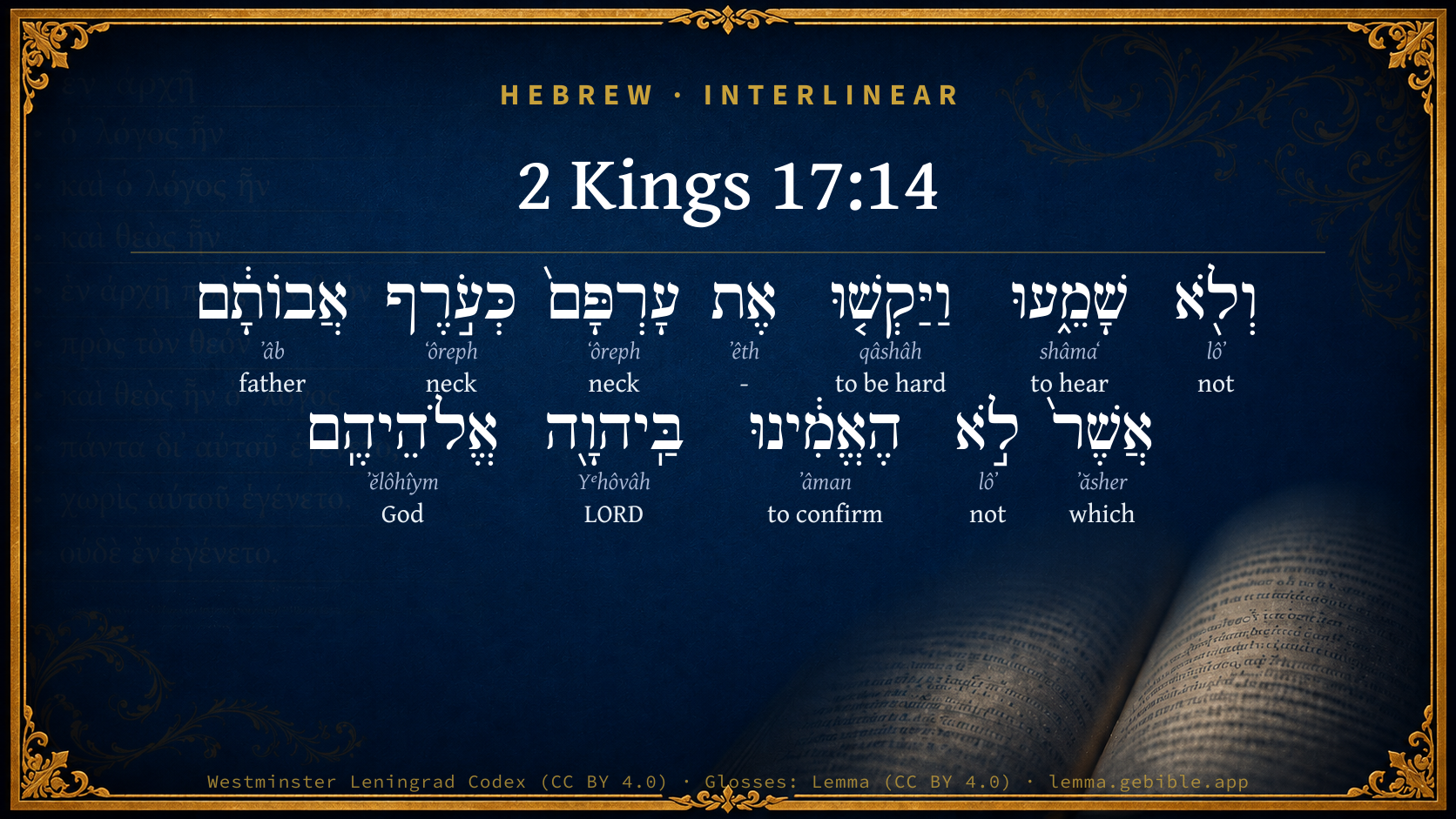
2 Kings 17:14

Hebrew (Westminster Leningrad Codex) 2 Kings 17:14 appears in the Hebrew Old Testament. The text above is from the Westminster Leningrad Codex. Each word links to its Strong’s number, a concise gloss, and parsing drawn from the Open Scriptures Hebrew Bible morphology. Click any word for its full Brown-Driver-Briggs (BDB) entry.
Download image
Cite this verse

2 Kings 17:14 (World English Bible). Public Domain. Lemma interlinear Bible study tool, https://lemma.gebible.app/v/2-kings/17/14.

Show BibTeX & RIS
BibTeX
RIS
English Translation
Notwithstanding, they would not hear, but hardened their neck, like the neck of their fathers, who didn't believe in Yahweh their God.
World English Bible · Public Domain
Download a study sheet

One document with this verse’s original text, its word-by-word gloss line, the meaning frame, cross-references with their text, attributed commentary, and full source and license credits — printable, and it pastes into notes with its structure intact.

This verse Autodidact and up

Study sheet (.html) Plain text (.txt)

A passage Seminary Student

Up to 50 verses in one chapter. A passage sheet keeps up to 6 commentary sources and 12 cross-references per verse, in the order this page ranks them, and says so on the sheet whenever that leaves anything out. Ask for a single verse and you get the Autodidact verse sheet above.

Everything on this page stays free to read, with no account — the sheet is a download of what is already on screen, not access to it.

Want to remove ads? Support Godless Engineer
Compare translations 3

The same verse in 3 English versions, stacked beneath the original-language interlinear above. Click any original word for its lexicon entry.

Each is an independent rendering of the whole verse — the interlinear is not word-aligned to these translations.

Highlighted words mark where these versions differ — a whole-verse word diff, not a word-by-word alignment.

  • World English Bible Public Domain
    Notwithstanding, they would not hear, but hardened their neck, like the neck of their fathers, who didn't believe in Yahweh their God.
  • King James Version Public Domain
    Notwithstanding they would not hear, but hardened their necks, like to the neck of their fathers, that did not believe in the LORD their God.
  • unfoldingWord Literal Text CC BY-SA 4.0
    But they did not listen, and they stiffened their neck, like the neck of their fathers who did not trust in Yahweh their God.

unfoldingWord Literal Text — © unfoldingWord, licensed CC BY-SA 4.0. Word-aligned USFM3 via Door43 (git.door43.org/unfoldingWord/en_ult).

Versions to compare (up to 4)

3 of 4 selected

Show all 18 translations

Every available English version of this verse, each an independent rendering of the whole verse.

  • World English Bible Public Domain
    Notwithstanding, they would not hear, but hardened their neck, like the neck of their fathers, who didn't believe in Yahweh their God.
  • Berean Standard Bible Public Domain
    But they would not listen, and they stiffened their necks like their fathers, who did not believe the LORD their God.
  • Majority Standard Bible Public Domain
    But they would not listen, and they stiffened their necks like their fathers, who did not believe the LORD their God.
  • King James Version Public Domain
    Notwithstanding they would not hear, but hardened their necks, like to the neck of their fathers, that did not believe in the LORD their God.
  • American Standard Version (1901) Public Domain
    Notwithstanding, they would not hear, but hardened their neck, like to the neck of their fathers, who believed not in Jehovah their God.
  • Revised Version (1885) Public Domain
    Notwithstanding they would not hear, but hardened their neck, like to the neck of their fathers, who believed not in the LORD their God.
  • Geneva Bible (1599) Public Domain
    Neuerthelesse they would not obey, but hardened their neckes, like to the neckes of their fathers, that did not beleeue in the Lord their God.
  • Douay-Rheims (1899) Public Domain
    And they hearkened not, but hardened their necks like to the neck of their fathers, who would not obey the Lord their God.
  • Young's Literal Translation Public Domain
    and they have not hearkened, and harden their neck, like the neck of their fathers, who did not remain stedfast in Jehovah their God,
  • Literal Standard Version CC BY-SA 4.0
    and they have not listened, and harden their neck, like the neck of their fathers, who did not remain steadfast in their God YHWH,
  • Unlocked Literal Bible CC BY-SA 4.0
    But they would not listen; instead they were very stubborn like their fathers who did not trust in Yahweh their God.
  • unfoldingWord Literal Text CC BY-SA 4.0
    But they did not listen, and they stiffened their neck, like the neck of their fathers who did not trust in Yahweh their God.
  • Darby Bible Public Domain
    But they would not hear, and hardened their necks, like to the neck of their fathers, who did not believe in Jehovah their God.
  • World Messianic Bible Public Domain
    Notwithstanding, they would not listen, but hardened their neck like the neck of their fathers who didn’t believe in the LORD their God.
  • Webster's Bible Public Domain
    Notwithstanding, they would not hear, but hardened their necks, like the neck of their fathers, that did not believe in the LORD their God.
  • Free Bible Version CC BY-SA 4.0
    But they refused to listen, and they were as stubborn as their forefathers who did not trust the Lord their God.
  • Bible in Basic English Public Domain
    And they did not give ear, but became stiff-necked, like their fathers who had no faith in the Lord their God.
  • JPS Tanakh (1917) Public Domain
    notwithstanding they would not hear, but hardened their neck, like to the neck of their fathers, who believed not in the LORD their God;

Literal Standard Version (2020), Covenant Press — licensed CC BY-SA 4.0. Text via the HelloAO Bible API (eBible.org). Unlocked Literal Bible (unfoldingWord) — licensed CC BY-SA 4.0. Text via the HelloAO Bible API (eBible.org). unfoldingWord Literal Text — © unfoldingWord, licensed CC BY-SA 4.0. Word-aligned USFM3 via Door43 (git.door43.org/unfoldingWord/en_ult). Free Bible Version, Dr. Jonathan Gallagher — licensed CC BY-SA 4.0. Text via the HelloAO Bible API (eBible.org).

Word by word

More ways to search: Search by grammar → Find every occurrence → Compare this word →

Practice this passage: Drill this verse → Learn its vocabulary →

וַיַּקְשׁ֤וּ
qâshâh
H7185
“and · to be hard”
Conjunction + Verb, Hiphil, Sequential Imperfect, 3rd Person, Masculine, Plural
Part of Speech
Conjunction + Verb
Stem
Hiphil
Form
Sequential Imperfect
Person
3rd Person
Gender
Masculine
Number
Plural
Full BDB Definition

Origin: a primitive root

TWOT: 2085

to be hard, be severe, be fierce, be harsh - (Qal) - to be hard, be difficult - to be hard, be severe - (Niphal) - to be ill-treated - to be hard pressed - (Piel) to have severe labour (of women) - (Hiphil) - to make difficult, make difficulty - to make severe, make burdensome - to make hard, make stiff, make stubborn - of obstinacy (figuratively) - to show stubbornness
  1. וְלֹ֖א lôʼ H3808 “and · not” Conjunction + Particle, Negative
  2. שָׁמֵ֑עוּ shâmaʻ H8085 “to hear” Verb, Qal, Perfect, 3rd Person, Common, Plural
  3. אֶת ʼêth H853 “-” Particle, Direct Object
  4. עָרְפָּם֙ ʻôreph H6203 “neck · their” Noun, Common, Masculine, Singular, Construct + Suffix, Personal, 3rd Person, Masculine, Plural
  5. כְּעֹ֣רֶף ʻôreph H6203 “like/as · neck of” Preposition + Noun, Common, Masculine, Singular, Construct
  6. אֲבוֹתָ֔ם ʼâb H1 “fathers · their” Noun, Common, Masculine, Plural, Construct + Suffix, Personal, 3rd Person, Masculine, Plural
  7. אֲשֶׁר֙ ʼăsher H834 “which” Particle, Relative
  8. לֹ֣א lôʼ H3808 “not” Particle, Negative
  9. הֶאֱמִ֔ינוּ ʼâman H539 “to confirm” Verb, Hiphil, Perfect, 3rd Person, Common, Plural
  10. בַּֽיהוָ֖ה Yᵉhôvâh H3068 “in/at · LORD” Preposition + Noun, Proper
  11. אֱלֹהֵיהֶֽם ʼĕlôhîym H430 “God(s) · their” Noun, Common, Masculine, Plural, Construct + Suffix, Personal, 3rd Person, Masculine, Plural

About this verse

These counts appear in no published source. They are computed here, from the morphology-tagged text and Lemma’s own curated glosses. What Lemma adds →

12
words
10
distinct lemmas
Historical
section

Shared distinctive vocabulary

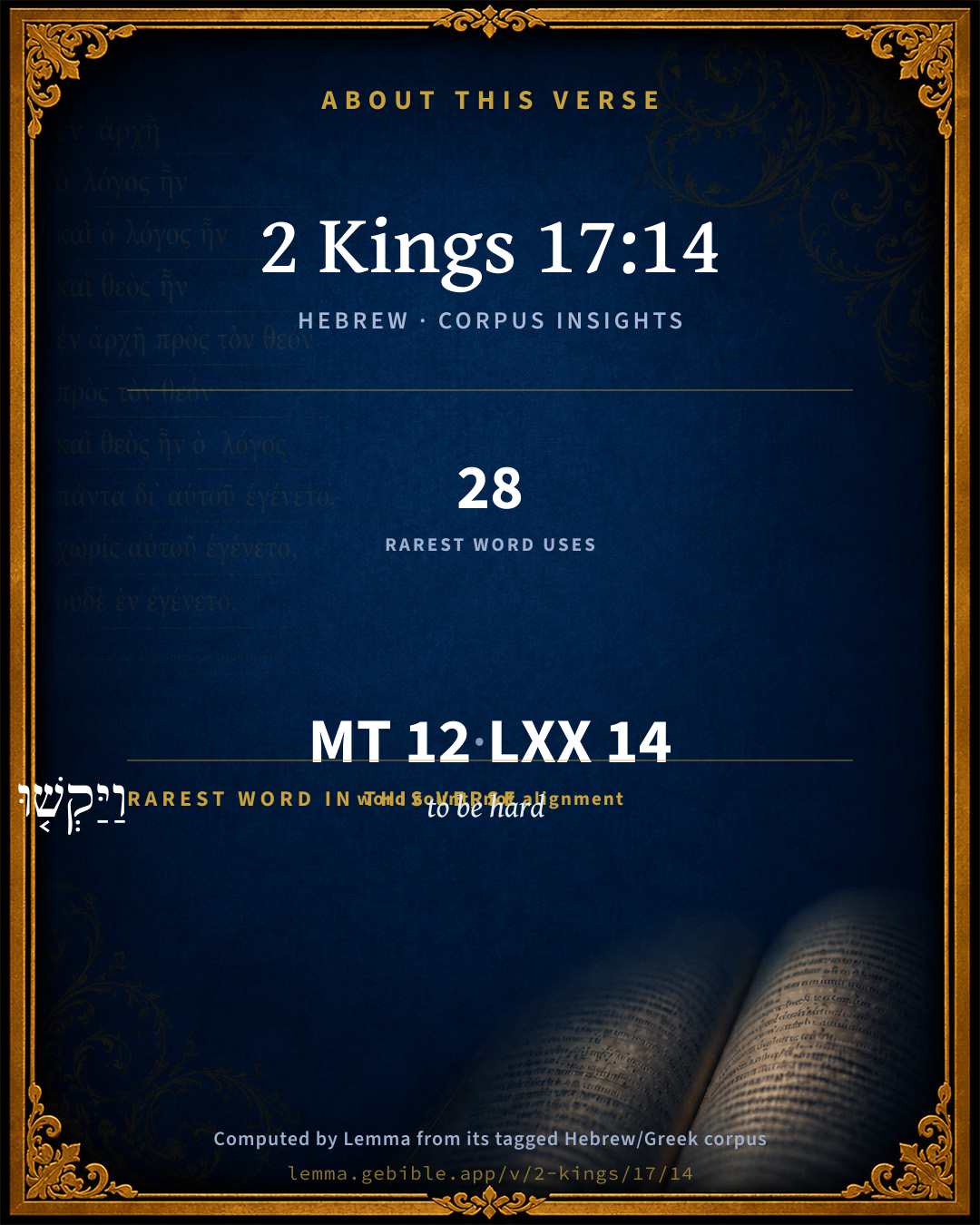
וַיַּקְשׁ֤וּ to be hard H7185 occurs in 28 verses of the Hebrew Bible. Also found in:

Grammatical profile

  • 3 verbs
  • 5 nouns
  • 4 particles

Verb forms

  • שָׁמֵ֑עוּ Qal · Perfect
  • וַיַּקְשׁ֤וּ Hiphil · Sequential Imperfect
  • הֶאֱמִ֔ינוּ Hiphil · Perfect

Repetition

Words recur within this verse — often emphatic in Hebrew:

  • עָרְפָּם֙ neck H6203 ×2
  • וְלֹ֖א not H3808 ×2

Hebrew & Septuagint length

In English translation the verse runs 22 words from the Hebrew and 15 from the Septuagint (LXX English) — the Septuagint runs noticeably shorter here. See the side-by-side →

A rough comparison of the two English renderings, which tokenize alike — not a word-level alignment.

Word counts can differ between the Hebrew and the Greek without any difference in meaning — e.g. the Hebrew direct-object marker אֵת has no separate Greek word, and Greek often adds the article ὁ.

In the original languages it is 12 Hebrew tokens and 14 Greek tokens — but the two are counted differently (Hebrew bundles its prefixes and suffixes into one token; the Greek is in lemma form), so that isn’t a like-for-like length.

Cross-references

14

Topical passages linked to 2 Kings 17:14 in the Treasury of Scripture Knowledge — connected by theme and wording, ordered by reader-vote popularity; previews shown in the World English Bible.

  • Deuteronomy 31:27 For I know your rebellion, and your stiff neck: behold, while I am yet alive with you this day, you have been rebellious against Yahweh; and how much more after my death?
  • Acts 7:51 "You stiff-necked and uncircumcised in heart and ears, you always resist the Holy Spirit! As your fathers did, so you do.
  • Exodus 32:9 Yahweh said to Moses, "I have seen these people, and, behold, they are a stiff-necked people.
  • Deuteronomy 1:32 Yet in this thing you didn't believe Yahweh your God,
  • 2 Chronicles 36:13 He also rebelled against king Nebuchadnezzar, who had made him swear by God: but he stiffened his neck, and hardened his heart against turning to Yahweh, the God of Israel.
  • Psalms 78:22 Because they didn't believe in God, And didn't trust in his salvation.
  • Psalms 78:32 For all this they still sinned, And didn't believe in his wondrous works.
  • Psalms 106:24 Yes, they despised the pleasant land. They didn't believe his word,
  • Proverbs 29:1 He who is often rebuked and stiffens his neck Will be destroyed suddenly, with no remedy.
  • Isaiah 48:4 Because I knew that you are obstinate, and your neck is an iron sinew, and your brow brass;
  • Jeremiah 7:26 yet they didn't listen to me, nor inclined their ear, but made their neck stiff: they did worse than their fathers.
  • Romans 2:4–5 Or do you despise the riches of his goodness, forbearance, and patience, not knowing that the goodness of God leads you to repentance?
  • Hebrews 3:7–8 Therefore, even as the Holy Spirit says, "Today if you will hear his voice,
  • Hebrews 3:12 Beware, brothers, lest perhaps there be in any one of you an evil heart of unbelief, in falling away from the living God;

Cross-references courtesy of OpenBible.info (CC BY 4.0).

Hebrew and Greek witnesses Masoretic Hebrew ↔ Greek Septuagint

The same verse in the two great witnesses to the Old Testament, shown verse-for-verse.

Here the Septuagint runs noticeably shorter than the Hebrew — LXX2012 (modern English Septuagint) 15 words vs World English Bible 22. A rough length comparison of the two English translations, not a word-level alignment — read both below.

These are two independent witnesses, not word-aligned to each other, and the Septuagint is shown in lemma (dictionary) form.

Hebrew 2 Kings 17:14 Masoretic · Westminster Leningrad Codex

וְלֹ֖א שָׁמֵ֑עוּ וַיַּקְשׁ֤וּ אֶת עָרְפָּם֙ כְּעֹ֣רֶף אֲבוֹתָ֔ם אֲשֶׁר֙ לֹ֣א הֶאֱמִ֔ינוּ בַּֽיהוָ֖ה אֱלֹהֵיהֶֽם

Notwithstanding, they would not hear, but hardened their neck, like the neck of their fathers, who didn't believe in Yahweh their God.

World English Bible · Public Domain

Greek LXX 2 Kings 17:14 Septuagint · lemma form

καί οὐ ἀκούω καί σκληρύνω ὁ νῶτον αὐτός ὑπέρ ὁ νῶτον ὁ πατήρ αὐτός

But they listened not, and made their neck harder than the neck of their fathers.

LXX2012 (modern English Septuagint) · Public Domain

On this verse, Ellicott's Commentary for English Readers discusses the Septuagint’s reading. Read the note in Commentary ↓

Hebrew: Westminster Leningrad Codex (CC BY 4.0). Greek: Septuagint (public domain); English from LXX2012 (modern English Septuagint) (Public Domain). How the Septuagint differs from the Hebrew →

Targum (Aramaic paraphrase)

1

The Targum is the ancient Jewish Aramaic paraphrase of the Hebrew Scriptures — an interpretive translation, not the Hebrew text itself. Onkelos (literal) and Pseudo-Jonathan (expansive) render the Torah, and Jonathan the Prophets. Coverage is partial: where no permissively-licensed English translation exists for a verse, only the Aramaic is shown. This is verse-level text, not a word-by-word alignment to the Hebrew.

  1. Targum Jonathan Prophets (Joshua–Malachi)
    וְלָא קַבִּילוּ וְאַקְשִׁיאוּ יַת קְדַלְהוֹן כִּקְדָלָא דַאֲבָהַתְהוֹן דְלָא הֵימְנוּ בְּמֵימְרָא דַייָ אֱלָהָהוֹן:

    (no public-domain English translation for this verse)

    Targum Jonathan — Aramaic: “Mikraot Gedolot” (public domain). English: “Sefaria Community Translation” (CC0 1.0 (public-domain dedication)); “London "Chaldee Paraphrase," 1871” (public domain). Text via Sefaria.

Commentary

Notes on 2 Kings 17:14 from classic Christian and Jewish commentators (each source and its license shown beneath its notes). The classic Christian expositions comment on the surrounding passage and are grouped to its opening verse, so a note may address several verses; the Jewish commentaries on the Tanakh (Rashi and others) are per-verse, so they appear only where the commentator wrote on this verse.

Lemma curates 59 commentaries, every one of them public domain or Creative Commons licensed, each selected and text-cleaned for this edition rather than reprinted as found. About our sources →

Trapp's Complete Commentary

John Trapp

2Ki 17:14 Notwithstanding they would not hear, but hardened their necks, like to the neck of their fathers, that did not believe in the LORD their God.

Ver. 14. But hardened their necks.] Adding to their sinews of iron (natural impudency), brows of brass, notorious impudency in sin. {Isa 48:8}

John Trapp, A Commentary or Exposition upon All the Books of the Old and New Testament (1647–1656) — public domain. Text from a community e-Sword module.

Joseph Benson's Commentary

2Ki 17:14. Notwithstanding, they would not hear, but hardened their necks — Refused to submit their necks to the yoke of God’s precepts: a metaphor taken from stubborn oxen that will not bow to the yoke. Like to the neck of their fathers — In the wilderness; that did not believe in the Lord their God — This was the original and primary cause of all their sins and sufferings, their unbelief; this formerly prevented their fathers from entering Canaan, and now turned them out of it: they did not truly believe in God’s power, and love, and faithfulness; did not receive his truths, though attested by signs and wonders innumerable; did not credit his threatenings, nor rely on his promises. The testimony of the prophets, therefore, was without effect, with respect to the nation in general, and their endeavours to reclaim them were exerted in vain. And God was compelled, humanly speaking, in vindication of his own infinite perfections, the injured rights of his moral government, and the cause of truth and righteousness, to execute the frequently-denounced vengeance, and send wrath upon them to the uttermost.

Joseph Benson's Commentary on the Old and New Testaments (1811–1818) — public domain. Text from a community e-Sword module.

Tyndale Open Study Notes

Tyndale Open Resources

17:14-15 Like their ancestors (Deut 10:16; 1 Sam 12:6-9; Ps 106:28), the Israelites persisted in their infidelity to the Lord (Isa 65:6-7; Amos 2:4; see Acts 7:51-53).

Tyndale Open Study Notes — © Tyndale Open Resources, licensed CC BY-SA 4.0. Text via the HelloAO Bible API.

Geneva Bible (1599)

Geneva Bible translators

So that to allege the authority of our fathers or great antiquity, except we can prove that they were godly, is but to declare that we are the children of the wicked.

Geneva Bible (1599) marginal notes — public domain. Text via Bolls.life.

Ellicott's Commentary for English Readers

(14) Notwithstanding . . . hear.—Rather, and they hearkened not.

Necks.—Heb., neck. (Comp. Deu_10:16; Jer_17:23; 2Ch_36:13.)

Like to the neck.—LXX. and Syriac, more than the neck. One letter different in the Hebrew.

Did not believe in the Lord their God.—The reference is not to intellectual but to moral unbelief, evincing itself as disobedience. Vulg., “qui volerunt obediren.” They did not render the obedience of faith. (Comp. the use of ἀπειθεῖ ν in the Greek Testament.)

A Bible Commentary for English Readers, edited by Charles John Ellicott (1878–1897) — public domain. Text from a community e-Sword module.

The Cambridge Bible for Schools and Colleges

gen. ed. J. J. S. Perowne

14. hardened their necks] R.V. neck. The original has the singular, the people being regarded as one body. Israel throughout the Scripture is constantly reproached as a ‘stiffnecked’ people. Cf. Exo_32:9; Exo_33:3; Deu_10:16; Act_7:51 and parallel passages.

that did not believe] R.V. who believed not. The relative is thus connected a little more clearly with its proper antecedent ‘fathers’.

The Cambridge Bible for Schools and Colleges (gen. ed. J. J. S. Perowne; Cambridge University Press, 1878–1918) — public domain. Text from a community e-Sword module.

John Gill's Exposition

Notwithstanding, they would not hear,.... Their instructions, advice, and admonitions, and obey them:

but hardened their necks, like to the neck of their fathers, that did not believe in the Lord their God: as Terah and Nahor, who were idolaters; or rather, their fathers in the wilderness, that made and served the calf, and those that rebelled against Moses and Aaron; it is a metaphor taken from oxen, that will not submit their necks to the yoke, but draw back from it, or cast it off, see Act 7:51.

John Gill's Exposition of the Whole Bible (1746–1763) — public domain (CC PDM 1.0). Text via the HelloAO Bible API.

Albert Barnes' Notes on the Bible

To “harden” or “stiffen the neck” is a common Hebrew expression significative of unbending obstinacy and determined self-will. See the marginal references.

Albert Barnes' Notes on the Bible (1834–1885) — public domain. Text from a community e-Sword/MySword module.

Matthew Poole's English Annotations

Hardened their necks, i.e. refused to submit their neck to the yoke of God’s precepts; a metaphor from stubborn oxen, that make their necks hard, or stiff, and will not bow to the yoke: See Poole "Deu 31:27".

Matthew Poole's English Annotations on the Holy Bible (1683–1685) — public domain. Text from a community e-Sword/MySword module.

The Pulpit Commentary

Notwithstanding they would not hear; rather, and they would not hear. The construction still runs on without any change (see the comment on vers. 7 and 12). But hardened their necks. (On the origin of the phrase, see "Homiletic Commentary" on Exo_32:9) The obstinate perversity of the Israelites, which the phrase expresses, is noted through the entire history (see Exo_33:3, 5 34:9; Deu_9:6, Deu_9:13; Psa_75:5; 2Ch_30:8 2Ch_36:13; Neh_9:16, Neh_9:17, Neh_9:29; Jer_7:26 Jer_17:23; Act_7:51, etc.) Like to the neck of their fathers, that did not believe in the Lord their God. The reference is especially to the many passages in the Pentateuch where the Israelites are called "a stiff-necked people" (see, besides those already quoted,. (Deu_31:27)

The Pulpit Commentary (1880–1919), ed. H.D.M. Spence-Jones & Joseph S. Exell — public domain. Text from a community e-Sword module.

John Wesley's Explanatory Notes

Hardened, &c. - Refused to submit their neck to the yoke of God's precepts. A metaphor from stubborn oxen, that will not bow to the yoke.

John Wesley, Explanatory Notes Upon the Whole Bible (1754–1765) — public domain. Text via the GEBible commentary corpus.

unfoldingWord translationNotes

Door43 World Missions Community

General Information:

The summary of Yahweh's judgment on Israel continues.

they were very stubborn

They were unwilling to follow God's laws and rely on Yahweh as their God.

rejected his statutes

They refused to obey God's Laws.

They followed useless practices

They followed the practices of the people around them.

not to imitate

"not to copy"

translationWords

stiff-necked

ancestor

trust

God

reject

statute

covenant

decree

pagan

unfoldingWord translationNotes — © Distant Shores Media and the Door43 World Missions Community, licensed CC BY-SA 4.0. Source: git.door43.org/Door43/en_tn.

Lesson kit

Teaching starters — assembled from the data on this page, not authored interpretation. Every prompt links to the verse data it draws on. Edit before teaching.

2 Kings, in the Historical, opens this verse with 12 words (10 distinct Hebrew lemmas). Its most distinctive word is qâshâh (“to be hard”). The Greek Septuagint runs shorter here. A historical commentator’s framing appears above. Read the whole chapter for the surrounding context.

Discussion questions

  1. The word qâshâh carries the sense “to be hard.” How does it shape the verse?
  2. How does Genesis 35:16, which shares the word «to be hard», read alongside this verse?
  3. What does the repetition of “neck” (2× in this one verse) do in this verse?
  4. The Septuagint runs shorter here than the Hebrew. What might account for the difference?
  5. These translations render this verse differently. What is at stake in choosing one wording over another?
  6. «שָׁמֵ֑עוּ» is a Qal Perfect verb. How does that grammatical form shape the action described?
  7. Compare how Trapp's Complete Commentary and Joseph Benson's Commentary read this verse. Where do they agree or differ?

Things to notice

Reading settings

Reading text

Shown beneath each verse's original-language words.

Old Testament
Old Testament edition

Read the OT as the Masoretic Hebrew (MT) or the Greek Septuagint (LXX).

English shown for the Greek Septuagint (in the Hebrew ↔ Greek comparison).

Comparing translations? Open the Compare panel on any verse page to stack up to four side by side.