1 Kings 21:16

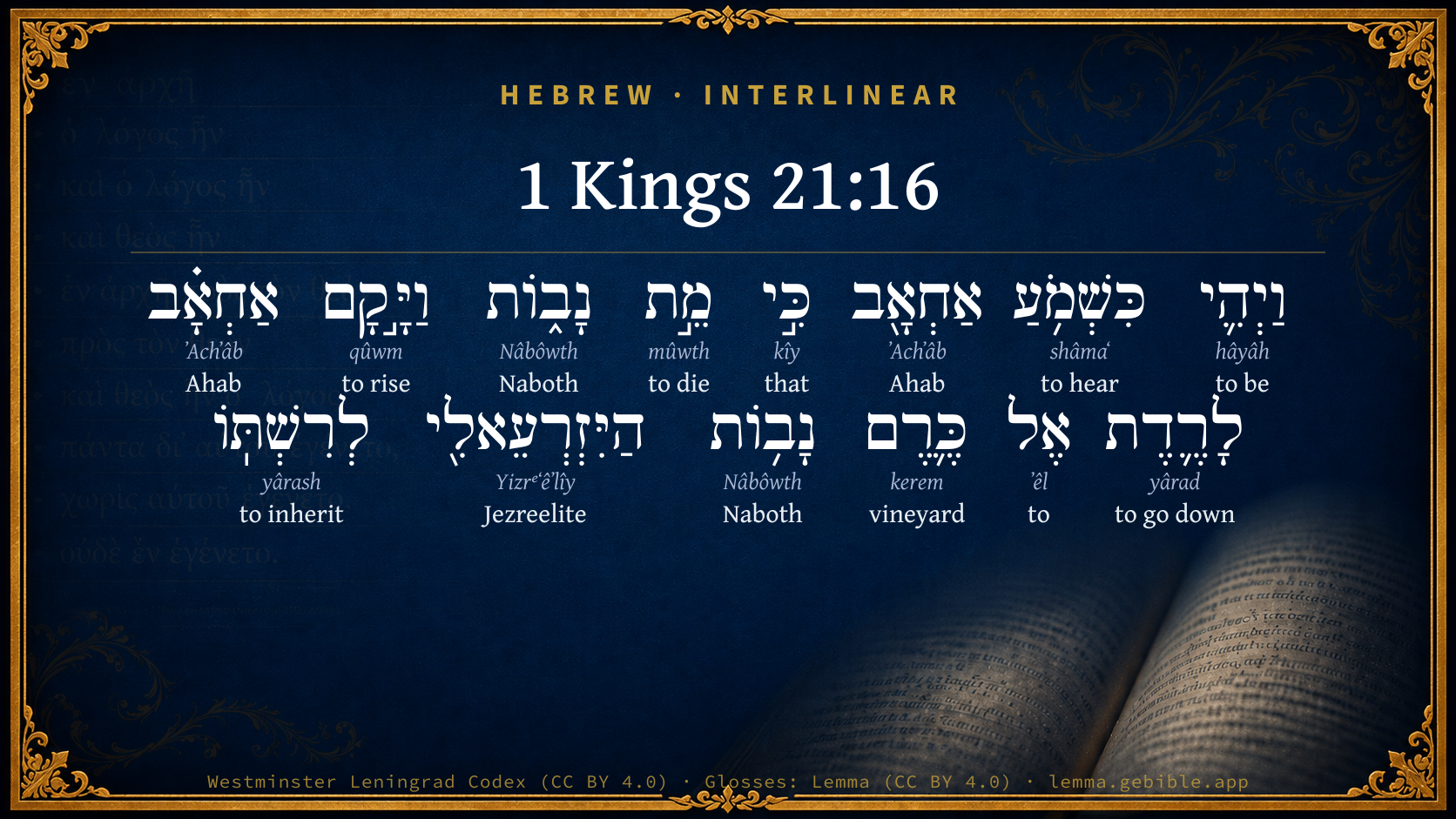
Hebrew (Westminster Leningrad Codex) 1 Kings 21:16 appears in the Hebrew Old Testament. The text above is from the Westminster Leningrad Codex. Each word links to its Strong’s number, a concise gloss, and parsing drawn from the Open Scriptures Hebrew Bible morphology. Click any word for its full Brown-Driver-Briggs (BDB) entry.
Download image
Cite this verse

1 Kings 21:16 (World English Bible). Public Domain. Lemma interlinear Bible study tool, https://lemma.gebible.app/v/1-kings/21/16.

Show BibTeX & RIS
BibTeX
RIS
English Translation
It happened, when Ahab heard that Naboth was dead, that Ahab rose up to go down to the vineyard of Naboth the Jezreelite, to take possession of it.
World English Bible · Public Domain
Download a study sheet

One document with this verse’s original text, its word-by-word gloss line, the meaning frame, cross-references with their text, attributed commentary, and full source and license credits — printable, and it pastes into notes with its structure intact.

This verse Autodidact and up

Study sheet (.html) Plain text (.txt)

A passage Seminary Student

Up to 50 verses in one chapter. A passage sheet keeps up to 6 commentary sources and 12 cross-references per verse, in the order this page ranks them, and says so on the sheet whenever that leaves anything out. Ask for a single verse and you get the Autodidact verse sheet above.

Everything on this page stays free to read, with no account — the sheet is a download of what is already on screen, not access to it.

Want to remove ads? Support Godless Engineer
Compare translations 3

The same verse in 3 English versions, stacked beneath the original-language interlinear above. Click any original word for its lexicon entry.

Each is an independent rendering of the whole verse — the interlinear is not word-aligned to these translations.

Highlighted words mark where these versions differ — a whole-verse word diff, not a word-by-word alignment.

  • World English Bible Public Domain
    It happened, when Ahab heard that Naboth was dead, that Ahab rose up to go down to the vineyard of Naboth the Jezreelite, to take possession of it.
  • King James Version Public Domain
    And it came to pass, when Ahab heard that Naboth was dead, that Ahab rose up to go down to the vineyard of Naboth the Jezreelite, to take possession of it.
  • unfoldingWord Literal Text CC BY-SA 4.0
    And it happened, when Ahab heard that Naboth had died, that Ahab arose to go down to the vineyard of Naboth the Jezreelite to possess it.

unfoldingWord Literal Text — © unfoldingWord, licensed CC BY-SA 4.0. Word-aligned USFM3 via Door43 (git.door43.org/unfoldingWord/en_ult).

Versions to compare (up to 4)

3 of 4 selected

Show all 18 translations

Every available English version of this verse, each an independent rendering of the whole verse.

  • World English Bible Public Domain
    It happened, when Ahab heard that Naboth was dead, that Ahab rose up to go down to the vineyard of Naboth the Jezreelite, to take possession of it.
  • Berean Standard Bible Public Domain
    And when Ahab heard that Naboth was dead, he got up and went down to take possession of the vineyard of Naboth the Jezreelite.
  • Majority Standard Bible Public Domain
    And when Ahab heard that Naboth was dead, he got up and went down to take possession of the vineyard of Naboth the Jezreelite.
  • King James Version Public Domain
    And it came to pass, when Ahab heard that Naboth was dead, that Ahab rose up to go down to the vineyard of Naboth the Jezreelite, to take possession of it.
  • American Standard Version (1901) Public Domain
    And it came to pass, when Ahab heard that Naboth was dead, that Ahab rose up to go down to the vineyard of Naboth the Jezreelite, to take possession of it.
  • Revised Version (1885) Public Domain
    And it came to pass, when Ahab heard that Naboth was dead, that Ahab rose up to go down to the vineyard of Naboth the Jezreelite, to take possession of it.
  • Geneva Bible (1599) Public Domain
    And when Ahab heard that Naboth was dead, he rose to go downe to the vineyard of Naboth the Izreelite, to take possession of it.
  • Douay-Rheims (1899) Public Domain
    And when Achab heard this, to wit, that Naboth was dead, he arose, and went down to the vineyard of Naboth the Jezrahelite, to take possession of it.
  • Young's Literal Translation Public Domain
    And it cometh to pass, at Ahab's hearing that Naboth is dead, that Ahab riseth to go down unto the vineyard of Naboth the Jezreelite, to possess it.
  • Literal Standard Version CC BY-SA 4.0
    And it comes to pass, at Ahab’s hearing that Naboth is dead, that Ahab rises to go down to the vineyard of Naboth the Jezreelite, to possess it.
  • Unlocked Literal Bible CC BY-SA 4.0
    When Ahab heard that Naboth was dead, he rose up to go down to the vineyard of Naboth the Jezreelite and take possession of it.
  • unfoldingWord Literal Text CC BY-SA 4.0
    And it happened, when Ahab heard that Naboth had died, that Ahab arose to go down to the vineyard of Naboth the Jezreelite to possess it.
  • Darby Bible Public Domain
    And it came to pass when Ahab heard that Naboth was dead, that Ahab rose up to go down to the vineyard of Naboth the Jizreelite, to take possession of it.
  • World Messianic Bible Public Domain
    When Ahab heard that Naboth was dead, Ahab rose up to go down to the vineyard of Naboth the Jezreelite, to take possession of it.
  • Webster's Bible Public Domain
    And it came to pass, when Ahab heard that Naboth was dead, that Ahab arose to go down to the vineyard of Naboth the Jezreelite, to take possession of it.
  • Free Bible Version CC BY-SA 4.0
    When Ahab heard that Naboth was dead, he got up and went to claim ownership of Naboth's vineyard.
  • Bible in Basic English Public Domain
    So Ahab, hearing that Naboth was dead, went down to the vine-garden of Naboth the Jezreelite to take it as his heritage.
  • JPS Tanakh (1917) Public Domain
    And it came to pass, when Ahab heard that Naboth was dead, that Ahab rose up to go down to the vineyard of Naboth the Jezreelite, to take possession of it.

Literal Standard Version (2020), Covenant Press — licensed CC BY-SA 4.0. Text via the HelloAO Bible API (eBible.org). Unlocked Literal Bible (unfoldingWord) — licensed CC BY-SA 4.0. Text via the HelloAO Bible API (eBible.org). unfoldingWord Literal Text — © unfoldingWord, licensed CC BY-SA 4.0. Word-aligned USFM3 via Door43 (git.door43.org/unfoldingWord/en_ult). Free Bible Version, Dr. Jonathan Gallagher — licensed CC BY-SA 4.0. Text via the HelloAO Bible API (eBible.org).

Word by word

More ways to search: Search by grammar → Find every occurrence → Compare this word →

Practice this passage: Drill this verse → Learn its vocabulary →

הַיִּזְרְעֵאלִ֖י
Yizrᵉʻêʼlîy
H3158
“the · Jezreelite”
Particle, Definite Article + Noun, Gentilic, Masculine, Singular, Absolute
Part of Speech
Particle + Noun
Type
Gentilic
Gender
Masculine
Number
Singular
State
Absolute
Full BDB Definition

Origin: patronymically from H3157

TWOT: None

Jezreelite = see Jezreel " sown of God" - an inhabitant of Jezreel
  1. וַיְהִ֛י hâyâh H1961 “and · to be” Conjunction + Verb, Qal, Sequential Imperfect, 3rd Person, Masculine, Singular
  2. כִּשְׁמֹ֥עַ shâmaʻ H8085 “like/as · to hear” Preposition + Verb, Qal, Infinitive Construct
  3. אַחְאָ֖ב ʼAchʼâb H256 “Ahab” Noun, Proper
  4. כִּ֣י kîy H3588 “that” Conjunction
  5. מֵ֣ת mûwth H4191 “to die” Verb, Qal, Perfect, 3rd Person, Masculine, Singular
  6. נָב֑וֹת Nâbôwth H5022 “Naboth” Noun, Proper
  7. וַיָּ֣קָם qûwm H6965 “and · to rise” Conjunction + Verb, Qal, Sequential Imperfect, 3rd Person, Masculine, Singular
  8. אַחְאָ֗ב ʼAchʼâb H256 “Ahab” Noun, Proper
  9. לָרֶ֛דֶת yârad H3381 “to go down” Preposition + Verb, Qal, Infinitive Construct
  10. אֶל ʼêl H413 “to” Preposition
  11. כֶּ֛רֶם kerem H3754 “vineyard of” Noun, Common, Both, Singular, Construct
  12. נָב֥וֹת Nâbôwth H5022 “Naboth” Noun, Proper
  13. לְרִשְׁתּֽוֹ yârash H3423 “to inherit · him” Preposition + Verb, Qal, Infinitive Construct + Suffix, Personal, 3rd Person, Masculine, Singular

About this verse

These counts appear in no published source. They are computed here, from the morphology-tagged text and Lemma’s own curated glosses. What Lemma adds →

14
words
12
distinct lemmas
Historical
section

Notable vocabulary

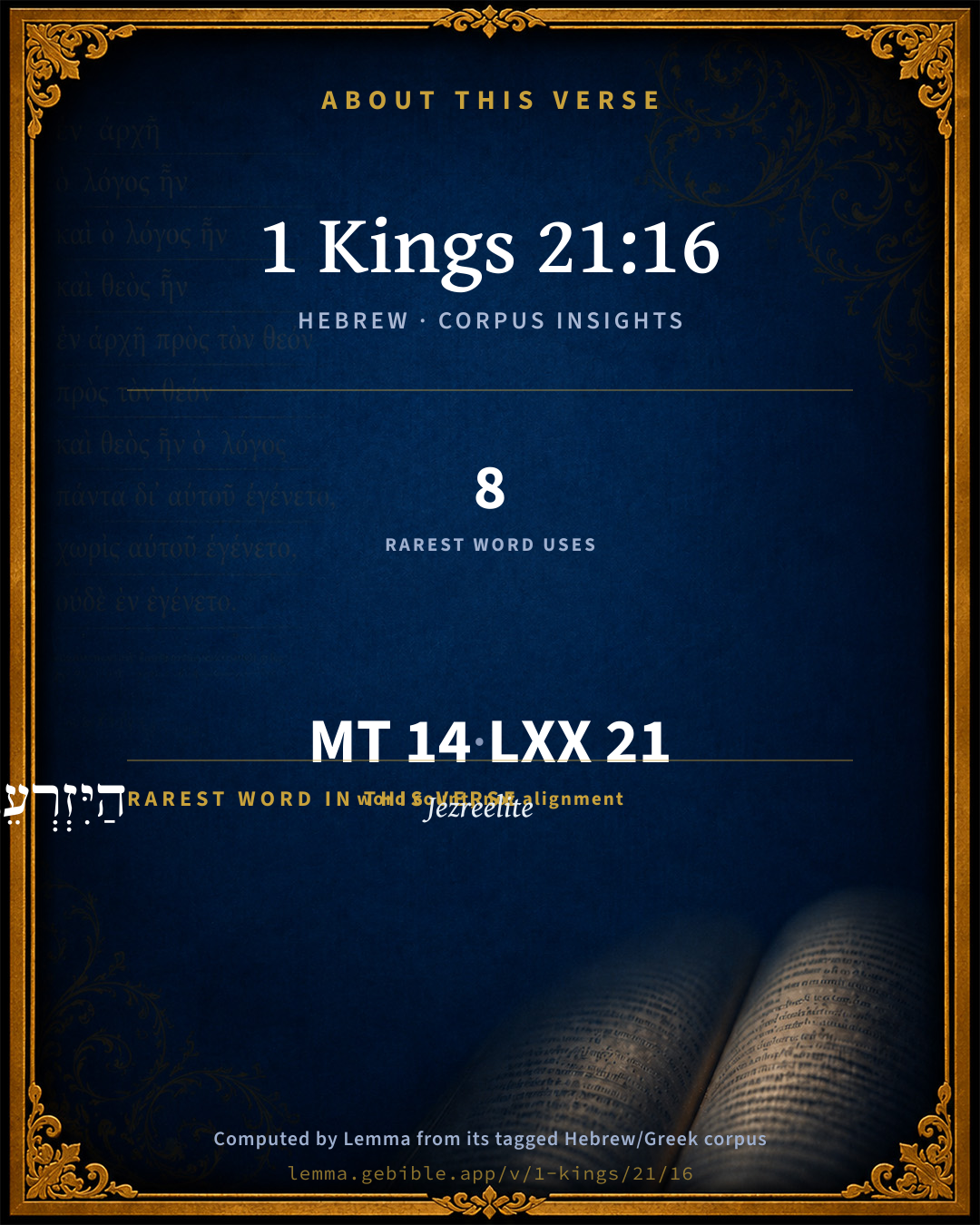
The rarest word here is הַיִּזְרְעֵאלִ֖י Jezreelite H3158 — appearing just 8 times in the whole Hebrew Bible.

Shared distinctive vocabulary

הַיִּזְרְעֵאלִ֖י Jezreelite H3158 occurs in 8 verses of the Hebrew Bible. Also found in:

Grammatical profile

  • 6 verbs
  • 6 nouns
  • 1 preposition
  • 1 conjunction

Verb forms

  • וַיְהִ֛י Qal · Sequential Imperfect
  • כִּשְׁמֹ֥עַ Qal · Infinitive Construct
  • מֵ֣ת Qal · Perfect
  • וַיָּ֣קָם Qal · Sequential Imperfect
  • לָרֶ֛דֶת Qal · Infinitive Construct
  • לְרִשְׁתּֽוֹ Qal · Infinitive Construct

Repetition

Words recur within this verse — often emphatic in Hebrew:

  • אַחְאָ֖ב Ahab H256 ×2
  • נָב֑וֹת Naboth H5022 ×2

Hebrew & Septuagint length

In English translation the verse runs 28 words from the Hebrew and 29 from the Septuagint (LXX English) — closely comparable.

A rough comparison of the two English renderings, which tokenize alike — not a word-level alignment.

Word counts can differ between the Hebrew and the Greek without any difference in meaning — e.g. the Hebrew direct-object marker אֵת has no separate Greek word, and Greek often adds the article ὁ.

In the original languages it is 14 Hebrew tokens and 21 Greek tokens — but the two are counted differently (Hebrew bundles its prefixes and suffixes into one token; the Greek is in lemma form), so that isn’t a like-for-like length.

Cross-references

9

Topical passages linked to 1 Kings 21:16 in the Treasury of Scripture Knowledge — connected by theme and wording, ordered by reader-vote popularity; previews shown in the World English Bible.

  • 2 Samuel 1:13–16 David said to the young man who told him, Whence are you? He answered, I am the son of a foreigner, an Amalekite.
  • 2 Samuel 4:9–12 David answered Rechab and Baanah his brother, the sons of Rimmon the Beerothite, and said to them, As Yahweh lives, who has redeemed my soul out of all adversity,
  • 2 Samuel 11:25–27 Then David said to the messenger, Thus shall you tell Joab, Don't let this thing displease you, for the sword devours one as well as another; make your battle more strong against the city, and overthrow it: and encourage you him.
  • 2 Samuel 23:15–17 David longed, and said, Oh that one would give me water to drink of the well of Bethlehem, which is by the gate!
  • Psalms 50:18 When you saw a thief, you consented with him, And have participated with adulterers.
  • Isaiah 33:15 He who walks righteously, and speaks blamelessly; he who despises the gain of oppressions, who shakes his hands from taking a bribe, who stops his ears from hearing of blood, and shuts his eyes from looking on evil:
  • Obadiah 1:12–14 But don't look down on your brother in the day of his disaster, and don't rejoice over the children of Judah in the day of their destruction. Don't speak proudly in the day of distress.
  • Romans 1:32 who, knowing the ordinance of God, that those who practice such things are worthy of death, not only do the same, but also approve of those who practice them.
  • 2 Peter 2:15 forsaking the right way, they went astray, having followed the way of Balaam the son of Beor, who loved the wages of wrong-doing;

Cross-references courtesy of OpenBible.info (CC BY 4.0).

Hebrew and Greek witnesses Masoretic Hebrew ↔ Greek Septuagint

The same verse in the two great witnesses to the Old Testament, shown verse-for-verse.

These are two independent witnesses, not word-aligned to each other, and the Septuagint is shown in lemma (dictionary) form.

Hebrew 1 Kings 21:16 Masoretic · Westminster Leningrad Codex

וַיְהִ֛י כִּשְׁמֹ֥עַ אַחְאָ֖ב כִּ֣י מֵ֣ת נָב֑וֹת וַיָּ֣קָם אַחְאָ֗ב לָרֶ֛דֶת אֶל כֶּ֛רֶם נָב֥וֹת הַיִּזְרְעֵאלִ֖י לְרִשְׁתּֽוֹ

It happened, when Ahab heard that Naboth was dead, that Ahab rose up to go down to the vineyard of Naboth the Jezreelite, to take possession of it.

World English Bible · Public Domain

Greek LXX 1 Kings 21:16 Septuagint · lemma form

καί ἐκἔρχομαι μεσημβρία καί υἱός αδερ πίνω μεθύω ἐν σοκχωθ αὐτός καί ὁ βασιλεύς τριάκοντα καί δύο βασιλεύς συμβοηθός μετά αὐτός

And he went forth at noon, and the son of Ader was drinking and getting drunk in Socchoth, he and the kings, even thirty and two kings, his allies.

LXX2012 (modern English Septuagint) · Public Domain

On this verse, Ellicott's Commentary for English Readers discusses the Septuagint’s reading. Read the note in Commentary ↓

Hebrew: Westminster Leningrad Codex (CC BY 4.0). Greek: Septuagint (public domain); English from LXX2012 (modern English Septuagint) (Public Domain). How the Septuagint differs from the Hebrew →

Targum (Aramaic paraphrase)

1

The Targum is the ancient Jewish Aramaic paraphrase of the Hebrew Scriptures — an interpretive translation, not the Hebrew text itself. Onkelos (literal) and Pseudo-Jonathan (expansive) render the Torah, and Jonathan the Prophets. Coverage is partial: where no permissively-licensed English translation exists for a verse, only the Aramaic is shown. This is verse-level text, not a word-by-word alignment to the Hebrew.

  1. Targum Jonathan Prophets (Joshua–Malachi)
    וַהֲוָה כַּד שְׁמַע אַחְאָב אֲרֵי מִית נָבוֹת וְקָם אַחְאָב לְמֵיחַת לְכַרְמָא דְנָבוֹת יִזְרְעֶאלָה לְמֵירְתֵיהּ:

    (no public-domain English translation for this verse)

    Targum Jonathan — Aramaic: “Mikraot Gedolot” (public domain). English: “Sefaria Community Translation” (CC0 1.0 (public-domain dedication)); “London "Chaldee Paraphrase," 1871” (public domain). Text via Sefaria.

Commentary

Notes on 1 Kings 21:16 from classic Christian and Jewish commentators (each source and its license shown beneath its notes). The classic Christian expositions comment on the surrounding passage and are grouped to its opening verse, so a note may address several verses; the Jewish commentaries on the Tanakh (Rashi and others) are per-verse, so they appear only where the commentator wrote on this verse.

Lemma curates 59 commentaries, every one of them public domain or Creative Commons licensed, each selected and text-cleaned for this edition rather than reprinted as found. About our sources →

Trapp's Complete Commentary

John Trapp

1Ki 21:16 And it came to pass, when Ahab heard that Naboth was dead, that Ahab rose up to go down to the vineyard of Naboth the Jezreelite, to take possession of it.

Ver. 16. Ahab rose up to go down] But better sit still than rise and fall. Josephus saith that he leaped for joy of the good news, and forthwith went to take possession. And yet Ambrose, Sulpitius, and some Greek copies have it that Ahab, hearing it, rent his clothes and put on sackcloth. This is not so likely.

John Trapp, A Commentary or Exposition upon All the Books of the Old and New Testament (1647–1656) — public domain. Text from a community e-Sword module.

Jamieson, Fausset & Brown

Robert Jamieson, A. R. Fausset & David Brown

Ahab rose up to go down--from Samaria to Jezreel.

Jamieson, Fausset & Brown — Commentary Critical and Explanatory on the Whole Bible (1871) — public domain (CC PDM 1.0). Text via the HelloAO Bible API.

Ellicott's Commentary for English Readers

(16) When Ahab heard.—It is characteristic of Ahab that he takes care to ask no question about Naboth’s death, desirous “to be innocent of the knowledge,” and yet tacitly to “applaud the deed.” The guilt is Jezebel’s; the fruit, his own. In the LXX. there is here a curious and striking insertion: “he rent his clothes and put on sackcloth,” representing Ahab as struck with momentary horror, and then, after thus salving his conscience, still resolving to carry out his desire for the coveted vineyard. The picture is equally true to nature, especially to such a nature as his. But the insertion has little authority, and is probably a mistaken interpolation from 1Ki_21:27.

A Bible Commentary for English Readers, edited by Charles John Ellicott (1878–1897) — public domain. Text from a community e-Sword module.

The Cambridge Bible for Schools and Colleges

gen. ed. J. J. S. Perowne

16. when Ahab heard that Naboth was dead] Here the LXX. adds ‘he rent his garments and covered himself with sackcloth’. This clause must be entirely out of place. Josephus gives us a detail far more in harmony with Ahab’s character. He says (Ant. viii. 13, 8) ‘And Ahab was pleased with what had been done, and sprang up from his bed, and went to see Naboth’s vineyard’. There was certainly no time lost by him. His entry on the possession seems to have been made the very next day after Naboth’s death. We learn afterwards (2Ki_9:26) that Jehu and Bidkar rode with Ahab at the time, and so appalling was the curse which Elijah pronounced on the wretched king that it was imprinted on Jehu’s memory and he could quote it many years afterwards, apparently in its very words.

The Cambridge Bible for Schools and Colleges (gen. ed. J. J. S. Perowne; Cambridge University Press, 1878–1918) — public domain. Text from a community e-Sword module.

John Gill's Exposition

And Ahab said to Elijah, hast thou found me, O mine enemy?.... So he reckoned him, because he dealt faithfully with him, and reproved him for his sins, and denounced the judgments of God upon him for them:

and he answered, I have found thee; as a thief, a robber and plunderer, in another's vineyard; he had found out his sin in murdering Naboth, and unjustly possessing his vineyard, which was revealed to him by the Lord; and now was come as his enemy, as he called him, as being against him, his adversary, not that he hated his person, but his ways and works:

because thou hast sold thyself to work evil in the sight of the Lord; had given up himself wholly to his lusts, was abandoned to them, and as much under the power of them as a man is that has sold himself to another to be his slave; and which he served openly, publicly in the sight of the omniscient God, and in defiance of him. Abarbinel gives another sense of the word we render "sold thyself", that he "made himself strange", as if he was ignorant, and did not know what Jezebel had done; whereas he knew fully the whole truth of the matter, and that Naboth was killed through her contrivance, and by her management purposely; and so he did evil in the sight of that God that knows all things, pretending he was ignorant when he was not, and this Elijah found out by divine revelation; so the word is used in Gen 42:6, but the former sense is best, as appears from Kg1 21:25.

John Gill's Exposition of the Whole Bible (1746–1763) — public domain (CC PDM 1.0). Text via the HelloAO Bible API.

Albert Barnes' Notes on the Bible

To take possession of it - The goods of traitors appear to have been forfeited to the crown by the Jewish law as they still are almost universally throughout the East. Compare 2Sa 16:4.

Albert Barnes' Notes on the Bible (1834–1885) — public domain. Text from a community e-Sword/MySword module.

Haydock's Catholic Bible Commentary

Of it, on the title of confiscation, as Naboth had been condemned for high treason; (see 2 Kings ix. 7.; Menochius) or because there was no heir left, ver. 10. Some assert, that Naboth was Achab’s uncle. But this wants proof. (Calmet) --- Achab only waited one day, and the Elias met him to denounce to him a similar fate after he was dead, 4 Kings ix. 26. Septuagint have, "he tore this garments, and put on sackcloth; and it came to pass afterwards, that Achab arose," &c. This addition would intimate that the king pretended to be sorry. They repeat the same thing, ver. 27., "he had put on sackcloth, on the day when he slew Naboth, and went along cast down." It is probable that Achab might assume this garb, to make people suppose that he had no hand in the death of Naboth; but this was all hypocrisy, and Elias boldly accused him of guilt. Thou hast slain, &c., ver. 19. (Haydock) --- He knew, at least, of his wife’s machinations. (Salien)

George Leo Haydock (1774–1849), Haydock's Catholic Family Bible and Commentary, 1859 edition — public domain. Excludes Psalms (Douay-Rheims chapter numbering differs from Protestant) and Deuterocanonical books (Catholic canon only).

The Pulpit Commentary

And it came to pass, when Ahab heard that Naboth was dead, that Ahab arose up According to the LXX, his first act was to rend his clothes and put on sackcloth. Afterwards "he rose up," etc. to go down The "Great Plain, on the margin of which Jezreel stands, is at a much lower level than Samaria, which is in the mountain district of Ephraim" to the vineyard of Naboth the Jezreelite, to take possession of it. "Behind him probably in the back part of his chariot ride his two pages, Jehu and Bidkar," (2Ki_9:26) Stanley. But the expression "riding in pairs after Ahab" (A.V "rode together after") does not make it certain that they were in the same chariot. Indeed, they may have been on horseback. This was apparently (2Ki_9:26) on the day after the murder.

The Pulpit Commentary (1880–1919), ed. H.D.M. Spence-Jones & Joseph S. Exell — public domain. Text from a community e-Sword module.

Keil & Delitzsch

C. F. Keil & F. Delitzsch

But when Ahab went down to Jezreel to take possession of the vineyard of Naboth, Elijah came to meet him by the command of God, with the word of the Lord, "Hast thou murdered and also taken possession?" The question served to sharpen his conscience, since Ahab was obliged to admit the fact. בּשׁמרון אשׁר means "who lives at Samaria," for when Elijah came to meet him, Ahab was in Jezreel, Elijah then said to him still further: "Thus saith the Lord: In the place where the dogs have licked the blood of Naboth, will they also lick thine, yea, thy blood." אתּה גּם serves as an emphatic repetition of the suffix (cf. Ges. 121, 3). This threat was only so far fulfilled upon Ahab, from the compassion of God, and in consequence of his humbling himself under the divine judgment (Kg1 21:27-29), that dogs licked his blood at Samaria when the carriage was washed in which he had died (Kg1 22:38); but it was literally fulfilled in the case of his son Joram, whose corpse was cast into Naboth's piece of ground (Kg2 9:25-26).

Keil & Delitzsch — Biblical Commentary on the Old Testament (1861–1891) — public domain (CC PDM 1.0). Text via the HelloAO Bible API. (Old Testament only.)

Lesson kit

Teaching starters — assembled from the data on this page, not authored interpretation. Every prompt links to the verse data it draws on. Edit before teaching.

1 Kings, in the Historical, opens this verse with 14 words (12 distinct Hebrew lemmas). Its most distinctive word is Yizrᵉʻêʼlîy (“Jezreelite”). A historical commentator’s framing appears above. Read the whole chapter for the surrounding context.

Discussion questions

  1. How does “Jezreelite” (Yizrᵉʻêʼlîy) shape what this verse is saying?
  2. How does 1 Kings 21:1, which shares the word «Jezreelite», read alongside this verse?
  3. What does the repetition of “Ahab” (2× in this one verse) do in this verse?
  4. These translations render this verse differently; the difference is in the English rendering, not the original. What questions does that raise?
  5. «וַיְהִ֛י» is a Qal Sequential Imperfect verb. How does that grammatical form shape the action described?
  6. Compare how Trapp's Complete Commentary and Jamieson, Fausset & Brown read this verse. Where do they agree or differ?

Things to notice

Reading settings

Reading text

Shown beneath each verse's original-language words.

Old Testament
Old Testament edition

Read the OT as the Masoretic Hebrew (MT) or the Greek Septuagint (LXX).

English shown for the Greek Septuagint (in the Hebrew ↔ Greek comparison).

Comparing translations? Open the Compare panel on any verse page to stack up to four side by side.