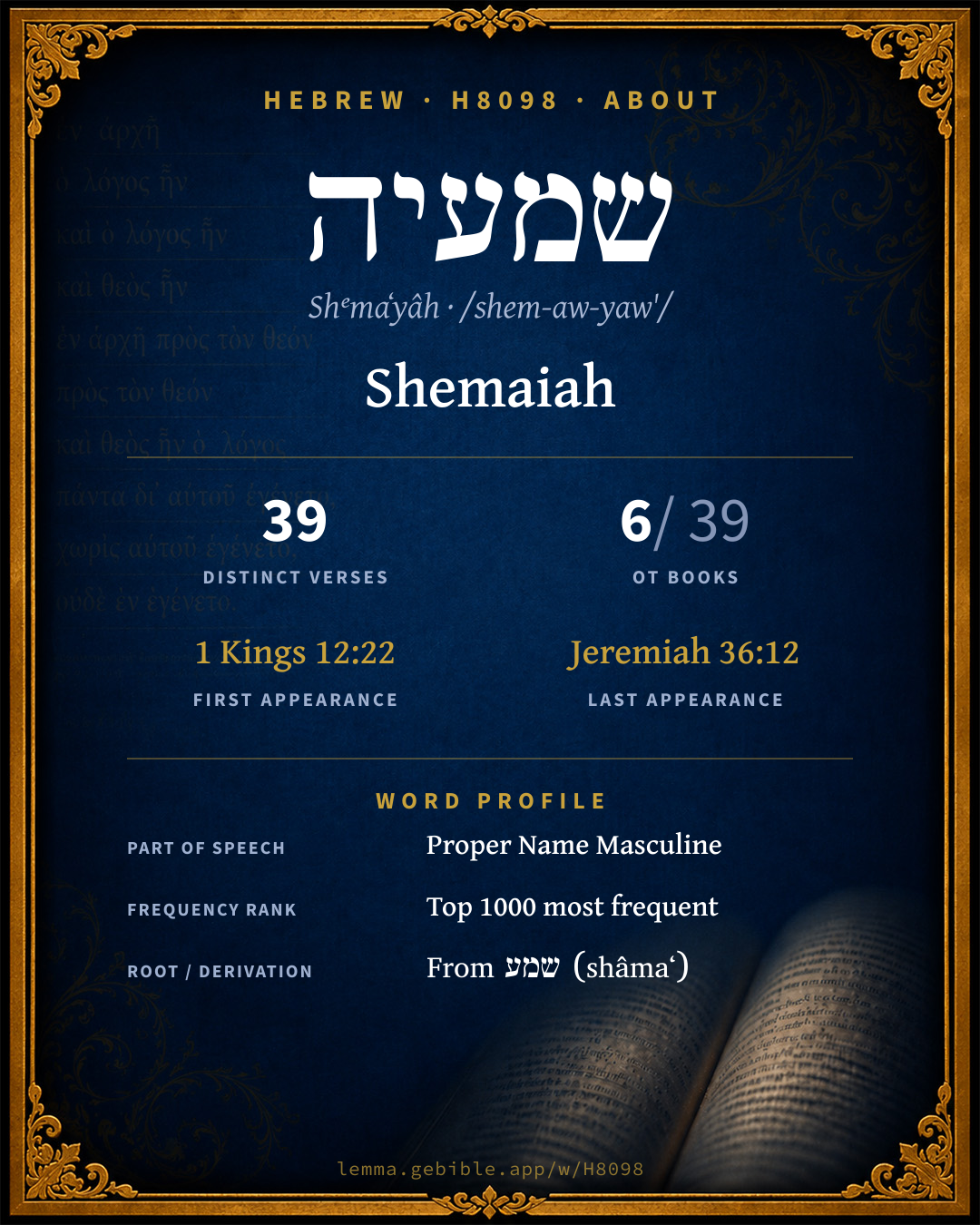
שְׁמַעְיָ֫הוּ
Shemaiah
BDB lists 10 entries for ‘Shemaiah’ fuller range ↓
Full lexicon entry — Brown-Driver-Briggs (BDB)
From Brown-Driver-Briggs (BDB)
Where this word appears
Grammar key — what these labels mean
Part of speech
- Noun
- A naming word — a person, place, thing, or idea.
Noun type
- Proper
- A name of a specific person, place, or people (e.g. Abraham, Zion, Israel).
Every verse where H8098 appears — 39 distinct verses across 6 books. Click any verse to open its interlinear word-by-word view. Verse text shown in the World English Bible for context — . Each verse’s Hebrew form is shown with its reference; the English is not keyword-highlighted, since the data carries no word-level English alignment. Use “Compare translations” on any verse to read it across multiple English versions. This concordance covers the Hebrew Bible; Septuagint (Greek Old Testament) occurrences are not indexed here.
1 Kings 1 verse
1 Chronicles 11 verses
- 1 Chronicles 3:22 שְׁמַעְיָ֑ה שְׁמַעְיָ֗ה n Proper n Proper The sons of Shecaniah: Shemaiah. The sons of Shemaiah: Hattush, and Igal, and Bariah, and Neariah, and Shaphat, six.
- 1 Chronicles 4:37 שְׁמַֽעְיָֽה n Proper and Ziza the son of Shiphi, the son of Allon, the son of Jedaiah, the son of Shimri, the son of Shemaiah--
- 1 Chronicles 5:4 שְׁמַֽעְיָ֥ה n Proper The sons of Joel: Shemaiah his son, Gog his son, Shimei his son,
- 1 Chronicles 9:14 שְׁמַֽעְיָ֧ה n Proper Of the Levites: Shemaiah the son of Hasshub, the son of Azrikam, the son of Hashabiah, of the sons of Merari;
- 1 Chronicles 9:16 שְׁמַֽעְיָ֔ה n Proper and Obadiah the son of Shemaiah, the son of Galal, the son of Jeduthun, and Berechiah the son of Asa, the son of Elkanah, who lived in the villages of the Netophathites.
- 1 Chronicles 15:8 שְׁמַֽעְיָ֥ה n Proper of the sons of Elizaphan, Shemaiah the chief, and his brothers two hundred;
- 1 Chronicles 15:11 שְׁמַֽעְיָ֔ה n Proper David called for Zadok and Abiathar the priests, and for the Levites, for Uriel, Asaiah, and Joel, Shemaiah, and Eliel, and Amminadab,
- 1 Chronicles 24:6 שְֽׁמַֽעְיָה֩ n Proper Shemaiah the son of Nethanel the scribe, who was of the Levites, wrote them in the presence of the king, and the princes, and Zadok the priest, and Ahimelech the son of Abiathar, and the heads of the fathers' [houses] of the priests and of the Levites; one fathers' house being taken for Eleazar, and one taken for Ithamar.
- 1 Chronicles 26:4 שְׁמַֽעְיָ֤ה n Proper Obed-edom had sons: Shemaiah the firstborn, Jehozabad the second, Joah the third, and Sacar the fourth, and Nethanel the fifth,
- 1 Chronicles 26:6 וְ/לִֽ/שְׁמַֽעְיָ֤ה conj + prep + n Proper Also to Shemaiah his son were sons born, who ruled over the house of their father; for they were mighty men of valor.
- 1 Chronicles 26:7 שְׁמַֽעְיָ֗ה n Proper The sons of Shemaiah: Othni, and Rephael, and Obed, Elzabad, whose brothers were valiant men, Elihu, and Semachiah.
2 Chronicles 8 verses
- 2 Chronicles 11:2 שְׁמַֽעְיָ֥הוּ n Proper But the word of Yahweh came to Shemaiah the man of God, saying,
- 2 Chronicles 12:5 וּֽ/שְׁמַֽעְיָ֤ה conj + n Proper Now Shemaiah the prophet came to Rehoboam, and to the princes of Judah, who were gathered together to Jerusalem because of Shishak, and said to them, Thus says Yahweh, You have forsaken me, therefore have I also left you in the hand of Shishak.
- 2 Chronicles 12:7 שְׁמַֽעְיָ֧ה n Proper When Yahweh saw that they humbled themselves, the word of Yahweh came to Shemaiah, saying, They have humbled themselves: I will not destroy them; but I will grant them some deliverance, and my wrath shall not be poured out on Jerusalem by the hand of Shishak.
- 2 Chronicles 12:15 שְׁמַֽעְיָ֧ה n Proper Now the acts of Rehoboam, first and last, aren't they written in the histories of Shemaiah the prophet and of Iddo the seer, after the manner of genealogies? There were wars between Rehoboam and Jeroboam continually.
- 2 Chronicles 17:8 שְֽׁמַֽעְיָ֡הוּ n Proper and with them the Levites, even Shemaiah, and Nethaniah, and Zebadiah, and Asahel, and Shemiramoth, and Jehonathan, and Adonijah, and Tobijah, and Tob-adonijah, the Levites; and with them Elishama and Jehoram, the priests.
- 2 Chronicles 29:14 שְׁמַֽעְיָ֖ה n Proper and of the sons of Heman, Jehuel and Shimei; and of the sons of Jeduthun, Shemaiah and Uzziel.
- 2 Chronicles 31:15 וּֽ/שְׁמַֽעְיָ֜הוּ conj + n Proper Under him were Eden, and Miniamin, and Jeshua, and Shemaiah, Amariah, and Shecaniah, in the cities of the priests, in their office of trust, to give to their brothers by divisions, as well to the great as to the small:
- 2 Chronicles 35:9 וּ/שְׁמַֽעְיָ֨הוּ conj + n Proper Conaniah also, and Shemaiah and Nethanel, his brothers, and Hashabiah and Jeiel and Jozabad, the chiefs of the Levites, gave to the Levites for the Passover offerings five thousand [small cattle], and five hundred oxen.
Ezra 4 verses
- Ezra 8:13 וּֽ/שְׁמַעְיָ֑ה conj + n Proper Of the sons of Adonikam, [who were] the last; and these are their names: Eliphelet, Jeuel, and Shemaiah; and with them sixty males.
- Ezra 8:16 לִֽ֠/שְׁמַעְיָה prep + n Proper Then sent I for Eliezer, for Ariel, for Shemaiah, and for Elnathan, and for Jarib, and for Elnathan, and for Nathan, and for Zechariah, and for Meshullam, chief men; also for Joiarib, and for Elnathan, who were teachers.
- Ezra 10:21 וּֽ/שְׁמַֽעְיָ֔ה conj + n Proper Of the sons of Harim: Maaseiah, and Elijah, and Shemaiah, and Jehiel, and Uzziah.
- Ezra 10:31 שְׁמַֽעְיָ֥ה n Proper [of] the sons of Harim: Eliezer, Isshijah, Malchijah, Shemaiah, Shimeon,
Nehemiah 10 verses
- Nehemiah 3:29 שְׁמַֽעְיָ֣ה n Proper After them repaired Zadok the son of Immer over against his own house. After him repaired Shemaiah the son of Shecaniah, the keeper of the east gate.
- Nehemiah 6:10 שְֽׁמַֽעְיָ֧ה n Proper I went to the house of Shemaiah the son of Delaiah the son of Mehetabel, who was shut up; and he said, Let us meet together in the house of God, within the temple, and let us shut the doors of the temple: for they will come to kill you; yes, in the night will they come to kill you.
- Nehemiah 10:8 שְׁמַֽעְיָ֑ה n Proper Maaziah, Bilgai, Shemaiah; these were the priests.
- Nehemiah 11:15 שְׁמַעְיָ֧ה n Proper Of the Levites: Shemaiah the son of Hasshub, the son of Azrikam, the son of Hashabiah, the son of Bunni;
- Nehemiah 12:6 שְׁמַֽעְיָ֥ה n Proper Shemaiah, and Joiarib, Jedaiah.
- Nehemiah 12:18 לִֽ/שְׁמַעְיָ֖ה prep + n Proper of Bilgah, Shammua; of Shemaiah, Jehonathan;
- Nehemiah 12:34 וּֽ/שְׁמַֽעְיָ֖ה conj + n Proper Judah, and Benjamin, and Shemaiah, and Jeremiah,
- Nehemiah 12:35 שְׁמַֽעְיָ֗ה n Proper and certain of the priests' sons with trumpets: Zechariah the son of Jonathan, the son of Shemaiah, the son of Mattaniah, the son of Micaiah, the son of Zaccur, the son of Asaph;
- Nehemiah 12:36 שְֽׁמַעְיָ֡ה n Proper and his brothers, Shemaiah, and Azarel, Milalai, Gilalai, Maai, Nethanel, and Judah, Hanani, with the musical instruments of David the man of God; and Ezra the scribe was before them.
- Nehemiah 12:42 וּֽ/שְׁמַֽעְיָ֜ה conj + n Proper and Maaseiah, and Shemaiah, and Eleazar, and Uzzi, and Jehohanan, and Malchijah, and Elam, and Ezer. The singers sang loud, with Jezrahiah their overseer.
Jeremiah 5 verses
- Jeremiah 26:20 שְׁמַעְיָ֔הוּ n Proper There was also a man who prophesied in the name of Yahweh, Uriah the son of Shemaiah of Kiriath Jearim; and he prophesied against this city and against this land according to all the words of Jeremiah:
- Jeremiah 29:24 שְׁמַעְיָ֥הוּ n Proper Concerning Shemaiah the Nehelamite you shall speak, saying,
- Jeremiah 29:31 שְׁמַעְיָ֖ה שְׁמַעְיָ֗ה n Proper n Proper Send to all them of the captivity, saying, Thus says Yahweh concerning Shemaiah the Nehelamite: Because Shemaiah has prophesied to you, and I didn't send him, and he has caused you to trust in a lie;
- Jeremiah 29:32 שְׁמַעְיָ֣ה n Proper therefore thus says Yahweh, Behold, I will punish Shemaiah the Nehelamite, and his seed; he shall not have a man to dwell among this people, neither shall he see the good that I will do to my people, says Yahweh, because he has spoken rebellion against Yahweh.
- Jeremiah 36:12 שְׁ֠מַעְיָהוּ n Proper he went down into the king's house, into the scribe's chamber: and, behold, all the princes were sitting there, [to wit], Elishama the scribe, and Delaiah the son of Shemaiah, and Elnathan the son of Achbor, and Gemariah the son of Shaphan, and Zedekiah the son of Hananiah, and all the princes.
About this entry
At a glance — auto-summarized from this page’s data, not written by a person. Every figure links to its source below. This summary describes the numbers; it doesn’t interpret them.
שמעיה (Shᵉmaʻyâh) is a Hebrew name most often rendered “Shemaiah.” It first appears in 1 Kings 12:22. Spanning 39 verses in 6 books, it ranks among the moderately common words of the Hebrew Bible. 1 Chronicles dominates its distribution — 11 of 39 verses. The sections below give every occurrence and version rendering.
Gloss history
Strong's 1890 vs modern scholarship
About this word
Strong's H8098 catalogs a Hebrew word from the Hebrew Old Testament.
These counts are not copied from any lexicon or concordance. They are computed here, from the morphology-tagged Hebrew Old Testament. What Lemma adds →
- 39
- distinct verses
- The word appears in 39 distinct verses.
- 6 / 39
- OT books
- The word appears in 6 of 39 Old Testament books.
- #891
- by frequency
- Top 1000 most frequent Hebrew words (rank 891 of 8,640 Hebrew words by occurrence).
View all 39 occurrences in the concordance →
Most concentrated in
- 1 Chronicles 11 verses 28%
- Nehemiah 10 verses 26%
- 2 Chronicles 8 verses 21%
By section of the Old Testament
By traditional corpus
Conventional, traditional groupings — biblical authorship is debated, so this is a traditional corpus grouping, not an authorship claim. Each share is this word’s portion of its verses in that division of the Hebrew canon. Each figure is a share of the word’s 39 distinct verses.
- Writings (Ketuvim) 33 verses · 85%
- Prophets (Nevi'im) 6 verses · 15%
How translations render this word
Counts come from each version’s own published word-to-Strong’s tagging or interlinear alignment — an approximate guide to how each version renders this word, not a word-level alignment the data otherwise carries. Because each total is that version’s own tagged count, the per-version totals vary from one another and need not match the appearance or distinct-verse counts above. These counts may also differ from a printed concordance because Lemma counts each distinctly tagged rendering and does not collapse phrase taggings into a single head-word total. This is a fixed set of word-tagged versions (KJV, ASV, BSB, ULT) and does not change with the reading translation you choose elsewhere. Each version’s license is shown beside its name below (and on Sources).
- King James Version: Shemaiah 36×, Came to shemaiah 2×
- American Standard Version: Shemaiah 33×, Came to shemaiah 2×, Concerning shemaiah 2×
- Berean Standard Bible: Shemaiah 39×
- unfoldingWord Literal Text: Shemaiah 36×
King James Version Public Domain
Renders H8098 across 41 tagged occurrences — most commonly:
Plus 3 renderings that appear only once — usually multi-word phrases or single function words the recovered tagging swept in, not distinct renderings.
American Standard Version Public Domain
Renders H8098 across 41 tagged occurrences — most commonly:
Plus 4 renderings that appear only once — usually multi-word phrases or single function words the recovered tagging swept in, not distinct renderings.
Berean Standard Bible Public Domain
Renders H8098 across 41 tagged occurrences — most commonly:
Plus 2 renderings that appear only once — usually multi-word phrases or single function words the recovered tagging swept in, not distinct renderings.
unfoldingWord Literal Text CC BY-SA 4.0
Renders H8098 across 37 tagged occurrences — most commonly:
Plus 1 rendering that appears only once — usually multi-word phrases or single function words the recovered tagging swept in, not distinct renderings.
33 senses and sub-senses in the full BDB
What do BDB’s symbols mean?
BDB uses these scholarly abbreviations:
| Symbol | Meaning |
|---|---|
| 𝔊 | the Septuagint (the ancient Greek translation, LXX) |
| 𝔙 | the Vulgate (the Latin translation) |
| 𝔖 | the Syriac version (the Peshitta) |
| 𝔗 | the Targum (the Aramaic translation) |
| ψ | the Psalms |
| √ | root (the underlying root or stem) |
| ‖ | parallel passage (a synonymous or contrasted parallel) |
| † | the dagger: every passage where the word occurs is cited |
The 33 senses and sub-senses the full Brown-Driver-Briggs lexicon distinguishes for this word, in lexicon order (not ranked by frequency), with BDB’s own verbatim wording and sub-sense lettering. Shown in Hebrew script with BDB’s own scholarly abbreviations. The condensed entry is in the Lexicon Entry tab. See also the Forms in the corpus table below.
- 1. prophet, Rehob.’s time 1 K 12:22 2 Ch 12:5, 7, 15; = -יָהוּ 11:2. e.g. 1 Kings 12:22
- 2. Jer’s time:
- a. false proph. Je 29:31(×2), 32 = -יָהוּ v 24. e.g. Jeremiah 29:31
- b. -יָהוּ 36:12. e.g. Jeremiah 36:12
- 3. -יָהוּ a prophet’s father 26:20. e.g. Jeremiah 26:20
- 4. descendant of Zerub. 1 Ch 3:22(×2). e.g. 1 Chronicles 3:22
- 5. in Simeon 4:37. e.g. 1 Chronicles 4:37
- 6. in Reuben 5:4. e.g. 1 Chronicles 5:4
- 7. Levites:
- a. 1 Ch 9:14. e.g. 1 Chronicles 9:14
- b. v 16 = שַׁמּוּעַ 3. e.g. 1 Chronicles 9:16
- c. 15:8, 11. e.g. 1 Chronicles 15:8
- d. 24:6. e.g. 1 Chronicles 24:6
- e. 26:4, 6, 7. e.g. 1 Chronicles 26:4
- f. 2 Ch 29:14. e.g. 2 Chronicles 29:14
- g. Ezr 8:16. e.g. Ezra 8:16
- h. Ne 11:15. Also -יָהוּ e.g. Nehemiah 11:15
- i. 2 Ch 17:8. e.g. 2 Chronicles 17:8
- j. 31:15. e.g. 2 Chronicles 31:15
- k. 35:9. e.g. 2 Chronicles 35:9
- 8. companions of Ezra:
- a. Ezr 8:13. e.g. Ezra 8:13
- b. 10:21. e.g. Ezra 10:21
- c. v 31. e.g. Ezra 8:31
- 9. of Neh.:
- a. Ne 3:29. e.g. Nehemiah 3:29
- b. 6:10. e.g. Nehemiah 6:10
- 10. priests:
- a. Ne 10:9; 12:42. e.g. Nehemiah 10:9
- b. v 6, 18. e.g. Nehemiah 12:6
- c. v 35. e.g. Nehemiah 12:35
- d. v 36. e.g. Nehemiah 12:36
- 11. a prince v 34. e.g. Nehemiah 12:34
Senses from the full Brown-Driver-Briggs lexicon (Brown, Driver, Briggs; Oxford 1906 — public domain), digitized via Sefaria, supplemented by the OpenScriptures HebrewLexicon (CC BY 4.0). Full attribution on Sources.
Word origin
n.pr.m. Σαμαιας, etc.: שְׁמַעְיָה,
— Brown-Driver-Briggs (Oxford 1906, public domain), digitized via Sefaria, supplemented by the OpenScriptures HebrewLexicon (CC BY 4.0). See Sources.
Derived from שמע (shâmaʻ) (H8085) — to hear.
Jastrow Dictionary
A second Hebrew/Aramaic lexicon for comparison, covering Aramaic and post-biblical (Talmudic, Targumic, Midrashic) usage that the biblical-Hebrew BDB does not. Matched by lemma rather than by Strong’s number, so a lemma may carry more than one Jastrow headword (shown separately below), and the entries cover usage well beyond the Bible.
שְׁמַעְיָא
- (b. h.) pr. n. m. Shemaiah, colleague of Abṭalion (v. אַבְטַלְיוֹן). Pes. 66ᵃ. Ab. I, 10. Yoma 71ᵇ. Gitt. 57ᵇ; a. fr.
A Dictionary of the Targumim, the Talmud Babli and Yerushalmi, and the Midrashic Literature (Marcus Jastrow; London, Luzac, 1903) — Public Domain. Digitized via Sefaria. Digitized via Sefaria. Full attribution on Sources.
Forms in the corpus
The 33 distinct written forms H8098 takes in the Hebrew Bible, most frequent first — each parse links to that state’s occurrences in the concordance. Hebrew forms include their vowel points and cantillation, so a single lemma takes many written forms.
| Form | Parsing | Example | Uses |
|---|---|---|---|
| שְׁמַֽעְיָ֥ה | Noun, Proper | Ezra 10:31 | 4 |
| שְׁמַֽעְיָ֧ה | Noun, Proper | 1 Chronicles 9:14 | 3 |
| שְׁמַֽעְיָ֔ה | Noun, Proper | 1 Chronicles 9:16 | 2 |
| שְׁמַֽעְיָ֗ה | Noun, Proper | 1 Chronicles 26:7 | 2 |
| שְׁמַעְיָ֗ה | Noun, Proper | 1 Chronicles 3:22 | 2 |
| וְ/לִֽ/שְׁמַֽעְיָ֤ה | Noun, Proper | 1 Chronicles 26:6 | 1 |
| וּ/שְׁמַֽעְיָ֨הוּ | Noun, Proper | 2 Chronicles 35:9 | 1 |
| וּֽ/שְׁמַֽעְיָ֔ה | Noun, Proper | Ezra 10:21 | 1 |
| וּֽ/שְׁמַֽעְיָ֖ה | Noun, Proper | Nehemiah 12:34 | 1 |
| וּֽ/שְׁמַֽעְיָ֜ה | Noun, Proper | Nehemiah 12:42 | 1 |
| וּֽ/שְׁמַֽעְיָ֜הוּ | Noun, Proper | 2 Chronicles 31:15 | 1 |
| וּֽ/שְׁמַֽעְיָ֤ה | Noun, Proper | 2 Chronicles 12:5 | 1 |
| וּֽ/שְׁמַעְיָ֑ה | Noun, Proper | Ezra 8:13 | 1 |
| לִֽ/שְׁמַעְיָ֖ה | Noun, Proper | Nehemiah 12:18 | 1 |
| לִֽ֠/שְׁמַעְיָה | Noun, Proper | Ezra 8:16 | 1 |
| שְׁ֠מַעְיָהוּ | Noun, Proper | Jeremiah 36:12 | 1 |
| שְֽׁמַֽעְיָ֡הוּ | Noun, Proper | 2 Chronicles 17:8 | 1 |
| שְֽׁמַֽעְיָ֧ה | Noun, Proper | Nehemiah 6:10 | 1 |
| שְֽׁמַֽעְיָה֩ | Noun, Proper | 1 Chronicles 24:6 | 1 |
| שְֽׁמַעְיָ֡ה | Noun, Proper | Nehemiah 12:36 | 1 |
| שְׁמַֽעְיָ֑ה | Noun, Proper | Nehemiah 10:8 | 1 |
| שְׁמַֽעְיָ֖ה | Noun, Proper | 2 Chronicles 29:14 | 1 |
| שְׁמַֽעְיָ֣ה | Noun, Proper | Nehemiah 3:29 | 1 |
| שְׁמַֽעְיָ֤ה | Noun, Proper | 1 Chronicles 26:4 | 1 |
| שְׁמַֽעְיָ֥הוּ | Noun, Proper | 2 Chronicles 11:2 | 1 |
| שְׁמַֽעְיָֽה | Noun, Proper | 1 Chronicles 4:37 | 1 |
| שְׁמַעְיָ֑ה | Noun, Proper | 1 Chronicles 3:22 | 1 |
| שְׁמַעְיָ֔הוּ | Noun, Proper | Jeremiah 26:20 | 1 |
| שְׁמַעְיָ֖ה | Noun, Proper | Jeremiah 29:31 | 1 |
| שְׁמַעְיָ֣ה | Noun, Proper | Jeremiah 29:32 | 1 |
| שְׁמַעְיָ֥ה | Noun, Proper | 1 Kings 12:22 | 1 |
| שְׁמַעְיָ֥הוּ | Noun, Proper | Jeremiah 29:24 | 1 |
| שְׁמַעְיָ֧ה | Noun, Proper | Nehemiah 11:15 | 1 |
Same root — word family
Other BDB entries built from the same root as H8098, grouped by Strong’s listed origin. These share a root / origin per the lexicon — not necessarily a shared meaning. Each links to that word’s own entry.
Derives from
Shares the same root
- השמעות hashmâʻûwth H2045 report
- משמע mishmâʻ H4926 rumor
- שמע shᵉmaʻ H8086 to hear
- שמע shêmaʻ H8088 hearing
- שמע shômaʻ H8089 report
Proper names from this root
People and places named from this root — a name, not an additional meaning of the word.
- אשתמע ʼEshtᵉmôaʻ H851 Eshtemoh
- ישמעאל Yishmâʻêʼl H3458 Ishmael
- ישמעיה Yishmaʻyâh H3460 Ishmaiah
- שמואל Shᵉmûwʼêl H8050 Samuel
- שמע Shâmâʻ H8091 Shama
- שמעון Shimʻôwn H8095 Simeon
Compare all same-root words → Showing 4 of 13 — not the complete family. 6 of the same-root words are proper names (people or places). They share a root, not necessarily a meaning.
Bible dictionary
Public-domain dictionary articles matched to this entry by name (Shemaiah). A biblical name can be shared by more than one person or place, so an article may treat several.
Easton's Bible Dictionary · M. G. Easton, 1897
Whom Jehovah heard. (1.) A prophet in the reign of Rehoboam (1 Kings 12:22-24).
(2.) Neh. 3:29.
(3.) A Simeonite (1 Chr. 4:37).
(4.) A priest (Neh. 12:42).
(5.) A Levite (1 Chr. 9:16).
(6.) 1 Chr. 9:14; Neh. 11:15.
(7.) A Levite in the time of David, who with 200 of his brethren took part in the bringing up of the ark from Obed-edom to Hebron (1 Chr. 15:8).
(8.) A Levite (1 Chr. 24:6).
(9.) The eldest son of Obed-edom (1 Chr. 26:4-8).
(10.) A Levite (2 Chr. 29:14).
(11.) A false prophet who hindered the rebuilding of Jerusalem (Neh. 6:10).
(12.) A prince of Judah who assisted at the dedication of the wall of Jerusalem (Neh. 12:34-36).
(13.) A false prophet who opposed Jeremiah (Jer. 29:24-32).
(14.) One of the Levites whom Jehoshaphat appointed to teach the law (2 Chr. 17:8).
(15.) A Levite appointed to "distribute the oblations of the Lord" (2 Chr. 31:15).
(16.) A Levite (2 Chr. 35:9).
(17.) The father of Urijah the prophet (Jer. 26:20).
(18.) The father of a prince in the reign of Jehoiakim (Jer. 36:12).
Smith's Bible Dictionary · William Smith, 1863
(heard by Jehovah).
+ A prophet in the reign of Rehoboam. (1 Kings 12:22; 2 Chronicles 11:2) (B.C. 972.) He wrote a chronicle containing the events of Rehoboam's reign. (2 Chronicles 12:5,15) + The son of Shechaniah, among the descendants of Zerubbabel. (1 Chronicles 3:23; Nehemiah 3:28) + A prince of the tribe of Simeon. (1 Chronicles 4:27) + Son of Joel, Reubenite. (1 Chronicles 5:4) (B.C. after 1706.) + Son of Hasshub, a Merarite Levite. (1 Chronicles 9:14; Nehemiah 11:15) + Father of Obadiah or Abda, a Levite. (1 Chronicles 9:16) + Son of Elizaphan, and chief of his house in the reign of David. (1 Chronicles 15:8,11) (B.C. 1043.) + A Levite, son of Nethaneel and also a scribe in the time of David. (1 Chronicles 24:6) (B.C. 1014.) + The eldest son of Obed-edom the Gittite. (1 Chronicles 26:4,6,7) (B.C. 1014.) + A descendant of Jeduthun the singer who lived in the reign of Hezekiah (2 Chronicles 29:14) + One of the sons of Adonikam who returned with Ezra. (Ezra 5:13) + One of Ezra's messengers. (Ezra 8:16) + A priest of the family of Harim, who put away his foreign wife at Ezra's bidding. (Ezra 10:21) (B.C. 455.) + A layman of Israel son of another Harim, who had also married a foreigner. (Ezra 10:31) (B.C. 458.) + Son of Delaiah the son of Mehetabeel, a prophet in the time of Nehemiah. (Nehemiah 6:10) (B.C. 446.) + The head of a priestly house who signed the covenant with Nehemiah. (Nehemiah 10:8; 12:6,18) (B.C. 410.) + One of the princes of Judah at the time of the dedication of Jerusalem. (Nehemiah 12:34) + One of the choir on the same occasion. (Nehemiah 12:38) + A priest. (Nehemiah 12:42) + A false prophet in the time of Jeremiah. (Jeremiah 29:24-32) + A Levite in the reign of Jehoshaphat. (2 Chronicles 17:8) (B.C. 909.) + A Levite in the reign of Hezekiah. (2 Chronicles 31:15) (B.C. 726.) + A Levite in the reign of Josiah. (2 Chronicles 35:9) (B.C. 628.) + The father of Urijah of Kirjath-jearim. (Jeremiah 26:20) (B.C. before 608.) + The father of Delaiah. (Jeremiah 36:12) (B.C. before 605.)
Hitchcock's Bible Names Dictionary · Roswell D. Hitchcock, 1869
that hears or obeys the Lord
Classic public-domain reference works; full attribution on Sources.
Septuagint verse parallels
This word appears in 26 verses that also exist in the Greek Old Testament (Septuagint), out of the 39 Hebrew verses it occurs in. You can read those verses in Greek by switching the Old Testament edition to the Septuagint.
Read these verses in the Septuagint
This is a verse-level parallel only — the same verses exist in both the Hebrew and Greek Old Testaments. No word-level Hebrew↔Greek correspondence is claimed: the data carries no such alignment, so no Greek word is shown as this Hebrew word’s translation. Coverage is not total — the Septuagint omits the deuterocanon and renumbers the Psalms, so some Hebrew verses have no direct Greek parallel.