
1 Kings 8:29

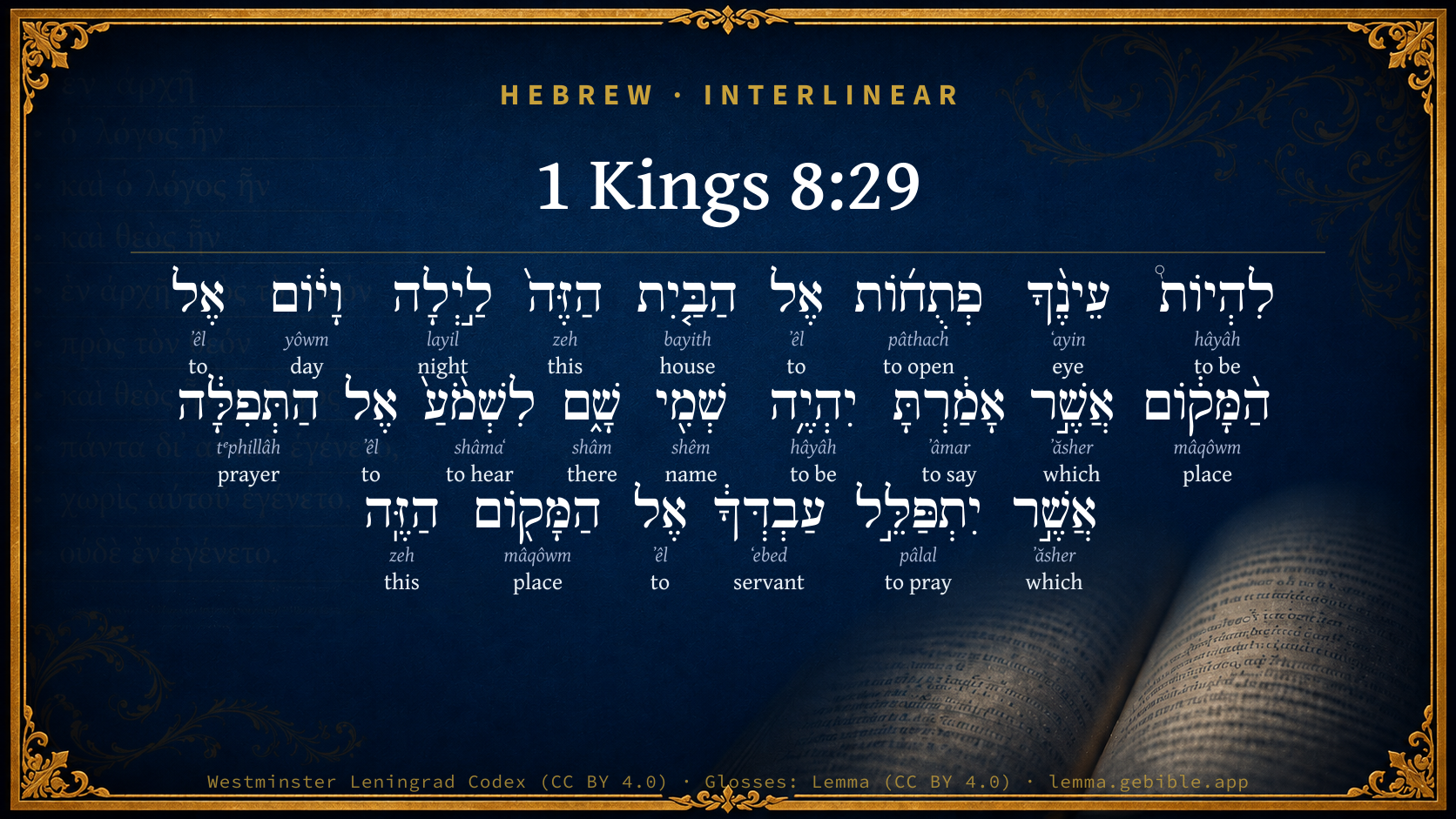
Hebrew (Westminster Leningrad Codex) 1 Kings 8:29 appears in the Hebrew Old Testament. The text above is from the Westminster Leningrad Codex. Each word links to its Strong’s number, a concise gloss, and parsing drawn from the Open Scriptures Hebrew Bible morphology. Click any word for its full Brown-Driver-Briggs (BDB) entry.
Download image
Cite this verse

1 Kings 8:29 (World English Bible). Public Domain. Lemma interlinear Bible study tool, https://lemma.gebible.app/v/1-kings/8/29.

Show BibTeX & RIS
BibTeX
RIS
English Translation
that your eyes may be open toward this house night and day, even toward the place of which you have said, My name shall be there; to listen to the prayer which your servant shall pray toward this place.
World English Bible · Public Domain
Download a study sheet

One document with this verse’s original text, its word-by-word gloss line, the meaning frame, cross-references with their text, attributed commentary, and full source and license credits — printable, and it pastes into notes with its structure intact.

This verse Autodidact and up

Study sheet (.html) Plain text (.txt)

A passage Seminary Student

Up to 50 verses in one chapter. A passage sheet keeps up to 6 commentary sources and 12 cross-references per verse, in the order this page ranks them, and says so on the sheet whenever that leaves anything out. Ask for a single verse and you get the Autodidact verse sheet above.

Everything on this page stays free to read, with no account — the sheet is a download of what is already on screen, not access to it.

Want to remove ads? Support Godless Engineer
Compare translations 3

The same verse in 3 English versions, stacked beneath the original-language interlinear above. Click any original word for its lexicon entry.

Each is an independent rendering of the whole verse — the interlinear is not word-aligned to these translations.

Highlighted words mark where these versions differ — a whole-verse word diff, not a word-by-word alignment.

  • World English Bible Public Domain
    that your eyes may be open toward this house night and day, even toward the place of which you have said, My name shall be there; to listen to the prayer which your servant shall pray toward this place.
  • King James Version Public Domain
    That thine eyes may be open toward this house night and day, even toward the place of which thou hast said, My name shall be there: that thou mayest hearken unto the prayer which thy servant shall make toward this place.
  • unfoldingWord Literal Text CC BY-SA 4.0
    that your eyes may be opened to this house night and day, to the place which you have said, ‘My name will be there,’ to listen to the prayer that your servant will pray toward this place.

unfoldingWord Literal Text — © unfoldingWord, licensed CC BY-SA 4.0. Word-aligned USFM3 via Door43 (git.door43.org/unfoldingWord/en_ult).

Versions to compare (up to 4)

3 of 4 selected

Show all 18 translations

Every available English version of this verse, each an independent rendering of the whole verse.

  • World English Bible Public Domain
    that your eyes may be open toward this house night and day, even toward the place of which you have said, My name shall be there; to listen to the prayer which your servant shall pray toward this place.
  • Berean Standard Bible Public Domain
    May Your eyes be open toward this temple night and day, toward the place of which You said, ‘My Name shall be there,’ so that You may hear the prayer that Your servant prays toward this place.
  • Majority Standard Bible Public Domain
    May Your eyes be open toward this temple night and day, toward the place of which You said, ‘My Name shall be there,’ so that You may hear the prayer that Your servant prays toward this place.
  • King James Version Public Domain
    That thine eyes may be open toward this house night and day, even toward the place of which thou hast said, My name shall be there: that thou mayest hearken unto the prayer which thy servant shall make toward this place.
  • American Standard Version (1901) Public Domain
    that thine eyes may be open toward this house night and day, even toward the place whereof thou hast said, My name shall be there; to hearken unto the prayer which thy servant shall pray toward this place.
  • Revised Version (1885) Public Domain
    that thine eyes may be open toward this house night and day, even toward the place whereof thou hast said, My name shall be there: to hearken unto the prayer which thy servant shall pray toward this place.
  • Geneva Bible (1599) Public Domain
    That thine eyes may be open toward this house, night and day, euen towarde the place whereof thou hast said, My Name shalbe there: that thou mayest hearken vnto the prayer which thy seruant prayeth in this place.
  • Douay-Rheims (1899) Public Domain
    That thy eyes may be open upon this house night and day: upon the house of which thou hast said: My name shall be there: that thou mayest hearken to the prayer, which thy servant prayeth in this place to thee.
  • Young's Literal Translation Public Domain
    for Thine eyes being open towards this house night and day, towards the place of which Thou hast said, My Name is there; to hearken unto the prayer which Thy servant prayeth towards this place.
  • Literal Standard Version CC BY-SA 4.0
    for Your eyes being open toward this house night and day, toward the place of which You have said, My Name is there; to listen to the prayer which Your servant prays toward this place.
  • Unlocked Literal Bible CC BY-SA 4.0
    May your eyes be open toward this temple night and day, to the place about which you have said, 'My name and my presence will be there'—in order to listen to the prayers that your servant will pray toward this place.
  • unfoldingWord Literal Text CC BY-SA 4.0
    that your eyes may be opened to this house night and day, to the place which you have said, ‘My name will be there,’ to listen to the prayer that your servant will pray toward this place.
  • Darby Bible Public Domain
    that thine eyes may be open upon this house night and day, upon the place of which thou hast said, My name shall be there: to hearken unto the prayer which thy servant prayeth toward this place.
  • World Messianic Bible Public Domain
    that your eyes may be open toward this house night and day, even toward the place of which you have said, ‘My name shall be there;’ to listen to the prayer which your servant prays toward this place.
  • Webster's Bible Public Domain
    That thy eyes may be open towards this house night and day, even towards the place of which thou hast said, My name shall be there: that thou mayest hearken to the prayer which thy servant shall make towards this place.
  • Free Bible Version CC BY-SA 4.0
    May you watch over this Temple day and night, caring for the place where you said you would be honored. May you hear the prayer your servant prays toward this place,
  • Bible in Basic English Public Domain
    That your eyes may be open to this house night and day, to this place of which you have said, My name will be there; hearing the prayer which your servant may make, turning to this place.
  • JPS Tanakh (1917) Public Domain
    that Thine eyes may be open toward this house night and day, even toward the place whereof Thou hast said: My name shall be there; to hearken unto the prayer which Thy servant shall pray toward this place.

Literal Standard Version (2020), Covenant Press — licensed CC BY-SA 4.0. Text via the HelloAO Bible API (eBible.org). Unlocked Literal Bible (unfoldingWord) — licensed CC BY-SA 4.0. Text via the HelloAO Bible API (eBible.org). unfoldingWord Literal Text — © unfoldingWord, licensed CC BY-SA 4.0. Word-aligned USFM3 via Door43 (git.door43.org/unfoldingWord/en_ult). Free Bible Version, Dr. Jonathan Gallagher — licensed CC BY-SA 4.0. Text via the HelloAO Bible API (eBible.org).

Word by word

More ways to search: Search by grammar → Find every occurrence → Compare this word →

Practice this passage: Drill this verse → Learn its vocabulary →

הַתְּפִלָּ֔ה
tᵉphillâh
H8605
“the · prayer”
Particle, Definite Article + Noun, Common, Feminine, Singular, Absolute
Part of Speech
Particle + Noun
Type
Common
Gender
Feminine
Number
Singular
State
Absolute
Full BDB Definition

Origin: from H6419

TWOT: 1776a

prayer - prayer - pray a prayer - house of prayer - hear prayer - in Psalm titles (of poetic or liturgical prayer)
  1. לִהְיוֹת֩ hâyâh H1961 “to be” Preposition + Verb, Qal, Infinitive Construct
  2. עֵינֶ֨ךָ ʻayin H5869 “eyes · your” Noun, Common, Both, Dual, Construct + Suffix, Personal, 2nd Person, Masculine, Singular
  3. פְתֻח֜וֹת pâthach H6605 “opened” Verb, Qal, Participle Passive, Feminine, Plural, Absolute
  4. אֶל ʼêl H413 “to” Preposition
  5. הַבַּ֤יִת bayith H1004 “the · house” Particle, Definite Article + Noun, Common, Masculine, Singular, Absolute
  6. הַזֶּה֙ zeh H2088 “the · this” Particle, Definite Article + Pronoun, Demonstrative, Masculine, Singular
  7. לַ֣יְלָה layil H3915 “night” Noun, Common, Masculine, Singular, Absolute
  8. וָי֔וֹם yôwm H3117 “and · day” Conjunction + Noun, Common, Masculine, Singular, Absolute
  9. אֶל ʼêl H413 “to” Preposition
  10. הַ֨מָּק֔וֹם mâqôwm H4725 “the · place” Particle, Definite Article + Noun, Common, Masculine, Singular, Absolute
  11. אֲשֶׁ֣ר ʼăsher H834 “which” Particle, Relative
  12. אָמַ֔רְתָּ ʼâmar H559 “to say” Verb, Qal, Perfect, 2nd Person, Masculine, Singular
  13. יִהְיֶ֥ה hâyâh H1961 “to be” Verb, Qal, Imperfect, 3rd Person, Masculine, Singular
  14. שְׁמִ֖י shêm H8034 “name · my” Noun, Common, Masculine, Singular, Construct + Suffix, Personal, 1st Person, Common, Singular
  15. שָׁ֑ם shâm H8033 “there” Adverb
  16. לִשְׁמֹ֨עַ֙ shâmaʻ H8085 “to hear” Preposition + Verb, Qal, Infinitive Construct
  17. אֶל ʼêl H413 “to” Preposition
  18. אֲשֶׁ֣ר ʼăsher H834 “which” Particle, Relative
  19. יִתְפַּלֵּ֣ל pâlal H6419 “to pray” Verb, Hithpael, Imperfect, 3rd Person, Masculine, Singular
  20. עַבְדְּךָ֔ ʻebed H5650 “servant · your” Noun, Common, Masculine, Singular, Construct + Suffix, Personal, 2nd Person, Masculine, Singular
  21. אֶל ʼêl H413 “to” Preposition
  22. הַמָּק֖וֹם mâqôwm H4725 “the · place” Particle, Definite Article + Noun, Common, Masculine, Singular, Absolute
  23. הַזֶּֽה zeh H2088 “the · this” Particle, Definite Article + Pronoun, Demonstrative, Masculine, Singular

About this verse

These counts appear in no published source. They are computed here, from the morphology-tagged text and Lemma’s own curated glosses. What Lemma adds →

24
words
17
distinct lemmas
Historical
section

Grammatical profile

  • 6 verbs
  • 9 nouns
  • 2 pronouns
  • 4 prepositions
  • 1 adverb
  • 2 particles

Verb forms

  • לִהְיוֹת֩ Qal · Infinitive Construct
  • פְתֻח֜וֹת Qal · Participle Passive
  • אָמַ֔רְתָּ Qal · Perfect
  • יִהְיֶ֥ה Qal · Imperfect
  • לִשְׁמֹ֨עַ֙ Qal · Infinitive Construct
  • יִתְפַּלֵּ֣ל Hithpael · Imperfect

Repetition

Words recur within this verse — often emphatic in Hebrew:

  • לִהְיוֹת֩ to be H1961 ×2
  • הַ֨מָּק֔וֹם place H4725 ×2
  • אֶל to H413 ×4
  • הַזֶּה֙ this H2088 ×2
  • אֲשֶׁ֣ר which H834 ×2

Hebrew & Septuagint length

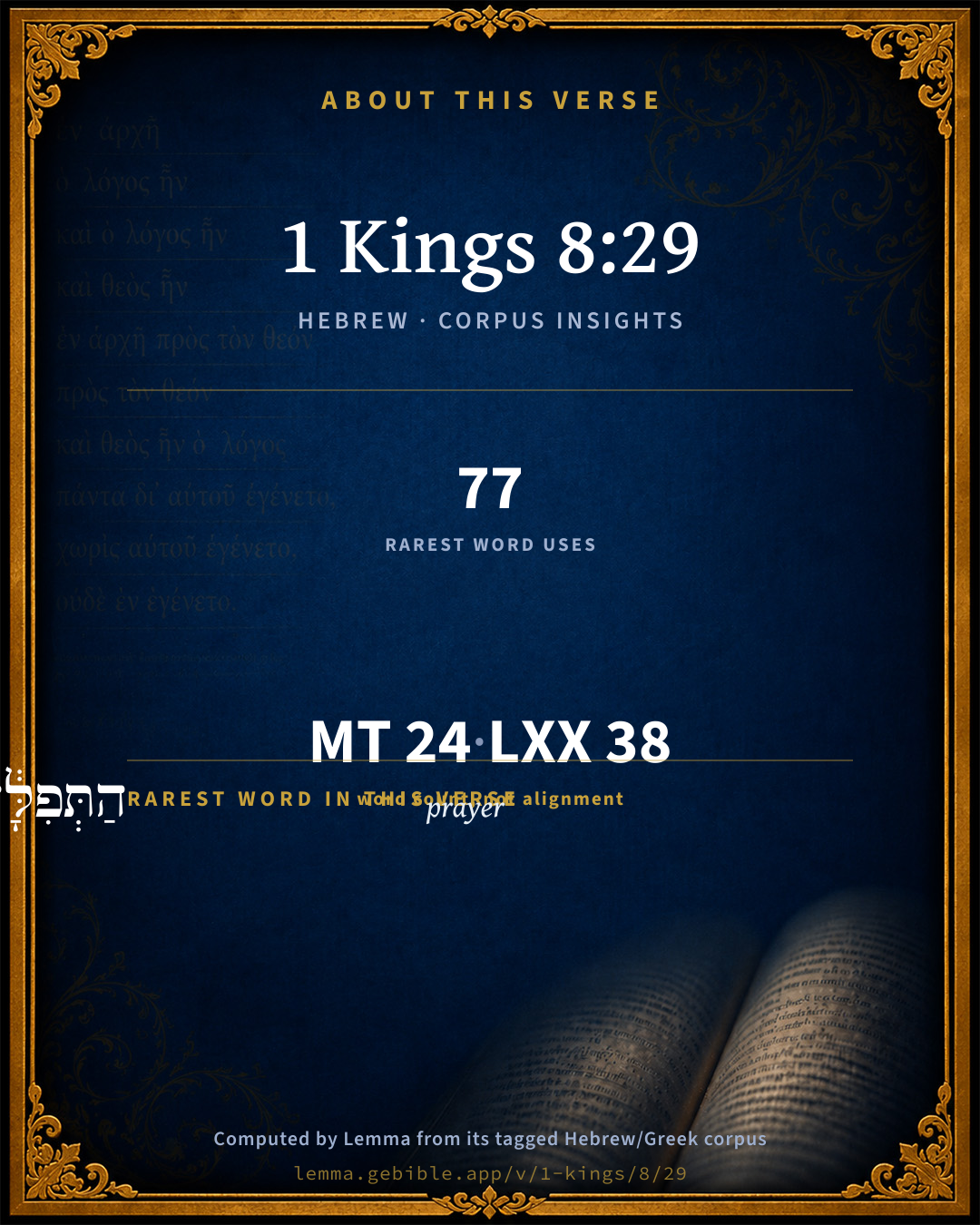
In English translation the verse runs 39 words from the Hebrew and 38 from the Septuagint (LXX English) — closely comparable.

A rough comparison of the two English renderings, which tokenize alike — not a word-level alignment.

Word counts can differ between the Hebrew and the Greek without any difference in meaning — e.g. the Hebrew direct-object marker אֵת has no separate Greek word, and Greek often adds the article ὁ.

In the original languages it is 24 Hebrew tokens and 38 Greek tokens — but the two are counted differently (Hebrew bundles its prefixes and suffixes into one token; the Greek is in lemma form), so that isn’t a like-for-like length.

Cross-references

27

Topical passages linked to 1 Kings 8:29 in the Treasury of Scripture Knowledge — connected by theme and wording, ordered by reader-vote popularity; previews shown in the World English Bible.

  • 2 Chronicles 6:20 that your eyes may be open toward this house day and night, even toward the place where you have said that you would put your name there; to listen to the prayer which your servant shall pray toward this place.
  • 2 Chronicles 7:15–16 Now my eyes shall be open, and my ears attentive, to the prayer that is made in this place.
  • Deuteronomy 12:11 then it shall happen that to the place which Yahweh your God shall choose, to cause his name to dwell there, there shall you bring all that I command you: your burnt offerings, and your sacrifices, your tithes, and the heave-offering of your hand, and all your choice vows which you vow to Yahweh.
  • 1 Kings 8:16 Since the day that I brought forth my people Israel out of Egypt, I chose no city out of all the tribes of Israel to build a house, that my name might be there; but I chose David to be over my people Israel.
  • Nehemiah 1:6 Let your ear now be attentive, and your eyes open, that you may listen to the prayer of your servant, which I pray before you at this time, day and night, for the children of Israel your servants while I confess the sins of the children of Israel, which we have sinned against you. Yes, I and my father's house have sinned:
  • 2 Kings 23:27 Yahweh said, I will remove Judah also out of my sight, as I have removed Israel, and I will cast off this city which I have chosen, even Jerusalem, and the house of which I said, My name shall be there.
  • 2 Chronicles 6:5–6 Since the day that I brought forth my people out of the land of Egypt, I chose no city out of all the tribes of Israel to build a house in, that my name might be there; neither chose I any man to be prince over my people Israel:
  • 2 Chronicles 33:4 He built altars in the house of Yahweh, of which Yahweh said, In Jerusalem shall my name be forever.
  • Nehemiah 1:9 but if you return to me, and keep my commandments and do them, though your outcasts were in the uttermost part of the heavens, yet will I gather them from there, and will bring them to the place that I have chosen, to cause my name to dwell there.
  • Daniel 6:10 When Daniel knew that the writing was signed, he went into his house (now his windows were open in his chamber toward Jerusalem) and he kneeled on his knees three times a day, and prayed, and gave thanks before his God, as he did before.
  • Daniel 9:18 My God, turn your ear, and hear; open your eyes, and see our desolations, and the city which is called by your name: for we do not present our petitions before you for our righteousness, but for your great mercies' sake.
  • Exodus 20:24 You shall make an altar of earth for me, and shall sacrifice on it your burnt offerings and your peace-offerings, your sheep and your oxen. In every place where I record my name I will come to you and I will bless you.
  • Deuteronomy 16:2 You shall sacrifice the Passover to Yahweh your God, of the flock and the herd, in the place which Yahweh shall choose, to cause his name to dwell there.
  • Deuteronomy 16:6 but at the place which Yahweh your God shall choose, to cause his name to dwell in, there you shall sacrifice the Passover at even, at the going down of the sun, at the season that you came forth out of Egypt.
  • Deuteronomy 26:2 that you shall take of the first of all the fruit of the ground, which you shall bring in from your land that Yahweh your God gives you; and you shall put it in a basket, and shall go to the place which Yahweh your God shall choose, to cause his name to dwell there.
  • 1 Kings 8:43 hear in heaven, your dwelling-place, and do according to all that the foreigner calls to you for; that all the peoples of the earth may know your name, to fear you, as does your people Israel, and that they may know that this house which I have built is called by my name.
  • 1 Kings 8:52 that your eyes may be open to the supplication of your servant, and to the supplication of your people Israel, to listen to them whenever they cry to you.
  • 1 Kings 11:36 To his son will I give one tribe, that David my servant may have a lamp always before me in Jerusalem, the city which I have chosen me to put my name there.
  • 2 Kings 19:16 Incline your ear, Yahweh, and hear; open your eyes, Yahweh, and see; and hear the words of Sennacherib, with which he has sent him to defy the living God.
  • 2 Kings 21:4 He built altars in the house of Yahweh, of which Yahweh said, In Jerusalem will I put my name.
  • 2 Kings 21:7 He set the engraved image of Asherah, that he had made, in the house of which Yahweh said to David and to Solomon his son, In this house, and in Jerusalem, which I have chosen out of all the tribes of Israel, will I put my name forever;
  • 2 Chronicles 6:40 Now, my God, let, I beg you, your eyes be open, and let your ears be attentive, to the prayer that is made in this place.
  • 2 Chronicles 16:9 For the eyes of Yahweh run back and forth throughout the whole earth, to show himself strong in the behalf of them whose heart is perfect toward him. Herein you have done foolishly; for from henceforth you shall have wars.
  • 2 Chronicles 20:8 They lived therein, and have built you a sanctuary therein for your name, saying,
  • 2 Chronicles 33:7 He set the engraved image of the idol, which he had made, in the house of God, of which God said to David and to Solomon his son, In this house, and in Jerusalem, which I have chosen out of all the tribes of Israel, will I put my name forever:
  • Psalms 34:15 Yahweh's eyes are toward the righteous. His ears listen to their cry.
  • John 14:13–14 Whatever you will ask in my name, that will I do, that the Father may be glorified in the Son.

Cross-references courtesy of OpenBible.info (CC BY 4.0).

Hebrew and Greek witnesses Masoretic Hebrew ↔ Greek Septuagint

The same verse in the two great witnesses to the Old Testament, shown verse-for-verse.

These are two independent witnesses, not word-aligned to each other, and the Septuagint is shown in lemma (dictionary) form.

Hebrew 1 Kings 8:29 Masoretic · Westminster Leningrad Codex

לִהְיוֹת֩ עֵינֶ֨ךָ פְתֻח֜וֹת אֶל הַבַּ֤יִת הַזֶּה֙ לַ֣יְלָה וָי֔וֹם אֶל הַ֨מָּק֔וֹם אֲשֶׁ֣ר אָמַ֔רְתָּ יִהְיֶ֥ה שְׁמִ֖י שָׁ֑ם לִשְׁמֹ֨עַ֙ אֶל הַתְּפִלָּ֔ה אֲשֶׁ֣ר יִתְפַּלֵּ֣ל עַבְדְּךָ֔ אֶל הַמָּק֖וֹם הַזֶּֽה

that your eyes may be open toward this house night and day, even toward the place of which you have said, My name shall be there; to listen to the prayer which your servant shall pray toward this place.

World English Bible · Public Domain

Greek LXX 1 Kings 8:29 Septuagint · lemma form

ὁ εἰμί ὀφθαλμός σύ ἀναοἴγω εἰς ὁ οἶκος οὗτος ἡμέρα καί νύξ εἰς ὁ τόπος ὅς εἶπον εἰμί ὁ ὄνομα ἐγώ ἐκεῖ ὁ εἰςἀκούω ὁ προσευχή ὅς προςεὔχομαι ὁ δοῦλος σύ εἰς ὁ τόπος οὗτος ἡμέρα καί νύξ

that your eyes may be open toward this house day and night, even toward the place which you said, My name shall be there, to hear the prayer which your servant prays at this place day and night.

LXX2012 (modern English Septuagint) · Public Domain

Hebrew: Westminster Leningrad Codex (CC BY 4.0). Greek: Septuagint (public domain); English from LXX2012 (modern English Septuagint) (Public Domain). How the Septuagint differs from the Hebrew →

Targum (Aramaic paraphrase)

1

The Targum is the ancient Jewish Aramaic paraphrase of the Hebrew Scriptures — an interpretive translation, not the Hebrew text itself. Onkelos (literal) and Pseudo-Jonathan (expansive) render the Torah, and Jonathan the Prophets. Coverage is partial: where no permissively-licensed English translation exists for a verse, only the Aramaic is shown. This is verse-level text, not a word-by-word alignment to the Hebrew.

  1. Targum Jonathan Prophets (Joshua–Malachi)
    לְמֶהֱוֵי רַעֲוָא קָדָמָךְ לְאַגָנָא עַל בֵּיתָא הָדֵין לֵילֵי וְיֵמָם לְאַתְרָא דִי אֲמַרְתְּ יְהֵי שְׁמִי תַּמָן לְקַבֵּל צְלוֹתָא דִי צַלֵי עַבְדָךְ לְאַפֵּי אַתְרָא הָדֵין:

    (no public-domain English translation for this verse)

    Targum Jonathan — Aramaic: “Mikraot Gedolot” (public domain). English: “Sefaria Community Translation” (CC0 1.0 (public-domain dedication)); “London "Chaldee Paraphrase," 1871” (public domain). Text via Sefaria.

Commentary

Notes on 1 Kings 8:29 from classic Christian and Jewish commentators (each source and its license shown beneath its notes). The classic Christian expositions comment on the surrounding passage and are grouped to its opening verse, so a note may address several verses; the Jewish commentaries on the Tanakh (Rashi and others) are per-verse, so they appear only where the commentator wrote on this verse.

Lemma curates 59 commentaries, every one of them public domain or Creative Commons licensed, each selected and text-cleaned for this edition rather than reprinted as found. About our sources →

Trapp's Complete Commentary

John Trapp

1Ki 8:29 That thine eyes may be open toward this house night and day, [even] toward the place of which thou hast said, My name shall be there: that thou mayest hearken unto the prayer which thy servant shall make toward this place.

Ver. 29. That thine eyes may be open.] See Psa 34:15. {See Trapp on "Psa 34:15"}

John Trapp, A Commentary or Exposition upon All the Books of the Old and New Testament (1647–1656) — public domain. Text from a community e-Sword module.

The Biblical Illustrator

Joseph S. Exell

1Ki_8:29

This place.

Meditations in a new church

I. What the house of God is not.

1. In this place is no architectural type; it is no homage to the esthetics of form. Architecture is but a help and a convenience; it is not a religion.

2. This place is not reared in homage to any principle, so called, of Natural Religion; on the contrary, it is an admission that Natural Religion is not enough to satisfy the heart of the worshipper; it is true the groves were God s first temples; it is equally true that the early Persian made his peak an altar, and worshipped the Lord of nature from the tops of earths oer-gazing mountains; it may be true that our Gothic architecture is an attempt to torture the stone to the grace and grandeur of the forest aisles, but it will not do, it will not do. This place is not reared to emulate in the long-drawn aisle and the fretted vault, the mysteries of the groves and the trees; it is to point to one tree--the Cross; it is not to celebrate the mountain majesties of heaven, but to be a cleft of the rock, in which the people may hide themselves while the tempest and the wrath pass by.

3. This place is not an Ecclesiasticism; it is not the place for mere hierarchical assumption; it does not exist to symbolise any particular creed; it derives any value it may boast, not from man or men, but from God.

4. This Place is not built in homage to Intellectual Achievement, or to the consecrating efforts of Taste.

II. What the house of God is.

This place is the assertion that a new church has come to view. Hebraism was a church--the Jew was, in fact, a Christian. But he was so pictorially, and he must represent to us God as working the salvation over and independent of him. What, then, is suggested to us by this place?

1. It is Consecration. This is the stone for a memorial; and the prayers of the people and their dedication words are the holy oil poured upon the stone. This is the place of an almond-tree, beneath whose shade the weary Jacob rests, and beholds the vision of ascending and descending angels; and says, Lo, God is in this place; this is none other than the house of God; this is the gate of heaven.

2. And with that idea goes this other of seclusion, seclusion even here. But it will be said, is not every place Gods--is not every place equally Divine? To Him, Yes; to us, I must say, No, certainly not. Is not God equally diffused over all creation? To Himself, Yes; to us, No, certainly not. As well ask, Does magnetism reside equally in all substances? Is there not a loadstone, and a magnetic needle? The Sabbath is an answer to our necessities, by being a seclusion in time; the temple is an answer to our necessities by being a seclusion in space. Man needs, not only Sabbath hours, he needs Sabbath spots. Cannot man worship alone, it is said, in his own life and heart, and have there his own still Sabbath? What some may do, I will not say; but on the whole, I shall reply, Certainly not; mans true seclusion will be the temple; seclusion in such a place is very beautiful. As consecration is the act of setting apart, to and for God, so seclusion is that retiring into ourselves; we always enter into our closet when we retire into ourselves; but how large and mighty is the idea that in this place we retire not only into ourselves but into and with God.

3. But this place reveals the principle of association as surely as of seclusion or consecration. Here is revealed the unity of the Church--here is realised the image of the harmonious interworkings of countless spirits, who, though scattered over the whole globe, endowed with freedom, and possessing the power to strike off into every deviation to the right or to the left, yet preserving still their various peculiarities, constitute one great brotherhood for the advancement of each other s spiritual existence, representing one idea, that of the reconciliation of men with God, who, on that account, have been reconciled with one another, and have become one body.

4. But, again, this place is not merely emotional, it is conservative, it is the centre of doctrine, and therefore there is associated with it the idea of teaching it is the House of God; it is the home of the chosen of the living God; it is the depository of the pillar and ground of the truth.

5. Another sentiment suitable to this place is, that it is perfectly in harmony with all that has gone before; it may be naturally described as the centre of conversion. Repent and be converted, for the kingdom of heaven is at hand--this is the word which must often be uttered here, and of this man it shall be said, he was born there. These buildings exist for the purpose for which the Gospels were written; they were built that believers may have life, but they were built also that men may believe. Lessons: To regenerated hearts this place is a memory. Here we pierce back into the night of time, and the eye surveys the splendid piles of ancient days. This place is an anticipation: it is a promise from God to man of his future home, and it is the declaration to mans heart, from the deeper instincts of his being, of the great, the hallowed, and all-hallowing truth that there remaineth a rest for the people of God--our rest in this place is the assurance of our rest yonder. (B. P. Hood.)

The place of worship

I. The house of god. Our text speaks of heaven as Gods dwelling-place. Perfectly true. But where is heaven? Heaven is above us, but it is also beneath and about us. Now it was this thought that appealed even to Solomon aa he knelt with outspread hands before the glory lit altar of the new temple. For a moment he seems to have been staggered: But he recovers himself speedily, however. It was Gods house. Why was it Gods house? He Himself had selected the site; it had been built on the Divine-plan; the builders had been directed in all the arrangements. Gods own promise was in the matter, and it had been fulfilled to the letter.

II. The house of prayer. I like, however, to remember that it is, in the second title, a place of worship, a House of Prayer. Solomon used the first Temple for that purpose at the outset, and named it so from the beginning. And those who could not tread its sacred courts were to open their windows toward Jerusalem, and throw the arrows of their prayers through the lattice which looked that way. The Temple, in a word, was to be the medium and the mediator between the yearning hearts of men and the bounteous hands of the Lord God of Israel. Things have changed since then; old things have passed, away; behold, all things have become new.

III. The house of mercy.--When thou hearest, forgive. Forgive! Ah yes, yes, we shall need to pray that prayer amongst the rest. Prayers for succour and for strength, prayers for comfort and for joy, will need to be supplemented with prayers for pardon. Some nowadays profess to have got far away beyond this. I am not ashamed to confess in one sense that I have not. The Lord has taught us so to pray, Forgive us our debts as we forgive our debtors (Thomas Spurgeon.)

The Biblical Illustrator, edited by Joseph S. Exell (c. 1880s–1900s) — public domain. Text from a community e-Sword module.

Tyndale Open Study Notes

Tyndale Open Resources

8:29-51 Solomon asked God to hear the prayers of his people from the Temple. He then addressed specific instances in which they would need God’s answers.

Tyndale Open Study Notes — © Tyndale Open Resources, licensed CC BY-SA 4.0. Text via the HelloAO Bible API.

Adam Clarke's Commentary

Verse 29. My name shall be there] I will there show forth my power and my glory by enlightening, quickening, pardoning, sanctifying, and saving all my sincere worshippers.

Adam Clarke's Commentary on the Bible (1810–1826) — public domain. Text from a community e-Sword/MySword module.

The Cambridge Bible for Schools and Colleges

gen. ed. J. J. S. Perowne

29. even toward the place of which thou hast said, My name shall be there] These words refer back to 1Ki_8:16, and appear to imply all that is contained in the expansion there alluded to from 2Ch_6:6 that God had chosen Jerusalem as the place for His temple. ‘My name’ indicates God’s revelation of Himself with all His attributes.

towards this place] For the king was not in the Temple but looking towards it, as would be the case with all future worshippers except the priests who were allowed to enter into the building. Hence it came to pass that in foreign lands the Israelite turned his face in the direction of Jerusalem. Cf. Dan_6:10; Jon_2:4; Psa_5:7.

The Cambridge Bible for Schools and Colleges (gen. ed. J. J. S. Perowne; Cambridge University Press, 1878–1918) — public domain. Text from a community e-Sword module.

John Gill's Exposition

That thine eyes may be open towards this house night and day,.... That is, to the people that pray in it, as they are to his righteous ones, Psa 33:14 even towards the place of which thou hast my name shall be there; there should be some displays of his presence, power, and providence, of goodness, grace, and mercy:

that thou mayest hearken unto the prayer which thy servant shall make towards this place; not only to what he should make in it, but to what he should make in his own house, with his face directed towards this, as would be, and was the practice of good people in later times, yea, even when the temple lay in ruins; see Dan 6:10 figuring the respect gracious souls have to Christ by faith in their prayers, in whom the Godhead dwells bodily, see Jon 2:4 and it is observable, according to a Jewish canon (b), one at a distance, in another land, was not only to turn his face to the land of Israel, but direct his heart to Jerusalem, and the temple, and the holy of holies; and if in the land, to Jerusalem, &c. and if in Jerusalem, not only to the temple, and holy of holies, but if behind the mercy seat, he was to turn his face to it; which was a symbol of Christ, the propitiatory and throne of grace, to be looked unto by faith, Rom 3:25.

(b) Schulchan Aruch, par. 1. c. 94. sect. 1.

John Gill's Exposition of the Whole Bible (1746–1763) — public domain (CC PDM 1.0). Text via the HelloAO Bible API.

Albert Barnes' Notes on the Bible

The choice of Jerusalem as the place seems to have been made by special revelation to David. See Psa 78:68; Psa 132:13; and compare 1Ch 22:1.

Toward this place - Better (here and in 1Ki 8:30) than the marginal “in.” Wherever they were, the Jews always worshipped toward the temple. (See margin reference.)

Albert Barnes' Notes on the Bible (1834–1885) — public domain. Text from a community e-Sword/MySword module.

Haydock's Catholic Bible Commentary

My name. It shall be called the house of God. (Haydock) --- There people shall come to do homage to the Lord. (Calmet)

George Leo Haydock (1774–1849), Haydock's Catholic Family Bible and Commentary, 1859 edition — public domain. Excludes Psalms (Douay-Rheims chapter numbering differs from Protestant) and Deuterocanonical books (Catholic canon only).

Matthew Poole's English Annotations

That thine eyes may be open to behold, to wit, with an eye of favour and compassion. So it is a synecdochical expression: compare Psa 33:18; 34:15; Zec 12:4.

My name; my presence, and glory, and grace. See Poole "1Ki 8:16".

Towards this place; this temple, to which Solomon did now look, and, it may be, point; and towards which the godly Israelites directed their looks in their prayers. See Dan 6:10.

Matthew Poole's English Annotations on the Holy Bible (1683–1685) — public domain. Text from a community e-Sword/MySword module.

The Pulpit Commentary

That thine eyes may be open This anthropomorphism does not conflict with what was said under ver. 27 toward this house night and day not so much to watch over it as to see the worship and prayer offered there, even toward the place of which thou hast said, My name shall be there cf. Eze_48:35, and vers. 18. 19, 20, etc. When had God said this? Never perhaps, in so many words. Keil says the reference is to 2Sa_7:13 implicite ("He shall build a house for my name"), while Rawlinson thinks the "reference is not to any single text, but to the many passages in Deuteronomy where God speaks of a place which He will choose to "set his name" there (Deu_12:5, Deu_12:11, Deu_12:18, etc.; 14:23; 15:20; 16:2, etc.) "But it is very probable that a revelation was made to David respecting the sanctuary, the terms of which are not preserved to us. This is almost implied by Psa_78:68 Psa_132:10 1Ch_22:1 passages which prove that David claimed to have Divine sanction for placing the temple on "Mount Zion." Psalm 132, is unmistakeably Davidic, and embodies some features of the message of God: (e.g., the condition, ver. 12) not preserved in 2Sa 7 that thou mayest hearken unto the prayer which thy servant shall make toward Marg. in, but Heb. lae. supports the A.V rendering. Now that God had revealed His presence in the temple, the Jew, wherever he might be, would, and as a matter of fact did, pray towards it, (Dan_6:10 Psa_5:7 Jon_2:4) just as the Mohammedan has his Kibleh in Mecca this place.

The Pulpit Commentary (1880–1919), ed. H.D.M. Spence-Jones & Joseph S. Exell — public domain. Text from a community e-Sword module.

John Wesley's Explanatory Notes

Open - To behold with an eye of favour. My name - My presence, and glory and grace. This place - This temple, to which Solomon did now look, and towards which, the godly Israelites directed their looks in their prayers.

John Wesley, Explanatory Notes Upon the Whole Bible (1754–1765) — public domain. Text via the GEBible commentary corpus.

unfoldingWord translationNotes

Door43 World Missions Community

May your eyes be open toward

The eye is a metonym for what the eye does. AT: "May you watch over" (See: Metonymy)

night and day

This is a merism. AT: "all the time" or "continually" (See: Merism)

My name and my presence

These two words together emphasize that Yahweh will dwell in the temple. (See: Doublet)

that your servant will pray

Solomon speaks of himself as "your servant" to show that he respects Yahweh. This can be stated in first person. AT: "that I, your servant, will pray" (See: First, Second, or Third Person)

listen to the request of your servant and of your people Israel

Solomon speaks of himself as "your servant" to show that he respects Yahweh. This can be stated in first person. AT: "listen to my request and the request of your people Israel" (See: First, Second, or Third Person)

translationWords

temple

name

pray

servant

forgive

unfoldingWord translationNotes — © Distant Shores Media and the Door43 World Missions Community, licensed CC BY-SA 4.0. Source: git.door43.org/Door43/en_tn.

Lesson kit

Teaching starters — assembled from the data on this page, not authored interpretation. Every prompt links to the verse data it draws on. Edit before teaching.

1 Kings, in the Historical, opens this verse with 24 words (17 distinct Hebrew lemmas). Its most distinctive word is tᵉphillâh (“prayer”). A historical commentator’s framing appears above. Read the whole chapter for the surrounding context.

Discussion questions

  1. The word tᵉphillâh carries the sense “prayer.” How does it shape the verse?
  2. 2 Chronicles 6:20 shares this passage’s theme. How do the two illuminate each other?
  3. “to be” occurs 2× in this one verse. What is the effect of the repetition?
  4. The translations on this page render this verse differently — a whole-verse word diff, not a word-by-word alignment. What might account for the different wordings?
  5. The verb «לִהְיוֹת֩» is Qal Infinitive Construct. How does its form color the action?
  6. Reading how Trapp's Complete Commentary and The Biblical Illustrator read this verse, where do the two commentators agree and where do they part?

Things to notice

Reading settings

Reading text

Shown beneath each verse's original-language words.

Old Testament
Old Testament edition

Read the OT as the Masoretic Hebrew (MT) or the Greek Septuagint (LXX).

English shown for the Greek Septuagint (in the Hebrew ↔ Greek comparison).

Comparing translations? Open the Compare panel on any verse page to stack up to four side by side.