Deuteronomy 13:8

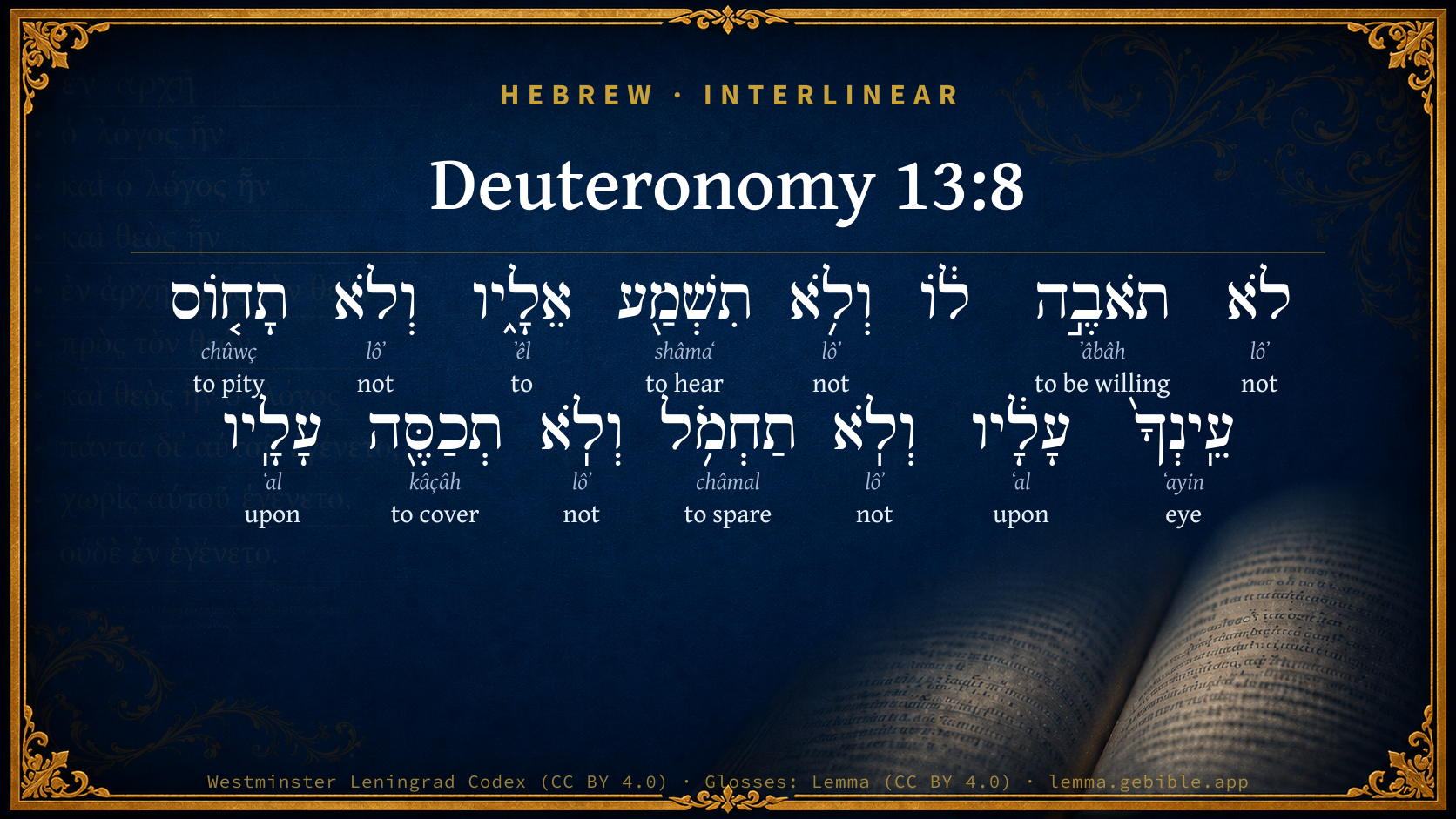
Hebrew (Westminster Leningrad Codex) Deuteronomy 13:8 appears in the Hebrew Old Testament. The text above is from the Westminster Leningrad Codex. Each word links to its Strong’s number, a concise gloss, and parsing drawn from the Open Scriptures Hebrew Bible morphology. Click any word for its full Brown-Driver-Briggs (BDB) entry.
Download image
Cite this verse

Deuteronomy 13:8 (World English Bible). Public Domain. Lemma interlinear Bible study tool, https://lemma.gebible.app/v/deuteronomy/13/8.

Show BibTeX & RIS
BibTeX
RIS
English Translation
you shall not consent to him, nor listen to him; neither shall your eye pity him, neither shall you spare, neither shall you conceal him:
World English Bible · Public Domain
Download a study sheet

One document with this verse’s original text, its word-by-word gloss line, the meaning frame, cross-references with their text, attributed commentary, and full source and license credits — printable, and it pastes into notes with its structure intact.

This verse Autodidact and up

Study sheet (.html) Plain text (.txt)

A passage Seminary Student

Up to 50 verses in one chapter. A passage sheet keeps up to 6 commentary sources and 12 cross-references per verse, in the order this page ranks them, and says so on the sheet whenever that leaves anything out. Ask for a single verse and you get the Autodidact verse sheet above.

Everything on this page stays free to read, with no account — the sheet is a download of what is already on screen, not access to it.

Want to remove ads? Support Godless Engineer
Compare translations 3

The same verse in 3 English versions, stacked beneath the original-language interlinear above. Click any original word for its lexicon entry.

Each is an independent rendering of the whole verse — the interlinear is not word-aligned to these translations.

Highlighted words mark where these versions differ — a whole-verse word diff, not a word-by-word alignment.

  • World English Bible Public Domain
    you shall not consent to him, nor listen to him; neither shall your eye pity him, neither shall you spare, neither shall you conceal him:
  • King James Version Public Domain
    Thou shalt not consent unto him, nor hearken unto him; neither shall thine eye pity him, neither shalt thou spare, neither shalt thou conceal him:
  • unfoldingWord Literal Text CC BY-SA 4.0
    do not yield to him and do not listen to him, and your eye shall not pity him, and do not spare nor hide him.

unfoldingWord Literal Text — © unfoldingWord, licensed CC BY-SA 4.0. Word-aligned USFM3 via Door43 (git.door43.org/unfoldingWord/en_ult).

Versions to compare (up to 4)

3 of 4 selected

Show all 18 translations

Every available English version of this verse, each an independent rendering of the whole verse.

  • World English Bible Public Domain
    you shall not consent to him, nor listen to him; neither shall your eye pity him, neither shall you spare, neither shall you conceal him:
  • Berean Standard Bible Public Domain
    you must not yield to him or listen to him. Show him no pity, and do not spare him or shield him.
  • Majority Standard Bible Public Domain
    you must not yield to him or listen to him. Show him no pity, and do not spare him or shield him.
  • King James Version Public Domain
    Thou shalt not consent unto him, nor hearken unto him; neither shall thine eye pity him, neither shalt thou spare, neither shalt thou conceal him:
  • American Standard Version (1901) Public Domain
    thou shalt not consent unto him, nor hearken unto him; neither shall thine eye pity him, neither shalt thou spare, neither shalt thou conceal him:
  • Revised Version (1885) Public Domain
    thou shalt not consent unto him, nor hearken unto him; neither shall thine eye pity him, neither shalt thou spare, neither shalt thou conceal him:
  • Geneva Bible (1599) Public Domain
    Thou shalt not cosent vnto him, nor heare him, neither shall thine eye pitie him, nor shewe mercie, nor keepe him secret:
  • Douay-Rheims (1899) Public Domain
    Consent not to him, hear him not, neither let thy eye spare him to pity and conceal him,
  • Young's Literal Translation Public Domain
    thou dost not consent to him, nor hearken unto him, nor doth thine eye have pity on him, nor dost thou spare, nor dost thou cover him over.
  • Literal Standard Version CC BY-SA 4.0
    you do not consent to him, nor listen to him, nor does your eye have pity on him, nor do you spare, nor do you cover him over.
  • Unlocked Literal Bible CC BY-SA 4.0
    You must not give in to him or listen to him, and you must not permit your eye to pity him, and you must not spare him or conceal him.
  • unfoldingWord Literal Text CC BY-SA 4.0
    do not yield to him and do not listen to him, and your eye shall not pity him, and do not spare nor hide him.
  • Darby Bible Public Domain
    thou shalt not consent unto him, nor hearken unto him; neither shall thine eye spare him, neither shalt thou pity him, neither shalt thou screen him,
  • World Messianic Bible Public Domain
    you shall not consent to him nor listen to him; neither shall your eye pity him, neither shall you spare, neither shall you conceal him;
  • Webster's Bible Public Domain
    Thou shalt not consent to him, nor hearken to him; neither shall thy eye pity him, neither shalt thou spare, neither shalt thou conceal him:
  • Free Bible Version CC BY-SA 4.0
    don't give into them or listen to them. Show them no mercy. Don't spare them or protect them.
  • Bible in Basic English Public Domain
    Do not be guided by him or give attention to him; have no pity on him or mercy, and give him no cover;
  • JPS Tanakh (1917) Public Domain
    (13-9) thou shalt not consent unto him, nor hearken unto him; neither shall thine eye pity him, neither shalt thou spare, neither shalt thou conceal him;

Literal Standard Version (2020), Covenant Press — licensed CC BY-SA 4.0. Text via the HelloAO Bible API (eBible.org). Unlocked Literal Bible (unfoldingWord) — licensed CC BY-SA 4.0. Text via the HelloAO Bible API (eBible.org). unfoldingWord Literal Text — © unfoldingWord, licensed CC BY-SA 4.0. Word-aligned USFM3 via Door43 (git.door43.org/unfoldingWord/en_ult). Free Bible Version, Dr. Jonathan Gallagher — licensed CC BY-SA 4.0. Text via the HelloAO Bible API (eBible.org).

Word by word

More ways to search: Search by grammar → Find every occurrence → Compare this word →

Practice this passage: Drill this verse → Learn its vocabulary →

תָח֤וֹס
chûwç
H2347
“to pity”
Verb, Qal, Imperfect, 3rd Person, Feminine, Singular
Part of Speech
Verb
Stem
Qal
Form
Imperfect
Person
3rd Person
Gender
Feminine
Number
Singular
Full BDB Definition

Origin: a primitive root

TWOT: 626

(Qal) to pity, have compassion, spare, look upon with compassion
  1. לֹא lôʼ H3808 “not” Particle, Negative
  2. תֹאבֶ֣ה ʼâbâh H14 “to be willing” Verb, Qal, Imperfect, 2nd Person, Masculine, Singular
  3. וְלֹ֥א lôʼ H3808 “and · not” Conjunction + Particle, Negative
  4. תִשְׁמַ֖ע shâmaʻ H8085 “to hear” Verb, Qal, Imperfect, 2nd Person, Masculine, Singular
  5. אֵלָ֑יו ʼêl H413 “to · him” Preposition + Suffix, Personal, 3rd Person, Masculine, Singular
  6. וְלֹא lôʼ H3808 “and · not” Conjunction + Particle, Negative
  7. עֵֽינְךָ֙ ʻayin H5869 “eye · your” Noun, Common, Both, Singular, Construct + Suffix, Personal, 2nd Person, Masculine, Singular
  8. עָלָ֔יו ʻal H5921 “upon · him” Preposition + Suffix, Personal, 3rd Person, Masculine, Singular
  9. וְלֹֽא lôʼ H3808 “and · not” Conjunction + Particle, Negative
  10. תַחְמֹ֥ל châmal H2550 “to spare” Verb, Qal, Imperfect, 2nd Person, Masculine, Singular
  11. וְלֹֽא lôʼ H3808 “and · not” Conjunction + Particle, Negative
  12. תְכַסֶּ֖ה kâçâh H3680 “to cover” Verb, Piel, Imperfect, 2nd Person, Masculine, Singular
  13. עָלָֽיו ʻal H5921 “upon · him” Preposition + Suffix, Personal, 3rd Person, Masculine, Singular

About this verse

These counts appear in no published source. They are computed here, from the morphology-tagged text and Lemma’s own curated glosses. What Lemma adds →

15
words
9
distinct lemmas
Pentateuch
section

Notable vocabulary

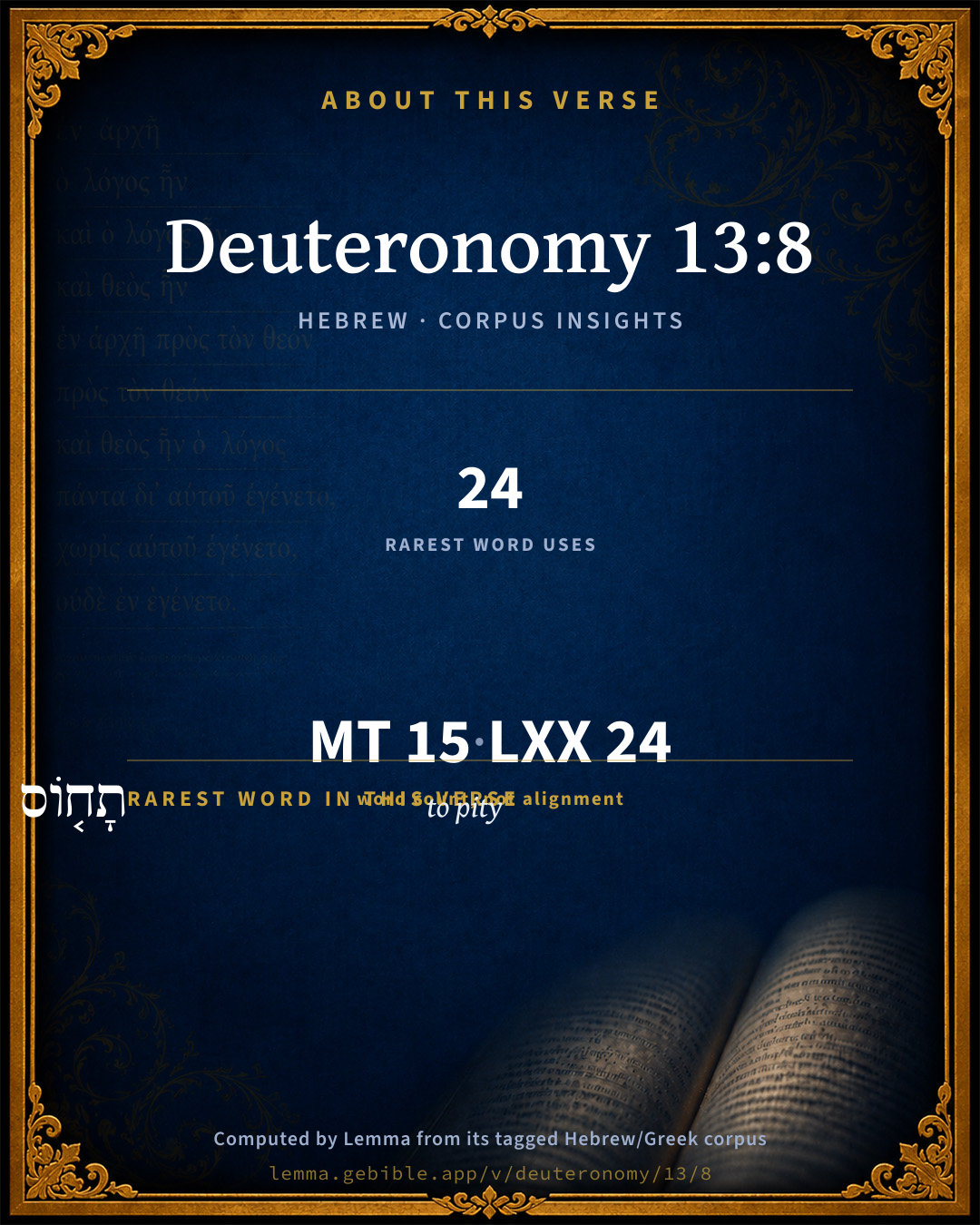
The rarest word here is תָח֤וֹס to pity H2347 — appearing just 24 times in the whole Hebrew Bible.

Shared distinctive vocabulary

תָח֤וֹס to pity H2347 occurs in 24 verses of the Hebrew Bible. Also found in:

Grammatical profile

  • 5 verbs
  • 1 noun
  • 4 prepositions
  • 5 particles

Verb forms

  • תֹאבֶ֣ה Qal · Imperfect
  • תִשְׁמַ֖ע Qal · Imperfect
  • תָח֤וֹס Qal · Imperfect
  • תַחְמֹ֥ל Qal · Imperfect
  • תְכַסֶּ֖ה Piel · Imperfect

Repetition

Words recur within this verse — often emphatic in Hebrew:

  • עָלָ֔יו upon H5921 ×2
  • לֹא not H3808 ×5

Hebrew & Septuagint length

In English translation the verse runs 25 words from the Hebrew and 33 from the Septuagint (LXX English) — closely comparable.

A rough comparison of the two English renderings, which tokenize alike — not a word-level alignment.

Word counts can differ between the Hebrew and the Greek without any difference in meaning — e.g. the Hebrew direct-object marker אֵת has no separate Greek word, and Greek often adds the article ὁ.

In the original languages it is 15 Hebrew tokens and 24 Greek tokens — but the two are counted differently (Hebrew bundles its prefixes and suffixes into one token; the Greek is in lemma form), so that isn’t a like-for-like length.

Cross-references

8

Topical passages linked to Deuteronomy 13:8 in the Treasury of Scripture Knowledge — connected by theme and wording, ordered by reader-vote popularity; previews shown in the World English Bible.

  • Deuteronomy 19:13 Your eye shall not pity him, but you shall put away the innocent blood from Israel, that it may go well with you.
  • Proverbs 1:10 My son, if sinners entice you, don't consent.
  • Deuteronomy 7:16 You shall consume all the peoples who Yahweh your God shall deliver to you; your eye shall not pity them: neither shall you serve their gods; for that will be a snare to you.
  • Ezekiel 9:5–6 To the others he said in my hearing, Go you through the city after him, and strike: don't let your eye spare, neither have you pity;
  • Exodus 20:3 You shall have no other gods before me.
  • Ezekiel 5:11 Therefore, as I live, says the Lord Yahweh, surely, because you have defiled my sanctuary with all your detestable things, and with all your abominations, therefore will I also diminish [you]; neither shall my eye spare, and I also will have no pity.
  • Galatians 1:8–9 But even though we, or an angel from heaven, should preach to you any gospel other than that which we preached to you, let him be cursed.
  • 1 John 5:21 Little children, keep yourselves from idols.

Cross-references courtesy of OpenBible.info (CC BY 4.0).

Hebrew and Greek witnesses Masoretic Hebrew ↔ Greek Septuagint

The same verse in the two great witnesses to the Old Testament, shown verse-for-verse.

These are two independent witnesses, not word-aligned to each other, and the Septuagint is shown in lemma (dictionary) form.

Hebrew Deuteronomy 13:8 Masoretic · Westminster Leningrad Codex

לֹא תֹאבֶ֣ה ל֔וֹ וְלֹ֥א תִשְׁמַ֖ע אֵלָ֑יו וְלֹא תָח֤וֹס עֵֽינְךָ֙ עָלָ֔יו וְלֹֽא תַחְמֹ֥ל וְלֹֽא תְכַסֶּ֖ה עָלָֽיו

you shall not consent to him, nor listen to him; neither shall your eye pity him, neither shall you spare, neither shall you conceal him:

World English Bible · Public Domain

Greek LXX Deuteronomy 13:8 Septuagint · lemma form

ἀπό ὁ θεός ὁ ἔθνος ὁ περικύκλῳ σύ ὁ ἐγγίζω σύ ἤ ὁ μακράν ἀπό σύ ἀπό ἄκρος ὁ γῆ ἕως ἄκρος ὁ γῆ

you shall not consent to him, neither shall you listen to him; and your eye shall not spare him, you shall feel no regret for him, neither shall you at all protect him:

LXX2012 (modern English Septuagint) · Public Domain

Hebrew: Westminster Leningrad Codex (CC BY 4.0). Greek: Septuagint (public domain); English from LXX2012 (modern English Septuagint) (Public Domain). How the Septuagint differs from the Hebrew →

Targum (Aramaic paraphrase)

2

The Targum is the ancient Jewish Aramaic paraphrase of the Hebrew Scriptures — an interpretive translation, not the Hebrew text itself. Onkelos (literal) and Pseudo-Jonathan (expansive) render the Torah, and Jonathan the Prophets. Coverage is partial: where no permissively-licensed English translation exists for a verse, only the Aramaic is shown. This is verse-level text, not a word-by-word alignment to the Hebrew.

  1. Targum Onkelos Torah (Genesis–Deuteronomy)
    מִטַעֲוַת עַמְמַיָא דִי בְסַחֲרָנֵיכוֹן דִקְרִיבִין לָךְ אוֹ דִרְחִיקִין מִנָךְ מִסְיָפֵי אַרְעָא וְעַד סְיָפֵי אַרְעָא

    (no public-domain English translation for this verse)

    Targum Onkelos — Aramaic: “Onkelos Genesis” (public domain); “Onkelos Exodus” (public domain); “Onkelos Leviticus” (public domain); “Onkelos Numbers” (public domain); “Onkelos Deuteronomy” (public domain). English: “Sefaria Community Translation” (CC0 1.0 (public-domain dedication)); “J.W. Etheridge. The Targums of Onkelos and Jonathan Ben Uzziel on the Pentateuch. London: Longmans, Green, 1862” (public domain). Text via Sefaria.

  2. Targum Pseudo-Jonathan Torah (Genesis–Deuteronomy)
    מִטַּעֲוַות שִׁבְעָתֵי עַמְמַיָא דִּבְחוֹזְרָנוּתְכוֹן דְּקָרִיבִין לְכוֹן אוֹ מִן שְׁאַר עַמְמַיָא דִרְחִיקִין לְכוֹן מִן סְיָיפֵי אַרְעָא וְעַד סְיָיפֵי אַרְעָא

    or the idols of the seven nations who are near you round about, or of the rest of the nations who are far away from you, from one end of the earth to the other;

    Targum Pseudo-Jonathan — Aramaic: “Targum Jonathan on Genesis” (public domain); “Targum Jonathan on Exodus” (public domain); “Targum Jonathan on Leviticus” (public domain); “Targum Jonathan on Numbers” (public domain); “Targum Jonathan on Deuteronomy” (public domain). English: “The Targum of Jonathan ben Uzziel, trans. J. W. Etheridge, London, 1862” (public domain). Text via Sefaria.

Commentary

Notes on Deuteronomy 13:8 from classic Christian and Jewish commentators (each source and its license shown beneath its notes). The classic Christian expositions comment on the surrounding passage and are grouped to its opening verse, so a note may address several verses; the Jewish commentaries on the Tanakh (Rashi and others) are per-verse, so they appear only where the commentator wrote on this verse.

Lemma curates 59 commentaries, every one of them public domain or Creative Commons licensed, each selected and text-cleaned for this edition rather than reprinted as found. About our sources →

Joseph Benson's Commentary

Deu 13:8. Neither shall thine eye pity him — The reason of the thing shows that two circumstances are implied: one is, that the seducer should be convicted by two sufficient witnesses before he should be put to death; the other, that the offender obstinately persisted in the defence of idolatry in spite of admonition; for who can doubt but a father, for instance, might save the life of his son, in case he brought him to timely repentance? Neither shalt thou conceal him — That is, smother his fault, hide or protect his person; but shalt accuse him to the magistrate, and demand justice upon him.

Joseph Benson's Commentary on the Old and New Testaments (1811–1818) — public domain. Text from a community e-Sword module.

John Gill's Exposition

Thou shall not consent unto him,.... To commit the idolatry enticed unto, or join with him in it:

nor hearken to him; not so much as patiently to hear him, but at once express an abhorrence of and indignation at what he recommends:

neither shall thine eye pity him; pitied he might be for his ignorance, stupidity, and wickedness, and on account of the miserable estate and condition he was in, and of those dreadful consequences which would follow upon it, if not converted from it; but no mercy was to be shown him on account of nearness of relation:

neither shall thou spare; to reprove him sharply and to expose him to public vengeance:

neither shall thou conceal him; neither him nor his sin, but make both public, acquaint others with it, and endeavour to bring him before the civil magistrate to be examined, tried, and judged; so far should they be from hiding his offence from others, or excusing and extenuating it, or from harbouring his person privately when sought for upon information.

John Gill's Exposition of the Whole Bible (1746–1763) — public domain (CC PDM 1.0). Text via the HelloAO Bible API.

Matthew Poole's English Annotations

i.e. Smother his fault, hide or protect his person, but shalt accuse him to the magistrate, and demand justice upon him, which was not to be done in most other criminal causes; and no wonder, this crime being of a far higher nature than others.

Matthew Poole's English Annotations on the Holy Bible (1683–1685) — public domain. Text from a community e-Sword/MySword module.

The Pulpit Commentary

Pity, spare, conceal. The accumulation of terms serves to make the injunction more solemn and impressive.

The Pulpit Commentary (1880–1919), ed. H.D.M. Spence-Jones & Joseph S. Exell — public domain. Text from a community e-Sword module.

John Wesley's Explanatory Notes

Conceal him - That is, smother his fault, hide or protect his person, but shalt accuse him to the magistrate, and demand justice upon him.

John Wesley, Explanatory Notes Upon the Whole Bible (1754–1765) — public domain. Text via the GEBible commentary corpus.

unfoldingWord translationNotes

Door43 World Missions Community

You must not give in to him

"Do not agree to what he wants"

you must not permit your eye to pity him

Here "your eye" refers to the whole person. AT: "you msut not look at him with pity" or "you must not show him mercy" (See: Synecdoche)

you must not spare him or conceal him

"you must not show him mercy or hide from others what he has done"

your hand will be the first on him to put him to death

This means that he was to throw the first stone at the guilty person. The word "hand" represents the whole person. AT: "you must be the first to strike him to kill him" (See: Synecdoche)

the hand of all the people

Here "hand" represents the whole person. AT: "the other people will join you" (See: Synecdoche)

translationWords

hand

die

unfoldingWord translationNotes — © Distant Shores Media and the Door43 World Missions Community, licensed CC BY-SA 4.0. Source: git.door43.org/Door43/en_tn.

Rashi

Rabbi Shlomo Yitzchaki (Rashi)

הקרבים אליך או הרחקים [LET US GO AND SERVE OTHER GODS … NAMELY, OF THE GODS] WHICH ARE NIGH UNTO THEE, OR FAR OFF [FROM THEE] — To what end does it (Scripture) mention the gods of the near nations and those of the far-off ones? But this is in effect what Scripture says: From your knowledge of the gods of the near nations, you may draw conclusions regarding the nature of the gods of those far-off; just as there is nothing real in those of the near ones so there is nothing real in those of the far-off ones (Sanhedrin 61b; Sifrei Devarim 88:1).

מקצה הארץ [GODS … FAR OFF FROM THEE] FROM THE ONE END OF THE EARTH [EVEN UNTO THE OTHER END OF THE EARTH] — This refers to the sun, the moon and the host of heaven (the stars) who move from one end of the world to the other (Sifrei Devarim 88:2).

Rashi on the Tanakh — English translations: “The Judaica Press complete Tanach with Rashi, translated by A. J. Rosenberg” (CC BY 4.0); “Pentateuch with Rashi's commentary by M. Rosenbaum and A.M. Silbermann, 1929-1934” (public domain); “The Metsudah Tanach series, Lakewood, N.J” (CC BY 4.0); and “The Book of Joshua, Metsudah Publications, 1997” (CC BY 4.0). Text via Sefaria.

Lesson kit

Teaching starters — assembled from the data on this page, not authored interpretation. Every prompt links to the verse data it draws on. Edit before teaching.

Deuteronomy, in the Pentateuch, opens this verse with 15 words (9 distinct Hebrew lemmas). Its most distinctive word is chûwç (“to pity”). A historical commentator’s framing appears above. Read the whole chapter for the surrounding context.

Discussion questions

  1. How does “to pity” (chûwç) shape what this verse is saying?
  2. How does Genesis 45:20, which shares the word «to pity», read alongside this verse?
  3. What does the repetition of “upon” (2× in this one verse) do in this verse?
  4. The translations on this page render this verse differently — a whole-verse word diff, not a word-by-word alignment. What might account for the different wordings?
  5. «תֹאבֶ֣ה» is a Qal Imperfect verb. How does that grammatical form shape the action described?
  6. Compare how Joseph Benson's Commentary and John Gill's Exposition read this verse. Where do they agree or differ?

Things to notice

Reading settings

Reading text

Shown beneath each verse's original-language words.

Old Testament
Old Testament edition

Read the OT as the Masoretic Hebrew (MT) or the Greek Septuagint (LXX).

English shown for the Greek Septuagint (in the Hebrew ↔ Greek comparison).

Comparing translations? Open the Compare panel on any verse page to stack up to four side by side.