
1 Kings 13:26

Hebrew (Westminster Leningrad Codex) 1 Kings 13:26 appears in the Hebrew Old Testament. The text above is from the Westminster Leningrad Codex. Each word links to its Strong’s number, a concise gloss, and parsing drawn from the Open Scriptures Hebrew Bible morphology. Click any word for its full Brown-Driver-Briggs (BDB) entry.
Download image
Cite this verse

1 Kings 13:26 (World English Bible). Public Domain. Lemma interlinear Bible study tool, https://lemma.gebible.app/v/1-kings/13/26.

Show BibTeX & RIS
BibTeX
RIS
English Translation
When the prophet who brought him back from the way heard of it, he said, It is the man of God, who was disobedient to the mouth of Yahweh: therefore Yahweh has delivered him to the lion, which has torn him, and slain him, according to the word of Yahweh, which he spoke to him.
World English Bible · Public Domain
Download a study sheet

One document with this verse’s original text, its word-by-word gloss line, the meaning frame, cross-references with their text, attributed commentary, and full source and license credits — printable, and it pastes into notes with its structure intact.

This verse Autodidact and up

Study sheet (.html) Plain text (.txt)

A passage Seminary Student

Up to 50 verses in one chapter. A passage sheet keeps up to 6 commentary sources and 12 cross-references per verse, in the order this page ranks them, and says so on the sheet whenever that leaves anything out. Ask for a single verse and you get the Autodidact verse sheet above.

Everything on this page stays free to read, with no account — the sheet is a download of what is already on screen, not access to it.

Want to remove ads? Support Godless Engineer
Compare translations 3

The same verse in 3 English versions, stacked beneath the original-language interlinear above. Click any original word for its lexicon entry.

Each is an independent rendering of the whole verse — the interlinear is not word-aligned to these translations.

Highlighted words mark where these versions differ — a whole-verse word diff, not a word-by-word alignment.

  • World English Bible Public Domain
    When the prophet who brought him back from the way heard of it, he said, It is the man of God, who was disobedient to the mouth of Yahweh: therefore Yahweh has delivered him to the lion, which has torn him, and slain him, according to the word of Yahweh, which he spoke to him.
  • King James Version Public Domain
    And when the prophet that brought him back from the way heard thereof, he said, It is the man of God, who was disobedient unto the word of the LORD: therefore the LORD hath delivered him unto the lion, which hath torn him, and slain him, according to the word of the LORD, which he spake unto him.
  • unfoldingWord Literal Text CC BY-SA 4.0
    And the prophet who had brought him back from the road heard, and he said, “He is the man of God who disobeyed the mouth of Yahweh. And Yahweh gave him to the lion, and it tore him apart and killed him, according to the word of Yahweh that he spoke to him.”

unfoldingWord Literal Text — © unfoldingWord, licensed CC BY-SA 4.0. Word-aligned USFM3 via Door43 (git.door43.org/unfoldingWord/en_ult).

Versions to compare (up to 4)

3 of 4 selected

Show all 18 translations

Every available English version of this verse, each an independent rendering of the whole verse.

  • World English Bible Public Domain
    When the prophet who brought him back from the way heard of it, he said, It is the man of God, who was disobedient to the mouth of Yahweh: therefore Yahweh has delivered him to the lion, which has torn him, and slain him, according to the word of Yahweh, which he spoke to him.
  • Berean Standard Bible Public Domain
    When the prophet who had brought him back from his journey heard this, he said, “It is the man of God who disobeyed the command of the LORD. Therefore the LORD has delivered him to the lion, and it has mauled him and killed him, according to the word that the LORD had spoken to him.”
  • Majority Standard Bible Public Domain
    When the prophet who had brought him back from his journey heard this, he said, “It is the man of God who disobeyed the command of the LORD. Therefore the LORD has delivered him to the lion, and it has mauled him and killed him, according to the word that the LORD had spoken to him.”
  • King James Version Public Domain
    And when the prophet that brought him back from the way heard thereof, he said, It is the man of God, who was disobedient unto the word of the LORD: therefore the LORD hath delivered him unto the lion, which hath torn him, and slain him, according to the word of the LORD, which he spake unto him.
  • American Standard Version (1901) Public Domain
    And when the prophet that brought him back from the way heard thereof, he said, It is the man of God, who was disobedient unto the mouth of Jehovah: therefore Jehovah hath delivered him unto the lion, which hath torn him, and slain him, according to the word of Jehovah, which he spake unto him.
  • Revised Version (1885) Public Domain
    And when the prophet that brought him back from the way heard thereof, he said, It is the man of God, who was disobedient unto the mouth of the LORD: therefore the LORD hath delivered him unto the lion, which hath torn him, and slain him, according to the word of the LORD, which he spake unto him.
  • Geneva Bible (1599) Public Domain
    And when the Prophet that brought him backe againe from the waye, hearde thereof, hee sayde, It is the man of God, who hath bene disobedient vnto the commandement of the Lord: therefore the Lord hath deliuered him vnto the lion, which hath rent him and slayne him, according to the worde of the Lord, which hee spake vnto him.
  • Douay-Rheims (1899) Public Domain
    And when that prophet, who had brought him back out of the way, heard of it, he said: It is the man of God, that was disobedient to the mouth of the Lord, and the Lord hath delivered him to the lion, and he hath torn him, and killed him according to the word of the Lord, which he spoke to him.
  • Young's Literal Translation Public Domain
    And the prophet who brought him back out of the way heareth and saith, `It `is' the man of God who provoked the mouth of Jehovah, and Jehovah giveth him to the lion, and it destroyeth him, and putteth him to death, according to the word of Jehovah that he spake to him.'
  • Literal Standard Version CC BY-SA 4.0
    And the prophet who brought him back out of the way hears and says, “It [is] the man of God who provoked the mouth of YHWH, and YHWH gives him to the lion, and it destroys him, and puts him to death, according to the word of YHWH that he spoke to him.”
  • Unlocked Literal Bible CC BY-SA 4.0
    When the prophet who had brought him back from the way heard it, he said, “It is the man of God who disobeyed the word of Yahweh. Therefore Yahweh gave him to the lion, which tore him to pieces and killed him, just as the word of Yahweh warned him.”
  • unfoldingWord Literal Text CC BY-SA 4.0
    And the prophet who had brought him back from the road heard, and he said, “He is the man of God who disobeyed the mouth of Yahweh. And Yahweh gave him to the lion, and it tore him apart and killed him, according to the word of Yahweh that he spoke to him.”
  • Darby Bible Public Domain
    And the prophet that brought him back from the way heard [of it] and said, It is the man of God who was disobedient to the word of Jehovah; therefore Jehovah has delivered him to the lion, which has torn him and slain him, according to the word of Jehovah which he spoke to him.
  • World Messianic Bible Public Domain
    When the prophet who brought him back from the way heard of it, he said, “It is the man of God who was disobedient to the LORD’s word. Therefore the LORD has delivered him to the lion, which has mauled him and slain him, according to the LORD’s word which he spoke to him.”
  • Webster's Bible Public Domain
    And when the prophet that brought him back from the way heard of it, he said, It is the man of God, who was disobedient to the word of the LORD: therefore the LORD hath delivered him to the lion, which hath torn him, and slain him, according to the word of the LORD, which he spoke to him.
  • Free Bible Version CC BY-SA 4.0
    When the old prophet who had led the other astray heard what had happened, he said, “It's the man of God who disobeyed the Lord's orders. That's why the Lord put him in the path of the lion, and it has mauled him and killed him, just as the Lord told him would happen.”
  • Bible in Basic English Public Domain
    Then the prophet who had made him come back, hearing it, said, It is the man of God, who went against the word of the Lord; that is why the Lord has given him to the lion to be wounded to death, as the Lord said.
  • JPS Tanakh (1917) Public Domain
    And when the prophet that brought him back from the way heard thereof, he said: 'It is the man of God, who rebelled against the word of the LORD; therefore the LORD hath delivered him unto the lion, which hath torn him, and slain him, according to the word of the LORD, which He spoke unto him.'

Literal Standard Version (2020), Covenant Press — licensed CC BY-SA 4.0. Text via the HelloAO Bible API (eBible.org). Unlocked Literal Bible (unfoldingWord) — licensed CC BY-SA 4.0. Text via the HelloAO Bible API (eBible.org). unfoldingWord Literal Text — © unfoldingWord, licensed CC BY-SA 4.0. Word-aligned USFM3 via Door43 (git.door43.org/unfoldingWord/en_ult). Free Bible Version, Dr. Jonathan Gallagher — licensed CC BY-SA 4.0. Text via the HelloAO Bible API (eBible.org).

Word by word

More ways to search: Search by grammar → Find every occurrence → Compare this word →

Practice this passage: Drill this verse → Learn its vocabulary →

מָרָ֖ה
mârâh
H4784
“to rebel”
Verb, Qal, Perfect, 3rd Person, Masculine, Singular
Part of Speech
Verb
Stem
Qal
Form
Perfect
Person
3rd Person
Gender
Masculine
Number
Singular
Full BDB Definition

Origin: a primitive root

TWOT: 1242

to be contentious, be rebellious, be refractory, be disobedient towards, be rebellious against - (Qal) to be disobedient, be rebellious - towards father - towards God - (Hiphil) to show rebelliousness, show disobedience, disobey
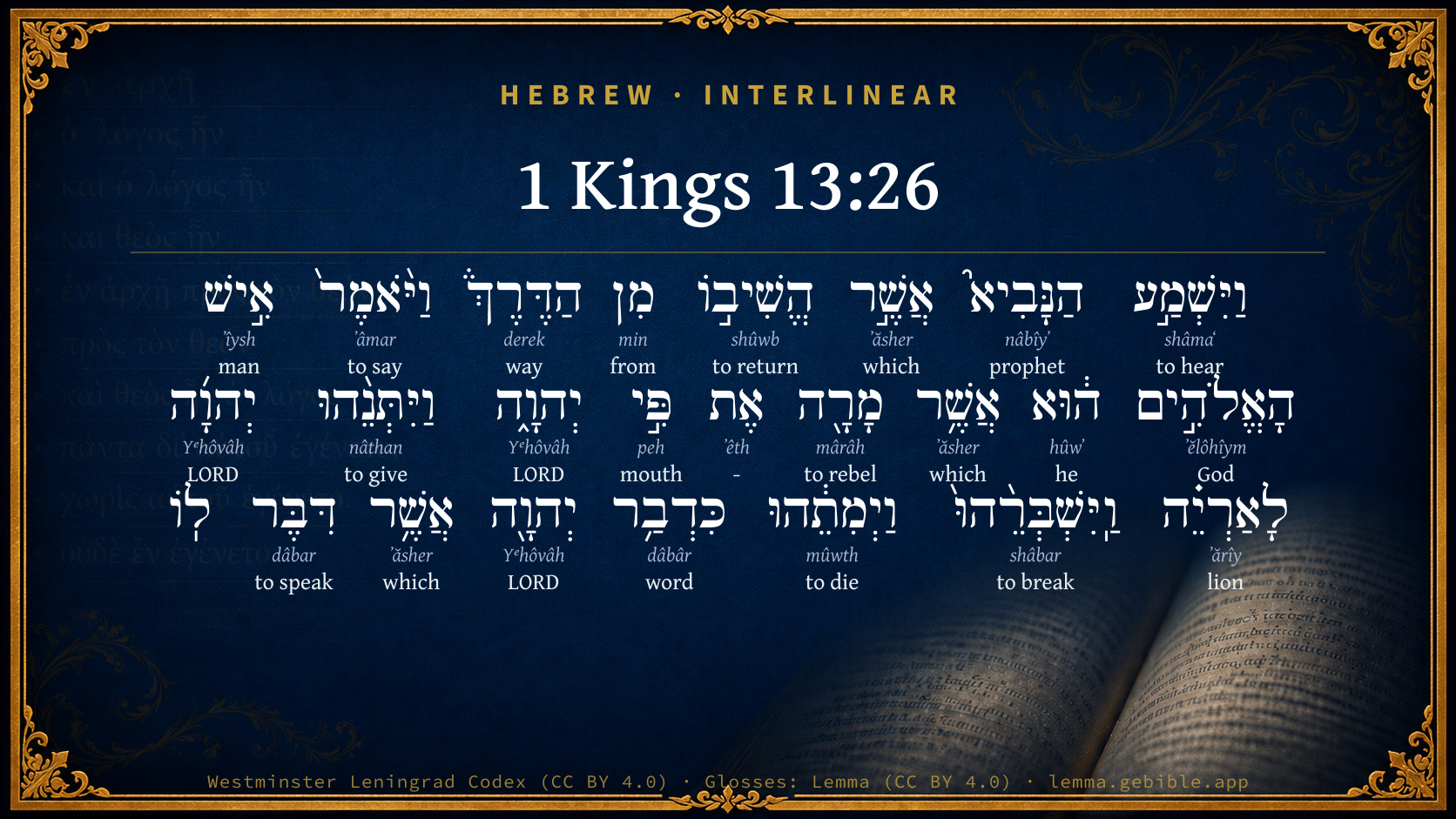
  1. וַיִּשְׁמַ֣ע shâmaʻ H8085 “and · to hear” Conjunction + Verb, Qal, Sequential Imperfect, 3rd Person, Masculine, Singular
  2. הַנָּבִיא֮ nâbîyʼ H5030 “the · prophet” Particle, Definite Article + Noun, Common, Masculine, Singular, Absolute
  3. אֲשֶׁ֣ר ʼăsher H834 “which” Particle, Relative
  4. הֱשִׁיב֣וֹ shûwb H7725 “to return · him” Verb, Hiphil, Perfect, 3rd Person, Masculine, Singular + Suffix, Personal, 3rd Person, Masculine, Singular
  5. מִן min H4480 “from” Preposition
  6. הַדֶּרֶךְ֒ derek H1870 “the · way” Particle, Definite Article + Noun, Common, Both, Singular, Absolute
  7. וַיֹּ֨אמֶר֙ ʼâmar H559 “and · to say” Conjunction + Verb, Qal, Sequential Imperfect, 3rd Person, Masculine, Singular
  8. אִ֣ישׁ ʼîysh H376 “man of” Noun, Common, Masculine, Singular, Construct
  9. הָאֱלֹהִ֣ים ʼĕlôhîym H430 “the · God(s)” Particle, Definite Article + Noun, Common, Masculine, Plural, Absolute
  10. ה֔וּא hûwʼ H1931 “he” Pronoun, Personal, 3rd Person, Masculine, Singular
  11. אֲשֶׁ֥ר ʼăsher H834 “which” Particle, Relative
  12. אֶת ʼêth H853 “-” Particle, Direct Object
  13. פִּ֣י peh H6310 “mouth of” Noun, Common, Masculine, Singular, Construct
  14. יְהוָ֑ה Yᵉhôvâh H3068 “LORD” Noun, Proper
  15. וַיִּתְּנֵ֨הוּ nâthan H5414 “and · to give · him” Conjunction + Verb, Qal, Sequential Imperfect, 3rd Person, Masculine, Singular + Suffix, Personal, 3rd Person, Masculine, Singular
  16. יְהוָ֜ה Yᵉhôvâh H3068 “LORD” Noun, Proper
  17. לָאַרְיֵ֗ה ʼărîy H738 “to/for the · lion” Preposition, Determined + Noun, Common, Masculine, Singular, Absolute
  18. וַֽיִּשְׁבְּרֵ֨הוּ֙ shâbar H7665 “and · to break · him” Conjunction + Verb, Qal, Sequential Imperfect, 3rd Person, Masculine, Singular + Suffix, Personal, 3rd Person, Masculine, Singular
  19. וַיְמִתֵ֔הוּ mûwth H4191 “and · to die · him” Conjunction + Verb, Hiphil, Sequential Imperfect, 3rd Person, Masculine, Singular + Suffix, Personal, 3rd Person, Masculine, Singular
  20. כִּדְבַ֥ר dâbâr H1697 “like/as · word of” Preposition + Noun, Common, Masculine, Singular, Construct
  21. יְהוָ֖ה Yᵉhôvâh H3068 “LORD” Noun, Proper
  22. אֲשֶׁ֥ר ʼăsher H834 “which” Particle, Relative
  23. דִּבֶּר dâbar H1696 “to speak” Verb, Piel, Perfect, 3rd Person, Masculine, Singular

About this verse

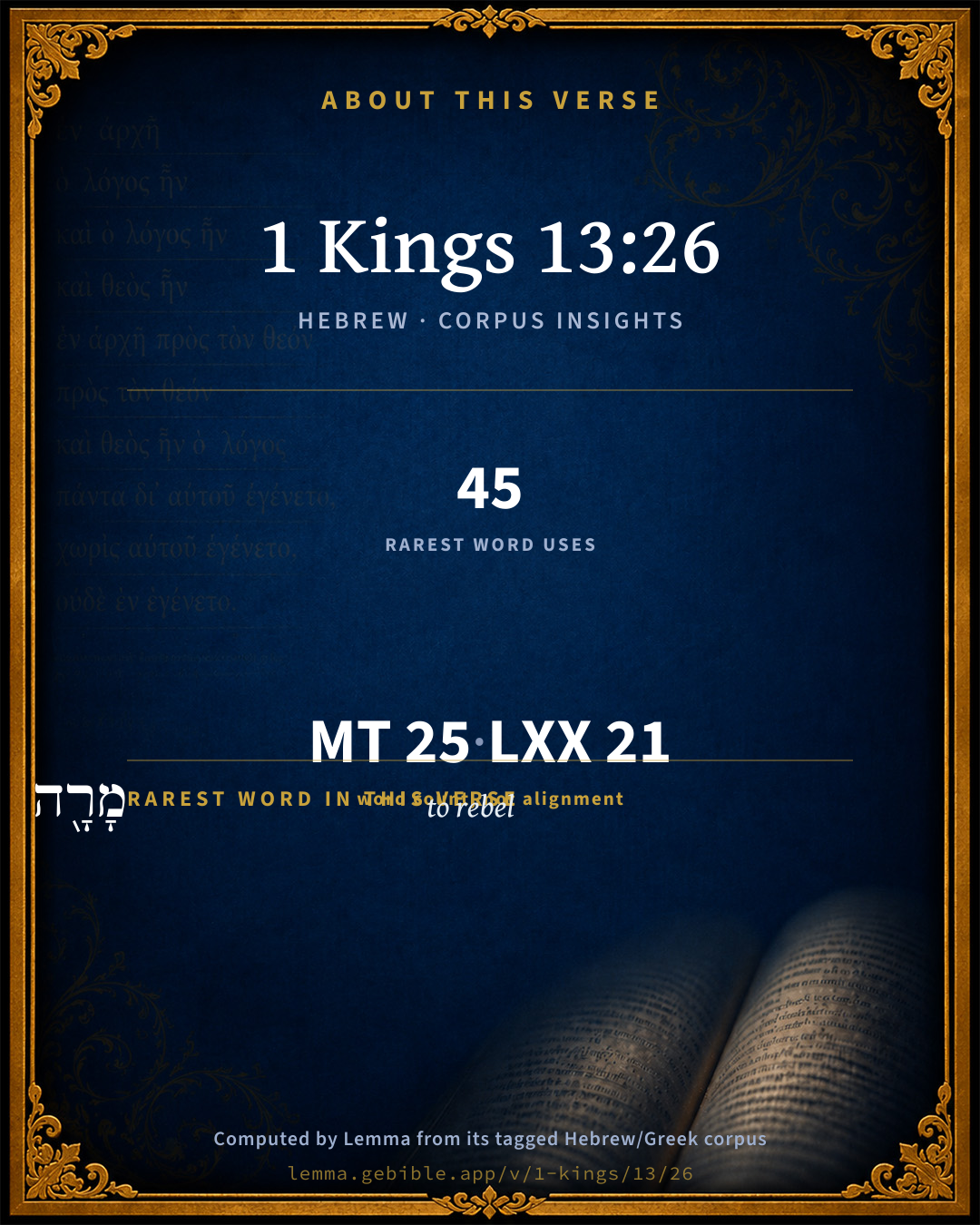
These counts appear in no published source. They are computed here, from the morphology-tagged text and Lemma’s own curated glosses. What Lemma adds →

25
words
20
distinct lemmas
Historical
section

Shared distinctive vocabulary

מָרָ֖ה to rebel H4784 occurs in 44 verses of the Hebrew Bible. Also found in:

Grammatical profile

  • 8 verbs
  • 10 nouns
  • 1 pronoun
  • 2 prepositions
  • 4 particles

Verb forms

  • וַיִּשְׁמַ֣ע Qal · Sequential Imperfect
  • הֱשִׁיב֣וֹ Hiphil · Perfect
  • וַיֹּ֨אמֶר֙ Qal · Sequential Imperfect
  • מָרָ֖ה Qal · Perfect
  • וַיִּתְּנֵ֨הוּ Qal · Sequential Imperfect
  • וַֽיִּשְׁבְּרֵ֨הוּ֙ Qal · Sequential Imperfect
  • וַיְמִתֵ֔הוּ Hiphil · Sequential Imperfect
  • דִּבֶּר Piel · Perfect

Repetition

Words recur within this verse — often emphatic in Hebrew:

  • יְהוָ֑ה LORD H3068 ×3
  • אֲשֶׁ֣ר which H834 ×3

Hebrew & Septuagint length

In English translation the verse runs 55 words from the Hebrew and 28 from the Septuagint (LXX English) — the Septuagint runs noticeably shorter here. See the side-by-side →

A rough comparison of the two English renderings, which tokenize alike — not a word-level alignment.

Word counts can differ between the Hebrew and the Greek without any difference in meaning — e.g. the Hebrew direct-object marker אֵת has no separate Greek word, and Greek often adds the article ὁ.

In the original languages it is 25 Hebrew tokens and 21 Greek tokens — but the two are counted differently (Hebrew bundles its prefixes and suffixes into one token; the Greek is in lemma form), so that isn’t a like-for-like length.

Cross-references

9

Topical passages linked to 1 Kings 13:26 in the Treasury of Scripture Knowledge — connected by theme and wording, ordered by reader-vote popularity; previews shown in the World English Bible.

  • Ezekiel 9:6 kill utterly the old man, the young man and the virgin, and little children and women; but don't come near any man on whom is the mark: and begin at my sanctuary. Then they began at the old men that were before the house.
  • Leviticus 10:3 Then Moses said to Aaron, "This is what Yahweh spoke of, saying, "'I will show myself holy to those who come near me, And before all the people I will be glorified.'" Aaron held his peace.
  • 2 Samuel 12:10 Now therefore the sword will never depart from your house, because you have despised me, and have taken the wife of Uriah the Hittite to be your wife.'
  • 2 Samuel 12:14 However, because by this deed you have given great occasion to Yahweh's enemies to blaspheme, the child also who is born to you shall surely die."
  • Psalms 119:120 My flesh trembles for fear of you. I am afraid of your judgments.
  • Proverbs 11:31 Behold, the righteous shall be repaid in the earth; How much more the wicked and the sinner!
  • 1 Corinthians 11:30 For this cause many among you are weak and sickly, and not a few sleep.
  • Hebrews 12:28–29 Therefore, receiving a Kingdom that can't be shaken, let us have grace, through which we serve God acceptably, with reverence and awe,
  • 1 Peter 4:17 For the time has come for judgment to begin at the house of God. If it begins first with us, what will happen to those who don't obey the Gospel of God?

Cross-references courtesy of OpenBible.info (CC BY 4.0).

Hebrew and Greek witnesses Masoretic Hebrew ↔ Greek Septuagint

The same verse in the two great witnesses to the Old Testament, shown verse-for-verse.

Here the Septuagint runs noticeably shorter than the Hebrew — LXX2012 (modern English Septuagint) 28 words vs World English Bible 55. A rough length comparison of the two English translations, not a word-level alignment — read both below.

These are two independent witnesses, not word-aligned to each other, and the Septuagint is shown in lemma (dictionary) form.

Hebrew 1 Kings 13:26 Masoretic · Westminster Leningrad Codex

וַיִּשְׁמַ֣ע הַנָּבִיא֮ אֲשֶׁ֣ר הֱשִׁיב֣וֹ מִן הַדֶּרֶךְ֒ וַיֹּ֨אמֶר֙ אִ֣ישׁ הָאֱלֹהִ֣ים ה֔וּא אֲשֶׁ֥ר מָרָ֖ה אֶת פִּ֣י יְהוָ֑ה וַיִּתְּנֵ֨הוּ יְהוָ֜ה לָאַרְיֵ֗ה וַֽיִּשְׁבְּרֵ֨הוּ֙ וַיְמִתֵ֔הוּ כִּדְבַ֥ר יְהוָ֖ה אֲשֶׁ֥ר דִּבֶּר לֽוֹ

When the prophet who brought him back from the way heard of it, he said, It is the man of God, who was disobedient to the mouth of Yahweh: therefore Yahweh has delivered him to the lion, which has torn him, and slain him, according to the word of Yahweh, which he spoke to him.

World English Bible · Public Domain

Greek LXX 1 Kings 13:26 Septuagint · lemma form

καί ἀκούω ὁ ἐπιστρέφω αὐτός ἐκ ὁ ὁδός καί εἶπον ὁ ἄνθρωπος ὁ θεός οὗτος εἰμί ὅς παραπικραίνω ὁ ῥῆμα κύριος

And the prophet that turned him back out of the way heard, and said, This is the man of God who rebelled against the word of the Lord.

LXX2012 (modern English Septuagint) · Public Domain

On this verse, The Cambridge Bible for Schools and Colleges discusses the Septuagint’s reading. Read the note in Commentary ↓

Hebrew: Westminster Leningrad Codex (CC BY 4.0). Greek: Septuagint (public domain); English from LXX2012 (modern English Septuagint) (Public Domain). How the Septuagint differs from the Hebrew →

Targum (Aramaic paraphrase)

1

The Targum is the ancient Jewish Aramaic paraphrase of the Hebrew Scriptures — an interpretive translation, not the Hebrew text itself. Onkelos (literal) and Pseudo-Jonathan (expansive) render the Torah, and Jonathan the Prophets. Coverage is partial: where no permissively-licensed English translation exists for a verse, only the Aramaic is shown. This is verse-level text, not a word-by-word alignment to the Hebrew.

  1. Targum Jonathan Prophets (Joshua–Malachi)
    וּשְׁמַע נְבִיָא דַאֲתָבֵיהּ מִן אוֹרְחָא וַאֲמַר נְבִיָא דַייָ הוּא דְסָרֵיב עַל מֵימְרָא דַייָ וּמַסְרֵיהּ יְיָ לְאַרְיָא וְתַבְרֵיהּ וְקַטְלֵיהּ כְּפִתְגָמָא דַייָ דְמַלֵיל לֵיהּ:

    (no public-domain English translation for this verse)

    Targum Jonathan — Aramaic: “Mikraot Gedolot” (public domain). English: “Sefaria Community Translation” (CC0 1.0 (public-domain dedication)); “London "Chaldee Paraphrase," 1871” (public domain). Text via Sefaria.

Commentary

Notes on 1 Kings 13:26 from classic Christian and Jewish commentators (each source and its license shown beneath its notes). The classic Christian expositions comment on the surrounding passage and are grouped to its opening verse, so a note may address several verses; the Jewish commentaries on the Tanakh (Rashi and others) are per-verse, so they appear only where the commentator wrote on this verse.

Lemma curates 59 commentaries, every one of them public domain or Creative Commons licensed, each selected and text-cleaned for this edition rather than reprinted as found. About our sources →

Trapp's Complete Commentary

John Trapp

1Ki 13:26 And when the prophet that brought him back from the way heard [thereof], he said, It [is] the man of God, who was disobedient unto the word of the LORD: therefore the LORD hath delivered him unto the lion, which hath torn him, and slain him, according to the word of the LORD, which he spake unto him.

Ver. 26. Who was disobedient unto the word of the Lord.] Still his sin is styled disobedience, though he were tricked into it. It was no good excuse of our grandame Eve to say, The serpent deceived me, and I did eat.

John Trapp, A Commentary or Exposition upon All the Books of the Old and New Testament (1647–1656) — public domain. Text from a community e-Sword module.

The Biblical Illustrator

Joseph S. Exell

1Ki_13:26-32

And when the prophet that brought him back from the way heard thereof.

On the character of the old prophet of Bethel

The most careful review of this mans conduct does not make it easy to comprehend it; nor, indeed, do we know enough about him to satisfy us in pronouncing decidedly on the subject. Still there are circumstances in his history which do throw light on certain points of his character; and give them sufficient distinctness for us to apprehend a drift in them, and see an instruction which they convey to us. The first circumstance I would notice, is what we find in the twenty-third chapter of the Second Book of Kings; where we read, at the eighteenth verse, that the relics of him who was buried by the side of the man of God, are stated to be the bones of the prophet that came out of Samaria. He was originally of Samaria, the capital of his country; and now, in his old age, we find him removed to Bethel; the very mount of corruption, the temple of sacrilege, the very throne and stronghold of that son of Nebat, who had so fearfully made Israel to sin. Wherefore was he there? Had he gone there in grief and dismay at the doings of his prince, to remonstrate against and correct them? Had he gone, in jealousy of zeal and affection for the honour of his God and his Church? Alas! no; he could have gone with no such wish or object as this, or it would not have required Gods special mission of one of His prophets from Judah, to declare the violated truth before king, and priests, and people at Bethel! It is too clear that the old prophet must have been, at least, a consenting party to the doings which had made Israel an abomination in the sight of God. He must have even preferred the new order of things under this spiritual revolution of Jeroboam, or he need not have remained where they must day after day have done violence to his habits, and shocked his principles of religion.

1. That the burden of causing this misery and sin was mainly to be laid to the old prophets charge, there can be no doubt whatever. Although the delinquency of the man of God was great, the guilt of his aged brother was greater far; the former, indeed, yielded unjustifiably to temptation, but the latter assumed a part fit only for the malice of Satan himself. Our blessed Lord spoke with His characteristic monitory expression, when He joined the character of a liar and a murderer together; and pointed out to certain of the Jews that their father the devil had been a destroyer from the beginning, because he abode not in the truth, and there was no truth in him.

2. The next thing we should observe, is the singular faith and courage of his conduct, after he had been forced to announce his own victims punishment, and after the result of his treachery had broken, in its dreadful reality, upon his mind. Compunction and remorse evidently seized upon his mind, when he set forth upon the sorrowful errand of bringing back to an honoured burial, and a deep mourning, the man whom he had hurried to this untimely end. He saw and acknowledged the finger of God in this thing.

3. Moreover, it is evident that he must by this time have become touched with the truths which God had proclaimed by the mouth of His servant, and the richly earned vengeance in store for the crying sins of Israel. For, according to the words of our text, he solemnly forewarned his sons of the certain accomplishment of the saying which was cried by the word of the Lord against the altar in Bethel, and all the houses of the high places which were in the cities of Samaria; this, said he, shall surely come to pass. And that there was repentance in the after-conduct of the old prophet; and that God was mercifully pleased to look upon it with a pitying eye, there is some ground for hope in the issue of the event, as it came to pass in Gods own time. For when Josiah had accomplished the Divine vengeance on all the abominations of Bethel; had deposed its priests, broken clown its high places, and defiled its altars; and was in the act of taking the dead from the sepulchres on the mount, and burning them on the altars of the former sin; we read that he religiously spared the sepulchre of the man of God that came from Judah; and that they let his bones alone, together with the bones of the prophet that came cub of Samaria. A signal act of mercy this, on a day of severe and general retribution!

Lessons:

1. I need scarcely say that this example directs its first and broadest rebuke against all such as would ever knowingly and wilfully oppose and pervert the truth. This is a species of guilt so monstrous and offensive in the eyes of God and man; so merely malicious in its whole drift, and policy, and endeavour; that one would think it needs only to be noted, to be at once shunned and abhorred. It was the first origin of all corruption and misery on the face of Gods pure and perfect creation; the cause of mans degradation, and the cursing of the earth for his sake: by it sin entered into the world, and death by sin.

2. But further, there is a modification of the old prophets sin, into which we may sometimes fall, without at all going to its full extent. We are apt to be enamoured of our own particular views of what we are pleased to think is truth; to cherish these, and to propagate these, without sufficient warranty for their sound and solid foundation in what is right. (J. Puckle, M. A.)

The grave and its epitaph

Bury me, said the remorseful old man to his sons standing in tears around his miserable death-bed, bury me in the same grave with the bones of the man of God out of Judah. And the old prophets sons so buried their father. And an awful grave that was in Bethel, with an awful epitaph upon it. Now, suppose this Suppose that you were buried on the same awful principle--in whose grave would your bones lie waiting together with his till the last trump to stand forth before God and man together? And what would your epitaph and his be? Would it be this: Here lie the liar and his victim ? Or would it be this: Here lie the seducer and the seduced? Or would it be this: Here lie the hater and him he hated down to death? Or would it be this: Here lie the tempting host and his too willing to be tempted guest? Or, if you are a minister, would it be this: Here lies a dumb dog, and beside him one who was a crowded preacher in the morning of his days, but a castaway before night? Alas, my brother. (A. Whyte, D. D.)

The Biblical Illustrator, edited by Joseph S. Exell (c. 1880s–1900s) — public domain. Text from a community e-Sword module.

Ellicott's Commentary for English Readers

(26) He said, It is the man of God.—The old prophet did not know how his prediction was to be fulfilled, but recognised at once its supernatural fulfilment. There is in his words a characteristic reticence as to his own share in the work, in respect both of the deceit and the prediction of judgment, perhaps indicating something of the strange mixture of remorse and unscrupulous policy which comes out in his later action.

A Bible Commentary for English Readers, edited by Charles John Ellicott (1878–1897) — public domain. Text from a community e-Sword module.

The Cambridge Bible for Schools and Colleges

gen. ed. J. J. S. Perowne

26. disobedient unto the word] The R.V. gives here as the A.V. in 1Ki_13:21 unto the mouth. This is the literal rendering, and is as intelligible as the other. The LXX. (Vat.) gives for this verse only: ‘And he who brought him back from the way heard it and said, This is the man of God who rebelled against the word of the Lord.’ The next verse (27) is not represented at all in that version.

The Cambridge Bible for Schools and Colleges (gen. ed. J. J. S. Perowne; Cambridge University Press, 1878–1918) — public domain. Text from a community e-Sword module.

John Gill's Exposition

And the prophet took up the carcass of the man of God,.... The lion perhaps made off as soon as he came, or, if he stayed, the prophet was not afraid of him, seeing he did not attempt to devour the carcass, nor touch the ass, nor do any hurt to those that passed by:

and laid it upon the ass, and brought it back; to his own city:

and the old prophet came to the city to mourn, and to bury him; to perform the funeral rites, according to the custom of the place.

John Gill's Exposition of the Whole Bible (1746–1763) — public domain (CC PDM 1.0). Text via the HelloAO Bible API.

Matthew Poole's English Annotations

Or rather,

concerning him; for so the particle lamed is oft used, as Gen 10:13; Psa 3:2; 91:11, compared with Mat 4:6. See Poole "1Ki 13:20".

Matthew Poole's English Annotations on the Holy Bible (1683–1685) — public domain. Text from a community e-Sword/MySword module.

The Pulpit Commentary

And when the prophet that brought him back from the way heard thereof, he said, It is the man of God, who was disobedient Heb. rebelled; same word as in ver. 21 unto the word Heb. mouth," as in ver. 21 of the Lord: therefore the Lord hath delivered him unto the lion, which hath torn Heb. as marg., broken. The word "is very expressive, for the lion kills with one blow" (Thenius) and slain him, according to the word of the Lord, which he spake unto him.

The Pulpit Commentary (1880–1919), ed. H.D.M. Spence-Jones & Joseph S. Exell — public domain. Text from a community e-Sword module.

Keil & Delitzsch

C. F. Keil & F. Delitzsch

When the old prophet at Bethel heard of this, he said, "It is the man of God, who was disobedient to the word of the Lord; the Lord hath delivered him to the lion, so that it hath torn him (שׁבר, frangere, confringere, used of a lion which tears its prey in pieces) and slain him according to the word of the Lord, which He spake to him."

Keil & Delitzsch — Biblical Commentary on the Old Testament (1861–1891) — public domain (CC PDM 1.0). Text via the HelloAO Bible API. (Old Testament only.)

unfoldingWord translationNotes

Door43 World Missions Community

the body

"the dead body of the man of God"

left in the road

"lying in the road"

translationWords

word of God

son

unfoldingWord translationNotes — © Distant Shores Media and the Door43 World Missions Community, licensed CC BY-SA 4.0. Source: git.door43.org/Door43/en_tn.

Lesson kit

Teaching starters — assembled from the data on this page, not authored interpretation. Every prompt links to the verse data it draws on. Edit before teaching.

1 Kings, in the Historical, opens this verse with 25 words (20 distinct Hebrew lemmas). Its most distinctive word is mârâh (“to rebel”). The Greek Septuagint runs shorter here. A historical commentator’s framing appears above. Read the whole chapter for the surrounding context.

Discussion questions

  1. How does “to rebel” (mârâh) shape what this verse is saying?
  2. How does Numbers 20:10, which shares the word «to rebel», read alongside this verse?
  3. What does the repetition of “LORD” (3× in this one verse) do in this verse?
  4. The Septuagint runs shorter here than the Hebrew. What might account for the difference?
  5. These translations render this verse differently. What is at stake in choosing one wording over another?
  6. «וַיִּשְׁמַ֣ע» is a Qal Sequential Imperfect verb. How does that grammatical form shape the action described?
  7. Compare how Trapp's Complete Commentary and The Biblical Illustrator read this verse. Where do they agree or differ?

Things to notice

Reading settings

Reading text

Shown beneath each verse's original-language words.

Old Testament
Old Testament edition

Read the OT as the Masoretic Hebrew (MT) or the Greek Septuagint (LXX).

English shown for the Greek Septuagint (in the Hebrew ↔ Greek comparison).

Comparing translations? Open the Compare panel on any verse page to stack up to four side by side.