
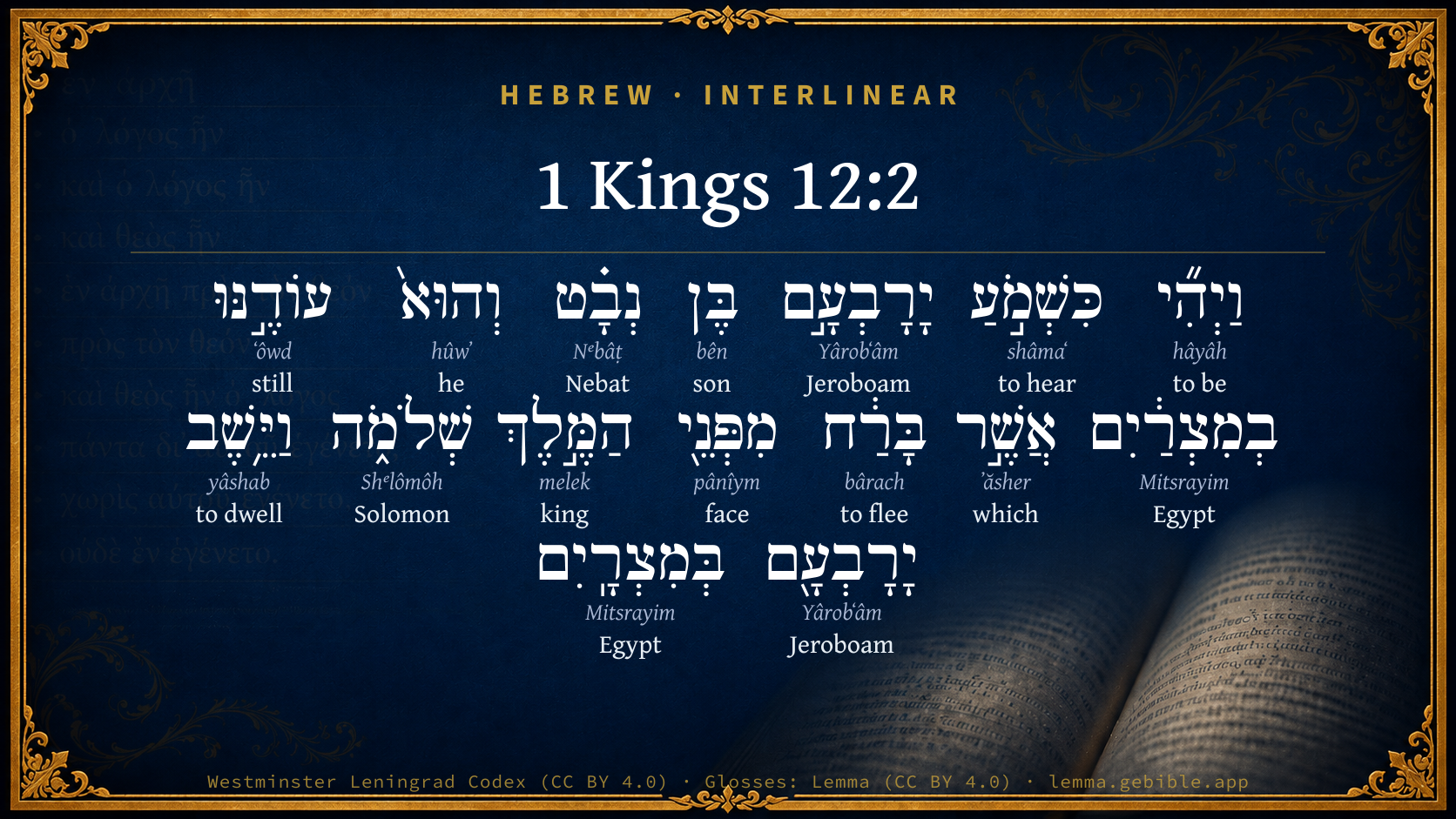
1 Kings 12:2

Hebrew (Westminster Leningrad Codex) 1 Kings 12:2 appears in the Hebrew Old Testament. The text above is from the Westminster Leningrad Codex. Each word links to its Strong’s number, a concise gloss, and parsing drawn from the Open Scriptures Hebrew Bible morphology. Click any word for its full Brown-Driver-Briggs (BDB) entry.
Download image
Cite this verse

1 Kings 12:2 (World English Bible). Public Domain. Lemma interlinear Bible study tool, https://lemma.gebible.app/v/1-kings/12/2.

Show BibTeX & RIS
BibTeX
RIS
English Translation
It happened, when Jeroboam the son of Nebat heard of it (for he was yet in Egypt, where he had fled from the presence of king Solomon, and Jeroboam lived in Egypt,
World English Bible · Public Domain
Download a study sheet

One document with this verse’s original text, its word-by-word gloss line, the meaning frame, cross-references with their text, attributed commentary, and full source and license credits — printable, and it pastes into notes with its structure intact.

This verse Autodidact and up

Study sheet (.html) Plain text (.txt)

A passage Seminary Student

Up to 50 verses in one chapter. A passage sheet keeps up to 6 commentary sources and 12 cross-references per verse, in the order this page ranks them, and says so on the sheet whenever that leaves anything out. Ask for a single verse and you get the Autodidact verse sheet above.

Everything on this page stays free to read, with no account — the sheet is a download of what is already on screen, not access to it.

Want to remove ads? Support Godless Engineer
Compare translations 3

The same verse in 3 English versions, stacked beneath the original-language interlinear above. Click any original word for its lexicon entry.

Each is an independent rendering of the whole verse — the interlinear is not word-aligned to these translations.

Highlighted words mark where these versions differ — a whole-verse word diff, not a word-by-word alignment.

  • World English Bible Public Domain
    It happened, when Jeroboam the son of Nebat heard of it (for he was yet in Egypt, where he had fled from the presence of king Solomon, and Jeroboam lived in Egypt,
  • King James Version Public Domain
    And it came to pass, when Jeroboam the son of Nebat, who was yet in Egypt, heard of it, (for he was fled from the presence of king Solomon, and Jeroboam dwelt in Egypt;)
  • unfoldingWord Literal Text CC BY-SA 4.0
    And it happened, when Jeroboam, the son of Nebat, heard (now he, he still in Egypt, where he had fled from the face of King Solomon, and Jeroboam dwelled in Egypt),

unfoldingWord Literal Text — © unfoldingWord, licensed CC BY-SA 4.0. Word-aligned USFM3 via Door43 (git.door43.org/unfoldingWord/en_ult).

Versions to compare (up to 4)

3 of 4 selected

Show all 18 translations

Every available English version of this verse, each an independent rendering of the whole verse.

  • World English Bible Public Domain
    It happened, when Jeroboam the son of Nebat heard of it (for he was yet in Egypt, where he had fled from the presence of king Solomon, and Jeroboam lived in Egypt,
  • Berean Standard Bible Public Domain
    When Jeroboam son of Nebat heard about this, he was still in Egypt where he had fled from King Solomon and had been living ever since.
  • Majority Standard Bible Public Domain
    When Jeroboam son of Nebat heard about this, he was still in Egypt where he had fled from King Solomon and had been living ever since.
  • King James Version Public Domain
    And it came to pass, when Jeroboam the son of Nebat, who was yet in Egypt, heard of it, (for he was fled from the presence of king Solomon, and Jeroboam dwelt in Egypt;)
  • American Standard Version (1901) Public Domain
    And it came to pass, when Jeroboam the son of Nebat heard of it (for he was yet in Egypt, whither he had fled from the presence of king Solomon, and Jeroboam dwelt in Egypt,
  • Revised Version (1885) Public Domain
    And it came to pass, when Jeroboam the son of Nebat heard of it, (for he was yet in Egypt, wither he had fled from the presence of king Solomon, and Jeroboam dwelt in Egypt,
  • Geneva Bible (1599) Public Domain
    And whe Ieroboam ye sonne of Nebat heard of it (who was yet in Egypt, whither Ieroboam had fled from king Salomon, and dwelt in Egypt)
  • Douay-Rheims (1899) Public Domain
    But Jeroboam the son of Nabat, who was yet in Egypt, a fugitive from the face of king Solomon, hearing of his death, returned out of Egypt.
  • Young's Literal Translation Public Domain
    And it cometh to pass, at Jeroboam son of Nebat's hearing (and he `is' yet in Egypt where he hath fled from the presence of Solomon the king, and Jeroboam dwelleth in Egypt),
  • Literal Standard Version CC BY-SA 4.0
    And it comes to pass, at Jeroboam son of Nebat’s hearing (and he [is] yet in Egypt where he has fled from the presence of Solomon the king, and Jeroboam dwells in Egypt),
  • Unlocked Literal Bible CC BY-SA 4.0
    It happened that Jeroboam son of Nebat heard of this (for he was still in Egypt, where he had fled from the presence of King Solomon), for Jeroboam had settled down in Egypt.
  • unfoldingWord Literal Text CC BY-SA 4.0
    And it happened, when Jeroboam, the son of Nebat, heard (now he, he still in Egypt, where he had fled from the face of King Solomon, and Jeroboam dwelled in Egypt),
  • Darby Bible Public Domain
    And it came to pass when Jeroboam the son of Nebat heard it (now he was yet in Egypt, whither he had fled from the presence of king Solomon, and Jeroboam dwelt in Egypt;
  • World Messianic Bible Public Domain
    When Jeroboam the son of Nebat heard of it (for he was yet in Egypt, where he had fled from the presence of King Solomon, and Jeroboam lived in Egypt;
  • Webster's Bible Public Domain
    And it came to pass, when Jeroboam the son of Nebat, who was yet in Egypt, heard of it, (for he had fled from the presence of king Solomon, and Jeroboam dwelt in Egypt;)
  • Free Bible Version CC BY-SA 4.0
    Jeroboam, son of Nebat, was still in Egypt when he heard about this. (He had run away to Egypt to escape from King Solomon and was living there.)
  • Bible in Basic English Public Domain
    And, hearing of it, Jeroboam, the son of Nebat, who was still in Egypt, where he had gone in flight from Solomon, and was living there, came back to his town Zeredah, in the hill-country of Ephraim;
  • JPS Tanakh (1917) Public Domain
    And it came to pass, when Jeroboam the son of Nebat heard of it — for he was yet in Egypt, whither he had fled from the presence of king Solomon, and Jeroboam dwelt in Egypt,

Literal Standard Version (2020), Covenant Press — licensed CC BY-SA 4.0. Text via the HelloAO Bible API (eBible.org). Unlocked Literal Bible (unfoldingWord) — licensed CC BY-SA 4.0. Text via the HelloAO Bible API (eBible.org). unfoldingWord Literal Text — © unfoldingWord, licensed CC BY-SA 4.0. Word-aligned USFM3 via Door43 (git.door43.org/unfoldingWord/en_ult). Free Bible Version, Dr. Jonathan Gallagher — licensed CC BY-SA 4.0. Text via the HelloAO Bible API (eBible.org).

Word by word

More ways to search: Search by grammar → Find every occurrence → Compare this word →

Practice this passage: Drill this verse → Learn its vocabulary →

נְבָ֗ט
Nᵉbâṭ
H5028
“Nebat”
Noun, Proper
Part of Speech
Noun
Type
Proper
Full BDB Definition

Origin: from H5027

TWOT: None

Nebat = "aspect" - an Ephraimite of Zereda, father of king Jeroboam I of the northern kingdom of Israel
  1. וַיְהִ֞י hâyâh H1961 “and · to be” Conjunction + Verb, Qal, Sequential Imperfect, 3rd Person, Masculine, Singular
  2. כִּשְׁמֹ֣עַ shâmaʻ H8085 “like/as · to hear” Preposition + Verb, Qal, Infinitive Construct
  3. יָרָבְעָ֣ם Yârobʻâm H3379 “Jeroboam” Noun, Proper
  4. בֶּן bên H1121 “son of” Noun, Common, Masculine, Singular, Construct
  5. וְהוּא֙ hûwʼ H1931 “and · he” Conjunction + Pronoun, Personal, 3rd Person, Masculine, Singular
  6. עוֹדֶ֣נּוּ ʻôwd H5750 “still · his” Adverb + Suffix, Personal, 3rd Person, Masculine, Singular
  7. בְמִצְרַ֔יִם Mitsrayim H4714 “in/at · Egypt” Preposition + Noun, Proper
  8. אֲשֶׁ֣ר ʼăsher H834 “which” Particle, Relative
  9. בָּרַ֔ח bârach H1272 “to flee” Verb, Qal, Perfect, 3rd Person, Masculine, Singular
  10. מִפְּנֵ֖י pânîym H6440 “from · face(s) of” Preposition + Noun, Common, Both, Plural, Construct
  11. הַמֶּ֣לֶךְ melek H4428 “the · king” Particle, Definite Article + Noun, Common, Masculine, Singular, Absolute
  12. שְׁלֹמֹ֑ה Shᵉlômôh H8010 “Solomon” Noun, Proper
  13. וַיֵּ֥שֶׁב yâshab H3427 “and · to dwell” Conjunction + Verb, Qal, Sequential Imperfect, 3rd Person, Masculine, Singular
  14. יָרָבְעָ֖ם Yârobʻâm H3379 “Jeroboam” Noun, Proper
  15. בְּמִצְרָֽיִם Mitsrayim H4714 “in/at · Egypt” Preposition + Noun, Proper

About this verse

These counts appear in no published source. They are computed here, from the morphology-tagged text and Lemma’s own curated glosses. What Lemma adds →

16
words
14
distinct lemmas
Historical
section

Notable vocabulary

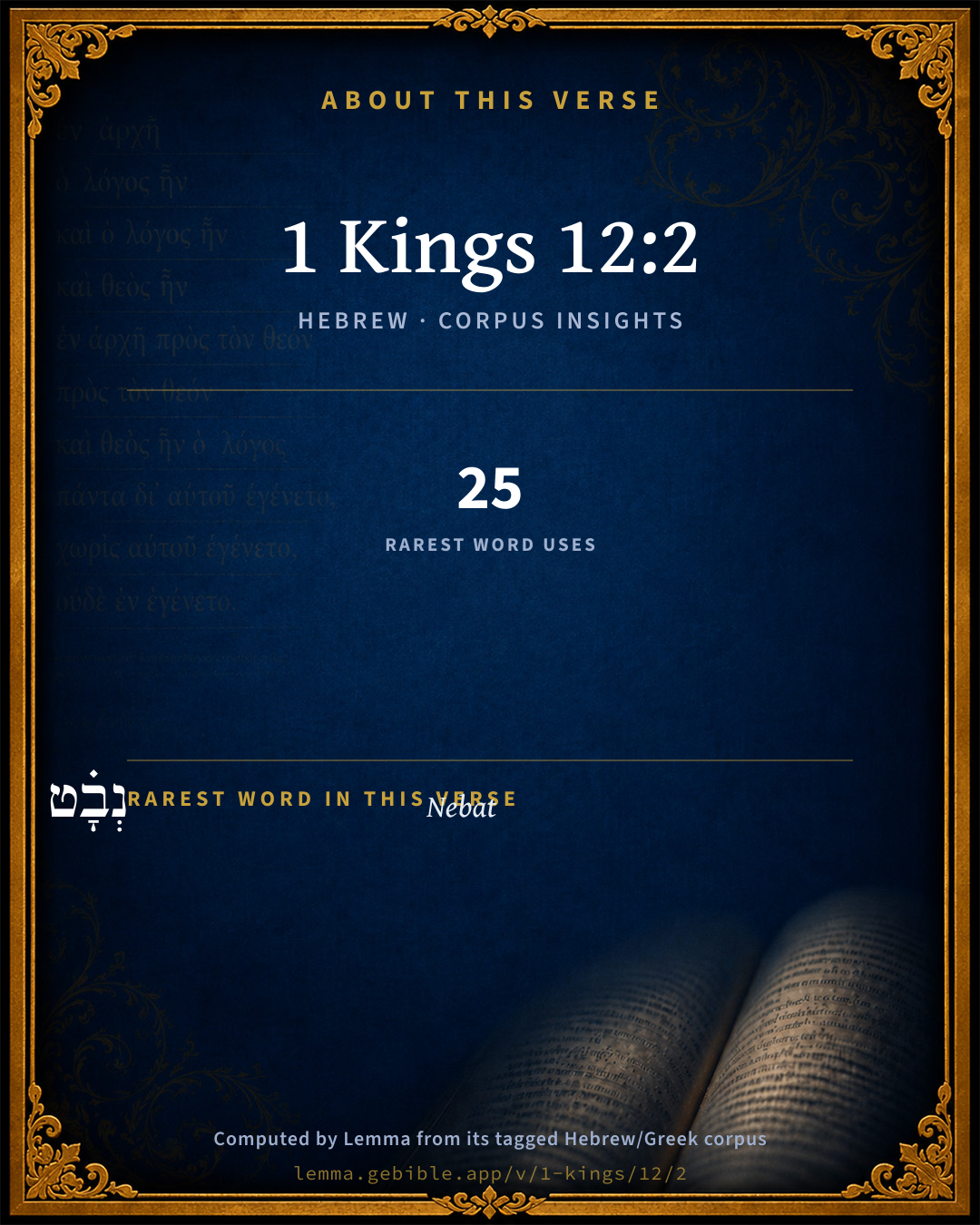
The rarest word here is נְבָ֗ט Nebat H5028 — appearing just 25 times in the whole Hebrew Bible.

Shared distinctive vocabulary

נְבָ֗ט Nebat H5028 occurs in 25 verses of the Hebrew Bible. Also found in:

Grammatical profile

  • 4 verbs
  • 9 nouns
  • 1 pronoun
  • 1 adverb
  • 1 particle

Verb forms

  • וַיְהִ֞י Qal · Sequential Imperfect
  • כִּשְׁמֹ֣עַ Qal · Infinitive Construct
  • בָּרַ֔ח Qal · Perfect
  • וַיֵּ֥שֶׁב Qal · Sequential Imperfect

Repetition

Words recur within this verse — often emphatic in Hebrew:

  • יָרָבְעָ֣ם Jeroboam H3379 ×2
  • בְמִצְרַ֔יִם Egypt H4714 ×2

Cross-references

3

Topical passages linked to 1 Kings 12:2 in the Treasury of Scripture Knowledge — connected by theme and wording, ordered by reader-vote popularity; previews shown in the World English Bible.

  • 1 Kings 11:40 Solomon sought therefore to kill Jeroboam; but Jeroboam arose, and fled into Egypt, to Shishak king of Egypt, and was in Egypt until the death of Solomon.
  • 1 Kings 11:26–31 Jeroboam the son of Nebat, an Ephraimite of Zeredah, a servant of Solomon, whose mother's name was Zeruah, a widow, he also lifted up his hand against the king.
  • 2 Chronicles 10:2–3 It happened, when Jeroboam the son of Nebat heard of it, (for he was in Egypt, where he had fled from the presence of king Solomon), that Jeroboam returned out of Egypt.

Cross-references courtesy of OpenBible.info (CC BY 4.0).

Hebrew and Greek witnesses Masoretic Hebrew ↔ Greek Septuagint

The same verse in the two great witnesses to the Old Testament, shown verse-for-verse.

These are two independent witnesses, not word-aligned to each other, and the Septuagint is shown in lemma (dictionary) form.

Hebrew 1 Kings 12:2 Masoretic · Westminster Leningrad Codex

וַיְהִ֞י כִּשְׁמֹ֣עַ יָרָבְעָ֣ם בֶּן נְבָ֗ט וְהוּא֙ עוֹדֶ֣נּוּ בְמִצְרַ֔יִם אֲשֶׁ֣ר בָּרַ֔ח מִפְּנֵ֖י הַמֶּ֣לֶךְ שְׁלֹמֹ֑ה וַיֵּ֥שֶׁב יָרָבְעָ֖ם בְּמִצְרָֽיִם

It happened, when Jeroboam the son of Nebat heard of it (for he was yet in Egypt, where he had fled from the presence of king Solomon, and Jeroboam lived in Egypt,

World English Bible · Public Domain

On this verse, Ellicott's Commentary for English Readers discusses the Septuagint’s reading. Read the note in Commentary ↓

Hebrew: Westminster Leningrad Codex (CC BY 4.0). Greek: Septuagint (public domain); English from a public-domain English Septuagint. How the Septuagint differs from the Hebrew →

Targum (Aramaic paraphrase)

1

The Targum is the ancient Jewish Aramaic paraphrase of the Hebrew Scriptures — an interpretive translation, not the Hebrew text itself. Onkelos (literal) and Pseudo-Jonathan (expansive) render the Torah, and Jonathan the Prophets. Coverage is partial: where no permissively-licensed English translation exists for a verse, only the Aramaic is shown. This is verse-level text, not a word-by-word alignment to the Hebrew.

  1. Targum Jonathan Prophets (Joshua–Malachi)
    וַהֲוָה כַּד שְׁמַע יָרָבְעָם בַּר נְבָט וְהוּא עַד כְּעַן בְּמִצְרַיִם דַעֲרַק מִן קֳדָם מַלְכָּא שְׁלֹמֹה וִיתֵב יָרָבְעָם בְּמִצְרָיִם:

    (no public-domain English translation for this verse)

    Targum Jonathan — Aramaic: “Mikraot Gedolot” (public domain). English: “Sefaria Community Translation” (CC0 1.0 (public-domain dedication)); “London "Chaldee Paraphrase," 1871” (public domain). Text via Sefaria.

Commentary

Notes on 1 Kings 12:2 from classic Christian and Jewish commentators (each source and its license shown beneath its notes). The classic Christian expositions comment on the surrounding passage and are grouped to its opening verse, so a note may address several verses; the Jewish commentaries on the Tanakh (Rashi and others) are per-verse, so they appear only where the commentator wrote on this verse.

Lemma curates 59 commentaries, every one of them public domain or Creative Commons licensed, each selected and text-cleaned for this edition rather than reprinted as found. About our sources →

Trapp's Complete Commentary

John Trapp

1Ki 12:2 And it came to pass, when Jeroboam the son of Nebat, who was yet in Egypt, heard [of it], (for he was fled from the presence of king Solomon, and Jeroboam dwelt in Egypt;)

Ver. 2. For he was fled,] viz., For safeguard of his life, as man is ζωον φιλοζωον, a life loving creature. See on 1Ki 11:40.

John Trapp, A Commentary or Exposition upon All the Books of the Old and New Testament (1647–1656) — public domain. Text from a community e-Sword module.

The Biblical Illustrator

Joseph S. Exell

1Ki_12:2-20

When Jeroboam, the son of Nebat, who was in Egypt heard of it . . . they sent and called him.

The kingdom divided

1. This chapter reveals one of the turning-points in Israels history, for it is as true in the history of Israel as in that of any other people that there are periods comparatively insignificant, and hours as well, that are full of great events.

2. It had seemed to be one of the chief purposes of God to make Israel a great nation. That is the promise made to Abram. The nation seems to have been essential to the carrying out of Gods purpose in giving a revelation and establishing His kingdom in the world. Truth does not gather momentum while it is propagated by an occasional teacher or prophet. Great institutions, educational, civil, and religious, such as can be developed only in a great nation, are necessary to make truth mighty, to give it power among the masses, and that volume which sets it moving over wide areas. The revelation, which had been sporadic in Israel throughout patriarchal times, now by means of the great civil and religious institutions of Israel as a nation--prophecy and the school of the prophets, the priesthood and the great religious festivals--gathers momentum and moves grandly on toward the fulfilment of the promise made to Abram.

3. But by this Scripture we are introduced to a condition of things that is startling. The very chosen instrument essential to the carrying out of Gods purpose to bless and save the world--the Israelitish nation--is threatened with destruction. There is something violent in the very tones of the cry, To your tents, O Israel. Where now is the nation through which God is to bless the world? Can His purpose be accomplished by these fragments?

4. A study of the actual course of history among these tribes would show that there were many natural causes leading to this division of the kingdom. Rehoboam was weak and wicked. He who will rule others must first learn to rule himself. The young men, probably sons of Solomons chief officers, who had been trained at the royal court and were designed to be the officers of the succeeding king, had inherited the bitter hostility that had long existed, especially between the tribes of Judah and Ephraim; thinking themselves strong under the new king, they were ready to advise and help to carry out rash measures. There was no lack of occasion for dissension on the side of Rehoboam. On the other hand there can be little doubt that the taxes exacted of Israel were oppressive. Ephraim had always been jealous of and restive under Judahs rule. To the house of Joseph--that is to Ephraim, with its adjacent tribes of Benjamin and Manasseh--had belonged all the chief rulers of Israel, down to the time of David: Joshua, the conqueror; Deborah, the prophetess; Gideon, the one regal spirit of the judges; Abimelech and Saul, the first kings; Samuel, the restorer of the people after the fall of Shiloh. It was natural with such an inheritance of glory that Ephraim always chafed under any rival supremacy. And when the Lord refused the tabernacle of Joseph, and chose not the tribe of Ephraim, but chose the tribe of Judah, the old jealousy was intensified and ready to burst forth on any pretext. Jeroboam had once lifted up his hand against King Solomon, and Solomon had attempted to kill him, and had driven him into Egypt. Weakness, wilfulness, and impetuosity on the part of the king and his advisers, all of which served to intensify an inherited jealousy of prerogative, were the influences at work on the one side. On the other a powerful people fired with a sense of injustice, with a powerful, ambitious, and unscrupulous leader--these certainly afforded causes for a disruption deep and irremediable.

5. But the prophet expressly tells us that this division is of God.

6. What was the real cause? The record makes it plain, and reveals at the same time God, the long suffering and the holy One. It was not that the king had fleeced them, as Samuel a century earlier had told them he would (1Sa_8:11-17). It was that they had rejected God, as God told Samuel they had, when they asked a king (1Sa_8:6-8).

What are the lessons to be learned?

1. God gives opportunities to individuals and to nations even though He knows that they will not improve them. Jeroboam was justified in taking possession of the Ten Tribes. It was part of the Divine plan. He had been so instructed. But Jeroboam departed from God, and he has gone down in the sacred history as the man that made Israel to sin. Rehoboam had his opportunity also both before and after the division of the kingdom. He wasted it wickedly. Whether we use or abuse our opportunities they come to us, and God with and in them all, to work out His righteous will through us if we will, and, if not, to abandon us and to find a way for His will and purposes through others.

2. We may learn also that, however essential an institution may seem to be for carrying forward the purposes of God, if it fail it is doomed. The Israelitish nation, in order to express the Divine will and be a revelation of Jehovah, must be conscious of its dependence on Him. But this Israel had lost. There is no trace of the confidence or of the sense of dependence that appears in the song of.Moses at the Red Sea. The spiritual hold on Jehovah has relaxed.

3. God works in the actual condition of things. It is a mistake to suppose that God must wait for either the ideal man or the ideal nation. The ambitious Jeroboam and the weak Rehoboam are alike His agents. The revelation which shapes the conditions under which the kingdom of God cannot flourish may be as important as that which shows the conditions of its prosperity. To your tents, O Israel: see to thine own house, David, is violent language. Jehovah will find other means for propagating and perpetuating His truth. The Arabian traditions relate that in the staff on which Solomon leaned, and which supported him long after his death, there was a worm which was secretly gnawing it asunder. The worm--idolatry--has done its work. (B. P. Raymond.)

The kingdom divided

God was in Israels history, but he is equally in all history. He guided Israel with a very special purpose, yet no more truly or constantly than He guides us. If from the study of this ancient record we learn to interpret our own lives and the lives of all men and all nations in the spirit in which the sacred historian wrote of Israel and Judah, we shall have learned its main lesson: God rules in this world of ours. He exalts one, casts down another, and makes the very wrath of man to praise Him.

1. Israels secession was from the Lord. From terrible, relentless, persistent tyranny, after due but vain remonstrance, subjects have a Divine right to free themselves by revolution. The powers that be are ordained of God, but no particular form of polity is so. Rulers exist for subjects, not subjects for rulers. The government of a nation at any time presumably deserves respect and support; but it may forfeit all claim to both by ceasing to fulfil its function as a blessing to the people.

2. Observe the pusillanimity of pride. Pride seems a source of strength: it is rather a source of weakness; it prevents one from acting according to his best light. Rehoboam must in his first calm moment have felt convinced of the superior wisdom of the course urged by the older counsellors. But the words of the younger men appealed to his pride and momentarily blinded him to their folly.

3. Consider how expensive such senseless pride may become. It cost Rehoboam far the best part of his dominions. Israel rather than Judah fills the chief place in the history of the next few centuries. Henceforth until the fall of Samaria Israel is ever upon the historians page. Judah occupying a subordinate place. The history of Israel is that of a nation--Judah consisted of but a single great and splendid city. Rehoboams pride was an expensive luxury--it cost him the richest jewels in his crown.

4. Mark the peril of disregarding the wisdom of age. Had Rehoboam consulted only his seniors, he would have taken the right course. This his pride forbade. Was he not king? Old men, fogies, the Bismarcks and the Gladstones, had carried on the State long enough. Like William of Germany, he would show what wonders fresh blood and brain could do. Besides, was he not getting all the light he could inquiring of all rather than of few? Many a youth has thus cheated himself into the belief that he was proceeding with great prudence, when in fact he merely wished an excuse for some darling folly.

5. Notice, that serving is the only way to win true fortunes. How numerous are the applications of this principle in the household in the workshop, in society, in government! If employers only treated their employees in this spirit, how it would assuage the friction between the two, to the advantage of both! If labourers always acted in this temper of love, what added strength it would assure to labouring mens organisations! How perfectly did the course of our Divine Lord and Saviour illustrate this! He came to win the world. How was it to be done? Had He been a mere man, He would never have sought to attain His end in the way He did. Instead of appearing as a grand monarch, ministered unto, courted, and flattered, He came as a servant, ministering ever unto others. Instead of being rich, He had not where to lay His head. Instead of courting the great and wise, He sought the poor and lowly. And He has in this world a Name which is above every name, at whose mention millions of hearts rise and millions of heads bow in loving adoration. (J. B. G. Pidge, D. D.)

Revolt of the Ten Tribes

The son of Solomon began his reign with a blunder, assuming that the throne was his by Divine right of succession and ignoring the ratification of the people. In this particular he is a good type of many young men at the present day, who think they see in the wealth and social position of their parents the claim to societys unquestioning homage to themselves. Real kinghood is personal. The true king, as Carlyle put it, is the canning--the man who can. The endorsement of a wealthy parent may carry a sons cheque; it will not carry him. Society recognises drafts on personal deposits only. Rehoboam fancied that the son of Solomon could pass to the throne unchallenged. Not so thought the proud and jealous Ephraimites; not so thought nine other tribes: and the young aspirants self-complacency was, rudely checked by the refusal of these tribes to come to Jerusalem and pay him homage, by their summoning him to Shechem, the tribe-centre of Ephraim, and by their meeting him there, not with submission, but with a bill of rights. This very check was an opportunity for Rehoboam to show whether he was made of true kingly stuff. The crisis which exposes a mans mistake often develops his wisdom, if he has any. The crisis proved him to be lacking in one of the prime qualifications of a king. He lived, as one has remarked, in a fools paradise, blind and deaf to what would have arrested the attention of a sensible ruler. At any rate, the emergency was one which he could not meet alone, and therefore he sought counsel. There are, however, different motives for asking advice. That a man consults with others does not disprove his self-conceit. Men often seek advice only to have their own opinion or their own course confirmed, and consequently choose their advisers from among their sympathisers; and a sympathiser is not, usually, the best adviser. Decency required that Rehoboam should advise with the old counsellors of his father, but he evidently did so merely for proprietys sake. In the first place, the old counsellors clearly discerned the issue in Rehoboams mind. It was between two ideals of sovereignty, the despotic and the paternal. Should sovereignty mean being served or serving? Evidently, as the result showed, Rehoboams ideal was the former. Christ rules more than Caesar because He put Himself at the worlds service. The worlds real rulers are invariably those who have served it. The worlds thought is that power absolves from obligation; Christs thought is that power emphasises obligation. One of the most impressive pictures of history is that of the young Edward the Black Prince of England, after the victory of Poitiers, serving the captive king of France at table and soothing the mortification of defeat with praises of his bravery and with kindly assurances; and the spirit of that scene is condensed into his favourite motto interwoven with the faded ostrich-plumes about his tomb at Canterbury, Hen mout; Ich dien: High spirit; I serve. Well says Dean Stanley, To unite in our lives the two qualities expressed in this motto--high spirit and reverent service--is to be indeed not only a true gentleman and a true soldier, but a true Christian also. Liberty is essentially a social principle, and every social principle imposes limitations on the individual. Love brings the two ideas of liberty and service into their true relation. Love uses its free choice to choose service, and so makes service the very highest expression of liberty. The young king could not appreciate this lofty ideal of sovereignty. He could not read in service any higher meaning than servility. This advice appealed to a packed jury. He wanted encouragement rather than counsel, and therefore, having satisfied the proprieties of the occasion, he turned to another and more congenial class of advisers, the young men that were grown up with him--young men as proud, as shallow and as hot-headed as himself. There is nothing uncommon in chat. It is a fact of our time no less than of Rehoboams--a fact that carries with it a strange inconsistency, for one does not always nor often reject what is ripe. Crudeness, in most eases, is a reproach. One wants ripe fruit on his table and seasoned timber for his house or his carriage. One does not trust a law student with the management of a fortune, nor put his childs life into the hands of yesterdays graduate in medicine. Youth seems to prefer the route through the shoals and rocks to that through the open sea to which ripened wisdom stands ready to direct it. Those shoals are strewn with wrecks. How few escape! The Bible, it is to be noticed, will not let the old past entirely lose its hold upon us. Enoch and Abraham and Moses appear as counsellors of the nineteenth century, which in so many respects is far in advance of them; and for the reason that they represent principles of life and character which are eternal. The consequences of Rehoboams decision are familiar. We are indeed told that the cause was from the Lord, and that the catastrophe came about in fulfilment of his promise to rend the kingdom from Solomons house; but it was in Rehoboams power to have escaped all responsibility for that terrible result. Gods decrees never relieve us of the duty of obedience. And this is a fair ground of appeal. The popular proverb is profoundly true: A man is known by the company he keeps. Only let us be sure and emphasise the last word, the company he keeps. We keep only what we like. The man is not truthfully indexed by the company in which he happens to be found at any particular time, not by the accidental contact of society, not by the circle into which he may have dropped in order to satisfy some conventional demand or to win some social prestige. That kind of company he does not keep; he only touches it. (M. R. Vincent, D. D.)

Revolt of the Ten Tribes

The fault of the prince lay not in consulting younger men--for they are often most favourable to progress--the error was in allowing his action, as a ruler, to be governed by private considerations. The young mans failing was a kingly one, but also a very common one. The great landowner cannot see the advantage of yielding his game-preserve to the uses of hard-worked tenants. The manufacturer does not frequently pay the sowing-women he employs more than the market price for their labour. Power and wealth men are as slow to give up as Pharaoh was the Israelite slaves.

I. An early illustration of an attempt to adjust difficulties by conference. Though the people might not have remained for a long period loyal to the house of David, they made an attempt to adjust the difficulties between them and their hereditary prince. They did not go into open rebellion. They asked that their rights and their complaints might be considered Kings who exercise despotic power, and their defenders, are wont to base their claims on the authority of the Bible. As Englishmen, we point with pride to the Barons at Runnymede as they demand the Great Charter from King John. This right of petition, exercised by Israelites and Englishmen, is not one that has always been conceded. Charles II. endeavoured to secure the passage of a bill limiting this right of his subjects so late as 1680. In early Bible times we find free speech, free petition, and methods of arbitration. This right of petition must be conceded before any adjustments can he made between sovereigns and their subjects, or between men and their fellows. We must be willing to hear mens causes and defence, before any result can be obtained that will be satisfactory. Before conference can begin, there must be this openness of discussion. There is one phase of this matter that is very practical. Do we not often condemn persons before giving them any opportunity to explain their action? We nurse fancied wrongs and bear ill-will toward those who ought to be dear to us. Have we ever told them of our grievances? Are we sure they are aware of fault or sin? We say too often, Let them find out for themselves. Thus friends are alienated and homes made unhappy. Christ emphasised the adjustments of wrongs between men as individuals. In the Old Testament, we have the same duty enforced by example and precept. We have, also, an illustration of a proper method of righting public wrongs. This lesson is for labourers and capitalists, for servants and masters, as well as for kinsfolk and friends.

II. The inevitable transfer of power from him who serveth not, to him who will, serve the interests of others. The power of the house of the beloved David must be diminished when his descendants no longer served the people. Jeroboam, the rival claimant for the throne, was a man of few good qualities, but he professed to be willing to serve the people. He certainly attempted to please them, though he finally degraded them, as is seen in the subsequent chapter. Even into the hands of demagogues, power will often pass, with Gods permission, from selfish and despotic princes. God calls the world to witness the humiliation of greatness that is supported by injustice. There is continually a redistribution of power and wealth that goes on in the world with the Divine sanction. Where men may gamble and become suddenly rich, they may as suddenly lose their wealth. A house or family founded on unrighteousness has in it the elements of its own destruction. Drink may ruin the son of the millionaire. His wealth goes to strangers. Often the transfer of power is sudden, and proud men in their own lifetime behold their sceptre wrenched by an unlineal hand, no son of theirs succeeding. Power that has not lifted the worlds burdens will pass.

III. Great revolutions may take place under Gods guidance without violence. We are told that this revolt was of the Lord. The people failed in their conference, but they succeeded in accomplishing a great change quietly. They had begun right to end well. Thenceforth the cause was in Gods hands. Prayer is one of the means by which great changes are accomplished silently. God is always on the side of the earnest prayer, and any good that results is from Him. The history of the revolutions wrought by prayer must remain unwritten till the great day of revelation. (Monday Club Sermons.)

Tribal causes of schism

The first cause of the schism to be noted, from the human point of view, was the deep cleft between the northern and southern tribes. It arose from geographical and economical differences, accentuated probably by longstanding tribal jealousies. From the days of Deborah, at latest, the cleft had been visible, and the unity which had been achieved, largely under the pressure of the Philistine wars, that crushed the loose organisation into a more compact whole for self-preservation, and held the kingdom together under Saul and David, would have been hard to keep up, even with skilful and beneficent kingship. Both America and England know how deep the gulf between North and South may be, and how hard it is to cast the encircling bond of a common nationality round them. England and Scotland are not perfectly fused together even now, and there are other broad lines of separation than the colour line on the other side of the Atlantic. (A. Maclaren, D. D.)

The Biblical Illustrator, edited by Joseph S. Exell (c. 1880s–1900s) — public domain. Text from a community e-Sword module.

Whedon's Commentary on the Bible

Daniel D. Whedon

2. When Jeroboam… heard — Heard that Solomon was dead, and that Rehoboam had begun to reign in Jerusalem.

For he was fled — The parenthesis which begins here should take in, according to Schmidt, De Wette, and others, the first sentences in the next verse, but this is unnecessary. The whole passage, (1Ki_12:2-3,) however, should be translated thus: When Jeroboam the son of Nebat heard, (now he was still in Egypt, whither he had fled from the face of Solomon the king, and Jeroboam was dwelling in Egypt,) then sent they and called him, and they came, Jeroboam and all the assembly of Israel, and spake to Reho-boam, saying. They had heard of Ahijah’s prophecy that Jeroboam should become their king, and they knew his ability and influence, and desired his counsel and guidance in this critical period of their history. All this indicates a deeply-laid plan and a well-matured purpose to throw off the yoke of the house of David.

Daniel D. Whedon (gen. ed.), Commentary on the Old and New Testaments (1874–1909) — public domain. Text from a community e-Sword module.

Geneva Bible (1599)

Geneva Bible translators

Or, return from Egypt.

Geneva Bible (1599) marginal notes — public domain. Text via Bolls.life.

Ellicott's Commentary for English Readers

(2) For he was fled.—In 2Ch_10:2, and in the LXX. version (or, rather versions, for there is variety of reading) of this passage, Jeroboam is made to return from Egypt, on hearing of the death of Solomon, to his own city, and to be “sent for” thence. This is obviously far more probable, and might be read in the Hebrew by a slight alteration of the text.

A Bible Commentary for English Readers, edited by Charles John Ellicott (1878–1897) — public domain. Text from a community e-Sword module.

The Cambridge Bible for Schools and Colleges

gen. ed. J. J. S. Perowne

2. And it came to pass] The LXX. (Vat.) having given the substance of this verse as an addition to 1Ki_11:43, omits it here. The R.V. makes the parenthesis commence a little earlier and extend a little farther than is shewn in A.V. The connexion thus becomes: And it came to pass when ‘Jeroboam … heard of it (for he was yet in Egypt whither he had fled … and they sent … him;) that Jeroboam’ &c.

heard of it] There must have been some interval between the death of Solomon and the gathering of the people at Shechem. The character and purpose of this meeting must also have been settled beforehand, so that news of what was intended could be carried to Jeroboam, and he, seeing events to be promising for his enterprise, could come back into Israel, and take the lead, as in the next verse he is said to have done, of those who petitioned the new king for reforms.

The Cambridge Bible for Schools and Colleges (gen. ed. J. J. S. Perowne; Cambridge University Press, 1878–1918) — public domain. Text from a community e-Sword module.

John Gill's Exposition

And it came to pass, when Jeroboam the son of Nebat, who was yet in Egypt, heard of it,.... Of the death of Solomon, and of the meeting of the Israelites at Shechem:

(for he was fled from the presence of King Solomon; see Kg1 11:40.

and Jeroboam dwelt in Egypt;) until the death of Solomon; some render the words, "Jeroboam, returned out of Egypt" (d), which agrees with Ch2 10:2, this he did on hearing the above news, and on being sent for by some of his friends, as follows.

(d) "reversus est de Aegypto", V. L. Ex Egypto, pro Vatablus.

John Gill's Exposition of the Whole Bible (1746–1763) — public domain (CC PDM 1.0). Text via the HelloAO Bible API.

Albert Barnes' Notes on the Bible

Heard of it - i. e., of the death of Solomon and accession of Rehoboam. This would be more clear without the division into chapters; which division, it must be remembered, is without authority.

Dwelt in Egypt - By a change of the pointing of one word, and of one letter in another, the Hebrew text here will read as in 2Ch 10:2, “returned out of Egypt; and they sent and called him.”

In the Septuagint Version the story of Jeroboam is told in two different ways. The general narrative agrees closely with the Hebrew text; but an insertion into the body of 1 Kings 12 - remarkable for its minuteness and circumstantiality - at once deranges the order of the events, and gives to the history in many respects a new aspect and coloring. This section of the Septuagint, though regarded by some as thoroughly authentic, absolutely conflicts with the Hebrew text in many important particulars. In its general outline it is wholly irreconcileable with the other narrative; and, if both stood on the same footing, and we were free to choose between them, there could be no question about preferring the history as given in our Version.

Albert Barnes' Notes on the Bible (1834–1885) — public domain. Text from a community e-Sword/MySword module.

Haydock's Catholic Bible Commentary

Hearing of. Hebrew, "It (the assembly) and Jeroboam dwelt in Egypt." (Haydock) --- But in 2 Paralipomenon x. 2., we find he returned. It is probable that both texts agreed in the days of St. Jerome; as the same letters, if read in a different manner, may have both meanings. (Calmet) --- Septuagint have also "returned." (Haydock)

George Leo Haydock (1774–1849), Haydock's Catholic Family Bible and Commentary, 1859 edition — public domain. Excludes Psalms (Douay-Rheims chapter numbering differs from Protestant) and Deuterocanonical books (Catholic canon only).

Matthew Poole's English Annotations

Heard of it; in the Hebrew it is only heard, and may relate either to Solomon’s death, or to the meeting which all the tribes had appointed at Shechem.

Matthew Poole's English Annotations on the Holy Bible (1683–1685) — public domain. Text from a community e-Sword/MySword module.

The Pulpit Commentary

And it came to pass, when Jeroboam the son of Nebat, (see 1Ki_11:26) who was yet in Egypt The usual, and indeed the necessary, interpretation, if we retain our present Hebrew text, is that these words refer, not as the context would lead us to suppose, to the time indicated in vers. 1, 3, etc., but to the time of Solomon"s death. But see below, heard of it The words "of it," though not in the original, are a fair and legitimate interpretation of its meaning. Whether they are retained or not, the natural and grammatical interpretation is that it was the visit to Shechem, just before mentioned, of which Jeroboam heard. But according to our received text, Jeroboam was one of the deputation which met king Rehoboam at Shechem. It has been found necessary, consequently, to understand the words of the death of Solomon, which has been related in 1Ki_11:43. So the Vulgate, Audita morte ejus. Similarly the LXX Cod. Vat. inserts the substance of this verse as part of 1Ki_11:43. (The Cod. Alex. follows the Hebrew.) But this interpretation is surely strained and unnatural (for he was fled from the presence of king Solomon, and Jeroboam dwelt in Egypt; ) The parallel passage in 2Ch 10. has here, "And Jeroboam returned from Egypt" (xmm ry b instead of xmb ry bvYew). And as some copies of the LXX have kaistreyen IJero boaptou and the Vulgate has Reversus est de Aegypto," Dathe, Bahr, al. would adopt this reading here. It is true it involves but a slight change, and it may simplify the construction. But no change is really required, Bahr"s objection, that in the text, as it stands, we have an unmeaning repetition, "He was still in Egypt and Jeroboam dwelt in Egypt," loses all its force if we understand Jeroboam to have continued his residence in Egypt (as the LXX says he did) after hearing of Solomon"s death. until summoned by the tribes to be their leader. In any case the repetition accords with Hebrew usage.

The Pulpit Commentary (1880–1919), ed. H.D.M. Spence-Jones & Joseph S. Exell — public domain. Text from a community e-Sword module.

Lesson kit

Teaching starters — assembled from the data on this page, not authored interpretation. Every prompt links to the verse data it draws on. Edit before teaching.

1 Kings, in the Historical, opens this verse with 16 words (14 distinct Hebrew lemmas). Its most distinctive word is Nᵉbâṭ (“Nebat”). A historical commentator’s framing appears above. Read the whole chapter for the surrounding context.

Discussion questions

  1. What does “Nebat” (Nᵉbâṭ) contribute to the verse as a whole?
  2. 1 Kings 11:26 shares the word «Nebat» with this verse. How do the two illuminate each other?
  3. “Jeroboam” occurs 2× in this one verse. What is the effect of the repetition?
  4. These translations render this verse differently; the difference is in the English rendering, not the original. What questions does that raise?
  5. The verb «וַיְהִ֞י» is Qal Sequential Imperfect. How does its form color the action?
  6. Reading how Trapp's Complete Commentary and The Biblical Illustrator read this verse, where do the two commentators agree and where do they part?

Things to notice

Reading settings

Reading text

Shown beneath each verse's original-language words.

Old Testament
Old Testament edition

Read the OT as the Masoretic Hebrew (MT) or the Greek Septuagint (LXX).

English shown for the Greek Septuagint (in the Hebrew ↔ Greek comparison).

Comparing translations? Open the Compare panel on any verse page to stack up to four side by side.