1 Kings 10:8

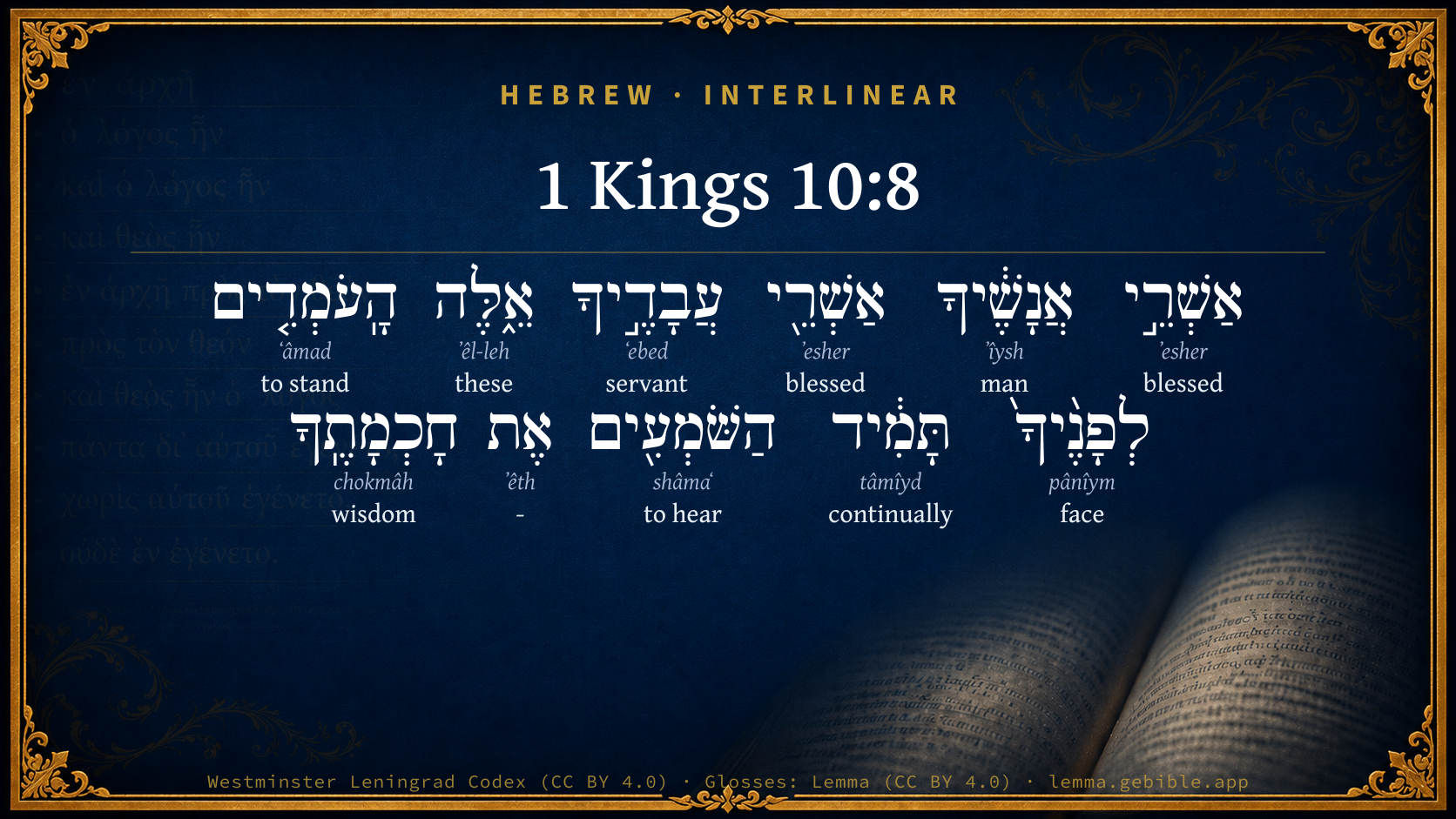
Hebrew (Westminster Leningrad Codex) 1 Kings 10:8 appears in the Hebrew Old Testament. The text above is from the Westminster Leningrad Codex. Each word links to its Strong’s number, a concise gloss, and parsing drawn from the Open Scriptures Hebrew Bible morphology. Click any word for its full Brown-Driver-Briggs (BDB) entry.
Download image
Cite this verse

1 Kings 10:8 (World English Bible). Public Domain. Lemma interlinear Bible study tool, https://lemma.gebible.app/v/1-kings/10/8.

Show BibTeX & RIS
BibTeX
RIS
English Translation
Happy are your men, happy are these your servants, who stand continually before you, [and] who hear your wisdom.
World English Bible · Public Domain
Download a study sheet

One document with this verse’s original text, its word-by-word gloss line, the meaning frame, cross-references with their text, attributed commentary, and full source and license credits — printable, and it pastes into notes with its structure intact.

This verse Autodidact and up

Study sheet (.html) Plain text (.txt)

A passage Seminary Student

Up to 50 verses in one chapter. A passage sheet keeps up to 6 commentary sources and 12 cross-references per verse, in the order this page ranks them, and says so on the sheet whenever that leaves anything out. Ask for a single verse and you get the Autodidact verse sheet above.

Everything on this page stays free to read, with no account — the sheet is a download of what is already on screen, not access to it.

Want to remove ads? Support Godless Engineer
Compare translations 3

The same verse in 3 English versions, stacked beneath the original-language interlinear above. Click any original word for its lexicon entry.

Each is an independent rendering of the whole verse — the interlinear is not word-aligned to these translations.

Highlighted words mark where these versions differ — a whole-verse word diff, not a word-by-word alignment.

  • World English Bible Public Domain
    Happy are your men, happy are these your servants, who stand continually before you, [and] who hear your wisdom.
  • King James Version Public Domain
    Happy are thy men, happy are these thy servants, which stand continually before thee, and that hear thy wisdom.
  • unfoldingWord Literal Text CC BY-SA 4.0
    The happiness of your men! The happiness of these servants of yours, the ones standing to your face continually, the ones hearing your wisdom!

unfoldingWord Literal Text — © unfoldingWord, licensed CC BY-SA 4.0. Word-aligned USFM3 via Door43 (git.door43.org/unfoldingWord/en_ult).

Versions to compare (up to 4)

3 of 4 selected

Show all 18 translations

Every available English version of this verse, each an independent rendering of the whole verse.

  • World English Bible Public Domain
    Happy are your men, happy are these your servants, who stand continually before you, [and] who hear your wisdom.
  • Berean Standard Bible Public Domain
    How blessed are your men! How blessed are these servants of yours who stand continually before you and hear your wisdom!
  • Majority Standard Bible Public Domain
    How blessed are your men! How blessed are these servants of yours who stand continually before you and hear your wisdom!
  • King James Version Public Domain
    Happy are thy men, happy are these thy servants, which stand continually before thee, and that hear thy wisdom.
  • American Standard Version (1901) Public Domain
    Happy are thy men, happy are these thy servants, that stand continually before thee, `and' that hear thy wisdom.
  • Revised Version (1885) Public Domain
    Happy are thy men, happy are these thy servants, which stand continually before thee, and that hear thy wisdom.
  • Geneva Bible (1599) Public Domain
    Happy are the men, happie are these thy seruants, which stande euer before thee, and heare thy wisedome.
  • Douay-Rheims (1899) Public Domain
    Blessed are thy men, and blessed are thy servants, who stand before thee always, and hear thy wisdom.
  • Young's Literal Translation Public Domain
    O the happiness of thy men, O the happiness of thy servants -- these -- who are standing before thee continually, who are hearing thy wisdom!
  • Literal Standard Version CC BY-SA 4.0
    O the blessedness of your men, O the blessedness of your servants—these—who are standing before you continually, who are hearing your wisdom!
  • Unlocked Literal Bible CC BY-SA 4.0
    How blessed are your wives, and how blessed are your servants who constantly stand before you, because they hear your wisdom.
  • unfoldingWord Literal Text CC BY-SA 4.0
    The happiness of your men! The happiness of these servants of yours, the ones standing to your face continually, the ones hearing your wisdom!
  • Darby Bible Public Domain
    Happy are thy men! happy are these thy servants, who stand continually before thee, who hear thy wisdom!
  • World Messianic Bible Public Domain
    Happy are your men, happy are these your servants who stand continually before you, who hear your wisdom.
  • Webster's Bible Public Domain
    Happy are thy men, happy are these thy servants, who stand continually before thee, and that hear thy wisdom.
  • Free Bible Version CC BY-SA 4.0
    How happy your people must be! How happy those who work for you, who stand here every day listening to your wisdom!
  • Bible in Basic English Public Domain
    Happy are your wives, happy are these your servants whose place is ever before you, hearing your words of wisdom.
  • JPS Tanakh (1917) Public Domain
    Happy are thy men, happy are these thy servants, that stand continually before thee, and that hear thy wisdom.

Literal Standard Version (2020), Covenant Press — licensed CC BY-SA 4.0. Text via the HelloAO Bible API (eBible.org). Unlocked Literal Bible (unfoldingWord) — licensed CC BY-SA 4.0. Text via the HelloAO Bible API (eBible.org). unfoldingWord Literal Text — © unfoldingWord, licensed CC BY-SA 4.0. Word-aligned USFM3 via Door43 (git.door43.org/unfoldingWord/en_ult). Free Bible Version, Dr. Jonathan Gallagher — licensed CC BY-SA 4.0. Text via the HelloAO Bible API (eBible.org).

Word by word

More ways to search: Search by grammar → Find every occurrence → Compare this word →

Practice this passage: Drill this verse → Learn its vocabulary →

אַשְׁרֵ֣י
ʼesher
H835
“blessed”
Noun, Common, Masculine, Plural, Absolute
Part of Speech
Noun
Type
Common
Gender
Masculine
Number
Plural
State
Absolute
Full BDB Definition

Origin: from H833

TWOT: 183a

happiness, blessedness - often used as interjection - blessed are
  1. אֲנָשֶׁ֔יךָ ʼîysh H376 “men · your” Noun, Common, Masculine, Plural, Construct + Suffix, Personal, 2nd Person, Masculine, Singular
  2. אַשְׁרֵ֖י ʼesher H835 “blessed” Noun, Common, Masculine, Plural, Absolute
  3. עֲבָדֶ֣יךָ ʻebed H5650 “servants · your” Noun, Common, Masculine, Plural, Construct + Suffix, Personal, 2nd Person, Masculine, Singular
  4. אֵ֑לֶּה ʼêl-leh H428 “these” Pronoun, Demonstrative, Common, Plural
  5. הָֽעֹמְדִ֤ים ʻâmad H5975 “the · standing” Particle, Definite Article + Verb, Qal, Participle Active, Masculine, Plural, Absolute
  6. לְפָנֶ֨יךָ֙ pânîym H6440 “to/for · face(s) · your” Preposition + Noun, Common, Both, Plural, Construct + Suffix, Personal, 2nd Person, Masculine, Singular
  7. תָּמִ֔יד tâmîyd H8548 “continually” Noun, Common, Masculine, Singular, Absolute
  8. הַשֹּׁמְעִ֖ים shâmaʻ H8085 “the · hearing” Particle, Definite Article + Verb, Qal, Participle Active, Masculine, Plural, Absolute
  9. אֶת ʼêth H853 “-” Particle, Direct Object
  10. חָכְמָתֶֽךָ chokmâh H2451 “wisdom · your” Noun, Common, Feminine, Singular, Construct + Suffix, Personal, 2nd Person, Masculine, Singular

About this verse

These counts appear in no published source. They are computed here, from the morphology-tagged text and Lemma’s own curated glosses. What Lemma adds →

11
words
10
distinct lemmas
Historical
section

Shared distinctive vocabulary

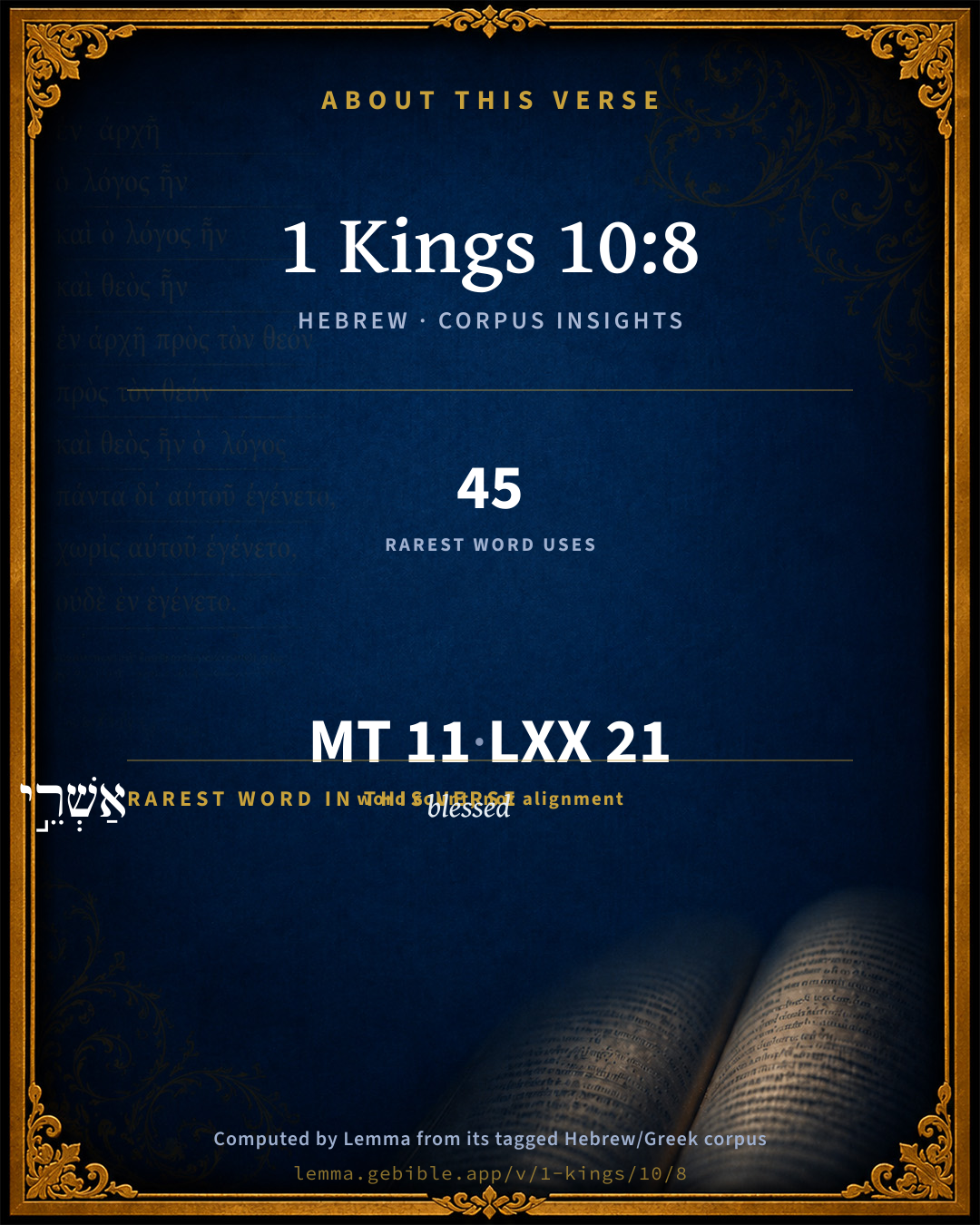
אַשְׁרֵ֣י blessed H835 occurs in 42 verses of the Hebrew Bible. Also found in:

Grammatical profile

  • 2 verbs
  • 7 nouns
  • 1 pronoun
  • 1 particle

Verb forms

  • הָֽעֹמְדִ֤ים Qal · Participle Active
  • הַשֹּׁמְעִ֖ים Qal · Participle Active

Repetition

A word recurs within this verse — often emphatic in Hebrew:

  • אַשְׁרֵ֣י blessed H835 ×2

Hebrew & Septuagint length

In English translation the verse runs 19 words from the Hebrew and 19 from the Septuagint (LXX English) — the same length.

A rough comparison of the two English renderings, which tokenize alike — not a word-level alignment.

Word counts can differ between the Hebrew and the Greek without any difference in meaning — e.g. the Hebrew direct-object marker אֵת has no separate Greek word, and Greek often adds the article ὁ.

In the original languages it is 11 Hebrew tokens and 21 Greek tokens — but the two are counted differently (Hebrew bundles its prefixes and suffixes into one token; the Greek is in lemma form), so that isn’t a like-for-like length.

Cross-references

8

Topical passages linked to 1 Kings 10:8 in the Treasury of Scripture Knowledge — connected by theme and wording, ordered by reader-vote popularity; previews shown in the World English Bible.

  • Proverbs 8:34 Blessed is the man who hears me, Watching daily at my gates, Waiting at my door posts.
  • Proverbs 10:21 The lips of the righteous feed many, But the foolish die for lack of understanding.
  • Luke 11:31 The Queen of the South will rise up in the judgment with the men of this generation, and will condemn them: for she came from the ends of the earth to hear the wisdom of Solomon; and behold, one greater than Solomon is here.
  • 2 Chronicles 9:7–8 Happy are your men, and happy are these your servants, who stand continually before you, and hear your wisdom.
  • Proverbs 3:13–14 Happy is the man who finds wisdom, The man who gets understanding.
  • Proverbs 13:20 One who walks with wise men grows wise, But a companion of fools suffers harm.
  • Luke 10:39–42 She had a sister called Mary, who also sat at Jesus' feet, and heard his word.
  • Luke 11:28 But he said, "On the contrary, blessed are those who hear the word of God, and keep it."

Cross-references courtesy of OpenBible.info (CC BY 4.0).

Hebrew and Greek witnesses Masoretic Hebrew ↔ Greek Septuagint

The same verse in the two great witnesses to the Old Testament, shown verse-for-verse.

These are two independent witnesses, not word-aligned to each other, and the Septuagint is shown in lemma (dictionary) form.

Hebrew 1 Kings 10:8 Masoretic · Westminster Leningrad Codex

אַשְׁרֵ֣י אֲנָשֶׁ֔יךָ אַשְׁרֵ֖י עֲבָדֶ֣יךָ אֵ֑לֶּה הָֽעֹמְדִ֤ים לְפָנֶ֨יךָ֙ תָּמִ֔יד הַשֹּׁמְעִ֖ים אֶת חָכְמָתֶֽךָ

Happy are your men, happy are these your servants, who stand continually before you, [and] who hear your wisdom.

World English Bible · Public Domain

Greek LXX 1 Kings 10:8 Septuagint · lemma form

μακάριος ὁ γυνή σύ μακάριος ὁ παῖς σύ οὗτος ὁ παραἵστημι ἐνώπιον σύ διά ὅλος ὁ ἀκούω πᾶς ὁ φρόνησις σύ

Blessed are your wives, blessed are these your servants who stand before you continually, who hear all your wisdom.

LXX2012 (modern English Septuagint) · Public Domain

On this verse, The Cambridge Bible for Schools and Colleges discusses the Septuagint’s reading. Read the note in Commentary ↓

Hebrew: Westminster Leningrad Codex (CC BY 4.0). Greek: Septuagint (public domain); English from LXX2012 (modern English Septuagint) (Public Domain). How the Septuagint differs from the Hebrew →

Targum (Aramaic paraphrase)

1

The Targum is the ancient Jewish Aramaic paraphrase of the Hebrew Scriptures — an interpretive translation, not the Hebrew text itself. Onkelos (literal) and Pseudo-Jonathan (expansive) render the Torah, and Jonathan the Prophets. Coverage is partial: where no permissively-licensed English translation exists for a verse, only the Aramaic is shown. This is verse-level text, not a word-by-word alignment to the Hebrew.

  1. Targum Jonathan Prophets (Joshua–Malachi)
    טוּבֵי גַבְרָךְ טוּבֵי עַבְדָךְ אִלֵין דְקַיְמִין קֳדָמָךְ תְּדִירָא דְשָׁמְעִין יַת חוּכְמָתָךְ:

    (no public-domain English translation for this verse)

    Targum Jonathan — Aramaic: “Mikraot Gedolot” (public domain). English: “Sefaria Community Translation” (CC0 1.0 (public-domain dedication)); “London "Chaldee Paraphrase," 1871” (public domain). Text via Sefaria.

Commentary

Notes on 1 Kings 10:8 from classic Christian and Jewish commentators (each source and its license shown beneath its notes). The classic Christian expositions comment on the surrounding passage and are grouped to its opening verse, so a note may address several verses; the Jewish commentaries on the Tanakh (Rashi and others) are per-verse, so they appear only where the commentator wrote on this verse.

Lemma curates 59 commentaries, every one of them public domain or Creative Commons licensed, each selected and text-cleaned for this edition rather than reprinted as found. About our sources →

Trapp's Complete Commentary

John Trapp

1Ki 10:8 Happy [are] thy men, happy [are] these thy servants, which stand continually before thee, [and] that hear thy wisdom.

Ver. 8. Happy are thy men.] How happy then are those heavenly courtiers that continually see Christ’s face, hear his voice, &c. Sulla called himself happy, because victorious. Henry I of France took unto himself the title of Tres-heureuse Roy, the thrice happy king; but was soon after confuted, as coming to an untimely end. The happiness of those in heaven, as it is unutterable, so it is unalterable.

John Trapp, A Commentary or Exposition upon All the Books of the Old and New Testament (1647–1656) — public domain. Text from a community e-Sword module.

Geneva Bible (1599)

Geneva Bible translators

But much more happy are they, which hear the wisdom of God revealed in his word.

Geneva Bible (1599) marginal notes — public domain. Text via Bolls.life.

Adam Clarke's Commentary

Verse 8. Happy are thy men] All these are very natural expressions from a person in her state of mind.

Adam Clarke's Commentary on the Bible (1810–1826) — public domain. Text from a community e-Sword/MySword module.

The Cambridge Bible for Schools and Colleges

gen. ed. J. J. S. Perowne

8. Happy are thy men] The LXX. reads here μακάριαι αἱ γυναῖκές σου, having read נשׁיך ‘thy wives’ instead of אנשׁיך ‘thy men.’ The Syriac and Arabic versions have the same variation.

The Cambridge Bible for Schools and Colleges (gen. ed. J. J. S. Perowne; Cambridge University Press, 1878–1918) — public domain. Text from a community e-Sword module.

John Gill's Exposition

Happy are thy men,.... The men of Israel, that had a king over them so wise, so great, so good:

happy are these thy servants, which stand continually before thee, and hear thy wisdom; who were now present, and to whom she pointed, and may respect not his nobles and courtiers only, but his menial servants, who had an opportunity of often hearing the wise sayings which dropped from his lips; and which no doubt were means of greatly improving their knowledge and understanding in things natural and divine.

John Gill's Exposition of the Whole Bible (1746–1763) — public domain (CC PDM 1.0). Text via the HelloAO Bible API.

The Pulpit Commentary

Howbeit, I believed not the words "Fame, as it is always a blab, so ofttimes a liar" (Bp. Hall) until I came, and mine eyes had seen it: and behold, the half was not told me; thy wisdom and prosperity exceeded the fame Heb. thou hast added wisdom and good to the report which I heard. Happy Heb. O the happiness, as in Psa_1:1 Psa_2:12 Psa_33:12, etc. are thy men LXX wives, gunaikev); happy are thy servants, which stand continually before thee , (see on 1Ki_1:2) and that hear thy wisdom.

The Pulpit Commentary (1880–1919), ed. H.D.M. Spence-Jones & Joseph S. Exell — public domain. Text from a community e-Sword module.

John Wesley's Explanatory Notes

Happy, &c. - With much more reason may we say this of Christ's servants: Blessed are they that dwell in thy house: they will be always praising thee.

John Wesley, Explanatory Notes Upon the Whole Bible (1754–1765) — public domain. Text via the GEBible commentary corpus.

unfoldingWord translationNotes

Door43 World Missions Community

who constantly stand before you

This is an idiom. AT: "who are always in your presence waiting to serve you" (See: Idiom)

May Yahweh your God be praised

This can be stated in active form. AT: "May people praise Yahweh your God" (See: Active or Passive)

who placed you on the throne of Israel

The throne is a metonym for the king who sits on it. AT: "who made you king of Israel" (See: Metonymy)

translationWords

bless

servant

Yahweh

God

praise

throne

Israel

love

eternity

just

righteous

unfoldingWord translationNotes — © Distant Shores Media and the Door43 World Missions Community, licensed CC BY-SA 4.0. Source: git.door43.org/Door43/en_tn.

Lesson kit

Teaching starters — assembled from the data on this page, not authored interpretation. Every prompt links to the verse data it draws on. Edit before teaching.

1 Kings, in the Historical, opens this verse with 11 words (10 distinct Hebrew lemmas). Its most distinctive word is ʼesher (“blessed”). A historical commentator’s framing appears above. Read the whole chapter for the surrounding context.

Discussion questions

  1. The word ʼesher carries the sense “blessed.” How does it shape the verse?
  2. Deuteronomy 33:29 shares the word «blessed» with this verse. How do the two illuminate each other?
  3. “blessed” occurs 2× in this one verse. What is the effect of the repetition?
  4. These translations render this verse differently. What is at stake in choosing one wording over another?
  5. The verb «הָֽעֹמְדִ֤ים» is Qal Participle Active. How does its form color the action?
  6. Reading how Trapp's Complete Commentary and Geneva Bible (1599) read this verse, where do the two commentators agree and where do they part?

Things to notice

Reading settings

Reading text

Shown beneath each verse's original-language words.

Old Testament
Old Testament edition

Read the OT as the Masoretic Hebrew (MT) or the Greek Septuagint (LXX).

English shown for the Greek Septuagint (in the Hebrew ↔ Greek comparison).

Comparing translations? Open the Compare panel on any verse page to stack up to four side by side.