
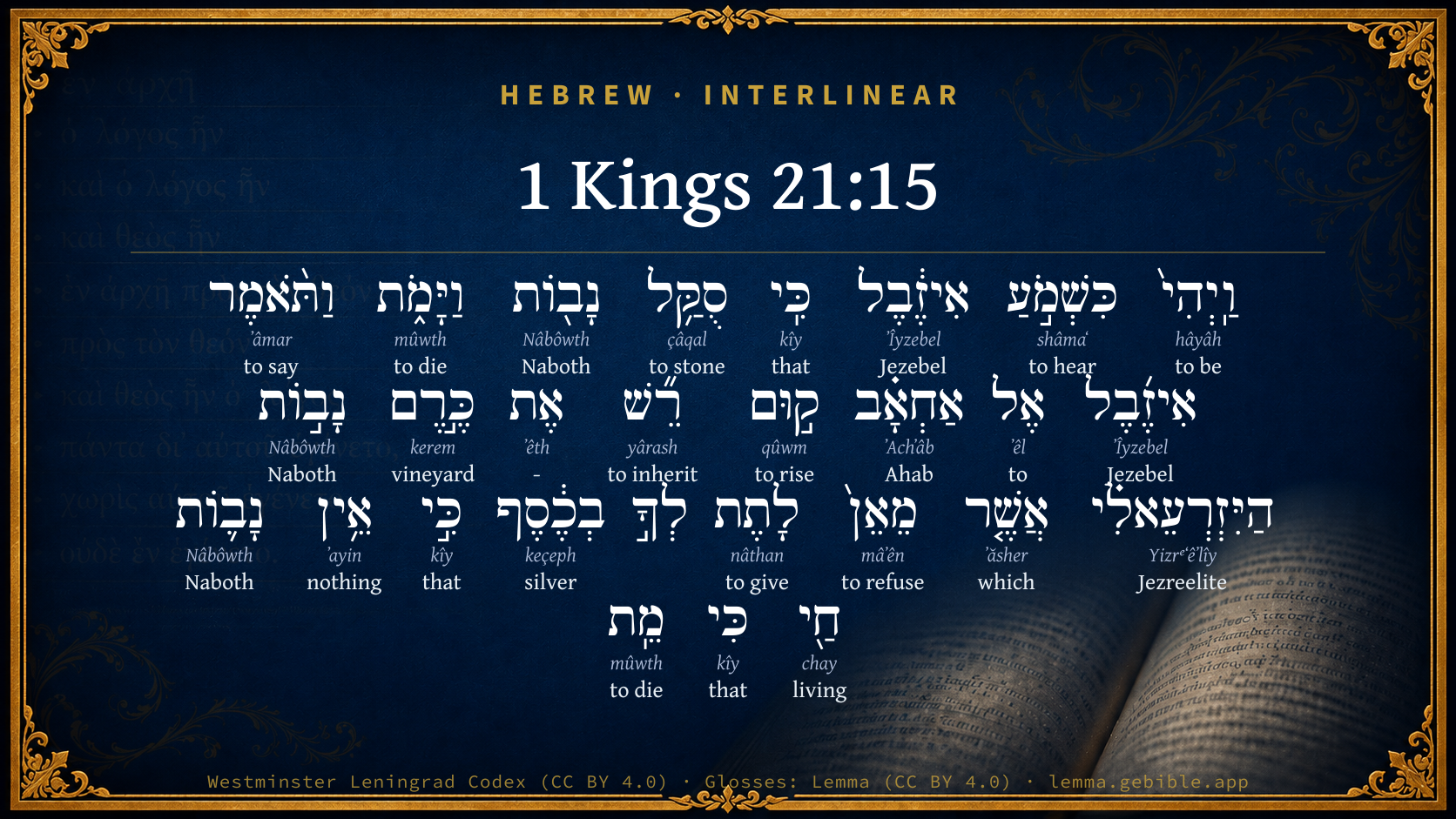
1 Kings 21:15

Hebrew (Westminster Leningrad Codex) 1 Kings 21:15 appears in the Hebrew Old Testament. The text above is from the Westminster Leningrad Codex. Each word links to its Strong’s number, a concise gloss, and parsing drawn from the Open Scriptures Hebrew Bible morphology. Click any word for its full Brown-Driver-Briggs (BDB) entry.
Download image
Cite this verse

1 Kings 21:15 (World English Bible). Public Domain. Lemma interlinear Bible study tool, https://lemma.gebible.app/v/1-kings/21/15.

Show BibTeX & RIS
BibTeX
RIS
English Translation
It happened, when Jezebel heard that Naboth was stoned, and was dead, that Jezebel said to Ahab, Arise, take possession of the vineyard of Naboth the Jezreelite, which he refused to give you for money; for Naboth is not alive, but dead.
World English Bible · Public Domain
Download a study sheet

One document with this verse’s original text, its word-by-word gloss line, the meaning frame, cross-references with their text, attributed commentary, and full source and license credits — printable, and it pastes into notes with its structure intact.

This verse Autodidact and up

Study sheet (.html) Plain text (.txt)

A passage Seminary Student

Up to 50 verses in one chapter. A passage sheet keeps up to 6 commentary sources and 12 cross-references per verse, in the order this page ranks them, and says so on the sheet whenever that leaves anything out. Ask for a single verse and you get the Autodidact verse sheet above.

Everything on this page stays free to read, with no account — the sheet is a download of what is already on screen, not access to it.

Want to remove ads? Support Godless Engineer
Compare translations 3

The same verse in 3 English versions, stacked beneath the original-language interlinear above. Click any original word for its lexicon entry.

Each is an independent rendering of the whole verse — the interlinear is not word-aligned to these translations.

Highlighted words mark where these versions differ — a whole-verse word diff, not a word-by-word alignment.

  • World English Bible Public Domain
    It happened, when Jezebel heard that Naboth was stoned, and was dead, that Jezebel said to Ahab, Arise, take possession of the vineyard of Naboth the Jezreelite, which he refused to give you for money; for Naboth is not alive, but dead.
  • King James Version Public Domain
    And it came to pass, when Jezebel heard that Naboth was stoned, and was dead, that Jezebel said to Ahab, Arise, take possession of the vineyard of Naboth the Jezreelite, which he refused to give thee for money: for Naboth is not alive, but dead.
  • unfoldingWord Literal Text CC BY-SA 4.0
    And it happened, when Jezebel heard that Naboth had been stoned and had died, that Jezebel said to Ahab, “Arise! Possess the vineyard of Naboth the Jezreelite that he refused to give to you for silver, for Naboth not alive, but he is dead!”

unfoldingWord Literal Text — © unfoldingWord, licensed CC BY-SA 4.0. Word-aligned USFM3 via Door43 (git.door43.org/unfoldingWord/en_ult).

Versions to compare (up to 4)

3 of 4 selected

Show all 18 translations

Every available English version of this verse, each an independent rendering of the whole verse.

  • World English Bible Public Domain
    It happened, when Jezebel heard that Naboth was stoned, and was dead, that Jezebel said to Ahab, Arise, take possession of the vineyard of Naboth the Jezreelite, which he refused to give you for money; for Naboth is not alive, but dead.
  • Berean Standard Bible Public Domain
    When Jezebel heard that Naboth had been stoned to death, she said to Ahab, “Get up and take possession of the vineyard of Naboth the Jezreelite, who refused to give it to you for silver. For Naboth is no longer alive, but dead.”
  • Majority Standard Bible Public Domain
    When Jezebel heard that Naboth had been stoned to death, she said to Ahab, “Get up and take possession of the vineyard of Naboth the Jezreelite, who refused to give it to you for silver. For Naboth is no longer alive, but dead.”
  • King James Version Public Domain
    And it came to pass, when Jezebel heard that Naboth was stoned, and was dead, that Jezebel said to Ahab, Arise, take possession of the vineyard of Naboth the Jezreelite, which he refused to give thee for money: for Naboth is not alive, but dead.
  • American Standard Version (1901) Public Domain
    And it came to pass, when Jezebel heard that Naboth was stoned, and was dead, that Jezebel said to Ahab, Arise, take possession of the vineyard of Naboth the Jezreelite, which he refused to give thee for money; for Naboth is not alive, but dead.
  • Revised Version (1885) Public Domain
    And it came to pass, when Jezebel heard that Naboth was stoned, and was dead, that Jezebel said to Ahab, Arise, take possession of the vineyard of Naboth the Jezreelite, which he refused to give thee for money: for Naboth is not alive, but dead.
  • Geneva Bible (1599) Public Domain
    And when Iezebel heard that Naboth was stoned and was dead, Iezebel sayd to Ahab, Vp, and take possession of the vineyarde of Naboth the Izreelite, which he refused to giue thee for money: for Naboth is not aliue, but is dead.
  • Douay-Rheims (1899) Public Domain
    And it came to pass when Jezabel heard that Naboth was stoned, and dead, that she said to Achab: Arise and take possession of the vineyard of Naboth the Jezrahelite, who would not agree with thee, and give it thee for money: for Naboth is not alive, but dead.
  • Young's Literal Translation Public Domain
    And it cometh to pass, at Jezebel's hearing that Naboth hath been stoned, and is dead, that Jezebel saith unto Ahab, `Rise, possess the vineyard of Naboth the Jezreelite, that he refused to give to thee for money, for Naboth is not alive but dead.'
  • Literal Standard Version CC BY-SA 4.0
    And it comes to pass, at Jezebel’s hearing that Naboth has been stoned, and is dead, that Jezebel says to Ahab, “Rise, possess the vineyard of Naboth the Jezreelite, that he refused to give to you for money, for Naboth is not alive but dead.”
  • Unlocked Literal Bible CC BY-SA 4.0
    So when Jezebel heard that Naboth had been stoned and was dead, she said to Ahab, “Get up and take possession of the vineyard of Naboth the Jezreelite, which he refused to give you for money, because Naboth is not alive, but dead.”
  • unfoldingWord Literal Text CC BY-SA 4.0
    And it happened, when Jezebel heard that Naboth had been stoned and had died, that Jezebel said to Ahab, “Arise! Possess the vineyard of Naboth the Jezreelite that he refused to give to you for silver, for Naboth not alive, but he is dead!”
  • Darby Bible Public Domain
    And it came to pass when Jezebel heard that Naboth was stoned and was dead, that Jezebel said to Ahab, Arise, take possession of the vineyard of Naboth the Jizreelite, which he refused to give thee for money; for Naboth is not alive, but dead.
  • World Messianic Bible Public Domain
    When Jezebel heard that Naboth had been stoned and was dead, Jezebel said to Ahab, “Arise, take possession of the vineyard of Naboth the Jezreelite, which he refused to give you for money; for Naboth is not alive, but dead.”
  • Webster's Bible Public Domain
    And it came to pass, when Jezebel heard that Naboth was stoned, and was dead, that Jezebel said to Ahab, Arise, take possession of the vineyard of Naboth the Jezreelite, which he refused to give thee for money: for Naboth is not alive, but dead.
  • Free Bible Version CC BY-SA 4.0
    As soon as Jezebel heard that Naboth had been stoned and he was dead, Jezebel told Ahab, “Get up, go and claim ownership of the vineyard of Naboth from Jezreel, which he refused to sell you, for Naboth is no longer alive, but dead.”
  • Bible in Basic English Public Domain
    Then Jezebel, hearing that Naboth had been stoned and was dead, said to Ahab, Get up and take as your heritage the vine-garden of Naboth the Jezreelite, which he would not give you for money, for Naboth is no longer living but is dead.
  • JPS Tanakh (1917) Public Domain
    And it came to pass, when Jezebel heard that Naboth was stoned, and was dead, that Jezebel said to Ahab: 'Arise, take possession of the vineyard of Naboth the Jezreelite, which he refused to give thee for money; for Naboth is not alive, but dead.'

Literal Standard Version (2020), Covenant Press — licensed CC BY-SA 4.0. Text via the HelloAO Bible API (eBible.org). Unlocked Literal Bible (unfoldingWord) — licensed CC BY-SA 4.0. Text via the HelloAO Bible API (eBible.org). unfoldingWord Literal Text — © unfoldingWord, licensed CC BY-SA 4.0. Word-aligned USFM3 via Door43 (git.door43.org/unfoldingWord/en_ult). Free Bible Version, Dr. Jonathan Gallagher — licensed CC BY-SA 4.0. Text via the HelloAO Bible API (eBible.org).

Word by word

More ways to search: Search by grammar → Find every occurrence → Compare this word →

Practice this passage: Drill this verse → Learn its vocabulary →

הַיִּזְרְעֵאלִ֗י
Yizrᵉʻêʼlîy
H3158
“the · Jezreelite”
Particle, Definite Article + Noun, Gentilic, Masculine, Singular, Absolute
Part of Speech
Particle + Noun
Type
Gentilic
Gender
Masculine
Number
Singular
State
Absolute
Full BDB Definition

Origin: patronymically from H3157

TWOT: None

Jezreelite = see Jezreel " sown of God" - an inhabitant of Jezreel
  1. וַֽיְהִי֙ hâyâh H1961 “and · to be” Conjunction + Verb, Qal, Sequential Imperfect, 3rd Person, Masculine, Singular
  2. כִּשְׁמֹ֣עַ shâmaʻ H8085 “like/as · to hear” Preposition + Verb, Qal, Infinitive Construct
  3. אִיזֶ֔בֶל ʼÎyzebel H348 “Jezebel” Noun, Proper
  4. כִּֽי kîy H3588 “that” Conjunction
  5. סֻקַּ֥ל çâqal H5619 “to stone” Verb, Pual, Perfect, 3rd Person, Masculine, Singular
  6. נָב֖וֹת Nâbôwth H5022 “Naboth” Noun, Proper
  7. וַיָּמֹ֑ת mûwth H4191 “and · to die” Conjunction + Verb, Qal, Sequential Imperfect, 3rd Person, Masculine, Singular
  8. וַתֹּ֨אמֶר ʼâmar H559 “and · to say” Conjunction + Verb, Qal, Sequential Imperfect, 3rd Person, Feminine, Singular
  9. אִיזֶ֜בֶל ʼÎyzebel H348 “Jezebel” Noun, Proper
  10. אֶל ʼêl H413 “to” Preposition
  11. אַחְאָ֗ב ʼAchʼâb H256 “Ahab” Noun, Proper
  12. ק֣וּם qûwm H6965 “rise” Verb, Qal, Imperative, 2nd Person, Masculine, Singular
  13. רֵ֞שׁ yârash H3423 “inherit” Verb, Qal, Imperative, 2nd Person, Masculine, Singular
  14. אֶת ʼêth H853 “-” Particle, Direct Object
  15. כֶּ֣רֶם kerem H3754 “vineyard of” Noun, Common, Both, Singular, Construct
  16. נָב֣וֹת Nâbôwth H5022 “Naboth” Noun, Proper
  17. אֲשֶׁ֤ר ʼăsher H834 “which” Particle, Relative
  18. מֵאֵן֙ mâʼên H3985 “to refuse” Verb, Piel, Perfect, 3rd Person, Masculine, Singular
  19. לָתֶת nâthan H5414 “to give” Preposition + Verb, Qal, Infinitive Construct
  20. בְכֶ֔סֶף keçeph H3701 “in/at · silver” Preposition + Noun, Common, Masculine, Singular, Absolute
  21. כִּ֣י kîy H3588 “that” Conjunction
  22. אֵ֥ין ʼayin H369 “nothing” Particle, Negative
  23. נָב֛וֹת Nâbôwth H5022 “Naboth” Noun, Proper
  24. חַ֖י chay H2416 “living” Adjective, Adjective, Masculine, Singular, Absolute
  25. כִּי kîy H3588 “that” Conjunction
  26. מֵֽת mûwth H4191 “to die” Verb, Qal, Perfect, 3rd Person, Masculine, Singular

About this verse

These counts appear in no published source. They are computed here, from the morphology-tagged text and Lemma’s own curated glosses. What Lemma adds →

28
words
21
distinct lemmas
Historical
section

Notable vocabulary

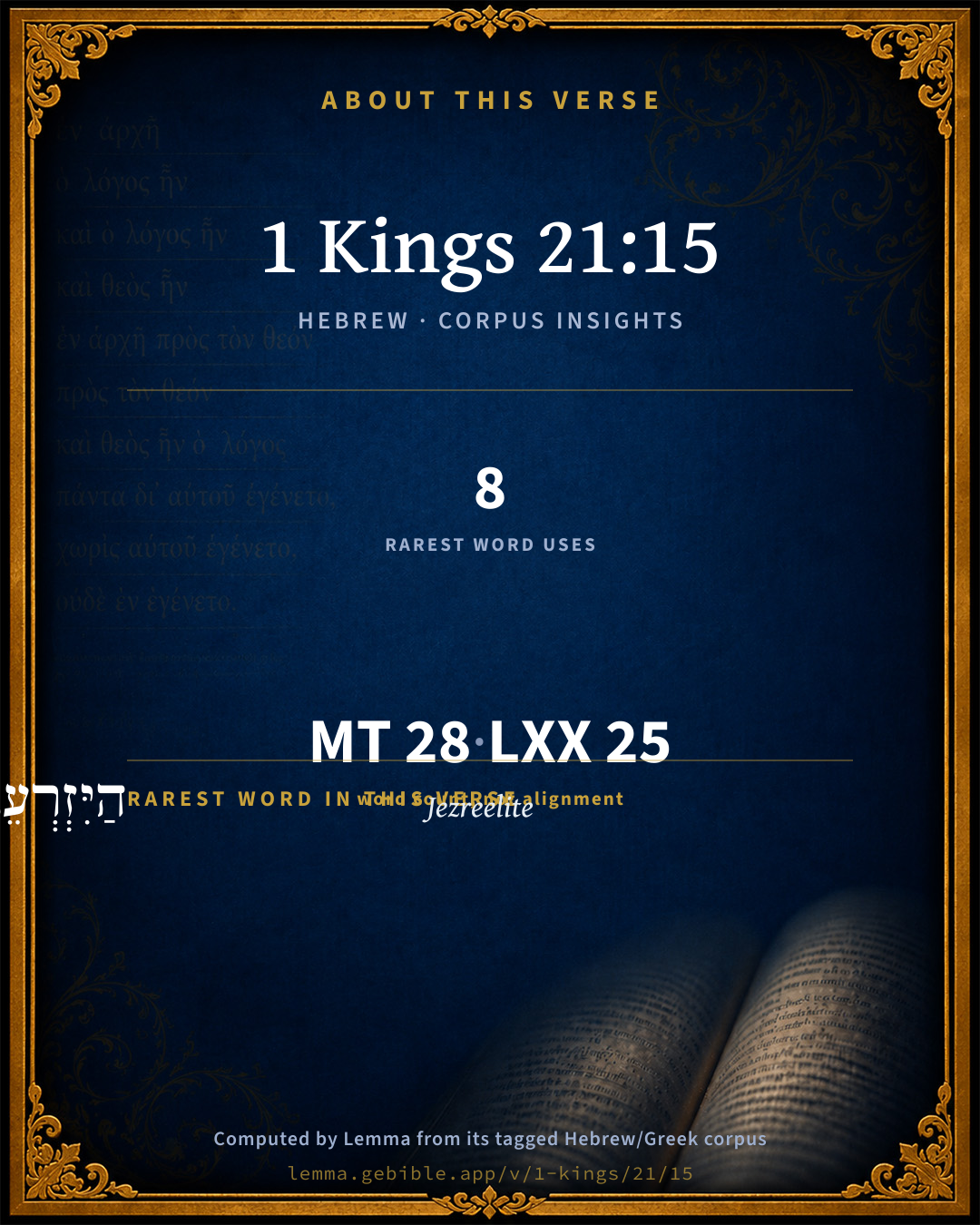
The rarest word here is הַיִּזְרְעֵאלִ֗י Jezreelite H3158 — appearing just 8 times in the whole Hebrew Bible.

Shared distinctive vocabulary

הַיִּזְרְעֵאלִ֗י Jezreelite H3158 occurs in 8 verses of the Hebrew Bible. Also found in:

Grammatical profile

  • 10 verbs
  • 9 nouns
  • 1 adjective
  • 2 prepositions
  • 3 conjunctions
  • 3 particles

Verb forms

  • וַֽיְהִי֙ Qal · Sequential Imperfect
  • כִּשְׁמֹ֣עַ Qal · Infinitive Construct
  • סֻקַּ֥ל Pual · Perfect
  • וַיָּמֹ֑ת Qal · Sequential Imperfect
  • וַתֹּ֨אמֶר Qal · Sequential Imperfect
  • ק֣וּם Qal · Imperative
  • רֵ֞שׁ Qal · Imperative
  • מֵאֵן֙ Piel · Perfect
  • לָתֶת Qal · Infinitive Construct
  • מֵֽת Qal · Perfect

Repetition

Words recur within this verse — often emphatic in Hebrew:

  • נָב֖וֹת Naboth H5022 ×3
  • אִיזֶ֔בֶל Jezebel H348 ×2
  • וַיָּמֹ֑ת to die H4191 ×2
  • כִּֽי that H3588 ×3

Hebrew & Septuagint length

In English translation the verse runs 42 words from the Hebrew and 32 from the Septuagint (LXX English) — closely comparable.

A rough comparison of the two English renderings, which tokenize alike — not a word-level alignment.

Word counts can differ between the Hebrew and the Greek without any difference in meaning — e.g. the Hebrew direct-object marker אֵת has no separate Greek word, and Greek often adds the article ὁ.

In the original languages it is 28 Hebrew tokens and 25 Greek tokens — but the two are counted differently (Hebrew bundles its prefixes and suffixes into one token; the Greek is in lemma form), so that isn’t a like-for-like length.

Cross-references

3

Topical passages linked to 1 Kings 21:15 in the Treasury of Scripture Knowledge — connected by theme and wording, ordered by reader-vote popularity; previews shown in the World English Bible.

  • 1 Kings 21:7 Jezebel his wife said to him, Do you now govern the kingdom of Israel? arise, and eat bread, and let your heart be merry: I will give you the vineyard of Naboth the Jezreelite.
  • Proverbs 1:10–16 My son, if sinners entice you, don't consent.
  • Proverbs 4:17 For they eat the bread of wickedness, And drink the wine of violence.

Cross-references courtesy of OpenBible.info (CC BY 4.0).

Hebrew and Greek witnesses Masoretic Hebrew ↔ Greek Septuagint

The same verse in the two great witnesses to the Old Testament, shown verse-for-verse.

These are two independent witnesses, not word-aligned to each other, and the Septuagint is shown in lemma (dictionary) form.

Hebrew 1 Kings 21:15 Masoretic · Westminster Leningrad Codex

וַֽיְהִי֙ כִּשְׁמֹ֣עַ אִיזֶ֔בֶל כִּֽי סֻקַּ֥ל נָב֖וֹת וַיָּמֹ֑ת וַתֹּ֨אמֶר אִיזֶ֜בֶל אֶל אַחְאָ֗ב ק֣וּם רֵ֞שׁ אֶת כֶּ֣רֶם נָב֣וֹת הַיִּזְרְעֵאלִ֗י אֲשֶׁ֤ר מֵאֵן֙ לָתֶת לְךָ֣ בְכֶ֔סֶף כִּ֣י אֵ֥ין נָב֛וֹת חַ֖י כִּי מֵֽת

It happened, when Jezebel heard that Naboth was stoned, and was dead, that Jezebel said to Ahab, Arise, take possession of the vineyard of Naboth the Jezreelite, which he refused to give you for money; for Naboth is not alive, but dead.

World English Bible · Public Domain

Greek LXX 1 Kings 21:15 Septuagint · lemma form

καί ἐπισκέπτομαι αχααβ ὁ παιδάριον ὁ ἄρχων ὁ χώρα καί γίγνομαι διακόσιοι καί τριάκοντα καί μετά οὗτος ἐπισκέπτομαι ὁ λαός πᾶς υἱός δύναμις ἑξήκοντα χιλιάς

And Achaab numbered the young men the heads of the districts, and they were two hundred and thirty: and afterwards he numbered the people, even every man fit for war, seven thousand.

LXX2012 (modern English Septuagint) · Public Domain

On this verse, The Cambridge Bible for Schools and Colleges discusses the Septuagint’s reading. Read the note in Commentary ↓

Hebrew: Westminster Leningrad Codex (CC BY 4.0). Greek: Septuagint (public domain); English from LXX2012 (modern English Septuagint) (Public Domain). How the Septuagint differs from the Hebrew →

Targum (Aramaic paraphrase)

1

The Targum is the ancient Jewish Aramaic paraphrase of the Hebrew Scriptures — an interpretive translation, not the Hebrew text itself. Onkelos (literal) and Pseudo-Jonathan (expansive) render the Torah, and Jonathan the Prophets. Coverage is partial: where no permissively-licensed English translation exists for a verse, only the Aramaic is shown. This is verse-level text, not a word-by-word alignment to the Hebrew.

  1. Targum Jonathan Prophets (Joshua–Malachi)
    וַהֲוָה כַּד שְׁמַעַת אִיזֶבֶל אֲרֵי אִתְרְגִים נְבוֹת וּמִית וַאֲמַרַת אִיזֶבֶל לְאַחְאָב קוּם אַחְסִין יַת כַּרְמָא דְנָבוֹת יִזְרְעֶאלָה דְלָא אֲבָא לְמִתַּן לָךְ בְּכַסְפָּא אֲרֵי לֵית נָבוֹת קַיָם אֱלָהֵין מִית:

    (no public-domain English translation for this verse)

    Targum Jonathan — Aramaic: “Mikraot Gedolot” (public domain). English: “Sefaria Community Translation” (CC0 1.0 (public-domain dedication)); “London "Chaldee Paraphrase," 1871” (public domain). Text via Sefaria.

Commentary

Notes on 1 Kings 21:15 from classic Christian and Jewish commentators (each source and its license shown beneath its notes). The classic Christian expositions comment on the surrounding passage and are grouped to its opening verse, so a note may address several verses; the Jewish commentaries on the Tanakh (Rashi and others) are per-verse, so they appear only where the commentator wrote on this verse.

Lemma curates 59 commentaries, every one of them public domain or Creative Commons licensed, each selected and text-cleaned for this edition rather than reprinted as found. About our sources →

Trapp's Complete Commentary

John Trapp

1Ki 21:15 And it came to pass, when Jezebel heard that Naboth was stoned, and was dead, that Jezebel said to Ahab, Arise, take possession of the vineyard of Naboth the Jezreelite, which he refused to give thee for money: for Naboth is not alive, but dead.

Ver. 15. For Naboth is not alive, but dead.] He and all his heirs are dead, and the vineyard doth confiscate to thee.

John Trapp, A Commentary or Exposition upon All the Books of the Old and New Testament (1647–1656) — public domain. Text from a community e-Sword module.

Geneva Bible (1599)

Geneva Bible translators

This example of monstrous cruelty the holy Ghost leaveth to us, to the intent that we should abhor all tyranny, and specially in them whom nature and kind should move to be pitiful and inclined to mercy.

Geneva Bible (1599) marginal notes — public domain. Text via Bolls.life.

Adam Clarke's Commentary

Verse 15. Arise, take possession] By what rites or in what forms this was done, we do not know.

Adam Clarke's Commentary on the Bible (1810–1826) — public domain. Text from a community e-Sword/MySword module.

Ellicott's Commentary for English Readers

(15) Take possession.—Naboth’s sons (see 2Ki_9:26) were murdered with him, so that there was none to claim the inheritance. Even had this not been so, the property of executed traitors would naturally fall to the king, although no enactment to this effect is found in the Law.

A Bible Commentary for English Readers, edited by Charles John Ellicott (1878–1897) — public domain. Text from a community e-Sword module.

The Cambridge Bible for Schools and Colleges

gen. ed. J. J. S. Perowne

15. that Naboth was stoned, and was dead] These words are omitted by the LXX. The repetition is alien to Greek style, but exactly after the fashion of Hebrew.

take possession of the vineyard] Some have thought that the king could do this, because it is supposed that the property of one so executed would become confiscated. Others have suggested that there was some relationship between Ahab and the family of Naboth. It seems unnecessary to seek for reasons in such a case. Where so much had been done unlawfully, and a life, or perhaps several, taken by false accusation, it would be a small matter to seize on the ground without any plea of law or kinship.

The Cambridge Bible for Schools and Colleges (gen. ed. J. J. S. Perowne; Cambridge University Press, 1878–1918) — public domain. Text from a community e-Sword module.

John Gill's Exposition

And thou shalt speak unto him, saying, thus saith the Lord, hast thou killed, and also taken possession?.... Killed in order to possess, and now taken possession upon the murder; some versions, as the Vulgate Latin and Arabic, read without an interrogation, "thou hast killed and hath taken possession", so Joseph Kimchi and Ben Melech; charging him with the murder of Naboth, and the unjust possession of his vineyard; the murder is ascribed to him, because his covetousness was the cause of it; and it was done by the contrivance of his wife; and it is highly probable Ahab knew more of it, and connived at it, and consented to it, than what is recorded, and however, by taking possession upon it, he abetted the fact:

and thou shalt speak unto him, saying, in the place where dogs licked the blood of Naboth shall dogs lick thy blood, even thine; which was fulfilled in his sons, who were his flesh and blood, Kg2 9:26, for the punishment was respited in his days, and transferred to his sons, see Kg1 21:29, though dogs did lick his blood, even his blood also, according to this prophecy, though not in the same place, see Kg1 22:38, wherefore some take these words not to be expressive of the place where, but of the cause or reason for which this should be done, and read the words, "inasmuch", or "because dogs have licked" (h), &c.

(h) "pro eo quod", Junius & Tremellius; "propierea quod", Grotius; so some in Vatablus.

John Gill's Exposition of the Whole Bible (1746–1763) — public domain (CC PDM 1.0). Text via the HelloAO Bible API.

Matthew Poole's English Annotations

Take possession of the vineyard of Naboth; either, first, By right of confiscation, to repair the injury which he did to the king by blaspheming him. Or, secondly, By tyrannical usurpation. Or, thirdly, By right of inheritance; for some say that Ahab was his next kinsman, his sons being dead; which they judge more likely, because his land was next to the king’s.

Matthew Poole's English Annotations on the Holy Bible (1683–1685) — public domain. Text from a community e-Sword/MySword module.

Whedon's Commentary on the Bible

Daniel D. Whedon

15. Take possession of the vineyard — As confiscated property.

Daniel D. Whedon (gen. ed.), Commentary on the Old and New Testaments (1874–1909) — public domain. Text from a community e-Sword module.

The Pulpit Commentary

And it came to pass, when Jezebel heard that Naboth was stoned, and was dead, that Jezebel said to Ahab, Arise, take possession or inherit, succeed to; same word Gen_21:10; Deu_2:24; Jer_49:1. The possessions of a person executed for treason were ipso facto forfeited to the crown. There was no law prescribing this, but it followed the principles of the Mosaic code. Just as the goods of the idolater were devoted as cherem to the Lord (Deu_13:16), so those of the traitor reverted to the king. So Keil of the vineyard of Naboth the Jezreelite, which he refused to give to thee for money there is a proud malicious triumph in these words. "He refused, simple fool, to sell it. Now thou canst have it for nothing. I have discovered a better plan than buying it": for Naboth is not alive, but dead.

Vers. 15-24.

Divine Inquisition.

Ahab lost no time in reaping the fruit of Jezebel"s wickedness. The next day, after the murder of Naboth and his family, we find him taking possession of the coveted vineyard. (see 2Ki_9:26) But in all this dark business there was an invisible Spectator, whose presence does not seem to have been sufficiently taken into the account,

I GOD IS AN OMNISCIENT OBSERVER.

1. He inspects all human actions.

(1) He was present in the palace looking upon the king of Israel as he sulked and sickened upon his bed. His eye also was full upon Jezebel as she proposed her ready cure for the monarch"s chagrin. "Thou God seest me .

(2) He was present in that court of justice when the honest Naboth was "set on high among the people." He witnessed the sons of Belial as they swore away the fives of a worthy family. He looked into the faces of the "nobles" and "eiders" of Jezreel who suborned these perjurers. "Thou God seest me.

(3) He was a spectator at the place of execution. He saw the steadiness of Naboth"s step, and noted well the bearing of his sons as they came forth to suffer for righteousness. And the swelling of every muscle of those who hurled the stones was measured by His piercing vision. "Thou God seest me.

2. He surveys all human motives.

(1) He clearly discerned the abominable hypocrisy of Jezebel"s "fast." It was proclaimed ostensibly to avert from the nation Divine judgments provoked by the alleged blasphemy or idolatry of Naboth. The vineyard of Naboth had more to do with it than his crime. It is "a new thing in the earth" to see Jezebel jealous for the honour of Jehovah!

(2) He knew why the sons of Belial publicly perjured themselves, and accurately estimated the price for which they sold the lives of honourable citizens. He also estimated the cowardly fear of Jezebel"s wrath, rather than encounter which the magistrates carried out her wicked instructions. "Nobles" and "elders" they were accounted by men; perjurers, murderers, and dastards they were accounted by God.

(3) He nicely weighed the motive which nerved the muscle of every man who lifted a stone against the life of Naboth. If any were misled by the hypocrisy of the authorities, and thought they "did God service" when they cast the stones, their sincerity was recognized; and those who were not deceived were also known.

3. Nothing is forgotten before Him.

(1) As He sees the end from the beginning so does He see the beginning from the end.

(2) Let us never forget that God never can forget. Every action of our lives is present with Him so every word so every thought and intent of the heart. Therefore

II GOD IS A SUPREME JUDGE.

1. He makes sin bitter to the sinner.

(1) The acquisition of the vineyard, the murders notwithstanding, was at first so pleasing to Ahab that it cured his sickness, and he "rose up to go down to the vineyard of Naboth the Jezreelite, to take possession of it." And this is often the first effect of the gratification of covetousness.

(2) But how transient is the unworthy satisfaction! It is soon succeeded by a season of reflection. The sudden apparition of Elijah upon the scene filled Ahab with alarm. His conscience now brought his guilt home, and before Elijah uttered a word, the king exclaimed, "Hast thou found me, O mine enemy?" This was the language of mingled hatred and fear. (see Gal_4:16) The presence of the good is a silent and effective rebuke to the wicked.

(3) The enormity of Ahab"s guilt was brought home to him by the questions, "Hast thou killed, and also taken possession?" He has killed, for by taking possession he sanctions the means by which his title is made out. (Job_31:39; Jer_22:18, Jer_22:14; Hab_2:12)

(4) God"s Holy Spirit still, by means of the word of prophecy, if not by the lips of living prophets, carries guilt to the consciences of sinners, and fills them with remorseful shame.

2. He conveys judgments in His providence. We read this principle in the denunciations uttered by Elijah.

(1) Upon Ahab. "In the place where dogs licked the blood of Naboth shall dogs lick thy blood, even thine." This was fulfilled. (see 1Ki_22:38) But how "in the place?" for Naboth suffered near Jezreel. Jezreel is, generally, called Samaria, being like Bethel, one of the "cities of Samaria". (1Ki_13:32) So in verse 16, the vineyard of Naboth is said to be in Samaria. The passage is more clearly thus translated: "And the word of Jehovah came to Elijah the Tishbite, saying, Arise, go down to meet Ahab the king of Israel, who is in Samaria; behold, at the vineyard of Naboth, whither he is gone down to take possession of it.

(2) Upon the family of Ahab (vers. 21, 22, 24). This was a reprisal for the family of Naboth sacrificed with him. (see 2Ki_9:26) All was to the letter accomplished (see 2Ki_9:10)

(3) Upon Jezebel. The "cursed woman" is signally execrated (ver. 23). The retribution was as signally accomplished. (see 2Ki_9:36)

(4) This law of retribution in the judgments of Providence is not limited to sacred history. Orestes recognized it when he said to Aegisthus

Go where thou slew"st my father, That in the selfsame place thou too may"st die.

It may be read in every full and accurate history.

3. He will finally judge the world.

(1) For Naboth and his family have yet to be vindicated. Providence has vindicated their reputation; but they have to be vindicated in person also. To this end all parties concerned in their murder will have to stand face to face, with their hearts exposed to the clear light and sensible presence of Omniscient Justice. What defence can the sons of Belial then set up? The magistrates? Jezebel? Ahab?

(2) What a day of vindications will that be to all the righteous! What a day of confusion to all the wicked! Everything will be righteously adjusted in that final sentence. J.A.M. (Mat_25:34, Mat_25:41, Mat_25:46)

Vers. 15-29.

Guilt and Mercy.

I To ENJOY THE FRUITS OF SIN IS TO TAKE ITS GUILT. "Hast thou killed?" etc. It is not said that Ahab knew of the plot. The plain inference is that he did not. Jezebel wrote to the elders, and to her the tidings were sent that the deed was done. But if Ahab did not know before, he knew after. Knowing how it had been procured he nevertheless received it, and heard as he stood there the word of the Lord: "Hast thou killed, and also taken possession?" There are men, for example, who could not pass their days in the vile drink traffic. They could not sleep at night for thought of the wives and mothers and children whose misery had pleaded in God"s sight against them and their work. The thought of the souls they had helped to lead down into the eternal darkness would terrify them. But they can pocket the gains of that very trade; they can receive the higher rent which their property secures because it is let to the sellers of drink, and live in quietness, and sit at the Lord"s table, and die in good esteem, and go forth to meet what? the same judgment as the publican! Your reputable merchant may not lie and cheat; but if the young men that serve behind his counters do so, and if he knowingly pockets the gains of such baseness, he is equally guilty in God"s sight. To take the fruit of falsehood and oppression and wrong is to stain our souls with their guilt. "Thus saith the Lord, In the place where dogs licked the blood of Naboth shall dogs lick thy blood, even thine." "Behold I will bring evil upon thee," etc. (vers. 2124).

II WHAT IT MEANS WHEN A MAN FINDS THE TRUTH HATEFUL. Ahab"s question, "Hast thou found me?" etc., was a self revelation. There were many to whom Elijah"s presence would have been like that of an angel of God; but to Ahab it is as the shadow of death. And the explanation was, "Because thou hast sold thyself to work evil in the sight of the Lord." It is only to death that the truth is a savour of death. He was sin"s bondman. For the gratification of evil desire he had sold himself to work Satan"s will, and now in his attitude to God"s servant he was owning Satan still as master. It is easy to listen with approval, and with pleasure even, when other men"s sins are dealt with; but when our own are touched when we are met with our feet standing in Naboth"s vineyard, what is our attitude toward the truth? Is it anger or submission? Whom do we own as master, Satan or God?

III THE RICHES OF GOD"S MERCY (vers. 25-29).

1. The greatness of Ahab"s sin. He had outstripped all who had gone before him, great as their sins had been; "but there was none like unto Ahab," etc.

2. The inadequacy of his repentance. It was no doubt sincere, but it did not go far enough. It was fear of judgment, not loathing of sin.

3. The fulness of the Divine compassion. Verses 25 and 26 might well have been a prelude to the record of full and speedy vengeance, and especially so in view of the unsatisfactory nature of his sorrow. But it is the introduction to the story of mercy. All that sin sin of deepest dye will not prevent God running forth to meet Ahab so soon as he begins to turn to Him. That sorrow, shallow though it was, God had marked and accepted. "Seest thou how Ahab?" etc. God is not a stern, relentless Judge. Father"s heart has never yearned over child as God"s over us. U.

The Pulpit Commentary (1880–1919), ed. H.D.M. Spence-Jones & Joseph S. Exell — public domain. Text from a community e-Sword module.

Kretzmann's Popular Commentary

Paul E. Kretzmann

The Prophecy of Ahab’s Doom

v. 15. And it came to pass, when Jezebel heard that Naboth was stoned and was dead, his sons having been forced to share his fate, 2Ki 9:26, that Jezebel said to Ahab, who had persisted in his stubborn, childish behavior, Arise, take possession of the vineyard of Naboth the Jezreelite which he refused to give thee for money; for Na-both is not alive, but dead.

v. 16. And it came to pass, when Ahab heard that Naboth was dead, that Ahab rose up to go down to the vineyard of Naboth the Jezreelite, to take possession of it. Although he had not personally conducted the case against Naboth, and probably did not know what means Jezebel actually employed to get possession of his vineyard, yet he was fully as guilty as she, for he had known that she had contrived to get Naboth out of the way, by fair means or foul.

v. 17. And the word of the Lord came to Elijah the Tishbite, who now appears on the scene once more, saying,

v. 18. Arise, go down, namely, from the mountain district in which he was then staying, to meet Ahab, king of Israel, which is in Samaria; behold, he is in the vineyard of Naboth, whither he is gone down to possess it.

v. 19. And thou shalt speak unto him, saying, Thus saith the Lord, Hast thou killed and also taken possession? The question was not put to cause a confession of guilt, but to accuse the king outright of murder and of robbery. He had probably tried to quiet his conscience with the excuse that the property of a blasphemer who had suffered the penalty of death was taken over by the crown. And thou shalt speak unto him, saying, Thus saith the Lord, In the place where dogs licked the blood of Naboth shall dogs lick thy blood, even thine. His was to be a similar disgraceful death, that of a criminal.

v. 20. And Ahab said to Elijah, Hast thou found me, O mine enemy? The implication was that Elijah was always endeavoring to oppose the king and to thwart his purposes. And he, with all the frank fearlessness of God’s messenger, answered, I have found thee, because thou hast sold thyself to work evil in the sight of the Lord. Ahab had so abandoned himself to wickedness that he had become its slave.

v. 21. Behold, I will bring evil upon thee, and will take away thy posterity, the sentence of doom upon the families of apostate kings, and will cut off from Ahab him that pisseth against the wall, and him that is shut up and left in Israel, all the male descendants of the king; even the minors were included in the curse. Cf 1Ki 14:10.

v. 22. And will make thine house like the house of Jeroboam, the son of Nebat, and like the house of Baasha, the son of Ahijah, whose families were eradicated by divine decree, 1Ki 15:29; 1Ki 16:3-11, for the provocation wherewith thou hast provoked Me to anger and made Israel to sin.

v. 23. And of Jezebel also spake the Lord, saying, The dogs shall eat Jezebel by the wall of Jezreel. Cf 2Ki 9:10-36.

v. 24. Him that dieth of Ahab in the city the dogs shall eat, and him that dieth in the field shall the fowls of the air eat; they would, by the Lord’s curse, he denied even an honorable burial.

v. 25. But there was none like unto Ahab, a note inserted by the historian, which did sell himself to work wickedness in the sight of the Lord, whom Jezebel, his wife, stirred up, their union being an unusually striking example of warning against the evil of mixed marriages.

v. 26. And he did very abominably in following idols, according to all things as did the Amorites, whom the Lord cast out before the children of Israel, the reference being to all the Canaanitish nations.

v. 27. And it came to pass, when Ahab heard those words, that he rent his clothes, and put sackcloth upon his flesh, and fasted, and lay In sackcloth, and went softly, all signs of deep mourning and penitence. For a while at least his sorrow was sincere.

v. 28. And the word of the Lord came to Elijah the Tishbite, saying,

v. 29. Seest thou how Ahab humbleth himself before Me? Because he humbleth himself before Me, I will not bring the evil in his days; but in his son’s days will I bring the evil upon his house. Thus the punishment was deferred, and the misdeeds of the father were borne by the children, who followed him in his evil ways. It is a terrible thing to despise and reject the goodness and the severity of God, for the end is bound to be death, everlasting destruction.

Paul E. Kretzmann, Popular Commentary of the Bible (1921–1924) — public domain. Text from a community e-Sword module.

unfoldingWord translationNotes

Door43 World Missions Community

that Naboth had been stoned and was dead

This can be stated in active form. AT: "that the people had stoned Naboth and he was dead" (See: Active or Passive)

Naboth is not alive, but dead.

These two phrases mean the same thing and emphasize Jezebel's statement. AT: "Naboth is dead!" (See: Doublet)

translationWords

Jezebel

Ahab

possess

vineyard

Jezreel

unfoldingWord translationNotes — © Distant Shores Media and the Door43 World Missions Community, licensed CC BY-SA 4.0. Source: git.door43.org/Door43/en_tn.

Rashi

Rabbi Shlomo Yitzchaki (Rashi)

Get up and take possession. Some of our Sages say that the property of those executed by the king [belong] to the king. And some of them say that he was the son of his father’s brother. He killed him and his children and was therefore the legal heir to inherit his property.

Rashi on the Tanakh — English translations: “The Judaica Press complete Tanach with Rashi, translated by A. J. Rosenberg” (CC BY 4.0); “Pentateuch with Rashi's commentary by M. Rosenbaum and A.M. Silbermann, 1929-1934” (public domain); “The Metsudah Tanach series, Lakewood, N.J” (CC BY 4.0); and “The Book of Joshua, Metsudah Publications, 1997” (CC BY 4.0). Text via Sefaria.

Lesson kit

Teaching starters — assembled from the data on this page, not authored interpretation. Every prompt links to the verse data it draws on. Edit before teaching.

1 Kings, in the Historical, opens this verse with 28 words (21 distinct Hebrew lemmas). Its most distinctive word is Yizrᵉʻêʼlîy (“Jezreelite”). A historical commentator’s framing appears above. Read the whole chapter for the surrounding context.

Discussion questions

  1. How does “Jezreelite” (Yizrᵉʻêʼlîy) shape what this verse is saying?
  2. 1 Kings 21:1 shares the word «Jezreelite» with this verse. How do the two illuminate each other?
  3. “Naboth” occurs 3× in this one verse. What is the effect of the repetition?
  4. These translations render this verse differently. What is at stake in choosing one wording over another?
  5. The verb «וַֽיְהִי֙» is Qal Sequential Imperfect. How does its form color the action?
  6. Reading how Trapp's Complete Commentary and Geneva Bible (1599) read this verse, where do the two commentators agree and where do they part?

Things to notice

Reading settings

Reading text

Shown beneath each verse's original-language words.

Old Testament
Old Testament edition

Read the OT as the Masoretic Hebrew (MT) or the Greek Septuagint (LXX).

English shown for the Greek Septuagint (in the Hebrew ↔ Greek comparison).

Comparing translations? Open the Compare panel on any verse page to stack up to four side by side.