
1 Kings 8:30

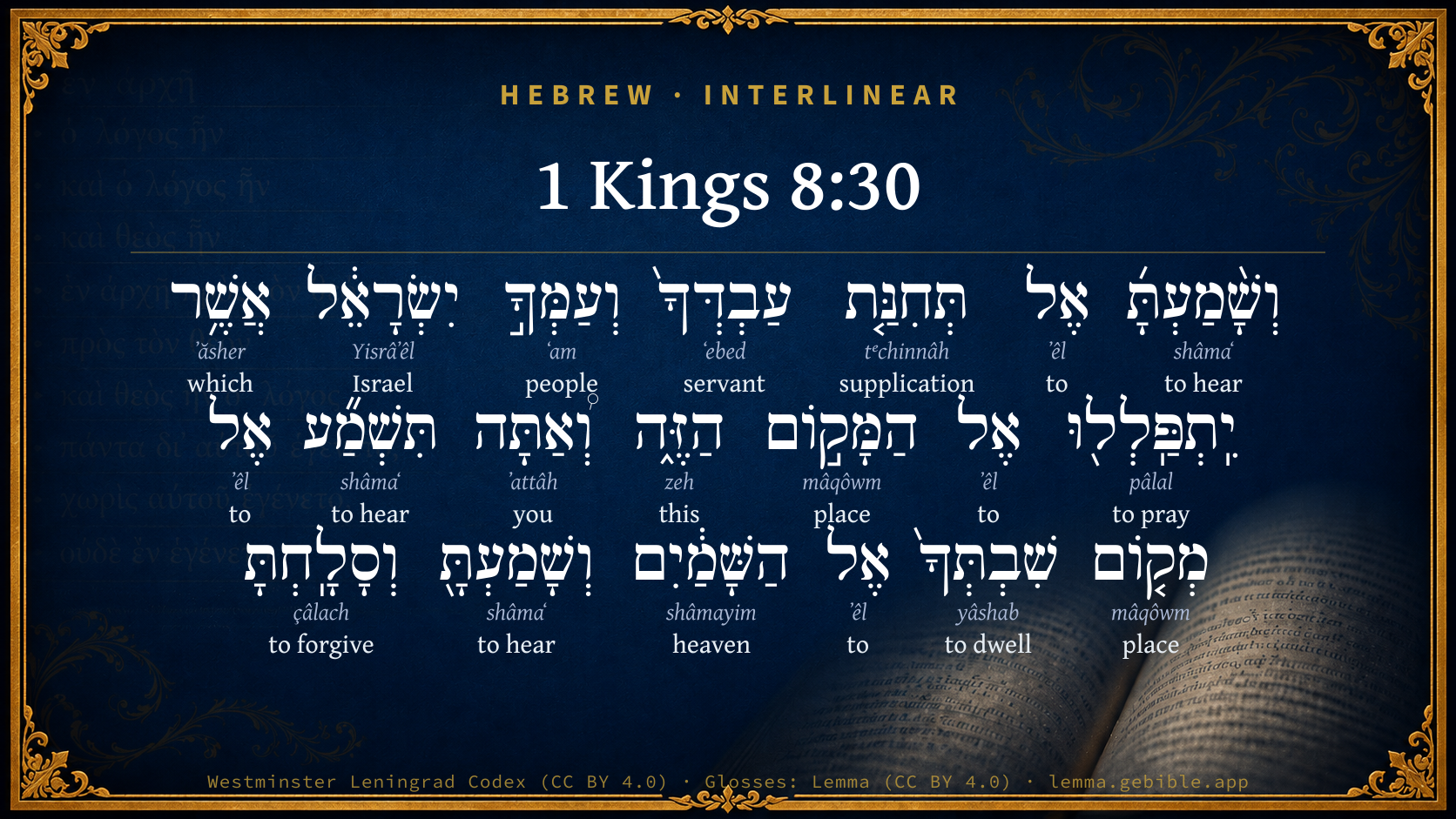
Hebrew (Westminster Leningrad Codex) 1 Kings 8:30 appears in the Hebrew Old Testament. The text above is from the Westminster Leningrad Codex. Each word links to its Strong’s number, a concise gloss, and parsing drawn from the Open Scriptures Hebrew Bible morphology. Click any word for its full Brown-Driver-Briggs (BDB) entry.
Download image
Cite this verse

1 Kings 8:30 (World English Bible). Public Domain. Lemma interlinear Bible study tool, https://lemma.gebible.app/v/1-kings/8/30.

Show BibTeX & RIS
BibTeX
RIS
English Translation
Listen you to the supplication of your servant, and of your people Israel, when they shall pray toward this place: yes, hear in heaven, your dwelling-place; and when you hear, forgive.
World English Bible · Public Domain
Download a study sheet

One document with this verse’s original text, its word-by-word gloss line, the meaning frame, cross-references with their text, attributed commentary, and full source and license credits — printable, and it pastes into notes with its structure intact.

This verse Autodidact and up

Study sheet (.html) Plain text (.txt)

A passage Seminary Student

Up to 50 verses in one chapter. A passage sheet keeps up to 6 commentary sources and 12 cross-references per verse, in the order this page ranks them, and says so on the sheet whenever that leaves anything out. Ask for a single verse and you get the Autodidact verse sheet above.

Everything on this page stays free to read, with no account — the sheet is a download of what is already on screen, not access to it.

Want to remove ads? Support Godless Engineer
Compare translations 3

The same verse in 3 English versions, stacked beneath the original-language interlinear above. Click any original word for its lexicon entry.

Each is an independent rendering of the whole verse — the interlinear is not word-aligned to these translations.

Highlighted words mark where these versions differ — a whole-verse word diff, not a word-by-word alignment.

  • World English Bible Public Domain
    Listen you to the supplication of your servant, and of your people Israel, when they shall pray toward this place: yes, hear in heaven, your dwelling-place; and when you hear, forgive.
  • King James Version Public Domain
    And hearken thou to the supplication of thy servant, and of thy people Israel, when they shall pray toward this place: and hear thou in heaven thy dwelling place: and when thou hearest, forgive.
  • unfoldingWord Literal Text CC BY-SA 4.0
    And may you listen to the supplication of your servant and your people Israel that they will pray toward this place. And you, may you hear in the place of your dwelling, in the heavens, and may you hear and forgive.

unfoldingWord Literal Text — © unfoldingWord, licensed CC BY-SA 4.0. Word-aligned USFM3 via Door43 (git.door43.org/unfoldingWord/en_ult).

Versions to compare (up to 4)

3 of 4 selected

Show all 18 translations

Every available English version of this verse, each an independent rendering of the whole verse.

  • World English Bible Public Domain
    Listen you to the supplication of your servant, and of your people Israel, when they shall pray toward this place: yes, hear in heaven, your dwelling-place; and when you hear, forgive.
  • Berean Standard Bible Public Domain
    Hear the plea of Your servant and of Your people Israel when they pray toward this place. May You hear from heaven, Your dwelling place. May You hear and forgive.
  • Majority Standard Bible Public Domain
    Hear the plea of Your servant and of Your people Israel when they pray toward this place. May You hear from heaven, Your dwelling place. May You hear and forgive.
  • King James Version Public Domain
    And hearken thou to the supplication of thy servant, and of thy people Israel, when they shall pray toward this place: and hear thou in heaven thy dwelling place: and when thou hearest, forgive.
  • American Standard Version (1901) Public Domain
    And hearken thou to the supplication of thy servant, and of thy people Israel, when they shall pray toward this place: yea, hear thou in heaven thy dwelling-place; and when thou hearest, forgive.
  • Revised Version (1885) Public Domain
    And hearken thou to the supplication of thy servant, and of thy people Israel, when they shall pray toward this place: yea, hear thou in heaven thy dwelling place; and when thou hearest, forgive.
  • Geneva Bible (1599) Public Domain
    Heare thou therefore the supplication of thy seruant, and of thy people Israel, which pray in this place, and heare thou in the place of thine habitation, euen in heauen, and when thou hearest, haue mercie.
  • Douay-Rheims (1899) Public Domain
    That thou mayest hearken to the supplication of thy servant and of thy people Israel, whatsoever they shall pray for in this place, and hear them in the place of thy dwelling in heaven; and when thou hearest, shew them mercy.
  • Young's Literal Translation Public Domain
    `Then Thou hast hearkened unto the supplication of Thy servant, and of Thy people Israel, which they pray towards this place; yea, Thou dost hearken in the place of Thy dwelling, in the heavens -- and Thou hast hearkened, and hast forgiven,
  • Literal Standard Version CC BY-SA 4.0
    Then You have listened to the supplication of Your servant, and of Your people Israel, which they pray toward this place; indeed, You listen in the place of Your dwelling, in the heavens—and You have listened, and have forgiven,
  • Unlocked Literal Bible CC BY-SA 4.0
    So listen to the request of your servant and of your people Israel when we pray toward this place. Yes, listen from the place where you live, from the heavens; and when you listen, forgive.
  • unfoldingWord Literal Text CC BY-SA 4.0
    And may you listen to the supplication of your servant and your people Israel that they will pray toward this place. And you, may you hear in the place of your dwelling, in the heavens, and may you hear and forgive.
  • Darby Bible Public Domain
    And hearken unto the supplication of thy servant, and of thy people Israel, when they shall pray toward this place, and hear thou in thy dwelling-place, in the heavens, and when thou hearest, forgive.
  • World Messianic Bible Public Domain
    Listen to the supplication of your servant, and of your people Israel, when they pray toward this place. Yes, hear in heaven, your dwelling place; and when you hear, forgive.
  • Webster's Bible Public Domain
    And hearken thou to the supplication of thy servant, and of thy people Israel, when they shall pray towards this place: and hear thou in heaven thy dwelling-place: and when thou hearest, forgive.
  • Free Bible Version CC BY-SA 4.0
    and may you hear the request of your servant and your people Israel when they pray toward this place. Please hear from heaven where you live. May you hear and forgive.
  • Bible in Basic English Public Domain
    Give ear to the prayers of your servant, and the prayers of your people Israel, when they make their prayers, turning to this place; give ear in heaven your living-place, and hearing, have mercy.
  • JPS Tanakh (1917) Public Domain
    And hearken Thou to the supplication of Thy servant, and of Thy people Israel, when they shall pray toward this place; yea, hear Thou in heaven Thy dwelling-place; and when Thou hearest, forgive.

Literal Standard Version (2020), Covenant Press — licensed CC BY-SA 4.0. Text via the HelloAO Bible API (eBible.org). Unlocked Literal Bible (unfoldingWord) — licensed CC BY-SA 4.0. Text via the HelloAO Bible API (eBible.org). unfoldingWord Literal Text — © unfoldingWord, licensed CC BY-SA 4.0. Word-aligned USFM3 via Door43 (git.door43.org/unfoldingWord/en_ult). Free Bible Version, Dr. Jonathan Gallagher — licensed CC BY-SA 4.0. Text via the HelloAO Bible API (eBible.org).

Word by word

More ways to search: Search by grammar → Find every occurrence → Compare this word →

Practice this passage: Drill this verse → Learn its vocabulary →

תְּחִנַּ֤ת
tᵉchinnâh
H8467
“supplication of”
Noun, Common, Feminine, Singular, Construct
Part of Speech
Noun
Type
Common
Gender
Feminine
Number
Singular
State
Construct
Full BDB Definition

Origin: from H2603

TWOT: 694f

favour, supplication, supplication for favour - favour - supplication for favour
  1. וְשָׁ֨מַעְתָּ֜ shâmaʻ H8085 “and · to hear” Conjunction + Verb, Qal, Sequential Perfect, 2nd Person, Masculine, Singular
  2. אֶל ʼêl H413 “to” Preposition
  3. עַבְדְּךָ֙ ʻebed H5650 “servant · your” Noun, Common, Masculine, Singular, Construct + Suffix, Personal, 2nd Person, Masculine, Singular
  4. וְעַמְּךָ֣ ʻam H5971 “and · people · your” Conjunction + Noun, Common, Masculine, Singular, Construct + Suffix, Personal, 2nd Person, Masculine, Singular
  5. יִשְׂרָאֵ֔ל Yisrâʼêl H3478 “Israel” Noun, Proper
  6. אֲשֶׁ֥ר ʼăsher H834 “which” Particle, Relative
  7. יִֽתְפַּֽלְל֖וּ pâlal H6419 “to pray” Verb, Hithpael, Imperfect, 3rd Person, Masculine, Plural
  8. אֶל ʼêl H413 “to” Preposition
  9. הַמָּק֣וֹם mâqôwm H4725 “the · place” Particle, Definite Article + Noun, Common, Masculine, Singular, Absolute
  10. הַזֶּ֑ה zeh H2088 “the · this” Particle, Definite Article + Pronoun, Demonstrative, Masculine, Singular
  11. וְ֠אַתָּה ʼattâh H859 “and · you” Conjunction + Pronoun, Personal, 2nd Person, Masculine, Singular
  12. תִּשְׁמַ֞ע shâmaʻ H8085 “to hear” Verb, Qal, Imperfect, 2nd Person, Masculine, Singular
  13. אֶל ʼêl H413 “to” Preposition
  14. מְק֤וֹם mâqôwm H4725 “place of” Noun, Common, Masculine, Singular, Construct
  15. שִׁבְתְּךָ֙ yâshab H3427 “to dwell · you” Verb, Qal, Infinitive Construct + Suffix, Personal, 2nd Person, Masculine, Singular
  16. אֶל ʼêl H413 “to” Preposition
  17. הַשָּׁמַ֔יִם shâmayim H8064 “the · heaven(s)” Particle, Definite Article + Noun, Common, Masculine, Plural, Absolute
  18. וְשָׁמַעְתָּ֖ shâmaʻ H8085 “and · to hear” Conjunction + Verb, Qal, Sequential Perfect, 2nd Person, Masculine, Singular
  19. וְסָלָֽחְתָּ çâlach H5545 “and · to forgive” Conjunction + Verb, Qal, Sequential Perfect, 2nd Person, Masculine, Singular

About this verse

These counts appear in no published source. They are computed here, from the morphology-tagged text and Lemma’s own curated glosses. What Lemma adds →

20
words
14
distinct lemmas
Historical
section

Notable vocabulary

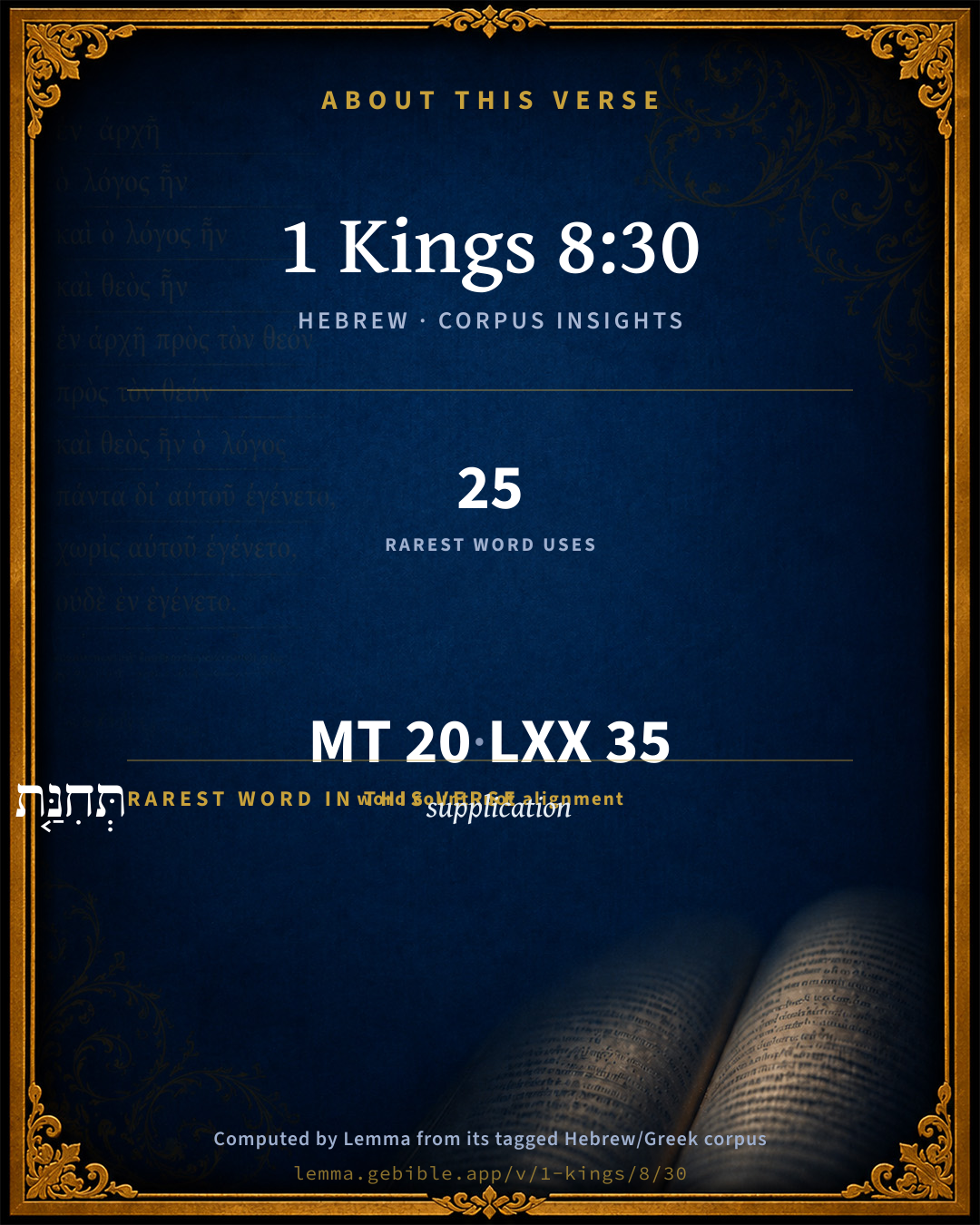
The rarest word here is תְּחִנַּ֤ת supplication H8467 — appearing just 25 times in the whole Hebrew Bible.

Shared distinctive vocabulary

תְּחִנַּ֤ת supplication H8467 occurs in 24 verses of the Hebrew Bible. Also found in:

Grammatical profile

  • 6 verbs
  • 7 nouns
  • 2 pronouns
  • 4 prepositions
  • 1 particle

Verb forms

  • וְשָׁ֨מַעְתָּ֜ Qal · Sequential Perfect
  • יִֽתְפַּֽלְל֖וּ Hithpael · Imperfect
  • תִּשְׁמַ֞ע Qal · Imperfect
  • שִׁבְתְּךָ֙ Qal · Infinitive Construct
  • וְשָׁמַעְתָּ֖ Qal · Sequential Perfect
  • וְסָלָֽחְתָּ Qal · Sequential Perfect

Repetition

Words recur within this verse — often emphatic in Hebrew:

  • וְשָׁ֨מַעְתָּ֜ to hear H8085 ×3
  • הַמָּק֣וֹם place H4725 ×2
  • אֶל to H413 ×4

Hebrew & Septuagint length

In English translation the verse runs 31 words from the Hebrew and 38 from the Septuagint (LXX English) — closely comparable.

A rough comparison of the two English renderings, which tokenize alike — not a word-level alignment.

Word counts can differ between the Hebrew and the Greek without any difference in meaning — e.g. the Hebrew direct-object marker אֵת has no separate Greek word, and Greek often adds the article ὁ.

In the original languages it is 20 Hebrew tokens and 35 Greek tokens — but the two are counted differently (Hebrew bundles its prefixes and suffixes into one token; the Greek is in lemma form), so that isn’t a like-for-like length.

Cross-references

19

Topical passages linked to 1 Kings 8:30 in the Treasury of Scripture Knowledge — connected by theme and wording, ordered by reader-vote popularity; previews shown in the World English Bible.

  • 1 Kings 8:34 then hear you in heaven, and forgive the sin of your people Israel, and bring them again to the land which you gave to their fathers.
  • 1 Kings 8:36 then hear in heaven, and forgive the sin of your servants, and of your people Israel, when you teach them the good way in which they should walk; and send rain on your land, which you have given to your people for an inheritance.
  • 1 Kings 8:39 then hear in heaven, your dwelling-place, and forgive, and do, and render to every man according to all his ways, whose heart you know; (for you, even you only, know the hearts of all the children of men;)
  • Daniel 9:19 Lord, hear; Lord, forgive; Lord, listen and do; don't defer, for your own sake, my God, because your city and your people are called by your name.
  • Psalms 130:3–4 If you, Yah, kept a record of sins, Lord, who could stand?
  • Ecclesiastes 5:2 Don't be rash with your mouth, and don't let your heart be hasty to utter anything before God; for God is in heaven, and you on earth. Therefore let your words be few.
  • Isaiah 57:15 For thus says the high and lofty One who inhabits eternity, whose name is Holy: I dwell in the high and holy place, with him also who is of a contrite and humble spirit, to revive the spirit of the humble, and to revive the heart of the contrite.
  • 1 Kings 8:43 hear in heaven, your dwelling-place, and do according to all that the foreigner calls to you for; that all the peoples of the earth may know your name, to fear you, as does your people Israel, and that they may know that this house which I have built is called by my name.
  • 1 Kings 8:49 then hear you their prayer and their supplication in heaven, your dwelling-place, and maintain their cause;
  • 2 Chronicles 6:21 Listen you to the petitions of your servant, and of your people Israel, when they shall pray toward this place: yes, hear from your dwelling-place, even from heaven; and when you hear, forgive.
  • 2 Chronicles 20:8–9 They lived therein, and have built you a sanctuary therein for your name, saying,
  • Nehemiah 1:5–6 and said, I beg you, Yahweh, the God of heaven, the great and awesome God, who keeps covenant and loving kindness with those who love him and keep his commandments:
  • Psalms 33:13–14 Yahweh looks from heaven. He sees all the sons of men.
  • Psalms 85:2 You have forgiven the iniquity of your people. You have covered all their sin. Selah.
  • Psalms 113:5–6 Who is like Yahweh, our God, Who has his seat on high,
  • Psalms 123:1 To you I do lift up my eyes, You who sit in the heavens.
  • Matthew 6:9 Pray like this: 'Our Father in heaven, may your name be kept holy.
  • Matthew 6:12 Forgive us our debts, as we also forgive our debtors.
  • 2 Chronicles 7:14 if my people, who are called by my name, shall humble themselves, and pray, and seek my face, and turn from their wicked ways; then will I hear from heaven, and will forgive their sin, and will heal their land.

Cross-references courtesy of OpenBible.info (CC BY 4.0).

Hebrew and Greek witnesses Masoretic Hebrew ↔ Greek Septuagint

The same verse in the two great witnesses to the Old Testament, shown verse-for-verse.

These are two independent witnesses, not word-aligned to each other, and the Septuagint is shown in lemma (dictionary) form.

Hebrew 1 Kings 8:30 Masoretic · Westminster Leningrad Codex

וְשָׁ֨מַעְתָּ֜ אֶל תְּחִנַּ֤ת עַבְדְּךָ֙ וְעַמְּךָ֣ יִשְׂרָאֵ֔ל אֲשֶׁ֥ר יִֽתְפַּֽלְל֖וּ אֶל הַמָּק֣וֹם הַזֶּ֑ה וְ֠אַתָּה תִּשְׁמַ֞ע אֶל מְק֤וֹם שִׁבְתְּךָ֙ אֶל הַשָּׁמַ֔יִם וְשָׁמַעְתָּ֖ וְסָלָֽחְתָּ

Listen you to the supplication of your servant, and of your people Israel, when they shall pray toward this place: yes, hear in heaven, your dwelling-place; and when you hear, forgive.

World English Bible · Public Domain

Greek LXX 1 Kings 8:30 Septuagint · lemma form

καί εἰςἀκούω ὁ δέησις ὁ δοῦλος σύ καί ὁ λαός σύ ἰσραήλ ὅς ἄν προςεὔχομαι εἰς ὁ τόπος οὗτος καί σύ εἰςἀκούω ἐν ὁ τόπος ὁ κατοίκησις σύ ἐν οὐρανός καί ποιέω καί ἵλεως εἰμί

And you shall listen to the prayer of your servant, and of your people Israel, which they shall pray toward this place; and you shall hear in your dwelling-place in heaven, and you shall do and be gracious.

LXX2012 (modern English Septuagint) · Public Domain

Hebrew: Westminster Leningrad Codex (CC BY 4.0). Greek: Septuagint (public domain); English from LXX2012 (modern English Septuagint) (Public Domain). How the Septuagint differs from the Hebrew →

Targum (Aramaic paraphrase)

1

The Targum is the ancient Jewish Aramaic paraphrase of the Hebrew Scriptures — an interpretive translation, not the Hebrew text itself. Onkelos (literal) and Pseudo-Jonathan (expansive) render the Torah, and Jonathan the Prophets. Coverage is partial: where no permissively-licensed English translation exists for a verse, only the Aramaic is shown. This is verse-level text, not a word-by-word alignment to the Hebrew.

  1. Targum Jonathan Prophets (Joshua–Malachi)
    וּתְקַבֵּל בָּעוּת עַבְדָךְ וְעַמָךְ יִשְׂרָאֵל דְיִצְלוּן לְאַפֵּי אַתְרָא הָדֵין וְאַתְּ תְּקַבֵּל מֵאֲתַר בֵּית שְׁכִנְתָּךְ מִן שְׁמַיָא וּתְקַבֵּל צְלוֹתְהוֹן וְתִשְׁבּוֹק לְחוֹבֵיהוֹן:

    (no public-domain English translation for this verse)

    Targum Jonathan — Aramaic: “Mikraot Gedolot” (public domain). English: “Sefaria Community Translation” (CC0 1.0 (public-domain dedication)); “London "Chaldee Paraphrase," 1871” (public domain). Text via Sefaria.

Commentary

Notes on 1 Kings 8:30 from classic Christian and Jewish commentators (each source and its license shown beneath its notes). The classic Christian expositions comment on the surrounding passage and are grouped to its opening verse, so a note may address several verses; the Jewish commentaries on the Tanakh (Rashi and others) are per-verse, so they appear only where the commentator wrote on this verse.

Lemma curates 59 commentaries, every one of them public domain or Creative Commons licensed, each selected and text-cleaned for this edition rather than reprinted as found. About our sources →

Trapp's Complete Commentary

John Trapp

1Ki 8:30 And hearken thou to the supplication of thy servant, and of thy people Israel, when they shall pray toward this place: and hear thou in heaven thy dwelling place: and when thou hearest, forgive.

Ver. 30. And hearken thou, &c.] These repetitions of the selfsame petitions, argue greatest earnestness.

And when thou hearest, forgive,] q.d., Whatever else thou deniest us, grant us pardon; yea, forgive the sin of our prayers; for when we have prayed for the forgiveness of sins, we had need pray again for the forgiveness of our prayers; such a spring and sink of sin there is within us.

John Trapp, A Commentary or Exposition upon All the Books of the Old and New Testament (1647–1656) — public domain. Text from a community e-Sword module.

The Biblical Illustrator

Joseph S. Exell

1Ki_8:30

When thou hearest, forgive.

The first prayer in Solomons Temple

Simple, touching, and beautiful were the words of the first prayer offered under the roof of Solomons Temple. Forgiveness is the first thing asked for. Solomon takes it for granted that forgiveness will be the great thing needed by those who in after days would pray in that house. He does not tell us what shall be the prayer, further than as the nature of the prayer is implied in the nature of the answer he bespeaks for it. In that single request, in that one word, Solomon gathers up the essence, as it were, of all the prayers that ever should be offered beneath that Temples roof.

I. That all men are sure to need forgiveness: that whatever differences there may be among them in other respects, they all agree in this, that they are sure to need forgiveness. Now, what is forgiveness? Forgiveness implies that a man has done something that is wrong--some wrong that is especially directed against some other being--and so which might justly excite the being wronged to regard the wrong-doer with an unfriendly and angry feeling, and seek to inflict punishment upon him: but that the being wronged resolves to pass by the offence done him--to blot it out from recollection, so far as may be--to cherish no angry spirit towards the offender, and to take no vengeance upon him for that which he has done.

II. The chief thing which beings like us ought to ask for in our prayers, is the pardon of our sins. Solomon seems to have thought that there was nothing which men needed so much; nothing which it was so important that they should get; nothing which included and meant so much. It was of this, no doubt, that our Blessed Lord was thinking, when, alluding to something which He did not name, but which all would understand, He said, One thing is needful. For see what is meant by being an un-forgiven sinner. It means that a man has the anger of the Almighty God resting upon him. It means that the creature, weak, helpless, dependent, is at enmity with the Creator, without whose aid he cannot draw a breath, move a limb, live a moment. It means that the word of the True is solemnly plighted to destroy him: that the power of the Almighty is solemnly engaged to destroy him. It means that he is one of those, concerning whom God has declared that when they leave this world, they must enter into a place of infinite and never ending woe and wretchedness; and there dwell through eternity still under the burden of His wrath. That is what is meant by being a sinner, not forgiven; it means that everything is wrong! And what is meant by being forgiven? It means that everything that was wrong before, is now set right. It means that everything that was ban before, is now made good. It means that God, before an enemy, is now a friend. It means that God, formerly the angry Judge, is now the reconciled and gracious, Father. It moans that Gods true word, formerly plighted to destroy us, and God s Almighty power, formerly engaged to destroy us, are now plighted and engaged to preserve and bless us.

III. God is the only being who can forgive, in the large and full sense of that word. Yell will remember, when I say this, the remark of the Scribes and Pharisees when our Saviour told a certain man that his sins were forgiven: they said, This man blasphemeth: who can forgive sins but God only? And they said what was true, if Christ had been a mere man. No one but God can forgive sin. And it is quite easy to show you how and why it is so. For, you know quite well, an offence can be forgiven only by the person against whom it was committed. Now all sin is in its essential nature, something committed against God; and therefore it can only be forgiven by God. There is a striking illustration in Scripture of this great truth, that sin especially consists in wrong done to God--that its great aggravation consists in this--and that when the conscience is awakened, the thing that weighs most heavy on a man s heart is, that he has sinned against God.

IV. Prayer is the way to obtain the forgiveness of sins. You see Solomon looked forward to days when sinful beings should, under the consciousness of guilt, employ the natural and recognised means for getting that guilt forgiven. He took it for granted, that when men felt they needed forgiveness, they would pray to God to forgive them: and so he himself, in anticipation of very many prayers which would be offered for pardon, says, Hear Thou in heaven Thy dwelling-place; and when Thou hearest, forgive. But indeed it is so plain that when you want anything from God, the right way to get it is to ask for it: this is so completely the dictate of common sense, that the matter needs no enforcement or illustration. (A. K. H. Boyd.)

Possibility of the souls recovery

If Kant emphasised the starry heavens and the moral law, if Daniel Webster emphasised the thought of personal responsibility to God, Hawthorne believed the greatest thought that can occupy the human mind is the thought of justice and its retributive workings through conscience. Doubtless there are a thousand problems that compete for the attention of youth; but for men grown mature and strong life offers no more momentous question than this: Can the soul, injured by temptation and scarred by sin, ever recover its pristine strength and beauty? Is there no place of recovery, though men seek it long with tears? I do not know, answers the old Greek, I do not know that God has any right to forgive sin. But Dante, having affirmed that man cannot forgive himself, thinks that sin may be consumed, and therefore makes the transgressor walk up a stairway of red-hot marble that pain may consume his iniquities. Hawthorns felt that somewhere life holds a fountain divine for cleansing the dust from the souls wing. Therefore, at the very gates of the jail into which the prisoner enters, Hawthorne makes a rose-bush grow, with thorns indeed to typify the sharp pains that society inflicts upon the wrong-doer, but with blossoms, too, offering fragrance to the prisoner as he goes in, and suggesting that if the petals fall through the frosts of to-day, these falling petals, passing into the roots will reappear in me richer blossoms of to-morrow. As if another life might recover the disasters of this; as if, no matter what mans harshness, great nature and natures God hold a wide, deep pity that can atone, forgive, and save. (N. A. Hillis, D. D.)

The Biblical Illustrator, edited by Joseph S. Exell (c. 1880s–1900s) — public domain. Text from a community e-Sword module.

Joseph Benson's Commentary

1Ki 8:30. When they shall pray toward this place — None but the priests might enter that place, but when the people worshipped in the courts of the temple, it was to be with an eye toward it, not with a superstitious regard or veneration, as though it were holy in itself, or in any respect the ground of their confidence in their worship, which would have been idolatry; but, as an instituted medium of their worship, helping the weakness of their faith, and typifying the mediation of Jesus Christ, who is the true temple, and to whom we must have an eye in all our approaches to, and intercourse with, God. Hence, the pious Jews that were at a distance looked toward Jerusalem for the sake of the temple, even when it lay in ruins, Dan 6:10. Hear thou in heaven — Which he adds to direct them, in their addresses to God in or looking toward this temple, to lift up their eyes above it, even to heaven, where God’s most true and most proper dwelling-place is. When thou hearest, forgive — The sins of thy people praying, and even of their prayers; which sins, if not pardoned, will certainly hinder the success of all their prayers, and the course of all thy blessings.

Joseph Benson's Commentary on the Old and New Testaments (1811–1818) — public domain. Text from a community e-Sword module.

Geneva Bible (1599)

Geneva Bible translators

Or, from.

Geneva Bible (1599) marginal notes — public domain. Text via Bolls.life.

Adam Clarke's Commentary

Verse 30. Toward this place] Both tabernacle and temple were types of our Lord Jesus, or of God manifested in the flesh; and he was and is the Mediator between God and man. All prayer, to be acceptable, and to be entitled to a hearing, must go to God through Him. The human nature of Christ is the temple in which dwelt all the fulness of the Godhead bodily; therefore with propriety all prayer must be offered to God through Him. "If they pray toward this place, hear thou in heaven thy dwelling-place; and when thou hearest, forgive." This appears to me to be the true sense and doctrine of this verse.

Adam Clarke's Commentary on the Bible (1810–1826) — public domain. Text from a community e-Sword/MySword module.

John Gill's Exposition

And hearken thou to the supplication of thy servant, and of thy people Israel, when they shall pray towards this place,.... Not only he desires his prayers might be heard, but those of the people of Israel, then, and at all times in succeeding ages, whenever they should look towards the temple, and to him that was typified by it; to whose blood, righteousness, sacrifice and mediation, the acceptance of prayers with God is to be ascribed:

and hear thou in heaven thy dwellingplace; for though he condescended to take up his residence in the temple, yet his more proper and more glorious dwelling was in heaven, and from whence, notwithstanding the distance of it, he could hear the prayers of his people, and does:

and when thou hearest, forgive; manifest and apply pardoning grace and mercy on account of sins confessed, and repented of; or remove calamities and distresses on account of sin, which sometimes is meant, and frequently in this prayer, by the forgiveness of sin.

John Gill's Exposition of the Whole Bible (1746–1763) — public domain (CC PDM 1.0). Text via the HelloAO Bible API.

Albert Barnes' Notes on the Bible

And when thou hearest, forgive - literally, “both hear and forgive” - i. e., “hear the prayer, and forgive the sin” which alone causes God to chasten men or to withhold from them His choicest blessings.

Albert Barnes' Notes on the Bible (1834–1885) — public domain. Text from a community e-Sword/MySword module.

Matthew Poole's English Annotations

Thy dwelling-place; which he adds, that the people might not idolize the temple, nor presume upon it, as if God were now fast tied to them, as having no other dwelling-place; and to direct them in all their addresses to God in his temple, to lift up their eyes above it, even to heaven, where God’s most true and most glorious dwelling-place is.

And when thou hearest, forgive, to wit, the sins of thy people praying, and even of their prayers; which, if not pardoned, will certainly hinder the success of all their prayers, and the course of all thy blessings upon them.

Matthew Poole's English Annotations on the Holy Bible (1683–1685) — public domain. Text from a community e-Sword/MySword module.

The Pulpit Commentary

And hearken thou to the supplication of thy servant, and of thy people Israel, when they shall pray toward this place: and hear thou in heaven Heb. unto heaven, a pregnant censtruction hear the prayer that ascends unto heaven. The chronicler here, as elsewhere, simplifies the meaning by reading "from heaven," VhAmi thy dwelling place Here, and in vers. 39, 43, and 49, heaven is described as the true dwelling place of Deity. Confidently as Solomon believes that he has built a habitation for the Lord, he never dreams that the "Most High dwelleth not in temples made with hands": (Act_7:48 Act_17:4) and when thou hearest, forgive. There is possibly a play of words here Tmv

With the next verse the special or particular supplications begin. Like those of the Lord"s prayer, they are seven in number, and no doubt for the same reason, viz., because seven was the number of covenant, the number which expressed the relationship between the Lord and His people ("die Signatur der Verbindung Gottes und der Welt Bahr, Symbolik, 1:187 sqq.) In fact, to the Jew the number "seven" was something like the sign of the cross to a large portion of Catholic Christendom, for it spoke to him of God"s covenant of mercy and peace.

And the first of the seven concerns oaths. The king implores the covenant-keeping God to watch over the covenants of words made in the now consecrated sanctuary, and to protect their sanctity by punishing the false swearer. There were cases in which the Mosaic law provided that an oath should be administered to suspected persons. (Exo_22:11 Lev_5:1, Lev_5:4, etc.) And there were other cases in which men of their own accord, for "an end of all strife," would make oath. Now every oath, whatever its form, (Mat_23:16-22) is in reality an affirmation" by the God of truth"; (Isa_65:16) it is an appeal to the knowledge and power and justice of the Most High. (Lev_19:12 Deu_6:13 Deu_10:20 Isa_48:1 Jer_12:16 Jer_44:26) A false oath, consequently, dishonoured the Divine name, and polluted the sanctuary dedicated to that name, and if it went unpunished, contradicted the principles and provisions of the dispensation Of temporal punishments, and so encouraged falsehood and impiety. God is here entreated, consequently, to take cognizance of the oaths sworn before His altar (ver. 31), and to be a swift witness against the false swearers. (Mal_3:5) It is, perhaps, because of the direct dishonour which perjury offers to the Divine name that, as Bahr suggests, this prayer stands first among the seven, thus corresponding to the "Hallowed be Thy name" in the Lord"s prayer, and to the third among the ten commandments.

The Pulpit Commentary (1880–1919), ed. H.D.M. Spence-Jones & Joseph S. Exell — public domain. Text from a community e-Sword module.

John Wesley's Explanatory Notes

In heaven - Which he adds to direct them in their addresses to God in this temple, to lift up their eyes above it, even to heaven, where God's most true, and most glorious dwelling-place is. Forgive - The sins of thy people, praying, and even of their prayers; which, if not pardoned, will certainly hinder the success of all their prayers, and the course of all thy blessings.

John Wesley, Explanatory Notes Upon the Whole Bible (1754–1765) — public domain. Text via the GEBible commentary corpus.

Lesson kit

Teaching starters — assembled from the data on this page, not authored interpretation. Every prompt links to the verse data it draws on. Edit before teaching.

1 Kings, in the Historical, opens this verse with 20 words (14 distinct Hebrew lemmas). Its most distinctive word is tᵉchinnâh (“supplication”). A historical commentator’s framing appears above. Read the whole chapter for the surrounding context.

Discussion questions

  1. What does “supplication” (tᵉchinnâh) contribute to the verse as a whole?
  2. Joshua 11:20 shares the word «supplication» with this verse. How do the two illuminate each other?
  3. “to hear” occurs 3× in this one verse. What is the effect of the repetition?
  4. The translations on this page render this verse differently — a whole-verse word diff, not a word-by-word alignment. What might account for the different wordings?
  5. The verb «וְשָׁ֨מַעְתָּ֜» is Qal Sequential Perfect. How does its form color the action?
  6. Reading how Trapp's Complete Commentary and The Biblical Illustrator read this verse, where do the two commentators agree and where do they part?

Things to notice

Reading settings

Reading text

Shown beneath each verse's original-language words.

Old Testament
Old Testament edition

Read the OT as the Masoretic Hebrew (MT) or the Greek Septuagint (LXX).

English shown for the Greek Septuagint (in the Hebrew ↔ Greek comparison).

Comparing translations? Open the Compare panel on any verse page to stack up to four side by side.