
Hosea 9:17

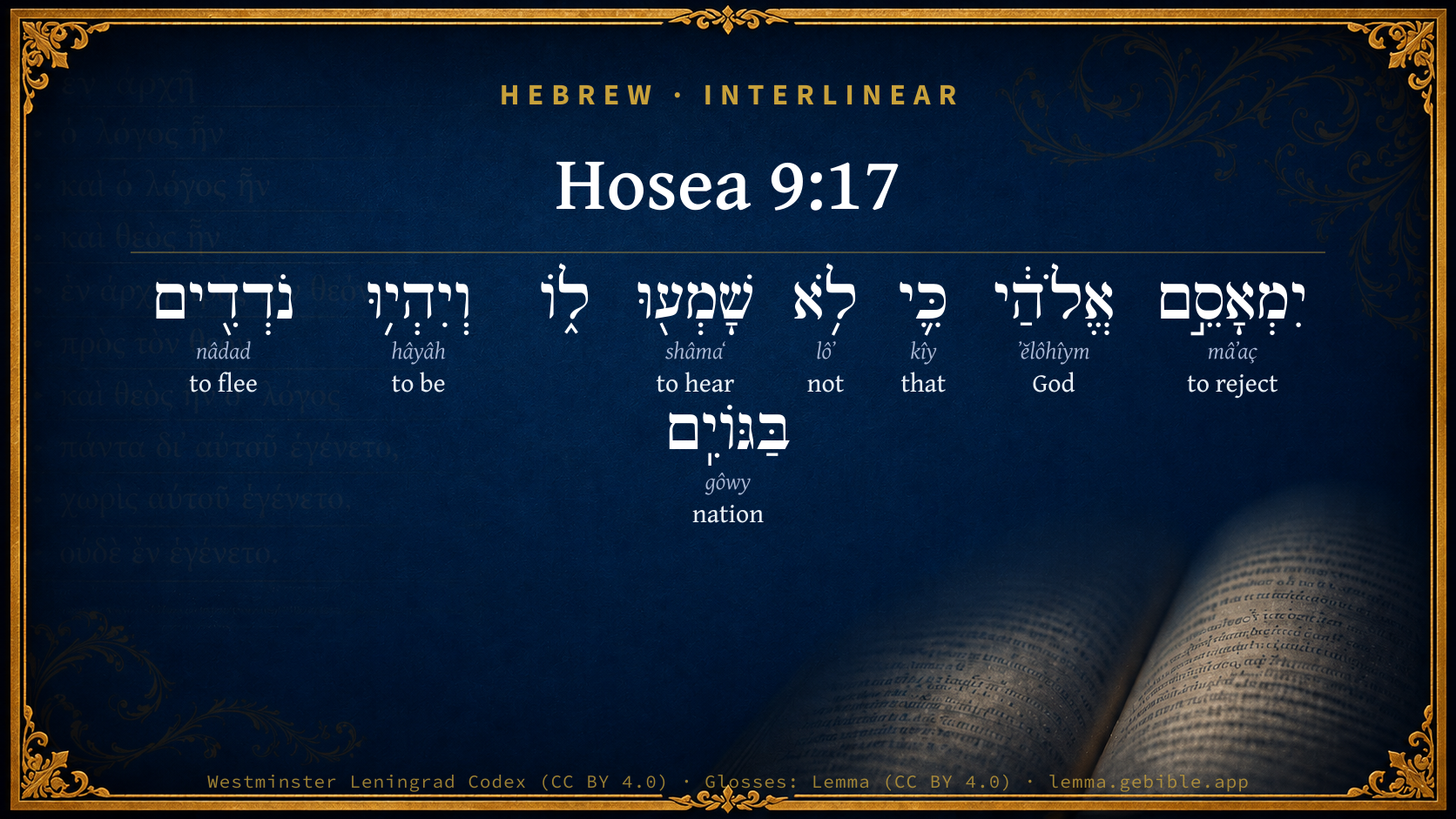
Hebrew (Westminster Leningrad Codex) Hosea 9:17 appears in the Hebrew Old Testament. The text above is from the Westminster Leningrad Codex. Each word links to its Strong’s number, a concise gloss, and parsing drawn from the Open Scriptures Hebrew Bible morphology. Click any word for its full Brown-Driver-Briggs (BDB) entry.
Download image
Cite this verse

Hosea 9:17 (World English Bible). Public Domain. Lemma interlinear Bible study tool, https://lemma.gebible.app/v/hosea/9/17.

Show BibTeX & RIS
BibTeX
RIS
English Translation
My God will cast them away, because they did not listen to him; And they will be wanderers among the nations.
World English Bible · Public Domain
Download a study sheet

One document with this verse’s original text, its word-by-word gloss line, the meaning frame, cross-references with their text, attributed commentary, and full source and license credits — printable, and it pastes into notes with its structure intact.

This verse Autodidact and up

Study sheet (.html) Plain text (.txt)

A passage Seminary Student

Up to 50 verses in one chapter. A passage sheet keeps up to 6 commentary sources and 12 cross-references per verse, in the order this page ranks them, and says so on the sheet whenever that leaves anything out. Ask for a single verse and you get the Autodidact verse sheet above.

Everything on this page stays free to read, with no account — the sheet is a download of what is already on screen, not access to it.

Want to remove ads? Support Godless Engineer
Compare translations 3

The same verse in 3 English versions, stacked beneath the original-language interlinear above. Click any original word for its lexicon entry.

Each is an independent rendering of the whole verse — the interlinear is not word-aligned to these translations.

Highlighted words mark where these versions differ — a whole-verse word diff, not a word-by-word alignment.

  • World English Bible Public Domain
    My God will cast them away, because they did not listen to him; And they will be wanderers among the nations.
  • King James Version Public Domain
    My God will cast them away, because they did not hearken unto him: and they shall be wanderers among the nations.
  • unfoldingWord Literal Text CC BY-SA 4.0
    My God will reject them, for they have not listened to him, so they will be wanderers among the nations.

unfoldingWord Literal Text — © unfoldingWord, licensed CC BY-SA 4.0. Word-aligned USFM3 via Door43 (git.door43.org/unfoldingWord/en_ult).

Versions to compare (up to 4)

3 of 4 selected

Show all 18 translations

Every available English version of this verse, each an independent rendering of the whole verse.

  • World English Bible Public Domain
    My God will cast them away, because they did not listen to him; And they will be wanderers among the nations.
  • Berean Standard Bible Public Domain
    My God will reject them because they have not obeyed Him; and they shall be wanderers among the nations.
  • Majority Standard Bible Public Domain
    My God will reject them because they have not obeyed Him; and they shall be wanderers among the nations.
  • King James Version Public Domain
    My God will cast them away, because they did not hearken unto him: and they shall be wanderers among the nations.
  • American Standard Version (1901) Public Domain
    My God will cast them away, because they did not hearken unto him; and they shall be wanderers among the nations.
  • Revised Version (1885) Public Domain
    My God will cast them away, because they did not hearken unto him: and they shall be wanderers among the nations.
  • Geneva Bible (1599) Public Domain
    My God will cast them away, because they did not obey him: and they shall wander among the nations.
  • Douay-Rheims (1899) Public Domain
    My God will cast them away, because they hearkened not to him: and they shall be wanderers among the nations.
  • Young's Literal Translation Public Domain
    Reject them doth my God, Because they have not hearkened to Him, And they are wanderers among nations!
  • Literal Standard Version CC BY-SA 4.0
    My God rejects them, || Because they have not listened to Him, || And they are wanderers among nations!”
  • Unlocked Literal Bible CC BY-SA 4.0
    My God will reject them because they have not obeyed him. They will become wanderers among the nations.
  • unfoldingWord Literal Text CC BY-SA 4.0
    My God will reject them, for they have not listened to him, so they will be wanderers among the nations.
  • Darby Bible Public Domain
    My God hath rejected them, because they hearkened not unto him; and they shall be wanderers among the nations.
  • World Messianic Bible Public Domain
    My God will cast them away, because they didn’t listen to him; and they will be wanderers among the nations.
  • Webster's Bible Public Domain
    My God will cast them away, because they did not hearken to him: and they shall be wanderers among the nations.
  • Free Bible Version CC BY-SA 4.0
    My God will reject you because you have not listened to him, and you will become homeless wanderers among the nations.
  • Bible in Basic English Public Domain
    My God will give them up because they did not give ear to him; they will be wandering among the nations.
  • JPS Tanakh (1917) Public Domain
    My God will cast them away, because they did not hearken unto Him; and they shall be wanderers among the nations.

Literal Standard Version (2020), Covenant Press — licensed CC BY-SA 4.0. Text via the HelloAO Bible API (eBible.org). Unlocked Literal Bible (unfoldingWord) — licensed CC BY-SA 4.0. Text via the HelloAO Bible API (eBible.org). unfoldingWord Literal Text — © unfoldingWord, licensed CC BY-SA 4.0. Word-aligned USFM3 via Door43 (git.door43.org/unfoldingWord/en_ult). Free Bible Version, Dr. Jonathan Gallagher — licensed CC BY-SA 4.0. Text via the HelloAO Bible API (eBible.org).

Word by word

More ways to search: Search by grammar → Find every occurrence → Compare this word →

Practice this passage: Drill this verse → Learn its vocabulary →

נֹדְדִ֖ים
nâdad
H5074
“fleeing”
Verb, Qal, Participle Active, Masculine, Plural, Absolute
Part of Speech
Verb
Stem
Qal
Form
Participle Active
Gender
Masculine
Number
Plural
State
Absolute
Full BDB Definition

Origin: a primitive root

TWOT: 1300

to retreat, flee, depart, move, wander abroad, stray, flutter - (Qal) - to retreat, flee - to flee, depart - to wander, stray - to flutter (of birds) - (Poal) to flee away, be chased - (Hiphil) to chase away - (Hophal) to be chased away - (Hithpolel) to flee away
  1. יִמְאָסֵ֣ם mâʼaç H3988 “to reject · them” Verb, Qal, Imperfect, 3rd Person, Masculine, Singular + Suffix, Personal, 3rd Person, Masculine, Plural
  2. אֱלֹהַ֔י ʼĕlôhîym H430 “God(s) · my” Noun, Common, Masculine, Plural, Construct + Suffix, Personal, 1st Person, Common, Singular
  3. כִּ֛י kîy H3588 “that” Conjunction
  4. לֹ֥א lôʼ H3808 “not” Particle, Negative
  5. שָׁמְע֖וּ shâmaʻ H8085 “to hear” Verb, Qal, Perfect, 3rd Person, Common, Plural
  6. וְיִהְי֥וּ hâyâh H1961 “and · to be” Conjunction + Verb, Qal, Imperfect, 3rd Person, Masculine, Plural
  7. בַּגּוֹיִֽם gôwy H1471 “in/at the · nations” Preposition, Determined + Noun, Common, Masculine, Plural, Absolute

About this verse

These counts appear in no published source. They are computed here, from the morphology-tagged text and Lemma’s own curated glosses. What Lemma adds →

9
words
8
distinct lemmas
Prophets
section

Shared distinctive vocabulary

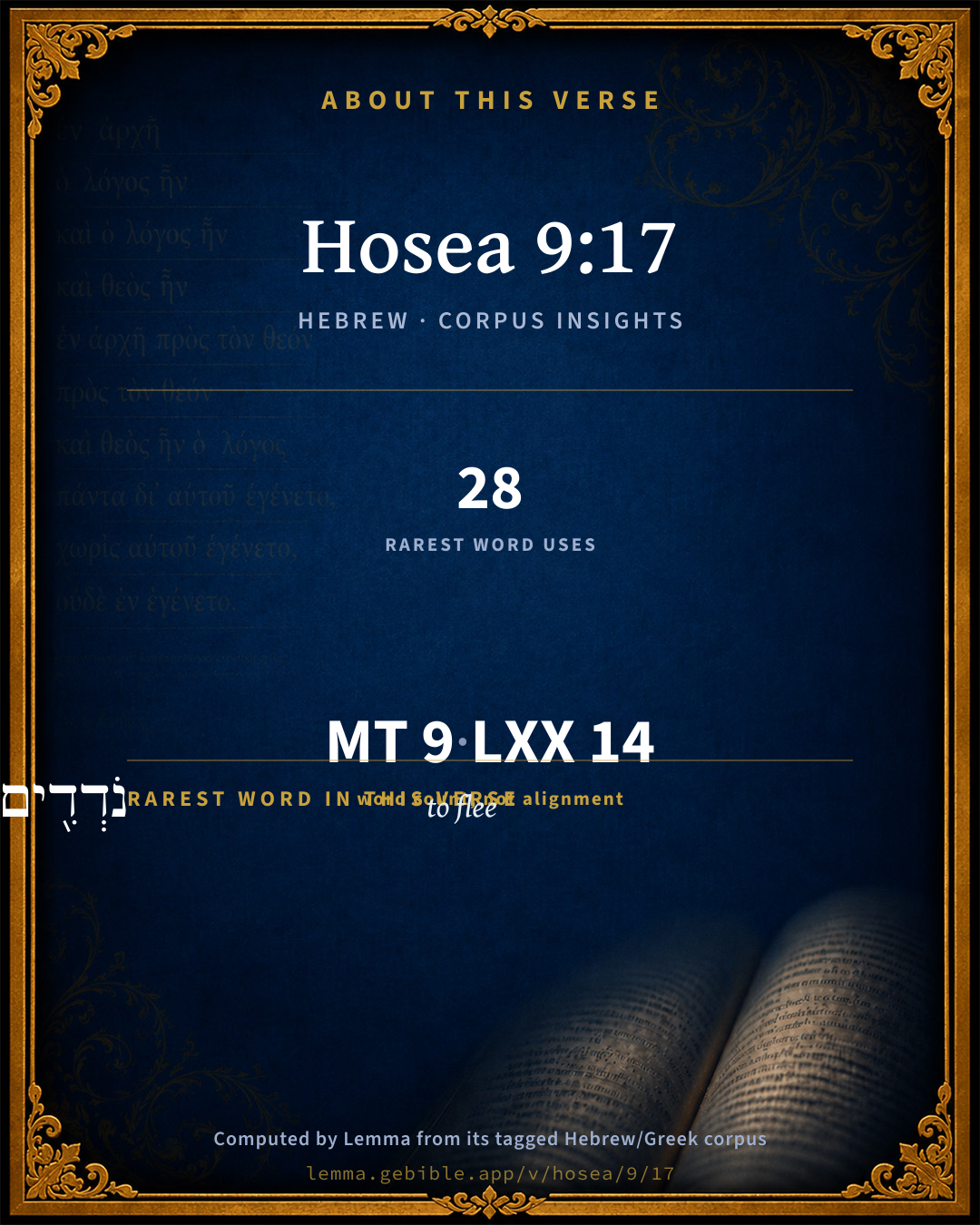
נֹדְדִ֖ים to flee H5074 occurs in 26 verses of the Hebrew Bible. Also found in:

Grammatical profile

  • 4 verbs
  • 2 nouns
  • 1 preposition
  • 1 conjunction
  • 1 particle

Verb forms

  • יִמְאָסֵ֣ם Qal · Imperfect
  • שָׁמְע֖וּ Qal · Perfect
  • וְיִהְי֥וּ Qal · Imperfect
  • נֹדְדִ֖ים Qal · Participle Active

Hebrew & Septuagint length

In English translation the verse runs 21 words from the Hebrew and 19 from the Septuagint (LXX English) — closely comparable.

A rough comparison of the two English renderings, which tokenize alike — not a word-level alignment.

Word counts can differ between the Hebrew and the Greek without any difference in meaning — e.g. the Hebrew direct-object marker אֵת has no separate Greek word, and Greek often adds the article ὁ.

In the original languages it is 9 Hebrew tokens and 14 Greek tokens — but the two are counted differently (Hebrew bundles its prefixes and suffixes into one token; the Greek is in lemma form), so that isn’t a like-for-like length.

Cross-references

28

Topical passages linked to Hosea 9:17 in the Treasury of Scripture Knowledge — connected by theme and wording, ordered by reader-vote popularity; previews shown in the World English Bible.

  • Deuteronomy 28:64–65 Yahweh will scatter you among all peoples, from the one end of the earth even to the other end of the earth; and there you shall serve other gods, which you have not known, you nor your fathers, even wood and stone.
  • Hosea 7:13 Woe to them! For they have wandered from me. Destruction to them! For they have trespassed against me. Though I would redeem them, Yet they have spoken lies against me.
  • Isaiah 48:18 Oh that you had listened to my commandments! then had your peace been as a river, and your righteousness as the waves of the sea:
  • Micah 7:7 But as for me, I will look to Yahweh. I will wait for the God of my salvation. My God will hear me.
  • Zechariah 1:4 Don't you be like your fathers, to whom the former prophets proclaimed, saying: Thus says Yahweh of hosts, 'Return now from your evil ways, and from your evil doings;' but they did not hear, nor listen to me, says Yahweh.
  • Zechariah 7:11–14 But they refused to listen, and turned their backs, and stopped their ears, that they might not hear.
  • Acts 3:23 It will be, that every soul that will not listen to that prophet will be utterly destroyed from among the people.'
  • Jeremiah 26:4–6 You shall tell them, Thus says Yahweh: If you will not listen to me, to walk in my law, which I have set before you,
  • Jeremiah 35:15–17 I have sent also to you all my servants the prophets, rising up early and sending them, saying, Return you now every man from his evil way, and amend your doings, and don't go after other gods to serve them, and you shall dwell in the land which I have given to you and to your fathers: but you have not inclined your ear, nor listened to me.
  • Hosea 4:10 They will eat, and not have enough. They will play the prostitute, and will not increase; Because they have abandoned giving to Yahweh.
  • Amos 9:9 "For, behold, I will command, and I will sift the house of Israel among all the nations, as grain is sifted in a sieve, yet not the least kernel will fall on the earth.
  • Deuteronomy 32:26 I said, I would scatter them afar, I would make the memory of them to cease from among men;
  • 1 Kings 14:15–16 For Yahweh will strike Israel, as a reed is shaken in the water; and he will root up Israel out of this good land which he gave to their fathers, and will scatter them beyond the River, because they have made their Asherim, provoking Yahweh to anger.
  • 2 Kings 17:14–20 Notwithstanding, they would not hear, but hardened their neck, like the neck of their fathers, who didn't believe in Yahweh their God.
  • 2 Chronicles 18:13 Micaiah said, As Yahweh lives, what my God says, that will I speak.
  • 2 Chronicles 36:16 but they mocked the messengers of God, and despised his words, and scoffed at his prophets, until the wrath of Yahweh arose against his people, until there was no remedy.
  • Nehemiah 5:19 Remember to me, my God, for good, all that I have done for this people.
  • Psalms 31:14 But I trust in you, Yahweh. I said, "You are my God."
  • Psalms 81:11–13 But my people didn't listen to my voice. Israel desired none of me.
  • Proverbs 29:1 He who is often rebuked and stiffens his neck Will be destroyed suddenly, with no remedy.
  • Isaiah 7:13 He said, "Listen now, house of David: Is it not enough for you to try the patience of men, that you will try the patience of my God also?
  • Jeremiah 25:3–4 From the thirteenth year of Josiah the son of Amon, king of Judah, even to this day, these twenty-three years, the word of Yahweh has come to me, and I have spoken to you, rising up early and speaking; but you have not listened.
  • Amos 8:2 He said, "Amos, what do you see?" I said, "A basket of summer fruit." Then Yahweh said to me, "The end has come on my people Israel. I will not again pass by them any more.
  • John 7:35 The Jews therefore said among themselves, "Where will this man go that we won't find him? Will he go to the Dispersion among the Greeks, and teach the Greeks?
  • John 20:17 Jesus said to her, "Don't touch me, for I haven't yet ascended to my Father; but go to my brothers, and tell them, 'I am ascending to my Father and your Father, to my God and your God.'"
  • John 20:28 Thomas answered him, "My Lord and my God!"
  • Philippians 4:19 My God will supply every need of yours according to his riches in glory in Christ Jesus.
  • James 1:1 James, a servant of God and of the Lord Jesus Christ, to the twelve tribes which are in the Dispersion: Greetings.

Cross-references courtesy of OpenBible.info (CC BY 4.0).

Hebrew and Greek witnesses Masoretic Hebrew ↔ Greek Septuagint

The same verse in the two great witnesses to the Old Testament, shown verse-for-verse.

These are two independent witnesses, not word-aligned to each other, and the Septuagint is shown in lemma (dictionary) form.

Hebrew Hosea 9:17 Masoretic · Westminster Leningrad Codex

יִמְאָסֵ֣ם אֱלֹהַ֔י כִּ֛י לֹ֥א שָׁמְע֖וּ ל֑וֹ וְיִהְי֥וּ נֹדְדִ֖ים בַּגּוֹיִֽם

My God will cast them away, because they did not listen to him; And they will be wanderers among the nations.

World English Bible · Public Domain

Greek LXX Hosea 9:17 Septuagint · lemma form

ἀποὠθέω αὐτός ὁ θεός ὅτι οὐ εἰςἀκούω αὐτός καί εἰμί πλανήτης ἐν ὁ ἔθνος

God shall reject them, because they have not listened to him: and they shall be wanderers among the nations.

LXX2012 (modern English Septuagint) · Public Domain

Hebrew: Westminster Leningrad Codex (CC BY 4.0). Greek: Septuagint (public domain); English from LXX2012 (modern English Septuagint) (Public Domain). How the Septuagint differs from the Hebrew →

Targum (Aramaic paraphrase)

1

The Targum is the ancient Jewish Aramaic paraphrase of the Hebrew Scriptures — an interpretive translation, not the Hebrew text itself. Onkelos (literal) and Pseudo-Jonathan (expansive) render the Torah, and Jonathan the Prophets. Coverage is partial: where no permissively-licensed English translation exists for a verse, only the Aramaic is shown. This is verse-level text, not a word-by-word alignment to the Hebrew.

  1. Targum Jonathan Prophets (Joshua–Malachi)
    יַרְחִיקִינוּן אֱלָהָי אֲרֵי לָא קַבִּילוּ לְמֵימְרֵיהּ וִיהוֹן מְטַלְטְלִין בֵּינֵי עַמְמַיָא:

    (no public-domain English translation for this verse)

    Targum Jonathan — Aramaic: “Mikraot Gedolot” (public domain). English: “Sefaria Community Translation” (CC0 1.0 (public-domain dedication)); “London "Chaldee Paraphrase," 1871” (public domain). Text via Sefaria.

Commentary

Notes on Hosea 9:17 from classic Christian and Jewish commentators (each source and its license shown beneath its notes). The classic Christian expositions comment on the surrounding passage and are grouped to its opening verse, so a note may address several verses; the Jewish commentaries on the Tanakh (Rashi and others) are per-verse, so they appear only where the commentator wrote on this verse.

Lemma curates 59 commentaries, every one of them public domain or Creative Commons licensed, each selected and text-cleaned for this edition rather than reprinted as found. About our sources →

Trapp's Complete Commentary

John Trapp

Hos 9:17 My God will cast them away, because they did not hearken unto him: and they shall be wanderers among the nations.

Ver. 17. My God will cast them away] My God, not their God, for they are castaways and apostates; see the like, 1Jn 5:17, and learn to stick to God the closer when others start from him; and to secure our own interest in a general defection, by siding with God, and subscribing, as here the prophet doth, to his perfect righteousness in the rejection and destruction of reprobates.

Will cast them away] With disdain and detestation, as vile and execrable. He will do it, saith the prophet here, not without a great deal of grief, as finding that God was fully resolved, and would not alter. The eternity of Israel will not lie, nor repent, 1Sa 15:29; for he is not a man, that he should repent, saith Samuel to Saul, that castaway; and it is very dreadful; as indeed it is for any wicked men to have such as have interest in God to declare against them; since "the secret of the Lord is with them that fear him," Psa 25:14, and their sentence is not to be slighted. God’s messengers especially, out of their acquaintance with their Master’s proceedings, can foresee and foretell a punishment.

Because they did not hearken unto him] Haec notabilis est sententia, This is a notable sentence, saith Luther upon the text; and worthy to be written upon all our walls and windows. Death came into the world by the ear, so must life; for it is, Hear, and your souls shall live; and they that will not hear the instruction of life are doomed to destruction, as were Eli’s sons, 1Sa 2:25, and Amaziab, 2Ch 25:16. A heavy ear is a singular judgment, Isa 6:10, an uncircumcised ear a forerunner of ruin, Jer 6:10-11. Oh pray God to pull off that filthy foreskin, and to give us a hearing ear (that way to wisdom), an understanding heart, such as Solomon begged, 1Ki 3:9. Pray that he would bore our ears, as Psa 40:6, and make the bore big enough, that we may not only hear, but hearken; listen as for life. "Hear and give ear, be not proud, for the Lord hath spoken it," Jer 13:15 : when God hath spoken once let us hear it twice, as David did, Psa 62:11; he preached over the sermon again to himself at home. We must do with the word’s directions, as we do with oil to a stiff joint; rub and chafe them on our hearts by deep and frequent meditation and prayer; lest else we hear with these in the text,

Because they did not hearken unto him, they shall be wanderers among the nations] Heb. Nodedim: Cain’s curse shall befall them. "A fugitive and a vagabond shall I be upon the earth," Gen 4:12; but could not wander so wide as to miss hell, nor flee so far as from his own evil conscience. Lo, this is the case of these wandering Jews, a dejected and despised nation, exiled out of the world by a common consent of all people, till God turn again their captivity as the streams in the south, till he gather the outcasts of Israel.

John Trapp, A Commentary or Exposition upon All the Books of the Old and New Testament (1647–1656) — public domain. Text from a community e-Sword module.

The Biblical Illustrator

Joseph S. Exell

Hos_9:17

My God will cast them away . . . and they shall be wanderers among the nations.

Divine severities for a nation

1. It is a judgment to have an unsettled spirit. A spirit wandering up and down, unable to settle to anything, sometimes in this place, sometimes in that, sometimes in this way, and sometimes in another, this is a judgment of God. The wandering of mens appetites and desires works them a great deal of vexation.

2. Those who are cast away out of Gods house can have no rest; they go about like the unclean spirit, seeking rest, but can find none. The Church of God and His ordinances are Gods rest. But you will say. May not men be wanderers; that is, may they not be cast out of their habitations and countries, and wander up and down, and yet not be cast off from God? There is no evil in wandering if we carry a good conscience with us. But there it is, They shall be wanderers among the nations. It was a great judgment of God for Israel to be scattered among the nations, for they were a people that were separated from the nations, and not to be reckoned among the nations; they were Gods peculiar treasure. This curse is upon the Jews to this very day,--how are they wanderers among the nations! (Jeremiah Burroughs.)

Wanderers among the nations.

The lost ten tribes

The words of the prophet imply an abiding condition. He does not say, They shall wander, but They shall be wanderers. Such was to be their lot; such has been their lot ever since; and such was not the ordinary lot of those large populations whom Eastern conquerors transported from their own land. The transported population had a settled abode allotted to it, whether in the capital or the provinces. Sometimes new cities or villages were built for the settlers. Israel at first was so located. Perhaps on account of the frequent rebellions of their kings the ten tribes were placed amid a wild, warlike population, in the cities of the Medes. When the interior of Asia was less known, people thought that they were still to be found there. The Jews fabled, that the ten tribes lay behind some mighty and fabulous river, Sambatyon, or were fenced in by mountains. Christians thought that they might be found in some yet unexplored part of Asia. Undeceived as to this, they still asked whether the Afghans or Yezides, or the natives of North America were the ten tribes, or whether they were the Nestorians of Kurdistan. So natural did it seem that they, like other nations so transported, should remain as a body near or at the places where they had been located by their conquerors. The prophet says otherwise. He says, their abiding condition shall be, they shall be wanderers among the nations; wanderers among them, but no part of them. Before the final dispersion of the Jews at the destruction of Jerusalem the Jewish race, Josephus says, was in great numbers throughout the whole world, interspersed with the nations. Those assembled at the Day of Pentecost had come from all parts of Asia Minor, but also from Parthia, Media, Persia, Mesopotamia, Arabia, Egypt, maritime Lybia, Crete, and Italy. Wherever the apostles went in Asia or Greece they found Jews, in numbers sufficient to raise persecution against them. The Jews, scoffing, asked whether our Lord would go to the dispersion among the Greeks. The Jews of Egypt were probably the descendants of those who went thither after the murder Of Gedaliah. The Jews of the North, as well as those of China, India, Russia, were probably descendants of the ten tribes. From one end of Asia to the other, and onward through the Crimea, Greece, and Italy, the Jews, by their presence, bare witness to the fulfilment of the prophecy. Not like the wandering Indian tribe, who spread over Europe, living apart in their native wildness, but, settled among the inhabitants of each city, they were still distinct, although with no polity of their own, a distinct, settled, yet foreign and subordinate race. Still remains unreversed this irrevocable sentence as to the temporal state and face of an earthly kingdom, that they remain still wanderers, or dispersed among other nations, and have never been restored, nor are in any likelihood of ever being restored to their own land, so as to call it their own. If ever any of them hath returned thither, it hath been but as strangers. (E. B. Pusey, D. D.)

.

The Biblical Illustrator, edited by Joseph S. Exell (c. 1880s–1900s) — public domain. Text from a community e-Sword module.

Tyndale Open Study Notes

Tyndale Open Resources

9:17 wanderers: God’s judgment on the Israelites would cut them off from the land, leaving them with no home.

Tyndale Open Study Notes — © Tyndale Open Resources, licensed CC BY-SA 4.0. Text via the HelloAO Bible API.

Jamieson, Fausset & Brown

Robert Jamieson, A. R. Fausset & David Brown

My God--"My," in contrast to "them," that is, the people, whose God Jehovah no longer is. Also Hosea appeals to God as supporting his authority against the whole people.

wanderers among . . . nations-- (Kg2 15:29; Ch1 5:26).

Next: Hosea Chapter 10

Jamieson, Fausset & Brown — Commentary Critical and Explanatory on the Whole Bible (1871) — public domain (CC PDM 1.0). Text via the HelloAO Bible API.

Adam Clarke's Commentary

Verse 17. My God will cast them away] Here the prophet seems to apologize for the severity of these denunciations; and to vindicate the Divine justice, from which they proceeded. It is -

Because they did not hearken unto him] That "my God," the fountain of mercy and kindness, "will cast them away."

And they shall be wanderers among the nations.] And where they have wandered to, who can tell? and in what nations to be found, no man knows. Wanderers they are; and perhaps even now unknown to themselves. Some have thought they have found them in one country; some, in another; and a very pious writer, in a book entitled, The Star in the West, thinks he has found their descendants in the American Indians; among whom he has discovered many customs, apparently the same with those of the ancient Jews, and commanded in the Law. He even thinks that the word Je-ho-vah is found in their solemn festal cry, Ye-ho-wa-he. If they be this long lost people, they are utterly unknown to themselves; their origin being lost in a very remote antiquity.

Adam Clarke's Commentary on the Bible (1810–1826) — public domain. Text from a community e-Sword/MySword module.

John Calvin's Commentaries

The Prophet, as I have lately hinted, assigns a reason why God had resolved to deal so severely with this people, namely because he saw their unnameable perverseness. For the Prophets always defend the justice of God against the impious complaints of those men who murmur whenever God severely punishes them, and cry out that he is cruel, and exceeds moderation. The Prophets do therefore shut up the mouth of the ungodly, that they may not vomit out their blasphemies against God; and the Prophet is now on this subject. Hence he says, that destruction was nigh the Israelites, because God had rejected them; for the verb מאס, mas, means to reject, to cast away, to despise. As long then as the Lord vouchsafed to care for this people, they possessed at least some eminence; but the Prophet says that now they were wholly cast away. What then remained for them but entire ruin?

And he says, My God will cast them away By this expression he claims authority to himself, and thunders against the whole people; for though the whole worship of God was shamefully corrupted in the kingdom of Israel, they yet boasted that they were the holy seed of Abraham, and the name of God was as yet ready in every mouth, as we know that the ungodly take to themselves the liberty of profaning the name of God without any hesitation or shame. Since then this false glorying prevailed as yet among the Israelites, the Prophet says, “He is no more your God, mine he is.” Thus he placed himself on one side, and set himself alone in opposition to the whole people. But at the same time he proves that he has more authority than they all; for he brings forward God as the supporter and defender of his doctrine. ‘My God,’ he says, ‘will cast them away.’ So also Isaiah says, when reproving Ahab,

‘Is it not enough that ye be troublesome to men, except ye be also troublesome to my God?’ (Isaiah 7:13.)

And yet Isaiah was not the only one who worshipped God purely. This is true; but he had respect to the king and his company; and therefore he connected himself with God, and separated them all from himself, inasmuch as they had already by their perfidy separated themselves from him.

Then he says, ‘My God will cast them away.’ So at this day we may safely take the name of God in opposition to the Papists; for they have nothing in common with the true God, since they have polluted themselves with so many abominations: and though they may be proud against us, trusting in their vast multitude, and because we are few; yet we may boldly oppose them, since God, we know, can never be separated nor drawn away from his word, and his word, we know, stands on our side. We may then lawfully reprove the Papists, and say that God is opposed to them, for we fight under his banner.

Because, he says, they have not obeyed me We see that the cause of extreme vengeance is perverseness; that is, when men designedly harden their hearts against God. The Gentiles also perish, indeed, without any instruction; but vengeance is doubled, when the Lord extends his hand to the erring, and seeks to recall them to the way of salvation, and when they obstinately refuse to obey; yea, when they show their heart to be perverse in their wickedness. When, then, such perverseness is added to errors and vicious affections, God must necessarily come forth with his extreme vengeance, as he threatens here by his Prophet.

As, then, they obeyed not, the Lord will cast them away, and they shall be fugitives among the nations This seems to be a lighter punishment than what he had previously stated respecting their seed being destroyed. But we must remember the contrast between the rest given them by God, and this vagrant wandering, of which the Prophet now speaks. The land of Canaan was to them a quiet habitation, where they rested as though God cherished them under his wings; and hence it is even called the rest of God in Psalm 95. But now, when the Israelites wandered as fugitives, and sought rest here and there, and could not find it, it was more evidently a rejection of them; for the Lord proved, every day and every moment, that they were repudiated by him, inasmuch as they were deprived of that rest which he had promised them. Let us proceed —

John Calvin's Commentaries (1540-1563) — public domain. Text from the Calvin Translation Society English edition (1840s-50s) via the Christian Classics Ethereal Library (ccel.org). Calvin's coverage is partial (roughly two-thirds of the Bible); uncommented books and verses are honest gaps, never fabricated. The 19th-century editor's footnotes and remarks are omitted so the notes are faithfully Calvin's own voice.

Ellicott's Commentary for English Readers

(17) Wanderers.—Strangely confirmed from Assyrian monuments and the entire subsequent history of the bulk of Israel; and Israel still wanders, not coalescing with any nation, unless they lose their ancient faith by corruption into idolatry, or conversion to Christianity. (See Pusey.)

A Bible Commentary for English Readers, edited by Charles John Ellicott (1878–1897) — public domain. Text from a community e-Sword module.

The Cambridge Bible for Schools and Colleges

gen. ed. J. J. S. Perowne

17. The prophet has quelled his brief paroxysm, and calmly proceeds. But the threat is not now extermination.

My God] No longer, alas! Israel’s God. Comp. Isaiah’s ‘this people’ for ‘my people’ (Isa_6:9).

wanderers] Or, fugitives (it is the participle of the verb used in Hos_7:13, see note).

The Cambridge Bible for Schools and Colleges (gen. ed. J. J. S. Perowne; Cambridge University Press, 1878–1918) — public domain. Text from a community e-Sword module.

Albert Barnes' Notes on the Bible

My God hath cast them away - “My God” (he saith) as if God were his God only who clave to him, not their’s who had, by their disobedience, departed from Him. “My God.” “He had then authority from Him,” whom he owned and who owned “him,” and who bade him so Speak, as though God were “his” God, and no longer their’s. God “casts them away,” lit. “despises them,” and so rejects them as an object of aversion to Him, “because they did not hearken to Him.” “God never forsakes unless He be first forsaken.” When they would not hearken, neither doing what God commanded, nor abstaining from what He forbade, God at last rejected them, as worthless, lacking altogether to that end for which He created them.

And they shall be wanderers among the nations - This was the sentence of Cain Gen 4:12; “a fugitive and a vagabond shalt thou be in the earth.” So God had forewarned them. “The Lord shall scatter thee among all people, from the one end of the earth even unto the other end of the earth - and among these nations shalt there find no ease, neither shall the sole of thy foot have rest” Deu 28:64-65.

The words of the prophet imply an abiding condition. He does not say, “they shall wander, but, they shall be wanderers.” Such was to be their lot; such has been their lot ever since; and such was not the ordinary lot of those large populations whom Eastern conquerors transported from their own land. Those conquerors took away with them into their own land, portions of the people whom they conquered, for two ends. When a people often rebelled, they were placed where they could rebel no more, among tribes more powerful than they, and obedient to the rule of the conqueror. Or they were carried off; as slaves to work in bricks, like Israel in Egypt .

Their workmen, smiths, artificers, were especially taken to labor on those gigantic works, the palaces and temples of Nineveh or Babylon. But, for both these purposes, the transported population had a settled abode allotted to it, whether in the capital or the provinces. Sometimes new cities or villages were built for the settlers . Israel at first was so located. Perhaps on account of the frequent rebellions of their kings, the ten tribes were placed amid a wild, warlike, population, “in the cities of the Medes.” 2Ki 17:6. When the interior of Asia was less known, people thought that they were still to be found there.

The Jews fabled, that the ten tribes lay behind some mighty and fabulous river, Sambatyon , or were fenced in by mountains . Christians thought that they might be found in some yet unexplored part of Asia. Undeceived as to this, they still asked whether the Afghans, or the Yezides, or the natives of North America were the ten tribes, or whether they were the Nestorians of Kurdistan. So natural did it seem, that they, like other nations so transported, should remain as a body, near or at the places, where they had been located by their conquerors. The prophet says otherwise. He says their abiding condition shall be, “they shall be wanderers among the nations,” wanderers among them, but no part of them. Before the final dispersion of the Jews at the destruction of Jerusalem, “the Jewish race,” Josephus says ,” was in great numbers through the whole world, interspersed with the nations.”

Those assembled at the day of Pentecost had come from all parts of Asia Minor but also from Parthia, Media, Persia, Mesopotamia, Arabia, Egypt, maritime Lybia, Crete, and Italy Act 2:9-11. Wherever the Apostles went, in Asia or Greece, they found Jews, in numbers sufficient to raise persecution against them. James writes to those whom, with a word corresponding to that of Hosea, he calls, “the dispersion.” “James ... to the twelve in the dispersion” . The Jews, scoffing, asked, whether our Lord would go to “the dispersion among the Greeks” . They speak of it, as a body, over against themselves, to whom they supposed that He meant to go, to teach them, when He said, “Ye shall seek Me and shall not find Me.” The Jews of Egypt were probably the descendants of those who went there, after the murder of Gedaliah. The Jews of the North, as well as those of China, India, Russia, were probably descendants of the ten tribes.

From one end of Asia to the other and onward through the Crimea, Greece and Italy, the Jews by their presence, bare witness to the fulfillment of the prophecy. Not like the wandering Indian tribe, who spread over Europe, living apart in their native wildness, but settled, among the inhabitants of each city, they were still distinct, although with no polity of their own; a distinct, settled, yet foreign and subordinate race. : “Still remains unreversed this irrevocable sentence, as to their temporal state and face of an earthly kingdom, that they remain still “wanderers” or dispersed among other nations, and have never been restored, nor are in likelihood of ever being restored to their own land, so as to call it their own. If ever any of them hath returned thither, it hath been but as strangers, and all, as to any propriety that they should challenge in it, to hear the ruins and waste heaps of their ancient cities to echo in their ears the prophet’s words, “Arise ye and depart, for this is not your rest;” your ancestors polluted it, and ye shall never return as a people thither, to inhabit it, as in your former condition” Mic 2:10.

“Meanwhile Ephraim here is an example, not only to particular persons, that as they will avoid personal judgments, so they take care faithfully to serve God and hearken unto Him; but to nations and kingdoms also, that as they will prevent national judgments, so they take care that God be truly served, and the true religion maintained in purity and sincerity among them. Ephraim, or lsrael, held their land by as good and firm tenure as any people in the world can theirs, having it settled on them by immediate gift from Him who is the Lord of the whole earth, who promised it to their forefathers, Abraham and his seed forever Gen 13:14-15; Deu 34:4, called therefore the land which the Lord sware unto them Num. 14; and which He had promised them Deu 9:28, the land of promise Heb 11:9. Who could have greater right to a place, better and firmer right, than they had to the Lord’s land, by “His” promise which never fails, and “His” oath who will not repent, confirmed to them?

Certainly, if they had observed conditions and kept covenant with Him, all the people in the world could never have driven them out, or dispossessed them of it. But, seeing they revolted and brake His covenant, and did not hearken to Him, He would not suffer them longer to dwell in it, but drave and cast them out of it, so that they could never recover it again, but continue to this day “wandering among the nation,” having no settled place of their own, nowhere where they can be called a people, or are for such owned. If God so dealt with Israel on their disobedience and departing from His service, to whom He had so particularly engaged himself to make good to them the firm possession of that land; how shall any presume on any right or title to any other, or think to preserve it to themselves by any force or strength of their own, if they revolt from Him, and cast off thankful obedience to Him? The Apostle cautioneth and teacheth us so to argue, “if God spared not the natural branches, take heed lest He also spare not thee,” and therefore warneth, “be not high-minded,” and presumptuous, “but fear” Rom 11:20-21.

Albert Barnes' Notes on the Bible (1834–1885) — public domain. Text from a community e-Sword/MySword module.

Matthew Poole's English Annotations

My God; no more thy God, O Ephraim, thou canst no more have hope on that account, but my God, saith the prophet, my God who hath revealed his purpose to me, and who will accomplish it, who will make good the word I have spoken against you.

Will cast them away: your sins have been a weariness, a loathing to my God, and now as a vile, loathed, and wearisome thing is cast off by a man, so shall you be cast off from your God.

They did not hearken unto him; neither did hearken to God to prevent apostacy, nor would ever after hearken to God at first to repent and turn to him; like a wilful adulteress, they would not keep faithful to their Husband, nor return to him when once departed from him.

They shall be wanderers; have no city of their own, no settled dwelling-place; as much suspected, hated, ill used, and punished as vagabonds are in well-ordered commonwealths; all which is fully come upon them.

Among the nations: Gentiles were such the proud circumcision did despise and hate, but now the sins of the circumcised shall bring them under as much contempt with the nations; nay, these proud apostates from God, when cast off and wanderers, shall account it a favour to be admitted to incorporate with, and so to grow up heathens among heathens, as after long time they did.

Matthew Poole's English Annotations on the Holy Bible (1683–1685) — public domain. Text from a community e-Sword/MySword module.

The Pulpit Commentary

"Wanderers among the nations.

Whether or not there was present to the mind of the prophet the actual fate which has overtaken his countrymen, it seems plain that the Spirit within him uttered in these words a doom of which long centuries have beheld the awful fulfillment. We see here

I NATIONAL CONTINUITY. The Hebrews were, and are, treated as one people. God visited, and still visits, the sins of the fathers upon the children. The Israelites who apostatized were one generation; the Israelites who suffered the ills and privations of captivity were another generation. Generation after generation of Israel"s sons have been "scattered," "wanderers among the nations a fate incurred by the obstinate unbelief of their forefathers, who rejected and crucified the Son of God. This is no doubt a very mysterious arrangement of Providence; but we must acknowledge it as an indisputable fact.

II DIVINE RIGHTEOUSNESS. God is a Ruler, a moral Governor, who never abdicates his regal and judicial functions. The prophets were inspired to insist upon this great fact with emphasis and with repetition. A covenant God, a God delighting in mercy, yet threatens his chosen people thus: I will cast them away, because they did not hearken unto me: and they shall be wanderers among the nations." People, hearing from preachers of the gospel much about the pity and the love of God, sometimes scarcely believe in the equity and the moral sway and reign of him who is supremely just. Nevertheless, he will vindicate his government, he will assert his authority, and under his rule the wicked "shall not go unpunished.

III DIVINE TRUTHFULNESS AND FORESIGHT. The language of the text has been so exactly verified that it might have been written after the event. Inspiration) only could have written it before. Human sagacity might have predicted the captivity; only Divine foreknowledge could have predicted the dispersion. Thus in the process of time God"s Word becomes its own warrant.

IV PURPOSE AND PREPARATION FOR NATIONAL RESTORATION" AND RETURN. Why are the Jews kept separate from the peoples in whose lands they dwell? Surely "he who scattereth will gather them"! It is the expectation of some that the Jews shall be restored to the land of promise; it is the belief of all that the ingathering of the Jews into the Christian fold shall one day be brought about, and that their union with Gentiles, in subjection to the one Divine Lord and Savior, shall be as life from the dead. T.

The Pulpit Commentary (1880–1919), ed. H.D.M. Spence-Jones & Joseph S. Exell — public domain. Text from a community e-Sword module.

Rashi

Rabbi Shlomo Yitzchaki (Rashi)

My God shall reject them This is not a curse but a report. He is destined to reject them.

Rashi on the Tanakh — English translations: “The Judaica Press complete Tanach with Rashi, translated by A. J. Rosenberg” (CC BY 4.0); “Pentateuch with Rashi's commentary by M. Rosenbaum and A.M. Silbermann, 1929-1934” (public domain); “The Metsudah Tanach series, Lakewood, N.J” (CC BY 4.0); and “The Book of Joshua, Metsudah Publications, 1997” (CC BY 4.0). Text via Sefaria.

Lesson kit

Teaching starters — assembled from the data on this page, not authored interpretation. Every prompt links to the verse data it draws on. Edit before teaching.

Hosea, in the Prophets, opens this verse with 9 words (8 distinct Hebrew lemmas). Its most distinctive word is nâdad (“to flee”). A historical commentator’s framing appears above. Read the whole chapter for the surrounding context.

Discussion questions

  1. The word nâdad carries the sense “to flee.” How does it shape the verse?
  2. How does Genesis 31:40, which shares the word «to flee», read alongside this verse?
  3. These translations render this verse differently. What is at stake in choosing one wording over another?
  4. «יִמְאָסֵ֣ם» is a Qal Imperfect verb. How does that grammatical form shape the action described?
  5. Compare how Trapp's Complete Commentary and The Biblical Illustrator read this verse. Where do they agree or differ?

Things to notice

Reading settings

Reading text

Shown beneath each verse's original-language words.

Old Testament
Old Testament edition

Read the OT as the Masoretic Hebrew (MT) or the Greek Septuagint (LXX).

English shown for the Greek Septuagint (in the Hebrew ↔ Greek comparison).

Comparing translations? Open the Compare panel on any verse page to stack up to four side by side.