
1 Samuel 13:4

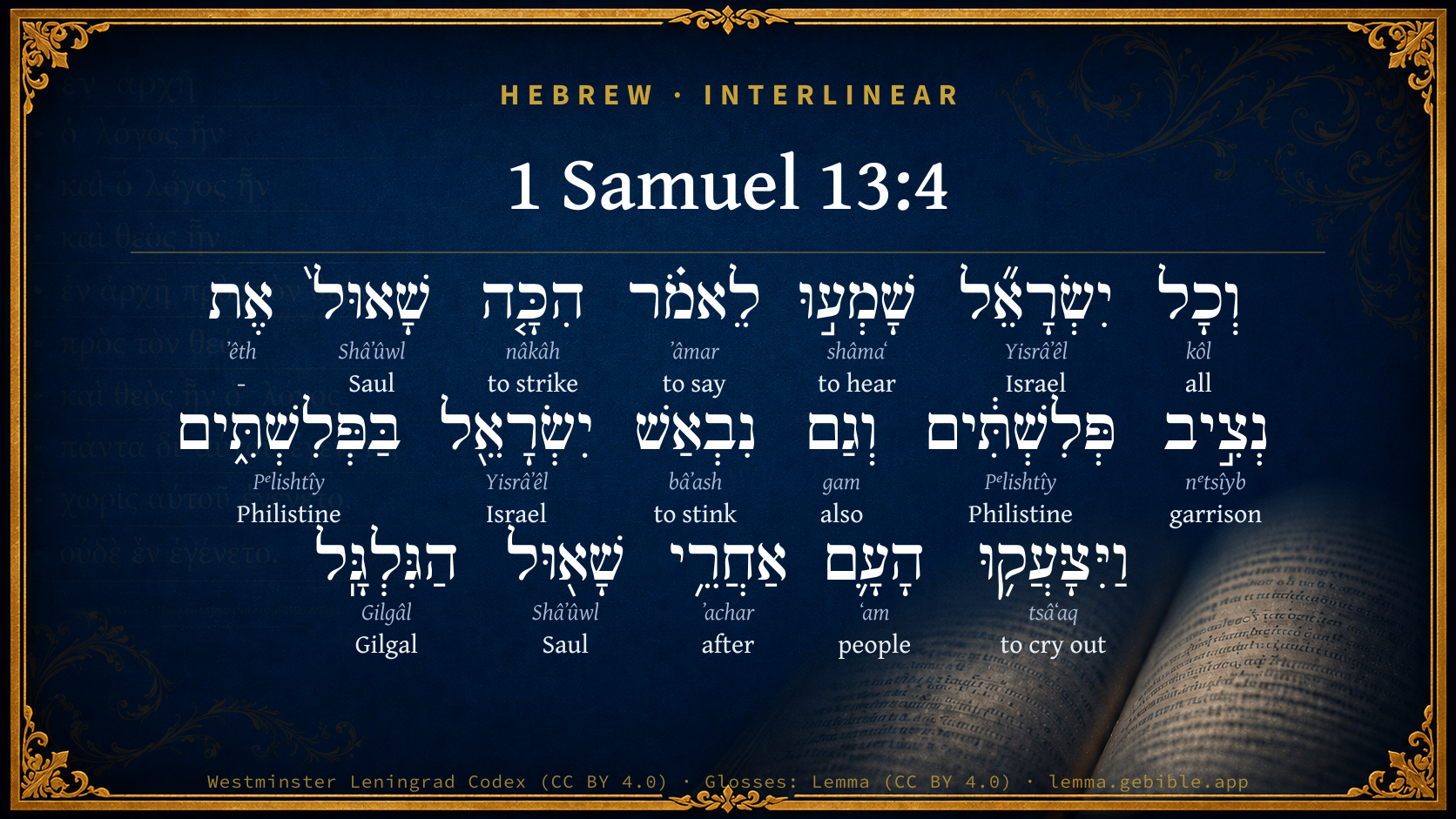
Hebrew (Westminster Leningrad Codex) 1 Samuel 13:4 appears in the Hebrew Old Testament. The text above is from the Westminster Leningrad Codex. Each word links to its Strong’s number, a concise gloss, and parsing drawn from the Open Scriptures Hebrew Bible morphology. Click any word for its full Brown-Driver-Briggs (BDB) entry.
Download image
Cite this verse

1 Samuel 13:4 (World English Bible). Public Domain. Lemma interlinear Bible study tool, https://lemma.gebible.app/v/1-samuel/13/4.

Show BibTeX & RIS
BibTeX
RIS
English Translation
All Israel heard say that Saul had struck the garrison of the Philistines, and also that Israel was had in abomination with the Philistines. The people were gathered together after Saul to Gilgal.
World English Bible · Public Domain
Download a study sheet

One document with this verse’s original text, its word-by-word gloss line, the meaning frame, cross-references with their text, attributed commentary, and full source and license credits — printable, and it pastes into notes with its structure intact.

This verse Autodidact and up

Study sheet (.html) Plain text (.txt)

A passage Seminary Student

Up to 50 verses in one chapter. A passage sheet keeps up to 6 commentary sources and 12 cross-references per verse, in the order this page ranks them, and says so on the sheet whenever that leaves anything out. Ask for a single verse and you get the Autodidact verse sheet above.

Everything on this page stays free to read, with no account — the sheet is a download of what is already on screen, not access to it.

Want to remove ads? Support Godless Engineer
Compare translations 3

The same verse in 3 English versions, stacked beneath the original-language interlinear above. Click any original word for its lexicon entry.

Each is an independent rendering of the whole verse — the interlinear is not word-aligned to these translations.

Highlighted words mark where these versions differ — a whole-verse word diff, not a word-by-word alignment.

  • World English Bible Public Domain
    All Israel heard say that Saul had struck the garrison of the Philistines, and also that Israel was had in abomination with the Philistines. The people were gathered together after Saul to Gilgal.
  • King James Version Public Domain
    And all Israel heard say that Saul had smitten a garrison of the Philistines, and that Israel also was had in abomination with the Philistines. And the people were called together after Saul to Gilgal.
  • unfoldingWord Literal Text CC BY-SA 4.0
    And all of Israel heard, saying, “Saul has struck the garrison of the Philistines, and now Israel has made itself stink among the Philistines.” And the people were summoned after Saul Gilgal.

unfoldingWord Literal Text — © unfoldingWord, licensed CC BY-SA 4.0. Word-aligned USFM3 via Door43 (git.door43.org/unfoldingWord/en_ult).

Versions to compare (up to 4)

3 of 4 selected

Show all 18 translations

Every available English version of this verse, each an independent rendering of the whole verse.

  • World English Bible Public Domain
    All Israel heard say that Saul had struck the garrison of the Philistines, and also that Israel was had in abomination with the Philistines. The people were gathered together after Saul to Gilgal.
  • Berean Standard Bible Public Domain
    And all Israel heard the news: “Saul has attacked an outpost of the Philistines, and now Israel has become a stench to the Philistines!” Then the people were summoned to join Saul at Gilgal.
  • Majority Standard Bible Public Domain
    And all Israel heard the news: “Saul has attacked an outpost of the Philistines, and now Israel has become a stench to the Philistines!” Then the people were summoned to join Saul at Gilgal.
  • King James Version Public Domain
    And all Israel heard say that Saul had smitten a garrison of the Philistines, and that Israel also was had in abomination with the Philistines. And the people were called together after Saul to Gilgal.
  • American Standard Version (1901) Public Domain
    And all Israel heard say that Saul had smitten the garrison of the Philistines, and also that Israel was had in abomination with the Philistines. And the people were gathered together after Saul to Gilgal.
  • Revised Version (1885) Public Domain
    And all Israel heard say that Saul had smitten the garrison of the Philistines, and that Israel also was had in abomination with the Philistines. And the people were gathered together after Saul to Gilgal.
  • Geneva Bible (1599) Public Domain
    And al Israel heard say, Saul hath destroied a garison of the Philistims: wherefore Israel was had in abomination with the Philistims: and the people gathered together after Saul to Gilgal.
  • Douay-Rheims (1899) Public Domain
    And all Israel heard this report: Saul hath smitten the garrison of the Philistines: and Israel took courage against the Philistines. And the people were called together after Saul to Galgal.
  • Young's Literal Translation Public Domain
    And all Israel have heard, saying, `Saul hath smitten the garrison of the Philistines,' and also, `Israel hath been abhorred by the Philistines;' and the people are called after Saul to Gilgal.
  • Literal Standard Version CC BY-SA 4.0
    And all Israel have heard, saying, “Saul has struck the garrison of the Philistines,” and also, “Israel has been abhorred by the Philistines”; and the people are called after Saul to Gilgal.
  • Unlocked Literal Bible CC BY-SA 4.0
    All Israel heard that Saul had defeated the garrison of the Philistines, and also that Israel had become a rotten smell to the Philistines. Then the soldiers were summoned together to join Saul at Gilgal.
  • unfoldingWord Literal Text CC BY-SA 4.0
    And all of Israel heard, saying, “Saul has struck the garrison of the Philistines, and now Israel has made itself stink among the Philistines.” And the people were summoned after Saul Gilgal.
  • Darby Bible Public Domain
    And all Israel heard say, Saul has smitten the garrison of the Philistines, and Israel also has become odious to the Philistines. And the people were called together after Saul to Gilgal.
  • World Messianic Bible Public Domain
    All Israel heard that Saul had struck the garrison of the Philistines, and also that Israel was considered an abomination to the Philistines. The people were gathered together after Saul to Gilgal.
  • Webster's Bible Public Domain
    And all Israel heard it said that Saul had smitten a garrison of the Philistines, and that Israel also was had in abomination with the Philistines: and the people were called together after Saul to Gilgal.
  • Free Bible Version CC BY-SA 4.0
    All of Israel heard the news, “Saul has attacked the Philistine garrison, and now Israel is like a bad smell to the Philistines!” So the whole army was called up to join Saul at Gilgal.
  • Bible in Basic English Public Domain
    And all Israel had the news that Saul had made an attack on the Philistines, and that Israel was bitterly hated by the Philistines. And the people came together after Saul to Gilgal.
  • JPS Tanakh (1917) Public Domain
    And all Israel heard say that Saul had smitten the garrison of the Philistines, and that Israel also had made himself odious with the Philistines. And the people were gathered together after Saul to Gilgal.

Literal Standard Version (2020), Covenant Press — licensed CC BY-SA 4.0. Text via the HelloAO Bible API (eBible.org). Unlocked Literal Bible (unfoldingWord) — licensed CC BY-SA 4.0. Text via the HelloAO Bible API (eBible.org). unfoldingWord Literal Text — © unfoldingWord, licensed CC BY-SA 4.0. Word-aligned USFM3 via Door43 (git.door43.org/unfoldingWord/en_ult). Free Bible Version, Dr. Jonathan Gallagher — licensed CC BY-SA 4.0. Text via the HelloAO Bible API (eBible.org).

Word by word

More ways to search: Search by grammar → Find every occurrence → Compare this word →

Practice this passage: Drill this verse → Learn its vocabulary →

נְצִ֣יב
nᵉtsîyb
H5333
“garrison of”
Noun, Common, Masculine, Singular, Construct
Part of Speech
Noun
Type
Common
Gender
Masculine
Number
Singular
State
Construct
Full BDB Definition

Origin: from H5324

TWOT: 1398b

set over, something placed, pillar, prefect, garrison, post - pillar - prefect, deputy
  1. וְכָל kôl H3605 “and · all of” Conjunction + Noun, Common, Masculine, Singular, Construct
  2. יִשְׂרָאֵ֞ל Yisrâʼêl H3478 “Israel” Noun, Proper
  3. שָׁמְע֣וּ shâmaʻ H8085 “to hear” Verb, Qal, Perfect, 3rd Person, Common, Plural
  4. לֵאמֹ֗ר ʼâmar H559 “to say” Preposition + Verb, Qal, Infinitive Construct
  5. הִכָּ֤ה nâkâh H5221 “to strike” Verb, Hiphil, Perfect, 3rd Person, Masculine, Singular
  6. שָׁאוּל֙ Shâʼûwl H7586 “Saul” Noun, Proper
  7. אֶת ʼêth H853 “-” Particle, Direct Object
  8. פְּלִשְׁתִּ֔ים Pᵉlishtîy H6430 “Philistines” Noun, Gentilic, Masculine, Plural, Absolute
  9. וְגַם gam H1571 “and · also” Conjunction + Particle, Accusative
  10. נִבְאַשׁ bâʼash H887 “to stink” Verb, Niphal, Perfect, 3rd Person, Masculine, Singular
  11. יִשְׂרָאֵ֖ל Yisrâʼêl H3478 “Israel” Noun, Proper
  12. בַּפְּלִשְׁתִּ֑ים Pᵉlishtîy H6430 “in/at the · Philistines” Preposition, Determined + Noun, Gentilic, Masculine, Plural, Absolute
  13. וַיִּצָּעֲק֥וּ tsâʻaq H6817 “and · to cry out” Conjunction + Verb, Niphal, Sequential Imperfect, 3rd Person, Masculine, Plural
  14. הָעָ֛ם ʻam H5971 “the · people” Particle, Definite Article + Noun, Common, Masculine, Singular, Absolute
  15. אַחֲרֵ֥י ʼachar H310 “after” Preposition
  16. שָׁא֖וּל Shâʼûwl H7586 “Saul” Noun, Proper
  17. הַגִּלְגָּֽל Gilgâl H1537 “the · Gilgal” Particle, Definite Article + Noun, Proper

About this verse

These counts appear in no published source. They are computed here, from the morphology-tagged text and Lemma’s own curated glosses. What Lemma adds →

18
words
15
distinct lemmas
Historical
section

Notable vocabulary

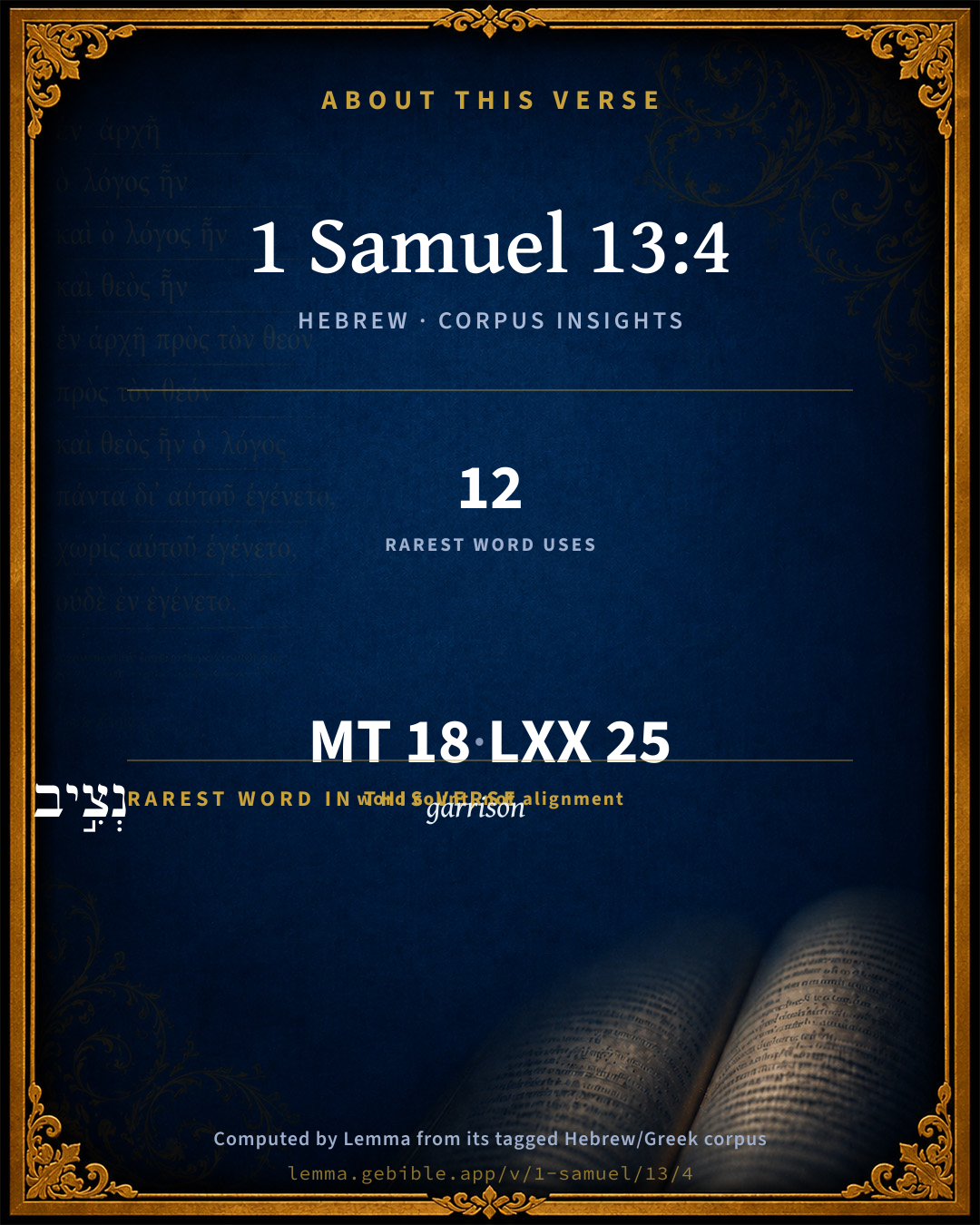
The rarest word here is נְצִ֣יב garrison H5333 — appearing just 12 times in the whole Hebrew Bible.

Shared distinctive vocabulary

נְצִ֣יב garrison H5333 occurs in 11 verses of the Hebrew Bible. Also found in:

Grammatical profile

  • 5 verbs
  • 10 nouns
  • 1 preposition
  • 2 particles

Verb forms

  • שָׁמְע֣וּ Qal · Perfect
  • לֵאמֹ֗ר Qal · Infinitive Construct
  • הִכָּ֤ה Hiphil · Perfect
  • נִבְאַשׁ Niphal · Perfect
  • וַיִּצָּעֲק֥וּ Niphal · Sequential Imperfect

Repetition

Words recur within this verse — often emphatic in Hebrew:

  • יִשְׂרָאֵ֞ל Israel H3478 ×2
  • שָׁאוּל֙ Saul H7586 ×2
  • פְּלִשְׁתִּ֔ים Philistine H6430 ×2

Hebrew & Septuagint length

In English translation the verse runs 33 words from the Hebrew and 32 from the Septuagint (LXX English) — closely comparable.

A rough comparison of the two English renderings, which tokenize alike — not a word-level alignment.

Word counts can differ between the Hebrew and the Greek without any difference in meaning — e.g. the Hebrew direct-object marker אֵת has no separate Greek word, and Greek often adds the article ὁ.

In the original languages it is 18 Hebrew tokens and 25 Greek tokens — but the two are counted differently (Hebrew bundles its prefixes and suffixes into one token; the Greek is in lemma form), so that isn’t a like-for-like length.

Cross-references

7

Topical passages linked to 1 Samuel 13:4 in the Treasury of Scripture Knowledge — connected by theme and wording, ordered by reader-vote popularity; previews shown in the World English Bible.

  • Genesis 34:30 Jacob said to Simeon and Levi, "You have troubled me, to make me odious to the inhabitants of the land, among the Canaanites and the Perizzites. I am few in number. They will gather themselves together against me and strike me, and I will be destroyed, I and my house."
  • Exodus 5:21 and they said to them, "May Yahweh look at you, and judge, because you have made us a stench to be abhorred in the eyes of Pharaoh, and in the eyes of his servants, to put a sword in their hand to kill us."
  • Genesis 46:34 that you shall say, 'Your servants have been keepers of cattle from our youth even until now, both we, and our fathers:' that you may dwell in the land of Goshen; for every shepherd is an abomination to the Egyptians."
  • Joshua 5:9 Yahweh said to Joshua, This day have I rolled away the reproach of Egypt from off you. Therefore the name of that place was called Gilgal, to this day.
  • 1 Samuel 10:8 You shall go down before me to Gilgal; and, behold, I will come down to you, to offer burnt offerings, and to sacrifice sacrifices of peace-offerings: seven days shall you wait, until I come to you, and show you what you shall do.
  • 1 Samuel 11:14–15 Then said Samuel to the people, Come, and let us go to Gilgal, and renew the kingdom there.
  • Zechariah 11:8 I cut off the three shepherds in one month; for my soul was weary of them, and their soul also loathed me.

Cross-references courtesy of OpenBible.info (CC BY 4.0).

Hebrew and Greek witnesses Masoretic Hebrew ↔ Greek Septuagint

The same verse in the two great witnesses to the Old Testament, shown verse-for-verse.

These are two independent witnesses, not word-aligned to each other, and the Septuagint is shown in lemma (dictionary) form.

Hebrew 1 Samuel 13:4 Masoretic · Westminster Leningrad Codex

וְכָל יִשְׂרָאֵ֞ל שָׁמְע֣וּ לֵאמֹ֗ר הִכָּ֤ה שָׁאוּל֙ אֶת נְצִ֣יב פְּלִשְׁתִּ֔ים וְגַם נִבְאַשׁ יִשְׂרָאֵ֖ל בַּפְּלִשְׁתִּ֑ים וַיִּצָּעֲק֥וּ הָעָ֛ם אַחֲרֵ֥י שָׁא֖וּל הַגִּלְגָּֽל

All Israel heard say that Saul had struck the garrison of the Philistines, and also that Israel was had in abomination with the Philistines. The people were gathered together after Saul to Gilgal.

World English Bible · Public Domain

Greek LXX 1 Samuel 13:4 Septuagint · lemma form

καί πᾶς ἰσραήλ ἀκούω λέγω παίζω σαούλ ὁ νασιβ ὁ ἀλλόφυλος καί αἰσχύνω ἰσραήλ ἐν ὁ ἀλλόφυλος καί ἀναβοάω ὁ λαός ὀπίσω σαούλ ἐν γάλγαλα

And all Israel heard say, Saul has struck Nasib the Philistine; now Israel had been put to shame before the Philistines; and the children of Israel went up after Saul in Galgala.

LXX2012 (modern English Septuagint) · Public Domain

On this verse, Haydock's Catholic Bible Commentary discusses the Septuagint’s reading. Read the note in Commentary ↓

Hebrew: Westminster Leningrad Codex (CC BY 4.0). Greek: Septuagint (public domain); English from LXX2012 (modern English Septuagint) (Public Domain). How the Septuagint differs from the Hebrew →

Targum (Aramaic paraphrase)

1

The Targum is the ancient Jewish Aramaic paraphrase of the Hebrew Scriptures — an interpretive translation, not the Hebrew text itself. Onkelos (literal) and Pseudo-Jonathan (expansive) render the Torah, and Jonathan the Prophets. Coverage is partial: where no permissively-licensed English translation exists for a verse, only the Aramaic is shown. This is verse-level text, not a word-by-word alignment to the Hebrew.

  1. Targum Jonathan Prophets (Joshua–Malachi)
    וְכָל יִשְׂרָאֵל שְׁמָעוּ לְמֵימַר מְחָא שָׁאוּל יַת אִסְטַרְטִיגֵי פְלִישְׁתָּאֵי וְאַף אִתְגְרִי יִשְׂרָאֵל בִּפְלִשְׁתָּאֵי וְאִתְכְּנִישׁוּ עַמָא בָּתַר שָׁאוּל לְגִלְגָלָא:

    (no public-domain English translation for this verse)

    Targum Jonathan — Aramaic: “Mikraot Gedolot” (public domain). English: “Sefaria Community Translation” (CC0 1.0 (public-domain dedication)); “London "Chaldee Paraphrase," 1871” (public domain). Text via Sefaria.

Commentary

Notes on 1 Samuel 13:4 from classic Christian and Jewish commentators (each source and its license shown beneath its notes). The classic Christian expositions comment on the surrounding passage and are grouped to its opening verse, so a note may address several verses; the Jewish commentaries on the Tanakh (Rashi and others) are per-verse, so they appear only where the commentator wrote on this verse.

Lemma curates 59 commentaries, every one of them public domain or Creative Commons licensed, each selected and text-cleaned for this edition rather than reprinted as found. About our sources →

Trapp's Complete Commentary

John Trapp

1Sa 13:4 And all Israel heard say [that] Saul had smitten a garrison of the Philistines, and [that] Israel also was had in abomination with the Philistines. And the people were called together after Saul to Gilgal.

Ver. 4. That Saul had smitten a garrison.] As desirous to rid the country of those Lurdaines.

And that Israel also was had in abomination.] Heb., Did stink; were as loathsome to them as any carrion. It was quarrel enough to the Hebrews, that they would not be miserable, but sought to unslave themselves.

John Trapp, A Commentary or Exposition upon All the Books of the Old and New Testament (1647–1656) — public domain. Text from a community e-Sword module.

Tyndale Open Study Notes

Tyndale Open Resources

13:4 Saul had destroyed: The commander in chief often got credit for what his soldiers accomplished. • Saul’s kingship had been reaffirmed at Gilgal (11:15). Now the Lord would reject his kingship there because of his disobedience (13:7-14).

Tyndale Open Study Notes — © Tyndale Open Resources, licensed CC BY-SA 4.0. Text via the HelloAO Bible API.

Adam Clarke's Commentary

Verse 4. The people were called together] The smiting of this garrison was the commencement of a war, and in effect the shaking off of the Philistine yoke; and now the people found that they must stand together, and fight for their lives.

Adam Clarke's Commentary on the Bible (1810–1826) — public domain. Text from a community e-Sword/MySword module.

Ellicott's Commentary for English Readers

(4) And all Israel heard.—Saul is put for “Jonathan,” though the bold deed had been performed by the young prince, Saul being the general-in-chief. The expression “smitten” implies that the garrison in question had been utterly routed, probably put to the sword. The intense hatred with which the Philistines hated the Hebrews is often brought forward. From the first conquest by Joshua they regarded them as interlopers and intruders; between the two peoples there was ceaseless warfare, until the Philistines were completely subdued by the greater Hebrew kings. Naturally, such a deed as that of Jonathan’s would at once arouse Philistia.

And the people were called together.—Gradually round the King of Israel the fighting men of the nation in great numbers were gathered. This seems to have been by no means a “levée en masse” of all the people; they seem to have come together very slowly, and very quickly again to have dispersed. The hour for a decisive blow was not yet come. Something, as we shall soon see, prevented Saul, with all his gallantry and splendid military skill, from winning popular confidence. (On Gilgal, the place where Saul was trying to assemble the people at this juncture, see Note on 1Sa_13:8 and Excursus E at the end of this Book.)

A Bible Commentary for English Readers, edited by Charles John Ellicott (1878–1897) — public domain. Text from a community e-Sword module.

The Cambridge Bible for Schools and Colleges

gen. ed. J. J. S. Perowne

4. heard say that Saul had smitten a garrison] Heard saying, Saul hath smitten the garrison of the Philistines. The first blow in the war of independence was doubtless struck by Jonathan under Saul’s direction.

was had in abomination] The same word meaning literally, “to make one’s self stink” occurs in Gen_34:30; Exo_5:21; 1Sa_27:12; 2Sa_10:6.

the people were called together after Saul to Gilgal] Gilgal (see note on 1Sa_7:15) was probably chosen for the rendezvous as being the usual meeting-place, and the least liable to an attack from the Philistines.

The Cambridge Bible for Schools and Colleges (gen. ed. J. J. S. Perowne; Cambridge University Press, 1878–1918) — public domain. Text from a community e-Sword module.

John Gill's Exposition

And all Israel heard say that Saul had smitten a garrison of the Philistines,.... For though it was smitten by Jonathan, yet it was by the order of Saul, and so ascribed to him; it seems to be a concerted thing to fall upon the garrisons of the Philistines, and get them out of their hands, and so deliver Israel entirely from them; but it was not wise for Saul, if he had such a scheme in his head, to disband his large army, as he had lately done:

and that Israel also was had in abomination with the Philistines; who were highly incensed against them by this action, and vowed revenge; the name of an Israelite was abhorred by them; and perhaps this action might be attended with much craft and cruelty; and if these garrisons were held by agreement, they might charge them with perfidy, with breach of articles, and so their name was made to stink among them, as the word signifies:

and the people were called together after Saul to Gilgal; by sound of trumpet.

John Gill's Exposition of the Whole Bible (1746–1763) — public domain (CC PDM 1.0). Text via the HelloAO Bible API.

Albert Barnes' Notes on the Bible

To Gilgal - The Wady Suweinit de-bouches into the plain of the Jordan in which Gilgal was situated. For the sanctity of Gilgal, see above, 1Sa 11:14 note.

Albert Barnes' Notes on the Bible (1834–1885) — public domain. Text from a community e-Sword/MySword module.

Haydock's Catholic Bible Commentary

Courage. Hebrew, "and Israel was in abomination (stinking) with the Philistines." See Exodus vi. 21. (Calmet) --- Septuagint, "despised as nothing the strangers." --- Were should be omitted, as the verb is active, clamavit, in the Vulgate and Septuagint, though the Protestants have "were called," &c. They shouted with alacrity, that Saul would lead them on to battle. (Haydock) --- Osiander thinks that they "exclaimed against him," for engaging them in this new war.

George Leo Haydock (1774–1849), Haydock's Catholic Family Bible and Commentary, 1859 edition — public domain. Excludes Psalms (Douay-Rheims chapter numbering differs from Protestant) and Deuterocanonical books (Catholic canon only).

Matthew Poole's English Annotations

Saul had smitten, i.e. Jonathan by Saul’s direction and encouragement. The actions of an army are commonly ascribed to their general.

Gilgal; the place before appointed by Samuel, 1Sa 10:8.

Matthew Poole's English Annotations on the Holy Bible (1683–1685) — public domain. Text from a community e-Sword/MySword module.

Whedon's Commentary on the Bible

Daniel D. Whedon

4. Was had in abomination — נבאשׁ, was made to stink; that is, had become loathsome and hateful to their enemies. When they heard that this Philistine garrison had been dislodged, the Hebrews understood at once that their old enemy of the seacoast would be provoked to war.

The people… after Saul to Gilgal — The same Gilgal where the kingdom was renewed, (1Sa_11:14,) and where Samuel judged Israel. 1Sa_7:16. It was situated in the east border of Jericho, and was the first camping ground of the Israelites after their entrance into the Land of Promise. Jos_4:19. It is said (1Sa_13:12) to be down from Michmash, and also that Samuel went up from it in order to reach Gibeah. Such statements would be improper if made of the northern Gilgal, (Jiljilia,) for that was up both from Gibeah and Michmash. Saul, seeing the Philistines attempting a bold and determined invasion, deemed it prudent to withdraw his own forces from the heights of Michmash and Beth-el, and gather the people together in this more retired spot of the Jordan valley.

Daniel D. Whedon (gen. ed.), Commentary on the Old and New Testaments (1874–1909) — public domain. Text from a community e-Sword module.

The Pulpit Commentary

That Saul had smitten. Though the achievement was actually Jonathan"s, yet it belonged to Saul as the commander-in-chief, and probably had been done under his instructions. Israel was had in abomination with the Philistines. They must have viewed with grave displeasure Israel"s gathering together to choose a king, and Saul"s subsequent defeat of the Ammonites, and retention with him of a large body of men, and so probably they had been for some time making preparations for war. Saul, therefore, knowing that they were collecting their forces, does the same, and the people were called together after Saul. Literally, "were cried after him," i.e. were summoned by proclamation. (comp. Jud_1:7:23, 24 10:17, where see margin) For Gilgal see 1Sa_7:16 1Sa_11:14. This place had been selected because, as the valley opens there into the plain of Jordan it was a fit spot for the assembling of a large host. For its identification see Conder, "Tent Work," 2:7-12.

The Pulpit Commentary (1880–1919), ed. H.D.M. Spence-Jones & Joseph S. Exell — public domain. Text from a community e-Sword module.

John Wesley's Explanatory Notes

Saul - Perhaps contrary to some treaty.

John Wesley, Explanatory Notes Upon the Whole Bible (1754–1765) — public domain. Text via the GEBible commentary corpus.

Rashi

Rabbi Shlomo Yitzchaki (Rashi)

And that Yisroel has become hateful. Literally, they have come in bad odor with the Philistines, an expression of hatred.

To follow Shaul to Gilgol. This is what Shmuel had said to him, "you shall go down to Gilgol ahead of me."

Rashi on the Tanakh — English translations: “The Judaica Press complete Tanach with Rashi, translated by A. J. Rosenberg” (CC BY 4.0); “Pentateuch with Rashi's commentary by M. Rosenbaum and A.M. Silbermann, 1929-1934” (public domain); “The Metsudah Tanach series, Lakewood, N.J” (CC BY 4.0); and “The Book of Joshua, Metsudah Publications, 1997” (CC BY 4.0). Text via Sefaria.

Lesson kit

Teaching starters — assembled from the data on this page, not authored interpretation. Every prompt links to the verse data it draws on. Edit before teaching.

1 Samuel, in the Historical, opens this verse with 18 words (15 distinct Hebrew lemmas). Its most distinctive word is nᵉtsîyb (“garrison”). A historical commentator’s framing appears above. Read the whole chapter for the surrounding context.

Discussion questions

  1. What does “garrison” (nᵉtsîyb) contribute to the verse as a whole?
  2. Genesis 19:26 shares the word «garrison» with this verse. How do the two illuminate each other?
  3. “Israel” occurs 2× in this one verse. What is the effect of the repetition?
  4. These translations render this verse differently. What is at stake in choosing one wording over another?
  5. The verb «שָׁמְע֣וּ» is Qal Perfect. How does its form color the action?
  6. Reading how Trapp's Complete Commentary and Tyndale Open Study Notes read this verse, where do the two commentators agree and where do they part?

Things to notice

Reading settings

Reading text

Shown beneath each verse's original-language words.

Old Testament
Old Testament edition

Read the OT as the Masoretic Hebrew (MT) or the Greek Septuagint (LXX).

English shown for the Greek Septuagint (in the Hebrew ↔ Greek comparison).

Comparing translations? Open the Compare panel on any verse page to stack up to four side by side.