
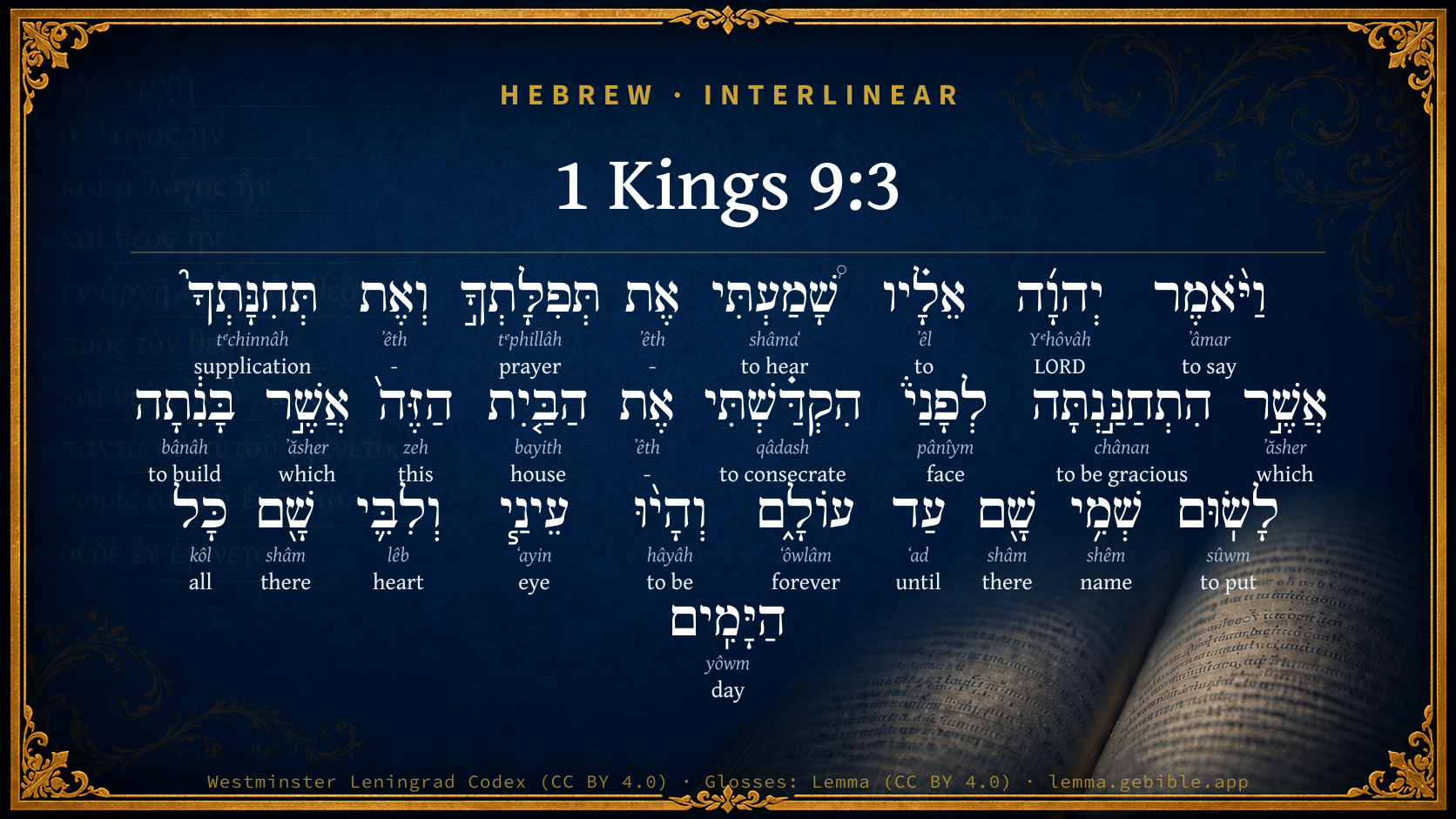
1 Kings 9:3

Hebrew (Westminster Leningrad Codex) 1 Kings 9:3 appears in the Hebrew Old Testament. The text above is from the Westminster Leningrad Codex. Each word links to its Strong’s number, a concise gloss, and parsing drawn from the Open Scriptures Hebrew Bible morphology. Click any word for its full Brown-Driver-Briggs (BDB) entry.
Download image
Cite this verse

1 Kings 9:3 (World English Bible). Public Domain. Lemma interlinear Bible study tool, https://lemma.gebible.app/v/1-kings/9/3.

Show BibTeX & RIS
BibTeX
RIS
English Translation
Yahweh said to him, I have heard your prayer and your supplication, that you have made before me: I have made this house holy, which you have built, to put my name there forever; and my eyes and my heart shall be there perpetually.
World English Bible · Public Domain
Download a study sheet

One document with this verse’s original text, its word-by-word gloss line, the meaning frame, cross-references with their text, attributed commentary, and full source and license credits — printable, and it pastes into notes with its structure intact.

This verse Autodidact and up

Study sheet (.html) Plain text (.txt)

A passage Seminary Student

Up to 50 verses in one chapter. A passage sheet keeps up to 6 commentary sources and 12 cross-references per verse, in the order this page ranks them, and says so on the sheet whenever that leaves anything out. Ask for a single verse and you get the Autodidact verse sheet above.

Everything on this page stays free to read, with no account — the sheet is a download of what is already on screen, not access to it.

Want to remove ads? Support Godless Engineer
Compare translations 3

The same verse in 3 English versions, stacked beneath the original-language interlinear above. Click any original word for its lexicon entry.

Each is an independent rendering of the whole verse — the interlinear is not word-aligned to these translations.

Highlighted words mark where these versions differ — a whole-verse word diff, not a word-by-word alignment.

  • World English Bible Public Domain
    Yahweh said to him, I have heard your prayer and your supplication, that you have made before me: I have made this house holy, which you have built, to put my name there forever; and my eyes and my heart shall be there perpetually.
  • King James Version Public Domain
    And the LORD said unto him, I have heard thy prayer and thy supplication, that thou hast made before me: I have hallowed this house, which thou hast built, to put my name there for ever; and mine eyes and mine heart shall be there perpetually.
  • unfoldingWord Literal Text CC BY-SA 4.0
    And Yahweh said to him, “I have heard your prayer and your supplication that you supplicated to my face. I have consecrated this house that you have built, to put my name there to forever. And my eyes and my heart will be there all of the days.

unfoldingWord Literal Text — © unfoldingWord, licensed CC BY-SA 4.0. Word-aligned USFM3 via Door43 (git.door43.org/unfoldingWord/en_ult).

Versions to compare (up to 4)

3 of 4 selected

Show all 18 translations

Every available English version of this verse, each an independent rendering of the whole verse.

  • World English Bible Public Domain
    Yahweh said to him, I have heard your prayer and your supplication, that you have made before me: I have made this house holy, which you have built, to put my name there forever; and my eyes and my heart shall be there perpetually.
  • Berean Standard Bible Public Domain
    And the LORD said to him: “I have heard your prayer and petition before Me. I have consecrated this temple you have built by putting My Name there forever; My eyes and My heart will be there for all time.
  • Majority Standard Bible Public Domain
    And the LORD said to him: “I have heard your prayer and petition before Me. I have consecrated this temple, which you have built, by putting My Name there forever; My eyes and My heart will be there for all time.
  • King James Version Public Domain
    And the LORD said unto him, I have heard thy prayer and thy supplication, that thou hast made before me: I have hallowed this house, which thou hast built, to put my name there for ever; and mine eyes and mine heart shall be there perpetually.
  • American Standard Version (1901) Public Domain
    And Jehovah said unto him, I have heard thy prayer and thy supplication, that thou hast made before me: I have hallowed this house, which thou hast built, to put my name there for ever; and mine eyes and my heart shall be there perpetually.
  • Revised Version (1885) Public Domain
    And the LORD said unto him, I have heard thy prayer and thy supplication, that thou hast made before me: I have hallowed this house, which thou hast built, to put my name there for ever; and mine eyes and mine heart shall be there perpetually.
  • Geneva Bible (1599) Public Domain
    And the Lord sayd vnto him, I haue heard thy prayer and thy supplication, that thou hast made before me: I haue halowed this house (which thou hast built) to put my Name there for euer, and mine eyes, and mine heart shall be there perpetually.
  • Douay-Rheims (1899) Public Domain
    And the Lord said to him: I have heard thy prayer and thy supplication, which thou hast made before me: I have sanctified this house, which thou hast built, to put my name there for ever, and my eyes and my heart shall be there always.
  • Young's Literal Translation Public Domain
    and Jehovah saith unto him, `I have heard thy prayer and thy supplication with which thou hast made supplication before Me; I have hallowed this house that thou hast built to put My name there -- unto the age, and Mine eyes and My heart have been there all the days.
  • Literal Standard Version CC BY-SA 4.0
    and YHWH says to him, “I have heard your prayer and your supplication with which you have made supplication before Me; I have hallowed this house that you have built to put My Name there for all time, and My eyes and My heart have been there [for] all the days.
  • Unlocked Literal Bible CC BY-SA 4.0
    Then Yahweh said to him, “I have heard your prayer and your request that you have made before me. I have set apart this house, which you have built, to myself, to put my name there forever. My eyes and my heart will be there for all time.
  • unfoldingWord Literal Text CC BY-SA 4.0
    And Yahweh said to him, “I have heard your prayer and your supplication that you supplicated to my face. I have consecrated this house that you have built, to put my name there to forever. And my eyes and my heart will be there all of the days.
  • Darby Bible Public Domain
    And Jehovah said to him, I have heard thy prayer and thy supplication which thou hast made before me: I have hallowed this house, which thou hast built, to put my name there for ever; and mine eyes and my heart shall be there perpetually.
  • World Messianic Bible Public Domain
    The LORD said to him, “I have heard your prayer and your supplication that you have made before me. I have made this house holy, which you have built, to put my name there forever; and my eyes and my heart shall be there perpetually.
  • Webster's Bible Public Domain
    And the LORD said to him, I have heard thy prayer and thy supplication that thou hast made before me: I have hallowed this house, which thou hast built, to put my name there for ever; and my eyes and my heart shall be there perpetually.
  • Free Bible Version CC BY-SA 4.0
    The Lord told him, “I have heard your prayer and your request to me. I have dedicated this Temple you have built by placing my name on it forever; I will always watch over it and take care of it.
  • Bible in Basic English Public Domain
    And the Lord said to him, Your prayers and your requests for grace have come to my ears: I have made holy this house which you have made, and I have put my name there for ever; my eyes and my heart will be there at all times.
  • JPS Tanakh (1917) Public Domain
    And the LORD said unto him: 'I have heard thy prayer and thy supplication, that thou hast made before Me: I have hallowed this house, which thou hast built, to put My name there for ever; and Mine eyes and My heart shall be there perpetually.

Literal Standard Version (2020), Covenant Press — licensed CC BY-SA 4.0. Text via the HelloAO Bible API (eBible.org). Unlocked Literal Bible (unfoldingWord) — licensed CC BY-SA 4.0. Text via the HelloAO Bible API (eBible.org). unfoldingWord Literal Text — © unfoldingWord, licensed CC BY-SA 4.0. Word-aligned USFM3 via Door43 (git.door43.org/unfoldingWord/en_ult). Free Bible Version, Dr. Jonathan Gallagher — licensed CC BY-SA 4.0. Text via the HelloAO Bible API (eBible.org).

Word by word

More ways to search: Search by grammar → Find every occurrence → Compare this word →

Practice this passage: Drill this verse → Learn its vocabulary →

תְּחִנָּתְךָ֮
tᵉchinnâh
H8467
“supplication · your”
Noun, Common, Feminine, Singular, Construct + Suffix, Personal, 2nd Person, Masculine, Singular
Part of Speech
Noun
Type
Common
Gender
Feminine
Number
Singular
State
Construct
Full BDB Definition

Origin: from H2603

TWOT: 694f

favour, supplication, supplication for favour - favour - supplication for favour
  1. וַיֹּ֨אמֶר ʼâmar H559 “and · to say” Conjunction + Verb, Qal, Sequential Imperfect, 3rd Person, Masculine, Singular
  2. יְהוָ֜ה Yᵉhôvâh H3068 “LORD” Noun, Proper
  3. אֵלָ֗יו ʼêl H413 “to · him” Preposition + Suffix, Personal, 3rd Person, Masculine, Singular
  4. שָׁ֠מַעְתִּי shâmaʻ H8085 “to hear” Verb, Qal, Perfect, 1st Person, Common, Singular
  5. אֶת ʼêth H853 “-” Particle, Direct Object
  6. תְּפִלָּתְךָ֣ tᵉphillâh H8605 “prayer · your” Noun, Common, Feminine, Singular, Construct + Suffix, Personal, 2nd Person, Masculine, Singular
  7. וְאֶת ʼêth H853 “and · -” Conjunction + Particle, Direct Object
  8. אֲשֶׁ֣ר ʼăsher H834 “which” Particle, Relative
  9. הִתְחַנַּ֣נְתָּה chânan H2603 “to be gracious” Verb, Hithpael, Perfect, 2nd Person, Masculine, Singular
  10. לְפָנַי֒ pânîym H6440 “to/for · face(s) · my” Preposition + Noun, Common, Both, Plural, Construct + Suffix, Personal, 1st Person, Common, Singular
  11. הִקְדַּ֗שְׁתִּי qâdash H6942 “to consecrate” Verb, Hiphil, Perfect, 1st Person, Common, Singular
  12. אֶת ʼêth H853 “-” Particle, Direct Object
  13. הַבַּ֤יִת bayith H1004 “the · house” Particle, Definite Article + Noun, Common, Masculine, Singular, Absolute
  14. הַזֶּה֙ zeh H2088 “the · this” Particle, Definite Article + Pronoun, Demonstrative, Masculine, Singular
  15. אֲשֶׁ֣ר ʼăsher H834 “which” Particle, Relative
  16. בָּנִ֔תָה bânâh H1129 “to build” Verb, Qal, Perfect, 2nd Person, Masculine, Singular
  17. לָשֽׂוּם sûwm H7760 “to put” Preposition + Verb, Qal, Infinitive Construct
  18. שְׁמִ֥י shêm H8034 “name · my” Noun, Common, Masculine, Singular, Construct + Suffix, Personal, 1st Person, Common, Singular
  19. שָׁ֖ם shâm H8033 “there” Adverb
  20. עַד ʻad H5704 “until” Preposition
  21. עוֹלָ֑ם ʻôwlâm H5769 “forever” Noun, Common, Masculine, Singular, Absolute
  22. וְהָי֨וּ hâyâh H1961 “and · to be” Conjunction + Verb, Qal, Perfect, 3rd Person, Common, Plural
  23. עֵינַ֧י ʻayin H5869 “eyes · my” Noun, Common, Both, Dual, Construct + Suffix, Personal, 1st Person, Common, Singular
  24. וְלִבִּ֛י lêb H3820 “and · heart · my” Conjunction + Noun, Common, Masculine, Singular, Construct + Suffix, Personal, 1st Person, Common, Singular
  25. שָׁ֖ם shâm H8033 “there” Adverb
  26. כָּל kôl H3605 “all of” Noun, Common, Masculine, Singular, Construct
  27. הַיָּמִֽים yôwm H3117 “the · days” Particle, Definite Article + Noun, Common, Masculine, Plural, Absolute

About this verse

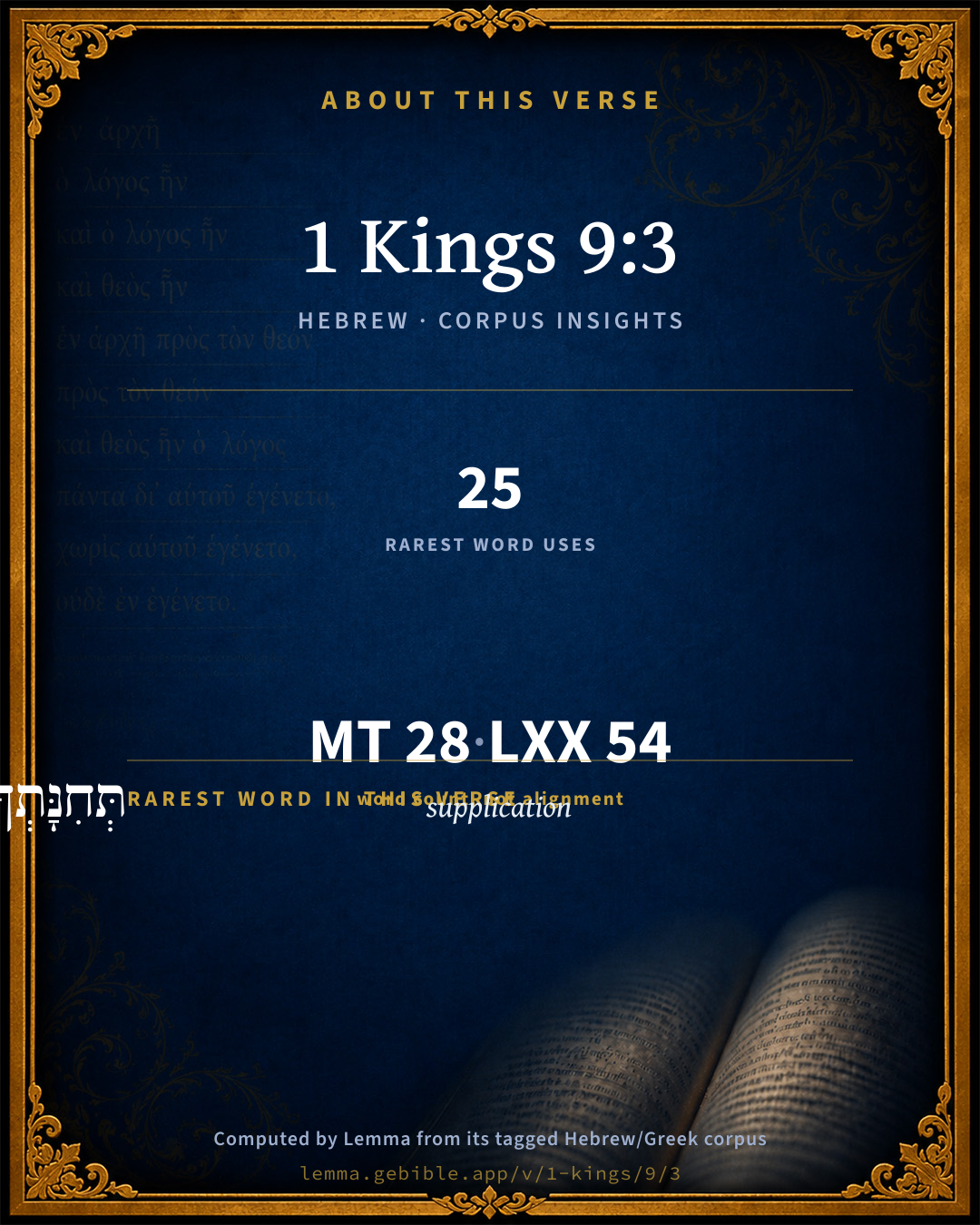
These counts appear in no published source. They are computed here, from the morphology-tagged text and Lemma’s own curated glosses. What Lemma adds →

28
words
24
distinct lemmas
Historical
section

Notable vocabulary

The rarest word here is תְּחִנָּתְךָ֮ supplication H8467 — appearing just 25 times in the whole Hebrew Bible.

Shared distinctive vocabulary

תְּחִנָּתְךָ֮ supplication H8467 occurs in 24 verses of the Hebrew Bible. Also found in:

Grammatical profile

  • 7 verbs
  • 11 nouns
  • 1 pronoun
  • 2 prepositions
  • 2 adverbs
  • 5 particles

Verb forms

  • וַיֹּ֨אמֶר Qal · Sequential Imperfect
  • שָׁ֠מַעְתִּי Qal · Perfect
  • הִתְחַנַּ֣נְתָּה Hithpael · Perfect
  • הִקְדַּ֗שְׁתִּי Hiphil · Perfect
  • בָּנִ֔תָה Qal · Perfect
  • לָשֽׂוּם Qal · Infinitive Construct
  • וְהָי֨וּ Qal · Perfect

Repetition

Words recur within this verse — often emphatic in Hebrew:

  • שָׁ֖ם there H8033 ×2
  • אֲשֶׁ֣ר which H834 ×2

Hebrew & Septuagint length

In English translation the verse runs 44 words from the Hebrew and 58 from the Septuagint (LXX English) — closely comparable.

A rough comparison of the two English renderings, which tokenize alike — not a word-level alignment.

Word counts can differ between the Hebrew and the Greek without any difference in meaning — e.g. the Hebrew direct-object marker אֵת has no separate Greek word, and Greek often adds the article ὁ.

In the original languages it is 28 Hebrew tokens and 54 Greek tokens — but the two are counted differently (Hebrew bundles its prefixes and suffixes into one token; the Greek is in lemma form), so that isn’t a like-for-like length.

Cross-references

23

Topical passages linked to 1 Kings 9:3 in the Treasury of Scripture Knowledge — connected by theme and wording, ordered by reader-vote popularity; previews shown in the World English Bible.

  • 1 Kings 8:29 that your eyes may be open toward this house night and day, even toward the place of which you have said, My name shall be there; to listen to the prayer which your servant shall pray toward this place.
  • 2 Kings 20:5 Turn back, and tell Hezekiah the prince of my people, Thus says Yahweh, the God of David your father, I have heard your prayer, I have seen your tears: behold, I will heal you; on the third day you shall go up to the house of Yahweh.
  • Psalms 10:17 Yahweh, you have heard the desire of the humble. You will prepare their heart. You will cause your ear to hear,
  • 1 John 5:14 This is the boldness which we have toward him, that, if we ask anything according to his will, he listens to us.
  • Psalms 116:1 I love Yahweh, because he listens to my voice, And my cries for mercy.
  • Deuteronomy 11:12 a land which Yahweh your God cares for: the eyes of Yahweh your God are always on it, from the beginning of the year even to the end of the year.
  • 2 Chronicles 6:40 Now, my God, let, I beg you, your eyes be open, and let your ears be attentive, to the prayer that is made in this place.
  • Psalms 132:13–14 For Yahweh has chosen Zion. He has desired it for his habitation.
  • Exodus 20:11 for in six days Yahweh made heaven and earth, the sea, and all that is in them, and rested the seventh day; therefore Yahweh blessed the Sabbath day, and made it holy.
  • Matthew 6:9 Pray like this: 'Our Father in heaven, may your name be kept holy.
  • Acts 10:31 and said, 'Cornelius, your prayer is heard, and your gifts to the needy are remembered in the sight of God.
  • Numbers 16:38 even the censers of these sinners against their own lives; and let them be made beaten plates for a covering of the altar: for they offered them before Yahweh; therefore they are holy; and they shall be a sign to the children of Israel.
  • Deuteronomy 12:11 then it shall happen that to the place which Yahweh your God shall choose, to cause his name to dwell there, there shall you bring all that I command you: your burnt offerings, and your sacrifices, your tithes, and the heave-offering of your hand, and all your choice vows which you vow to Yahweh.
  • Deuteronomy 16:11 and you shall rejoice before Yahweh your God, you, and your son, and your daughter, and your man-servant, and your maid-servant, and the Levite who is within your gates, and the foreigner, and the fatherless, and the widow, who are in the midst of you, in the place which Yahweh your God shall choose, to cause his name to dwell there.
  • 1 Kings 8:10–11 It came to pass, when the priests were come out of the holy place, that the cloud filled the house of Yahweh,
  • 2 Chronicles 7:15–16 Now my eyes shall be open, and my ears attentive, to the prayer that is made in this place.
  • Song of Solomon 4:9–10 You have ravished my heart, my sister, my bride. You have ravished my heart with one of your eyes, With one chain of your neck.
  • Jeremiah 15:1 Then said Yahweh to me, Though Moses and Samuel stood before me, yet my mind would not be toward this people: cast them out of my sight, and let them go forth.
  • Daniel 9:23 At the beginning of your petitions the commandment went forth, and I am come to tell you; for you are greatly beloved: therefore consider the matter, and understand the vision.
  • Psalms 66:19 But most assuredly, God has listened. He has heard the voice of my prayer.
  • John 11:42 I know that you always listen to me, but because of the multitude that stands around I said this, that they may believe that you sent me."
  • Deuteronomy 12:5 But to the place which Yahweh your God shall choose out of all your tribes, to put his name there, even to his habitation shall you seek, and there you shall come;
  • Deuteronomy 12:21 If the place which Yahweh your God shall choose, to put his name there, be too far from you, then you shall kill of your herd and of your flock, which Yahweh has given you, as I have commanded you; and you may eat within your gates, after all the desire of your soul.

Cross-references courtesy of OpenBible.info (CC BY 4.0).

Hebrew and Greek witnesses Masoretic Hebrew ↔ Greek Septuagint

The same verse in the two great witnesses to the Old Testament, shown verse-for-verse.

These are two independent witnesses, not word-aligned to each other, and the Septuagint is shown in lemma (dictionary) form.

Hebrew 1 Kings 9:3 Masoretic · Westminster Leningrad Codex

וַיֹּ֨אמֶר יְהוָ֜ה אֵלָ֗יו שָׁ֠מַעְתִּי אֶת תְּפִלָּתְךָ֣ וְאֶת תְּחִנָּתְךָ֮ אֲשֶׁ֣ר הִתְחַנַּ֣נְתָּה לְפָנַי֒ הִקְדַּ֗שְׁתִּי אֶת הַבַּ֤יִת הַזֶּה֙ אֲשֶׁ֣ר בָּנִ֔תָה לָשֽׂוּם שְׁמִ֥י שָׁ֖ם עַד עוֹלָ֑ם וְהָי֨וּ עֵינַ֧י וְלִבִּ֛י שָׁ֖ם כָּל הַיָּמִֽים

Yahweh said to him, I have heard your prayer and your supplication, that you have made before me: I have made this house holy, which you have built, to put my name there forever; and my eyes and my heart shall be there perpetually.

World English Bible · Public Domain

Greek LXX 1 Kings 9:3 Septuagint · lemma form

καί εἶπον πρός αὐτός κύριος ἀκούω ὁ φωνή ὁ προσευχή σύ καί ὁ δέησις σύ ὅς δέω ἐνώπιον ἐγώ ποιέω σύ κατά πᾶς ὁ προσευχή σύ ἁγιάζω ὁ οἶκος οὗτος ὅς οἰκοδομέω ὁ τίθημι ὁ ὄνομα ἐγώ ἐκεῖ εἰς ὁ αἰών καί εἰμί ὁ ὀφθαλμός ἐγώ ἐκεῖ καί ὁ καρδία ἐγώ πᾶς ὁ ἡμέρα

And the Lord said to him, I have heard the voice of your prayer, and your supplication which you made before me: I have done for you according to all your prayer: I have hallowed this house which you have built to put my name there for ever, and my eyes and my heart shall be there always.

LXX2012 (modern English Septuagint) · Public Domain

On this verse, The Cambridge Bible for Schools and Colleges discusses the Septuagint’s reading. Read the note in Commentary ↓

Hebrew: Westminster Leningrad Codex (CC BY 4.0). Greek: Septuagint (public domain); English from LXX2012 (modern English Septuagint) (Public Domain). How the Septuagint differs from the Hebrew →

Targum (Aramaic paraphrase)

1

The Targum is the ancient Jewish Aramaic paraphrase of the Hebrew Scriptures — an interpretive translation, not the Hebrew text itself. Onkelos (literal) and Pseudo-Jonathan (expansive) render the Torah, and Jonathan the Prophets. Coverage is partial: where no permissively-licensed English translation exists for a verse, only the Aramaic is shown. This is verse-level text, not a word-by-word alignment to the Hebrew.

  1. Targum Jonathan Prophets (Joshua–Malachi)
    וַאֲמַר לֵיהּ שְׁמִיעַ קֳדָמַי צְלוֹתָךְ וּבָעוּתָךְ דִבְעֵיתָא מִן קֳדָמַי אַקְדֵישִׁית יַת בֵּיתָא הָדֵין דִי בְנֵיתָא לְאַשְׁרָאָה שְׁכִנְתִּי תַמָן עַד עַלְמָא וּתְהֵי שְׁכִנְתִּי שַׁרְיָא בֵיהּ אִם רְעוּתִי מִתְעַבְּדָא תַמָן כָּל יוֹמַיָא:

    (no public-domain English translation for this verse)

    Targum Jonathan — Aramaic: “Mikraot Gedolot” (public domain). English: “Sefaria Community Translation” (CC0 1.0 (public-domain dedication)); “London "Chaldee Paraphrase," 1871” (public domain). Text via Sefaria.

Commentary

Notes on 1 Kings 9:3 from classic Christian and Jewish commentators (each source and its license shown beneath its notes). The classic Christian expositions comment on the surrounding passage and are grouped to its opening verse, so a note may address several verses; the Jewish commentaries on the Tanakh (Rashi and others) are per-verse, so they appear only where the commentator wrote on this verse.

Lemma curates 59 commentaries, every one of them public domain or Creative Commons licensed, each selected and text-cleaned for this edition rather than reprinted as found. About our sources →

Trapp's Complete Commentary

John Trapp

1Ki 9:3 And the LORD said unto him, I have heard thy prayer and thy supplication, that thou hast made before me: I have hallowed this house, which thou hast built, to put my name there for ever; and mine eyes and mine heart shall be there perpetually.

Ver. 3. I have heard thy prayer.] God sometimes answereth his people before they ask, {Isa 65:24} as he did David; {Psa 32:5} sometimes as they are asking, as he did Daniel; {Dan 9:20} but certainly after they have prayed, provided that they bring to him lawful petitions and honest hearts. The reason whereof, see Joh 16:26-27.

Mine eyes and my heart shall be there.] It shall well be seen that this house is mihi chara, cordi, et curae.

John Trapp, A Commentary or Exposition upon All the Books of the Old and New Testament (1647–1656) — public domain. Text from a community e-Sword module.

Joseph Benson's Commentary

1Ki 9:3. The Lord said, I have heard thy prayer — This shows that the first verse is to be understood as we have just stated: for otherwise we must suppose this appearance of God to Solomon to have taken place, and this answer to have been given to his prayer, eleven years after he had finished the house, and addressed that prayer to him at the dedication of it; which is very unlikely. I have hallowed this house — By my glorious presence in the cloud, and by my acceptance of thy sacrifices. I have sanctified it to my proper use and service. Solomon had dedicated it, but it was God’s prerogative to hallow or consecrate it. Men cannot make a place holy; yet what we in sincerity devote to God, we may hope he will graciously accept as his. To put my name there for ever — As long as the Mosaic dispensation lasts: whereas hitherto my worship has been successively in several places. And mine eyes — My watchful and gracious providence. My heart — My true and tender affection. Shall be there perpetually — Shall be toward this place and people, upon condition of your obedience, as it here follows. Apply this to persons, to God’s living temples: those whom he hallows or sanctifies; whom he sets apart for himself, in consequence of their repentance and faith in Jesus, have his eye upon and his heart toward them; they have his love and his care, and this perpetually.

Joseph Benson's Commentary on the Old and New Testaments (1811–1818) — public domain. Text from a community e-Sword module.

The Preacher's Complete Homiletical Commentary

Joseph S. Exell (gen. ed.)

CRITICAL AND EXPLANATORY NOTES.—

1Ki_9:3. Sept. inserts, after “Supplication that thou hast made before me,” “I have done to thee according to all thy prayer.”

1Ki_9:6. If ye shall at all turn.—A. V. implies only the slightest dereliction, “at all turn;” whereas שוֹב תְּשֻׁבוֹן is an intensive Hebraism, implying entirety, absolute apostasy. Which I have set before you: or, Moses set before you; so Sept. Notice also that the threatening (1Ki_9:7) is a quotation from Moses (Deu_28:37).

1Ki_9:8. This house is high—Omit italicised words at and which; is high=future tense, shall be high עֶלְיוֹן not exalted in renown (as Von Meyer, De Wette, Bähr), but shall stand high, a conspicuous example, a pre-eminent illustration of destruction. Others (the Peshito and Dr. Böttcher), “this house shall be a heap.” Sept.=ὁ οἶκος οὗτος ἔσται ὁ υψηλός. Vulg., et domus hæc crit in exemplum.

HOMILETICS OF 1Ki_9:3-9

RELIGION THE GLORY OF A NATION

I. That the religion of a nation does not consist in anything external.

1. Not in the grandeur of its temples. Architecture and artistic decoration are not essential to true piety. The most exquisite creations of the trowel and mallet can never rival the glorious edifice which has been already reared by the master hand of Deity. Nature is one vast cathedral, with its roof fretted with clouds and gemmed with stars; its aisles are the long-extended valleys; its pillars the lofty, massive hills; its altar the spot where the worshipper reverently bends his knee; and its music the manifold voices that rise from bird, or forest, or sea. Some of the costliest temples built by the art and adorned by the genius of man are consecrated to the worship of other than the only true God.

2. Not in the elaborateness of its ritual. The rites and ceremonies of the Israelitish religion in the days of Solomon were minute and exacting. Their worship was a rich, imposing pageant, calculated to impress both the worshipper and the spectator; and their history shows with what scrupulosity they observed the forms of their ritual when the spirit which gave those forms life and meaning was altogether quenched. It is the tendency of man to rest in the outward; and the devoutest worshipper has often to complain—

But I of means have made my boast,

Of means an idol made;

The spirit in the letter lost,

The substance in the shade.

3. Religion consists in the sincere worship of an ever-present God. The true glory of Moriah’s Temple was the hallowing presence of Jehovah. “I have hallowed this house which thou hast built, to put my name there for ever; and mine eyes and mine heart shall be there perpetually” (1Ki_9:3). When we fail to recognize the true God, when we forget His eye is upon us, when we are no longer conscious of His personal and all-compassionate love, religion ceases to be a power, ceases to be a reality. We may take our place in the temple, we may engage mechanically in its services, but there is no longer any true, acceptable worship (Mat_15:8-9).

II. That the religion of a nation depends for its permanence on obedience to God (1Ki_9:4-5).

1. Obedience is regulated by clearly defined injunctions. “To do according to all that I have commanded thee, and wilt keep my statutes and my judgments.” Obedience must be intelligent, be governed by a studious appreciation of the Divine commands. We are surrounded by law. We cannot properly fulfil the great purpose of life without some acquaintance with the laws and forces in operation around us. The mariner needs it in order to pilot his vessel aright, the scientist to guide him in research, the physician to ameliorate human suffering. There should not be less study given to the laws of God for the government of our moral actions than is given to the laws of nature.

2. Obedience must be genuine and complete. “In integrity of heart and in uprightness.” We must be sincere. When we remember with what energy and publicity we have sometimes served sin, we should be animated with the more courage and earnestness in serving God. “He doeth not God’s will but his own, who doeth no more than himself will. Everything must be done as well as anything, else we do nothing.”

3. Obedience is illustrated by noble examples. “If thou wilt walk before me as David thy father walked.” God expects no impossibility. What one man has done, another may do. David had great imperfections; but he had also great virtues. The seed of the godly cannot expect to enjoy the entail of the blessing unless they tread in the steps of those who have gone before, and keep up the piety of their ancestors. Solomon’s subsequent fall lends to these repeated warnings a special interest.

4. Obedience ensures perpetuity of blessing. “Then I will establish the throne of thy kingdom upon Israel for ever” (1Ki_9:5). Obedience and blessing run together. If we are faithful to our part of the covenant, God will never fail on His part. All the promises of God are conditional; and failure in fulfilment of the promise is no proof of changeableness in God, but of infidelity in man. While the condition is observed, the promise is inviolably kept.

III. That the decay of the religion of a nation is inevitably followed by national ruin (1Ki_9:6-9).

1. The ruin of its national greatness. “Then will I cut off Israel out of the land I have given them.” In the very land where the Jews were most highly exalted did they witness the most abject degradation. When the people forsook God, and turned to idols, the Temple of Solomon—the world-wide evidence of national prosperity and blessing—was destroyed, Israel ceased to be an independent kingdom, and the people were banished; and when, after the second temple was built, they rejected David’s greater Son—their promised, true, and eternal king in whom all nations of the earth were to be blessed—this temple was destroyed never to be rebuilt, and the people were scattered through the whole world, ceasing for ever to be an independent kingdom and nation. Irreligion will ruin a nation more completely than an invading army could do. The external evidences of national greatness are the last to go: the first fatal weakness begins within, and may progress for a time silently and unnoticed.

2. The ruin of its religious prestige. “And this house which I have hallowed for my name will I cast out of my sight.” The temple was the symbol and external evidence of the intense religiousness of the people. Never was there before a nation so favoured with religious privileges: it was its solemn mission to preserve and promulgate the idea of the Only True God, which idea had become lost amid the mists of heathenism. When Israel lost its religion it lost everything—temple, character, influence. The same is true of every nation that abandons God.

3. The ruin is held up as a terrible warning to all ages. “And Israel shall be a proverb and a bye-word among all people; and this house which is high (Heb. shall be high), every one that passeth by it shall be astonished, and shall hiss” (1Ki_9:7-8). Not a scornful hiss, but a hissing of terror (Jer_19:8; Jer_49:17). The temple and the nation shall be as conspicuous in their desolation as in their glory. No people in the world ever became such a proverb—everywhere despised, reviled, and persecuted. By its story it illustrates to all nations the unchanging truth uttered by the prophet Azariah to King Asa, “If ye forsake Him, He will forsake you” (2Ch_15:2).

LESSONS:—

1. Religion is at once the strength and the adornment of a people.

2. The chief concern of the monarch should be for the religious welfare of his people.

3. The nation that abandons God will be abandoned by Him.

GERM NOTES ON THE VERSES

1Ki_9:3. “To put my name there for ever.” God’s gifts are without repentance. When He puts His name in the temple, He does it, in intention, for ever. He will not arbitrarily withdraw it after so many years or so many centuries. Once placed there, it will remain there for ever, so far as God is concerned. But the people may, by unfaithfulness, drive it away.

—“Mine eyes and mine heart shall be there perpetually.” Solomon’s prayer had been that God’s eyes might be directed towards the temple continually. The answer given is—Not mine eyes only, but mine eyes and mine heart. To every house where the name of God is truly honoured applies the Divine saying, “Mine eyes and my heart shall dwell there for ever.”

—The Divine solicitude for the Church. 1. He investigates its moral condition.

2. He sympathises with its struggles.

3. He rejoices in its triumphs.

4. His care is unremitting.

1Ki_9:4. “If Thou wilt walk before me” (compared with 1Ki_9:6). The power of individualism.

1. The national is vastly influenced by the personal.

2. A monarch may foster or blast the religious interests of his people.

3. The greater the authority placed in the hands of one man, the greater is his responsibility for its use or abuse.

4. How momentous are the opportunities presented within the compass of a single life!

1Ki_9:6-9. Because men endure uninterrupted prosperity with much greater difficulty than they do crosses and afflictions, therefore, when they are at the summit of their wishes and their hearts’ desire, it is most necessary that the grave importance of God and of eternity should be held up before them, so that they may not fall into security, and forget to work out their own salvation with fear and trembling (Mat_16:26; 1Co_10:12). The more abundantly God displays His mercy and love towards an individual or towards a nation, so much the more fearful will be the righteous sentence, if the riches of His mercy are despised. In happy and prosperous days forget not that the Lord tells us, “Watch and pray, lest ye enter into temptation.” How many men, how many families, how many nations, blessed in every respect, have come to a fearful and shameful end! Askest thou—“Wherefore is this? The only reply is—Because they have forsaken the Lord their God; for what a man sows that shall he also reap. Let him who will not recognize a Divine justice, turn to the twice-destroyed temple of Jerusalem, and to the world-scattered people who have become a byeword amongst all nations.—Lange.

1Ki_9:7. If our growth in grace does not correspond with our privileges, our boast of the temple and the best form of worship will but delude and destroy us.

1Ki_9:9. Apostasy is hateful even among the heathen. Solyman, the Grand Signior, rejected the revolt of his Christian subjects to Turkism, and doubled their taxations.

The Preacher's Complete Homiletical Commentary (gen. ed. Joseph S. Exell; Funk & Wagnalls, c. 1892) — public domain (pre-1929). A full-Bible homiletical/sermon-outline anthology covering 65 of 66 books (2 John is absent from the source module). Text from a community e-Sword module.

Tyndale Open Study Notes

Tyndale Open Resources

9:3-9 The Lord answered Solomon’s prayer by reviewing the conditions of the covenant. Obedience would bring prosperity and the Lord’s blessing; disobedience could mean utter disaster, including destruction of the city and Temple, and deportation of God’s people (see Deut 28:36-37, 63-68). Although God’s covenant was irrevocable, receiving its blessings depended upon faithfulness to its terms (Ps 89:24-37).

Tyndale Open Study Notes — © Tyndale Open Resources, licensed CC BY-SA 4.0. Text via the HelloAO Bible API.

Ellicott's Commentary for English Readers

(3) To put my name there for ever.—The meaning of the words “for ever” is determined by the prayer which they answer. They simply mark the Temple as the “settled habitation to abide in for ever” (see 1Ki_8:13), in contradistinction from the movable tabernacle. Whether they were to have a larger significance is expressly declared to depend on the faithfulness of Israel (see 1Ki_9:7-8).

Mine eyes and mine heart.—See 8:29.

(3-9) And the Lord said unto him.—This vision of the Lord presents a remarkable contrast with that recorded in 1Ki_6:11-13, while the Temple was in building. Then all was promise and encouragement; now, not only is warning mingled with promise, but, as in Solomon’s own prayer, the sadder alternative seems in prophetic anticipation to overpower the brighter. In this there is (as has been often remarked) a striking exemplification of the austere and lofty candour of the inspired narrative, sternly contradicting that natural hopefulness in the hour of unexampled prosperity, which would have shrunk from even entertaining the idea that the blessing of God on the Temple should be frustrated, and the glory of Israel should pass away.

It is notable that, in its reference to the two parts of the promise to David, there is a subtle and instructive distinction. As for the Temple, now just built in fulfilment of that promise, it is declared without reserve that, in case of unfaithfulness in Israel, it shall be utterly destroyed, and become an astonishment and a proverb of reproach before the world. But in respect of the promise of the perpetuity of David’s kingdom—the true Messianic prediction, which struck the key-note of all future prophecies—it is only said that Israel shall be “cut off from the land,” and so “become a proverb and a byword” in captivity. Nothing is said to contradict the original declaration, that, even in case of sin, the mercy of God would chastise and not forsake the house of David (2Sa_7:13-14; Psa_89:30-37). So again and again in prophecy captivity is denounced as a penalty of Israel’s sin; but the hope of restoration is always held out, and thus the belief in God’s unchanging promise remains unshaken. The true idea is strikingly illustrated by the prophet Amos (1Ki_9:9-11): “I will sift the house of Israel, among all nations . . . yet shall not the least grain fall upon the earth . . . I will raise up the tabernacle of David that is fallen, and close up the breaches thereof.”

A Bible Commentary for English Readers, edited by Charles John Ellicott (1878–1897) — public domain. Text from a community e-Sword module.

The Cambridge Bible for Schools and Colleges

gen. ed. J. J. S. Perowne

3. I have heard thy prayer] This could not have been the form of God’s message, if thirteen years had passed away since the dedication. God’s way is rather that spoken of by Isa_65:24 ‘While they are yet speaking I will hear.’ The LXX. adds after the first clause of this verse ‘I have done for thee according to all thy prayer.’

to put my name there for ever] The place which God had chosen was now made known; and God’s purposes change not.

mine eyes and mine heart shall be there] As in the former vision at Gibeon, God had given more than Solomon asked, so it is here. The prayer was that God’s eyes might be open toward the house, the promise is that His heart shall be there perpetually.

This verse is largely expanded in 2Ch_7:12 seqq. thus: ‘I have heard thy prayer and have chosen this place to myself for an house of sacrifice. If I shut up heaven that there be no rain, or if I command the locusts to devour the land, or if I send pestilence among my people; if my people which are called by my name shall humble themselves and pray and seek my face and turn from their wicked ways, then will I hear from heaven, and will forgive their sin, and will heal their land. Now mine eyes shall be open and mine ears attent unto the prayer that is made in this place. For now I have chosen and sanctified this house that my name may be there for ever.’ This addition appears to be the work of a later writer who wished to express by it, that God’s answer was as large as the king’s prayer.

The Cambridge Bible for Schools and Colleges (gen. ed. J. J. S. Perowne; Cambridge University Press, 1878–1918) — public domain. Text from a community e-Sword module.

John Gill's Exposition

And the Lord said unto him, I have heard thy prayer and thy supplication that thou hast made before me,.... With delight and pleasure, and had accepted it; meaning the prayer recorded in the preceding chapter:

I have hallowed this house which thou hast built; by the cloud of glory filling it, and by fire descending from heaven, and consuming the sacrifices offered in it, Ch2 7:1.

to put my name there for ever; there to grant his presence, so long as his pure worship should be continued in it; so the Targum adds,

"and my Shechinah or divine Majesty shall abide in it, if my will is done there continually:''

and mine eyes and mine heart shall be there perpetually; his eyes of Providence should be upon it, to watch over it, and protect it, and his worshippers in it; and he should have a cordial regard to the sacrifices there offered, and to the persons of the offerers, so long as they offered them in a right way, and to right ends and purposes.

John Gill's Exposition of the Whole Bible (1746–1763) — public domain (CC PDM 1.0). Text via the HelloAO Bible API.

Albert Barnes' Notes on the Bible

The answer given by God to Solomon’s prayer is reported more fully in 2Ch 7:12-22.

When God puts His Name in the temple He does it, in intention, “forever.” He will not arbitrarily withdraw it; there it will remain “forever,” so far as God is concerned. But the people may by unfaithfulness drive it away 1Ki 9:7-9.

And mine eyes and my heart - An answer in excess of the prayer 1Ki 8:29; “Not Mine eyes only, but Mine eyes and Mine heart.”

Albert Barnes' Notes on the Bible (1834–1885) — public domain. Text from a community e-Sword/MySword module.

Matthew Poole's English Annotations

I have hallowed this house; I have, by my glorious presence in the cloud, and by my acceptation of thy sacrifices, sanctified it to my proper use and service.

For ever; as long as the Mosaical dispensation lasts; whereas hitherto my name and worship hath been successively in several places.

Mine eyes, i.e. my watchful and gracious providence.

Mine heart; my true and tender affection.

Shall be there; shall be towards this place and people, Perpetually; upon condition of your obedience, as it here follows.

Matthew Poole's English Annotations on the Holy Bible (1683–1685) — public domain. Text from a community e-Sword/MySword module.

The Pulpit Commentary

And the Lord said unto him This message is given at greater length in 2Ch_7:12-22. Vers. 13, 14, e.g., contain a reference to that part of the prayer which related to drought and rain), I have heard thy prayer and thy supplication These two words are found similarly united in Solomon"s prayer, (vers. 38, 45, 54) that thou hast made Heb. supplicated before me; I have hallowed this house which thou hast built sc. by the manifestation described 1Ki_8:11. Cf. Exo_29:43: "the tabernacle shall be sanctified" (same word) "by my glory." In 2 Chronicles we read, "I have chosen this place to myself for a house of sacrifice," where, however, it is worth considering whether instead of the somewhat singular jbz tyb the original text may not have been lbz tyb, (1Ki_8:13) to put my name there 1Ki_8:29; cf. vers. 16, 17, 18, 19; also Deu_12:11; Luk_11:12 forever 1Ki_8:13. As Solomon offered it, so God accepted it, in perpetuity. That the house was subsequently "left desolate" and destroyed (2Ki_25:9) was because of the national apostasy (vers. 8, 9), and mine eyes and mine heart shall be there perpetually. In 1Ki_8:29 Solomon asked that God"s "eyes may be open towards the house." The answer is that not only His eyes shall be open, but eyes and heart shall be there Eph_3:20; see Homiletics on; the 1Ki_3:5 eye to watch, the heart to cherish it.

The Pulpit Commentary (1880–1919), ed. H.D.M. Spence-Jones & Joseph S. Exell — public domain. Text from a community e-Sword module.

John Wesley's Explanatory Notes

For ever - As long as the Mosaic dispensation lasts; whereas hitherto my worship has been successively in several places. Eyes - My watchful and gracious providence. Heart - My tender affection. Shall be there - Shall be towards this place and people.

John Wesley, Explanatory Notes Upon the Whole Bible (1754–1765) — public domain. Text via the GEBible commentary corpus.

Keil & Delitzsch

C. F. Keil & F. Delitzsch

The divine promise to Solomon, that his prayer should be answered, is closely connected with the substance of the prayer; but in our account we have only a brief summary, whereas in the Chronicles it is given more elaborately (vid., Ch2 7:12-16). "I have sanctified this house which thou hast built, to put my name there." For the expression, see Deu 12:11. The sanctifying consisted in the fact, that Jehovah put His name in the temple; i.e., that by filling the temple with the cloud which visibly displayed His presence, He consecrated it as the scene of the manifestation of His grace. To Solomon's prayer, "May Thine eyes stand open over this house" (Kg1 8:29), the Lord replies, giving always more than we ask, "My eyes and my heart shall be there perpetually."

Keil & Delitzsch — Biblical Commentary on the Old Testament (1861–1891) — public domain (CC PDM 1.0). Text via the HelloAO Bible API. (Old Testament only.)

unfoldingWord translationNotes

Door43 World Missions Community

your prayer and your request

The words "prayer" and "request" mean basically the same thing and emphasize that Yahweh recognized that Solomon's request was sincere. See how you translated similar words in 1 Kings 8:28. AT: "your request" (See: Doublet)

to put my name there forever

The name is a metonym for the person. AT: "to dwell there and to claim possession of it forever" (See: Metonymy)

My eyes and my heart will be there

The eyes and heart are synecdoche for the whole person. AT: "I will protect and care for it" (See: Synecdoche)

translationWords

Yahweh

pray

set apart

name

eternity

heart

unfoldingWord translationNotes — © Distant Shores Media and the Door43 World Missions Community, licensed CC BY-SA 4.0. Source: git.door43.org/Door43/en_tn.

Rashi

Rabbi Shlomo Yitzchaki (Rashi)

And My eyes and My heart will be. [Targum] Yonoson rendered, “and My Divine Presence will dwell there if My will is done.” And My eyes and My heart will be there. If My heart and My will are there.

Rashi on the Tanakh — English translations: “The Judaica Press complete Tanach with Rashi, translated by A. J. Rosenberg” (CC BY 4.0); “Pentateuch with Rashi's commentary by M. Rosenbaum and A.M. Silbermann, 1929-1934” (public domain); “The Metsudah Tanach series, Lakewood, N.J” (CC BY 4.0); and “The Book of Joshua, Metsudah Publications, 1997” (CC BY 4.0). Text via Sefaria.

Lesson kit

Teaching starters — assembled from the data on this page, not authored interpretation. Every prompt links to the verse data it draws on. Edit before teaching.

1 Kings, in the Historical, opens this verse with 28 words (24 distinct Hebrew lemmas). Its most distinctive word is tᵉchinnâh (“supplication”). A historical commentator’s framing appears above. Read the whole chapter for the surrounding context.

Discussion questions

  1. What does “supplication” (tᵉchinnâh) contribute to the verse as a whole?
  2. How does Joshua 11:20, which shares the word «supplication», read alongside this verse?
  3. What does the repetition of “there” (2× in this one verse) do in this verse?
  4. The translations on this page render this verse differently — a whole-verse word diff, not a word-by-word alignment. What might account for the different wordings?
  5. «וַיֹּ֨אמֶר» is a Qal Sequential Imperfect verb. How does that grammatical form shape the action described?
  6. Compare how Trapp's Complete Commentary and Joseph Benson's Commentary read this verse. Where do they agree or differ?

Things to notice

Reading settings

Reading text

Shown beneath each verse's original-language words.

Old Testament
Old Testament edition

Read the OT as the Masoretic Hebrew (MT) or the Greek Septuagint (LXX).

English shown for the Greek Septuagint (in the Hebrew ↔ Greek comparison).

Comparing translations? Open the Compare panel on any verse page to stack up to four side by side.