
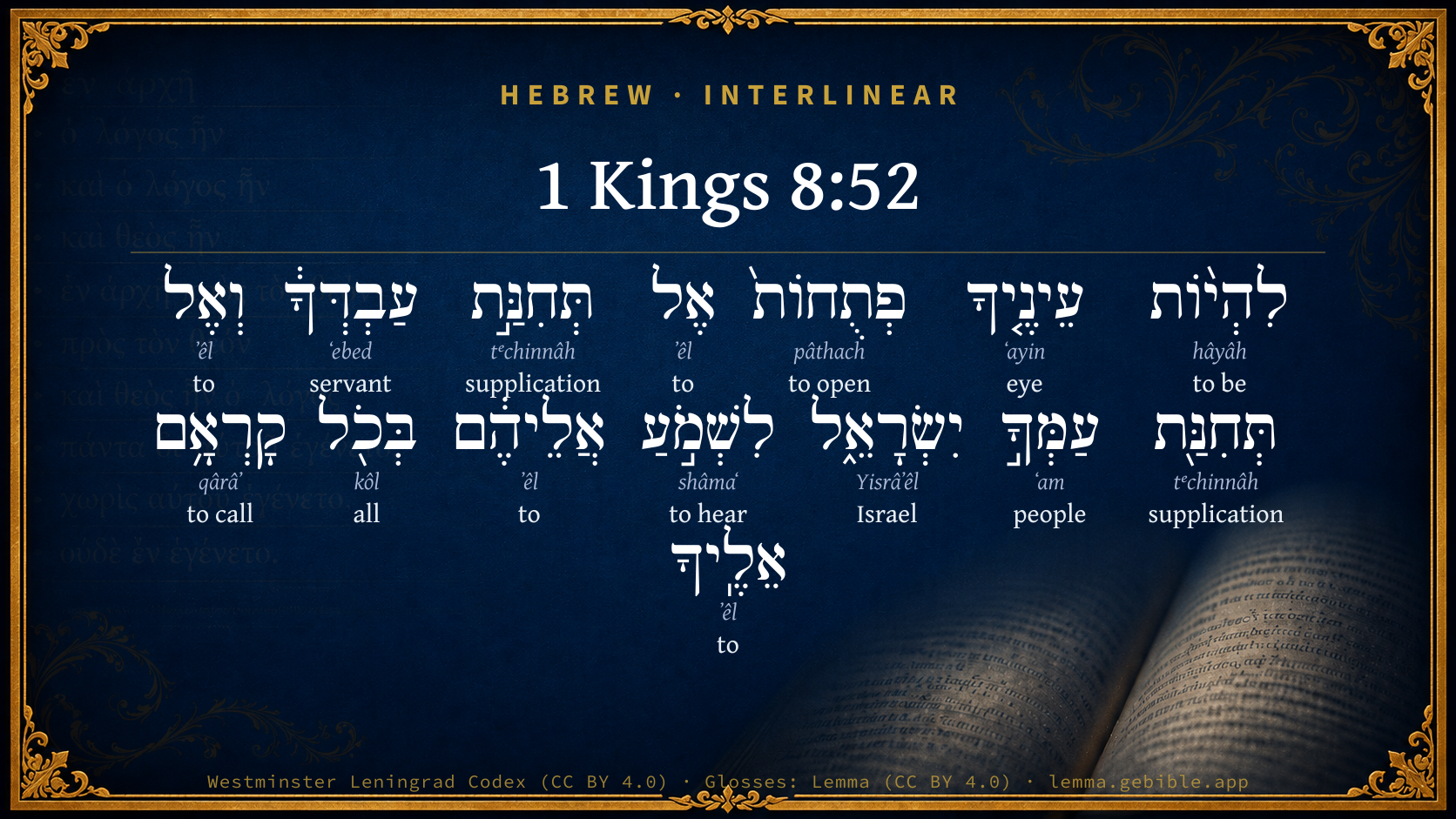
1 Kings 8:52

Hebrew (Westminster Leningrad Codex) 1 Kings 8:52 appears in the Hebrew Old Testament. The text above is from the Westminster Leningrad Codex. Each word links to its Strong’s number, a concise gloss, and parsing drawn from the Open Scriptures Hebrew Bible morphology. Click any word for its full Brown-Driver-Briggs (BDB) entry.
Download image
Cite this verse

1 Kings 8:52 (World English Bible). Public Domain. Lemma interlinear Bible study tool, https://lemma.gebible.app/v/1-kings/8/52.

Show BibTeX & RIS
BibTeX
RIS
English Translation
that your eyes may be open to the supplication of your servant, and to the supplication of your people Israel, to listen to them whenever they cry to you.
World English Bible · Public Domain
Download a study sheet

One document with this verse’s original text, its word-by-word gloss line, the meaning frame, cross-references with their text, attributed commentary, and full source and license credits — printable, and it pastes into notes with its structure intact.

This verse Autodidact and up

Study sheet (.html) Plain text (.txt)

A passage Seminary Student

Up to 50 verses in one chapter. A passage sheet keeps up to 6 commentary sources and 12 cross-references per verse, in the order this page ranks them, and says so on the sheet whenever that leaves anything out. Ask for a single verse and you get the Autodidact verse sheet above.

Everything on this page stays free to read, with no account — the sheet is a download of what is already on screen, not access to it.

Want to remove ads? Support Godless Engineer
Compare translations 3

The same verse in 3 English versions, stacked beneath the original-language interlinear above. Click any original word for its lexicon entry.

Each is an independent rendering of the whole verse — the interlinear is not word-aligned to these translations.

Highlighted words mark where these versions differ — a whole-verse word diff, not a word-by-word alignment.

  • World English Bible Public Domain
    that your eyes may be open to the supplication of your servant, and to the supplication of your people Israel, to listen to them whenever they cry to you.
  • King James Version Public Domain
    That thine eyes may be open unto the supplication of thy servant, and unto the supplication of thy people Israel, to hearken unto them in all that they call for unto thee.
  • unfoldingWord Literal Text CC BY-SA 4.0
    for your eyes to be opened to the supplication of your servant and to the supplication of your people Israel, to listen to them in all of their crying out to you.

unfoldingWord Literal Text — © unfoldingWord, licensed CC BY-SA 4.0. Word-aligned USFM3 via Door43 (git.door43.org/unfoldingWord/en_ult).

Versions to compare (up to 4)

3 of 4 selected

Show all 18 translations

Every available English version of this verse, each an independent rendering of the whole verse.

  • World English Bible Public Domain
    that your eyes may be open to the supplication of your servant, and to the supplication of your people Israel, to listen to them whenever they cry to you.
  • Berean Standard Bible Public Domain
    May Your eyes be open to the pleas of Your servant and of Your people Israel, and may You listen to them whenever they call to You.
  • Majority Standard Bible Public Domain
    May Your eyes be open to the pleas of Your servant and of Your people Israel, and may You listen to them whenever they call to You.
  • King James Version Public Domain
    That thine eyes may be open unto the supplication of thy servant, and unto the supplication of thy people Israel, to hearken unto them in all that they call for unto thee.
  • American Standard Version (1901) Public Domain
    that thine eyes may be open unto the supplication of thy servant, and unto the supplication of thy people Israel, to hearken unto them whensoever they cry unto thee.
  • Revised Version (1885) Public Domain
    that thine eyes may be open unto the supplication of thy servant, and unto the supplication of thy people Israel, to hearken unto them whensoever they cry unto thee.
  • Geneva Bible (1599) Public Domain
    Let thine eyes be open vnto the prayer of thy seruant, and vnto the prayer of thy people Israel, to hearken vnto them, in all that they call for vnto thee.
  • Douay-Rheims (1899) Public Domain
    That thy eyes may be open to the supplication of thy servant, and of thy people Israel, to hear them in all things for which they shall call upon thee.
  • Young's Literal Translation Public Domain
    for Thine eyes being open unto the supplication of Thy servant, and unto the supplication of Thy people Israel, to hearken unto them in all they call unto Thee for;
  • Literal Standard Version CC BY-SA 4.0
    for Your eyes being open to the supplication of Your servant, and to the supplication of Your people Israel, to listen to them in all they call to You for;
  • Unlocked Literal Bible CC BY-SA 4.0
    May your eyes be open to the request of your servant and to the requests of your people Israel, to listen to them whenever they cry to you.
  • unfoldingWord Literal Text CC BY-SA 4.0
    for your eyes to be opened to the supplication of your servant and to the supplication of your people Israel, to listen to them in all of their crying out to you.
  • Darby Bible Public Domain
    thine eyes being open unto the supplication of thy servant, and unto the supplication of thy people Israel, to hearken unto them in all that they call for unto thee.
  • World Messianic Bible Public Domain
    that your eyes may be open to the supplication of your servant and to the supplication of your people Israel, to listen to them whenever they cry to you.
  • Webster's Bible Public Domain
    That thy eyes may be open to the supplication of thy servant, and to the supplication of thy people Israel, to hearken to them in all their supplications to thee.
  • Free Bible Version CC BY-SA 4.0
    May you pay attention to the requests of your servant, and to the requests of your people Israel, and may you respond whenever they call out to you.
  • Bible in Basic English Public Domain
    Let your eyes be open to your servant's prayer for grace and to the prayer of your people Israel, hearing them when their cry comes to you.
  • JPS Tanakh (1917) Public Domain
    that Thine eyes may be open unto the supplication of Thy servant, and unto the supplication of Thy people Israel, to hearken unto them whensoever they cry unto Thee.

Literal Standard Version (2020), Covenant Press — licensed CC BY-SA 4.0. Text via the HelloAO Bible API (eBible.org). Unlocked Literal Bible (unfoldingWord) — licensed CC BY-SA 4.0. Text via the HelloAO Bible API (eBible.org). unfoldingWord Literal Text — © unfoldingWord, licensed CC BY-SA 4.0. Word-aligned USFM3 via Door43 (git.door43.org/unfoldingWord/en_ult). Free Bible Version, Dr. Jonathan Gallagher — licensed CC BY-SA 4.0. Text via the HelloAO Bible API (eBible.org).

Word by word

More ways to search: Search by grammar → Find every occurrence → Compare this word →

Practice this passage: Drill this verse → Learn its vocabulary →

תְּחִנַּ֣ת
tᵉchinnâh
H8467
“supplication of”
Noun, Common, Feminine, Singular, Construct
Part of Speech
Noun
Type
Common
Gender
Feminine
Number
Singular
State
Construct
Full BDB Definition

Origin: from H2603

TWOT: 694f

favour, supplication, supplication for favour - favour - supplication for favour
  1. לִהְי֨וֹת hâyâh H1961 “to be” Preposition + Verb, Qal, Infinitive Construct
  2. עֵינֶ֤יךָ ʻayin H5869 “eyes · your” Noun, Common, Both, Dual, Construct + Suffix, Personal, 2nd Person, Masculine, Singular
  3. פְתֻחוֹת֙ pâthach H6605 “opened” Verb, Qal, Participle Passive, Feminine, Plural, Absolute
  4. אֶל ʼêl H413 “to” Preposition
  5. עַבְדְּךָ֔ ʻebed H5650 “servant · your” Noun, Common, Masculine, Singular, Construct + Suffix, Personal, 2nd Person, Masculine, Singular
  6. וְאֶל ʼêl H413 “and · to” Conjunction + Preposition
  7. תְּחִנַּ֖ת tᵉchinnâh H8467 “supplication of” Noun, Common, Feminine, Singular, Construct
  8. עַמְּךָ֣ ʻam H5971 “people · your” Noun, Common, Masculine, Singular, Construct + Suffix, Personal, 2nd Person, Masculine, Singular
  9. יִשְׂרָאֵ֑ל Yisrâʼêl H3478 “Israel” Noun, Proper
  10. לִשְׁמֹ֣עַ shâmaʻ H8085 “to hear” Preposition + Verb, Qal, Infinitive Construct
  11. אֲלֵיהֶ֔ם ʼêl H413 “to · them” Preposition + Suffix, Personal, 3rd Person, Masculine, Plural
  12. בְּכֹ֖ל kôl H3605 “in/at · all” Preposition + Noun, Common, Masculine, Singular, Absolute
  13. קָרְאָ֥ם qârâʼ H7121 “to call · them” Verb, Qal, Infinitive Construct + Suffix, Personal, 3rd Person, Masculine, Plural
  14. אֵלֶֽיךָ ʼêl H413 “to · you” Preposition + Suffix, Personal, 2nd Person, Masculine, Singular

About this verse

These counts appear in no published source. They are computed here, from the morphology-tagged text and Lemma’s own curated glosses. What Lemma adds →

15
words
11
distinct lemmas
Historical
section

Notable vocabulary

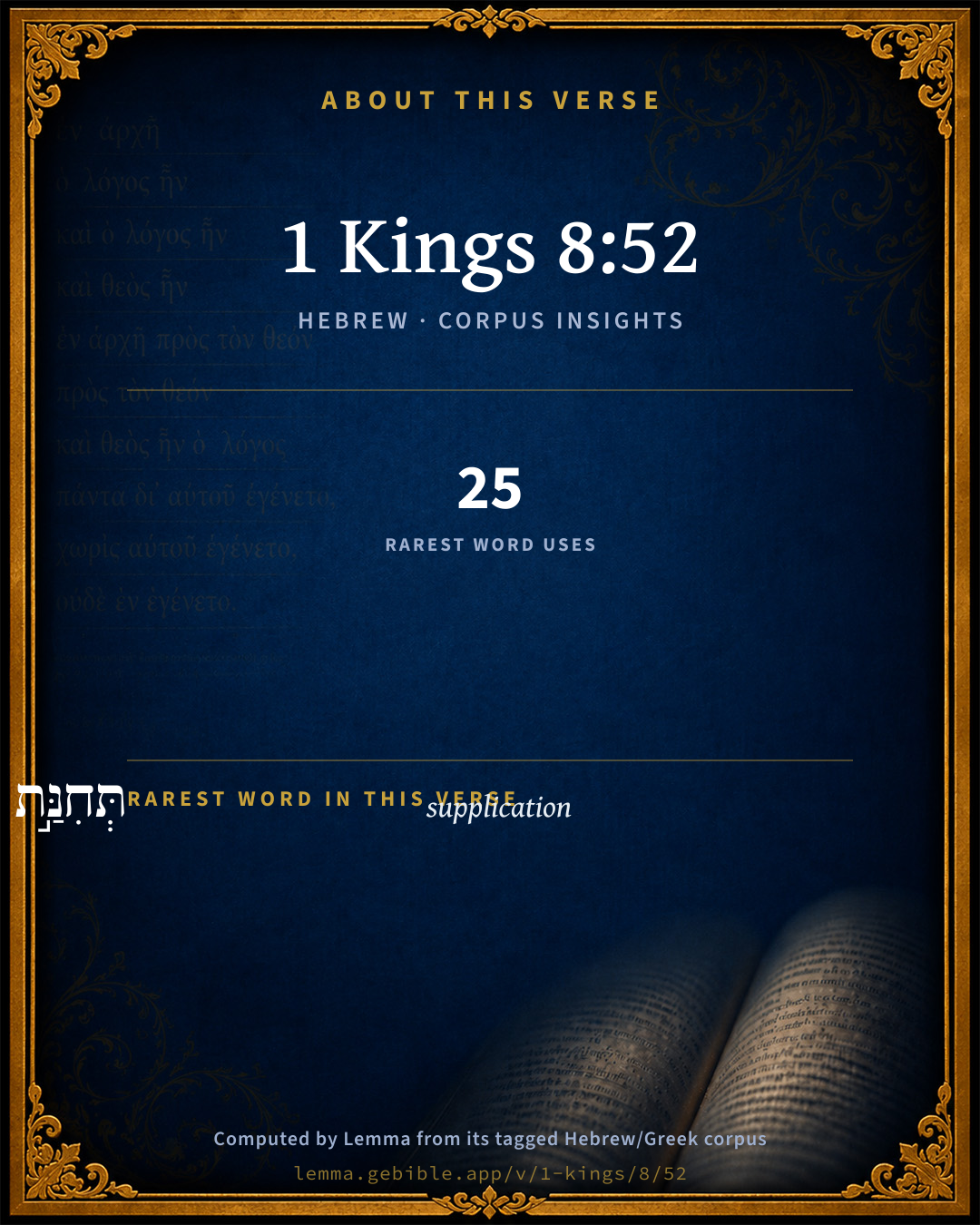
The rarest word here is תְּחִנַּ֣ת supplication H8467 — appearing just 25 times in the whole Hebrew Bible.

Shared distinctive vocabulary

תְּחִנַּ֣ת supplication H8467 occurs in 24 verses of the Hebrew Bible. Also found in:

Grammatical profile

  • 4 verbs
  • 7 nouns
  • 4 prepositions

Verb forms

  • לִהְי֨וֹת Qal · Infinitive Construct
  • פְתֻחוֹת֙ Qal · Participle Passive
  • לִשְׁמֹ֣עַ Qal · Infinitive Construct
  • קָרְאָ֥ם Qal · Infinitive Construct

Repetition

Words recur within this verse — often emphatic in Hebrew:

  • תְּחִנַּ֣ת supplication H8467 ×2
  • אֶל to H413 ×4

Hebrew & Septuagint length

In English translation the verse runs 29 words from the Hebrew and 37 from the Septuagint (LXX English) — closely comparable.

A rough comparison of the two English renderings, which tokenize alike — not a word-level alignment.

Word counts can differ between the Hebrew and the Greek without any difference in meaning — e.g. the Hebrew direct-object marker אֵת has no separate Greek word, and Greek often adds the article ὁ.

Cross-references

4

Topical passages linked to 1 Kings 8:52 in the Treasury of Scripture Knowledge — connected by theme and wording, ordered by reader-vote popularity; previews shown in the World English Bible.

  • Psalms 145:18 Yahweh is near to all those who call on him, To all who call on him in truth.
  • 1 Kings 8:29 that your eyes may be open toward this house night and day, even toward the place of which you have said, My name shall be there; to listen to the prayer which your servant shall pray toward this place.
  • Psalms 86:5 For you, Lord, are good, and ready to forgive; Abundant in loving kindness to all those who call on you.
  • 2 Chronicles 6:40 Now, my God, let, I beg you, your eyes be open, and let your ears be attentive, to the prayer that is made in this place.

Cross-references courtesy of OpenBible.info (CC BY 4.0).

Hebrew and Greek witnesses Masoretic Hebrew ↔ Greek Septuagint

The same verse in the two great witnesses to the Old Testament, shown verse-for-verse.

These are two independent witnesses, not word-aligned to each other, and the Septuagint is shown in lemma (dictionary) form.

Hebrew 1 Kings 8:52 Masoretic · Westminster Leningrad Codex

לִהְי֨וֹת עֵינֶ֤יךָ פְתֻחוֹת֙ אֶל תְּחִנַּ֣ת עַבְדְּךָ֔ וְאֶל תְּחִנַּ֖ת עַמְּךָ֣ יִשְׂרָאֵ֑ל לִשְׁמֹ֣עַ אֲלֵיהֶ֔ם בְּכֹ֖ל קָרְאָ֥ם אֵלֶֽיךָ

that your eyes may be open to the supplication of your servant, and to the supplication of your people Israel, to listen to them whenever they cry to you.

World English Bible · Public Domain

Greek LXX 1 Kings 8:52 Septuagint · lemma form

καί εἰμί ὁ ὀφθαλμός σύ καί ὁ οὖς σύ ἀναοἴγω εἰς ὁ δέησις ὁ δοῦλος σύ καί εἰς ὁ δέησις ὁ λαός σύ ἰσραήλ εἰςἀκούω αὐτός ἐν πᾶς ὅς ἄν ἐπικαλέω σύ

And let your eyes and your ears be opened to the supplication of your servant, and to the supplication of your people Israel, to listen to them in all things for which they shall call upon you.

LXX2012 (modern English Septuagint) · Public Domain

Hebrew: Westminster Leningrad Codex (CC BY 4.0). Greek: Septuagint (public domain); English from LXX2012 (modern English Septuagint) (Public Domain). How the Septuagint differs from the Hebrew →

Targum (Aramaic paraphrase)

1

The Targum is the ancient Jewish Aramaic paraphrase of the Hebrew Scriptures — an interpretive translation, not the Hebrew text itself. Onkelos (literal) and Pseudo-Jonathan (expansive) render the Torah, and Jonathan the Prophets. Coverage is partial: where no permissively-licensed English translation exists for a verse, only the Aramaic is shown. This is verse-level text, not a word-by-word alignment to the Hebrew.

  1. Targum Jonathan Prophets (Joshua–Malachi)
    לְמֶהֱוֵי רַעֲוָא קֳדָמָךְ לְקַבָּלָא בָּעוּלַת עַבְדָךְ וּבָעוּת עַמָךְ יִשְׂרָאֵל לְקַבָּלָא צְלוֹתְהוֹן בְּכָל עִדָן דְאִינוּן מְצַלָן קֳדָמָךְ:

    (no public-domain English translation for this verse)

    Targum Jonathan — Aramaic: “Mikraot Gedolot” (public domain). English: “Sefaria Community Translation” (CC0 1.0 (public-domain dedication)); “London "Chaldee Paraphrase," 1871” (public domain). Text via Sefaria.

Commentary

Notes on 1 Kings 8:52 from classic Christian and Jewish commentators (each source and its license shown beneath its notes). The classic Christian expositions comment on the surrounding passage and are grouped to its opening verse, so a note may address several verses; the Jewish commentaries on the Tanakh (Rashi and others) are per-verse, so they appear only where the commentator wrote on this verse.

Lemma curates 59 commentaries, every one of them public domain or Creative Commons licensed, each selected and text-cleaned for this edition rather than reprinted as found. About our sources →

Trapp's Complete Commentary

John Trapp

1Ki 8:52 That thine eyes may be open unto the supplication of thy servant, and unto the supplication of thy people Israel, to hearken unto them in all that they call for unto thee.

Ver. 52. In all that they call for unto thee.] Lawful petitions and honest hearts is all that God calleth for: bring these, and be sure to speed.

John Trapp, A Commentary or Exposition upon All the Books of the Old and New Testament (1647–1656) — public domain. Text from a community e-Sword module.

Tyndale Open Study Notes

Tyndale Open Resources

8:52-53 Solomon concluded his prayer of dedication with a general petition for God to be accessible to all of Israel and respond to their requests. Returning to the theme of the Exodus (8:16), Solomon reminded God that he had selected Israel as his special possession (Exod 19:5; Deut 7:6; 14:1-2; 26:18; Ps 135:4; cp. Titus 2:11-14; 1 Pet 2:9-10).

Tyndale Open Study Notes — © Tyndale Open Resources, licensed CC BY-SA 4.0. Text via the HelloAO Bible API.

The Cambridge Bible for Schools and Colleges

gen. ed. J. J. S. Perowne

52. in all that they call for unto thee] The Hebrew is literally ‘In all their crying unto thee,’ which R.V. represents more nearly by whensoever they cry unto thee.

The Cambridge Bible for Schools and Colleges (gen. ed. J. J. S. Perowne; Cambridge University Press, 1878–1918) — public domain. Text from a community e-Sword module.

John Gill's Exposition

For thou didst separate them from among all people of the earth to be thine inheritance,.... By his choice of them in his own mind, by the redemption of them out of Egypt, by the peculiar laws he gave them, and by the special blessings he conferred upon them:

as thou spakest by the hand of Moses thy servant, when thou broughtest our fathers out of Egypt, O Lord our God; it was he that spake this to Moses, and by him to the people, Exo 19:5 and it was he that did it, namely, separate them from all nations, to be his people and peculiar treasure: in this and the two preceding verses Solomon makes use of arguments taken from what the people of Israel were to the Lord, and he had done for them, to engage him to hearken to their supplications, and here ends his long prayer; in Ch2 6:1 some things are added at the close of it, and some omitted.

John Gill's Exposition of the Whole Bible (1746–1763) — public domain (CC PDM 1.0). Text via the HelloAO Bible API.

The Pulpit Commentary

That thine eyes may be open cf. ver. 29 unto the supplication of thy servant, and unto the supplication of thy people Israel of. vers. 28, 30, to hearken unto them in all that they call for unto thee.

The Pulpit Commentary (1880–1919), ed. H.D.M. Spence-Jones & Joseph S. Exell — public domain. Text from a community e-Sword module.

Lesson kit

Teaching starters — assembled from the data on this page, not authored interpretation. Every prompt links to the verse data it draws on. Edit before teaching.

1 Kings, in the Historical, opens this verse with 15 words (11 distinct Hebrew lemmas). Its most distinctive word is tᵉchinnâh (“supplication”). A historical commentator’s framing appears above. Read the whole chapter for the surrounding context.

Discussion questions

  1. What does “supplication” (tᵉchinnâh) contribute to the verse as a whole?
  2. Joshua 11:20 shares the word «supplication» with this verse. How do the two illuminate each other?
  3. “supplication” occurs 2× in this one verse. What is the effect of the repetition?
  4. These translations render this verse differently. What is at stake in choosing one wording over another?
  5. The verb «לִהְי֨וֹת» is Qal Infinitive Construct. How does its form color the action?
  6. Reading how Trapp's Complete Commentary and Tyndale Open Study Notes read this verse, where do the two commentators agree and where do they part?

Things to notice

  • These translations choose different wording for 12 words in this verse.
  • “supplication” occurs 2× in this single verse.
  • 11 distinct Hebrew lemmas span 15 words in this verse.

Reading settings

Reading text

Shown beneath each verse's original-language words.

Old Testament
Old Testament edition

Read the OT as the Masoretic Hebrew (MT) or the Greek Septuagint (LXX).

English shown for the Greek Septuagint (in the Hebrew ↔ Greek comparison).

Comparing translations? Open the Compare panel on any verse page to stack up to four side by side.