
Exodus 33:4

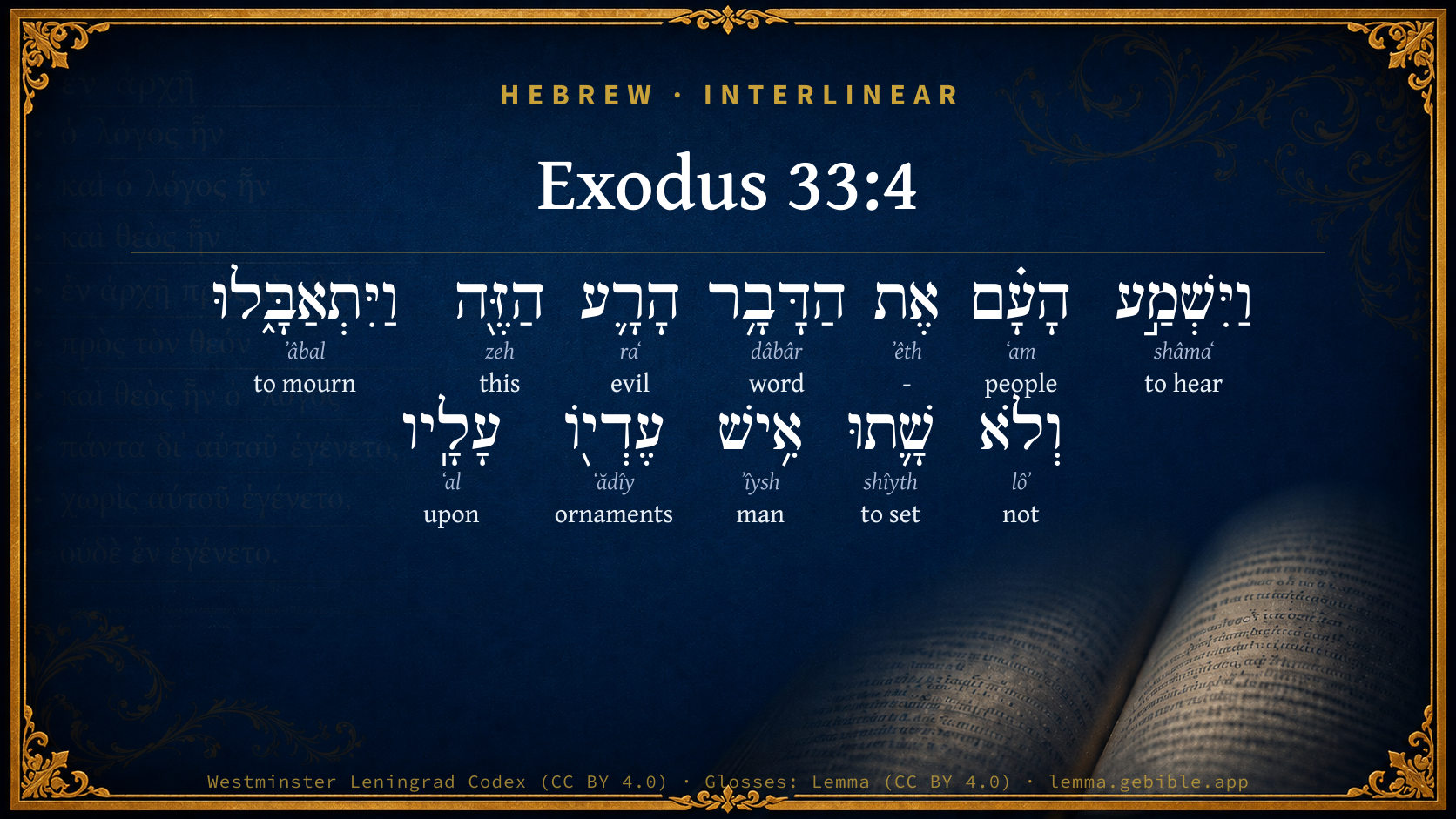
Hebrew (Westminster Leningrad Codex) Exodus 33:4 appears in the Hebrew Old Testament. The text above is from the Westminster Leningrad Codex. Each word links to its Strong’s number, a concise gloss, and parsing drawn from the Open Scriptures Hebrew Bible morphology. Click any word for its full Brown-Driver-Briggs (BDB) entry.
Download image
Cite this verse

Exodus 33:4 (World English Bible). Public Domain. Lemma interlinear Bible study tool, https://lemma.gebible.app/v/exodus/33/4.

Show BibTeX & RIS
BibTeX
RIS
English Translation
When the people heard this evil news, they mourned: and no one put on his jewelry.
World English Bible · Public Domain
Highlights
  • 1 first appearance in the Hebrew Bible
Full analysis ↓
Download a study sheet

One document with this verse’s original text, its word-by-word gloss line, the meaning frame, cross-references with their text, attributed commentary, and full source and license credits — printable, and it pastes into notes with its structure intact.

This verse Autodidact and up

Study sheet (.html) Plain text (.txt)

A passage Seminary Student

Up to 50 verses in one chapter. A passage sheet keeps up to 6 commentary sources and 12 cross-references per verse, in the order this page ranks them, and says so on the sheet whenever that leaves anything out. Ask for a single verse and you get the Autodidact verse sheet above.

Everything on this page stays free to read, with no account — the sheet is a download of what is already on screen, not access to it.

Want to remove ads? Support Godless Engineer
Compare translations 3

The same verse in 3 English versions, stacked beneath the original-language interlinear above. Click any original word for its lexicon entry.

Each is an independent rendering of the whole verse — the interlinear is not word-aligned to these translations.

Highlighted words mark where these versions differ — a whole-verse word diff, not a word-by-word alignment.

  • World English Bible Public Domain
    When the people heard this evil news, they mourned: and no one put on his jewelry.
  • King James Version Public Domain
    And when the people heard these evil tidings, they mourned: and no man did put on him his ornaments.
  • unfoldingWord Literal Text CC BY-SA 4.0
    And the people heard this evil word, and they mourned, and each one did not put his ornaments on him.

unfoldingWord Literal Text — © unfoldingWord, licensed CC BY-SA 4.0. Word-aligned USFM3 via Door43 (git.door43.org/unfoldingWord/en_ult).

Versions to compare (up to 4)

3 of 4 selected

Show all 18 translations

Every available English version of this verse, each an independent rendering of the whole verse.

  • World English Bible Public Domain
    When the people heard this evil news, they mourned: and no one put on his jewelry.
  • Berean Standard Bible Public Domain
    When the people heard these bad tidings, they went into mourning, and no one put on any of his jewelry.
  • Majority Standard Bible Public Domain
    When the people heard this bad news, they went into mourning, and no one put on any of his jewelry.
  • King James Version Public Domain
    And when the people heard these evil tidings, they mourned: and no man did put on him his ornaments.
  • American Standard Version (1901) Public Domain
    And when the people heard these evil tidings, they mourned: and no man did put on him his ornaments.
  • Revised Version (1885) Public Domain
    And when the people heard these evil tidings, they mourned: and no man did put on him his ornaments.
  • Geneva Bible (1599) Public Domain
    And when the people heard this euill tydings, they sorowed, and no man put on his best rayment.
  • Douay-Rheims (1899) Public Domain
    And the people hearing these very bad tidings, mourned: and no man put on his ornaments according to custom.
  • Young's Literal Translation Public Domain
    And the people hear this sad thing, and mourn; and none put his ornaments on him.
  • Literal Standard Version CC BY-SA 4.0
    And the people hear this sad thing, and mourn; and none puts his ornaments on him.
  • Unlocked Literal Bible CC BY-SA 4.0
    When the people heard these troubling words, they mourned, and no one put on any jewelry.
  • unfoldingWord Literal Text CC BY-SA 4.0
    And the people heard this evil word, and they mourned, and each one did not put his ornaments on him.
  • Darby Bible Public Domain
    And when the people heard this evil word, they mourned; and no man put on his ornaments.
  • World Messianic Bible Public Domain
    When the people heard this evil news, they mourned; and no one put on his jewelry.
  • Webster's Bible Public Domain
    And when the people heard these evil tidings, they mourned: and no man put on him his ornaments.
  • Free Bible Version CC BY-SA 4.0
    When the people heard these words of criticism, they mourned and didn't put on their jewelry.
  • Bible in Basic English Public Domain
    Hearing this bad news the people were full of grief, and no one put on his ornaments.
  • JPS Tanakh (1917) Public Domain
    And when the people heard these evil tidings, they mourned; and no man did put on him his ornaments.

Literal Standard Version (2020), Covenant Press — licensed CC BY-SA 4.0. Text via the HelloAO Bible API (eBible.org). Unlocked Literal Bible (unfoldingWord) — licensed CC BY-SA 4.0. Text via the HelloAO Bible API (eBible.org). unfoldingWord Literal Text — © unfoldingWord, licensed CC BY-SA 4.0. Word-aligned USFM3 via Door43 (git.door43.org/unfoldingWord/en_ult). Free Bible Version, Dr. Jonathan Gallagher — licensed CC BY-SA 4.0. Text via the HelloAO Bible API (eBible.org).

Word by word

More ways to search: Search by grammar → Find every occurrence → Compare this word →

Practice this passage: Drill this verse → Learn its vocabulary →

עֶדְי֖וֹ
ʻădîy
H5716
“ornaments · his”
Noun, Common, Masculine, Singular, Construct + Suffix, Personal, 3rd Person, Masculine, Singular
Part of Speech
Noun
Type
Common
Gender
Masculine
Number
Singular
State
Construct
Full BDB Definition

Origin: from H5710 in the sense of trappings

TWOT: 1566a

ornaments - ornaments - trappings (of horses)
  1. וַיִּשְׁמַ֣ע shâmaʻ H8085 “and · to hear” Conjunction + Verb, Qal, Sequential Imperfect, 3rd Person, Masculine, Singular
  2. הָעָ֗ם ʻam H5971 “the · people” Particle, Definite Article + Noun, Common, Masculine, Singular, Absolute
  3. אֶת ʼêth H853 “-” Particle, Direct Object
  4. הַדָּבָ֥ר dâbâr H1697 “the · word” Particle, Definite Article + Noun, Common, Masculine, Singular, Absolute
  5. הָרָ֛ע raʻ H7451 “the · evil” Particle, Definite Article + Adjective, Adjective, Masculine, Singular, Absolute
  6. הַזֶּ֖ה zeh H2088 “the · this” Particle, Definite Article + Pronoun, Demonstrative, Masculine, Singular
  7. וַיִּתְאַבָּ֑לוּ ʼâbal H56 “and · to mourn” Conjunction + Verb, Hithpael, Sequential Imperfect, 3rd Person, Masculine, Plural
  8. וְלֹא lôʼ H3808 “and · not” Conjunction + Particle, Negative
  9. שָׁ֛תוּ shîyth H7896 “to set” Verb, Qal, Perfect, 3rd Person, Common, Plural
  10. אִ֥ישׁ ʼîysh H376 “man” Noun, Common, Masculine, Singular, Absolute
  11. עָלָֽיו ʻal H5921 “upon · him” Preposition + Suffix, Personal, 3rd Person, Masculine, Singular

About this verse

These counts appear in no published source. They are computed here, from the morphology-tagged text and Lemma’s own curated glosses. What Lemma adds →

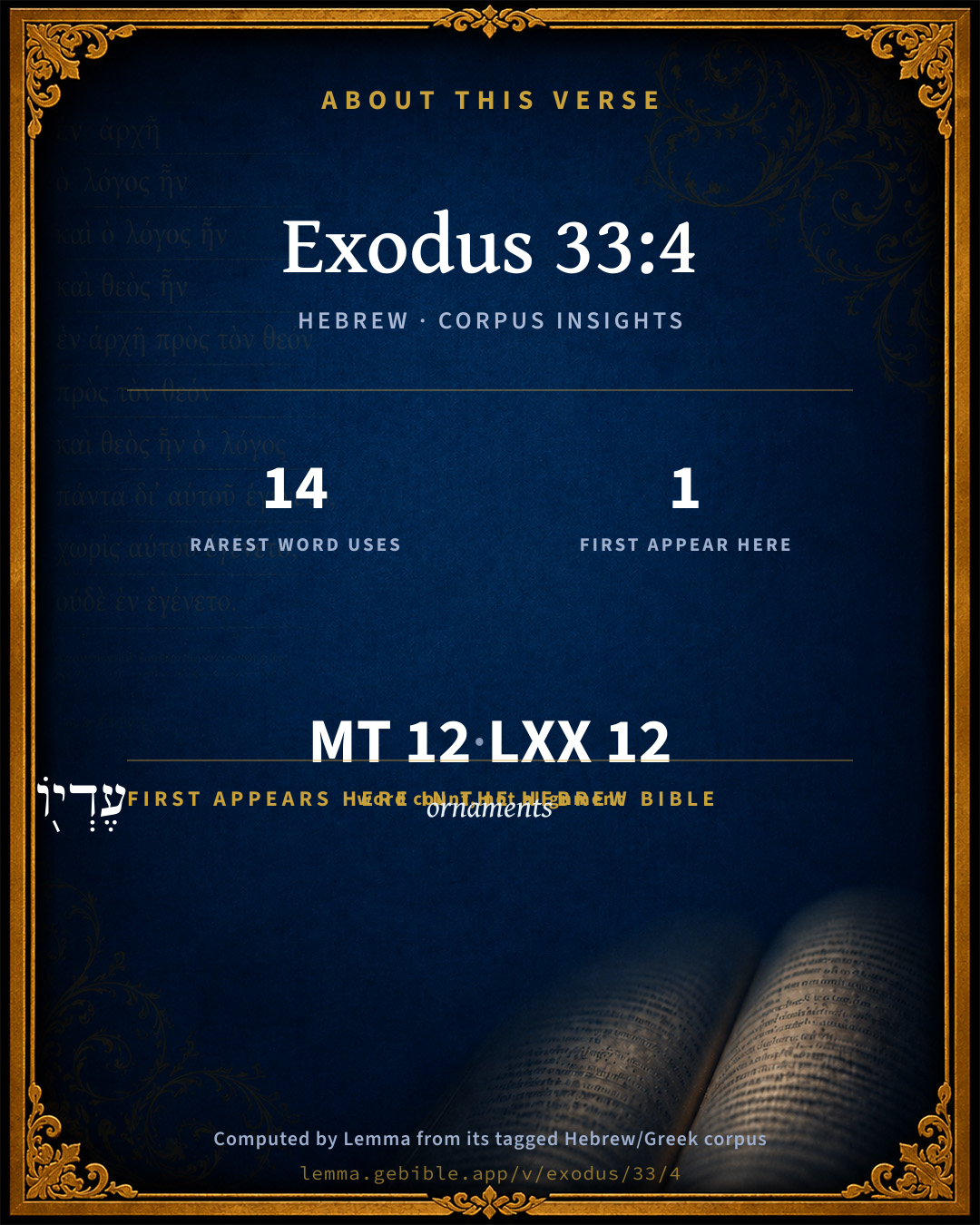
12
words
12
distinct lemmas
Pentateuch
section

Notable vocabulary

The rarest word here is עֶדְי֖וֹ ornaments H5716 — appearing just 14 times in the whole Hebrew Bible.

First appearance in Scripture

This word makes its first canonical appearance in the Hebrew Bible here:

  • עֶדְי֖וֹ ornaments H5716

Shared distinctive vocabulary

עֶדְי֖וֹ ornaments H5716 occurs in 13 verses of the Hebrew Bible. Also found in:

Grammatical profile

  • 3 verbs
  • 4 nouns
  • 1 adjective
  • 1 pronoun
  • 1 preposition
  • 2 particles

Verb forms

  • וַיִּשְׁמַ֣ע Qal · Sequential Imperfect
  • וַיִּתְאַבָּ֑לוּ Hithpael · Sequential Imperfect
  • שָׁ֛תוּ Qal · Perfect

Hebrew & Septuagint length

In English translation the verse runs 16 words from the Hebrew and 12 from the Septuagint (LXX English) — closely comparable.

A rough comparison of the two English renderings, which tokenize alike — not a word-level alignment.

Word counts can differ between the Hebrew and the Greek without any difference in meaning — e.g. the Hebrew direct-object marker אֵת has no separate Greek word, and Greek often adds the article ὁ.

In the original languages it is 12 Hebrew tokens and 12 Greek tokens — but the two are counted differently (Hebrew bundles its prefixes and suffixes into one token; the Greek is in lemma form), so that isn’t a like-for-like length.

Cross-references

18

Topical passages linked to Exodus 33:4 in the Treasury of Scripture Knowledge — connected by theme and wording, ordered by reader-vote popularity; previews shown in the World English Bible.

  • Numbers 14:39 Moses told these words to all the children of Israel: and the people mourned greatly.
  • Leviticus 10:6 Moses said to Aaron, and to Eleazar and to Ithamar, his sons, "Don't let the hair of your heads go loose, neither tear your clothes; that you don't die, and that he not be angry with all the congregation: but let your brothers, the whole house of Israel, bewail the burning which Yahweh has kindled.
  • Numbers 14:1 All the congregation lifted up their voice, and cried; and the people wept that night.
  • Ezekiel 24:17 Sigh, but not aloud, make no mourning for the dead; bind your headdress on you, and put your shoes on your feet, and don't cover your lips, and don't eat men's bread.
  • Ezekiel 24:23 Your tires shall be on your heads, and your shoes on your feet: you shall not mourn nor weep; but you shall pine away in your iniquities, and moan one toward another.
  • Ezekiel 26:16 Then all the princes of the sea shall come down from their thrones, and lay aside their robes, and strip off their embroidered garments: they shall clothe themselves with trembling; they shall sit on the ground, and shall tremble every moment, and be astonished at you.
  • 2 Samuel 19:24 Mephibosheth the son of Saul came down to meet the king; and he had neither dressed his feet, nor trimmed his beard, nor washed his clothes, from the day the king departed until the day he came home in peace.
  • 1 Kings 21:27 It happened, when Ahab heard those words, that he tore his clothes, and put sackcloth on his flesh, and fasted, and lay in sackcloth, and went softly.
  • 2 Kings 19:1 It happened, when king Hezekiah heard it, that he tore his clothes, and covered himself with sackcloth, and went into the house of Yahweh.
  • Ezra 9:3 When I heard this thing, I tore my garment and my robe, and plucked off the hair of my head and of my beard, and sat down confounded.
  • Esther 4:1–4 Now when Mordecai knew all that was done, Mordecai tore his clothes, and put on sackcloth with ashes, and went out into the midst of the city, and cried with a loud and a bitter cry;
  • Job 1:20 Then Job arose, and tore his robe, and shaved his head, and fell down on the ground, and worshiped.
  • Job 2:12 When they lifted up their eyes from a distance, and didn't recognize him, they raised their voices, and wept; and they each tore his robe, and sprinkled dust on their heads toward the sky.
  • Isaiah 32:11 Tremble, you women who are at ease; be troubled, you careless ones; strip yourselves, and make yourselves naked, and gird [sackcloth] on your loins.
  • Hosea 7:14 They haven't cried to me with their heart, But they howl on their beds. They assemble themselves for grain and new wine. They turn away from me.
  • Jonah 3:6 The news reached the king of Nineveh, and he arose from his throne, and took off his royal robe, covered himself with sackcloth, and sat in ashes.
  • Zechariah 7:3 and to speak to the priests of the house of Yahweh of Hosts, and to the prophets, saying, "Should I weep in the fifth month, separating myself, as I have done these so many years?"
  • Zechariah 7:5 "Speak to all the people of the land, and to the priests, saying, 'When you fasted and mourned in the fifth and in the seventh month for these seventy years, did you at all fast to me, really to me?

Cross-references courtesy of OpenBible.info (CC BY 4.0).

Hebrew and Greek witnesses Masoretic Hebrew ↔ Greek Septuagint

The same verse in the two great witnesses to the Old Testament, shown verse-for-verse.

These are two independent witnesses, not word-aligned to each other, and the Septuagint is shown in lemma (dictionary) form.

Hebrew Exodus 33:4 Masoretic · Westminster Leningrad Codex

וַיִּשְׁמַ֣ע הָעָ֗ם אֶת הַדָּבָ֥ר הָרָ֛ע הַזֶּ֖ה וַיִּתְאַבָּ֑לוּ וְלֹא שָׁ֛תוּ אִ֥ישׁ עֶדְי֖וֹ עָלָֽיו

When the people heard this evil news, they mourned: and no one put on his jewelry.

World English Bible · Public Domain

Greek LXX Exodus 33:4 Septuagint · lemma form

καί ἀκούω ὁ λαός ὁ ῥῆμα ὁ πονηρός οὗτος καταπενθέω ἐν πενθικός

And the people having heard this grievous saying, mourned in mourning apparel.

LXX2012 (modern English Septuagint) · Public Domain

Hebrew: Westminster Leningrad Codex (CC BY 4.0). Greek: Septuagint (public domain); English from LXX2012 (modern English Septuagint) (Public Domain). How the Septuagint differs from the Hebrew →

Targum (Aramaic paraphrase)

2

The Targum is the ancient Jewish Aramaic paraphrase of the Hebrew Scriptures — an interpretive translation, not the Hebrew text itself. Onkelos (literal) and Pseudo-Jonathan (expansive) render the Torah, and Jonathan the Prophets. Coverage is partial: where no permissively-licensed English translation exists for a verse, only the Aramaic is shown. This is verse-level text, not a word-by-word alignment to the Hebrew.

  1. Targum Onkelos Torah (Genesis–Deuteronomy)
    וּשְׁמַע עַמָא יָת פִּתְגָמָא בִישָׁא הָדֵין וְאִתְאַבָּלוּ וְלָא שַׁוִיוּ גְבַר תִּקוּן זֵינֵהּ עֲלוֹהִי:

    (no public-domain English translation for this verse)

    Targum Onkelos — Aramaic: “Onkelos Genesis” (public domain); “Onkelos Exodus” (public domain); “Onkelos Leviticus” (public domain); “Onkelos Numbers” (public domain); “Onkelos Deuteronomy” (public domain). English: “Sefaria Community Translation” (CC0 1.0 (public-domain dedication)); “J.W. Etheridge. The Targums of Onkelos and Jonathan Ben Uzziel on the Pentateuch. London: Longmans, Green, 1862” (public domain). Text via Sefaria.

  2. Targum Pseudo-Jonathan Torah (Genesis–Deuteronomy)
    וּשְׁמַע עַמָּא יַת פִּתְגָּמָא בִּישָׁא הָדֵין וְאִתְאַבָּלוּ וְלָא שַׁוִּיוּ גְבַר יַת תִּיקוּן זֵינֵיהּ דְּאִתְיַהַב לְהוֹן בְּסִינַי דְבֵיהּ שְׁמָא רַבָּא וְקַדִּישָׁא חָקִיק וּמְפָרַשׁ עֲלוֹי

    And the people heard this evil word, and mourned; and no man put on his accustomed ornaments, which had been given them at Mount Sinai, and on which was inscribed and set forth the great and holy Name.

    Targum Pseudo-Jonathan — Aramaic: “Targum Jonathan on Genesis” (public domain); “Targum Jonathan on Exodus” (public domain); “Targum Jonathan on Leviticus” (public domain); “Targum Jonathan on Numbers” (public domain); “Targum Jonathan on Deuteronomy” (public domain). English: “The Targum of Jonathan ben Uzziel, trans. J. W. Etheridge, London, 1862” (public domain). Text via Sefaria.

Commentary

Notes on Exodus 33:4 from classic Christian and Jewish commentators (each source and its license shown beneath its notes). The classic Christian expositions comment on the surrounding passage and are grouped to its opening verse, so a note may address several verses; the Jewish commentaries on the Tanakh (Rashi and others) are per-verse, so they appear only where the commentator wrote on this verse.

Lemma curates 59 commentaries, every one of them public domain or Creative Commons licensed, each selected and text-cleaned for this edition rather than reprinted as found. About our sources →

Trapp's Complete Commentary

John Trapp

Exo 33:4 And when the people heard these evil tidings, they mourned: and no man did put on him his ornaments.

Ver. 4. They mourned.] As good cause they had: for "woe be unto thee when I depart from thee." {Hos 9:12}

John Trapp, A Commentary or Exposition upon All the Books of the Old and New Testament (1647–1656) — public domain. Text from a community e-Sword module.

The Biblical Illustrator

Joseph S. Exell

Exo_33:4-8

Put off thy ornaments from thee, that I may know what to do unto thee.

The work of Lent

Lent is a season with a likeness to Jewish ordinances, because man in his nature and wants is ever the same; it is a Christian season, because its one object is to make us know more of the nearness of God to man, which is the great fact of Christianity. In the text we have one of Gods most explicit statements of the need of such observance; and we ask the meaning of that reason which He assigns for a season of special penitence and humiliation.

1. God wishes to know what to do with us. If the putting aside of ornaments, no matter how valuable or brilliant, is the condition of that process, it ought to be done; for Gods action must be full of power and love; and to be told that His hand is to be felt in our life, must imply that a blessing is to be bestowed upon us far beyond anything that can come from any other addition.

2. Never at any stage of His revelation has God ceased, in one form or other, to prescribe temporary and voluntary relinquishments, in order that He may enter. The ornaments, or Gods voice--that is the simple form of choice.

3. The object of Gods dealings with men is, that He may destroy their sin. And there is no more fruitful source of sin than those ornaments which He tells us to put away. The things which gather about our lives are causes of separation from our brother. The innocence or the desirability of the ornament may make no difference in the result. Learning, applause, and culture may make us just as forgetful, or unsympathetic, or even cruel towards others, as the more material possessions of life.

4. We can see, therefore, that this command is like the call of a John Baptist: Make the way plain, the path straight and level, for the coming of the Lord; remove the stumbling-block which has been in thy own or thy brothers path. Men must learn to see their oneness as brothers, before sin can be done away; lives very different from each other must be placed side by side, and then new modes of thought and comparison will at once enter. How often one word, which gives us a glimpse into the real condition of anothers heart, makes us ashamed of some feeling which we have been cherishing toward him!

5. But the sins against our brethren are not the only evil that our ornaments work, and do not constitute the only reason why they must be abandoned before God can do His work for us. Those very sins spring from a deeper injury which has been done to our souls. These things that have attached themselves to life come to be regarded as its substance, and to regulate its whole movement. What the text says to us, then, is this: Cease to depend upon the present condition and surroundings of life. Think of yourself as an immortal soul. Try to imagine yourself as cut off from all these pursuits and surroundings, for so, in fact, you must be at some time; then count over the treasures of your life, and see whether there is enough to support an immortal soul.

6. The Lenten call is a call to greater moderation in the use of the things of this life, so that they shall not become our masters; it is a call to exalt the true Master of our life, so that every ornament of our being shall be discarded for ever, which is got worthy to minister to His glory, or which attempts to fight against His supremacy, so that all which remains shall be used in obedience to His commands, and in subservience to His purposes. It is by this test that innocent and sinful indulgence in the things of this life is to be discriminated, that the line of the too much and the too little is to be drawn, and that we are to be made men and women worthy and fit to use the world rightly.

7. But why does God need that the ornaments of mens lives should be put off before He shall know what to do unto them? Is it not limiting His power to say that He cannot deal with us as we are, with all our ornaments upon us? The work which God is to do for us has for its greatest mark that it is dependent upon what we are. It is the work of overcoming sin. God, when He made man, gave him all he needed for full development and growth. His course was forward and upward, ever increasing in power and glory, while obedience and dependence upon God ruled his action. No redemption would be necessary for such a being. Mans sin, his desire after the things of this world, his willingness to build up his life with those, created the great necessity. The self-will of man called upon God for new action--action which His Divine wisdom could alone create, and which His Divine power could alone execute. That He may know what it shall be, He asks some indication of mans desire. There is nothing to do but to punish, to let the life which persistently holds to what has been its destruction, go its own sad way of separation from God, if there is no relaxing of the nervous grasp on earthly good and ornament. But at the very first sign of a willingness to put such things away, to bridle lifes passion, and to restrain lifes desire, the way of redeeming love is open. Man is ready; and God knows what to do, and He is able to make him His child once more.

8. Let us, then, rejoice at this season for putting away the mere ornaments of life, and in it open our ear anxiously, constantly, eagerly, to hear the word of His gracious intention. Gods treasury is full of the true ornaments of life. He readily offers them to us. Receive them as readily, and the worlds ornaments will lose their false glitter; our hearts will cease to desire them with that eager covetousness which conceals all the better impulses of the soul, and God will be able to do for us all the deep purposes of His wisdom and His love. (Arthur Brooks.)

Repentance of the Israelites

I. God is not able to exercise mercy towards an impenitent transgressor. He cannot do this, because it would--

1. Be inconsistent with His own perfections.

2. Be ineffectual for the happiness of the persons themselves.

3. Introduce disorder into the whole universe.

II. Where humiliation is manifested, mercy may be expected. This appears from--

1. The very mode in which repentance is here enjoined.

2. The experience of penitents in all ages.

Application:

1. Consider what obstructions you have laid in the way of your own happiness.

2. Endeavour instantly to remove them. (C. Simon, M. A.)

A fashionable sin

The house of prayer is a poor place to exhibit beads, ribbons, ruffles, gewgaws, and trinkets. The evils of such extravagance are many. It keeps people from worship, when they have not apparel as gorgeous as their neighbours. It loads the poor with burdens too heavy to be borne to procure fashionable clothing. It leads many into temptations, debt, dishonesty, and sin. It causes many a poor shop girl to work nearly all Saturday night, that some customers fine clothes may be ready for the Sunday show. It keeps people at home in cloudy or stormy weather, when, if they wore plain clothing, they could defy clouds and storms. It consumes the hours in dressing, crimping, and fussing, keeping people from church, and wasting time, hindering the reading of the Scripture, and making Sunday a day of folly. It makes the poor emulous, malicious, and envious, and plants many a bitter thought in the minds of children and others, when they see their neighbours decked in finery--often unpaid for--and feel that people are respected, not for their integrity of character, but for the fashion of their clothes. It is forbidden in Gods Word. And yet we seldom find a minister that dare open his mouth against this fashionable sin. Christian people should dress plainly before the Lord, for examples sake at home and abroad, for decencys sake, and for the sake of Christ. (Christian Age.)

The Biblical Illustrator, edited by Joseph S. Exell (c. 1880s–1900s) — public domain. Text from a community e-Sword module.

Joseph Benson's Commentary

Exo 33:4. No man did put on his ornaments — This was a visible sign and profession of their inward humiliation and repentance for their sin, and of their deep sense of God’s displeasure.

Joseph Benson's Commentary on the Old and New Testaments (1811–1818) — public domain. Text from a community e-Sword module.

Tyndale Open Study Notes

Tyndale Open Resources

33:4-6 The jewelry and fine clothes might have been worn while worshiping the gold calf. Here their removal signifies mourning (33:4) and repentance.

Tyndale Open Study Notes — © Tyndale Open Resources, licensed CC BY-SA 4.0. Text via the HelloAO Bible API.

Jamieson, Fausset & Brown

Robert Jamieson, A. R. Fausset & David Brown

when the people heard these evil tidings--from Moses on his descent from the mount.

Jamieson, Fausset & Brown — Commentary Critical and Explanatory on the Whole Bible (1871) — public domain (CC PDM 1.0). Text via the HelloAO Bible API.

Ellicott's Commentary for English Readers

(4) When the people heard these evil tidings, they mourned.—It was something that the people felt the tidings to be “evil.” It is natural for sinful men to shrink from the near presence of God (Mat_8:34; Luk_5:8); and so the Israelites had shrunk from it a short time previously (Exo_20:19). Even now they would probably have feared a too near contact; but still, they were unwilling that God should cease to be the leader and guide of the host: they set a value on His presence and protection, which they felt that that of an angel would ill replace. Accordingly, when Moses communicated to them what God had said (Exo_33:1-3), they “mourned,” i.e., not only grieved inwardly, but showed the outward tokens of grief—made a public and, as it were, national lamentation.

No man did put on him his ornaments.—The Orientals, both men and women, have always affected ornament, and taken an extreme delight in it. Herodotus tells us that the Persians who accompanied Xerxes into Greece wore generally collars and bracelets of gold (Hist. ix. 80). Xenophon says that the Medes indulged a similar taste (Cyropœd. i. 3, § 2). In Egypt, at the time of the exodus, men of station wore generally collars, armlets, and bracelets, occasionally anklets. The Assyrians wore armlets, bracelets, and ear-rings. To strip himself of his ornaments was a great act of self-denial on the part of an Oriental; but it was done commonly in the case of mourning on account of a family bereavement, and sometimes in the case of national misfortunes. (See Note on Exo_33:1-6.)

A Bible Commentary for English Readers, edited by Charles John Ellicott (1878–1897) — public domain. Text from a community e-Sword module.

The Cambridge Bible for Schools and Colleges

gen. ed. J. J. S. Perowne

4. these evil tidings] that Jehovah would not accompany them to Canaan.

and no man, &c.] The removal of ornaments was a mark of mourning and grief: Eze_24:17; Eze_26:16, Jdt_10:3 f. (Kn.).

4–6. The people strip themselves of their ornaments.

The Cambridge Bible for Schools and Colleges (gen. ed. J. J. S. Perowne; Cambridge University Press, 1878–1918) — public domain. Text from a community e-Sword module.

John Gill's Exposition

And when the people heard these evil tidings,.... That God would withdraw his gracious presence, and go not up with them himself, only send an angel with them; and especially this may respect what is threatened, Exo 33:5 and had been said at this time:

they mourned; were inwardly and heartily grieved for their sin, whereby they had provoked the Lord to depart from them, and gave some outward and open tokens of it:

and no man did put on his ornaments; they used to wear at other times, their rings and jewels, which the princes and the chief among the people especially were wont to wear; and in common the people did not put on their best clothes, or what they usually wore, but clothed themselves in mournful habits, in sackcloth and ashes, or in some such like manner.

John Gill's Exposition of the Whole Bible (1746–1763) — public domain (CC PDM 1.0). Text via the HelloAO Bible API.

Haydock's Catholic Bible Commentary

Ornaments. Chaldean and Syriac, "arms." They had brought jewels, &c., out of Egypt. (Menochius)

George Leo Haydock (1774–1849), Haydock's Catholic Family Bible and Commentary, 1859 edition — public domain. Excludes Psalms (Douay-Rheims chapter numbering differs from Protestant) and Deuterocanonical books (Catholic canon only).

Matthew Poole's English Annotations

Their precious garments or jewels, which the women reserved, as we saw, Exo 33:3. This was a visible sign and profession of their inward humiliation and repentance for their sin, and of their deep sense of God’s displeasure.

Matthew Poole's English Annotations on the Holy Bible (1683–1685) — public domain. Text from a community e-Sword/MySword module.

Whedon's Commentary on the Bible

Daniel D. Whedon

4. The people heard… mourned — The withdrawal of the divine presence seemed to them to be ominous of evil. Though God’s voice out of Sinai filled them with terror, (see Exo_20:19,) and they could not endure the nearness of such excessive majesty, the thought that the Holy One is about to forsake them in wrath excites even deeper fear.

Ornaments — See also in Exo_33:5-6. The putting off of these was a sign of humiliation and penitence. In a time of sorrow and guilt the adornments of the person were strikingly out of place.

Daniel D. Whedon (gen. ed.), Commentary on the Old and New Testaments (1874–1909) — public domain. Text from a community e-Sword module.

The Pulpit Commentary

When the people heard. Moses had communicated to the people what God had said to him. They felt it to be evil tidings they woke up at last to a feeling of the ineffable value of the privileges which they bad hitherto enjoyed his guidance by the pillar of the cloud (Exo_13:21) his counsel, if there were need to ask anything (Exo_15:25) his aid in the day of battle (Exo_17:8-13) his near presence, by day and by night, constantly (Exo_13:22) and they dreaded a change, which they felt must involve a loss, and one the extent of which they could not measure. "An angel" is a poor consolation when we are craving for Jehovah! So the people mourned felt true sorrow were really troubled in their hearts and, to show their penitence, ceased to wear their customary ornaments. These may have consisted of armlets, bracelets, and even, perhaps, anklets, all of which were worn by men in Egypt at this period.

The Pulpit Commentary (1880–1919), ed. H.D.M. Spence-Jones & Joseph S. Exell — public domain. Text from a community e-Sword module.

Keil & Delitzsch

C. F. Keil & F. Delitzsch

The people were so overwhelmed with sorrow by this evil word, that they all put off their ornaments, and showed by this outward sign the trouble of their heart,

Keil & Delitzsch — Biblical Commentary on the Old Testament (1861–1891) — public domain (CC PDM 1.0). Text via the HelloAO Bible API. (Old Testament only.)

unfoldingWord translationNotes

Door43 World Missions Community

jewelry

beautiful clothing as well as chains and rings with jewels in them

a stubborn people

"people who refuse to change." See how you translated this in Exodus 33:3.

translationWords

people group

trouble

word

mourn

Yahweh

Moses

Israel

stiff-necked

Horeb

unfoldingWord translationNotes — © Distant Shores Media and the Door43 World Missions Community, licensed CC BY-SA 4.0. Source: git.door43.org/Door43/en_tn.

Rashi

Rabbi Shlomo Yitzchaki (Rashi)

הדבר הרע THIS EVIL THING — that the Shechina would not dwell nor go with them.

איש עדיו [AND NO MAN PUT ON HIM] HIS ORNAMENT — the crowns which were given them on Horeb when they said: (Exodus 24:7) “we shall do and hearken” (Shabbat 88a).

Rashi on the Tanakh — English translations: “The Judaica Press complete Tanach with Rashi, translated by A. J. Rosenberg” (CC BY 4.0); “Pentateuch with Rashi's commentary by M. Rosenbaum and A.M. Silbermann, 1929-1934” (public domain); “The Metsudah Tanach series, Lakewood, N.J” (CC BY 4.0); and “The Book of Joshua, Metsudah Publications, 1997” (CC BY 4.0). Text via Sefaria.

Lesson kit

Teaching starters — assembled from the data on this page, not authored interpretation. Every prompt links to the verse data it draws on. Edit before teaching.

Exodus, in the Pentateuch, opens this verse with 12 words (12 distinct Hebrew lemmas). Its most distinctive word is ʻădîy (“ornaments”). A historical commentator’s framing appears above. Read the whole chapter for the surrounding context.

Discussion questions

  1. The word ʻădîy carries the sense “ornaments.” How does it shape the verse?
  2. The word “ornaments” first appears here in Scripture. What is being introduced at this debut?
  3. Exodus 33:5 shares the word «ornaments» with this verse. How do the two illuminate each other?
  4. The translations on this page render this verse differently — a whole-verse word diff, not a word-by-word alignment. What might account for the different wordings?
  5. The verb «וַיִּשְׁמַ֣ע» is Qal Sequential Imperfect. How does its form color the action?
  6. Reading how Trapp's Complete Commentary and The Biblical Illustrator read this verse, where do the two commentators agree and where do they part?

Things to notice

Reading settings

Reading text

Shown beneath each verse's original-language words.

Old Testament
Old Testament edition

Read the OT as the Masoretic Hebrew (MT) or the Greek Septuagint (LXX).

English shown for the Greek Septuagint (in the Hebrew ↔ Greek comparison).

Comparing translations? Open the Compare panel on any verse page to stack up to four side by side.