
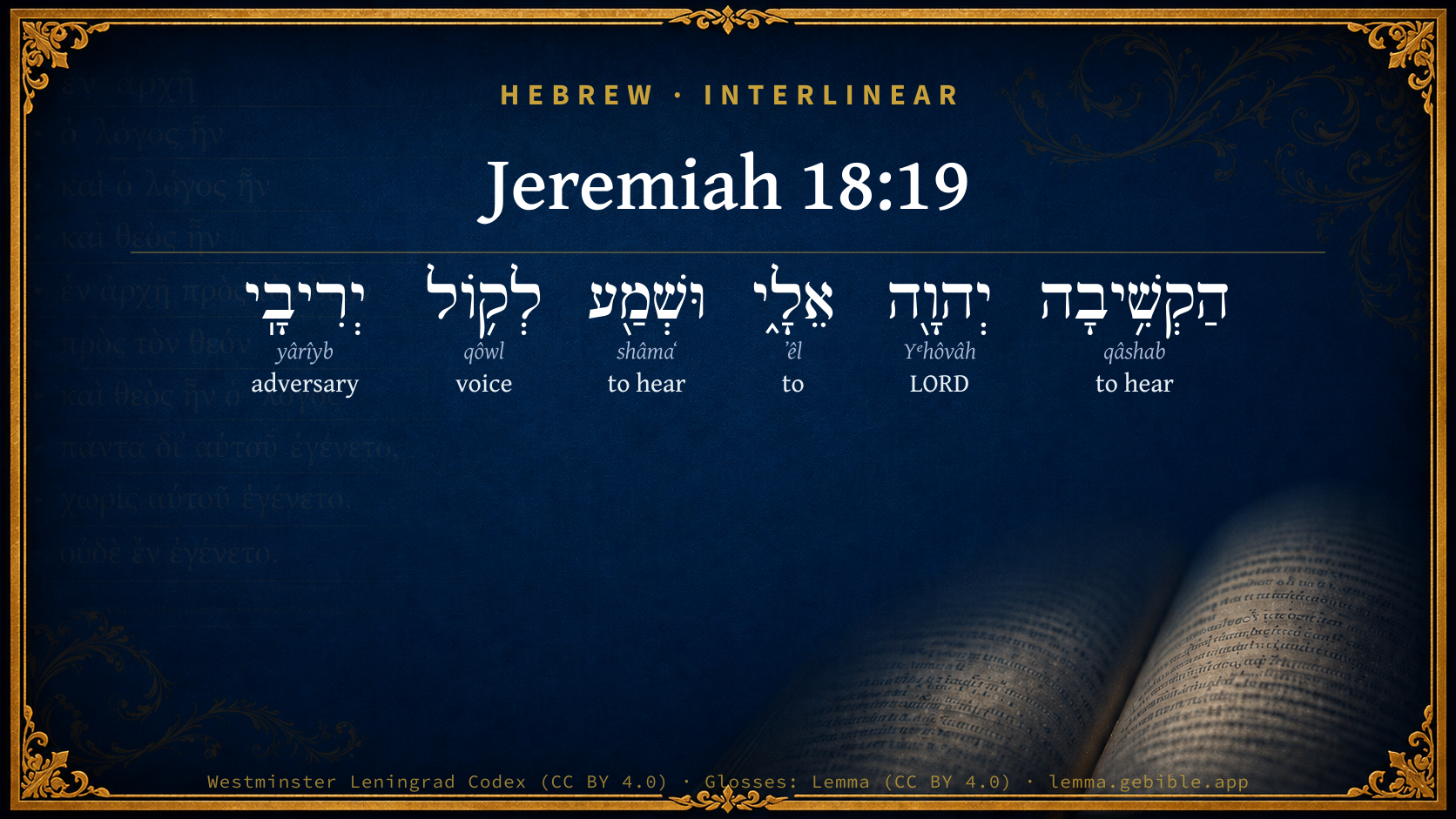
Jeremiah 18:19

Hebrew (Westminster Leningrad Codex) Jeremiah 18:19 appears in the Hebrew Old Testament. The text above is from the Westminster Leningrad Codex. Each word links to its Strong’s number, a concise gloss, and parsing drawn from the Open Scriptures Hebrew Bible morphology. Click any word for its full Brown-Driver-Briggs (BDB) entry.
Download image
Cite this verse

Jeremiah 18:19 (World English Bible). Public Domain. Lemma interlinear Bible study tool, https://lemma.gebible.app/v/jeremiah/18/19.

Show BibTeX & RIS
BibTeX
RIS
English Translation
Give heed to me, Yahweh, and listen to the voice of those who contend with me.
World English Bible · Public Domain
Download a study sheet

One document with this verse’s original text, its word-by-word gloss line, the meaning frame, cross-references with their text, attributed commentary, and full source and license credits — printable, and it pastes into notes with its structure intact.

This verse Autodidact and up

Study sheet (.html) Plain text (.txt)

A passage Seminary Student

Up to 50 verses in one chapter. A passage sheet keeps up to 6 commentary sources and 12 cross-references per verse, in the order this page ranks them, and says so on the sheet whenever that leaves anything out. Ask for a single verse and you get the Autodidact verse sheet above.

Everything on this page stays free to read, with no account — the sheet is a download of what is already on screen, not access to it.

Want to remove ads? Support Godless Engineer
Compare translations 3

The same verse in 3 English versions, stacked beneath the original-language interlinear above. Click any original word for its lexicon entry.

Each is an independent rendering of the whole verse — the interlinear is not word-aligned to these translations.

Highlighted words mark where these versions differ — a whole-verse word diff, not a word-by-word alignment.

  • World English Bible Public Domain
    Give heed to me, Yahweh, and listen to the voice of those who contend with me.
  • King James Version Public Domain
    Give heed to me, O LORD, and hearken to the voice of them that contend with me.
  • unfoldingWord Literal Text CC BY-SA 4.0
    Pay attention to me, Yahweh, and listen to the voice of my opponents.

unfoldingWord Literal Text — © unfoldingWord, licensed CC BY-SA 4.0. Word-aligned USFM3 via Door43 (git.door43.org/unfoldingWord/en_ult).

Versions to compare (up to 4)

3 of 4 selected

Show all 18 translations

Every available English version of this verse, each an independent rendering of the whole verse.

  • World English Bible Public Domain
    Give heed to me, Yahweh, and listen to the voice of those who contend with me.
  • Berean Standard Bible Public Domain
    Attend to me, O LORD. Hear what my accusers are saying!
  • Majority Standard Bible Public Domain
    Attend to me, O LORD. Hear what my accusers are saying!
  • King James Version Public Domain
    Give heed to me, O LORD, and hearken to the voice of them that contend with me.
  • American Standard Version (1901) Public Domain
    Give heed to me, O Jehovah, and hearken to the voice of them that contend with me.
  • Revised Version (1885) Public Domain
    Give heed to me, O LORD, and hearken to the voice of them that contend with me.
  • Geneva Bible (1599) Public Domain
    Hearken vnto mee, O Lord, and heare the voyce of them that contend with me.
  • Douay-Rheims (1899) Public Domain
    Give heed to me, O Lord, and hear the voice of my adversaries.
  • Young's Literal Translation Public Domain
    Give attention, O Jehovah, unto me, And hearken to the voice of those contending with me.
  • Literal Standard Version CC BY-SA 4.0
    Give attention, O YHWH, to me, || And listen to the voice of those contending with me.
  • Unlocked Literal Bible CC BY-SA 4.0
    Pay attention to me, Yahweh, and listen to the voice of my enemies.
  • unfoldingWord Literal Text CC BY-SA 4.0
    Pay attention to me, Yahweh, and listen to the voice of my opponents.
  • Darby Bible Public Domain
    Jehovah, give heed to me, and listen to the voice of those that contend with me.
  • World Messianic Bible Public Domain
    Give heed to me, LORD, and listen to the voice of those who contend with me.
  • Webster's Bible Public Domain
    Give heed to me, O LORD, and hearken to the voice of them that contend with me.
  • Free Bible Version CC BY-SA 4.0
    Lord, please pay attention to what's happening to me! Listen to what my accusers are saying!
  • Bible in Basic English Public Domain
    Give thought to me, O Lord, and give ear to the voice of those who put forward a cause against me.
  • JPS Tanakh (1917) Public Domain
    Give heed to me, O LORD, and hearken to the voice of them that contend with me.

Literal Standard Version (2020), Covenant Press — licensed CC BY-SA 4.0. Text via the HelloAO Bible API (eBible.org). Unlocked Literal Bible (unfoldingWord) — licensed CC BY-SA 4.0. Text via the HelloAO Bible API (eBible.org). unfoldingWord Literal Text — © unfoldingWord, licensed CC BY-SA 4.0. Word-aligned USFM3 via Door43 (git.door43.org/unfoldingWord/en_ult). Free Bible Version, Dr. Jonathan Gallagher — licensed CC BY-SA 4.0. Text via the HelloAO Bible API (eBible.org).

Word by word

More ways to search: Search by grammar → Find every occurrence → Compare this word →

Practice this passage: Drill this verse → Learn its vocabulary →

About this verse

These counts appear in no published source. They are computed here, from the morphology-tagged text and Lemma’s own curated glosses. What Lemma adds →

6
words
6
distinct lemmas
Prophets
section

Notable vocabulary

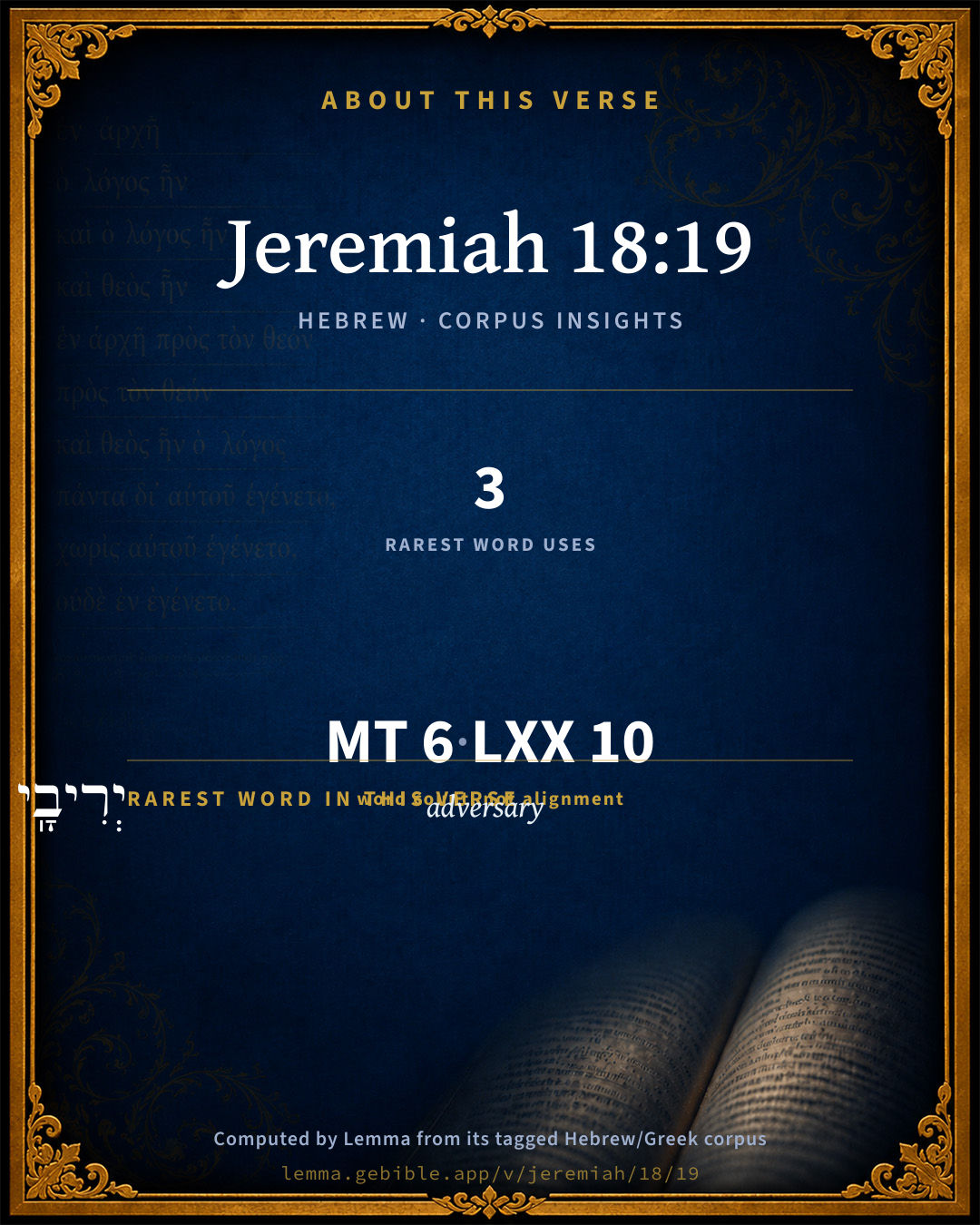
The rarest word here is יְרִיבָֽי adversary H3401 — appearing just 3 times in the whole Hebrew Bible.

Shared distinctive vocabulary

יְרִיבָֽי adversary H3401 occurs in 3 verses of the Hebrew Bible. Also found in:

Grammatical profile

  • 2 verbs
  • 3 nouns
  • 1 preposition

Verb forms

  • הַקְשִׁ֥יבָה Hiphil · Imperative
  • וּשְׁמַ֖ע Qal · Imperative

Hebrew & Septuagint length

In the original languages it is 6 Hebrew tokens and 10 Greek tokens — but the two are counted differently (Hebrew bundles its prefixes and suffixes into one token; the Greek is in lemma form), so that isn’t a like-for-like length.

Cross-references

11

Topical passages linked to Jeremiah 18:19 in the Treasury of Scripture Knowledge — connected by theme and wording, ordered by reader-vote popularity; previews shown in the World English Bible.

  • Nehemiah 6:9 For they all would have made us afraid, saying, Their hands shall be weakened from the work, that it not be done. But now, [God], strengthen you my hands.
  • Psalms 55:16–17 As for me, I will call on God. Yahweh will save me.
  • Psalms 109:28 They may curse, but you bless. When they arise, they will be shamed, But your servant shall rejoice.
  • Jeremiah 20:12 But, Yahweh of Hosts, who tests the righteous, who sees the heart and the mind, let me see your vengeance on them; for to you have I revealed my cause.
  • Micah 7:8 Don't rejoice against me, my enemy. When I fall, I will arise. When I sit in darkness, Yahweh will be a light to me.
  • 2 Kings 19:16 Incline your ear, Yahweh, and hear; open your eyes, Yahweh, and see; and hear the words of Sennacherib, with which he has sent him to defy the living God.
  • Nehemiah 4:4–5 Hear, our God; for we are despised: and turn back their reproach on their own head, and give them up for a spoil in a land of captivity;
  • Psalms 56:1–3 Be merciful to me, God, for man wants to swallow me up. All day long, he attacks and oppresses me.
  • Psalms 64:1–4 Hear my voice, God, in my complaint. Preserve my life from fear of the enemy.
  • Psalms 109:4 In return for my love, they are my adversaries; But I am in prayer.
  • Luke 6:11–12 But they were filled with rage, and talked with one another about what they might do to Jesus.

Cross-references courtesy of OpenBible.info (CC BY 4.0).

Hebrew and Greek witnesses Masoretic Hebrew ↔ Greek Septuagint

The same verse in the two great witnesses to the Old Testament, shown verse-for-verse.

These are two independent witnesses, not word-aligned to each other, and the Septuagint is shown in lemma (dictionary) form.

Hebrew Jeremiah 18:19 Masoretic · Westminster Leningrad Codex

הַקְשִׁ֥יבָה יְהוָ֖ה אֵלָ֑י וּשְׁמַ֖ע לְק֥וֹל יְרִיבָֽי

Give heed to me, Yahweh, and listen to the voice of those who contend with me.

World English Bible · Public Domain

Greek LXX Structure differs

In the Septuagint, Jeremiah is about an eighth shorter than the Hebrew and arranges its material differently — the Oracles Against the Nations (Hebrew chapters 46–51) appear in the middle of the Greek book, after 25:13. Because the chapter and verse boundaries do not line up, a verse-for-verse comparison with the Hebrew is not shown.

A verse-for-verse comparison isn’t shown here because the chapters and verses don’t line up. Switch to the LXX edition with the MT / LXX toggle above to read the Greek directly.

Hebrew: Westminster Leningrad Codex (CC BY 4.0). Greek: Septuagint (public domain); English from a public-domain English Septuagint. How the Septuagint differs from the Hebrew →

Targum (Aramaic paraphrase)

1

The Targum is the ancient Jewish Aramaic paraphrase of the Hebrew Scriptures — an interpretive translation, not the Hebrew text itself. Onkelos (literal) and Pseudo-Jonathan (expansive) render the Torah, and Jonathan the Prophets. Coverage is partial: where no permissively-licensed English translation exists for a verse, only the Aramaic is shown. This is verse-level text, not a word-by-word alignment to the Hebrew.

  1. Targum Jonathan Prophets (Joshua–Malachi)
    גְּלֵי קֳדָמָךְ יְיָ דִינִי וּשְׁמַע קֳדָמָךְ עוּלְבָּנִי:

    (no public-domain English translation for this verse)

    Targum Jonathan — Aramaic: “Mikraot Gedolot” (public domain). English: “Sefaria Community Translation” (CC0 1.0 (public-domain dedication)); “London "Chaldee Paraphrase," 1871” (public domain). Text via Sefaria.

Commentary

Notes on Jeremiah 18:19 from classic Christian and Jewish commentators (each source and its license shown beneath its notes). The classic Christian expositions comment on the surrounding passage and are grouped to its opening verse, so a note may address several verses; the Jewish commentaries on the Tanakh (Rashi and others) are per-verse, so they appear only where the commentator wrote on this verse.

Lemma curates 59 commentaries, every one of them public domain or Creative Commons licensed, each selected and text-cleaned for this edition rather than reprinted as found. About our sources →

Trapp's Complete Commentary

John Trapp

Jer 18:19 Give heed to me, O LORD, and hearken to the voice of them that contend with me.

Ver. 19. Give heed to me, O Lord.] Though they will not, yet do thou, I beseech thee. This is ordinary with good men, when wearied out with the world’s misusages, to turn them to God, and to seek help of him.

John Trapp, A Commentary or Exposition upon All the Books of the Old and New Testament (1647–1656) — public domain. Text from a community e-Sword module.

Joseph Benson's Commentary

Jer 18:19-23. Give heed to me, O Lord — The people had determined not to give heed to any of his words, (Jer 18:18,) nor to admit any of his complaints, nor take the least notice of his grievances; therefore he appeals to God, as an impartial judge, that would hear both sides, as every judge ought to do. It is a matter of comfort to faithful ministers that, if men will not give heed to their preaching, yet God will give heed to their praying. And hearken to the voice of them that contend with me — Hear what they have to say against me, and for themselves, and then make it appear that thou sittest upon the throne judging right. Shall evil be recompensed for good? — And shall it go unpunished? Wilt not thou recompense me good for that evil? see 2Sa 16:12. “To render good for good,” says Henry, “is human, evil for evil is brutish, good for evil is Christian, but evil for good is devilish; it is so very absurd and wicked a thing that we cannot think but God will avenge it.” They have digged a pit for my soul — That is, They have laid snares for me as for a wild beast; for pits are digged for wild beasts to fall into, that so they may be taken. Therefore the sense is, They have formed a design against my life, and that not in a generous way, by an open assault, against which I might have had an opportunity of defending myself; but in a base, cowardly, clandestine way. Such was the evil they did or devised against him. But see how great the good was which he had done for them: Remember, he says, that I stood before thee to speak good for them — That is, in the execution of my prophetical office, I always interposed, with my prayers, in their behalf, to avert those judgments which, by thy command, I denounced against them. Therefore deliver up their children, &c. — Since they are thus incorrigible, I shall not any more intercede for them, but let those calamities of famine and sword, with which thou hast threatened them, overtake them. Let a cry be heard from their houses, &c. — When they are unexpectedly assaulted by a troop of their enemies, that come to plunder and destroy them. Yet Lord, or, rather, For Lord, thou knowest all their counsel against me, to slay me; forgive not their iniquity, &c. — Compare chap. Jer 11:20; Jer 15:15; Psa 59:5; on which passages see the notes. Although it redounds to the glory of God’s justice that incorrigible sinners should meet with exemplary punishment; yet these strong imprecations are not to be considered as the effusions of an unholy zeal, but as simple prophecies, in which light, we have shown, in our commentary on the Psalms, many similar expressions occurring there are to be considered.

Joseph Benson's Commentary on the Old and New Testaments (1811–1818) — public domain. Text from a community e-Sword module.

Tyndale Open Study Notes

Tyndale Open Resources

18:19-20 Jeremiah reminded the Lord of the injustice of his enemies’ opposition.

Tyndale Open Study Notes — © Tyndale Open Resources, licensed CC BY-SA 4.0. Text via the HelloAO Bible API.

Jamieson, Fausset & Brown

Robert Jamieson, A. R. Fausset & David Brown

Give heed--contrasted with, "let us not give heed" (Jer 18:18). As they give no heed to me, do Thou, O Lord, give heed to me, and let my words at least have their weight with Thee.

Jamieson, Fausset & Brown — Commentary Critical and Explanatory on the Whole Bible (1871) — public domain (CC PDM 1.0). Text via the HelloAO Bible API.

John Calvin's Commentaries

As the Prophet saw that his labor as to men was useless, he turned to God, as we find he had done often before. This way of speaking, no doubt, had more force than if he had continued to address the people. He might indeed have said, “Miserable men! where are you rushing headlong? what means this madness? what at last do ye think will be the end, since ye are resisting God, being obstinate against his Spirit? for ye cannot extinguish the light by your perverseness or by your effrontery.” The Prophet might have thus reproved them; but it betokens more vehemence, when he leaves men and addresses God, himself. This apostrophe then ought to be carefully noticed, for we hence gather that the madness of the Jews was reprobated, inasmuch as the Prophet did not deign to contend with them. But he notwithstanding said, “As they do not attend, attend thou, Jehovah, to me.” He saw that he was despised by God’s enemies, and by this prayer he intimates, that his doctrine was in force before God, and retained its own importance and could not fail. Hence he says, Jehovah, regard me, and hear the voice of those who contend with me.

Here Jeremiah asks two things, — that God would undertake his cause, and that he would take vengeance on the wantonness of his enemies. And this passage deserves especial notice, for it is a support which can never fail us, when we know that our service is approved by God, and that as he prescribes to us what to say, so what proceeds from him shall ever possess its own weight, and that it cannot be effected by the ingratitude of the world, that any portion of the authority of celestial truth should be destroyed or diminished. Whenever then the ungodly deride us, and elude or neglect the truth, let us follow the example of the Prophet, let us ask God to look on us; but this cannot be done, except we strive with a sincere heart to execute what he has committed to us. Then a pure conscience will open a door for us, so that we may be able confidently to call on God as our guardian and defender, whenever our labor is despised by men.

He asks, in the second place, that God would hear the voice of those who contended with him. We hence conclude, that the wicked gain nothing by their pride, for they provoke God more and more, when they thus oppose his pure doctrine and contend against his prophets and faithful teachers. Since then we see that the ungodly effect nothing, except that they kindle God’s wrath the more, we ought to go on more courageously in the discharge of our office; for even when for a time they suppress by their great clamours the truth of God, he will yet check them, and so check them, that the doctrine, which is now subverted by unjust calumnies, may shine forth more fully. He afterwards adds —

John Calvin's Commentaries (1540-1563) — public domain. Text from the Calvin Translation Society English edition (1840s-50s) via the Christian Classics Ethereal Library (ccel.org). Calvin's coverage is partial (roughly two-thirds of the Bible); uncommented books and verses are honest gaps, never fabricated. The 19th-century editor's footnotes and remarks are omitted so the notes are faithfully Calvin's own voice.

Ellicott's Commentary for English Readers

(19) Give heed to me . . .—This is the prophet’s answer to the resolve of the people, “Let us not give heed.” He appeals in the accents of a passionate complaint to One who will heed his words. The opening words are almost as an echo of Psa_35:1.

A Bible Commentary for English Readers, edited by Charles John Ellicott (1878–1897) — public domain. Text from a community e-Sword module.

John Gill's Exposition

Therefore deliver up their children to the famine,.... To be starved, and perish by it, as they were in the siege of Jerusalem, both by the Chaldeans, and the Romans:

and pour out their blood by the force of the sword: or, "upon the hands of the sword" (f); by means of it; that is, the blood of the parents of the children; let the one perish by famine, and the other by the sword; which, when thrust into a man, blood gushes out, and runs upon the sword to the handle of it:

and let their wives be bereaved of their children, and be widows; let them have neither husbands nor children; which latter might be a comfort to them, when they had lost their husbands; but being stripped of these also, the affliction and distress must be the greater:

and let their men be put to death; or "slain with death" (g); with the pestilence, as Kimchi rightly interprets it; see Rev 6:8; Jarchi understands it of the angel of death; see Heb 2:14;

let their young men be slain by the sword in battle; such being commonly employed in military service, as being the most proper persons for it.

(f) "super manus gladii", Montanus, Schmidt. (g) "occisi morte", Pagninus, Montanus, "i.e. peste" Schmidt; "occisi mortis", Cocceius.

John Gill's Exposition of the Whole Bible (1746–1763) — public domain (CC PDM 1.0). Text via the HelloAO Bible API.

Albert Barnes' Notes on the Bible

The voice - i. e., the outcry and threats.

Albert Barnes' Notes on the Bible (1834–1885) — public domain. Text from a community e-Sword/MySword module.

Matthew Poole's English Annotations

The several following verses, to the end of this chapter, contain the prophet’s prayer by way of appeal to God against those wicked men: Lord, (saith he,) though they are resolved to take no heed to my words, yet do thou give heed to them, and do thou take notice of those men that contend with me. Take notice of what they say, not to confirm, but to cross their desires, and to be revenged on them for them.

Matthew Poole's English Annotations on the Holy Bible (1683–1685) — public domain. Text from a community e-Sword/MySword module.

The Pulpit Commentary

Vers. 19, 20. Them that contend with me. Shall evil, etc.? Compare the phraseology of Psa_35:1-12 (either Jeremiah imitated this psalm or vice versa); and for another point of contact with this psalm, see on Jer_23:12. They have digged a pit, etc. Comp. Psa_57:6. To speak good for them. See Jeremiah"s intercessions in Jer_14:7-9, Jer_14:19-22.

Vers. 19-23. The prophet"s prayer for vengeance on his enemies.

(Cf. homily on "Imprecatory prayers," Jer_50:20-23)

The Pulpit Commentary (1880–1919), ed. H.D.M. Spence-Jones & Joseph S. Exell — public domain. Text from a community e-Sword module.

Lesson kit

Teaching starters — assembled from the data on this page, not authored interpretation. Every prompt links to the verse data it draws on. Edit before teaching.

Jeremiah, in the Prophets, opens this verse with 6 words (6 distinct Hebrew lemmas). Its most distinctive word is yârîyb (“adversary”). A historical commentator’s framing appears above. Read the whole chapter for the surrounding context.

Discussion questions

  1. How does “adversary” (yârîyb) shape what this verse is saying?
  2. Psalms 35:1 shares the word «adversary» with this verse. How do the two illuminate each other?
  3. The translations on this page render this verse differently — a whole-verse word diff, not a word-by-word alignment. What might account for the different wordings?
  4. The verb «הַקְשִׁ֥יבָה» is Hiphil Imperative. How does its form color the action?
  5. Reading how Trapp's Complete Commentary and Joseph Benson's Commentary read this verse, where do the two commentators agree and where do they part?

Things to notice

Reading settings

Reading text

Shown beneath each verse's original-language words.

Old Testament
Old Testament edition

Read the OT as the Masoretic Hebrew (MT) or the Greek Septuagint (LXX).

English shown for the Greek Septuagint (in the Hebrew ↔ Greek comparison).

Comparing translations? Open the Compare panel on any verse page to stack up to four side by side.