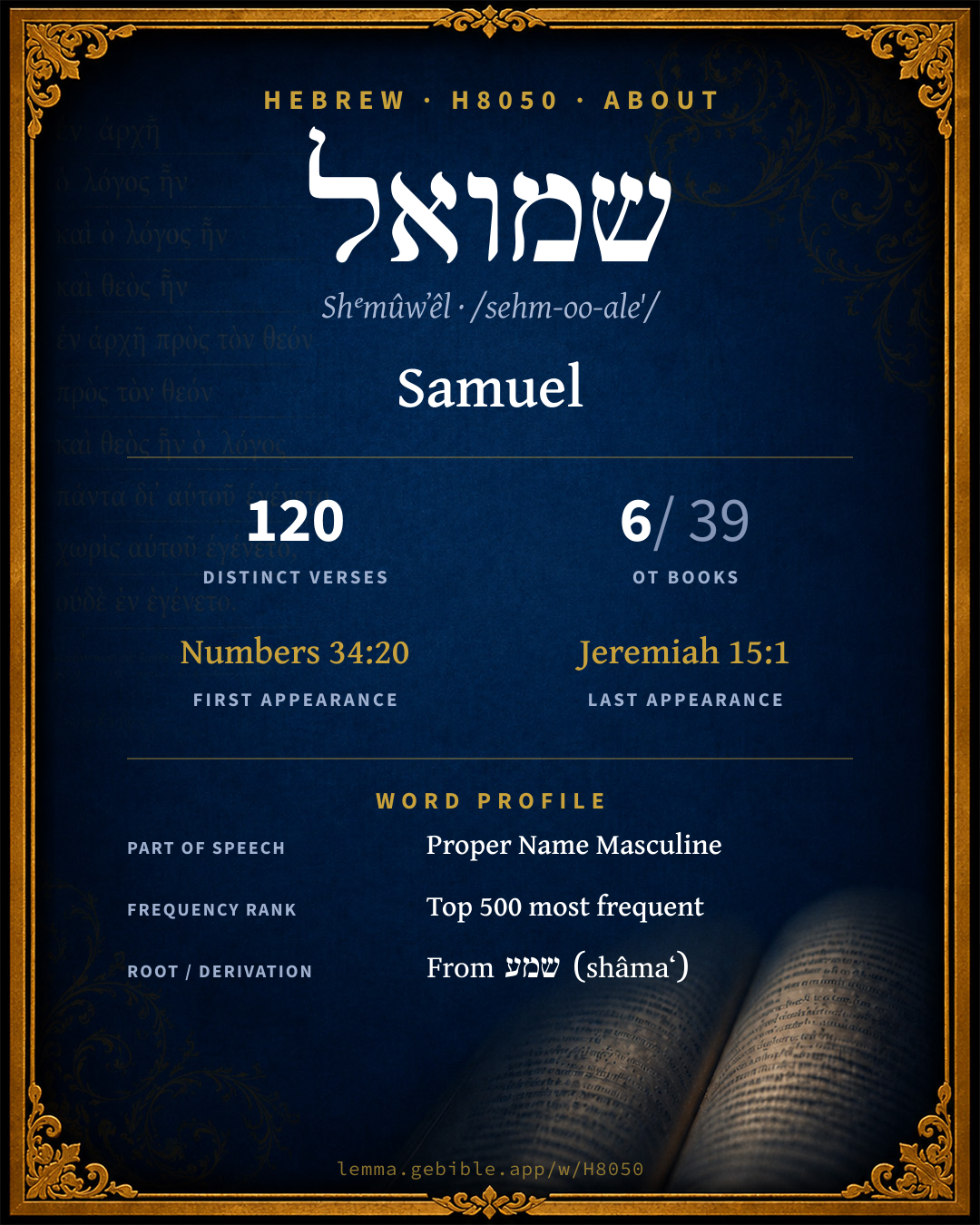
שְׁמוּאֵל
Samuel
BDB lists 4 entries for ‘Samuel’ fuller range ↓
Full lexicon entry — Brown-Driver-Briggs (BDB)
From Brown-Driver-Briggs (BDB)
Where this word appears
Grammar key — what these labels mean
Part of speech
- Noun
- A naming word — a person, place, thing, or idea.
Noun type
- Proper
- A name of a specific person, place, or people (e.g. Abraham, Zion, Israel).
Every verse where H8050 appears — 120 distinct verses across 6 books. Click any verse to open its interlinear word-by-word view. Verse text shown in the World English Bible for context — . Each verse’s Hebrew form is shown with its reference; the English is not keyword-highlighted, since the data carries no word-level English alignment. Use “Compare translations” on any verse to read it across multiple English versions. This concordance covers the Hebrew Bible; Septuagint (Greek Old Testament) occurrences are not indexed here.
Numbers 1 verse
1 Samuel 109 verses
- 1 Samuel 1:20 שְׁמוּאֵ֔ל n Proper It happened, when the time was come about, that Hannah conceived, and bore a son; and she named him Samuel, [saying], Because I have asked him of Yahweh.
- 1 Samuel 2:18 וּ/שְׁמוּאֵ֕ל conj + n Proper But Samuel ministered before Yahweh, being a child, girded with a linen ephod.
- 1 Samuel 2:21 שְׁמוּאֵ֖ל n Proper Yahweh visited Hannah, and she conceived, and bore three sons and two daughters. The child Samuel grew before Yahweh.
- 1 Samuel 2:26 שְׁמוּאֵ֔ל n Proper The child Samuel grew on, and increased in favor both with Yahweh, and also with men.
- 1 Samuel 3:1 שְׁמוּאֵ֛ל n Proper The child Samuel ministered to Yahweh before Eli. The word of Yahweh was precious in those days; there was no frequent vision.
- 1 Samuel 3:3 וּ/שְׁמוּאֵ֖ל conj + n Proper and the lamp of God hadn't yet gone out, and Samuel had laid down [to sleep], in the temple of Yahweh, where the ark of God was;
- 1 Samuel 3:4 שְׁמוּאֵ֖ל n Proper that Yahweh called Samuel; and he said, Here am I.
- 1 Samuel 3:6 שְׁמוּאֵל֒ שְׁמוּאֵל֙ n Proper n Proper Yahweh called yet again, Samuel. Samuel arose and went to Eli, and said, Here am I; for you called me. He answered, I didn't call, my son; lie down again.
- 1 Samuel 3:7 וּ/שְׁמוּאֵ֕ל conj + n Proper Now Samuel didn't yet know Yahweh, neither was the word of Yahweh yet revealed to him.
- 1 Samuel 3:8 שְׁמוּאֵל֮ n Proper Yahweh called Samuel again the third time. He arose and went to Eli, and said, Here am I; for you called me. Eli perceived that Yahweh had called the child.
- 1 Samuel 3:9 לִ/שְׁמוּאֵל֮ שְׁמוּאֵ֔ל prep + n Proper n Proper Therefore Eli said to Samuel, Go, lie down: and it shall be, if he call you, that you shall say, Speak, Yahweh; for your servant hears. So Samuel went and lay down in his place.
- 1 Samuel 3:10 שְׁמוּאֵ֣ל שְׁמוּאֵ֑ל שְׁמוּאֵל֙ n Proper n Proper n Proper Yahweh came, and stood, and called as at other times, Samuel, Samuel. Then Samuel said, Speak; for your servant hears.
- 1 Samuel 3:11 שְׁמוּאֵ֔ל n Proper Yahweh said to Samuel, Behold, I will do a thing in Israel, at which both the ears of everyone who hears it shall tingle.
- 1 Samuel 3:15 שְׁמוּאֵל֙ וּ/שְׁמוּאֵ֣ל n Proper conj + n Proper Samuel lay until the morning, and opened the doors of the house of Yahweh. Samuel feared to show Eli the vision.
- 1 Samuel 3:16 שְׁמוּאֵ֔ל שְׁמוּאֵ֣ל n Proper n Proper Then Eli called Samuel, and said, Samuel, my son. He said, Here am I.
- 1 Samuel 3:18 שְׁמוּאֵל֙ n Proper Samuel told him every whit, and hid nothing from him. He said, It is Yahweh: let him do what seems him good.
- 1 Samuel 3:19 שְׁמוּאֵ֑ל n Proper Samuel grew, and Yahweh was with him, and did let none of his words fall to the ground.
- 1 Samuel 3:20 שְׁמוּאֵ֔ל n Proper All Israel from Dan even to Beersheba knew that Samuel was established to be a prophet of Yahweh.
- 1 Samuel 3:21 שְׁמוּאֵ֛ל n Proper Yahweh appeared again in Shiloh; for Yahweh revealed himself to Samuel in Shiloh by the word of Yahweh.
- 1 Samuel 4:1 שְׁמוּאֵ֖ל n Proper The word of Samuel came to all Israel. Now Israel went out against the Philistines to battle, and encamped beside Ebenezer: and the Philistines encamped in Aphek.
- 1 Samuel 7:3 שְׁמוּאֵ֗ל n Proper Samuel spoke to all the house of Israel, saying, If you do return to Yahweh with all your heart, then put away the foreign gods and the Ashtaroth from among you, and direct your hearts to Yahweh, and serve him only; and he will deliver you out of the hand of the Philistines.
- 1 Samuel 7:5 שְׁמוּאֵ֔ל n Proper Samuel said, Gather all Israel to Mizpah, and I will pray for you to Yahweh.
- 1 Samuel 7:6 שְׁמוּאֵ֛ל n Proper They gathered together to Mizpah, and drew water, and poured it out before Yahweh, and fasted on that day, and said there, We have sinned against Yahweh. Samuel judged the children of Israel in Mizpah.
- 1 Samuel 7:8 שְׁמוּאֵ֔ל n Proper The children of Israel said to Samuel, "Don't cease to cry to Yahweh our God for us, that he will save us out of the hand of the Philistines."
- 1 Samuel 7:9 שְׁמוּאֵ֗ל שְׁמוּאֵ֤ל n Proper n Proper Samuel took a sucking lamb, and offered it for a whole burnt-offering to Yahweh: and Samuel cried to Yahweh for Israel; and Yahweh answered him.
- 1 Samuel 7:10 שְׁמוּאֵל֙ n Proper As Samuel was offering up the burnt offering, the Philistines drew near to battle against Israel; but Yahweh thundered with a great thunder on that day on the Philistines, and confused them; and they were struck down before Israel.
- 1 Samuel 7:12 שְׁמוּאֵ֜ל n Proper Then Samuel took a stone, and set it between Mizpah and Shen, and called the name of it Ebenezer, saying, Hitherto has Yahweh helped us.
- 1 Samuel 7:13 שְׁמוּאֵֽל n Proper So the Philistines were subdued, and they came no more within the border of Israel: and the hand of Yahweh was against the Philistines all the days of Samuel.
- 1 Samuel 7:15 שְׁמוּאֵל֙ n Proper Samuel judged Israel all the days of his life.
- 1 Samuel 8:1 שְׁמוּאֵ֑ל n Proper It happened, when Samuel was old, that he made his sons judges over Israel.
- 1 Samuel 8:4 שְׁמוּאֵ֖ל n Proper Then all the elders of Israel gathered themselves together, and came to Samuel to Ramah;
- 1 Samuel 8:6 שְׁמוּאֵ֔ל שְׁמוּאֵ֖ל n Proper n Proper But the thing displeased Samuel, when they said, Give us a king to judge us. Samuel prayed to Yahweh.
- 1 Samuel 8:7 שְׁמוּאֵ֔ל n Proper Yahweh said to Samuel, Listen to the voice of the people in all that they tell you; for they have not rejected you, but they have rejected me, that I should not be king over them.
- 1 Samuel 8:10 שְׁמוּאֵ֔ל n Proper Samuel told all the words of Yahweh to the people who asked of him a king.
- 1 Samuel 8:19 שְׁמוּאֵ֑ל n Proper But the people refused to listen to the voice of Samuel; and they said, No: but we will have a king over us,
- 1 Samuel 8:21 שְׁמוּאֵ֔ל n Proper Samuel heard all the words of the people, and he rehearsed them in the ears of Yahweh.
- 1 Samuel 8:22 שְׁמוּאֵל֙ שְׁמוּאֵל֙ n Proper n Proper Yahweh said to Samuel, Listen to their voice, and make them a king. Samuel said to the men of Israel, Go you every man to his city.
- 1 Samuel 9:14 שְׁמוּאֵל֙ n Proper They went up to the city; [and] as they came within the city, behold, Samuel came out toward them, to go up to the high place.
- 1 Samuel 9:15 שְׁמוּאֵ֑ל n Proper Now Yahweh had revealed to Samuel a day before Saul came, saying,
- 1 Samuel 9:17 וּ/שְׁמוּאֵ֖ל conj + n Proper When Samuel saw Saul, Yahweh said to him, Behold, the man of whom I spoke to you! this same shall have authority over my people.
- 1 Samuel 9:18 שְׁמוּאֵ֖ל n Proper Then Saul drew near to Samuel in the gate, and said, Tell me, Please, where the seer's house is.
- 1 Samuel 9:19 שְׁמוּאֵ֜ל n Proper Samuel answered Saul, and said, I am the seer; go up before me to the high place, for you shall eat with me today: and in the morning I will let you go, and will tell you all that is in your heart.
- 1 Samuel 9:22 שְׁמוּאֵל֙ n Proper Samuel took Saul and his servant, and brought them into the guest-chamber, and made them sit in the best place among those who were invited, who were about thirty persons.
- 1 Samuel 9:23 שְׁמוּאֵל֙ n Proper Samuel said to the cook, Bring the portion which I gave you, of which I said to you, Set it by you.
- 1 Samuel 9:24 שְׁמוּאֵ֖ל n Proper The cook took up the thigh, and that which was on it, and set it before Saul. [Samuel] said, Behold, that which has been reserved! set it before you and eat; because to the appointed time has it been kept for you, for I said, I have invited the people. So Saul ate with Samuel that day.
- 1 Samuel 9:26 שְׁמוּאֵ֤ל וּ/שְׁמוּאֵ֖ל n Proper conj + n Proper They arose early: and it happened about the spring of the day, that Samuel called to Saul on the housetop, saying, Up, that I may send you away. Saul arose, and they went out both of them, he and Samuel, abroad.
- 1 Samuel 9:27 וּ/שְׁמוּאֵ֞ל conj + n Proper As they were going down at the end of the city, Samuel said to Saul, Bid the servant pass on before us (and he passed on), but stand you still first, that I may cause you to hear the word of God.
- 1 Samuel 10:1 שְׁמוּאֵ֜ל n Proper Then Samuel took the vial of oil, and poured it on his head, and kissed him, and said, Isn't it that Yahweh has anointed you to be prince over his inheritance?
- 1 Samuel 10:9 שְׁמוּאֵ֔ל n Proper It was so, that when he had turned his back to go from Samuel, God gave him another heart: and all those signs happened that day.
- 1 Samuel 10:14 שְׁמוּאֵֽל n Proper Saul's uncle said to him and to his servant, Where went you? He said, To seek the donkeys; and when we saw that they were not found, we came to Samuel.
- 1 Samuel 10:15 שְׁמוּאֵֽל n Proper Saul's uncle said, Tell me, Please, what Samuel said to you.
- 1 Samuel 10:16 שְׁמוּאֵֽל n Proper Saul said to his uncle, He told us plainly that the donkeys were found. But concerning the matter of the kingdom, of which Samuel spoke, he didn't tell him.
- 1 Samuel 10:17 שְׁמוּאֵל֙ n Proper Samuel called the people together to Yahweh to Mizpah;
- 1 Samuel 10:20 שְׁמוּאֵ֔ל n Proper So Samuel brought all the tribes of Israel near, and the tribe of Benjamin was taken.
- 1 Samuel 10:24 שְׁמוּאֵ֜ל n Proper Samuel said to all the people, "You see him whom Yahweh has chosen, that there is none like him among all the people?" All the people shouted, and said, [Long] live the king.
- 1 Samuel 10:25 שְׁמוּאֵ֜ל שְׁמוּאֵ֛ל n Proper n Proper Then Samuel told the people the manner of the kingdom, and wrote it in a book, and laid it up before Yahweh. Samuel sent all the people away, every man to his house.
- 1 Samuel 11:7 שְׁמוּאֵ֔ל n Proper He took a yoke of oxen, and cut them in pieces, and sent them throughout all the borders of Israel by the hand of messengers, saying, Whoever doesn't come forth after Saul and after Samuel, so shall it be done to his oxen. The dread of Yahweh fell on the people, and they came out as one man.
- 1 Samuel 11:12 שְׁמוּאֵ֔ל n Proper The people said to Samuel, Who is he who said, Shall Saul reign over us? bring the men, that we may put them to death.
- 1 Samuel 11:14 שְׁמוּאֵל֙ n Proper Then said Samuel to the people, Come, and let us go to Gilgal, and renew the kingdom there.
- 1 Samuel 12:1 שְׁמוּאֵל֙ n Proper Samuel said to all Israel, Behold, I have listened to your voice in all that you said to me, and have made a king over you.
- 1 Samuel 12:6 שְׁמוּאֵ֖ל n Proper Samuel said to the people, It is Yahweh who appointed Moses and Aaron, and that brought your fathers up out of the land of Egypt.
- 1 Samuel 12:11 שְׁמוּאֵ֑ל n Proper Yahweh sent Jerubbaal, and Bedan, and Jephthah, and Samuel, and delivered you out of the hand of your enemies on every side; and you lived in safety.
- 1 Samuel 12:18 שְׁמוּאֵל֙ שְׁמוּאֵֽל n Proper n Proper So Samuel called to Yahweh; and Yahweh sent thunder and rain that day: and all the people greatly feared Yahweh and Samuel.
- 1 Samuel 12:19 שְׁמוּאֵ֗ל n Proper All the people said to Samuel, Pray for your servants to Yahweh your God, that we not die; for we have added to all our sins [this] evil, to ask us a king.
- 1 Samuel 12:20 שְׁמוּאֵ֤ל n Proper Samuel said to the people, "Don't be afraid; you have indeed done all this evil; yet don't turn aside from following Yahweh, but serve Yahweh with all your heart:
- 1 Samuel 13:8 שְׁמוּאֵ֔ל שְׁמוּאֵ֖ל n Proper n Proper He stayed seven days, according to the set time that Samuel [had appointed]: but Samuel didn't come to Gilgal; and the people were scattered from him.
- 1 Samuel 13:10 שְׁמוּאֵ֖ל n Proper It came to pass that as soon as he had made an end of offering the burnt offering, behold, Samuel came; and Saul went out to meet him, that he might greet him.
- 1 Samuel 13:11 שְׁמוּאֵ֖ל n Proper Samuel said, What have you done? Saul said, Because I saw that the people were scattered from me, and that you didn't come within the days appointed, and that the Philistines assembled themselves together at Michmash;
- 1 Samuel 13:13 שְׁמוּאֵ֛ל n Proper Samuel said to Saul, You have done foolishly; you have not kept the commandment of Yahweh your God, which he commanded you: for now would Yahweh have established your kingdom on Israel forever.
- 1 Samuel 13:15 שְׁמוּאֵ֗ל n Proper Samuel arose, and got him up from Gilgal to Gibeah of Benjamin. Saul numbered the people who were present with him, about six hundred men.
- 1 Samuel 15:1 שְׁמוּאֵל֙ n Proper Samuel said to Saul, Yahweh sent me to anoint you to be king over his people, over Israel: now therefore listen you to the voice of the words of Yahweh.
- 1 Samuel 15:10 שְׁמוּאֵ֖ל n Proper Then came the word of Yahweh to Samuel, saying,
- 1 Samuel 15:11 לִ/שְׁמוּאֵ֔ל prep + n Proper It repents me that I have set up Saul to be king; for he is turned back from following me, and has not performed my commandments. Samuel was angry; and he cried to Yahweh all night.
- 1 Samuel 15:12 שְׁמוּאֵ֛ל לִ/שְׁמוּאֵ֜ל n Proper prep + n Proper Samuel rose early to meet Saul in the morning; and it was told Samuel, saying, Saul came to Carmel, and, behold, he set him up a monument, and turned, and passed on, and went down to Gilgal.
- 1 Samuel 15:13 שְׁמוּאֵ֖ל n Proper Samuel came to Saul; and Saul said to him, Blessed are you by Yahweh: I have performed the commandment of Yahweh.
- 1 Samuel 15:14 שְׁמוּאֵ֔ל n Proper Samuel said, What means then this bleating of the sheep in my ears, and the lowing of the oxen which I hear?
- 1 Samuel 15:16 שְׁמוּאֵל֙ n Proper Then Samuel said to Saul, Stay, and I will tell you what Yahweh has said to me this night. He said to him, Say on.
- 1 Samuel 15:17 שְׁמוּאֵ֔ל n Proper Samuel said, "Though you were little in your own sight, weren't you made the head of the tribes of Israel? Yahweh anointed you king over Israel;
- 1 Samuel 15:20 שְׁמוּאֵ֗ל n Proper Saul said to Samuel, Yes, I have obeyed the voice of Yahweh, and have gone the way which Yahweh sent me, and have brought Agag the king of Amalek, and have utterly destroyed the Amalekites.
- 1 Samuel 15:22 שְׁמוּאֵ֗ל n Proper Samuel said, Has Yahweh as great delight in burnt offerings and sacrifices, as in obeying the voice of Yahweh? Behold, to obey is better than sacrifice, and to listen than the fat of rams.
- 1 Samuel 15:24 שְׁמוּאֵל֙ n Proper Saul said to Samuel, I have sinned; for I have transgressed the commandment of Yahweh, and your words, because I feared the people, and obeyed their voice.
- 1 Samuel 15:26 שְׁמוּאֵל֙ n Proper Samuel said to Saul, I will not return with you; for you have rejected the word of Yahweh, and Yahweh has rejected you from being king over Israel.
- 1 Samuel 15:27 שְׁמוּאֵ֖ל n Proper As Samuel turned about to go away, [Saul] laid hold on the skirt of his robe, and it tore.
- 1 Samuel 15:28 שְׁמוּאֵ֔ל n Proper Samuel said to him, Yahweh has torn the kingdom of Israel from you this day, and has given it to a neighbor of yours who is better than you.
- 1 Samuel 15:31 שְׁמוּאֵ֖ל n Proper So Samuel turned again after Saul; and Saul worshiped Yahweh.
- 1 Samuel 15:32 שְׁמוּאֵ֗ל n Proper Then said Samuel, Bring you here to me Agag the king of the Amalekites. Agag came to him cheerfully. Agag said, Surely the bitterness of death is past.
- 1 Samuel 15:33 שְׁמוּאֵ֔ל שְׁמוּאֵ֧ל n Proper n Proper Samuel said, As your sword has made women childless, so shall your mother be childless among women. Samuel hewed Agag in pieces before Yahweh in Gilgal.
- 1 Samuel 15:34 שְׁמוּאֵ֖ל n Proper Then Samuel went to Ramah; and Saul went up to his house to Gibeah of Saul.
- 1 Samuel 15:35 שְׁמוּאֵ֜ל שְׁמוּאֵ֖ל n Proper n Proper Samuel came no more to see Saul until the day of his death; for Samuel mourned for Saul: and Yahweh repented that he had made Saul king over Israel.
- 1 Samuel 16:1 שְׁמוּאֵ֗ל n Proper Yahweh said to Samuel, How long will you mourn for Saul, seeing I have rejected him from being king over Israel? fill your horn with oil, and go: I will send you to Jesse the Bethlehemite; for I have provided me a king among his sons.
- 1 Samuel 16:2 שְׁמוּאֵל֙ n Proper Samuel said, How can I go? if Saul hear it, he will kill me. Yahweh said, Take a heifer with you, and say, I am come to sacrifice to Yahweh.
- 1 Samuel 16:4 שְׁמוּאֵ֗ל n Proper Samuel did that which Yahweh spoke, and came to Bethlehem. The elders of the city came to meet him trembling, and said, Come you peaceably?
- 1 Samuel 16:7 שְׁמוּאֵ֗ל n Proper But Yahweh said to Samuel, "Don't look on his face, or on the height of his stature; because I have rejected him: for [Yahweh sees] not as man sees; for man looks at the outward appearance, but Yahweh looks at the heart."
- 1 Samuel 16:8 שְׁמוּאֵ֑ל n Proper Then Jesse called Abinadab, and made him pass before Samuel. He said, Neither has Yahweh chosen this.
- 1 Samuel 16:10 שְׁמוּאֵ֑ל שְׁמוּאֵל֙ n Proper n Proper Jesse made seven of his sons to pass before Samuel. Samuel said to Jesse, Yahweh has not chosen these.
- 1 Samuel 16:11 שְׁמוּאֵ֣ל שְׁמוּאֵ֤ל n Proper n Proper Samuel said to Jesse, Are here all your children? He said, There remains yet the youngest, and, behold, he is keeping the sheep. Samuel said to Jesse, Send and get him; for we will not sit down until he come here.
- 1 Samuel 16:13 שְׁמוּאֵ֜ל שְׁמוּאֵ֔ל n Proper n Proper Then Samuel took the horn of oil, and anointed him in the midst of his brothers: and the Spirit of Yahweh came mightily on David from that day forward. So Samuel rose up, and went to Ramah.
- 1 Samuel 19:18 שְׁמוּאֵל֙ וּ/שְׁמוּאֵ֔ל n Proper conj + n Proper Now David fled, and escaped, and came to Samuel to Ramah, and told him all that Saul had done to him. He and Samuel went and lived in Naioth.
- 1 Samuel 19:20 וּ/שְׁמוּאֵ֕ל conj + n Proper Saul sent messengers to take David: and when they saw the company of the prophets prophesying, and Samuel standing as head over them, the Spirit of God came on the messengers of Saul, and they also prophesied.
- 1 Samuel 19:22 שְׁמוּאֵ֖ל n Proper Then went he also to Ramah, and came to the great well that is in Secu: and he asked and said, Where are Samuel and David? One said, Behold, they are at Naioth in Ramah.
- 1 Samuel 19:24 שְׁמוּאֵ֔ל n Proper He also stripped off his clothes, and he also prophesied before Samuel, and lay down naked all that day and all that night. Therefore they say, "Is Saul also among the prophets?"
- 1 Samuel 25:1 שְׁמוּאֵ֔ל n Proper Samuel died; and all Israel gathered themselves together, and lamented him, and buried him in his house at Ramah. David arose, and went down to the wilderness of Paran.
- 1 Samuel 28:3 וּ/שְׁמוּאֵ֣ל conj + n Proper Now Samuel was dead, and all Israel had lamented him, and buried him in Ramah, even in his own city. Saul had put away those who had familiar spirits, and the wizards, out of the land.
- 1 Samuel 28:11 שְׁמוּאֵ֖ל n Proper Then said the woman, Whom shall I bring up to you? He said, Bring me up Samuel.
- 1 Samuel 28:12 שְׁמוּאֵ֔ל n Proper When the woman saw Samuel, she cried with a loud voice; and the woman spoke to Saul, saying, Why have you deceived me? for you are Saul.
- 1 Samuel 28:14 שְׁמוּאֵ֣ל n Proper He said to her, What form is he of? She said, An old man comes up; and he is covered with a robe. Saul perceived that it was Samuel, and he bowed with his face to the ground, and did obeisance.
- 1 Samuel 28:15 שְׁמוּאֵל֙ n Proper Samuel said to Saul, Why have you disquieted me, to bring me up? Saul answered, I am sore distressed; for the Philistines make war against me, and God is departed from me, and answers me no more, neither by prophets, nor by dreams: therefore I have called you, that you may make known to me what I shall do.
- 1 Samuel 28:16 שְׁמוּאֵ֔ל n Proper Samuel said, Why then do you ask of me, seeing Yahweh is departed from you, and is become your adversary?
- 1 Samuel 28:20 שְׁמוּאֵ֑ל n Proper Then Saul fell immediately his full length on the earth, and was sore afraid, because of the words of Samuel: and there was no strength in him; for he had eaten no bread all the day, nor all the night.
1 Chronicles 7 verses
- 1 Chronicles 6:28 שְׁמוּאֵ֛ל n Proper The sons of Samuel: the firstborn [Joel], and the second Abijah.
- 1 Chronicles 6:33 שְׁמוּאֵֽל n Proper These are those who waited, and their sons. Of the sons of the Kohathites: Heman the singer, the son of Joel, the son of Samuel,
- 1 Chronicles 7:2 וּ/שְׁמוּאֵ֗ל conj + n Proper The sons of Tola: Uzzi, and Rephaiah, and Jeriel, and Jahmai, and Ibsam, and Shemuel, heads of their fathers' houses, [to wit], of Tola; mighty men of valor in their generations: their number in the days of David was twenty-two thousand six hundred.
- 1 Chronicles 9:22 וּ/שְׁמוּאֵ֥ל conj + n Proper All these who were chosen to be porters in the thresholds were two hundred and twelve. These were reckoned by genealogy in their villages, whom David and Samuel the seer did ordain in their office of trust.
- 1 Chronicles 11:3 שְׁמוּאֵֽל n Proper So all the elders of Israel came to the king to Hebron; and David made a covenant with them in Hebron before Yahweh; and they anointed David king over Israel, according to the word of Yahweh by Samuel.
- 1 Chronicles 26:28 שְׁמוּאֵ֤ל n Proper All that Samuel the seer, and Saul the son of Kish, and Abner the son of Ner, and Joab the son of Zeruiah, had dedicated, whoever had dedicated anything, it was under the hand of Shelomoth, and of his brothers.
- 1 Chronicles 29:29 שְׁמוּאֵ֣ל n Proper Now the acts of David the king, first and last, behold, they are written in the history of Samuel the seer, and in the history of Nathan the prophet, and in the history of Gad the seer,
2 Chronicles 1 verse
Psalms 1 verse
Jeremiah 1 verse
About this entry
At a glance — auto-summarized from this page’s data, not written by a person. Every figure links to its source below. This summary describes the numbers; it doesn’t interpret them.
The Hebrew name שמואל centers on the idea of “Samuel.” The word gravitates to 1 Samuel (91%), then 1 Chronicles and Numbers. It appears 120 verses across 6 books of the Hebrew Bible, among its common vocabulary. Debuting at Numbers 34:20, it then recurs through the corpus. Dig into 120-verse concordance and the renderings breakdown below.
Gloss history
Strong's 1890 vs modern scholarship
About this word
Strong's H8050 catalogs a Hebrew word from the Hebrew Old Testament.
These counts are not copied from any lexicon or concordance. They are computed here, from the morphology-tagged Hebrew Old Testament. What Lemma adds →
- 120
- distinct verses
- The word appears in 120 distinct verses.
- 6 / 39
- OT books
- The word appears in 6 of 39 Old Testament books.
- #323
- by frequency
- Top 500 most frequent Hebrew words (rank 323 of 8,640 Hebrew words by occurrence).
View all 120 occurrences in the concordance →
Most concentrated in
- 1 Samuel 109 verses 91%
- 1 Chronicles 7 verses 6%
- Numbers 1 verse 1%
By section of the Old Testament
By traditional corpus
Conventional, traditional groupings — biblical authorship is debated, so this is a traditional corpus grouping, not an authorship claim. Each share is this word’s portion of its verses in that division of the Hebrew canon. Each figure is a share of the word’s 120 distinct verses.
- Prophets (Nevi'im) 110 verses · 92%
- Writings (Ketuvim) 9 verses · 8%
- Torah (Pentateuch) 1 verse · 1%
How translations render this word
Counts come from each version’s own published word-to-Strong’s tagging or interlinear alignment — an approximate guide to how each version renders this word, not a word-level alignment the data otherwise carries. Because each total is that version’s own tagged count, the per-version totals vary from one another and need not match the appearance or distinct-verse counts above. These counts may also differ from a printed concordance because Lemma counts each distinctly tagged rendering and does not collapse phrase taggings into a single head-word total. This is a fixed set of word-tagged versions (KJV, ASV, BSB, ULT) and does not change with the reading translation you choose elsewhere. Each version’s license is shown beside its name below (and on Sources).
BDB lists this Strong’s number as 2 distinct words (homographs). Each count above pools all of them and is not split by sense — see the Senses section below. A low-frequency rendering may belong to a different one of those words, not the primary meaning.
- King James Version†: Samuel 122×, Shemuel 3×, Behold samuel 2×
- American Standard Version†: Samuel 122×, Behold 2×, Now samuel 2×
- Berean Standard Bible†: Samuel 124×, He 3×, Now samuel 2×
- unfoldingWord Literal Text†: Samuel 134×, Now samuel 3×
King James Version Public Domain
Renders H8050 across 140† tagged occurrences — most commonly:
Plus 9 renderings that appear only once — usually multi-word phrases or single function words the recovered tagging swept in, not distinct renderings.
American Standard Version Public Domain
Renders H8050 across 140† tagged occurrences — most commonly:
Plus 12 renderings that appear only once — usually multi-word phrases or single function words the recovered tagging swept in, not distinct renderings.
Berean Standard Bible Public Domain
Renders H8050 across 138† tagged occurrences — most commonly:
Plus 7 renderings that appear only once — usually multi-word phrases or single function words the recovered tagging swept in, not distinct renderings. Not rendered by a distinct English word in 2 further occurrences.
unfoldingWord Literal Text CC BY-SA 4.0
Renders H8050 across 140† tagged occurrences — most commonly:
Plus 3 renderings that appear only once — usually multi-word phrases or single function words the recovered tagging swept in, not distinct renderings.
Senses in the full BDB
What do BDB’s symbols mean?
BDB uses these scholarly abbreviations:
| Symbol | Meaning |
|---|---|
| 𝔊 | the Septuagint (the ancient Greek translation, LXX) |
| 𝔙 | the Vulgate (the Latin translation) |
| 𝔖 | the Syriac version (the Peshitta) |
| 𝔗 | the Targum (the Aramaic translation) |
| ψ | the Psalms |
| √ | root (the underlying root or stem) |
| ‖ | parallel passage (a synonymous or contrasted parallel) |
| † | the dagger: every passage where the word occurs is cited |
The 3 senses and sub-senses the full Brown-Driver-Briggs lexicon distinguishes for this word, in lexicon order (not ranked by frequency), with BDB’s own verbatim wording and sub-sense lettering. Shown in Hebrew script with BDB’s own scholarly abbreviations. The condensed entry is in the Lexicon Entry tab. See also the Forms in the corpus table below.
- 1. great prophet, 11th cent. b.c., Σαμουηλ: 1 S 1:20 (name expl. as if from שָׁאַל), 1:18, 21, 26 + 125 times 1 S, 1 Ch 6:13, 18; 9:22; 11:3; 26:28; 29:29; 2 Ch 35:18; Je 15:1 ψ 99:6. e.g. 1 Samuel 1:20
- 2. in Simeon, Nu 34:20 (P), Σαλαμιηλ. e.g. Numbers 34:20
- 3. in Issachar 1 Ch 7:2, (Ι)σαμουηλ. e.g. 1 Chronicles 7:2
Senses from the full Brown-Driver-Briggs lexicon (Brown, Driver, Briggs; Oxford 1906 — public domain), digitized via Sefaria, supplemented by the OpenScriptures HebrewLexicon (CC BY 4.0). Full attribution on Sources.
Word origin
n.pr.m. Samuel (= name of Ēl Thes al. (or, his name is Ēl HomHeb. Trad. 98 f. WklKAT3 225 Now 1 S 1:20), cf. פְּנוּאֵל, רְעוּאֵל; v. Dr 1 S 1:20; PrätZMG 1903, 777 ff. caritative from יִשְׁמָעֵאל; Palm. שמואל Lzb 377; v. further GieAT1 Schätzung d. Gottesn. (1901), 102 ff.);—
— Brown-Driver-Briggs (Oxford 1906, public domain), digitized via Sefaria, supplemented by the OpenScriptures HebrewLexicon (CC BY 4.0). See Sources.
Derived from שמע (shâmaʻ) (H8085) — to hear.
Jastrow Dictionary
A second Hebrew/Aramaic lexicon for comparison, covering Aramaic and post-biblical (Talmudic, Targumic, Midrashic) usage that the biblical-Hebrew BDB does not. Matched by lemma rather than by Strong’s number, so a lemma may carry more than one Jastrow headword (shown separately below), and the entries cover usage well beyond the Bible.
שְׁמוּאֵל
- (b. h.) Samuel,
- 1. S. the prophet. Ber. 10ᵇ כש׳ הרמתי as Samuel the Ramathite (who declined all offers of hospitality). Naz. 5ᵃ. Sabb. 55ᵇ sq. כל האומר בני ש׳ חטאו וכ׳ whoever says that the sons of S. sinned, errs. Gen. R. s. 85 בבית דינו של ש׳ in Samuel’s court of justice; a. fr.
- 2. ש׳ הקטן S. the Little, a Tannai. Ber. 28ᵇ עמד ש׳ הק׳ וכ׳ Samuel the Little arose and arranged it (the benediction concerning the Minim, v. מִין III). Y. Hor. III, end, 48ᶜ; Y. Sot. IX, 24ᵇ. Snh. 11ᵃ. Ab. IV, 19; a. e.
- 3. Samuel, the Babylonian, contemporary of Rab, and founder of the college of Nehardea. Keth. 43ᵇ (surnamed Shaḳud); Y. ib. IV, 28ᵇ bot. (Shoḳed). Y. Taan. IV, 68ᵃ ש׳ ואילין וכ׳ S. and those of the house of Shila &c. B. Mets. 85ᵇ, v. יַרְחִינָאָה. R. Hash. 20ᵇ. Snh. 17ᵇ; Shebu. 47ᵃ, v. רַב II. Sabb. 53ᵃ, v. אַרְיוֹךְ; a. v. fr.
- 4. name of several Amoraim. Y. Snh. II, 20ᵇ top ש׳ הזקן. Sot. 10ᵇ ש׳ סבא.—Y. Kil. II, 28ᵃ; ib. IV, 29ᶜ; a. fr.—S. bar Naḥmani or Naḥman. Y. Ter. VIII, end, 46ᶜ. Ber. l. c.; a. fr.—S. bar Imi or Ammi. Y. Kidd. III, 63ᵈ bot. Sot. l. c.; a. fr.; and several others. V. Fr. M’bo, p. 125ᵃ, sq.
A Dictionary of the Targumim, the Talmud Babli and Yerushalmi, and the Midrashic Literature (Marcus Jastrow; London, Luzac, 1903) — Public Domain. Digitized via Sefaria. Digitized via Sefaria. Full attribution on Sources.
Forms in the corpus
The 25 distinct written forms H8050 takes in the Hebrew Bible, most frequent first — each parse links to that state’s occurrences in the concordance. Hebrew forms include their vowel points and cantillation, so a single lemma takes many written forms.
| Form | Parsing | Example | Uses |
|---|---|---|---|
| שְׁמוּאֵ֔ל | Noun, Proper | 1 Samuel 1:20 | 26 |
| שְׁמוּאֵל֙ | Noun, Proper | 1 Samuel 3:6 | 23 |
| שְׁמוּאֵ֖ל | Noun, Proper | 1 Samuel 2:21 | 20 |
| שְׁמוּאֵ֗ל | Noun, Proper | 1 Samuel 7:3 | 10 |
| שְׁמוּאֵ֑ל | Noun, Proper | 1 Samuel 3:10 | 9 |
| שְׁמוּאֵ֛ל | Noun, Proper | 1 Chronicles 6:28 | 7 |
| שְׁמוּאֵ֜ל | Noun, Proper | 1 Samuel 7:12 | 7 |
| שְׁמוּאֵֽל | Noun, Proper | 1 Chronicles 6:33 | 7 |
| שְׁמוּאֵ֣ל | Noun, Proper | 1 Chronicles 29:29 | 6 |
| שְׁמוּאֵ֤ל | Noun, Proper | 1 Chronicles 26:28 | 5 |
| וּ/שְׁמוּאֵ֕ל | Noun, Proper | 1 Samuel 2:18 | 3 |
| וּ/שְׁמוּאֵ֖ל | Noun, Proper | 1 Samuel 3:3 | 3 |
| וּ/שְׁמוּאֵ֣ל | Noun, Proper | 1 Samuel 3:15 | 2 |
| וּ/שְׁמוּאֵ֔ל | Noun, Proper | 1 Samuel 19:18 | 1 |
| וּ/שְׁמוּאֵ֗ל | Noun, Proper | 1 Chronicles 7:2 | 1 |
| וּ/שְׁמוּאֵ֞ל | Noun, Proper | 1 Samuel 9:27 | 1 |
| וּ/שְׁמוּאֵ֥ל | Noun, Proper | 1 Chronicles 9:22 | 1 |
| וּ/שְׁמוּאֵל֙ | Noun, Proper | Jeremiah 15:1 | 1 |
| וּ֭/שְׁמוּאֵל | Noun, Proper | Psalms 99:6 | 1 |
| לִ/שְׁמוּאֵ֔ל | Noun, Proper | 1 Samuel 15:11 | 1 |
| לִ/שְׁמוּאֵ֜ל | Noun, Proper | 1 Samuel 15:12 | 1 |
| לִ/שְׁמוּאֵל֮ | Noun, Proper | 1 Samuel 3:9 | 1 |
| שְׁמוּאֵ֧ל | Noun, Proper | 1 Samuel 15:33 | 1 |
| שְׁמוּאֵל֒ | Noun, Proper | 1 Samuel 3:6 | 1 |
| שְׁמוּאֵל֮ | Noun, Proper | 1 Samuel 3:8 | 1 |
Same root — word family
Other BDB entries built from the same root as H8050, grouped by Strong’s listed origin. These share a root / origin per the lexicon — not necessarily a shared meaning. Each links to that word’s own entry.
Derives from
Shares the same root
- השמעות hashmâʻûwth H2045 report
- משמע mishmâʻ H4926 rumor
- שמע shᵉmaʻ H8086 to hear
- שמע shêmaʻ H8088 hearing
- שמע shômaʻ H8089 report
Proper names from this root
People and places named from this root — a name, not an additional meaning of the word.
- אשתמע ʼEshtᵉmôaʻ H851 Eshtemoh
- ישמעאל Yishmâʻêʼl H3458 Ishmael
- ישמעיה Yishmaʻyâh H3460 Ishmaiah
- שמע Shâmâʻ H8091 Shama
- שמעון Shimʻôwn H8095 Simeon
- שמעיה Shᵉmaʻyâh H8098 Shemaiah
- Σαμουηλ Samouḗl G4545 Samuel
Compare all same-root words → Showing 4 of 14 — not the complete family. 7 of the same-root words are proper names (people or places). They share a root, not necessarily a meaning.
Bible dictionary
Public-domain dictionary articles matched to this entry by name (Samuel). A biblical name can be shared by more than one person or place, so an article may treat several.
Easton's Bible Dictionary · M. G. Easton, 1897
Heard of God. The peculiar circumstances connected with his birth are recorded in 1 Sam. 1:20. Hannah, one of the two wives of Elkanah, who came up to Shiloh to worship before the Lord, earnestly prayed to God that she might become the mother of a son. Her prayer was graciously granted; and after the child was weaned she brought him to Shiloh nd consecrated him to the Lord as a perpetual Nazarite (1:23-2:11). Here his bodily wants and training were attended to by the women who served in the tabernacle, while Eli cared for his religious culture. Thus, probably, twelve years of his life passed away. "The child Samuel grew on, and was in favour both with the Lord, and also with men" (2:26; comp. Luke 2:52). It was a time of great and growing degeneracy in Israel (Judg. 21:19-21; 1 Sam. 2:12-17, 22). The Philistines, who of late had greatly increased in number and in power, were practically masters of the country, and kept the people in subjection (1 Sam. 10:5; 13:3).
At this time new communications from God began to be made to the pious child. A mysterious voice came to him in the night season, calling him by name, and, instructed by Eli, he answered, "Speak, Lord; for thy servant heareth." The message that came from the Lord was one of woe and ruin to Eli and his profligate sons. Samuel told it all to Eli, whose only answer to the terrible denunciations (1 Sam. 3:11-18) was, "It is the Lord; let him do what seemeth him good", the passive submission of a weak character, not, in his case, the expression of the highest trust and faith. The Lord revealed himself now in divers manners to Samuel, and his fame and his influence increased throughout the land as of one divinely called to the prophetical office. A new period in the history of the kingdom of God now commenced.
The Philistine yoke was heavy, and the people, groaning under the wide-spread oppression, suddenly rose in revolt, and "went out against the Philistines to battle." A fierce and disastrous battle was fought at Aphek, near to Ebenezer (1 Sam. 4:1, 2). The Israelites were defeated, leaving 4,000 dead "in the field." The chiefs of the people thought to repair this great disaster by carrying with them the ark of the covenant as the symbol of Jehovah's presence. They accordingly, without consulting Samuel, fetched it out of Shiloh to the camp near Aphek. At the sight of the ark among them the people "shouted with a great shout, so that the earth rang again." A second battle was fought, and again the Philistines defeated the Israelites, stormed their camp, slew 30,000 men, and took the sacred ark. The tidings of this fatal battle was speedily conveyed to Shiloh; and so soon as the aged Eli heard that the ark of God was taken, he fell backward from his seat at the entrance of the sanctuary, and his neck brake, and he died. The tabernacle with its furniture was probably, by the advice of Samuel, now about twenty years of age, removed from Shiloh to some place of safety, and finally to Nob, where it remained many years (21:1).
The Philistines followed up their advantage, and marched upon Shiloh, which they plundered and destroyed (comp. Jer. 7:12; Ps. 78:59). This was a great epoch in the history of Israel. For twenty years after this fatal battle at Aphek the whole land lay under the oppression of the Philistines. During all these dreary years Samuel was a spiritual power in the land. From Ramah, his native place, where he resided, his influence went forth on every side among the people. With unwearied zeal he went up and down from place to place, reproving, rebuking, and exhorting the people, endeavouring to awaken in them a sense of their sinfulness, and to lead them to repentance. His labours were so far successful that "all the house of Israel lamented after the Lord." Samuel summoned the people to Mizpeh, one of the loftiest hills in Central Palestine, where they fasted and prayed, and prepared themselves there, under his direction, for a great war against the Philistines, who now marched their whole force toward Mizpeh, in order to crush the Israelites once for all. At the intercession of Samuel God interposed in behalf of Israel. Samuel himself was their leader, the only occasion in which he acted as a leader in war. The Philistines were utterly routed. They fled in terror before the army of Israel, and a great slaughter ensued. This battle, fought probably about B.C. 1095, put an end to the forty years of Philistine oppression. In memory of this great deliverance, and in token of gratitude for the help vouchsafed, Samuel set up a great stone in the battlefield, and called it "Ebenezer," saying, "Hitherto hath the Lord helped us" (1 Sam. 7:1-12). This was the spot where, twenty years before, the Israelites had suffered a great defeat, when the ark of God was taken.
This victory over the Philistines was followed by a long period of peace for Israel (1 Sam. 7:13, 14), during which Samuel exercised the functions of judge, going "from year to year in circuit" from his home in Ramah to Bethel, thence to Gilgal (not that in the Jordan valley, but that which lay to the west of Ebal and Gerizim), and returning by Mizpeh to Ramah. He established regular services at Shiloh, where he built an altar; and at Ramah he gathered a company of young men around him and established a school of the prophets. The schools of the prophets, thus originated, and afterwards established also at Gibeah, Bethel, Gilgal, and Jericho, exercised an important influence on the national character and history of the people in maintaining pure religion in the midst of growing corruption. They continued to the end of the Jewish commonwealth.
Many years now passed, during which Samuel exercised the functions of his judicial office, being the friend and counsellor of the people in all matters of private and public interest. He was a great statesman as well as a reformer, and all regarded him with veneration as the "seer," the prophet of the Lord. At the close of this period, when he was now an old man, the elders of Israel came to him at Ramah (1 Sam. 8:4, 5, 19-22); and feeling how great was the danger to which the nation was exposed from the misconduct of Samuel's sons, whom he had invested with judicial functions as his assistants, and had placed at Beersheba on the Philistine border, and also from a threatened invasion of the Ammonites, they demanded that a king should be set over them. This request was very displeasing to Samuel. He remonstrated with them, and warned them of the consequences of such a step. At length, however, referring the matter to God, he acceded to their desires, and anointed Saul (q.v.) to be their king (11:15). Before retiring from public life he convened an assembly of the people at Gilgal (ch. 12), and there solemnly addressed them with reference to his own relation to them as judge and prophet.
The remainder of his life he spent in retirement at Ramah, only occasionally and in special circumstances appearing again in public (1 Sam. 13, 15) with communications from God to king Saul. While mourning over the many evils which now fell upon the nation, he is suddenly summoned (ch. 16) to go to Bethlehem and anoint David, the son of Jesse, as king over Israel instead of Saul. After this little is known of him till the time of his death, which took place at Ramah when he was probably about eighty years of age. "And all Israel gathered themselves together, and lamented him, and buried him in his house at Ramah" (25:1), not in the house itself, but in the court or garden of his house. (Comp. 2 Kings 21:18; 2 Chr. 33:20; 1 Kings 2:34; John 19:41.)
Samuel's devotion to God, and the special favour with which God regarded him, are referred to in Jer. 15:1 and Ps. 99:6.
Smith's Bible Dictionary · William Smith, 1863
was the son of Elkanah and Hannah, and was born at Ramathaim-zophim, among the hills of Ephraim. [Ramah No. 2] (B.C. 1171.) Before his birth he was dedicated by his mother to the office of a Nazarite and when a young child, 12 years old according to Josephus he was placed in the temple, and ministered unto the Lord before Eli." It was while here that he received his first prophetic call. (1 Samuel 3:1-18) He next appears, probably twenty years afterward, suddenly among the people, warning them against their idolatrous practices. (1 Samuel 7:3,4) Then followed Samuel's first and, as far as we know, only military achievement, ch. (1 Samuel 7:5-12) but it was apparently this which raised him to the office of "judge." He visited, in the discharge of his duties as ruler, the three chief sanctuaries on the west of Jordan--Bethel, Gilgal and Mizpeh. ch. (1 Samuel 7:16) His own residence was still native city, Ramah, where he married, and two sons grew up to repeat under his eyes the same perversion of high office that he had himself witnessed in his childhood in the case of the two sons of Eli. In his old age he shared his power with them, (1 Samuel 8:1-4) but the people dissatisfied, demanded a king, and finally anointed under God's direction, and Samuel surrendered to him his authority, (1 Samuel 12:1) ... though still remaining judge. ch. (1 Samuel 7:15) He was consulted far and near on the small affairs of life. (1 Samuel 9:7,8) From this fact, combined with his office of ruler, an awful reverence grew up around him. No sacrificial feast was thought complete without his blessing. Ibid. (1 Samuel 9:13) A peculiar virtue was believed to reside in his intercession. After Saul was rejected by God, Samuel anointed David in his place and Samuel became the spiritual father of the psalmist-king. The death of Samuel is described as taking place in the year of the close of David's wanderings. It is said with peculiar emphasis, as if to mark the loss, that "all the Israelites were gathered together" from all parts of this hitherto-divided country, and "lamented him," and "buried him" within his own house, thus in a manner consecrated by being turned into his tomb. (1 Samuel 25:1) Samuel represents the independence of the moral law, of the divine will, as distinct from legal or sacerdotal enactments, which is so remarkable a characteristic of all the later prophets. He is also the founder of the first regular institutions of religious instructions and communities for the purposes of education.
Hitchcock's Bible Names Dictionary · Roswell D. Hitchcock, 1869
heard of God; asked of God
Classic public-domain reference works; full attribution on Sources.
Septuagint verse parallels
This word appears in 119 verses that also exist in the Greek Old Testament (Septuagint), out of the 120 Hebrew verses it occurs in. You can read those verses in Greek by switching the Old Testament edition to the Septuagint.
Read these verses in the Septuagint
This is a verse-level parallel only — the same verses exist in both the Hebrew and Greek Old Testaments. No word-level Hebrew↔Greek correspondence is claimed: the data carries no such alignment, so no Greek word is shown as this Hebrew word’s translation. Coverage is not total — the Septuagint omits the deuterocanon and renumbers the Psalms, so some Hebrew verses have no direct Greek parallel.